WEEKLY EPIDEMIOLOGY BULLETIN - Ministry of Health
←
→
Page content transcription
If your browser does not render page correctly, please read the page content below
Week ending February 20, 2021                                                                                  Epidemiological Week 07

            WEEKLY EPIDEMIOLOGY BULLETIN
       NATIONAL EPIDEMIOLOGY UNIT, MINISTRY OF HEALTH & WELLNESS, JAMAICA

                                                                                                                EPI WEEK 07
Biological Weapons: Series 1 of 10: Smallpox                                                                         SYNDROMES

                                                                                                                     PAGE 2
Overveiw: Smallpox is an acute contagious disease caused by the variola virus, a member of the
orthopoxvirus family. It was one of the most devastating diseases known to humanity and caused
millions of deaths before it was eradicated. It is believed to have existed for at least 3000 years. The
smallpox vaccine, created by Edward Jenner in 1796, was the first successful vaccine to be developed.
                                                                                                                     CLASS 1 DISEASES
He observed that milkmaids who previously had caught cowpox did not catch smallpox and showed
that a similar inoculation could be used to prevent smallpox in other people. The World Health
                                                                                                                     PAGE 4
Organization launched an intensified plan to eradicate smallpox in 1967. Widespread immunization
and surveillance were conducted around the world for several years. The last known natural case was
in Somalia in 1977. In 1980 WHO declared smallpox eradicated – the only infectious disease to achieve
this distinction. This remains among the most notable and profound public health successes in history.

Symptoms:. Early symptoms of smallpox include high fever, fatigue and severe back pain, and less
often, abdominal pain and vomiting. Two to 3 days later the virus produces a characteristic rash with                INFLUENZA
bumps full of a clear liquid, which later fill with pus and finally develop a crust that dries and falls off.
The rash begins on the face and hands, then spreads to the rest of the body. Lesions develop in the                  PAGE 5
mucous membranes of the nose and mouth and ulcerate soon after formation. Smallpox is
transmitted from person to person via infective droplets during close contact with infected people
who have symptoms of the disease, or in some cases through contaminated clothing and bedding. It
has an incubation period of 7–17 days after exposure and only becomes infectious once a fever
develops. People remain infectious until the last scabs fall off. Smallpox was fatal in up to 30% of
cases.                                                                                                               DENGUE FEVER

                                                                                                                     PAGE 6
WHO response: The period since eradication has been defined by a lengthy and complex debate
focussed on the destruction of the last remaining stocks of live variola virus. In 1996, at the 49th World
Health Assembly, Member States decided to have this stock destroyed in June 1999, and only to allow
small samples to be kept for research purposes at two designated secure laboratories – one in the
United States and one in the Russian Federation. Temporary retention of the existing stocks of variola
virus are used for further essential research, which is overseen by the Advisory Committee for Variola
                                                                                                                     GASTROENTERITIS
Virus Research. This group meets on an annual basis.
                                                                                                                     PAGE 7

                                                                                                                     RESEARCH PAPER

                                                                                                                     PAGE 8

https://www.who.int/health-topics/smallpox#tab=tab_1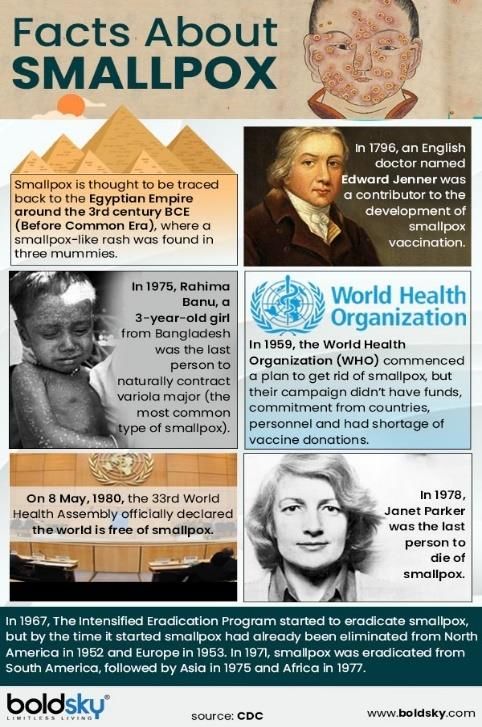
Released March 05, 2021                                                                                              ISSN 0799-3927
SENTINEL SYNDROMIC SURVEILLANCE
  Sentinel Surveillance in        A syndromic surveillance system is good for early detection of and response to
          Jamaica                 public health events.

                                  Sentinel surveillance occurs when selected health facilities (sentinel sites) form a
                                  network that reports on certain health conditions on a regular basis, for example,
                                  weekly. Reporting is mandatory whether or not there are cases to report.

                                  Jamaica’s sentinel surveillance system concentrates on visits to sentinel sites for
                                  health events and syndromes of national importance which are reported weekly
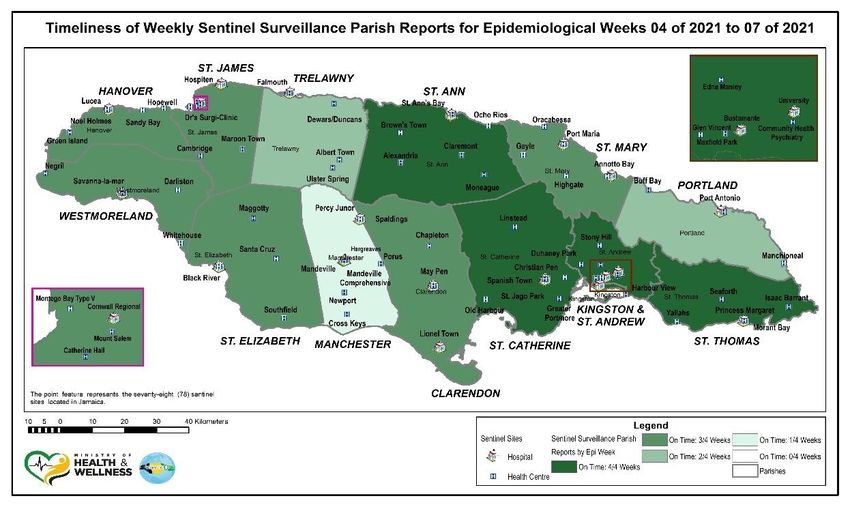
                                  (see pages 2 -4). There are seventy-eight (78) reporting sentinel sites (hospitals
                                  and health centres) across Jamaica.

Map representing the
Timeliness of Weekly
Sentinel Surveillance
Parish Reports for the Four
Most Recent
Epidemiological Weeks – 4
2021 to 7 of 2021

Parish health departments
submit reports weekly by
3 p.m. on Tuesdays.
Reports submitted after 3
p.m. are considered late.

                       REPORTS FOR SYNDROMIC SURVEILLANCE
FEVER
                                                             Weekly Visits to Sentinel Sites for Undifferentiated Fever All ages: Jamaica,
Temperature of >380C                                                              Weekly Threshold vs Cases 2021
/100.40F (or recent history of                        1400
fever) with or without an
                                                      1200
obvious diagnosis or focus of
                                   Number of visits

infection.                                            1000
                                                      800
                                                      600
                                                      400
                                                      200
           KEY                                           0
VARIATIONS OF BLUE                                            1 3 5 7 9 11 13 15 17 19 21 23 25 27 29 31 33 35 37 39 41 43 45 47 49 51
SHOW CURRENT WEEK                                                                                Epidemiologic week
                                                                2021
Released March 05, 2021                                                                                                    ISSN 0799-3927
FEVER AND NEUROLOGICAL
                                                                      Weekly Visits to Sentinel Sites for Fever and Neurological Symptoms 2020
Temperature of >380C
                                                                                       and 2021 vs. Weekly Threshold: Jamaica
/100.40F (or recent history of
                                                                40
fever) in a previously healthy
person with or without                                          35
headache and vomiting. The                                      30

                                        Number of visits
person must also have                                           25
meningeal irritation,                                           20
convulsions, altered                                            15
consciousness, altered                                          10
sensory manifestations or                                       5
paralysis (except AFP).                                         0
                                                                      1 3 5 7 9 11 13 15 17 19 21 23 25 27 29 31 33 35 37 39 41 43 45 47 49 51 53
                                                                                                      Epidemiologic week

                                                                                  2020      2021         Alert Threshold      Epidemic Threshold

FEVER AND
                                                                     Weekly visits to Sentinel Sites for Fever and Haemorrhagic 2020 and 2021 vs
HAEMORRHAGIC
                                                                                              Weekly Threshold; Jamaica
Temperature of >380C
/100.40F (or recent history of                              8
fever) in a previously healthy                              7
                                         Number of visits

person presenting with at                                   6
                                                            5
least one haemorrhagic
                                                            4
(bleeding) manifestation with
                                                            3
or without jaundice.                                        2
                                                            1
                                                            0
                                                                 1 3 5 7 9 11 13 15 17 19 21 23 25 27 29 31 33 35 37 39 41 43 45 47 49 51 53
                                                                                                     Epidemiologic week

                                                                                  2020      2021         Alert Threshold      Epidemic Threshold

FEVER AND JAUNDICE                                                   Fever and Jaundice cases: Jamaica, Weekly Threshold vs Cases 2020 and 2021
Temperature of >380C /100.40F
(or recent history of fever) in a                           8
previously healthy person                                   7
presenting with jaundice.
                                     Number of visits

                                                            6
The epidemic threshold is used                              5
to confirm the emergence of an                              4
epidemic in order to implement                              3
control measures. It is calculated
using the mean reported cases                               2
per week plus 2 standard                                    1
deviations.                                                 0
                                                                 1    3   5   7   9 11 13 15 17 19 21 23 25 27 29 31 33 35 37 39 41 43 45 47 49 51 53
                                                                                                     Epidemiologic Week
                                                                                  2020      2021         Alert Threshold      Epidemic Threshold

       3 NOTIFICATIONS-              INVESTIGATION                                             HOSPITAL                             SENTINEL
          All clinical               REPORTS- Detailed Follow                                  ACTIVE                               REPORT- 78 sites.
          sites                      up for all Class One Events                               SURVEILLANCE-                        Automatic reporting
                                                                                               30 sites. Actively
                                                                                               pursued
Released March 05, 2021                                                                                                        ISSN 0799-3927
ACCIDENTS                                                                Weekly visits to Sentinel Sites for Accidents by Age Group 2021 vs Weekly
Any injury for which the                                                                              Threshold; Jamaica
cause is unintentional, e.g.
motor vehicle, falls, burns,
etc.

                               Number of Visits
           KEY                                               500
VARIATIONS Of BLUE
SHOW CURRENT WEEK

                                                             50
                                                                       1 3 5 7 9 11 13 15 17 19 21 23 25 27 29 31 33 35 37 39 41 43 45 47 49 51 53
                                                                                                         Epidemiological weeks
                                                               ≥5 Cases 2021
Released March 05, 2021 ISSN 0799-3927
CLASS ONE NOTIFIABLE EVENTS Comments
Confirmed YTDα AFP Field Guides
CURRENT PREVIOUS from WHO indicate
CLASS 1 EVENTS that for an effective
YEAR 2021 YEAR 2020
surveillance system,
Accidental Poisoning 0β 5 detection rates for
AFP should be
NATIONAL /INTERNATIONAL
Cholera 0 0 1/100,000 population
See Dengue See Dengue under 15 years old (6
Dengue Hemorrhagic Feverγ to 7) cases annually.
page below page below
INTEREST
Hansen’s Disease (Leprosy) 0 0 ___________
Pertussis-like
Hepatitis B 0 0 syndrome and Tetanus
Hepatitis C 0 0 are clinically
confirmed
HIV/AIDS NA NA classifications.
Malaria (Imported) 0 0 ______________
γ
Dengue
Meningitis (Clinically confirmed) 0 1 Hemorrhagic Fever
EXOTIC/ data include Dengue
UNUSUAL Plague 0 0
related deaths;
MORBIDITY/
MORTALITY
Meningococcal Meningitis 0 0
δ
Figures include all
H IGH
Neonatal Tetanus 0 0 deaths associated with
Typhoid Fever 0 0 pregnancy reported
for the period.
Meningitis H/Flu 0 0
AFP/Polio 0 0 ε
CHIKV IgM
Congenital Rubella Syndrome 0 0 positive cases
θ
Zika PCR positive
Congenital Syphilis 0 0
cases
SPECIAL PROGRAMMES
Fever and Measles 0 0 β
Updates made to
Rash
Rubella 0 0 prior weeks in 2020.
α
Maternal Deathsδ 0 3 Figures are
cumulative totals for
Ophthalmia Neonatorum 0 10 all epidemiological
Pertussis-like syndrome 0 0 weeks year to date.
Rheumatic Fever 0 0
Tetanus 0 0
Tuberculosis 0 0
Yellow Fever 0 0
ε
Chikungunya 0 0
Zika Virusθ 0 0 NA- Not Available
5 NOTIFICATIONS- INVESTIGATION HOSPITAL SENTINEL
All clinical REPORTS- Detailed Follow ACTIVE REPORT- 78 sites.
sites up for all Class One Events SURVEILLANCE- Automatic reporting
30 sites. Actively
pursuedReleased March 05, 2021 ISSN 0799-3927
NATIONAL SURVEILLANCE UNIT
INFLUENZA REPORT
EW 7
February 14, 2021 – February 20, 2021 Epidemiological Week 07
Weekly visits to Sentinel Sites for Influenza-like Illness (ILI) All
EW 7 YTD ages 2021 vs Weekly Threshold; Jamaica
SARI cases 2500
13 69
Number of visits
Total 2000
Influenza 1500
0 0
positive
Samples 1000
Influenza A 0 0 500
H3N2 0 0
0
H1N1pdm09 0 0 1 3 5 7 9 11 13 15 17 19 21 23 25 27 29 31 33 35 37 39 41 43 45 47 49 51
Not subtyped 0 0 Epidemiologic week
Influenza B 0 0 2021Released March 05, 2021 ISSN 0799-3927
Dengue Bulletin
February 14, 2020 – February 20, 2021 Epidemiological Week 07 Epidemiological Week 07
Dengue Cases by Year: 2004-2021, Jamaica
12000
Number of cases
10000
8000
6000
4000
2000
0
2012
2021
2004
2005
2006
2007
2008
2009
2010
2011
2013
2014
2015
2016
2017
2018
2019
2020
Year
Total Suspected Confirmed DF
Reported suspected and confirmed dengue
with symptom onset in week 07 of 2021
2021*
EW 07 YTD
Total Suspected Dengue
8 8
Cases
Lab Confirmed Dengue
0 0
cases
CONFIRMED
0 0
Dengue Related Deaths
Suspected dengue cases for 2020 and 2021 versus
monthly mean, alert, and epidemic thresholds (2007-
2020)
600
500
Points to note:
Number of Cases
• *Figure as at February 22, 2021 400
• Only PCR positive dengue cases 300
are reported as confirmed.
200
• IgM positive cases are classified
as presumed dengue. 100
0
1 2 3 4 5 6 7 8 9 10 11 12
Month of onset
2020 Epidemic threshold
Alert Threshold Monthly mean
2021
7 NOTIFICATIONS- INVESTIGATION HOSPITAL SENTINEL
All clinical REPORTS- Detailed Follow ACTIVE REPORT- 78 sites.
sites up for all Class One Events SURVEILLANCE- Automatic reporting
30 sites. Actively
pursuedReleased March 05, 2021 ISSN 0799-3927
RESEARCH PAPER
ABSTRACT
A Comparison of the Nutritional Status of HIV- positive Children living in Family Homes and an
‘Institutionalized’ Children’s Home
S Dawson, S Robinson, J DeSouza
Epidemiology Research and Training Unit, Ministry of Health, Kingston, Jamaica
Objective: To assess the nutritional status of HIV-infected children living in family homes and in an
institution.
Design and Method: A cross-sectional descriptive study was conducted involving 31 HIV- positive children
with anthropometric measurements used as outcome indicators. The children who met the inclusion criteria
were enrolled, and nutritional statuses for both sets of children were assessed and compared.
Results: Fifteen of the children (48.4%) lived in family homes and sixteen (51.6%) in the institution, with a
mean age of 7.2 ± 3.2 years. Significant differences between the two settings were found for the means,
Weight-For-Height, WFH (p=0.020) and Body Mass Index, BMI (p=0.005); children in family homes having
significantly better WFH and BMI. Four of the children (13.3%) were underweight; 3 from the institution
(18.8%) and 1 (6.7%) from a family home. Two children (6.9%) were found to be ‘at risk’ of being overweight.
Conclusion: Although anthropometric indices for most of these children are within the acceptable range, there
seems to be significant differences in nutritional status between infected children resident in family homes,
and those in the institution. The factors responsible for such differences are not immediately obvious, and
require further investigation. The influence of ARV therapy on nutritional outcomes in these settings require
prospective studies which include dietary, immunologic and biochemical markers, in order to provide data
that may help to improve the medical nutritional management of these children.
____________________________________________________________________________________
The Ministry of Health and Wellness
24-26 Grenada Crescent
Kingston 5, Jamaica
Tele: (876) 633-7924
Email: surveillance@moh.gov.jm
8 NOTIFICATIONS- INVESTIGATION HOSPITAL SENTINEL
All clinical REPORTS- Detailed Follow ACTIVE REPORT- 78 sites.
sites up for all Class One Events SURVEILLANCE- Automatic reporting
30 sites. Actively
pursuedYou can also read


