Western Sydney Centres: Beyond Recovery - WSP
←
→
Page content transcription
If your browser does not render page correctly, please read the page content below
Western Sydney Centres:
   Beyond Recovery
    Great Places Leading Our Liveability and Economic Success
Western Sydney Five Centres

                              2
Introduction                                         04
Table of
                                                                06
Contents
           Strengthening the Accessibility of Local Hubs
                Context                                         06
                Accessibility Analysis                          07
                      JOBS                                      08

                      HEALTH SERVICES                           09

                      EDUCATION                                 10

                      ARTS AND CULTURAL FACILITIES               11

                      OPEN SPACE AND RECREATION FACILITIES       12

           Building a Knowledge Economy                         13
                Foundations of Innovation                       13

           Understanding People and Place                       15
                The Role of Innovation Precincts                15
                Community and Stakeholder Aspirations           15
                No Place Without Emotion                        16
                Case Study: Roosevelt Island                    17
                Case Study: The Westmead Precinct               18
                Case Study: Penrith Bridge to Bridge Walk       19

           Conclusion and Recommendations                       20
                Strengthening the Accessibility of Local Hubs   20
                Building a Knowledge Economy                    20
                Understanding People and Place                  21
                Key Contacts                                    22
                Steering Committee                              22
                Footnotes                                       22

                      3
Introduction
Investment in major infrastructure has, and will,               consideration in the planning of Western Sydney’s
continue to play a significant role in shaping the              employment precincts. The development of
future of Western Sydney, however, it’s not the only            Innovation Precincts globally provides insight
key to unlocking the long-term success of the region.           to the manner in which place-making can assist
Western Sydney Centres: Beyond Recovery, produced               in achieving talent retention outcomes.
by WSP, the Centre for Western Sydney and the                —— Understanding people and place – As the
Western Sydney Leadership Dialogue, looks beyond                Western Parkland City grows through the
the well-known, ‘big-ticket’ projects synonymous                development of infrastructure, housing and
with the region’s growth story. This report, instead,           economic centres, there is a risk that place
focuses on key accessibility elements critical to               outcomes will be a secondary consideration.
driving economic development and delivering                     Opportunities to ‘humanise infrastructure’
improved social and environmental outcomes.                     and focus on the intersection between the
As we reflect on 2020, COVID-19 has not only                    built environment and citizens’ experience
changed the way Western Sydney’s residents work,                of place, to ensure the quality of day-to-day-
live and play, it has also impacted how the region’s            life remains central, are considered in the
cities and local centres function. Emerging from                context of community and stakeholder
the pandemic and associated recession, there is an              values and aspirations.
opportunity, and a need, to recalibrate the Western          The WSP Customer Connectivity Tool, and its
Sydney growth agenda. It is critical the region is           measurement of transport networks against
well equipped to respond to the future aspirations
                                                             accessibility indicators, forms the basis of this
of its communities and to enhance its economic
                                                             study, benchmarking the region’s planning and
development role.
                                                             development against access to employment,
This report is focused on understanding the issues           education and medical care.
that underpin Western Sydney’s future economic
growth, particularly as they relate to:
—— Healthy and accessible places – Using active
   and public transport, how well is the population
   of Western Sydney linked to the regional centres
   which provide local and convenient jobs, health
   and education services, recreation and arts and
   culture? It is well understood that Western
   Sydney is generally more car-dependent than
   most other areas of Sydney. What can be done
   to improve this and create more accessible and
   healthy places for all parts of the population?
—— Retention and attraction of talent – As the jobs
   market in Western Sydney grows and matures
   towards higher value jobs of the future, home-
   grown talent will need to be retained and new
   talent attracted. Talented and skilled workers are
   highly mobile and will be attracted not only to
   the best companies, but also to the best working
   environments, where they can achieve career
   goals, while also having access to quality of life
   and lifestyle choices, collaboration and networking
   opportunities with peers and enhanced
   environmental settings. Place making for the
   work environments of the future is an important

                                                         4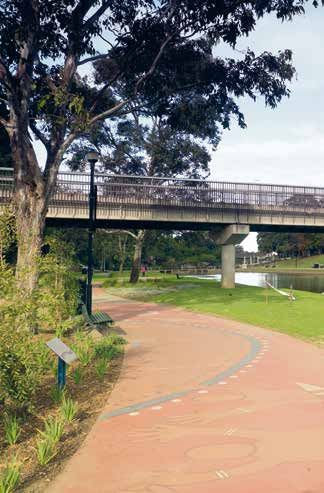
Structural connectivity is examined alongside                  Creek). It makes a number of recommendations—
liveability and environmental factors including access         through the lens of accessibility—to support jobs and
to recreation, arts and culture and public space. This         industry growth. Importantly, these recommendations
intersection of social and economic accessibility              are framed in relation to the broader imperative of
measures recognises the convergence of sociocultural           improving the way communities and cities connect.
access with economic in, for example, investment and
talent attraction, and employment generation.                  Western Sydney Centres: Beyond Recovery promotes
                                                               the delivery of more accessible, connected and
This report is spatially focussed on the urban centres         liveable places, ensuring that the region’s human
of South-West Sydney and the Western Parkland City;            capital, is recognised and prioritised, as much as
specifically: Liverpool, Bankstown, Campbelltown-              its infrastructure pipeline.
Macarthur, Penrith and ‘the Aerotropolis’ (Badgerys

  Healthy and                            Retention and                            Understanding
  Accessible Places                      Attraction of Talent                     People and Place

  Better transport options will          WSU’s mission is to prepare its          Opportunities exist to grow
  deliver better health, wellbeing       almost-45,000 students to be             thriving and connected urban
  and quality of life outcomes for       active and positive agents in their      centres that feature jobs, learning,
  Western Sydney residents.              communities; taking up roles as          transport and amenity, based on
                                         innovative entrepreneurs, future         leading practice approaches to
                                         thinkers, global citizens and            placemaking, to support great
                                         sustainability advocates.                places for people.

        75–85%                                #37
  of all trips are taken by car in the   Sydney ranks 37th on the                 Visionary thinking, collaborative
  five centres which form the focus      Global Innovation Index – below          partnerships, place based planning
  of this report                         Eindhoven, The Netherlands, a city       and effective engagement underpin
                                         with a population of just 223,2091.      the future success of South West
                                                                                  Sydney’s centres as they grow

        68%                              Place-making is a major factor
                                         in driving innovation and jobs
                                                                                  and emerge.

  of all trips are taken
  by car in Parramatta                   creation and can contribute towards
                                         mitigating the large disparity in
                                         University attainment between

        25%
                                         parts of Western Sydney and
                                         other parts of Sydney.
  of all trips are taken
  by car in the City of Sydney

  RECOMMENDATION                         RECOMMENDATION                           RECOMMENDATION
  Western Sydney residents need          The centres of Western Sydney            Embed human centred design
  better support across all levels       should be both planned and de-           into infrastructure planning
  of government to address the           regulated to enable the evolution        processes. This includes Co-Design
  root causes of car-dependence          of integrated Innovation Precincts,      processes, iterative prototyping
  and encourage strong modal shift       incorporating mixed-use activities       and testing, and integration of arts
  towards public and active transport.   around core public spaces. Within        and cultural practice to support
  This can be achieved through           this context, rapid transport options    place based outcomes. In doing so,
  planning, policy and investment        must be pursued that intersect and       more focus needs to be brought to
  settings, aligned to achieve mode      disrupt spaces rather than simply        communicating and engaging with
  shift targets.                         connect them.                            communities in all their diversity to
                                                                                  ensure that visioning processes and
                                                                                  public communications are inclusive
                                                                                  and respond to people’s diverse
                                                                                  needs and aspirations for place.

                                                           5
Strengthening the Accessibility
of Local Hubs
Context                                                      density, sprawling land use patterns, fragmented
                                                             public transport network, poorly developed cycling
Western Sydney is entering an unprecedented phase
                                                             and pedestrian networks, and recurrently prohibitive
of development spurred by the Western Sydney City
                                                             urban heat issues. The five centres within the scope
Deal, the coming Airport, Aerotropolis and large scale       of this report are very car-dependent, with between
infrastructure program. The Greater Sydney Region            75 and 85 per cent of all trips taken by car and around
Plan envisions ‘a Metropolis of Three Cities’, with          10 per cent mode share each for public and active
Western Sydney taking in the Western Parkland                transport. This is in stark contrast to the City
City and parts of the Central River City.                    of Sydney where only 25 per cent of all trips are
                                                             taken by car and the balance are taken by public
Despite this economic growth, the region faces
                                                             and active transport.
transport challenges to ensure that existing and
future residents enjoy levels of accessibility and           The Greater Sydney Region Plan envisions a city in
connectivity comparable to residents in the more             which most people live within 30 minutes of their
established eastern districts of Greater Sydney,             jobs, schools, health facilities, other services and
particularly without relying on private transport.           leisure destinations, using public and active transport.
At present, Western Sydney is notoriously car                This raises important questions for Western Sydney.
dependent because of its exceedingly low jobs                How do we measure access to, and quality of these

                                                         6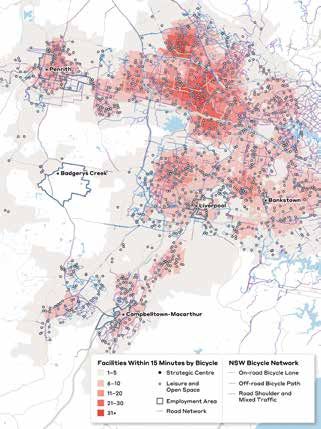
amenities? What quality of access do residents have          The NSW Government’s Future Transport 2056 sets
now? How can quality of access (and therefore quality        a series of desired ‘customer outcomes’ for the next
of life) be improved as the city develops?                   40 years across Greater Sydney without setting firm
                                                             commitments and timelines for the resolution of
The NSW Government is investing heavily in                   pronounced accessibility gaps, particularly those
improved public transport for Western Sydney,                in Campbelltown-Macarthur.
focused around Metro West, Metro South-West
and Metro-Greater West, which in time is expected            Renewed focus, under the Western Sydney City
to significantly improve transport connectivity.             Deal (2018) on the Western Parkland City, including
A significant gap, however, is apparent in relation          the Aerotropolis, provides a unique opportunity
                                                             to put a greater focus on realising active transport
to active transport (cycling and pedestrians). Much
                                                             networks that encourage better access and healthy
of the literature on the liveability of cities focuses
                                                             living outcomes, whilst supporting the resolution
on the quality-of-life attributes associated with
                                                             of larger scale network gaps, and the redress of
easy access to safe and convenient active transport          employment density shortfalls across large sections
networks; specifically, networks which:                      of the South West.
—— Serve all age groups
—— Are increasingly accessible with the rise of              Accessibility Analysis
   ‘3rd speed’ mobility (e-bikes and e-scooters’)
                                                             The WSP Customer Connectivity Tool measures public
—— Promote ‘active’ modes, accessible within a               and active transport networks against accessibility
   15-minute travel range                                    indicators such as access to employment, education
—— Contribute to healthy lifestyles                          and medical care. It does this by determining how
                                                             far a person can travel within a given travel time by
—— Relieve congestion
                                                             public or active transport, before measuring locations
—— Support community preferences for alternative             that can be accessed within that catchment to create
   transport, post-COVID.                                    accessibility indicators. This type of locational analysis
                                                             measures the quality of access that places have based
There are inherent socio-economic challenges                 on the locations that are important to residents such
presented by significant and longstanding transport          as employment, education, medical care, open space
accessibility gaps and network exclusions across             and cultural facilities. The Customer Connectivity
Western Sydney, along with profound imbalances               Tool measures access to physical locations, and
in jobs distribution. This structural inequity               therefore does not measure access to all aspects of
has largely necessitated the greater use of                  indicators such as creativity and amenity. Rather,
private vehicles (compared with other areas                  it provides a baseline to compare accessibility by
of Greater Sydney), with associated economic                 location. The results of the accessibility analysis
imposts and poorer health outcomes the result.               and selected locations are discussed overleaf.

                                                         7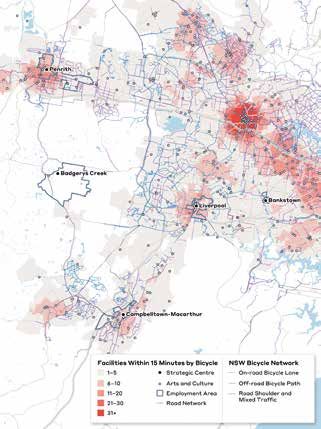
Jobs

Accessibility to employment in the five centres                     Penrith, Liverpool and Campbelltown Macarthur are
was measured using the Travel Zone Projection 2019’s                the strongest employment centres with over 20,000
employment estimates for 2021, based on the NSW                     jobs clustered within their CBDs. Bankstown is
Government’s Common Planning Assumptions. It’s                      somewhat weaker with fewer than 15,000 jobs, and
important to note that this dataset represents a                    the Aerotropolis Core that currently has almost no
‘pre-COVID’ baseline for December 2019, however                     existing employment. Across Western Sydney, 250 to
remains useful in comparing the quantum of access                   300,000 residents have access to at least 5,000 jobs
between different centres. To focus this analysis on                in these centres within either a 15-minute cycling
the employment opportunities within the centres,                    journey or 30-minute public transport journey.
employment areas were defined based on the                          When considering access to 20,000 potential jobs
‘indicative location of existing jobs and services in               or more, this is reduced to 65 to 90,000 residents.
centres’ according to the A Metropolis of Three Cities
- Greater Sydney Region Plan and associated district
plans. It’s important to note that most people leave
Western Sydney for work each day as there are more
employment opportunities concentrated in the
east of the city. While the figures seem low, they
represent local employment opportunities so that
residents of Western Sydney can work closer to
where they live.

Figure 3.2 Access to Employment in Western Sydney Within            Figure 3.3 Access to Employment in Western Sydney Within
a 15-Minute Cycling Journey                                         a 30-Minute Public Transport Journey

                                               5,000+ Jobs           10,000+ Jobs         15,000+ Jobs          20,000+ Jobs

 15-min Cycling Journey                          250,000                148,500              126,000               90,000
 30-min Public Transport Journey                 290,000                138,500              101,500               64,000

Table 3.2 Population in Western Sydney with access to various levels of employment within 15-minute cycling and 30-minute public
transport journeys     Source: WSP Customer Connectivity Tool

                                                                8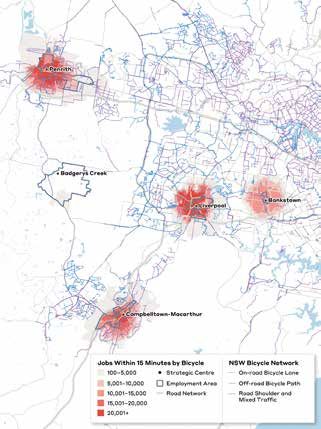
Health Services

Access to health services is measured by using
the location of major hospitals in Western Sydney.

Of the five centres, only the Aerotropolis Core
does not have access to a hospital within 15 minutes.
Roughly 350,000 residents in Western Sydney have
access to a hospital within 15 minutes by cycling or
30 minutes by public transport.

Aside from acute and routine care, it’s also important
to consider that hospitals are an important cluster of
local jobs, economic activity and community services.

Figure 3.4 Access to hospitals in Western Sydney within a            Figure 3.5 Access to hospitals in Western Sydney within a
15-minute cycling journey                                            30-minute public transport journey

                                                            1 Hospital                2 Hospitals               3 Hospitals

 15-min Cycling Journey                                      362,000                     91,000                    73,500
 30-min Public Transport Journey                             344,000                     86,000                    22,000

Table 3.3 Population in Western Sydney with access to hospitals within 15-minute cycling and 30-minute public transport
journeys     Source: WSP Customer Connectivity Tool

                                                                 9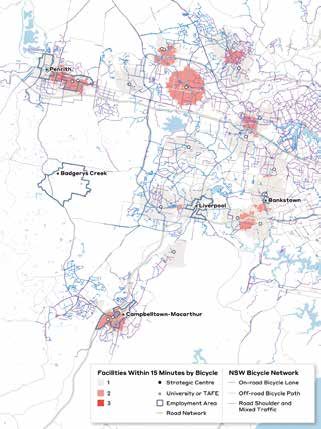
Education

Educational facilities include the major campuses of
universities and TAFE colleges in Western Sydney.

All centres except for the Aerotropolis Core
have University or TAFE campuses located nearby,
generally with two campuses accessible by walking
or cycling within 15-minutes.

More than 450,000 residents have access to an
educational campus within 15 minutes by cycling or
30 minutes by public transport, however far fewer
residents can access two or three campuses within
these timeframes.

                                                                                   Image courtesy of Sally Tsoutas

Figure 3.6 Access to university and TAFE campuses in Western        Figure 3.7 Access to university and TAFE campuses in Western
Sydney within a 15-minute cycling journey                           Sydney within a 30-minute public transport journey

                                                           1 Campus                 2 Campuses                3 Campuses

15-min Cycling Journey                                      481,500                    173,000                       1,600
30-min Public Transport Journey                            464,000                     168,500                   26,500

Table 3.4 Population in Western Sydney with access to university and TAFE campuses within 15-minute cycling and 30-minute public
transport journeys     Source: WSP Customer Connectivity Tool

                                                               10
Arts and Cultural Facilities
The accessibility indicator for arts and cultural both formalised institutions and other creative
facilities was created by using the Google Places activity that is not as easily identified through
API to identify the locations of places of interest location-based analysis3. It recognises the emergence
in Western Sydney that are tagged as museums, art and importance of less formal creative activity in
galleries, libraries or tourist attractions. It is recognised Western Sydney, despite limited access to more
that the artistic and cultural capital of a region formal arts and cultural facilities in the region.
cannot be measured entirely by the location of
these facilities and institutions, nor does access Of the five centres, Penrith and Liverpool have
encapsulate the quality of a facility. As the City of the highest concentration of arts and cultural
Parramatta’s Cultural Plan outlined, sites of artistic facilities with up to 20 locations accessible within a
and cultural production and consumption can be 15-minute active transport journey for residents in
‘grand’ institutions like museums and galleries, these centres. Campbelltown-Macarthur has fewer
as well as ‘on the streets and laneways, sporting facilities with residents accessing up to 10 facilities
grounds, open spaces’2. Through a locational analysis, at most, while the area surrounding Bankstown has
this paper focuses on understanding the quality of access to five or fewer arts and cultural facilities.
access that residents of Western Sydney’s centres Most suburban areas of Western Sydney have
have to such facilities, especially in comparison to access to at least one facility within 15 minutes.
more established centres like Parramatta. Western By comparison, Parramatta has over 30 cultural
Sydney University has conducted further research facilities in and around its CBD reflecting the
on arts and culture in Western Sydney that discusses considerable investment as Sydney’s second CBD.
Figure 3.8 Access to arts and cultural facilities in Western Figure 3.9 Access to arts and cultural facilities in Western
Sydney within a 15-minute cycling journey Sydney within a 30-minute public transport journey
1–5 6–10 11–20 21–30 31+
15-min Cycling Journey 1,128,000 546,500 257,500 101,500 85,500
30-min Public Transport Journey 1,188,000 427,000 187,500 84,000 66,000
Table 3.5 Population in Western Sydney with access to arts & cultural facilities within 15-minute cycling and 30-minute public
transport journeys Source: WSP Customer Connectivity Tool
11Open Space and Recreation Facilities
Open space and recreation facilities provide grounds and zoos. As with the analysis of arts
opportunities for play, personal and community and culture, the methodological approach taken
wellbeing, and physical and social connections to here has its limitations. For example, it does not
Sydney’s communities. The importance of access to assess the perceived safety of a park which might
parks and open space is recognised in the Premier’s impact on accessibility by some members of the
Priorities to increase the proportion of homes within community, such as women. Rather, what this
a ten minute walk of green, open and public space by approach does provide is a baseline analysis for
10 per cent by 20235. The accessibility indicator for access to recreation for residents across different
open space and recreation facilities was created using areas of Western Sydney.
a combination of geospatial analysis and the Google
Places API.
Access to parks and open space areas is important for
residents, particularly those living in higher density
locations. Parks included in the analysis were those
with an area of over 7,000m2 or 2ha for district parks.
Other recreational facilities were added to this dataset
by using the Google Places API to identify sporting
facilities, amusement parks, bowling alleys, camping
Figure 3.10 Access to leisure and open space facilities in Figure 3.11 Access to leisure and open space facilities in Western
Western Sydney within a 15-minute cycling journey Sydney within a 30-minute public transport journey
1–15 16–30 31–45 46–60 61+
15-min Cycling Journey 1,171,500 708,500 196,500 51,500 12,500
30-min Public Transport Journey 1,214,500 366,500 93,000 21,000 3,500
Table 3.5 Population in Western Sydney with access to leisure & open space facilities within 15-minute cycling and 30-minute public
transport journeys Source: WSP Customer Connectivity Tool
12Building a Knowledge Economy
Foundations of Innovation government is planning—the educational outcomes
of the region need to markedly improve. While
Increasingly, economic success is determined by a
education attainment levels in Western Sydney have
region’s ability to create and use knowledge in the
almost doubled in the past 30 years, the region must
production and delivery of high value-added goods
continue to invest in education to build the human
and services. The knowledge economy is fueled by
capital required to deliver workforce capacity and to
human capital, or the mobilisation of an educated
leverage regional opportunities. At present, below-
and highly-skilled population to create, acquire,
average university attainment rates undermine the
and utilise knowledge in innovative ways.
opportunity to mobilise the human capital potential
Many governments around the world are vigorously of Western Sydney to further the creation of a broad-
pursuing innovation agendas. In Asia for example, based knowledge economy to fill the knowledge
Tokyo-Yokohama, Shenzhen-Hong Kong-Guangzhou, jobs of tomorrow. For example, local government
Seoul, and Beijing are the top four most vibrant areas across Western Sydney including Fairfield
science and technology clusters in the world. These (11.3%), Campbelltown (15.3%), Liverpool (15.7%),
clusters are highly competitive, in part, because of and Canterbury-Bankstown (19.7%) are below the
their reliance on a highly educated and skilled STEM- nation-wide (22.0%), state-wide (23.4%), and Sydney-
literate workforce. According to the Global Innovation wide (28.3%) university attainment rates. Some low
Index, Sydney ranks 37th – below Eindhoven, The Socio-Economic Indexes for Areas (SEIFA) in parts
Netherlands, a city with a population of just 223,2091. of South-Western Sydney have rates of university
education attainment as low as 4.0%. In contrast,
If Western Sydney is to seriously compete as Parramatta has a 37.2% university attainment rate,
a national, and indeed, international, science hosting among the largest concentration of people
and technology leader—as the state and federal with a PhD in the country.
13Further, skills shortage in areas of national priority create at-scale, transdisciplinary curriculum to
such as information technology are a significant risk address these questions. WSU’s mission is to prepare
for the development of nascent high-tech industries its almost-45,000 students to be active and positive
in Western Sydney. The digital transformation agents in their communities; taking up roles as
of the regional economy—once underpinned by innovative entrepreneurs, future thinkers, global
manufacturing with the potential to lead the country citizens, and sustainability advocates.
in advanced manufacturing—can only be delivered
by a large, diverse, locally-based, highly-skilled WSU is building its future curriculum around
technology workforce. Building and future-proofing the trends shaping employment markets, as well
the regional knowledge economy, however, is no as industry and community needs. The University
easy task because it requires planning for a future is continually scanning the horizon to consider
marked by a disruptive labour market and non-linear opportunities to renew its academic course profile.
career trajectories. By large, this non-linearity will be The economic transformation of the region is
driven by emerging technologies such as processes of generating many opportunities, particularly around
automation, artificial intelligence, blockchain, 3D/4D innovation precincts. These precincts are framed by
printing and immersive reality. A 2019 McKinsey open innovation – a process whereby, companies
report, estimated that ‘25-46 per cent of current work and firms openly develop new ideas and bring them
activities in Australia could be automated by 2030. to market. The geographic concentration of related
Most of these jobs are middle-class, white-collar, industries, universities, and hospitals, and research
professional occupations, undertaken largely institutes in a single location considerably broadens
by university graduates. the possibilities for partnership pedagogy.
This technological proliferation will be set against The COVID-19 pandemic accelerated the digital
a backdrop of broader fluctuations such as global transformation of the economy and placed an
warming, increasing income inequality, a growing increased emphasis on digital skills and coding.
ageing population, and the re-organisation of the The current recession also led many professionals
global geopolitical order. Collectively, these will to consider whether their existing skillsets and
reshape the economic, social, and political fabric of knowledge will serve them well in the post-
the world in which graduates will work and live. COVID world. As a solution, WSU worked with
What is certain in these uncertain times is that the Federal Government to deliver short courses
the jobs of the future will require hybrid skills. based on areas of national priority. In response
It will no longer be adequate for graduates to leave to the successful uptake of these courses by the
university with knowledge and skills built around community, the University is building an alternative
a single discipline. Institutions such as Western credentialing platform and strategy. This will
Sydney University (WSU), through its 21Century position the University to respond with agility to
Curriculum, are already exercising leadership to the rapidly changing needs of students, graduates,
identify solutions to these challenges and to co- staff, industries and the broader WSU community.
14Understanding People and Place
As the Western Parkland City grows through which local community members can shape the
the development of infrastructure, housing and public realm in order to maximise shared value.
economic centres, there is a risk that place outcomes According to the Project for Public Spaces ‘place’
will be a secondary consideration. Opportunities model, robust engagement to support great places
to ‘humanise infrastructure’ and focus on the needs to consider the fundamentals of four key
intersection between the built environment and elements: sociability; access and connections;
citizens’ experience of place, to ensure the quality uses and activities; and comfort and image.
of day-to-day-life remains central, are considered
in the context of community and stakeholder values Further to this, a layered understanding of people
and aspirations. This chapter explores the role of and place—that builds in ongoing opportunities
innovation precincts in supporting thriving local for community voice—is critical. In order to
centres—and the importance of diverse elements support desirable and active centres where people
of place including those that may be considered from all walks of life with diverse expertise and
less tangible—to enable appealing and enduring talents can thrive, we need to understand and
centres in Sydney’s west. respect community values and aspirations. As
part of renewal and infrastructure projects this
The Role of Innovation Precincts means learning from people’s lived experience,
involving them in the process of testing and refining
A selection of case studies of leading innovation options, and seeking their input into meaningful
precincts that contribute to social, economic and
opportunities for legacy that respond to local
environmental aspects of place are presented in this
priorities within their regional context. For instance,
chapter. They include one international (Roosevelt
through targeted opportunities for jobs and training,
Island, New York City) and two local exemplars from
and design of community facilities and public spaces
Western Sydney (the Westmead Precinct and Penrith
that reflects local culture and stories.
Bridge to Bridge Walk). While the former is complete,
each of the latter projects offers opportunities for
further and far reaching impacts beyond those
that currently exist.
Community and Stakeholder
Aspirations
Great places are not created. They evolve. Engaging
with communities and other knowledge holders
to understand what matters most about their
neighbourhoods and centres is an integral aspect
of supporting socially sustainable places. Taking
cover in the cool shade provided by decades old
trees, looking out over our city from one of its many
natural vantage points, the joy of social connections
made walking the dog or exercising in a local
park: these are some of the simple but important
experiences and pleasures offered by great places.
As our centres grow and change, engaging with the
people who live, work and visit remains critical to
their renewal and emergence as appealing, adaptable
and enduring places for people. International
placemaking organisation Project for Public Spaces
refers to placemaking as a collaborative process by
15Sydney’s Open Space and
Parklands Sydney Metro West
Elton Consulting recently worked with the WSP was engaged to deliver scoping and definition
Department of Planning, Industry and Environment design services for the proposed Sydney Metro West
to support a discussion with Sydneysiders about line. The Central City Metro Joint Venture selected
the future of our city’s open space and parklands – stations, interchanges and precincts in both green
in response to A 50-Year Vision for Greater Sydney’s and brownfield locations to support the growing
Open Space and Parklands: Discussion Paper. The Vision employment, residential, health, research and
for parks and open space across Sydney’s diverse education precincts along the newly defined corridor.
landscapes and neighbourhoods is underpinned by The primary aim was to ensure the project was
four strategic directions: Growing a city of parks for designed with the needs, wants and behaviours of
people; Connecting neighbourhoods to parks; Keeping current and future users at heart. This was achieved
Sydney green and captivating; and Being smart through developing an internal ‘design thinking’
and resilient. Together the four strategic directions capability and knowledge of the human-centred
recognise and reflect the depth and breadth of design process among the project’s team of
community values for Sydney’s national, regional and technical experts.
local parks, waterways, and the links between these
open spaces – including green corridors, streets and
walking and cycle paths. The Vision highlights the No Place Without Emotion
critical importance of parks and open space areas as Maps of cities usually show roads, landmarks and
critical social infrastructure in Western Sydney—and places of interest. Yet, memories and experiences,
showcases leading practice case studies in Penrith, emotions and aspirations are just as important as
Blacktown and Parramatta—that make a strong the visible aspects of the city when it comes to
contribution to their neighbourhoods, the region navigating, understanding and (re)imagining the city.
and Sydney as a whole.
To demonstrate and explore this concept, the
Centre for Western Sydney at Western Sydney
University has developed an online map and app
Western Sydney Aerotropolis titled Invisible City. Invisible City brings the city to
life by capturing how people feel about it. People can
The Western Sydney Aerotropolis will surround the contribute their emotion reports online or via the
planned Western Sydney International Nancy-Bird app on a smart phone.
Walton Airport and will contribute towards the
200,000 jobs target for the Western Parkland City.
Jobs will be offered in technology, logistics, science,
creative industries and agribusiness, within a cool,
connected green environment.
Elton Consulting, a WSP company, was engaged
by Western Sydney Planning Partnership to assist
Hassell, a multidisciplinary architecture, design
and urban planning practice, with preparation of
two urban design precinct plans for the Western
Sydney Aerotropolis. The work involved the delivery
of specialised planning advice on the existing and
future planning controls and policies that need to
be considered through the urban design work. After
reviewing all technical studies, planning implications
for the precinct plans are being prepared to inform the
new planning framework. As part of this engagement,
the Western Sydney Aerotropolis Precinct Plan was
was drafted for the five initial precincts of the
Aerotropolis. The Precinct Plan achieves the place-
based planning principles and themes identified
in the Western Sydney Aerotropolis Plan including
sustainability, connectivity, productivity, liveability,
place and built form. It uses a landscape-led approach
to planning for the Aerotropolis; an approach that
recognises Aboriginal cultural values in terms of
design, heritage and urban systems.
16Case Study: Roosevelt Island
Current Status Success Factors
In the shadow of the global financial crisis, the City Key learnings from Roosevelt Island can be leveraged
of New York identified the importance of increasing to enhance innovation precincts and a culture
the pool of Science, Technology, Engineering, and of innovation within Australia. Key elements of
Maths (STEM) graduates to fuel growth in New York’s Roosevelt Island’s success include:
knowledge-intensive economy. In response, the City —— Identifying an anchor tenant who possesses a
of New York partnered with Cornell University and strong, established legacy of academic excellence
Technion-Israel Institute of Technology to deliver and adopts progressive approaches to globally-
a five-hectare STEM education and entrepreneur applied research and education
campus on Roosevelt Island. —— Utilising a ‘work, live, play’ model, rather than
focusing purely on commercial uses as in the
The Roosevelt Island Innovation Precinct brings traditional technology park model
together academia and industry to catalyse —— Creating a co-located, connected precinct with
pioneering technologies and create new leaders physical infrastructure that facilitates affordable
for the digital age. Four new buildings, including connectivity and movement of goods, services
a residence for students and faculty, opened in and labour
2017 with the full project currently scheduled
for completion in 2043.
Facts and Figures
Lessons for Western Sydney
and Beyond —— To achieve the ambitions of Roosevelt Island
the City of New York provided city-owned
New York City is often viewed as the centre of land, a seed investment of city capital, and
the world for finance, advertising, media, the arts offered full support of the administration to
and international commerce. By harnessing the remove roadblocks to the development.
engineering expertise of Cornell University and the —— When fully completed, the $2 billion, 12-acre
entrepreneurial spirit of Technion-Israel Institute of campus will be home to more than 2,000
Technology, Roosevelt Island aims to strengthen New graduate students and hundreds of faculty
York City’s future competitiveness through building and staff.
a reputation as an internationally recognized hub of —— Cornell Tech will double the number of
cutting-edge science and technology. engineering faculty and graduate students
in NYC, improving NY’s ability to compete
Roosevelt Island will create impact beyond its campus in the knowledge and information economy.
through building and diversifying New York City’s —— Cornell Tech is expected to generate up to
tech talent pipeline so that more people can share in 8,000 permanent jobs and foster hundreds
the rapid growth of the tech economy. This will be of spin-off companies generating more than
achieved through: $23 billion in economic activity over the
next 35 years.
—— Ensuring that the design of the campus allows
for dedicated publicly-accessible open space
—— Fostering cross-industry collaboration beyond
the confines of the campus to encourage diverse
economic activity that facilitates and benefits
from the exchange of ideas, innovation, and talent
—— Providing affordable housing and service
offerings which will attract and retain a strong
talent base
—— Providing a strong, collaborative governance
model and regulatory environment that enables
and rewards innovation
17Case Study: The Westmead Precinct
Current Status Success Factors
Westmead Health and Education Precinct is a leading Beyond its own contribution to Western Sydney, key
example of the transformative qualities of innovation learnings from Westmead can be leveraged to enhance
precincts that build on an active network of medical innovation precincts and a culture of innovation more
research institutions, facilities and complementary widely. Key elements of Westmead’s success include:
industry tenants. WSP Cities Advisory team (with —— A visionary masterplan for Westmead will
Cox Architecture) managed the preparation of the be delivered by the WSP/Cox Architecture
Westmead Innovation District Master Plan in 2018–19, consortium. Successful implementation will
aimed at delivering an aspirational outcomes for be supported by a three-staged Integrated
an innovative precinct, driven by connectivity, Development Strategy for the Westmead
sustainability and lifestyle. Western Sydney Innovation District that maximises its connection
University and Charter Hall plan to develop a $350 to Parramatta as Sydney’s second CBD.
million health research and commercial precinct in
—— Key stakeholders including City of Parramatta
the heart of Westmead—the Innovation Quarter—
Council and the Westmead Alliance have played
bringing the university’s total investment in
an integral role in shaping the future of this place
Westmead to $700 million. Stage One construction
through all stages of the project. This includes
of the Innovation Quarter commenced in late 2019.
identification of challenges and opportunities,
generating ideas to support a vision for the
Benefits for Western Sydney precinct and providing input to scenario testing.
and Beyond —— As the third joint-venture between Western
The world-class Innovation Quarter is part of the Sydney University and Charter Hall, the
Westmead Precinct and Western Sydney University’s Innovation Quarter project has built on the earlier
‘Western Growth’ strategy. This ambitious program of successes of the partnership: the Engineering
works is reshaping the University’s campus network Innovation Hub (Hassall Street, Parramatta) and
and transforming the face of education and place the Peter Shergold Building (Parramatta Square).
across the Western Sydney region – in partnership
with industry, government and higher education
providers. The Westmead Precinct will facilitate
significant health, social and economic benefits Facts and Figures
for Western Sydney and beyond. It will:
—— Create an environment for strategic research —— 75 hectare site comprising 400,000 square
partnerships and collaborations with government metres of high-end health, research, innovation
and industry and education related developments plus
transport, retail and diverse accommodation
—— Be a place for researchers, industry partners and
clinicians to collaboratively address critical health —— One of Australia’s largest health, education,
challenges facing Australia research and training precincts
—— Provide a home for Western Sydney University’s —— Provides direct health services to almost 10
per cent of Australians through four major
world-leading research institutes – the MARCS
hospitals, three research institutes and two
Institute for Brain, Behaviour and Development,
major university campuses
the Translational Health Research Institute, and
the NICM Health Research Institute —— One in three of Sydney’s science, health,
engineering and IT jobs will be located
—— Be a walkable city incorporating strong public
in Westmead
transport links
—— Growth potential to provide 50,000 jobs and
—— Provide homes for a diverse community including 40,000 students by 2046
key workers and students
—— Be an appealing, active and connected place for
people to live, work, learn and enjoy shopping
and community life.
The precinct has the potential to transform
Western Sydney into Australia’s most advanced
innovation district.
18Case Study: Penrith Bridge to Bridge Walk
open spaces and walking and cycling trails
Current Status along the length of the river and east to other
key urban areas
The Penrith Bridge to Bridge Walk is an example of —— Provide opportunities to stimulate economic
how the vision for the Western Parkland City is being opportunities in key destinations along the edge
realised. The seven kilometre walking and cycling of the river, including opportunities for outdoor
loop track creates an active transport link along the dining, pop-up markets, activations and live
edge of the Nepean River, connecting Emu Plains entertainment.
to Penrith. Located along the walk is the Penrith
Regional Gallery as well as several cafes and parks, While this project enhances people’s access to
this important Sydney waterway, opportunities
playgrounds, lookouts and picnic and BBQ facilities.
to improve water quality are important to ensure
The Penrith Bridge to Bridge Walk is a part of Western Sydney’s communities are able to
the broader strategy, the Great River Walk, for the enjoy water-based recreational activities such
Hawkesbury Nepean River which aims to strengthen as swimming.
green and blue links between urban centres, public
open spaces and the Hawkesbury Nepean River and
encourage the uptake of active transport to improve Success Factors
health and wellbeing outcomes in Western Sydney.
Beyond the existing outcomes achieved for Western
Upon completion, the Great River Walk will provide Sydney, learnings and ambitions of the Penrith Bridge
a walking track that follows the Hawkesbury Nepean to Bridge Walk, and the Great River Walk more
River from the south of Goulburn to its mouth at broadly, can be leveraged to improve social, economic
Broken Bay just north of Sydney - a total distance of and environmental outcomes across Western Sydney.
570 km. A southern extension of the Penrith Bridge Key elements of the project’s success include:
to Bridge Walk to Fernhill Estate is expected to be —— Driving collaborative partnerships between all
completed by 2040. levels of government and private landowners
to realise the ambitions of local and regional
strategies and projects
Benefits for Western Sydney —— Using place-based planning to enhance the diverse
and Beyond landscapes, reduce urban heat build-up and provide
new economic and social opportunities in public
The Hawkesbury Nepean River is one of the most
open space across Western Sydney
distinguishing natural features of the Western
Parkland City. Increasing permeability to and along the —— Expanding and linking key natural areas and
movement corridors to strengthen Western
river’s edge at key destinations will provide diverse
Sydney’s green and blue grid and encourage
social, economic and environmental opportunities
the uptake of active transport
for Western Sydney. As increases in density occur
within nearby centres, the importance of the river
as a recreational destination will also increase.
The Penrith Bridge to Bridge Walk demonstrates Facts and Figures
the broader social, economic and environmental
outcomes which can be achieved through the —— At 7km, the Penrith Bridge to Bridge walk
delivery of similar projects along the Hawkesbury makes up 1.2% of the entire Great River Walk
Nepean River and beyond. The delivery of such —— The Nepean Bridge which completed the
projects will: Penrith Bridge to Bridge walk in 2018 has the
—— Improve and expand access to quality open largest main span—at 200 metres—of a cycling
space that is safe and located close to pockets and pedestrian bridge in Australia
of urban density —— Providing a walk of around an hour in length
or run of 30 minutes, the Penrith Bridge to
—— Protect, enhance and connect important
Bridge walk has grown increasingly popular
ecological communities
during the COVID-19 period as a connection
—— Increase local and regional accessibility to the that supports recreation and social interaction
river edges, creating a series of connected public
19Conclusion and Recommendations
Strengthening the Accessibility Recommendation 2
of Local Hubs At the local level, Councils can support walking
Western Sydney’s established strategic centres and the and cycling by amending statutory planning
greenfield Aerotropolis face challenges in ensuring instruments to require end of trip facilities and
that current and future residents enjoy the same levels travel plans for new commercial developments.
of accessibility and connectivity as other parts of Councils should also adopt mode-share targets
Sydney, by all modes. Western Sydney today is highly in line with TfNSW and the GSC and support
car-dependent with low-density land use patterns other actors in delivering an early active
and longer trip distances making it hard for public transport network.
transport services to have competitive service levels
or travel times. Residents often drive not only by
choice, but are also often impacted by other structural Recommendation 3
and socio-economic factors. Extreme heat and a lack The Western Sydney City Deal will deliver new
of shade are becoming stronger deterrents to walking rapid bus routes for the region, however these
and cycling with Penrith recording the highest routes should be supported by on-demand services
temperature on earth at 48.9 degrees in January 2020. wherever possible to encourage mode shift in
areas where a frequent local service can’t yet be
Cycling is becoming more popular for recreation sustained. Providing public transport services early
and commuting, partly due to a resurgence during supported by car share programs will give residents
the COVID-19 pandemic and governments’ transport options and reduce the need to own a
response in providing safe, separated pop-up cycling car, supporting longer term behaviour change.
infrastructure. The proliferation of food delivery
services has also seen a boom of gig-economy workers
using e-bikes, increasing the overall number of cyclists Building a Knowledge Economy
on our streets. These trends show that more people are Connecting Western Sydney’s knowledge
willing to cycle when high quality infrastructure is networks is critical in fully realising the substantial
available, and e-bikes are further reducing the fitness socioeconomic uplift the region’s growing education
and confidence barriers to active travel. and research sector has the potential to deliver. This
is particularly important for south western Sydney’s
Recommendation 1 emerging health and education precincts at Liverpool
Western Sydney needs strong policy settings from and Campbelltown, and planned concentrations of
all levels of government to address the root causes research and development activity at, for example,
of car-dependence and encourage strong modal Bankstown and the Aerotropolis.
shift towards public and active transport. At the Planning and urban design frameworks need to
district level, the Greater Sydney Commission afford very significant scope for unplanned, kinetic
should set strong and ambitious mode-share targets and messy spatial interactions between research,
for the Western District to encourage mode shift, education, industry and cultural sectors. Current
particularly for walking and cycling. These targets planning frameworks are often too prescriptive
should be reflected by Transport for NSW and and inhibit the ability for mixed uses to co-exist
supported by a planning and investment strategy and find synergies. This is potentially a risk for the
to establish a safe, connected active transport Aerotropolis in particular, where multiple layers of
network. Following success in the Eastern Harbour planning may inhibit organic and evolving outcomes
City, early opportunities should be explored to
for Universities, established businesses, start-ups
implement pop-up cycleways in Penrith, Liverpool,
and others to co-exist around core public spaces. This
Bankstown and Campbelltown-Macarthur, while
model of universities being integrated, or ‘salt and
infrastructure in the greenfield Aerotropolis should
peppered’ with communities, businesses and other
be designed to accommodate walking, cycling and
institutions is common in the US and Europe, and
‘third speed’ e-mobility devices.
is emerging at UTS and UNSW.
20Rapid transport options must be pursued that infrastructure projects aren’t as commonly about life
intersect and disrupt spaces rather than simply and death, they are about ensuring our centres offer
connect them. This approach must be promoted quality of life benefits and resilience in the face of
above zoning and planning designations that seek to emerging challenges. Inclusive planning processes
corral and, perhaps inadvertently, segregate activity. that recognise the importance of communicating and
engaging with people in all their diversity, in ways
Achieving ‘mess’ in a setting like the Aerotropolis
that are appropriate to meet their needs, is critical
—where fixed economic, employment and strategic
to support thriving centres.
policy targets dominate broader planning objectives—
is challenging. But blurred and intersectional uses of
space, with dynamic transport fissures, is a principle Recommendation 1
that can in fact accelerate the realisation of economic Embed human centred design into infrastructure
imperatives pursued by more traditional methods. planning processes. This includes Co-Design
Unplanning may be the doctrine that, where astutely processes, iterative prototyping and testing, and
and collaboratively deployed, delivers accessibility integration of arts and cultural practice to support
outcomes far and above those achievable by more place based outcomes.
restrained approaches.
Recommendation 2
Recommendation 1
Communicate and engage with communities in all
The centres of Western Sydney should be planned
their diversity to ensure that visioning processes
and de-regulated to enable the integration of mixed-
and public communications are inclusive and
use activities around core public spaces. Within this
respond to people’s diverse needs and aspirations
context, rapid transport options must be pursued
for place. This includes engaging with Aboriginal
that intersect and disrupt spaces rather than simply
people and communities early and regularly,
connect them.
engaging with Western Sydney’s culturally and
linguistically diverse communities, and ensuring
Understanding People and Place that young people have a voice in projects about
Understanding what members of the community the future of our centres.
and other stakeholders value about each of the
centres examined in this document is essential to
retaining and supporting a strong sense of their
own individual place identity and appeal. At times,
large infrastructure projects can prioritise efficient
delivery over what is often considered the softer
and less tangible elements of people and place.
Similarly, community spaces, public domain and
active travel infrastructure that speak to the specifics
of a place can be overlooked or provided as an ‘add
on’. This can translate into missed opportunities for
realising vital urban centres as first and foremost,
places that attract and offer enduring appeal for the
people and communities who work, live and enjoy
spending time in them.
Reaching out to diverse members of the community
may be regarded as a challenge – within the
constraints of project timeframes and resources.
However, actively seeking out and considering diverse
voices in planning and renewal of Western Sydney’s
centres has boundless value to offer, for creating truly
sustainable centres in this growing region that reflect
local character, culture and charisma.
The COVID-19 pandemic has highlighted the critical
importance of strong and inclusive engagement in
order to ensure that all members of our community
have access to vital, and in that instance life saving
health information. While city planning and
21Key Contacts Steering Committee
Alana Newbrook Western Sydney Centres: Beyond Recovery has
WSP been developed with input and guidance from
our Steering Committee. Members include:
Director, Advisory and —— Helen Barcham, Manager, Strategy and Projects,
Regional Director, Sydney/ Western Sydney University
Greater Western Sydney —— Victoria Black, Head of Stakeholder Engagement
and Strategic Partnerships, WSP
David Tow —— Christopher Brown AM, Chairman, Western
WSP Sydney Leadership Dialogue
—— Pete Davis, Transport Planner, WSP
Technical Executive,
—— Poppy Dowsett, Project Manager, Social
Cities Advisory
Sustainability, Elton Consulting, a WSP Company
—— Lucy Greig, Project Director, Social Sustainability,
Dr. Andy Marks Elton Consulting, a WSP Company
Western Sydney —— Adam Leto, Executive Director, Western Sydney
University Leadership Dialogue
Director, Centre for Western —— Dr. Andy Marks, Assistant Vice-Chancellor,
Sydney and Assistant Vice- Western Sydney University
Chancellor —— David Tow, Technical Executive, Cities Advisory,
WSP
Christopher Brown AM
Western Sydney
Leadership Dialogue
Chairman
Footnotes
1
Source: World Intellectual Property Organisation (WIPO) 3
See: https://www.creativewest.com.au/ led by Western Sydney
Statistics Database, March 2020. Please note, science and University’s Katrina Sandbach; and file://ad.uws.edu.au/dfshare/
technology cluster rank is based on total share in patent filing HomesPTA$/30037146/Downloads/Recalibrating_culture_
and scientific publication using fractional counting and the production_consump.pdf by the Institute for Culture and Society
publication period of 2014-2018. at Western Sydney University.
2
See: https://www.cityofparramatta.nsw.gov.au/sites/council/ 4
NSW Government 2020, viewed 23 November 2020, https://
files/2017-07/Culture%20and%20Our%20City%20-%20A%20 www.nsw.gov.au/premiers-priorities
Cultural%20Plan%20for%20Parramatta%27s%20CBD%20
2017%20-%202022%20.pdf
5
Project for Public Spaces, What Makes A Successful Place?
2009, viewed 23 November 2020, https://www.pps.org/article/
grplacefeat
22In Partnership
Western Sydney Centers: Beyond Recovery has been
produced as part of a partnership between:
One of the world’s leading engineering professional
services consulting firms, with more than 50 offices
in Australia and New Zealand, WSP are technical
experts who design comprehensive and sustainable
solutions and engineer projects that will help
societies grow for lifetimes to come.
A not-for-profit, community initiative leading a
national conversation about Greater Western Sydney,
Western Sydney Leadership Dialogue facilitates
interactions between key opinion leaders, across
industry, government, academia and the community,
to inform public policy debate and to advance a
regional agenda.
Since its creation in 2014, the Centre for Western
Sydney at the University of Western Sydney, has
established itself as a research entity of profound
rigour. The Centre’s work on jobs distribution and
related economic, employment and planning policy
is authoritative. Equally, it has brought to the fore a
range of analysis exploring the impact of, and ways
to mitigate, rising heat in Western Sydney.
The Centre acts as a leading source of collaborative
and cross disciplinary research and advocacy on
Western Sydney.
23You can also read


