YEAR 9 OPTIONS BOOKLET KEY STAGE 4 OPTIONS 2019-2021 - Dean ...
←
→
Page content transcription
If your browser does not render page correctly, please read the page content below
YEAR 9 OPTIONS BOOKLET
KEY STAGE 4
OPTIONS
2019-2021
CONTENTS
Contents:
Welcome from the Headteacher, Miss Gowan
Frequently Asked Questions
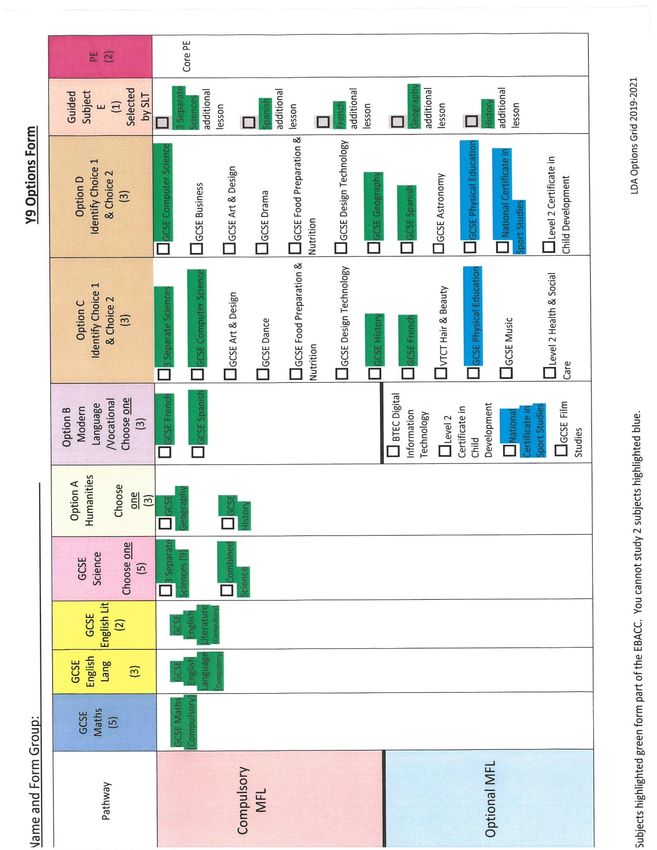
Options Grid
Core Subjects
GCSE English Language
GCSE English Literature
GCSE Mathematics
GCSE Science (Combined Science)
GCSE Science (3 Separate Sciences)
The English Baccalaureate
GCSE Geography
GCSE History
GCSE French
GCSE Spanish
GCSE Computer Science
English Baccalaureate Optional MFL Pathway
Level 2 Certificate in Child Development
BTEC Digital Information Technology
National Certificate in Sports Studies
GCSE Film Studies

                                                            2
                              YEAR 9 OPTIONS CHOICES 2019
CONTENTS
Contents:
Option Groups C and D
GCSE 3 Separate Sciences
GCSE Geography
GCSE History
GCSE French
GCSE Spanish
GCSE Computer Science
GCSE Business Studies
GCSE Astronomy
GCSE Art and Design
GCSE Drama
GCSE Dance
GCSE Music
GCSE Food Preparation and Nutrition
GCSE Design and Technology
Level 2 Certificate in Child Development
VTCT Hair and Beauty
BTEC Health and Social Care
GCSE Physical Education

                                                        3
                          YEAR 9 OPTIONS CHOICES 2019
Key Stage 4 Curriculum Provision
Welcome
Welcome to the Options Booklet for our current Year 9 pupils at Lord Derby Academy.
These pupils will be embarking on their Key Stage 4 (KS4) studies from September 2018.
This is a crucial time for our pupils and we are here to guide them and to advise them as
they make important choices which will have a direct impact on their future life chances.
At Lord Derby Academy we aim to provide a traditional curriculum which matches the
abilities and aspirations of our pupils, fulfils the ambitions of parents/carers for their
children and meets the requirements and expectations of further education providers and
employers. The world of 14-19 education and beyond is in a period of significant change
and we must respond to this change appropriately whilst always keeping the best interests
of our pupils at the heart of our decisions.
The well designed KS4 curriculum at Lord Derby Academy offers a broad and balanced
range of courses, with the essential subjects of English, Mathematics and Science at the
core of our provision. We are also placing a real emphasis on the English Baccalaureate
(EBACC) which comprises GCSE qualifications across a suite of academic subjects (English
Language and English Literature, Mathematics, Science including Computer Science,
Geography/ History, French/ Spanish).
We have analysed the performance data of each of our Year 9 pupils and we have then
placed individuals on what we believe to be the appropriate KS4 pathway to enable them
to attain, achieve and maximise their potential.
Some of our pupils have been placed on the ‘Compulsory MFL Pathway’ and others have
been placed on the ‘Optional MFL’ pathway. I have written to parents/carers individually
to explain which pathway their son/daughter will be following.
All pupils at Lord Derby Academy will be studying the following subjects as part of their
compulsory education at KS4:
•    GCSE English Language
•    GCSE English Literature
•    GCSE Mathematics
•    GCSE Science (Combined Science or 3 Separate Sciences)
•    GCSE Geography and/or GCSE History
•    Pupils on the ‘Compulsory MFL’ pathway will also be studying GCSE French or GCSE
     Spanish. Pupils on the ‘Optional MFL’ pathway can study GCSE French and/or GCSE
     Spanish if they opt to do so.
In addition to the above subjects, we are offering a wide range of Level 2 option choices,
comprised primarily of GCSE qualifications. We are confident that these courses will
broaden and deepen the experience of our pupils and will ensure all pupils have access to
a minimum of nine qualifications.
The coming weeks are clearly a very important period in the educational life of our Year 9
pupils. We ask families to take full advantage of the guidance and resources available and
to discuss the possibilities and choices thoroughly. The staff at Lord Derby Academy are
here to support pupils in making the right choices in order to ensure each individual is able
to follow an appropriate pathway to success.
Miss V Gowan
Headteacher                                                                                4
Frequently Asked Questions:

•
.
    Who can pupils speak to for advice?
    All staff at Lord Derby Academy will help to advise pupils in their
    option choices. The list of people below would be a good starting
    point:
    Mrs J. Ellis– Assistant Headteacher (Director of KS3)
    Miss L. Morrison – Assistant Headteacher (Director of KS4)
    Mrs S. Bannon – Head of Year 9
    Miss H. Donaldson – Year 9 Pupil Support Manager
    Mrs C. Finn – Inclusion Manager
    Ms C. Thwaite – Lead teacher for SEND
    Form Tutors
    Heads of Department
    Our careers adviser Jane Roff from the careers service.

•   What do ‘GCSE’ and ‘BTEC’ stand for?
    GCSE stands for ‘General Certificate of Secondary Education’
    BTEC stands for ‘Business and Education Technology Council’

•   What is a BTEC?
    A BTEC is a work-related course. Pupils learn by completing projects
    and assignments that are based on realistic workplace situations,
    activities and demands. BTECs provide a good basis for pupils to go
    on to a more advanced work-related qualification.

                                                                          5
•   How are pupils allocated to the pathways?
    Pathways have been decided by looking at a pupil’s individual
    performance data, including his/her results achieved at KS2 and
    his/her progress at KS3. We have also discussed a pupil’s needs and
    abilities with subject teachers and Heads of Department. We have
    then selected the pathway we feel is most appropriate for a pupil’s
    chances of success.

•   Can pupils choose any subjects they want?
     Some subjects are compulsory. These subjects are known as the
     core curriculum. There is then a range of other guided subject
     choices for pupils to opt from. We cannot guarantee pupils will
     always be allocated their first option choices but we will always aim
     to ensure a pupil is pleased with the qualifications he/she will be
     working towards.

•   Will pupils be able to change their mind in Year 10?
    This is very unlikely. Pupils need to choose their options carefully
    because it is difficult for us to move pupils around once the
    timetable is finalised.

•   How can pupils make appropriate options choices?
    It is important that pupils consider their choices very carefully. This
    booklet provides a lot of information but pupils should also talk to
    their form tutors, subject teachers and the staff listed above. Pupils
    should consider the information discussed at the Options Evening
    on 7th February 2019. If pupils would like more information they
    can book an appointment with our Careers Advisor or an
    appropriate member of staff.

    Pupils should:
    Select subjects they enjoy
    Select subjects they are good at
    Ask teachers, support staff, parents/carers for advice
    Consider the careers they might be interested in and research
    which subjects are useful for these careers

                                                                           6
Pupils should not:
     Select a subject because their friends are planning on studying it
     Select a subject because they like the teacher (they may well be
     allocated a different teacher at KS4)

•   How are schools judged?
    The Department for Education has introduced new accountability
    measures for schools.

     From 2016 schools have been judged according to the following
     measures:
    1.   Progress against a suite of 8 subjects (with 5 places reserved
         for EBACC subjects)
    2. Attainment across a suite of 8 subjects
    3. The percentage of pupils achieving a Grade 5 or above in
        English Language or English Literature and Mathematics
    4. The EBACC (the percentage of pupils who achieve good grades
        in the range of academic subjects which comprise the EBACC)
    5. A destination measure

•   What to do next:
    All pupils should read this booklet carefully and discuss it with a
    parent/carer.
    Pupils and parents/ carers can attend the Options Evening on 7th
    February 2019 4.30-6.30pm when they will be able to hear a talk
    about the curriculum and speak to subject staff and Heads of
    Department.
    A Careers Advisor from the careers service will also be available at
    this time.
                                                                           7
Pupils then need to decide on the subjects they wish to choose and
complete the Options choices form.
The Option choices form must be completed and handed in to the school’s
main reception area by Friday 8th March 2019.
Pupils can hand in the options form on the Options Evening if they wish to
do so.
If any pupil would benefit from an individual meeting with a member of
staff to discuss his/her option choices then an appointment can be made
via Mrs Bannon (Head of Year 9).
Please be aware that:
Options forms handed in after the Friday 8th March 2019 deadline will only
be considered after those handed in by this date. This means that if pupils
are late handing in their form they may have less chance of being offered
their first choice of subject.
Senior staff will consider a pupil’s options choices carefully and further
conversations will take place before final decisions are made.
Not all subjects will run. We have deliberately tried to keep our range of
subjects as broad as we can and, where possible, pupils will be given their
first choices. However, if a particular subject attracts only a few pupils, or if
there are any unexpected issues arising regarding a certain subject, then
those pupils will be offered a reserve choice.
On the next page is a copy of the options grids for each pathway. There
then follows a description of the courses that make up the core curriculum
and the options choices.

The following websites can prove useful:
www.careerconnect.org.uk
www.gov.uk/government/organisations/department-for-education
                                                                               8
9

CORE SUBJECTS

The following subjects comprise our Core Curriculum and will
be studied by all pupils at KS4:

GCSE English Language (EBACC)
GCSE English Literature (EBACC)
GCSE Mathematics (EBACC)
GCSE Science (Combined or 3 Separate Sciences) (EBACC)

                                                        10
                          YEAR 9 OPTIONS CHOICES 2019
GCSE ENGLISH LANGUAGE
COURSE TITLE: GCSE English Language
EXAMINATION BOARD: AQA SYLLABUS CODE: 8700
What skills will I develop? Course components: Exam only course
PAPER 1: Explorations in creative Reading and Writing
Identification, synthesis, External examination 50% of the total GCSE:
analysis, evaluation and Section A: Reading- Fiction source
comparison
Section B: Writing- Descriptive or Narrative writing
Creativity, imagination and
originality
PAPER 2: Writers’ Viewpoints and Perspectives
Composition, structure and
organisation of ideas External examination 50% of the total GCSE:
Section A: Reading- Non-fiction and Literary non-fiction
Section B: Writing- Writing from a particular
What career opportunities viewpoint/perspective
can this subject lead to?
Course content:
English, as a core subject, gives a
secure grounding in education •Unseen fiction, high quality journalism and literary non-fiction
and can be used to prepare for from the 19th, 20th and 21st Century
any career choice or to support •Creative writing including narrative and descriptive writing
further study. •Writing from a particular viewpoint/perspective including
articles, letters, websites and speeches
A pass at grade ‘5’ or above is a
basic requirement for many 6th What attributes will I need to be successful in this
form college courses, university subject?
courses and careers.
•Detailed, perceptive, sophisticated, critical, convincing
responses
What extra support is available ?
The English Department run a range of tailored
support for all pupils.
•Extra lessons
•Exam master blaster revision classes
•1-1 support is available both in class and during additional
sessions
•Revision packs to prepare for external examination
•Saturday/Half term sessions leading up to external examination
11
YEAR 9 OPTIONS CHOICES 2019GCSE ENGLISH LITERATURE
COURSE TITLE: GCSE English Literature
EXAMINATION BOARD: AQA SYLLABUS CODE: 8702
What skills will I develop? Course components: Exam only course
PAPER 1: Shakespeare and the 19th Century Novel
Critical reading, evaluation of External examination: 40% of the total GCSE marks
writers’ choices and Section A: Shakespeare
comparison of texts Section B: 19th Century Novel
PAPER 2: Modern Texts and Poetry
What career opportunities External examination: 60% of the total GCSE marks
can this subject lead to? Section A: Modern Prose and Drama
Section B: Poetry Comparison
English, as a core subject, gives Section C: Unseen poetry
a secure grounding in education
and can be used to prepare for Course content:
any career choice or to support
further study. •A range of texts from across literary heritage, including a
Shakespeare play and 19th Century novel
A pass at grade ‘5’ or above is a •Modern drama and prose texts
basic requirement for many 6th •Poetry past and present
form college courses, university •Unseen Poetry
courses and careers.
What attributes will I need to be successful in this
subject?
•Interest and enthusiasm for reading a range of texts
•The ability to make links between the texts and their
contexts
•The ability to explore theme/character across/between
texts
What extra support is available ?
•Extra lessons
•Exam master blaster revision classes
•1-1 support is available both in class and during additional
sessions
•Revision/Independent study guides to prepare for external
examination
•Saturday/Half term sessions leading up to external
examination
12
YEAR 9 OPTIONS CHOICES 2019GCSE MATHEMATICS
COURSE TITLE: GCSE Mathematics
EXAMINATION BOARD: EDEXCEL SYLLABUS CODE: 1MA1
What skills will I develop? Course components:
Mathematics develops pupils’ •UNIT/PAPER 1: No calculator allowed
skills to calculate, to reason •UNIT/PAPER 2: Calculator allowed
logically, algebraically and •UNIT/PAPER 3: Calculator allowed
geometrically, to solve •No coursework
problems and to handle data.
Course content:
•Number
•Ratio, proportion and rates of change
•Algebra
•Geometry and measures
What career opportunities •Probability and statistics
can this subject lead to?
A pass at grade ‘5’ or above is a
basic requirement for many
What attributes will I need to be successful in this
careers, 6th form college subject?
courses and university courses.
•You need to be motivated and enthusiastic about learning
•The ability to understand why each topic is being taught
and where it fits in with all the other topics
•Be able to think flexibly about how to apply their skills and
enjoy having to puzzle out an answer, don’t give up!
•Understand how your mathematical knowledge can be
used and apply appropriate strategies to solve problems in
a range of contexts
What extra support is available ?
•Extra classes available throughout the course but
especially during Y11
•Revision materials at an appropriate level to prepare for
GCSE examinations or mock examinations
•Regular mock exams
13
YEAR 9 OPTIONS CHOICES 2019GCSE COMBINED SCIENCE
Examination board: Edexcel
What skills will I develop? Course components:
•Communication
•6 x 1 hour 10 minute exams covering biology, chemistry
•The ability to collaborate with
and physics
others
•Analysing data
•Evaluation Course content:
•Mathematical skills
•Practical skills Cell biology
Genetics
Natural selection and evolution
Health and disease
Environment and ecosystems
What career opportunities
can this subject lead to? Atoms and the Periodic table
States of matter
•Nursing Rates of reaction
•Teaching (primary/secondary) Chemical changes
•Engineering
•Sport Science Forces and energy
•Biotechnology Waves and electricity
•Psychology Particles and matter.
•Doctor Radioactivity
•Science technician Electromagnetism
What attributes will I need to be successful in this
subject?
•Good communicator
•Imaginative
•Resilient
•Dedication and motivation
•Independent learner
What extra support is available ?
•Revision material
•Study support
•Revision sessions
•One-to-one support
14
YEAR 9 OPTIONS CHOICES 2019THREE SEPARATE SCIENCES
Examination board: Edexcel
What skills will I develop? Course components:
•Communication •2x 1 hour 45 minute exams for biology
•The ability to collaborate with •2x 1 hour 45 minute exams for chemistry
others •2x 1 hour 45 minute exams for physics
•Analysing data
•Evaluation
Course content:
•Mathematical skills Biology
•Practical skills Cell biology
Genetics
Natural selection and evolution
What career opportunities Health and disease
can this subject lead to? Environment and ecosystems
Chemistry
•Medicine (doctor/pharmacy) Atoms and the Periodic table
•Teaching (primary/secondary) States of matter
•Engineering Rates of reaction
•Sport science Chemical changes
•Biotechnology Physics
•Forensic science Forces and energy
•Astrophysicist/space scientist Waves and electricity
•Molecular biologist Particles and matter.
•Dentist/optician Radioactivity
Electromagnetism Astrophysics
Space
This course contains additional higher content compared to
combined science.
What attributes will I need to be successful in this
What extra support is available ? subject?
•Revision material •Good communicator
•Study support •Resilient
•Revision sessions •Dedication and motivation
•One-to-one support •Independent learner
•Good use of mathematics
15
YEAR 9 OPTIONS CHOICES 2019THE ENGLISH BACCALAUREATE
The following subjects also count in the English Baccalaureate
performance measure with English, Mathematics and
Science:
All pupils will study either geography or history.
Approximately 65% of the cohort will study GCSE French or
GCSE Spanish.
GCSE Geography
GCSE History
GCSE Spanish
GCSE French
GCSE Computer Science
16
YEAR 9 OPTIONS CHOICES 2019GCSE GEOGRAPHY
COURSE TITLE: GCSE Geography
EXAMINATION BOARD: AQA SYLLABUS CODE: 8035
What skills will I develop? Course components:
•Skills in interpreting written and Paper 1: Living with the physical environment.
visual evidence • The challenge of natural hazards
•Written communication and • The living world
development of oracy skills • Physical landscapes of the UK.
•A real understanding of the key
issues which are central to lives of Paper 2: Challenges in the human environment.
both individuals and countries • Urban issues and challenges
• The changing economic world
• The challenge of resource management.
What attributes will I need to be
successful in this subject? Paper 3: Geographical application
• Issue Evaluation
•An ability to produce good written • Fieldwork
English is a real help in producing • Geographical skills.
extended, accurate answers
•An ability to link ideas / facts to a Course content
given issue or geographical feature
Physical paper:
is helpful
1hr 30 minute examination and worth 35% of the overall grade.
•An ability to interpret visual
There are 3 main topics for this examination, outlined below.
information such as maps, photos,
Natural hazards covers a range of topics including tectonic, weather and
data tables, graphs and video climate change and hazards of the world.
The living world, we will look at the ecosystems of the world including
those within our own country as well as hot deserts and cold environments.
What extra support is available ?
During Physical landscapes of the UK we will be looking at how coasts have
shaped our environment and we will be looking at the key features and
•Extra Lessons
processes of rivers.
•Fieldwork activities
•Revision sessions – themed revision
Human paper:
on skills and exam technique 1hr 30 minute examination and worth 35% of the overall grade.
Urban issues and challenges looks at how globally, the urban environments
are changing. We also look specifically at UK examples.
What career opportunities can this
Changing the economic environment identifies how the world is classified
subject lead to?
by development. We also look at how low income countries aim to develop
their economies.
•Civil Service: Government agencies
The challenge of resource management aims to enhance knowledge of the
such as the Environment Agency,
demands of food, water or energy in the global environment.
Diplomatic Service and Education
department Geographical Application
•Tourism : National Parks and 1 hr 15 minute examination worth 30% of overall grade.
Leisure services Pupils develop a range of skills through 2 compulsory fieldwork studies.
•Armed Services: Army and Navy Pupils will also be required to develop a variety of skills including
•Airlines / Cargo Services cartographic, numeric, and graphical skills.
17
YEAR 9 OPTIONS CHOICES 2019GCSE HISTORY
COURSE TITLE: GCSE History
EXAMINATION BOARD: EDEXCEL SYLLABUS CODE: 1HI0
What skills will I develop? Course components:
- Research skills PAPER 1
- Looking at situations/events • Crime and punishment in Britain, c1000-present and
from differing viewpoints Whitechapel, c1870-c1900: crime, policing and inner city
- Investigation skills PAPER 2
- Extended writing • Anglo-Saxon and Norman England, c1060-88
- Extraction of information • The American West, c1835-c1895
from sources of evidence PAPER 3
• Weimar and Nazi Germany, 1918-39
What career opportunities
Course content:
can this subject lead to?
• The development of crime and punishment over time,
A qualification in history can including study of the historic environment of
lead directly to a career in the Whitechapel and ‘Jack the Ripper’
heritage or museum industry. • The Norman conquest of England including the Battle of
However, the key skills Hastings
developed throughout the • The conflict between white settlers and Native
course can be transferred to Americans in the ‘American West’
almost any career as you will • The rise of Hitler and life for ordinary people in Nazi
constantly be constructing Germany
arguments and explanations to
justify an opinion or viewpoint. What attributes will I need to be successful in this
These skills are particularly subject?
useful in careers involving the
law or the police. The ability to see a situation from more than one
viewpoint; the ability to explain why events take place and
the effects of these events; the ability to make inferences
from sources of evidence.
What extra support is available?
- Weekly extra lessons
- 1:1 support when necessary
- Extensive exam practice
18
YEAR 9 OPTIONS CHOICES 2019GCSE FRENCH
COURSE TITLE: GCSE FRENCH
EXAMINATION BOARD: AQA SYLLABUS CODE: 8658
What skills will I develop? Course components:
Paper 1: Listening- 25% of GCSE (Externally assessed)
•Develop excellent communication • Foundation paper: 35 min written paper, 40 marks.
and listening skills • Higher paper: 45 min written paper, 50 marks
•Understanding of the language Paper 2: Speaking- 25% of GCSE (Externally assessed)
through a variety of contexts and Non-exam assessment, Controlled assessment.
grammatical concepts • Foundation paper: 7–9 minutes + preparation time
•Improve your self-confidence • Higher paper: 10–12 minutes + preparation time
•Enhance your creativity and personal Foundation 60 marks – Higher 72 marks
thinking skills Paper 3- Reading- 25% of GCSE (Externally assessed)
•Seek opportunities to visit Colleges • Foundation paper: 45 min written paper, 60 marks.
and Universities • Higher paper: 60 min written paper, 60 marks
•Cultural awareness of French Paper 4: Writing- 25% of GCSE (Externally assessed)
speaking countries through trips • Foundation paper: 60 min written paper, 50 marks
abroad and the possibility of an • Higher paper: 1 hour 15 min written paper, 60 marks
exchange programme. TIERS OF ENTRY CANNOT BE MIXED
What career opportunities can
this subject lead to? Course content:
People with language skills are highly Theme 1: Identity and culture
thought of in the modern world. They Theme 2: Local, national, international and global areas
are highlighted as talented and of interest
successful people, with a broad Theme 3: Current and future study and employment
outlook on life. What attributes will I need to be successful in this
• Be in a stronger position to receive subject?
a University interview or a career
in companies with international •Organised, flexible and hardworking
links. •Good memory skills
• Some career pathways may •Good communication skills
involve: translating, the import and •Good problem solving skills
export industry,
journalism, market What extra support is available ?
researcher, teacher, technical
•Weekly intervention sessions
consultant, engineering,
•Revision materials
and travel and tourism
•Active Learn online membership
industry.
•Memrise website and AQA past paper website
• Language learning takes you to
•1:1 support with extra member of staff
places!
19
YEAR 9 OPTIONS CHOICES 2019GCSE SPANISH
COURSE TITLE: GCSE SPANISH
EXAMINATION BOARD: AQA SYLLABUS CODE: 8698
What skills will I develop? Course components:
Paper 1: Listening- 25% of GCSE (Externally assessed)
•Develop excellent communication • Foundation paper: 35 min written paper, 40 marks.
and listening skills • Higher paper: 45 min written paper, 50 marks
•Understanding of the language Paper 2: Speaking- 25% of GCSE (Externally assessed)
through a variety of contexts and Non-exam assessment, Controlled assessment.
grammatical concepts • Foundation paper: 7–9 minutes + preparation time
•Improve your self-confidence • Higher paper: 10–12 minutes + preparation time
•Enhance your creativity and Foundation 60 marks – Higher 72 marks
personal thinking skills Paper 3- Reading- 25% of GCSE (Externally assessed)
•Seek opportunities to visit Colleges • Foundation paper: 45 min written paper, 60 marks.
and Universities • Higher paper: 60 min written paper, 60 marks
• Cultural awareness of Spanish Paper 4: Writing- 25% of GCSE (Externally assessed)
speaking countries through trips • Foundation paper: 60 min written paper, 50 marks
abroad and the possibility of an • Higher paper: 1 hour 15 min written paper, 60 marks
exchange programme. TIERS OF ENTRY CANNOT BE MIXED
What career opportunities can
this subject lead to? Course content:
People with language skills are highly Theme 1: Identity and culture
thought of in the modern world. They Theme 2: Local, national, international and global areas of
are highlighted as talented and interest
successful people, with a broad Theme 3: Current and future study and employment
outlook on life.
What attributes will I need to be successful in this
• Be in a stronger position to receive subject?
a University interview or a career
in companies with international •Organised, flexible and hardworking
links. •Good memory skills
• Some career pathways may •Good communication skills
involve: translating, the import •Good problem solving skills
and export industry, What extra support is available ?
journalism, market
researcher, teacher, technical •Weekly intervention sessions
consultant, engineering, •Revision materials
and travel and tourism •Active Learn online membership
industry. •Memrise website and AQA past paper website
• Language learning takes you to •1:1 support with extra member of staff
places!
20
YEAR 9 OPTIONS CHOICES 2019GCSE COMPUTER SCIENCE
COURSE TITLE: GCSE (9-1) Computer Science
EXAMINATION BOARD: EDEXCEL SYLLABUS CODE: 601/8058/4
What skills will I develop? Course components:
Component 1: Principles of Computer Science
•Programming languages
External examination 50% of the total GCSE
•Hardware architecture and
construction Component 2: Component 2: Application of
•Communication Computational Thinking
•Time management and External examination 50% of the total GCSE
organisation
•Presenting reasoned
arguments
Course content:
•An understanding of what algorithms are, what they are used
•Retrieval of information for and how they work; ability to interpret, amend and create
•Numeracy algorithms (program instructions)
•Commercial awareness •Encryption and databases; ability to use SQL to insert, amend
and extract data stored in a structured database
What career opportunities •An understanding of components of computer systems; ability
to construct truth tables, produce logic statements and read and
can this subject lead to? interpret fragments of assembly code
Experience in this qualification •An understanding of computer networks, the internet and the
world wide web
will benefit you in any
•Ability to construct web pages using HTML and CSS
employment that involves the
use of computers. Specialist What attributes will I need to be successful in this
roles can include: Subject?
•Computer Programmer •Enthusiasm for ICT and Computing
•Database administrator •Positive attitude to learning
•Game developer •Able to meet deadlines
•Network Engineer •Logical thinker
•Systems Analyst •Able to take and act on instructions
•Good Mathematics and Literacy skills
•A problem solver
Computer Science is seen as an
excellent foundation for going
on to do a range of Level 3, A
What extra support is available?
•After school sessions
level and Degree courses.
•1:1 sessions
•Revision Guides
•Sample assessment materials for guidance
21
YEAR 9 OPTIONS CHOICES 2019OPTIONAL MFL PATHWAY
The following subjects are on offer for pupils who are in the
Optional Modern Foreign Language Pathway.
22
YEAR 9 OPTIONS CHOICES 2019CHILD DEVELOPMENT
COURSE TITLE: Level 2 Cambridge National Certificate in Child
Development
EXAMINATION BOARD: OCR SYLLABUS CODE: J818
What skills will I develop? Course Components:
UNIT 1: Health and well-being for child development. Written
• Communicating effectively exam 1hour 15 minutes (50%)
through written work, speaking UNIT 2: Understand the equipment and nutritional needs of
and listening children from birth to five years (25%)
• Independent learning and UNIT 3: Understand the development of a child from birth to five
research skills years (25%)
• Time management
• Leadership, a willingness to lead,
take charge, and offer opinions
and direction Course content:
Unit 1; reproduction, parental responsibility, antenatal care,
What career opportunities can birth, postnatal checks, care, conditions for development,
this subject lead to? childhood illnesses and child safety.
• Early years practitioner Unit 2; equipment needs of babies and young children, nutrition
• Nursery worker/Child minder and hygiene practices.
• Midwife
• Health visitor Unit 3; developing activities to observe development norms in
• Social work/fostering children up to the age of five.
What attributes will I need to be successful in this subject?
• An interest in working with children and parents
• An interest in designing and making leaflets, booklets and other
informative materials
• Enjoy conducting research
• The ability to work independently and in a group
What extra support is available ?
• Visits from outside agencies e.g. midwives and other child care
professionals
• Extra lessons after school for extra help with coursework.
• Revision materials and booster sessions for help with exams
23
YEAR 9 OPTIONS CHOICES 2019DIGITAL INFORMATION
TECHNOLGY
COURSE TITLE: BTEC Tech Award in DIGITAL INFORMATION TECHNOLOGY
EXAMINATION BOARD: EDEXCEL SYLLABUS CODE: 603/2740/6
What skills will I develop? Course components:
The Edexcel BTEC Tech Award in Digital Information Technology
•Creative processes to design requires three component units to be completed.
digital products and interfaces. Units of study
•Project planning. Component 1: Exploring User Interface Design Principles and
•Cyber security Project Planning Techniques
•System development for data Component 2: Collecting, Presenting and Interpreting Data
collection and interpretation. Component 3: Effective Digital Working Practices
•Effective digital work practices.
•Technology in the workplace The compulsory units 1 and 2 will take the form of internal
•Commercial awareness assessment projects and unit 3 will be an external practical
examination.
Course content:
The BTEC Tech Award in Digital Information Technology has been
What career opportunities designed to engage and enthuse young people with an interest in
Information Technology and its use. Component 1 covers areas such
can this subject lead to? as interface design and development principles eg: information
boards, mobile applications. Component 2 covers the area of data
This qualification provides a broad
collection, presentation and interpreting. Pupils will design and
and solid foundation for further
produce software that will collect data from an external sources
study of various aspects of
such as the internet and present it in a suitable form for its users to
creative computing, such as
interpret. Finally, component 3 will explore how IT professionals
graphic design, web design and
work with digital solutions to integrate them into organisations and
interactive media.
their activities. This will cover modern technologies, threats and
It supports progress to further
legal issues.
study, including:
What attributes will I need to be successful in this
● A level in IT or Computing Subject?
● Level 3 BTECs in IT • Enthusiasm for ICT and Computing
● Technical Certificate in IT • Positive attitude to learning
Support or Digital Technology • Able to meet deadlines
• Ability to work independently
It also enhances young people’s • Able to take and act on instructions
overall digital literacy and gives
them a solid foundation for further What extra support is available?
study and employment. • After school sessions
• 24/7 access to course material
• Revision Guides
• mock examinations
24
YEAR 9 OPTIONS CHOICES 2019PHYSICAL EDUCATION
COURSE TITLE: Cambridge National Certificate in Sport Studies (Level 2)
EXAMINATION BOARD: OCR SYLLABUS CODE: J813
What skills will I develop? Course components:
•Knowledge of a wide range of Compulsory Units :
issues in PE and sport. - Contemporary issues in sport (1hr exam)
•Further improvement of - Developing sports skills (Practical)
practical skills.
•Personal organisation skills. Optional units (two from) :
•The ability to work - Sports leadership (Practical)
independently and co- - Sport and the media
operatively. - Working in the sports industry
•Leadership skills. - Developing knowledge and skills in outdoor
activities (Practical)
What career opportunities
can this subject lead to?
What attributes will I need to be successful in this
This qualification will allow you
to progress in further education
subject?
towards many sport related •Excellent attendance and personal organisation.
careers. This course is aimed at •A interest in a wide range of sports.
those who have a general •Be able to regularly complete homework, meet deadlines
interest in sport. and revise for exams
•A willingness to try new activities
What extra support is available ?
•Extra lessons for practical and theory course elements
•Revision materials
•Extra curricular sport
25
YEAR 9 OPTIONS CHOICES 2019GCSE FILM STUDIES
COURSE TITLE: GCSE FILM STUDIES
EXAMINATION BOARD: WJEC SYLLABUS CODE: 0155
What skills will I develop? Course Components:
Component 1:
•Group work
Key Developments in US Film Written examination: 1 hour
•Collaboration with others
30 minutes 35% of qualification.
•Independent work – ability to
analyse and explore film Component 2:
•Film skills Global Film: Narrative, Representation and Film Style
•Digital photography Written examination: 1 hour 30 minutes 35% of
• Use of Mac books- industry qualification.
standard equipment .
Component 3: Production Non-exam assessment 30% of
qualification
What career opportunities
Course content:
can this subject lead to?
Learners will study six films using the following core study
This GCSE will lead to a variety
areas:
of other qualifications
1. Key elements of film form (cinematography, mise-en-
including; Film Studies or Media
scène, editing and sound)
Studies A-Level, as well as BTEC
2. The contexts of film (social, cultural, historical, political,
and other qualifications. This
and institutional), including key aspects of the history of
qualification will enhance
film and film technology.
students’ progression in English
language GCSE /A-Level. What attributes will I need to be successful in this
GCSE film studies will allow
subject?
students to follow a career path
in many areas in the media An interest in the world around you and how it is
both practical and theoretical . represented by film is advantageous. No previous film
making experience is needed but a willingness to learn new
things is vital. A willingness to film and be filmed is helpful.
A love of film: watching, thinking about and discussing
them is useful too.
What extra support is available ?
•Extra lessons once a week
•Extra lessons at weekend
•Attendance to cinema and film events i.e. TV/ Film sets
26
YEAR 9 OPTIONS CHOICES 2019OPTION GROUPS C AND D
ALL pupils must choose one subject from Option block C and
one subject from Option block D from the following subjects:
Please note:
Subjects highlighted in the same colour cannot be chosen
together because they discount each other
27
YEAR 9 OPTIONS CHOICES 2019THREE SEPARATE SCIENCES
Examination board: Edexcel
What skills will I develop? Course components:
•Communication •2x 1 hour 45 minute exams for biology
•The ability to collaborate with •2x 1 hour 45 minute exams for chemistry
others •2x 1 hour 45 minute exams for physics
•Analysing data
•Evaluation
Course content:
•Mathematical skills Biology
•Practical skills Cell biology
Genetics
Natural selection and evolution
What career opportunities Health and disease
can this subject lead to? Environment and ecosystems
Chemistry
•Medicine (doctor/pharmacy) Atoms and the Periodic table
•Teaching (primary/secondary) States of matter
•Engineering Rates of reaction
•Sport science Chemical changes
•Biotechnology Physics
•Forensic science Forces and energy
•Astrophysicist/space scientist Waves and electricity
•Molecular biologist Particles and matter.
•Dentist/optician Radioactivity
Electromagnetism Astrophysics
Space
This course contains additional higher content compared to
combined science.
What attributes will I need to be successful in this
What extra support is available ? subject?
•Revision material •Good communicator
•Study support •Resilient
•Revision sessions •Dedication and motivation
•One-to-one support •Independent learner
•Good use of mathematics
28
YEAR 9 OPTIONS CHOICES 2019GCSE GEOGRAPHY
COURSE TITLE: GCSE Geography
EXAMINATION BOARD: AQA SYLLABUS CODE: 8035
What skills will I develop? Course components:
•Skills in interpreting written and Paper 1: Living with the physical environment.
visual evidence • The challenge of natural hazards
•Written communication and • The living world
development of oracy skills • Physical landscapes of the UK.
•A real understanding of the key
issues which are central to lives of Paper 2: Challenges in the human environment.
both individuals and countries • Urban issues and challenges
• The changing economic world
• The challenge of resource management.
What attributes will I need to be
successful in this subject? Paper 3: Geographical application
• Issue Evaluation
•An ability to produce good written • Fieldwork
English is a real help in producing • Geographical skills.
extended, accurate answers
•An ability to link ideas / facts to a Course content
given issue or geographical feature
Physical paper:
is helpful
1hr 30 minute examination and worth 35% of the overall grade.
•An ability to interpret visual
There are 3 main topics for this examination, outlined below.
information such as maps, photos,
Natural hazards covers a range of topics including tectonic, weather and
data tables, graphs and video climate change and hazards of the world.
The living world, we will look at the ecosystems of the world including
those within our own country as well as hot deserts and cold environments.
What extra support is available ?
During Physical landscapes of the UK we will be looking at how coasts have
shaped our environment and we will be looking at the key features and
•Extra Lessons
processes of rivers.
•Fieldwork activities
•Revision sessions – themed revision
Human paper:
on skills and exam technique 1hr 30 minute examination and worth 35% of the overall grade.
Urban issues and challenges looks at how globally, the urban environments
are changing. We also look specifically at UK examples.
What career opportunities can this
Changing the economic environment identifies how the world is classified
subject lead to?
by development. We also look at how low income countries aim to develop
their economies.
•Civil Service: Government agencies
The challenge of resource management aims to enhance knowledge of the
such as the Environment Agency,
demands of food, water or energy in the global environment.
Diplomatic Service and Education
department Geographical Application
•Tourism : National Parks and 1 hr 15 minute examination worth 30% of overall grade.
Leisure services Pupils develop a range of skills through 2 compulsory fieldwork studies.
•Armed Services: Army and Navy Pupils will also be required to develop a variety of skills including
•Airlines / Cargo Services cartographic, numeric, and graphical skills.
29
YEAR 9 OPTIONS CHOICES 2019GCSE HISTORY
COURSE TITLE: GCSE History
EXAMINATION BOARD: EDEXCEL SYLLABUS CODE: 1HI0
What skills will I develop? Course components:
- Research skills PAPER 1
- Looking at situations/events • Crime and punishment in Britain, c1000-present and
from differing viewpoints Whitechapel, c1870-c1900: crime, policing and inner city
- Investigation skills PAPER 2
- Extended writing • Anglo-Saxon and Norman England, c1060-88
- Extraction of information • The American West, c1835-c1895
from sources of evidence PAPER 3
• Weimar and Nazi Germany, 1918-39
What career opportunities
Course content:
can this subject lead to?
• The development of crime and punishment over time,
A qualification in history can including study of the historic environment of
lead directly to a career in the Whitechapel and ‘Jack the Ripper’
heritage or museum industry. • The Norman conquest of England including the Battle of
However, the key skills Hastings
developed throughout the • The conflict between white settlers and Native
course can be transferred to Americans in the ‘American West’
almost any career as you will • The rise of Hitler and life for ordinary people in Nazi
constantly be constructing Germany
arguments and explanations to
justify an opinion or viewpoint. What attributes will I need to be successful in this
These skills are particularly subject?
useful in careers involving the
law or the police. The ability to see a situation from more than one
viewpoint; the ability to explain why events take place and
the effects of these events; the ability to make inferences
from sources of evidence.
What extra support is available?
- Weekly extra lessons
- 1:1 support when necessary
- Extensive exam practice
30
YEAR 9 OPTIONS CHOICES 2019GCSE FRENCH
COURSE TITLE: GCSE FRENCH
EXAMINATION BOARD: AQA SYLLABUS CODE: 8658
What skills will I develop? Course components:
Paper 1: Listening- 25% of GCSE (Externally assessed)
•Develop excellent communication • Foundation paper: 35 min written paper, 40 marks.
and listening skills • Higher paper: 45 min written paper, 50 marks
•Understanding of the language Paper 2: Speaking- 25% of GCSE (Externally assessed)
through a variety of contexts and Non-exam assessment, Controlled assessment.
grammatical concepts • Foundation paper: 7–9 minutes + preparation time
•Improve your self-confidence • Higher paper: 10–12 minutes + preparation time
•Enhance your creativity and personal Foundation 60 marks – Higher 72 marks
thinking skills Paper 3- Reading- 25% of GCSE (Externally assessed)
•Seek opportunities to visit Colleges • Foundation paper: 45 min written paper, 60 marks.
and Universities • Higher paper: 60 min written paper, 60 marks
•Cultural awareness of French Paper 4: Writing- 25% of GCSE (Externally assessed)
speaking countries through trips • Foundation paper: 60 min written paper, 50 marks
abroad and the possibility of an • Higher paper: 1 hour 15 min written paper, 60 marks
exchange programme. TIERS OF ENTRY CANNOT BE MIXED
What career opportunities can
this subject lead to? Course content:
People with language skills are highly Theme 1: Identity and culture
thought of in the modern world. They Theme 2: Local, national, international and global areas
are highlighted as talented and of interest
successful people, with a broad Theme 3: Current and future study and employment
outlook on life. What attributes will I need to be successful in this
• Be in a stronger position to receive subject?
a University interview or a career
in companies with international •Organised, flexible and hardworking
links. •Good memory skills
• Some career pathways may •Good communication skills
involve: translating, the import and •Good problem solving skills
export industry,
journalism, market What extra support is available ?
researcher, teacher, technical
•Weekly intervention sessions
consultant, engineering,
•Revision materials
and travel and tourism
•Active Learn online membership
industry.
•Memrise website and AQA past paper website
• Language learning takes you to
•1:1 support with extra member of staff
places!
31
YEAR 9 OPTIONS CHOICES 2019GCSE SPANISH
COURSE TITLE: GCSE SPANISH
EXAMINATION BOARD: AQA SYLLABUS CODE: 8698
What skills will I develop? Course components:
Paper 1: Listening- 25% of GCSE (Externally assessed)
•Develop excellent communication • Foundation paper: 35 min written paper, 40 marks.
and listening skills • Higher paper: 45 min written paper, 50 marks
•Understanding of the language Paper 2: Speaking- 25% of GCSE (Externally assessed)
through a variety of contexts and Non-exam assessment, Controlled assessment.
grammatical concepts • Foundation paper: 7–9 minutes + preparation time
•Improve your self-confidence • Higher paper: 10–12 minutes + preparation time
•Enhance your creativity and Foundation 60 marks – Higher 72 marks
personal thinking skills Paper 3- Reading- 25% of GCSE (Externally assessed)
•Seek opportunities to visit Colleges • Foundation paper: 45 min written paper, 60 marks.
and Universities • Higher paper: 60 min written paper, 60 marks
• Cultural awareness of Spanish Paper 4: Writing- 25% of GCSE (Externally assessed)
speaking countries through trips • Foundation paper: 60 min written paper, 50 marks
abroad and the possibility of an • Higher paper: 1 hour 15 min written paper, 60 marks
exchange programme. TIERS OF ENTRY CANNOT BE MIXED
What career opportunities can
this subject lead to? Course content:
People with language skills are highly Theme 1: Identity and culture
thought of in the modern world. They Theme 2: Local, national, international and global areas of
are highlighted as talented and interest
successful people, with a broad Theme 3: Current and future study and employment
outlook on life.
What attributes will I need to be successful in this
• Be in a stronger position to receive subject?
a University interview or a career
in companies with international •Organised, flexible and hardworking
links. •Good memory skills
• Some career pathways may •Good communication skills
involve: translating, the import •Good problem solving skills
and export industry, What extra support is available ?
journalism, market
researcher, teacher, technical •Weekly intervention sessions
consultant, engineering, •Revision materials
and travel and tourism •Active Learn online membership
industry. •Memrise website and AQA past paper website
• Language learning takes you to •1:1 support with extra member of staff
places!
32
YEAR 9 OPTIONS CHOICES 2019GCSE COMPUTER SCIENCE
COURSE TITLE: GCSE (9-1) Computer Science
EXAMINATION BOARD: EDEXCEL SYLLABUS CODE: 601/8058/4
What skills will I develop? Course components:
Component 1: Principles of Computer Science
•Programming languages
External examination 50% of the total GCSE
•Hardware architecture and
construction Component 2: Component 2: Application of
•Communication Computational Thinking
•Time management and External examination 50% of the total GCSE
organisation
•Presenting reasoned
arguments
Course content:
•An understanding of what algorithms are, what they are used
•Retrieval of information for and how they work; ability to interpret, amend and create
•Numeracy algorithms (program instructions)
•Commercial awareness •Encryption and databases; ability to use SQL to insert, amend
and extract data stored in a structured database
What career opportunities •An understanding of components of computer systems; ability
to construct truth tables, produce logic statements and read and
can this subject lead to? interpret fragments of assembly code
Experience in this qualification •An understanding of computer networks, the internet and the
world wide web
will benefit you in any
•Ability to construct web pages using HTML and CSS
employment that involves the
use of computers. Specialist What attributes will I need to be successful in this
roles can include: Subject?
•Computer Programmer •Enthusiasm for ICT and Computing
•Database administrator •Positive attitude to learning
•Game developer •Able to meet deadlines
•Network Engineer •Logical thinker
•Systems Analyst •Able to take and act on instructions
•Good Mathematics and Literacy skills
•A problem solver
Computer Science is seen as an
excellent foundation for going
on to do a range of Level 3, A
What extra support is available?
•After school sessions
level and Degree courses.
•1:1 sessions
•Revision Guides
•Sample assessment materials for guidance
33
YEAR 9 OPTIONS CHOICES 2019BUSINESS
COURSE TITLE: Edexcel GCSE (9-1) Business
EXAMINATION BOARD: EDEXCEL SYLLABUS CODE: 603/0121/1
Course Components:
What skills will I develop? The GCSE (9–1) in Business consists of two compulsory
•Effective communication externally-examined papers. The first theme, Investigating a
•Use of verbal and non-verbal small business covers areas such as enterprise and
interpersonal skills entrepreneurship, spotting a business opportunity, putting
•Planning a business idea into practice, making the business effective
•Teamwork and understanding the external influences on businesses.
•People skills
The second theme, Building a business covers areas
including marketing, operational, financial decisions and
What career opportunities human resources.
can this subject lead to? Both themes enable pupils to understand the demands of a
This qualification provides truly modern and evolving business environment
learners with a good foundation
Course content:
in post- 16 education, or to
entry level job roles within the COMPULSORY UNITS:
business sector.
Theme 1: Investigating small business (50%)
Theme 2: Building a business (50%)
What attributes will I need to be successful in this
subject?
To be able to:
•Work independently
•Research and use different sources of information
•ICT literate
•Interest in business
•Be able to use an enquiring, critical approach to distinguish
facts and opinions, to build arguments and make informed
judgements
What extra support is available ?
•1:1 sessions
•After school extra sessions
•Exemplar work from a successful portfolio.
344
YEAR 9 OPTIONS CHOICES 2018GCSE ASTRONOMY
Examination board: Edexcel
What skills will I develop? Course components:
•Using a telescope and other
astronomical equipment •2x 1 hour 45 minute exams.
•Communication •A log book containing observations of the night sky.
•Record keeping and note
taking
•The ability to collaborate with Course content:
others
•Analysing data • Naked eye astronomy
•Mathematical skills
Planet Earth
The Moon and it’s main features
What career opportunities Observing the solar system and the constellations
can this subject lead to? How the Universe formed
Time and the Earth-Moon-Sun cycles
• Space scientist Celestial observation
•Engineer
•Astrophysicist • Telescopic astronomy
•Astronaut
•Apprenticeship Using telescopes to observe the Moon
Observing the wider Universe
The structure of the solar system
How planets and stars form
The evolution of stars
Exploring space
Cosmology
What attributes will I need to be successful in this
subject?
What extra support is available ? •Good communicator
•Imaginative
•Revision material
•Resilient
•Study support
•Dedication and motivation
•Revision sessions
•Independent learner
•One-to-one support
•Patience and commitment
•Aided observation sessions
•Good use of mathematics
35
YEAR 9 OPTIONS CHOICES 2019GCSE ART AND DESIGN
COURSE TITLE: GCSE ART AND DESIGN
EXAMINATION BOARD: AQA SYLLABUS CODE: 8201
What skills will I develop? Course components:
The study of art can help you
UNIT Portfolio (60%)
develop transferable skills that you
can take to any career or job. It UNIT External Set Assignment (40%)
will help your research skills, the Course content:
ability to work independently and
the aptitude to share ideas visually
•Aesthetic appreciation Develop your drawing and painting skills
•Creative and artistic ability Practise different art processes and techniques
•An ability to think innovatively Research artists, craftspeople and designers
•Cultural awareness Develop your understanding of the design process
•Practical application Produce a portfolio
What career opportunities What attributes will I need to be successful in this
can this subject lead to? Subject?
You could go on to take an AS level
in Art & Design, or a Vocational A •An interest in art
level in Art & Design or a related
•Enjoy participating in creative activities
subject. If you know the area of
art, craft or design you want to •A good imagination
specialise in, you could study for a •Stamina!!!
National Certificate or National
Diploma in Art & Design. What extra support is available?
This course can lead to a
foundation course or BA (Hons) •Lunchtime club
degree and many career •Extra sessions after school
possibilities including:
•Weekend intervention and ‘catch up’ sessions
Animation & Illustration,
Architecture, Graphic Design: Print •Extra lessons in the school holidays
Graphic Design: Web, Photography
Product Design, Prop & Set Design
Landscape Design, Art Teacher,
Airbrush Artist, Art Dealer,
Cartoonists, E book Cover Artist,
Fashion Designer, Freelance Artist,
Fashion Illustration, Graphic Artist
Interior Design, Illustrators, make
up artists, museum director.
36
YEAR 9 OPTIONS CHOICES 2019You can also read


