YouTube as a Source of Patient Information for Bipolar Disorder: A Content-Quality and Optimization Analysis
←
→
Page content transcription
If your browser does not render page correctly, please read the page content below
Journal of Psychiatry and Mental Health
           Sci Forschen
                 Open HUB for Scientific Researc h   ISSN 2474-7769 | Open Access

RESEARCH ARTICLE                                                                                                                          Volume 6 - Issue 2

YouTube as a Source of Patient Information for Bipolar Disorder: A Content-
Quality and Optimization Analysis
Tomasz Szmuda1,#, Weronika Żydowicz2,#,*, Shan Ali2,#, Karolina Fedorow2,# and Paweł Słoniewski2
1
  Neurosurgery Department, Medical University of Gdansk, Poland
2
  Student’s Scientific Circle of Neurology and Neurosurgery, Neurosurgery Department, Medical University of Gdansk, Poland
#
  Equally contributed

*Corresponding author: Weronika Żydowicz, MD, MPH, Student’s Scientific Circle of Neurology and Neurosurgery, Neurosurgery Department, Med-
ical University of Gdansk, Poland, Tel: +4866477915; Fax: 0048583493330; E-mail: veronikazydowicz@wp.pl

Received: 14 Apr, 2021 | Accepted: 07 May, 2021 | Published: 15 May, 2021

Citation: Szmuda T, Żydowicz W, Ali S, Fedorow K, Słoniewski P (2021) YouTube as a Source of Patient Information for Bipolar Disorder: A
Content-Quality and Optimization Analysis. J Psychiatry Ment Health 6(2): dx.doi.org/10.16966/2474-7769.141
Copyright: © 2021 Szmuda T, et al. This is an open-access article distributed under the terms of the Creative Commons Attribution License,
which permits unrestricted use, distribution, and reproduction in any medium, provided the original author and source are credited.
Abstract
Objectives: YouTube is currently the second most popular website in the world and it is often used by patients to access health information online.
We aimed to evaluate the content-quality of YouTube videos relating to bipolar disorder.
Methods: We chose the first 30 videos for four different search phrases: “bipolar disorder,” “bipolar disorder treatment,” “bipolar disorder
symptoms” and “manic depression”. Video contents were evaluated by two independent final-year medical students using the validated DISCERN
instrument. Qualitative data, quantitative data and the upload source was recorded for analysis.
Results: Out of the total 120 videos, 80 videos met our inclusion criteria and were evaluated. The mean DISCERN score was 63.5 (out of 75 possible
points). This indicates that the quality of YouTube videos on bipolar disorder is excellent. Reliability between the two raters was excellent (intraclass
correlation coefficient=0.96). Nearly all videos had symptoms of the disorder (100%) and the impact of the disorder on daily life (98.8%). Videos were
mostly uploaded by educational channels (61.3%) and hospitals (16.3%). Videos that had a doctor speaker had a significantly higher average daily
views, comments and a video power index (P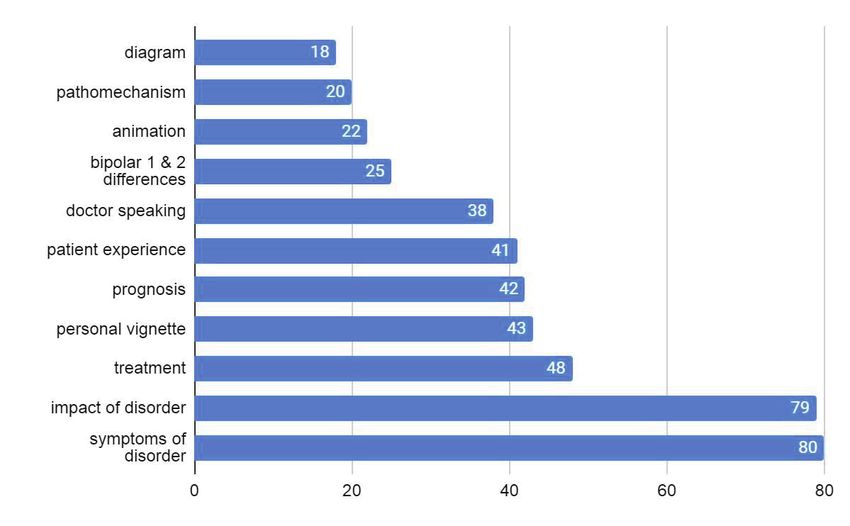
Sci Forschen
         Open HUB for Scientific Researc h
                                                                                                                   Journal of Psychiatry and Mental Health
                                                                                                                                       Open Access Journal

most do not discuss Internet information concerning BD with their              as seen in table 1 [15,16]. The first fifteen questions are scored on a
physician [11].                                                                scale from 1-5 depending on if they meet the given criteria. A score
                                                                               of 1 means the video did not fulfill the criteria, partial fulfillment of
   Individuals with BD consistently report social stigma as one of the
                                                                               criteria can be scored a 2-4 depending on the independent judgment
greatest challenges of living with the condition and thus anonymously
                                                                               of the scorer, and a 5 is a definite yes. The total minimum score is 16
search for medical information online (rather than seeking professional
                                                                               and the maximum score is 80 points.
help) [12]. For this reason, BD is often misdiagnosed or can go
undiagnosed for up to 10 years which perpetuates the suffering from               The last question is a summary of the previous 15 DISCERN
the disease [13]. However, several of the other factors are involved           questions and determines whether the publication can be used as an
and the delayed diagnosis of BD including first-degree relatives, high         appropriate source of information. An overall rating of 2 or below
stress, trauma, illicit drug usage and most importantly, depressive            indicates the publication is of “poor” quality with many shortcomings
disorders/emotional lability like neuroticism.                                 and is not useful or appropriate. A score of 3 indicates a “fair” quality
                                                                               of publication that requires additional sources of information due
  We aimed to assess the current quality and the reliability of You
                                                                               to some limitations. A score of 4 or above indicates “good” quality
Tube videos on BD using a comprehensive search strategy. We also
                                                                               meaning the publication is useful and appropriate as a source of
sought to determine what optimizes a video for audience engagement.
                                                                               information about treatment choices [15,16].
Materials and Methods                                                             The DISCERN score may also be interpreted as a total out of 75
Search strategy                                                                using only the first 15 questions. A score of 63 to 75 indicates an
                                                                               “excellent” score, 51 to 62 indicates a “good” score, 39 to 50 indicates
   We searched YouTube on November 11, 2019 using the four key                 a “fair” score, 27-38 indicates a “poor” score and 16 to 26 indicates a
phrases; “bipolar disorder”, “bipolar disorder treatment”, “bipolar            “very poor” score [17,18].
disorder symptoms”, and “manic depression”. We felt that these search
terms offered a sufficient view of BD videos because they are relative         Video optimization
synonyms to BD. We intentionally chose these phrases since after                 The optimization analysis method in this study is similar to studies
being given a diagnosis of “bipolar disorder” we anticipated that a
patient would probably use the same search term or a slight variation
of it on YouTube.                                                              Table 1: The 16 question DISCERN Instrument.

Data collection                                                                  Nr                     Question                           Rating
    Previous research shows that 90% of search engine users only look             1   Are the aims clear?                         1    2     3      4   5
at the first 3 pages of searched content. Thus, the first 30 results of each      2   Does it achieve its aims?                   1    2     3      4   5
search were viewed and evaluated under the chosen criteria and results
were recorded [14].                                                               3   Is it relevant?                             1    2     3      4   5
                                                                                      Is it clear what sources of information
Inclusion and exclusion criteria                                                  4   were used to compile the publication        1    2     3      4   5
   Out of 120 videos, we evaluated a total of 80 videos related to                    (other than the author or producer)?
BD. Any duplicates, advertisements, music videos, videos in another                   Is it clear when the information used
language or videos clearly not related to BD (e.g., music videos) were            5   or reported in the publication was          1    2     3      4   5
excluded.                                                                             produced?
                                                                                  6   Is it balanced and unbiased?                1    2     3      4   5
Variables extracted
                                                                                      Does it provide details of additional
   We used the Google Chrome extension “VidIQ Vision for YouTube”                 7                                               1    2     3      4   5
                                                                                      sources of support and information?
to retrieve quantitative information from each video. This included:
                                                                                  8   Does it refer to areas of uncertainty?      1    2     3      4   5
total number of views, total number of comments, duration, video
description word count, video description link count, referrers, likes,               Does it describe how each treatment
                                                                                  9                                               1    2     3      4   5
dislikes, and video tags and time since upload. Information about the                 works?
host channel was also recorded: uploader name, average daily views,                   Does it describe the benefits of each
                                                                                 10                                               1    2     3      4   5
average daily subscribers, subscribers, and tags.                                     treatment?
                                                                                      Does it describe the risks of each
   Qualitative information included: impact of the disorder on                   11                                               1    2     3      4   5
                                                                                      treatment?
everyday life, symptoms of BD, personal story/vignette of person,
                                                                                      Does it describe what would happen if
the difference between BP1 and BP2, results of treatment, discussion             12                                               1    2     3      4   5
                                                                                      no treatment is used?
of prognosis, animations, diagrams, pathomechanisms explained, a
doctor speaker and/or a patient experience. We recorded the video                     Does it describe how the treatment
                                                                                 13                                               1    2     3      4   5
                                                                                      choices affect overall quality of life?
upload source and categorized it into one of the following categories:
physician, hospital, patient, educational or other.                                   Is it clear that there may be more than
                                                                                 14                                               1    2     3      4   5
                                                                                      1 possible treatment choice?
Scoring system                                                                        Does it provide support for shared
                                                                                 15                                               1    2     3      4   5
   Videos were evaluated using the validated DISCERN instrument,                      decision making?
by two medical students in the final clinical years of their studies who              Based on the answers to all of these
each had five years of experience using the DISCERN instrument. The                   questions, rate the overall quality
                                                                                 16                                               1    2     3      4   5
DISCERN instrument is a sixteen-point questionnaire designed to                       of the publication as a source of
allow laypeople to judge the reliability and quality of health information            information about treatment choices

Citation: Szmuda T, Żydowicz W, Ali S, Fedorow K, Słoniewski P (2021) YouTube as a Source of Patient Information for Bipolar Disorder:
A Content-Quality and Optimization Analysis. J Psychiatry Ment Health 6(2): dx.doi.org/10.16966/2474-7769.141                                           2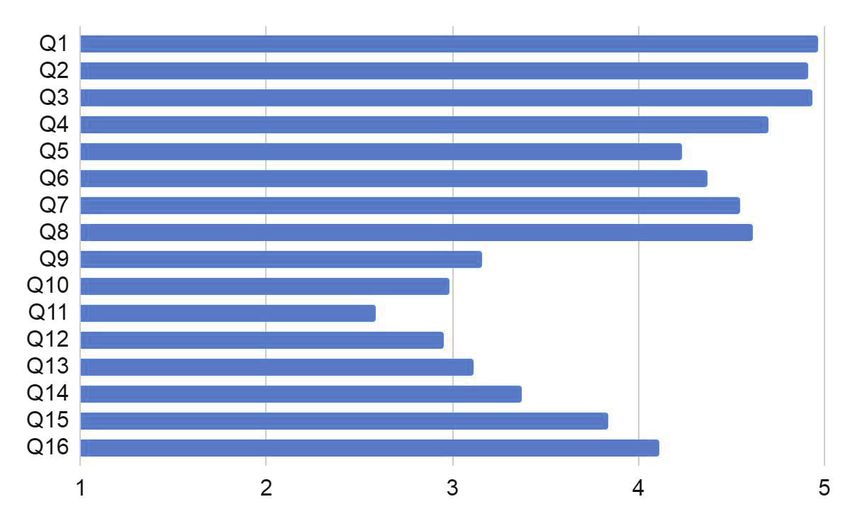
Sci Forschen
         Open HUB for Scientific Researc h
                                                                                                                Journal of Psychiatry and Mental Health
                                                                                                                                    Open Access Journal

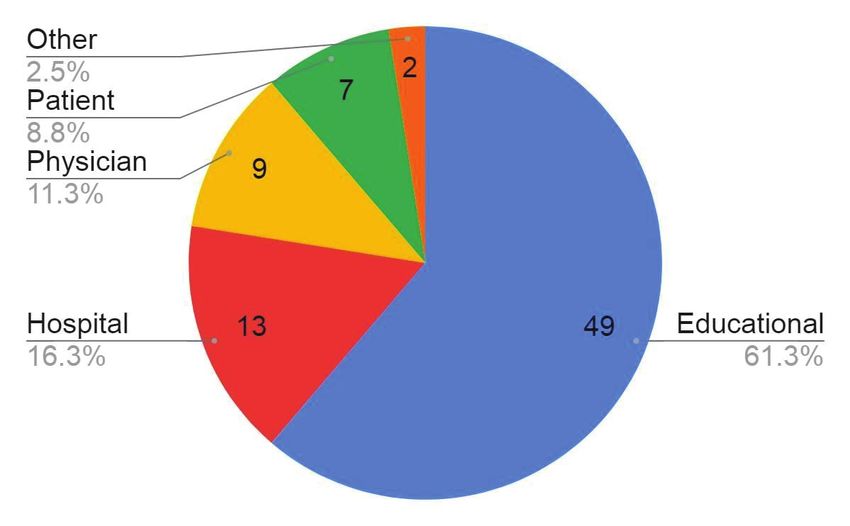
previously published [4,7,19-21]. The average daily views (total views/      of the videos were uploaded by an educational channel 61.3% (49
days since upload), the like ratio ((likes/likes+dislikes)*100) and the      videos). The remainder of the videos was uploaded by a hospital 16.3%
video power index (VPI) ((like*100/(like+dislike))*(views/day)/100)          (13 videos), a physician 11.3% (9 videos), a patient 8.8% (7 videos) and
were used to assess the audience engagement with a video. Of note,           2.5% (2 videos) were uploaded by other sources.
standardized cut-off scores do not exist for the VPI since it depends on     Video statistics
the number of likes and views and this is highly variable depending on
how popular a video is. However, we have provided the mean VPI in               The following represent the mean quantitative aspects of the videos
the results section so that a reader may use it for reference (to see if a   overall: duration 1034.1 (47-7573) seconds, view count 323059 (1061-
VPI value is higher or lower than the mean).                                 3500000), comments 702.3 (0-5960), likes 6011.4 (0-61000), dislikes
                                                                             153.8 (0-1683), average daily views 41 (0-630), like ratio 93.9 (50-100),
   Videos were grouped based on their qualitative content (e.g., if a        video referrers 71.7 (0-527) and days since upload 1459.325 (125-
video included the treatment of BP disorder). These video groups were        4294).
analyzed against their average daily views, like ratio, VPI and number
                                                                               The following represent the mean channel popularity of the videos:
of comments.
                                                                             subscribers 1713569 (3-21700000), daily views 6824841.4 (49.8-
Statistical methods                                                          486900000) and daily subscribers 39832.6 (0.1-1550000).
   The normality was checked and in cases where the data were                Video quality evaluation
normally distributed, the Mann-Whitney U test was used to find
                                                                                The mean DISCERN score of the two raters for DISCERN was 63.4
differences between categorical variables. The intraclass correlation
                                                                             ± 11.3 (38-80) (out of 80 possible points). The first rater and second
coefficient was used to ascertain inter-rater agreement. P
Sci Forschen
Open HUB for Scientific Researc h
Journal of Psychiatry and Mental Health
Open Access Journal
Figure 2: Source of video uploads on bipolar disorder.
Figure 3 illustrates the mean score for each of the 16 questions of Discussion
DISCERN. Questions 1 to 3 scored the highest ratings overall. They
pose essential questions in regards to the qualitative video content: are Quality analysis
the aims clear, does it achieve its aims, and is it relevant. Questions 4 The overall quality and reliability of the bipolar videos were of
to 8 all scored above 4, this is considered a “good” score. These five good quality. Thus, patients may gain basic knowledge about BD
questions rate the publication based on the publication’s clarity of on YouTube. Healthcare professionals have a duty to provide their
sources of information, clarity of when the information was reported patients with reliable medical information. Since it is impractical
or used, bias, the inclusion of additional sources, and uncertainty. The to peer-review all videos and other information on the internet, we
lowest scores were for questions 9 to 15. These questions are focused have listed the top 6 highest quality videos on BD so that physicians
explicitly on treatment or lack thereof: how it works, what are the may share reliable educational YouTube content to their patients over
benefits, what are the risks, how they affect the quality of life, and the online communications (e.g., e-mail, social media, hospital websites).
variety of treatments. While there is research on other neuropsychiatric disorders on the
internet and on YouTube, our paper is the first to cover an in-depth
Video quality correlations
analysis of the quality and reliability of BD.
Table 2 shows video quality in relation to the video content. Videos
Our study shows that YouTube contains adequate medical
had a greater DISCERN score when they included: the results of the
information concerning BD. However, several factors were often
treatment (P=0.0001), the prognosis (P=0.0001), the pathomechanisms
(P=0.0003), a doctor speaker (P=0.0004) and diagrams (P=0.0098). omitted, these included: the risks of each treatment, the consequences
of treatment, the benefits of each treatment, how treatment would
Optimization analysis affect the overall quality of life, how each treatment works, and the
Table 3 shows that audience engagement concerning the video possibility of more than one treatment option. Future video creators
content. Videos that contained an animation (P=0.034) or a doctor may focus on these aspects as they are frequently omitted. Including
speaker (P=0.0006) had significantly higher average daily views and this information would not only increase the quality of the videos,
a higher VPI. There was a statistically significant relationship with but also the popularity. We suggest that medical institutions tasked
a doctor speaker (P=0.0005) in the video and a higher number of with publishing medical YouTube videos should consider our
comments. There were no statistically significant findings in regards recommendations and use the DISCERN tool as a checklist for what
to the like ratio. should be included in their videos to provide a valid information
package. We encourage hospitals to publish high-quality and
Top-quality YouTube videos informative videos on BD and other medical topics.
Table 4 shows the highest-scoring YouTube videos. The three top- Optimization analysis
scoring videos were tied with 80 points and the following 3 were tied
with 79 points. The mean DISCERN score of the top six videos is 79.5 Prior studies found that patients do not engage with the highest
(99.375%), which means patients may view them as a trusted source quality educational videos [25]. Our study has comparable findings.
of health content. Half of the videos were uploaded by an educational Thus, it is critical for content creators (i.e., hospital staff and medical
channel, two were uploaded by hospitals and one was uploaded by a professionals) to understand what makes a video attractive and
physician. engaging to the viewer. This way, the most informative videos may be
given attention instead of being ignored.
All these videos included the following five features: symptoms of
BD, the impact of the disorder on everyday life, results of treatment, Our results show that videos containing an animation garnered the
discussion of prognosis and a doctor speaker. In general, these videos highest average daily views and VPI. This demonstrates that visual aids
were 4 times longer in duration and (on average 4028 seconds in may make videos more appealing to viewers. The presence of a doctor
comparison to the average of all videos 1034) covered an entire gamut speaker resulted in more comments, average daily views and VPI. This
of information. indicates that patients are more inclined to watch and interact with
Citation: Szmuda T, Żydowicz W, Ali S, Fedorow K, Słoniewski P (2021) YouTube as a Source of Patient Information for Bipolar Disorder:
A Content-Quality and Optimization Analysis. J Psychiatry Ment Health 6(2): dx.doi.org/10.16966/2474-7769.141 4Sci Forschen
Open HUB for Scientific Researc h
Journal of Psychiatry and Mental Health
Open Access Journal
Figure 3: The mean score of the two raters for the 16 DISCERN instrument questions.
Abbreviation: Q: question
Table 2: Statistically significant relationships between the DISCERN score Table 3: Statistically significant relationships between the average daily
and selected qualitative video content. views, comments and the video power index against qualitative video
content.
With information Without information
With information Without information
DISCERN Average daily views
Results of treatment Animation
Mean 70.563 52.578 Mean 940.6 408.74
95% Confidence interval 68.583 to 72.542 49.927 to 55.230 95% Confidence interval -123.84 to 2005.00 150.66 to 666.82
Sample size 48 32 Sample size 22 58
P value 0.0001 P value 0.034
Doctor speaker
Prognosis
Mean 218.29 859.64
Mean 70.726 55.237
95% Confidence interval 34.57 to 402.01 242.71 to 1476.60
95% Confidence interval 68.462 to 72.990 52.218 to 58.255
Sample size 38 42
Sample size 42 38
P value 0.0006
P value 0.0001
Comments
Diagrams Doctor speaker
Mean 69.028 61.726 Mean 263.49 1096.2
95% Confidence interval 63.601 to 74.455 58.947 to 64.504 95% Confidence interval 98.331 to 428.64 591.16 to 1601.20
Sample size 18 62 Sample size 35 35
P value 0.0098 P value 0.0005
Video power index
Pathomechanism
Animation
Mean 70.750 60.908
Mean 914.33 402.77
95% Confidence interval 66.577 to 74.923 58.073 to 63.744
95% Confidence interval -126.14 to 1954.80 151.29 to 652.26
Sample size 20 60
Sample size 22 57
P value 0.0003
P value 0.0489
Doctor speaker Doctor speaking
Mean 67.395 59.726 Mean 217.8 833.69
95% Confidence interval 63.870 to 70.919 56.409 to 63.043 95% Confidence interval 32.061 to 403.53 234.71 to 1432.70
Sample size 38 42 Sample size 37 42
P value 0.0004 P value 0.0008
Citation: Szmuda T, Żydowicz W, Ali S, Fedorow K, Słoniewski P (2021) YouTube as a Source of Patient Information for Bipolar Disorder:
A Content-Quality and Optimization Analysis. J Psychiatry Ment Health 6(2): dx.doi.org/10.16966/2474-7769.141 5Sci Forschen
Open HUB for Scientific Researc h
Journal of Psychiatry and Mental Health
Open Access Journal
Table 4: The top six highest quality bipolar disorder videos based on the DISCERN criteria.
DISCERN Title Uploader YouTube ID
80 Bipolar disorder: treatment and preventing relapse-Dr Patrick McKeon Aware LCeLKT2SFQo
80 Treatment of bipolar disorder NAMI SGV Q2KNgzVYQZo
80 Treatment choices: options for bipolar disorder DBS Alliance gzgi9Sr7twY
79 Treating bipolar disorder Paul Merritt wpYlrJ_ild0
79 Understanding and treating bipolar disorder Free CE WfkgvBHPOYQ
79 Understanding bipolar depression Stanford Hospital b_ZxPOubM6A
videos uploaded by credible medical professionals. This is a reassuring as only 11.3% of the videos were published by physicians in our study.
finding to know that patients appreciate or may be trying to reproduce We encourage medical professions to use our optimization analysis
the classical doctor-patient interaction on a digital interface. The findings to make their videos more appealing to the viewer.
presence of a patient experience was another determinant of high
Patients search the internet for medical information most often to
popularity indicating that patients value information coming from a learn about side effects from prescription drugs or to obtain help from
relatable source. coping with their disease [11]. This is especially important for patients
However, we highlight that a direct cause-effect relationship between with BD since the majority of them will inevitably turn to the internet
content (e.g., a doctor speaker) and audience engagement metric (e.g., for sources of health information [11]. Our study showed that videos
average daily views) may not be able to be established since the viewer often lacked information regarding how to cope with the disorder and
discovers the content of the video only after it is clicked. For example, what treatment they may undergo.
unless the title or thumbnail indicates the content of the video (e.g., Patients and physicians may greatly benefit from empowering
“Doctor X talks about Bipolar Disorder” or a thumbnail of a person in patients with unbiased and robust medical information. It has been
a white coat) the viewer would not know that there is a doctor speaker shown to reduce diagnostic times, create online support communities
before clicking it. Of all the audience engagement metrics we have and encourage a more productive patient-doctor dialogue [3,32-35].
analyzed, we assert that the VPI and like ratio are the best indicators of
audience engagement as a viewer has to like the video while watching The ability to provide reliable information at a distance is just one
it. Therefore, “clickbait videos” (which may have a higher number of of the ways telemedicine is expanding. Modern methods of psychiatric
views due to a catchy title and thumbnail) are not part of the equation. patient care include E-mental health apps with medication monitoring
Clickbait videos would actually have a lower VPI and like ratio score and individualized messages based on real-time data self-reported
since people would dislike the video more. by patients [36,37]. This is especially critical in the current era of
practicing medicine at a distance. However, while these validated
Context digital tools and helpful online resources exist, we wish to highlight
the “digital divide” where people with lower technical skills or access to
After deep analysis, the sources of the videos with the highest
digital technology may not be able to utilize these resources. Indeed, a
popularity were more for entertainment purposes, especially news
2016 study showed that patients with low health literacy were less likely
channels or other educational channels rather than hospitals. Media
to use health information technology [38]. The current coronavirus
has a potent influence on the public perception of any kind of illness
disease 2019 pandemic has exacerbated this divide as essential services
[26,27]. Social media influencers should be mentioned as they can
have moved online although some populations still do not have access
often outshine medical authorities in terms of traffic, views comments to the internet [39].
and popularity. Not to mention they profit from YouTube with ads and
sponsorship deals [28]. There is no doubt that social media influencers We stress that medical information on YouTube is only
often engage in mental health awareness as this is a popular topic supplementary and does not replace seeing a doctor. Bauer M, et al.
among their viewers [29]. With the majority of YouTube users being [40] brings to attention the potential medical harm related to “poor
between 15-25 years old and 75% of mental health disorders being quality online information, self-diagnosis and self-treatment, passive
manifested before the age of 24, it is understandable that mental health monitoring, and the use of unvalidated smartphone apps [40].”
is a popular topic among this demographic [30,31]. Moreover, there is potential to quickly share fake medical news with
the use of social media. Waszak PM, et al. [41] found that popular
Taking all this into consideration, it is evident that the risk of websites related to common diseases contained misinformation in
misconception is high since media coverage is bound to focus on details 40% of cases and were shared 451,272 times from 2012 to 2017 [41].
that create impact and interest. Therefore, it is of critical importance
that health care institutions use media as a type of communication to Limitations
provide accurate and high-quality information to the public. As noted One may argue that a physician with experience with BD, such
previously, YouTube and other internet websites have gained a more as a psychiatrist, should be involved in the video evaluation process.
active role in the life of patients and their management of illness or However, the DISCERN instrument was created for “patients
disease. During epidemics such as the recent novel corona pandemic, and information providers” and “was not dependent on specialist
the role of telemedicine and online source of health information is knowledge of a health condition or treatment.” In addition, the two
emphasized even more. Doctors need to be aware of this and provide raters had an excellent intraclass correlation agreement indicating the
reliable resources for their patients. Previous YouTube quality studies quality analysis study was reliable and conclusive. Moreover, the two
found that physicians upload a relatively low number of educational independent raters were medical students both having completed 90
or medical videos on YouTube [3,4]. Our study matches this finding hours of clinical rotations in psychiatry.
Citation: Szmuda T, Żydowicz W, Ali S, Fedorow K, Słoniewski P (2021) YouTube as a Source of Patient Information for Bipolar Disorder:
A Content-Quality and Optimization Analysis. J Psychiatry Ment Health 6(2): dx.doi.org/10.16966/2474-7769.141 6Sci Forschen
Open HUB for Scientific Researc h
Journal of Psychiatry and Mental Health
Open Access Journal
We based our main keywords on the suggestions and synonyms that Authors’ contributions
the YouTube search provided. Thus, we believe that they are relevant.
Tomasz Szmuda-Methodology, Investigation, Formal analysis,
However, the paper would have even more robust findings if a pilot
Writing-original draft
study was done to see exactly what BD patients search for online.
Weronika Żydowicz-Methodology, Investigation, Formal analysis,
Future directions Writing-original draft
Since this paper is a cross-sectional evaluation, we recommend
Shan Ali-Methodology, Investigation, Formal analysis, Writing-
that it be repeated within a few years to monitor alterations of
original draft
video content quality. Such studies may focus on how physician and
hospital-based health channels on YouTube provide medical content- Karolina Fedorow-Methodology, Investigation, Formal analysis,
based and if it up to date with recent evidence. Additional studies Writing-original draft
may be done to examine the extent to which patients with BD refer
Paweł Słoniewski-Methodology, Formal analysis, Supervision
to YouTube specifically to gather information about their disease and
whether they regard this information as valuable. Furthermore, the Acknowledgements
YouTube algorithm that ranks and suggests videos is complex, highly
Not applicable.
personalized and constantly changing [42,43]. Moreover, new videos
are being added constantly and new popular trends affect the search Author’s information
results (e.g., the amyotrophic lateral sclerosis ice bucket challenge
Tomasz Szmuda, MD, PhD; Medical University of Gdansk,
of 2014). In our experience, we did not notice any popular trends
Neurosurgery Department
concerning BD. However, we encourage future scientists to publish a
follow-up study to monitor the quality of YouTube information on BD Weronika Żydowicz; Medical University of Gdansk
over time and obtain a clearer understanding of which video content is
Shan Ali; Medical University of Gdansk
most frequently recommended by YouTube.
Karolina Fedorow; Medical University of Gdansk
Since only English videos were analyzed future studies may focus
the differences in video quality in various languages and geographical Paweł Słoniewski MD, PhD, Professor; Medical University of
locations where there may be more stigmatization of mental diseases Gdansk, Neurosurgery Department
[44]. Furthermore, future studies could use the DISCERN instrument
to evaluate other sources of medical information about mental health References
such as phone apps or websites. We encourage physicians to inform 1. Statista (2021) Global digital population as of January 2021 (in
patients about DISCERN tool to evaluate medical health information billions). Statista Inc, United States.
for themselves.
2. PwC Health Research Institute (2012) Social media “likes” healthcare
Conclusion from marketing to social business. PwC, United Kingdom.
YouTube is often a good source of information on BD as it fulfills 3. Madathil KC, Rivera-Rodriguez AJ, Greenstein JS, Gramopadhye AK
the basic information required for patient information. However, the (2015) Healthcare information on YouTube: A systematic review.
quality of information may still improve particularly in regards to Health Informatics J 21: 173-194.
treatment risks, consequences, benefits and overall treatment options.
4. Szmuda T, Rosvall P, Hetzger TV, Ali S, Słoniewski P (2020) YouTube
The unregulated nature of YouTube means that videos may fail to meet as a Source of Patient Information for Hydrocephalus: A Content-
a higher standard in conveying medical information. Thus, care should Quality and Optimization Analysis. World Neurosurg 138: e469-e477.
be taken by health professionals to provide reliable online information.
We suggest that physicians reference our list of the highest quality 5. Lam NHT, Woo BKP (2020) Efficacy of Instagram in Promoting
videos on BD. Since a doctor speaker and animation significantly Psychoeducation in the Chinese-Speaking Population. Health Equity
optimized a video for high audience engagement, we recommend that 4: 114-116.
physicians create medical content on BD and include animation in the 6. Lam NHT, Tsiang JT, Woo BKP (2017) Exploring the Role of YouTube in
video. Disseminating Psychoeducation. Acad Psychiatry 41: 819-822.
Declaration 7. Szmuda T, Özdemir C, Fedorow K, Ali S, Słoniewski P (2021) YouTube
as a source of information for narcolepsy: A content‐quality and
Ethics approval and consent to participate optimization analysis. J Sleep Res 30: e13053.
Not applicable.
8. Depression and Bipolar Support Alliance (2021) Bipolar Disorder
Consent for publication Statistics. DBSA, United States.
Not applicable. 9. Bauer R, Conell J, Glenn T, Alda M, Ardau R, et al. (2016) Internet
use by patients with bipolar disorder: Results from an international
Availability of data and material multisite survey. Psychiatry Res 242: 388-394.
All data was available online. 10. Bauer R, Conell J, Glenn T, Alda M, Ardau R, et al. (2017) International
Competing interests multi-site survey on the use of online support groups in bipolar
disorder. Nord J Psychiatry 71: 473-476.
Not applicable.
11. Conell J, Bauer R, Glenn T, Alda M, Ardau R, et al. (2016) Online
Funding information seeking by patients with bipolar disorder: results from
Not applicable. an international multisite survey. Int J Bipolar Disord 4: 17.
Citation: Szmuda T, Żydowicz W, Ali S, Fedorow K, Słoniewski P (2021) YouTube as a Source of Patient Information for Bipolar Disorder:
A Content-Quality and Optimization Analysis. J Psychiatry Ment Health 6(2): dx.doi.org/10.16966/2474-7769.141 7Sci Forschen
Open HUB for Scientific Researc h
Journal of Psychiatry and Mental Health
Open Access Journal
12. Mileva VR, Vázquez GH, Milev R (2013) Effects, experiences, and 29. Foster CB (2013) Mental Health On Youtube: Exploring the Potential
impact of stigma on patients with bipolar disorder. Neuropsychiatr of Interactive Media to Change Knowledge, Attitudes and Behaviors
Dis Treat 9: 31-40. About Mental Health. Doctoral dissertation, University of South
Carolina, USA.
13. Shen H, Zhang L, Xu C, Zhu J, Chen M, et al. (2018) Analysis of
Misdiagnosis of Bipolar Disorder in An Outpatient Setting. Shanghai 30. Aslam S (2020) YouTube by the Numbers: Stats, Demographics &
Arch Psychiatry 30: 93-101. Fun Facts. Omnicore, United States.
14. iProspect (2006) iProspect search engine user behaviour study. 31. National Alliance on Mental Illness (2021) Mental Health by the
United States. Numbers. NAMI, United States.
15. Charnock D, Shepperd S, Needham G, Gann R (1999) DISCERN:
32. Sangeorzan I, Andriopoulou P, Livanou M (2019) Exploring the
An instrument for judging the quality of written consumer health
experiences of people vlogging about severe mental illness on
information on treatment choices. J Epidemiol Community Health
YouTube: An interpretative phenomenological analysis. J Affect
53: 105-111.
Disord 246: 422-428.
16. Rees CE, Ford JE, Sheard CE (2002) Evaluating the reliability
of DISCERN: a tool for assessing the quality of written patient 33. Nour MM, Nour MH, Tsatalou OM, Barrera A (2017) Schizophrenia
information on treatment choices. Patient Educ Couns 47: 273-275. on YouTube. Psychiatr Serv 68: 70-74.
17. Cassidy JT, Baker JF (2016) Orthopaedic Patient Information on the 34. Michalak EE, McBride S, Barnes SJ, Wood CS, Khatri N, et al. (2017)
World Wide Web: An Essential Review. J Bone Joint Surg Am 98: 325- Bipolar disorder research 2.0: Web technologies for research
338. capacity and knowledge translation. J Eval Clin Pract 23: 1144-1152.
18. Weil AG, Bojanowski MW, Jamart J, Gustin T, Lévêque M (2014) 35. Naslund JA, Grande SW, Aschbrenner KA, Elwyn G (2014) Naturally
Evaluation of the quality of information on the Internet available occurring peer support through social media: the experiences of
to patients undergoing cervical spine surgery. World Neurosurg 82: individuals with severe mental illness using YouTube. PLoS One 9:
e31-e39. e110171.
19. Szmuda T, Talha SM, Singh A, Ali S, Słoniewski P (2021) YouTube as a 36. Faurholt-Jepsen M, Frost M, Christensen EM, Bardram JE, Vinberg
source of patient information for meningitis: A content-quality and M, et al. (2020) Validity and characteristics of patient-evaluated
audience engagement analysis. Clin Neurol Neurosurg 202: 106483. adherence to medication via smartphones in patients with bipolar
20. Szmuda T, Alkhater A, Albrahim M, Alquraya E, Ali S, et al. (2020) disorder: exploratory reanalyses on pooled data from the MONARCA
YouTube as a source of patient information for stroke: A content- I and II trials. Evid Based Ment Health 23: 2-7.
quality and an audience engagement analysis. J Stroke Cerebrovasc
37. Faurholt-Jepsen M, Frost M, Christensen EM, Bardram JE, Vinberg M,
Dis 29: 105065.
et al. (2019) The validity of daily patient-reported anxiety measured
21. Szmuda T, Syed MT, Singh A, Ali S, Özdemir C, et al. (2020) YouTube as using smartphones and the association with stress, quality of life
a source of patient information for Coronavirus Disease (COVID-19): and functioning in patients with bipolar disorder. J Affect Disord
A content-quality and audience engagement analysis. Rev Med Virol 257: 100-107.
30: e2132.
38. Mackert M, Mabry-Flynn A, Champlin S, Donovan EE, Pounders K
22. Koo TK, Li MY (2016) A Guideline of Selecting and Reporting (2016) Health Literacy and Health Information Technology Adoption:
Intraclass Correlation Coefficients for Reliability Research. J Chiropr The Potential for a New Digital Divide. J Med Internet Res 18: e264.
Med 15: 155-163.
39. Lai J, Widmar NO (2021) Revisiting the Digital Divide in the COVID-19
23. Terry K Koo, Mae Y Li (2017) Erratum to “A Guideline of Selecting Era. Appl Econ Perspect Policy
and Reporting Intraclass Correlation Coefficients for Reliability
Research.” J Chiropr Med 16: 346. 40. Bauer M, Glenn T, Monteith S, Bauer R, Whybrow PC, et al. (2017)
Ethical perspectives on recommending digital technology for
24. Cicchetti DV (1994) Guidelines, Criteria, and Rules of Thumb for patients with mental illness. Int J Bipolar Disord 5: 6.
Evaluating Normed and Standardized Assessment Instruments in
Psychology. Psychol Assess 6: 284-290. 41. Waszak PM, Kasprzycka-Waszak W, Kubanek A (2018) The spread of
medical fake news in social media-The pilot quantitative study. Heal
25. Desai T, Shariff A, Dhingra V, Minhas D, Eure M, et al. (2013) Is
Policy Technol 7: 115-118.
content really king? An objective analysis of the public’s response to
medical videos on YouTube. PLoS One 8: 82469. 42. Covington P, Adams J, Sargin E (2016) Deep neural networks for
26. Young ME, Norman GR, Humphreys KR (2008) Medicine in the YouTube recommendations. RecSys '16: Proceedings of the 10th
popular press: the influence of the media on perceptions of disease. ACM Conference on Recommender Systems, New York, USA 191-
PLoS One 3: e3552. 198.
27. Ross AM, Morgan AJ, Jorm AF, Reavley NJ (2019) A systematic review 43. Davidson J, Liebald B, Liu J, Nandy P, Van Vleet T (2010) The YouTube
of the impact of media reports of severe mental illness on stigma video recommendation system. RecSys’10: Proceedings of the
and discrimination, and interventions that aim to mitigate any fourth ACM conference on Recommender systems 293-296.
adverse impact. Soc Psychiatry Psychiatr Epidemiol 54: 11-31. 44. Botha UA, Koen L, Niehaus DJ (2006) Perceptions of a South African
28. Lindgren S, Lundström R (2019) Tube therapy: Dealing with mental schizophrenia population with regards to community attitudes
health problems in social video comment threads. First Monday 24: towards their illness. Soc Psychiatry Psychiatr Epidemiol 41: 619-
5-6. 623.
Citation: Szmuda T, Żydowicz W, Ali S, Fedorow K, Słoniewski P (2021) YouTube as a Source of Patient Information for Bipolar Disorder:
A Content-Quality and Optimization Analysis. J Psychiatry Ment Health 6(2): dx.doi.org/10.16966/2474-7769.141 8You can also read


