2018 Hurricane Florence Agricultural Disaster Assistance Program - Dr. Sandy Stewart NCDA&CS Assistant Commissioner of Agricultural Services ...
←
→
Page content transcription
If your browser does not render page correctly, please read the page content below
2018 Hurricane Florence
           Agricultural Disaster Assistance
                      Program
                             Dr. Sandy Stewart
           NCDA&CS Assistant Commissioner of Agricultural Services
                             October 31, 2018

10/31/18                                                             1
Purpose
• Invest in North Carolina’s largest industry which suffered $1.1 Billion*
  in production losses from Hurricane Florence.
• Alleviate economic hardship and spur growth in counties most
  affected by Hurricane Florence.
• Quickly provide direct assistance to farmers most affected by
  Hurricane Florence in order to:
      • Assist with managing debt related to Florence, previous disasters, and chronic
        low commodity prices.
      • Provide cash flow to maintain agriculture and its multiplier effect for rural
        economies.
                                                               *Based on initial 35 counties
10/31/18                                                                                       2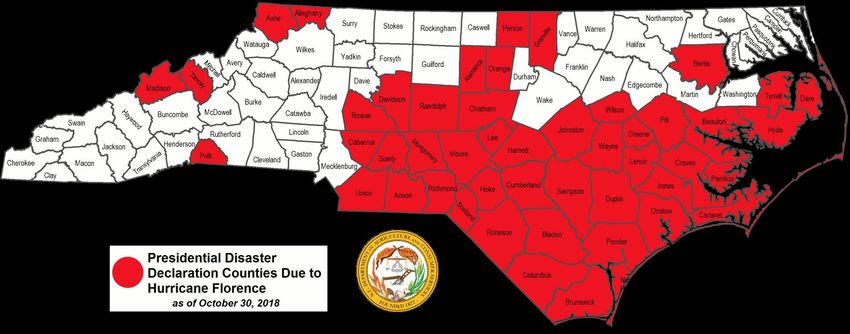
Eligibility
• Farmers in
  Presidential-declared
  disaster counties
  related to Hurricane
  Florence*
• Farmers who had
  planted, but not
  harvested on or
  before September 13,
  2018

                          *Note: County eligibility
     10/31/18             subject to change.          3
Eligible Commodities
            Crops                           Livestock                       Aquaculture
Apples, barley, corn, cotton, dry   Cattle, sheep, swine, goats,     Must be propagated or reared
 peas, flax, forage, freezing and farmed cervids, bison, chickens,   in a controlled environment.
  canning peas, grain sorghum,       quail and turkeys. Horses,       Inland aquaculture (catfish,
  grapes, hay, industrial hemp,    mules or other equines qualify         crawfish ponds, etc.)
   native grass, nursery crops,       only if they are used for
 nuts, oats, peanuts, potatoes,      production of agricultural
   rye, soybeans, sunflowers,               commodities.
sweet corn, tobacco, tomatoes,
  wheat, specialty crops, other
fruits & vegetables. *Does not
       include stored grain

10/31/18                                                                                             4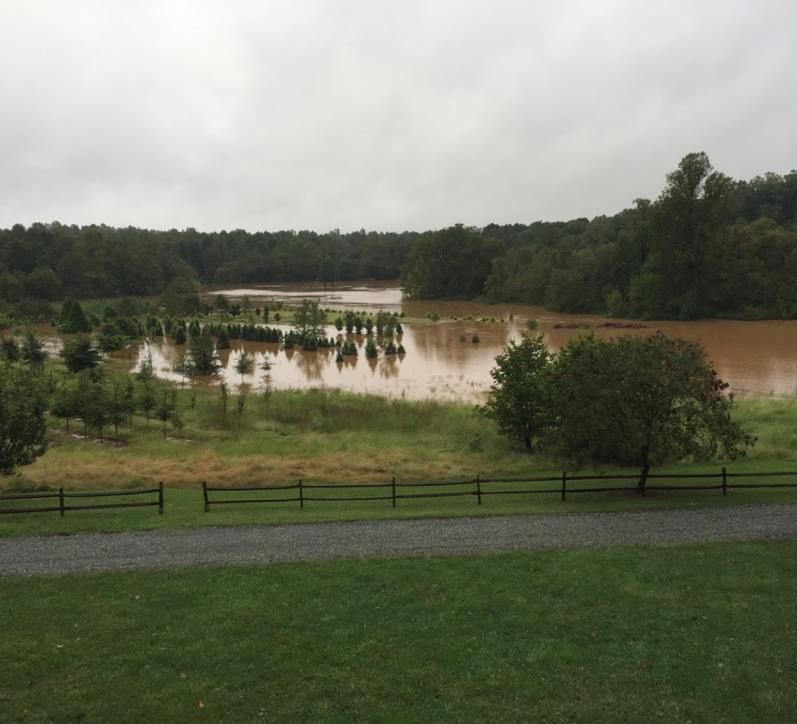
Qualifications
• For Crops:
      • Acreage reported to USDA Farm Service Agency (FSA) on FSA Forms as
        specified in the application.
• For Livestock:
      • Farmers must first qualify for and receive an indemnity payment through the
        USDA Livestock Indemnity Program (LIP), and provide documentation of loss.
• For Aquaculture:
      • NCDA&CS will work directly with aquaculture producers to determine loss
        related to Hurricane Florence.

10/31/18                                                                              5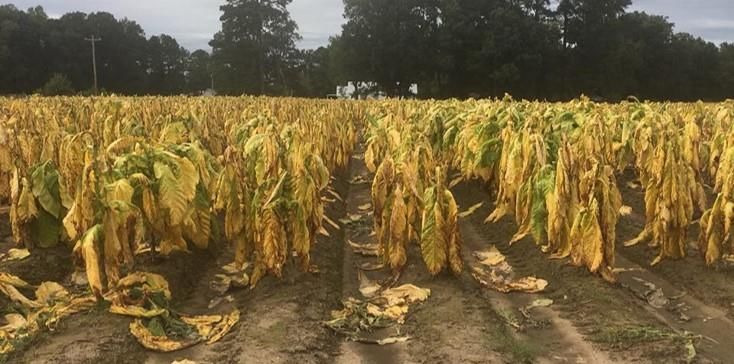
• Program sign-up period:
  November 7 to December 10,
  2018.
     • Extensions may be requested
       for losses of nursery crops,
       livestock, and fruit-bearing trees
       and bushes for which losses
       may not be known or
       qualification & payment for LIP
       has not occurred by December
       10, 2018.

10/31/18                                    6
Payment Determination (crops)
• Will be based on:
• County Loss
• Reported by FSA, or;
• Estimated by Cooperative Extension/NCDA&CS and a vetting process.
• Average County Yield
• Utilizing USDA-NASS data, or;
• Established yields based in USDA Noninsured Crop Disaster Assistance Program (NAP)
• Average Price
• Statewide data from USDA-NASS, or;
• Established price from USDA NAP Program
10/31/18 7Payment Determination (crops)
• Sample Calculation:
• Loss = (FSA Reported Acreage) x (County Average Yield) x (Average Price) x
(FSA Reported County Loss)
• Assume:
• FSA Reported Acreage = 100 acres of cotton
• County Average = 900 lbs
• Average Price = $0.72/lb
• County Loss = 50%
• End Result:
• Loss = (100 acres) x (900 lbs) x ($0.72) x (50% loss)
• Loss = $32,400
10/31/18 8Payment Determination (crops)
• From the previous example, loss is
calculated to be $32,400.
• For this farmer, for this commodity
• The sum of all losses for a farmer will
determine the overall payment to the
farmer as a pro-rated share of the
overall appropriation to this program
• Assistance to farmers in this program
will be dependent on the overall loss
and overall appropriation to the
program.
10/31/18 9Payment Determination (Livestock) • Farmers must first qualify for and receive payment through the USDA Livestock Indemnity Program (LIP). • LIP pays an indemnity on 75% of the loss on a per head basis. • This program will offer assistance on one-half of the remaining loss, or 12.5%. 10/31/18 10
Payment Determination (Nursery and fruit-bearing trees
  and bushes)

• Farmers may apply for direct assistance as with other
  crops.
• Farmers may also apply for an extension until May 1,
  2019 for reporting losses if the loss is not known by
  December 10, 2018.
    • Example: Flooded nursery trees or blueberry bushes may not
      have known loss until spring emergence.
• Payment Assistance to farmers in this program will be
  dependent on the overall loss and overall
  appropriation to the program.

  10/31/18                                                         11
Payment Determination (aquaculture) • Farmers may apply for direct assistance as with crops and livestock. • Reported losses will be verified by NCDA&CS staff. • Payment Assistance to farmers in this program will be dependent on the overall loss and overall appropriation to the program. 10/31/18 12
What is Not Covered?
• Infrastructure.
• Stored forage losses (baled hay).
• Stored grain or other stored commodities.
• Quality Losses – Not directly covered but should be accounted for in
  FSA reported county average losses.

10/31/18                                                                 13
How to Apply/What is Needed?
• Beginning November 7th, 2018, apply for assistance at
  www.ncagr.gov/AgriculturalDisasterProgram. Complete applications must be
  submitted electronically by December 10th, 2018. *
• Before completing application, have electronic copies of the following documents:
     •   USDA FSA Form 578 per county for crop losses.**
     •   USDA LIP payment for Livestock and Poultry Loss (Form CCC-852).
     •   USDA FSA field map and list of physical addresses for crops not reported on USDA Form 578.
     •   Completed W-9 for producer SSN/EIN.

*NCSU Extension offices, NCDA&CS disaster program website, & the Agriculture Disaster
Hotline will be available to answer questions for farmers.
**A late filing fee may be incurred for previously unreported crops. Please check with your
local FSA office for more information.

 10/31/18                                                                                             14
Partners
• USDA-Farm Service Agency (FSA)
• Provide county loss information, program information, requested documents
from farmers, and other documents.
• Cooperative Extension
• Provide program information, assistance with enrollment, and county loss
estimates where needed.
• NCDA&CS
• Provide program information, administration, county loss information where
needed, reporting, auditing, and disbursement of appropriated funds.
10/31/18 15Timeline
Farmer - County FSA Office
REPORTING FORMS - Form 578, Affidavit (in application), W-9 Form, and Extension (if needed)
Farmer - Home or with Assistance from Cooperative Extension
UPLOAD INFORMATION – Scan and Upload documents, Report Acreage, November 7 to December 10
NCDA&CS
COLLECT ALL LOSS INFORMATION by December 10, 2018
NCDA&CS
CALCULATE LOSS Based on Appropriation and Total Losses
NCDA&CS
MAKE PAYMENTS – As soon as possible after Jan. 1, 2019, reserving allocation for requested extensions
10/31/18 16Accountability
• Farmer-provided information is only planted acres, nursery inventory, or
livestock inventory.
• Most easily verified information.
• Documentation (ex. Form 578) must be uploaded with the online application.
• Requirement of affidavit that will:
• Provide penalties for submitting false information.
• Allow for auditing at any time.
• Each step in the process will have reportable, reviewable information.
• NCDA&CS will not be taking any administrative costs from the appropriation
to this program.
10/31/18 17Purpose
• Invest in North Carolina’s largest industry which suffered $1.1 Billion in
production losses from Hurricane Florence.
• Alleviate economic hardship and spur growth in counties most affected by
Hurricane Florence.
• Provide direct assistance to farmers most affected by Hurricane Florence in order
to:
• Assist with managing debt related to Florence, previous disasters, and chronic low
commodity prices.
• Provide cash flow to maintain agriculture and its multiplier effect for rural economies.
• Effectiveness of this program will depend on level of appropriation.
10/31/18 18Questions? 10/31/18 19
You can also read


