Assessing flow intermittence in France under climate change
←
→
Page content transcription
If your browser does not render page correctly, please read the page content below
Assessing flow intermittence in France
          under climate change
          Aurélien BEAUFORT 1, Quentin BOTTET 1,
          Guillaume THIREL 2 & Eric SAUQUET 1
          1 INRAE, RiverLy, Lyon, France
          2 INRAE, Hycar, Antony, France

Stratégies
Titre        territorialisées d’adaptation et d’atténuation des systèmes agri-alimentaires et forestiers face au changement climatique
            EGU2020: Sharing Geoscience Online 4-8 May 2020
      de la présentation                                                                                                                 p. 1
18/03/2020
Date           / Sylvain
      / information  / nomPellerin & Eric Sauquet
                            de l’auteur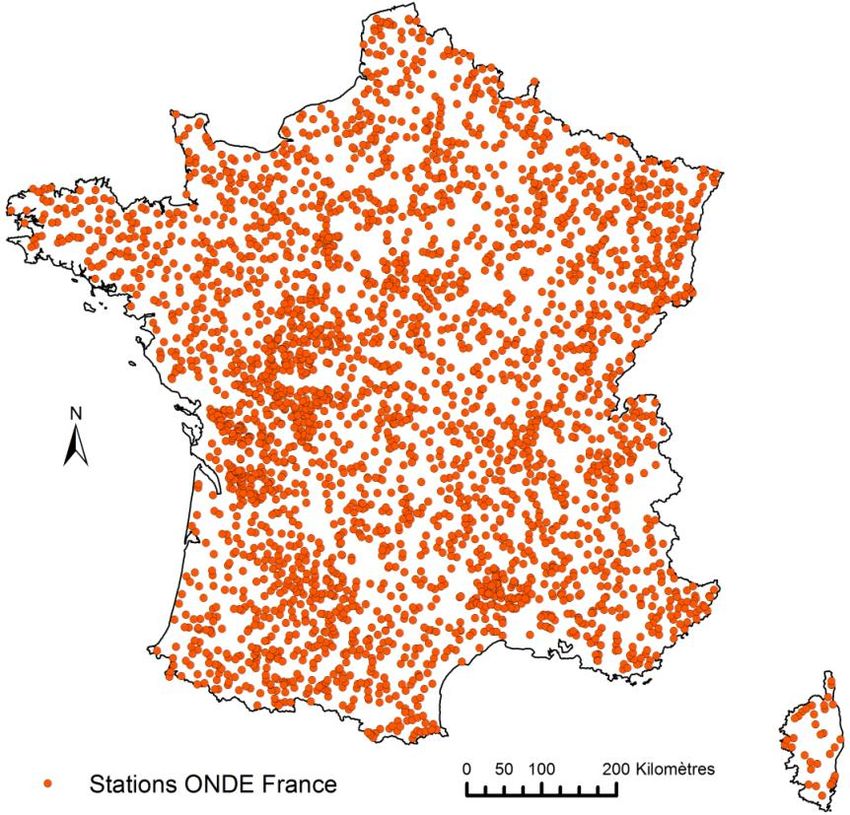
Introduction
• Globally, in the future, flow intermittence in summer should increase where
  climate is projected to be driest; conversely, flow intermittence in winter should
  reduce where no-flow conditions are due to freezing

• Few impact studies of climate change on European intermittent rivers due to:
    • the difficulties for hydrological models to simulate no-flow events
    • the reduced number of gauged basins with intermittent flow regime

• Besides climate influences, intermittence characteristics are strongly influenced
  by processes operating at small scales, such as groundwater-surface water
  interactions and transmission losses (e.g. Beaufort et al., 2019, Costigan et al.
  2017). Using global hydrological models is thus certainly hazardous to assess
  changes in flow intermittence characteristics (e.g. Döll and Schmied, 2012)

       Beaufort, A., Carreau, J., & Sauquet, E. (2019). A classification approach to reconstruct local daily drying dynamics at
       headwater streams. Hydrological Processes, 33, 1896– 1912.
       Costigan et al. (2017). Chapter 2.2 – Flow regimes in intermittent rivers and ephemeral streams. In: “Datry T.,
       Bonada N. & Boulton A.J. (Eds.), Intermittent Rivers and Ephemeral Streams. Ecology and Management”,
       Academic Press (pp. 51–78).
       Döll, P., & Schmied, H. M. (2012). How is the impact of climate change on river flow regimes related to the
       impact
   Stratégies
   Titre        on mean annual
               territorialisées
         de la présentation         runoff?et
                                d’adaptation A d’atténuation
                                               global-scale des
                                                             analysis. Environ.
                                                                systèmes        Res. Lett.,et7,forestiers
                                                                         agri-alimentaires      014037.face au changement climatique p. 2
   18/03/2020
   Date         / Sylvain
        / information     Pellerin
                      / nom        & Eric Sauquet
                            de l’auteur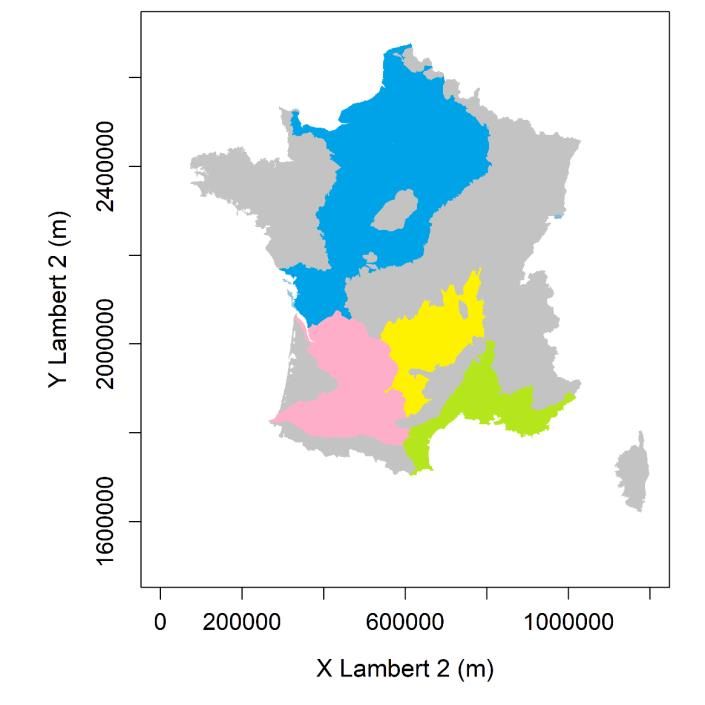
Introduction
• De Girolamo et al. (2017) have calibrated and applied the SWAT model forced by
  three regional climate projections to a temporary river system in southern Italy
  and results point out a longer period with no-flow conditions during the period
  2030–2059 compared to the recent past period 1980–2009

• Cipriani et al. (2014) have used two rainfall-runoff models to simulate no-flow
  events of an intermittent river in south-eastern France and the consequences in
  terms of biodiversity. Results suggest that, by 2050, (1) no-flow events could be
  more frequent, (2) durations of no-flow event are expected to increase, and (3)
  the consequence could be a loss of approximately two taxa

• Here, a modelling framework supported by field observations performed on a
  large number of French headwater streams is developed and applied to assess
  the probability of drying in headwater streams at the regional scale (RPoD)
  under climate change
       Cipriani et al. (2014). Impact of climate change on aquatic ecosystems along the Asse River Network. In: FRIEND-Water
       2014, Hydrology in a Changing World: Environmental and Human Dimensions, February 2014, Hanoi, Vietnam (IAHS
       Publ. 36X, 2014), 463-468.
       De Girolamo et al. (2017). Hydrology under climate change in a temporary river system: Potential impact on water
       balance and flow regime. River Research and Applications, 33, 1219– 1232.
   Stratégies
   Titre       territorialisées d’adaptation et d’atténuation des systèmes agri-alimentaires et forestiers face au changement climatique
         de la présentation                                                                                                              p. 3
   18/03/2020
   Date         / Sylvain
        / information     Pellerin
                      / nom        & Eric Sauquet
                            de l’auteur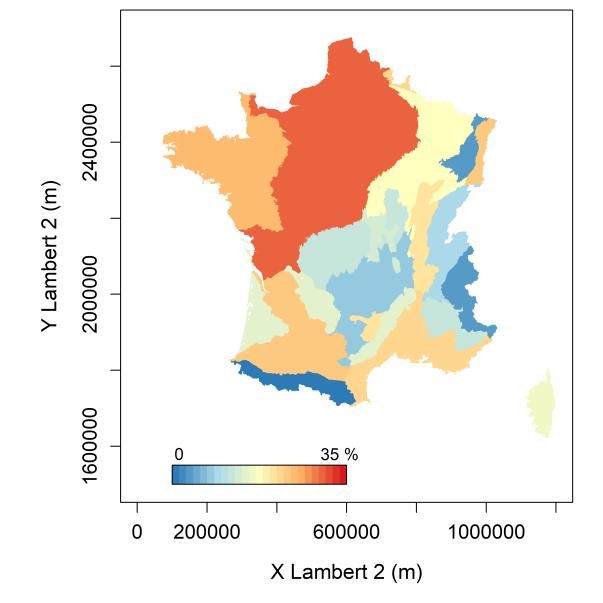
Outlines

   • Material and methods

   • Results

   • Conclusions

Stratégies
Titre        territorialisées d’adaptation et d’atténuation des systèmes agri-alimentaires et forestiers face au changement climatique
      de la présentation                                                                                                                 p. 4
18/03/2020
Date           / Sylvain
      / information  / nomPellerin & Eric Sauquet
                            de l’auteur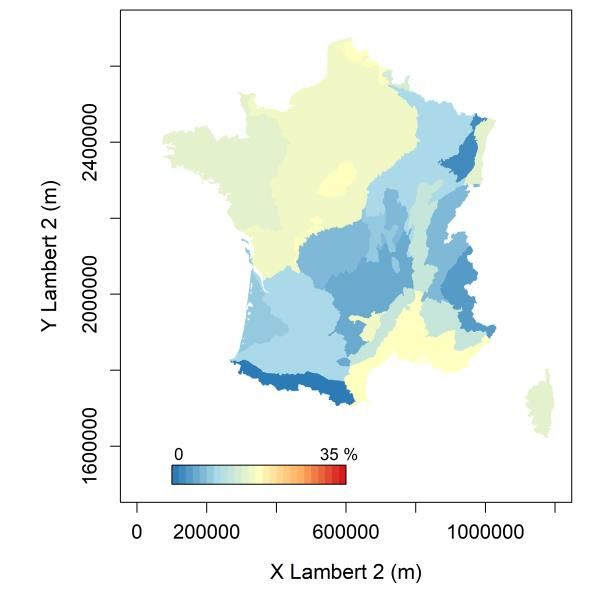
ONDE site
 Material and methods
  • Field observation states from the
    ONDE network
    (https://onde.eaufrance.fr)
          • 3300 sites with Strahler order < 5
            visually inspected once a month
            between April and October since
            2012
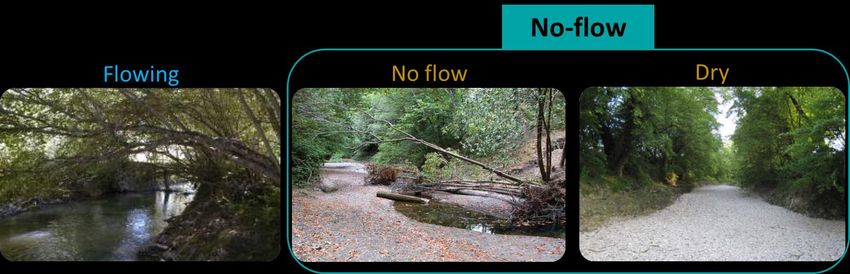
          • One of the following flow states
            assigned at each
            observation:

Stratégies
Titre        territorialisées d’adaptation et d’atténuation des systèmes agri-alimentaires et forestiers face au changement climatique
      de la présentation                                                                                                                 p. 5
18/03/2020
Date           / Sylvain
      / information  / nomPellerin & Eric Sauquet
                            de l’auteur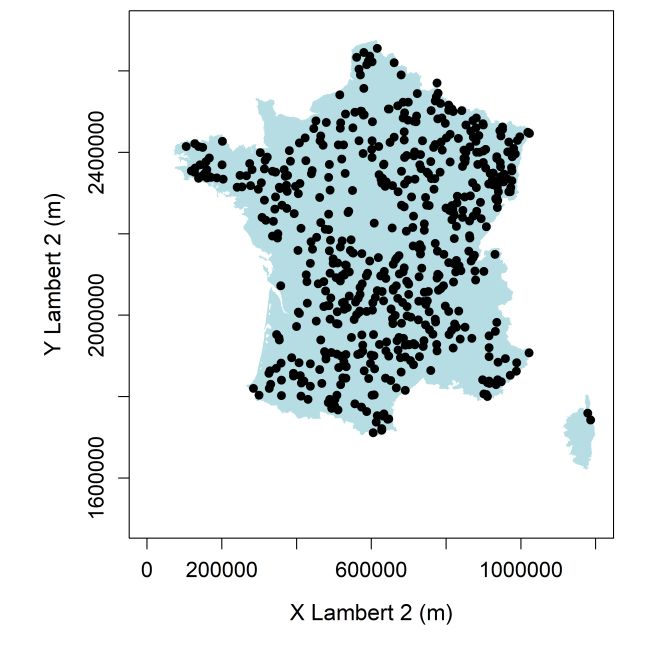
Material and methods
  • Meteorological forcing datasets from the Safran French near-surface
    reanalysis data (Vidal et al., 2010)

  • An ensemble of 26 high-resolution projections derived from GCM simulations
    under RCP2.6 and RCP8.5 emission scenarios, applying an advanced delta
    change approach (van Pelt et al., 2012)

  • Discharge data of 568 gauging stations
    (●) extracted from the French HYDRO
    database (http://hydro.eaufrance.fr/)

  • A total of 22 large regions homogeneous
    in terms of climate, topography and
    geological features (Wasson et al., 2002)

            Vidal et al. (2010). A 50-year high-resolution atmospheric reanalysis over France with the Safran system. Int. J.
            Climatol., 30, 1627–1644.
            van Pelt et al. (2012). Future changes in extreme precipitation in the Rhine basin based on global and regional
            climate model simulations. Hydrol. Earth Syst. Sci., 16, 4517–4530.
            Wasson et al. (2002). Typology and reference conditions for surface water bodies in France: the hydro-ecoregion
Stratégies  territorialisées
            approach.
Titre de la présentation     d’adaptation
                          TemaNord,       et d’atténuation des systèmes agri-alimentaires et forestiers face au changement climatique
                                       37–41.                                                                                         p. 6
18/03/2020
Date         / Sylvain
     / information     Pellerin
                   / nom        & Eric Sauquet
                         de l’auteur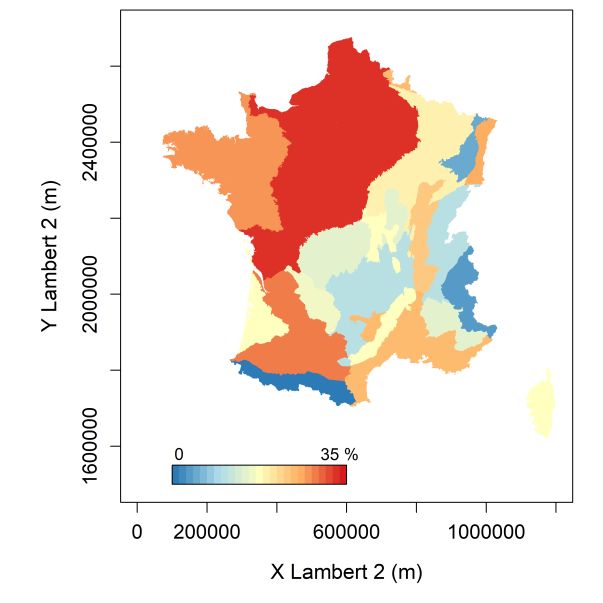
Material and methods
  Modelling the risk of intermittence (regional approach) developed
  by Beaufort et al. (2018)

                                                                                                 The observed regional
                                                                                                 probabilities of drying of
                                                                                                 headwater streams (RPoD)
                                                                                                 are given by the daily
                                                                                                 proportions of no-flow
                                                                                                 states observed at ONDE
                                                                                                 sites within the region

           Beaufort et al. (2018). Extrapolating regional probability of drying of headwater streams using discrete
Stratégies
Titre        territorialisées
             observationsd’adaptation
      de la présentation       and gaugingetnetworks.
                                              d’atténuation des systèmes
                                                         Hydrology       agri-alimentaires
                                                                     and Earth             et forestiers
                                                                                 System Sciences,        face3033–3051.
                                                                                                     22(5),   au changement climatique   p. 7
18/03/2020
Date           / Sylvain
      / information  / nomPellerin & Eric Sauquet
                            de l’auteur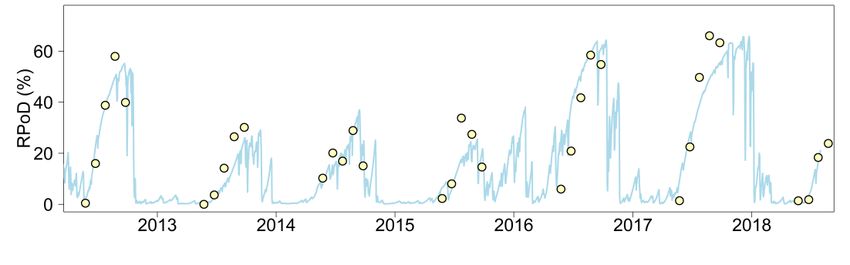
Material and methods
             Modelling the risk of intermittence (regional approach) developed
             by Beaufort et al. (2018)
              •    For each region and each regional climate projection:
                   (1961-2100) (1961-1990)
                                Calibration

  Q obs                                                            RPoD obs                                                        Regional

                                                                                                     (1961-2100) (2012-2018)
                                                                                                      Simulation Calibration
                                                                                                                                 relationships
  Safran                                                   Q sim and associated                                                 between non-
                                              GR6J           non exceedance                                                       exceedance
                                                               frequencies
                    Simulation

 Climate                                                                                                                       frequencies and
projections                                                                                                                     proportions of
                                                                                                                                no-flow states
              •    Step 4 in Beaufort et al. (2018) is carried out using daily
                   discharges simulated by the GR6J rainfall-runoff model
                   (Pushpalatha et al., 2011)
              •    Safran is used as inputs for calibration over the period                                                       RPoD sim
                   1961-1990 and for simulation for the period 1961-2100
              •    Non-exceedance probabilities deduced from simulated discharges are calculated
                   considering the whole period 1961-2100
                            Pushpalatha et al. (2011). A downward structural sensitivity analysis of hydrological models to improve
           Stratégies
           Titre        territorialisées
                 de la présentation      d’adaptation
                        low-flow simulation,           et d’atténuation
                                                   J. Hydrol.,          des systèmes agri-alimentaires et forestiers face au changement climatique
                                                               411, 66–76.                                                                           p. 8
           18/03/2020
           Date           / Sylvain
                 / information  / nomPellerin & Eric Sauquet
                                       de l’auteur
Results
   • Calibration
     (without climate
     projection)

RPoD sim                                                                                                  •      Good performance
RPoD obs                                                                                                         (seasonality,
                                                                                                                 severity)
      Stratégies
      Titre        territorialisées d’adaptation et d’atténuation des systèmes agri-alimentaires et forestiers face au changement climatique
            de la présentation                                                                                                                 p. 9
      18/03/2020
      Date           / Sylvain
            / information  / nomPellerin & Eric Sauquet
                                  de l’auteur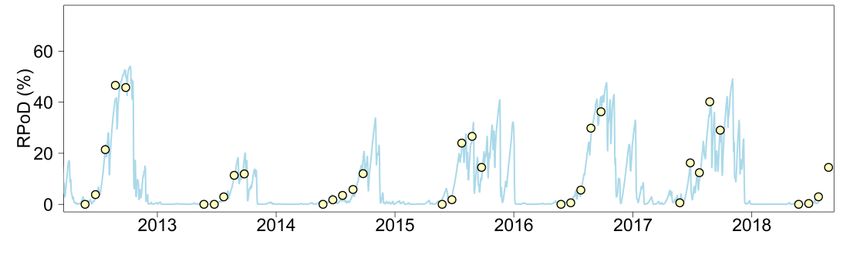
Results
• Simulation

                                                                                                    P             PST       – 1961-2018
                                                                                                                 RCP2.6 – 2021-2050
                                                                                                                 RCP2.6 – 2071-2100
                                                                                                                 RCP8.5 – 2021-2050
  Stratégies  territorialisées d’adaptation et d’atténuation des systèmes agri-alimentaires et forestiers face au changement climatique p. 10
  Titre de la présentation
  18/03/2020 / Sylvain Pellerin & Eric Sauquet
                                                                                                                 RCP8.5     – 2071-2100
  Date / information / nom de l’auteur
Conclusions
• Results for the two 30-year periods 2021-2050 and 2071-2100 show an increase
in flow intermittence in headwaters with time. The mean RPod over the period
May–October is 12% at the national scale under the current climate, compared to
20% and 23% on average all RCPs together for the periods 2021-2050 and 2071-
2100, respectively
1961-2018 2021-2050 2071-2100
• The changes are significant in regions with historically high probability of drying.
No change is detected in the Alps (debatable result due to low performance of
the models for predicting RPoD, intermittence due mostly to freezing, and sparse
ONDE network in this area)
Stratégies
Titre territorialisées d’adaptation et d’atténuation des systèmes agri-alimentaires et forestiers face au changement climatique
de la présentation p. 11
18/03/2020
Date / Sylvain
/ information / nomPellerin & Eric Sauquet
de l’auteurThanks for your attention!
Contact: eric.sauquet at inrae.fr
#shareEGU20
Stratégies
Titre territorialisées d’adaptation et d’atténuation des systèmes agri-alimentaires et forestiers face au changement climatique
de la présentation p. 12
18/03/2020
Date / Sylvain
/ information / nomPellerin & Eric Sauquet
de l’auteurYou can also read


