2019-2020 Developing Excellence Plan - Flanderwell Primary School - Flanderwell Primary ...
←
→
Page content transcription
If your browser does not render page correctly, please read the page content below

Flanderwell Primary School

Developing Excellence Plan

           2019-2020
     “Every child, every minute, every hope”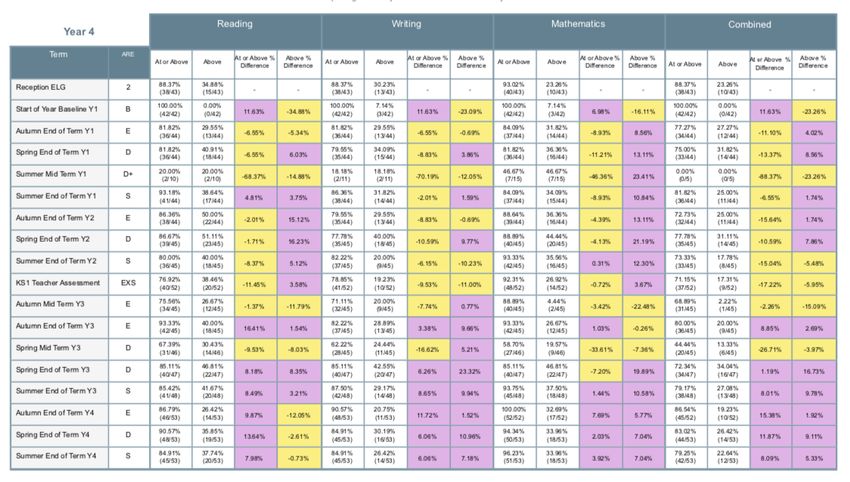
Contents

Review of school performance KS1 and KS2 2018/19………….page 3

Developing Excellence Plan 2019/20…………………………….page 19

Early Years review of performance and action plan…………….page 62

Appendices
 - Staff tasks towards DEP implementation……………………page 41
 - Sport’s funding document 2019/20…………………………..page 45
 - Pupil premium action plan 2019/20………………………….page 50
 - Summary SEF 2019/20……………………………………… page 56

                                  2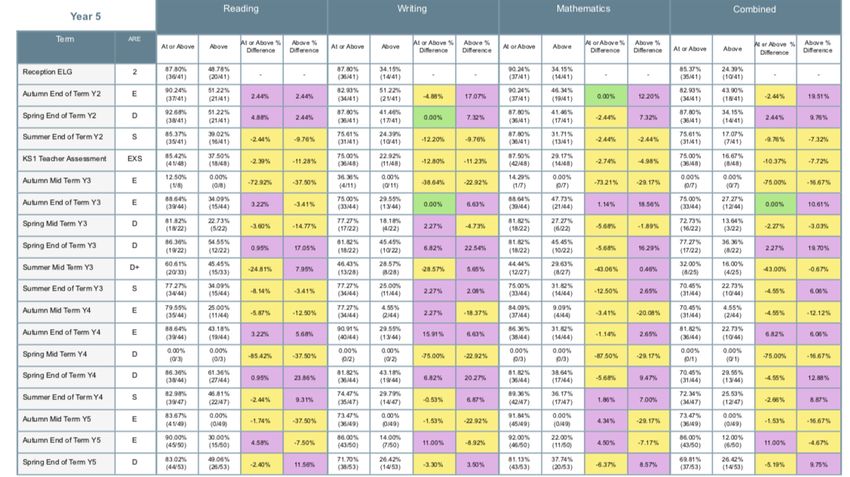
Review of school
  performance
    2018/19

       3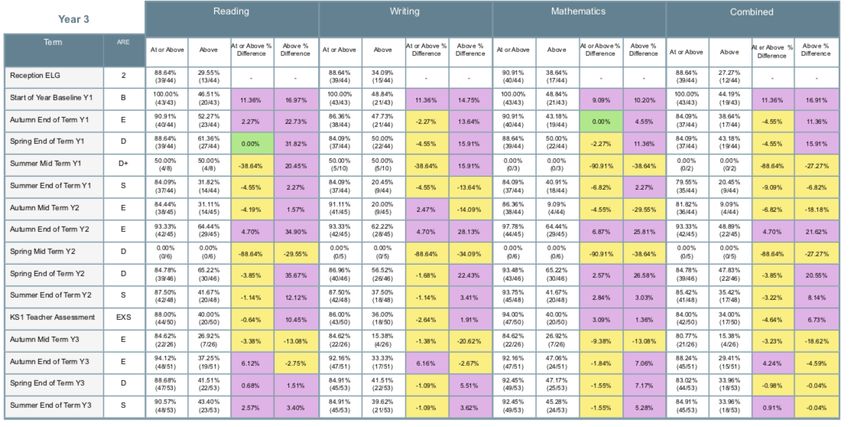
Y1 Progress and Attainment 2018/19
 7 SEN:      Historical data: On entry to FS1 2016   Historical data: on exit to FS2 2018    Attainment Summer       Attainment Y1B 2019    Attainment Y1E 2019
pupils; 9                                                                                     2019 whole cohort
PP pupils
% RWM                         %             %                     %             %                        %                      %                       %
                                                                                            % expected   exceeding    % ARE     Exceeding    % ARE      Exceeding
  exp:        % below      expected     exceeding    % below      expected      exceeding
 Maths          40            60            0          11            89            29          96            30        91          36        100           25
Reading         56            44            0          16            84            33          91            37        86          41         96           33
Writing         60            50            0          16            84            19          91            22        86          18         96           25
 SPAG                                                                                          87            22        77          18         96           25
   SEN                                                                                         71            0          0           0         50            0
  maths
   SEN                                                                                         71            0         50           0        100            0
 reading
   SEN                                                                                         57            0         25           0        100            0
 writing
   SEN                                                                                         57            0         25           0        100           0
  SPAG
  Maths                                                                                        96            40        92          46        100           33
   Boys
  Maths                                                                                        95            19        89          22        100           33
   Girls
 Reading                                                                                       92            40        85          54        100           25
   Boys
 Reading                                                                                       90            33        89          22         92           41
   Girls
 Writing                                                                                       86            19        78          11         92           25
   Girls
 Writing                                                                                       96            24        92          23        100           25
   Boys
Spag Girls                                                                                     81            19        67          11         92           25
Spag Boys                                                                                      92            24        85          23        100           25
  Maths                                                                                       100            33       100          33        100           33
  Pupil
Premium
 Reading                                                                                       89            44        67          33        100           50
  Pupil
Premium
 Writing                                                                                      100            22       100           0        100           33
  Pupil
Premium
SPAG PP                                                                                        57            0         25           0        100            0

                                                                                        4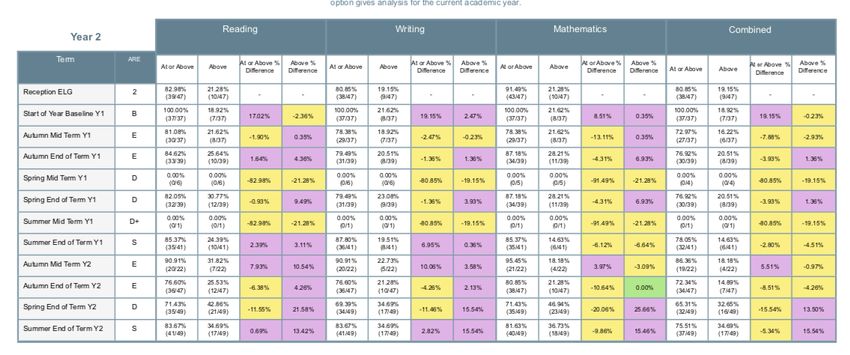
Y1 Progress and Attainment:

 Phonics

   % school passing phonics screen               % national passing phonics screen              % PP (school) passing phonics
   Y1 2019                                       Y1 2019                                        screen Y1 2019
                 85%                                            82%                                           89%

Impact:
  The % pupils passing the phonics test is above national (an improvement on 2018).
  Very good progress has been made from the end of EYFS to the end of Y1 in reading and writing and maths at Expected and Greater Depth.
  At the expected standard, there are no significant gaps between the performance of boys and girls.

 Implications for future action:
      •    Improve progress rates in maths for this cohort and for Y1 2020.
      •    Close gaps in performance in performance at GDS in favour of boys for this cohort.
      •    Improve outcomes in SPAG for PP pupils.

                                                                                        5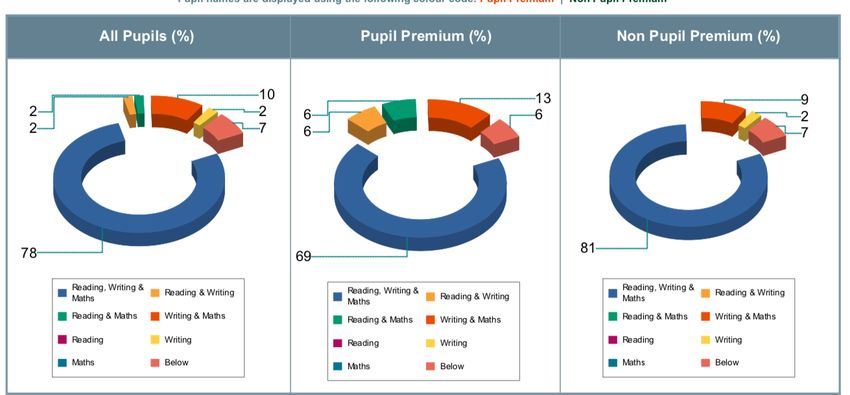
Y2 Progress and Attainment 2018/19
 SEN: 5      Historical data: On entry to FS1     Historical data: on exit to FS2       Attainment            Attainment         Attainment Y2S      Attainment Y2
pupils; 7                  2015                                2017                   Summer 2018 y1         Y2G/Sh 2019               2019           whole cohort
PP pupils                                                                                 cohort
% RWM                       %            %                    %            %                     %                    %                   %
                                                                                         %       exceeding   % ARE   Exceeding   % ARE   Exceeding   % ARE   % GDS
exp:76%      % below     expected    exceeding   % below      expected    exceeding
                                                                                      expected
  Maths        41          59           10          7            93          10         86           14       75       46         88       28         82       37
 Reading       51          49           10         14            86          21         83           24       83       42         84       28         84       35
 Writing       51          49           10         14            86          19         86           19       83       42         84       28         84       35
  SPAG                                                                                  76           17       63       29         80       29         63       26

   SEN                                                                                  40           0        25        0         86        0         64       0
  maths
   SEN                                                                                   0           0        50        0         57        0         55       0
 reading
   SEN                                                                                   0           0        50        0         57        0         55       0
 writing
SEN SPAG                                                                                 0           0        36        0         25        0         43       0
  Maths                                                                                 87           13       70       40         88       29         81       33
  Boys
  Maths                                                                                 84           16       79       50         88       25         82       41
  Girls
 Reading                                                                                83           30       78       30         76       29         80       30
  Boys
 Reading                                                                                84           16       86       50        100       25         91       41
  Girls
 Writing                                                                                89           16       85       50        100       25         91       41
  Girls
 Writing                                                                                83           22       80       30         76       29         78       30
  Boys
Spag Girls                                                                              79           11       71       36        100       25         82       32

Spag Boys                                                                               74           22       50       20         71       29         63       26

 Maths                                                                                 100           20       67       63         80       40         75       50
  Pupil
Premium
Reading                                                                                 40           40       67       67         40       40         50       50
  Pupil
Premium
 Writing                                                                                40           20       86       50         60       40         63       50
  Pupil
Premium
SPAG PP                                                                                                       67       33         40       40         50       38

                                                                               6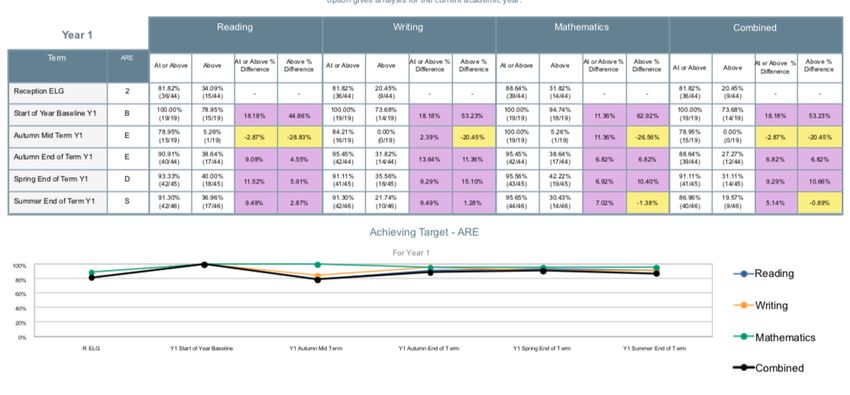
Comparisons with national:
                                                                              Working at Greater Depth within
                          Working at the Expected Standard
   Key Stage 1                                                                    the Expected Standard
                               School                   National                 School           National
    Reading                     84%                      75%                      35%               25%
    Writing                     84%                      69%                      35%               15%
  Mathematics                   82%                      76%                      37%               22%
   R, W & M                     76%                      65%                      35%               11%

          *Please note mid-term assessments are only undertaken for a small number of pupils who have raised concern.

Impact:
    •   Outcomes for expected and greater depth are well above national in all areas, including at Greater Depth. Good progress was made from the end of FS2 in reading and writing. Progress
        was slower in mathematics. The progress of more able pupils was very good in all areas.
    •   12 new pupils arrived in Y2 over the academic year.

Implications for future action:
     •    Increase progress rates in maths at KS1.
     •    Narrow gap in attainment in reading and writing in favour of girls for this cohort.

                                                                                                7
Y3 Progress and Attainment 2018/19
SEN: 9 Historical data: On entry to Historical data: on exit to FS2 End of KS1 2018 Attainment Attainment Attainment
pupils; 11 FS1 2014 2016 Summer 2019 Y3W Summer 2019 Summer 2019
PP pupils Y3C whole cohort Y3
% RWM % % % % % % % Exp % GDS % Exp % GDS % Exp % GDS % Exp % GDS
exp:85% below expected exceeding below expected exceeding
Maths 53 47 9 11 89 39 92 41 97 48 88 42 92 45
Reading 53 47 9 13 87 30 86 41 97 41 83 42 91 46
Writing 53 47 9 11 89 37 88 37 86 41 73 27 85 40
SPAG 80 33 86 31 83 17 85 25
SEN 50 0 100 0 25 0 56 0
maths
SEN 33 0 80 0 0 0 44 0
reading
SEN 33 0 40 0 0 0 22 0
writing
SEN 11 0 22 0 0 0 20 0
SPAG
Maths 15 85 25 92 37 93 57 82 36 88 48
Boys
Maths 8 92 50 93 44 100 40 92 46 96 43
Girls
Reading 20 80 20 79 29 93 36 73 37 84 36
Boys
Reading 8 92 38 93 52 100 47 92 47 96 46
Girls
Writing 4 96 50 96 41 93 47 92 46 93 46
Girls
Writing 20 80 20 79 33 73 27 92 46 93 46
Boys
Spag 81 33 93 27 92 15 93 21
Girls
Spag 79 33 76 28 73 18 79 36
Boys
Maths 93 44 100 0 71 29 82 18
Pupil
Premium
Reading 80 40 100 0 72 43 82 27
Pupil
Premium
Writing 90 30 75 0 71 14 73 9
Pupil
Premium
SPAG PP 60 30 40 0 0 0 73 0
8*Please note mid-term assessments are only undertaken for a small number of pupils who have raised concern. There were 5 new pupils in y3 compared to the end of Y2.
Y3 pupil progress and attainment
Impact:
Outcomes are strong at the end of Y3 in reading, writing and maths and the Expected standard and at Greater Depth. Boys and PP perform less well compared to girls
in SPAG and boys perform less well in maths and reading compared to girls, although girls perform exceptionally well. Progress is good from starting points.
Implications for future action:
• Accelerate the progress of PP pupils in this cohort in all areas.
• Accelerate the progress of boys and PP in SPAG for this cohort.
• Continue to improve writing attainment for this cohort in order to narrow gaps with starting points.
9Y4 Progress and Attainment 2018/19
14 SEN: Historical data: On entry to Historical data: on exit to Attainment Attainment Attainment Attainment Attainment Y4
pupils; 15 FS1 2013 FS2 2015 End KS1whole end of Y3 Y4c 2019 Y4 K 2019 whole cohort 219
PP pupils cohort 2017
% Exp % % % % % % % % % % % %
GDS % Exceeding ARE Exceeding % ARE Exceeding
RWM: 79 % expected exceeding % expected exceeding Exp GDS Exp ARE
below below
Maths 73 27 0 9 91 24 94 34 94 36 100 37 92 31 96 34
Reading 56 44 0 14 86 35 81 38 86 40 93 33 81 35 87 34
Writing 58 42 0 14 86 31 83 19 88 28 89 33 81 19 85 36
SPAG 83 23 100 33 77 27 89 30
SEN 71 0 77 0 100 0 83 0 93 0
maths
SEN 29 0 62 0 75 12.5 33 0 57 7
reading
SEN 29 0 54 0 63 0 33 0 50 0
writing
SEN 29 0 54 0 100 0 33 0 71 0
SPAG
Maths 91 24 96 29 100 27 100 33 100 30
Boys
Maths 96 42 92 42 100 50 86 29 92 39
Girls
Reading 71 19 79 21 87 20 75 25 81 22
Boys
Reading 88 36 92 58 100 50 86 29 92 39
Girls
Writing 88 27 96 42 100 50 93 36 96 42
Girls
Writing 77 10 79 12.5 80 20 67 0 74 11
Boys
Spag Girls 88 34 100 50 86 43 92 46
Spag Boys 76 10 100 20 67 8 85 15
Maths 82 0 91 9 100 17 78 0 87 7
Pupil
Premium
Reading 82 18 91 21 100 17 67 0 80 7
Pupil
Premium
Writing 55 0 91 18 67 17 67 0 67 7
Pupil
Premium
SPAG PP 55 0 100 0 33 0 71 0
10*Please note mid-term assessments are only undertaken for a small number of pupils who have raised concern. There were 8 new pupils in y4 compared to the end of Y2.
Y4 pupil progress and attainment
Impact:
Outcomes are strong at the end of Y4 in reading, writing and maths and the Expected standard and at Greater Depth. Boys and PP perform less well compared to girls
all areas, most notably in writing. Progress is good from starting points (end of KS1) in all areas and for combined RWM.
Implications for future action:
• Accelerate the progress of PP pupils in this cohort in writing and SPAG in particular.
• Accelerate the progress of boys in this cohort so that the gap in attainment compared to girls is narrowed in all areas, particularly in writing and in particular for
the Y4K cohort.
11Progress and Attainment: Year 5 2018/19
7 SEN pupils; 17 Historical data: Entry to Historical data: Exit to End of KS1 2016 Attainment 2018 Attainment 2019
PP Pupils FS1 2012/13 FS2 2014
Y5C % GDS
Y5H % Exp
Y5C % Exp
Y4F % Exp
%expected
Y4L % Exp
% (Greater
expected
expected
% above
% above
% Below
% below
% below
(cohort)
(cohort)
(cohort)
(cohort)
% GDS
% GDS
Depth)
Y4F %
Y4L %
% Exp
% Exp
GDS
GDS
GDS
Y5H
%
%
Maths 83 17 0 13 87 33 0 87 29 88 35 88 33 88 36 83 35 82 39 85 31
Reading 72 28 0 16 84 47 2 87 36 84 45 79 42 88 48 81 48 82 43 81 54
Writing 64 36 0 13 87 31 4 78 22 76 29 71 17 80 40 72 33 75 39 69 27
Spag 4 78 42 82 35 75 25 88 44 72 35 75 39 69 31
SEN maths 0 50 0 43 0 50 0 33 0 25 0 50 0 0 0
SEN reading 25 50 0 43 0 50 0 33 0 13 0 0 0 25 0
SEN writing 50 25 0 0 0 0 0 0 0 0 0 0 0 0 0
SEN spag 50 50 0 43 0 50 0 33 0 0 0 0 0 0 0
Maths Boys 0 79 25 81 31 79 21 83 42 74 22 77 23 71 21
Maths Girls 0 95 33 96 39 100 59 92 31 93 48 92 39 93 57
Reading Boys 4 89 25 81 35 79 27 83 42 70 33 69 39 71 29
Reading Girls 0 95 48 87 57 80 60 92 54 93 63 93 57 92 69
Writing Girls 4 96 33 91 39 90 30 92 46 89 32 93 57 85 46
Writing Boys 4 63 13 62 19 57 7 67 33 56 15 57 21 54 8
Spag Girls 5 95 57 91 44 90 40 92 46 89 52 93 57 85 46
Spag Boys 4 67 29 73 27 64 14 83 42 56 19 57 21 54 15
Pupil Premium 0 77 12 82 24 80 20 86 27 79 16 75 12.5 82 18
maths
Pupil premium 6 76 12 76 18 70 10 86 27 79 32 75 25 82 37
reading
Pupil premium 12 59 6 76 12 80 10 71 14 63 11 63 12.5 64 19
writing
Pupil Premium 12 59 18 82 35 70 10 86 27 68 11 63 12.5 73 7
Spag
Y5 pupil progress and attainment (see also table below showing progress over time)
Impact:
Outcomes are good at the end of Y5 in reading, writing and maths and the Expected standard and at Greater Depth. Boys and PP perform less well compared to girls all
areas, most notably in writing and SPAG. Gaps in attainment between boys and girls in favour of girls have not been sufficiently narrowed over the academic year.
Progress is good from starting points (end of KS1) in all areas at Greater Depth but progress has been slower at Expected (see table below).
Implications for future action:
• Accelerate the progress of PP pupils and boys in this cohort in writing and SPAG in particular.
• Improve attainment levels at the expected standard.
12*Please note mid-term assessments are only undertaken for a small number of pupils who have raised concern. There were 13 new pupils in y5 compared to the end of Y2.
.
13Progress and Attainment: Year 6 2018/19
SEN=13 pupils, Historical data: On entry to Historical data: exit to Historical data: end of Attainment 2018 Attainment 2019
.PP= 16 pupils FS2 2012/13 FS2 2013 KS1 2015
10 NEW pupils added
% GDS Y5H
% GDS Y5C
exceeding
exceeding
to year group in y6, 3
Exceeding
expected
expected
% below
% below
% AS Y5H
% AS Y5C
Expected
% Below
of which were SEN and
(cohort)
(cohort)
% GDS
%
%
%
%
(cohort)
(cohort)
% GDS
3 PP.
% AS
% AS
%
%
Maths 69 31 0 11 89 29 2 89 29 83 34 79 31 87 37 90 32
Reading 59 41 0 11 77 33 4 89 33 86 44 79 41 94 44 83 17
Writing 62 38 0 23 77 13 7 77 13 78 32 76 34 80 30 92 31
spag 76 39 76 41 77 37 86 39
SEN maths 17 50 0 30 0 25 0 33 0 62 15
SEN reading 33 33 0 50 0 0 0 33 0 54 8
SEN writing 50 0 0 20 0 0 0 33 0 69 15
SEN spag 20 0 0 0 33 0 54 8
Maths Boys 5 87 32 79 38 69 39 88 38 84 42
Maths Girls 0 95 26 87 30 88 25 86 36 96 21
Reading Boys 10 82 32 79 38 69 39 88 38 77 29
Reading Girls 0 96 35 93 47 94 43 93 50 86 4
Writing Girls 0 92 27 87 40 88 44 86 36 96 29
Writing Boys 14 64 5 69 24 62 23 75 25 87 33
Spag Girls 83 43 88 44 79 43 93 43
Spag Boys 69 35 62 39 75 31 81 32
Maths Pupil 0 90 20 92 23 100 0 88 38 88 12.5
Premium
Reading Pupil 0 80 10 92 23 100 0 88 38 81 12.5
Premium
Writing Pupil 0 70 10 85 15 100 0 75 25 88 13
Premium
Spag Pupil 77 23 100 0 63 38 81 25
premium
Evaluation of impact:
The majority of pupils perform at a level that is in line with age related expectations in maths, reading, writing and spag. The proportion pupils performing below age related has
decreased over the year in maths writing and SPAG, but increased slightly in reading: however this is a cohort that has experienced a significant level of mobility with 10/60 pupils new to
Y6 in Y6. The % progress from entry to school in FS2 to end of y5 is outstanding in maths and writing. The % pupils working as higher ability pupils increased for the cohort since end of
FS2 and from end of KS1 in maths and writing, which was the focus of school action. Outstanding progress has been made for the cohort from entry to school in 2012.
Issues for action:
Pupils struggled to complete the reading SAT paper and some pupils who had performed well throughout their y6 year failed to make both expected standard or greater depth standard. This
was the case for both boys and girls, those who were new to our school in y6 but also some who were not. The school needs to accelerate the progress of pupils in reading by improving
school-wide strategies for developing fluency and stamina in reading.
14Working at Greater Average Scaled • Outcomes were significantly above national at Expected in writing
Working at the
Depth within the Score and maths and well above national in reading, GPS and RWM combined.
Key Stage 2 Expected Standard
Expected Standard • Outcomes were above national at GDS in writing, maths, GPS.
School National School National School National
• Combined RWM AS for PP was above national for all pupils (69%)
Reading 83% 73% 15% 27% 104 104
Writing 92% 79% 31% 20%
Mathematics 90% 76% 25% 27% 107 105
GPS 86% 78% 39% 36% 107 106
R, W & M 80% 65% 10% 10%
PROGRESS END OF KS2 2019
This was a challenging Y6 cohort with high mobility in upper KS2, however outcomes were strong represented significant achievement and progress over time:
All pupils On entry to FS2 Exit to KS1 2015 Attainment Y6 % progress (+/-) % progress (+/-) entry Progress score
2012 2019 entry FS2 to end end of KS1 – end of
of KS2 KS2
% EXP % % % % EXP % % EXP % % EXP % GDS
GDS EXP GDS GDS GDS
Reading 41% %0 89% %23 81% 13% +40% +13% -8% -10% 0 (-1.7-1.5)
(mobility)
Writing 38% 0% 77% 13% 92% 31% +54% +31% +15% +18% 2.9 (1.5-4.4)
Maths 31% 0% 89% 29% 90% 32% +59% +32% +1% +3% 2.1 (0.7 – 3.4)
RWM combined
outcomes were well above
national for all pupils and pupil
premium pupils (national 65%),
however not significantly above
as pupils performed less well than
expected in reading compared to
teacher assessment.
15Pupil at the end of KS2 2019 performed well compared to national expected in all areas and in writing and maths at Greater Depth. Boys outperformed national in all areas. Girls
performed well at expected but below national at GDS in reading and maths.
Overall, attainment is strong in all areas with greater depth in reading an area for improvement.
Implications for future action:
• Continue to raise attainment in reading in order to accelerate progress rates so that attainment at GDS is in line with writing and maths
• Target support for pupils in the 2019/20 Y6 cohort who have not yet securely age related in RWM,
• Continue to raise the attainment of pupil premium pupils in all areas for the Y6 2019/20 cohort.
16Group Analysis Whole School 2019 Y1 – Y5
• Overall, pupils perform at Expected well above national. They perform less well in writing compared to other aeas.
• Boys perform less well in reading and writing across school compared to girls.
• Pupil Premium pupils achieve well in maths but the English gap with their peers needs to continue to close in 2020.
• BME pupils (35 in total) perform well compared to Non BME pupils.
17Foundation subjects assessments 2018/19:
% Art % % % Design % % RE % % % French PE
Geography History and Music Science Computing
Technology
Y1 % 76/17 96/0 97/0 93/4 100/0 96/0 91/7 93/4 91/6
Expected/GDS
Y2 % 86/2 78/4 80/4 86/2 92/0 86/6 86/18 93/0 88/10
Expected/GDS
Y3 % 74/27 80/17 74/24 76/24 98/2 85/15 89/33 81/19 89/7 72/28
Expected/GDS
Y4 % 100/0 100/0 100/0 100/0 81/19 100/0 100/0 100/0 100/0 77/22
Expected/GDS
Y5 % 78/12 73/19 77/15 46/19 96/4 89/8 81/31 69/19 92/3 80/19
Expected/GDS
Y6 % 91/8
Expected/GDS
18Developing
Excellence Plan
2019-20
19WHOLE SCHOOL ISSUES AND IMPLICATIONS FOR ACTION ARISING FROM OUTCOMES 2018/19:
The detailed picture…….
KS1 Areas for development:
Y2 2019/20:
• Improve progress rates in maths for at KS1
• Close gaps in performance in performance at GDS in favour of boys for this cohort.
• Improve outcomes in SPAG for PP pupils.
• Accelerate the progress of pupils in reading by improving school-wide strategies for developing fluency and stamina in reading.
KS2 Areas for development:
Y3 2019/20:
• Increase progress rates in maths for this cohort.
• Narrow gap in attainment in reading and writing in favour of girls for this cohort.
• Accelerate progress for pupil premium pupils in all areas
• Accelerate the progress of pupils in reading by improving school-wide strategies for developing fluency and stamina in reading.
Y4 2019/20:
• Accelerate the progress of PP pupils in this cohort in all areas.
• Accelerate the progress of boys and PP in SPAG for this cohort.
• Continue to improve writing attainment for this cohort in order to narrow gaps with starting points.
• Accelerate the progress of pupils in reading by improving school-wide strategies for developing fluency and stamina in reading.
Y5 2019/20:
• Accelerate the progress of PP pupils and boys in this cohort in writing and SPAG in particular.
• Improve attainment levels at the expected standard.
• Accelerate the progress of pupils in reading by improving school-wide strategies for developing fluency and stamina in reading.
Y6 2019/20:
• Accelerate the progress of pupils in reading by improving school-wide strategies for developing fluency and stamina in reading.
• Accelerate the progress of PP pupils and boys in this cohort in writing and SPAG in particular.
• Improve attainment levels at the expected standard
20EMERGING ISSUES (the overview):
(Outcomes of self-evaluation activities from 2018/2019)
Quality of education
• Embed curriculum programmes of study (Cornerstones/ Abacus maths/ RWI spelling/Reflex maths), including embedding with new staff and staff new
to year groups, to ensure the curriculum offer is broad, full and balanced, studied by all and is both knowledge-led whilst promoting mastery of skills.
• Tighten systems for the teaching of reading in order to accelerate achievement for all. Improve fluency and stamina.
• Revise assessment procedures in order to improve accuracy of formative and summative assessment, therefore improving teachers’ ability to target
any gaps in knowledge and understanding and raise achievement. Embed marking policy with new staff and introduce new assessment systems across
school.
• Raise attainment in reading, writing and maths so that outcomes are significantly above national in all areas: target at least 90% RWM in each year
group. Do this by closing gaps in attainment for groups of pupils (in particular pupil premium pupils and boys), through improving the subject
knowledge of staff, evaluating and monitoring the targeted support to pupil premium pupils more closely and by ensuring consistency and progression
across all subject areas.
Behaviours and Attitudes
• Introduce a spiral curriculum across Foundation subjects (already established in maths and English) and promote learning which arises from teachers’
understanding of metacognition. Teach teachers about the science of memory and support pupils to develop more effective learning styles.
Personal development
• Continue to a deploy sport’s coach (WSSC) who will focus on preparing pupils for competitive sport and encouraging them to engage in physical
activity.
• Establish a strong culture of character development – teach children to be respectful, not afraid to take risks in their learning and to be resilient. Use
Collective Worship sessions and RE as a catalyst for exploring personal development.
Leadership and Management
• Promote an inclusive and ambitious vision for all. Revise the intervention timetables to enable access for all learners to a full and balanced curriculum.
• Raise achievement by strengthening the quality of teaching and learning. Plan high quality CPD for all staff, thereby improving teacher subject
knowledge, including exploration of quality questioning for mastery and developing staff’s expertise at breaking down a learning objective into its
smallest components.
21A C T I O N P L A N 2019/20
Improvement Priority 1 Remove barriers to pupil progress in order for all groups of learners to make good progress.
Success Criteria: We will know we are successful when …
• All cohorts and groups achieve at least good progress per annum and the % outstanding progress is accelerated in RWM
• Provision raises standards and is responsive to children’s needs.
• Teaching is responsive to need, takes account of the needs of all groups of learners and is focused and simple.
• Any gap in performance in favour of girls are reduced, in particular in reading and writing.
• Pupil premium pupils have a highly structured support system in place, teaching styles match their needs perfectly and the gap is narrowed for PP pupils
performing below age related
Objectives Lead Milestones Time Monitoring and Evaluation
Person scale
What By When Outcome
who
m
Securing outstanding outcomes for the Y6 cohort 2019/20:
1. Reduce barriers RC/CC End of
to progress for the year
• Target support for pupils in the y6 2019/20 cohort who have
Y6, ensuring high
standards are at
not yet secure age related in maths and English lesson AA/ Half Outcomes for Y6
least maintained and • Reduce the gap in performance between pupil premium pupils observatio JA termly pupils continue to
improved and their peers in maths, reading, writing and SPAG ns/ drop improve and RWM
• Target PP pupils in the y6 2019/20 cohort to ensure outcomes ins combined expected
are at least in line with peers attainment is well
• Improve % EXP in reading by the end of the key stage so that above national by
2020.
outcomes are well above national attainment
Outstanding
progress is made by
the cohort and
groups of pupils,
including PP.
2. Continue to • Narrow the gap between secure age-related attainment for PP pupils and their By Monitoring JA/A Termly A highly structured
improve outcomes JA/TO/A peers (personal education plans in place for all PP pupils regardless of ability to end of of A/T and rigorous plan is
for pupil premium A be quality assured, monitored and evaluated). year personal O in place to ensure
pupils • Targeted support for all vulnerable PP cohorts/ pupils in order to raise attainment education the progress rates of
and ensure that the gap with their peers is narrowed. Monitor and evaluate this plans PP pupils are
targeted support regularly (JA/TO) accelerated
• All PP pupils who are not on track to secure ARE or to make sufficient progress Pupil Outcomes are
to have a gap analysis carried out; interventions planned/ monitored/ evaluated; interviews improved in all
targeted first quality teaching support given. cohorts for PP pupils
and any gaps are
narrowed
3. Narrow gender JA/AA/V • Continue to narrow the gap between boys and girls attainment in favour of girls June Pupil AA/J Termly
gaps for some A/HW for some cohorts. Do this through: 2020 progress B % boys attaining
cohorts in favour of - Bespoke programmes of support for underperforming cohorts and groups meetings expected or
girls (at ARE or for Drop ins exceeding
- Planning that is fluid and appropriate for the needs of all pupils
more able pupils) Pupil statements raised in
interviews 2019/20 for cohorts
22- Further improve outcomes in SPAG/ spelling elements of writing across Work with gender gaps,
scrutiny gaps to be narrowed
school for all pupils, with a particular focus on boys and PP, through
(literacy compared to
ensuring that RWI spelling programme is embedded. Link spelling and spag 2018/19.
competitions through house teams in order to inspire boys through books)
competition Monitoring
- Planning to be more ‘purposeful’ to inspire boys: use of Cornerstones. of long
term
- Raise achievement in boy’s writing so that progress from KS1 to the end of planning
KS2 is at least good for all cohorts and the good outcomes in writing at the
end of KS2 in reading are at least maintained.
- Continue to raise attainment for boys in cohorts with more notable gender
gaps for average or more able pupils.
(see also Maths and English action plan)
23A C T I O N P L A N 2019/20
Improvement Priority 2 Remove barriers to pupil progress in order for all groups of learners to make good progress by embedding the
strategy of ‘teach simply’.
Success Criteria: We will know we are successful when …
• All cohorts and groups achieve at least good progress per annum and the % outstanding progress is accelerated in RWM
• Provision raises standards and is responsive to children’s needs.
• Teaching is responsive to need, takes account of the needs of all groups of learners and is focused and simple.
Objectives Milestones Time Monitoring and Evaluation
Lead
scale
What By When Outcome
whom
Outcomes in writing
• Through coaching strategies, ensure that teachers break down teaching improve, in particular
Improve for low attaining groups
objectives into their simplest form: CPD with a focus on breaking Deep dive AA/JA/
the and pupils at risk of not
AA/JA/ objectives into components/ composites/ C planning. Improve subject Sep monitoring: TO/JSh/ Half
quality of knowledge of teachers so that they are able to use this knowledge to plan making sufficient
the HW/JS 2019- HW termly progress from starting
from misconceptions.
teaching July Drop-ins points.
• Ensure planning methods in maths focus on the development of small
of steps. Embed use of bar modelling as a strategy for teaching simply how
2020
English to solve complex reasoning problems as a tool for mathematical thinking. Book The gap between
and Continue with maths mastery approaches within a spiral curriculum. scrutiny current attainment in
all year groups and
maths so • Improve teacher subject knowledge of genres and use a consistent yet
the school target of
that simple and progressive writing framework throughout year groups. Lesson
90% RWM Exp is
teaching • Introduce simple but effective strategies for teaching common exception obs narrowed.
words/ commonly used words, ensuring that current research into the
focuses
science of memory are deployed. Ensure all resources, working walls, Pupil
on vocabulary and strategies are consistent across the key stage.
The % pupils performing
delivering interviews below expected in maths
• Develop staff confidence in assessing pupil progress in reading is improved across year
simple (benchmarking) and planning simple strategies for narrowing gaps in groups, particularly for
lessons achievement for SEN pupils and low attainers in reading. SEN/PP/lower ability
which • Improve teacher subject knowledge in the area of the science of pupils.
impact memory, the principles of instruction and metacognition (staff text for
positively CPD: Rosenshine) as a means of enabling staff to further develop skills The % pupils performing
of ‘teaching simply’. below expected in
upon reading is improved
pupil • In connection with improving staff subject knowledge, develop depth for
across year groups,
progress mastery questioning in order to increase access to outstanding teaching. particularly for
througho Introduce a simple framework for teachers to scaffold questioning, SEN/PP/lower ability
thereby ‘digging deeper’ and improving AFL (Ideas for Depth). Develop pupils.
ut school. the central idea of teaching with variation to highlight the essential
features of a concept or idea through varying the non-essential features The % pupils performing
• Simplify and structure scaffolds for low ability pupils to enable them to below expected in writing
achieve success and attain expected standards. Continue to train TA’s is improved across year
to support less able pupils well, fostering independence rather than over- groups, particularly for
scaffolding support. SEN/PP/lower ability
pupils and boys.
•
(see also maths and English action plan).
24A C T I O N P L A N 2019/20
Improvement Priority 3 Practice thoroughly: To ensure that all pupils have mastery of core elements in RWM, by ensuring fitness fluency and retrieval practice in
Maths and English is an essential part of daily provision for all cohorts and barriers to progress are removed for all pupils including
vulnerable groups.
Success Criteria: We will know we are successful when …
• Pupils’ basic skills in maths, reading and writing are firmly established for all pupils
• Fitness fluency and retrieval practice is an established part of daily teaching
• Pupils practice regularly skills needed to master RWM
• Pupils’ knowledge and understanding of key skills are deep and established rather than shallow, so that they are instantly able to recall them
and apply them in a variety of contexts
• The % pupils working at the expected standard in all year groups is increased and no children are left behind.
Objectives Milestones Time Monitoring and Evaluation
Lead
scale
What By When Outcome
whom
• Embed Fluency Fitness strategies in ENGLISH AND MATHS, Outcomes in writing
Improve the ensuring fluency skills are taught every day so that children improve, in particular for
quality of the have the opportunity to practice thoroughly in order to Deep dive AA/JA low attaining groups and
teaching of AA/J embed new concepts and number facts in Maths and basic skills Sep monitoring: Half pupils at risk of not
English and in English. Introduce Reflex Maths to support this across all year making sufficient
A/JS/ 2019- termly
maths so that groups. progress from starting
HW/V July Drop-ins
teaching • Fluency Fitness ‘non-negotiables’ for each year group to be points.
A sent home and shared in parent workshops. This will detail 2020
allows for
what each year group should know by the end of the year. Book
opportunity The gap between
• Embed the teaching and learning of fluency linked to scrutiny
to practice current attainment in all
thoroughly the science of memory. CPD on Retrieval Practice year groups and the
skills and research with all staff and develop the use of working Lesson obs school target of 90%
memory. All staff to investigate the use of retrieval
knowledge RWM Exp is narrowed.
practice as a learning tool. What did we learn last week Pupil
learned, thus that helped us today?
impacting interviews The % pupils performing
• In English, continue to use CLPE or equivalent recommended,
positively below expected in maths is
age appropriate texts to inspire, model and continue to
upon pupil improved across year
develop fluency across all English strands. Provide more able
progress groups, particularly for
pupils the opportunity to ‘read around the text’ in order to
throughout SEN/PP/lower ability
practice reading skills and in addition improve their vocabulary
school. pupils.
range and agility.
• Provide more opportunities for children to read across the The % pupils performing
curriculum in order to practice their reading skills thoroughly. below expected in reading
Explore echo reading and similar strategies to improve reading
is improved across year
fluency and stamina. Track reading speed of all pupils and
groups, particularly for
benchmark regularly – ensuring benchmarking is monitored by
SEN/PP/lower ability
SLT.
pupils.
• Introduce/embed with new staff a spiral curriculum to support the
science of memory and retrieval practice: Understanding The % pupils performing
Christianity; Cornerstones; (including continuing to embed below expected in writing is
Abacus maths and the revision of genre focus in writing so there
improved across year
is progression throughout KS2.)
groups, particularly for
SEN/PP/lower ability pupils
and boys
25A C T I O N P L A N 2019/20
Improvement Priority 4 Remove barriers to pupil progress in order for all groups of learners to make good progress
by embedding the strategy of ‘feedback constructively’.
Success Criteria: We will know we are successful when …
• All cohorts and groups achieve at least good progress per annum and the % good progress is accelerated in RWM
• Provision raises standards and is responsive to children’s needs.
• More pupils access good or better teaching, learning and assessment
• Outcomes for groups and all pupils improve for as a result of accelerated progress resulting from outstanding teaching and learning in relation to feedback
and effective use of assessment for learning
Objectives Milestones Time Monitoring and Evaluation
Lead
scale
What By When Outcome
whom
Improve the quality of AA • Improve marking and feedback, Intro new assessment Monitoring of Partner Termly Outcomes in writing
the teaching of English allowing pupils enough time to assessments schools improve, in particular for
system Autumn 2019
and maths so that JS respond to feedback and low attaining groups and
teaching allows for improve their work: focus on live pupils at risk of not
JA Testing introduced by
feeding back marking and feedback. making sufficient
constructively, thus Dec 2019
• Introduce new summative assessments progress from starting
impacting positively for RWM: points.
upon pupil progress - Revise KPI’s, ensuring that there are
QLA by Jan 2020 Analysis of Test AA/JA/JS Termly
throughout school. scores
clear non-negotiable statements that The % pupils performing at
Improve summative each child needs to achieve in each Moderation of writing expected in maths is
assessment year group. Revise statement criteria assessments improved across year
procedures in order to and terminology (move to Jan/April/June Marking scrutiny AA/JA/JS groups, particularly for
improve the accuracy WT/EXP/GDS for all year groups to Half SEN/PP/lower ability
of teacher judgements, allow for greater consistency and to termly
Pupil progress pupils.
therefore impacting support parents with their
positively on tracking understanding of assessment). meetings termly or
most often if needed. AA/JA The % pupils performing at
and pupil progress. - Introduced summative testing termly for Pupil progress expected in reading is
each year group. meetings Termly improved across year
- Analyse (question level analysis) in New assessment groups, particularly for
depth testing for individuals in order to system well embedded SEN/PP/lower ability
inform next steps by July 2020 pupils.
- Improve the quality of pupil progress
meetings, allowing for conversation The % pupils performing at
about in-depth analysis of test results. expected in writing is
- Moderate assessments across improved across year
partnership of schools with Exec HT
groups, particularly for
SEN/PP/lower ability pupils
and boys.
Assessments and
predictions are increasingly
accurate,and teachers plan
lessons or interventions
based accurately on needs
of pupils.
26A C T I O N P L A N 2019/20
Improvement Priority 5 To accelerate progress for all pupils across the broad and balanced curriculum, ensuring that outstanding provision is embedded in all
aspects of school life and in all year groups by pursuing excellence in all aspects: embody excellence.
Success Criteria: We will know we are successful when …
• More pupils access good or outstanding teaching across all subject areas
• Outcomes for groups and all pupils improve for as a result of accelerated progress resulting from good or outstanding teaching
and learning across the curriculum and in all year groups.
Objectives Milestones Time Monitoring and Evaluation
Lead
scale
What By When Outcome
whom
Action planning for Humanities, Science, the Arts:
- Improve the • Review long term planning and ensure children Sept Deep dive SLT termly Children have full
quality of the CC/JA access the breadth of the curriculum but in a 19 – monitoring by and
access to a braid,
teaching across more meaningfully and with excellence and July SLT and subject
subject leaders balanced curriculum.
the curriculum so enjoyment. Introduce the Cornerstones 2020
leaders across
that excellence is curriculum, enabling leaders to check for the Standards in all
standard in all coverage of content and progression across curriculum, subject areas improve.
subject areas Subject year groups. including work
scrutiny
leaders • Ensure pupils acquire knowledge across the Pupils have
- Improve the opportunity to practice
curriculum as well as skills.
curriculum offer to maths and English
• Develop stronger cross curricular links in order
ensure coverage skills within foundation
for pupils to practice maths and English skills in subjects and science
and progression
all aspects of the curriculum at the same lessons.
for all pupils standard as in discrete maths and English
regardless of lessons, and to ensure that learning is multi-
ability sensory and inviting for all pupils (including more
- Ensure effective able, boys, SEN, PP).
links are made to
develop maths Action planning for RE and Collective Worship:
and English skills • Embed Understanding Christianity schemes across
in cross- all year groups to improve the quality and
curricular progression of knowledge and understanding in RE
learning. (spiral curriculum).
Action planning for Computing:
• Introduce a new computing scheme which provides
coverage and progression for all units of work.
27Literacy Action Plan 2019/20
Literacy Curriculum Intent:
“To raise the fluency of English”
To inspire children to become fluent, confident readers whose love for literature will thread through into their adult lives.
To empower children to interact with peers and adults in a confident, articulate way to prepare them for the next stage in their educational journey.
To provide a safe and secure learning culture in all literacy lessons characterised by high challenge and support.
To develop children’s rich vocabulary to support our learners to flourish, create, innovate and achieve in a variety of ways, including the written form.
To develop a genuine love and enjoyment for literacy learning characterised by positive behaviours.
For our children to achieve positive personal, social and academic outcomes, regardless of their starting point in all areas of English curriculum.
To create a culture of resilience, perseverance and resourcefulness.
To provide a curriculum for all children where the knowledge and skills are progressive and revisited.
National Curriculum “A high-quality education in English will teach pupils to speak and write fluently so that they can communicate their ideas and emotions to others and
through their reading and listening, others can communicate with them.”
Excellence and enjoyment “Teachers recognise where links are effective to enable pupils to apply the knowledge and skills learned in one subject to others, as well as
bringing coherence to learning when complementary aspects of subjects are brought together.”
What fluency means at Flanderwell:
“Fluency is the ability to draw on all areas of English together when teaching, and when learning.”
Evaluation
Improve children achieving AS and GDS in reading, especially pupil premium children and prior attainers making the required progress.
Reading
KS1 Data: KS1 PP: KS2 Data: KS2 PP:
AS = 49% AS = 0% AS = 64.4% AS = 68.8%
GDS = 34.7% GDS = 50% GDS = 16.9% GDS = 12.5%
• Benchmarking is now established across the school = next step to continue staff development for Benchmarking to ensure children both
reading fluently and comprehending. Chn to pass (at AS) a KS1 SAT paper before being moved to White – no matter whereabouts in FS/KS1
they are. Chn to pass an old curriculum (at L2) SAT paper before moving onto purple reading band. Chn who pass a new curriculum paper
at GDS (110) can be moved to brown.
• CPD work still needed with staff on how to answer SAT type questions.
• Cracking, Headstart, home reading scheme, reading into writing embedded – needs to be monitored by literacy leads.
• Children need opportunities to read around the CLPE text, either genre or author.
• Hooked on a Book developed for Y5 and Y6 with an increased range of books. Need to develop similar for Y3 and Y4.
• Book corners have improved – next step needs to be more interactive (activities and games to do) – to be used for ‘choice reading’.
• Analysis of KS2 Reading SAT needed – where did it go wrong?
• CPD needed for teaching of reading and the different reading content domains.
28Improve staff subject knowledge in SPaG & improve attainment
GPS KS1 PP: KS2 Data: KS2 PP:
KS1 Data: AS = 12.5% AS = 49.2% AS = 53.6%
AS = 42.9% GDS = 37.5% GDS = 37.3% GDS = 25%
GDS = 28.6%
• Staff meetings delivered clarification and up-knowledge teachers on phrases, clauses and sentences. Clarity on what should be taught
and when it should be taught.
• New SPaG workbooks bought for September 2019.
• Activities and teaching ideas beyond the core books needed.
• What summative assessment can we use? Do we need a class track equivalent for SPaG or should we just use the summative assessment?
Accelerate progress in writing
Writing KS1 PP: KS2 Data: KS2 PP:
KS1 Data: AS = 12.5% AS = 61% AS = 75%
AS = 49% GDS = 50% GDS = 30.5% GDS = 12.5%
GDS = 34.7%
Planning, Purpose & Audience
Progression of writing document written and coverage document written. Twilight session on this. Focus on alternative ways to teach narratives – moving
away from extended pieces and adopting the ‘less is more’ approach. Simplistic plans used throughout the school effectively. Work on purpose and
audience continued to develop. Next steps are process of writing and progression of skills. Clarification of what modelled / guided and shared is.
Vocabulary
CPD work sporadic throughout the year on vocabulary. We now need a policy or guidance or what we mean by ‘teaching’ vocabulary – has to link to
reading.
Editing Work
Children are editing their work and responding to teachers’ marking. More work is needed to develop this and ensure marking is always purposeful and will
develop childrens’ writing ability. More peer editing needed within KS2. Focused more on secretarial within some classes, e.g. just spellings and in some
cases where teachers are making the edits rather than the children. Every draft should be edited. Staff to observe good practice around school. Plans to be
edited prior to writing to ensure a high quality piece of writing is produced.
AOB
How do we take the RWI into writing?
29Objectives Actions to be taken When Deep Dive Success Criteria
Develop the • Pupil Questionnaire to investigate September 2019 Pupils VA and HW to use feedback improve the reading
enjoyment children’s thoughts and feelings about experience for children.
and fluency of reading, cracking, home reading books,
reading homework etc.
• Embed Hooked on a Book within Y5 and Ongoing Pupils Children regularly read Hooked on a Book and have
Y6 – ensure opportunities for children to opportunity to feedback.
feed back about their book are provided Y3 and Y4 have the opportunity to access hooked
regularly. Roll out hooked on a book to Y3 on a book.
and Y4 and create a new area in Y3/4
shared area.
• Continue with reading certificates, which Ongoing Teachers Children & Parents rewarded for home reading and
reward home reading at the given points. feel their time is valued.
Continue to use a central display to share
children’s success, which teachers or
teaching assistants should update
regularly. Continue to display a reading
racetrack within each classroom
displaying jumps of multiples of 10 to
motivate reading and celebrate reading
success.
• KS1 Parental engagement meeting to Autumn 2019 Curriculum Parents are clear on how children progress through
explain what book bands mean and how Leaders the book bands and the expected speed of
they can support their child at each level progression.
(inc. bed time stories).
• KS2 Parental involvement to be worked on Ongoing Teachers Parents are clear what is expected of their children
once home reading activities have been and how they can help their child.
audited.
• To ensure that good quality texts are being Ongoing Teachers Children hear a range of high quality texts regularly.
shared regularly with children using texts
from CLPE or suggested Cornerstones
Texts.
• Continue to allow KS1 and KS2 children to Children are given opportunities to read books
choose their own book to read during From September Lesson Visits chosen by them. Children are given opportunities to
independent time that sits alongside their 2019 read aloud to adults.
banded home reading book. Reading
30corners to reflect personal choices and
questionnaire feedback.
• Review of current timetable to ensure From September Pupils Children given regular opportunities to read aloud to
children are reading aloud to teachers. 2019 adults.
Provide opportunities every day for whole A range of domains are asked when children read
class reading and continue to ensure all aloud to adults.
children are heard by the class teacher or
teaching assistant on a regular basis.
Continue to use the updated reading
sheets to record individual reads with T or
TA.
• Develop the use of reading buddies From September Pupil Children have additional opportunities to read with
(currently Y2 and Y5) across school with a 2019 their peers and share books for enjoyment.
particular focus on children who are not
reading at home or are not on track to
make good progress.
• Review of home reading activities and TA Autumn 2019 Work Scrutiny Children have meaningful home reading activities
marking/changeover process. Develop that are easily marked by TA or teacher.
new approach so that the children are able Children have a more positive approach to reading
to access the texts and questions with comprehension homework and are pre taught the
greater ease and are more positive about required vocabulary and question types before
their reading homework. accessing the texts at home.
Clarify and • Moderation of benchmarking – possibly Termly Work Scrutiny Children reading books at their correct reading level.
embed the supplement benchmarking with SAT Pupils
process of papers before progressing to purple, gold,
reading white & brown.
• In Y2-Y6, Re-design and clarify the two Ongoing Lesson Visits • Children begin to build their stamina in reading.
week teaching sequence of Cracking Work Scrutiny • Children expand their vocabulary.
Comprehension. Pupils • Children build on current comprehension diet.
• Timed summarising activities.
• 90 word per min activities.
• Stamina activities.
• Vocabulary activities
31• Develop the fluency and accuracy of Ongoing Lesson Visits • Children can read an age appropriate text
childrens’ reading so they can read at least Work Scrutiny accurately and fluently.
90 words per minute of an age appropriate Pupils
text by the end of Year 6. Begin to use the
Herts Reading Intervention.
• In Y1 and 2 (RWInc children), review the Ongoing Lesson Visits • Children have firm basis in fluency so that they
timetable for teaching reading. Work Scrutiny can access a range of texts.
• Embed the skills teaching of content Pupils • Children expand their vocabulary.
domains through headstart and • Children begin to develop comprehension skills,
cracking. which should be linked to RWInc skills and
• Allocate a time for children to read to approaches, e.g. ‘Find it, Prove it.’
teacher.
• Time for discrete comprehension
activities.
• Linking well to RWInc so that children
have continuity when they come off
RWInc and begin comprehension.
• In Year 2, consider the groupings for Ongoing Lesson Visits
reading comprehension and RWInc Work Scrutiny
Phonics to ensure that children are having Pupils
access to high quality teaching of reading
comprehension and are accessing
phonics so that they keep up.
• Continue to monitor the progress of all Ongoing Lesson Visits
children, with a particular focus on PP Work Scrutiny
children so that they are making at least Pupils
the same progress if not better than their
peers.
• CPD of teaching the content domains Ongoing Lesson Visits Children understand that different questions require
explicitly. Work Scrutiny different skills to answer them and have the skills
• Staff Meetings Staff Meetings Pupils required to answer them.
Cover for lesson
• Modelled observations from HW and observations.
other good practice. Cover for peer
• Peer Coaching coaching
• Monitoring by HW
32Clarify and • CPD of teaching the process of writing
embed the (Analysed WAGOLLS, Simplistic
process of planning, Modelled, Shared, Guided Ongoing Lesson Visits Children are taught a systematic process for
teaching and writing, writing drafts, editing work) Work Scrutiny producing a piece of writing
modelling • Create a Shared/Modelled/Guided Staff Meetings Pupils 1 – Analyse a WAGOLLwith a focus on improving
Cover for lesson
writing writing document clarifying the observations.
writing as well as the genre specific features.
practice. 2 – Produce a simplistic plan
• Lesson observations of HW 3 – Model / Shared / Guided Writing
• HW/VA to observe 4 – Write draft
• Staff meetings 5 – Self & Peer edit
• Create a skills (component progression By Summer 2020 Curriculum There is a clear spiral curriculum for writing pathing
document) from FS-Y6 Leaders the various components.
• Embed the audience and purpose work Ongoing Work scrutiny • Children understand the purpose of why they are
from previous year. writing and who their audience is.
• Children can tailor their writing to the audience and
purpose.
• Develop TA knowledge of modelled writing Ongoing Lesson Visits • All children are independent and making good
or supporting individual writing, with a Pupils progress.
particular focus on support for SEN/ LAP. Work scrutiny
• Provide opportunities for
• Continue to apply SPaG skills from Ongoing Lesson Visits • All children are taught a progressive range of
discrete grammar lessons within writing Pupils grammar skills and these are used within their
and ensure these skills are highlighted writing.
within writing lessons. Embed the use of a
grammar scheme across school to ensure
a spiral curriculum and there is
consistency. Continue to develop staff
knowledge of grammatical vocabulary
through the use of CPD and explicit
scheme.
• Ensure children have quick recall of how to Ongoing Lesson Visits • Children are able to accurately spell a range of
spell high frequency words/ commonly Book Scrutiny commonly used words and are able to apply them
used words and words from their year consistently within their writing.
group lists.
Provide access to the correct spellings
within the classroom environment. Ensure
children are provided with opportunities to
practise these words and that they are high
33profile within the teaching and marking of
writing.
• More opportunities for children to read Termly Lesson Visits • Children can choose books to read independently
around the core text, either by offering Pupils similar to the core book.
opportunities to read books from the same • Children are given samples of books similar to the
author or same genre. core book during writing lessons.
Develop a • HW to lead the development and share Ongoing Lesson Visits • Staff have a good understanding of the
whole school information from Literacy Hub 2019. Pupils requirements for teaching vocabulary.
approach to
the teaching
and • Timetable it to fit within the 2-week cycle of Ongoing Lesson Visits • Children are taught high quality vocabulary
understanding comprehension. Use a range of strategies Pupils lessons regularly with a consistent approach.
of vocabulary and share these with staff.
• Develop a system of tracking children’s Ongoing Lesson Visits • Children are taught vocabulary in a progressive
exposure to new vocabulary and develop Pupils and purposeful way.
the sure of knowledge organisers so that
vocabulary is understood by all children.
• Develop children’s speaking and listening Ongoing Pupils • Children are able to clearly articulate their
skills and the use of debate and P4C thoughts and can apply a range of vocabulary to a
activities. range of situations.
HW/ VA to regularly monitor the following (deep dives to be undertaken once per half term)
• Comprehension (Cracking, Headstart, Teaching the Content Domains)
• Spelling (RWI)
• Benchmarking
• Handwriting
• Modelled/Shared/Guided Writing
• Fluency (reading 90 words per minute)
/
Subject: Maths
Evaluation 2018/19
34Strengths Areas For Development Evidence Priorities For
Development
Introduction of Reflex Maths to enable children to develop and Reflex maths – To develop this further, encourage Informal discussions Maths fluency
improve fluency facts for maths. children to access it more at home. Inform parents How misconceptions are
clearly about Reflex maths through a Reflex workshop. Learning Walks addressed.
Abacus planning – A spiral curriculum ensuring children revisit skills How Abacus fluency fitness
and have more opportunities to master the curriculum. Celebration of math achievements – rewards for Book Scrutiny resources are being used.
success with Reflex maths and Times Tables Rockstars. Involving parents during a
Fitness fluency in lessons – children are more fluent and confident with Pupil Interviews workshop.
their rapid recall of facts. Continue to develop fluency and arithmetic (the use of Addressing this to meet the
rising stars) – Investigate how misconceptions are Learning walks and needs of SEN maths learners
Bar modelling training -introducing another visual strategy for children being taught. How and when is fluency fitness and lesson observations and those with slow
to use. driving test activities being delivered? progress.
Staff feedback during
Problem solving – STOPS challenges and the KPI challenges – (try it, Embed bar modelling to follow on from training this DEP twilight Celebration of achievements
apply it, fly with it). These also link with the introduction as bar year. Develop times tables
modelling as some questions feature this. corridor display.
Investigate – “Can you still…?” How is it being taught? Times tables awards.
Lots of verbal problem solving taking place in foundation stage. Achievements in Reflex to
Y2 cohort moving into Y3 – work on consolidating be shared.
Attitudes towards maths as a subject across school continue to be mathematical gaps in learning to increase the progress
strong and positive. Children clearly enjoy maths and are confident rate. Bar modelling
learners. These attitudes towards maths could be seen clearly with the Also investigate how children with specific maths Embed this approach so it is
Y4 maths tests and times tables tests and also from children taking needs (e.g. dyscalculiar) and how they use visual used frequently and
their Y2 maths SATS. prompts to support their learning and build on their consistently across the whole
strengths. school.
Continue to build a high quality cross-curricular OFSTED ACTION PLAN
portfolio to work towards OFSTED target. TARGET
To ensure greater
opportunities are provided
for pupils in KS1 and KS2 to
apply their mathematical
skills in a wide range of
subjects.
35Action plan 2019/20
Objectives Actions to be taken Start Target Person Resources (time, Monitoring (how, Success Criteria
Date Date Leading personnel, event) when and by whom)
Action
1.Maths Ø Investigate how and when Abacus OCT Spring JS Time to talk to JC / AA / JA Fluency fitness and Driving
fluency Fluency Fitness and Driving Test children about During learning walks Tests are used regularly in all
To ensure experiences with FF / Teacher KS2 classes.
learning opportunities are being
children’s questionnaire and Children in KS1 are given
misconception delivered. Further improve GDS
s in maths are outcomes with their mathematical Learning walk to see pupil interview opportunities to practice fluency
addressed to fluency skills. it in action. skills daily.
enable them
to become Monitor how Rising Stars arithmetic OCT
fluent JS JS AA / JA
learners.
tests are being delivered.
How are misconceptions being taught
To provide or addressed? Reflex maths is high profile
regular Septe JS and Afternoon for a JS / JA / AA across school and children
opportunities Ø Reflex Maths parent workshop to
for children to
mber Y4/5/6 parent workshop for engage with it regularly through
inform parents about how it benefits teachers all Year groups use at home and school.
develop
fluency skills. their children and provide them with accessing Reflex
an opportunity to see it in action. Maths.
Septe JS and
Ø Increase Times Tables Rockstars mber Key JS / JA Times tables remain high profile
Engagement with verbal times tables Stage and children are fluent with
battles in Key Stage Assemblies. leaders their facts and individual
targets.
Mar
Ø Spring 1 – Now children will have been
taught most methods in class, have an JS Spring term – JS / JA / AA Parents are aware of calculation
afternoon workshop for parents to see afternoon maths methods taught in the relevant
the appropriate calculation methods workshop across year group and how they can
school. support their child’s learning at
for individual year groups in action.
home.
Provide parents with a copy of the calculation
strategies for the relevant year group.
Sprin
g Fluency and prior learning links
Ø Investigate ‘can you still…?’ How is it JS Learning walks / JS / JA / AA are seen clearly during maths
being taught in classes? pupil interviews lessons.
What have you remembered from last
week, which has helped you with your
learning today?”
Develop reasoning in lessons,
including in plenaries
36You can also read


