2020 CMS Web Interface - MH-1 (NQF 0710): Depression Remission at Twelve Months Measure Steward: MNCM - CMS QPP
←
→
Page content transcription
If your browser does not render page correctly, please read the page content below
MH-1 (NQF 0710): Depression Remission at Twelve Months   2020

                     2020 CMS Web Interface
   MH-1 (NQF 0710): Depression Remission at Twelve
                       Months
                         Measure Steward: MNCM

CMS Web Interface V4.0                 Page 1 of 29                               November 2019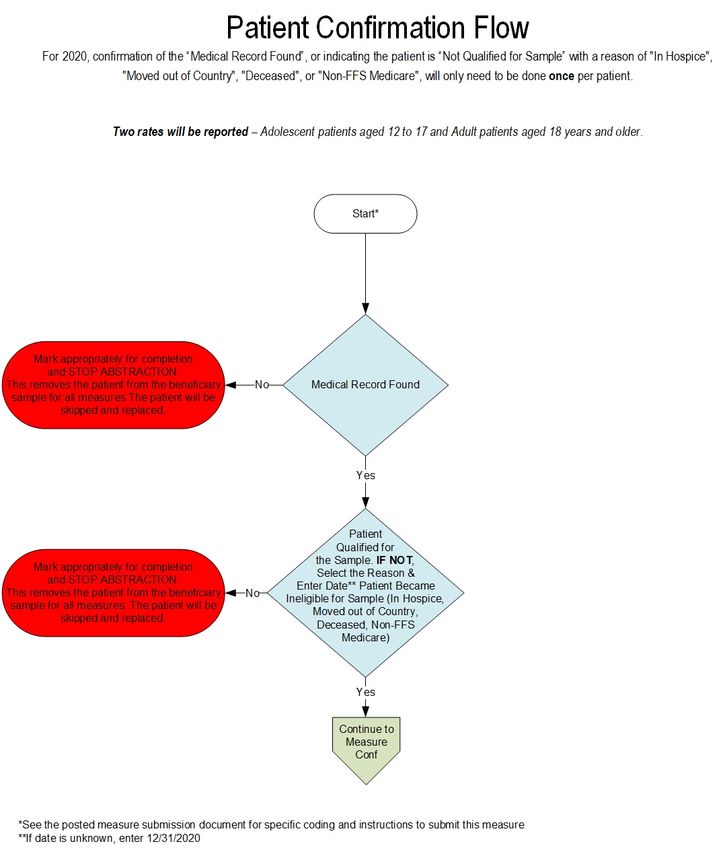
MH-1 (NQF 0710): Depression Remission at Twelve Months                                                      2020
Contents
 INTRODUCTION ........................................................................................................................................................ 4
 CMS WEB INTERFACE SAMPLING INFORMATION............................................................................................... 5
  BENEFICIARY SAMPLING ....................................................................................................................................... 5
 NARRATIVE MEASURE SPECIFICATION ............................................................................................................... 6
  DESCRIPTION: ......................................................................................................................................................... 6
  IMPROVEMENT NOTATION: ................................................................................................................................... 6
  INITIAL POPULATION: ............................................................................................................................................. 6
  DENOMINATOR: ....................................................................................................................................................... 6
  DENOMINATOR EXCLUSIONS................................................................................................................................ 6
  DENOMINATOR EXCEPTIONS................................................................................................................................ 6
  NUMERATOR:........................................................................................................................................................... 6
  NUMERATOR EXCLUSIONS ................................................................................................................................... 6
  DEFINITIONS ............................................................................................................................................................ 6
  GUIDANCE ................................................................................................................................................................ 7
 SUBMISSION GUIDANCE ......................................................................................................................................... 8
  PATIENT CONFIRMATION ....................................................................................................................................... 8
 SUBMISSION GUIDANCE ......................................................................................................................................... 9
  DENOMINATOR CONFIRMATION ........................................................................................................................... 9
 SUBMISSION GUIDANCE ....................................................................................................................................... 12
  DENOMINATOR CONFIRMATION ......................................................................................................................... 12
 SUBMISSION GUIDANCE ....................................................................................................................................... 13
  DENOMINATOR CONFIRMATION ......................................................................................................................... 13
 SUBMISSION GUIDANCE ....................................................................................................................................... 14
  NUMERATOR SUBMISSION .................................................................................................................................. 14
 SUBMISSION GUIDANCE ....................................................................................................................................... 15
  NUMERATOR SUBMISSION .................................................................................................................................. 15
 DOCUMENTATION REQUIREMENTS .................................................................................................................... 16
 APPENDIX I: PERFORMANCE CALCULATION FLOW......................................................................................... 17
 APPENDIX II: DOWNLOADABLE RESOURCE MAPPING TABLE ....................................................................... 24
 APPENDIX III: MEASURE RATIONALE AND CLINICAL RECOMMENDATION STATEMENTS.......................... 25
  RATIONALE ............................................................................................................................................................ 25
  CLINICAL RECOMMENDATION STATEMENTS.................................................................................................... 26
 APPENDIX IV: USE NOTICES, COPYRIGHTS, AND DISCLAIMERS ................................................................... 29

CMS Web Interface V4.0                                                    Page 2 of 29                                                                     November 2019
MH-1 (NQF 0710): Depression Remission at Twelve Months                                                   2020
  COPYRIGHT ........................................................................................................................................................... 29

CMS Web Interface V4.0                                                  Page 3 of 29                                                                    November 2019

MH-1 (NQF 0710): Depression Remission at Twelve Months                 2020
INTRODUCTION
There are a total of 10 individual measures included in the 2020 CMS Web Interface targeting high-cost chronic
conditions, preventive care, and patient safety. The measures documents are represented individually and contain
measure specific information. The corresponding coding documents are posted separately in an Excel format.
The measure documents are being provided to allow organizations an opportunity to better understand each of the
10 individual measures included in the 2020 CMS Web Interface data submission method. Each measure document
contains information necessary to submit data through the CMS Web Interface.
Narrative specifications, supporting submission documentation, and calculation flows are provided within each
document. Please review all of the measure documentation in its entirety to ensure complete understanding of these
measures.

CMS Web Interface V4.0                            Page 4 of 29                                         November 2019
MH-1 (NQF 0710): Depression Remission at Twelve Months              2020
CMS WEB INTERFACE SAMPLING INFORMATION
BENEFICIARY SAMPLING
For more information on the sampling process and methodology please refer to the 2020 CMS Web Interface
Sampling Document, which will be made available during the performance year at CMS.gov.

CMS Web Interface V4.0                          Page 5 of 29                                       November 2019
MH-1 (NQF 0710): Depression Remission at Twelve Months                 2020
NARRATIVE MEASURE SPECIFICATION
DESCRIPTION:
The percentage of adolescent patients 12 to 17 years of age and adult patients 18 years of age or older with major
depression or dysthymia who reached remission 12 months (+/- 60 days) after an index event.
IMPROVEMENT NOTATION:
Higher score indicates better quality
INITIAL POPULATION:
Adolescent patients 12 to 17 years of age and adult patients 18 years of age and older with a diagnosis of major
depression or dysthymia and an initial Patient Health Questionnaire-9 item version (PHQ-9) or Patient Health
Questionnaire-9 Modified for Teens and Adolescents (PHQ-9M) score greater than nine during the index event.
DENOMINATOR:
Equals Initial Population
         DENOMINATOR EXCLUSIONS:
         Patients with a diagnosis of bipolar disorder
         Patients with a diagnosis of select personality disorders
         Patients with a diagnosis of schizophrenia or psychotic disorder
         Patients with a diagnosis of pervasive developmental disorder
         Patients who were permanent nursing home residents
         DENOMINATOR EXCEPTIONS:
         None
NUMERATOR:
Adolescent patients 12 to 17 years of age and adult patients 18 years of age and older who achieved remission at
twelve months as demonstrated by a twelve month (+/- 60 days) PHQ-9 or PHQ-9M score of less than five.
         NUMERATOR EXCLUSIONS:
         Not Applicable
DEFINITION:
Denominator Identification Period - The period in which eligible patients can have an index event. The
denominator identification period occurs prior to the measurement period and is defined as 14 months to two months
prior to the start of the measurement period. The denominator identification period is from 11/1/2018 to 10/31/2019.
For patients with an index event, there needs to be enough time following index for the patients to have the
opportunity to reach remission twelve months +/- 60 days after the index event date.

Index Event Date - The date in which the first instance of elevated PHQ-9 or PHQ-9M greater than nine AND
diagnosis of depression or dysthymia occurs during the denominator identification period (11/1/2018 to 10/31/2019).
Patients may be screened using PHQ-9 or PHQ-9M up to seven days prior to the encounter (including the day of the
encounter).
Measure Assessment Period - The index event date marks the start of the measurement assessment period for
each patient which is 14 months (12 months +/- 60 days). This 14 month measure assessment period allows for
measurement of the patient’s remission status at both six and 12 months (Quality ID #411: Depression Remission at
Six Months). This assessment period is fixed and does not “start over” with a higher PHQ-9 or PHQ-9M that may
occur after the index event date.

Remission - Is defined as a PHQ-9 or PHQ-9M score of less than five.

CMS Web Interface V4.0                             Page 6 of 29                                          November 2019
MH-1 (NQF 0710): Depression Remission at Twelve Months 2020 Twelve Months - Is defined as the point in time from the index event date extending out twelve months and then allowing a grace period of sixty days prior to and sixty days after this date. The most recent PHQ-9 or PHQ-9M score less than five obtained during this four month period is deemed as remission at twelve months, values obtained prior to or after this period are not counted as numerator compliant (remission). GUIDANCE: None CMS Web Interface V4.0 Page 7 of 29 November 2019
MH-1 (NQF 0710): Depression Remission at Twelve Months 2020
SUBMISSION GUIDANCE
PATIENT CONFIRMATION
Establishing patient eligibility for submission requires the following:
o Determine if the patient’s medical record can be found
o If you can locate the medical record select “Yes”
OR
o If you cannot locate the medical record select “No - Medical Record Not Found”
OR
o Determine if the patient is qualified for the sample
If the patient is deceased, in hospice, moved out of the country or did not have Fee-
for-Service (FFS) Medicare as their primary payer select “Not Qualified for Sample”,
select the applicable reason from the provided drop-down menu, and enter the date
the patient became ineligible
Guidance Patient Confirmation
If “No – Medical Record Not Found” or “Not Qualified for Sample” is selected, the patient is completed but not
confirmed. The patient will be “skipped” and another patient must be submitted in their place, if available. The CMS
Web Interface will automatically skip any patient for whom “No – Medical Record Not Found” or “Not Qualified for
Sample” is selected in all other measures into which they have been sampled.
If “Not Qualified for Sample” is selected and the date is unknown, you may enter the last date of the
measurement period (i.e., 12/31/2020).
The Measurement Period is defined as January 1 – December 31, 2020.
NOTE:
- In Hospice: Select this option if the patient is not qualified for sample due to being in hospice care at any
time during the measurement period (this includes non-hospice patients receiving palliative goals or comfort
care)
- Moved out of Country: Select this option if the patient is not qualified for sample because they moved out
of the country any time during the measurement period
- Deceased: Select this option if the patient died during the measurement period
- Non-FFS Medicare: Select this option if the patient was enrolled in Non-FFS Medicare at any time during
the measurement period (i.e., commercial payers, Medicare Advantage, Non-FFS Medicare, HMOs, etc.)
This exclusion is intended to remove beneficiaries for whom Fee-for-Service Medicare is not the primary
payer.
CMS Web Interface V4.0 Page 8 of 29 November 2019MH-1 (NQF 0710): Depression Remission at Twelve Months 2020
SUBMISSION GUIDANCE
DENOMINATOR CONFIRMATION
o Determine if the patient has an active diagnosis of major depression or dysthymia during the denominator
identification period (11/1/2018 to 10/31/2019)
o If the patient has a documented diagnosis of major depression or dysthymia in the medical record
select “Yes”
OR
o If you are unable to confirm the diagnosis of major depression or dysthymia for the patient select
“Not Confirmed - Diagnosis”
OR
o If there is a denominator exclusion for patient disqualification from the measure select
“Denominator Exclusion”
OR
o If there is an "other" CMS approved reason for patient disqualification from the measure select “No
- Other CMS Approved Reason”
Denominator and Denominator Exclusion codes can be found in the 2020 CMS Web Interface MH Coding Document.
The Downloadable Resource Mapping Table can be located in Appendix II of this document.
Guidance Denominator
Note: This outcome measure is indicated for patients with a diagnosis of major depression or dysthymia. These
diagnosis codes are identified during the CMS sampling process and can be found in the Denominator Codes tab in
the MH_Coding Document. Confirmation of the diagnosis of major depression or dysthymia can occur using any of
the following methods:
Diagnosis code on the encounter or problem list (regardless of vendor assigned description of the code)
Words “major depression”, “major depressive disorder”, “dysthymia”, “dysthymic disorder”, “pervasive
depressive disorder” (DSM 5 term for dysthymia) on progress notes or problems lists can be used to confirm
the diagnosis. Additionally, in paper records, the description “depression” may be used with the option to
confirm by billing code.
If “Not Confirmed – Diagnosis” or “Denominator Exclusion” or “No – Other CMS Approved Reason” is
selected, the patient will be “skipped” and another patient must be submitted in their place, if available. The patient
will only be removed from the measure for which one of these options was selected, not all CMS Web Interface
measures.
Other CMS Approved Reason is reserved for unique cases that are not covered by any of the above stated skip
reasons. To gain CMS approval, submit a skip request by selecting Request Other CMS Approved Reason in the
patient qualification question for the measure. Note that skip requests can only be submitted manually through the
CMS Web Interface.
To submit a skip request, follow these steps:
1. After confirming the beneficiary for the sample, scroll to the measure you would like to skip.
2. When confirming if the beneficiary is qualified for the measure, select Request Other CMS Approved
Reason.
3. In the skip request modal, review the organization you are reporting for and provide the submitter's email
address. CMS uses this email to send status updates and/or reach out if further information is needed to
resolve the skip request. You also need to provide specific information about the beneficiary’s condition and
CMS Web Interface V4.0 Page 9 of 29 November 2019MH-1 (NQF 0710): Depression Remission at Twelve Months 2020
why it disqualifies the beneficiary from this measure. Never include Personally Identifiable Information (PII)
or Protected Health Information (PHI) in the case.
Beneficiaries remain incomplete until CMS resolves the skip request. The CMS Web Interface automatically updates
the resolution of a skip request, either approved or denied. Beneficiaries for whom a CMS Approved Reason is
approved are marked as Skipped and another beneficiary must be reported in their place, if available.
NOTE:
- Active Diagnosis of Major Depression or Dysthymia is defined as a diagnosis that is either on the
patient’s problem list, a diagnosis code description listed on the encounter, or is documented in a progress
note indicating that the patient is being treated or managed for the disease or condition during the
denominator identification period
- Patient must be age 12 years or older at the time of the index event (confirming diagnosis and PHQ-9 or
PHQ-9M greater than 9)
CMS Web Interface V4.0 Page 10 of 29 November 2019MH-1 (NQF 0710): Depression Remission at Twelve Months 2020
- Index Event Date is defined as the date on which the first instance of elevated PHQ-9 or PHQ-9M greater
than 9 AND diagnosis of major depression or dysthymia occurs during the denominator identification period
(11/1/2018 to 10/31/2019). Patients may be screened using PHQ-9 or PHQ-9M up to seven days prior to
the encounter (including the day of the encounter).
- Denominator Exclusions - active diagnosis of bipolar disorder, personality disorder (select types;
cyclothymic, borderline, histrionic and factitious), schizophrenia, psychotic disorder or pervasive
developmental disorder any time prior to the end of the measure assessment period. Patients who were a
permanent nursing home resident any time during the denominator identification period or the measure
assessment period.
- Permanent Nursing Home Resident is defined as a patient who is residing in a long-term residential
facility any time during the denominator identification period or before the end of the measurement
assessment period. It does not include patients who are receiving short-term rehabilitative services
following a hospital stay, nor does it include patients residing in assisted living or group home settings
- Two rates will be reported – Adolescent patients aged 12 to 17 and Adult patients aged 18 years and
older.
CMS Web Interface V4.0 Page 11 of 29 November 2019MH-1 (NQF 0710): Depression Remission at Twelve Months 2020
SUBMISSION GUIDANCE
DENOMINATOR CONFIRMATION
o Determine if the patient had one or more PHQ-9s or PHQ-9Ms administered during the denominator
identification period between 11/1/2018 and 10/31/2019
o If the patient did have a PHQ-9 or PHQ-9M administered during the denominator identification
period select “Yes”
OR
o If the patient did not have a PHQ-9 or PHQ-9M administered during the denominator identification
period select “No”
Denominator codes can be found in the 2020 CMS Web Interface MH Coding Document. The Downloadable
Resource Mapping Table can be located in Appendix II of this document.
Guidance Denominator
If “No” is selected, the patient is not considered denominator eligible. The patient will be “skipped” and another
patient must be submitted in their place, if available.
NOTE:
- PHQ-9 or PHQ-9M administration does not require a face-to-face visit; multiple modes of administration
are acceptable (telephone, mail, e-visit, email, patient portal, iPad/tablet, or patient kiosk)
- Index event date is the date in which the first instance of elevated PHQ-9 or PHQ-9M greater than 9 AND
diagnosis of depression or dysthymia occurs during the denominator identification period (11/1/2018 to
10/31/2019). Patients may be screened using PHQ-9 or PHQ-9M up to seven days prior to the encounter
(including the day of the encounter).
- Measure Assessment Period- the index event date marks the start of the measurement assessment
period for each patient which is 14 months (12 months +/- 60 days). This 14 month measure assessment
period allows for measurement of the patient’s remission status at both six and 12 months (Quality ID #411:
Depression Remission at Six Months). This assessment period is fixed and does not start over with a higher
PHQ- 9 or PHQ-9M that may occur after the index date
CMS Web Interface V4.0 Page 12 of 29 November 2019MH-1 (NQF 0710): Depression Remission at Twelve Months 2020
SUBMISSION GUIDANCE
DENOMINATOR CONFIRMATION
o Determine if the patient had a PHQ-9 or PHQ-9M score greater than 9 between 11/1/2018 and 10/31/2019
o If the patient did have a PHQ-9 or PHQ-9M greater than 9 during the denominator identification
period select “Yes”
IF YES
Record the date of the index PHQ-9 or PHQ-9M score greater than 9 in
MM/DD/YYYY format. This is the patient’s index date.
AND
Enter the score of the PHQ-9 or PHQ-9M associated with the Index Date
OR
o If the patient did not have a PHQ-9 or PHQ-9M greater than 9 during the denominator identification
period select “No”
Denominator codes can be found in the 2020 CMS Web Interface MH Coding Document. The Downloadable
Resource Mapping Table can be located in Appendix II of this document.
Guidance Denominator
If “No” is selected, the patient is not considered denominator eligible. The patient will be “skipped” and another
patient must be submitted in their place, if available.
NOTE:
- Enter the first instance of PHQ-9 or PHQ-9M greater than 9 that is also associated with a diagnosis of
major depression or dysthymia during the time period of 11/1/2018 and /10/31/2019. This is the Index Event
Date for this patient and marks the start of the 14 month assessment period (12 months +/- 60 days)
- All nine questions must be answered to have a valid summary score. If a patient chooses more than one
response for a single question, select the “worse” response (higher number) to calculate the summary score
CMS Web Interface V4.0 Page 13 of 29 November 2019MH-1 (NQF 0710): Depression Remission at Twelve Months 2020
SUBMISSION GUIDANCE
NUMERATOR SUBMISSION
o Determine if the patient had one or more PHQ-9s or PHQ-9Ms administered during the Measurement
Assessment Period (12 months +/- 60 days from the Index Event Date). Within the +/- 60 day window
(120 days total), the most recent PHQ-9 or PHQ-9M is used to determine remission.
o If the patient did have one or more PHQ-9s or PHQ-9Ms administered during the Measurement
Assessment Period, select “Yes”
OR
o If the patient did not have one or more PHQ-9s or PHQ-9Ms administered during the Measurement
Assessment Period, select “No”
Numerator codes can be found in the 2020 CMS Web Interface MH Coding Document. The Downloadable Resource
Mapping Table can be located in Appendix II of this document.
Guidance Numerator
NOTE:
- The only tools appropriate for indicating remission is a completed PHQ-9 or PHQ-9M
CMS Web Interface V4.0 Page 14 of 29 November 2019MH-1 (NQF 0710): Depression Remission at Twelve Months 2020
SUBMISSION GUIDANCE
NUMERATOR SUBMISSION
o Determine if the patient achieved remission with a follow-up PHQ-9 or PHQ-9M performed and a score less
than 5 at 12 months (+/- 60 days) of the initial (index event date) PHQ-9 or PHQ-9M score greater than 9
o If the patient did have a PHQ-9 or PHQ-9M less than 5 select “Yes”
IF YES
Record the date of the PHQ-9 or PHQ-9M score less than 5 in MM/DD/YYYY format. This is
the patient’s Remission Date.
If the patient had more than one PHQ-9 or PHQ-9M administered during the +/- 60 day
window (120 days total), enter the date of the most recent PHQ-9 or PHQ-9M
AND
Enter the score of the PHQ-9 or PHQ-9M associated with the Remission Date
OR
o If the patient did not have a PHQ-9 or PHQ-9M less than 5 select “No”
Numerator codes can be found in the 2020 CMS Web Interface MH Coding Document. The Downloadable Resource
Mapping Table can be located in Appendix II of this document.
Guidance Numerator
NOTE:
- If more than one PHQ-9 or PHQ-9M score was obtained between the 10 and 14 month window, select
the most recent PHQ-9 or PHQ-9M date and score within that window
- Scores obtained prior to or after this period are not counted as numerator compliant (remission)
- Patient remission, a follow-up PHQ-9 or PHQ-9M result less than 5, may be determined during a telehealth
encounter
- PHQ-9 or PHQ-9M administration does not require a face-to-face visit; multiple modes of administration
are acceptable (telephone, mail, e-visit, email, patient portal, iPad/tablet, or patient kiosk)
CMS Web Interface V4.0 Page 15 of 29 November 2019MH-1 (NQF 0710): Depression Remission at Twelve Months 2020 DOCUMENTATION REQUIREMENTS When submitting data through the CMS Web Interface, the expectation is that medical record documentation is available that supports the action submitted in the CMS Web Interface i.e., medical record documentation is necessary to support the information that has been submitted. Claims data cannot be used to confirm a diagnosis (DM, HTN etc.,) used for sampling purposes as claims are the original source of the diagnosis sampling. Claims data can be used to prepare the CMS Web Interface Excel, but supporting medical record documentation will be required to substantiate what is submitted in the event of an audit. CMS Web Interface V4.0 Page 16 of 29 November 2019
MH-1 (NQF 0710): Depression Remission at Twelve Months                2020
Appendix I: Performance Calculation Flow
Disclaimer: Refer to the measure submission document for specific coding and instructions to submit this measure.

CMS Web Interface V4.0                           Page 17 of 29                                         November 2019
MH-1 (NQF 0710): Depression Remission at Twelve Months   2020

CMS Web Interface V4.0                 Page 18 of 29                              November 2019
MH-1 (NQF 0710): Depression Remission at Twelve Months   2020

CMS Web Interface V4.0                 Page 19 of 29                              November 2019
MH-1 (NQF 0710): Depression Remission at Twelve Months                   2020
                                           Patient Confirmation Flow

 NOTE: Two rates will be reported – Adolescent patients aged 12 to 17 and Adult patients aged 18 years and older.

For 2020, confirmation of the “Medical Record Found”, or indicating the patient is “Not Qualified for Sample” with a
reason of “In Hospice”, “Moved out of Country”, “Deceased”, or “Non-FFS Medicare”, will only need to be done once
per patient. Refer to the Measure Submission Document for further instructions.

         1. Start Patient Confirmation Flow.

         2. Check to determine if Medical Record can be found.

                  a. If no, Medical Record not found, mark appropriately for completion and stop abstraction. This
                     removes the patient from the beneficiary sample for all measures. The patient will be skipped
                     and replaced. Stop processing.

                  b. If yes, Medical Record found, continue processing.

         3. Check to determine if Patient Qualified for the sample.

                  a. If no, the patient does not qualify for the sample, select the reason why and enter the date (if
                     date is unknown, enter 12/31/2020) the patient became ineligible for sample. For example; In
                     Hospice, Moved out of Country, Deceased, Non-FFS Medicare. Mark appropriately for
                     completion and stop abstraction. This removes the patient from the beneficiary sample for all
                     measures. The patient will be skipped and replaced. Stop processing.

                  b. If yes, the patient does qualify for the sample; continue to the Measure Confirmation Flow for
                     MH-1.

CMS Web Interface V4.0                             Page 20 of 29                                           November 2019
MH-1 (NQF 0710): Depression Remission at Twelve Months 2020
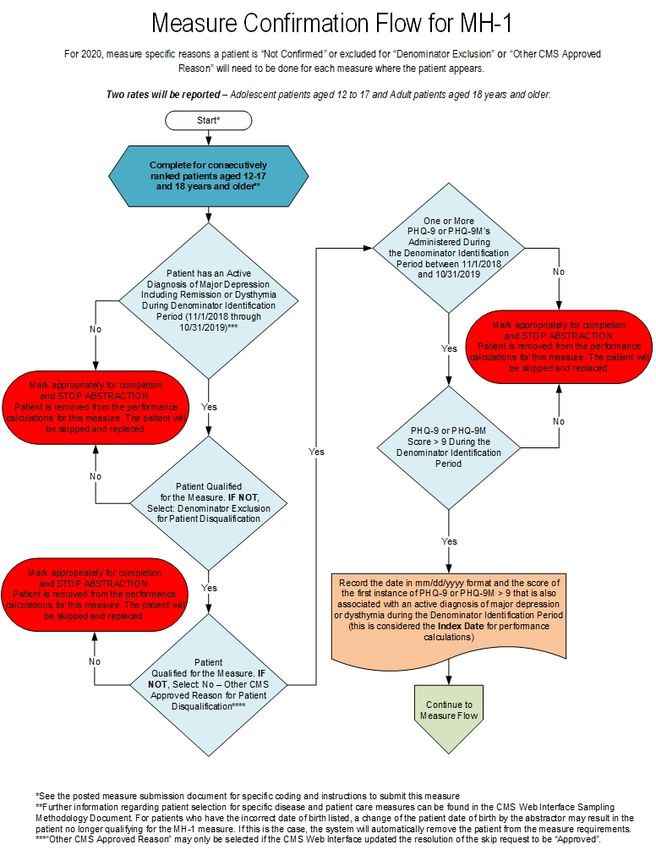
Measure Confirmation Flow for MH-1
NOTE: Two rates will be reported – Adolescent patients aged 12 to 17 and Adult patients aged 18 years and older.
For 2020, measure specific reasons a patient is “Not Confirmed” or excluded for “Denominator Exclusion” or “Other
CMS Approved Reason” will need to be done for each measure where the patient appears. Refer to the Measure
Submission Document for further instructions.
1. Start Measure Confirmation Flow for MH-1. Complete for consecutively ranked patients aged 12 to 17 years
of age and patients 18 years of age and older. Further information regarding patient selection for specific
disease and patient care measures can be found in the CMS Web Interface Sampling Methodology
Document. For patients who have the incorrect date of birth listed, a change of the patient date of birth by
the abstractor may result in the patient no longer qualifying for the MH-1 measure. If this is the case, the
system will automatically remove the patient from the measure requirements.
2. Check to determine if the patient has an active diagnosis of major depression or dysthymia during the
denominator identification period (11/1/2018 through 10/31/2019).
a. If no, the patient does not have an active diagnosis of major depression or dysthymia during the
denominator identification period, mark appropriately for completion and stop abstraction. Patient is
removed from the performance calculations for this measure. The patient will be skipped and
replaced. Stop processing
b. If yes, the patient does have an active diagnosis of major depression or dysthymia during the
denominator identification period, continue processing.
3. Check to determine if the patient qualifies for the measure (Denominator Exclusion).
a. If no, the patient does not qualify for the measure select: Denominator Exclusion for patient
disqualification. Mark appropriately for completion and stop abstraction. Patient is removed from
the performance calculations for this measure. The patient will be skipped and replaced. Stop
processing.
b. If yes, the patient does qualify for the measure, continue processing.
4. Check to determine if the patient qualifies for the measure (Other CMS Approved Reason).
a. If no, the patient does not qualify for the measure select: No – Other CMS Approved Reason for
patient disqualification. Mark appropriately for completion and stop abstraction. Patient is removed
from the performance calculations for this measure. The patient will be skipped and replaced.
“Other CMS Approved Reason” may only be selected if the CMS Web Interface updated the
resolution of the skip request to be “Approved”. Stop processing.
b. If yes, the patient does qualify for the measure, continue processing.
5. Check to determine if the patient had one or more PHQ-9s or PHQ-9Ms administered during the
denominator identification period between 11/1/2018 and 10/31/2019.
a. If no, the patient did not have one or more PHQ-9s or PHQ-9Ms administered during the
denominator identification period, mark appropriately for completion and stop abstraction. Patient is
removed from the performance calculations for this measure. The patient will be skipped and
replaced. Stop processing.
CMS Web Interface V4.0 Page 21 of 29 November 2019MH-1 (NQF 0710): Depression Remission at Twelve Months 2020
b. If yes, the patient did have one or more PHQ-9s or PHQ-9Ms administered during the denominator
identification period, continue processing.
6. Check to determine if the patient had any PHQ-9 or PHQ-9M score greater than 9 during the denominator
identification period.
a. If no, the patient does not have a PHQ-9 or PHQ-9M score greater than 9 during the denominator
identification period, mark appropriately for completion and stop abstraction. Patient is removed
from the performance calculations for this measure. The patient will be skipped and replaced. Stop
processing.
b. If yes, the patient does have a PHQ-9 or PHQ-9M score greater than 9 during the denominator
identification period, record the date in mm/dd/yyyy format and the score of the first instance of
PHQ-9 or PHQ-9M greater than 9 that is also associated with an active diagnosis of major
depression or dysthymia during the denominator identification period (this is considered the index
date for performance calculations). Continue to the MH-1 measure flow.
CMS Web Interface V4.0 Page 22 of 29 November 2019MH-1 (NQF 0710): Depression Remission at Twelve Months 2020
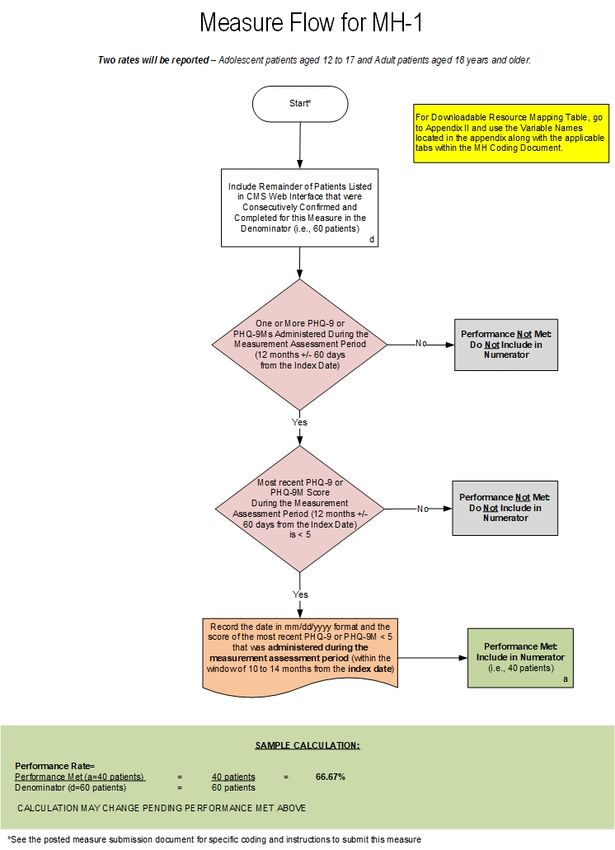
Measure Flow for MH-1
NOTE: Two rates will be reported – Adolescent patients aged 12 to 17 and Adult patients aged 18 years and older.
For Downloadable Resource Mapping Table, go to Appendix II and use the Variable Names located in the appendix
along with the applicable tabs within the MH Coding Document.
1. Start processing 2020 MH-1 (NQF 0710) Flow for the patients that qualified for the sample in the Patient
Confirmation Flow and the Measure Confirmation Flow for MH-1. Note: Include remainder of patients listed
in the CMS Web Interface that were consecutively confirmed and completed for this measure in the
denominator. For the sample calculation in the flow these patients would fall into the ‘d’ category (eligible
denominator, i.e. 60 patients).
2. Check to determine if the patient had one or more PHQ-9s or PHQ-9Ms administered during the
measurement assessment period (12 months plus or minus 60 days from the index event date).
a. If no, patient did not have one or more PHQ-9s or PHQ-9Ms administered during the measurement
assessment period, performance is not met and the patient will not be included in the numerator.
Stop processing.
b. If yes, the patient did have one or more PHQ-9s or PHQ-9Ms administered during the
measurement assessment period, continue processing.
3. Check to determine if the patient’s most recent PHQ-9 or PHQ-9M score during the measurement
assessment period (12 months plus or minus 60 days from the index event date) is less than 5.
a. If no, patient’s most recent PHQ-9 or PHQ-9M score during the measurement assessment period
(12 months plus or minus 60 days from the index event date) is not less than 5, performance is
not met and the patient should not be included in the numerator. Stop processing.
b. If yes, patient’s most recent PHQ-9 or PHQ-9M score during the measurement assessment period
(12 months plus or minus 60 days from the index event date) is less than 5, enter the date in
mm/dd/yyyy format and the score of the most recent PHQ-9 or PHQ-9M less than 5 that was
administered during the measurement assessment period (within the window of 10 to 14 months
from the index date). Performance is met and the patient will be included in the numerator. For
the sample calculation in the flow these patients would fall into the ‘a’ category (numerator, i.e. 40
patients). Stop processing.
CMS Web Interface V4.0 Page 23 of 29 November 2019MH-1 (NQF 0710): Depression Remission at Twelve Months 2020
Appendix II: Downloadable Resource Mapping Table
Each data element within this measure’s denominator or numerator is defined as a pre-determined set of clinical
codes. These codes can be found in the 2019 CMS Web Interface MH Coding Document.
*MH-1: Depression Remission at Twelve Months
Measure Component/Excel Coding
Data Element Variable Name
Tab System(s)
Denominator/Denominator Depression or Dysthymia DEPRESSION_CODE I10
Codes Diagnosis SNM
DYSTHYMIA_CODE I10
SNM
Index PHQ-9 or PHQ-9M Index PHQ-9 or PHQ-9M No Coding
Administered Provided
PHQ-9 or PHQ-9M PHQ-9 or PHQ-9M With No Coding
Greater Than 9 Score Greater Than 9 Provided
Denominator Exclusions BIPOLAR_DX_CODE I9
Exclusion/Denominator I10
Exclusion Codes SNM
Exclusions NH_RES_CODE C4
SNM
Exclusions PERSONALITY_DIS_CODE I9
I10
SNM
Exclusions PERVASIVE_DIS_CODE I9
I10
SNM
Exclusions SCHIZO_PSYCH_DIS_CODE I9
I10
SNM
Numerator/Numerator Codes Assessment PHQ-9 or Assessment PHQ-9 or PHQ- No Coding
PHQ-9M 9M Administered Provided
PHQ-9 or PHQ-9M Less PHQ-9 or PHQ-9M With No Coding
Than 5 Score Less Than 5 Provided
*For EHR mapping, the coding within MH-1 is considered to be all-inclusive
CMS Web Interface V4.0 Page 24 of 29 November 2019MH-1 (NQF 0710): Depression Remission at Twelve Months 2020 Appendix III: Measure Rationale and Clinical Recommendation Statements RATIONALE: Adults: Depression is a common and treatable mental disorder. 8.1% of American adults age 20 and over had depression in a given 2 week period. Women (10.4%) were almost twice as likely as were men (5.5%) to have had depression. The prevalence of depression among adults decreased as family income levels increased. About 80% of adults with depression reported at least some difficulty with work, home, or social activities because of their depression symptoms. (Centers for Disease Control and Prevention, 2018). Persons with a current diagnosis of depression and a lifetime diagnosis of depression or anxiety were significantly more likely than persons without these conditions to have cardiovascular disease, diabetes, asthma and obesity and to be a current smoker, to be physically inactive and to drink heavily (Strine, 2008). People who suffer from depression have lower incomes, lower educational attainment and fewer days working each year, leading to seven fewer weeks of work per year, a loss of 20% in potential income and a lifetime loss for each family who has a depressed family member of $300,000 (Smith, 2010). The incremental economic burden of individuals with major depressive disorder (MDD) increased by 21.5% (from $173.2 billion to $210.5 billion, inflation-adjusted dollars). The composition of these costs remained stable, with approximately 45% attributable to direct costs, 5% to suicide-related costs, and 50% to workplace costs. Only 38% of the total costs were due to MDD itself as opposed to comorbid conditions. (Greenberg, 2015). Adolescents and Adults: The Centers for Disease Control and Prevention states that during 2009-2012 an estimated 7.6% of the U.S. population aged 12 and over had depression, including 3% of Americans with severe depressive symptoms. Almost 43% of persons with severe depressive symptoms reported serious difficulties in work, home and social activities, yet only 35% reported having contact with a mental health professional in the past year. Depression is associated with higher mortality rates in all age groups. People who are depressed are 30 times more likely to take their own lives than people who are not depressed and five times more likely to abuse drugs. Depression is the leading cause of medical disability for people aged 14 - 44. Depressed people lose 5.6 hours of productive work every week when they are depressed, fifty percent of which is due to absenteeism and short-term disability. Adolescents: In 2014, an estimated 2.8 million adolescents age 12 to 17 in the United States had at least one major depressive episode (MDE) in the past year. This represented 11.4% of the U.S. population. The same survey found that only 41.2 percent of those who had a MDE received treatment in the past year. The 2013 Youth Risk Behavior Survey of students grades 9 to 12 indicated that during the past 12 months 39.1% of female (F) and 20.8% of male (M) students indicated feeling sad or hopeless almost every day for at least 2 weeks, 16.9% (F) and 10.3% (M) indicated a planned suicide attempt, and 10.6% (F) and 5.4% (M) attempted suicide. Adolescent-onset depression is associated with chronic depression in adulthood. Many mental health conditions (anxiety, bipolar, depression, eating disorders, and substance abuse) are evident by age 14. The 12-month prevalence of MDEs increased from 8.7% in 2005 to 11.3% in 2014 in adolescents and from 8.8% to 9.6% in young adults (both P < .001). The increase was larger and statistically significant only in the age range of 12 to 20 years. The trends remained significant after adjustment for substance use disorders and sociodemographic factors. Mental health care contacts overall did not change over time; however, the use of specialty mental health providers increased in adolescents and young adults, and the use of prescription medications and inpatient hospitalizations increased in adolescents. In 2015, 9.7% of adolescents in Minnesota (MN) who were screened for depression or other mental health conditions, screened positively. CMS Web Interface V4.0 Page 25 of 29 November 2019
MH-1 (NQF 0710): Depression Remission at Twelve Months                      2020
CLINICAL RECOMMENDATION STATEMENTS:
Adults:
Source: Institute for Clinical Systems Improvement (ICSI) Health Care Guideline for Adult Depression in Primary
Care (Trangle, 2016)

Major depression is a treatable cause of pain, suffering, disability and death, yet primary care clinicians detect major
depression in only one-third to one-half of their patients with major depression (Williams Jr, 2002; Schonfeld, 1997).

Usual care for depression in the primary care setting has resulted in only about half of depressed adults getting
treated (Kessler, 2005) and only 20-40% showing substantial improvement over 12 months (Unutzer, 2002; Katon,
1999).

Recommendations and algorithm notations supporting depression outcomes and duration of treatment according to
ICSI's Health Care Guideline:

Recommendation: Clinicians should establish and maintain follow-up with patients. Appropriate, reliable follow-up is
highly correlated with improved response and remission scores. It is also correlated with the improved safety and
efficacy of medications and helps prevent relapse.

Proactive follow-up contacts (in person, telephone) based on the collaborative care model have been shown to
significantly lower depression severity (Unutzer, 2002). In the available clinical effectiveness trials conducted in real
clinical practice settings, even the addition of a care manager leads to modest remission rates (Trivedi, 2006;
Unutzer, 2002). Interventions are critical to educating the patient regarding the importance of preventing relapse,
safety and efficacy of medications, and management of potential side effects. Establish and maintain initial follow-up
contact intervals (office, phone, other) (Hunkeler, 2000; Simon, 2000).

PHQ-9 as monitor and management tool. The PHQ-9 is an effective management tool, as well, and should be used
routinely for subsequent visits to monitor treatment outcomes and severity. It can also help the clinician decide if/how
to modify the treatment plan (Duffy, 2008; Lowe, 2004). Using a measurement-based approach to depression care,
PHQ-9 results and side effect evaluation should be combined with treatment algorithms to drive patients toward
remission. A five-point drop in PHQ-9 score is considered the minimal clinically significant difference (Trivedi, 2009).

Every time that the PHQ-9 is assessed, suicidality is assessed, as well. If the suicidality was indeed of high risk,
urgent referral to crisis specialty health care is advised. In case of low suicide risk, the patient can proceed with
treatment in the primary care practice (Huijbregts, 2013).

Care Algorithm: Has patient reached remission?

The goals of treatment should be to achieve remission, reduce relapse and recurrence, and return to previous level
of occupational and psychosocial function.

Full remission is defined as a two-month period devoid of major depressive signs and symptoms (American
Psychiatric Association, 2013). If using a PHQ-9 tool, remission translates to PHQ-9 score of less than 5 (Kroenke,
2001). Results from the STAR*D study showed that remission rates lowered with more treatment steps, but the
overall cumulative rate was 67% (Rush, 2006).

Response is defined as a 50% or greater reduction in symptoms (as measured on a standardized rating scale).
Partial response is defined as a 25-50% reduction in symptoms. This definition is based on how the depression
literature defines response.

CMS Web Interface V4.0                               Page 26 of 29                                            November 2019
MH-1 (NQF 0710): Depression Remission at Twelve Months                    2020
Response and remission take time. In the STAR*D study, longer times than expected were needed to reach
response or remission. In fact, one-third of those who ultimately responded did so after six weeks. Of those who
achieved remission by Quick Inventory of Depressive Symptomatology (QIDS), 50% did so only at or after six
weeks of treatment (Trivedi, 2006). If the primary care clinician is seeing some improvement, continue working
with that patient to augment or increase dosage to reach remission. This can take up to three months.

A reasonable criterion for extending the initial treatment: assess whether the patient is experiencing a 25% or greater
reduction in baseline symptom severity at six weeks of therapeutic dose. If the patient's symptoms are reduced by
25% or more, but the patient is not yet at remission, and if medication has been well tolerated, continue to prescribe.
Raising the dose is recommended (Trivedi, 2006).

Improvement with psychotherapy is often a bit slower than with pharmacotherapy. A decision regarding progress with
psychotherapy and the need to change or augment this type of treatment may require 8 to 10 weeks before
evaluation (Schulberg, 1998).

Care Algorithm: Continuation and Maintenance Treatment Duration Based on Episode

Acute therapy is the treatment phase focused on treating the patient to remission. Acute therapy typically lasts 6-12
weeks but technically lasts until remission is reached (American Psychiatric Association, 2010). Full remission is
defined as a two-month period devoid of major depressive signs and symptoms (American Psychiatric Association,
2013).

Continuation therapy is the four-to-nine month period beyond the acute treatment phase during which the patient is
treated with antidepressants, psychotherapy, electroconvulsive therapy (ECT) or other somatic therapies to
prevent relapse (American Psychiatric Association, 2010). Relapse is common within the first six months following
remission from an acute depressive episode; as many as 20-85% of patients may relapse (American Psychiatric
Association, 2010).

This measure assesses achievement of remission, which is a desired outcome of effective depression treatment and
monitoring.

Adult Depression in Primary Care - Guideline Aims
- Increase the percentage of patients with major depression or persistent depressive disorder who have improvement
in outcomes from treatment for major depression or persistent depressive disorder.
- Increase the percentage of patients with major depression or persistent depressive disorder who have follow-up to
assess for outcomes from treatment.
- Improve communication between the primary care physician and the mental health care clinician (if patient is co-
managed).

Adolescents:
Source: American Academy of Child and Adolescent Psychiatry Practice Parameter for the Assessment and
Treatment of Children and Adolescents with Depressive Disorders (2007)
http://www.jaacap.com/article/S0890-8567(09)62053-0/pdf

Recommendations:
Recommendations supporting depression outcomes and duration of treatment according to AACAP guideline:
- Treatment of depressive disorders should always include an acute and continuation phase; some children may also
require maintenance treatment. The main goal of the acute phase is to achieve response and ultimately full
symptomatic remission (definitions below).
- Each phase of treatment should include psychoeducation, supportive management, and family and school
involvement

CMS Web Interface V4.0                             Page 27 of 29                                           November 2019
MH-1 (NQF 0710): Depression Remission at Twelve Months                  2020
- Education, support, and case management appear to be sufficient treatment for the management of depressed
children and adolescents with an uncomplicated or brief depression or with mild psychosocial impairment
- For children and adolescents who do not respond to supportive psychotherapy or who have more complicated
depressions, a trial with specific types of psychotherapy and/or antidepressants is indicated

Sources:
Guidelines for Adolescent Depression in Primary Care (GLAD-PC) (2018)
http://pediatrics.aappublications.org/content/141/3/e20174081
Guidelines for adolescent depression in primary care (GLAD-PC): II. Treatment and ongoing management
http://pediatrics.aappublications.org/content/141/3/e20174082

Recommendations supporting depression outcomes and duration of treatment according to GLAD-PC:
Recommendations for Ongoing Management of Depression:
- Mild depression: consider a period of active support and monitoring before starting other evidence-based treatment
- Moderate or severe major clinical depression or complicating factors:
  -- consultation with mental health specialist with agreed upon roles
  -- evidence based treatment (cognitive behavioral therapy (CBT) or interpersonal psychotherapy (IPT) and/or
  antidepressant selective serotonin reuptake inhibitor (SSRI))
- Monitor for adverse effects during antidepressant therapy
  -- clinical worsening, suicidality, unusual changes in behavior
- Systematic and regular tracking of goals and outcomes
  -- improvement in functioning status and resolution of depressive symptoms
Regardless of the length of treatment, all patients should be monitored on a monthly basis for 6 to 12 months after
the full resolution of symptoms

CMS Web Interface V4.0                             Page 28 of 29                                         November 2019
MH-1 (NQF 0710): Depression Remission at Twelve Months               2020
Appendix IV: Use Notices, Copyrights, and Disclaimers
COPYRIGHT
© MN Community Measurement, 2019. All rights reserved.

CPT® contained in the Measure specifications is copyright 2004-2019 American Medical Association. LOINC® is
copyright 2004-2019 Regenstrief Institute, Inc. This material contains SNOMED Clinical Terms® (SNOMED CT®)
copyright 2004-2019 International Health Terminology Standards Development Organisation. ICD-10 is copyright 2019
World Health Organization. All Rights Reserved.

CMS Web Interface V4.0                          Page 29 of 29                                       November 2019
You can also read


