4 Revenue trends and tax proposals - National Treasury
←
→
Page content transcription
If your browser does not render page correctly, please read the page content below
4
Revenue trends and tax proposals

 In brief
 •   Given the weak economic outlook, government will not raise additional revenue from tax proposals in 2020/21.
 •   Tax revenue is projected to grow by 4.9 per cent in 2020/21.
 •   The main tax proposals include personal income tax relief through above-inflation adjustments in all brackets, along
     with increases in the fuel and Road Accident Fund (RAF) levies to adjust for inflation. Corporate interest deductions
     will be limited to combat base erosion and profit shifting.
 •   The revitalisation of the South African Revenue Service (SARS) is under way, and this is expected to contribute to
     increased tax revenue over the medium term.
 •   South Africa aims to strengthen its progressive tax system, while broadening the tax base and removing exemptions.
     In line with this approach, government will review tax incentives over the medium term, and repeal or redesign
     those that are inefficient or inequitable.

     Overview

P     rojected revenue for 2019/20 is now R63.3 billion lower than the
      estimate at the time of the 2019 Budget. This under-collection
      exceeds that of 2009/10, in the immediate aftermath of the global
financial crisis. The shortfall is a consequence of weakening economic
                                                                                            Large revenue under-collection
                                                                                            generally matches difference
                                                                                            in GDP forecast and outcome

growth, and largely matches the lower GDP growth forecast. For example,
the 2019 Budget forecast real economic growth in 2019 at 1.5 per cent; the
revised forecast is 0.3 per cent.
Over the past five years, government has implemented large tax increases.
But the difference between projected and collected revenue has grown
progressively larger in the face of a persistent slowdown in economic
growth and a weakened SARS. In the last 12 months, the new SARS
leadership has taken steps to revive the institution, and tax administration
has started to recover – but the economy has not.
Growth in wages, consumption and business profitability has stagnated in
recent years, lowering tax receipts for personal income tax, value-added

                                                                                                                             33
2020 BUDGET REVIEW
tax (VAT) and corporate income tax, which make up more than 80 per cent
of total tax revenue.
Government proposes no In this context, substantial tax increases are unlikely to be effective. South
overall increase in taxes for Africa already has a relatively high tax-to-GDP ratio compared with other
2020/21 countries at a similar level of development. New tax increases at this time
could harm the economy’s ability to recover. Consequently, government
will not raise additional revenue from tax proposals for 2020/21. Additional
revenue from indirect taxes will be offset by personal income tax relief.
The main tax proposals for 2020/21 are:
• Providing personal income tax relief through an above-inflation
increase in the brackets and rebates.
• Further limiting corporate interest deductions to combat base erosion
and profit shifting.
• Restricting the ability of companies to fully offset assessed losses from
previous years against taxable income.
• Increasing the fuel levy by 25c/litre, consisting of a 16c/litre increase in
the general fuel levy and a 9c/litre increase in the RAF levy, to adjust for
inflation.
• Increasing the annual contribution limit to tax-free savings accounts by
R3 000 from 1 March 2020.
• Increasing excise duties on alcohol and tobacco by between 4.4 and
7.5 per cent.
Revenue collection and outlook
Projected revenue shortfall of Compared with the 2019 Budget estimate, the projected revenue shortfall
R63.3 billion stems from weak for 2019/20 is R63.3 billion – significantly higher than the revised estimate
economic growth of R52.5 billion published in the 2019 Medium Term Budget Policy
Statement.
The main reason for reductions in projected revenue collection over the
past two years has been weaker-than-expected economic growth.
Personal income tax collection has been affected by sluggish employment
and wage growth. Following the recession in the first half of 2018, the
dividends tax has not yielded the expected results, and corporate income
tax collection continued to underperform.
Growth in fraudulent VAT Growth in VAT collection has moderated following the one percentage
claims to be referred for audit point rate increase in 2018/19. Strong growth in VAT refunds also played a
or criminal investigation role in the lower year-to-date performance. Following the acceleration of
VAT refund payments in the past year, SARS reports that the number of
fraudulent claims has been increasing. VAT refunds for the last quarter of
the fiscal year are expected to moderate as SARS refers more cases for
audit or criminal investigation. Tax collections related to trade have slowed
in the second half of 2019/20 in line with contracting imports, resulting in
lower estimated revenue from customs duties and import VAT.
Tax buoyancy – a ratio of tax revenue growth to economic growth – is a
useful measure to determine whether revenue collections are performing
as expected. For example, gross tax buoyancy was particularly low in
34CHAPTER 4: REVENUE TRENDS AND TAX PROPOSALS
2016/17 and 2017/18, a period in which SARS was severely weakened. Tax
increases in those years should have caused revenue to grow faster than
nominal GDP, but buoyancy was at or below one.
Table 4.1 Budget estimates and revenue outcomes1
2018/19 2019/20 Percentage
2 2 3
R million Budget Outcome Deviation Budget Revised Deviation change
Taxes on income and profits 751 846 738 741 -13 105 820 342 778 280 -42 062 5.4%
Personal income tax 497 451 492 083 -5 368 552 877 527 584 -25 293 7.2%
Corporate income tax 218 436 212 046 -6 390 229 608 216 718 -12 890 2.2%
Dividends tax 30 341 29 898 -443 31 893 29 144 -2 748 -2.5%
Other taxes on income and 5 618 4 714 -904 5 964 4 833 -1 131 2.5%
4
profits
Skills development levy 17 312 17 439 127 18 759 18 576 - 182 6.5%
Taxes on property 16 035 15 252 -783 17 159 16 038 -1 121 5.2%
Domestic taxes on goods and services 460 287 460 545 257 504 649 488 711 -15 938 6.1%
Value-added tax 325 917 324 766 -1 151 360 471 344 202 -16 269 6.0%
Specific excise duties 40 276 40 830 553 42 354 46 765 4 411 14.5%
Health promotion levy 2 396 3 195 799 1 986 2 590 604 -18.9%
Ad valorem excise duties 4 163 4 192 29 4 454 4 112 - 342 -1.9%
Fuel levy 75 374 75 372 -1 82 958 79 277 -3 680 5.2%
Other domestic taxes 12 161 12 190 28 12 426 11 764 - 661 -3.5%
5
on goods and services
Taxes on international 56 722 55 723 -999 61 300 57 330 -3 971 2.9%
trade and transactions
Customs duties 55 638 54 968 -670 60 029 56 325 -3 704 2.5%
Health promotion levy on imports 78 53 -25 245 54 -191 2.4%
Diamond export levy 87 78 -9 93 90 -3 15.9%
Miscellaneous customs 918 624 -295 932 860 -73 37.8%
and excise receipts
Gross tax revenue 1 302 201 1 287 690 -14 511 1 422 208 1 358 935 -63 273 5.5%
6
Non-tax revenue 31 473 35 869 4 395 31 537 36 142 4 605 0.8%
of which:
Mineral and petroleum 8 340 8 612 272 8 766 11 952 3 186 38.8%
royalties
7
Less: SACU payments -48 289 -48 289 – -50 280 -50 280 – 4.1%
Main budget revenue 1 285 386 1 275 270 -10 116 1 403 464 1 344 796 -58 668 5.5%
Provinces, social security 169 831 170 154 323 180 347 172 192 -8 155 1.2%
funds and selected
public entities
Consolidated budget revenue 1 455 217 1 445 424 -9 793 1 583 811 1 516 988 -66 823 5.0%
1. A more disaggregated view is presented in Tables 2 and 3 of the statistical annexure
2. 2019 Budget Review estimates
3. Percentage change between outcome in 2018/19 and revised estimate in 2019/20
4. Includes interest on overdue income tax and interest withholding tax
5. Includes turnover tax for micro businesses, air departure tax, plastic bag levy, electricity levy, CO₂ tax on motor
vehicle emissions, incandescent light bulb levy, Universal Service Fund, tyre levy and International Oil Pollution
Compensation Fund
6. Includes mineral and petroleum royalties, mining leases, departmental revenue and sales of capital assets
7. Southern African Customs Union. Amounts made up of payments and other adjustments
Source: National Treasury
Analysis of the main components of tax revenue shows that although
2019/20 personal income tax collections are not expected to meet the
2019 Budget forecast, their decline is in line with moderating real wage
growth in the economy. Similarly, domestic VAT collections and trade-
related taxes are in line with expected outcomes for consumption and
imports. Corporate income tax, which is particularly volatile, is expected to
significantly underperform.
352020 BUDGET REVIEW
Table 4.2 Budget revenue1
2016/17 2017/18 2018/19 2019/20 2020/21 2021/22 2022/23
R million Outcome Revised Medium-term estimates
Taxes on income and 664 526 711 703 738 741 778 280 813 588 863 888 921 375
2
profits
of which:
3
Personal income tax 424 545 460 953 492 083 527 584 546 771 581 146 621 602
4
Corporate income tax 204 432 217 412 212 046 216 718 230 226 243 686 258 357
Skills development levy 15 315 16 012 17 439 18 576 19 413 20 585 21 970
Taxes on property 15 661 16 585 15 252 16 038 17 510 18 956 20 165
Domestic taxes on goods 402 464 422 248 460 545 488 711 514 267 543 916 576 525
and services
of which:
VAT 289 167 297 998 324 766 344 202 360 555 381 859 405 598
Taxes on international 46 102 49 939 55 723 57 330 60 640 64 849 69 622
trade and transactions
Gross tax revenue 1 144 081 1 216 464 1 287 690 1 358 935 1 425 418 1 512 194 1 609 657
5 33 272 35 849 35 869 36 142 35 973 32 663 34 586
Non-tax revenue
of which:
Mineral and petroleum royalties 5 802 7 617 8 612 11 952 12 697 13 439 14 248
6 -39 448 -55 951 -48 289 -50 280 -63 395 -60 563 -63 366
Less: SACU payments
Main budget revenue 1 137 904 1 196 362 1 275 270 1 344 796 1 397 996 1 484 294 1 580 877
Provinces, social security 147 700 155 015 170 154 172 192 185 910 198 545 210 442
funds and selected public
entities
Consolidated budget revenue 1 285 605 1 351 378 1 445 424 1 516 988 1 583 905 1 682 839 1 791 319
As percentage of GDP
Tax revenue 25.9% 25.9% 26.2% 26.3% 26.3% 26.3% 26.3%
Main budget revenue 25.7% 25.5% 25.9% 26.1% 25.8% 25.8% 25.8%
GDP (R billion) 4 419.4 4 698.7 4 921.5 5 157.3 5 428.2 5 759.0 6 126.3
Tax buoyancy 0.97 1.00 1.23 1.15 0.93 1.00 1.01
1. A more disaggregated view is presented in Tables 2 and 3 of the statistical annexure
2. Includes secondary tax on companies/dividends tax, interest withholding tax and interest on overdue income tax
3. As announced in the 2018 Budget, medical tax credits were adjusted below inflation over the MTEF to fund additional
expenditure for national health insurance. The additional amount for 2020/21 is R0.58 billion. This is the last year of
that MTEF, and therefore such an amount is not included in the two outer-year estimates for personal income taxes
4. Relative to the estimates published in Table D.4 of the 2019 MTBPS, the forecasts for corporate income tax
assume a buoyancy of 0.9, 0.95 and 1 over the next three years
5. Includes mineral and petroleum royalties, mining leases, departmental revenue and sales of capital assets
6. Southern African Customs Union. Amounts made up of payments and other adjustments
Source: National Treasury and SARS
Tax revenue is projected to grow by 4.9 per cent in 2020/21. Gross tax
buoyancy is expected to decrease to 0.93, primarily due to lower personal
income tax receipts following the anticipated reduction in the public-
service wage bill. After contractions in four of the past seven quarters,
economic growth and profitability are expected to remain weak, putting
greater pressure on corporate income tax collections. Revenue should
improve over the medium term as growth recovers. Efficiency
improvements at SARS may bolster revenue further, but such potential
gains are not included in the current projections.
Strengthening the South African Revenue Service
SARS to renew its focus on Building a capable state that serves South Africa is integrally linked to the
illicit and criminal activity success of SARS. The new Commissioner is focusing on stabilising the
organisation, re-establishing integrity and compliance functions, and
restoring employee confidence and public trust. Revenue recovery plans
include assistance from the re-established Davis Tax Committee to address
36CHAPTER 4: REVENUE TRENDS AND TAX PROPOSALS
tax leakages, customs fraud, trade mispricing and harmful tax practices;
setting up a new centre focused on wealthy individuals who have complex
tax arrangements; and renewing the focus on illicit and criminal activity,
including non-compliance of religious public-benefit organisations.
SARS is reviewing its procurement processes. Contracts that did not Some experienced SARS staff
represent value for money have not been renewed. A number of senior have returned to roles from
officials implicated by the Nugent Commission have left, and experienced which they had been displaced
staff returned to roles from which they had been displaced. Strengthening
SARS will take time, but will result in improved revenue collections in the
years ahead.
Rebuilding governance at SARS
The Commission of Inquiry into Tax Administration and Governance by SARS (the Nugent Commission) found a “massive
failure of governance and integrity” at SARS under the former Commissioner. The Commission made
27 recommendations. The SARS Commissioner is responsible for implementing non-legislative and organisational
recommendations from the report, and the Minister of Finance for policy recommendations. This is in keeping with two
guiding principles:
• SARS should implement tax laws fairly, without bias and without political interference.
• SARS is autonomous but accountable to the Minister of Finance, who determines tax policy.
Accordingly, government plans to publish a discussion document by June 2020 setting out proposed legislative
amendments to strengthen governance at SARS. These will include an improved appointment and removal process for
the Commissioner by the President, and an appointment and removal process for Deputy Commissioners.
The Office of the Tax Ombud has proved effective in ensuring that taxpayers are not prejudiced by SARS. Government
will strengthen the ombud and separate it financially and operationally from SARS.
In addition, government recognises the need for an independent office to oversee governance and conduct within SARS.
Accordingly, government will propose an inspector-general to:
• Monitor and report conduct and performance metrics to government and the public.
• Safeguard whistleblowing by SARS officials in a way that keeps tax information secret.
• Empower senior SARS officials to disclose any lapses or findings by the internal audit function.
• Provide independent assurance that internal processes are sound and unbiased.
Tax policy
Over the past five years, government has increased rates of personal South Africa’s tax-to-GDP ratio
income tax, dividends tax, capital gains tax and VAT, while raising the fuel is nearing its democratic-era
levy and excise duties on alcohol and tobacco. The tax-to-GDP ratio has peak
steadily increased over this period, reaching 26.2 per cent, which is close
to its democratic-era peak of 26.4 per cent in 2007/08.
The 2019 Budget announced that an additional R10 billion in tax revenue
would be raised in 2020/21 to support fiscal consolidation. At the time, real
GDP growth was expected to be 1.5 per cent for 2019 and 1.7 per cent for
2020. Since then, the economy has faltered and growth estimates have
been revised down to 0.3 per cent for 2019 and 0.9 per cent for 2020.
Substantial tax increases may obstruct short-term recovery. As a result,
government will not raise any taxes to collect the additional R10 billion
in 2020/21.
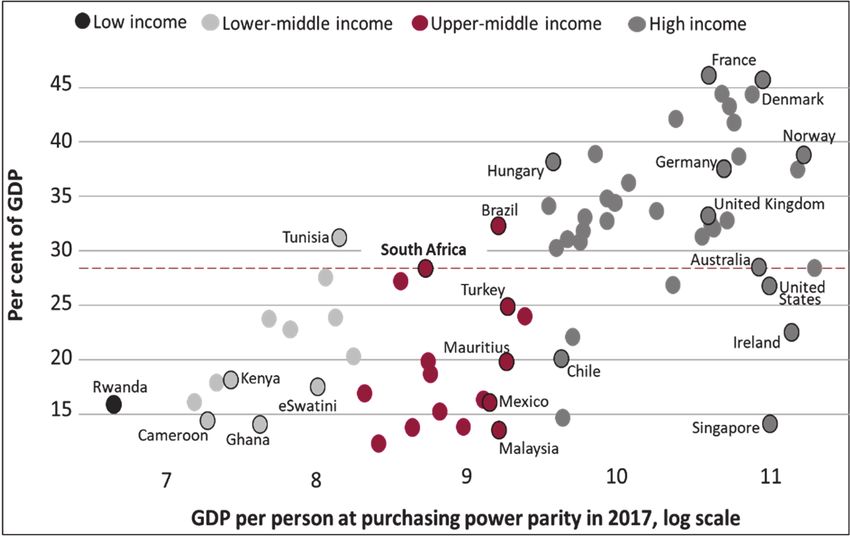
Even without additional tax increases this year, the projected tax-to-GDP South Africa has relatively high
ratio is expected to equal 26.3 per cent over the next three years. South level of tax to GDP compared
Africa has a relatively high level of tax to GDP compared with other upper- with other upper-middle-
middle-income countries, as shown in Figure 4.1. Higher levels of economic income countries
372020 BUDGET REVIEW
growth are required for further tax increases to be effective in
consolidating the public finances or financing additional expenditure.
Figure 4.1 Tax burdens for countries at different levels of development
Source: OECD, International Monetary Fund
Government seeks to broaden The way in which tax revenue is raised has important implications for
tax base, and eliminate fairness and economic growth. South Africa aims to strengthen its
exemptions and deductions progressive tax system by broadening the tax base and eliminating
where possible exemptions or deductions where possible. The system should make it easy
for individuals and firms to comply, and minimise distortions so that they
do not base their decisions on tax. Crucially, the system should continue to
generate tax revenue throughout the business cycle.
Corporate income tax
To promote economic growth, government intends to restructure the
corporate income tax system over the medium term by broadening the
base and reducing the rate. Broadening the base will involve minimising
tax incentives, and introducing new interest deduction and assessed loss
limitations. Rate reductions will be implemented in a revenue-neutral
manner.
As trading partners reduce Government has broadened the corporate income tax base since the early
their corporate tax rates, 2000s by taxing foreign dividends, imposing capital gains tax and
South Africa’s relative introducing the controlled foreign company regime. In contrast with many
competitiveness declines other countries, however, South Africa’s corporate income tax rate has
remained unchanged at 28 per cent for more than a decade. As the gap
with our trading and investment partners grows, the country’s relative
competitiveness declines. India, the United States and the United Kingdom
have all recently reduced their corporate income tax rates below
28 per cent.
Reducing the corporate income tax rate will encourage businesses to invest
and expand production, improve the country’s competitiveness as an
investment destination, and reduce the appeal of base erosion and profit
shifting.
38CHAPTER 4: REVENUE TRENDS AND TAX PROPOSALS
Figure 4.2 Corporate income tax rate movements
2000 2019
55
45
35
Per cent
25
15
5
Japan
Belgium
Portugal
Hungary
Korea
Ireland
Czech Republic
Spain
Turkey
United States
India
Norway
Mexico
Greece
Denmark
Germany
Canada
New Zealand
Netherlands
Switzerland
Poland
United Kingdom
Chile
France
South Africa
Australia
Italy
Source: OECD
Do tax incentives work?
Tax incentives are subsidies that provide favourable tax treatment to Tax incentives can undermine
individuals and businesses to encourage specific behaviour or activities. the tax system by creating
They can compromise the principles of a good tax system by creating complexity and inequity
complexity and inequities between individuals, sectors and activities. They
also reduce the tax base, requiring higher tax rates for the rest of the
economy and opening up avenues for aggressive tax avoidance. In many
cases, the incentivised investment or action would have taken place
anyway, causing a direct loss of revenue with no additional benefit.
In addition, tax incentives result in:
• Increasingly complicated governing legislation to isolate the specific
activity that is being promoted without an undue loss of tax revenue.
• Greater benefits to larger firms and those who are able to afford
specialist tax advice.
• Additional SARS resources to monitor and audit incentives.
The 1994 Katz Commission stated that tax incentives “are a form of special Katz: tax incentives are ‘a form
pleading, a preferential treatment to a particular group” and as such they of special pleading, a
should be treated as a subsidy provided by government. It noted that preferential treatment to a
incentives often lead to lobbying by particular groups whose aim is to particular group’
retain their vested interest. These subsidies do not form part of the annual
budget process and are not subject to the same level of annual oversight
as government expenditure, although the estimated costs of most tax
expenditures are published in Annexure B of the Budget Review. The Katz
Commission stated that “the range of incentives should be narrowed as far
as possible”. The Davis Tax Committee has proposed a detailed review of
corporate tax incentives and the removal of inefficient subsidies.
The 2020 Budget applies sunset clauses to several incentives, as described Government to launch
in the tax proposals section. Over the medium term, government will systematic review of tax
systematically review tax incentives and repeal or redesign those found to incentives
be redundant, inefficient or inequitable. This will create a more
392020 BUDGET REVIEW
standardised tax treatment of different sectors and individuals, and could
allow for lower tax rates. In addition, government will consider publishing
information on which companies benefit from tax incentives, and the
amount of those incentives, to improve transparency.
Tax proposals
Some relief is provided for The tax proposals for the 2020 Budget aim to support a recovery in
personal income tax economic growth, with some relief at the level of personal income tax.
They result in no overall change to tax revenue in 2020/21.
Table 4.3 Impact of tax proposals on 2020/21 revenue1
R million
Gross tax revenue (before tax proposals) 1 425 418
Budget 2020/21 proposals -
Direct taxes -2 000
Taxes on individuals and companies
Personal income tax -2 000
Increasing brackets by more than inflation -2 000
Revenue if no adjustment is made 12 000
Higher-than-inflation increase in brackets -14 000
and rebates
Indirect taxes 2 000
Carbon tax 1 750
Plastic bag levy 250
Gross tax revenue (after tax proposals) 1 425 418
1. Revenue changes are in relation to thresholds that have been fully adjusted
for inflation
Source: National Treasury
Personal income tax
The personal income tax brackets and the primary, secondary and tertiary
rebates will be increased by 5.2 per cent for 2020/21, which is above
expected inflation of 4.4 per cent (Table 4.4). This adjustment provides
R2 billion in tax relief. The change in the primary rebate increases the tax-
free threshold from R79 000 to R83 100.
Medical tax credits
Medical tax credit adjustment Government proposes an increase in the value of medical tax credits in
less than inflation to help fund 2020/21 from R310 to R319 per month for the first two beneficiaries, and
rollout of national health from R209 to R215 per month for the remaining beneficiaries. This
insurance increases the value of the tax credit by 2.8 per cent. It is in line with the
announcement in the 2018 Budget Review that the credit would be
adjusted by less than inflation to help fund the rollout of national health
insurance over the medium term.
Tax-free savings accounts
The annual limit on contributions to tax-free savings accounts will be
increased from R33 000 to R36 000 from 1 March 2020.
40CHAPTER 4: REVENUE TRENDS AND TAX PROPOSALS
Table 4.4 Personal income tax rates and bracket adjustments
2019/20 2020/21
Taxable income (R) Rates of tax Taxable income (R) Rates of tax
R0 - R195 850 18% of each R1 R0 - R205 900 18% of each R1
R195 851 - R305 850 R35 253 + 26% of the amount R205 901 - R321 600 R37 062 + 26% of the amount
above R195 850 above R205 900
R305 851 - R423 300 R63 853 + 31% of the amount R321 601 - R445 100 R67 144 + 31% of the amount
above R305 850 above R321 600
R423 301 - R555 600 R100 263 + 36% of the amount R445 101 - R584 200 R105 429 + 36% of the amount
above R423 300 above R445 100
R555 601 - R708 310 R147 891 + 39% of the amount R584 201 - R744 800 R155 505 + 39% of the amount
above R555 600 above R584 200
R708 311 - R1 500 000 R207 448 + 41% of the amount R744 801 - R1 577 300 R218 139 + 41% of the amount
above R708 310 above R744 800
R1 500 001 and above R532 041 + 45% of the amount R1 577 301 and above R559 464 + 45% of the amount
above R1 500 000 above R1 577 300
Rebates Rebates
Primary R14 220 Primary R14 958
Secondary R7 794 Secondary R8 199
Tertiary R2 601 Tertiary R2 736
Tax threshold Tax threshold
Below age 65 R79 000 Below age 65 R83 100
Age 65 and over R122 300 Age 65 and over R128 650
Age 75 and over R136 750 Age 75 and over R143 850
Source: National Treasury
Table 4.5 provides a distributional breakdown of the effects of changes to
the rebates and personal income tax brackets. Lower-income individuals
will receive most of the income tax relief from these inflation adjustments.
Table 4.5 Estimates of individual taxpayers and taxable income, 2020/21
Income tax Income tax
Registered Taxable Income tax relief
Taxable bracket payable payable after
individuals income after proposals
before relief proposals
R thousand Number % R billion % R billion % R billion % R billion %
1 –
R0 - R80 6 822 326 – 218.8 – – – – – –
R80 - R150 2 084 683 29.2 235.3 9.3 23.8 4.2 -1.4 10.2 22.4 4.1
R150 - R250 1 771 582 24.8 354.3 14.1 30.9 5.5 -2.1 14.8 28.8 5.3
R250 - R350 1 071 402 15.0 318.3 12.6 47.2 8.4 -2.0 14.0 45.3 8.3
R350 - R500 1 029 509 14.4 424.1 16.8 81.0 14.4 -2.8 20.0 78.2 14.3
R500 - R750 615 177 8.6 368.2 14.6 90.4 16.1 -2.5 17.6 87.9 16.1
R750 - R1 000 266 169 3.7 225.7 9.0 65.9 11.8 -1.3 9.6 64.5 11.8
R1 000 - R1 500 182 883 2.6 217.2 8.6 71.0 12.7 -0.9 6.6 70.1 12.8
R1 500 + 125 029 1.7 376.4 14.9 150.6 26.8 -1.0 7.2 149.6 27.4
Total 7 146 434 100.0 2 519.5 100.0 560.8 100.0 -14.0 100.0 546.8 100.0
Grand total 13 968 760 2 738.3 560.8 -14.0 546.8
1. Registered individuals with taxable income below the income-tax threshold
Source: National Treasury
412020 BUDGET REVIEW
Curtailing excessive corporate interest deductions
Proposal to restrict net interest Government proposes to restrict net interest expense deductions to
expense deductions to curb 30 per cent of earnings for years of assessment commencing on or after
base erosion and profit shifting 1 January 2021. This measure will address a typical form of base erosion
and profit shifting by multinational corporations. This practice involves
artificially inflating company debt and/or the interest rate on that debt to
a related party in another jurisdiction with a lower corporate income tax
rate. The resulting interest payments are deducted in South Africa,
reducing the domestic tax base and effectively shifting profits to be taxed
at a lower rate offshore.
Consultation on the design of this limitation begins today. A discussion
document is available on the National Treasury website and the closing
date for comments is 17 April 2020.
Taxing the digital economy
In today’s digital economy, many businesses are able to generate significant profits in a country, without a physical
presence. The Organisation for Economic Co-operation and Development (OECD) secretariat has proposed a unified
approach to taxing multinational firms. This approach considers multinationals as a whole, and recognises that consumers
and intangible assets contribute to global profits. Under the proposal, multinationals would be required to report a
portion of their global profits in all countries where they have a sustained and material market presence. The proposal
forms the basis for negotiations and a hoped-for consensus in 2020. South Africa participates in these discussions as a
member of the OECD’s inclusive framework steering group.
Sunset dates for corporate tax incentives
The National Treasury proposes introducing a 28 February 2022 sunset
date for tax incentives dealing with airport and port assets, rolling stock,
and loans for residential units. Government will review each of these
incentives before the sunset date to determine whether they should be
extended. Details are provided in Annexure B.
The section 12I tax incentive relating to industrial policy projects will not
be renewed beyond 31 March 2020. The urban development zone
incentive will be extended for one year while a review of the incentive is
completed. Government intends to insert sunset dates in additional tax
incentives where they do not currently exist to avoid benefits continuing
indefinitely without adequate oversight. More details are provided in
Annexure B. Given the fiscal position, government does not intend to
extend the tax incentives for special economic zones beyond the six zones
already approved by the Minister of Finance.
Limiting the use of assessed losses to reduce taxable income
Growing international trend to When a company’s tax-deductible expenses exceed its income, it records
restrict use of assessed losses an assessed loss. Often, the loss is carried forward to the next year and is
carried forward offset against taxable income in that year. Over the past few years, there
has been an international trend to restrict this practice.
Government proposes broadening the corporate income tax base by
restricting the offset of assessed losses carried forward to 80 per cent of
taxable income, for years of assessment commencing on or after
1 January 2021. This is viewed as a reasonable approach that affects all
businesses equally, rather than restricting the number of years for carrying
forward assessed losses, which would disproportionately hurt businesses
with large initial investments or long lead times to profitability.
42CHAPTER 4: REVENUE TRENDS AND TAX PROPOSALS
Export taxes
Export taxes are limited by trade agreements, and lead to winners and Given their negative impact on
losers in the economy. Given these considerations, South Africa has trade, South Africa has
generally avoided such taxes. Government is aware, however, that unfair generally not used export
trade practices have put some key industries under pressure. taxes
Government will consult with affected industries on the introduction of
export taxes on scrap metal, which could replace the current price
preference system. Proposed export taxes will apply to ferrous metals at
the rate of R1 000 per tonne, aluminium at R3 000 per tonne, red metals
at R8 426 per tonne, and other waste and scrap metals at
R1 000 per tonne. This reform aims to improve the availability of better-
quality scrap metal at affordable prices for domestic foundries and mills.
Consultation will begin today, to be concluded by the end of May 2020, for
consideration in the annual tax bills.
Transfer duties
The brackets to calculate transfer duties on the sale of property, last
adjusted in 2017, will be adjusted for inflation from 1 March 2020. No
transfer duty will be liable on the purchase of property with a value below
R1 million.
Table 4.6 Transfer duty rate adjustments
2019/20 2020/21
Property value (R) Rates of tax Property value (R) Rates of tax
R0 - R900 000 0% of property value R0 - R1 000 000 0% of property value
R900 001 - R1 250 000 3% of property value R1 000 001 - R1 375 000 3% of property value
above R900 000 above R1 000 000
R1 250 001 - R1 750 000 R10 500 + 6% of property value R1 375 001 - R1 925 000 R11 250 + 6% of property value
above R1 250 000 above R1 375 000
R1 750 001 - R2 250 000 R40 500 + 8% of property value R1 925 001 - R2 475 000 R44 250 + 8% of property value
above R1 750 000 above R1 925 000
R2 250 001 - R10 000 000 R80 500 + 11% of property value R2 475 001 - R11 000 000 R88 250 + 11% of property value
above R2 250 000 above R2 475 000
R10 000 001 and above R933 000 + 13% of property value R11 000 001 and above R1 026 000 + 13% of property value
above R10 000 000 above R11 000 000
Source: National Treasury
Taxation of heated tobacco products
Heated tobacco products produce aerosols containing addictive
substances and other chemicals that are inhaled by users. These products
are not currently subject to excise duty. Government will introduce a new
category or tariff subheading for heated tobacco products in the schedule
of excise duties, to be taxed at a rate of 75 per cent of the cigarette excise
rate with immediate effect.
Electronic cigarettes
Electronic cigarettes are different to heated tobacco products: they do not Government intends to tax
contain tobacco, but they do contain nicotine or other chemicals. electronic cigarettes due to
Currently, electronic cigarettes are not taxed. Globally, policymakers are concerns about health effects
looking at regulating and taxing these products due to concerns about their
health effects. Government intends to tax electronic cigarettes in 2021.
432020 BUDGET REVIEW
Excise duties on alcohol and tobacco
Excise duties on alcohol and Taxes on alcohol and tobacco are determined within a policy framework
tobacco increase in line with that targets the excise duty burden. The excise burdens for most types of
inflation alcoholic beverages and tobacco products currently exceed the targeted
level as a result of above-inflation increases and price fluctuations.
Government will increase most excise duties by an amount that matches
expected inflation of 4.4 per cent for 2020/21, and by 6 per cent in the case
of sparkling wine and 7.5 per cent for pipe tobacco and cigars.
Table 4.7 Changes in specific excise duties, 2020/21
Current excise Proposed excise Percentage change
Product duty rate duty rate Nominal Real
Malt beer R102.07/ litre of absolute R106.56/ litre of absolute 4.4 –
alcohol (173,51c / average alcohol (181,15c / average
340ml can) 340ml can)
Traditional African beer 7,82c / litre 7,82c / litre – -4.4
Traditional African beer 34,70c / kg 34,70c / kg – -4.4
powder
Unfortified wine R4.20 / litre R4.39 / litre 4.4 –
Fortified wine R7.03 / litre R7.34 / litre 4.4 –
Sparkling wine R13.55 / litre R14.36 / litre 6.0 1.6
Ciders and alcoholic fruit R102.07/ litre of absolute R106.56/ litre of absolute 4.4 –
beverages alcohol (173,51c / average alcohol (181,15c / average
340ml can) 340ml can)
Spirits R204.15 / litre of absolute R213.13 / litre of absolute 4.4 –
alcohol (R65.84 / 750ml alcohol (R68.73 / 750ml
bottle) bottle)
Cigarettes R16.66 / 20 cigarettes R17.40 / 20 cigarettes 4.4 –
Cigarette tobacco R18.73 / 50g R19.55 / 50g 4.4 –
Pipe tobacco R5.39 / 25g R5.79 / 25g 7.5 3.1
Cigars R89.72 / 23g R96.45 / 23g 7.5 3.1
Source: National Treasury
Levies on fuel
To adjust for inflation, government proposes to increase the general fuel
levy by 16c/litre and the RAF levy by 9c/litre from 1 April 2020.
Table 4.8 Total combined fuel taxes on petrol and diesel
2018/19 2019/20 2020/21
93 octane Diesel 93 octane Diesel 93 octane Diesel
Rands/litre petrol petrol petrol
General fuel levy 3.37 3.22 3.54 3.39 3.70 3.55
Road Accident Fund levy 1.93 1.93 1.98 1.98 2.07 2.07
Customs and excise levy 0.04 0.04 0.04 0.04 0.04 0.04
1 – – 0.07 0.08 0.07 0.08
Carbon tax
Total 5.34 5.19 5.63 5.49 5.88 5.74
2
Pump price 15.30 14.20 13.86 13.14 15.71 14.57
Taxes as percentage of 34.9% 36.5% 40.6% 41.8% 37.4% 39.4%
pump price
1. The carbon tax on fuel became effective from 5 June 2019
2. Average Gauteng pump price for the 2018/19 and 2019/20 years. The 2020/21 figure is the Gauteng
pump price in February 2020. Diesel (0.05% sulphur) wholesale price (retail price not regulated)
Source: National Treasury
44CHAPTER 4: REVENUE TRENDS AND TAX PROPOSALS
Carbon tax
The carbon tax rate will increase by 5.6 per cent for the 2020 calendar year.
This increase includes an annual inflation rate of 3.6 per cent plus two
percentage points in line with the Carbon Tax Act (2019). Accordingly, the
carbon tax rate will increase from R120 per tonne of carbon dioxide
equivalent to R127 per tonne of carbon dioxide equivalent.
Purchase tax on motor vehicle emissions and incandescent globe tax
In line with global vehicle emission standards and the shift to low-carbon, Vehicle emission tax to
fuel-efficient vehicles, government proposes to increase the vehicle increase in line with global
emissions tax rate for passenger cars to R120 per gram of carbon dioxide standards and shift to fuel-
emissions per kilometre (gCO2/km) and R160 gCO2/km for double cabs. The efficient cars
threshold will be adjusted from 120 gCO2/km to 95 gCO2/km for passenger
vehicles to align with the Euro 6 emission standards. These amendments
will take effect from 1 April 2020. Government proposes to increase the
incandescent light bulb levy by R2 from R8 to R10, effective 1 April 2020,
to encourage the uptake of more energy-efficient light bulbs.
Levies on plastic
An estimated 12.7 million tonnes of plastic litters the world’s oceans. While
progress has been made in the domestic environment, plastic pollution
remains a significant problem, particularly for marine life. The National
Treasury will consult on extending the current levy on plastic bags to all
single-use plastics used for retail consumption, including plastic straws,
utensils and packaging. Changes will be implemented in 2021.
Government proposes to raise the plastic bag levy from 12 to 25 cents per
bag effective 1 April 2020. A review of the current levy, including a
clarification of the tax treatment of compostable bags, will be undertaken.
Carbon pricing and environmental taxation
Increasingly, governments and businesses recognise that the world faces a climate crisis, and acknowledge the need for
partnerships to limit global warming to below 1.5 degrees Celsius. As the Paris Agreement becomes operational in 2020,
signatories will submit revised nationally determined contribution commitments to mitigate climate change. A range of
legislation and policies is being developed to meet South Africa’s commitments in this regard.
South Africa introduced a carbon tax in June 2019 as part of government’s broader climate change mitigation policy. The
National Treasury and the Department of Environment, Forestry and Fisheries will jointly consult stakeholders on future
mitigation policies, including the integration of the carbon tax and mandatory carbon budgeting for the private sector to
provide policy certainty and promote transparency. Government will also continue to monitor developments under
Article 6 of the Paris Agreement and their implications for the design and implementation of the domestic carbon offset
scheme under the carbon tax. Government will review the design of the carbon tax after it has been in operation for at
least three years to ensure that the measure is contributing appropriately to cost-effective emissions reduction.
Government is preparing to publish an environmental fiscal reform review paper. It will explore the potential for new
environmental taxes and reforms to existing instruments, such as:
• Restructuring the general fuel levy to include a local air pollution emissions component.
• Alleviating traffic congestion through road pricing charges and design options for an annual carbon dioxide tax on
vehicles, in collaboration with the Department of Transport and provincial governments.
• Reviewing inefficient fossil fuel subsidies, including the VAT zero-rating of transport fuels.
• Considering product taxes on electrical and electronic waste.
• Reviewing the tax treatment of company cars to incentivise use of more fuel-efficient vehicles.
452020 BUDGET REVIEW
Foreign remuneration exemption
Government wants to Government will increase the cap on the exemption of foreign
encourage all South Africans remuneration earned by South African tax residents to R1.25 million per
working abroad to maintain year from 1 March 2020. Some advisors have recommended emigration,
their ties to the country as recognised by the Reserve Bank, as a way to break tax residency.
However, this is only one factor considered by SARS. Government wants to
encourage all South Africans working abroad to maintain their ties to the
country. Consequently, this concept of emigration will be phased out by
1 March 2021. Details appear in Annexure E.
Tax policy reviews and research
The fiscal treatment of the upstream petroleum sector
The draft Upstream Petroleum Resources Development Bill was recently
published for public comment. The National Treasury notes the current
public discussion on the bill and will consult with the relevant stakeholders
as to the most appropriate fiscal regime for South Africa.
Other projects
The National Treasury will undertake or complete the following projects
during 2020/21:
• Examining the regulation and tax treatment of unlisted real estate
investment trusts, in line with the announcements in the 2013 and
2019 Budget Review.
• Reviewing the tax treatment of amounts received by portfolios of
collective investment schemes in line with the announcement in the
2019 Budget Review.
Measures to enhance tax administration
Pay-as-you-earn and personal income tax administration reform
Reforms expected to lead to The legal framework and administration of pay-as-you-earn (PAYE) will be
automated PAYE system that reviewed with a view to implementing a more modern, automated process
could reduce filing burden for employers that is easy to understand, access and maintain. The reform
is intended to promote accurate and timely withholding from employees
and payments to SARS. It is expected to reduce the administrative burden
for employers, payroll administrators and SARS. In addition, employees will
be able to monitor their tax obligations during the course of the year, and
the annual return process for employers will be simplified. Over time, this
reform is likely to mean that most individual salaried taxpayers will not
have to file personal tax returns.
Conclusion
Revenue collection continues to perform below expectations, driven by a
weak economy. The 2020 Budget aims to support economic recovery in the
short term by not raising additional taxes. Over time, the strengthening of
SARS is expected to lead to increased revenue collection.
46You can also read


