A Manifesto for a New Digital Deal - Towards a human-centric digitalisation - Telefónica
←
→
Page content transcription
If your browser does not render page correctly, please read the page content below

A Manifesto
for a New
Digital Deal
Towards a human-centric
digitalisation

A Manifesto for a
                                                 New Digital Deal
                                                 Towards a human-centric
                                                 digitalisation

Cover photo:
Angélica Roa, Telefónica’s Venezuela employee.
Chapter 1.
                                           CONNECTING DIGITAL LIVES                                        p_ 18
                                           1. Digitalisation is changing everyday life                     p_ 21
                                           2. New infrastructures, better infrastructures                  p_ 23
                                           3. Private sector                                               p_ 26
                                           4. Public administrations                                       p_ 28

INDEX                                      Chapter 2.
                                           REFORMING SOCIAL AND TAX POLICIES
                                           FOR DIGITAL SOCIETIES                                           p_ 32
                                           1. The changing world of work                                   p_ 35
                                           2. Learning to learn: the new goal in education                 p_ 37
                                           3. Social policy innovation                                     p_ 40

                                           Chapter 3.
                                           DELIVERING TRUST IN DATA                                        p_ 44
                                           1. The lack of trust                                            p_ 47
                                           2. Data as a force for good                                     p_ 48
                                           3. Building trust in data through new data ethics               p_ 51
                                           4. Rights and security                                          p_ 55
                                           5. Security in products and services                            p_ 56

                                           Chapter 4.
                                           SUPPORTING FAIRER PLATFORMS
                                           AND ACCOUNTABLE ALGORITHMS                                      p_ 58
                                           1. The Internet of platforms                                    p_ 61
                                           2. The issue of digital platforms and bottlenecks               p_ 62
                                           3. The clash of global platforms with national jurisdictions    p_ 64
                                           4. The importance of Artificial Intelligence and algorithms     p_ 66
                                           5. Policy responses                                             p_ 70
                                           6. The way forward                                              p_ 71

Foreword          A New Digital Deal:      Chapter 5.
                                           MODERNISING RIGHTS AND POLICIES                                 p_ 76

By José María     towards a human-         1. Digital Bill of Rights
                                           2. Smart Public Policies
                                                                                                           p_ 79
                                                                                                           p_ 81

Álvarez-Pallete   centric digitalisation   3. Improving global cooperation                                 p_ 84

p_6               p_9                      CONCLUSIONS                                                    p_ 90
Foreword
               by José María Álvarez-Pallete
               Chairman & CEO of Telefónica S.A

               As the new wave of digitalisation took hold,           democratic institutions, as well as stronger, more
               Telefónica’s first Digital Manifesto in 2014 looked    open collaboration between the public and private
               to the future and called to address the challenges     sectors. Most of all, this settlement must seek
               of preserving an open and safe Internet                to preserve democracy and humanity, ensuring
               experience for our customers. We highlighted           that technology serves to improve the lives of
               the importance of digital trust and were early         individuals in every part of the world.
               advocates for respecting privacy and improving
               online security.                                       Telefónica’s new Digital Manifesto calls for a
                                                                      renewed focus on people and how their everyday
               We are not living through an era of change but a       lives will be impacted by technology. It considers

    FOREWORD
               change of era. Never in history has humankind          connectivity as the core enabler and data as a
               enjoyed such an amount of technology as we do          force for good that fuels incredible insights and
               today. Digitalisation is driving transformation        intelligence. All this will improve our lives in many
               across every sector by improving customer              different ways.
               satisfaction, driving optimization, nurturing new
               revenue streams and developing new business            At the same time, technology sets ethical
               models.                                                debates, particularly around data. Who does
                                                                      data belong to? Where is the boundary between
               On top of all this amazing technology, we have         privacy and freedom? Our societies will also
               seen the arrival of the Artificial Intelligence. Not   need to find answers to key challenges of the
               so long ago this appeared to be just too futuristic.   Artificial Intelligence era. Businesses must take
               However, the development of underlying                 responsibility for the impact of technology on our
               technologies such as augmented and virtual             lives.
               reality, language recognition and machine
               learning algorithms is making it very real.            We will need to modernise our policies and norms
                                                                      to ensure fair competition and innovation. We
               That is why now is the time to reach a new             will need a Digital Constitution, a new Digital Bill
               settlement, a “New Digital Deal” which ensures         of Rights to protect our values and fundamental
               that the significant benefits of the new               rights in a digital future. This Manifesto aims
               Cognitive world are made available to everyone,        to initiate the debate on how we can achieve
               that governments modernise education and               human-centric digitalisation.
               successfully transform public services.
               This will require a renewal of social, economic and

6                                                                                                                             7
A New Digital Deal:
    Towards a human-centric
    digitalisation
    “The social order is a sacred right which is the basis
    of all other rights. Nevertheless, this right does not
    come from nature, and must therefore be founded
    on conventions”.

    Jean Jacques Rousseau, The Social Contract (1762)

    We live not in an era of change, but in a              Digitalisation today runs the risk of being regarded
    change of era.                                         as an even more radical form of globalisation,
                                                           and being perceived by parts of the population in
    The pace of change is remarkable. No aspect of         developed economies as a source of inequality and
    our lives will remain untouched. Across the world,     degradation of living standards.
    economies and societies are being fundamentally
    transformed by digitalisation. It is redefining        Features of the new era
    all aspects of life, from new models of business
    and work, to learning, leisure and democratic          The Fourth Industrial Revolution that we are
    participation. It could even challenge the very idea   witnessing today has some distinctive features:
    of what it means to be a human being.                  the rate of change in all production, management
                                                           and governance systems, as well as its impact,
    The promise of data and digital technologies to        are unprecedented. While industries are being
    improve lives is compelling. However, decision-        transformed through new technologies that are
    makers in government and business also need            revolutionizing traditional sales and distribution
    to tackle the risks that this epochal change will      processes, and even institutions are also changing
    inevitably bring. We face the important task of        the way in which they provide services. For
    seizing new digital opportunities for societies and    example, Artificial Intelligence can recognise
    economies, whilst mitigating the risks.                patterns and draw inferences from large amounts
                                                           of data, leading to advantages in fields such as
    Since Telefónica published its first Digital           medicine, public health, safety, law enforcement,
    Manifesto in 2014 there has been a substantial         education and environmental protection. Through
    shift in the political climate. The benefits of        the transition from “Big Data” to “Smart Data”,
    globalisation are being increasingly questioned by     public and private organisations are finding
    populist and extreme political forces.                 new value in the capability to distil actionable
                                                           knowledge and insights from data.

8                                                                                                                 9
Emerging technologies will also disrupt the way we     High-speed connectivity based on fibre and 5G
     exchange value. Blockchain’s distributed ledgers       networks.
     enable trusted transactions. New, decentralised
                                                            Decentralisation of processes using Blockchain and
     organisational forms, such as Distributed
                                                            distributed ledgers, providing a way to establish
     Autonomous Organisations (DAO), may allow
                                                            trusted peer-to-peer transactions.
     effective interaction between people who do not
     need to know or trust each other.                      Together, these developments are taking us into a
                                                            new era. However, they are also creating concerns
     The positive impact of this epochal change on per      and challenges which, when combined, could
     capita Gross Domestic Product (GDP) could be           jeopardise innovation, economic development and
     four times greater than during the last Industrial     growth. The key question is how to govern today
     Revolution.                                            to create a better tomorrow.
                                                            A new mindset is necessary in both the public
     A new data economy is developing as the                and private sectors, taking into account the
     combined effect of a number of different               following factors:
     developments, each in itself transformational:
                                                            Scale and speed of change: unprecedented in its
     The generation and storage of huge amounts of          scale and effects, digitalisation challenges the nature
     data, enabled by the falling cost of data storage      of national borders and increases the complexity of
     and processing together with super-fast and            local decision-making. The speed of these changes
     ultrabroadband connectivity and the proliferation      is overwhelming policymaking processes and
     of sensors, built into everything from consumer        challenges international policy cooperation.
     goods to industrial processes.
                                                            New digital divide: connectivity is an important          Internet raise concerns about the future of work.       New challenges for democracies: democracies
     The ability of Artificial and Cognitive Intelligence   foundation of digitalisation and is the key to social     If machines replace people, hard-won social and         are facing new challenges to form public opinion
     and Machine Learning to make sense of this vast        inclusion. However, half of the world’s population,       human rights will be in danger. This development        through social media because fake news and
     amount of data, turning it into valuable insights;     mostly in developing countries, is still not              might also create new forms of inequality and a         misinformation are making it difficult to ensure fair
     this will be the key to solving many of the world’s    connected, meaning they are excluded from the             need to help certain parts of society to adapt.         democratic processes.
     most pressing issues, from climate change to           benefits of digitalisation.
     migration and epidemics.                                                                                         Dominance and gatekeepers: the concentration
                                                            Privacy and security: revelations about mass              of power in the hands of a few global digital           A New Digital Deal: towards a human-
     The Automation of production which enables             surveillance, security breaches and especially            platforms makes them de facto gatekeepers of the        centric digitalisation
     “re-shoring” and “mass customisation” of               the ever more sophisticated analysis of massive           digital experience, potentially creating bottlenecks
     products. Routine jobs and repetitive tasks will       amounts of data challenge the fundamental right           that threaten the sustainability of digitalisation      Many existing rules, frameworks and processes are
     be taken care of by machines and at the same           to privacy.                                               and the Internet. Some platforms have a huge            no longer fit to resolve these challenges.
     time productivity will increase, though it is as yet                                                             influence on public opinion and people’s everyday
                                                            Automation: developments in AI, the Internet of
     unclear if this will be accompanied by job creation,                                                             lives, which can challenge the fair and proper          Their complexity means that broad collaboration
                                                            Things (IoT) and the emergence of the Industrial
     perhaps bringing a new set of challenges.                                                                        functioning of democracies and markets.                 to find solutions is now necessary. The goal should
                                                                                                                                                                              be to define how new technologies could be used
                                                                                                                      Fair contributions to societies: there is a
                                                                                                                                                                              in fair and democratic ways. Technology needs to
                                                                                                                      growing perception that global digital platforms
                                                                                                                                                                              be human-centric and we cannot afford to leave
                                                                                                                      do not contribute sufficiently to the welfare and
                                                                                                                                                                              anyone behind.
                                                                                                                      development of local communities. This risks
                                                                                                                      generating further resistance to digitalisation.
                                                                                                                                                                              It is time for society to fundamentally agree on
                                                                                                                      Sovereignity of States under threat due to the          ethical principles and common values for a digital
                                                                                                                      global nature of digital services: the powers           world: it is time for a New Digital Deal. It needs to
                                                                                                                      of governments usually end at national borders.         define a new social contract which ensures better,
                                                                                                                      Governments find it increasingly difficult to enforce   more open collaboration between governments,
                                                                                                                      national laws, for example in the collection of taxes   business, and civil society and under which
                                                                                                                      and the protection of citizens’ privacy. This creates   technology finally serves to improve everyday
                                                                                                                      public debates on the question if global digital        life for every member of our societies. We need
                                                                                                                      services comply with national laws and contribute       collaboration and debate to find creative ideas to
                                                                                                                      sufficiently and fairly to society.
10                                                                                                                                                                                                                                    11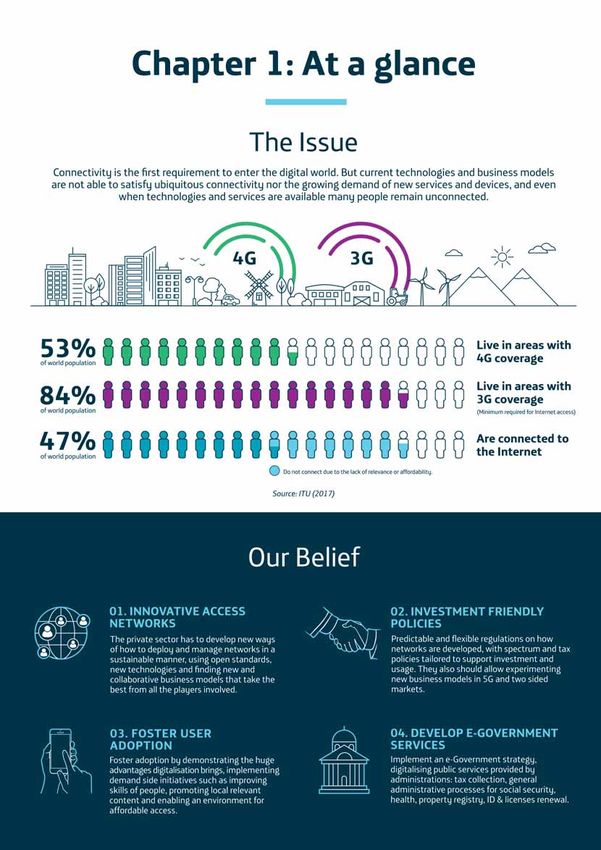
renegotiate, redefine and reassert common values play: regulatory reform can stimulate investment Research suggests that:
for our digital future. and removal of sector-specific taxation can
Nearly half of all the work we do today will be
make connectivity more affordable. Demand
automated by the year 20552.
This New Digital Deal should establish: for services is stimulated by improving skills,
promoting relevant local content and through the 90% of jobs will require some level of digital skill3.
A Digital Bill of Rights that protects our values
digitalisation of public administrations. 65% of today’s children will perform jobs that do
and fundamental rights in a digital world.
not exist yet4.
A modernisation of our policies and regulatory Overall, there are opportunities to establish new
frameworks to guarantee fair competition. models for investment, as well as a need for new Chart 1. Disruption in the jobs market
A renewed focus on business responsibility policies that encourage technological and business
Percentage Point Change in Employment Shares by Skill Group 2012 - 2014
based on better transparency and increased innovation. A new cooperation and collaboration
accountability for their services and platforms. effort between businesses and policymakers is 10
8 7,2
necessary to deliver innovative ways to provide 6
5,4
A commitment to innovation, entrepreneurship 4
3,4 3
connectivity infrastructure.
2,7
Percentage points
and investment. 2 0,9 1
0,1
0
-2
A collective understanding of how Reforming social and tax policies: -4
digitalisation can be made sustainable innovating in education, employment and -6
-8
by improving inclusiveness, transparency, taxation -10
High Medium Medium Low High Medium Medium Low High Medium Medium Low
accountability, responsibility and fairness.
skilled skilled - skilled - skilled skilled skilled - skilled - skilled skilled skilled skilled skilled
non routine non routine non routine
routine routine routine
One of the main public concerns regarding European Union Japan United States
Achieving such a human-centric digitalisation digitalisation is the loss of jobs.
will require collaboration on the following priority Source: European Commission, DG Research and Innovation
issues. However, history suggests that new kinds of jobs
are created in place of those that are replaced by Automation is improving business performance
Connecting digital lives: leaving no one new technologies. This means that we will see by increasing productivity. It is important that
behind a transitional period during which workers will the disruption produced by the rapid pace of
need to be reskilled and social policy will need to technological development is better understood.
It is important to ensure that the benefits of mitigate the most negative impacts. Society must be prepared for digitalisation and
digitalisation flow to all citizens to create a more people must be equipped with the necessary skills
inclusive society leaving no one behind. The first to cope with it.
step for inclusiveness is to have infrastructure
available to connect.
Driven by massive private investments, the
growth of connectivity in recent years has been
remarkable. However, almost half of the population
is still not connected1.
The reasons for this unsatisfactory situation
are manifold and the public administrations
should cooperate with the private sector to bring
connectivity to all.
The private sector should find new ways of
providing connectivity allowing it to deploy
infrastructure in unserved, rural areas.
Additionally, new methods of commercialisation
should be established that make broadband
affordable even for low-income consumers.
Public administrations have also a vital role to
12 13
Education systems and national curricula need to Innovation of social policies should focus Delivering trust in data access to tools that enable them to obtain the
be updated and made flexible in order to address on mitigating new inequalities born out of full value of their personal data in simple and
a world of continuous change and uncertainty. digitalisation. Some proposals brought forward Data can be a force for good and its use can enrich convenient ways.
A humanistic approach to education is required, include Universal Basic Income, negative taxation, the lives of individuals, benefit businesses and Choice: people should have meaningful choices
fostering critical and creative thinking together four-day weeks and increasing taxes further on the advance society as a whole. about how and for what purpose their data is used.
with a philosophy of lifelong learning. wealthy. Solutions will require the engagement of
all stakeholders, including workers themselves. We believe a new data ethical framework Given the huge value of data-driven services for
Governments should cooperate closely with is needed because people should be at the people and society, ethical frameworks for data
businesses and educational institutions to ensure Massive adoption of robots and digital services centre of digital transformation. Human-centric processing and processes that guarantee safety
that education meets the needs of the upcoming provided from abroad can have disruptive effects technologies can transform civil services such as and security are essential. Security and rights are
labour market, so as to avoid skill shortages. on employment and contributions to public health, education and transport to create a better inextricably linked and therefore national security
The key question is how to better anticipate the finances. future. It can also enable sustainable development activities like mass surveillance must guarantee
transitions of the labour markets that will define and help to address some of the world’s biggest human rights, which should be upheld by both
the future of work. Digitalisation will require policymakers to adopt problems, like climate change, natural disasters public and private sector organisations.
new approaches to fiscal policy in coming years. and pandemics.
It will be important to guide people through But sector-specific taxation, such as a tax on
Perimeter-based approaches to security
this transition and qualify them. Telefónica robots, might have unintended consequences: Surveys show that people want to have control of have become outdated. Measures ensuring
proposes the following priorities: holistic analysis and testing are needed. their data, to decide how and when it is used and architecture’s resilience to attack, data
Investment in training programs to help displaced for what purposes. People also want meaningful authentication, access control and client privacy
Tax policies should avoid tax base erosion by choice in relation to their data usage.
workers. need to be established in order to make certain
ensuring that online and offline businesses
that security is bound with the data itself.
Actions that foster collaboration across industrial contribute fairly to those societies where their Chart 2. Would you like to have your own tools to
Empowering people will be the key to a successful
sectors to develop new forms of employment. transactions take place. manage your privacy options on the internet?
transition towards a data economy, especially
Most probably, the labour market will increasingly No when an increasing part of our lives will be
be characterised by the prevalence of short-term Businesses will also need to embrace responsible 6,3%
N/A measured by sensors that collect personal data
contracts and freelance work. Such new ways tax practices and aim so as to fairly contribute 10,6%
about our health, location and habits. Trust in the
of working provide flexibility to workers but also to finance the public services of those countries
use of data will be of even greater importance than
challenge their social safety protections and where they provide their services.
it is today.
benefits.
Supporting fairer platforms and
Yes accountable algorithms
83,1%
Luana da Oliveira, Bianca Guardia and Renan Kawakami, Telefónica’s Brazil employees.
Global digital platforms create value for their users,
drive innovation and deploy new business models
Source: Reptrack 2017
that often are more efficient or convenient than
established ones.
Most countries protect a certain level of privacy,
but regulation alone will not be enough to help
Despite such obvious benefits, the dominance
people feel more confident about the use of their
and market power gathered by today’s biggest
data. In fact, outdated regulation can actually
platforms gives them the potential to control
increase consumers’ confusion because it applies
users’ digital experience and exert a huge influence
different levels of protection for similar services.
on their lives. Some even have the ability to shape
public opinion.
Building trust in relation to personal data requires
attention to four basic concepts:
The combination of new technologies based on
Transparency: allowing users to access the Artificial Intelligence, automated decision-making
information they generate. processes and massive access to data risks further
Data security: confidentiality and integrity of reinforcing the dominance of the leading Internet
data are the pillars of privacy. platforms. This could create enduring bottlenecks
in the digital economy.
Putting people in control: users should have
14 15
To preserve the global and open nature of the           business self-regulation, policy guidance and        Some dominant digital platforms have a far-
     Internet, local laws and values must be respected.      regulatory supervision.                              reaching impact on people, competition and
     To ensure fair contributions to societies, taxes                                                             economies that often goes beyond those of
                                                             A variety of existing institutions shape digital
     and other provisions to national welfare and                                                                 traditional business. Such companies should
                                                             policies, but the distribution of responsibilities
     employment must be linked to the places where                                                                place the values of transparency, accountability
                                                             has developed organically.
     transactions take place and services are used.                                                               and non-discrimination at the heart of their
     Policymakers should actively respond to these           As the Internet matures and the next wave            approach and activities; they must assume
     challenges and digital platforms should match           of digitalisation gathers pace, a strategic          greater responsibility for their impact on
     their great power with increased responsibility         solution is required, creating appropriate           economies and societies.
     towards their impact on the societies in which they     institutional frameworks that tackle today´s
     operate.                                                challenges:                                          Business leadership based on a values-driven
                                                             Competition dynamics in digital markets have         approach. Business, driven by values, must
     Modernising rights and policies                         led to the concentration of market power             anticipate the impact of digitalisation, acting
                                                             in the hands of a small number of global             responsibly to achieve a sustainable digital
     Rights must apply equally online as they do offline.    players. Whilst innovation still takes place         ecosystem.
                                                             in the digital ecosystem, there is a great risk
     In the digital ecosystem, business interests must       that it increasingly only takes place with the       This should include a cross-sector approach and
     coexist with people’s rights and the interests of       permission of these powerful firms, through          a focus on citizenship, human and consumer
     States. There is a plurality of interests that should   the proprietary rules they enforce and the           rights, rather than a purely market-centred
     be taken into account in this debate.                   bottlenecks they control.                            approach.

                                                             Technological evolution and new business
     Not only businesses but also governments within                                                              Global solutions
                                                             models are outpacing traditional policy and
     a democratic framework should contribute to
                                                             regulatory frameworks. In a fast-paced,
     an open and transparent Internet by protecting                                                               As digitalisation enhances globalisation,
                                                             disruptive, global, digital environment,
     people’s rights and fostering transnational                                                                  policymakers and businesses should strive to
                                                             regulation must become more responsive to
     agreements in various relevant areas.                                                                        find global or regional solutions to problems
                                                             behaviours and activities and less focused
     Governments should seek a certain harmonisation                                                              that are rooted in the cross-border nature of
                                                             on specific industries and sectors. Not
     of policies and rules in order to enable the                                                                 the Internet. The role of governments should
                                                             only businesses but also policymakers and
     fulfilment of individual’s rights.                                                                           be to enhance international cooperation in
                                                             regulators must embrace change and adapt to
                                                                                                                  order to solve new, global issues stemming
                                                             the new political and technological context.
     Citizen and consumer rights are embedded in                                                                  from global digital services and data flows.
     national and international arrangements, but their      Supervision must be modernised in order to           In this regard, the rise of cyberthreats has
     definition is usually shaped by their historical role   make it smarter and faster, seeking a new            become one of the most pressing dangers to
     in the offline world. These rights must become          approach based on:                                   the future of the Internet and there is a need
     equally applicable in the online world, so the          - A focus on “what” rather than “who” is             for better alignment and cooperation between
     establishment of a “Digital Bill of Rights” must          regulated.                                         governments and the private sector.
     become the subject of a public debate and
     agreement.                                              - A less prescriptive regulatory approach,           Today’s regulatory frameworks and
                                                               leaving markets the freedom to experiment          institutions were not built for this digital
     When it comes to the rights of citizens, the oft-         but with close supervision of market               age. It is time to redesign them in order to
     heard argument that “online is different” does not        developments; retaining the capability to          preserve the values and achievements of
     hold. Business must step up to its responsibilities       intervene decisively when market dominance         previous generations. This must be done
     and take an active role in society and the                and abuse take place.                              on the basis of a better understanding of
     promotion of people’s rights.                           - The inclusion of data in competition analysis      how new technologies, business models and
                                                               as the way to pay for services on a platform       markets evolve and work. New frameworks
     Market supervision                                        and a key production factor in the data            will need to find the right balance between
                                                               economy.                                           the experimentation and innovation inherent
     A new policy and regulatory paradigm                                                                         in well-functioning markets, whilst protecting
                                                             - More expertise about digital markets within
     is needed, and they should be based on                                                                       people’s rights and ensuring sufficient
                                                               authorities, making them fit for a digitalised
     accountability and transparency, combining                                                                   competition.
                                                               economy and society.

16                                                                                                                                                                   17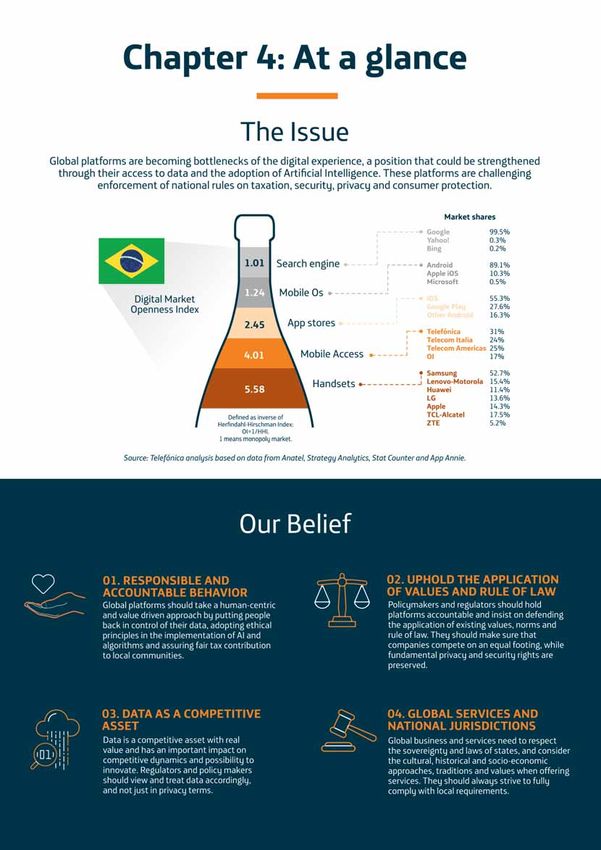
01
     CONNECTING
     DIGITAL LIVES
     In this chapter:
     You will learn about the benefits that access to the Internet
     brings and how to increase connectivity through innovation,
     cooperation, education and the right policies to leave no one
     behind.

18                                                                   19
1. Digitalisation is changing everyday life
The Issue
Being able to connect is essential for a
digitalisation process that leaves nobody
Digitalisation can be viewed as the Fourth
Industrial Revolution5 and the basis for
Connectivity is the
behind. amazing new services and business models
that are transforming and disrupting many
first requirement to
Although connectivity growth has been
remarkable over the last decade thanks businesses. enter the digital world.
to mobile broadband networks, half of the
population still remains unconnected. Around the world, the way we work,
The connectivity has a positive and relevant
communicate and face daily tasks is being
Current technologies and business models impact on employment and improves the
revolutionised by digitalisation – from
will not be able to deliver ubiquitous Gross National Income (GNI) per capita as the
shopping to culture and entertainment.
connectivity and satisfy the growing International Telecommunications Union (ITU)
requirements of new services and devices. has reported. Improving Internet access and
The telecommunications sector is a good
use are correlated with higher GNI (see
example of how digital services have changed
chart 1). The ITU has also published an ICT
CONNECTING
the way people communicate: images, video
Development Index (IDI), which records the
and enriched text messages now complement
population’s digital skills and suggests a clear
voice communication.
Our Belief
relationship between education and per capita
DIGITAL LIVES
GNI (see chart 2).
But this is not just about private businesses;
public services, governments and politics
Digitalisation must be inclusive so everyone But worldwide 3.9 billion people, more than
are changing too. Healthcare, transport and
has the opportunity to participate in the half the world’s total population, are still
education are all among rapidly-evolving
connected world. offline. The majority of these people are from
services that are improving their ability to
the developing countries6.
Public administrations should make interact with citizens and better meet
broadband deployment a priority for their their needs.
Out of this, around 1.2 billion cannot access to
national development and work together with
3G or 4G mobile infrastructures and therefore
the private sector to bring connectivity to all. To be sustainable, digitalisation must be
cannot connect to the Internet, but 2.7 billion
The private sector will need to rethink an inclusive process that ensures everyone
live in areas of coverage of mobile Internet
how it deploys network infrastructures has the opportunity to participate in a
access and do not connect and use it (see
and commercialises broadband services. connected world. Without reliable, high-speed
Chapter 1: At a glance).
Telefónica is a leader doing so in Latin connectivity infrastructure, people cannot
America. benefit from huge opportunities coming from
Telefónica has invested more than 45 billion
the new ways to create, communicate and
Governments should modernise regulation euros over the last five years to provide
collaborate.
to support and foster new ways to deploy, global infrastructure, becoming the first fibre
operate and commercialise networks by provider in terms of footprint and bringing
Digitalisation opens the access to digital
companies. mobile broadband coverage to almost 80% of
education and knowledge on an unprecedented
the Latin-American population. Nevertheless,
Regulatory reform should strive to attract global scale, which in turn provides new
20% of this region’s population is still
private investment and support lowering professional possibilities and prepares people
unserved by mobile broadband.
the cost of infrastructure deployment by for new digital employment.
removing taxation.
Therefore, connectivity is a necessary element
Public administrations should also contribute
to empower people and the key to social
to increase demand for broadband services
inclusion.
by improving people’s skills, promoting
relevant local content and digitalising public
services.
20 21Chart 1. Relationship between use of connectivity and GNI per capita:
“Broadband represents a powerful way to
accelerate progress towards the attainment
of the 17 SDGs, and new broadband networks
10
9 Korea (Rep.)
8
Estonia
and services will play a key role in the
7
Belarus R2=0.8248 delivery of education, healthcare and basic
social services, particularly for chronically
6 Jordan Brunei Darussalarn
Moldova
5
disadvantaged communities”.
Use 2017
Kuwait
4
3
2
Cuba
Howlin Zhao, ITU Secretary-General
1
Angola
Equatorial Guinea
Kiribati
0
0 10,000 20,000 30,000 40,000 50,000 60,000
GNI per capita, USD, Atlas Method 2015
2. New infrastructures, better infrastructures.
Chart 2. Relationship between ICT Development Index (IDI) and GNI per capita:
Connectivity is the first step in the digitalisation. Sustainable networks
It is important to work on two key areas:
10
Improve or evolve older networks to meet the
Digital divide. Connecting the demands of a fully digitalised society (Better
unconnected
Korea (Rep.)
9 Networks). The digitalisation of everything will
Estonia concentrate in ultra-dense areas up to 1 million
8
Belarus
Connecting those who don’t have access to devices connected simultaneously into a single
7 United Arab Emirates
R2=0.846
the most advanced networks (New Networks). 1 km2 (counting users’ smartphones and other
Moldova
Brunei Darussalam
The unconnected should be the main focus devices). This is an unprecedented challenge
6
of policymakers and governments. This New that entails a radical change in how networks are
5
Networks should not just be provided for the deployed and operated.
IDI 2017
short term, but designed to evolve as soon as
4
new solutions and innovations are created, thus In order to connect people and objects,
reducing the capability gap between rural area networks will need to become smarter and
3
networks compared to urban areas. more flexible. Some applications will need higher
2 bandwidth or better latency and response, while
Equatorial Guinea
Inclusion is a concern for all governments and others will be able to operate in networks with
1
other organisations shaping the digital world. In less demanding performance. In the same way,
0 the same way that power and water infrastructure the controlled and identifiable environment and
0 10,000 20,000 30,000 40,000 50,000 60,000
were central to development in the 20th century, the level of cybersecurity that industry 4.0 will
GNI per capita, USD, Atlas Method 2015
today connectivity must be accessible for require differ profoundly from the environment of
everyone. open access and freedom to attach (uncontrolled)
Source: ITU
devices offered by generic Internet access.
22 23Current approaches won’t work for these Making services more relevant to diverse Chart 3. Key characteristics of the world offline population
new challenges because: populations and creating relevant content
and services in local languages are key issues
The current obligations that operators that create a virtuous circle by promoting the The Gender Gap is most pronounced in Africa, Individuals with low educational
have when building infrastructures make it experience of digitalisation and encouraging the Arab States and Asia Pacific attainment often remain
impossible to provide networks at reasonable further exploration. unconnected across all regions
prices for low-income users living in remote
areas.
Misleading and restrictive understanding
In order to get Male 58% 60% live in rural areas, of which a
42%
people connected it
Female large proportion is located in Africa
of current regulations requires networks to
and Asia-Pacific
perform equally for all services or devices.
is necessary to find
Both challenges have a common ground:
they require a modernisation of rules and
innovative ways to Half have a GNI/ Capita of < US$ (PPP)
6.500, a large proportion of which are
The elderly have much lower Internet
penetration levels than the overall
regulations in order to provide an adequate
framework where network innovation is not
deploy networks, located in Africa and Asia-Pacific population across all regions
discouraged. enable the creation Source: Connecting the unconnected report, ITU, 2017
Providing such resilient, trusted and pervasive of relevant digital
infrastructures that bring connectivity to
everyone represents a big challenge that will services and equip
need a multi-stakeholder approach. This will
require the collaboration and cooperation
users with basic digital Case study
of the private and public sectors, as well skills to benefit from
as operators, device suppliers, regulators,
them. UNited nations’ Inadequate communications infrastructure restricts
access to markets, jobs, information and training,
policymakers, vendors, standardisation bodies
and open source communities. SUSTAINABLE creating a major barrier to business.
DEVELOPMENT GOALS
Undeveloped communications infrastructure limits
A variety of initiatives from the private
Telefónica maintains a firm commitment access to healthcare and education.
and public sectors are required to close the
to provide infrastructure to everyone in connectivity gap by taking action on both the Small and medium-sized enterprises (SMEs) that
the countries where we operate. We have supply and demand sides: engage in industrial processing and manufacturing
invested €45 billion worldwide over The United Nations sustainable development are the most critical for the early stages of
the last five years and we continue to agenda is guided by 17 Sustainable industrialisation and are typically the largest job
Private sector:
seek innovative ways to cooperate with Development Goals (SDGs) that seek to creators. Over 90 percent of businesses worldwide
- Devising innovative and sustainable technology are SMEs, accounting for between 50-60 percent of
other players in the ICT sector in order end poverty, protect the planet and ensure
and exploring disruptive investment models to prosperity for all. Two of the SDGs are directly employment.
to increase our presence and extend our
deliver infrastructure. linked with communications infrastructure,
services to challenging areas. Telefónica
believes that this is the best way to help Public administrations: digitalisation and its impact on education and
Goal 17: Revitalise the global partnership for
societies, in line with the United Nations (UN) economic growth.
- Creating an investment-friendly policy sustainable development
Sustainable Development Goals (SDG)7.
framework to build Information and Goal 9: Build resilient infrastructure, promote
Communications Technology (ICT) This goal recognises the importance of a
sustainable industrialisation and foster
Furthermore, finding new ways of providing
infrastructures. multi-stakeholder partnership approach:
innovation
better infrastructure to increase access to
services is not enough unless people can - Following a holistic approach. Enhancing the global partnership for sustainable
This goal recognises the importance of
see the benefits of using them. Even in well- - Digitalising public administrations and civil development, complemented by multi-stakeholder
investment in communications infrastructure:
connected areas, there are significant gender, partnerships that mobilise and share knowledge,
services.
age, income and education gaps8. expertise, technology and financial resources,
1-1.5 billion people do not have access to reliable
to support the achievement of the sustainable
telephone services.
development goals in all countries, in particular
Quality communications infrastructure supports the developing countries.
achievement of social, economic and political goals.
24 253. Private sector Additionally, innovative ways of using
existing technologies will allow the
downtown districts to remote and rural
coverage, the private sector will need to:
private sector to overcome traditionally
Develop new equipment and technical
unmanageable problems. Balloons, drones
solutions.
and satellites may all become elements of a
Innovation to deliver the access Similarly, the high cost of developing Find new business models and explore
network solution.
infrastructure that consumers need infrastructure in ultra-dense areas able to deal cooperation with other players.
with the new requirements of the Internet of
Open standards and open source initiatives Cooperation with digital service providers
The networks of the future should be personal, Things and other new services will need of new
reach their maximum potential in remote in some rural and low-income areas in order
fully flexible and adapted to customer solutions that may later be escalated to rural
places. They can reduce the level of expertise to provide sustainable network access
demands. People will interact with networks areas.
required to manage a local access network provision.
to manage and configure their experiences,
by enabling communities to handle an
depending on their immediate needs and The new technologies that are being developed Transform conventional business
operator’s local equipment by themselves
wishes. Networks need to be sustainable to provide fully flexible infrastructure approaches, break down silos and develop
and contributing to network maintenance
and also smart enough to keep pace with management in order to make them more business models to implement 5G networks
in remote areas. The use of more generic
consumers. sustainable are based on Software Defined that will help to solve these challenges,
equipment can then reduce the cost of
Networks, Network Function Virtualisation and both in rural and ultra-dense areas.
equipment maintenance and upgrades.
Delivering ubiquitous access infrastructure Network Slicing in 5G networks. This will allow Strengthen the cooperation between
will require a huge effort from the infrastructure providers to be more efficient,
Thus, in order to provide access equipment suppliers and software
telecommunications sector. Connecting remote providing network capabilities fit for purpose,
infrastructure that brings connectivity developers, working with open standards to
sites can cost much more than urban areas instead of having a rigid platform that cannot
to diverse and challenging contexts and achieve economically feasible, efficient and
and, therefore, the return on investment is sustainably satisfy the needs of a digitalised
areas across the world, from ultra-dense sustainable solutions.
much lower due to the cost of deployment, society.
even assuming the same intensity of use as in
urban areas.
Case study
With the “Internet para todos” programme, Telefónica is expanding Internet with an
TELEFÓNICA’s programme: “INTERNET innovative approach, incorporating a broad range of partners and stakeholders to solve
PARA TODOS” the rural connectivity challenge.
Almost 100 million people in Telefónica’s footprint generation of software-based networks to build HIGH ALTITUDE PLATFORMS
are not connected. We are committed to ensuring a rural, sustainable value chain with scalable Extension of coverage with “flying
that the benefits of digitalisation flow to all financial structures capable of deploying the towers” in extremely remote areas.
citizens and are more evenly shared, in order to networks of tomorrow. On demand coverage
create a more inclusive society that leaves nobody
behind.
Some of the key elements that “Internet para
Todos” is reinventing in Latin America are:
“Internet para Todos” is Telefónica’s internal
programme that reimagines the way networks Adapting infrastructure to low-density areas.
are designed, deployed, operated, maintained Designing an open, simplified, fully virtualised, RURAL OPERATOR
RURAL INNOVATION
and commercialised, so as to continue extending environmentally efficient and programmable network Overlay of voice network Use third parties to cover
our mobile Internet coverage beyond our current and support tools. Update our voice business with places where our operating
Already piloted in Peru
reach. innnovation in network model or financial performance
Discovering disruptive deployment models such with good results.
( Access and transportation) are not profitable
as High Altitude Platforms, local communities and
Telefónica tackles this major challenge with a
entrepreneurs.
radically open approach, collaborating with several
cross-industry stakeholders: Internet companies, Leveraging Big Data & Artificial Intelligence (AI) to
other local operators, local entrepreneurs, guide decision making.
Already piloted in Peru with good results.
governments, etc. We are using the next
26 27 274. Public administrations
Investment-friendly policy framework Case Study
Public administrations must focus on providing
the best outcome for all citizens, being open
SPAIN LEADS FIBRE
to new operational and investment models. TO THE HOME (FTTH)
DEPLOYMENT IN
Predictability of the legal and regulatory
environment is vital to enable investors to
assume risks and to attract the private capital
that is needed to build the infrastructure
EUROPE
networks of the future.
A flexible and predictable approach includes: In Spain, a change in the regulation of Daniel Souto, Telefónica’s Brazil employee
optical fibre access in 2009 aimed to attract
Greater flexibility in the way networks are investment in high-speed broadband (above 30
developed and used to provide services, A two-sided market means that both consumers offers and the benefits this can bring in terms
Mbps). It resulted in massive fibre roll-out by
supporting a more efficient rollout of next- and producers contribute to fund their common of take-up. While some of these initiatives
the three operators. By June 2016, more than
generation networks such as fibre and 5G both platform. It avoids the burden of funding falling have come under criticism for potential Net
11 million households had fibre to the home
in ultra-dense and remote areas, taking full solely on one party or the other. In many cases, Neutrality violations, it is fair to say that many
(FTTH) access and by the end of 2016 take-up consumers can contribute to fund the platform of them have been very popular.
advantage of what technology can provide in
was nearly to 35%. Back in 2008 Spain was a with their personal data in addition to or instead
terms of infrastructure usage efficiency.
laggard in Europe in terms of homes passed of financial remuneration. Affordability is often viewed as a relevant reason
The promotion of private investments in with FTTH technology. Now it is ranked 5th in why people do not use the Internet. Obviously,
cooperative and community networks operated the world (7th by number of FTTB subscribers) Operators, industries and individuals will need people need to be able to pay for connectivity,
by local residents in very low-density and and has the biggest FTTH network in Europe, to develop and experiment with new business so price levels do matter. However, as the ITU
unserved areas that may then be attached to: making Spain the leading European country for models, and regulators should be open to has recently stated in a major study for least-
FTTH availability. lightening regulatory burdens like some existing developed countries9, the relationship between
- Private backhaul links
net neutrality provisions. mobile broadband prices and Internet use is not
- Wholesale-only networks, also privately particularly strong and other factors, such as
funded, where anyone can join. As well as a modernised approach to innovative availability and skills, are also at play ( see chart 4).
Where Fiber Broadband is Most Prevalent business models, new ways are needed to provide Furthermore, mobile broadband prices have fallen
A regulatory reform or soft approach to encourage
Fixed fiber broadband subscriptions per 100 licenses from governments and regulators, considerably in recent years10 ( see chart 5).
new business models that can get the best of a inhabitatns in selected OECD countries*
two-sided market which complement the current removing the costly processes that transfer
Chart 4. Relation between mobile broadband basket
ones based only on bandwidth and/or volume of private capital to governments instead of having and internet usage, 2015, Least Developed Countries.
South Korea 30.0
data consumption. Such a two-sided market is a that capital deployed directly into the building of
Japan 22.9
key feature of the Internet for specific rural areas networks and infrastructure. 45
Sweden 20.4
with low-income population, as well as for ultra-low Norway 15.5
40
R2=0.4732
The experience of limiting regulation around
Internet use (% of population)
latency networks needed to provide new services in
35
Spain 10.7
very high density areas. wholesale fibre obligations in Spain resulted in a 30
Switzerland 9.6 25
boost to fibre deployment by all the operators,
Netherlands 6.0 20
It might be time to reconsider whether putting Spain at the forefront of the EU in terms of 15
Australia 5.8
consumers alone should assume the funding number of fibre connections and networked homes. 10
United States 3.7
burden of access networks, given how little Canada 3.7
5
control they have over the volume of data being Holistic policy approach 0
0 5 10 15 20 25 30
France 3.3
pushed towards them by digital services. Germany 0.7
Mobile broadband basket (% of per capita income)
Regulation should take into account the value
of innovation in business models and retail Source: Adapted from ITU
*December 2016 Source: ITU
28 29Chart 5. 1 Mbps broadband landline rate in and optimises resources, enabling reinvestment
Latinamerican countries as a percentage of monthly per and increasing efficiency.
capita GDP, 2010 and 2015
BOLIVIA It is a win-win proposition for all. Citizens become
PARAGUAY engaged in the digitalisation process and develop
ECUADOR an increasing need to participate in the digital
COLOMBIA society as public services go online.
CHILE
COSTA RICA It is easy to envisage some examples:
ARGENTINA
Digitalising healthcare will enable better services
BRAZIL
URUGUAY
to be delivered and efficiently extend the reach of
0 10 20 30 40 50 60 70 80
advanced medical services to remote areas.
2016 rate as a percentage of monthly per capita GDP in 2015
The use of data analytics makes public transport
2010 rate as a percentage of monthly per capita GDP in 2010
Average in 2010 systems more efficient.
Average in 2015
Digitalisation of processes involving tax authorities
Source: ECLAC Regional Broadband Observatory. For 2010, the rates
correspond to December. The rates for 2016 correspond to January;
has been demonstrated to act as a great incentive for
GDP to 2015 people, companies and other agencies to embrace the
advantages of such changes, saving time, efforts and
Affordability is, therefore, one factor, but other
money for all parties.
issues are equally important, including take-up
barriers that need more focus by governments
than just the price of connectivity. For example,
the cost of the associated equipment and
devices required to run digital applications and
services. Computers, tablets, smartphones Case study
and the power supply required to run them are
fundamental components of digital life and need
to be accessibly priced so that citizens can take
SWEDEN’S
advantage of the connectivity available to them. BLOCKCHAIN-
Communications services should not be taxed POWERED NATIONAL
differently than any other basic good and neither
should there be differences in taxation rules
PROPERTY REGISTRY
between different providers. High tax rates, or
sector-specific taxes, make communications
services less affordable for lower-income groups, March 2017, the Swedish National Land Survey
and can have the effect of turning the use of completed the second phase of a Blockchain-
digital services into the preserve of a privileged powered National Property Registry, working with
few. Governments should bear this in mind
the start-up ChromaWay, two banks specialised
when defining their tax policy and categorising
in mortgages, Telia and Kairos future technology
devices, which should be treated as basic tools for
consultants.
empowering people, not as luxury goods.
Modernisation of public administration The solution clears the way for the removal of the
old paper-based process and substitutes it with
Public administrations can help to build trust a fully digitalised system. Blockchain provides
and confidence by demonstrating the huge security and convenience, and a reliable way to
advantages of digitalisation. This process of streamline the workflow across the ten or more
digitalising administrations has additional different entities involved in the process.
advantages, as it increases their service capacity
30 3102
REFORMING
SOCIAL AND
TAX POLICIES
FOR DIGITAL
SOCIETIES
In this chapter:
You will learn about our recommendations to governments
and companies in order to help society become prepared for
the digital revolution by modernising education systems,
implementing reskilling programs, offering new social
policies and adapting taxes to the new digital economy.
32 33REFORMING SOCIAL 1. The changing world of work
AND TAX POLICIES FOR Technological advances are ushering in an
industrial renaissance that could empower workers
Supply matches demand.
Policy and regulatory frameworks are adapted to
DIGITAL SOCIETIES
and reduce inequality, both within and between
the new economic context.
countries. However, the digital economy leads to
disruptive processes in terms of efficiency (like Financial stability is guaranteed.
saving time, lowering costs and reducing errors), There is cross-sectoral adoption of new
standardisation and new models of collaboration technologies.
which are generating uncertainty about
employment.
The challenges that we currently face are related
to the speed of change mediated by technology.
What does history tell us about the relationship
These are risks related to digital divides, to the
between employment and technology? The
The Issue Our Belief experience following technological revolutions
digital transformation of companies and sectors
and to the adjustment of the labour market.
has always been very positive regarding job
The profound impact of digitalisation on Policymakers will need to actively shape creation, although every society has gone through
The Gig Economy
economies differs from that of previous digitalisation by adopting adequate policies transition periods to adapt supply and demand.
industrial revolutions due to the speed of to prepare and guide people through this The rise of the Gig Economy is creating a dynamic
change, making adoption more challenging new Industrial Revolution. Digitalisation is key to ensuring greater economic
environment in which the nature of work is
than ever before for society and people. dynamism in the short and medium term.
Social policies need to be modernised and being reshaped by changing demographics and
Labour markets are being radically adapted to the new markets’ realities to be technological progress with social, political and
A virtuous circle can be generated in the
transformed and many people are at risk of able to protect people and workers. economic implications that are concerning for
relationship between work and technology
being affected by new social insecurities and workers, organisations and policymakers.
Existing workforces will need to be reskilled provided that:
inequalities.
to guarantee future employability.
The sustainability of social policies, security
New approaches to education are needed to
and welfare are endangered through
develop the necessary skills and knowledge
digitalisation and Automation and their
for a digitalised economy. People will need
impact on tax contribution and employment.
to learn throughout their lives and education
“Intelligence is the
Artificial Intelligence (AI), Machine systems and businesses have to adapt to
Learning and Big Data will be the drivers of that new reality.
Automation of all repetitive processes and
ability to adapt to
Technology and connectivity will help to
jobs, leading to the disappearance of many
provide better education for everyone.
posts and professions, while creating new
ones. Tax erosion through digitalisation needs to
be avoided to ensure that public education, change”.
social policies and welfare are adequately
funded to be able to support the profound
transformation of digital societies.
Stephen Hawking (1945-2018)
Global digital businesses should adopt
responsible tax practices and contribute
fairly to those societies where their activity
and transactions take place.
34
34 35Disruption in the jobs market. In order to avoid skills shortages, mass
Job transformation unemployment and continued growth of
inequality, more individuals must
Some have seen automation as a synonym be empowered to participate in this digital
for unemployment, but it increasingly seems transformation.
that it will mainly target certain jobs profiles
which are due to repetition easy to automatise.
Digitalisation has already generated new jobs
that did not exist a decade ago, such as Big Data
It is vital to reform
specialists, social media managers, cognitive
computing engineers, Internet of Things (IoT)
education systems and
architects and Blockchain developers. Therefore, national curricula so as
it remains to be seen whether digitalisation
and Automation will change the world of to meet the needs of a
Jesús Gil, Rafael Muñoz, Angélica Roa, Andrés Vega and Edmar Vanessa: Telefónica’s Brazil employees
employment, replace repetitive jobs and
create demand for new skills. rapidly changing labour
During the transition to the new economy,
market, incorporating
Over the next decade, developed economies will
feel the effects of an ageing population that will
by uncertainty and precarious employment
conditions, but rather by fairness and social
training and reskilling of the existing workforce a philosophy of lifelong
will be required to help those workers displaced
need to remain independent, active and also
work for longer than before.
equality. To achieve this goal, policymakers
should find new formulas to afford individuals
by Automation. Going forward, training and learning, enabled by
better protection in these new work models
learning will play a major role in people’s working
lives because the future of work is going to be all digitalisation and
The digital revolution is helping people and and businesses should take action across
organisations to progress in previously industrial sectors to develop them. With the
about skills, change and adaptability.
connectivity.
unimaginable ways. New technologies are offering right policies in place, societies will be able
many opportunities for flexible work that has to deliver social inclusion and generate
moved beyond the option to work from the office. widespread prosperity. 2. Learning to learn: the Technology will help in those efforts. It can
revolutionise education systems and engage
Today, people are able to work anywhere.
Automation is also becoming a challenge for
new goal in education and inspire people to learn:
Many people work multiple freelance jobs since employment and the human-robot partnership Education should no longer be something that
online marketplaces provide businesses with will undoubtedly continue to further transform you do at a specific institution for a specific period
access to a scalable on-demand workforce. the nature of work. of time to obtain a certification. Instead, it should
The Organisation for Economic Cooperation and
Technology and service companies have been be a lifelong journey of exploration. To thrive in a
Chart 1. Jobs at High Risk of Automation or Facing
Development (OECD) estimates that 65% of today’s
a major force in the expansion of the Gig rapidly changing world, students must learn to be
Significant Change, 2016 children will have jobs that do not exist yet11.
Economy that is providing opportunities for self-motivated lifelong learners.
industry-specific workers to find work that fits
50 By 2020, more than one-third of jobs will be based Practical knowledge can be more relevant than
their schedules, skills and needs. The number of 45 on new kinds of skills. This is becoming a worldwide traditional qualifications, so the methods and
people working on a project basis in non-salaried 40
35 phenomenon and represents a new paradigm in purpose of assessment must also be adapted to
employment are on the rise and that requires 30 education. In the EU, the number of digital jobs the digital world.
a better understanding of current workers’ 25
is growing by about 100,000 every year, but the
expectations, to ensure that these new forms of 20 New possibilities for remote collaboration are
15 number of graduates with the required Information
work do not result in new social tensions. enabling people to access information that was
10
and Communications Technology (ICT) skills isn’t
5 previously inaccessible.
0 keeping pace with demand15.
Another factor shaping the new labour market Learning can be personalised and enriched through
um ce
nia
hK n
ea
S m
Ire rk
en
ep kia
nm n
So Ja tes
Po ria
ing ds
ay
Fin (3)
lic
d S 1)
rm y
Au ny
Es and
Sw and
ite er d
ut pa
De pai
Ge Ital
Un eth lan
a
do
Be Fran
ite EU(
ub
or
d K lan
ed
rw
st
a
h R va
to
ta
l
l
is non-financial motivation. Some Internet
No
ec lo
lgi
Cz S
Beyond Science, Technology, Engineering and Maths Artificial Intelligence (AI) and Augmented Reality
N
Un
services, like Wikipedia, have developed based (AR). New tools, such as Massive Open Online
(STEM), creativity, critical thinking and empathy are
almost entirely on volunteer work. Jobs at high risk of automation
Courses (MOOCs) should be widely available and
Jobs at risk of significant change becoming ever more important for all workers: the
Governments and business leaders must ensure accessible to everybody.
World Economic Forum (WEF) anticipates a growing
that this Gig Economy is not characterised Source: OECD (2016) “Employment Outlook”
demand for cognitive abilities (52%), systems skills
(42%) and complex problem-solving skills (40%)12.
36 37You can also read


