A New Rail Strategy for Surrey - March 2021 - Meetings, agendas, and ...
←
→
Page content transcription
If your browser does not render page correctly, please read the page content below
A New Rail Strategy
Page 21

          for Surrey
          March 2021

                                1
Contents

          Introduction                                            Strategy review                                                        Appendix
              Executive Summary                              3        Development of Surrey’s position on rail                     37         Acronym Glossary                                     88
              Process Flow Chart                             5        Key changes since the 2013 strategy                          38
                                                                                                                                              Stakeholder Engagement                               89
              Surrey Context                                 6        Scenario planning and uncertainty                            39
                                                                      Scenario development                                         40         Network Rail investment plans                        92
          Baseline                                                                                                                            Scheme Long List                                     95
              Surrey’s railways                              8        2013 action plan – short term (to 2019)                      41
                                                                      2013 action plan – medium term                               42
              Surrey’s stations                              9
                                                                      2013 action plan – long term                                 43
              Railway operators and ticketing                11   Strategy Development
              Service frequencies                            13         Developing and delivering improvements                     45
              Journey times to London                        14         Categorising interventions                                 46
              Journey times and connectivity within Surrey   15         Scoring the interventions                                  47
              Network performance                            16   Network infrastructure
Page 22

              Passenger journeys and freight                 17         Strategy                                                   49
              Impact of COVID 19                             19         Interventions                                              51
          Strategic aims and responses                            Connectivity and services
              Developing strategic aims                      21         Strategy                                                   56
              Developing strategic responses                 22         Interventions                                              58
                                                                  Stations and access to the rail network
              Achieve transport decarbonisation              23
                                                                        Strategy                                                   61
              Responding to change in the rail sector        24         Interventions                                              66
              Supporting Good Growth                         25   Passenger experience
              Access for all                                 26         Strategy                                                   73
              An attractive, high-quality rail network       27         Interventions                                              75
              A new Rail Strategy for Surrey, LTP4 and SIP   28   Delivering the strategy
          Stakeholder engagement                                        How we deliver the strategy                                78
              Approach to engagement                         30         How we achieve transport decarbonisation                   79
              Issues and challenges                          31         How we respond to change in the rail sector                80
              Strategic aims                                 32         How we encourage good growth and a sustainable economy 81
              Drivers of change                              33         How we increase access for all                             82
              Priorities                                     34         How we deliver an attractive, high-quality rail network    83
              Emerging themes                                35         The core scenario: Sustainable route to growth             84
                                                                        Alternative scenarios: The London Hub & Digital Future 85
                                                                        Alternative scenarios: Route to Growth & Sustainable Future 86
                                                                                                                                                  Cover Image Credit: Sterling Images / Shutterstock.com
                                                                                                                                                                                                      2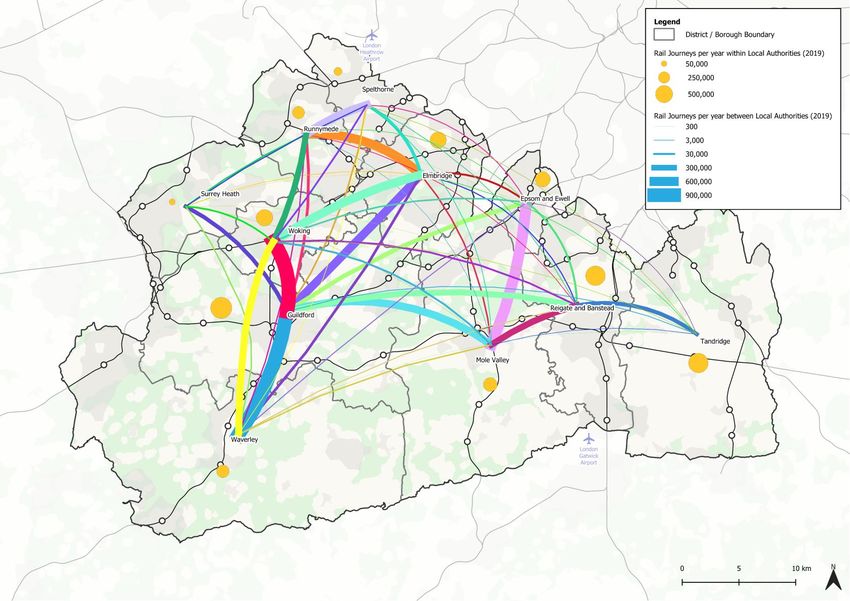
Introduction

          Executive summary                                                                         These strategic aims – combined with an assessment of feasibility and acceptability
          A New Rail Strategy for Surrey was commissioned by Surrey County Council in               – have been used to identify a core set of interventions which Surrey County Council
          April 2020; this builds on the 2013 strategy and subsequent update in 2016. This          can support through developing the case, influencing stakeholders, directly
          new strategy sets out how rail can contribute to a greener future, growing a              supporting schemes and monitoring delivery.
          sustainable economy, empowering communities, and tackling health inequality.
                                                                                                    There are a number of key developments in policy, society, and the pipeline of
          The strategy begins by setting out the baseline position of rail use in Surrey in terms   investments, the key example being the governments decision alongside TfL to
          of the network, stations, the operators and services and journeys currently               discontinue the development of Crossrail 2. This means that alternative approaches
          undertaken. This baselining exercise was the basis for our stakeholder engagement,        will have to be found to continue to increase capacity and improve performance on
                                                                                                    the south western corridor. This will require a greater focus on maximising upgrades
Page 23

          which encompassed the boroughs and districts of Surrey and key stakeholders in
          business, user groups, organisations representing disabled people and relevant            to the existing railway infrastructure, and progressing with projects such as digital
          transport bodies such as Transport for the South East and Network Rail.                   signalling and capacity improvements at Woking and Guildford.

          The Strategy acknowledges that significant challenges have emerged since the              In the east of Surrey a number of major infrastructure projects are being developed.
          previous 2013 Strategy; including slowing growth in passenger demand, changing            The Croydon Area Remodelling Scheme will increase capacity and reliability on the
          government policy, developing technology, and – most challenging of all – the             Brighton Main Line which together with improvements to Reigate station will allow
          emergence of COVID-19 and its unprecedented impact on the transport sector.               more frequent and higher capacity services. Surrey County Council will continue to
                                                                                                    make the case for better services on the Tonbridge to Redhill line with potential for
          We have identified five strategic aims which the rail network can assist in delivering    direct services to Gatwick Airport and to additional stations in Kent.
          over the next 30 years:
                                                                                                    Connectivity to airports remains an area where progress has been mixed. To improve
          •   Achieving transport decarbonisation                                                   access to Gatwick Airport, Network Rail is delivering improvements to the North
          •   Responding to change in the rail sector                                               Downs Line with new rolling stock and higher frequencies being delivered. Despite
          •   Encouraging good growth and a sustainable economy                                     being identified in the 2013 rail strategy, the planning of a new Southern Rail link to
          •   Increasing access for all                                                             Heathrow has not progressed and continues to be a gap in the region’s strategic rail
          •   Developing an attractive, high-quality rail network                                   connectivity. Surrey County Council will continue to make the case for direct
                                                                                                    connections to Heathrow by rail from the south, given the huge potential benefits for
                                                                                                    modal shift, congestion reduction, and economic performance of the region.
                                                                                                                                                                                              3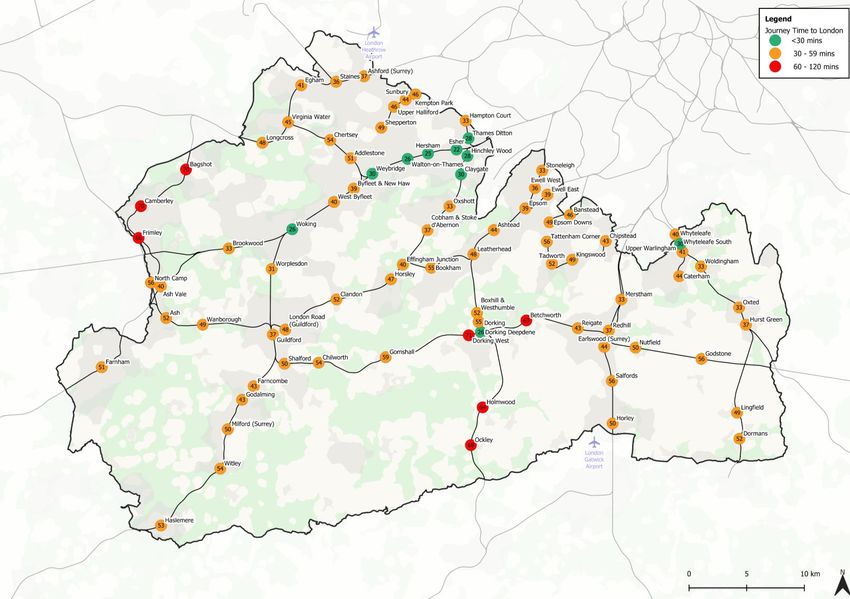
Introduction

          The Strategy has identified a need for a renewed focus on improving stations to benefit         This new rail strategy has a strong evidence base, with clear aims and identified
          local communities and utilise their potential for supporting sustainable local economic         priorities. It will enable Surrey County Council to articulate to government and the rail
          growth. Improvements should not be limited to the larger stations, such as Woking and           industry a case for change, whilst identifying the improvements to services and
          Guildford (although both have well developed and important plans) or those serving new          infrastructure required to support residents and businesses and deliver our strategic
          housing developments; there is an opportunity for new models of community investment            ambitions.
          in rural and suburban stations. Improvements to stations must be combined with
          improved access by public transport and active modes, some of which is already being            The process map showing how the strategy was developed is set out on the following
          delivered via the support of the Government’s cycling and walking investment strategy,          page.
          which will continue. Surrey and its partners have developed and delivered a number of
          improvements to step-free access and will continue to work with Network Rail and
          partners to develop and deliver further Access for All schemes.
Page 24

          Adapting the rail network for new sets of challenges will be key over the short term as the
          railway enters a post-COVID-19 era, with a new operating model and responses to the
          impact of the COVID-19 pandemic. Concerns on overcrowding may recede and instead
          passengers may need to be attracted back to the railway. To achieve this, new ticketing
          models may be needed, which are better suited to passenger needs and new work
          patterns, accompanied with a greater focus on service quality and reliability, and a plan to
          grow new markets such as leisure and tourism. Surrey County Council will ensure,
          through consultation with Government, that these reforms benefit rail passengers in
          Surrey.

          Decarbonising the transport network is the key priority for Surrey County Council; over
          40% of carbon emissions in Surrey are from surface transport, significantly higher then
          the UK average of 22%. Surrey County Council is working with Network Rail to make
          the case for electrification of the remaining network. However, this alone will not achieve
          decarbonation; it is key that rail’s share of local trips increases, and that it helps reduce
          emissions further by working with its partners in delivering the network and connectivity
          improvements, and delivers improvements in accessibility by walking, cycling, and                                         Engineering work during Redhill platform 0 construction , Arup
          public transport.
                                                                                                                                                                                                     4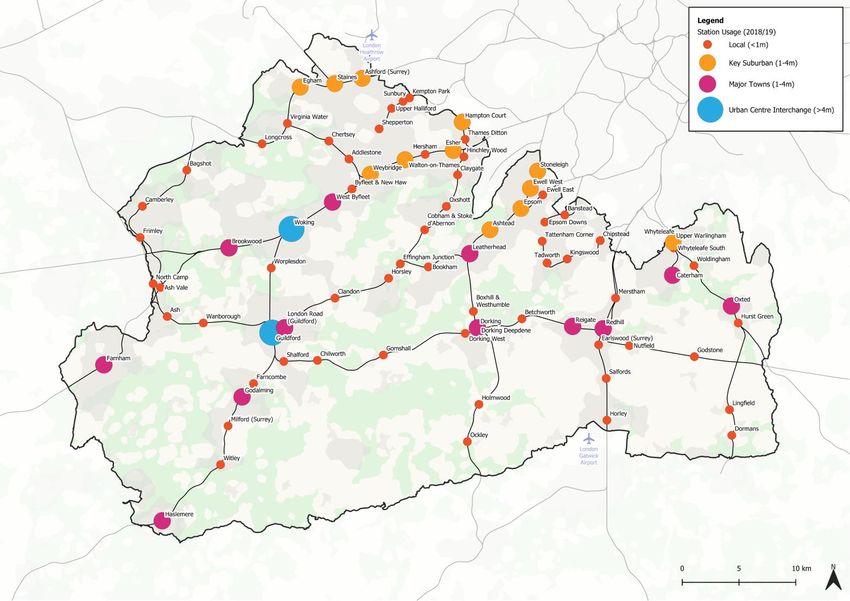
Introduction
Developing the New Rail Strategy for Surrey – Process Flow Chart
SCC strategic objectives
• Growing a sustainable economy so
everyone can benefit
• Enabling a greener future
• Tackling health inequality
• Empowering communities
Baseline Strategic aims Strategic responses Scoring criteria Strategy and interventions Delivering the strategy
Understanding the existing situation for rail transport in Surrey
• How feasible the scheme is in terms of
• Surrey s railways What Surrey wants to achieve with a New Sixteen specific outcomes which the technical delivery, funding and the delivery Summary of strategy and list of key projects List of actions and key projects for Surrey and
• Surrey s stations Rail Strategy: rail strategy should be delivering over organisation under four categories: key project over the short medium and long
Page 25
• Railway operators and ticketing • Transport decarbonisation the next 30 years • How acceptable the scheme is in terms of terms which together will deliver on the five
• Service frequencies • Responding to change in the rail sector value for money, stakeholder support and local • Network Infrastructure strategic aims.
• Encourage good growth and a sustainable Long list of options • Connectivity and Services
• Journey times to London impacts
• Stations and Access
• Journey times and connectivity within Surrey
economy • How effective the scheme is in delivering the
• Customer Experience
• Increasing access for all five strategic aims
• Network performance
• An attractive, high quality rail network
• Passenger journeys and freight Impact of COVID
Stakeholder engagement
Future scenarios
Consulted with stakeholders on their
consideration of: Four potential scenarios that could develop in
Surrey and how these could impact proposed
• Issues and challenges projects
• Strategic aims
• Drivers of change
• Priorities
Network Rail pipeline Surrey project list Strategy review
Review of projects contained in Long list of transport projects in • Review of proposed actions
the Network Rail CP6 and CP7 Surrey, including new stations, from 2013 strategy and
investment periods in Surrey stations access and highway current status
scheme • Review of changes in
transport technology,
government and local policy
and passenger preferences
since 2013
5
Introduction

          Surrey Context
          Surrey County Council (SCC) has a set of strategic priorities for the next five               The New Rail Strategy for Surrey will sit alongside other key documents
          years which we have used to guide the rail strategy development.                              related to transport and economic strategy in Surrey.

           SURREY COUNTY COUNCIL STRATEGIC OBJECTIVES                                                                      LTP4 will set out how to achieve a future-ready transport
                                                                                                               Local       system that allows Surrey to lead the UK in achieving a
Page 26

                                                                                                             Transport     low-carbon; economically prosperous; healthy and
           Growing a sustainable economy so                  Tackling health inequality                                    inclusive county, with excellent quality of life for all
           everyone can benefit                              Drive work across the system to reduce           Plan 4
                                                                                                                           residents; whilst seeking to enhance the built and natural
           Support people and businesses across              widening health inequalities; increasing
           Surrey to grow during the economic                our focus on addressing mental health,
                                                                                                                           environments.
           recovery; and re-prioritise infrastructure        and accelerating health and social care
           plans, to adapt to the changing needs and         integration, to reduce demand on                              The Surrey Infrastructure Plan will evaluate the ability of
           demands of residents at a time of financial       services while improving health                   Surrey      infrastructure to meet the objectives of Surrey County
           challenges.                                       outcomes for residents.                        Infrastucure   Council; and develop a robust tool which assesses ability
                                                                                                                Plan       of individual projects, and packages of projects, to meet
           Enabling a greener future                         Empowering communities                                        these objectives.
           Build on behaviour changes and lessons            Reinvigorate our relationship with
           learnt during lockdown, to further progress       residents, empowering communities to
           work to tackle environmental challenges,          tackle local issues and support one
           improve air quality, and focus on green           another, while making it easier for                           Surrey’s Economic Future sets out SCC priorities to
           energy, to make sure we achieve our 2030          everyone to play an active role in the
                                                                                                              Surrey’s     build on these economic strengths, supporting a
           net zero target.                                  decisions that will shape Surrey’s              Economic      resilient, productive, and high-value economy that
                                                             future.                                           Future      contributes to growth within the county and the UK.
                                                                                                                                                                                    6
Baseline
Page 27

                     7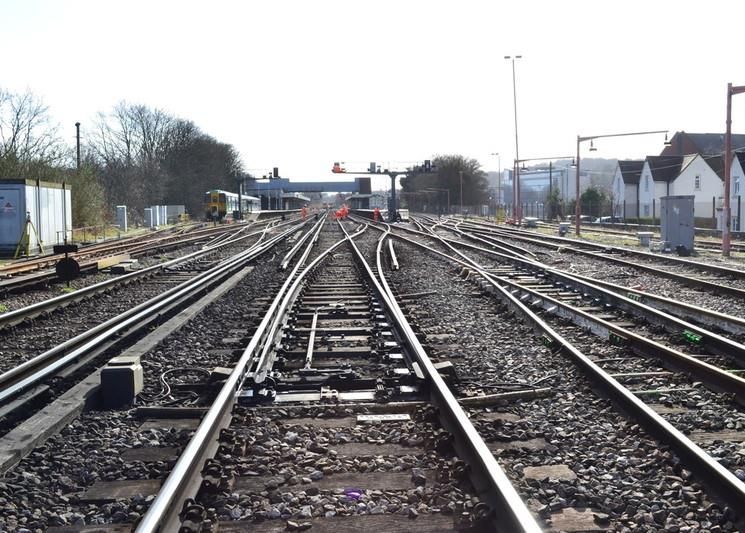
Baseline

          Surrey’s railways
          Surrey’s position on the southern edge of London means it benefits from
          a strong radial network into the capital, with the South West Main Line
          (SWML) and Brighton Main Line (BML) corridors passing through the
          county. These corridors are marked by very high frequency services, up
          to 24 trains per hour, and are served by high capacity rolling stock.

          The radial network not only connects to London but also provides
Page 28

          connectivity to the neighbouring counties of West and East Sussex (via
          Thameslink and the Oxted Line) and Hampshire (via the SMWL). To the
          north of the county, the London Waterloo to Reading line and Windsor
          lines connect the boroughs of Spelthorne and Runnymede to London to
          the east and Berkshire to the west.

          The North Downs Line is the primary orbital route running through the
          county, running west to east from Reading (providing connections to the
          Great Western Main Line), connecting to the SWML at Guildford and
          terminating at Redhill which also has connections to London, Kent, and
          to Gatwick Airport via the BML.

          Most of the network in Surrey is electrified with 750V DC third rail. The
          North Downs Line is only partially electrified. The sections between
          Wokingham and North Camp, and between Shalford Junction and
          Reigate are not electrified; requiring the route to be operated using diesel
          traction (at least when on those sections). The Uckfield branch is also not
          electrified.                                                                   Rail infrastructure in Surrey
                                                                                                                         8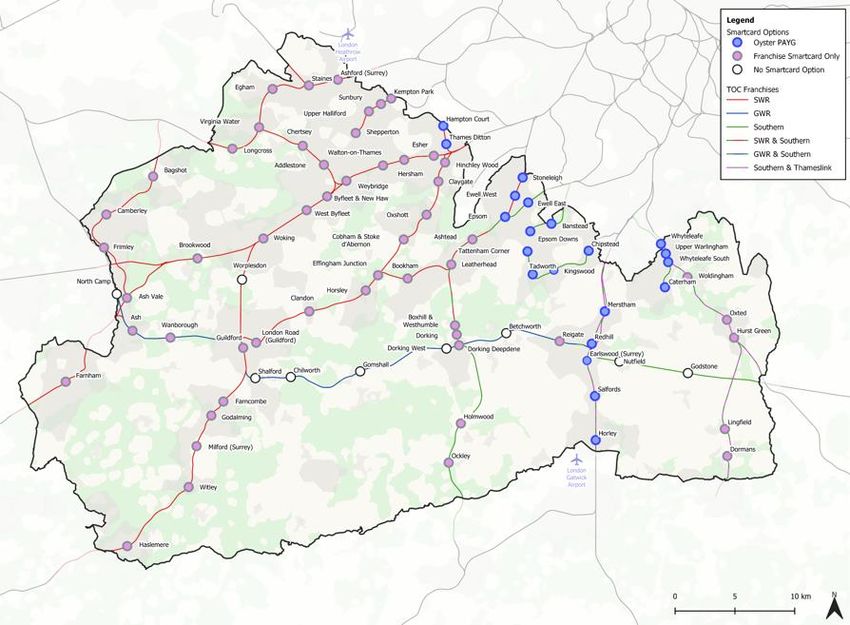
Baseline

                                                                                                                                 5-year growth in entries and exits by station class
          Surrey’s stations
                                                                                                                                   Urban Centre Interchange

          In 2018-19, there were 77 million journeys to and from the 84 stations in
                                                                                                                                              Major Towns
          Surrey. Its two busiest stations are Woking and Guildford, each of which
          serve over 7 million passengers per year1 (our analysis focuses on 2018-19
          to exclude any COVID-related impacts from the data).                                                                               Key Suburban

          Stations in the county vary significantly in terms of the facilities provided,                                                             Local
          although 79% offer dedicated parking options and all stations have some
                                                                                                        -4%          -3%         -2%         -1%              0%       1%           2%        3%          4%
Page 29

          cycling facilities, varying from secure parking with CCTV (such as
          Guildford and Woking) to providing simple bike stands. All stations are
          within reasonable walking distance of at least one scheduled bus service.                                                     Ten busiest stations in Surrey, 2018-19
                                                                                                                                            Total entries and                            5-year growth (entry
          We have identified four classes of station within Surrey from which we will                 Rank             Station                                        Interchanges
                                                                                                                                             exits 2018-191                                    and exit)
          identify wider trends and adopt appropriate strategies.                                        1            Woking                   7,729,100                                          0%
                                                                                                                                                                        1,424,174
                                                                                                         2           Guildford*                7,494,002                 991,689                 -6%
          • Urban Centre Interchange (>4m annual users):
                                                                                                         3        Epsom (Surrey)               3,981,152                 284,449                  0%
            Large stations with connections between lines and a range of express
                                                                                                         4            Redhill                  3,787,090                 917,907                  6%
            local services, interchange between lines.
                                                                                                         5       Walton-On-Thames              2,932,472                     -                    4%
          • Major Towns (1m – 4m annual users):
                                                                                                         6            Staines                  2,867,034                 359,965                  1%
            Serves a commuter market and local town centre.
                                                                                                         7           Weybridge                 2,383,624                 671,436                 -3%
          • Key Suburban (1m – 4m annual users):
                                                                                                         8            Egham                    2,072,838                     -                   -1%
            Stations located on the Surrey/London fringe.
                                                                                                         9          Leatherhead                2,062,214                  54,551                 -2%
          • Local (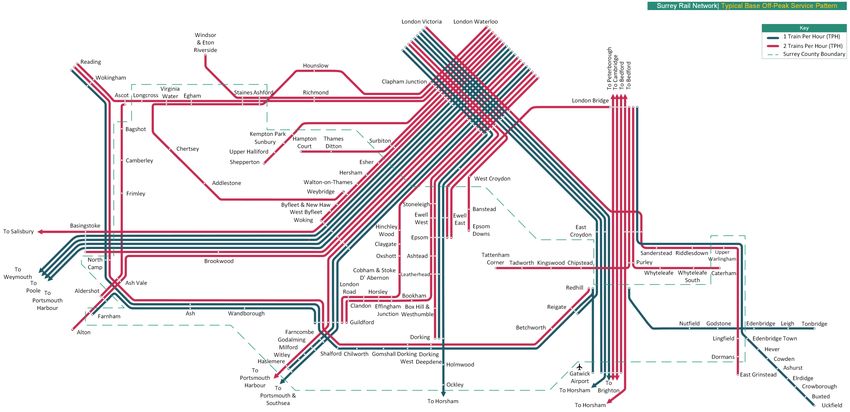
Baseline

                                     The map shows Surrey’s stations in terms of the volume of
                                     entries and exits in 2018-19, based on the Office of Rail
                                     and Road (ORR) station usage data.

                                     Typically, the most well-used stations are located in the
                                     larger towns on the main lines and stations closer to
                                     London, where journey times and frequencies are most
                                     competitive for commuting, but also attract leisure and
                                     other trip types.
Page 30

                                     Further from London station densities are lower, therefore
                                     stations will attract passengers from a wider catchment,
                                     particularly those with fast journey times to London.

          Station demand in Surrey
                                                                                                  10
Baseline
Railway operators and ticketing
The majority of rail services in Surrey are operated by South Western Railway
(SWR; a consortium of FirstGroup and Hong Kong’s MTR) who have
operated the current franchise since 2016. Services on the BML are operated
by Govia Thameslink Railway (GTR) under the Southern and Thameslink
brands, and Great Western Railway (GWR; FirstGroup) operate services on
the North Downs Line.
Page 31
The railway itself is maintained and renewed by Network Rail who are also
responsible for delivering upgrades to the network. Network Rail’s revenues
are generated from track access charges paid by operators and from grants
from national government. It delivers maintenance and renewals activities in
defined Control Periods which run for five years. The latest, Control Period 6,
runs from 2019 to 2024. Network Rail divides services in the county into
Wessex (services in the west of Surrey covering the SWR franchise network)
and Sussex (services in the east on the southern and Thameslink networks)
with the North Downs Line running across both areas.
Passengers can purchase paper tickets for all types of fare, including season
tickets which cover a specific route. Operators SWR, GWR, and GTR have
their own smart cards, which can be used on each other’s networks for pre-
purchased tickets, but not pay-as-you-go and not to stations operated by other
bodies (e.g London Underground or Overgound) within the Transport for
London (TfL) travel zone. The TfL travel zone now includes fourteen stations
in Surrey, and separate pay-as-you-go Oyster fares now extend to stations Smart card acceptance within Surrey
between Redhill and Horley. 11Baseline
The government launched a consultation on
Proportion of 2019 journeys by ticket type and local % Change in total journeys by ticket type
authority (2015-2019)
the topic of comprehensive pay-as-you-go
ticketing in the south east in 20191 and its
15% introduction (including contactless bank
Overall
card) was included in the 2019 Conservative
Woking
party manifesto2.
Waverley 10%
Nearly half the journeys from the county in
Page 32
Tandridge
2019 were undertaken using a season ticket;
Surrey Heath
5% however, this had fallen 8% since 2014
Spelthorne indicating a growing commuter preference
Runnymede for fewer trips per week. It is likely that
season ticket use will have reduced
Reigate and Banstead 0% significantly in 2020 as working from home
Mole Valley Standard Standard Standard Standard
Season Full Reduced Total
has increased, and commuting to London
Guildford (weighted average
has fallen as a result of COVID-19.
-5% of all)
Epsom and Ewell
The majority of fares in the county have
Elmbridge been rising in line with the Retail Price
0% 20% 40% 60% 80% 100% -10% Index (RPI) measure of inflation measure
over the last five years, as rises in season
Standard Season Standard Full Standard Reduced tickets and anytime fares are capped at that
level by the UK Government. In 2021
1 https://assets.publishing.service.gov.uk/government/uploads/system/uploads/attachment_data/file/776998/payg-rail-consultation-doc.pdf government is raising regulated fares by
2 https://assets-global.website-files.com/5da42e2cae7ebd3f8bde353c/5dda924905da587992a064ba_Conservative%202019%20Manifesto.pdf RPI+1% (2.6%).
12Baseline
Service frequencies
Surrey has high frequency trunk
routes with a mix of high speed and
stopping services on the SWML
and BML. This offers frequent
connections for stations on the
suburban fringes of London, and
express services to Woking,
Page 33
Guildford, and outer areas of the
county.
Thameslink offers a high frequency
service on the BML, but many of
the express services bypass stations
in Surrey (with the exception of
Reigate). Most radial routes in the
county are achieving a good
frequency of at least 4 trains per
hour (tph).
Currently the North Downs Line is
being increased to 3tph, however
the full introduction of higher
frequencies will not happen until Train frequencies in Surrey (services correct as at October 2020)
2021.
13Baseline
Journey times to London
Surrey has excellent connections to London, with an
average fastest journey time from Waterloo to Woking of
28 minutes, and from Waterloo to Guildford of 38
minutes. On the BML, Redhill is 31 minutes from
London Bridge and 46 minutes from St Pancras
International.
Page 34
Despite its location just outside of the county,
connections to Heathrow Airport are indirect or require a
change to bus or coach, at either Staines (20 mins),
Woking (55 mins), or Guildford (65 mins); or travelling
via central London. Connections to Gatwick are direct
from Guildford to Gatwick only taking 42 minutes; or 56
minutes from Woking to Gatwick via a single
interchange.
Fastest journey times to Central London
14Baseline
Journey times and connectivity within Surrey
Connection times for the largest station of each district or borough in Surrey are shown below. Many of the internal connections within Surrey are longer than connections
to London, especially where there is no direct connection.
Fastest journey time between stations (in minutes) during the morning Direct service Changes required
Destination
Walton-on-
Page 35
Woking Guildford Epsom Redhill Thames Leatherhead Staines Camberley Oxted Haslemere
Woking 7 50 61 10 42 43 44 67 22
Guildford 7 34 32 28 26 93 51 84 24
Epsom 54 37 43 50 7 67 100 64 67
Redhill 57 35 42 65 33 70 93 36 69
Origin
Walton-on-Thames 11 26 56 66 64 34 67 75 47
Leatherhead 51 29 8 34 59 83 109 78 59
Staines 54 70 65 73 33 73 42 74 85
Camberley 42 48 104 95 58 94 39 109 75
Oxted 63 76 66 43 73 79 74 123 91
Haslemere 25 14 60 61 45 52 105 71 107
15Baseline
Network performance Right-time** performance
90%
Since 2013 there have been significant challenges to the Surrey rail network in terms of performance
and reliability. Studies1 have shown that lower reliability results in fewer passengers on the railway 80%
network, and that disruption has a negative view on passengers’ perception of the railway.
70%
Number of services meeting RTP criteria
Thameslink has experienced a particularly challenging period following the May 2018 timetable
change, with its public performance measure (PPM)* falling to 73% and right time performance 60%
(rtp) ** to 50%. Services on Thameslink have now improved and returned to PPM of over 85% in
Page 36
2020 and RTP of 65%. 50%
On the SWR network reliability has also fallen, with disruption arising from the engineering works 40%
at London Waterloo and the impacts of industrial relations disputes. This caused a reduction of PPM
to below 80% and right time of 40% in 2016. 30%
Another challenge has been overcrowding, where high demand and limited capacity results in less 20%
attractive services, especially where the railway is competing with private car. Three services
operating in Surrey (two from Woking and one from Uckfield but passing through Surrey) have been 10%
consistently listed in the top 10 most crowded routes in the country2 .
0%
2013-14 P01
2013-14 P05
2013-14 P09
2013-14 P13
2014-15 P04
2014-15 P08
2014-15 P12
2015-16 P03
2015-16 P07
2015-16 P11
2016-17 P02
2016-17 P06
2016-17 P10
2017-18 P01
2017-18 P05
2017-18 P09
2017-18 P13
2018-19 P04
2018-19 P08
2018-19 P12
2019-20 P03
2019-20 P07
2019-20 P11
Low frequency is also a challenge, especially on orbital routes where some services are half hourly;
evidence from other operators shows the benefits for passengers of moving toward ‘turn up and go’
frequencies, this is considered to be above 4tph, where intervals are consistent3.
Axis Title
1 - https://catalogues.rssb.co.uk/research-development-and-innovation/research-project-catalogue/T1134
2 - https://assets.publishing.service.gov.uk/government/uploads/system/uploads/attachment_data/file/729221/top-10-overcrowded-trains-2017.pdf Thameslink SWR Suburban
3 - http://content.tfl.gov.uk/strategic-case-for-metroisation.pdf
* PPM – Public Performance Measure: The percentage of trains which arrive at their terminating station within 5 minutes of the planned arrival time 16
** Right Time Performance: The percentage of recorded station stops arrived at early or less than one minute after the scheduled timeBaseline
Passenger journeys and freight Total rail demand from Surrey Stations
90
The main driver of demand for rail travel in Surrey is for commuting for work, given the 80
attraction of higher wages in the capital, and the relatively cheaper house prices and excellent 70
Journeys (millions)
quality of life available in Surrey. Ticketing data from 2019 shows 85% of trips from Surrey 60
start or end outside the county, with 62% starting or ending their journey in central London. 50
40
Outside London there are significant flows to Gatwick Airport (570,000 journeys to/from per
30
year), Brighton (250,000), and Portsmouth (146,000). To the west there is a significant flow to
20
Reading (430,000), but rail demand to Heathrow is lower at less than 10,000 passengers per
10
Page 37
year.
-
Rail demand in Surrey will change through a combination of population change, employment
growth and pattern (within and outside Surrey), and rail trip rates (for work and leisure). The
Destination of Passengers Boarding at Surrey Stations
government is proposing a housing target of 6,750 additional dwellings per year, which is
almost double the current completion rate. This would result in a forecast 9% increase in Woking
population by 20311 . Waverley
Local Authority of Station
Tandridge
Commuter travel patterns are changing, even before the COVID-19 pandemic, as rail Surrey Heath
Spelthorne
commuters were increasingly taking fewer trips per week2, with a growing likelihood that many
Runnymede
workers will now not return to commuting five days a week3. The trend for lower trip rates has Reigate and Banstead
the potential to lessen the impact of increased population on rail demand in the medium and Mole Valley
long term. Previous Network Rail forecasting4 had predicted long term growth of 40% on the Guildford
services into London Waterloo by 2043, but the pandemic is challenging the basis for these Epsom and Ewell
projections. Elmbridge
0 2 4 6 8 10
1 - https://www.surreycc.gov.uk/__data/assets/pdf_file/0004/201874/Surrey-Place-Ambition-Version-1-July-2019.pdf
Journeys (millions)
2 - https://assets.publishing.service.gov.uk/government/uploads/system/uploads/attachment_data/file/790966/journeys-per-season-ticket-study.pdf
3 - https://d3cez36w5wymxj.cloudfront.net/wp-content/uploads/2021/02/12115246/Travel-during-Covid-19-survey-12-February-2021.pdf To Surrey To London Z1 To London Other To Other 17
4 - https://www.networkrail.co.uk/wp-content/uploads/2016/11/Network-Specification-2016-Wessex-1.pdfBaseline
The key journey attractors within Surrey are
Guildford, Woking, Epsom, and Reigate;
representing the key employment hubs, and large
retail and leisure sectors. Journeys tend to follow the
key radial links, but are also influenced by orbital
connectivity such as the North Downs between Mole
Valley and Guildford; and Chertsey Branch Line
between Runnymede and Elmbridge.
Currently there are limited strategic freight routes
Page 38
through Surrey, with some services timetabled on the
SWML, and on the Tonbridge to Redhill line to
London via Kent. The are also freight movements
from aggregate terminals at Tolworth, which run on
the Chessington Branch Line and SWML.
Journeys within Surrey (Arup analysis of LENNON (UK national ticketing and revenue database) 18Baseline
Impact of COVID-19 Motor and rail demand the pandemic relative to 20191
120%
COVID-19 has led to the biggest demand shock to railways since the Second World War, and saw 100%
passenger demand drop by over 90% across the network. The government has asked the UK 80%
population not to make unnecessary journeys, and for workers to work from home, which
60%
significantly reduced demand on commuter routes. In addition, the corresponding collapse of air
travel has impacted on employee and passenger trips in Surrey, to Gatwick and Heathrow airports. 40%
The government has been forced to suspend the established franchising model in favour of 20%
emergency contracts, in order to keep railways operating for passengers who need them.
0%
Page 39
In addition to its short-term impact, COVID-19 may be acting as an accelerator to existing trends for
increased remote working and reduced commuting to offices; which could have a profound impact
on the demand for rail travel in Surrey and the UK. Rail demand has previously fluctuated with Motor Vehicles National Rail
economic activity, and the economic fallout from the pandemic may mean a slower then expected
Forecasting challenges
recovery in rail use, even after risks of transmission from using public transport diminish. The
combination of these effects is having a large impact in the short term. Recovery from COVID-19
will rely on a number of unpredictable factors: in the short term, the speed of vaccination
programme and its effect on opening up sectors of the economy will be likely to dictate usage; but in
the medium and long term, the rate of economic growth, and changes to working and social patterns
will have far more of an impact on the pattern of rail usage.
2. Level of demand recovery compared to baseline
today
COVID-19 may also impact the financing of railway infrastructure, with government investment
constrained (£1bn was removed from the Network Rail CP6 budget in the November spending
review), and with uncertainty over the strength of existing business cases when demand is uncertain, 1. Length of demand recovery
balanced against the desire to boost economic activity in the short term as the the economy recovers. Short Term Recovery Medium Term Growth Rates
03/2020
09/2020
03/2021
09/2021
03/2022
09/2022
03/2023
09/2023
03/2024
09/2024
03/2025
Rail Demand Optimistic Forcast
Pessimistic Forcast
1 - Source: https://www.gov.uk/government/statistics/transport-use-during-the-coronavirus-covid-19-pandemic 19Strategic aims and responses
Page 40
20Strategic aims and responses
Baseline study
Developing strategic aims
We used the following sources to develop the strategic aims – based on plans for the GB rail network, and Specific source document
specific policies and outcomes Surrey County Council is looking to achieve
Responding to Encourage good
Achieve transport Increasing access for An attractive, high-
change in the rail growth & a
decarbonisation all quality rail network
sector sustainable economy
Page 41
Surrey County Council Climate Monitoring of government
Emergency Declaration proposals and policy Surrey County Council – Network Rail Accessibility
Surrey’s 2050 Place Ambition Strategy Journey time and
frequency and reliability
Surrey's Climate Change action Williams Rail Review evidence research
plan papers
Transport for the South East –
Surrey County Council –
Transport Strategy for the
Surrey’s 2050 Place Ambition
Network Rail – Traction South East
Network Rail – Putting
Decarbonisation Network
Passengers First
Strategy Department for Transport
– Connecting people: a
Department for Transport – Department for Transport – Surrey Economic Future Station accessibility research strategic vision for rail
Decarbonising Transport: Connecting People: a Strategic
Setting the Challenge Vision for Rail
Stakeholder engagement 21Strategic aims and responses
Developing strategic responses
These are specific objectives we seek to achieve and will be used to assess interventions
Encourage good
Achieve transport Responding to change Increasing access for An attractive, high-
growth & a
decarbonisation in the rail Sector all quality rail network
sustainable economy
Page 42
Connectivity to external
drivers of growth Ensure stations and trains are
Modal shift to public transport Support a local recovery A reliable network
accessible to all
Contribute to high value,
productive and sustainable
economic growth
Increased accountability of the A ticketing structure that
Decarbonising rail operations A high-capacity network
railway works for all
Connecting new communities
to jobs and opportunities
Decarbonising access to Enable access to the network Improved journey times and
Adapt to changing trends
stations Integration into other networks by diverse modes frequencies
22Strategic aims and responses
Achieve transport decarbonisation Surrey’s GHG emissions
4,500
4,000
Surrey has matched the UK government’s net-zero carbon air quality impacts. Additionally as power generation
3,500
target for 2050. Within Surrey, transport comprises more decarbonises (Network Rail already procures electricity
3,000
that 40% of CO2 emissions and 2.3 tonnes of carbon per from renewable and nuclear power) this gap will further
MtCO2e
person per year. Without interventions, no reduction is increase2. 2,500
forecast from the transport sector by 2050 in Surrey, 2,000
increasing its share of emissions to 48% as emissions from Strategic Response 1 - Encourage modal shift 1,500
other sectors decarbonise. 1,000
Improvements in rail should result in modal shift, however
500
Surrey’s Climate Change strategy sets a target of 60% a particular focus made on interventions where modal shift
Page 43
reduction in transport emissions by 2035 via a three- to rail from private car is highest can reduce emissions -
2019 2050 Unmitigated
pronged approach: reducing journeys, shifting to an fastest.
increase use of public and active transport modes, and Transport Other Emisions
developing zero emission vehicle options (avoid-shift- Strategic Response 2 - Decarbonising rail
remove). Surrey's Carbon Zero Targets
Support the adoption of low emissions technology, for rail 2025 2030 2035 2040 2045 2050
Continuing to maintain spare capacity and increase with diesel traction replaced by low- and ultimately zero-
performance on the radial links to London will be vital in emissions vehicles.
maintaining current rail mode shares. However, there is
the most scope for change in the journeys within Surrey Strategic Response 3 - Decarbonising access to stations
-46%
and neighbouring boroughs (as mode shares for rail are
lower), and encouraging improved services within Surrey A rail trip is only ever a component of a journey and
-67%
will be a key component of modal shift, but requiring a passengers have to access stations by other mode of
different set of policies to radial demand. transport, or by foot or bike. These linked trips create
-80%
emmsions and by encouraging access by low- and zero-
-87%
-92%
Whilst rail produces significantly less carbon emissions emissions modes, not only public and active transport but
-100%
per mile (at average passenger loadings) than road-based also low and zero emissions vehicles, emissions can be
transport overall, emissions on different parts of the lowered.
network vary. Diesel traction can produce twice the carbon 1 https://www.rssb.co.uk/en/Research-and-Technology/Sustainability/Decarbonisation/Decarbonisation-our-final-report-to-the-Rail-Minister
emissions of electric trains1, in additional to having local 2 https://www.theccc.org.uk/wp-content/uploads/2019/05/Net-Zero-Technical-report-CCC.pdf 23Strategic aims and responses
Responding to change in the rail sector
Since the privatisation of the railways in the mid-1990s, the Strategic Response 1 - Increased accountability to
passenger rail network in Surrey has been operated under passengers
franchise arrangements, where operators bid to run train
services and stations for a defined period of time, making Rail users can feel that the operations and planning of the
commitments to deliver a set of improvements plus an agreed railway is remote to the needs of the local population, and
financial transfer to/from the government. Operators are Surrey will support policies which increase local
allowed to set some fares, although many (such as season accountability to the areas and people the railways serves.
tickets and some walk-up fares) are regulated by the
Page 44
government. Investments in the network are delivered by Strategic Response 2 - Adapt to changing trends
Network Rail who also undertake maintenance and renewals,
receiving funds from the train operating companies in the A focus on interventions which can adapt to trends, and
form of track access charges. improve the flexibility of rail network and stations to new
technology and changing trends. The type of demand may
The traditional rail franchise model has had some successes, also change, and Surrey will need to support a diversification
but in recent years it has also become clear that there are of trip, away from commuting and towards increasing leisure
many areas where it has struggled to meet the needs of trips were this to develop.
passengers and taxpayers. The Williams Rail Review was
commissioned in September 2018 to propose solutions to Strategic Response 3 - Support a local recovery
some of these problems. That review is yet to be published,
government is now progressing with a programme of reform Interventions which can be delivered in the next two years are
which is expected to deliver a new industry structure and key to boosting economic growth in the recovery period. This
contractual model for passenger services. could include infrastructure projects or supporting projects
such as reforms to ticketing or timetables. Current GB railway organisation (Williams Rail Review)
The significant reduction in demand during COVID-19
combined with need to continue to provide capacity for
socially-distanced journeys for key workers has meant the
government has stepped in to fund the rail network during the
pandemic, as operating on commercial terms became
unviable. 24Strategic aims and responses
Encourage good growth and a sustainable economy
The Surrey 2050 Place Vision and Economic strategy sets out Strategic Response 1 – Connectivity to external drivers of
clear goals for the county, centred around delivering sustainable growth
growth.
Ensure Surrey is connected to national and international markets
Transport has the potential to help maximise the potential of through connections to Central London and key transport nodes
Surrey to grow, prosper, and attract new businesses to move to such as key mainline and HS2 stations, and Heathrow and
the county to take advantage of its skilled workforce and Gatwick airports.
excellent transport connections. By providing local opportunities
accessible by sustainable transport, Surrey can minimise the need Strategic Response 2 - Enable and influence economic growth
Page 45
for long commuting journeys and dependency on growth in
London. Increase the accessibility of Surrey’s opportunity areas across the
county, maximising agglomeration oppertunities and influencing
Surrey benefits from its close links to the London job market as opportunities across the county including its smaller towns.
well national connectivity. In order to connect to all areas of the
UK and the global economy, strong connectivity to key transport Strategic Response 3 – Connecting new and exiting populations
infrastructure such as international airports, high speed lines to jobs and opportunities
(HS1 and HS2) will be vital.
Utilise rail to increase the connectivity of new housing, enhance
Surrey also has long term goals to deliver new housing and this existing and new employment opportunities, and encourage
will need to be supported by improved transport capacity, whole placemaking.
including rail. This will ensure that residents can access local
jobs, those in central London and neighbouring areas, and Strategic Response 4 - Integration into other networks
employment hubs such as airports. This could be supported by Source: Surrey’s 2050 place ambition
developing sites close to existing stations; constructing new Ensure that the transport network is sufficiently coordinated to
stations; or improving links between new housing and nearby provide complete journeys, and sufficient capacity and
hub stations by public transport, active transport, and improved accessibility to opportunities across the county.
road capacity.
25Strategic aims and responses
8 Surrey stations still have a Category C rating for step free
access
Increasing access for all
8
15
Access to the railway network can create opportunities for Strategic Response 1- Ensure stations and trains are accessible to
residents by opening up access to employment, amenities, and all
improved wellbeing. Access for all can be ensured not only by
providing level access to board trains, but can also be supported Increase the number of step-free stations and support interventions
with the provision of safe and secure walking and cycling which improve all types of accessibility within Surrey. 60
facilites, and by addressing financial barriers to public transport
use. Strategic Response 2 - A ticketing structure that works for all
Category A - Step-free access to all platforms
Only 18% of Surrey's stations are fully accessible and without Support a simple and fair ticketing and fare structure that does not
Page 46
this, the benefits of any improvements to trains cannot be penalise groups such as part-time workers and those taking one Category B - Step-free access to at least one platform
maximised. Each increase in step free provision and station way trips. Category C - No step-free access to any platform
accessibility unlocks further journey opportunities.
Strategic Response 3 - Enable access to the network by diverse Over half of Surrey stations have ramps to help disabled
Access for all should also include improving access for those modes passengers board trains
unable to drive, by providing stations integrated into public
transport, walking and cycling networks, or utilise the potential Support interventions to increase accessibility of stations to their
for new Mobilty as a Service (MaaS)* technology. Integration is local communities by walking, cycling, and other forms of public
multi-faceted, including provision of integrated information, easy transport.
and quality interchanges, and ticketing to ensure journeys are
37
seamless.
46
There are also financial barriers to using the network, particularly
as many workers are increasingly no longer required to physcially
attend the office five days a week and others work part-time.
These groups face higher average fares than full time workers,
with only a choice of season tickets or walk-up fares. There is a Ramp Access No Ramp Access
growing need to ensure there are the types of ticket available
which maximise potential users whilst still ensuring the financial Source: National Rail website
sustainability of the railway.
*Mobility as a Service (MaaS) is the integration of various forms of transport services into a single mobility service accessible on demand. 26Strategic aims and responses
An attractive, high-quality rail network Overall satisfaction with the journey
In the 2013 Surrey Rail Strategy, the main focus was on Strategic Response 1 – A reliable network National average
delivering the large increase in capacity needed to meeting
the projected 40% growth in commuter demand. However, Support projects which deliver reliability improvements to
passenger growth has slowed over the last five years, and rebuild confidence in the railway network. Southern
there are other developments in passenger behaviour and
the economy which suggests that demand for commuter Strategic Response 2 – A high capacity network
travel to and from London may not increase as strongly as SWR
predicted, even after pandemic risk reduces. Maintaining a Support increased capacity on both radial and orbital
Page 47
highly attractive network will be important in attracting routes to give passengers a better travel experience and
0 10 20 30 40 50 60 70 80 90 100
users (both new and old) to the network. unlock new journey opportunities.
% Satisfied or Good % Neither/Nor % Dissatisfied or Poor
Whilst the lower commuter demand presents a challenge Strategic Response 3 – Improved journey times and
in terms of funding the railway, it presents opportunities to frequencies where required Overall satisfaction with the station
focus on delivering improved reliability, and a
reorganisation of services in both local and longer distance Continuing to support journey time improvements and
travel, which could support demand in the long run. better frequency, to improve passenger journeys. National average
Targeted capacity increases and journey time
improvements will still have a role to play in allowing Southern
more passengers to travel; facilitating journeys which are
more attractive to new users.
SWR
There are likely to be challenges to the reliability of the
network in future, for example extreme weather events;
0 10 20 30 40 50 60 70 80 90 100
and the railway will need to adapt to prevent these from
disrupting passenger experience. % Satisfied or Good % Neither/Nor % Dissatisfied or Poor
Source: National Rail Passenger Survey
27Strategic aims and responses
A New Rail Strategy for Surrey, LTP4, and Surrey Infrastructure Plan
Surrey's Local Transport Plan 4 (LTP4) will set the Local Transport Plan 4 – outcome objectives
policies and strategies, including investment, across all
modes in the county; with the aim of achieving To rapidly reduce To support To support To provide well
specified objectives. Rail is a part of LTP4. carbon emissions, thriving Surrey’s growth connected
ensuring that communities with ambitions, and communities that
A New Rail Strategy for Surrey, through its objective Surrey is on track clean air, enable businesses encourage social
setting and policy areas, will feed into LTP4. However, for net zero excellent health, and people to mobility and
Page 48
the inter-connected nature of rail travel, and its use for emissions by wellbeing, and prosper ensure no-one is
travel out of the county, mean many projects which are 2050 or earlier quality of life sustainably left behind
key for
developing the Surrey rail network require investment
outside the county, funding from central government,
A New Rail Strategy for Surrey
Achieve transport
and working with partners. decarbonisation ✔✔
Projects which require investment locally will be Responding to change in
assessed as part of the Surrey Infrastructure Plan, strategic aims the rail sector ✔ ✔ ✔
where they will be reviewed against other transport
Encourage good growth
investments and those outside transport.
& a sustainable economy ✔ ✔
Increasing access for all ✔ ✔ ✔✔
An attractive, high-
quality rail network ✔ ✔ ✔ ✔✔
28Stakeholder engagement
Page 49
29Stakeholder engagement
Surrey County Council, districts and boroughs Strategic delivery partners
Approach to engagement Interview: Interview:
• Surrey County Council • Network Rail
• Elmbridge Borough Council • Transport for the South East
As part of the strategy development process, Arup undertook a range of • Epsom and Ewell Borough Council • Heathrow Southern Railway
engagement activities, to capture the issues and investment priorities of key • Guildford Borough Council • Heathrow Strategic Planning Group
stakeholder groups and organisations. • Mole Valley District Council Survey questionnaire:
• Reigate & Banstead Borough Council • Heathrow Airport Limited
Virtual interviews were held with primary stakeholders between September • Runnymede Borough Council • Gatwick Airport Limited
and October 2020, to gain a deep understanding of the issues which need to be • Spelthorne Borough Council
addressed on the County’s rail network, and the investment priorities for the • Surrey Heath Borough Council
• Tandridge District Council
Rail user groups
delivery of rail infrastructure and services. The interviews provided high level
Page 50
direction of the strategy and a number of core themes intended to give shape • Waverley Borough Council
Survey questionnaire:
and focus to the strategy. • Woking Borough Council
• Railfuture
Neighbouring authorities • RRDRUA
Questionnaire surveys were also issued to a selected number of stakeholder • Guildford Rail Users
groups and organisations, believed to have a significant interest in the Survey questionnaire: • Guildford Bicycle User Group
County’s rail network. The questionnaire survey was designed to follow a • West Sussex County Council • Southeast Communities Rail Partner
similar structure to the interviews, allowing selected stakeholders to express • Hampshire County Council • Sussex Community Rail Partnership
their views on specific issues and themes, and make further comments or • RB of Windsor & Maidenhead
points for consideration. A copy of the questionnaire can be found in Appendix • Bracknell Forest Borough Council Disability representation
A. • Kent County Council
Survey questionnaire:
The engagement approach, and the list of stakeholders, was defined and • Surrey Coalition of Disabled people
Civil Parishes and residents’ associations
agreed with Surrey County Council prior to commencing engagement. LEPs and businesses
Stakeholder groups and organisations were first invited, and then prompted, to Survey questionnaire:
participate throughout the engagement period by email, to encourage • Buckland Parish Council Survey questionnaire:
participation. • Sanderstead Residents Association • Coast to Capital
• Salfords & Sidlow Parish Council • Enterprise M3
• Business Leadership forum
30Stakeholder engagement
Issues and challenges Issues and challenges
Customer service
Personal security Performance
Respondents were asked to comment on what they believed to be the main issues and
challenges for the County’s rail network. Level crossings
East west connectivity Ticketing & Pricing
Respondents recognised that there were many issues and challenges with the County’s rail Cleanliness
network. Station connectivity was the most frequently cited, with respondents acknowledging Station facilities Stations
the importance of providing integrated connections to, from, and between stations. Service Housing and growth
frequency, reliability, and ticketing structure were also considered as being key issues particular
Cycle parking provision
amongst rail user groups, possibly reflecting poor service performance in recent years. Network infrastructure
Page 51
Travel information
Respondents frequently cited the poor rail connections to both Heathrow and Gatwick airports COVID-19
Passenger experience
as a key issue in the County. Station accessibility was also considered to be a key issue amongst Network capacity
respondents, with some referencing specific stations where step-free access is still an issue. Climate change
Delays
On-board crowding on peak hour train services, and long journey times on certain branch lines, Car parking provision
were also noted as being key issues for the County. Insufficent car parking provision at stations
Journey times
was also viewed as an issue for some respondents, referring to the overspill and rail heading
which occurs in certain areas within the County. On-board crowding
Fares
Respondents recognised the significant challenge of climate change for the County’s railways, Station accessibility
with certain district and borough councils referencing the need for infrastructure to be resilient Connections to airports
to more frequent, extreme weather events. Ticketing structure
Reliability
COVID-19 was considered to be a challenge for the rail industry by some respondents, while
Service frequency
others believed the pandemic impact to be more short-term. Housing growth and network
capacity were also mentioned as being key challenges for the County, with some respondents Station connectivity
recognising the need to provide additional infrastructure capacity to support housing and 0 5 10 15 20 25 30
growth. Number of stakeholders
31Stakeholder engagement
Strategic aims Level of agreement with strategic aims
Respondents were presented with the proposed strategic aims of the Rail Strategy, and were asked to indicate
An attractive, high-quality rail network
the extent to which they agreed or disagreed with each.
There was a high level of support for the strategic aims, with respondents agreeing that the aims set out the
right direction for the future rail system in Surrey. Increasing access for all
There was strong support and recognition for the need to respond to the climate emergency by almost all
participants, with some borough and district councils highlighting recent declarations for a climate emergency.
Page 52
There was also favourable support for increasing access for all, particularly once assured that the theme not Encourage good growth
only just considers disabilities and mobility restraints, but also wider connectivity to the rail network.
Respondents supported the aim of encouraging good growth, recognising the role of rail connectivity in
supporting new homes and supporting growth through creating connectivity, but emphasised the need to Responding to Covid-19
provide additional capacity to support more trips on the network.
Respondents agreed with the aim of achieving an attractive, high-quality rail network, seeing this as key to
providing a viable alternative to car travel, therefore reducing climate emissions. An accountable railway
The aim to have an accountable railway was generally supported, however some respondents were unclear as
to what an accountable railway meant in practical terms. Most respondents supported the aim of responding to
COVID-19, recognising the significant impact the pandemic has had on passenger demand and the structural Respond to the climate emergency
changes. However, some participants believed that the strategy should focus on longer term issues, referencing
that the virus situation continues to evolve. As result we have merged these strategic aims to responding to 0% 10% 20% 30% 40% 50% 60% 70% 80% 90%100%
change in the rail sector.
Strongly Agree Agree Neither Agree nor Disagree
Similarly we have changed ‘respond to the climate emergency’ to achieve transport decarbonisation to Disagree Strongly Disagree Don't Know
provide a more focused strategic aim.
32Stakeholder Engagement
Drivers of change Drivers of change
Structural changes to local government
Respondents were asked to comment on what they considered to be the key drivers of
change, both positive and negative, shaping the County and its rail network. Brexit
Structural changes within to the economy
Respondents recognised that there were likely to be a number of key drivers of change that
will impact and shape the County and its rail network over the short, medium, and long- Funding focus on sustainable transport
term. Climate change was the most frequently cited, with respondents commenting on the
wide reaching impacts which climate change will have in the future. Population and Crossrail 2
housing growth was also mentioned by most stakeholders, understanding the pressures to Future airport expansion
Page 53
deliver housing targets in a sustainable way.
Future mobility
Respondents recognised the impact that COVID-19 has had on accelerating flexible
Network performance
working arrangements, and suggested that remote working is likely to continue to
significantly shape travel demand and movement patterns to, from, and within the County. Shifting political focus on infrastructure
There was also an appreciation by most stakeholders of the likely changes to the
operational model of the railway in light of the COVID-19 pandemic and the Williams Rail Covid-19
Review. Government changes to operational model
Technological change and future mobility innovations were believed to be important Technological change
considerations for the County’s rail network by stakeholders commonly stating the need to
Remote working
accommodate Mobility-as-a-Service and electric vehicle charging infrastructure at stations.
Population and housing growth
Future airport expansion at both Heathrow and Gatwick was considered to be a driver of
change within the County by some stakeholders, referencing the significant movement Climate change
demands which both airports generate and the need to improve connections to both hubs. 0 5 10 15 20 25 30
Stakeholders were less confident that Crossrail 2 will be delivered in the short to medium Number of stakeholders
term, and subsequently drive change within the County.
33You can also read


