Acute Decompensated Heart Failure: A Case Presentation - Avital Porter, MD ,Department of Cardiology ,Rabin Medical Center Israel
←
→
Page content transcription
If your browser does not render page correctly, please read the page content below
Acute Decompensated
Heart Failure: A Case
    Presentation

    Avital Porter, MD
,Department of Cardiology
  ,Rabin Medical Center
         Israel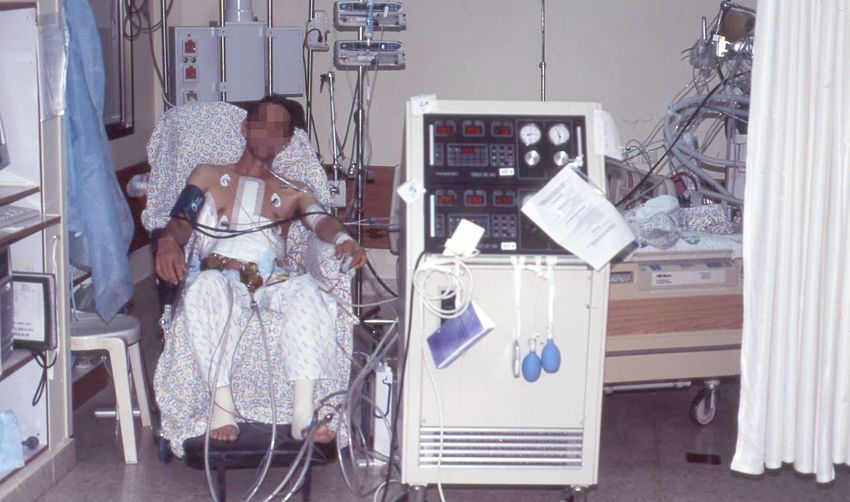
Demographics and past history
C.G, a 48 y old male, married+4, until recently non-
sedentary lifestyle
2000- left temporal intracranial bleeding D/T AV
malformation, treated by embolization and radiation.
No neurological deficit. Impaired short-term memory
and mood fluctuations.
Risk factors : Dyslipidemia treated with statins, past
history of smoking (18 years ago). No significant
family history for IHD or CMP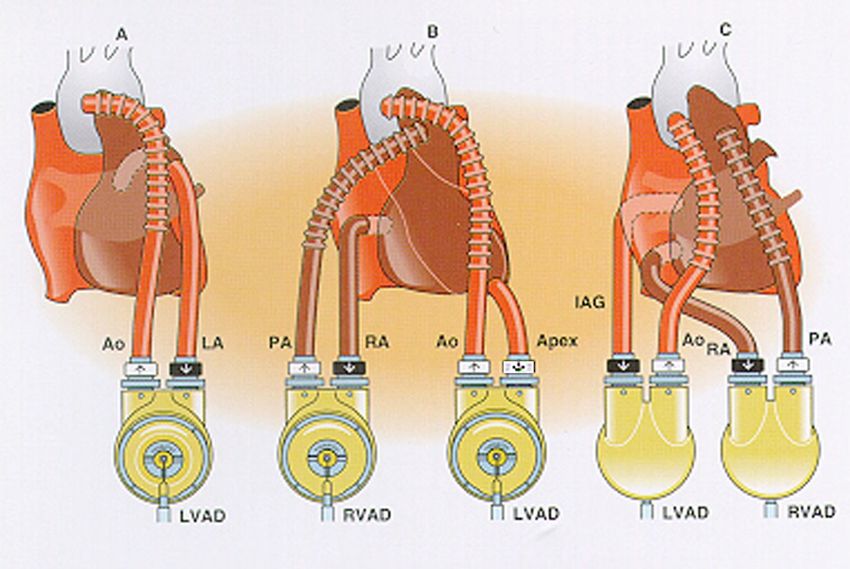
Current event
Fatigue over recent months.
A month before admission “common cold” w/o fever.
Progressive symptoms of fatigue, extreme weakness, effort
dyspnea, epigastric pain,vomiting and weight loss.
Admission to another hospital. Echo demonstrated dilated
left ventricle with estimated LVEF of 20% and antero-
apical dyskinesis
Coronary angiography revealed anatomically normal
coronary arteries.
A diagnosis of non-ischemic CMP (M/P post
myocarditis) was made and the patient was discharged
‘Current event- contd
Due to further clinical deterioration (NYHA 3) the
patient was admitted to a second hospital with signs
of low CO state with secondary “shock liver” and
acute renal failure.
ECG—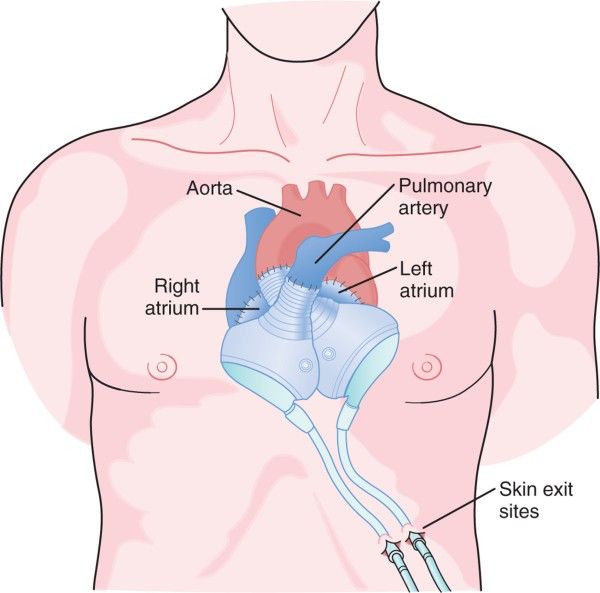
Echo at that time: LVEDD 62 mm,
EF 15%, moderate MR, mild
pulmonary HTN, severe RV
dysfunction
TDI- no evidence of intraventricular
disynchrony.
Right heart Catheterization
RA A: 25.4 CO 1.7
RA V: 21.7 CI 1.1
PA: 48/34; mean 38 SVR 34 wood
PCW A: 32.6
PVR 5.9 wood
PCW V: 38.3
RV 40 /15
?What can we do
Treatment Approach for the Patient
               with Heart Failure
      Stage A                   Stage B                       Stage C            Stage D
 At high risk, no           Structural heart             Structural heart    Refractory HF
    structural                  disease,                   disease with        requiring
     disease                 asymptomatic                  prior/current      specialized
                                                         symptoms of HF      interventions

      Therapy                    Therapy                       Therapy           Therapy
• Treat                    • All measures               • All measures      • All measures
  Hypertension               under stage A                under stage A       under stages A,B,
                                                                              and C
• Treat lipid              • ACE inhibitors in
  disorders                  appropriate                Drugs:              • Mechanical assist
                             patients                   • Diuretics           devices
• Encourage
  regular exercise         • Beta-blockers in           • ACE inhibitors    • Heart
                             appropriate                                      transplantation
• Discourage                                            • Beta-blockers
                             patients
  alcohol intake                                                            • Continuous (not
                                                        • Digitalis           intermittent) IV
• ACE inhibition
                                                        • Dietary salt        inotropic
                                                          restriction         infusions for
                                                                              palliation
                                                                            • Hospice care
                     Hunt, SA et al. ACC/AHA Guidelines CHF, 2001.
Current Opinion in Cardiology 2008, 23:134
Medical treatment
Medical Rx
The ideal treatment should:
improve symptoms and hemodynamics
without increasing myocardial oxygen
demand and increasing propensity for
arrhythmias.
Improve outcome!!!
Do current therapies meet these
criteria?Diuretics
The use of diuretics for the treatment of patients with ADHF represents an area of medicine with a paucity of rigorous clinical trials. The acceptance of diuretics into the HF treatment paradigm is largely based on clinical and anecdotal experience over the last forty years without the benefit of large, multi-center randomized trials.
There is evidence that low-dose
 furosemide in combination with
 vasodilators may enhance diuresis
 with less adverse effects than
 high-dose boluses.
Inotropes
Short-term inotropic infusion, although
frequently used to improve
hemodynamics and symptoms in acute
decompensated heart failure, remains
controversial. When patients present
with profound circulatory collapse,
inotropes may be absolutely required.
For patients with acute decompensated
heart failure who have evidence of end-
organ hypo perfusion or diuretic
resistance, but no frank hypotension,
the use of inotropes is not well
supported.Elkayam U, Tasissa G, Binanay C, Stevenson L. Use and impact of inotropes
and vasodilator therapy in hospitalized patients with severe heart failure. Am
Heart J 2007; 153:98–104.
The ESCAPE trial published in
2007 revealed that inotropic agents such as
dobutamine and milrinone in heart-failure patients
with low ejection fraction and hypotension had higher
6-month mortality rates [hazard ratio (HR) 2.14, 95%
CI 1.10– 4.15] than patients on vasodilators such as
Nesiritide when compared with placebo (HR 1.39,
95% CI 0.64–3.0). Inotropes in combination with
vasodilators showed the highest mortality (HR
2.90, 95% CI 1.88–4.48) Indicated in the case of
peripheral hypo perfusion with
or without pulmonary edema
Class IIa C1 of 3
HFSA 2006 Practice Guideline
Acute HF—IV Inotropes
Recommendation 12.18 (1 of 3)
Intravenous inotropes (milrinone or dobutamine) may be
considered to relieve symptoms and improve end-organ
function in patients with advanced HF characterized by:
LV dilation
Reduced LVEF
And diminished peripheral perfusion or end-organ dysfunction
(low output syndrome)
Particularly if these patients:
Have marginal systolic blood pressure (Phosphodiesterase inhibitors
((Milrinone
Increases myocardial cAMP
concentrations by selective inhibition of
phospho-diesterase III, which leads to
an increase in intracellular calcium,
causing increased myocardial
contractility, myocardial toxicity
secondary to calcium overload, and
relaxation of the endothelium.
Intermediate effect between pure
vasodilator to pure inotropic agentIt can be used simultaneously with catecholaminergic agonists or antagonists. Class IIb C
Levosimendan
Levosimendan differs from
conventional inotropic agents due to
its vasodilator properties and
positive inotropic effects achieved by
enhancing myocyte sensitivity to
calcium that is already in the cells
rather than increasing calcium in the
cellThe positive inotropic effects of levosimendan are achieved by its binding to troponin C and calcium, thereby stabilizing the tropomyosin molecule and prolonging the duration of actin- myosin overlap without a change in the net concentration of intracellular calcium. The vasodilatory effect of levosimendan is reached through activation of ATP-dependent potassium channels.
Class of recommendation IIa, level of
 evidence B

•Two most recent trials, SURVIVE and REVIVE II,
both support the symptomatic benefit of
Levosimendan in comparison with placebo.
•Mortelity untill 180 days did not differ between
levosimendan vs either inotropes or
plcebo(survive),and was non- significantly increased
at 90 days (Revive2)
In a meta-analysis of LIDO, CASINO
and SURVIVE, mortality at 6months was lower in
the Levosimendan group (relative risk 0.76,
P¼0.032)
acute heart failure guidelines published by the
European Society of Cardiology recommend its
use on patients having symptomatic, low-output
heart failure secondary to systolic dysfunction
which is not accompanied by severe hypotension
(Delle Karth et al 2003; Lehmann et al 2004;
Nieminen et al 2005). Use on patients with a
systolic blood pressure below 85 mmHg is not
recommended (Nieminen et al 2005.
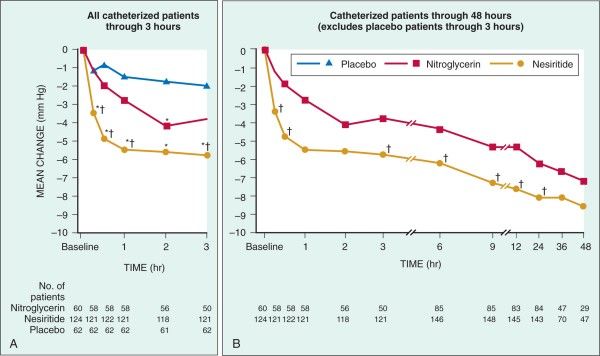
Vasodilators Nitroglycerin Class I recommendation, level of evidence B Nitropruside Class I recommendation, level of evidence C Nesiritide
ffects of Nesiritide
          Nesiritide
               Venous, arterial, coronary                                 RENAL
                   VASODILATION                                       NATRIURESIS
    HEMODYNAMIC                                                       DIURESIS
   CARDIAC
   INDEX                                                                     Fluid volume
                                                                             Preload
   Preload                                                                   Diuretic
   Afterload                                                                 usage
                              rhBNP       M
                                            DR
                                                I SS
                                                     S
                                                       S

   PCWP
                                          K            G
                                          R             L
                                           G            G         H
                                            F          C        R
                                             C S S
                                              G          K V LR

   Dyspnea                    S P K MV Q G S

                                                               Aldosterone
                                                               Endothelin
CARDIAC                                              SYMPATHETIC AND
                                                               Norepinephrine
          No increase in HR
                                                 NEUROHORMONAL SYSTEMS
          Not proarrhythmic
Nesiritide and Mortality
VMAC investigators JAMA2002 287:1531
                (acute heart failure+RHC)

            P
FDA Formed the Braunawald
Committee
The use of nesiritide should be strictly
limited to patients presenting to the
hospital with acutely decompensated
congestive heart failure who have
dyspnea at rest.
Physicians considering the use of
nesiritide should consider its efficacy in
reducing dyspnea, the possible risks of
the drug ,and the availability of
alternate therapies to relieve the
symptoms of congestive heart failureFuture targets
Vasopressin receptor antagonists (tolvaptan
and conivaptan) There are two types of
receptor, V1a and V2 receptors. V1a
receptors activate peripheral arterial and
coronary vasoconstriction, therefore
increasing both preload and afterload. V2
receptors are responsible for free water
absorption in the renalcollecting duct by
increasing the amount of aquaporin-2 within
the membrane(Arginine Vasopressin (AVP
aka Antidiuretic Hormone
V1A
VASCULAR SMOOTH
V1A V2
MUSCLE CELL HEART DISTAL TUBULES
• Vasoconstriction
• Coronary Vasoconstriction • Water Retention
• Myocyte Hypertrophy
• Increased afterload and wall stress
• LV hypertrophy
• Ischemia
• Increased preload, hyponatremia, edemaEffects of tolvaptan, a vasopressin antagonist,
in patients hospitalized with worsening heart
failure: A randomized controlled trial. JAMA
2004 29:1963- .
There were no differences in worsening heart
failure at 60 days between the tolvaptan and
placebo groups (P =.88 for trend). In post
hoc analysis, 60-day mortality was lower in
tolvaptan-treated patients with renal
dysfunction or severe systemic congestion.
A phase III trial EVEREST is currently being
conducted to evaluate the long-term efficacy
and safety of tolvaptan in hospitalized
patients with severe HF•Adenosine A1 receptor antagonists Show promising diuretic properties in patients with acute decompensated heart failure, particularly diuretic-refractory patients. Renal A1- receptor blockade prevents arteriolar vasoconstriction and post glomerular vasodilation resulting in improved glomerular blood flow. (Rolofylline- presented ACC 2008 PROTECT pilot study)
Endothelin receptor antagonists (tezosentan and
bosentan)
      Primary endpoint of death or worsening
          heart failure at 7 and 30 days
                                               • There was no difference in
                                   30 days     death or worsening heart failure
              7 days                           between the Tezosentan group
                                   p=0.61      compared to the placebo group
35%           p=0.95       31.9%
                                       33.2%   at both 7 and 30 days.
30%
      26.3%      26.4%                         • For the primary endpoint
25%                                            of dyspnea at 24 hours,
20%                                            there was no difference
                                               between the treatment
15%
                                               groups in either of the
10%                                            VERITAS trials individually
 5%                                            or together.
 0%
          Tezosentan       Placebo                          Presented at ACC

               VERITAS Trial: Primary Endpoint              2005
New inotropes
Cardiac myosin activators
Enhancing the efficiency of actin–
myosin coupling
Increasing contractility W/O increasing
intracellular calcium or oxygen
consumptionNon-pharmacological
therapies
Small randomized trials have shown that
continuous positive airway pressure (CPAP)
and other noninvasive ventilation decreased
the need for endotracheal intubation in
cardiogenic shock without a significant impact
in mortality.
Ultrafiltration- small trials revealed its
potential benefit for relief of pulmonary
edema, ascites,and peripheral edema
Costanzo MR, Guglin M, Saltzberg M, et al. UNLOAD Trial Investigators,
ultrafiltration versus intravenous diuretics for patients hospitalized for acuteMechanical assistance
IABP
Recommended in acute decompensated
states, as an urgent measure of cardiac
support, to stabilize the patient and
maintain organ perfusion until
transplantation is done.
Class I B‘Case presentation – cont
Being at a state of cardiogenic shock,
IABP was inserted and IV inotropes
(milrinone) were given with stabilization
of the blood pressure and mild
improvement of CI
The patient was transferred to our
ICCU without improvement in LV
function under above Rx?What can we do more !!!Assist device
Rationale of assist device use
Restoration of normal hemodynamics
and vital organ perfusion.
Reduction of ventricular strain and
improving remodelingCirculatory Support
Milestones
1982 - Begin Clinical Evaluation / Pennington,
SLU 1984 - 1st Successful Bridge to
Transplant / Hill, CPMC
1995 - FDA Approval for Bridge to Transplant
1998 - FDA Approval for Postcardiotomy
Recovery
1998 - Smallest VAD Recipient (17 Kg)
2000 - Youngest VAD Recipient (6 yrs)
2000 - Longest Duration VAD Support (566
days)the β2-adrenergic–receptor agonist
clenbuterol in combination with LVA in
pts with non ischemic CMPAssist devices
A a bridge to recovery or to heart
transplantation
Class IIa B
Oxygenator Short term
Thoratec LV+RV
Heartmate I/II long term, destination
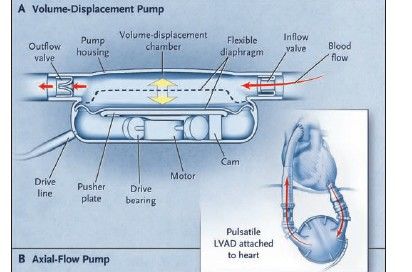
Total artificial heartAn external drive line provides electrical power to a motor within the device. The motor drives a pusher plate up and down repeatedly, expanding and compressing the volume-displacement chamber. The direction of blood flow is maintained by inflow and outflow valves. The inflow cannula is inserted into the left ventricular apex, and the outflow cannula is inserted into the ascending aorta.
Thoratec® Implant
Versatility
Cannulation Options
Total artificial heart
-abiocor
Heartmate II
Indications
May be indicated to patients not
responding to conventional Rx,
when there is a potential for
recovery or as a bridge to
transplantWho should get an assist device?
Major complications of assist device Bleeding Infection Neurologic events
Univentricular vs. Biventricular
Assist Device Support
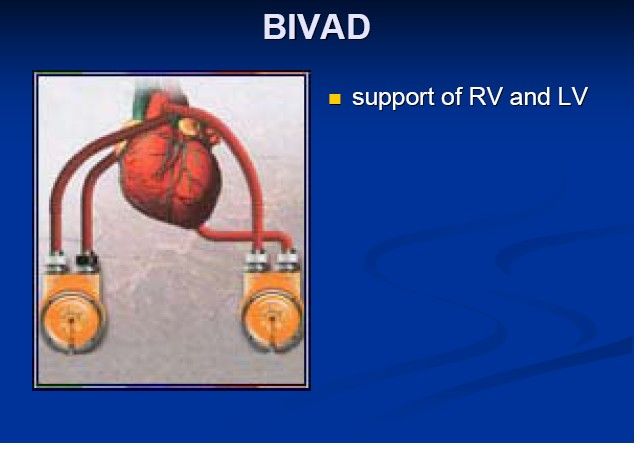
Indications for Biventricular Support
Signs of Right Heart Failure
Intractable Arrhythmias
RV/Septal Infarction
Elevated PVR
Secondary Organ Involvement
Prolonged Cardiogenic Shock “Sicker
Patients”Patient’s follow-up
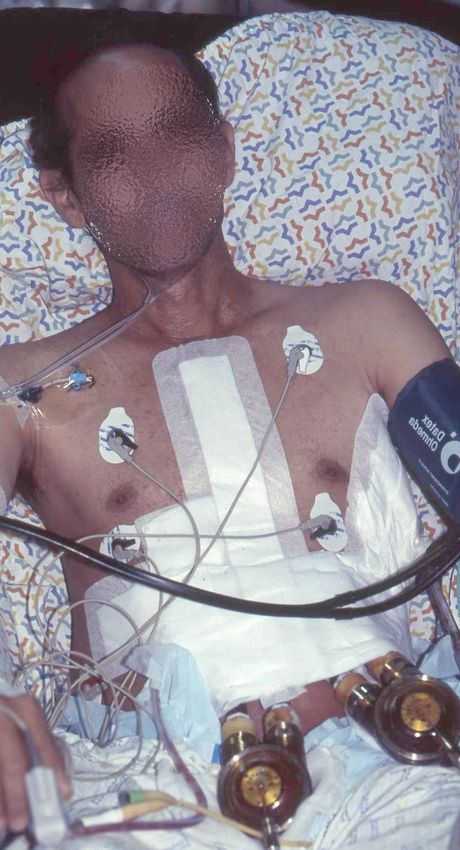
BIVAD- Thoratec implantation
Implantation of BIVAD
Myocardial Biopsy- mild perivascular and
interstitial fibrosis mild hypertrophic changes
Postoperative complications:
Revision due to bleeding and tamponade,
Acute delirium and restlessness treated
successfully with anti psychotics
Sepsis d/t Klebsiella originating from surgical
wound - resolved with broad-spectrum AbxSurvival with assist device in
Israel
During 2007 8 assist devices (7 BIVAD;
1 RVAD) were implanted in Rabin
Medical Center and the Sheba Medical
Center
Survival rate: 50 %
Untill 9/2008 3 assist devices were
implanted , of them only one
(destination) survived After BIVD implantation, he is
categorized as STATUS I, waiting
for heart transplantation
During this period he is mobile and
even spends some time at home
with the mobile BIVAD unitHeart transplantation statistics
during 2007/8 in Israel
During 2007 15 patients (7 in Rabin Medical
Center; 8 in Sheba Medical Center )
underwent orthotrophic heart transplantation
During 2008 7 pts underwent transplantation
(3 kids)
Survival rate: (86%) patients transplanted in
Rabin Medical Center are alive, and in
excellent conditionHeart transplantation
3 months after BIVAD implantation, while he
is categorized as STATUS I, he underwent
orthotropic heart transplantation
Perioperative course – difficulties in
hemostasis d/t warfarin Rx.
Treatment with RATG and steroids followed
by cellcept and takrolimus
Postoperative course- no major
complications, normal function of the
transplanted heartThere is always an option for
patients with severe
decompensated heart failure
Patients with acute decompensated heart
failure should receive all evidence –based
treatments (medical and mechanical) in order
to maintain vital organ function
After stabilization, patients should be
transferred to tertiary centers specializing in
assist device implantation and orthotropic
heart transplantationYou can also read


