Administered by The Multifamily Programs Division - of Tennessee Housing Development Agency
←
→
Page content transcription
If your browser does not render page correctly, please read the page content below
Administered by
  The Multifamily Programs Division
                  of
Tennessee Housing Development Agency

    Ralph M. Perrey, Executive Director
Section 1     Introduction and Disclaimers
Section 2     Definitions
Section 3     Statewide Allocation Limits
  a)   Annual Housing Credit Ceiling
  b)   Set-Asides and Available Housing Credit Amounts
  c)   Regional Pools
  d)   Incremental Development/Phase II Development
  e)   Housing Credit Limits for New Construction
  f)   Total Development Cost Limit
  g)   Limits by Developer or Related Parties
  h)   Limit on Developer Fees and Consultant Fees
  i)   Limit on Contractor Fees, Profit, Overhead and General Requirements
Section 4     THOMAS and Submission of Application
  a) Application
  b) Supporting Documents
  c) Calendar of Events
Section 5     Fees
  a) Effective Date
  b) Wiring Instructions
  c) Fee Chart
Section 6     Development Team Members and Eligibility Thresholds
  a)   Major SAE’s
  b)   Other Ineligibility, Eligibility Thresholds
  c)   Requests for Relief
  d)   Minor SAE’s
Section 7     Nonprofit Set-Aside
Section 8     Choice Neighborhoods Implementation Grant Allocation
Section 9     Innovation Round Allocation
Section 10    PHA Set-Aside
Section 11    Existing Multifamily Housing Allocations
Section 12    New Construction Regional Pools
Section 13    Threshold and Minimum Construction Requirements
  a) Threshold Requirements
  b) Minimum Construction Requirements for New Construction Developments
  c) Minimum Construction Requirements for Rehabilitation of Existing Multifamily Housing
Section 14    Initial Application Scoring
  a)   Project Location and Need
  b)   Development Characteristics and Populations Served
  c)   Construction
  d)   Deferral of the Qualified Contract Process or Eventual Tenant Ownership
  e)   Tennessee Growth Policy Act
  f)   Recapitalization Waiver
  g)   Development Team Characteristics
h) Project Location and Needs
Section 15    Initial Application Eligibility and Scoring Review
  a)   Initial Application Review Process
  b)   Cure Period
  c)   Review Appeal Process
  d)   Final Scoring
  e)   Application of Various Limits/Final Ranking Process
  f)   Tie Breaker
  g)   Preliminary Ranking Notifications to Applicants
  h)   Reservation Letter Process
  i)   Recapture of Housing Credits During Reservation Period
Section 16    Carryover Allocation Process
  a)   Qualifying for a Carryover Allocation
  b)   THOMAS Submission of Additional Information and Documentation
  c)   Low-Income Housing Credits Available
  d)   Status Reports
Section 17    Construction Review Process
Section 18    Final or Placed in Service Process
Section 19    Compliance and Stabilization Process
Section 20    Developments to be financed by Tax Exempt Bonds
Section 21    Miscellaneous Provisions
Section 22    Adoption and Approval by the Governor
Section 1: Introduction and Disclaimers

The Tennessee Housing Development Agency (“THDA”) administers the Low-Income Housing
Tax Credit program in Tennessee. The Low-Income Housing Tax Credit (“Housing Credit”)
program was created by the Tax Reform Act of 1986 under Section 42 of the Internal Revenue
Code of 1986, as amended (“Section 42”), to encourage the construction and rehabilitation of
rental housing for low-income individuals and families. Under Section 42(m), THDA is required
to develop a Qualified Allocation Plan (“QAP”) to define the process by which it will allocate an
annual amount of Low-Income Housing Tax Credits in Tennessee.

This QAP contains “electronic links” to resources utilized by THDA in the application process
such as the Tennessee Growth Policy Act, Multifamily Tax Subsidy Project Income Limits,
Qualified Census Tracts, designations of Difficult to Develop Areas, Fair Housing Act
requirements, etc. “Attachments” are forms or documents which must be submitted in the
Tennessee Housing On-line Management Administration System (“THOMAS”) as part of the
Initial Application. Initial application information entered into THOMAS including, attachments
are collectively part of the “Application” and all are considered part of the QAP.

This QAP has been approved by the THDA Board of Directors and adopted by the Governor of
Tennessee.

When this QAP calls for some THDA action including but not limited to a determination,
adjustment, review, evaluation, or exercise of discretion, all such actions shall be at THDA’s sole
discretion, whether specifically so stated or not.

No person or entity who submits an Initial Application shall have any right to an allocation of Housing
Credits under this QAP based solely on the score assigned to their Initial Application.

The QAP as Public Policy

The policy surrounding this QAP is to use the Housing Credits allocated to Tennessee during
2019 and 2020 to create, maintain, and preserve affordable rental housing for low-income
households. Specific objectives of this QAP are to:
   A. Make rental units affordable, in the areas of greatest need, to households with as low an
       income as possible and for the longest time period possible;

   B. Encourage development of appropriate housing units for persons with special needs,
      including the elderly, the homeless and the disabled;

   C. Allocate only the minimum amount of Housing Credits necessary to make a development
      financially feasible and viable throughout the credit period;

   D. Encourage Nonprofit entities to develop rental housing for low-income households;

                                                                                                     3

                                   Wednesday, September 12, 2018
E. Encourage fair distribution of Housing Credits among counties and developers; and
F. Allocate Housing Credits fairly.
Document Review
THDA will review and evaluate only those materials submitted in compliance with the
requirements of this QAP. THDA will not evaluate any materials submitted outside the
deadlines for submission of such materials and will assume no obligation to request additional
information from applicants for any purpose. THDA may require additional information and/or
documentation if THDA determines that additional information is necessary for clarification
and/or explanation. THDA’s review of documents submitted with any application, including
Initial Applications or documents submitted in connection with Housing Credits reserved or
allocated under this QAP is for THDA’s own purposes and is not for the purpose of advising,
certifying, representing or warranting to others as the feasibility or viability of any proposed
development.
No THDA Liability
No member, officer, agent, or employee of THDA shall have any personal liability with respect to any
matters arising out of, or in relation to, this QAP, Housing Credits reserved or allocated under this QAP
or the monitoring of properties that receive Housing Credits.
THDA makes no representations or warranties to applicants, developers, owners or anyone else as
to compliance with Section 42, Treasury regulations, or any other laws or regulations applying to
Housing Credits or Housing Credit developments or as to the feasibility or viability of any
proposed Housing Credit development.
Enforcement
In the event THDA seeks enforcement of any matter connected with any reservation, allocation or
monitoring of Housing Credits, or any other matter connected with Housing Credits, THDA shall be entitled
to recover all damages, costs, expenses and fees, including without limitation, all court costs, all legal fees
and expenses, and all staff time, from any party connected with Housing Credits reserved, allocated or
monitored for compliance under this QAP.
False Statements
A. Tennessee Code Annotated, Section 13-23-133, makes it a Class E felony for any person to
knowingly make, utter, or publish a false statement of substance or aid or abet another person in
making, uttering, or publishing a false statement of substance for the purpose of influencing
THDA to allow participation in the Housing Credit Program. Any and all statements contained in
any materials, including without limitation, an Initial Application and any other applications,
documents, letters, opinions, or certifications, submitted to THDA in connection with any Initial
Application, subsequent applications or in connection with Housing Credits reserved, allocated or
monitored for compliance under this QAP or otherwise made by an applicant or other person
connected in any way with Housing Credits reserved, allocated or monitored for compliance
under this QAP are statements of substance made for the purpose of influencing THDA to allow
participation in the Housing Credit Program.
B. By submitting any materials, including without limitation, an Initial Application and any other
applications, documents, letters, opinions, or certifications, to THDA in an effort to obtain or
4
Wednesday, September 12, 2018maintain Housing Credits, the applicant and all parties connected with the development proposed
in the Initial Application acknowledge and agree (1) they are entering into a contract with THDA;
and (2) they intend for THDA to rely on and seek enforcement of all selections or statements
(written or oral) made with respect to any reservation, allocation or monitoring of Housing
Credits by any and all means available, including, without limitation, specific performance; and
(3) they are knowingly making, uttering or publishing or aiding and abetting others in making,
uttering or publishing statements of substance for the purpose of influencing THDA to allow
participation in the Housing Credit program.
5
Wednesday, September 12, 2018Section 2: Definitions
20/50 Federal Election - The 20/50 federal election is a minimum set-aside that may be elected by an
applicant for Housing Credits that requires at least 20 percent of the units in a Housing Credit
development to be both rent restricted and occupied by households whose income is less than or equal to
50 percent of area median gross income. This is an irrevocable election made in an Initial Application.
40/60 Federal Election - The 40/60 federal election is a minimum set-aside that may be elected by an
applicant for Housing Credits that requires at least 40 percent of the units in a Housing Credit
development to be both rent restricted and occupied by households whose income is less than or equal to
60 percent of area median gross income. This is an irrevocable election made in an Initial Application.
60% Income Averaging Federal Election - The 60% income averaging federal election is a minimum set-
aside that may be elected by an applicant for Housing Credits. Under this election, at least 40 percent of
the units in a Housing Credit development are required to be both rent restricted and occupied by
individuals whose incomes do not exceed the imputed income limitation designated by the applicant.
This is an irrevocable election made at Initial Application The average of the imputed income limitation
designated cannot exceed 60 percent of AMI. The designated imputed income limitations must be in 10
percent increments as follows: 20 percent, 30 percent, 40 percent, 50 percent, 60 percent, 70 percent, 80
percent.
42(m) Letter - A letter issued by THDA to successful applicants for 4% Housing Credits
Adaptive Reuse/Conversion - the renovation and reuse of a pre-existing building that has not been used
for residential purposes and creates additional affordable housing units. Adaptive Reuse/Conversion will
be evaluated and reviewed as New Construction developments.
AMI -Area Median Income as determined by HUD.
Appraisal - An opinion of value for land and building cost.
Basis Boost – An increase of up to 30% in eligible basis for a building in order to improve the financial
feasibility of the building in a difficult to develop area.
Calendar of Events – Dates items are due in the Housing Credit program as specified in Section 4 of this
QAP.
Capital Needs Assessment - See Physical Needs Assessment
Carryover Allocation Agreement - The document allocating Housing Credits when a development that
received a Reservation Notice will not be placed in service in the same year as the Reservation Notice.
This document is issued by THDA and extends the required placed-in-service date to the end of the
second calendar year after the year of the Reservation Notice.
Carryover Allocation Application – The application cycle for submission of developments with a
Reservation Notice of Housing Credits that will not be placed in service in the same year.
6
Wednesday, September 12, 2018CNI – Choice Neighborhoods Implementation Grants awarded by HUD to PHAs, local governments, or
tribal entities to revitalize severely distressed public housing and/or HUD assisted multifamily housing
projects.
Code - Internal Revenue Code of 1986, as amended, and together with “Section 42”, shall include all
subsequent tax legislation duly enacted by the Congress of the United states and shall be deemed to
include the United States Treasury Regulations proposed or in effect with respect thereto (including
regulations first promulgated under previous versions of the Code) and shall also include revenue
procedures, revenue rulings, or other published determinations of the Treasury Department or the Internal
Revenue Service of the United States.
Concerted Community Revitalization Plan (CRP) - A document that assesses the health and potential
prosperity of an area through public interaction and assessment of the physical, social and economic
health of the citizenry, businesses, infrastructure and built environment in the area. A CRP must contain
all of the following:
• A target area with clearly defined geographic boundaries.
• A defined role for the lead and/or convening organization that will coordinate all other partners
efforts and monitor plan progress.
• A steering committee or coalition that is representative of the community and is charged with
guiding the process.
• A survey of current conditions, a needs assessment and/or an asset map that defines community
assets upfront and clearly identifies challenges to be addressed. The data should include
demographics, economic vitality, and public investment.
• Public meetings and surveys to identify the citizen and business’ vision for the
neighborhood/target area.
• Minimum elements the plan should address include Housing, Education, Infrastructure and
Economic Development.
• Defined outcomes and objectives based both on data and community outreach. Outcomes should
be realistic and responsive to the interests of the community.
• A set of strategies to achieve the outcomes.
• A proposed timeline for implementation of strategies.
• Proposed funding for implementation.
• Continued evaluation of progress, allowing periodic assessment of what is working, what is not
and where adjustments are needed.
• Approval of the plan from the appropriate local entity
Compliance Period - The compliance period is the 15 year period over which a development must
continue to satisfy Housing Credit requirements in order to avoid recapture of the Housing Credits. The
compliance period begins with the first taxable year of the credit period.
Conditional 42(m) Letter- A letter issued by THDA to applicants seeking 4% Housing Credits in
conjunction with non-committed Multifamily Tax-Exempt Bond Authority.
Cost Certification - The certification of actual total development costs development and the amount of
Housing Credit eligible basis in the development at the completion of the development.
7
Wednesday, September 12, 2018Credit Period - The 10 year period over which the Housing Credit is claimed. The Credit Period generally
begins on the date a development is placed in service, but the owner of a Housing Credit development
may elect to start the Credit Period as of the beginning of the year following the year the Housing credit
development is placed in service.
Development Team - Includes any individual or member of the development team including
Governors/Directors, Members, and Managers/Officers of the Ownership Entity; Officers, Directors, and
Stockholders of the Development Entity; General Contractor; Architect, Officers, Directors and
Stockholders of the Property Management Company and Consultant(s).
Difficult Development Area (DDA) - Any area designated as such by HUD. Also Section 42(d)(5)(B)(v)
allows THDA to determine areas where affordable housing development presents challenges to
immediate and long-term financial feasibility and identify the areas as difficult to develop.
ENERGY STAR - Energy efficient designation that must be obtained in order to utilize the Energy Star
Utility Allowances published on the THDA website.
Extended Use Agreement - also known as the Land Use Restrictive Agreement (LURA) is an agreement
between THDA and the taxpayer that:
1. Requires that the low-income occupancy use percentage for the building for each taxable year in
the extended use period will not be less than the low-income use percentage in the agreement, and
that prohibits the eviction or termination of the tenancy (except for good cause) of an existing
low-income resident or any increase in the gross rent with respect to a low-income unit that is not
otherwise permitted;
2. Allows individuals who meet the income limitation applicable to the building the right to enforce
in any state court the rights under (1) above;
3. Prohibits the disposition to any person of any portion of the building to which the agreement
applies is disposed of such person;
4. Prohibits the refusal to lease to a holder of a voucher or certificate of eligibility under the
Housing Act of 1937 because of the status of the prospective resident as such a holder;
5. Is binding on all successors of the taxpayer; and
6. Is recorded pursuant to local law as a restrictive covenant for such property
The Extended Use Agreement begins on the first day of the compliance period and ends the later or:
1. The date specified by THDA in the agreement; and
2. The date 15 years after the close of the compliance period
Existing Multifamily Housing - a multifamily development that will create new or preserve affordable
housing units that are rent and income restricted.
Federally Assisted Building - A federally assisted building is any building that is substantially assisted,
financed or operated under laws in effect the date of enactment of the Code.
Federally Subsidized - A building that is financed with a below market federal loan or with a loan for
which the interest income earned by the holder of the loan is exempt from tax under Section 103 of the
Code.
Final Application - The application cycle for submission of developments that are placed in service and
seeking the IRS Form 8609.
8
Wednesday, September 12, 2018Firm 42(m) Letter- A letter issued by THDA to applicants seeking 4% Housing Credits in conjunction
with a commitment of Multifamily Tax-Exempt Bond Authority.
Forms and Templates - THDA provided documents that are used in conjunction with Initial, Carryover, or
Final Application submission cycles.
Hard Cost - Hard Costs - Costs which include expenses directly related to the physical
construction of a building such as; construction materials and construction labor.
Housing Credit Ceiling - The maximum amount of Housing Credits THDA may allocate in a given year.
HUD – The federal Department of Housing and Urban Development.
Initial Application - The application cycle for submission of developments seeking an allocation of
Housing Credits.
Local Government Notification - Following receipt of Initial Applications, THDA will notify the chief
executive officer (or the equivalent) of the local government in whose jurisdiction a development
proposed in an Initial Application is to be located. Such individual will have an opportunity to comment
on the development proposed in the Initial Application to be located in the jurisdiction, as required by
Section 42(m)(1)(A)(ii).
Market Study - An analysis of the market conditions of supply, demand and pricing for a specific property
type in specific areas.
Method A - The Eligible Basis method for calculation of an amount of Housing Credit. This calculation is
derived from the totals of the acquisition eligible basis and the rehabilitation or new construction eligible
basis entered into THOMAS on the Total Development Cost page. The amount of Housing Credits
allocated to a successful applicant is the lesser of the amount of Housing Credit calculated by Method A
or Method B.
Method B - The Gap method for calculation of an amount of Housing Credit. This calculation is derived
from the total of the actual cost entered into THOMAS on the Total Development Cost page. The amount
of Housing Credits allocated to a successful applicant is the lesser of the amount of Housing Credit
calculated by Method A or Method B.
Modifications – Changes to location buildings, units, square footage, scoring items, etc. which determine
eligibility for an allocation of housing credits.
PHA – Public Housing Authority created under Tennessee Code Annotated Section .
Placed in Service Application – See Final Application
Physical Needs Assessment- A detailed work plan showing all necessary and contemplated improvements
and the projected costs.
Pre-Existing Building - A building containing residential rental units previously occupied or approved for
occupancy by the applicable authority having jurisdiction.
9
Wednesday, September 12, 2018Property Control - Documentation submitted in conjunction with the Initial Application that demonstrates
control of the property on which the development proposed in the initial application is to be located.
Qualified Census Tract (QCT) - Any census tract identified as such by HUD.
Qualified Contract Process (QCP) – The process determined by THDA in compliance with Section
42(h)(6)(F)&(6) and found at Qualified Contract Process.
Qualified Nonprofit Organization - An organization that is described in Section 501(c)(3) or (4) of the
Code that is exempt from tax under Section 501(a) of the Code, and that meets the additional
requirements contained in Section 10 of this QAP.
RAD – Rental Assistance Demonstration Program administered by HUD that allows PHAs and owners of
other HUD-assisted properties to convert (public housing or other assisted) units from their original
sources of HUD financing to project-based Section 8 contracts.
Related Parties: In relation to the Initial Application, any subsequent application or any request for a
Modification, related parties include, the applicant, developer, owner, entities with commonality of one or
more persons with those listed in the Ownership Entity Breakdown, entities with commonality of one or
more persons with those listed in the Developer Entity Breakdown, and any of the following:
a) Any person or entity who has a right to (i) replace the developer, (ii) act as co-developer, (iii)
replace any individuals or entities who comprise a developer or co-developer, or (iv) otherwise
direct the activities of the developer will be considered a developer for purposes of applying this
limit.
b) Any person or entity who has a right to (i) replace the general partner of the owner or applicant,
(ii) act as co-general partner of the owner or applicant, (iii) replace any individuals or entities
who comprise a general partner or co-general partner of the owner or applicant, or (iv) otherwise
direct the activities of the general partner of the owner or applicant will be considered an owner
or applicant, as the case may be, for purposes of applying this limit.
c) Any person or entity who has a right to (i) replace the controlling stockholder of the owner or
applicant, (ii) act as controlling stockholder of owner or applicant, (iii) replace any individuals or
entities who comprise a controlling stockholder of the owner or applicant, or (iv) otherwise direct
the activities of the controlling stockholder of the owner or applicant will be considered an owner
or applicant, as the case may be, for purposes of applying this limit.
d) Any person or entity who has a right to (i) replace the managing member of the owner or
applicant, (ii) act as co-managing member of the owner or applicant, (iii) replace any individuals
or entities who comprise a managing member or co-managing member of the owner or applicant,
or (iv) otherwise direct the activities of the managing member of the owner or applicant will be
considered an owner or applicant, as the case may be, for purposes of applying this limit.
e) Any person who is a signatory or guarantor of construction financing documents, permanent
financing documents, and/or equity syndication documents.
f) This limit will also apply to any person or entity that is related to any person or entity specified
above.
Reservation Notice – Notice from THDA to an applicant that Housing Credits may be made available in
the competitive Housing Credit allocation process.
Rural – Counties identified as rural in the New Construction County Needs Scores; on the THOMAS
documents page
10
Wednesday, September 12, 2018Scattered Site Development - A Housing Credit development located on multiple sites that will use one
common plan of financing.
Significant Adverse Event (“SAE”) - An occurrence of noncompliance (curable or incurable), program
fraud or misrepresentation, or an act that adversely conflicts with THDA’s mission as described in
Section 6 of this QAP.
Soft Costs - Soft Costs - Costs which include expenses indirectly related to construction of a
building but not directly related to construction materials and construction labor such as;
construction permits and fees, architect’s and accounting charges, engineering costs, etc.
Supportive Service - Supportive service is any service provided under a planned program of services
designed to enable residents of Housing Credit developments to remain independent and avoid placement
in a hospital, nursing home or intermediate care facility.
Suburban – Counties identified as suburban in the New Construction County Needs Scores; on the
County needs table and the THOMAS documents page.
Tennessee Growth Policy Act- Growth plans as determined by the Tennessee Advisory Commission on
Intergovernmental Relations
Total Development Cost – The total of actual costs associated with new construction or rehabilitation
development activities.
THOMAS Documents Page - A webpage that will provide necessary forms, templates, guidance,
calendar, and links that are utilized through any application submission cycles.
THOMAS - the Tennessee Housing Online Management and Application System for all applications
involving Housing Credits.
THOMAS User Manual - THDA provided document that gives guidance on the registration and
application submission cycles in the THOMAS System.
Uniform Physical Conditional Standards (UPCS) - The HUD requirements that govern the physical
condition of Housing Credit developments.
Urban – Counties identified as urban in the New Construction County Needs Scores; on the THOMAS
documents page
Urbanicity – The quality or fact of (an area) being urban. The degree to which a given geographical area
is urban. Urbanicity designations can be found on the THOMAS documents page.
Zoning –Written documentation from the appropriate local government authority demonstrating that
current zoning and other local land use regulations permit the development as proposed or that no such
regulations currently apply to the proposed development in the Initial Application.
11
Wednesday, September 12, 2018Section 3: State Allocation Limits
THDA will only allocate Housing Credits necessary for the financial feasibility of a development and its
viability as a qualified low-income housing development in accordance with Section 42(m)(2). THDA may
reject or require modifications to Initial Applications for Housing Credits when THDA determines that the
proposed development is not financially feasible or does not need Housing Credits. THDA may also reserve
or allocate an amount of Housing Credits less than the amount requested in an Initial Application, in a
Carryover Allocation Application or in a Final Application. THDA’s determination under Section 42(m)(2)
shall not be construed to be a representation or warranty by THDA as to the financial feasibility, viability,
or lack thereof, of any development.
A. Annual Housing Credit Ceiling
The methodology to determine the annual Housing Credit Ceiling is contained in Section 42
(h)(3)(C)(i).
B. Set-Asides and Available Housing Credit Amounts
1. Nonprofit Set-Aside- No less than ten percent (10%) of the annual Housing Credit Ceiling will
be allocated to qualified Nonprofit applicants. THDA reserves the right to make allocations of
Housing Credits to qualified Nonprofit applicants as needed to meet the requirements of
Section 42(h)(5).
2. CNI Grants – Eligible PHAs with qualified CNI grants may receive an allocation of Housing
Credits outside of the PHA Set-Aside. The annual amount of Housing Credit available for
Initial Applications involving CNI grants shall not exceed $1,700,000.
3. Innovation Round – No more than one innovation round Initial Application may receive
Housing Credits annually. The amount of Housing Credit available to the successful
innovation round Initial Application shall not exceed the amount of Housing Credits available
under the per development cap for the type of construction proposed in the innovation round
Initial Application. THDA, in its sole discretion, may elect not to award Housing Credits to
any Innovation Round Application.
4. PHA Set-Aside - No more than twenty percent (20%) of the annual Housing Credit Ceiling
will be allocated to developments involving a PHA that meets the requirements of section 10
of this QAP.
5. Existing Multifamily Housing - Existing Multifamily Housing-No more than twenty-five
percent (25%) of the annual Housing Credit Ceiling will be allocated to developments that
include rehabilitation of existing multifamily housing or adaptive reuse/conversion of pre-
existing building.
6. New Construction - At least fifty-five percent (55%) of the annual Housing Credit Ceiling will
be allocated to developments involving new construction using the regional pool methodology
described below.
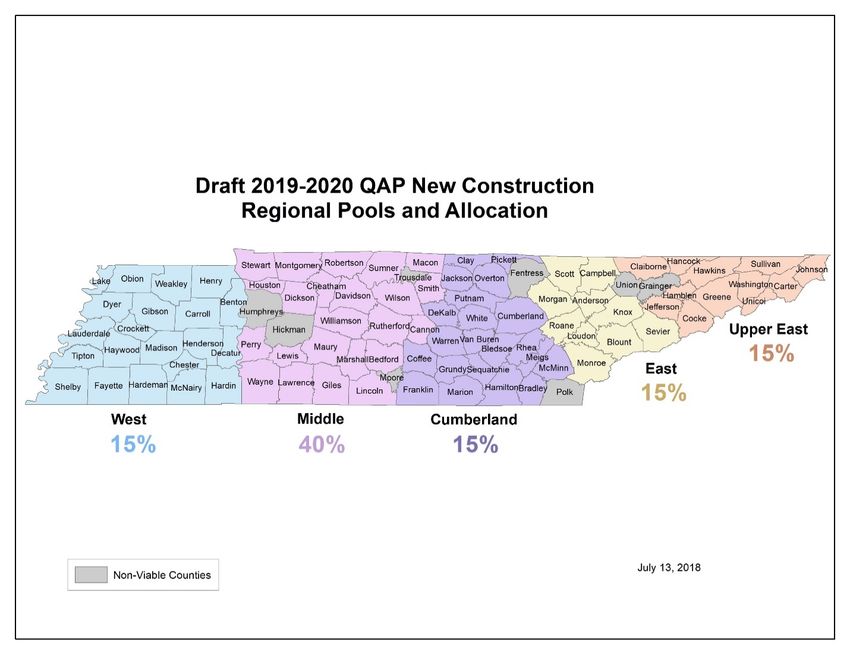
C. Regional Pools
THDA will allocate Housing Credits to developments proposing new construction from one of
the following five regional pools:
12
Wednesday, September 12, 2018D. Incremental Development/ Phase II Development
An application proposing new units to a previously allocated new construction development in
the next allocation year is an Incremental Development. The proposed new units will include the
previously allocated development and must be located on the same plot of land within the same
development, share a common financing plan and use the same Development Team.
Incremental Developments differ from Phase II Developments by nature because a Phase II
Development relies on the Phase I Development’s lease up status. A Phase I Development’s
construction must be complete and rent up must be substantially completed, meaning at least 50%
of the units have been leased, prior to applying for a Phase II Development.
Initial Applications proposing Incremental Developments will be reviewed, evaluated, and scored
based solely on the costs, characteristics, and other elements of the new housing units added in
THOMAS. If an allocation of Housing Credits is allocated as an incremental development, the
development will be subject to these limitations, based on the cumulative costs of the entire
development as proposed:
1. By County
2. By Development
13
Wednesday, September 12, 20183. By Developer or Related Parties
4. Aggregate Qualified Census Tract
5. Total Development Cost Per Total Unit Limit
6. Second Allocation
7. Financial Feasibility
8. Developer, Consultant, Contractor, Overhead and General Requirements Fees
THDA Reserves the right determine in its sole discretion whether an application is requesting an
Incremental Development or a Phase II Development.
E. Housing Credit Limits for New Construction
Applications proposing developments involving new construction shall not be eligible for
Housing Credits that exceed the following limits:
County Per Development Per County Cap
Area Cap
Urban $1,300,000 1
Suburban $1,100,000 1
Rural $900,000 1
No more than one development proposing new construction shall receive an allocation of Housing Credits
in each county. Allocations to developments involving CNI will count against this per county limit.
In making limit determinations, THDA will consider the physical location of developments; the
relationships among owners, developers, contractors, consultants, management agents, and other
development participants; the structure of financing; and any other information which might
clarify whether Initial Applications reflect a single development or multiple developments.
F. Total Development Cost Limit
Number of Rural Suburban Urban
Bedrooms
1 $126,000 $141,000 $158,000
2 $164,000 $178,000 $193,000
3 $215,000 $233,000 $252,000
4 $268,000 $290,000 $314,000
5 $302,000 $327,000 $354,000
G. Limits by Developer or Related Parties
1. The maximum amount of Housing Credits that may be allocated to a single applicant,
developer, owner, or Related Parties shall not exceed two million six hundred thousand
dollars ($2,600,000).
2. An applicant, developer, owner, or Related Party may not be involved in more than one
Initial Application per county. THDA reserves the right to determine, in its sole discretion,
whether Related Parties are involved for the purpose of applying this limit.
H. Limit on Developer Fees and Consultant Fees
1. The combined total of developer and consultant fees which may be included in the
determination of the amount of Housing Credits for a particular development cannot exceed
14
Wednesday, September 12, 2018fifteen percent (15%) of that portion of THDA determined eligible basis attributable to
acquisition (before the addition of the developer and consultant fees), and cannot exceed fifteen
percent (15%) of that portion of THDA determined eligible basis attributable to new
construction or to rehabilitation (before the addition of the developer and consultant fees).
Construction Advisory or Construction Supervision fees listed separately from the maximum
allowed Contractor Fees will be considered as a Consultant Fee.
2. If the developer and contractor are related persons as defined in Section 42(d)(2)(D)(iii), then
the combined total of developer fees, consultant fees, and contractor profit, contractor
overhead, and general requirements, which may be included in the determination of the amount
of Housing Credits for a particular development, cannot exceed fifteen percent (15%) of THDA
determined eligible basis of that portion of the development attributable to acquisition (before
the addition of the fees), and cannot exceed twenty-five percent (25%) of that portion of THDA
determined eligible basis attributable to new construction or to rehabilitation (before the
addition of the fees).
I. Limit on Contractor Fees, Profit, Overhead and General Requirements
1. The total contractor fees, including contractor profit, contractor overhead and general
requirements shall be limited to fourteen percent (14%) of total site work costs, plus cost of
accessory buildings plus either new building hard costs or rehabilitation hard costs, as
determined by THDA, broken down as follows:
Fee Description Fee Amount
Contractor ProfitSection 4: THOMAS and Submission of Application
A. Applications
1. All applications involving Housing Credits, including Initial Applications, must be submitted
electronically through THOMAS. If THDA determines that THOMAS malfunctions in a way
that renders applicants unable to submit applications on-line, THDA will provide alternative
instructions via e-mail BLASTS and THDA website postings. THDA reserves the right to
identify in-progress applications and extend application deadlines to meet THOMAS’s
operational capacities.
a) All fees required at the time of application, as specified in Section 5, must be receive by
THDA via a wire transfer.
B. Supporting Documents
Supporting documents required as part of an Initial Application or subsequent application must be
uploaded into THOMAS as specified in the THOMAS User Manual.
The THOMAS Documents page will contain Forms and Templates for required third party
reports.
THDA will not accept cost certifications, market studies, physical needs assessments and
appraisals prepared by parties THDA has determined are not independent from other members of
the development team or Related Parties.
C. Calendar of Events
The calendar of events applicable to this QAP is as shown below. These dates are subject to
change at THDA’s sole discretion.
A calendar will also be published on the THOMAS Documents page
Dates LIHC 2019
Thursday, November 1, 2018 2019 Innovation Proposals Due
Monday, December 03, 2018 2019 Innovation Finalists Notified
Initial Application Registration in THOMAS
Thursday, December 06, 2018
Opens FY 2019
Wednesday, January 02, 2019 Initial Application Cycle Opens FY 2019
Tuesday, March 05, 2019 Initial Application Cycle Ends FY 2019
Section 5 Fees
16
Wednesday, September 12, 2018A. Effective Date
The fee schedule reflected below shall be in effect as of January 1, 2019.
B. Wiring instructions-All fees should be in the form of an electronic wire.
Bank: US Bank
ABA: 064000059
BNF: THDA Clearing Account
BNF A/C: 151203673398
BNF ADDDRESS:
502 Deaderick Street,
Andrew Jackson Bldg., 3rd Floor
Nashville, TN 37243
OBI: Housing Credit/Bond Application Fees + TN ID Number(s) Applicants may send
one wire to cover multiple applications as applicants should enter the applicable TN ID
Number(s) in the OBI field on the wire.
Applicants are encouraged to send the wire confirmation to thomas@thda.org.
C. Fee Chart
The following fees shall apply.
Fee Type Calculated Amount Due
Application Fee 1-4 Units $395 When Initial Application is
5-50 Units $1595 submitted
51-100 Units $2,210
101+ Units $40 per Unit
Reservation Fee 6.25% of the total annual Housing When Reservation Notice is
Credit amount approved by THDA. accepted
42(m) Letter Fee 6.25% of the total annual amount of When request is made
noncompetitive Housing Credit
amount requested by applicant
Modification Fee Equal to the greater of $750 or When request is made
6.25% of the Total Housing Credits
in the Reservation Notice
8609 Amendment Fee $50 per form. $250 minimum When request is made
Monitoring Fee $600 per Low Income Unit When Final Application is
submitted
Re-inspection Fee $200 a unit When request is made
Late Fee for $100 per month When request is made
Compliance Forms
Deadline Extension 1-5 Days $500 When request is made
Fee 6+ Days $200 per day
Maximum Fee $6000
17
Wednesday, September 12, 2018Utility Company $10.00 per unit for the administrative When request is made
Estimate review
Methodology
Energy Consumption $250 for the administrative review When request is made
Model Methodology
Agency Estimate $150 for the administrative review When request is made
18
Wednesday, September 12, 2018Section 6: Development Team Members and Eligibility Thresholds
THDA prefers Development Teams who have successful Tennessee Housing Credit experience.
Successful Tennessee Housing Credit experience is evidenced by completed construction of a recently
allocated Housing Credit development, a good track record in the development and on-going operations
of the property, and the capacity to sustain the property in the ever changing regulatory and rental market.
Applications shall be ineligible for Housing Credits under this QAP when Development Teams or
individual members identified in the application have incurred and failed to cure one major SAE since
January 1, 2014 or any other event listed in B below as of the date of the application.
A. SAEs
Major SAEs include without limitation:
1. The General Partner/Managing Member/Sole Stockholder being removed from the ownership
entity of a prior Housing Credit development or allocation;
2. An uncured event of default under the Section 1602 or Tax Credit Assistance Program;
3. A Fair Housing Act violation, including those involving a finding of discrimination by an
adverse final decision from a federal court or a complaints that results in a consent decree or a
judgement enforcing the terms of a consent decree;
4. A foreclosure involving the loss of units from the affordable housing stock or failure to notify
THDA of foreclosure (including a deed in lieu of foreclosure transaction);
5. Submitting to the IRS an IRS Form 8609 that was not created by THDA in an effort to claim
Housing Credits or submitting to the IRS an IRS Form 8609 which has been altered or
contains information inconsistent with the IRS Form 8609 created by THDA in an effort to
claim Housing Credit;
6. Failure to meet the federal placed in service deadline for a development that received
Housing Credits; or
7. A development which received Housing Credits being placed in “No Further Monitoring”
status by THDA.
B. Other Ineligibility, Eligibility Thresholds
Housing Credit applications are ineligible if any of the following apply:
1. Any individual involved in the application has any one of the following:
a) A felony conviction of any type within the last ten (10) years; or
b) A fine, suspension or debarment involving financial or housing activities within the last
five (5) years imposed by any federal agency; or
c) A current bankruptcy or a bankruptcy discharged within the last four (4) years or any
organization or entity in which the individual had significant control currently is in
bankruptcy or had a bankruptcy discharged within the last four (4) years;
d) Individual bankruptcy of a member of the board of directors of an entity that is, or is
wholly controlled by, a government entity will not be grounds for ineligibility provided
that the individual certifies that he/she will not have substantial decision-making
authority with regard to the proposed development; or
e) Any suspensions of required state licenses (Tennessee or any other state) within the last
ten (10) years.
2. Any individual involved in the application who is currently participating in the Qualified
Contract Process for another Housing Credit development in Tennessee. This is applicable
during and prior to the expiration of the one year term.
19
Wednesday, September 12, 20183. If any of the following are true regarding the developer, development entity, owner,
ownership entity, related parties or individuals involved (either directly or indirectly) with the
developer, the ownership entity, or related parties (whether formed or to be formed) identified
in the Initial Application for any development receiving an allocation of Housing Credits
after December 31, 2011:
a) An individual previously or currently involved with a developer, development entity,
owner, ownership entity, or Related Parties in any pre-2019 Housing Credit development
with a first allocation of Housing Credits in Tennessee, but for which THDA has not
issued an IRS Form(s) 8609; or
b) An individual previously or currently involved with a developer, development entity,
owner, ownership entity, or Related Parties in any pre-2019 Housing Credit development
with an accepted Reservation Notice, but for which a Carryover Allocation Agreement
was not obtained; or
c) An individual previously or currently involved with a developer, development entity,
owner, ownership entity, or Related Parties in any pre-2019 Housing Credit development
with a fully executed Carryover Allocation Agreement, but for which IRS Form(s) 8609
were not obtained; or
d) An individual previously or currently involved with a developer, development entity,
owner, ownership entity, or Related Parties in any pre-2019 Housing Credit development
for which THDA issued IRS Form(s) 8609, but the Housing Credit development failed to
meet the minimum set-aside for low-income tenants as specified in the Land Use
Restrictive Covenants by the end of the first year of the Credit Period; or
e) An individual previously or currently involved with a developer, development entity,
owner, ownership entity, or Related Parties in any pre-2019 Housing Credit development
that THDA determined to be in violation of the requirements of the applicable QAP
regarding developer or related party issues; or
f) An individual previously or currently involved with a developer, development entity,
owner, ownership entity, or Related Parties in any pre-2019 Housing Credit development
that involved a “broker” who does not remain involved in the Initial Application through
the closing of permanent financing for the Housing Credit development; or
g) An individual previously or currently involved with a developer, development entity,
owner, ownership entity, or Related Parties in any pre-2019 Housing Credit development
that does not meet the requirements of the applicable QAP regarding submission of
permanent financing documentation to THDA; or
h) An individual previously or currently involved with a developer, development entity,
owner, ownership entity, or Related Parties in any pre-2019 Housing Credit development
as a consultant, but who is a (i) signatory of construction financing, permanent financing
or equity syndications documents or (ii) provides a guaranty in connection with
construction financing, permanent financing or equity syndication; or
i) An individual previously or currently involved with a developer, development entity,
owner, ownership entity, or Related Parties in any Multifamily Tax Exempt Bond
Authority Application that received an allocation of bond authority but failed to meet the
established deadline for issuance and sale of the tax-exempt bonds. Voluntary
withdrawal of a Multifamily Tax Exempt Bond Authority Application in accordance with
all applicable program requirements will not cause ineligibility; or
j) The application is deemed ineligible pursuant to any other provisions of this QAP.
20
Wednesday, September 12, 2018C. Requests for Relief
Prohibition of an individual’s participation in programs administered by the Multifamily
Programs Division in Tennessee shall be determined by Multifamily Programs staff. Any
individual prohibited due to a Major SAE may appeal the determination to the THDA Executive
Director and the THDA Board Chair. The determination of prohibition shall be at the sole
discretion of the THDA Executive Director and the THDA Board Chair and shall not be
appealable to the THDA Board or the Tax Credit Committee (TCC) Board.
D. Minor SAEs
Minor SAEs are defined as events, which individually, will not compromise an individual’s
participation in programs administered by the Multifamily Programs Division in Tennessee.
Minor SAEs indicate administrative problems and poor performance by individuals in the
Development Team. Effective January 1, 2019, THDA will track Minor SAEs as they occur in
the development and on-going operations of Housing Credit developments.
As Minor SAEs are incurred, Multifamily Programs staff will notify the Development Team.
Multifamily Programs will maintain Minor SAE records by individual. The cumulative total of
Minor SAEs will determine the Development Team Track Records points.
Minor SAEs include, without limitation, any of the following that occur with respect to any
Housing Credit development in Tennessee:
1. Requesting a Housing Credit Allocation Exchange from the initial allocation year to a
subsequent year;
2. Requesting any deadline extension;
3. Requesting any development modification;
4. Demonstrating a pattern of repeated UPCS findings;
5. Failing to maintain a positive history of payment to subcontractors during the
development of any Housing Credit development;
6. Having significant unpaid receivables;
7. Defaulting on loan payments or having arrearages of at least three months on any loan for
a Housing Credit development;
8. Failing to utilize all listed funding sources in the amount or under the terms described in
the Initial Application until the Housing Credit development is placed in service, unless
THDA has been advised of the change in funding source and agreed to the change;
9. Failing to maintain and operate amenities and services throughout the credit, compliance
and extended use periods;
10. Failing to fulfill commitments made in any application, including without limitation, the
Initial Application (except for changes approved by THDA, in its sole discretion);
11. Failing to correct outstanding noncompliance issues within the applicable correction
period;
12. Failing to convert construction loan financing to permanent loan financing within 6
months of THDA issuance of IRS Form 8609; unless THDA has been advised of the
delay and agreed to the change.
13. Making changes to the Housing Credit development ownership entity without THDA
approval.
21
Wednesday, September 12, 2018Section 7: Nonprofit Set-Aside
To be eligible for Housing Credits from the Non-profit Set-Aside, an Initial Application must
contain information satisfactory to THDA demonstrating that the development proposed in the
Initial Application involves a qualified non-profit organization. To be qualified, a non-profit
organization must meet ALL of the following:
A. The organization must be a bona fide non-profit organization, as evidenced by the following:
1. The organization must be an IRS 501(c)(3) or 501(c)(4) entity;
2. The organization must be organized and existing in the State of Tennessee or if organized
and existing in another state, must be qualified to do business in Tennessee;
3. The organization must: (i) not be formed by one or more individuals or for-profit entities
for the principal purpose of being included in the Non-profit Set-Aside; (ii) not be
controlled by a for-profit organization; and (iii) not have any staff member, officer or
member of the board of directors who will materially participate, directly or indirectly, in
the proposed development as or through a for-profit entity; and
4. The organization must be engaged in the business of developing AND building
low-income rental housing in Tennessee and must have been so engaged at all times since
January 1, 2016.
B. The organization must, prior to the reservation of Housing Credits: (i) own all of the general
partnership interests of the ownership entity of the development; or (ii) own, alone or with
other non-profits who meet all of the requirements of this Section, one hundred percent
(100%) of the stock of a corporate ownership entity of the development; or (iii) own, alone or
with other non-profits who meet all of the requirements of this Section, one hundred percent
(100%) of the stock, 100% of the partnership interests, or 100% of the membership interests
of an entity that is the sole general partner or sole managing member of the ownership entity
of the development proposed in the Initial Application;
C. The nonprofit organization must materially participate (regular, continuous and substantial
on-site involvement) in the development and operation of the development throughout the
extended use period.
D. To demonstrate eligibility, ALL of the following must be submitted in THOMAS as part of
the Initial Application, or:
1. A copy of the IRS determination letter clearly stating the organization’s status as an IRS
501(c)(3) or 501(c)(4) entity; and
2. (a) if organized and existing under the laws of the State of Tennessee, a Certificate of
Existence from the Tennessee Secretary of State’s Office dated not more than thirty (30)
days prior to the date of the Initial Application.
(b) if organized and existing under the laws of another state, a certificate of existence
from the secretary of state of the state in which the organization was organized and is
existing, together with other documentation from such secretary of state indicating that
the organization is in good standing under such laws and a certificate from the Tennessee
Secretary of State indicating that the organization is qualified to do business in
Tennessee, all dated not more than thirty (30) days prior to the date of the Initial
Application; and
3. A Certificate Regarding Qualification for the Non-Profit Set Aside for Non-Profit is the
Sole General Partner or Sole Managing Member of the Development Owner or for Non-
22
Wednesday, September 12, 2018Profit(s) Formed a Corporation to be Sole General Partner or Sole Managing Member of
the Development Owner which will be found on the THOMAS Documents page.
23
Wednesday, September 12, 2018Section 8: Choice Neighborhoods Implementation Grant Allocation
To be eligible for Housing Credits when an application involves a CNI Grant, an Initial Application must
contain information demonstrating that the development proposed in the Initial Application involves a
qualified PHA and has entered into a CNI Grant agreement with HUD.
A. To be considered a qualified PHA, all of the following requirements must be met:
1. The PHA must materially participate (regular, continuous and substantial on-site
involvement) in the development and operation of the development throughout the
development’s compliance period; and
2. The PHA must be acting solely within the geographic area of its jurisdiction; and
3. The PHA must have a fully executed CNI grant agreement and submit a copy of the CNI
grant agreement in THOMAS as part of an Initial Application; and
4. The PHA must submit A Form of Letter from PHA Executive Director Regarding the Choice
Neighborhoods Initiative (CNI) Implementation Grant which will be found on the THOMAS
Documents page.
B. Only one CNI development per county may receive Housing Credits.
C. CNI developments will count against New Construction County Cap in the county where the CNI
development is proposed.
D. The total Housing Credit amount available for CNI developments cannot exceed $1,700,000.
E. Proposed CNI developments involving new construction may be located in a QCT.
F. CNI developments that receive Housing Credits may also receive a Basis Boost.
G. An CNI Initial Application must choose to compete in the PHA Set-Aside or for a New
Construction Allocation or for an Existing Housing Allocation.
24
Wednesday, September 12, 2018Section 9: Innovation Round
The Innovation Round is an opportunity for applicants to propose unique development approaches that
address unmet housing needs including; hard to serve populations, distinctive design and construction
concepts, underserved regional or geographical areas, etc.; without being competitively disadvantaged in
the regular competitive allocation round. Innovation Round applicants must propose a financially feasible
development and include a Development Team with the capacity, experience and performance to
complete the proposal. THDA prefers proposals which contribute to THDA’s Strategic Plan.
To participate in the 2019 Innovation Round, applicants must submit an Innovation Round Proposal by
November 1, 2018. Information on the 2020 Innovation Round deadlines are found in Section 4 of this
QAP. Proposals are accepted by email at Innovation@thda.org.
The Innovation Round Proposal must meet all of the following requirements:
A. Contain no more than 5 single-sided, single spaced pages (including all attachments and exhibits,
if any) describing each of the following:
1. Clearly identify the uniqueness and innovative nature of the development concept (i.e. among
other things, has a development of this type been done before, does this proposal recommend
a method of construction or financing not previously used, will this housing serve a group or
population currently unserved, and how this proposal will result in a development that is
different from “regular” Housing Credit developments);
2. How the proposed development addresses an unmet need of the population to be served,
services provided, or geographic location;
3. How the proposed development contributions to THDA’s Strategic Plan;
4. The reasonableness of the proposed development’s scope in addressing an unmet need;
5. The proposed sources and uses of funds for the proposed development;
6. The extent to which the proposed development would be at a competitive or financial
disadvantage relative to developments considered in the regular competitive round;
7. The demonstrated capacity of the applicant and the development team to complete the
proposed development;
8. Certification of compliance with all applicable requirements of Section 42 and this QAP; and
9. The contact information for the applicant, the proposed development name, the number of
units and bedroom mix, geographic location, type of development (including, but not limited
to new construction located in a QCT).
B. The Innovation First Round Evaluation team will score each Innovation Round proposal for
financial feasibility, extent of uniqueness and/or innovation, and compliance with all applicable
requirements of Section 42, and this QAP. No more than three (3) Innovation Round Proposals
may be selected to submit a full Initial Application for consideration in the Innovation Second
Round Evaluation. The Innovation First Round Evaluation team may select fewer than three
Innovation Round Proposals or no Innovation Round Proposals. Applicants submitting
Innovation Round proposals that are not selected will not be considered further. Applicants
submitting Innovation Round proposals that are not selected to submit a full Initial Application in
the Innovation Round may submit a full application in the regular competitive round.
C. 2019 Innovation Round Applicants, if any, will be notified by December 3, 2018 and invited to
submit a full Initial Application by the competitive deadline specified in Section 4.
D. A successful Innovation Round Initial Application may be eligible for a Basis Boost.
E. The selection of Innovation Round Applicants and a successful Innovation Round
application, if any, shall not be appealable to the THDA Tax Credit Committee or the
THDA Board of Directors.
25
Wednesday, September 12, 2018You can also read


