Aid and Internal Migration in Malawi - RSC 2021/18 Robert Schuman Centre for Advanced Studies Migration Policy Centre - Mauro Lanati, Marco ...
←
→
Page content transcription
If your browser does not render page correctly, please read the page content below
RSC 2021/18
Robert Schuman Centre for Advanced Studies
Migration Policy Centre

Aid and Internal Migration in Malawi

Mauro Lanati, Marco Sanfilippo, Filippo Santi
European University Institute
Robert Schuman Centre for Advanced Studies
Migration Policy Centre

Aid and Internal Migration in Malawi

Mauro Lanati, Marco Sanfilippo, Filippo Santi

EUI Working Paper RSC 2021/18
Terms of access and reuse for this work are governed by the Creative Commons Attribution 4.0 (CC-
BY 4.0) International license. If cited or quoted, reference should be made to the full name of the
author(s), editor(s), the title, the working paper series and number, the year and the publisher.

ISSN 1028-3625

© Mauro Lanati, Marco Sanfilippo, Filippo Santi, 2021

This work is licensed under a Creative Commons Attribution 4.0 (CC-BY 4.0) International license.
https://creativecommons.org/licenses/by/4.0/

Published in February 2021 by the European University Institute.
Badia Fiesolana, via dei Roccettini 9
I – 50014 San Domenico di Fiesole (FI)
Italy

Views expressed in this publication reflect the opinion of individual author(s) and not those of the
European University Institute.

This publication is available in Open Access in Cadmus, the EUI Research Repository:
https://cadmus.eui.eu
Robert Schuman Centre for Advanced Studies
The Robert Schuman Centre for Advanced Studies, created in 1992 and currently directed by
Professor Brigid Laffan, aims to develop inter-disciplinary and comparative research on the
major issues facing the process of European integration, European societies and Europe’s place
in 21st century global politics.
The Centre is home to a large post-doctoral programme and hosts major research programmes,
projects and data sets, in addition to a range of working groups and ad hoc initiatives. The
research agenda is organised around a set of core themes and is continuously evolving,
reflecting the changing agenda of European integration, the expanding membership of the
European Union, developments in Europe’s neighbourhood and the wider world.
For more information: http://eui.eu/rscas
The EUI and the RSC are not responsible for the opinion expressed by the author(s).

Migration Policy Centre (MPC)
The Migration Policy Centre (MPC) is part of the Robert Schuman Centre for Advanced Studies at the
European University Institute in Florence. It conducts advanced research on the transnational
governance of international migration, asylum and mobility. It provides new ideas, rigorous evidence,
and critical thinking to inform major European and global policy debates.
The MPC aims to bridge academic research, public debates, and policy-making. It proactively engages
with users of migration research to foster policy dialogues between researches, policy-makers, migrants,
and a wide range of civil society organisations in Europe and globally. The MPC seeks to contribute to
major debates about migration policy and governance while building links with other key global
challenges and changes.
The MPC working paper series, published since April 2013, aims at disseminating high-quality research
pertaining to migration and related issues. All EUI members are welcome to submit their work to the
series. For further queries, please contact the Migration Policy Centre Secretariat at migration@eui.eu
More information can be found on: http://www.migrationpolicycentre.eu/
Disclaimer: The EUI, RSCAS and MPC are not responsible for the opinion expressed by the author(s).
Furthermore, the views expressed in this publication cannot in any circumstances be regarded as the
official position of the European Union.

Abstract
This paper uses geographically disaggregated data to investigate the role of foreign aid as a pull factor
for internal migration in Malawi over the period 1998-2008. Employing a standard gravity model of
migration, we show a positive relationship between the volume of foreign assistance a district receives
and the number of immigrants. While aid makes districts more attractive as migrant destinations, there
is no evidence of a corresponding push factor effect on internal mobility. We also dig deeper into the
mechanisms through which foreign aid can shape internal migration decisions. According to our results,
the positive welfare effects of foreign assistance manifest themselves not only through a rise in economic
opportunities, but also in improved access to public services in recipient districts.

Keywords
Foreign Aid, Malawi, Sub-Saharan Africa, Internal Migration
JEL classification: F35, R2, O55
1. Introduction*
   Differentials in economic opportunities and in the availability and quality of public services are
typically among the main factors influencing the decision to migrate (Lucas, 2015). Migrants tend to
move to areas where employment and income opportunities are larger (Harris and Todaro, 1970; Young,
2013), or in which the supply of public services, such as health care and education, is more abundant
and of better quality (e.g. Clark et al., 2003; Gollin et al. 2017).
   In developing countries, gaps in public services’ provision and income opportunities across
geographical areas are often related to the spatial distribution of foreign aid. Especially in poor and
fragile contexts, governments have been relying on development aid to provide those social and
economic infrastructures that are crucial for local population’s subsistence and wellbeing.
   Indeed, the volume of ODA flows for several least developed countries (e.g. Burundi, Liberia,
Malawi) accounts for large shares of gross national income and represents more than those countries
can collect through taxes (OECD 2014). Recent studies focusing on geo-localized aid show that
development aid is positively associated with healthcare quality (e.g. Kotsadam et al., 2018;
Odokonyero et al., 2018), education outcomes (e.g. De and Becker, 2015; Martorano et al., 2020) and
economic growth (e.g. Dreher and Lohmann, 2015; Khomba and Trew, 2019).1
   This paper investigates the role of ODA as a pull factor for internal migration. We argue that the
presence of aid projects, particularly in poor and aid-dependent countries, positively influences both
monetary as well as non-monetary dimensions of wellbeing at local level. This in turn shapes the
incentives to migrate internally and drives population movements. While several recent studies focused
on international emigrant flows (e.g. Berthélemy et al., 2009; Lanati and Thiele, 2018; Clist and Restelli,
2020), the impact of foreign development assistance on internal migration remains substantially
unexplored. Yet, much of the population movements, especially in developing countries, occur
internally rather than internationally. Globally, 1 in 7 people are internal migrants (UNDP, 2009), which
is three times as many as international migrants. Furthermore, internal migration is one of the driving
forces underlying the rapid demographic change occurring in most developing countries, particularly
in Sub-Saharan Africa (Lagakos, 2020). The challenges imposed by rapid urbanization (Henderson and
Turner, 2020) call for a better understanding of the factors which influence migration decisions and the
role of international donors in shaping the forces that drive population movements.

* The authors are grateful to Paul Clist for helpful comments and suggestions. We also thank Robert Lucas, Rainer Thiele,
Martin Ruhs, Léa Marchal, Frank Borge Wietzke Sarah Langlotz and the participants of the webinar 'Development Aid &
Migration: Unexplored Dimensions and Latest Research Findings’ organized by the Migration Policy Centre (EUI).
a European University Institute - Migration Policy Center. Email: Mauro.Lanati@eui.eu – Corresponding Author
b University of Turin – Department of Economics and Statistics “Cognetti de Martiis”; European University Institute and IOB,

University of Antwerp. Email: marco.sanfilippo@unito.it
c University of Florence and Bielefeld University –Faculty of Business and Economics. Email: filippo.santi@uni-bielefeld.de
    1 These results corroborate previous empirical research at the macro level based on cross-country analysis, which found a

positive impact of aid disaggregated along various lines on a range of economic and social indicators (e.g. Mishra and
Newhouse 2009; Clemens et al 2012).

                                                               1
Mauro Lanati, Marco Sanfilippo, Filippo Santi
Our work focuses on the case of Malawi, which presents some desirable characteristics for this type
of analysis. On the one hand, internal migration in Malawi is far more relevant than international
migration among both rural and urban households and represents the main driver of urbanization in the
country. 2 While most of the country’s population still predominantly resides in rural areas, Malawi has
one of the highest rates of urban population growth (Anglewicz, 2019) and recent estimates show that
internal migrants account for over half of the annual population growth in urban areas (World Bank,
2016). On the other hand, social and economic infrastructures in Malawi are highly dependent on
external financial resources. Aid represents approximately 20% of the country’s GNI,3 and it is
estimated to account for over three quarters of the country’s total development expenditures (Khomba
and Trew, 2019). This is especially true as far as the provision of social services is concerned. For
instance, recent studies showed that foreign aid accounts for 81% of Malawi’s total health expenditure
(CHAI, 2015). It is also positively related to the quality of services proxied by a series of health and
educational outcomes (De and Becker, 2015; Dolan, 2018). In such a context, foreign aid is likely to
significantly shape the spatial differences in the provision of public services and economic
opportunities.
Our empirical analysis relies on a standard gravity model of migration (e.g. Ortega and Peri, 2013)
where internal bilateral migration flows are regressed on foreign aid volumes at destination. We
construct a dyadic matrix over the period 1998-2008, combining information on district-to-district
bilateral migration flows (source: IPUMS, 2008 population census) with geo-localized data on foreign
aid (source: AidData). In accordance with previous gravity model applications (e.g., Beine and Parsons,
2015; Bertoli and Fernández-Huertas Moraga, 2015), our model is estimated via the Poisson Pseudo-
Maximum Likelihood (PPML) estimator. To reduce the risk of model mis-specification and the
potential omitted variable bias, we include origin-time and district-pair fixed effects to account for the
so-called multilateral resistance to migration (Bertoli and Fernández-Huertas Moraga, 2013). This also
fully controls for origin specific and district-pair (time invariant) unobserved heterogeneity.
Since our identification strategy cannot completely rule out measurement errors and potential
endogeneity concerns, we provide a series of robustness tests which include different definitions of the
variables of interest, alternative specifications, and an instrumental variable (IV) approach. The latter
combines a two-step strategy along the lines of Eaton and Kortum (2002) and Head and Mayer (2014)
with an IV that exploits the exogenous variation in the supply of ODA weighted by the district’s
probability of receiving aid (as in Nunn and Qian, 2014; Chauvet and Ehrhart, 2018; Dreher et al.,
2019).
Our results reveal a positive impact of foreign aid as a pull factor for internal migration in Malawi.
This effect is not only statistically significant, but also economically relevant. A simple back-of-the-
envelope calculation shows that moving from zero to positive aid inflows (which corresponds to the
2 See for instance FAO (2017) and Gollin et al., 2017.
3 This refers to the period 1998-2008. Data retrieved from the World Bank World Development Indicators.
2Aid and Internal Migration in Malawi
55th percentile of the aid distribution), leads to 22 more migrants per dyad. This roughly corresponds to
an additional 660 immigrants per district, which is about 8% of the average number of migrants per
district in 2008. In addition, the relationship between aid disbursements and internal immigration is
non-linear, as it is characterized by diminishing marginal returns. Therefore, migration decisions appear
to be mostly influenced by the presence of aid-supported projects in recipient districts, rather than their
size.
Next, we show that the effect of foreign assistance on within-country migration (a) does not vary
significantly between men and women; (b) is stronger for younger cohorts of emigrants; (c) is more
likely to explain migration to urban areas; (d) is predominantly driven by economic-oriented aid
projects; and (e) works/operates exclusively as a pull, rather than as a push factor for internal migrants.
In the final part of the paper, we identify some of the potential channels at work. We assume that
migration choices are mostly driven by economic opportunities and differentials in the provision of
public services (Lagakos, 2020). We test for this hypothesis using additional data from different
sources. The results suggest that economic development in Malawian districts, which we proxy using
variation in nightlight density, is positively associated with volumes of foreign aid. Furthermore, by
exploiting survey information available from Afrobarometer, we show that Malawian districts that
received more development assistance are also those exhibiting improved indiviudal access to various
public services, including education or health facilities, as well as to several types of utilities.
Our contribution to the literature is threefold. First, we complement an existing (but rather small)
literature on the link between aid and internal migration, which is almost exclusively confined to the
impact of cash transfer or credit access programs (e.g. Ardington 2009; Bryan et Al., 2014; Cai 2020).
A common pattern emerging from those studies is that access to such programs favors internal migration
by relaxing household’s liquidity constraints in the presence of substantial upfront migration costs. The
focus on cash transfer and credit access programs is particularly suitable to investigate the budget
constraint channel of aid. However, it limits the scope of the analysis to very specific types of assistance,
specifically designed to relax liquidity-related constraints. By including the provision of other types of
aid, our analysis may capture alternative forces driving the decision to migrate which go beyond the
better capacity of would-be-emigrants to finance their moving costs. We thereby complement previous
research which shows that the quality of amenities and public services is a rather important determinant
of migration decisions (e.g. Dustmann and Okatenko, 2014; Gollin et al. 2017; Henderson and Turner,
2020).
Second, the paper sheds some light on the potential mechanisms linking aid to internal migration. In
particular, we test whether the volume of foreign assistance in recipient districts is associated to
development outcomes that are likely to shape internal migration flows. This links our paper to the
growing and recent literature that uses geo-localized data to evaluate the impact of aid on both economic
and social welfare indicators (e.g. Dreher and Lohmann, 2015; Kotsadam et al., 2018).
3Mauro Lanati, Marco Sanfilippo, Filippo Santi
Finally, to the best of our knowledge, no other works look at the role of official development
assistance as a pull factor for internal migration in a developing country. Instead, scholars mostly
investigated the controversial role of foreign aid as a push factor for international migration (e.g. Dreher
et al., 2019; Clist and Restelli, 2020) given the salience in the policy debate around the issue of how to
deal with the rising South-North migration following the so-called refugee crises. Our findings suggest
that the welfare enhancing effects of aid-supported projects not only make districts more appealing as
internal migrant destinations, but also seem to create more incentives for households to stay in their
district of origin, rather than leaving.
The remainder of the paper is structured as follows. Section 2 describes the method and data
employed in the econometric analysis and provides some descriptive statistics. Section 3 reports and
discusses the regression results, including a number of robustness checks. Section 4 provides several
extensions to the main results, while Section 5 digs deeper into the mechanisms through which foreign
aid influences migration decisions. Section 6 concludes.
2. Data and Empirical Specification
2.1 Data on Aid Projects
We use data on the precise geographical location of aid-supported projects in Malawi from AidData.
The dataset includes donor-reported information on ODA projects, totaling an estimated value of $5.3
billion, covering approximately 80% of total foreign aid reported by the government of Malawi during
the period 2000–2011.4 AidData provides a rich set of information for each specific aid-supported
project, including the volume of foreign assistance (committed and disbursed), sectoral and purpose
codes, type of assistance, donor and year in which each project was originally agreed as well as the date
of its completion.5
In this paper we only consider projects completed by the end of 2008 - the latest year for which
information on internal migration is available, and whose geographic location is defined with a
minimum level of precision.6 In line with the approach of some recent studies (e.g. Briggs, 2018), we
select projects with a precision code of up to 4, which makes it easier to associate the exact location of
the project with a specific district, our spatial unit of interest. While this strategy reduces the uncertainty
regarding the exact geo-localization of aid-supported projects and attenuates potential issues due to
measurement errors, it lowers the number of observations by about 18%.7
4 Further details and information on the dataset are available at the following webpage (accessed on Dec 5, 2019):
https://www.aiddata.org/data/malawi-release-17-april-2012
5 The information on foreign aid projects has been geo-localized using the UCDP/AidData methodology (see Tierney et
al., 2011)
6 We nonetheless exploit the information on projects that are not yet completed by the end of our sample period (2008) in
some robustness checks reported in Table 3
7 Projects with a precision code higher than 4 are in almost all cases projects that have not been geolocated at all. These
includes for the largest part grants directed to the central government in sectors related to Governance.
4Aid and Internal Migration in Malawi
Our baseline sample includes 65 projects, covering a total of 411 project-locations.8 Panel (a) of
Figure 1 reports the distribution of aid projects in Malawi. The projects are spread almost equally over
all districts, with a slight majority of them based in urban areas such as the capital city, Lilongwe
(accounting for about 10% of the total), and Zomba (8.8%). Conversely, the aid volumes (Panel b of
Figure 1), demonstrate that the larger ODA flows are concentrated in the districts of Karonga,
Mangochi, and in Lilongwe district. The largest share of aid disbursements in our sample takes the form
of grants (around 70%) and comes from a restricted group of multilateral agencies (African
Development Bank, the European Commission, World Bank and FAO) and bilateral donors, namely
the US, Norway and Germany.
Figure 1- Aid Projects in Malawi, 1998-2008
Panel a: Location of Aid Projects Panel b: Disbursements for Concluded Projects
Notes: The graph includes only completed projects concluded in the period 1998-2008.
Source: Authors’ elaboration on AidData.
The top seven donors accounts for about 90% of the total number of projects. As far as the sectoral
composition is concerned Figure 2 (Panel a), aid-supported projects in Malawi are highly concentrated
in the agricultural sector, and are almost evenly distributed across the other groups. When looking at
the size of these projects, however, aid disbursements in rural development and roads, public works and
transport make about 60% of the total volume of ODA.
8 As the information on financial disbursements is only available at the main project level - i.e. reported as the cumulative
disbursement of all project-location entries that share the same project code - we evenly split the value of each multi-location
project across the different sites involved (as it is standard practice in this literature, see for instance Dreher and Lohman,
2015). All financial disbursements are reported in constant US $.
5Mauro Lanati, Marco Sanfilippo, Filippo Santi
2.2 Migration Data
We employ the 2008 Population Census of Malawi9 to construct a retrospective panel of district-to-
district migration over the period 1998-2008.10 Starting from the census year 2008, we build a dyadic
matrix by tracking all individuals who have declared to have moved to the current district of residence
from any other districts in a given year. Going backward, we reconstruct the internal migration flows
that occurred each year from 1998 to 2008. 11 Formally, we compute annual dyadic migration flows as
follows:
, ,
denotes each individual currently residing in district 1, … , , who moved from district
1, … , ( ℎ in a given year 1998, … , 2008.
Figure 2 - Sectoral distribution of Aid Projects (1998-2008)
Panel a: Number of Concluded Projects Panel b: Disbursements for Concluded Projects
Water, Other Water, Other
Sanitation 6% Sanitation 5% Agriculture
and and 8%
Irrigation Irrigation
12% 9% Education
Agriculture 10%
Roads, Public Works Roads,
26%
and Transport Public
17% Works and
Transport Health
29% 8%
Integrated
Rural Integrated Rural
Education
Development Development
Health 12% 31%
14%
13%
Source: Authors’ elaboration on AidData.
This methodology allows us to cover the whole spectrum of internal migration flows and lead to a
dyadic-panel setup that is particularly suitable for gravity model estimations. However, it presents three
main concerns. First, this strategy does not allow us to keep track of any intermediate migratory
movements by individuals that might have occurred between 1998 (the first year of our sample) and the
last declared movement. This issue is likely to be more relevant for later waves of our panel than for
9 The census was run by the Malawi National Statistical Office, and is distributed by the Integrated Public Use Microdata
Series (IPUMS) at the University of Minnesota. From IPUMS, the data are available as a systematic sample of every 10th
househould with a random start, which was drawn by the Minnesota Population Center to preserve the anonymity of
respondents while preserving the representativeness of the data. For additional details on the sampling, see:
https://international.ipums.org/international-action/sample_details/country/mw#tab_mw2008a
10 The census tracks the current place of residence down to Traditional Authorities level, Malawi’s lowest administrative
division. Nonetheless, we cannot go more granular since the IPUMS anonymization procedure allows to track the previous
residence of migrants only at the district level. This limitation also prevents us from considering within district movements
(for instance, from rural to urban areas), which is itself an important component of internal migration (Becerra-Valbuena and
Millock, 2020).
11 As we identify migrants based on individual respondents, our figures might be affected by some degree of recall bias.
Even though this issue is more likely to affect the older waves in our panel than the more recent ones, we assume that 10 years
is a short enough period to exclude substantial recall errors.
6Aid and Internal Migration in Malawi
the earlier ones, as the probability that intermediate migratory steps will be overlooked increases when
the latest movement has occurred more recently.12 Second, we can only rely on information about
individuals who were alive at the time of the 2008 census. Hence, the constructed flows are likely to be
underestimated, as they do not account for people who migrated during our time-span, but that were not
alive in 2008. This measurement issue is plausibly more relevant for earlier waves than for more recent
ones.13 Finally, Malawi’s 2008 census did not distinguish between internally displaced people (IDPs)
and voluntary migration. This issue could represent a potential threat to our identification, as the routes
(and the motivations) followed by IDPs might diverge from those of other migrants. Nonetheless, our
data do not exhibit any relevant surge in district-level outflows (which might have been caused by an
adverse displacing event) in the period considered.
Overall, Malawi exhibits relatively high internal migration rates. About 40% of the total Malawian
population in 2008 (i.e., around 5.2 million people) declared to have changed their district of residence
at least once over the course of their life. Among them, slightly less than 3 million persons have changed
their district of residence during the decade 1998-2008.
Figure 3 - Migration intensity and Growth by District
Panel a: Migration Intensity (Aggregate flow) Panel b: Internal Immigrants (Rate of Growth)
Notes: Shaded areas (from light to dark) denotes immigration intensity (left panel) and immigration growth (right) by district
over the period 1998-2008. Source: Authors’ Elaboration based on IPUMS data
Figure 3 (left panel) shows that the southern districts represent the most attractive destinations for
internal migrants. Such an uneven distribution of immigration flows across geographical areas can be
12 An example helps clarifying this point: if an individual declares to have moved to its current location in 1998, then we
can assume that he/she did not move a second time in the subsequent years. We cannot make the same assumption concerning
an individual who declare to have moved to his/her current location in 2008: it could be that this individual had migrated at
least another time between 1998 and 2008.
13 In quantitative terms, though, this is unlikely to represent a major concern. Table A3 in the appendix shows that people
aged 65 or more look underrepresented in the group of migrants.
7Mauro Lanati, Marco Sanfilippo, Filippo Santi
explained by the presence of important economic activities in the south which attracted people from
other districts. This includes, for example, large fisheries and fish farms in the southern shore of lake
Malawi, as well as the massive agricultural-targeted national investment policy launched by the national
government in the early 2000s, which mostly benefited the districts in the south. However, while
internal migrants moved – on average – predominantly to the south-central districts and to the capital
city, the areas in the North exhibited the highest growth rate of migration inflows over the period 1998-
2008 (Figure 3, right panel).
From a demographic perspective, internal migrants in Malawi are distributed equally between men and
women (Table A2 in the Appendix). This seems to suggest that even though the determinants of internal
mobility in Malawi might differ across genders (Anglewicz et al. 2019), the two groups have equal
propensities to migrate. The average migrant tends to be 15 months older than the typical non-migrant
(22.6 years of age against 21.3).
2.3 Empirical Specification
Our econometric specification relies on a standard gravity model of migration (e.g. Ortega and Peri,
2013) where internal bilateral migration flows from district i to district j at time t are a function of
completed foreign aid projects at destination. Our baseline specification is:
ln& ' ( + ( + * ln(, - ./ 010 : , 3 +0 (1)
Our variable of interest , - ./ 010 : , 3 is the 3-years average volume of aid
disbursements for projects that have been concluded in district j in the previous three years. Following
the existing literature, we take 3-year averages for the aid disbursements received to smooth the
volatility of annual aid flows (e.g. Galiani et al., 2017; Moullan 2013). This strategy is justified by the
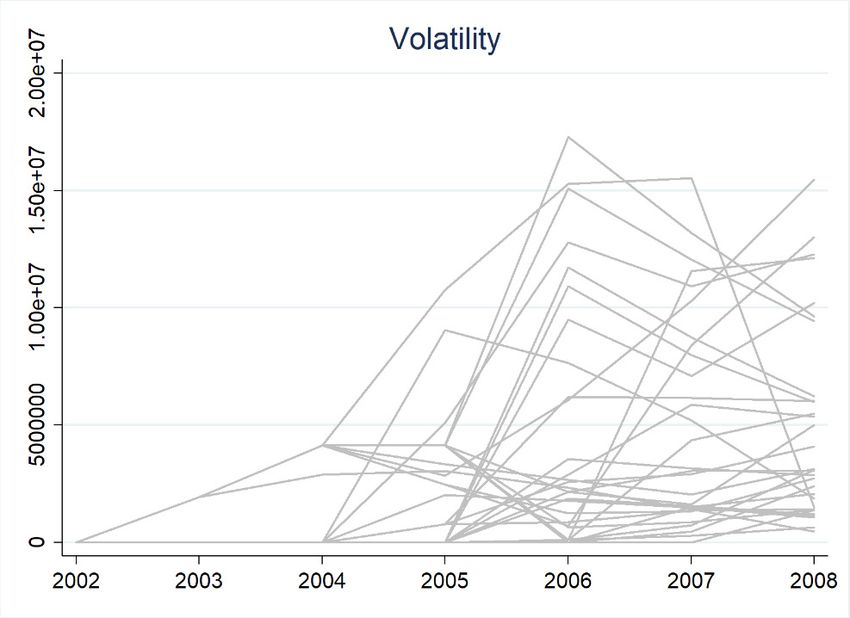
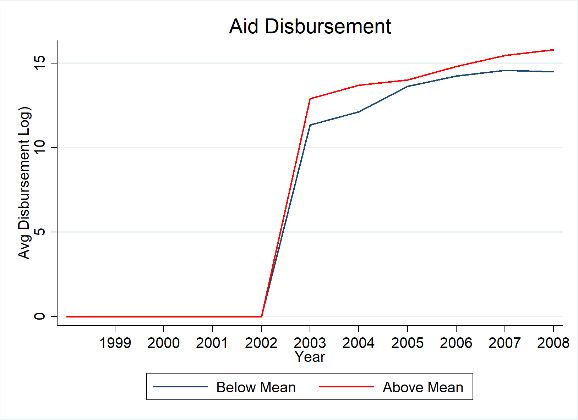
high volatility in the provision of foreign assistance across Malawian districts over time (see Figure A.1
in the Appendix A). Also, we use predetermined values of aid with respect to migration inflows to
alleviate potential endogeneity concerns due to reverse causality (e.g. Dreher et al., 2019; Clemens et
al. 2012). While our choice on the variable of interest might appear somewhat arbitrary, a series of
robustness tests show that our results are consistent across different definitions (number of projects vs
disbursements), lags and averages of foreign assistance (see Section 3.2).
The effect of ODA is first estimated without any controls, including only the set of fixed effects
along the lines of Beine and Parsons (2017) and Cattaneo and Peri (2016). We deem this parsimonious
model to be our preferred specification. Despite the fact that it is potentially prone to omitted variable
bias, it has the advantage of not including control variables that could possibly absorb part of the overall
aid effect. We subsequently add a limited number of controls to test whether our coefficient of interest
is robust to their inclusion. The controls include (i) the size of the migrant network, which is captured
8Aid and Internal Migration in Malawi
by the pre-determined (one-year lagged) bilateral stocks of migrants from district i living in district j;
(ii) the night-time light intensity, which proxies for economic activities at local level (Henderson et al.,
2012); (iii) the occurrence of conflicts and the extent of climate shocks, which is measured in terms of
Standardised Precipitation-Evapotranspiration Index (SPEI). Table 1 reports the descriptive statistics
for the main variables included in the empirical analysis.14
The large set of fixed effects included in Equation (1) significantly lowers the risk of model mis-
specification and, most importantly, accounts for the so-called multilateral resistance to migration
(Bertoli and Fernández-Huertas Moraga, 2013). More precisely, the inclusion of origin-time dummies
( controls for origin specific push factors of internal migration and leads to estimates that are
consistent with the assumptions underlying the random utility model (RUM) à la Ortega and Peri
(2013). Furthermore, the term ( absorbs all of the (asymmetric) time-invariant dyadic determinants
of internal migration, such as cultural proximity and transport costs, and generates a nest for each
district-pair. This further alleviates estimation problems deriving from the potential cross-sectional
dependence of the error term (Bertoli and Fernández-Huertas Moraga, 2015). Finally, all specifications
are estimated with standard errors clustered at the district of destination level.
Table 1 - Main Descriptive Statistics
Migration: Bilateral Flows and Stocks
N mean sd min max
Migrant Flows (od), t 10054 288.30 1658.03 0 65630
Network (od), t 10054 3954.55 27372.86 0 535300
Aid (different definitions)
N mean sd min max
Disbursement for Concluded Projects j,t 10054 2026431 4822938 0 32133124
Number Concluded Projects j,t 10054 1.761886 2.926194 0 17
Aid Disbursementsj:t-1,t-3 10054 1853393 3024883 0 16353139
Number of Aid Projectsj:t-1,t-3 10054 1.836301 2.534877 0 17
Additional Control Variables
N mean Sd min Max
Nightlights j,t 10054 0.688222 1.173775 0.006179 4.975995
Conflict j,t 10054 0.326733 0.381061 0 1
SPEI j,t 10054 0.243752 0.708976 -1.34018 1.635544
Notes: Descriptive statistics of the main variables included in the baseline specification and in robustness checks Aid Disbursementsj:t-1,t-
3(Number of Aid Projectsj:t-1,t-3) refers to the 3-years average of total aid disbursements (total number of projects) concluded in the
destination district j over the previous 3 years, expressed in constant US$. See Table A1 for the complete list of sources. Source: Authors’
Elaboration based on different datasets.
In line with existing applications of the gravity model of migration (e.g. Beine and Parsons, 2015;
Bertoli and Fernández-Huertas Moraga, 2015), we estimate Equation (1) using Poisson Pseudo-
14 The network variable is constructed as the number of migrants who moved from district i to district j before year t (and
were still resident in district j in 2008).
9Mauro Lanati, Marco Sanfilippo, Filippo Santi
Maximum Likelihood (PPML). The choice of using PPML as our preferred estimator is justified by two
main considerations. First, the share of zeros in our dependent variable is approximately 22%, which is
large enough to bias the results of standard log-linear fixed effect models (see Santos-Silva and
Tenreyro, 2006; 2011). Second, PPML remains consistent in presence of heteroscedasticity (see Head
and Mayer, 2014; Santos-Silva and Tenreyro, 2006), and fits well with the utility-maximizing behavior
of the migrants under different distributional assumptions (Schmidheiny and Brülhart, 2011).15
3. Results
3.1 Baseline Estimates
Table 2 reports the baseline estimates of Equation (1). We start from a specification that only
includes our variable of interest, together with the full set of fixed effects (Column 1). We then
progressively add other controls, namely the stock of migrants (Column 2), Nightlights - as a proxy for
economic attractiveness at destination (Column 3) – and the presence of Conflicts along with the
occurrence of weather shocks (SPEI) at destination (Column 4).
Table 2 - Baseline Estimates
(1) (2) (3) (4)
Estimator PPML PPML PPML PPML
Dep. Variable Migrant Flows Migrant Flows Migrant Flows Migrant Flows
Aid Disbursementsj:t-1,t-3 0.008*** 0.007*** 0.006*** 0.006***
(0.002) (0.002) (0.002) (0.002)
Network ij, t-1 0.360** 0.323** 0.323**
(0.162) (0.153) (0.154)
Nightlights j,t 0.074*** 0.075***
(0.021) (0.021)
Conflict j,t -0.004
(0.018)
SPEI j,t 0.014
(0.039)
Observations 10,054 10,054 10,054 10,054
% Null .22 .22 .22 .22
Adj. R2 .96 .96 .96 .96
Pair FE Yes Yes Yes Yes
Origin*Year FE Yes Yes Yes Yes
Notes: *** pAid and Internal Migration in Malawi
The magnitude of the aid coefficient remains remarkably stable across the different specifications
(Columns 1-4). This implies that the monadic control variables in our specification do not take up part
of the overall aid effect and therefore do not significantly bias the coefficient in either direction. The
network effect always remains statistically significant and with the expected positive sign (columns 2-
4). Its elasticity is stable at around 0.3, which is in line with previous studies and confirms the role of
pre-existing migrant networks as one of the most important factors favoring migration (see Beine et al,
2016).16 As expected, economic activities, which are proxied by nightlight density, positively influence
the attractiveness of a given district as internal migrant destination. However, there is no evidence of
conflicts or climate shocks as having a significant effect on within-country immigration flows.
Looking at our preferred specification, the estimated effect is not only statistically significant, but
also economically relevant. Our results show that a 10% increase in the provision of aid to a given
district corresponds to a 0.8% rise in the bilateral immigration flows within Malawi. A simple back-of-
the-envelope calculation shows that moving from zero to positive aid inflows (which corresponds to
moving from the median to the 55th percentile of the aid distribution - an increase of slightly more than
230,000 US$), will lead to 22 more migrants per dyad. This approximately corresponds to an additional
660 immigrants per district, which is about 8% of the average number of migrants per district in 2008.
Put differently, a 1000$ increase in aid disbursements from zero is roughly equivalent, on average, to
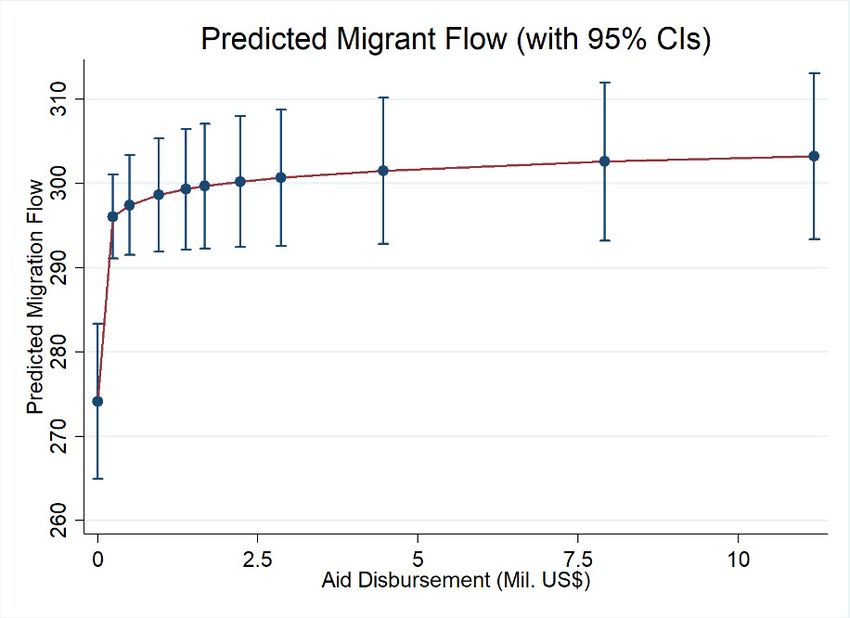
2.8 additional immigrants in the recipient district. Furthermore, as showed in Figure 4, the resulting pull
factor effect appears to be mostly driven by the presence of aid-supported projects rather than their size.
Indeed, moving from the 55th to the 90th percentile of the aid distribution would only add 6 more
migrants per dyad, denoting diminishing marginal returns of aid disbursements.17
16 The magnitude of the diaspora effect for internal mobility in Malawi is very close to the correspondent impact estimated
in cross-country studies for international migration (see Beine et al., 2015)
17 To put it differently, the completion of the first aid project in a district has a large impact on immigration flows. With
respect to the no-aid scenario, going from nil to positive aid flows - no matter the amount received afterwards - increases
immigration toward a district by 15.2% (on average).
11Mauro Lanati, Marco Sanfilippo, Filippo Santi
Figure 4 - Quantification
Note: Marginal prediction of the effect of Aid Disbursements for concluded projects at destination
(lagged 3-years average) on bilateral FDI. The figure reports the marginal prediction of every 5th
percentile from the median to the 99th. Source: Authors elaboration based on baseline estimates
(Table 2)
3.2 Robustness
Measurement Issues
As discussed in Section 2.1, the lack of precise information on financial disbursements at the location
level and other limitations regarding the quality of the geo-localized aid data, could possibly lead to
biases in our estimates. Another potential measurement issue is the strategy of relying on the first lag
of the 3-year averages of aid disbursements. While this choice follows the existing literature (e.g.
Galiani et al., 2017) and is essentially motivated by the high volatility of aid flows (see Figure A.1 in
the Appendix A), we want to make sure it is not driving our results.
Table 3 - Robustness Tests: Measurement Issues
(1) (2) (3) (4) (5) (6) (7) (8)
PPML PPML PPML PPML PPML PPML PPML PPML
Estimator
Migrant Migrant Migrant Migrant Migrant Migrant Migrant Migrant
Dep. Variable
Flows Flows Flows Flows Flows Flows Flows Flows
Aid Disbursementsj:t,t-2 0.008**
(0.003)
Number of Aid Projectsj:t-1,t-3 0.130***
(0.019)
Number of Aid Projectsj:t,t-2 0.134***
(0.023)
Aid Disbursementsj,t-1 0.003*
(0.002)
Number of Aid Projectsj,t-1 0.058**
(0.025)
Stock of Aid Disbursements j,t 0.102***
12Aid and Internal Migration in Malawi
(0.017)
Commitment for Aid Projectsj:t-1,t-3 0.007***
(0.002)
Disbursement for Incomplete Proj.:t-1,t-3 0.000
(0.003)
Observations 10,054 10,054 10,054 10,054 10,054 10,054 10,054 10,054
% Null .22 .22 .22 .22 .22 .22 .22 .22
Adj. R2 .96 .96 .96 .96 .96 .96 .96 .96
Pair FE Yes Yes Yes Yes Yes Yes Yes Yes
Origin*Year FE Yes Yes Yes Yes Yes Yes Yes Yes
Notes: *** pMauro Lanati, Marco Sanfilippo, Filippo Santi
aid inflows (Column 10) from the sample. Overall, this set of robustness tests indicate that our parameter
of interest is rather stable across model specifications, estimators and sample selections, and is very
close in magnitude to our baseline estimates reported in Table 2. The inclusion of a reduced set of fixed
effects, however, leads to changes in the size of the aid coefficient, which is particularly prominent
when we exclude origin specific time dummies (Column 3).
Endogeneity Concerns
An important econometric issue in our specification is the potential endogeneity of geo-localized aid
projects, which may stem from two different sources: reverse causation and omitted variable bias.
Reverse causality could be a concern if, for instance, internal migration shocks triggered by extreme
events - such as natural disasters and conflicts - lead to humanitarian responses by donors. To the best
of our knowledge, no such disruptive event occurred in Malawi during the period analyzed in this paper,
and no sudden changes in the provision of humanitarian aid have occurred in the years 1998-2008.
Omitted variables are thus plausibly the most relevant source of bias in the context of our analysis. For
instance, the potential omission of unobserved factors, such as changes in the political landscape and/or
in socio-economic conditions, might co-determine aid and migration.
14Aid and Internal Migration in Malawi
Table 4 - Robustness Tests: Alternative Specifications
(1) (2) (3) (4) (5) (6) (7) (8) (9) (10)
Alternative Estimators Alternative Sets of Fixed Effects Robustness to sample selection
Type of Robustness Test Pooled No Top No Top Migr. No Top No Zero
EK Tobit Pair Only Pair + T Pair + O + T O+T+D
OLS Destination Corridors Recipients Aid Flows
Aid Disbursementsj:t-1,t-3 0.008** 0.007*** 0.040*** 0.009*** 0.009*** 0.009*** 0.008*** 0.007*** 0.008*** 0.011***
(0.003) (0.002) (0.005) (0.002) (0.002) (0.002) (0.001) (0.002) (0.002) (0.004)
Observations 10,230 10,230 10,054 10,054 10,054 10,230 9,064 9,999 9,075 5,436
% Null - - .22 .22 .22 .23 .23 .22 .23 .16
Adj. R2 .85 .85 0.94 0.95 0.95 .35 0.95 .96 .96 .96
Origin*Year FE Yes Yes No No No No Yes Yes Yes Yes
District Pair FE Yes Yes Yes Yes Yes No Yes Yes Yes Yes
Year FE No No No Yes Yes Yes No No No No
Origin FE No No No No Yes Yes No No No No
Destination FE No No No No No Yes No No No No
Notes: *** pMauro Lanati, Marco Sanfilippo, Filippo Santi
This is particularly compelling in our analysis as we are only able to include a limited set of district
specific controls given constraints in terms of data availability in Malawi.
Potential endogeneity concerns are traditionally addressed by means of an instrumental variable (IV)
approach. However, the presence of a monadic endogenous variable in a dyadic setting as in Equation
(2) makes the IV approach hardly viable in practice, as the instrument should have an ijt dimension to
qualify. An attractive solution is to implement an instrumental variable (IV) approach using a two-step
strategy along the lines of Eaton and Kortum (2002) and Head and Mayer (2014). This approach is
formally described in Appendix B.
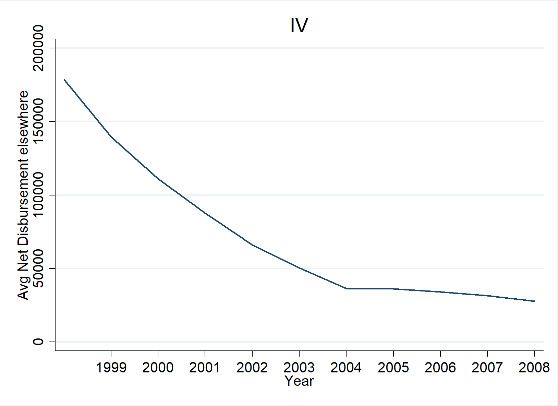
Following the existing literature on aid effectiveness (Nunn and Qian, 2014; Chauvet and Ehrhart,
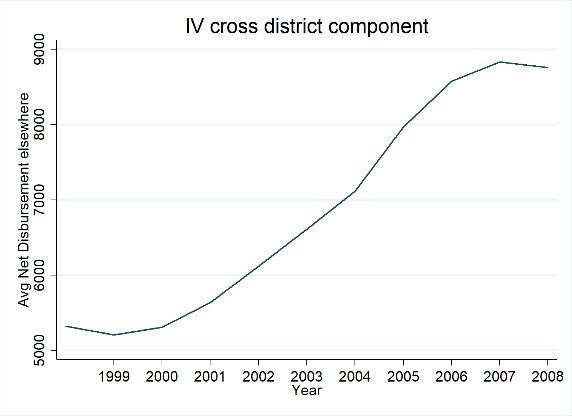
2018; Dreher et al., 2019), we build an instrument that exploits the exogenous variation in the supply
of aid weighted by the district’s probability of receiving aid. More precisely, we interact a district-
specific time invariant variable - the probability of each district to receive aid from a particular donor k
over the period considered, 747777
5,6 – with a time varying variable – the total volume of aid disbursements
delivered by all donors to all recipients (except Malawi), with at least one project in district j in year t.
Details about the construction and the characteristics of the IV, including a discussion regarding its
validity (relevance and exogeneity) are reported in Appendix B. Table 5 reports the estimates of the 2-
step approach described in the Appendix B and the IV.19 Results of the 2-Step PPML (Column 1)
essentially confirm the findings of our baseline estimates. Once endogeneity is accounted for (Column
2), the aid coefficient significantly increases. This denotes potential sources of bias in the data and
suggests that the baseline results should be interpreted as a lower bound of the “true” effect of foreign
assistance.
Table 5 - Robustness Tests: Two-Step Strategy / IV Method
(1) (2)
Estimator PPML IV-PPML
Stage II Step no IV II Step IV
Dep. Variable Migrant Flows Migrant Flows
Aid Disbursementsj:t-1,t-3 0.008*** 0.066***
(0.002) (0.025)
Observations 342 342
Adj. R2 .99 -
Destination FE Yes Yes
Year FE Yes Yes
Kleibergen-Paap F-stat - 16.46
Notes: *** pAid and Internal Migration in Malawi
4. Extensions
4.1 Sectoral Aid
Several authors (e.g. Clemens et al., 2012; Qian, 2015) argue that the impact of aid is difficult to
interpret as it encompasses many different types of aid and each type affects a different set of outcomes.
Indeed, as reported in Section 2.1, completed aid projects in Malawi span over diverse sectors. This
includes some of the ‘early-impact’ type (Clemens et al., 2012), which can foster internal migration
under the promises of short term economic opportunities, as well as other projects, whose attractiveness
grounds on opportunities of access to public services that are not available in the place of origin. To
investigate the heterogeneous impact of aid on migration, we group the projects on the basis of their
Creditor Report System (CRS) sectoral codes, mostly focusing on the distinction between projects in
social infrastructure/services and economic infrastructure/services.20
In Table 6 we firstly replicate our baseline results by separately estimating the impact of aid in
economic and social infrastructures - along with projects that do not fall in any of these two categories
(Column 1-3).21 We then include all sectoral categories within the same regression (Column 4). The
results show that aid projects in economic infrastructures – mostly in the transport sector and agriculture
(see Section 2.1) – are those which make districts more attractive for internal migrants in Malawi.
consider these results to be plausible, since aid-supported projects in the economic sector are more
likely to create income and employment opportunities for the local population. Conversely, we do not
find a significant effect for aid in social infrastructures and other sectoral projects (though their
coefficients remain positive). While these findings are somewhat indicative of the types of aid projects
that mostly affect migration decisions, they must be interpreted with caution, given the strong
interdependencies across aid categories.
4.2 Migrants’ characteristics
The results discussed so far point towards a positive impact of foreign aid on migration inflows.
However, this relationship might be heterogeneous between rural and urban areas as well as across
20 The classification follows the recent work by Martorano et al. (2020) on the impact of Chinese aid on household welfare
in Africa. The grouping strategy is inspired by the work of Clemens et al (2012), who first identified early-impact aid projects.
Economic projects include (CRS code in parenthesis): Transport and Storage (210); Communications (220); Energy
Generation and Supply (230); Banking and Financial Services (240); Business and Other Services (250); Agriculture, Forestry
and Fishing (310); Industry, Mining, Construction (320); Trade and Tourism (330). Social projects include: Education (110);
Health (120); Population Policies (130); Water Supply and Sanitation (140); Government and Civil Society (150); Other Social
Other Social Infrastructure and Services (160); Women in Development (420); Developmental Food Aid (520); Non-Food
Commodity Assistance (530). Other Social Infrastructure and Services (160); Women in Development (420); Developmental
Food Aid (520); Non-Food Commodity Assistance (530). Infrastructure and Services (160); Women in Development (420);
Developmental Food Aid (520); Non-Food Commodity Assistance (530).
21 This category includes a very small fraction of total projects in our sample (also see Figure 1). Among them there are
projects that do not fit into any of the previous categories due to their generic sectoral allocation (e.g., CRS codes 430 “Other
Multisector”) or projects that have not been allocated to any CRS code. This residual category mostly includes multi-purposed
coded projects, the main of which is a $ 21 million project funded by the EU, spanning over 12 different locations in Malawi
with the distribution of small projects in different sectors, including health, education, production and community
development.
17Mauro Lanati, Marco Sanfilippo, Filippo Santi
different migrant characteristics, such as gender and age. Given the rapid urbanization that Malawi has
been experiencing over the last 2 decades, we expect the overall aid effect to be driven by urban
destinations. Additionally, Anglewicz (2019) showed that there is no evidence of gender polarization
in Malawi’s internal mobility, with men primarily moving for work and women more likely to move
for marriage related reasons. Furthermore, the results reported in Table 6 suggest that aid appears to be
a more effective determinant for employment-induced migration. Lastly, as showed in Table A3, in
Malawi the younger cohorts of the population and people in the working age are those more likely to
move internally. Hence, in light of these considerations, we expect the presence of aid projects to be
particularly effective in attracting men, younger cohorts and working age population from other
districts.
Table 6 - Disaggregated Analysis: ODA by Sector
(1) (2) (3) (4)
PPML PPML PPML PPML
Estimator
Migrant Migrant Migrant Migrant
Dep. Variable
Flows Flows Flows Flows
Disbursement for Social Projectsj:t-1,t-3 0.003 0.001
(0.003) (0.003)
Disbursement for Economic Projectsj:t-1,t-3 0.010** 0.017***
(0.003) (0.005)
Disbursement for Miscellaneous Projectsj:t-1,t-3 0.003 0.001
(0.003) (0.003)
Observations 10,054 10,054 10,054 10,054
% Null .22 .22 .22 .22
Adj. R2 .96 .96 .96 .96
Pair f.e. Yes Yes Yes Yes
Origin * year f.e. Yes Yes Yes Yes
Notes*** pAid and Internal Migration in Malawi
Table 7 - Disaggregated Analysis: Different Types of Migrants
(1) (2) (3) (4) (5) (6) (7)
Estimator PPML PPML PPML PPML PPML PPML PPML
Dep. Variable Migration Migration Migration Migration Migration Migration Migration
(Men) (Women) (Youth) (Work.) (Old) (Urban) (Rural)
Aid Disbursementsj:t-1,t-3 0.010*** 0.006*** 0.008*** 0.007*** 0.007 0.006* 0.005
(0.002) (0.002) (0.002) (0.002) (0.002) (0.003) (0.003)
Observations 9,966 9,790 9,647 10,032 4,750 1,320 8,734
% Null .22 .2 .37 .27 .74 .09 .24
Adj. R2 .94 .94 .97 .87 .4 .97 .96
Pair f.e. Yes Yes Yes Yes Yes Yes Yes
Origin * year f.e. Yes Yes Yes Yes Yes Yes Yes
12.389324 0.16 3.97
Wald Test Chi2 (p-val)
(0.00) (0.69) (0.04)
Notes: *** pMauro Lanati, Marco Sanfilippo, Filippo Santi
In order to correctly identify the impact of aid projects on emigration, we replace origin-year with
destination-year fixed effects in our baseline gravity equation. We also provide the corresponding IV
estimates, obtained by applying the same strategy and instrument employed in Table 5 to the aid
received by the district of origin.24 The estimates reported in Table 8 point toward a null impact of ODA
on district-level emigration (Column 1), i.e. an increase in the size of aid at district level is associated
with no variation in the emigration rates. When instrumented, the effect of aid even turns negative,
which seems to suggest that providing higher amounts of aid lowers the incentives for the local
population to emigrate.25 Taken together, these findings appear to be at odds with the budgetary
constraint channel and the positive role of aid in favoring emigration by enabling a larger share of the
population to finance their moving costs.
5. Transmission channels
In this section, we dig deeper into some of the potential channels through which foreign aid can
affect internal migration decisions in Malawi. Specifically, we empirically test two potential
mechanisms: the capacity of aid to create local economic opportunities and its role as a source of
amenities and public services at district level.
5.1 Economic Opportunities
The potential role of aid as determinant of internal migration is partly grounded in its capacity to
spur economic growth. While the literature on the aid-growth nexus at macro-level is inconclusive (see
Arndt et al., 2010), there seems to be some consensus on a positive relationship in the recent studies
based on more refined information on aid projects at sub-national level. For instance, a recent paper by
Khomba and Trew (2019) shows that economic growth in Malawian districts is positively influenced
by the volume of aid inflows. They argue that aid is likely to be a major instrument in leveraging
economic growth in the country, as it accounts for more than 70% of the overall development spending.
Using the same data on geo-localized aid projects employed by Khomba and Trew (2019), we regress
the growth rate of nighttime light (NTL) density on the volumes of aid received at district level. NTL
density proxies for the intensity of economic activities at geo-localized level and is commonly used in
the literature (see Henderson et al., 2012). The regression includes district and year fixed effects, with
standard errors clustered at the district level. The results reported in Table 9 (Column 1) show that aid-
supported projects are positively related to economic growth at district level. This finding corroborates
with the results of the disaggregated analysis (Table 6), and generally supports our hypothesis on the
24 Our instrument is obtained as a shift-share, computed as the district-level summation of the total ODA disbursed globally
by every donor operating in Malawi (net of the spending in Malawi itself), multiplied by the probability for that donor to be
present in a certain district in a given year.
25 This is consistent with the existing evidence linking aid to internal migration in Malawi (see Miller Runfola and Napier,
2016)
20Aid and Internal Migration in Malawi
significant role of aid on internal migration decisions through the creation of greater economic
opportunities.
5.2 Public Services Provision
Next, we look at the capacity of aid-supported projects to provide access to specific types of public
services, such as health care facilities, schools and basic infrastructures, that can plausibly affect the
decision to migrate internally (see Dustmann and Okatenko, 2014; Gollin et al., 2017). To test whether
aid matters for the provision of public and social services to the local population, we employ individual
data from rounds 3 and 4 of the Afrobarometer Survey. The survey covers a total of 2,384 individuals
for Malawi, based in 68 and 69 clusters in the years 2005 and 2008.26
We focus on the following facilities: Schools, Health Clinics, Electricity, Piped Water and Sewage
Systems and use information on whether a given facility is “…present in the primary sampling
unit/enumeration area, or within easy walking distance”. We employ a linear probability model in
which individuals’ responses (0 or 1) are regressed on aid volumes received by the district where the
household resided at the time of the survey (2005 and 2008).27 All regressions control for individual
characteristics (gender, age, residence in rural/urban areas) as well as district and time fixed effects.
The results reported in Table 9 (Columns 2-6) suggest that the probability for an individual to live in
proximity of some key facilities is generally higher in locations which receive larger volumes of foreign
aid.
Table 9 - Mechanisms
(1) (2) (3) (4) (5) (6)
Mechanism Growth Public services
Dep. Variable Avg. Nightlight School Clinic Electricity Pipes Sewer
Aid Disbursementsj:t-1,t-3 0.001** 0.027*** 0.016* 0.021** 0.039*** 0.039***
(0.001) (0.006) (0.007) (0.007) (0.006) (0.006)
Observations 186 2,209 2,209 2,209 2,209 2,209
R-squared 0.89 0.895 0.457 0.521 0.538 0.456
Controls Yes Yes Yes Yes Yes Yes
District f.e. Yes Yes Yes Yes Yes Yes
Year f.e Yes Yes Yes Yes Yes Yes
Notes: *** pMauro Lanati, Marco Sanfilippo, Filippo Santi
6. Conclusions
The policy and academic debate around the relationship between ODA and migration has almost
exclusively been centered around the potential role of foreign assistance as an instrument to manage
(and curb) international emigration from developing countries. Yet, from a developing country
perspective, international migration accounts for a relatively small share of total population movements,
as it is characterized by substantive upfront moving costs. Especially in poor and deprived contexts,
internal emigration decisions, namely whether and where to emigrate - are likely to be more sensitive
to the welfare enhancing effects of foreign assistance.
In this paper, we have showed that ODA acts as a pull factor for internal migration in Malawi. Our
findings show that moving from zero to positive aid inflows leads to 660 more migrants per district,
which is about 8% of the average number of migrants per district in 2008. As the relationship between
aid disbursements and internal immigration is non-linear, the resulting pull factor effect appears to be
mostly driven by the presence of aid-supported projects, rather than their size. Conversely, we find no
evidence of a correspondent push factor effect of foreign assistance. Taken together, these findings
appear to be at odds with the budgetary constraint channel and the positive role of aid in favoring
emigration by enabling a larger share of the population to finance their moving costs.
When investigating the potential channels at work, our analysis reveals that the positive welfare
effects of foreign assistance manifest themselves not only through an increase in economic
opportunities, but also via improved access to local public services in recipient districts. This result
corroborates with previous research on the importance of aid-supported projects in affecting non-
monetary dimensions of well-being, particularly in low-income countries.
From a policy point of view this paper highlights a so far unexplored dimension of foreign aid i.e.
its capacity to drive within-country migration by affecting the distribution of economic and income
opportunities across internal areas. A potential concern is that aid-supported projects, as we show in our
analysis, mostly drives internal migration towards easily-targeted urban areas. This poses important
challenges in donors’ aid allocation decisions. While aid-supported projects in urban-areas might play
a role in helping cities to better manage the process of rapid urbanization and alleviate the associated
high costs (Henderson and Turner, 2020), they might also favor population growth in already congested
cities and magnify the existing rural/urban gaps in income and amenities.
22You can also read


