Amazon biome protected areas coordinated audit
←
→
Page content transcription
If your browser does not render page correctly, please read the page content below

Amazon biome
protected areas

                  coordinated
                        audit
                  Executive summary
FederativeFederativa
         República    Republic of
                                doBrazil
                                   Brasil
            Federal Court of Accounts
          Tribunal de Contas da União

                     Ministers

       João Augusto Ribeiro Nardes, President
       Aroldo Cedraz de Oliveira, Vice-President
                   Valmir Campelo
              Walton Alencar Rodrigues
                  Benjamin Zymler
                  Raimundo Carreiro
                      José Jorge
                 José Múcio Monteiro
                      Ana Arraes

              Substitute Ministers

            Augusto Sherman Cavalcanti
              Marcos Bemquerer Costa
               André Luís de Carvalho
                  Weder de Oliveira

       TCU Public Prosecutor´s office

      Paulo Soares Bugarin, Prosecutor General
      Lucas Rocha Furtado, Assistant Prosecutor
Cristina Machado da Costa e Silva, Assistant Prosecutor
    Marinus Eduardo de Vries Marsico, Prosecutor
         Júlio Marcelo de Oliveira, Prosecutor
       Sérgio Ricardo Costa Caribé, Prosecutor
Amazon biome
     protected areas

    coordinated audit
       Executive summary
                 brasília, 2014
© Copyright 2014, Federal Court of Accounts of Brazil

The concepts and opinions expressed in signed doctrinal works are
the sole responsibility of the authors.

The complete or partial reproduction of this publication is
permitted, without altering its content, as long as the source is cited
and it is not for commercial purposes.

www.tcu.gov.br

The judgment of the coordinated audit of the federal protected areas
in the Amazon, by Federal Court of Accounts of Brazil, occurred
through Decision 3.101/2013 - TCU - Plenary (TC 034.496/2012-2).

The other audit reports, as well as their judgments, which supported
the preparation of this summary may be obtained in electronic
addresses of the State Supreme Audit Institutions participants:

1.   TCE-AC      • www.tce.ac.gov.br
2.   TCE-AM      • www.tce.am.gov.br
3.   TCE-AP      • www.tce.ap.gov.br
4.   TCE-MA      • www.tce.ma.gov.br
5.   TCE-MT      • www.tce.mt.gov.br
6.   TCE-PA      • www.tce.pa.gov.br
7.   TCE-RO      • www.tce.ro.gov.br
8.   TCE-RR      • www.tce.rr.gov.br
9.   TCE-TO      • www.tce.to.gov.br

                                                     Brazil. Federal Court of Accounts.
                                                        Amazon Biome: protected areas: Coordinated audit/Federal Court of
                                                     Accounts - Brasília:TCU, 2014.
                                                         64 p. : Il. color. - (Executive Summaries)

                                                         1. Audit. 2. Protected areas - Amazon Biome. I. Title. II. Serie.

                                                                                            Catalogued by Biblioteca Ministro Ruben Rosa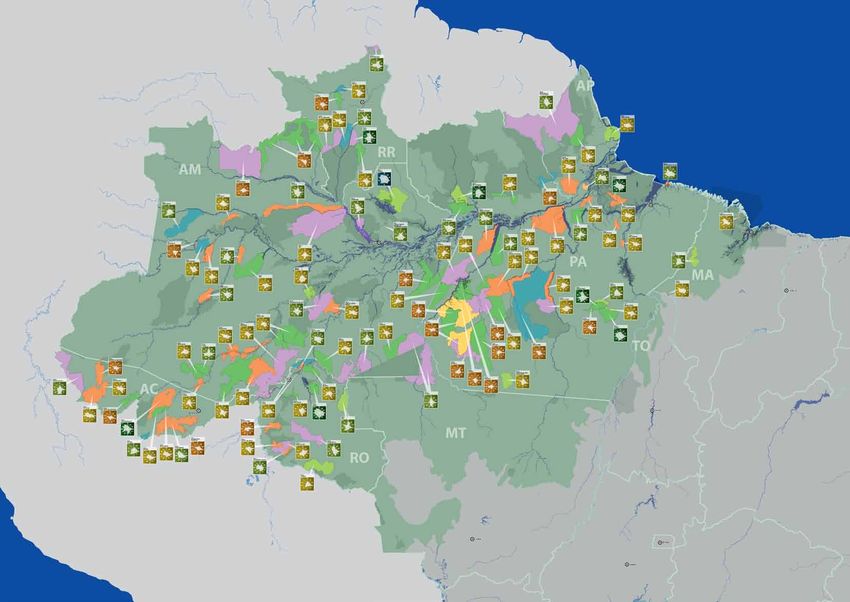
Foreword
D      ear Reader, it is our pleasure to present the Federal Court of Accounts
       coordinated work in the Amazon protected areas, in which we find one-third
       of the tropical forests of the planet, one-fifth of the available global drinking
water and a significant part of biodiversity. Considering that creating protected areas
is one of the internationally recognized ways to protect biodiversity, the challenge in
those territories is to combine environmental conservation and the responsible usage
of natural resources, focusing on sustainable development.
In this context, I highlight the relevant role entrusted to the Supreme Audit Institutions of
controlling the public environmental heritage. For that reason, in 2002, after the United
Nations Conference on Sustainable Development, also known as Rio+20, I suggested
a joint work along with nine state Courts of Accounts to assess the governance in
Amazon protected areas, as well as seeking good management practices.
Therefore, a coordinated audit was performed in Brazilian Amazon in 2013, enabling
the development of a systemic diagnosis, which was reported through geo-referenced
maps. The use of indicators in the method developed by the Federal Court of Accounts
enables the assessment, communication and monitoring of governance in those
protected areas, as shown in this publication. Also in 2013, Brazil started chairing the
Organization of Latin American and Caribbean Supreme Audit Institutions (OLACEFS),
one of the International Organization Supreme Audit Institutions (INTOSAI) regional
working groups. Among TCU main challenges facing the organization, the performance
of coordinated audits among member-countries should be mentioned.
In 2014 will be ongoing international biodiversity audit focused on protected areas in
Latin America, in accordance with the work plan of the Special Technical Committee
on Environment of the OLACEFS (Comtema).In view of this, I estimate that the SAIs
participants of this future coordinated audit may take advantage of the work done
in Brazil to enhance the method developed. This is because the joint works are
instruments that contribute to exchange experiences, build capacity of participants
and strengthen the Supreme Audit Institutions.
Moreover, these partnerships promote a systemic view on endless topics, as
environmental issues, that supersede states and countries boundaries. The integrated
and coordinated oversight activities, along with capacity building actions, are essential
pillars for the improvement of environmental public policies efficiency to foster
sustainable development.
I hope that this publication will contribute to enhance the performance of SAIs,
strengthening the instruments of cooperation and capacity building by conducting
coordinated audit.
Enjoy your reading!                                                                             Minister João Augusto
                                                                                                Ribeiro Nardes
                                                                                                President of the Federal
                                                                                                Court of Accounts
                                                                                                President of OLACEFS

FEDERAL COURT OF ACCOUNTS - Brazil                                                                                         3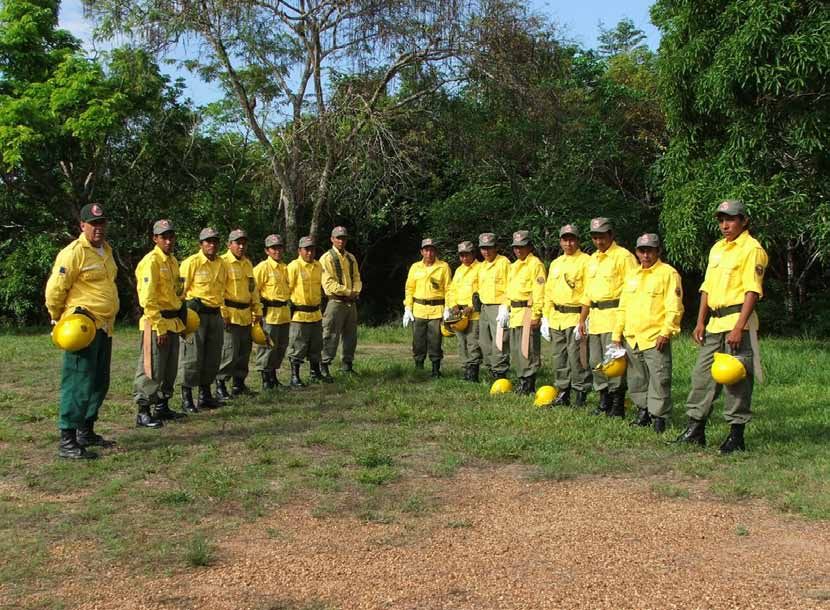
Rapporteur
                         Message
           C       oordinated audits are becoming one of the Supreme Audit Institutions
                   (SAIs) main instruments to contribute to the improvement of
              governance and national public sector management.

              In Brazil, the most relevant governmental programs, especially those that
              reach the most deprived segments of the population, are implemented
              through a joint and coordinated action of all institutions that compose
              the Federation:  Federal Government, States and Municipalities.

              In case of topics that correspond to issues that transcend the territory of
              a country, as environment, the coverage of coordinated actions may reach
              neighboring countries or regional blocks.

              The assessment of internal or international government actions needs
              coordination among the SAIs holding the mandate to audit several
              governmental institutions in charge for those initiatives. The coordinated
              audits approach meets that need and the increasing social demand so
              that the public sector becomes more efficient and effective.

              The present audit is a case of coordination success among several SAIs,
              in this case, the Federal Court of Accounts and several state courts of
              accounts, that allowed a broad diagnosis of governance management in
              Protected Areas of the Brazilian Amazon.

                          substitute minister Weder de Oliveira

                                          Rapporteur Minister

FEDERAL COURT OF ACCOUNTS - Brazil                                                          5
Summary

                                                               introduction
          9	Introduction
          10 Coordinated audit
          11 Object and objectives of the audit
          12 Evaluation
          13 Relevance of Protected Areas (PAs)
             in the Amazon biome

                                                               results
          14 Methods used

          15    Results of the coordinated audit
          16    Protection against deforestation
          20    Carbon flow
          26    The role of protected areas in promoting

                                                               resources
                social and environmental development
          27    National and state parks
          29    National and state forest
          31    Extractive reserves
          33    Biodiversity research and monitoring

          35    Provision fo resources needed by

                                                               articulation
                protected areas
          36    Management plans
          37    Financial resources
          38    Human resources
          40    Territorial consolidation

          41    Articulation of parties involved in the

                                                               products
                governance of protected areas
          42    Coordination of the National System for
                Nature Conservation (Snuc)
          43    Cooperation between Snuc parties
          44    Communication in Snuc

          45    Products developed for the evaluation
                                                               conclusion

          47    Indimapa indicators
          50    Indimapa index

          54    Conclusion

          64    Acknowledgement

FEDERAL COURT OF ACCOUNTS - Brazil                         7
Picture: Rede de Notícias da Amazônia

                                        AMAZON BIOME COORDINATED AUDIT PROTECTED AREAS
Protected
areas
Introduction
FEDERAL COURT OF ACCOUNTS - Brazil 9Coordinated
audit
A coordinated audit is any joint and
simultaneous form of cooperation
in which each Supreme Audit
Institution (SAI) conducts independent
audits and prepares reports based
on joint planning, with the ultimate
goal of preparing a document that
summarizes the main conclusions
on the audits conducted.
This type of audit facilitates
the exchange of information,
training of participants, exchange
of experiences and improves
coordination between audit bodies.
Furthermore, the production and
adoption of joint methodologies
helps to ripen the way policies
are assessed, contributing to the
improvement of Public Administration
Thus, one of the many benefits of
coordinated audits is the solution to the result of a partnership between the
challenges in significant issues that Brazilian Federal Court of Accounts
transcend borders of municipalities, (TCU) and the nine state Audit Courts
states and countries, such as issues of the Brazilian Amazon biome.
related to the environment Thus, this publication consolidates
the main points identified by the 10
This was the context in which the Audit Institutions participating in
opportunity to conduct a coordinated the coordinated audit of protected
audit in the Amazon was born.It was areas in the Amazon biome.
10 AMAZON BIOME COORDINATED AUDIT PROTECTED AREASObject and Objectives
introduction
Of the audit
Protected areas
T he Amazon is the largest Brazilian
biome, occupying 4.2 million
km2, with a natural richness that
places it among the world’s most
In Brazil protected areas (PAs) are areas
established by the Government, under
special administration regime, with
relevant regions to biodiversity. One
third of the rainforests of the planet,
conservation objectives and defined
one fifth of the world’s available fresh borders, due to their significant natural
water, and a significant sample of features, Federal Law 9985/2000.
biological diversity, are located in
this region. Most of this heritage is
located inside protected areas (PAs).
Therefore, biodiversity and in
particular PAs should be considered
part of the environmental heritage, That Brazil is part of the United Nations
which is why it is the responsibility Convention on Biological Diversity (CBD),
of oversight institutions to considered the main multilateral environmental
check whether the government
agreement in the area of biodiversity. This
has established mechanisms to
ensure proper management of convention considers PAs as one of the most
this valuable public asset. efficient ways to preserve biodiversity in situ,
which is conservation in the natural habitat.
In addition to the conservation of
biological diversity, PAs can serve
other goals, given the social and
economic potential of these areas.
For this reason, Audit Courts decided
to conduct an assessment of PAs
throughout the Amazon biome, at
the two governmental levels, state
and federal, identifying opportunities
for improvement and best practices
in the management of these areas.
FEDERAL COURT OF ACCOUNTS - Brazil 11Evaluation
The audit assessed to what degree the normative,
institutional and operational conditions are sufficient for
the protected areas (PAs) achieve their goals.
Three aspects were evaluated: inputs, articulation and
results, which guided the enquiries conducted by the
Supreme Audit Institutions (SAIs) participants
Between 2003 and 2008, Brazil was responsible for creating 74% of all protected
areas in the world. It is known that this environmental policy needs sufficient
conditions for implementation and proper management of these territories.
12 AMAZON BIOME COORDINATED AUDIT PROTECTED AREASRelevance of PAs in the
Amazon biome
introduction
C urrently there are 1,149
federal and state protected
(area and quantity)
areas (PAs) throughout Brazil, 247
located in the Amazon biome. the Brazilian National Protected
Areas System (Snuc, in portuguese), Social and environmental
The areas in this biome occupy there are two groups of protected aspect - Protected areas
1.1 million km2 and account for areas: full protection and sustainable (PAs) are not untouchable
73% of the total area of federal use, with 12 categories of PAs.
spaces where no human
and state PAs in Brazil.
The main objective of the full activity can be developed.
According to the Brazilian Federal protection areas is to preserve nature, Different uses that may
Law 9985/2000, which established admitting only the indirect use of generate immediate
its natural resources, where people positive effects on the
are usually not allowed to settle.
regional economy are
Amount of federal and In turn, the main purpose allowed in 88.3% of the
state PAs in Brazil of sustainable use areas is to total area protected by PAs.
combine nature conservation Only 11.7% have restrictions
140 107 with sustainable use of part of its
state federal in terms of direct use
PAs PAs natural resources. In this group, the
presence of traditional communities of natural resources,
is allowed and encouraged. although activities are
allowed provided they are
Finally, according to the Snuc, it is
regulated and controlled
expected that PAs present results
in terms of protection of natural by environmental bodies.
heritage and promotion of social
and environmental development.
State PAs Federal PAs
523,000 587,000
PAs state and federal
(km2)
areas in Brazil
Prepared by TCU with data from the National Registry of Protected areas (CNUC, in portuguese)
FEDERAL COURT OF ACCOUNTS - Brazil 13Along with federal and state levels, Amount of federal and state PAs in the Amazon biome
the most representative categories
in the Amazon biome are Extractive Resex Arie and
Esec
247
Revis
Reserves (Resex), Forests and Parks, 59 17 5
which will be detailed in this summary. Other Rebio
Forest 87 16
The following acronyms
PAs 58
Park
43
RDS
19
APA
30
in Portuguese mean:
Environmental Protection
Area of the federal and state PAs in the Amazon biome
Area (APA), Area of
Arie and
Ecological Interest (Arie), APA Revis
1,1
Resex 0,05% RDS
Ecological Station (Esec), 12% 17% 10%
Sustainable Development Others
Esec
Forest 23% 9%
Reserve (RDS), Biological 26%
Reserve (Rebio), Extractive
Reserve (Resex) and million km2 Park
22%
Rebio
4%
Wildlife Refuge (Revis).
Methods used
D ifferent techniques and
performance audit procedures
were used for the systemic
assessment of the protected areas.
In this context, a diagnostic tool
and define oversight strategies in
order to standardize data, maintain
comparability, and subsequently,
consolidate information.
collection method. This method was
considered the most appropriate
given the access and locomotion
difficulties that the Amazon area
presents. It is worth mentioning
called Problem Tree was created. The training workshop was delivered that 100% of the managers
This tool allows the visualization of to 35 auditors, from the TCU and completed the questionnaire.
the main aspects and weaknesses TCEs. There were technical talks on
of the management of PAs, as well management of protected areas and A full description of the methods
as the cause and effect relations. performance audits techniques. used, as well as the Tree Problem,
can be found in the TCU report.
Since this was a coordinated audit, The use of a questionnaire to (Decision 3.101/2013 – TCU –
a technical meeting was held with be completed by managers of Plenary, Rapporteur: Substitute
audit teams to standardize concepts PAs was agreed as the main data Minister Weder de Oliveira)
Picture: TCU Audit team
14 AMAZON BIOME COORDINATED AUDIT PROTECTED AREASResults of the
coordinated audit
The contribution of
protected areas to the
natural heritage
Tapajós Forest (PA)
FEDERAL
Picture: COURT OF ACCOUNTS - Brazil
ICMBio 15Protection against
deforestation
P rotected areas (PAs) have
brought positive results to
the protection of natural
heritage, contributing to a significant
reduction in Amazon deforestation.
There is a relation between the creation of protected areas and
the reduction in deforestation rates, since the implementation
of PAs by the government contributed to invert the logic of
occupation and economic exploitation of these territories. This is
Brazil has considerably reduced because the categorization of these areas as public lands involves
its annual deforested area. Legal
the presence of the Government, which reduces the pressure
deforestation in the Amazon
went from 27,772 km2 per year on the inappropriate use of that territory and discourages
in 2004 to 4,571 km² in 2012. illegal claims of ownership, in particular unauthorized logging.
Brazil made a commitment to the United Nations (UN)
to reduce deforestation. The country has reached 76%
of the target, which is to reduce annual deforestation
to an area of 3,925 km² by the year 2020.
1,200,000 35,000
Total PAs area in the Amazon (km²)
Deforesting rate in the Amazon (km²/ year)
1,000,000 30,000
25,000
800,000
20,000
600,000
15,000
400,000
10,000
200,000 5,000
0 0
Source: Created by TCU with data from INPE (National Institute for Space Research) and ICMBio (Chico Mendes Institute for Biodiversity Conservation)
16 AMAZON BIOME COORDINATED AUDIT PROTECTED AREASIt is worth noting that Brazil has
created 74% of the world’s protected Currently, federal and state PAs in the Amazon
areas in the period between 2003 occupy an area of 1.1 million km2, equivalent to
and 2008. In this period more than the sum of the territories of Spain and France.
550 thousand km2 of federal and
state PAs were created - an area
larger than that of Spain. Most of
these area is in the Amazon biome.
results
Thus, in the same period in which The audit produced the Indimapa The result of this evaluation showed
the annual deforestation rate Deforestation Warnings (Deforestation that 94% of the deforestation in the
was reduced, the percentage of map), a georeferenced tool to Amazon biome occurred outside
protected areas increased. identify the impact of deforestation protected areas, which proves the
in the protected areas assessed. low incidence of deforestation
In order to evaluate the effectiveness With this tool it was possible to inside protected areas.
of protected areas in containing individually distinguish occurrences
deforestation, TCU assessed for 247 federal and state PAs, Finally, the deforestation control
deforestation in the Amazon biome differentiating deforestation inside policy - part of the strategy of
in the period from 2008-2012. and outside those territories. creation and maintenance of PAs,
inspection activities, and positive
financial mechanisms, among other
actions, need to be maintained and
improved, at risk of losing the benefits
in the deforestation reduction.
Out of more than 15,000 km2 deforested in the Brazilian
Amazon biome in the period from 2008 to2012, only 971 km²
(6%) originated in the PAs, although these areas occupy more
than ¼ of the biome. Therefore, TCU’s assessment showed
that the probability of deforestation in areas outside PAs in
that period was 4.3 times higher than inside a protected area.
While PAs have an important role in reducing
deforestation, other actions and public policies also
contributed to this process, such as: improvement of
inspection activities, implementation of specific regulatory
measures and the existence of financial mechanisms
for a positive incentive to reduce deforestation.
FEDERAL COURT OF ACCOUNTS - Brazil 17INDIMAPA 61
DEFORESTATION 62
WARNINGS 63
64 135
181
65 66
67 136 137 182
14
68 183
69 184
15 16 138 185
70 71
139 186
140 189 188 187
141 190 191
192 193
72 142 194
73 143 144
195 196 217
197 198
145 199
17 18 74 147 146 200
76 75 148 218 219
19 20
77
80 79
78 149 221 220
150 201 222
82 81
83 84 223
202 224 225
21 22 85 151
24 86
23 203
87
152
26 88 153 226
25 204
14
154 205
89 155
90 157 156
91 158 161
160 159 162 206
28 92 93
27
94 163 207
95 164 165 209 208
96 97
29 166 211 210
30 213 212
98
167 168 214
169 170
31
99
32 100 171
172
2 4 101 102
3
1 34 103 174 173
105 104 106
5 33 107
35 108
110 109
7
6 37 36 38
114 112 113 111 115
39
116 175
117 118
40 41 119 120
42 122 121
10 123 215
8 9 124 176 216
43 177
44 46 125
45 126 178
11
47
12 48 49
50 127
51
53 52
13 128
54
56 55 Key
57
58 129 Deforestation according to Deter
59 130 (Percentage of deforested hectare in PA)
60
131 179 Not registered Deter warnings
132
Up to 1%
180 To 1% up to 2%
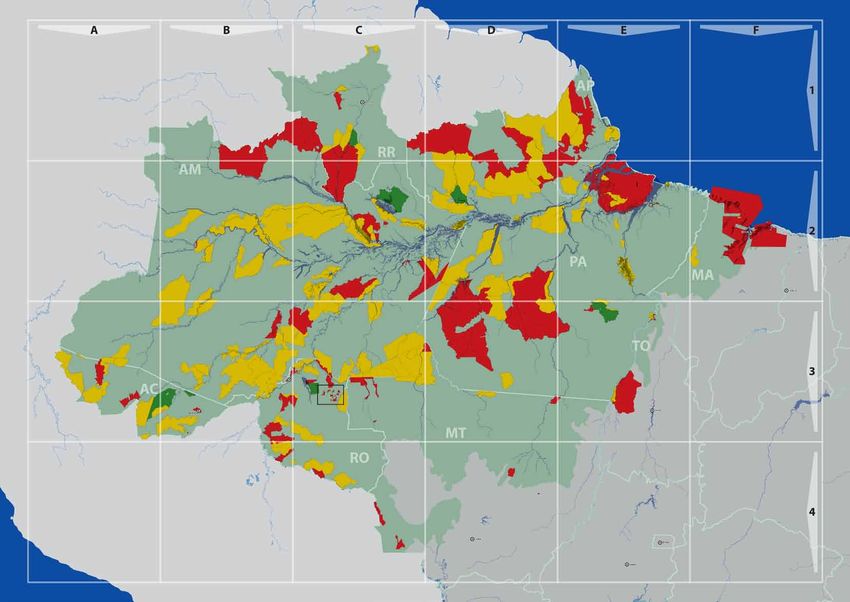
71% of federal and state PAs of the Amazon biome have not To 2% up to 3%
Above 3%
suffered deforestation from 2008 to 2012, as it can be seen on the 133
map below. The information of PAs that had deforestation alerts Brazilian Amazon Biome
above 25 hectares can be found at the end of this summary. Interstate boundaries
134 Federal capital and state capitals
This map can be visualized in the link below:
http://portal2.tcu.gov.br/portal/page/portal/TCU/imprensa/noticias/noticias_arquivos/2%20-%20Indimapa%20desmatamento%20nacional.pdfCarbon
flow
• The greenhouse effect is vital for keeping
the planet warm, and without it, life as we
know it could not exist. The problem lies in
the intensification of the greenhouse effect,
I n addition to preventing the
loss of biodiversity, reducing
deforestation also contributes to
the reduction of emissions of carbon
dioxide, methane and other gases
that cause the greenhouse effect.
which may destabilize the energy balance on
the planet by causing global warming with a The decrease in the emission of
consequent change in global climate patterns. greenhouse gases (GHG), arising
from the reduction of deforestation,
allowed Brazil to leave the group
• The consequences of climate change go
of the most polluting countries
beyond boundaries, because its effects go in the world in the 1990s.
beyond regions. Some of the potential results
of this process are: the savannization of the Recently, the country has achieved
good results since Brazilian GHG
Amazon, the greater frequency and intensity
emissions fell by 38% between
of droughts in the northeast, the increasing 2005 and 2010, according to the
rainfall volume and flooding in the south and Ministry of Science, Technology and
southeast, all of which can cause significant Innovation (MCTI, in portuguese).
impacts on agriculture, livestock, infrastructure
This decrease was largely due to the
and economic activity of the country. reduction of deforestation, which
allows the maintenance of a protected
• Countries have tried to reduce their emissions forest. That is because deforestation
of gases that cause the greenhouse effect, causes change of land use, promoting
in particular carbon dioxide (CO2), and the release of carbon stored in biomass
existing in that area. Therefore by
maintaining the standing forest influences the preserving the standing forest, in
CO2 fixation process and plays a crucial role addition to maintaining significant
in many ecosystem services that are critical amounts of carbon stored in the
in the global climate, as it influences directly biomass, the ecosystem can continue
removing carbon from the atmosphere.
the rain regimes of Brazil and Latin America.
The resolution that establishes targets to reduce deforestation,
also provides targets to reduce greenhouse gas (GHG)
emissions by 2020. Brazil has reached 65% of that target.
20 AMAZON BIOME COORDINATED AUDIT PROTECTED AREASVariations in emissions by sector in 2005 and 2010
2005 16%
2010
22% 32%
2%
4%
results
57% 20% 4%
The decrease in Brazilian GHG
35% 7%
emissions was driven by reductions
achieved in the “Change in Land and
Forests Use” sector, which reduced
emissions by 76%. Deforestation control Land and Forests Use
actions, especially in the Amazon, Energy
had a great influence on this result. Waste management
Industrial processes
The ranking of the sectors with higher Agriculture
greenhouse gases emissions in Brazil
has changed. The forest sector went
from being the number one responsible the world economy, the country also
for national emissions in 2005 (57%) managed to reduce GHG emissions,
to the third position in 2010 (22%). a fact that highlights the importance
The agricultural and energy sectors of PAs in the context of biodiversity
lead the ranking of emissions. maintenance and development
of the national economy.
The decrease in carbon emissions TCU’s analysis was based on the
from the forest sector - recorded In order to evaluate the role of study on the contribution of the
in deforestation control results -, PAs in the process of emissions land use sector on emissions and
was of such magnitude that even and removals (flow) of CO2, TCU removal of greenhouse gases,
though emissions in other sectors, calculated the contribution of federal promoted in 2010 by the Foundation
such as the industry, agriculture and state protected areas located for Science, Applications and Space
and energy sectors have increased, in the Amazon biome to achieving Technology (Funcate, in Portuguese).
Brazil has reduced its overall these positive results. Accordingly, This study was part of the Second
greenhouse gas (GHG) emissions. an estimated carbon flux caused Brazilian National Communication
by changes in land use in protected to the United Nations Framework
Therefore, in the same period in which areas in the Amazon was created. This Convention on Climate Change.
Brazil has expanded its production was done by crossing georeferenced
activities reaching 7th position in information on protected areas The result of the assessment on
with coverage and land use maps PAs participation in carbon flow
produced by IBGE in 1996 and 2006. (emission/removal) in the Amazon
between 1996 and 2006 can be
seen in the table on page 23.
This analysis conducted by the TCU
shows that most of the PAs in states
in the Amazon biome have negative
FEDERAL COURT OF ACCOUNTS - Brazil 21It is possible to estimate the portion of emissions or anthropogenic
emissions of carbon in a given area based on land use at two
points in time. The carbon exchange caused by the changes (or
not) on land use are basically of two types: the first refers to the
release of carbon contained in the organic matter in the tree
felling process. This amount is calculated based on the biomass
volume of each plant physiognomy. The second type of exchange
is the one that occurs in the physiological processes of plant
species. It is known that the difference between carbon emissions
and carbon removal from the atmosphere by plants is positive,
since a forest that is preserved absorbs atmospheric carbon.
values (column D of the table). This estimate the individual amount of benefited Brazil with external
means that these areas have removed CO2 removed or emitted by each PA. resources such as donations for
carbon during the period analyzed. This way, it is possible to monitor the Amazon Fund. Fundraising for
the carbon flow while also having a the Fund is subject to a reduction
Information on carbon flow per systemic view of the Amazon region. in greenhouse gas emissions from
protected area, as well as the methods deforestation, that is, it is necessary to
used, are included at the end of The results achieved in reducing the show deforestation reduction in the
this document and TCU’s report. deforestation rate and, consequently, Amazon in order to enable fundraising.
reducing greenhouse gas emissions
By analyzing the carbon flow resulting have impacted positively in the As for future benefits, there is the
from land use changes (between country’s international image, possibility of trading carbon credits
1996 and 2006) in the 247 protected attracting both short- and long- resulting from the reduction of
areas in the Amazon biome (state term financial resources. CO2 emissions, considering the
and federal), the TCU produced vast area occupied by the PAs
the “Indimapa Carbono”, a map to Deforestation reduction has already and the volume of carbon dioxide
One way of assessing carbon flux is by analyzing the change
of land use - a technique used in the PAs audits.
It is important to warn that the calculation regards only removals.
The stock of CO2 contained in these areas has not been considered.
22 AMAZON BIOME COORDINATED AUDIT PROTECTED AREASCarbon flow (emission/removal) within and outside of PAs in
the Amazon biome between 1996 and 2006
Inside PAs Total area
State Outside PAs
(federal and state) (inside and outside PAs)
Average Fraction of Average Average
Portion of Fraction of the carbon
carbon protected carbon
state located area outside emission Total carbon
State emission area in the emission (tC/
in the Amazon the PA emission (tC)
(tC/ha) state by PAs (tC/ha) ha)
Biome (ha) * (A)
(B) (C) (D) =(BxA)+(DxC)
Acre 14,185,700 65.65% 6.64 34.35% -1.50 54,544,714.00 3.85
results
Amazonas 146,676,100 73.19% 0.60 26.81% -3.07 -56,698,970.13 -0.39
Amapá 13,704,675 37.96% 1.23 62.04% -3.16 -20,513,191.75 -1.50
Maranhão 10,883,325 73.30% 32.02 26.70% 8.78 280,990,820.75 25.82
Mato Grosso 48,235,075 95.25% 12.22 4.75% -1.89 557,064,605.13 11.55
Pará 115,737,750 66.85% 8.26 33.15% -0.99 600,985,860.50 5.19
Rondônia 23,606,000 75.43% 24.08 24.57% -3.31 409,520,741.00 17.35
Roraima 22,179,725 79.40% 0.84 20.60% -2.76 2,233,115.50 0.10
Tocantins 2,283,225 99.42% 15.85 0.58% 55.01 36,699,027.00 16.07
Amazon Biome 397,491,575 73.17% 7.11 26.83% -1.90 1,864,826,722.00 4.69
* Water bodies not included (16 million ha)
Source: Prepared by TCU
removed by these territories.
It is therefore clear that the creation
of protected areas, besides protecting
the biodiversity, can benefit Brazil, The Amazon Fund is managed by the National
since the reduction of deforestation
and greenhouse gas emission are key
Bank for Economic and Social Development
in the context of climate change. (BNDES, in portuguese) and has received R$ 235
million or US$ 104 million. This fund will still
Finally, in spite of the positive results receive more than 1 billion reais or US$ 440 million
achieved in the protection of natural
from foreign Governments and companies.
heritage, it should be noted that
other objectives were set for PAs
related to the economic, social and
environmental potential of these areas.
FEDERAL COURT OF ACCOUNTS - Brazil 23INDIMAPA 61
CARBON FLOW 63
62
64 135
65 66 181
67 136 137 182
14
68 183
69 184
15 16 138 185
70 71
139 186
140 189 188 187
141 190 191
192 193
72 142 194
73 143 144
195 196 217
197 198
145 199
17 18 74 147 146 200
76 75 148 218 219
19 20
77
80 79
78 149 221 220
150 201 222
82 81
83 84 223
202 224 225
21 22 85 151
24 86
23 203
87
152
26 88 153 226
25 204
14
154 205
89 155
90 157 156
91 158 161
160 159 162 206
28 92 93
27
94 163 207
95 164 165 209 208
96 97
29 166 211 210
30 213 212
98
167 168 214
169 170
31
99
32 100 171
172
2 4 101 102
3
1 34 103 174 173
105 104 106
5 33 107
35 108
110 109
7
6 37 36 38
114 112 113 111 115
39
116 175
117 118
40 41 119 120
42 122 121
10 123 215
8 9 124 176 216
43 177
44 46 125
45 126 178
11
47
12 48 49
50 127 Key
51
53 52
13 128
54
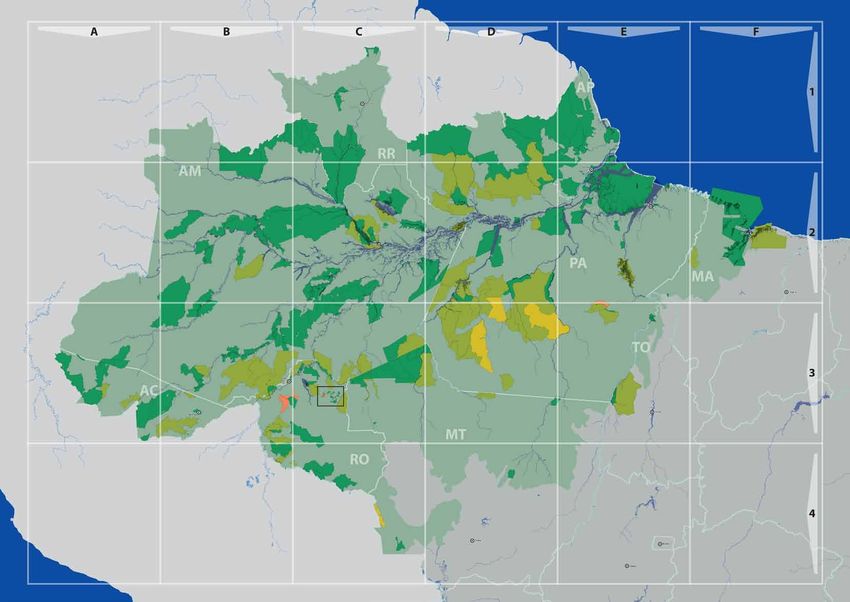
56 55 Average Carbon antropic flow
57 Removal to 10 up to 25 tC/ha
58 129 Removal to 5 up to 10 tC/ha
59 130 Removal up to 5 tC/ha
60
131 179 Null removal/emission
132
Emission up to 5 tC/ha
180 Emission up to 5 to 10 tC/ha
Emission up to 10 to 50 tC/ha
Emission above 50 tC/ha
133
Brazilian Amazon Biome
Information about carbon flow can be Interstate boundaries
found at the end of this summary 134 Federal capital and state capitals
This map can be visualized in the link below:
http://portal2.tcu.gov.br/portal/page/portal/TCU/imprensa/noticias/noticias_arquivos/3%20-%20Indimapa%20carbono%20nacional.pdfPicture: ICMBio
The role of protected
areas in promoting social and
environmental development
P romoting social and
environmental development
is also one of the objectives set
for protected areas (PAs) in the
Weaknesses in the management of PAs hinder
social and environmental development
PAs in the Brazilian Amazon implementing economically sustainable
Brazilian Amazon biome. biome have faced difficulties to alternatives, or that threaten the
promote social and environmental fulfillment of social and environmental
In this way, the Audit Institutions development in view of the underuse functions expected for these areas.
assessed issues that impact the of the potential of these areas.
achievement of the expected The assessment carried out by the
results for these territories. Examples of underutilization Courts was based on the representation
are parks that are not visited, of Parks, Forests and Extractive Reserves,
unsustainable logging of forests and federal and state PAs that occupy
extractive reserves with difficulties in most of the Amazon biome area.
26 AMAZON BIOME COORDINATED AUDIT PROTECTED AREASNational
and state parks
T
results
he coordinated audit identified that
Parks in the Amazon biome fail to The Snuc Law (Brazilian National Protected Area
achieve one of its main objectives: public
System) states that nacional and state Parks have as
use - visitations, tourism, recreation
and environmental education. primary objective to preserve natural ecosystems
of great ecological significance and scenic beauty
This means that almost all of the in order to conduct scientific research and develop
43 Parks in the Amazon are not
education and environmental interpretation activities,
fully developing education and
environmental interpretation activities. recreation in contact with nature and ecologic tourism.
A diagnostic tool, the Indimapa, was
developed to evaluate PAs in the Brazilian
Amazon biome. This tool contains
implementation indicators for various
management aspects in these areas. Indimapa will be explained in chapter:
products developed for the evaluation
The evaluation is composed of up to
14 topics that, from the perspective of
government audit, briefly communicates
the situation of each area.
Indicators ranging from 0 to 3
materialize these criteria.That is,
indicators are better positioned as they
approach the entirety of each scale.
43 national and state parks
In the case of parks, public use G Management plan
(indicator “U”) was the one with H Human resources
the lowest score among the criteria $ Financial resources
used to assess the implementation
E Physical structures,
and management of this category. furnishings and services
T Territorial consolidation
F Inspection and
fighting environmental
emergencies
P Research
B Biodiversity monitoring
C Consultative or
deliberative body
U Public use
Source: Created by TCU L Local articulation
FEDERAL COURT OF ACCOUNTS - Brazil 27It should be noted that the
characteristics of the Amazon
impact on the public use of Parks in
the region. These PAs are generally Some of the major Brazilian tourist attractions
difficult to access due their location are in national and state parks, such as: Fernando
and the means of transport required
de Noronha, Lençóis Maranhenses, Pantanal,
for visitation. These characteristics
should be considered in the evaluation Iguacu (Falls), Tijuca (Cristo Redentor), Anavilhas
of public use in the biome. (Amazonas), Jalapão (Tocantins), among others.
In addition, the existing visiting
structures at these areas are precarious.
According to the World Economic
Forum, Brazil is considered the largest
nature’s tourism power in the world in Sustainability is peripheral in One of the negative consequences
natural resources. However, according the country’s tourism strategy. of low public use of Parks is the
to the National Tourism Plan 2013- As a result, Brazil goes from the ignorance of the role of this type of
2016, prepared by the Ministry of first to 52nd place in tourism PA in biodiversity conservation by
Tourism, the country lacks a tourism competitiveness, when analyzing the society. The public use, through
policy focused on its protected areas. infrastructure, among other aspects. tourism, can be seen as one way
of promoting and fostering the
local economy, creating jobs and
generating income. The legitimacy of
these areas by society, and especially
by local communities, is affected
by the restrictions on public use.
Anavilhanas National Park (AM)
Iguaçu
Picture: Cataratas do Iguaçu SA
National
Park (PR)
Lençóis
Maranhenses
National
Park (MA)
Pictures: ICMBio
Tijuca
Picture: ICMBio National
Park (RJ)
28 AMAZON BIOME COORDINATED AUDIT PROTECTED AREASNational
and state forest
T he National and state Forests of
the Amazon have a small number
results
of onerous forest concessions in
exploitation. It is expected that forests According Snuc Law (Brazilian National Protected
in concession, if properly managed, Area System), nacional and state Forests have as
will provide wood in a sustainable as primary objective the sustainable multiple use
way, and still be a source of funds.
of forest resources and scientific research focused
The Amazon PAs audit revealed that on methods for sustainable use of native forests.
even though a high percentage of
forest managers claim that there is
potential for onerous forest concession
in their PAs, there are still few cases of
federal or state forests exploited. This The indicator of onerous forest Lack of promotion of forestry
indicates that this type of category concessions (indicator N) was the worst exploitation impacts in the offer of
has difficulties in achieving this goal. classified for Forests in the region. certified wood in the market. This
can generate distrust in the policy
For example, at the federal level, The small percentage of onerous for the management of public
there are currently only two forest concessions in exploitation forests for sustainable production.
national forests with onerous forest is due to several factors, such as no
concession in exploitation. prevision of zoning for logging. This situation can lead to the
underutilization of the potential
for generating employment and
income, and discourage sustainable
58 national and state forests forest economies in the Amazon.
An example of this successful
practice that has benefited the
G Management plan
local community is the National
H Human resources Forest (Flona) Tapajós, in Pará In
$ Financial resources this area, the traditional community
E Physical structures, organized itself as a cooperative, the
furnishings and services Cooperative of the Tapajós National
T Territorial consolidation Forest (Coomflona, in Portuguese),
F Inspection and and developed community
fighting environmental forest management activities.
emergencies
P Research Information provided by the
B Biodiversity monitoring manager of this area indicate
C Consultative or that the Cooperative managed
deliberative body 0.2% of Flona Tapajós in 2012
A Access to public policies and generated more than three
N Onerous forest million reais, benefiting the
concessions population living in the forest.
Source: Created by TCU L Local articulation
FEDERAL COURT OF ACCOUNTS - Brazil 29Besides the onerous forest concession, there is also
the community-based non-onerous concession.
This modality is performed in areas inhabited by
traditional communities that reconcile sustainable
exploitation of wood with income generation, to
ensure the sustainability of environmental resources.
Good practice
In 2009 Coomflona received the Chico Mendes Award
in the category Sustainable Business for the sustainable
production and commercialization of forest products,
helping protect vegetation, while generating income
and social inclusion for families living in the forest.
Technical visit of the President of Federal Court of
Pictures: TCU Audit team
Accounts at the Tapajós National Forest (PA)
Community-based forest
concession in the Tapajós
National Forest (PA)
30 AMAZON BIOME COORDINATED AUDIT PROTECTED AREASExtractive
reserves
results
The Snuc Law (Brazilian National Protected Area System)
states that Extractive Reserves are areas used by traditional
A t Extractive Reserves (Resex) of the
Amazon biome few Management
Agreements were implemented. This
document regulates the community
communities whose livelihood relies on extraction management of natural resources.
of natural resources, i.e. activities such as exploitation
Commercialization of rubber,
of rubber, nut harvesting, oil extraction, among other
fish farming, exploitation of
products. One of its goals is to protect the livelihoods nuts, oil extraction and honey
and culture of these populations, and to ensure the production are among the main
sustainable use of natural resources of the area. possible activities at a Resex.
Despite the existence of Management
Agreements, 53% of Resexs are
facing difficulties regarding their
implementation. Out of the total 59
Resexs, only 14 PAs presented medium
or high level of implementation
of management agreements.
The low level of implementation of
Management Agreements endangers
the continuity of the life style based
in natural resources extraction,
since traditional communities are
unable to access and trade natural
resources to generate income and
improve their quality of life.
Source: Created by TCU
FEDERAL COURT OF ACCOUNTS - Brazil 31The implementation of the
59 federal and state Resex
Management Agreements also G Management plan
depends on the articulation of the H Human resources
Snuc enforcing bodies with other $ Financial resources
stakeholders, whether governmental
E Physical structures,
or not. The flow of production furnishings and services
and addition of value to products T Territorial consolidation
goes beyond the implementation F Inspection and fighting
capacity of environmental bodies. environmental emergencies
P Research
In this line, the generation of income in B Biodiversity monitoring
Resex transcends environmental issues C Consultative or
and requires public policies to promote deliberative body
diversification and to strengthening M Community management
extractivism and family agriculture. A Access to public policies
L Local articulation
Source: Created by TCU
Picture: TCU Audit team
Above, council meeting
Resex Unini, Jaú National
Park and Anavilhanas
National Park (AM)
Beside, fish farming
at Tapajós-Arapiuns
Resex (PA)
32 AMAZON BIOME COORDINATED AUDIT PROTECTED AREASBiodiversity
research and
Monitoring
results
P roblems in conducting research
and monitoring activities lead to
difficulties in measuring and reporting
on results achieved in the protection
One of Snuc’s goals is to provide means and
incentives for scientific research activities,
studies and environmental monitoring.
of natural heritage and promotion of
social and environmental development
of PAs located in the Amazon biome.
Researching in the Amazon is impacted
by incipient infrastructure and Environment (MMA, in Portuguese)
difficulties of access to PAs. 73% of PAs recognizes that not all systems
managers stated that their area did not allow data exchange, which
have infrastructure to support research. difficults integration, access, and
In addition, it was reported that in 180 exchange of information.
of the 247 PAs there is lack of incentive
mechanisms to conduct research. Regarding monitoring, most PAs do not
perform activities aimed at monitoring
Although Brazil has developed biodiversity and promoting social
important information systems and environmental development.
on biodiversity, the Ministry of Of the 247 PAs evaluated in the than half of the managers of
Amazon biome, 64% of managers Extractive Reserves and Sustainable
said they have not been monitoring Development Reserves stated that
biodiversity in the last 5 years. their PA does not have tools to
monitor the results of social and
Regarding monitoring social and environmental development efforts.
environmental evolution, more
In this context, it was confirmed that
no comprehensive and coordinated
system for biodiversity monitoring has
been developed. On the other hand,
Brazil is internationally recognized
Biodiversity monitoring is an activity internationally for its land cover monitoring systems
created to monitor deforestation.
recognized as complex, with high costs and very
time consuming. All these factors were taken into In the evaluation of Ecological Stations
account in the analysis made by the audit institutions. (Esec, in Portuguese) and federal
and state Biological Reserves (Rebio)
of the Amazon biome, biodiversity
FEDERAL COURT OF ACCOUNTS - Brazil 33monitoring was one of the worst
indicators for these PA categories.
In 30 of the 33 areas there was no
biodiversity monitoring, a relevant
fact considering that conducting Brazil has some deforestation monitoring
scientific research is among the main systems, such as Deter (Detection of
objectives of these PA categories. Deforestation in Real Time) and Prodes (Program
to Calculate Deforestation in the Amazon), both
Finally, even though monitoring of
actions to combat deforestation is from Inpe (National Institute for Space Research).
considered efficient - it is used as
a proxy to analyze the protection
of natural heritage, it should be
noted that monitoring of social and
environmental development in PAs
need further improvement in order
to provide a realistic assessment of
government actions to the quality of
life of communities living in those areas.
Picture: Wikimedia Commons / Adrian Pingston
Picture: ICMBio
34 AMAZON BIOME COORDINATED AUDIT PROTECTED AREASProvision of resources
needed by
protected areas
B razil was one of the countries
that created more protected
areas in the recent years, mainly
in the Amazon region. However,
the evaluation conducted by audit
institutions revealed that basic
resources (management plan,
human and financial resources,
territorial consolidation, among
others) provided by federal and state
governments are not compatible
Wild fire fighters at Maracá with the PAs management needs.
Ecological Station (RR)
FEDERAL COURT OF ACCOUNTS - Brazil 35
Picture: ICMBio/ Blog of Maracá Ecological Station (RR)Management
plans
P PAs in the Amazon biome
have a small percentage of
approved management plans,
as well as a reduced level of The management plan is the main planning
implementation of this instrument.
and management document that establishes
Therefore, it is important that PAs not the zoning and regulations concerning the use
only have approved management plans, and management of PAs natural resources.
but also that these plans correspond
with the reality of the conservation Relevant activities such as: public use (visitation,
area, so that the actions planned can
be effectively implemented. This is
tourism, recreation and environmental
why audit intitutions went further education), sustainable logging (forest
in their assessment, and determined concessions), community resource management,
the degree of implementation and among others, cannot be performed in
adequacy of management plans.
the PAs without a management plan.
The absence of a management
plan has consequences in the
management of PAs. As long as plan
is not elaborated, the management
of the area focuses in protection and
monitoring actions, which particularly
difficults the promotion of social Management plans in the state and federal
and environmental development. PAs in the Amazon biome
247 PAs
The lack and inadequacy of
Management Plans - the main
management and planning instrument
that regulates the access and use
of natural resources- implies the 47 PAs
underutilization of the potential with medium
for sustainable use of PAs. or high
153 PAs 94 PAs 47 PAs implementation of
with little or no
without with management plans
implementation
Finally, although the management management management
of management
plan is a decisive factor for the plan plan
plans
implementation of activities that
depend on it, management efforts
are also necessary besides the mere
existence of this instrument.
Source: Created by TCU
36 AMAZON BIOME COORDINATED AUDIT PROTECTED AREASFinancial
resources
F inancial resources available for
the management of PAs in the
Amazon biome are not compatible
with the needs of those territories.
One of Snuc Law guidelines is granting proper allocation
of the necessary financial resources for protected areas to
be managed effectively and achieve their objectives.
Analyses performed by the TCU
and the nine TCEs concluded that
essential management activities,
such as: monitoring and combating
environmental emergencies,
resources
environmental educational and
awareness actions, biodiversity Good practice
monitoring, research and protection ICMBio hired an ongoing resources management service
were compromised because of
insufficient financial resources.
to improve the management of financial resources
and guarantee the supply of office, firefighting and
PAs have the support of other other supplies necessary to preserve areas.
financial sources in addition to
those in their official budgets. The
It is a kind of virtual warehouse, awarded a prize in 2012 by the
main source of extra-budgetary
financial resources is the Amazon National School of Public Administration (Enap) at the 17th
Protected Areas Program (Arpa). Innovation Competition in the Federal Public Administration.
In general, ARPA consists of action
by the federal government to raise
funds from international donors
(through the MMA) to be managed
by Funbio (Civil private non-
profited association), and applied
Arpa was established by Decree 4.326/2002 in order to expand
in protected areas of the Amazon
biome (federal, state and municipal). and consolidate all protected areas in the Amazon biome,
to ensure the conservation of biodiversity in the region and
Despite these extra-budgetary contribute to its sustainable development.
resources that contribute to the It is a partnership between the MMA, ICMBio, state and local
management of PAs in the Amazon,
the Audit Institutions noted the
governments of the Amazon, the Fund for the Environment
existence of an incompatibility of the Global Environment Facility (GEF), the World Bank,
total amount of resources available the Entwicklungsbank (KfW - German Development Bank),
with the financial management the Deutsche Gesellschaft für Internationale Zusammenarbeit (GIZ),
needs of these territories, which
the World Wildlife Fund
has compromised the performance
of essential activities. (WWF-Brazil), Funbio and Civil Society Organizations.
FEDERAL COURT OF ACCOUNTS - Brazil 37Human
resources
T he current staff of state and
federal PAs is not enough
to carry out the management
activities, since many essential
The National Strategic Plan for Protected Areas (Pnap), Decree
5.758/2006, establishes as a strategy “to have permanent staff
activities are no longer being
done due to lack of personnel. for environmental bodies to management protected areas”,
in order to achieve the general goal of establishing a political,
Moreover, there are 59 areas with
administrative and socioeconomic environment that favors the
no staff, which represents 24% of
the federal and state PAs in the implementation of the Snuc at the three government levels.
Amazon region. Only 3 of 247 PAs
reported that the number of staff
fully meets the demands of the area.
89% of the heads of federal PAs in the
Amazon biome, who participated in Besides understaffing, another The conditions for PAs staff at
the RAPPAM assessment conducted difficulty that PAs management the area and its surroundings
by WWF-Brazil in 2010, supported this faces is fixing staff locally, given the (health, education, housing,
information reporting that there are living conditions in the locations transportation, dislocation, etc.)
not enough human resources for the where they work and the working do not contribute to their fixing
effective management of the areas. conditions offered in these areas. residency in the Amazon region.
This information is confirmed by
data provided by the municipal
HDI (Human Development Index),
recently published in the 2013
Atlas of Human Development
in Brazil by the United Nations
The RAPPAM - Rapid Assessment and
Development Programme (UNDP).
Prioritization of Protected Areas Management
is a methodology adopted by the WWF Just like with the consequences
and recognized worldwide for assessing resulting from insufficient financial
management effectiveness of protected areas. resources, shortage of human
resources implies that essential
activities are no longer performed
or were performed unsatisfactorily,
mainly supervision, site coordination
and conflict management,
38 AMAZON BIOME COORDINATED AUDIT PROTECTED AREASenvironmental education awareness
and biodiversity monitoring.
Good practice
To face these difficulties was The National Biodiversity Academy
created the National Biodiversity
(Acadebio) was created at ICMBio in
Academy (Acadebio).
2009 to train the autarchy’s staff
The academy trains personnel
of federal and other public
institutions. These is a space to
exchange information regarding
the management of areas in various
Brazilian regions and biomes, since
course participants are lodged
resources
at the academy premises and no
per diem payments is required.
Acadebio is located
in the Ipanema
National Forest (SP)
Picture: ICMBio
FEDERAL COURT OF ACCOUNTS - Brazil 39Territorial
consolidation
P As in the Amazon biome
face significant territorial
consolidation problems, particularly
regarding land property regularization,
The Snuc Law states that full protection
areas (ecological stations, biological reserves,
parks) and some categories of sustainable
which can cause problems in
use areas (forests and extractive reserves)
management of areas and conflicts
over ownership and use of land. are of public domain, and that private areas
included in its limits will be expropriated.
One of the consequences of lack of
territorial consolidation is the existence
of people that are not authorized inside
the protected area by the management
department. This can result in the
development of activities that are Traditional communities living in protected areas tend to continue
incompatible with the PA goals and protected areas where their residency performing these activities and to
affect the management of that territory. is not allowed (fully protected areas) use natural resources available, until
will be indemnified or compensated they are compensated or relocated.
Another issue related to territorial for any improvements and properly
consolidation is the poor delimitation relocated by the Government Finally, it should be pointed out that
and signaling in protected areas, in a location and conditions resolution of problems related to
which brings doubts on which are the agreed between the parties. territorial consolidation sometimes
PA boundaries and where allowed exceed the capacity of environmental
activities can be practiced. Only Families that used to plant, fish, bodies, requiring the participation
25% of PAs in the Amazon biome deforest or collect non-timber of other stakeholders on issues
are delimited and signposted. products before the creation of related to protected areas.
Delimitation is the use of a mechanism to show
the boundaries where protected areas territories
begin and end. Signaling is placing plaques and
sings in the main access points to the unit
40 AMAZON BIOME COORDINATED AUDIT PROTECTED AREASFloating base at
Juruena National Park
(AM/MT) built by WFF
and donated to ICMBio
Picture: ICMBio
Articulation of
parties involved in the
governance of protected areas
A rticulation between parties
involved in the management
of PAs in the Amazon biome needs
to be improved. Coordination of the
Brazilian National Protected Areas
System (Snuc), as well as cooperation
and communication needed for
good governance of these areas
need to be strengthened so that
PAs can achieve the objectives set
forth in the time of their creation.
FEDERAL COURT OF ACCOUNTS - Brazil 41Coordination
of the Brazilian National
Protected Areas System (Snuc)
D ecree 5.758/2006 established
the National Strategic
Plan for Protected Areas (Pnap)
which was elaborated due to the
coordination between the parties-
has yet not been created.
It is crucial for the system to have a
have a systemic view of these areas
and taking general decisions.
Moreover, problems in coordination
commitment taken by the Brazilian strong and consistent coordination, between parties involved in the
government in the Convention through institutionalized mechanisms governance of PAs can cause waste
on Biological Diversity (CBD). and promotion of coordinating or duplication of efforts, which
and integrating actions aimed at stresses even more the need for
In this context, the implementation implementing public policies. improvement in the coordination
of the Pnap is expected to be carried of the Brazilian National Protected
out by a committee coordinated by The absence of the commission Areas System (Snuc). All that aimed
the Ministry of Environment (MMA). provided for in the Pnap imposes at contributing with the MMA in
obstacles to an integrated approach of performing its role as a formulator of
However, seven years after the government actions and undermines national strategies, articulator, mediator
publication of the Plan the committee the environmental governance of and generator of good practice.
- an important mechanism for PAs, since it makes it difficult to
The Brazilian National Protected Areas System
(Snuc) is composed by federal, state and municipal
PAs, and it is managed by executive bodies at each
governmental level, the Ministry of Environment
being the coordinator of the system.
42 AMAZON BIOME COORDINATED AUDIT PROTECTED AREASYou can also read


