An Artificial Intelligence Chatbot for Young People's Sexual and Reproductive Health in India (SnehAI): Instrumental Case Study - XSL FO
←
→
Page content transcription
If your browser does not render page correctly, please read the page content below

JOURNAL OF MEDICAL INTERNET RESEARCH                                                                                                         Wang et al

     Original Paper

     An Artificial Intelligence Chatbot for Young People’s Sexual and
     Reproductive Health in India (SnehAI): Instrumental Case Study

     Hua Wang1, PhD; Sneha Gupta1, MBA; Arvind Singhal2,3, PhD; Poonam Muttreja4, MPA; Sanghamitra Singh4, PhD;
     Poorva Sharma5, BSc; Alice Piterova5, MA
     1
      Department of Communication, University at Buffalo, The State University of New York, Buffalo, NY, United States
     2
      Department of Communication, The University of Texas at El Paso, El Paso, TX, United States
     3
      School of Business and Social Sciences, Inland University of Applied Sciences, Elverum, Norway
     4
      Population Foundation of India, New Delhi, India
     5
      AI for Good UK, London, United Kingdom

     Corresponding Author:
     Hua Wang, PhD
     Department of Communication
     University at Buffalo, The State University of New York
     359 Baldy Hall
     Buffalo, NY, 14260
     United States
     Phone: 1 7166451501
     Email: hwang23@buffalo.edu

     Abstract
     Background: Leveraging artificial intelligence (AI)–driven apps for health education and promotion can help in the
     accomplishment of several United Nations sustainable development goals. SnehAI, developed by the Population Foundation of
     India, is the first Hinglish (Hindi + English) AI chatbot, deliberately designed for social and behavioral changes in India. It
     provides a private, nonjudgmental, and safe space to spur conversations about taboo topics (such as safe sex and family planning)
     and offers accurate, relatable, and trustworthy information and resources.
     Objective: This study aims to use the Gibson theory of affordances to examine SnehAI and offer scholarly guidance on how
     AI chatbots can be used to educate adolescents and young adults, promote sexual and reproductive health, and advocate for the
     health entitlements of women and girls in India.
     Methods: We adopted an instrumental case study approach that allowed us to explore SnehAI from the perspectives of technology
     design, program implementation, and user engagement. We also used a mix of qualitative insights and quantitative analytics data
     to triangulate our findings.
     Results: SnehAI demonstrated strong evidence across fifteen functional affordances: accessibility, multimodality, nonlinearity,
     compellability, queriosity, editability, visibility, interactivity, customizability, trackability, scalability, glocalizability, inclusivity,
     connectivity, and actionability. SnehAI also effectively engaged its users, especially young men, with 8.2 million messages
     exchanged across a 5-month period. Almost half of the incoming user messages were texts of deeply personal questions and
     concerns about sexual and reproductive health, as well as allied topics. Overall, SnehAI successfully presented itself as a trusted
     friend and mentor; the curated content was both entertaining and educational, and the natural language processing system worked
     effectively to personalize the chatbot response and optimize user experience.
     Conclusions: SnehAI represents an innovative, engaging, and educational intervention that enables vulnerable and hard-to-reach
     population groups to talk and learn about sensitive and important issues. SnehAI is a powerful testimonial of the vital potential
     that lies in AI technologies for social good.

     (J Med Internet Res 2022;24(1):e29969) doi: 10.2196/29969

     KEYWORDS
     artificial intelligence; chatbot; Facebook; affordance; sex education; sexual and reproductive health; contraception; case study;
     young people; India; transmedia; mobile apps; mobile health; technology design; user engagement; digital health; mobile phone

     https://www.jmir.org/2022/1/e29969                                                                  J Med Internet Res 2022 | vol. 24 | iss. 1 | e29969 | p. 1
                                                                                                                       (page number not for citation purposes)
XSL• FO
RenderX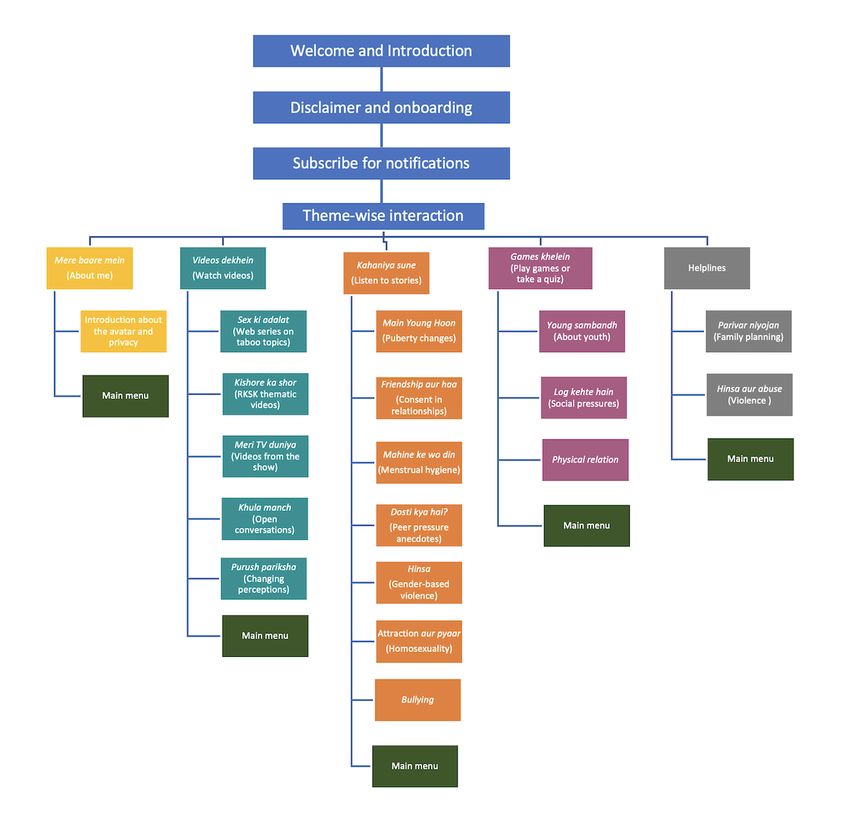
JOURNAL OF MEDICAL INTERNET RESEARCH                                                                                                   Wang et al

                                                                          understand. Although chatbots are often text based, their
     Introduction                                                         capabilities have exploded since the pioneering program ELIZA
     Background                                                           [15], especially in their increased sophistication and accuracy
                                                                          in understanding natural language using artificial intelligence
     This paper presents rich insights from an instrumental case study    (AI) technologies [16,17]. With AI, chatbots create a dynamic
     of an innovative chatbot in India called SnehAI, which was           library of answers, building on their existing database with each
     purposefully conceptualized and designed by the Population           conversation that occurs. This process of machine learning
     Foundation of India to educate and inspire adolescents and           makes their deployment immensely valuable for disseminating
     young adults to live healthy lives, promote sexual and               information. Not surprisingly, AI chatbot health apps are
     reproductive health (SRH), and advocate for the health and           burgeoning [18-21], and they have unique advantages for
     well-being of women and girls. The SnehAI chatbot aims to            addressing sensitive and taboo issues such as SRH [22].
     provide a safe space for Indian youth to have conversations          However, to date, AI chatbot initiatives in low-income countries
     about SRH, dispel sex-related myths and taboos, offer accurate       are scarce. Furthermore, for chatbot projects that do get
     information about safe sex and contraceptive choices, and            underway, systematic documentation and assessment are needed
     address mental health concerns. With a population of                 to generate new knowledge for the greater public good [23].
     approximately 1.4 billion, India accounts for about 18% of all
     people on the planet [1], with half of this population being under   Winner of the 2020 eNGO Challenge Award in Digital Tools
     the age of 25 years [2]. Despite stated policy commitments and       and Empowerment [24], SnehAI represents the first Hinglish
     significant strides made in recent years, the informational needs    (Hindi + English) AI chatbot that is cocreated with and for young
     of adolescents and youth are poorly met, quality education about     people, especially those from vulnerable sections of society, to
     SRH is highly limited, contraceptive practices are heavily           deliberately facilitate communication about SRH topics and
     skewed toward female sterilization, and unsafe abortions are         promote social and behavioral change [25,26]. It benefits the
     rampant [3-6].                                                       target population in many unique ways, but most importantly,
                                                                          it fills a gap that exists in the information around SRH. In a
     In particular, young people in India have limited awareness of       world where digital technologies for underdeveloped markets
     contraception and sexually transmitted infections; their             fail to consider consumers’ hedonic needs, such as play,
     knowledge base consists of inaccurate information; and their         romance, and entertainment, SnehAI provides an unusual
     family life education is highly insufficient [7]. Although the       repository of educational knowledge in an entertaining and
     government-endorsed national adolescent health program               engaging       container,     commonly       referred     to   as
     Rashtriya Kishor Swasthya Karyakram (RKSK) has included              entertainment-education or edutainment [27,28]. Recent
     SRH as part of its mandate since 2014, direct contact with           anthropological studies have shown that digital natives,
     frontline health workers, even by married young women, was           irrespective of their socioeconomic status, tend to be attracted
     extremely low. Contact with unmarried youth and use of SRH           to entertainment and storytelling when consuming social media
     services at adolescent-friendly health clinics are almost            content [23]. Thus, to spread crucial health information in
     completely amiss [8]. Uncomfortable and embarrassed to ask,          diverse populations, the content of social media platforms needs
     young people in India have increasingly referred to web-based        to engage users. Therefore, the SnehAI chatbot in India offers
     platforms to look for answers to SRH questions and have              a terrific opportunity for systematic investigation.
     garnered misleading or incorrect information [9,10]. In a day
     and age when mobile services and social media are proliferating      We focused our investigation on the different ways that SnehAI
     in India, this is unfortunate. At the beginning of 2020, India       enables SRH information sharing and user engagement. First,
     boasted of around 1.1 billion mobile phone connections,              we presented our guiding framework, the theory of affordances.
     covering 78% of the population [11]. With attractive pricing         Our literature review highlights both foundational arguments
     from India-based telecom giants, such as Jio, internet penetration   and affordances of relevant technologies. We then described
     and social media use through mobile networks are rapidly             our methodological approach, an instrumental case study that
     growing [11,12]. Facebook (Meta Platforms) is an obvious             harvests the unique contributions of SnehAI. Our findings are
     leader in the social media space in India, with 320 million users    organized by our theoretically derived research questions: first,
     [13]. With this massive expansion of information infrastructure      on the functional affordances of SnehAI, and second, on the
     comprising wireless networks, digital technologies, and social       user engagement patterns of SnehAI. We concluded with a
     media, Indian youths, both in urban and rural areas, are             discussion of these major findings, raising implications for
     increasingly being plugged into this technology web.                 theory and practice, and set some directions for future endeavors.

     One technology within the realm of social media that has             The Gibson Theory of Affordances
     experienced a rapid rise in different industries is chatbots [14].   The verb to afford means to make available, to provide, or to
     Chatbots are automated nonhuman agents that engage in                offer. The noun affordance did not exist until ecologic
     conversations with human actors [14]. By design, the user            psychologist Gibson [29] introduced his theory of affordances.
     experience in a chatbot strives to be pleasant, as it mimics a       He argued that animals (including humans) and their living
     scenario in which 2 humans are talking with each other. A            environments are one world, and we cannot understand it fully
     chatbot responds by accessing information stored in large digital    if we treat them as separate entities. Essentially, we are all
     data repositories. Chatbots quickly sieve what is relevant and       created by the world we live in, and our behaviors are shaped
     convert programing codes into expressions that humans can            by our environment [30]. The relational dynamics between us

     https://www.jmir.org/2022/1/e29969                                                            J Med Internet Res 2022 | vol. 24 | iss. 1 | e29969 | p. 2
                                                                                                                 (page number not for citation purposes)
XSL• FO
RenderX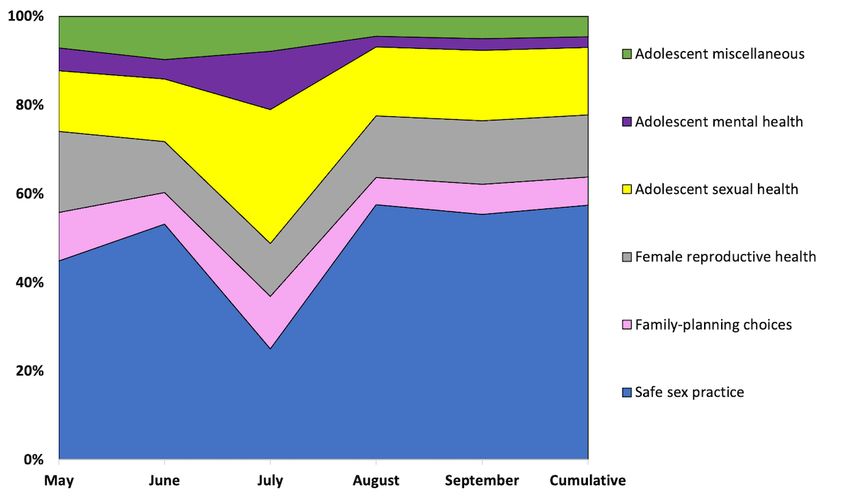
JOURNAL OF MEDICAL INTERNET RESEARCH                                                                                                    Wang et al

     and our environment can enable or prohibit certain action             reminders, nudges, and other triggers for user engagement;
     possibilities [30-32]. Presently, a smartphone can allow us to        enabling users to query information based on personal interests;
     make calls, send messages, browse the web, and guide us to            and enriching messages by having the content processed and
     locations; however, without a charged battery or a correct            enhanced with hyperlinks, emojis, graphics interchange formats
     password, nothing can be done. Gibson [30] also pointed out           (GIFs), and other audio-visual effects [17]. Although exploratory
     that affordances may easily imply a positive connotation;             studies of AI-driven chatbots are scarce, their promise to
     however, it is important to remember that they can also be            address, circumvent, and overcome the taboo nature of SRH
     negative. Certain possibilities may be enabling whereas others        and engage young people is unmistakable [22,47].
     are constraining [31]. Presently, a mass email can easily reach
     several people with a click of the send button, but if infected,
                                                                           Research Gaps and Questions
     it can also spread a computer virus across the world in no time.      For the most part, scholars and practitioners agree on the
     Moreover, Gibson [30] emphasized that the affordances of an           existence of affordances as specific functions of materials or
     environment exist permanently—some may be latent that require         artifacts (in our case, technologies) and the necessary
     discovery, but most should be directly perceivable without extra      recognition of such affordances for their realization to take
     effort of learning. Affordances invite concrete behaviors, which,     place [17,30,44]. However, there were several gaps. First, many
     in turn, can afford other behaviors [30] and, in some cases,          phrases, such as social affordances, cognitive affordances,
     provide agency to seek value and meaning [33,34]. Most young          emotional affordances, and therapeutic affordances, have
     people can figure out how to navigate various social networking       become popular in the literature that are in fact inferences or
     sites rather intuitively; and given that their behaviors are          implications of the functional affordances [39,42,43]. Therefore,
     observable to others, this can trigger additional web-based           any analysis of affordances should fundamentally be anchored
     behaviors.                                                            to technological functionalities. The categorization of social,
                                                                           cognitive, emotional, and therapeutic affordances should be
     Functional Affordances of Technologies                                secondary. Making such conceptual distinctions is important.
     Over the past 4 decades, the theory of affordances has deeply
                                                                           Second, most of the literature on affordances has a positive bias
     influenced the design of everyday objects and user experiences
                                                                           and is most often limited to their potential for achieving personal
     of human–computer interaction [35-37]. Affordances have been
                                                                           goals or public good without considering concerns or risks.
     used as a high-level theoretical framework to understand the
                                                                           Painting a rosy picture of a rapidly changing media landscape
     internet [38,39], mobile and social media [40,41], and digital
                                                                           is dangerous. Similar to all previous information and
     apps for eHealth [42-44]. As SnehAI represents an AI-driven
                                                                           communication technologies, smart and connected mobile
     chatbot accessible through the Facebook Messenger mobile
                                                                           devices and social media platforms work like a double-edged
     app, our literature review focused on discussions regarding the
                                                                           sword. It is our ethical obligation, in this digital and network
     affordances of all relevant technologies and those pertaining to
                                                                           society, to reduce the prejudice of technological determinism
     health promotion and education to set the conceptual foundation
                                                                           [31] and make deliberate efforts to address and account for the
     for our analysis.
                                                                           negative affordances that can cause detrimental effects [48].
     As the internet proliferated, reviews about its affordances
                                                                           Third, AI chatbot design and research are still in their infancy
     emphasized its accessibility through broadband networks.
                                                                           [14]. As technologies advance to highly interactive user interface
     Increasingly available anywhere, anytime, and in multiple media
                                                                           with realistic digital representations, it is unclear how their
     modalities (eg, text, audio, and visual), the internet embodied
                                                                           connection to certain contextual information, such as a
     the novel nonlinearity of user experience beyond time and space
                                                                           background story, will affect user appeal and engagement
     enabled by hypertexts and search engines [38,39]. Key
                                                                           [16,49-51]. Such technological advantages tend to serve
     affordances of mobile devices include portability of
                                                                           privileged populations better and can implicitly embody
     smartphones, information exchange with multiple others across
                                                                           prejudices against those who are vulnerable and marginalized
     multiple channels with increased frequency and directness,
                                                                           [52].
     surveillance risks tied to locational presence, and multimedia
     content production and sharing [40]. The key affordances of           Finally, although all the technological artifacts are embedded
     social media platforms include the permanent nature of                in some kind of regulatory system, be it legal or social, the role
     web-based expressions that are digitally recorded and archived;       of these regulatory systems is rarely included in the discussion
     the possibility for users to re-edit and recraft their messages to    of affordances. Although we focus on what algorisms would
     manage their self-presentation; the possibility for the digital       enable or prohibit digital citizens from doing (or not doing) with
     content to be searched, replicated, and disseminated to a mass        their smart devices, affordances of AI operate in the space of
     audience; and the increased visibility of users’ personal profiles,   public discourses that can affect individual autonomy and
     social connections, and web-based behaviors [41,45,46].               privacy [53,54].
     Although AI and chatbots have been around for decades, they           On the basis of the above literature review and identified gaps,
     have gained in currency with recent developments in cloud             we investigated the SnehAI chatbot as an AI-driven
     computing and machine learning to leverage big data [17,47].          conversational agent and a digital tool for sex education and
     The key affordances of AI-driven chatbots include receiving           communication about SRH, nested in the Facebook Messenger
     messages such as real-time status updates and aggregated              mobile app. By applying the theory of affordances as a
     information from different sources; setting options for automated     high-level conceptual framework, by connecting and

     https://www.jmir.org/2022/1/e29969                                                             J Med Internet Res 2022 | vol. 24 | iss. 1 | e29969 | p. 3
                                                                                                                  (page number not for citation purposes)
XSL• FO
RenderX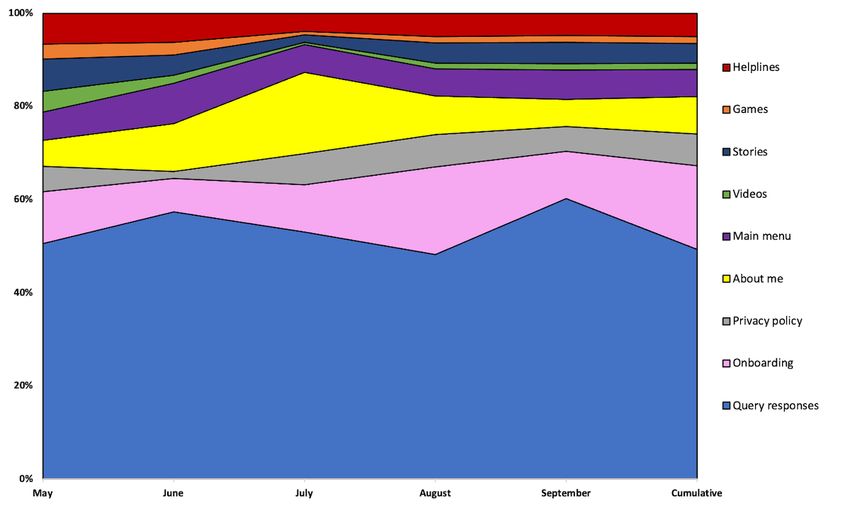
JOURNAL OF MEDICAL INTERNET RESEARCH                                                                                                   Wang et al

     synthesizing all relevant affordances from the literature, and by    millions to interact with curated content, answer questions, and
     analyzing both qualitative insights and unobtrusive quantitative     share personal opinions and actions inspired by the characters
     behavioral data, we answered the following research questions:       in the program [58]. Several miniseries were created out of the
     1.
                                                                          television content, extending the storyline on Main Kuch Bhi
          Research question 1: What are the functional affordances
                                                                          Kar Sakti Hoon’s Facebook page and YouTube channel [57,60].
          of SnehAI for promoting conversations around SRH?
     2.
                                                                          In particular, its Facebook page was popular among young
          Research question 2: How are users engaging with SnehAI
                                                                          people and male users according to Insights Analytics in October
          in their conversations?
                                                                          2019 (Multimedia Appendix 1).
     Methods                                                              In April 2019, during season 3, Main Kuch Bhi Kar Sakti Hoon
                                                                          launched a new transmedia extension through Facebook
     Study Context                                                        Messenger: a chatbot named after Dr Sneha, SnehAI (for Sneha
     SnehAI was first launched in April 2019. Although its current        AI). SnehAI was created by the Population Foundation of India
     version is a stand-alone AI chatbot, its original idea and           in close partnership with the UK-based innovative technology
     predecessor were deeply rooted in the Population Foundation          company AI for Good. This AI chatbot was purposefully
     of India’s innovative initiative called Main Kuch Bhi Kar Sakti      designed to extend Dr Sneha’s media personality as a trusted
     Hoon (I, A Woman, Can Achieve Anything). This initiative used        friend and open a safe, nonjudgmental, and private channel to
     a 360° approach, especially the transmedia edutainment social        engage the audience (especially young people) in India to talk
     and behavior change communication strategy [55,56],                  and learn about SRH. SnehAI version 1.0 used a built-in
     coordinated across multiple media platforms to challenge deeply      decision tree with predetermined rules and quick replies to help
     entrenched regressive gender norms and to advocate for               users navigate through the visual menus [25,26]. It was
     women’s empowerment. Powerful stories were told through the          cocreated with invaluable inputs from 84 adolescents and 19
     dramatic journey and positive role modeling of protagonist Dr        adults to ensure a friendly tone of voice with familiar colloquial
     Sneha, who leaves behind a lucrative medical practice in             expressions that, in fact, SnehAI became the world’s first ever
     Mumbai and returns to her home village Pratappur after her           Hinglish AI chatbot developed for social and behavioral change
     sister’s death from a forced abortion. She then stays on to tackle   [25,26]. It was promoted through Main Kuch Bhi Kar Sakti
     multiple social ills—child marriage, sex selection in favor of       Hoon’s website, interactive voice response system, Facebook
     male offspring, violence against women and girls, and many           page, and other channels. Building on previous efforts, this
     other manifestations of gender inequality [57].                      paper focuses on the current version of the AI chatbot, SnehAI
                                                                          version 2.0.
     From March 2014 to September 2019, 3 seasons of Main Kuch
     Bhi Kar Sakti Hoon were broadcast on the Indian national             SnehAI Chatbot
     television network Doordarshan, hundreds of All India Radio          In April 2020, SnehAI (version 2.0) was launched with a natural
     stations, and the Mobile Vaani community [58,59]. Main Kuch          language processing (NLP) platform and better content flow to
     Bhi Kar Sakti Hoon was the first to use an interactive voice         make SnehAI more intelligent in her conversations with users
     response system for large-scale real-time audience engagement,       [26]. It is required that an individual be a user of Facebook
     creating a voicebook as a transmedia extension that allowed          Messenger to chat with SnehAI (Figure 1).

     https://www.jmir.org/2022/1/e29969                                                            J Med Internet Res 2022 | vol. 24 | iss. 1 | e29969 | p. 4
                                                                                                                 (page number not for citation purposes)
XSL• FO
RenderX
JOURNAL OF MEDICAL INTERNET RESEARCH                                                                                                    Wang et al

     Figure 1. SnehAI chatbot user interface on Facebook Messenger.

     The conversation between a user and SnehAI starts with a warm              health; and Purush pariksha challenges beliefs and pushes
     welcoming message. The chatbot introduces itself as Dr Sneha.              viewers to question orthodox ideas.
     She mentions that she works in a hospital and is involved in          3.   Kahaniyan sune (Listen to stories): this option allows the
     other development projects in the village. After introduction,             user to engage with specific storylines featuring 7 young
     she asks the user to choose one of the available options to ensure         female and male characters in Main Kuch Bhi Kar Sakti
     that the user understands that he or she is interacting with a             Hoon. These stories include Naveen’s contemplation of
     chatbot rather than a human being. After that, the users are               adolescent attraction and curiosity and confusion about
     invited to subscribe to notifications from SnehAI. Then they               puberty (Main young hoon), Pinky’s story about menstrual
     can select and interact with a range of content presented on the           hygiene (Mahine ke vo din), Shama and Aman’s relationship
     main menu. Depending on their choices, the information may                 and their beliefs about consent (Friendship aur haa),
     be displayed as hyperlinked texts, images, or short videos.                Sanjay’s issues with peer pressure (Dosti kya hai?), Preeta’s
     Furthermore, these theme-wise interactions are organized into              survival of an acid attack for being a competent female
     five content categories (Figure 2):                                        football player (Hinsa), Bunty’s homosexuality (Attraction
     1.
                                                                                aur pyaar), and Aman’s concerns about bullying (bullying).
          Mere baare mein (About me): this is an introduction to the       4.   Games khelein (Play games or take a quiz): this option
          app. SnehAI is introduced as an avatar, and users are also
                                                                                allows the user to play quiz games on three themes: Young
          given the option to review the privacy policy. In the chatbot,
                                                                                sambandh has questions about adolescent development,
          this option appears at the end, as the goal is to promote
                                                                                Physical relation has questions about family planning, and
          health-related communication.
     2.
                                                                                Log kehte hain has questions about myths and
          Videos dekhein (Watch videos): this option allows the user
                                                                                misconceptions about SRH.
          to watch short videos from 3 interrelated programs. Sex ki       5.   Helplines: this option directs users to 2 helplines. One
          adalat includes 4 fictional court cases debating about
                                                                                helpline is on SRH through the national toll-free number
          virginity, masturbation, menstruation, and pornography;
                                                                                of the Jansankhya Sthirata Kosh endorsed by the Ministry
          Kishor ka shor offers conversations based on the
                                                                                of Health and Family Welfare. It provides callers with
          government-endorsed national adolescent health program
                                                                                information and counseling on family planning and
          RKSK themes featured in Main Kuch Bhi Kar Sakti Hoon
                                                                                reproductive health issues, including access and use of
          season 2 regarding obesity, child marriage, and cigarette
                                                                                contraceptives. The other helpline option links users to a
          smoking; Meri TV duniya includes trailers and exclusives
                                                                                national helpline on gender-based violence for the
          from Main Kuch Bhi Kar Sakti Hoon season 1, 2, and 3.
                                                                                counseling and reporting of incidents.
          Khula manch offers conversations on mental and physical

     https://www.jmir.org/2022/1/e29969                                                             J Med Internet Res 2022 | vol. 24 | iss. 1 | e29969 | p. 5
                                                                                                                  (page number not for citation purposes)
XSL• FO
RenderX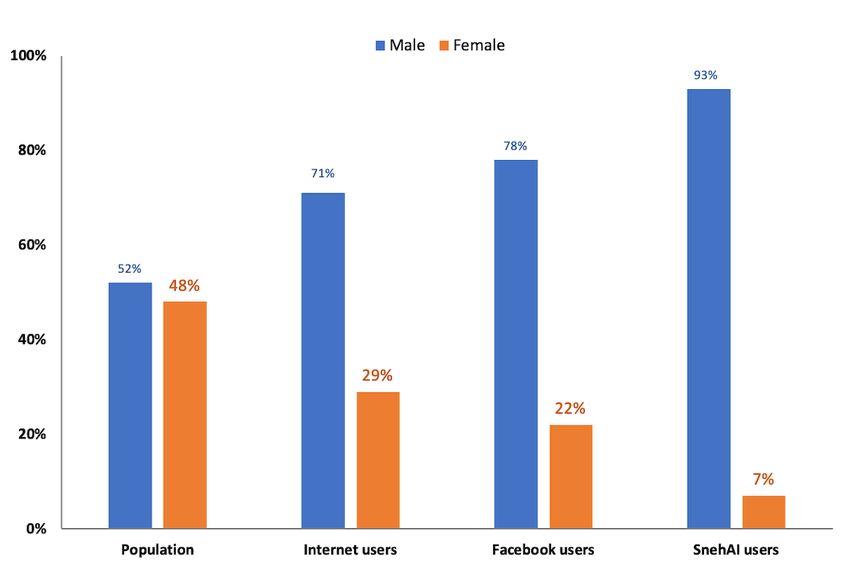
JOURNAL OF MEDICAL INTERNET RESEARCH                                                                                                   Wang et al

     Figure 2. SnehAI chatbot content flowchart. RKSK: Rashtriya Kishor Swasthya Karyakram.

     In addition to the improved content structure and flow, a critical    Instrumental Case Study
     element of SnehAI (version 2.0) is the use of an NLP system           The case study approach is particularly useful for exploring a
     to process and respond to user-entered free-text queries. This        phenomenon in its natural and real-life context and allows the
     NLP system first matches the free texts with prefilled regular        development of a more in-depth, multifaceted, and holistic
     expressions (RegEx in short as commonly used by                       understanding [62]. Although this method is well-recognized
     programmers), and if a match is found, corresponding replies          in disciplines such as business, law, and policy, it needs to be
     are executed. If no matches are found, the NLP system activates       embraced more in global and public health research [63]. We
     a Microsoft Language Understanding (LUIS) conversational              adopted an instrumental case study approach. An instrumental
     AI service and uses it to apply custom machine learning               (vs intrinsic or collective) case study focuses on 1 example to
     intelligence in client apps (such as AI chatbots, such as SnehAI)     gain a broader appreciation of a phenomenon [63,64]. The case
     to process user input and provide appropriate response [61].          in point here is SnehAI as an exemplar of AI chatbots for
     The Azure LUIS app, commonly used in AI chatbots, receives            promoting conversations about SRH. This research method
     user input in the form of conversational and natural language         allowed us to explore SnehAI from diverse perspectives, such
     texts, treats them as user utterances, processes the information      as technology design, program implementation, and user
     by extracting keywords and predicting user intentions, and then       engagement. We also used a mix of qualitative insights and
     uses the JSON response to make decisions about how to fulfill         quantitative data to triangulate our findings.
     the user’s requests [61].
                                                                           Qualitative insights were obtained from key stakeholders, with
                                                                           institutional representatives being the coauthors of this paper

     https://www.jmir.org/2022/1/e29969                                                            J Med Internet Res 2022 | vol. 24 | iss. 1 | e29969 | p. 6
                                                                                                                 (page number not for citation purposes)
XSL• FO
RenderX
JOURNAL OF MEDICAL INTERNET RESEARCH Wang et al
and others listed in the acknowledgments. A total of 2 in-person editability, and scalability) had been previously used in the
group meetings, 4 virtual conferences, and numerous follow-up literature, and some others were differently labeled although
email discussions took place from September 2018 to December they expressed similar ideas (ie, customizability, interactivity,
2020. Half a dozen interim and final reports (including 2 cited visibility, glocalizability, and connectivity). Notably, we
in this paper [25,26]), as well as detailed meeting notes, served contributed several new labels (ie, compellability, queriosity,
as foundational documents for our analysis. Quantitative data trackability, inclusivity, and actionability) to represent critical
were obtained through unobtrusive chatbot user behavior affordances of SnehAI that could apply to similar AI and chatbot
tracking with user permission. The chatbot user interactions apps:
were mainly captured in 2 ways. First, for any predetermined 1. Accessibility allows SnehAI users to access SRH
options indicated in the SnehAI flowchart, the choices were
information that is accurate (with content experts’ approval),
recorded anonymously in a third-party digital analytic tool
trustworthy (as shared by the avatar of a trusted friend),
designed for chatbots on Facebook Messenger, Dashbot [65].
and relatable (with messages expressed in colloquial
Conversation-specific analytics were aggregated to monitor
Hinglish). The subscription option for notifications affords
user engagement and help improve the dynamics of user–bot
additional access to new information as it becomes
interactions. Second, a user could also type questions or
available. However, digital inequalities may deprive
comments in the dialogue box at any time. These free texts were
underserved population groups such as women, youths, and
used as user input in the NLP system to detect user intention
rural residents of smartphone ownership or limit their
and determine the optimal response. For this project, we used
personal use. Furthermore, users who obtain access to the
the aggregated analytics data from the Population Foundation
chatbot can potentially be overwhelmed by new information
of India and its partner AI for Good, United Kingdom, gathered
about taboo topics. It helps that most information on SnehAI
from the beginning of May 2020 to the end of September 2020.
is presented as edutainment, both entertaining and
The data science team at AI for Good, United Kingdom, also
educational.
randomly selected 15,000 free-text messages with over 20 2. Multimodality affords SnehAI to be presented through more
characters and used machine learning techniques to detect user
than one sensory mode to help enhance the user experience.
behavior patterns.
Although common practice in the industry is to simply use
To proactively address potential pitfalls of the case study plain text in a chat box, SnehAI uses rich media that
methodology [63], we adopted a widely accepted and includes text, audio, and visual modalities, and popular
multidisciplinary conceptual framework (ie, the theory of presentation forms, such as GIFs, emojis, and short videos.
affordances) to guide our inquiries and investigations. We also What SnehAI users see and hear about gender norms may
drew clear boundaries around the specific case (ie, SnehAI 2.0) be dramatically different from what is covered in the
and the timeframe of user engagement data for our analysis (ie, mainstream media, which could potentially be a source of
a 5-month period shortly after the launch). Furthermore, we cognitive dissonance, yet necessary for raising social
went through several iterations of data validation, reported consciousness about gender inequality [57-59].
discrepancies caused by technical errors, and shared detailed 3. Nonlinearity allows SnehAI to provide curated content
notes with all team members to ensure transparency in the through clickable visual menu options instead of a
research process. prescribed sequence. In addition, users can enter their
queries through free-text messages at any time apart from
Results when they access branched content categories. Thus,
SnehAI allows users to take control of their experience as
Functional Affordances of SnehAI more of a choose-your-own-adventure type of journey. On
To answer research question 1, we compiled an extensive list the flip side, such an adventurous and nonlinear trajectory
of relevant affordances reviewed in the literature, evaluated can also be distracting or confusing for some users who
them against the SnehAI app based on the qualitative insights may lose track of a thought as they shift from one content
we obtained, and distilled 15 functional affordances (see a category to another. Currently, there is no separate search
summary in Multimedia Appendix 2 [17,33,34,38-41,45,53]). bar available in the user interface that allows users to
The results presented here specifically address the research gaps conduct a keyword search from anywhere.
we identified. The affordances of a new technology should be 4. Compellability allows SnehAI to engage users in compelling
primarily about its functionalities. Therefore, these 15 ways. The casual, friendly, yet culturally
affordances of SnehAI are all based on the functionalities of appropriate–looking avatar of SnehAI is rich in visual
the chatbot, its AI capacity through the NLP model, the appeal for Indian adolescents and young adults. Paid
Facebook Messenger mobile app it is embedded in, and the Facebook promotions can help attract new users and boost
internet and wireless networks that enable its existence. We also user retention. Furthermore, the triggers and prompts on
included the role of a media personality and relevant legal and Facebook Messenger can also attract user attention and
social regulatory systems in our assessment. Moreover, we provide cues to action. Although no nudges exist presently
considered both positive and negative sides of each affordance, when a user is inactive for a prolonged time, nudges can
with the intention of appreciating its actionable possibilities be annoying if their intentions are unclear to users [17].
while mitigating potential concerns. Certain labels of these 5. Queriosity allows SnehAI users to seek answers to their
affordances (ie, accessibility, multimodality, nonlinearity, queries based on personal curiosities. For users to be able
to enter free-text messages is in stark contrast with the
https://www.jmir.org/2022/1/e29969 J Med Internet Res 2022 | vol. 24 | iss. 1 | e29969 | p. 7
(page number not for citation purposes)
XSL• FO
RenderXJOURNAL OF MEDICAL INTERNET RESEARCH Wang et al
conventional method of preaching to the choir of users. In of the user journey [66]. For example, small talk intents
particular, young people learn better when their genuine cover the trivial chit-chat with phrases such as how are you
curiosity is encouraged without judgment [55,56]. The and thank you. However, a unique aspect of SnehAI is that
analysis of the 15,000 sampled queries by our data science the NLP model is designed to effectively detect core
team indicated that “SnehAI opened up a safe space for intentions related to topics such as safe sex, reproductive
users to ask ‘stupid’ or ‘embarrassing’ questions about SRH health, and family planning choices. These core intentions
without worrying about what others think.” The current are identified through keywords that serve as substitutes
version only allows users to query through manually typed for sex, accounting for the corresponding colloquial
text messages. In the future, other query methods may be expressions by young people and their spellings and
included. For instance, a search engine may be helpful when misspellings in Hinglish. The NLP system used in SnehAI
the curated content database expands so that users can find version 2.0 was initially trained based on insights from the
and explore the most relevant branched content category. previous version and is being retrained regularly. A part of
Providing voice input and output capability (as in Siri and the LUIS global network, SnehAI contributes Hinglish
Alexa) can be especially useful for users with low levels conversational messages to the larger pool to improve
of literacy. machine learning intelligence over time. It also leverages
6. Editability allows SnehAI users the ability to craft a its growing database for SnehAI NLP training. A more
message to their satisfaction before sending it out to the detailed illustration of the LUIS NLP model in SnehAI is
chatbot. Thus, users have full control over how they present provided in Multimedia Appendix 3 within a linked video
themselves in this private space. Again, the analysis of in Multimedia Appendix 4.
15,000 sampled queries by the data science team showed 10. Trackability allows SnehAI the capability to unobtrusively
that most user behaviors were respectful. “For instance, track certain users’ personal information and interactive
many treated the chatbot as if it was Dr. Sneha, addressing behaviors with the chatbot. Because of privacy concerns,
her as Dr, Ma’am ji [respected Ma’am], and didi [older Facebook is strict about the kind of personal information
sister].” On the other hand, once a free-text message is sent recorded in third-party apps. For SnehAI, version 2.0, a
out, there is no way to revise or recall it, even to correct formal application was submitted, reviewed, and approved
unintentional mistakes. by Facebook to record user’s gender in the Dashbot
7. Visibility allows SnehAI to automatically save all messages analytics tracking. Other key performance indicators such
exchanged between the user and the chatbot and keep them as important clickable reactions were also recorded and
permanently visible in the chat history. Such permanence reported in the User Engagement With SnehAI section in
in visibility can be a convenient information repository over Results. In addition, inappropriate and abusive user
time but also a potential vulnerability, as anyone who has behaviors were also monitored, flagged, and handled to
access to the user account can retrieve and review private keep SnehAI a safe and civil space. No matter how elaborate
messages. SnehAI is proud of its strict adherence to the the efforts to protect user privacy, some users (particularly
international General Data Protection Regulation on data those with low digital media literacy) may not fully
privacy with a built-in user option to review its detailed understand what kind of personal information is being
privacy policy, including user permission for recording or tracked at the back end.
deleting data. 11. Scalability allows SnehAI to achieve large-scale user reach
8. Interactivity allows SnehAI to provide immediate feedback by leveraging the popularity and massive user base of
on user requests. This allows the chatbot user to simulate Facebook in India, especially among adolescents and young
real-time interpersonal interaction through turn-taking with adults. All the information on SnehAI is digitally produced
verbal expressions and nonverbal cues—through emojis. and can be easily replicated for dissemination. As a
Therefore, each conversational session can flow like text stand-alone mobile app, SnehAI can be an effective digital
messaging with a real person. SnehAI is prompt and reliable tool for frontline health workers to share with young men
in responding. However, the free-text message queries by and women. Harnessing the existing health care and
a user are entirely dependent on the quality of the response field-based health education networks can easily spread
through the NLP model. When the user intention is SRH resources on SnehAI across tens of millions of users,
incorrectly decoded, the chatbot response is correspondingly with the probability of some creative content going viral.
off-track. Thus, the quality of conversations with the chatbot Currently there is no option in SnehAI for users to
is determined by the intelligence of the NLP model in recommend the chatbot to other Facebook friends. In
detecting communicative nuances and minimizing bias. addition, no aggregate user engagement information is
9. Customizability allows SnehAI users to interact with curated shared in the chat function to further grow the SnehAI user
content and customize their queries based on personal base.
interests, even though there is no option for users to 12. Glocalizability allows SnehAI to reach the youth living in
customize their chatbot menus or filter content. India and around the globe. The intentional use of colloquial
Nevertheless, SnehAI uses a hybrid of prefilled RegEx and Hinglish makes the AI chatbot particularly approachable
the LUIS conversational AI client app in its NLP system and friendly for young people. Regardless of where a user
to customize the chatbot’s response to user queries. In lives, there is a certain level of universality with respect to
particular, the NLP uses machine learning features, such curiosity, challenges, and experiences related to SRH issues.
as a phrase list, to detect user intentions at various junctions It is commendable that SnehAI, version 2.0, offers
https://www.jmir.org/2022/1/e29969 J Med Internet Res 2022 | vol. 24 | iss. 1 | e29969 | p. 8
(page number not for citation purposes)
XSL• FO
RenderXJOURNAL OF MEDICAL INTERNET RESEARCH Wang et al
information on 2 nationwide helplines. Unfortunately, no 15. Actionability affords SnehAI users to take action as the
location-based content tailoring is available at this time to direct result of their conversations with the chatbot. For
contextualize the SRH information for individual users, nor example, they can share in-person SRH information that
is there a capability to facilitate direct connections with they have learned with their trusted peers. Such private and
existing local health and social services. casual information sharing is, in fact, how many people
13. Inclusivity affords SnehAI to be welcoming of users with learn about SRH in the first place. They can also call
diverse backgrounds, especially underserved population national helplines to seek professional consultation for
groups such as women, youths, and rural residents. Once themselves or others. Currently, there is no possibility of
SnehAI can be accessed, the service is free. In addition, AI directly calling through the AI chatbot app or appointment
chatbots are becoming increasingly capable of processing scheduling capabilities with local health or social services.
human voice as user input, such as Siri and Alexa. Rather However, with the rapid development of AI technologies
than depending on the users’ reading and writing skills, a such as Google Assistant, more affordances can and will
voice-based option can benefit people with low literacy and become available for users in due time.
make SnehAI even more inclusive. Meanwhile, the chatbot
presents some privacy risks for users with low digital
User Engagement With SnehAI
literacy. Imagine a worrisome parent finding a teenager To answer research question 2, we examined the aggregate
asking about sexually transmitted infections or a controlling Dashbot analytics data on SnehAI user behaviors. Over a
husband finding his wife learning about injectable 5-month period, 8,170,879 messages were exchanged between
contraception. With time, other functions may be SnehAI and 135,263 unique chatbot users, including 5,100,449
incorporated to provide additional education and protection (62.42%) outgoing messages from the chatbot to the users and
to the most vulnerable users. 3,070,430 (37.58%) incoming messages from the users to the
14. Connectivity allows SnehAI meaningful opportunities for chatbot. The ratios between outgoing and incoming messages
parasocial interactions to occur between a user and the were consistently around 60:40 over time, with the exception
chatbot via Dr Sneha’s avatar. Parasocial interactions of repeated outgoing messages in July (such as technical errors,
typically occur in pseudorelationships between a media which are marked with asterisks in Figure 3). Specifically,
user and a media personality [67]. For SnehAI users, having incoming messages from the users to the chatbot were sent
someone they can trust to talk about SRH is much better through free texts (1,599,339/2,878,908, 52.09%); clickable
than having no one. According to our data science team, reactions (1,279,569/2,878,908, 41.67%); or GIFs, audios,
“Many opened up and shared deeply personal issues. Some images, and videos (191,522/2,878,908, 6.24%).
were keen in knowing more about Dr. Sneha’s whereabouts, The average user engagement with SnehAI was 1.9 sessions,
wanting to talk in person, and even asked for her WhatsApp 7.6 minutes, and 56.2 messages exchanged (Figure 4). The time
number.” In the current version, options are not yet available spent by top users increased from 2 to 3 hours in the first 3
to safely connect a user with other trusted real-life friends months to 7 hours in 14 sessions in August and 14 hours in 47
through Facebook Messenger. There is also no direct sessions in September.
connection to link one user’s queries with others’ queries
to securely facilitate peer-to-peer or social learning.
Figure 3. SnehAI chatbot outgoing versus incoming message ratios over time.
https://www.jmir.org/2022/1/e29969 J Med Internet Res 2022 | vol. 24 | iss. 1 | e29969 | p. 9
(page number not for citation purposes)
XSL• FO
RenderXJOURNAL OF MEDICAL INTERNET RESEARCH Wang et al
Figure 4. SnehAI chatbot average user engagement over time.
User engagement was also tracked through the content of sexual intercourse, oral and anal sex, impact of other health
categories, including both guided flows using clickable reactions ailments on sex life, and unplanned pregnancy (57,158/99,936,
and the handling of free-text messages using NLP. Although 57.19%); choice of family planning methods, such as male and
multiple messages could have been exchanged with SnehAI female condoms, oral contraceptive pills, intrauterine devices,
each time a user engaged with a particular content category, the injectables, and SRH-related themes, such as abortion, sexual
overtime trends of engagement frequencies across different intercourse during and after pregnancy, polycystic ovarian
content categories provided empirical evidence of user response disease, and infertility issues (6287/99,936, 6.29%); female
and preference. From onboarding, to learning about Sneha, to reproductive health concerning menstruation (eg, regularity,
its privacy policy, and its main menu to the videos, stories, pain, discharge, and spotting), virginity, and premarital sex
games, helplines, and query responses through NLP, the chatbot (13,965/99,936, 13.97%); adolescent sexual health issues, such
users traversed across these content areas for 1,430,416 times as nightfall, masturbation, pornography, sexual stamina, erectile
over the course of 5 months. Approximately half dysfunction, and STIs (15,160/99,936, 15.17%); adolescent
(705,305/1,430,416, 49.31%) of these interactions were about mental health issues regarding peer pressure and bullying
the chatbot responding to the user queries, including small talks (2343/99,936, 2.34%); and nutrition and social determinants of
and any questions related to themes of health communication health, such as child marriage and gender equality (4623/99,936,
(Figure 5). The next highest frequency content category was 4.63%).
onboarding (257,042/1,430,416, 17.97%), about SnehAI
With Facebook’s approval, we accessed the SnehAI chatbot
(115,131/1,430,416, 8.05%), privacy policy (96,305/1,430,416,
user’s gender-disaggregated data. What we discovered was an
6.73%), main menu (83,692/1,430,416, 5.85%), helplines
extreme gender gap (Figure 7): among the unique chatbot users
(71,211/1,430,416, 4.98%), stories (61,582/1,430,416, 4.31%),
over this 5-month period, 93% (125,795/135,263) were male,
games (20,897/1,430,416, 1.46%), and videos
6.8% (9198/135,263) were female, and 0.2% (270/135,263)
(19,251/1,430,416, 1.35%). These trends in content engagement
unknown. This gender ratio was disproportionally skewed
distribution were relatively consistent (with occasional
toward male users compared with that in the United Nations
fluctuations).
Development Programme report on gender distribution of
Our analytics tracking data showed a count of 99,936 typed text internet users (29% female) and Facebook users (22% female)
messages from the users that SnehAI handled and responded in India [12], as well as with that of the general population (48%
through the NLP system with queries related to the six topical female) according to census data [2].
themes (Figure 6): safe sex practices, such as consent, frequency
https://www.jmir.org/2022/1/e29969 J Med Internet Res 2022 | vol. 24 | iss. 1 | e29969 | p. 10
(page number not for citation purposes)
XSL• FO
RenderXJOURNAL OF MEDICAL INTERNET RESEARCH Wang et al
Figure 5. SnehAI chatbot content engagement distribution over time.
Figure 6. SnehAI chatbot free-text queries content distribution over time.
https://www.jmir.org/2022/1/e29969 J Med Internet Res 2022 | vol. 24 | iss. 1 | e29969 | p. 11
(page number not for citation purposes)
XSL• FO
RenderXJOURNAL OF MEDICAL INTERNET RESEARCH Wang et al
Figure 7. Gender gap in SnehAI users compared with internet and Facebook users in India.
Even worse, based on the 15,000 sampled queries, our data Moreover, the NLP system worked smoothly and effectively
science team found “a behavioral pattern with female users to personalize the chatbot response and optimize user
showing significantly lower self-confidence in their experience.
conversations with SnehAI.” This might be a function of female
Using the theory by Gibson to guide our research inquiries and
users facing gender disparities in mobile device ownership and
building on the existing literature, we distilled 15 functional
low digital media literacy in India.
affordances of SnehAI. The results of our instrumental case
Furthermore, they are likely less comfortable about openly study provide evidence that SnehAI offers a safe space for users
discussing SRH and may hold higher levels of privacy concerns to talk about sensitive SRH topics, seek and obtain accurate
for digital abuse and sexual exploitation. In contrast, there were information, access services locally through helplines, and seek
incidents where male users requested SnehAI to set up a girl personal counseling:
for them, and some even engaged in obscene chats with her 1. Accessibility: SnehAI provided a digital platform for Indian
expressing intimacy through sexting, asking for porn videos,
youth to access highly accurate and credible information
and using abusive language. A few questions also showed the
about SRH in a safe, nonjudgmental space.
darkest side of sexual abuse, with male users inquiring which 2. Multimodality: SnehAI used popular media modalities such
tablets they could give girls if they were unwilling to have sex
as videos, GIFs, and emojis to enhance engagement.
with them, with the intention of overriding consensual sex. 3. Nonlinearity: SnehAI offered curated content in branched
categories that invited nonlinear navigation.
Discussion 4. Compellability: SnehAI compelled the users to open up
Principal Findings through her relatable and approachable avatar image and
tone.
SnehAI pioneered the use of an AI chatbot to engage users, 5. Queriosity: SnehAI welcomed queries that encouraged user
especially young men, in conversations about SRH. A total of curiosity about SRH topics.
8.2 million messages were exchanged in a 5-month period, with 6. Editability: SnehAI enabled users to reword, redraft, and
almost half of the incoming user messages being free-text rescript how they showed up in the digital space.
queries comprising personal questions and concerns about SRH. 7. Visibility: SnehAI enabled users to privately and securely
Overall, the SnehAI avatar based on Dr Sneha—the protagonist save chat history, making it visible at any point.
in Main Kuch Bhi Kar Sakti Hoon television show—presented 8. Interactivity: SnehAI simulated conversational turn-taking
itself as a trustworthy friend and mentor. Furthermore, the and immediate verbal and nonverbal feedback.
curated content from this gender equality and family planning
initiative was found to be both entertaining and educational.
https://www.jmir.org/2022/1/e29969 J Med Internet Res 2022 | vol. 24 | iss. 1 | e29969 | p. 12
(page number not for citation purposes)
XSL• FO
RenderXJOURNAL OF MEDICAL INTERNET RESEARCH Wang et al
9. Customizability: SnehAI enabled users to navigate the and amplify the positives and minimize the negatives when
curated content according to their interests and used its designing, implementing, and studying these technologies. The
machine learning capability to customize responses. 15 affordances of SnehAI can serve as a comprehensive
10. Trackability: SnehAI tracked users’ web-based behaviors checklist for similar apps. It helped our research team to pinpoint
through their clickable actions and self-generated content. the unique attributes and strengths of SnehAI and clarify the
11. Scalability: SnehAI holds tremendous potential for scaling next steps for future improvements. They can also help chatbot
up through various adolescent health education programs, design and analytics teams to select key performance indicators
networks of frontline health workers, and diverse service to track over time and monitor user behavioral patterns to ensure
providers. the safety of the environment and improve user engagement.
12. Glocalizability: SnehAI enabled linkages between young This case study also described the NLP model used in SnehAI,
people and service providers in their local areas. version 2.0, to customize the interactions between an AI chatbot
13. Inclusivity: SnehAI served as a free digital consultation and a user. NLP helps optimize the conversation dynamics and
repository for all users. personalize the user’s journey, thus getting us closer to
14. Connectivity: SnehAI created the conditions for users to accomplishing the United Nations sustainable development
connect parasocially with a respected and trustworthy avatar goals, focusing on good health and well-being, gender equality,
at a deeply personal level. and quality education.
15. Actionability: SnehAI used the power of transmedia
In addition, by covering all relevant aspects of the SnehAI
storytelling to inspire users to take concrete actions to seek
chatbot, we learned that when treating technologies as artifacts,
help for themselves and their peers.
their affordances should include not only the specific app itself.
Meanwhile, we also discovered an extreme gender gap among What is equally, if not more, important is to include the
the many potential disparities. The patriarchal restrictions on information systems and communication networks an app is
women’s autonomy, mobility, and self-expression in India are nested in, as all of them are interconnected and interdependent.
vividly reflected in SnehAI user analytics data. This disparity SnehAI could not be functional without Facebook Messenger,
in ratio is a risk and can introduce gender bias in the AI chatbot’s access to mobile devices, or mobile connections to the internet.
NLP model. Our team is currently adapting field-based
Furthermore, studies on technological affordances should
promotional strategies to include more female users. Other
routinely include attention to legal and social regulatory systems
specific opportunities for improvement based on our results
that are usually invisible to the public. This is particularly
include the following:
pertinent when a citizenry is divided along the lines of prejudice
1. A more intelligent NLP model coupled with targeted and hierarchy, such as class, gender, and race. The rapid
behavior change strategies focusing on awareness building development of AI technologies will continue to challenge
and empowerment of women and girls to reduce gender innovators, marketers, and users with moral dilemmas. Our
bias. team’s experience working directly with the intended users of
2. A system setting of reminders and nudges to re-engage SnehAI to respect the circumstances of their living conditions
idling and inactive users. while facilitating meaningful social and behavioral change has
3. An option to edit or recall a text message after sending it demonstrated great value in cocreation and collaboration.
out to the chatbot or to use voice-based input and output to
include users with low literacy.
Theoretical Implications
4. A possibility to customize the menus, filter contents, and Our case study on SnehAI demonstrated both the robustness
search information in the chatbot when the digital artifacts and adaptability of Gibson’s theory of affordances, some 40
propagate to a larger scale. years after it was proposed. At the same time, our investigation
5. A feature that allows the user to invite other trusted friends of SnehAI also sheds light on research gaps in the current
to use the chatbot and leverage anonymous and aggregated literature on technology affordances and offers new insights to
user data to boost user participation and peer-to-peer expand this theoretical framework. Only when there is a deeper
learning. understanding of the design of a user interface and its operating
6. A mechanism to educate the most vulnerable users on how system behind the screen (similar to what our research team
to protect their privacy, safely participate in web-based did) that it becomes possible to evaluate new technology’s
activities, and advocate for their basic human rights. affordances—through their existence, recognition, and
7. A network that can directly connect the chatbot users to realization. Researchers should return to the basic functionalities
their local health and social services, for instance, enabling before jumping to conclusions about other types of social,
helpline dialing and scheduling appointments through the cognitive, emotional, and therapeutic inferences.
chatbot. Second, there is a utopian bias in affordances in new media
Practical Implications studies. It is important to balance technological determinism
and social constructivism when examining the social shaping
Our findings hold important policy and programmatic
and consequences of emerging technologies. The identification
implications for health informatics, especially for the design of
of affordances by nature is a function of one’s individual
user-centered and AI-driven interventions. Understanding both
capability. An affordance is permanent, but its perception is
positive and negative aspects of the affordances of AI chatbots
dependent on the individual’s culture, history, effort, and
such as SnehAI can help inform future endeavors to reinforce
necessity. Consequently, it is critical for users to be at the front
https://www.jmir.org/2022/1/e29969 J Med Internet Res 2022 | vol. 24 | iss. 1 | e29969 | p. 13
(page number not for citation purposes)
XSL• FO
RenderXYou can also read


