Attitude of People towards Electric Vehicles and Problems in Acceptability - irjet
←
→
Page content transcription
If your browser does not render page correctly, please read the page content below
International Research Journal of Engineering and Technology (IRJET)                               e-ISSN: 2395-0056
          Volume: 07 Issue: 05 | May 2020             www.irjet.net                                      p-ISSN: 2395-0072

           Attitude of People towards Electric Vehicles and Problems in
                                                    Acceptability

                                                Prachi1, Priya Goswami2

        1 Assistant   Professor, Dept. of Computer Science and Engineering, IPEC, Uttar Pradesh, India
        2Student,   Dept. of Computer Science and Engineering, IPEC, Uttar Pradesh, India

ABSTRACT - Electro Vehicle (EV) which were introduced                EVs are a potentially important technology to help reduce
in the global market a time ago. Now many countries are              greenhouse gas emissions, local air pollution, and
actively working towards changing their infrastructure.
                                                                     vehicular noise. This study reviews literature about the
Now when most of the countries are setting goals for EV
adoption and many of them are falling short, now is the time         key factors driving the recent trends in EV adoption. The
where the government needs to step in and ease the norms             purpose of this is to summaries knowledge and identify
for EVs so that people can go for the FAME incentives. We            gaps in understanding related to EV uptake with the
need improvements in EV’s over the predecessors and                  purpose of informing policy-makers and researchers.
electric driving range. Cost being the main game player in
India. So, what should the government come up with?
                                                                     The use of non-renewable and polluting sources for the
Several important gaps in knowledge are identified. First,
                                                                     production of energy has taken environmental pollution to
there is mixed evidence of the effectiveness of government
                                                                     a whole new level. The increasing global warming has an
incentives because still people are not ready to pay for so
                                                                     impending need for us to stop the use of non-renewable
much instead of moving towards ICE vehicles. Second, it is
                                                                     resources and reduce carbon emissions. Since the
not that people are reluctant to wait they have shown good           industrial age, the atmospheric carbon content is rising.
signs but the actual-to-action gap is too much. This paper
                                                                     Carbon emissions from vehicle amount for a typical
reviews important factors that will play a part in the
                                                                     passenger vehicle are 4.7 metric tons per year.[19] The
adoption of EVs in India and problems in acceptability.
                                                                     largest human source of carbon emission is from the
                                                                     combustion of fossil fuels. The development of electric
Key Words – Electric vehicle; Attitude; Economic benefit
                                                                     engines in vehicles has created a replacement for the
adoption, environmental concern.
                                                                     internal combustion engines paving way for the Electric
                                                                     Vehicles (EV). EVs have been adopted by many countries
1. INTRODUCTION                                                      since their development creating a positive impact on the
                                                                     environment. India’s growth prospects create the potential
Electric vehicles (EVs) were recently reintroduced to the            for developing leadership in EV in certain segments
global car market. Plug-in hybrid electric vehicles (PHEVs)
and battery electric vehicles (BEVs), collectively referred          Following is the table of Electric vehicle manufacturers in
to as EVs, reduce or entirely negate gasoline or diesel used         India/manufacturers of electric vehicles launched in India.
in the vehicle itself through integration with the electric
grid. EVs have re-emerged for a variety of reasons
including improvement in battery technology and

heightened government vehicle efficiency and air quality
standards.

© 2020, IRJET         |   Impact Factor value: 7.529           |   ISO 9001:2008 Certified Journal         |   Page 7785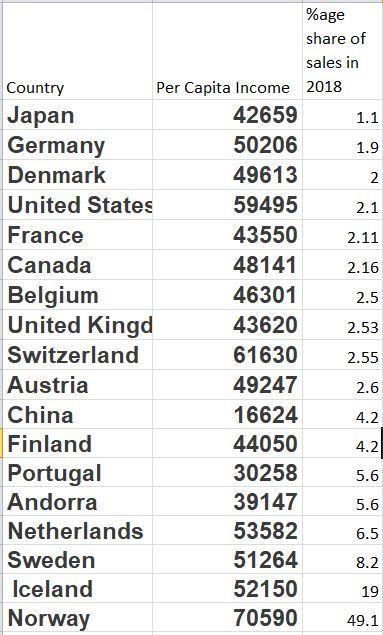
International Research Journal of Engineering and Technology (IRJET) e-ISSN: 2395-0056
Volume: 07 Issue: 05 | May 2020 www.irjet.net p-ISSN: 2395-0072
Table 1: - Electric vehicle manufacturers in India
S.no. Vehicle type Manufacturer
1. Motorcycles Revolt Motors (RV400 & RV300)[3]
Tork Motors (to be launched) [5]
Ultraviolent Automotive
2. Scooters Ather Energy[7]
Bajaj Chetak (Currently available in Pune and Bangalore)
TVS iQube (Currently available in Pune and Bangalore)[6]
Hero Electric Photon 48V
3. Buses Electric buses in Bangalore by BMTC
India's first electric bus was launched in Bangalore in 2014.[8]
Ashok Leyland launched its electric bus in October 2016.
Tata Motors launched its pure electric bus ‘Star bus Electric 9m’ and
hybrid ‘Star Bus Electric 12m’ in January 2017.[11]
Goldstone Infratech supplied Himachal Pradesh Transport
Corporation with 25 electric buses in September 2017.[12]
25 Tata Star bus Hybrid electric buses were delivered in
Maharashtra in March 2018.[13]
India's 1st intercity electric bus is inaugurated on 5 September which
is operated between Mumbai and Pune by MSRTC.
4. Mini pickup ECOYAN
trucks Mahindra
Tata Motors, Ace Electric in 2016
5. Heavy duty A Gurgaon based company; Infraprime Logistics Technologies Pvt. Ltd.
trucks, tractor launched first heavy-duty truck in India in Sep 2019.
trucks
6. Rickshaws Entice Impex Pvt Ltd (Gaetti E-rickshaw) [7]
Mahindra
Kerala Neem G from Kerala Automobiles Limited
7. Solar-electric Aditya, from NavAlt
boat
8. Conversion of E-trio Automobiles for Maruti Alto and Maruti Wagon R[17]
old vehicles into
battery vehicle
9. Hybrid cars Toyota Prius
Honda Accord Hybrid
Toyota Camry
Maruti Suzuki Ciaz
Maruti Suzuki Swift
Maruti Suzuki Baleno (mild hybrid)
Toyota Glanza (mild hybrid)
BMW i8
© 2020, IRJET | Impact Factor value: 7.529 | ISO 9001:2008 Certified Journal | Page 7786International Research Journal of Engineering and Technology (IRJET) e-ISSN: 2395-0056
Volume: 07 Issue: 05 | May 2020 www.irjet.net p-ISSN: 2395-0072
2. LITERATURE REVIEW
This study reviews literatures about the key factors driving the recent trends in EV adoption.[2] The purpose of this is to
summarize knowledge, following table depict the objective and description of different authors.
Table 2 – Literature Review and Its Description
Ref Objective Author Year Description
[10] Internal factors Carley, 2013 The literature identifies the following
affecting EV Krause, vehicle properties as those that have the
adoption Lane & greatest effect on EV adoption: vehicle
Graham, ownership costs, driving range, and charging
time. The relatively high price of EVs,
battery costs, limited driving range, and
potentially long charging time requirements
are major impediments to EV adoption.
[8],[9] Charging Bakker, 2014 Due to limited driving range, the presence of
networks & EV Maat, & adequate charging infrastructure that is
adoption Wee capable of meeting EV users’ mobility needs
is found to be critically important to EV
adoption. This relationship is often referred
to as the “chicken-and-egg” conundrum
where limited infrastructure is a barrier to
EV adoption yet investment in charging
networks depends on the number of EVs on
the road.
[9],[10] Government Langbroek, 2016 The principal financial incentive employed
Incentives for Franklin, & by governments is tax incentives on the
EVs Susilo, purchase of an EV. Non-financial incentives
include benefits like access to high
occupancy vehicle lanes, free or preferred
parking. Understanding whether incentives
create additional EV adoption is important
to assess the effective use of public funds
and resources.
[2] The importance Gass, 2014 Studies suggest that it may be an
of Schidt, & appropriate role for government to support
standardization Schmid EV infrastructure buildup as a public good.
of charging The authors suggest that supporting
infrastructure charging infrastructure could be the most
critical policy to support additional EV
adoption.
[11] Raising Lane and Survey works shows that consumers are
awareness Potter often misinformed regarding vehicle
purchases, found in a study of U.K.
consumers that people often lack knowledge
regarding vehicle characteristics particularly
related to fuel usage. While consumers may
know more about fuel costs, taxes, and
insurance, issues of depreciation and
government incentives for cleaner cars are
not well understood.
© 2020, IRJET | Impact Factor value: 7.529 | ISO 9001:2008 Certified Journal | Page 7787International Research Journal of Engineering and Technology (IRJET) e-ISSN: 2395-0056
Volume: 07 Issue: 05 | May 2020 www.irjet.net p-ISSN: 2395-0072
3. METHODOLOGY Safety
Environmental Impacts
The questionnaire which we used is hypothetically
4.1.3 Policy
administered through the survey.
According to the result of the questionnaire, most of the Taxation of vehicles and components
people are biased towards buying an electric vehicle. But Subsidies on fossil fuels
there is an attitude action gap. This gap refers to how Electricity tariff policies
consumers stated actions of preferences differ from their
actual actions or revealed preferences (Lane and Potter 4.1.4 Infrastructure
2007). Most of the people in India want to buy electric
vehicles ranging from 5 to 10 Lakhs but this range does Charging infrastructure
not exist in usually chosen cars of this range. Even after Smart Grids
the government will incentivize the cost of the vehicle will Battery recycling
still be high. This includes vehicle owning cost, battery Dedicated lanes for E - 2 Wheelers [14]
cost, recharging cost.
4. DISCUSSION 4.2 Indian EV scenario
4.2.1 National Electric Mobility Mission Plan
Road EVs include a large range of vehicles from electric (NEMMP) 2020
two-wheelers, three-wheelers (rickshaws), cars, and
electric buses. In addition, plug-in electric vehicles can be
classified into two types: battery electric vehicles (BEVs), The target of deploying 5 to 7 million electric
and plug-in hybrid electric vehicles (PHEVs.[16] EVs can go vehicles in the country by 2020.[15]
beyond the above-mentioned technology-based Emphasizes the importance of government
classification, and can be classified on the basis of their incentives and coordination between industry and
attributes such as i) charging time, ii) driving range and iii) academia
the maximum load it can carry. Of these attributes, the two The target of 400,000 passenger battery electric cars
most important characteristics of an electric vehicle of (BEVs) by 2020 ~ avoiding 120 million barrels of oil
concern to the consumer is:- and 4 million tons of CO2
Lowering of vehicular emissions by 1.3 percent by
Driving range (i.e. the maximum distance an EV 2020
can run when fully charged) Total investment required – INR 20,000 – 23,000cr
Charging time of batteries (i.e. the time required (approx. 3 billion USD)
to fully charge the battery) and Charging time
depends on the input power characteristics (i.e. 4.2.2 e-Rikshaw
input voltage and current), battery type, and
battery capacity.
The Government of India announced the Deen
4.1 Ecosystem for Electric Vehicle
Dayal scheme in June 2014, which would help in
4.1.1. Market the financing and procurement of the battery
rickshaws in the country.
Testing and certification In March 2015 the Motor Vehicles (Amendment)
Vehicle Servicing Bill was cleared establishing battery-powered e-
High capital cost and Financing rickshaws as a valid form of commercial transport
Electricity quality 3 wheeled vehicles run by battery power of no
more than 4,000 Watts
4.1.2 Technical 4 passengers, luggage of 50 kg and with a single
trip under 25 kilometers
Efficiencies of batteries In January 2014, Tripura became the first state in
Driving range of EVs India to regulate the functioning of the e-rickshaws,
and they came up with the Tripura Battery
Charging time
© 2020, IRJET | Impact Factor value: 7.529 | ISO 9001:2008 Certified Journal | Page 7788International Research Journal of Engineering and Technology (IRJET) e-ISSN: 2395-0056
Volume: 07 Issue: 05 | May 2020 www.irjet.net p-ISSN: 2395-0072
Operated Rickshaw Rules 2014 for the purpose. Reliance on imported components and parts
Tripura Battery Operated Rickshaw Rules 2014
Incentives linked to local manufacturing
consists of norms / guidelines such as driver
age limits, license fee, renewal fee, Road Tax, Range anxiety among consumers
provision for vehicle fitness certificate, insurance The high price of EVs currently
for e-rickshaw and identification of routes for Lack of options for high-performance EVs
operation of these vehicles.[17] Inadequate electricity supply in parts of India
Lack of quality maintenance and repair options
4.2.3 FAME India scheme
Affected by the broader automobile industry
downturn
The Department of Heavy Industry is administering the
scheme “Faster Adoption and Manufacturing of Electric
Investment in the electric vehicle has seen an
and Hybrid Vehicles in India”, popularly known as FAME
exponential increase in 2019 from the previous year,
India scheme since 01st April 2015.
this is shown in the following graph.
Under the scheme, the subsidy is being given to 11 cities
for launching electric buses, taxis, and three-wheelers. The
cities include Delhi, Ahmedabad, Bangalore, Jaipur,
Mumbai, Lucknow, Hyderabad, Indore, and Kolkata, plus
two cities – Jammu and Guwahati under
the category. [6] The nine big cities in the list will be given
subsidy for 40 buses each while Jammu and Guwahati will
get for 15 buses each. Subsidy for taxis will be given to
Ahmedabad (20 taxis), Bangalore (100 taxis), Indore (50
taxis) and Kolkata (200 taxis) – based on their demand.
Bangalore will get subsidy for 500 three-wheelers, Indore
for 200, and Ahmedabad for 20. This comes to a total of
390 buses, 370 taxis and 720 three-wheelers.[18]
4.3 Willingness to Recommend and
Purchase an EV
This construct showed strong relationships among the Graph 1 - Investment in Electric vehicle has seen an
variables (KMO=0.725). Factor loadings of the elements in exponential increase in 2019 from previous year.
this construct (all above 0.8) are given in Table 4.[19] The
Cronbach's Alpha had the highest value of all constructs,
0.910.[19]
5. Recommendations
The results of the analysis show that approximately 65% of
respondents would recommend EV to others. Buying an EV Adequate capacity addition primarily through
as a next car is chosen by 27.9% of respondents, while 35% Renewables in the distribution grid in order to
of respondents would prefer to use EV over any other car. meet additional demand created by high
This percentage of driver’s showing a preference to use EV penetration of EVs.[10]
over any other type of cars indicates a positive attitude EV charging station to be designed preferably with
towards EV and acceptability of the electric car. rooftop solar generation to minimize dependence
on fossil fuels in the entire supply chain hence
Table 3 - Willingness to recommend and purchase an shifting towards clean energy.
EV Factor Loadings.
Encourage EV manufacturers to design vehicles
with changeable batteries, so that EV owner can
4.4 What Are the Challenges for The EV Market just move in the charging the station, replace his
in India? battery with a fully charged battery and move on.
Inadequate charging infrastructure [18] Use of dynamic pricing model and smart grid tools
Reliance on battery imports for charging stations to encourage charging at on -
© 2020, IRJET | Impact Factor value: 7.529 | ISO 9001:2008 Certified Journal | Page 7789International Research Journal of Engineering and Technology (IRJET) e-ISSN: 2395-0056
Volume: 07 Issue: 05 | May 2020 www.irjet.net p-ISSN: 2395-0072
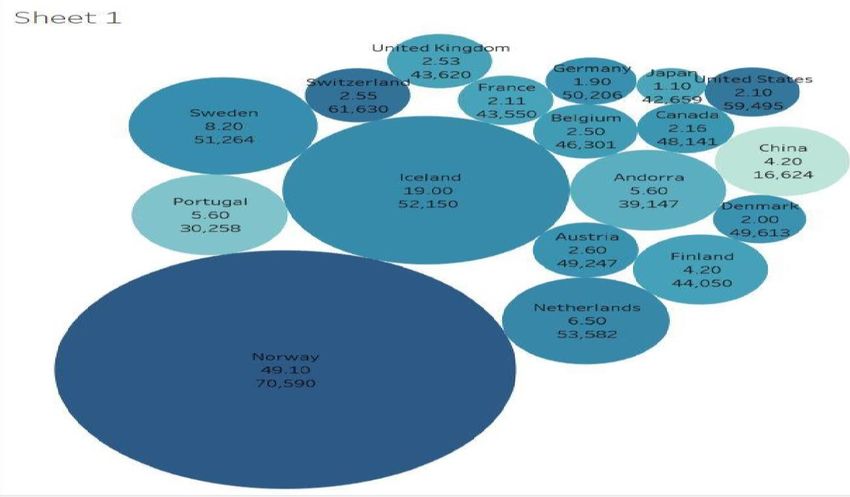
peak timings hence aiding to Peak Load The correlation between GDP Per capital income and
Management. %age share of sales in 2018 is also positive. The data is as
Adoption of EV standards Charging connector in following diagrams:
standards is being developed by the Automotive
Research Association of India. Rating of charging A. Data
sockets: Does household 16A sockets are good Data showing: Countries, GDP Per Capita, %age share of
enough for household EV charging? Or does it sales in 2018
need industry-standard sockets?
Identification of EV charging nodes in the existing
distribution network without affecting the voltage
profile of the network.
Suitable pricing mechanism to be developed, in
case the utility needs to augment the distribution
grid to support EV charging.
6. Result
According to the above literatures there are some major
reasons for growing market share of EV’s. They are:
GDP per capita income
Cost & Features of Charging Infrastructure
Driving Range
Cost of Batteries & Battery Life Figure 1- Share of EVs sales in 2018
Government Incentives
Education about Environmental Implications
© 2020, IRJET | Impact Factor value: 7.529 | ISO 9001:2008 Certified Journal | Page 7790International Research Journal of Engineering and Technology (IRJET) e-ISSN: 2395-0056
Volume: 07 Issue: 05 | May 2020 www.irjet.net p-ISSN: 2395-0072
Figure 2 – Data In Table the magnitude of this “gap”, with emphasis on different
consumer characteristics.
S.no. Items Factor Loadings
I prefer to use EV over 0.911 7. REFERENCES
1) any other type of cars.
[1] "First Revolt electric bike rolls off the assembly line
2) I would recommend EV to 0.828
in Manesar timesnews.com. Manesar". Retrieved 8
others.
August 2019.
3) I would buy an EV as my 0.837
next car.
[2] Shah July 10, Pradeep; Pm, 2019 1:08. "Revolt RV
400 crosses 2500 booking in 15 days: India's 1st
smart electric bike launching this month”. Retrieved
8August 2019
7. CONCLUSIONS
[3] Jump up to: a b Staff (7 August 2019). "Revolt RV 400
We reviewed literature on facts that affect EV adoption AI-enabled electric motorcycle India launch on
and identified several gaps in knowledge and areas for August 28". BGR India. Retrieved 8 August 2019.
further inquiry. First, the literature on EV adoption
suggests that high purchase price is a major reason EV
[4] www.ETAuto.com. "Does Rahul Sharma of Micromax
have the recipe to crack electric 2W market? - ET
uptake. Moreover, though many governments offer
Auto". ETAuto.com. Retrieved 8 August 2019.
incentives to support their thoughts and intentions. EV
driving range is identified as another major reason to EV [5] "Tork motors unveils India's first electric bike".
adoption. Economic Times.
Relatedly, studies suggest there is an appropriate role for [6] TVS Motor invests in e-mobility firm Ultraviolet -
government to support the development of charging The Hindu Business Line
infrastructure for EVs as a means of creating the public
network. Though there are early findings that the [7] Chauhan 2020-01-28T11:44:40Z, Siddharth. "Ather
presence of charging infrastructure significantly relates to Energy zooms into 10 Indian cities with the 450X
electric scooter". TechRadar India. Retrieved 6
rates of EV uptake, there is still an open question in
February 2020.
regards to the direction of causality. In addition, the
literature provides little guidance on how governments [8] "India's first electric bus launched in Bangalore". The
should best add the provision of infrastructure –for Times of India. Retrieved 1 January 2015.
example, through public provision, public/private
partnerships, financial incentives, or mandates. In [9] https://inc42.com/features/what-are-
addition, the literature has only begun to explore the thechallenges-for-the-ev-market-in
kinds of public charging infrastructure that may be india/https://vikaspedia.in/energy/energyefficienc
optimal and how that criteria may be developed per y/electric-vehicles-in-india
regional needs. The literature shows mixed evidence that
consumer characteristics like income, education, and age [10] Shilpa Elizabeth (20 October 2016). "Ashok Leyland
can significantly determine whether a person will be unveils India's first indigenous electric bus". The
interested in purchasing an EV. The survey data is the Economic Times.
biggest limitation in interpreting the results of studies on
[11] "Tata Motors launches electric, hybrid buses priced
EV uptake. The literature provides compelling
up to Rs 2crore". The Economic Times. 25 January
2017.
evidence that there is a substantial gap between people’s
stated likelihood of EV adoption and actual adoption [12] "Goldstone Infratech buses join HRTC fleet".
trends. We suggest more study should be done regarding thehindu.com.
© 2020, IRJET | Impact Factor value: 7.529 | ISO 9001:2008 Certified Journal | Page 7791International Research Journal of Engineering and Technology (IRJET) e-ISSN: 2395-0056
Volume: 07 Issue: 05 | May 2020 www.irjet.net p-ISSN: 2395-0072
[13] "Maharashtra Gets its First Intercity Electric Bus
Services, Leads the Way for Other States". News18.
Retrieved 6 February 2020.
[14] Jump up to: a b "Electric Truck -Time to move
things!". pluginindia.com.
[15] "India Prime Minister today unveiled the National
Electric Mobility Mission Plan (NEMMP) 2020".
Press Information Bureau Government of India.
Retrieved 15 August 2015.
[16] "Charging Ports at Fuel Bunks to Make e-Cars Road
Smart". The New Indian Express. Retrieved 9
September 2016.
[17] "Fuel stations may be rebranded service e-cars".
mydigitalfc.com. Archived from the original on 16
September 2016. Retrieved 9 September 2016.
[18] "Indian Government plans to set up electric car
charging points at petrol bunks". indiancarsbikes.in.
Retrieved 9 September 2016.
[19] "Electric Vehicle Market in India" (PDF).
enincon.com. Retrieved 18 January 2018.
© 2020, IRJET | Impact Factor value: 7.529 | ISO 9001:2008 Certified Journal | Page 7792You can also read


