Azul Pauseless Garbage Collection - Providing continuous, pauseless operation for Java applications
←
→
Page content transcription
If your browser does not render page correctly, please read the page content below
TECHNOLOGY
WHITE PAPER

              Azul Pauseless
              Garbage Collection
              Providing continuous,
              pauseless operation for
              Java applications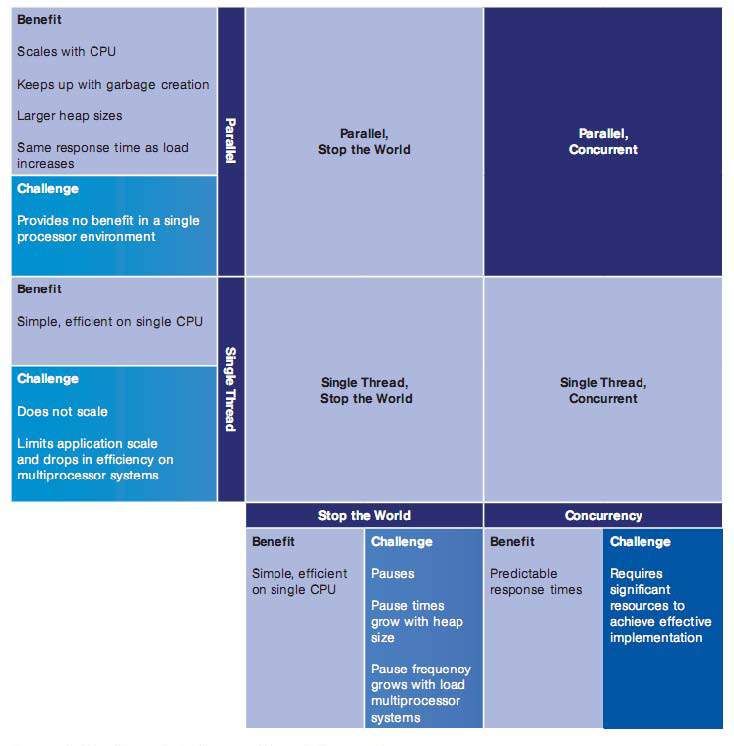
Executive Summary

    Conventional garbage collection approaches limit          This unique technology, which was part of Azul’s Vega
    the scalability of Java applications. At large memory     hardware appliances, is now available as part of
    heap sizes (> than a few GB), garbage collection (GC)     Zing, an innovative JVM. Using C4 garbage collection,
    pause times become too long, causing noticeable           Zing® provides:
    delays in processing and impacting business. The
                                                              • Predictable, consistent garbage collection (GC)
    Azul C4 (Continuously Concurrent Compacting
                                                                behavior
    Collector) garbage collection algorithm improves
    performance and removes barriers to Java scalability      • Predictable, consistent application response times

    by eliminating pause times even at very large heap        • Smoothly scale to memory heap sizes over 300 GB
    sizes. Using a combination of software techniques           with no business-interruptive pauses
    and hardware emulation features, the Azul C4 uses         • Unmatched Java application scalability
    ‘concurrent compaction’ to allow applications to
                                                              • Greatly simplified deployments with fewer,
    continue processing while remapping memory. The
                                                                larger instances
    result is Java applications that scale to tens of cores
                                                              • Reduced garbage collection (GC) tuning and
    and hundreds of gigabytes of heap memory without
                                                                JVM tuning
    degrading response time or application throughput.

2                                                                                    Azul Pauseless Garbage Collection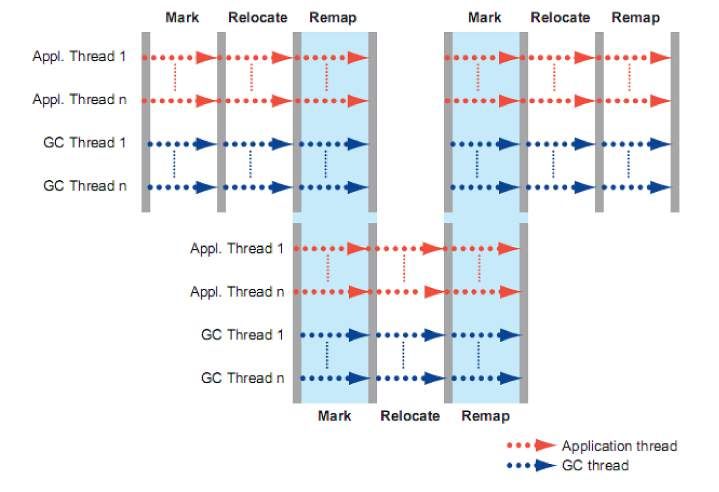
Table of Contents

Executive Summary .  .  .  .  .  .  .  .  .  .  .  .  .  .  .  .  .  .  .  .  .  .  .  .  .  .  .  .  .  .  .  .  .  .  .  .  .  .  .  .  .  .  . 2

Java Scalability Challenges. .  .  .  .  .  .  .  .  .  .  .  .  .  .  .  .  .  .  .  .  .  .  .  .  .  .  .  .  .  .  .  .  .  .  .  .  . 4

Solution: The ZING Elastic Runtime .  .  .  .  .  .  .  .  .  .  .  .  .  .  .  .  .  .  .  .  .  .  .  .  .  .  .  .  .  .  . 5
   Zing Components. .  .  .  .  .  .  .  .  .  .  .  .  .  .  .  .  .  .  .  .  .  .  .  .  .  .  .  .  .  .  .  .  .  .  .  .  .  .  .  .  .  .  . 5

The Azul C4 Garbage Collection Algorithm .  .  .  .  .  .  .  .  .  .  .  .  .  .  .  .  .  .  .  .  .  .  .  .  .  . 6
   Concurrent Marking.  .  .  .  .  .  .  .  .  .  .  .  .  .  .  .  .  .  .  .  .  .  .  .  .  .  .  .  .  .  .  .  .  .  .  .  .  .  .  .  .  . 7
   Concurrent Relocation .  .  .  .  .  .  .  .  .  .  .  .  .  .  .  .  .  .  .  .  .  .  .  .  .  .  .  .  .  .  .  .  .  .  .  .  .  .  .  . 8
       The Concurrent Marking Problem.  .  .  .  .  .  .  .  .  .  .  .  .  .  .  .  .  .  .  .  .  .  .  .  .  .  .  .  .  .  .  .  . 8
       Solving the Concurrent Marking Problem. .  .  .  .  .  .  .  .  .  .  .  .  .  .  .  .  .  .  .  .  .  .  .  .  .  . 10
       The Concurrent Relocation Problem. .  .  .  .  .  .  .  .  .  .  .  .  .  .  .  .  .  .  .  .  .  .  .  .  .  .  .  .  . 11
       Solving the Concurrent Relocation Problem.  .  .  .  .  .  .  .  .  .  .  .  .  .  .  .  .  .  .  .  .  .  .  .  . 11
       C4 Garbage Collection .  .  .  .  .  .  .  .  .  .  .  .  .  .  .  .  .  .  .  .  .  .  .  .  .  .  .  .  .  .  .  .  .  .  .  .  .  .  . 11
		              Mark Phase .  .  .  .  .  .  .  .  .  .  .  .  .  .  .  .  .  .  .  .  .  .  .  .  .  .  .  .  .  .  .  .  .  .  .  .  .  .  .  .  .  .  . 12
		              Relocate Phase.  .  .  .  .  .  .  .  .  .  .  .  .  .  .  .  .  .  .  .  .  .  .  .  .  .  .  .  .  .  .  .  .  .  .  .  .  .  .  .  . 13
		              Details of the Relocate Phase .  .  .  .  .  .  .  .  .  .  .  .  .  .  .  .  .  .  .  .  .  .  .  .  .  .  .  .  .  .  . 14
		              Remap Phase .  .  .  .  .  .  .  .  .  .  .  .  .  .  .  .  .  .  .  .  .  .  .  .  .  .  .  .  .  .  .  .  .  .  .  .  .  .  .  .  .  . 15

GC Tuning and JVM Tuning .  .  .  .  .  .  .  .  .  .  .  .  .  .  .  .  .  .  .  .  .  .  .  .  .  .  .  .  .  .  .  .  .  .  .  .  . 16

Benefits. .  .  .  .  .  .  .  .  .  .  .  .  .  .  .  .  .  .  .  .  .  .  .  .  .  .  .  .  .  .  .  .  .  .  .  .  .  .  .  .  .  .  .  .  .  .  .  .  .  .  .  .  .  .  .  . 16

Conclusion .  .  .  .  .  .  .  .  .  .  .  .  .  .  .  .  .  .  .  .  .  .  .  .  .  .  .  .  .  .  .  .  .  .  .  .  .  .  .  .  .  .  .  .  .  .  .  .  .  .  .  .  .  . 17

Contact Us .  .  .  .  .  .  .  .  .  .  .  .  .  .  .  .  .  .  .  .  .  .  .  .  .  .  .  .  .  .  .  .  .  .  .  .  .  .  .  .  .  .  .  .  .  .  .  .  .  .  .  .  .  . 17

                                                                                                                                            Azul Pauseless Garbage Collection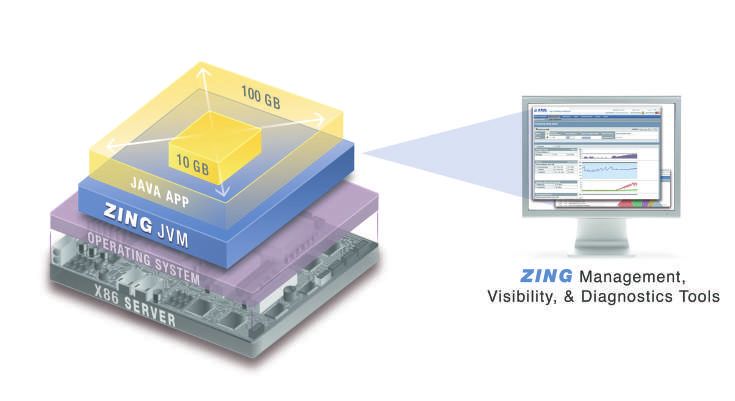
Java Scalability Challenges                              location. In today’s JVMs, compaction is universally
                                                             done as a ‘stop the world’ event that suspends
    Large transaction processing applications with heavy
                                                             application processing. The amount of time it takes
    resource requirements, such as ecommerce and web
                                                             to perform compaction grows linearly with memory
    portals, have become mainstream due to the growth
                                                             heap size, so if it takes two seconds to compact a
    of the Internet. These business-critical applications,
                                                             1GB heap it will take 20 seconds to compact 10 GB.
    most based on the Java platform, face challenges
                                                             At 20-30 seconds, the garbage collection delay be-
    that were inconceivable just a few years ago. They
                                                             comes a crash or an outage, which is unacceptable
    demand access to large amounts of data and memory
                                                             for business-critical applications. Long compaction
    at runtime to support high user and transaction
                                                             pauses create a practical limit on memory heap size
    loads. However, because of the resulting lengthy
                                                             per Java instance of about 2-4 GB.
    garbage collection pauses, Java applications quickly
    reach scalability barriers.                              The impact to business, IT organization and develop-
                                                             ers is significant. Businesses rely on consistently
    The garbage collection process automatically frees
                                                             fast application response times to create an out-
    the heap space used by objects that are no longer
                                                             standing user experience that drives revenue.
    referenced by the application. This makes the pro-
                                                             Garbage collection pauses create inconsistent and
    grammer’s life easier, since he or she no longer has
                                                             slow response times that impact customers. As
    to keep track and free allocated memory. Automating
                                                             a result, systems administrators deploy tens or
    this process reduces the number of bugs in the final
                                                             hundreds of instances using just a few GBs each
    program and saves developers plenty of headaches.
                                                             to keep pause times low and spend hundreds of
    In conventional Java Virtual Machines (JVMs), memory
                                                             additional hours tuning memory heap size, the JVM
    heap space is allocated per instance when the
                                                             and garbage collection to find ways to delay compac-
    application is launched and is, therefore, rigidly
                                                             tion. Developers create complex memory management
    limited. IT organizations spend hours tuning JVMs to
                                                             schemes and shift load to the database tier to keep
    the right amount of heap. Too much, and garbage
                                                             memory heap size low. This creates a complex,
    collection pauses interrupt processing, too little and
                                                             difficult to manage environment that suffers from
    the instance is ‘out-of-memory’ and crashes.
                                                             reduced efficiency; heavy, cross-JVM communication;
    The Java garbage collector also has to spend time        increased overall memory footprint and vastly under
    preventing memory heap fragmentation, where              utilized servers.
    blocks of freed memory are left between blocks in
                                                             To simplify deployments, remove scalability limita-
    use. When too much fragmentation occurs, new
                                                             tions and ensure consistently fast response times,
    objects may not fit in the largest continuous space
                                                             a new deployment platform is needed that eliminates
    and have to be created by extending the heap,
                                                             garbage collection pauses.
    even though overall enough unused memory exists.
    On a virtual memory system, heap growth results
    in extra paging which can also negatively impact
    performance. (Venners, 1996) Heap fragmentation
    eventually and inevitably leads to compaction, where
    the garbage collector reclaims unused memory
    between live objects. Moving the live objects requires
    scanning and fixing all references to reflect the new

4                                                                                   Azul Pauseless Garbage Collection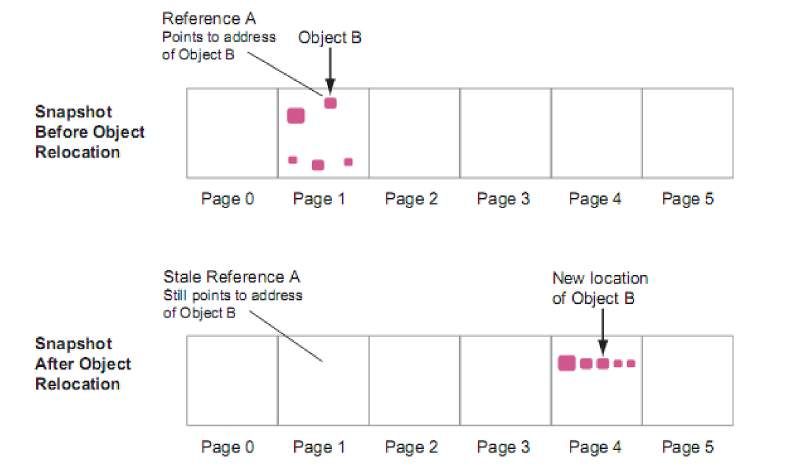
Solution: ZING                                            Zing seamlessly replaces your existing JVM with
                                                              no coding changes. It allows existing Java applica-
    Zing shatters Java scalability barriers and enables
                                                              tions to transparently tap the benefits of Azul’s C4
    existing Java applications to smoothly and reliably
                                                              pauseless garbage collection technology. C4 uses
    scale to dozens of CPU cores and hundreds of
                                                              a combination of software techniques and hardware
    gigabytes of heap memory. Zing automatically scales
                                                              emulation to directly address unacceptable pause
    resources for individual Java application instances up
                                                              times. The garbage collector is parallelized, runs con-
    and down based on real-time demands.
                                                              currently with the application, and is deterministic.
    Zing Components                                           Java application scalability can now reach hundreds
    Zing consists of a Java Virtual Machine (JVM), which      of gigabytes of heap memory without degrading
    is a full-featured JDK installed on the host server and   response-time consistency, application throughput,
    Zing Vision (ZVision), a true, zero-overhead produc-      or efficiency. Complex workarounds, architectural
    tion JVM monitoring, visibility and diagnostics tool.     restrictions and extensive JVM and GC tuning are no
                                                              longer necessary.

5                                                                                    Azul Pauseless Garbage Collection
The Azul C4 Garbage Collection Algorithm world are clearly no longer a good match for modern
Java applications. The availability of parallel collectors
The Azul C4 algorithm has multiple benefits compared
on most commercial JVMs reflects this reality as
to conventional garbage collection approaches.
does the emergence of partially concurrent or mostly
Why Do Conventional Garbage Collectors Have concurrent collectors that increase the portions of
Pauses That Limit Scalability and Performance? garbage collection work that can be done concurrently
Java and J2EE server environments have changed with the application’s execution.
dramatically over the last decade. Today’s applica-
While parallel and mostly parallel collectors have been
tions are deployed in multi-core, multi-GB heap
delivered by most commercial JVMs, concurrency has
memory environments and need to deliver predict-
proven to be a harder problem to solve using existing
able service levels to a wide variety of end users.
computer architectures due to two particularly difficult
Figure 1 shows the two main characteristics that
challenges to achieving concurrent collection: concur-
are evolving to match application requirements:
rent marking, and concurrent relocation. Without solving
parallelism and concurrency.
both problems, the best a collector can do is to reduce
Although single CPU, small heap size systems were the frequency of stop-the-world pause events.
prevalent in early Java application deployments,
today’s applications push the limits of memory heap
size and can run on servers capable of executing
many threads concurrently. Single threaded collec-
tors and non-concurrent collectors that stop the
ZING C4 GARBAGE COLLECTOR BENEFITS GARBAGE COLLECTOR TERMINOLOGY
• Predictable, consistent garbage collection (GC) Concurrent Garbage collection is performed
behavior simultaneously with the execution of the application
• Predictable, consistent application response threads so that applications do not have to pause
times while the heap is garbage collected.
• Smoothly scale to over 300 GB memory heap Parallel More than one garbage collection thread
sizes can be executing at the same time so that garbage
• Unmatched Java application scalability collection can scale with the number of active
application threads.
• Greatly simplified deployments with fewer,
larger instances Compacting To avoid heap fragmentation, objects
• Reduced garbage collection (GC) tuning and are moved by the collector to create more contiguous
JVM tuning free space for faster new object allocation.
6 Azul Pauseless Garbage CollectionFigure 1 Benefits and challenges of parallelism and concurrency
Concurrent Marking concurrently. If concurrent marking cannot be com-
Identifying live objects in a memory heap that is pleted in a bound period of time, a collector must
to go through garbage collection requires some resort to pauses to circumvent concurrency race
form of identifying and “marking” all reachable conditions. These pauses may mark the entire heap
objects. While marking is simple when the applica- while the program is paused. Among commercially
tion is stopped, marking concurrently with a running available JVMs, the collector used by Zing is unique
program presents challenges. Multi-pass marking is in its ability to concurrently mark the entire heap in
sensitive to the mutation rate of the heap, and weak, a single pass for optimal GC performance.
soft and final references are all difficult to deal with
7 Azul Pauseless Garbage CollectionConcurrent Relocation application and freezing all objects, a stop-the-world
Objects in the memory heap must also be concur- collector can mark and follow the static set of live
rently relocated in the process of compacting and objects quite simply. A concurrent collector, on the
defragmenting the heap. In long-running Java ap- other hand, must coexist with a running application
plications compaction is unavoidable as the heap and a continually changing object graph.
gets fragmented over time to a point where further
Concurrent collectors must somehow cooperate with
object allocation is impossible without defragmenta-
the application to ensure that no live objects are
tion. For this reason, all commercial JVMs except
missed in the marking operation. Without such coop-
Azul perform memory heap compaction that pause
eration, hidden pointers to live objects can occur
application execution. Semi-concurrent collectors
if an application thread rearranges the pointers to
that do not concurrently compact delay the pause
an object such that a live object that has already
that they need to perform compaction, and will peri-
been processed by the collector now holds the only
odically pause to perform this task. This is typically
pointer to an object that has not yet been processed.
the longest pause found in any garbage collector
Such hidden pointers result in the erroneous collec-
and has the most impact on performance. Among
tion of a live object, and incorrect program execution.
commercially available JVMs, Zing C4 garbage col-
To further complicate matters, references to objects
lection is unique in its ability to concurrently relocate
keep changing as the application executes. This
objects and compact the heap without a stop-the-
makes multi-pass marking sensitive to the mutation
world pause.
rate of the heap. Weak, soft and final references are
The Concurrent Marking Problem also very difficult to deal with concurrently.
For a collector to identify garbage that can be collected,
it must mark or traverse the entire set of live objects.
Objects not marked as live in this traversal are
“dead” and can be safely collected. By pausing the
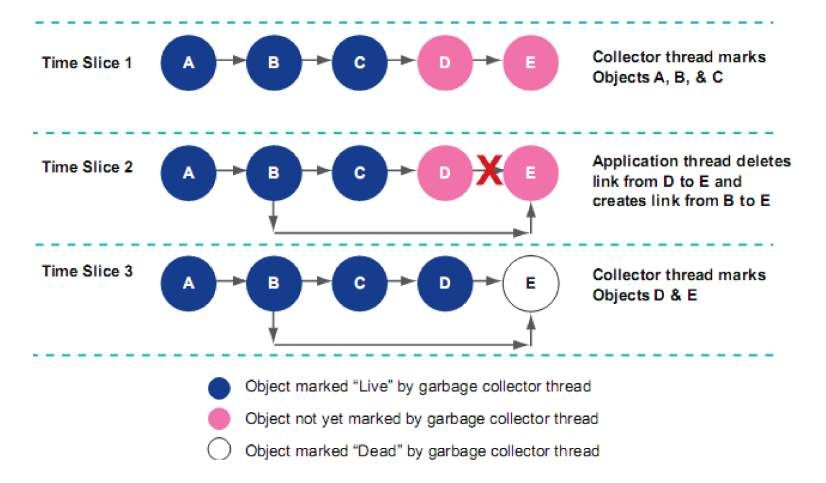
8 Azul Pauseless Garbage CollectionFigure 2 Hidden objects can occur unless the collector thread is made aware of changed references
Figure 2 shows the sequence that would result in a • Application thread stores link to Object E in the
hidden object being missed by the collector unless Object B pointer as shown in Time Slice 2
the collector is made aware of the changed references: • Object B now points to Object E and the garbage
• Collector thread marks Objects A, B, and C as collector has already checked Object B so it won’t
alive, then its time slice ends check again to find Object E
• During Time Slice 1, Object B has no link to Object • Application thread stores a null over Object D’s
E and the collector thread has not yet processed pointer to Object E
Object D which does point to Object E, so Object E • Collector thread continues marking and marks
is not yet found by the collector object D as alive and it marks Object E as dead
• Application thread loads Object D, finds the link to because it has no knowledge that Object E is refer-
Object E, and keeps it in a register enced by Object B (Time Slice 3)
9 Azul Pauseless Garbage CollectionFigure 3 Stale references must be updated before application threads try to access invalid data
Solving the Concurrent Marking Problem will ever happen. Program behavior that exhibits a
A common approach to avoiding the concurrent high rate of pointer change, or continually changing
marking race condition described above is to track behavior can easily present situations where such
all pointer modifications performed by the program “mostly concurrent” marking passes never converge.
as it runs. The collector then revisits all new or modi- The marking phase takes so long that the application
fied pointers after completing a first concurrent pass exhausts all free heap space before the collector
through the Java heap to mark objects. Some “most- is able to free more objects, resulting in a full and
ly concurrent” collectors perform this revisit pass lengthy garbage collection pause.
under stop-the-world full-pause conditions. A revisit The Zing C4 collector performs fully concurrent
pass can be performed concurrently and repeatedly marking which always completes in a single pass.
as long as pointer modifications are still tracked by Azul uses hardware emulated read barriers to inter-
the application, but an eventual stop-the-world final cept attempts by the application to use pointers that
pass is always necessary to complete the marking. have not yet been seen by the garbage collector.
As long as the rate at which reference pointers are The barrier logs such pointers to assure the collector
changed is low enough, the algorithm can eventually visits them, tags the pointers as “seen by the col-
converge to a small enough list of changed pointers lector”, and continues the application’s execution
that stopping the world to revisit it would be unno- without a pause.
ticeable. However, it is impossible to assure that this
10 Azul Pauseless Garbage CollectionThe Concurrent Relocation Problem stale pointers referring to old locations of relocated
Relocating objects without stopping application ex- objects. It then fixes those stale object pointers as
ecution is also challenging. Until now, no commercial they are encountered such that they point to the
JVM has provided such concurrent object relocation correct location without pausing the application.
because of the complexity and costs involved in C4 Garbage Collection in Zing
ensuring that all pointers to moved objects get updated
The Azul C4 garbage collection algorithm relies on a
correctly and data consistency is maintained. Figure
fairly sophisticated read barrier implemented using
3 illustrates the problem of outdated references
hardware emulation to solve both the concurrent
that result when objects are moved. After Object
marking and concurrent relocation problems. The C4
B is moved, it is easy to see that if Reference A is
algorithm is both concurrent and parallel and has the
loaded into memory in an attempt to fetch data held
highly desirable quality of continually compacting and
in Object B, it would retrieve data from a location
defragmenting the heap.
in memory Page 1 whereas Object B now resides
in a different location in memory Page 4. The data Central to the algorithm is a Loaded Value Barrier
retrieved from the wrong location compromises data (LVB). Every Java reference is verified as ‘sane’ when
integrity resulting in incorrect application execution. loaded and any ‘non-sane’ references are fixed in
This problem is especially difficult, since no easy way a self-healing barrier. (A ‘sane’ reference has the
exists to find all of the references to Object B and correct behavior and state.) References that have not
update them before an application thread tries to yet been marked through or that point to relocated
access the data in Object B through an old reference. are caught. This allows a guaranteed single pass
concurrent marker and the ability to lazily and concur-
Without concurrently relocating objects, the heap
rently remap references.
gets continually fragmented, requiring an eventual
defragmentation operation that would relocate While the Azul C4 algorithm actually requires zero
objects under a stop-the-world pause. “Mostly pauses in applications, the JVM implementation
concurrent” collectors will eventually perform such a does include brief pauses at phase transitions for
defragmentation pause, which is typically the longest simplicity and implementation expedience. These
pause found in any garbage collector. pauses are well below the threshold that would
be noticeable to users and are not affected by
Solving the Concurrent Relocation Problem
application scale or data set size. The C4 algorithm
The concurrent relocation problem is very difficult, completely decouples pause time from memory heap
and until now no commercial JVMs have attempted size, allowing applications to scale and use large
to solve it. Instead, “mostly concurrent” collectors amounts of heap memory without impacting perfor-
simply succumb to a long pause when fragmentation mance or user response time. The result is a
gets too high to allocate objects in the heap. highly scalable environment that offers predictable
The Zing C4 garbage collector (GPGC) performs fully performance for large Java applications.
concurrent object relocation, moving and compact-
ing objects in the heap as part of its normal course
of operation. Azul uses hardware emulated barriers
to intercept any attempts by the application to use
11 Azul Pauseless Garbage CollectionFigure 4 The Azul garbage collection cycle
C4 also implements a ‘young’ and ‘old’ generation, discarded so their memory space can be reclaimed.
providing 20x more throughput than a single genera- In addition to marking all live objects, the mark
tion. Both generations are concurrently compacted. phase maintains a count of the total live memory
in each memory page (each page is currently 1MB).
C4 is implemented in three major phases as
This information is later used by the relocation phase
illustrated in Figure 4. The figure illustrates three
to select pages for relocation and compaction. To
complete collection cycles, each cycle including a
avoid the concurrent mark problem described earlier,
mark, relocate, and remap phase. It is important to
the mark phase tracks not only marked objects, but
note that the remap phase of each cycle runs con-
also traversed object references (sometimes referred
currently with the mark phase of the next cycle.
to as pointers). The algorithm tracks the object
The following sections provide an overview of what is references that have been traversed by using an
accomplished in each of the three major phases of architecturally reserved bit in each 64 bit object
the algorithm. reference. This bit, called the “not marked through”
(NMT) bit, designates an object reference as either
Mark Phase
“marked through” or “not marked through”. The
The mark phase finds all live objects in the Java marking algorithm recursively loops through a working
heap. It works concurrently while application threads list of object references and finds all objects reachable
continue to execute, and traverses all reachable from the list. As it traverses the list, it marks all
objects in the heap. The mark completes in a single reachable objects as “live”, and marks each traversed
pass, marking every live object in the heap as “live”. object reference as having been “marked through”.
Objects not marked “live” at the end of the mark
phase are guaranteed to be “dead” can be safely
12 Azul Pauseless Garbage CollectionThe marker’s work list is “primed” with a root set phase, only objects that are known to be dead are
which includes all object references in application not marked as “live”, and all valid references have
threads at the start of a mark phase. All application their NMT bit set to “marked through”. Several as-
thread stacks are scanned for object references, pects of C4 enable the mark phase to have a highly
and all references are queued on the marker’s work deterministic quality. An entire Java heap (large or
list for later traversal. After being queued for later tra- small) can be marked consistently without falling be-
versal, each reference’s NMT bit can be safely set to hind and resorting to long garbage collection pauses
“marked through”. Once a mark phase has started, because the C4 employs:
it becomes impossible for the application threads to
• Single pass completion to avoid the possibility of
observe a “not marked through” reference without
applications changing references faster than the
being intercepted by the LVB.
mark phase can revisit them
Zing includes a read barrier instruction contained • “Self-healing” traps that ensure a finite workload
in hardware emulation software that is aware of the and avoid unnecessary overhead
NMT bit’s function, and ensures application threads
• Parallel marking threads to provide scalability that can
will never see an object reference that was not
support large applications and large dataset sizes
visited by the marker. The NMT bit is tested by the
read barrier instruction that all application threads Relocate Phase
use when reading Java references from the memory The relocate phase reclaims Java heap space occu-
heap. If the NMT bit does not match an expected pied by dead objects while compacting the heap. The
value of “marked through” for the current GC cycle, relocation phase selects memory pages that contain
the processor generates a fast GC trap. The trap code mostly dead objects, reclaims the memory space
corrects the cause of the trap by queuing the refer- occupied by them, and relocates any live objects to
ence to the marker’s work list, setting the NMT bit to newly allocated compacted areas. As live objects are
“marked through”, and correcting the source memory relocated from sparse pages, their physical memory
location the object reference was loaded from, to resources can be immediately reclaimed and used
ensure it, too includes the “marked through” indica- for new allocations. In each cycle, the amount of
tion. It then returns to normal application thread data that is relocated and compacted varies according
execution, with the application observing only the to program behavior and allocation rates. The Zing
safely “marked through” reference. By using the read C4 algorithm requires only one empty memory page
barrier and fast trapping mechanism, the marker is to compact the entire heap.
assured of safe marking in a single pass, eliminating
The relocation phase can continue to free and
the possibility of the application threads causing any
compact memory until it exhausts all dead objects
live references to escape its reach. By correcting the
detected by the previous mark phase. The garbage
cause of the trap in the source memory location (pos-
collector starts a new mark phase with enough time
sible only with a read barrier that intercepts the source
to detect more dead objects well ahead of the need
address), the GC trap has a “self-healing” effect since
for new allocations to use them. To maintain compac-
the same object references will not re-trigger addi-
tion efficiency the collector focuses on relocating
tional GC traps. This ensures a finite and predictable
mostly sparse pages, and starts new mark phases
amount of work in a mark phase.
when the supply of sparse pages starts to run low.
The mark phase continues until all objects in the
marker work list are exhausted, at which point all live
objects have been traversed. At the end of the mark
13 Azul Pauseless Garbage CollectionFigure 5 Live objects are copied out of sparsely populated or “mostly dead” pages
The relocate phase can be summarized as follows: • Physical memory is reclaimed and is available to
feed further compaction or allocation (in a process
• The GC protects ‘from’ pages, and uses the LVB to
called ‘quick release’), but the virtual memory
support lazy remapping by triggering on access to
addresses of the objects are still alive because
references on ‘from’ pages
pointers to those virtual addresses have not been
• The GC relocates any live objects to newly updated
allocated ‘to’ pages
• The page is flagged to indicate that it is in process
• The algorithm maintains forwarding pointers with garbage collection and any attempts to access
outside of the ‘from’ pages its contents should cause a trap
• Physical memory is immediately reclaimed for use
Details of the Relocate Phase
in further compaction or allocation, but virtual
‘from’ space cannot be recycled until all references Whenever the collector decides to relocate a set of
to allocated objects are remapped objects in this phase, it “GC protects” the pages
where the objects reside using a virtual memory
Figure 5 illustrates the impact on the heap when protection feature. Once the pages are protected, the
objects are moved from sparsely populated pages collector can relocate all live objects to new memory
into compacted areas. Forwarding pointers are also locations. The collector maintains “forwarding point-
saved to enable object references to be remapped to er” data, tracking each relocated object’s original
the new object locations. and new address for the duration of the relocation
After a memory page has been scrubbed by the phase. When all live objects have been relocated and
relocate algorithm: forwarding pointer data has been established, the
physical memory resources of the relocated pages
• All live objects have been copied to a new can be released and used for new allocations.
memory page
• A temporary array contains pointers to the
relocated objects
14 Azul Pauseless Garbage CollectionAs each batch of pages is protected in preparation read barrier that intercepts the source address), the
for relocation, all application threads are notified and GC protection trap has a “self-healing” effect, since
their stacks are scanned for references to objects the same object reference will not re-trigger traps.
in the newly relocated pages. All objects referred to This ensures a finite and predictable amount of work
by such references are immediately relocated, and in a concurrent relocation phase.
the references are remapped to point to the new
The “self-healing” trap behavior, coupled with the
object locations. Once this thread stack is complete,
marker’s use of parallel making threads, gives the
it becomes impossible for the application threads to
relocation phase a highly deterministic quality, help-
make a reference to a relocated page without being
ing to ensure that it will consistently release and
intercepted by the LVB.
compact memory without falling behind and resorting
The LVB is also used to detect and correct attempts to a long garbage collection pause. The relocation
to load references to relocated objects during the phase can be terminated whenever the collector
relocate and remap phases. The read barrier instruc- determines a new mark phase is needed. This occurs
tion checks the loaded reference’s value against a when the collector decides to detect more dead
Translation Look-aside Buffer (TLB), and if the refer- objects and sparse pages so that it can keep up with
ence points to a page that is GC protected (being the application’s object allocation rate. A remap phase
relocated), it will generate a fast GC trap. that completes the remapping of references to relocated
objects is overlapped with the next mark phase.
The trap code corrects the cause of the trap by
replacing the reference with a remapped reference Remap Phase
that points to the object’s new location. This remap- The remap phase is responsible for completing
ping is performed using the “forwarding pointer” data the remapping of all relocated object references. It
developed during object relocation. The trap code will ensures that references to the old location of previ-
correct the source memory location for the object ously relocated objects do not remain in the Java
reference from which it was loaded, ensuring that it heap. Such references can still exist at the beginning
now refers to the object’s new location. It will then of the remap phase, as the heap may contain object
return to normal application thread execution with references that were never visited by application
the application observing only the safely remapped threads after their target objects were relocated.
reference. When the remap phase is complete, the GC page
protection and virtual memory resources associ-
In the early part of a page’s relocation, if a read bar-
ated with relocated pages can be safely released
rier is triggered in an application thread before the
since live references to them will no longer exist.
referenced object has been relocated, the trap code
The forwarding pointer data is also released, as it
will cooperatively relocate the object rather than wait
is no longer needed. The remap phase performs its
for the collector to complete relocating the entire
task by scanning all live objects in the heap, and
page. This behavior ensures that application threads
remapping them if they point to a relocated object.
will not wait for an entire page to be relocated before
This scan completely overlaps with the mark phase’s
continuing their own execution. By using the GC
live object scan, and the two phases are performed
protection read barrier and fast trapping mechanism,
together. For each new garbage collection cycle, the
the collector overcomes the concurrent relocation
mark phase is combined with the previous cycle’s
problem described previously. The collector can now
remap phase to form a combined mark/remap phase
safely relocate objects, compact pages, and free
that is executed in a single pass.
dead object memory without stopping application
execution. By correcting the cause of the trap in the
source memory location (again, possible only with a
15 Azul Pauseless Garbage CollectionFigure 6: GC Tuning Parameter Example – Conventional JVM
Java -Xmx12g -XX:MaxPermSize=64M -XX:PermSize=32M -XX:MaxNewSize=2g
-XX:NewSize=1g -XX:SurvivorRatio=128 -XX:+UseParNewGC
-XX:+UseConcMarkSweepGC -XX:MaxTenuringThreshold=0
-XX:CMSInitiatingOccupancyFraction=60 -XX:+CMSParallelRemarkEnabled
-XX:+UseCMSInitiatingOccupancyOnly -XX:ParallelGCThreads=12
-XX:LargePageSizeInBytes=256m …
Java -Xms8g –Xmx8g –Xmn2g -XX:PermSize=64M -XX:MaxPermSize=256M
-XX:-OmitStackTraceInFastThrow -XX:SurvivorRatio=2 -XX:-UseAdaptiveSizePolicy
-XX:+UseConcMarkSweepGC -XX:+CMSConcurrentMTEnabled
-XX:+CMSParallelRemarkEnabled -XX:+CMSParallelSurvivorRemarkEnabled
-XX:CMSMaxAbortablePrecleanTime=10000 -XX:+UseCMSInitiatingOccupancyOnly
-XX:CMSInitiatingOccupancyFraction=63 -XX:+UseParNewGC –Xnoclassgc …
GC Tuning Parameters – Zing
Java -Xmx40g
As each reference is traversed in the combined memory, which allows memory to be shared on-
mark/remap phase, the mark phase marks objects demand between Java instances. Examples of GC
as live and sets the hardware emulated NMT bit to tuning parameters for a conventional JVM and for
the “marked through value.” At the same time, the Zing are shown above.
remap phase looks for references to previously relo-
Benefits
cated objects, and remaps them to point to the new
By utilizing Azul’s unique C4 garbage collection
object locations. Throughout the mark/remap phase,
technology, Zing provides:
the GC protection read barrier continues to protect
the concurrently executing application threads from • Predictable, consistent garbage collection (GC)
encountering references to relocated objects. behavior
GC Tuning and JVM Tuning • Predictable, consistent response times
For most JVMs, extensive GC and JVM tuning is • Smooth scalability to over 300 GB memory
required. A large Java heap size leads to business- heap sizes
interruptive GC pauses, while a small heap can lead • Unmatched Java application scalability
to out-of-memory errors and crashes. Preventing
• Greatly simplified deployments with fewer,
these issues normally entails tweaking a variety
larger instances
of JVM parameters to balance goals for maximum
• Reduced garbage collection (GC) tuning and
pause time, throughput and memory footprint. Using
JVM tuning
Zing, the need for JVM and GC tuning are minimized
through use of the C4 garbage collector and elastic
16 Azul Pauseless Garbage CollectionConclusion Contact Us
Azul Systems has created an efficient, high-perfor- To discover how the Zing can make your Java
mance garbage collection mechanism that provides deployments more scalable, more elastic, more
both concurrent and parallel collection. The collector reliable, and less complex, contact:
provides consistent and contained application response
Azul Systems®
times across a wide range of dynamic workloads.
1.650.230.6500
These benefits are coupled with unmatched Java
info@azulsystems.com
application scalability and immediate response to
www.azulsystems.com
changes in load.
By eliminating garbage collection pauses, Zing
enables existing Java applications to smoothly and
reliably scale to dozens of CPU cores and hundreds
of gigabytes of heap memory. The result is orders of
magnitude increases in throughput to withstand mas-
sive usage spikes with consistently fast response
times, improving service availability and overall user
experience. Available as easy-to-deploy software,
Zing brings scalability, reliability and elasticity benefits
to all Java deployments.
Copyright © 2014 Azul Systems, Inc. 1173 Borregas Ave, Sunnyvale California, USA
17 Azul Pauseless Garbage CollectionYou can also read


