Be Respectful Be Successful - Portland ...
←
→
Page content transcription
If your browser does not render page correctly, please read the page content below
PORTLAND SECONDARY COLLEGE – VCAL – 2022 COURSE SELECTION HANDBOOK                 1|P a g e

        Be Respectful         Be Successful        Be Resilient      Be Creative
Senior School Subject Selection Information
The Senior School at Portland Secondary College consists of Year 11 and Year 12 students (and students
from younger years completing a Senior School subject). There are two main pathways for students
entering into the Senior School to complete:
    • the Victorian Certificate of Education (VCE); or
    • the Victorian Certificate of Applied Learning (VCAL).
Both pathways can include Vocational Education and Training (VET) qualifications.
This handbook focuses on VCAL.

Table of Contents
1.     Victorian Certificate of Education (VCE) ....................................................................................................3
     1.1. Overview ............................................................................................................................................3

2.     Victorian Certificate of Applied Learning (VCAL) .......................................................................................4
     2.1. Overview ............................................................................................................................................4
     2.2. Differences between VCE and VCAL ..................................................................................................5
     2.3 VCAL Curriculum Offerings ......................................................................................................................6
     2.4    School based apprenticeships and traineeships (SBATs) ..................................................................7
     2.5    Work Placement ................................................................................................................................8
     2.6    Work Experience ...............................................................................................................................8

3.     Vocational Education and Training (VET DSS) ...........................................................................................9
     3.1   PSC offering .......................................................................................................................................9
     3.2   TAFE offering .....................................................................................................................................9
     3.3   VET DSS VCE.....................................................................................................................................10

4. Enrolling in VCAL..........................................................................................................................................11

5. Senior Secondary Certificate Reform ..........................................................................................................12

6. Subject Costs................................................................................................................................................14

Subjects
Foundation English Units 1-2 (Intermediate) .................................................................................................15
Foundation Mathematics Units 1-2 (Intermediate) ......................................................................................16
VCAL Numeracy Senior ...................................................................................................................................17
Personal Development Units 1-4 ...................................................................................................................18
VCAL Literacy Senior .......................................................................................................................................19
Work Related Skills Units 1-4..........................................................................................................................20
VET DSS – Certificate II in Community Services .............................................................................................21
VET DSS – Certificate III in Early Childhood Education and Care...................................................................22
VET DSS – Certificate II in Engineering ...........................................................................................................23
VET DSS – Certificate II in Furniture Making ..................................................................................................24
VET DSS – Certificate II in Kitchen Operations ...............................................................................................25
VET DSS – Certificate III in Tourism (Partial Completion) ..............................................................................26

PORTLAND SECONDARY COLLEGE – VCAL – 2022 COURSE SELECTION HANDBOOK                                                                                2|P a g e

               Be Respectful                       Be Successful                       Be Resilient                        Be Creative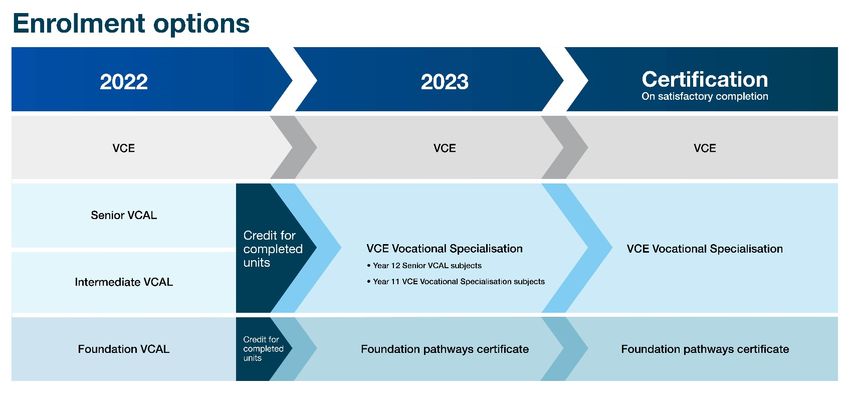
1. Victorian Certificate of Education (VCE)

1.1. Overview
The Victorian Certificate of Education (VCE) provides diverse pathways to further study or training at
university or TAFE and to employment.

Each VCE study is designed to be a 2-year program, with Units 1 and 2 at a Year 11 standard and Units 3
and 4 at a Year 12 standard. Each VCE unit involves 50 hours of scheduled classroom instruction and 50
hours of self-directed learning for students.

A student must satisfactorily complete 16 units to be awarded their VCE, which must include three units
from the English group (including a Unit 3-4 sequence) and at least three other sequences of Unit 3-4
studies.

At PSC it is expected that students will undertake 6 subjects (12 units) in Year 11 and 5 subjects (10 units)
in Year 12, for a total of 22 units. Exceptions can be made to this through the Senior Sub-school AP.

Students may undertake Units 1, 2 or 3 without previously undertaking a Unit of a study. However, it is
strongly advised that students complete Units 1 and 2 of Accounting, Chemistry, Languages and Physics
before attempting Unit 3 of these subjects. Students must successfully undertake Unit 3 before
commencing Unit 4 of a study.

The levels of achievement obtained by students for Units 3 and 4 form the basis of a student's Australian
Tertiary Admissions Rank (ATAR). Most universities require an ATAR for entrance to their courses for high
school leavers (but not all).

If you think the VCE is the pathway for you then you should download the VCE Course Selection Handbook
for further information.

PORTLAND SECONDARY COLLEGE – VCAL – 2022 COURSE SELECTION HANDBOOK                                  3|P a g e

         Be Respectful            Be Successful            Be Resilient             Be Creative
2. Victorian Certificate of Applied Learning (VCAL)
2.1. Overview
VCAL aims to provide the skills, knowledge and attributes to enable students to make informed choices
about pathways to work and further education. The VCAL program is underpinned by personal
development, students’ interests and pathways for Senior School students, in the context of applied
learning.
VCAL is issued at three award levels:
• Foundation (usually offered at the Reengagement Campus only)
• Intermediate (usually undertaken by Year 11 students)
• Senior (usually undertaken by Year 12 students)
Each VCAL course must include units in the following strands:
• Literacy Skills
• Numeracy Skills
• Personal Development Skills
• Work Related Skills
• Industry Specific Skills
At PSC, VCAL students will normally complete an additional VCE subject on top of the above course
requirements, which contributes credit to their program.
It is recommended that all VCAL students undertake a school-based apprenticeship or traineeship (SBAT),
or structured workplace learning (SWL).
If you think the Victorian Certificate of Applied learning (VCAL) is the pathway for you, then you need to
continue to read this Course Selection Handbook.
PORTLAND SECONDARY COLLEGE – VCAL – 2022 COURSE SELECTION HANDBOOK 4|P a g e
Be Respectful Be Successful Be Resilient Be Creative2.2. Differences between VCE and VCAL
VCE - Victorian Certificate of Education VCAL - Victorian Certificate of Applied
Learning
A two-year certificate awarded when Intermediate or Senior certificates awarded
requirements of VCE are met, usually at the as each level is completed, usually at the end
end of two years. of each year.
A main requirement for entry into University Best suited to students seeking
or TAFE courses. Some employers also employment, vocational training,
require it for selection purposes. traineeships, apprenticeships or TAFE
courses.
All units have a theoretical component. Some units have large practical components
Some subjects have a large practical and require students to demonstrate this
component. through written evidence.
Courses consist of VCE units and can include Courses consist of VCAL and VET DSS units
VET DSS Units. at school and/or TAFE. Students can elect to
undertake some VCE Units.
Semester-long units of work where set Semester-long units of work where set
outcomes must be completed by the end outcomes must be completed by the end of
of the semester. the semester.
All students studying a Unit must meet All students studying a Unit must meet the
the same outcomes. same outcomes.
Students must satisfactorily complete 16 Students must complete a minimum of 10
Units, including 3 Units of English, and Units credits per certificate, VCAL core subjects
3 & 4 in at least 3 other subjects. and credit gained through VET DSS or VCE
studies.
Students attend school for six periods per Students attend school for six periods per
day, five days a week. day, three or four days a week, depending on
their approved Work Placement and TAFE
attendance.
VCAL and VCE students are subject to the same Discipline and Wellbeing policies, Uniform
policies and Attendance requirements. All students are enrolled in, and their progress
reported on the same computer system (VASS). Both VCE and VCAL are overseen by VCAA.
VCAL and VCE students are offered the same opportunity to participate in all College
programs including graduation ceremonies, sport and other extra-curricular activities.
PORTLAND SECONDARY COLLEGE – VCAL – 2022 COURSE SELECTION HANDBOOK 5|P a g e
Be Respectful Be Successful Be Resilient Be Creative2.3 VCAL Curriculum Offerings
The following outlines the curriculum offerings for the VCAL program at PSC by VCAL strand.
Strand Intermediate (Year 11) Senior (Year 12)
Literacy Skills VCE Foundation English VCAL Senior Literacy
or or
VCE English (Units 1 + 2) VCE English (Units 3 + 4)
Numeracy VCE Foundation Maths VCAL Senior Numeracy
Skills or or
VCE General Maths (Units 1 + 2) appropriate VCE Maths option
or
VCE Maths Methods (Units 1 + 2)
Personal VCAL Intermediate Personal Development VCAL Senior Personal Development
Development Skills Skills
Skills (PDS)
Work Related VCAL Intermediate Work Related Skills VCAL Senior Work Related Skills
Skills (WRS) or or
VET Certificate II (only if a SBAT is chosen VET Certificate II (only if a SBAT is
for Industry Specific Skills) chosen for Industry Specific Skills)
Industry VET certificate II (1st of 2 years): VET certificate II (2nd of 2 years):
Specific Skills • Engineering • Engineering
• Early Childhood Education and • Community Services
Care (partial completion) • Early Childhood Education and
• Community Services Care (partial completion)
• Kitchen Operations • Furnishing (1st year must be
• Tourism (partial completion) completed)
• Kitchen Operations
Or a School Based Apprenticeship or
• Tourism (partial completion)
Traineeship (SBAT)
Or a School Based Apprenticeship or
Traineeship (SBAT)
VCE Subject Any Year 11 VCE subject (Units 1 and 2) Any Year 11 VCE subject (Units 1 and 2)
PORTLAND SECONDARY COLLEGE – VCAL – 2022 COURSE SELECTION HANDBOOK 6|P a g e
Be Respectful Be Successful Be Resilient Be Creative2.4 School based apprenticeships and traineeships (SBATs)
SBATs at PSC
SBATs are targeted at VCAL students due to the flexibility of their program. Any VCE student interested in a
SBAT must contact the Careers Co-Ordinator for an individualised discussion.
A SBAT will replace a class for students, usually their VET subject.
Students must gain the consent of the Careers Co-Ordinator and the Senior Sub-School Assistant Principal
to undertake a SBAT.
What is a SBAT?
A school based apprenticeship or traineeship (SBAT) offers students the option of combining part-time
employment, school and training. The program runs under a contract with an employer and has a training
plan registered with the Victorian Registration and Qualifications Authority (VRQA). The training must lead
to a nationally recognised qualification.
The vocational training components of SBATs also contribute credit towards a senior secondary certificate.
Many school based apprentices and trainees move on to a full-time contract with their employer after
leaving school, while others choose to continue their education and training at a registered training
organisation or university.
In order to undertake a SBAT, students attend their workplace on a weekly basis (or similar). They also
undertake theory-based training in their own time, through various providers.
Apprenticeship/traineeship: What’s the difference?
Under an apprenticeship:
• An employer agrees to employ the student for the term of the apprenticeship and to support them
in their training for that period of time, and the student agrees to follow instruction and attend off-
the-job and/or workplace-based training.
• If ownership of the business changes during an apprenticeship, the new employer must continue
with the training contract.
• Once the probationary period of the training contract has passed, all parties must agree in order
for the contract to be cancelled. Any disagreement about this can be resolved by contacting the
Victorian Registration and Qualifications Authority (VRQA) on 1300 722 603.
Under a traineeship:
• An employer agrees to employ the student for the term of the traineeship and to support them in
their training for that period.
• The student agrees to follow instruction and attend structured training.
• If ownership of the business changes, the new employer does not have to keep the student on as a
trainee.
• Either the employer or trainee can cancel the contract by signing a cancellation form or letter
stating the date of cancellation. There is no need for mutual agreement.
For more information on SBATs, students and parents should contact the Careers Coordinator and review
the Victorian DET School Based Apprenticeships and Traineeships (SBATs) Guide.
PORTLAND SECONDARY COLLEGE – VCAL – 2022 COURSE SELECTION HANDBOOK 7|P a g e
Be Respectful Be Successful Be Resilient Be Creative2.5 Work Placement
The VCAL program allows students the flexibility to undertake Work Placement (otherwise known as
Structured Workplace Learning (SWL)) instead of undertaking a VCE subject.
Work Placement allows students to:
• gain on-the-job experience while completing their VCAL studies;
• experience various industries/work places they might be interested in; and
• learn new skills in a hands-on/practical environment.
Any days of Work Placement must be pre-approved by the Senior Team and a Structured Workplace
Learning Arrangement Form must be completed and signed by:
• the employer;
• the student;
• the parent/guardian of the student (if the student is under 18 years of age); and
• the Principal or Acting Principal
before the Work Placement commences.
For more information on SWLs, students and parents should contact the Careers Coordinator and review
the Victorian DET Structured Workplace Learning Manual.
2.6 Work Experience
Students are encouraged to explore Work Experience options, particularly throughout the School Holidays.
Students wanting to complete extra Work Experience must complete the appropriate paperwork with the
Career’s Coordinator and the Senior Sub-School Team before commencing.
PORTLAND SECONDARY COLLEGE – VCAL – 2022 COURSE SELECTION HANDBOOK 8|P a g e
Be Respectful Be Successful Be Resilient Be Creative3. Vocational Education and Training (VET DSS)
Vocational Education and Training delivered to secondary students (VET DSS) aims to support quality
vocational pathways and provide options for all students.
Successful completion of the two-year course will result in the award of a Certificate II in most courses.
Failure to successfully complete both years will provide the student with a number of Units of Competency
(outlined by a Statement of Attainment) but will not provide the student with the Certificate of
completion. Completing one year of the course will not result in the award of a Certificate I.
3.1 PSC offering
PSC delivers two VET subjects:
• Kitchen Operations
• Furnishing (only available to students who have completed 1st Year Furnishing)
Both subjects will run from 1pm to 5pm on Thursday afternoon. Kitchen Operations will run in the
Discovery Hospitality Trade Training Centre (next to PSC campus). Furnishing will run on the PSC campus.
Both classes may have other students from local secondary schools.
If enrolment numbers permit, one 1st year Kitchen Operations may run within the normal PSC timetable. It
would be expected that these students complete 2nd year in the 1pm to 5pm timeslot if they continue with
the subject.
3.2 TAFE offering
PSC has a partnership agreement with TAFE to deliver the following VET courses :
• Engineering
• Early Childhood Education and Care*
• Community Services
• Tourism *
These courses will run 1pm to 5pm on Thursdays at SWTAFE Portland Campus (Hurd St, Portland). SWTAFE
is entirely responsible for the delivery of these programs, including teaching, behaviour management,
attendance and pastoral care. Students are responsible for making their own way to the TAFE Campus
ensuring they miss as little class time at PSC as possible.
*SWTAFE is only offering Tourism units which make up part of a Certificate III in Tourism, and Early
Childhood Education and Care units which make up part of a Certificate III in Early Childhood Education
and Care. Students taking this class in Year 11 and 12 need to be aware that this course cannot be
completed in two years. To gain the full certificate students would need to continue with this TAFE course
after they complete Year 12.
PORTLAND SECONDARY COLLEGE – VCAL – 2022 COURSE SELECTION HANDBOOK 9|P a g e
Be Respectful Be Successful Be Resilient Be Creative3.3 VET DSS VCE
The following VET DSS classes are able to be completed by VCE students:
• Kitchen Operations
• Furnishing (only available to students who have completed 1st Year Furnishing)
• Engineering
• Community Services
VCE students wishing to study Engineering or Community Service (i.e. VET DSS courses completed at
SWTAFE) need the approval of the Senior Sub-School Assistant Principal.
For more information, please review the TAFE Subject Information Pages at the end of this guide.
PORTLAND SECONDARY COLLEGE – VCAL – 2022 COURSE SELECTION HANDBOOK 10 | P a g e
Be Respectful Be Successful Be Resilient Be Creative4. Enrolling in VCAL
Students wishing to enroll in VCAL in 2022 should make the appropriate selections on their Course
Selection online request sheet.
Those students will then be invited to complete a formal application for selection into the VCAL Program.
This selection process will be completed early in Term Four.
Applicants will need to prove their suitability for the program and will be interviewed by a panel.
Unsuccessful candidates will be provided with advice and options available for future study and may be
placed on a waiting list.
Please note acceptance to the VCAL Program is not automatic and all applicants will be judged on merit
and on the space available as numbers are limited.
PORTLAND SECONDARY COLLEGE – VCAL – 2022 COURSE SELECTION HANDBOOK 11 | P a g e
Be Respectful Be Successful Be Resilient Be Creative5. Senior Secondary Certificate Reform
Victoria is transforming the delivery of senior secondary education with the introduction of a single senior
secondary certificate that will offer greater access to quality vocational and applied learning pathways for
all students. The senior secondary education reforms aim to provide access to education and training that
is relevant, engaging and that delivers in-demand skills for the future world of work, ensuring that students
can access education that leads to employment.
Next year students will still be able to enrol in either the Victorian Certificate of Applied Learning (VCAL) or
the Victorian Certificate of Education (VCE). The following year, in 2023, VCAL students will be enrolled in
the new VCE Vocational Specialisation or the new foundation pathways certificate which will be introduced
to replace Foundation VCAL.
The VCE Vocational Specialisation will be recognised internationally, be valued by employers and will build
on the strengths of VCAL including providing:
• flexible timetables that allow students to study at school, TAFE and work
• opportunities to experience real-life workplaces
• subjects that will build students skills and prepare them for life after school
• greater access to high quality VET learning, either in school, a neighboring school or a local TAFE
The new certificates are part of a suite of 38 reforms recommended in the Review into Vocational and
Applied Learning Pathways in Senior Secondary Schooling (the Firth Review) to lift the quality and
perception of vocational education and help more students access high-quality applied learning programs.
Course selection in 2022
We are supporting all students in their course selections for 2022 and are providing the following advice
and information to students considering a VCAL pathway.
If students are studying VCAL in 2022 they will transfer into the VCE Vocational Specialisation with credit
for completed VCAL subjects in 2023. In 2023, students will continue to study Senior VCAL subjects in the
new certificate as part of the implementation process. At the end of 2023, these students will be awarded
the VCE Vocational Specialisation if they meet the requirements.
Students who are studying Foundation VCAL over multiple years, including in 2022, will transfer into a new
foundation pathways certificate in 2023 with credit for completed subjects. These students will study the
new foundation subjects and graduate with the foundation pathways certificate.
This approach provides assurance and clarity to current Year 10 students some of whom will be among the
first cohort to receive a VCE Vocational Specialisation certificate in 2023.
The following diagram sets out the senior secondary pathways for students commencing the VCE or VCAL
in 2022.
PORTLAND SECONDARY COLLEGE – VCAL – 2022 COURSE SELECTION HANDBOOK 12 | P a g e
Be Respectful Be Successful Be Resilient Be Creative* Note: Students can also move between certificates
If you would like to talk further about these changes please contact, Carla Shiel. To learn more about
Victoria’s senior secondary certificate reform, you can email the Senior Secondary Reform team.
PORTLAND SECONDARY COLLEGE – VCAL – 2022 COURSE SELECTION HANDBOOK 13 | P a g e
Be Respectful Be Successful Be Resilient Be Creative6. Subject Costs
Portland Secondary College Council continually reviews the Essential Student Learning Items, Optional
Items and Voluntary Contributions (Donations) requested from parents.
The Department of Education SRP allows schools to provide students with free instruction to fulfil the
standard curriculum requirements as outlined in the Victorian Curriculum F-10, VCE and VCAL.
Parent Payment requests (School Fees) are made for Essential Learning Items which are for items and
activities which the school deems essential for student learning.
Year 11 & 12 students will be charged an overarching fee for all core subjects English & Mathematics. In
addition to this there is a base elective subject charge. If your child chooses an elective such as some Art,
Technology, Food or VET subject you will be invoiced an additional fee for the cost of consumables used in
that subject.
We make every effort to keep the cost of items and activities to a minimum and affordable for all parents.
Full subject costs for your child will be available to you at the time of Course Confirmation.
The College understands that some families may sometimes experience financial difficulty and therefore
offers a range of support options and payment arrangements including:
• cash
• cheque
• credit card
• EFTPOS
• Direct Credit
• Centrepay (Centrelink)
• BPay
• Payment Plans via Compass Pay (including individual plans to suit your financial situation)
In 2022 Portland Secondary College will be introducing and incursions/excursions charge. This charge will
cover activities that are linked to the curriculum such as buses and entry fees for local and regional
excursions, Year level activities, cultural excursions, sporting carnivals, etc. and incursions that have been
identified as part of the curriculum. Where Physical Education forms part of the core curriculum the cost
of transport and entry costs for PE will also be included in this cost. Families that have CSEF can apply this
directly to the charge.
Please note that Year Level camps and major excursion such as Top Arts will be invoiced to those students
who elect to attend and will not be included in this incursion/excursion charge. Full details of what will be
included in the is charge will be available at Course Confirmation.
PORTLAND SECONDARY COLLEGE – VCAL – 2022 COURSE SELECTION HANDBOOK 14 | P a g e
Be Respectful Be Successful Be Resilient Be CreativeFoundation English Units 1-2 (Intermediate)
The Foundation English study is designed for students who may require a more vocationally
orientated approach to English or may be aiming to directly enter the workforce upon completing
their senior secondary studies.
Topic
VCE Foundation English focuses on how English is used to communicate through written,
Overview spoken and multimodal texts of varying complexity. The study of this subject enables
students to improve their skills in comprehending and responding to a variety of texts, and
to enhance their overall communication skills.
Unit 1 In this unit, students focus on developing language and communication skills, primarily
through the study of a variety of texts. They develop communication skills in order to listen,
speak, read and write effectively in academic, workplace and social contexts. Topics include
reading and viewing texts, creating texts and listening to and presenting persuasive texts.
In this unit students develop a range of literacy skills and learning strategies. They extend
Unit 2 the understandings and processes required to read and write effectively. Students employ
learning strategies designed to enhance their achievement in and enjoyment of the English
language. Topics include reading and viewing texts, creating texts and listening to and
presenting persuasive texts.
Assessment Students may sit school-based assessments that includes prose summaries, digital or
handwritten graphic representations, instructional and informative writing, oral
presentations, written response to questions, creative responses. Students will sit an exam
at the end of each Unit. Detailed assessment information can be found in the Study Design
(see below).
Associated Foundation English develops language skills which are applicable to a wide variety of
Career Areas: workplaces, academic settings and community participation. Skills such as active listening,
reading for meaning, the use of formal and informal language and the conventions of a
range of text types are widely applicable to the modern workplace.
Ahead of time Students must be accepted into the VCAL Program to study this subject.
Study Design This subject is bound by the Study Design, which can be found on this website.
PORTLAND SECONDARY COLLEGE – VCAL – 2022 COURSE SELECTION HANDBOOK 15 | P a g e
Be Respectful Be Successful Be Resilient Be CreativeFoundation Mathematics Units 1-2
(Intermediate)
Looking for a trade after school but still need to be able to use measurements, work with money and other
number-related tasks? Numeracy is the choice for you. Skip the tests, skip the theoretical, work just on
practical maths projects relevant to jobs and choose Numeracy.
Topic VCE Foundation Mathematics provides for the continuing mathematical development of
Overview students entering VCAL and who do not intend to undertake General, Further or Methods
in Mathematics in both Year 11 and 12. The natural progression for VCAL students
undertaking Foundation Mathematics in Year 11 would be to complete Senior Numeracy in
Year 12.
Foundation In Foundation Mathematics there is a strong emphasis on the use of mathematics in
mathematics practical contexts encountered in everyday life in the community, at work and at study. The
areas of study for Units 1 and 2 of Foundation Mathematics are ‘Space, shape and design’,
Units 1 and 2 ‘Patterns and number’, ‘Data’ and ‘Measurement’.
Assessment Students may sit school-based assessments that includes application, modelling and
problem-solving tasks. Students will sit an exam at the end of each Unit.
Detailed assessment information can be found in the Study Design (see below).
Associated Numeracy is a requirement for the VCAL course and is required by many trades.
Career Areas:
Ahead of time Students must be accepted into the VCAL Program to study this subject.
Study Design This subject is bound by the VCAA Study Design, which can be found on this website.
PORTLAND SECONDARY COLLEGE – VCAL – 2022 COURSE SELECTION HANDBOOK 16 | P a g e
Be Respectful Be Successful Be Resilient Be CreativeVCAL Numeracy Senior
Looking for a trade after school but still need to be able to use measurements, work with money and
other number-related tasks? Numeracy is the choice for you. Skip the tests, skip the theoretical, work
just on practical math projects relevant to real-life and choose Numeracy.
Topic VCAL Numeracy provides for the continuing mathematical development of students
Overview entering Year 12 who do not intend to undertake Unit 3 and 4 Further Mathematics or
Maths Methods. The natural progression for VCAL students undertaking Foundation
Mathematics in Year 11 would be to complete Senior Numeracy in Year 12.
Senior
The purpose of this unit is to enable students to explore mathematics beyond its
Unit 1 familiar and everyday use to its application in wider, less personal contexts such as
newspapers and other media reports, workplace documents and procedures, and
specific projects at home or in the community.
The purpose of this unit is to enable students to develop, refine, extend and apply
numeracy knowledge and skills through an investigation in an unfamiliar industry area
Unit 2 in which they have an interest and may seek future employment. The numeracy
involved focuses on Number, Measurement, Financial Numeracy, and Probability and
Statistics.
Assessment Students may sit school-based assessments that includes application, modelling and
problem-solving tasks.
Detailed assessment information can be found in the Study Design (see below).
Associated Numeracy is a requirement for the VCAL course and is required by many trades.
Career Areas:
Ahead of time Any year 12 student can apply to the Senior Sub-School Assistant Principal for approval
to study this subject. This subject is a continuation of students who complete
Foundation Numeracy in Year 11.
Study Design This subject is bound by the VCAA Study Design, which can be found on this website.
PORTLAND SECONDARY COLLEGE – VCAL – 2022 COURSE SELECTION HANDBOOK 17 | P a g e
Be Respectful Be Successful Be Resilient Be CreativePersonal Development Units 1-4
Topic The Personal Development Skills units recognise learning that is valued in the community
Overview and develop the knowledge, skills and attributes identified in this strand. The units
emphasise the importance of self and connection to the community through locally
developed programs. Students apply their learning through community-based projects,
both internally and externally.
Unit 1 Unit 1 focuses on the development of appropriate knowledge, skills and attributes in
relation to: resilience, self-esteem and efficacy; health and wellbeing; family and social
(Intermediate) connectedness; environmental awareness; critical and creative thinking; planning and
organisational skills; problem solving and interpersonal skills; collaborative skills; leadership
and decision-making skills for group work or teamwork.
Unit 2 Unit 2 focuses on the development of appropriate knowledge, skills and attributes in
relation to: community engagement; social and environmental awareness; participation in
(Intermediate) a democratic society; social connectedness; critical and creative thinking; planning and
organisational skills; problem-solving and interpersonal skills.
Unit 3 This unit focuses on the development and implementation of appropriate knowledge, skills
and attributes in relation to: resilience, self-esteem and efficacy; health and wellbeing;
(Senior) family and social connectedness; environmental awareness; critical and creative thinking;
self-directed planning and organisational skills; problem-solving and interpersonal skills;
collaborative skills; leadership and decision-making skills for group work and teamwork and
builds directly on skills learned at the intermediate level.
Unit 4 This unit focuses on the development and implementation of appropriate knowledge, skills
and attributes in relation to: community engagement; social and environmental awareness;
(Senior) participation in a democratic society; social connectedness; critical and creative thinking;
planning and organisational skills; problem-solving and interpersonal skills and builds
directly on skills learned at the intermediate level.
Assessment Students may sit school-based assessments that includes written work, oral presentations,
object production and project implementation. Students must be observed to demonstrate
achievement of a learning outcome on more than one occasion and in different contexts to
ensure the assessment is valid, reliable, fair, flexible and equitable.
Detailed assessment information can be found in the Study Design (see below).
Associated For most Careers students need the ability to work with others.
Career Areas:
Ahead of time Any year 10 student can apply to the Senior Sub-School Assistant Principal for approval to
study this subject in Year 10 and 11.
Study Design This subject is bound by the VCAA Study Design, which can be found on this website.
PORTLAND SECONDARY COLLEGE – VCAL – 2022 COURSE SELECTION HANDBOOK 18 | P a g e
Be Respectful Be Successful Be Resilient Be CreativeVCAL Literacy Senior
Topic Overview The purpose of the literacy curriculum selected for this stand is to enable the
development of knowledge, skills and attributes relevant to reading, writing and oral
communication and their practical application in the contexts of everyday life, family,
employment, further learning and community.
Reading and
The purpose of this unit is to enable students to develop the knowledge, skills and
Writing attributes to read and write complex texts. The texts will deal with general situations and
include some abstract concepts or technical details. At this level, students produce texts
that incorporate a range of ideas, information, beliefs or processes and have control of
the language devices appropriate to the type of text.
Students identify the views shaping the text and the devices used to present that view
and express an opinion on the effectiveness and content of the text. At the end of the
unit students will be able to read, comprehend and write a range of complex texts across
a broad range of contexts.
The unit is broken into 4 separate areas of study:
-Self-expression
-Public Debate
-Practical Purposes
-Knowledge
Oral
The purpose of this unit is to enable students to develop the skills and attributes to
Communication speak in complex discussion. A supportive and encouraging learning environment needs
to be developed so that students feel comfortable to take risks and participate safely.
Students should not be forced to participate until they feel safe to do so. By rotating
turns and scaffolding skills, students can develop this confidence. Establishing a
consensus on guidelines for talks and discussions by listening to and respecting others is
important.
At the end of this unit students will be able to use and respond to spoken language,
around every day subject matter, which may include some unfamiliar aspects, for a
range of purposes in a number of contexts, which may be interrelated.
Assessment The purpose of VCAL assessment is to measure a student’s achievement of a learning
outcome by collecting evidence about their performance and making a judgment about
whether they have met the requirements of that learning outcome. These requirements
are clearly outlined in the elements of each learning outcome.
Associated Apprenticeships and traineeships, further study at TAFE, full-time employment within
Career Areas: vocational areas.
Ahead of time Any year 12 student can apply to the Senior Sub-School Assistant Principal for approval
to study this subject. This subject is a continuation of students who complete Foundation
English in Year 11.
Study Design This subject is bound by the Study Design, which can be found on this website.
PORTLAND SECONDARY COLLEGE – VCAL – 2022 COURSE SELECTION HANDBOOK 19 | P a g e
Be Respectful Be Successful Be Resilient Be CreativeWork Related Skills Units 1-4
The purpose of the VCAL Work Related Skills Strand is to develop student skills, knowledge and
attributes valued within community and work environments as a preparation for employment. The
development of employability skills within this strand provides students with a capacity to explore,
consider and choose from a range of pathways. Knowledge and understanding of occupational health
and safety (OHS) is integral to student preparation for a variety of community and work
environments.
Topic Students are offered a range of experiences within a particular industry sector to help
Overview them make informed decisions for future pathway choices and to promote their
employability skills. It is not specifically intended that students will graduate as
qualified in an occupational area, but that they will have gained highly relevant
experience and employability skills for an industry sector.
Unit 1 Work Related Skills Unit 1 is designed to develop knowledge and understanding of OHS,
(Intermediate) as well as a range of work environments and pathways. This unit has five learning
outcomes at the Intermediate level.
Work Related Skills Unit 2 is designed to develop knowledge, skills and attributes, with a
Unit 2 particular focus on employability skills and their application in specific industry and
(Intermediate) workplace settings. This unit has six learning outcomes at the Intermediate level.
Unit 3 Work Related Skills at this unit is designed to develop knowledge and understanding of
(Senior) OHS, as well as a range of work environments and pathways. This unit has five learning
outcomes at the Senior level.
Work Related Skills at this unit is designed to develop knowledge, skills and attributes,
Unit 4 with a particular focus on employability skills and their application in specific industry
(Senior) and workplace settings. This unit has six learning outcomes at the Senior level.
Assessment Students may sit school-based assessments that includes a comparative essay,
analytical essay, review analysis, creative response, reflective commentary and an
interpretative essay. Detailed assessment information can be found in the Study Design
(see below).
Associated Employability skills and knowledge of Occupational Health and Safety Skills is necessary for
Career Areas: all jobs.
Ahead of time Any year 10 student can apply to the Senior Sub-School Assistant Principal for approval
to study this subject in Year 10 and 11.
Study Design This subject is bound by the Study Design, which can be found on this website.
PORTLAND SECONDARY COLLEGE – VCAL – 2022 COURSE SELECTION HANDBOOK 20 | P a g e
Be Respectful Be Successful Be Resilient Be CreativeVET DSS – Certificate II in Community Services
Community Services is held at SWTAFE on a Thursday from 1-5pm.
Topic This course is students who are interested in further study in both the health and
Overview community-based services that focus on the promotion of good health practices. The
course reflects the role of workers in the community and / or residential setting who follow
individual health and wellbeing plans for people who may require support due to ageing,
disability or some other reason. Students will learn about the health and community
services sector and explore its different contexts of work.
You will learn: - To provide first aid
- How to respond to client needs
- Workplace health and safety
- To work within a community development framework
- How to manage personal stress in the workplace
Education - Certificate III in Community Services
Pathways: - Certificate III in Individual Support
- Certificate IV in Child, Youth and Family Intervention
- Certificate IV in Disability Support
- Diploma of Community Services
- Diploma of Nursing
Assessment Each UOC has set work to complete, with feedback from your trainer
Associated - Aged care worker
Career Areas: - Case worker or manager
- Child welfare officer
- Community health worker
- Counsellor
- Disability support officer
- Residential carer
- Social welfare worker
- Youth worker
- Nurse
Who can take VCAL any year, VCE Year 11 or 12
this subject Students must complete the first year of the course before they can undertake 2nd year.
Credit Credit:
1st Year: 2 x Year 11 VCE credits; 2 VCAL credits
2nd Year 2x Year 12 VCE credits; 2 VCAL credits
2nd Year: Scored assessment (full ATAR contribution)
PORTLAND SECONDARY COLLEGE – VCAL – 2022 COURSE SELECTION HANDBOOK 21 | P a g e
Be Respectful Be Successful Be Resilient Be CreativeVET DSS – Certificate III in Early Childhood
Education and Care
Early Childhood Education and Care is held at SWTAFE on a Thursday from 1-5pm.
Topic Do you love kids, toddlers and babies? Gain the skills you need to provide quality
Overview education to children. If you are passionate about the development of young children
and want to learn more about providing quality education and care in a range of
environments, this course is for you. You will learn to provide safe, nurturing,
meaningful and inclusive education and care for children in a fun and playful setting.
Learn using role plays, simulations, project work and a total of 120 hours of structured
workplace learning over two years (60 hours per year) in a variety of settings.
You will learn: - How to care for babies and children up to 12 years old
- How to develop positive relationships with children
- How to provide experiences to support children’s play and learning
- Effective interaction with children
- Childhood development
- Workplace health and safety and first aid.
Education - Certificate III in Early Childhood Education and Care
Pathways: - Certificate III in Education Support
- Diploma of Early Childhood Education and Care
- Bachelor of Early Childhood Teaching
Assessment Each UOC has set work to complete, with feedback from your trainer
Associated - Early childhood educator
Career Areas: - Family day carer
- Kindergarten or preschool assistant
- Nanny or out-of-school hours care assistant
Who can take VCAL any year, VCE Year 11 or 12
this subject Students must complete the first year of the course before they can undertake 2nd year.
Credit Credit:
1st Year: 2 x Year 11 VCE credits; 2 VCAL credits
2nd Year 2x Year 12 VCE credits; 2 VCAL credits
2nd Year: Scored assessment (full ATAR contribution)
PORTLAND SECONDARY COLLEGE – VCAL – 2022 COURSE SELECTION HANDBOOK 22 | P a g e
Be Respectful Be Successful Be Resilient Be CreativeVET DSS – Certificate II in Engineering
Engineering is held at SWTAFE on a Thursday from 1-5pm.
Topic This course includes the theoretical and practical components of basic engineering studies.
Overview Students learn the correct use and capabilities of a range of hand tools, perform basic
machining processes and apply basic fabrication techniques to work with metal.
You will learn: - Basic machine processing and fabrication techniques
- Workplace health and safety
- To use hand and power tools
- Creating 3D sketches and drawings
- Configuring and programming robotics
- Computer aided engineering drawings
- To perform computations.
Education - Engineering apprenticeships
Pathways: - Careers in manufacturing industries
- Certificate III in Engineering - Fabrication Trade
- Certificate III in Engineering - Mechanical Trade
- Certificate IV in Engineering
Assessment Each UOC has set work to complete, with feedback from your trainer
Associated - Boilermaker
Career Areas: - Engineer
- Machinist
- Fitter and turner
- Hydraulic controls technician
- Metal fabricator
Who can take VCAL any year, VCE Year 11 or 12
this subject Students must complete the first year of the course before they can undertake 2nd year.
Credit Credit:
1st Year: 2 x Year 11 VCE credits; 2 VCAL credits
2nd Year 2x Year 12 VCE credits; 2 VCAL credits
2nd Year: Scored assessment (full ATAR contribution)
PORTLAND SECONDARY COLLEGE – VCAL – 2022 COURSE SELECTION HANDBOOK 23 | P a g e
Be Respectful Be Successful Be Resilient Be CreativeVET DSS – Certificate II in Furniture Making
Furniture Making is held at PSC on a Thursday from 1-5pm.
Only students who have completed First Year Furniture Making are eligible to enrol in Second Year
Furniture Making for 2022
Topic This course includes the theoretical and practical tasks, designed to introduce and develop
Overview the skills required in the Furnishing and Cabinet making industry. Students undertake
projects which allow them to research, use CAD design, and develop prototypes and
constructive furniture.
You will learn: - To use furniture making sector hand and power tool
- To assemble furnishing components
- To plan and undertake a basic furniture making project
- Making measurements and calculations
Education - Apprentice cabinet maker or joiner
Pathways: - Certificate III in Joinery
- Certificate III in Cabinet Making
- Certificate IV in Building and Construction (Building)
Assessment Each UOC has set work to complete, with feedback from your trainer
Associated - Cabinet maker
Career Areas: - Furniture maker
- Kitchen installer
- Builder
- Carpenter
- Sales representative in kitchen/bathroom industry
- Production operator in a cabinet making enterprise
Who can take Year 12 VCE or VCAL students who have completed the first year of the course
this subject
Credit Credit:
2nd Year 2x Year 12 VCE credits; 2 VCAL credits
2nd Year: Scored assessment (full ATAR contribution)
PORTLAND SECONDARY COLLEGE – VCAL – 2022 COURSE SELECTION HANDBOOK 24 | P a g e
Be Respectful Be Successful Be Resilient Be CreativeVET DSS – Certificate II in Kitchen Operations
Are you interested in the Hospitality Industry? Would you like to get a step up in part time
employment? Do you like cooking and preparing food? If so, you will enjoy Kitchen Operations.
Kitchen Operations is held at PSC on a Thursday from 1-5pm.
Topic This course is designed to provide students with a range of food preparation and cookery
Overview skills to prepare food and menu items in a kitchen. Graduates typically provide routine and
repetitive tasks and are directly supervised. Pathways may include employment in various
workplaces within the hospitality industry such as restaurants, hotels, catering, operations,
clubs, pubs, coffee shops, institutions, aged care facilities, hospitals, prisons and schools.
You will learn: - Hygienic practices for food safety
- How to clean kitchen premises and equipment
- How to make appetisers and salads
- How to cook vegetable, fruit, egg, pasta and rice dishes
- How to prepare poultry dishes
Education - Certificate III in Hospitality
Pathways: - Certificate III in Commercial Cookery
- Certificate III in Baking
- Certificate III in Cake and Pastry
- Certificate III in Tourism
- Certificate IV in Travel and Tourism
- Diploma of Travel and Tourism
Assessment Each UOC has set work to complete, with feedback from your trainer
Associated - Barista
Career Areas: - Bar attendant
- Kitchen hand or chef
- Waiter
- Butcher or bakery assistant
- Catering assistant
Who can take Year 12: VCAL any year, VCE Year 11 or 12
this subject
Students must complete the first year of the course before they can undertake 2nd year.
Credit Credit:
1st Year: 2 x Year 11 VCE credits; 2 VCAL credits
2nd Year 2x Year 12 VCE credits; 2 VCAL credits
2nd Year: Scored assessment (full ATAR contribution)
PORTLAND SECONDARY COLLEGE – VCAL – 2022 COURSE SELECTION HANDBOOK 25 | P a g e
Be Respectful Be Successful Be Resilient Be CreativeVET DSS – Certificate III in Tourism (Partial
Completion)
Tourism is held at SWTAFE on a Thursday from 1-5pm.
Topic This course is designed to introduce students to the local industry of tourism and the
Overview important industry for the Great Ocean Road region. Students will gain an insight and basic
knowledge of the tourism industry operation, understanding of cultural awareness and
service provision to international visitors.
Students will learn the importance of customer service skills within a retail and hospitality
environment and students will develop marketing skills including digital merchandising and
social media.
This is a two year course. Please note this is a partial completion program. On successful
completion of this program, students will be eligible for a statement of attainment towards
the completion of this course.
You will learn: - To source and use travel information on the tourism industry
- To show social and cultural sensitivity
- To lead tour groups
- How to interpret aspects of local Australian Indigenous culture
- Customer interaction and assistance
- Workplace health and safety
- To provide accommodation reception services
- To use social media in business
Education - Certificate III in Tourism
Pathways: - Certificate IV in Travel and Tourism
- Diploma of Travel and Tourism Management
Assessment Each UOC has set work to complete, with feedback from your trainer
Associated - Travel agent
Career Areas: - Events and conference officer
- Accommodation and reservations coordinator
- Cruise ship assistant
- Tour guide
- Visitor information officer
Who can take VCAL any year, VCE Year 11 or 12
this subject
Students must complete the first year of the course before they can undertake 2nd year.
Credit 1st Year: 2 x 11 VCE credits, 2 VCAL credits
2nd Year 2 x Year 12 VCE credits, 2 VCAL credits
No study score available
PORTLAND SECONDARY COLLEGE – VCAL – 2022 COURSE SELECTION HANDBOOK 26 | P a g e
Be Respectful Be Successful Be Resilient Be CreativeGlossary of Terms
VCE The Victorian Certificate of Education.
VCAL The Victorian Certificate of Applied Learning.
VET DSS Vocational Education & Training Delivered to
Secondary Students.
SBA School-based Apprenticeship.
VCAA The Victorian Curriculum & Assessment Authority.
STUDY A subject. Most VCE studies are made up of 4 units
(Unit 1 & 2 in Year 11 and Unit 3 & 4 in Year 12).
UNIT A self-contained study of a semester’s length
representing about 100 hours of work, of which 50
hours are class time and 50 hours homework.
RTO Registered Training Organisation.
SEMESTER A half year
UNITS 1 & 2 Level of difficulty usually associated with Year 11.
UNITS 3 & 4 Level of difficulty usually associated with Year 12.
LEARNING OUTCOMES What you must know, by the time you have
finished a Unit.
S/N S - refers to satisfactory completion
N - refers to work that has not reached a
satisfactory level
SATISFACTORY COMPLETION A Unit of work has been satisfactorily completed
when all of the outcomes have been met as
specified in the Study Design. Students will be
made aware of the criteria for satisfactory
completion of each unit. 90% attendance and
meeting are two of the criteria.
SCHOOL ASSESSED TASK (SAT) A task done in school in design or practical-based
studies to assess how you are performing in Units
3 & 4, set and marked by teachers, and reviewed
externally by VCAA.
SCHOOL ASSESSED COURSEWORK (SACS) The assessment of coursework, done mainly in
class time, to establish how you are performing in
Units 3 & 4.
VTAC The Victorian Tertiary Admissions Centre which
organises the process by which students apply and
gain entry to a tertiary course.
GAT The General Achievement Test done by all students
doing a Unit 3 & 4 sequence. It is used by the VCAA
to check that schools are marking school assessed
course work to the same standard.
ATAR Australian Tertiary Admission Rank.
STUDY DESIGN Course and assessments for each subject that are
set by VCAA.
STUDY SCORE A score from zero to 50 which shows how you
performed in a VCE study, relative to all other
students doing the same study.
PORTLAND SECONDARY COLLEGE – VCAL – 2022 COURSE SELECTION HANDBOOK 27 | P a g e
Be Respectful Be Successful Be Resilient Be CreativePORTLAND SECONDARY COLLEGE – VCAL – 2022 COURSE SELECTION HANDBOOK 28 | P a g e
Be Respectful Be Successful Be Resilient Be CreativeYou can also read


