Student Information Year 7 - The ...
←
→
Page content transcription
If your browser does not render page correctly, please read the page content below
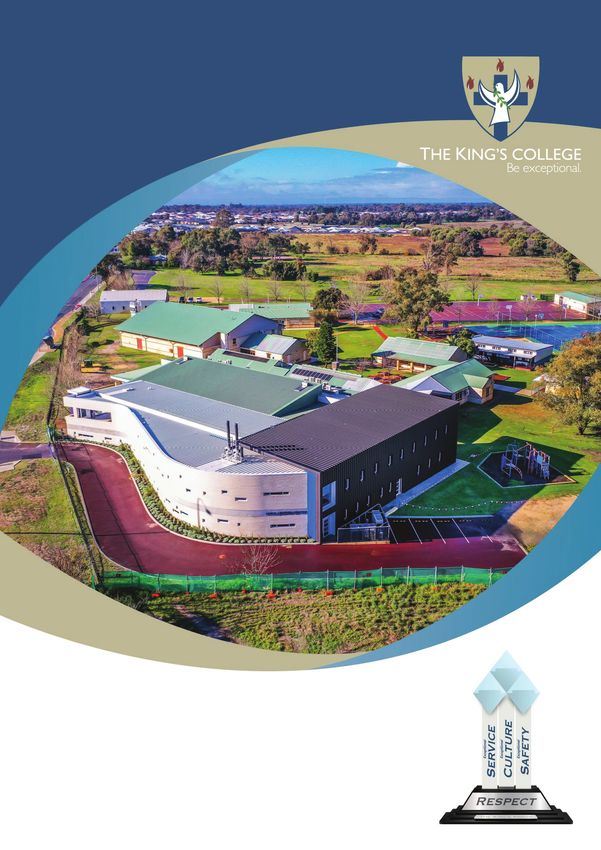
Staff Handbook
Student        2020
        Information
Year 7

Compliance and Review

The King’s College is committed to the continuous improvement of its Child Protection Programme
and adhering to the WA child protection laws, regulation and standards.

The King’s College            Reviewed by: The Principal              Updated: October 2019
  1 |Handbook
Staff Page       - Staf      f Endorsed
                                 H a n dby:bThe
                                             o oSchool
                                                 k 2 0Board
                                                        20            Next review: October 2020
THE KING’S COLLEGE
PO BOX 450
KWINANA WA 6966
170 BERTRAM ROAD
WELLARD
PHONE: 9411 4100
EMAIL: info@tkc.wa.edu.au
WEBSITE: https://thekingscollege.wa.edu.au
The King’s College recognises the importance of student safety and wellbeing as a prerequisite for effective learning.
For this reason, the College has implemented, and will continue to review and update, strategies to build a positive school
culture that fosters care and respect between students, and between staff and students.
The King’s College offers a safe, caring and positive environment in which a supportive teaching and learning community
can flourish. The College promotes student safety, student wellbeing and recognises student diversity. Strategies for the
prevention of harassment, aggression, violence and bullying, including cyber-bullying, have been put in place and are
continually reviewed and updated, as required.
The King’s College implements policies, procedures, practices and strategies for the prevention of grooming and child
abuse. These policies, procedures and strategies will be reviewed regularly. An age-appropriate protective behaviours
curriculum is delivered from Kindergarten to Year 12 to assist students in understanding appropriate and inappropriate
interactions; how and whom to tell if the boundary of appropriate interactions is crossed or violated.
All students have the right to feel safe and valued and, as such, any form of child abuse, corporal punishment or degrading
punishment and discrimination on any basis is not allowed by the College in accordance with government legislation and
the Australian Human Rights Commission.
The King’s College takes all complaints seriously and follows a clearly outlined Complaints Policy available on the
College website and incorporated into Information Booklets, the Student Diary and Family Handbook.
2020 1CONTENTS
WELCOME_____________________________________________________________________________________ 4
A Note to Parents and Carers_____________________________________________________________________ 5
INTRODUCTORY INFORMATION__________________________________________________________________ 6
About the College______________________________________________________________________________ 6
Purpose, Vision, Passion, Values___________________________________________________________________ 6
Core Principles_________________________________________________________________________________ 6
College Affirmation_____________________________________________________________________________ 7
Academic Guidelines____________________________________________________________________________ 7
Academic Support______________________________________________________________________________ 7
Secondary School Timetable______________________________________________________________________ 8
Teaching and Learning Philosophy_________________________________________________________________ 8
Academic Overview_____________________________________________________________________________ 9
Home Learning ________________________________________________________________________________ 9
Learning Journals______________________________________________________________________________ 10
The Student Diary _____________________________________________________________________________ 10
Academic Guidelines___________________________________________________________________________ 11
Bookwork Guidelines___________________________________________________________________________ 11
Assessment Guidelines_________________________________________________________________________ 12
SEQTA______________________________________________________________________________________ 12
Formal and Informal Assessment__________________________________________________________________ 12
Extra-curricular Activities________________________________________________________________________ 12
Tutoring_____________________________________________________________________________________ 12
COURSE INFORMATION________________________________________________________________________ 13
YEAR 7 CURRICULUM_________________________________________________________________________ 13
English______________________________________________________________________________________ 14
Humanities and Social Sciences ___________________________________________________________________ 14
Mathematics__________________________________________________________________________________ 14
Science______________________________________________________________________________________ 15
Christian Studies_______________________________________________________________________________ 15
Assembly/Chapel______________________________________________________________________________ 15
Health Education______________________________________________________________________________ 15
Physical Education _____________________________________________________________________________ 15
START______________________________________________________________________________________ 16
2 The King’s College Student Information Handbook A safe environment where we are free to discover who we really are. That’s exceptional!SPECIALIST SUBJECTS___________________________________________________________________________ 17
Digital Technology_____________________________________________________________________________ 17
Drama ______________________________________________________________________________________ 17
Food and Fibre_______________________________________________________________________________ 17
Music_______________________________________________________________________________________ 17
Visual Art____________________________________________________________________________________ 18
2020 3WELCOME
At The King’s College, we are genuinely interested in the well-being of each student. Our aim is to see students reach
their full potential academically, emotionally and spiritually. It is our hope that every student will be exposed to a wide
range of educational experiences whilst at the College. Students will be encouraged to take advantage of every
opportunity to develop their skills and talents in a safe and caring environment.
Throughout their time at the College, students will be exposed to new challenges and greater expectations will be
placed upon them. It is important for students to receive a well-balanced education and to be challenged both within the
classroom academically, as well as be challenged outside the mainstream classroom. These opportunities and challenges
are designed to build character and help to develop students for the world outside school.
The information provided in this booklet is designed to inform parents/carers and students about the academic structure
and educational opportunities of the College and to assist in further understanding the expectations of secondary school.
It is important for parents/carers to be aware of these changes and expectations. Please encourage your child to
participate fully in all aspects of the College life. Encourage your son/daughter to try new things and to persist in their
efforts, even when tasks are difficult. Constant encouragement and participation will help every student get the best
out of the year and make their continued progress throughout secondary school easier and more enjoyable.
4 The King’s College Student Information Handbook A safe environment where we are free to discover who we really are. That’s exceptional!A NOTE TO PARENTS AND CARERS
Year 7 is a vital year in the development of your child’s education. It is a year that incorporates the same individual care
and excitement associated with the Primary School whilst adding the specialised subjects, facilities and academic rigour of
the Secondary School.
Year 7 is a year of change for students; changes in the daily routine, subjects, home learning expectations, forms of
assessment and testing as well as changes in the form of contact with teaching staff. There is more to study, more subjects,
more opportunity to participate in extra-curricular activities and more responsibility for students.
The following pages explain the behaviour and academic expectations of the secondary school as well as the subjects
that are compulsory for Year 7 students and the Specialist Elective subjects that students will undertake during the year.
Please take the time to become familiar with what is on offer for Year 7 students at The King’s College.
Students in Year 7 are encouraged to try new subjects and to embark on new challenges in preparation for Year 8.
In order to gain the most from the year it is vital that students participate willingly and wholeheartedly in every aspect
of their learning and their extra-curricular activities.
In addition to the general learning programme, there will be opportunity for students to participate in various
challenges and leadership programmes throughout the year. These will include the Year 7 Camp.
2020 5INTRODUCTORY INFORMATION
ABOUT THE COLLEGE
Purpose, Vision, Passion, Values
The King’s College is a dynamic and innovative independent Christian College. For over thirty years, it has been providing
programmes aimed at equipping students for transformational leadership and inspiring them to “act justly, love mercy and
walk humbly with God.¨ Micah 6:8
Purpose:
For every individual to be equipped to fulfil their God-given potential.
Vision:
To be an exceptional Christ-centred learning community.
Passion:
• For each person to know and see that God is good, He is for us and His goodness is revealed through Jesus
Christ.
• For each person to experience a personal relationship with Jesus Christ and live a life of significance.
• To equip each student to do with excellence that which God has called and purposed them to do.
• To encourage each person to use their gifts and calling to serve God and others.
Values:
To practise exceptional:
• Generosity
• Integrity
• Leadership - developing transformational leaders
• Honour - God, family and community
• Service
CORE PRINCIPLES
The Core Principles that surround the values of The King’s College are:
Safety is vitally important for all of our students, our staff and our parents. We create an environment where there
are no put downs and no intimidation or bullying. Each student has the right to feel physically and psychologically safe.
At The King’s College, we uphold this value very strongly.
Service through timely and professional communication is a key component of the College aim to serve our parents and
our community. We want to serve everyone better, that we might become a light to the community.
Culture is what we are known for. We develop culture by design, not by default. Culture is promoted by what we
encourage, what we tolerate and what we stand for. The King’s College is known for its culture of safety, culture of
service and culture of respect through adding value to everything we do.
Respect has to do with our relationships with each other. No matter what the situation is, each student, teacher,
parent and community member needs to operate and be treated in a polite and respectful manner.
6 The King’s College Student Information Handbook A safe environment where we are free to discover who we really are. That’s exceptional!The Core Principles that surround the values of The King's College are:
Safety is vitally important for all of our students, our staff and our parents. We create an environment where there are no put
downs and no intimidation or bullying. Each student has a right to feel physically and psychologically safe. At The King’s College,
we uphold this value very strongly.
Service through timely and professional communication is a key component of the College’s aim to serve our parents and our
community. We want to serve everyone better, that we might become a light to our community.
Culture is what we are known for. We develop culture by design, not by default. Culture is promoted by what we encourage,
what we tolerate and what we stand for. The King’s College is known for its culture of safety, culture of service and culture of
respect through adding value to everything we do.
Respect has to do with our relationships with each other. No matter what the situation is, each student, teacher, parent and
community member needs to operate and be treated in a polite and respectful manner.
Adding Value makes us exceptional. We want to do more for our parents and our students and go beyond the ordinary into
the extraordinary. We want to be known for being an exceptional College through our culture of adding value.
Adding Value makes us exceptional. We want to do more for our parents and our students and go beyond the ordinary
We
intopromote our values We
the extraordinary. through
wantthe
to College
be knownAffirmation, which
for being an studentsCollege
exceptional and staffthrough
will be our
encouraged to adding
culture of memorise and make
value.
part of their daily language.
We promote our values through the College Affirmation, which students and staff are encouraged to memorise and make
part of their daily language.
College Affirmation
COLLEGE AFFIRMATION
Everystudent
Every studentisisexpected
expectedtotouphold
upholdthe
theprinciples
principlesand
andexpectations
expectationsofofThe
TheKing’s
King’sCollege.
College.AllAllstudents
students
areare expected
expected to to
take full
take full responsibility
responsibility for their appearance,
for their appearance, behaviourbehaviour and possessions
and possessions to assist intoevery
assistway
in every waywith
possible possible with the
the smooth smooth of the
functioning
functioning
College on aof the College
day-to-day on a day-to day basis.
basis.
I have a right to learn free from distraction.
I have a right to feel safe.
I am exceptional.
I always work to the best of my ability.
I treat everyone around me courteously and with respect.
I show courage when I attempt new things and I don’t give up easily.
I believe the best of myself and others.
I am the winner I was created to be.
I am exceptional.
ACADEMIC GUIDELINES
One of the foundation aims of The King’s College is an emphasis on a high standard of education in a safe, caring and
positive environment. Staff endeavour to be mindful of every student and try to assist them in reaching their full potential.
2020 11
It is important, therefore, that students are aware of the academic guidelines outlined in the Student Diary.
ACADEMIC SUPPORT
The academic progress of each student is very important to us. Staff are always available for consultation regarding a
student’s subjects and study. The first point of contact should be the student’s subject teacher, followed by the Dean of
Studies (Curriculum) and, if needed, the Dean of Students (Wellbeing) or the Deputy Principal.
2020 7SECONDARY SCHOOL TIMETABLE
In 2020, the College day will consist of six teaching periods. The welcome bell sounds at 8.25am for students to move to
their classroom. The first twenty minutes of the day are spent in the student’s form class for general administration and
daily notices. The first teaching session begins at 8.45am. The College teaching sessions finish at 3.10pm when students
return to their form class for the end-of–day administration and notices until 3.15pm.
Time Period Minutes
8:25am Welcome Bell
8:25am – 8:45am Form 20
8:45am – 9:40am Period 1 55
9:35am - 10:35am Period 2 55
10:35am – 10:55am Recess 20
10:55am – 11:50am Period 3 55
11:50am – 12:45pm Period 4 55
12:45pm – 1:40pm Lunch 35
1:20pm – 2:15pm Period 5 55
2:15pm – 3:10pm Period 6 55
3:10pm – 3:15pm Form 5
3:15pm End of Day
TEACHING AND LEARNING PHILOSOPHY
Success is achieved through a deliberate process; success is achieved through an intentional procedure. We believe that
the only place that success comes before work is in the dictionary and that preparation plus opportunity is required for
success. The staff at The King’s College are committed to students and their continued growth. The College has clearly
defined expectations for student learning, teaching and the curriculum.
Student Learning:
• is expected to be willing and active in all areas of the curriculum.
• is able to be demonstrated in a variety of authentic ways including academic, creative and physical.
Teaching at the College:
• takes place within a supportive, safe learning environment.
• is committed to delivering a challenging curriculum.
• is communicated in a professional manner.
• incorporates various approaches to engage and motivate students to achieve personal success.
• focuses on a wide range of subject matter and opportunities so that each student can develop a
breadth of knowledge and skills.
8 The King’s College Student Information Handbook A safe environment where we are free to discover who we really are. That’s exceptional!The Curriculum:
• adheres to the School Curriculum and Standards Authority (SCSA) regulations with regard to the
Western Australian Curriculum.
• is designed to offer a breadth and balance of subjects and skills.
• is relevant and aimed at the development of student awareness of local, national and international issues.
• aims at developing and stimulating student enquiry in an attempt to develop life-long learning skills.
• builds upon and extends work that has already been foundational to students in their earlier educational years,
therefore demonstrating progression and continuity.
• is designed to develop student knowledge, talents and personal strengths.
ACADEMIC OVERVIEW
In providing a smooth and unified education system, there will be a variety of courses on offer for Years 7 to 10 students.
In Year 7, students study the core subjects of English, Mathematics, Science plus Humanities and Social Sciences (HASS).
Students are required by the School Curriculum and Standards Authority (SCSA) to study both Technologies and Arts
subjects. These subjects may assist students to develop their interests and extend their abilities, creativity and experience.
Students must study Digital Technologies as well as another SCSA developed technology subject such as Food and Fibre.
Within the Arts, students will study both performing arts, Music and/or Drama, as well as Visual Art. These subjects are
designed to extend a student’s individual talents and equip them for the ever changing and specialised world that they will
enter as they leave school.
Students are also taught Health Education, Physical Education and Christian Studies. This academic platform offers students
opportunities to experience success and help them compete in specific areas of excellence.
Literacy support is available to students who may require extra support with their literacy skills or who are experiencing
a learning difficulty. Support may be given in a variety of settings including on an individual basis, in small groups or within
the class setting. Testing is conducted early in the academic year to determine whether students may have a reading,
comprehension or learning difficulty. Parents/carers are encouraged to contact the Inclusive Education Department at
the College to discuss any concerns that they may have regarding the learning ability of their child.
Some students may have difficulty coping with the increased workload in secondary school. The START programme,
which concentrates on areas surrounding study, learning, organisational skills and the changing world of social interaction
and technology, is designed to alleviate some of the pressures imposed on school aged students and help them to cope in
an ever-changing world.
HOME LEARNING
At The King’s College, we believe that homework is a valuable aspect of the learning process and contributes to the
development of sound study habits. Learning is enhanced through the provision of opportunities to review, reinforce and
apply what has been learned at school. Homework also enables parents to become aware of what students are studying
at school and monitor student ability in various areas of study.
Homework and regular revision improve student achievement at school and this is supported in the research literature.
Students are expected to regularly complete work at home to consolidate work that has been completed at school.
Students are also expected to complete any assignments that have been set and to revise for upcoming tests and
examinations.
Homework should be completed throughout the week on a regular basis. This incorporates:
• work set by the teacher, usually on a weekly basis.
• Learning Journals - review of the day’s new work.
• revision.
2020 9The recommended nightly amount of homework and revision for each year level varies. Please use the table below as a guide.
Year Level Suggested time for homework
Year 7 45 minutes plus reading and assignments
Year 8 60 minutes plus reading and assignments
Year 9 75 minutes plus reading and assignments
Year 10 90 minutes plus reading and assignments
This time is suggested for homework four to five times per week.
All homework should be written in the Student Diary. Homework that is not completed will be followed up by the
teacher and, if necessary, the parents informed of regular or repeatedly missed and incomplete work.
LEARNING JOURNALS
Each week as part of the homework in core subjects, students will be instructed to complete a Learning Journal.
This part of the homework is best completed over several nights for about 5 - 10 minutes at a time. The Learning Journal
is a tool to help students remember what has been covered in class and to help with revision for tests and later for exams.
The following are guidelines for completing a Learning Journal:
Step 1 Read through the pages completed in class in the last one to two days.
Carefully make notes (summarise) the work covered in those one or two days.
Step 2
This only needs to be a few short points (usually 5-10 points).
Step 3 Read back through the notes and highlight the most important information.
Steps 1 and 2 can be done in a few minutes on one night. The next night can be spent highlighting and revising these
points. If this task is completed on a regular basis, it will only take a few minutes. The Journal will then contain all the major
information needed for revision for tests and exams; of course more study is always needed before a test or examination,
but this will make it less stressful. The completion of the Learning Journal on a regular basis will help students to
remember the topics studied in class.
THE STUDENT DIARY
The Student Diary is designed to assist students with their organisational skills and the recording of all homework,
assignments and upcoming assessments. Students are encouraged to make use of this organisational tool to give them
every possible advantage in maintaining a regular study routine as well as minimise the stress that results from being
disorganised and overwhelmed with work that needs to be completed.
Every student is expected to have a Student Diary
The Student Diary is designed to achieve three major aims:
1. To help students in the organisation of school commitments, as a record of homework tasks and study,
and as a reminder of activities such as assessments and sporting commitments.
2. To allow teachers to monitor each student’s workload, progress and involvement in school activities.
3. To assist parents/carers in following homework, assessments, class and school activities.
10 The King’s College Student Information Handbook A safe environment where we are free to discover who we really are. That’s exceptional!The Student Diary should be taken to every class during the day and home every evening. All relevant matters should be
recorded in the Diary including homework, assessments, sporting commitments, social and family commitments etc.
The Student Diary should be checked by students each morning so that they are prepared for the day. The Diary should
also be checked each evening so that students can complete all relevant schoolwork and study.
Entries should be made by students to indicate when a task is given; when it is due and when a student plans to do the
work and/or study. These entries can then be marked off when they are completed.
ACADEMIC GUIDELINES
One of the foundation aims of The King’s College is an emphasis on a high standard of education in a safe, caring and
positive environment. Staff endeavour to be mindful of every student and try to assist them in reaching their full
potential. It is important, therefore, that students are aware of the following guidelines governing the academic aspects
of the College.
BOOKWORK GUIDELINES
Students are required to adhere to the following guidelines:
1) P
urchase the correct materials, books and equipment for each subject. Most subjects from Years 7 to 10
will require at least two exercise books. One book will be for the completion of class work and notes.
Some subjects might require another exercise book for homework or drafts of assignments and essays.
Every Core Subject from Years 7 to 10 will require an exercise book for the completion of a Learning Journal.
Students should check with class teachers concerning the number of books required. Students must have the
specified exercise books throughout the year and ensure that they are replaced if finished or lost. All books
should have the student’s name and class clearly written on the front cover. Covering books in contact will
help them to last longer.
2) A folder or ring binder will help store handouts, worksheets and exercise books in an organised manner.
3) S ome practical subjects may require students to keep a portfolio. Teachers of these subjects will inform
students about this early in their academic programme.
4) B
ookwork is designed to be a record of the student’s daily work and lesson material. It is a useful source of
revision and study material.
4) E xercise books used for homework are a record of the student’s completion of set tasks as well as a source of
study and revision for tests and examinations.
6) W
ork in these exercise books should be set out as follows::
• A margin should be ruled down the left hand side of the page and a line ruled across the top of the page in red pen.
• The page should be dated.
• A heading indicating the work title or exercises should also be at the top of the page.
• Work should be set out correctly using the accepted classroom standard for Mathematics; correct spelling,
grammar and paragraphs for notes and other work.
• All work should be completed in a neat, orderly and sequential manner.
• Generally, all work will be completed in blue or black pen. Pencil is acceptable for diagrams and graphs.
Students should check with class teachers as some subjects require the use of pencil for diagrams.
• Straight lines should be made using a ruler.
• Written errors should be corrected with a single line strike out or using correction tape
(no liquid paper or scribbling).
2020 116) F ailure to adhere to these guidelines may result in students being asked to repeat written work until it is of a
satisfactory standard.
7) S tudents are required to keep all of their materials, including their College bag, workbooks, textbooks, novels,
exercise books, exercise books, pencil case and contents clean and graffiti free. Failure to keep these items in a
good condition will result in students being obliged to purchase replacements for any damaged or defaced items.
ASSESSMENT GUIDELINES
The King’s College is committed to communication with parents regarding the academic progress of each student as well
as the expectations of each subject area.
SEQTA
The College utilises SEQTA software as its learning management system. Through the SEQTA Learn and SEQTA Engage
portal, students and parents can see class outlines as well as keep a track of progress in each class.
FORMAL AND INFORMAL ASSESSMENT
Assessment is a vital part of curriculum design and the teaching/learning process. Informal testing, which may take place in
the classroom, is designed to give students feedback on their progress in a particular unit of study as well as help teachers
determine whether learning is taking place as a result of their teaching strategies.
Formal assessment is used in reporting to parents through reports at the end of each semester. Formal assessment can take
many forms including practical assessments, in-class tests, investigations, research assignments/reports and formal examinations.
All students from Year 7 to Year 10 will undertake examinations in the core subjects of English, Mathematics, Science and
HASS at the end of each semester. A formal semester report is given after the examination period for Semester 1 and a
report for the whole academic year is given at the end of Semester 2. Reporting is based on SCSA requirements and the
Western Australian Curriculum.
The system of grades for the reports is:
A Excellent achievement
B High achievement
C Satisfactory achievement
D Limited achievement
E Very low achievement
All assessment tasks should comply with the principles of assessment:
VALID Assessment should provide valid information on the actual ideas, processes and products expected of students.
EDUCATIVE Assessment should make a positive contribution to the student learning process
EXPLICIT Assessment criteria should be explicit so that students are aware of the expectations of the assessment.
These expectations should be clear and public.
FAIR Assessment should be fair to all students and not discriminate on grounds that may be irrelevant to a student’s
achievement of the outcome.
COMPREHENSIVE Assessment types must be varied so that a judgement on student progress and achievement is based
on multiple kinds and sources of evidence.
EXTRA-CURRICULAR ACTIVITIES
There are many additional activities in which students can participate ranging from academic competitions
e.g. music tuition and after-school clubs.
TUTORING
Tutoring is available from many College teachers in the core subject areas. Students are encouraged to take part in these
tutoring sessions to gain extra support for the subject content, advice on assignments and revision for assessments.
12 The King’s College Student Information Handbook A safe environment where we are free to discover who we really are. That’s exceptional!COURSE INFORMATION
YEAR 7 CURRICULUM
Year 7 students at The King’s College have a fixed programme designed to give a ‘taste’ of a variety of subjects across the
curriculum, in line with the Western Australian Curriculum and SCSA requirements.
The school week will have 30 periods.
Students attend a Form period at the beginning of the day to take the roll, receive any notices or to make contact with the
Form teacher.
A Year 7 student will undertake the following course of study:
SUBJECTS PERIODS PER WEEK
ENGLISH 5
MATHEMATICS 5
SCIENCE 4
HUMANITIES and SOCIAL SCIENCES 4
CHRISTIAN STUDIES 1
ASSEMBLY/CHAPEL 1
HEALTH EDUCATION 1
PHYSICAL EDUCATION 2
START 1
ELECTIVE SUBJECTS
SPECIALIST ELECTIVES (Student choice)
Students will cycle
DRAMA through a selection of
Technologies and Arts
FOOD AND FIBRE
subjects mandated by
MUSIC SCSA. Each elective will
be 2 periods per week.
VISUAL ART
2020 13ENGLISH
The main components of the Year 7 course are reading and comprehending written language
(both fiction and non-fiction), developing literacy skills and responding to non-print language (film and media).
The course is designed to:
1. Extend the student’s capabilities for understanding and using language.
2. Develop in each student an appreciation of their heritage of language and literature.
3. Guide each student to a mastery of the conventions of standard English.
4. Make each student familiar with a variety of forms of communication, written and oral.
By the end of Year 7 students should have an understanding of the way in which text structures can influence the
complexity of a text and the way in which structure is dependent on audience, purpose and context. Students should
be capable of selecting specific details from texts to develop their own response and to support that response.
Students should also be able to explain the issues and ideas from a variety of sources as well as demonstrate how the
choice of features such as vocabulary and imagery can influence the meaning of a text.
Year 7 students will also engage in a number of oral presentations and discussions and learn the necessary language
features and skills needed to engage an audience.
HUMANITIES AND SOCIAL SCIENCES
Humanities and Social Sciences (HASS) embraces those areas that are concerned with the study of people in a society
and in an environment. The study of HASS broadens student understanding of the world around them, relationships
between people and the environment both now and throughout different periods of history.
The Year 7 course gives students a basic introduction to and understanding of a range of the Social Science disciplines:
History, Geography, Civics (Politics) and Economics. The ultimate aim of HASS is to promote active citizenship and an
understanding of the world around us and the way in which society was formed and shaped.
Students develop skills that are useful in their broader education and not merely confined to the study of this subject.
Year 7 students will make use of Information Technology both as a research tool and as an instrument for presentation.
Students will develop their mapping skills, note-taking and written skills as well as analytical and critical inquiry proficiency.
MATHEMATICS
The Year 7 Mathematics course is designed to help students make the transition from primary to secondary Mathematics,
as well as providing students with a solid foundation in Mathematics for Years 8 to 12. It helps students to develop the
numeracy skills they will need as a basis for their future careers and mathematical specialities as well as in their personal
and civic life.
Through the Western Australian Curriculum, a number of important skills from primary school are reviewed and
extended and students are introduced to more rigorous concepts in Algebra and Geometry. They will gain a more
developed and sophisticated understanding of problem-solving skills, mathematical fluency and logical reasoning.
14 The King’s College Student Information Handbook A safe environment where we are free to discover who we really are. That’s exceptional!SCIENCE
The Year 7 Science programme endeavours to provide opportunities for students to engage in the basic principles of
science learning. These principles fall under the following general headings:
Biology
Chemistry
Earth Science
Physics
Learning activities will also include investigations allowing students opportunities to become aware and commence
development of hands on science skills. It is during practical learning events students learn to appreciate the values of
cooperation, discussion, negotiation and reviewing.
Science is integral in everyday living and it is anticipated that as students build their knowledge of science and develop
valuable relational skills they will make connections between what science is about and how it may be relevant to their
current and future lives. In these environments students are more likely to become more engaged in science learning
enhancing growth in both science and scientific literacy.
CHRISTIAN STUDIES
Christian Studies aims to develop a coherent overview of Christianity throughout the student’s time at The King’s College.
This includes an understanding of God, the person of Jesus, the Bible, faith and salvation. A variety of teaching and learning
strategies are employed to make the subject both relevant and enjoyable for each student.
Throughout the course, students are encouraged to ask questions and to seek answers from both their teachers and as
well as on an independent basis. Students are asked to participate fully in the class and to be respectful of the opinions and
decisions of others.
ASSEMBLY/CHAPEL
Once a week, the secondary school attends Assembly or Chapel. Assemblies allow for the celebration of student
achievements, the acknowledgement of sporting results from inter-house and inter-school events and the effective
communication of the College culture.
During Chapel, students are given the opportunity to hear from guest speakers, participate in music and worship
sessions as well as consolidate some of the teaching from Christian Studies classes.
HEALTH EDUCATION
Year 7 students study a variety of health related issues aimed at increasing their awareness of their own personal needs
and understanding the choices necessary for a healthy lifestyle. This is a life skills course aimed at developing the student’s
health and decision making skills.
Students are assessed in a variety of tasks including tests, assignments, class work, drawing, role-plays and media analysis.
Students are expected to actively participate in class discussions and help make informed decisions regarding their own
health and the wellbeing of others around them. The course emphasises the need to apply acquired knowledge and skills
to everyday choices and attitudes.
PHYSICAL EDUCATION
The primary focus of the Year 7 course is to offer a range of activities that involve diverse motor skills and to assist
students to approach physical fitness in a positive manner. The course also aims at promoting and improving participation
in and enjoyment of regular physical activity. Students are assessed according to their achievement of prescribed outcomes
in the domains of movement skills, interpersonal skills and self-management skills.
2020 15EXTRA-CURRICULAR SPORT
There are opportunities for Year 7 students to participate in sporting activities beyond their normal classes.
The central focus of these activities is swimming, cross country and athletics (intra-school and inter-school).
All students are expected to participate in intra-school competitions that are run as competitions between the
College House factions. Inter-school participation is encouraged and is selected on the basis of the results of the
intra-school competition.
START
The START course is designed to assist students with the skills and techniques that will form the basis of sound study,
note-taking and research skills. Students will learn about various study techniques and devise a study timetable.
These skills will support students as they transition through secondary school forming the basis of sound learning and
organisational practices.
Students will also take part in the PeaceWise programme focussing on conflict resolution skills and building cultures
of peace.
16 The King’s College Student Information Handbook A safe environment where we are free to discover who we really are. That’s exceptional!SPECIALIST SUBJECTS
The following subjects form the basis of future elective subjects in Years 9 and 10 and fulfil the SCSA requirements. In
Year 7, students alternate through these subjects each semester. All students will complete a Digital Technology course
throughout the year and complete two other specialist subjects each semester. This gives students an understanding of the
content and expectations of these subjects thus enabling them to make more informed choices in future years.
Digital Technology
In Year 7, learning in digital technologies focuses on further developing understanding and skills in computational thinking,
such as decomposing problems and engaging students with a wider range of information systems as they broaden their
experiences and involvement in national, regional and global activities. Students have opportunities to create a range of
solutions, such as interactive web applications or simulations. Students explore the properties of networked systems.
They acquire data from a range of digital systems. Students use data to model objects and events. They further develop
their understanding of the vital role that data plays in their lives. Students are provided with further opportunities to
develop abstractions, identifying common elements, while decomposing apparently different problems and systems
to define requirements; and recognise that abstractions hide irrelevant details for particular purposes.
When defining problems, students identify the key elements of the problems and the factors and constraints at play.
They design increasingly complex algorithms that allow data to be manipulated automatically. Students predict and
evaluate their developed and existing solutions, considering time, tasks, data and the safe and sustainable use of
information systems. Students plan and manage individual and team projects with some autonomy. They consider ways
of managing the exchange of ideas, tasks, files and feedback. When communicating and collaborating online, students
develop an understanding of different social contexts; for example, acknowledging cultural practices and meeting legal
obligations.
Drama
Drama is a vibrant and varied art form found in play, storytelling, street theatre, festivals, film, television, interactive games,
performance art and theatres. It is one of the oldest art forms and part of our everyday life.
Drama has two elements of assessment: practical in the form of performances, presentations and production roles, and
written in the form of reflections, folios and posters. Students will use methods such as devising, improvising, performing
and reflecting.
Food and Fibre
This unit for Year 7 students is based on teaching the essential skills of food preparation and presentation.
The students learn the fundamental skills of cleanliness and kitchen organisation whilst having fun with basic recipes.
Students practise measuring ingredients, following a recipe and reading labels on food products.
This unit also highlights health and nutritional facts that can help students make correct choices regarding their diet and
food choices. Students are exposed to the essential knowledge of the food pyramid and learn to centre their menu plans
on this knowledge.
The students are introduced to some international recipe dishes as well as the preparation of some everyday food items.
The course is both practical and enjoyable.
Music
In Year 7, students are given opportunities to apply their music skills and knowledge when performing, composing and
listening to music. They develop their aural skills and aural memory to identify, sing/play and transcribe music, making
connections between sound and notation. They experiment with the elements of music to improvise and create simple
compositions within given frameworks, using invented and conventional notation and music terminology to record and
communicate music ideas. Students are provided with opportunities to participate in listening, analysis and score reading
activities, focusing on the use of the elements of music and key stylistic features.
2020 17Visual Art
In Year 7, students have opportunities to use and apply visual art language and artistic conventions in their design and
production process. They create 2D and/or 3D artwork through projects which encourage personal response and an
understanding of compositional structure. Students are made aware of the need for safe visual art practices, and pres-
ent their artwork for display. Students are introduced to an awareness of cultural, social and historical contexts that are
embodied in artwork/art style which, in turn, allows them to link their own production to a given context. They consider
how to present artwork to enhance audience interpretation. Students are introduced to a critical analysis framework to
analyse artwork and use visual art terminology when responding.
18 The King’s College Student Information Handbook A safe environment where we are free to discover who we really are. That’s exceptional!2020 19
20 The King’s College Student Information Handbook A safe environment where we are free to discover who we really are. That’s exceptional!
170 170
    Bertram
        Bertram
            Road,
                Road,
                  Wellard,
                      Wellard,
                           61706170
  PO Box
      PO Box
          450,450,
              Kwinana,
                   Kwinana,
                        69666966
     P: +61P: +61
              8 9411
                  8 9411
                     41004100
    E: info@tkc.wa.edu.au
         E: info@tkc.wa.edu.au
    W: www.tkc.wa.edu.au
         W: www.tkc.wa.edu.au
You can also read


