Biannual Differences in Interest Peaks for Web Inquiries Into Ear Pain and Ear Drops: Infodemiology Study
←
→
Page content transcription
If your browser does not render page correctly, please read the page content below
JOURNAL OF MEDICAL INTERNET RESEARCH                                                                                                         Brkic et al

     Original Paper

     Biannual Differences in Interest Peaks for Web Inquiries Into Ear
     Pain and Ear Drops: Infodemiology Study

     Faris F Brkic, MD; Gerold Besser, PhD, MD; Martin Schally; Elisabeth M Schmid; Thomas Parzefall, MD, PhD;
     Dominik Riss, MD; David T Liu, MD
     Department of Otorhinolaryngology, Head and Neck Surgery, Medical University of Vienna, Vienna, Austria

     Corresponding Author:
     David T Liu, MD
     Department of Otorhinolaryngology, Head and Neck Surgery
     Medical University of Vienna
     Währinger Gürtel 18-20
     Vienna, 1090
     Austria
     Phone: 43 1 404 002 0820
     Email: david.liu@meduniwien.ac.at

     Abstract
     Background: The data retrieved with the online search engine, Google Trends, can summarize internet inquiries into specified
     search terms. This engine may be used for analyzing inquiry peaks for different medical conditions and symptoms.
     Objective: The aim of this study was to analyze World Wide Web interest peaks for “ear pain,” “ear infection,” and “ear drops.”
     Methods: We used Google Trends to assess the public online interest for search terms “ear pain,” “ear infection,” and “ear
     drops” in 5 English and non–English-speaking countries from both hemispheres based on time series data. We performed our
     analysis for the time frame between January 1, 2004, and December 31, 2019. First, we assessed whether our search terms were
     most relevant to the topics of ear pain, ear infection, and ear drops. We then tested the reliability of Google Trends time series
     data using the intraclass correlation coefficient. In a second step, we computed univariate time series plots to depict peaks in
     web-based interest. In the last step, we used the cosinor analysis to test the statistical significance of seasonal interest peaks.
     Results: In the first part of the study, it was revealed that “ear infection,” “ear pain,” and “ear drops” were the most relevant
     search terms in the noted time frame. Next, the intraclass correlation analysis showed a moderate to excellent reliability for all 5
     countries’ 3 primary search terms. The subsequent analysis revealed winter interest peaks for “ear infection” and “ear pain”. On
     the other hand, the World Wide Web search for “ear drops” peaked annually during the summer months. All peaks were statistically
     significant as revealed by the cosinor model (all P values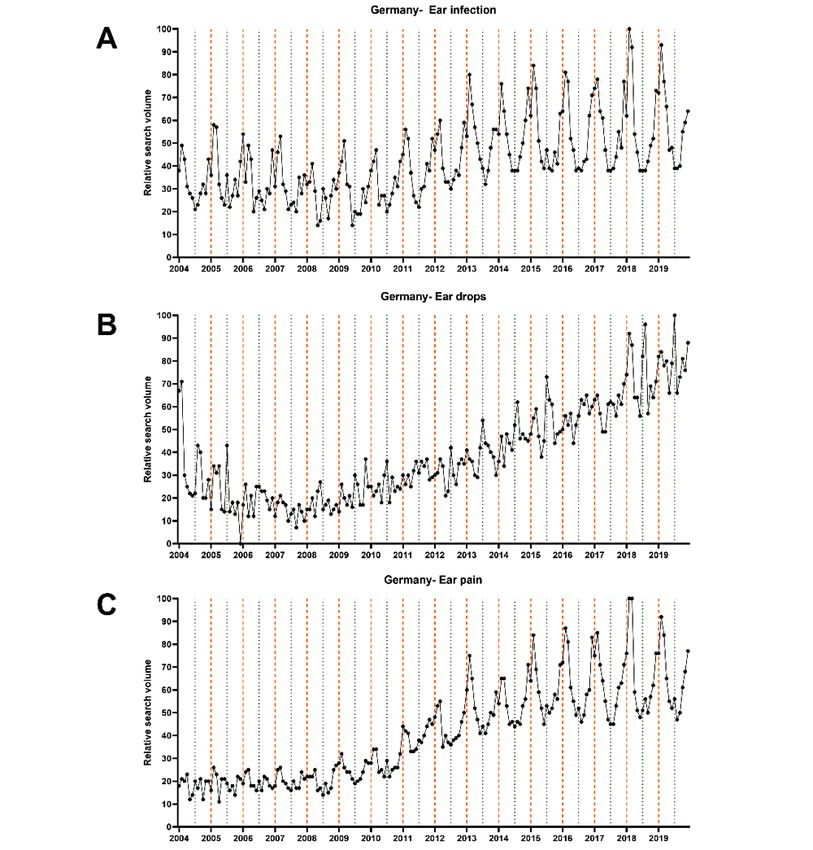
JOURNAL OF MEDICAL INTERNET RESEARCH                                                                                                       Brkic et al

     search volumes for certain medical conditions could potentially        The data were retrieved in the “Health” category for the time
     follow their annual incidence peaks.                                   frame between January 1, 2004, and December 31, 2019.
     Acute otitis media (OM) and otitis externa (OE) are common             The 3 preliminary search terms were entered on August 18,
     conditions in otolaryngology and represent the middle ear and          2020, and the function “Related (Top)” was used to show search
     external auditory canal’s inflammation, respectively [12,13].          terms related to the preliminary search terms in every analyzed
     OM is mostly a result of a dysfunction of the auditive tube due        country. We ensured that we analyzed 3 search terms with the
     to upper airway tract infections [12]. New diagnostic guidelines       highest RSV in the context of “ear pain,” “ear infection,” and
     recommend combining medical history, clinical symptoms, and            “ear drops” by using the GT function “Comparison.” We
     strict otoscopic criteria to determine this diagnosis [14]. These      therefore compared the RSV of all related search terms against
     include moderate or severe tympanic membrane bulging                   the 3 preliminary search terms. The most relevant search terms
     combined with otorrhea or mild bulging combined with recent            associated with each of the 3 preliminary search terms were
     onset of ear pain. OE’s incidence is comparable to that of OM          used for further data acquisition and analyses. Furthermore, we
     and affects up to 10% of people at some point in life. [13] Some       also added the search terms “otitis” and “otitis media”
     common symptoms tend to overlap with those of OM, such as              (“Gehörgangsentzündung”         and     “Mittelohrentzündung”,
     ear pain or otorrhea. Nevertheless, some critical differentiation      respectively, for Germany) to cover the full spectrum of ear
     signs exist, such as ear itching and tenderness of the tragus or       pain–related search terms.
     pinna, which are OE-specific symptoms [15]. Based on the
                                                                            We then entered each of the aforementioned 5 ear pain–related
     many similarities between these two conditions, it may be
                                                                            search terms (ie, “ear drops,” “ear pain,” “ear infection,” “otitis,”
     assumed that individuals tend to misdiagnose or incorrectly
                                                                            and “otitis media”) on April 25, 2021, and used the function
     treat themselves by referring to information available online.
                                                                            “Worldwide” to assess regional differences in country-specific
     It has been noted that OM occurs mostly in the winter months,          RSV. We specified our searches for the “Health” category and
     which correlates with the incidence rates of upper airway              the time frame between January 1, 2004, and December 31,
     infection [12,16-19]. In contrast, OE incidence rises significantly    2019. Finally, a reliability analysis was performed by
     during the warmer summer months, mostly due to increased               downloading selected search terms for 10 consecutive days,
     humidity, sweating, and swimming (ie, water exposure to the            starting from August 18, 2020. It has previously been reported
     outer ear canal [15,20,21]). Interestingly, a study on seasonal        that slightly different results are shown if GT data are
     peaks of acute OM incidence revealed peaks in the winter and           downloaded on different days [3,16].
     summer months [22].
                                                                            The analysis was performed with R software version 3.5.1 (R
     To the best of our knowledge, only one study group has assessed        Foundation for Statistical Computing) with the “season” and
     online user behavior regarding otologic conditions. Specifically,      “psych” packages. The visualization of these data was performed
     they correlated GT search for “ear drops” with Medicaid                with Prism 9.0.0 software (GraphPad). The intraclass correlation
     prescription frequency for ototopical agents [23]. However, to         coefficient (ICC; 2-way random model) was used for
     date, no study has analyzed World Wide Web public inquiries            examination of GT data reliability. Poor reliability was defined
     into other OM- and OE-related terms (such as ear pain or ear           as an ICC lower than 0.4, moderate reliability as an ICC higher
     infection). Therefore, our study aimed to analyze the web-based        than or equal to 0.4 and lower than 0.75, good reliability as an
     interest into ear pain, ear infections, and the associated treatment   ICC higher than or equal to 0.75 and lower than 0.9, and
     options (ear drops). This study’s results may help gain novel          excellent reliability as an ICC greater than or equal to 0.9. The
     insights into the temporal frequency of internet searches into         cosinor regression model was used to detect seasonality in time
     ear pain–related search terms and clarify the temporal dynamics        series data. The exact model is described in detail elsewhere
     of the affected individuals who search for symptoms or treatment       [25]. In short, the cosinor model is a parametric model that
     options regarding these medical conditions.                            captures seasonal patterns using a sinusoid. We fitted an annual
                                                                            seasonal pattern to our time series data and therefore defined
     Methods                                                                the annual seasonal cycle as 12 (months). As the cosinor model
                                                                            assumes the sinusoid to be symmetric and stationary, a peak (P,
     GT was used to explore the online search interest for “ear pain”       peak) and a nadir point (L, low point, defined as peak month
     and related terms entered into the Google search engine from           +/–6 months) are defined once per year. The cosinor analysis
     various countries worldwide. The relative search volume (RSV)          also computes an amplitude (size), which represents the
     shows user interest in specific search terms. It ranges from 0 to      magnitude of the seasonal effect. As the sinusoid is described
     100 (higher interest correlates with higher score). The                by both a sine and a cosine term, statistical significance can be
     normalization steps are described elsewhere [24]. We explored          tested as part of a generalized linear model. We set the P value
     RSV for the following 3 search terms (and the country-specific         to .03 to adjust for multiple comparisons (sine and cosine term).
     translation) related to ear infections: “ear drops”
     (“Ohrentropfen”), “ear pain” (“Ohrenschmerzen”), and “ear              The visualization of worldwide country-specific differences in
     infection” (“Ohr Entzündung”). In order to cover both                  RSV for our 5 ear pain–related search terms (mentioned
     hemispheres and 2 languages (English and German), we assessed          previously) was performed with Python 3.9.4 [26] in
     internet-based inquiries in the following countries: Australia,        combination with the libraries NumPy [27], Pandas [28],
     Canada, Germany, the United States, and the United Kingdom.            Matplotlib [29], and Geopandas [30].

     https://www.jmir.org/2021/6/e28328/                                                              J Med Internet Res 2021 | vol. 23 | iss. 6 | e28328 | p. 2
                                                                                                                    (page number not for citation purposes)
XSL• FO
RenderX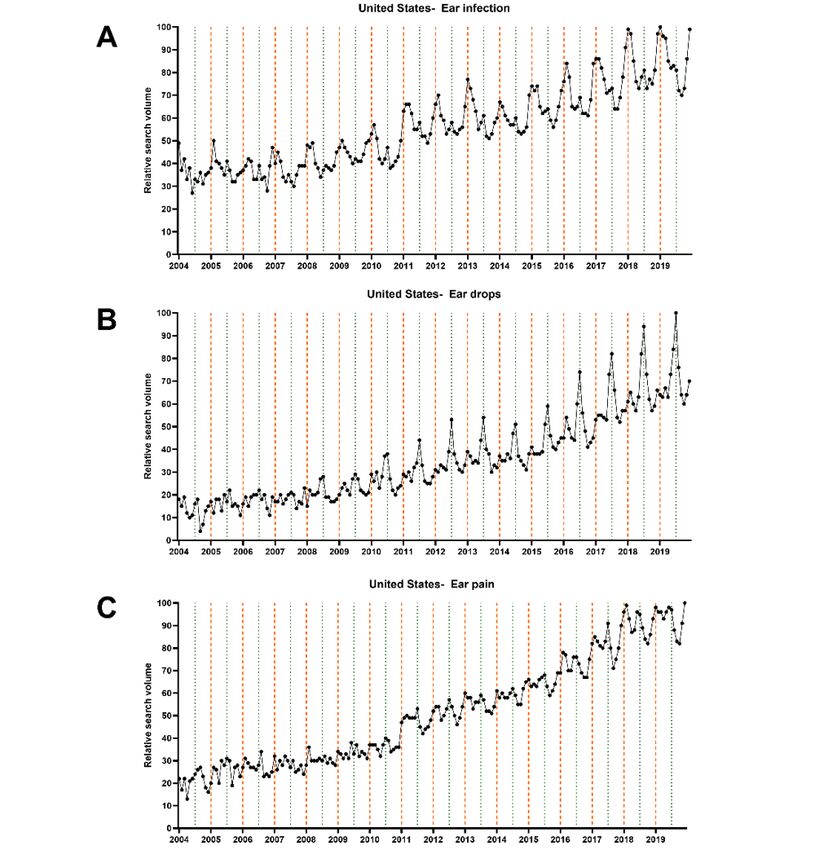
JOURNAL OF MEDICAL INTERNET RESEARCH                                                                                                    Brkic et al

     For the current study, only publicly available and nonidentifiable   terms (“ear pain,” “ear infection,” and “ear drops”) represented
     data were explored. Therefore, according to the guidelines of        the 3 most relevant search terms within their respective category
     the institutional review board of the Medical University of          in all English-speaking countries. Only the search term
     Vienna, study approval was not needed.                               “Mittelohrentzündung” (middle ear infection) had a higher RSV
                                                                          compared to “Ohr Entzündung” (ear infection) in Germany
     Results                                                              (Tables S1-S5, Multimedia Appendix 1). To cover the full
                                                                          spectrum of ear pain–related search terms, we also added “otitis”
     Search Terms Related to Ear Infection, Ear Pain, and                 and “otitis media” (“Gehörgangsentzündung” and
     Ear Drops                                                            “Mittelohrentzündung” for Germany) for further data analyses.
     As we wanted to perform the analysis only using search terms         Regional Differences in Relative Search Volume for
     with the highest RSV, our first step was to assess if preliminary    Ear Infection–Related Search Terms
     search terms were in fact the most searched in regard to the
     following 3 terms: (1) “ear pain,” (2) “ear infection,” and (3)      In the next step, we assessed country-specific differences in
     “ear drops.” We therefore entered each of the 3 primary search       RSV for our 5 ear infection–related search terms: “ear pain,”
     terms into GT for the time frame between January 1, 2004, and        “ear infection,” “ear drops,” “otitis,” and “otitis media.” We
     December 31, 2019. The search was performed using the                used the GT function “Worldwide” to compare the
     “Health” category. Furthermore, the GT function “Related             country-specific RSVs.
     queries (Top)” was used to identify search terms that users          The graphical analysis revealed regional differences in RSV for
     entered on GT following the specified one. This step was             each of the 5 ear infection–related search terms. “Ear infection”
     followed by comparing the RSV of each related search term            and “ear pain” were searched more often in English-speaking
     with each of the 3 preliminary search terms to evaluate whether      countries from the Northern Hemisphere, while “otitis” and
     the latter terms had the highest RSV within their respective         “otitis media” were searched more often in countries from the
     category. It was indeed shown that our 3 preliminary search          Southern Hemisphere (Figure 1).

     https://www.jmir.org/2021/6/e28328/                                                           J Med Internet Res 2021 | vol. 23 | iss. 6 | e28328 | p. 3
                                                                                                                 (page number not for citation purposes)
XSL• FO
RenderX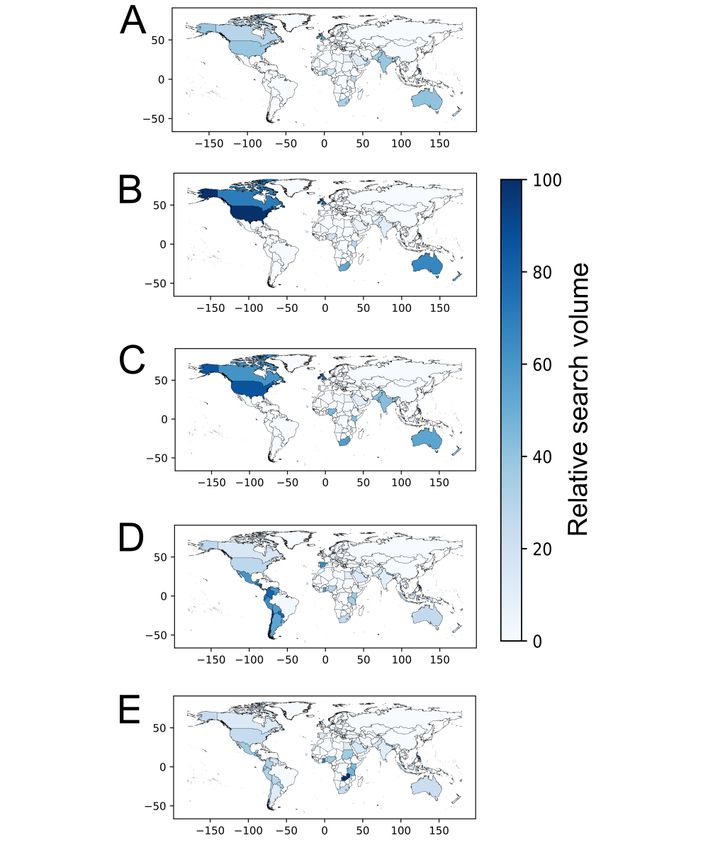
JOURNAL OF MEDICAL INTERNET RESEARCH                                                                                                                   Brkic et al

     Figure 1. World maps showing country-specific variations in relative search volume for (A) “ear drops,” (B) “ear infection,” (C) “ear pain,” (D) “otitis,”
     and (E) “otitis media.” The color legend represents the relative search volume. The x-axis and the y-axis represent the longitude and latitude, respectively.
     The maps have been created with the GeoPandas library [30].

                                                                                     ranging between 0.78 and 0.97 for “ear drops,” between 0.87
     Reliability of Ear Infection–Related Search Terms                               and 0.99 for “ear infection,” and between 0.89 to 0.99 for “ear
     We performed the reliability analysis using the ICC for GT time                 pain.” Furthermore, reliability analyses in Germany also
     series data of our 3 final search terms extracted on 10                         revealed excellent correlation coefficients for 2 of the 3 primary
     consecutive days, starting on August 18, 2020.                                  search terms: ICC of 0.91 for “Ohrentropfen” (ear drops), ICC
     The 3 primary search terms showed good to excellent reliability                 of 0.47 for “Ohr Entzündung” (ear infection), and ICC of 0.98
     in English-speaking countries, with correlation coefficients                    for “Ohrenschmerzen” (ear pain; Table 1). The analysis revealed

     https://www.jmir.org/2021/6/e28328/                                                                          J Med Internet Res 2021 | vol. 23 | iss. 6 | e28328 | p. 4
                                                                                                                                (page number not for citation purposes)
XSL• FO
RenderX
JOURNAL OF MEDICAL INTERNET RESEARCH Brkic et al
less reliable results for our 2 additional search terms. The ICC correlation analyses revealed an ICC of 0.93 for
ranged between 0.36 and 0.86 for “otitis” and between 0.37 to “Mittelohrentzündung” and an ICC of 0.75 for
0.74 for “otitis media” in the English-speaking countries. Further “Gehörgangsentzündung” in Germany.
https://www.jmir.org/2021/6/e28328/ J Med Internet Res 2021 | vol. 23 | iss. 6 | e28328 | p. 5
(page number not for citation purposes)
XSL• FO
RenderXJOURNAL OF MEDICAL INTERNET RESEARCH Brkic et al
Table 1. Reliability of single and averaged time series data on “ear drops,” “ear infection,” “ear pain,” “otitis,” and “otitis media” in all countries.
Search term by country ICCa Lower boundb Upper boundb F testc Df1d Df2e P value
Australia
Ear drops
Singlef 0.78 0.74 0.81 35.96 191 1719JOURNAL OF MEDICAL INTERNET RESEARCH Brkic et al
Search term by country ICCa Lower boundb Upper boundb F testc Df1d Df2e P value
Average 1.00 1.00 1.00 851.84 191 1719JOURNAL OF MEDICAL INTERNET RESEARCH Brkic et al
Search term by country ICCa Lower boundb Upper boundb F testc Df1d Df2e P value
Average 0.97 0.96 0.98 32.38 191 1719JOURNAL OF MEDICAL INTERNET RESEARCH Brkic et al
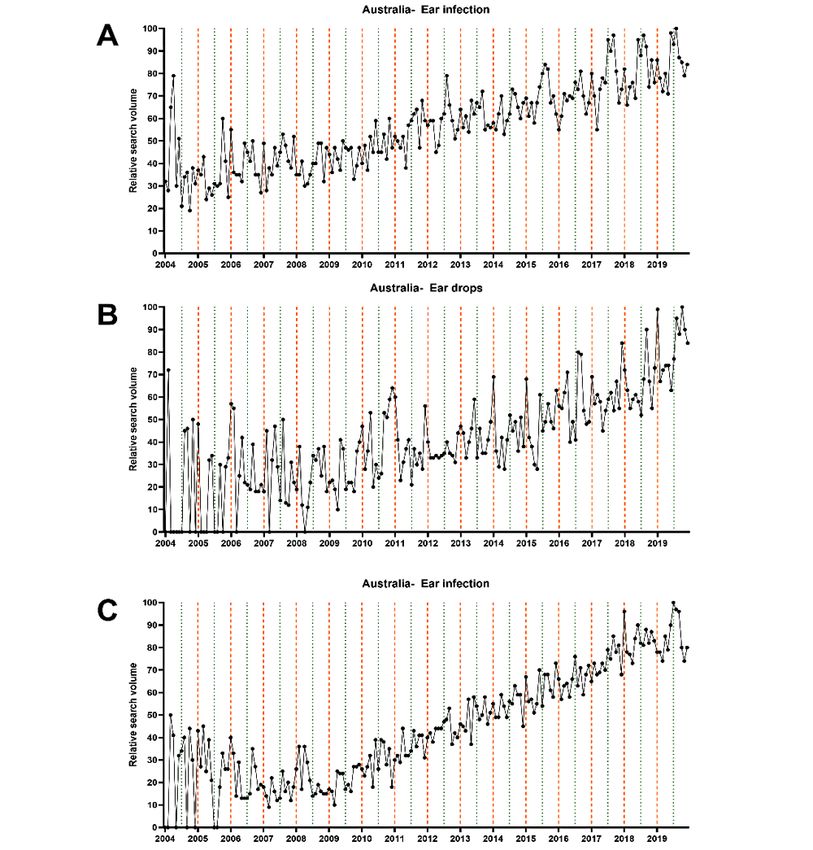
Figure 2. Univariate time series plot showing monthly changes in relative search volume for (A) “ear infection,” (B) “ear drops,” and (C) “ear pain”
in the United States between January 2004 and December 2019. The thick vertical orange lines mark January 1, while the thin vertical green lines mark
July 1. The black points represent the relative search volume of each of the 12 months.
https://www.jmir.org/2021/6/e28328/ J Med Internet Res 2021 | vol. 23 | iss. 6 | e28328 | p. 9
(page number not for citation purposes)
XSL• FO
RenderXJOURNAL OF MEDICAL INTERNET RESEARCH Brkic et al
Figure 3. Univariate time series plot showing monthly changes in relative search volume for (A) “ear infection,” (B) “ear drops,” and (C) “ear pain”
in Australia between January 2004 and December 2019. The thick vertical orange lines mark January 1, while the thin vertical green lines mark July 1.
The black points represent the relative search volume of each of the 12 months.
https://www.jmir.org/2021/6/e28328/ J Med Internet Res 2021 | vol. 23 | iss. 6 | e28328 | p. 10
(page number not for citation purposes)
XSL• FO
RenderXJOURNAL OF MEDICAL INTERNET RESEARCH Brkic et al
Figure 4. Univariate time series plot showing monthly changes in relative search volume for (A) “ear infection,” (B) “ear drops,” and (C) “ear pain”
in Germany between January 2004 and December 2019. The thick vertical orange lines mark January 1, while the thin vertical green lines mark July
1. The black points represent the relative search volume of each of the 12 months.
https://www.jmir.org/2021/6/e28328/ J Med Internet Res 2021 | vol. 23 | iss. 6 | e28328 | p. 11
(page number not for citation purposes)
XSL• FO
RenderXJOURNAL OF MEDICAL INTERNET RESEARCH Brkic et al
Figure 5. Cosinor analysis plots showing monthly variations in relative search volume for “ear infection,” “ear pain,” and “ear drops” (from left to
right) in (A) the United States, (B) Germany, and (C) Australia. The black dots mark the monthly mean relative search volume, while the error bars
mark the SE. The numbers on the x-axis represent the corresponding months (ie, 1 = January, 2 = February).
https://www.jmir.org/2021/6/e28328/ J Med Internet Res 2021 | vol. 23 | iss. 6 | e28328 | p. 12
(page number not for citation purposes)
XSL• FO
RenderXJOURNAL OF MEDICAL INTERNET RESEARCH Brkic et al
Table 2. Cosinor analysis on seasonality of “ear drops,” “ear pain,” “ear infection,” “otitis,” and “otitis media”.
Term by country Amplitude Peaka Nadira SE P value
Australia
Ear drops 5.73 11.1 5.1 0.016JOURNAL OF MEDICAL INTERNET RESEARCH Brkic et al
As noted, GT has often been used to analyze user-associated the hospital appears crucial, as a definitive diagnosis can only
online behavior in regard to different otorhinolaryngologic be made by a medical professional. Not postponing a doctor’s
conditions [3-6,16]. Furthermore, public online interest for appointment can lead to proper treatment and circumvention of
certain oral, maxillofacial, and dentistry problems has been potentially life-threatening complications.
analyzed by several authors [31-33]. Moreover, this engine was
OM affects all age groups, but about 80% of children have at
used for assessing public inquiries into seasonal influenza
least 1 acute OM episode before school age [12]. However, a
[34,35]. Even the currently prevailing and life-changing
plethora of pediatric patients does not necessarily warrant
COVID-19 pandemic was analyzed [36,37], and authors have
antibiotic therapy. Systemic antibiotics should be routinely
also discussed using GT to predict COVID-19 outbreaks [38,39].
indicated only in children above the age of 6 months with severe
There are several critical similarities between OM and OE symptoms and in children older than 2 years with bilateral acute
regarding symptoms and therapy options. The overlapping OM [14]. Observation with scheduled clinical follow-up is
symptoms include ear pain and otorrhea [14,15], while specific recommended in children 2 to 12 years old with nonsevere
OE signs include an itchy ear and tragus pain [15]. Therapy symptoms [14]. Furthermore, OM with effusion is often
regimens for both conditions include analgesics, but the misdiagnosed as acute OM and overtreated with antibiotics [52].
indication for antibiotic therapy varies significantly. Although Overtreatment is also a common problem affecting patients with
bacteria can be isolated from the middle ear in 50% to 90% of OE. One study group noted that about 20% to 40% of patients
cases [40,41], not all OM patients require antibiotic therapy at with an acute OE are primarily and unnecessarily treated with
initial presentation. Clinical observation and analgesic therapy a systemic antibiotic [53] even though systemic antibiotics do
are the first-line treatment approaches in adult patients and not necessarily produce better clinical outcomes [20]. In
children over 6 years with mild symptoms. However, either a summary, the timely differentiation between OM and OE is
clinical follow-up within 2 to 3 days should be scheduled, or a crucial, as it can result in proper therapy, reduction of
backup antibiotic should be prescribed and used in cases where overtreatment, and circumvention of possibly life-threatening
symptoms persist [14,42]. Regarding OE, therapy options complications.
include ear cleaning, analgesics, and topical treatment
The current study faces limitations associated with its
(antibiotics, steroids, antiseptics, antifungals, or combinations)
infodemiological design. Potential standard limitations of
[43]. Oral antibiotics are not indicated for treatment of OE, as
infodemiological studies could influence the interpretation of
they prolong time to clinical cure and are not associated with
our results. As we used a single search engine to retrieve all
better outcomes as compared with a topical agent used alone in
data, selection bias is a potential limitation. However, about
uncomplicated cases [20,44]. Additionally, the overuse of
two-thirds of daily internet searches are performed using Google
systemic antibiotics contributes to the global problem of
web search, which minimizes this risk [1]. A further selection
antibiotic resistance [16]. In summary, systemic or oral antibiotic
bias is reflected by the fact that people from higher-income
is only required in severe and persistent OM, while OE can be
areas have access and tend to use the internet for any kind of
treated mostly with topical therapy using ear drops.
information, particularly regarding certain medical conditions
Incompletely treated or untreated OM can result in [54]. Furthermore, with GT, the data on the age or gender of
complications, such as mastoiditis, facial nerve paresis or palsy, users who search for different terms cannot be assessed. This
or labyrinthitis. Therefore, symptoms of OM warrant further limitation could be a confounding factor, as younger people are
diagnosis and therapeutic approaches [45]. Furthermore, these more likely to use online search engines to gather information
can occur in cases with inadequately treated OM (eg, in cases on medical conditions [55]. On the other hand, studies designed
of antibiotic-resistant bacteria) [45]. The most typical symptoms around using infodemiological methods can arguably be more
of acute mastoiditis are a retroauricular swelling and a protruded extensive, detailed, and real time than epidemiological studies.
pinna. Other clinical signs include retroauricular erythema and Therefore, with these methods, the information retrieval and
pain, or an abscess of the external auditory canal [46,47]. Timely the efficacy of the research can be improved. Furthermore, it
recognition of these signs and a prompt referral to an can only be assumed that RSV varies only slightly across
otolaryngology department are crucial in treating OM individual areas within each country. We included larger
complications. The next steps include intravenous antibiotic countries in our analysis. Thus, our results may only represent
therapy and a computer tomography scan in cases that do not those regions with more inhabitants (and therefore higher RSV).
respond to therapy [48]. Surgical treatment such as Future studies will reveal whether regional differences have a
mastoidectomy remains the most efficient therapy option for significant influence on online search frequency for different
patients with intracranial complications or mastoid abscess [49]. medical conditions.
Malignant (necrotizing) OE is a potentially fatal complication
In conclusion, we observed biannual (summer and winter) peaks
of acute OE and affects older adults, immunocompromised
in searches for otitis externa and media and related terms, which
individuals, and patients with undertreated diabetes mellitus
correlated with the respective annual incidence increase of these
[50]. The most common signs are otalgia, subacute hearing loss,
two conditions. These findings thus underline the necessity for
and intensive otorrhea [50]. The infection can extend to the
accurate and easily accessible medical information on the
mastoid and the skull base and can potentially result in facial
internet, particularly for diagnosis, appropriate therapy options,
nerve palsy, venous sinus thrombosis, osteomyelitis, or even
and differentiating between OE and OM. This type of
death [51]. Although patients potentially self-manage these
information may reduce overtreatment with antibiotics in OE
conditions by looking for information online, timely referral to
cases and mitigate the global problem of antibiotic resistance.
https://www.jmir.org/2021/6/e28328/ J Med Internet Res 2021 | vol. 23 | iss. 6 | e28328 | p. 14
(page number not for citation purposes)
XSL• FO
RenderXJOURNAL OF MEDICAL INTERNET RESEARCH Brkic et al
Finally, prompt and early detection of potentially life-threatening could be facilitated.
complications and subsequent further diagnosis and therapy
Conflicts of Interest
None declared.
Multimedia Appendix 1
Results from relative search volume comparison between primary and related search terms in Australia.
[DOCX File , 70 KB-Multimedia Appendix 1]
References
1. Browser market share. Market Share Statistics for Internet Technologies. URL: https://netmarketshare.com [accessed
2020-12-20]
2. Pier MM, Pasick LJ, Benito DA, Alnouri G, Sataloff RT. Otolaryngology-related Google Search trends during the COVID-19
pandemic. Am J Otolaryngol 2020;41(6):102615 [FREE Full text] [doi: 10.1016/j.amjoto.2020.102615] [Medline: 32659612]
3. Liu DT, Besser G, Leonhard M, Bartosik TJ, Parzefall T, Brkic FF, et al. Seasonal variations in public inquiries into
laryngitis: an infodemiology study. J Voice 2020 May 19:1-8 [FREE Full text] [doi: 10.1016/j.jvoice.2020.04.018] [Medline:
32439216]
4. Liu DT, Besser G, Parzefall T, Riss D, Mueller CA. Winter peaks in web-based public inquiry into epistaxis. Eur Arch
Otorhinolaryngol 2020 Jul;277(7):1977-1985 [FREE Full text] [doi: 10.1007/s00405-020-05915-x] [Medline: 32180015]
5. Plante DT, Ingram DG. Seasonal trends in tinnitus symptomatology: evidence from Internet search engine query data. Eur
Arch Otorhinolaryngol 2015 Oct;272(10):2807-2813. [doi: 10.1007/s00405-014-3287-9] [Medline: 25234771]
6. Faoury M, Upile T, Patel N. Using Google Trends to understand information-seeking behaviour about throat cancer. J.
Laryngol. Otol 2019 Jul 08;133(7):610-614. [doi: 10.1017/s0022215119001348]
7. Trohman RG, Sharma PS, McAninch EA, Bianco AC. Amiodarone and thyroid physiology, pathophysiology, diagnosis
and management. Trends Cardiovasc Med 2019 Jul;29(5):285-295 [FREE Full text] [doi: 10.1016/j.tcm.2018.09.005]
[Medline: 30309693]
8. Zuin M, Rigatelli G, Ronco F. Worldwide and European interest in the MitraClip. Journal of Cardiovascular Medicine
2020;21(3):246-249. [doi: 10.2459/jcm.0000000000000916]
9. Dreher PC, Tong C, Ghiraldi E, Friedlander JI. Use of Google Trends to track online behavior and interest in kidney stone
surgery. Urology 2018 Nov;121:74-78. [doi: 10.1016/j.urology.2018.05.040] [Medline: 30076945]
10. Ikpeze TC, Mesfin A. Interest in orthopedic surgery residency: a Google Trends analysis. J Surg Orthop Adv
2018;27(2):98-101. [Medline: 30084815]
11. Skopelja EN, Whipple EC, Richwine P. Reaching and teaching teens: adolescent health literacy and the internet. Journal
of Consumer Health On the Internet 2008 Jun 17;12(2):105-118. [doi: 10.1080/15398280802121406]
12. Harmes KM, Blackwood RA, Burrows HL, Cooke JM, Harrison RV, Passamani PP. Otitis media: diagnosis and treatment.
Am Fam Physician 2013 Oct 01;88(7):435-440 [FREE Full text] [Medline: 24134083]
13. Morley G. Otitis externa. Br Med J 1938 Feb 19;1(4024):373-377 [FREE Full text] [doi: 10.1136/bmj.1.4024.373] [Medline:
20781253]
14. Lieberthal AS, Carroll AE, Chonmaitree T, Ganiats TG, Hoberman A, Jackson MA, et al. The diagnosis and management
of acute otitis media. Pediatrics 2013 Mar;131(3):e964-e999. [doi: 10.1542/peds.2012-3488] [Medline: 23439909]
15. Schaefer P, Baugh R. Acute otitis externa: an update. Am Fam Physician 2012 Dec 01;86(11):1055-1061 [FREE Full text]
[Medline: 23198673]
16. Brkic FF, Besser G, Janik S, Gadenstaetter AJ, Parzefall T, Riss D, et al. Peaks in online inquiries into pharyngitis-related
symptoms correspond with annual incidence rates. Eur Arch Otorhinolaryngol 2021 May;278(5):1653-1660 [FREE Full
text] [doi: 10.1007/s00405-020-06362-4] [Medline: 32968893]
17. Knopke S, Böttcher A, Chadha P, Olze H, Bast F. [Seasonal differences of tympanogram and middle ear findings in children]
German version. HNO 2017 Aug;65(8):651-656. [doi: 10.1007/s00106-016-0287-7] [Medline: 27904919]
18. Castagno LA, Lavinsky L. Otitis media in children: seasonal changes and socioeconomic level. International Journal of
Pediatric Otorhinolaryngology 2002 Feb;62(2):129-134. [doi: 10.1016/s0165-5876(01)00607-3]
19. Gordon MA, Grunstein E, Burton WB. The effect of the season on otitis media with effusion resolution rates in the New
York Metropolitan area. Int J Pediatr Otorhinolaryngol 2004 Feb;68(2):191-195. [doi: 10.1016/j.ijporl.2003.10.011]
[Medline: 14725986]
20. Gharaghani M, Seifi Z, Zarei Mahmoudabadi A. Otomycosis in Iran: a review. Mycopathologia 2015 Jun;179(5-6):415-424.
[doi: 10.1007/s11046-015-9864-7] [Medline: 25633436]
21. Centers for Disease ControlPrevention (CDC). Estimated burden of acute otitis externa--United States, 2003-2007. MMWR
Morb Mortal Wkly Rep 2011 May 20;60(19):605-609 [FREE Full text] [Medline: 21597452]
https://www.jmir.org/2021/6/e28328/ J Med Internet Res 2021 | vol. 23 | iss. 6 | e28328 | p. 15
(page number not for citation purposes)
XSL• FO
RenderXJOURNAL OF MEDICAL INTERNET RESEARCH Brkic et al
22. Lu YX, Liang JQ, Gu QL, Yu XM, Yan X. [Study on the correlation between meteorological factors and acute otitis media
in outpatients of children in Beijing]. Zhonghua Er Bi Yan Hou Tou Jing Wai Ke Za Zhi 2017 Oct 07;52(10):724-728.
[doi: 10.3760/cma.j.issn.1673-0860.2017.10.002] [Medline: 29050087]
23. Crowson M, Schulz K, Tucci D. National utilization and forecasting of ototopical antibiotics: Medicaid data versus "Dr.
Google". Otology Neurotology 2016;37(8):1049-1054. [doi: 10.1097/mao.0000000000001115]
24. FAQ about Google Trends data. Google. URL: https://support.google.com/trends/answer/4365533?hl=en [accessed
2021-01-07]
25. Adrian GB, Annette JD. Analysing Seasonal Health Data. Berlin, Heidelberg, Germany: Springer; 2009.
26. van Rossum G. Python tutorial. Centrum Wiskunde & Informatica Stichting.: Stichting Mathematisch Centrum; 1995.
URL: https://ir.cwi.nl/pub/5007 [accessed 2021-06-01]
27. Harris CR, Millman KJ, van der Walt SJ, Gommers R, Virtanen P, Cournapeau D, et al. Array programming with NumPy.
Nature 2020 Sep;585(7825):357-362 [FREE Full text] [doi: 10.1038/s41586-020-2649-2] [Medline: 32939066]
28. The Pandas development team. Pandas. URL: https://pandas.pydata.org/about/team.html [accessed 2021-04-27]
29. Hunter JD. Matplotlib: a 2D graphics environment. Comput. Sci. Eng 2007 May;9(3):90-95. [doi: 10.1109/mcse.2007.55]
30. Jordahl K. GeoPandas: Python tools for geographic data. GeoPandas 0.9.0. URL: https://geopandas.org/ [accessed 2021-04-27]
31. Patthi B. Global search trends of oral problems using Google Trends from 2004 to 2016: an exploratory analysis. JCDR
2017 Sep 1:C12-C16. [doi: 10.7860/jcdr/2017/26658.10564]
32. Shen JK, Every J, Morrison SD, Massenburg BB, Egbert MA, Susarla SM. Global interest in oral and maxillofacial surgery:
analysis of Google Trends data. J Oral Maxillofac Surg 2020 Sep;78(9):1484-1491. [doi: 10.1016/j.joms.2020.05.017]
[Medline: 32554065]
33. Harorli OT, Harorli H. Evaluation of internet search trends of some common oral problems, 2004 to 2014. Community
Dent Health 2014 Sep;31(3):188-192. [Medline: 25300156]
34. Samaras L, García-Barriocanal E, Sicilia M. Syndromic surveillance models using web data: the case of influenza in Greece
and Italy using Google Trends. JMIR Public Health Surveill 2017 Nov 20;3(4):e90 [FREE Full text] [doi:
10.2196/publichealth.8015] [Medline: 29158208]
35. Zhang Y, Bambrick H, Mengersen K, Tong S, Hu W. Using Google Trends and ambient temperature to predict seasonal
influenza outbreaks. Environ Int 2018 Aug;117:284-291. [doi: 10.1016/j.envint.2018.05.016] [Medline: 29778013]
36. Schnoell J, Besser G, Jank BJ, Bartosik TJ, Parzefall T, Riss D, et al. The association between COVID-19 cases and deaths
and web-based public inquiries. Infect Dis (Lond) 2021 Mar;53(3):176-183. [doi: 10.1080/23744235.2020.1856406]
[Medline: 33287607]
37. Walker A, Hopkins C, Surda P. Use of Google Trends to investigate loss-of-smell-related searches during the COVID-19
outbreak. Int Forum Allergy Rhinol 2020 Jul;10(7):839-847 [FREE Full text] [doi: 10.1002/alr.22580] [Medline: 32279437]
38. Venkatesh U, Gandhi PA. Prediction of COVID-19 outbreaks using Google Trends in India: a retrospective analysis.
Healthc Inform Res 2020 Jul;26(3):175-184 [FREE Full text] [doi: 10.4258/hir.2020.26.3.175] [Medline: 32819035]
39. Ayyoubzadeh S, Ayyoubzadeh S, Zahedi H, Ahmadi M, R Niakan Kalhori S. Predicting COVID-19 incidence through
analysis of Google Trends data in Iran: data mining and deep learning pilot study. JMIR Public Health Surveill 2020 Apr
14;6(2):e18828 [FREE Full text] [doi: 10.2196/18828] [Medline: 32234709]
40. Marchetti F, Ronfani L, Nibali SC, Tamburlini G, Italian Study Group on Acute Otitis Media. Delayed prescription may
reduce the use of antibiotics for acute otitis media: a prospective observational study in primary care. Arch Pediatr Adolesc
Med 2005 Jul;159(7):679-684. [doi: 10.1001/archpedi.159.7.679] [Medline: 15997003]
41. Jacobs MR, Dagan R, Appelbaum PC, Burch DJ. Prevalence of antimicrobial-resistant pathogens in middle ear fluid:
multinational study of 917 children with acute otitis media. Antimicrob Agents Chemother 1998 Mar;42(3):589-595 [FREE
Full text] [doi: 10.1128/AAC.42.3.589] [Medline: 9517937]
42. Arrieta A, Singh J. Management of recurrent and persistent acute otitis media: new options with familiar antibiotics. Pediatr
Infect Dis J 2004 Feb;23(2 Suppl):S115-S124. [doi: 10.1097/01.inf.0000112525.88779.8b] [Medline: 14770074]
43. Kaushik V, Malik T, Saeed S. Interventions for acute otitis externa. Cochrane Database Syst Rev 2010;1. [doi:
10.1002/14651858.cd004740.pub2]
44. Roland PS, Stroman DW. Microbiology of acute otitis externa. Laryngoscope 2002 Jul;112(7 Pt 1):1166-1177. [doi:
10.1097/00005537-200207000-00005] [Medline: 12169893]
45. Laulajainen-Hongisto A, Aarnisalo AA, Jero J. Differentiating acute otitis media and acute mastoiditis in hospitalized
children. Curr Allergy Asthma Rep 2016 Oct;16(10):72. [doi: 10.1007/s11882-016-0654-1] [Medline: 27613655]
46. van den Aardweg MTA, Rovers M, de Ru JA, Albers F, Schilder A. A systematic review of diagnostic criteria for acute
mastoiditis in children. Otol Neurotol 2008 Sep;29(6):751-757. [doi: 10.1097/MAO.0b013e31817f736b] [Medline: 18617870]
47. Stalfors J, Enoksson F, Hermansson A, Hultcrantz M, Robinson, Stenfeldt K, et al. National assessment of validity of coding
of acute mastoiditis: a standardised reassessment of 1966 records. Clin Otolaryngol 2013 Apr;38(2):130-135. [doi:
10.1111/coa.12108] [Medline: 23577881]
48. Psarommatis IM, Voudouris C, Douros K, Giannakopoulos P, Bairamis T, Carabinos C. Algorithmic management of
pediatric acute mastoiditis. Int J Pediatr Otorhinolaryngol 2012 Jun;76(6):791-796. [doi: 10.1016/j.ijporl.2012.02.042]
[Medline: 22405736]
https://www.jmir.org/2021/6/e28328/ J Med Internet Res 2021 | vol. 23 | iss. 6 | e28328 | p. 16
(page number not for citation purposes)
XSL• FO
RenderXJOURNAL OF MEDICAL INTERNET RESEARCH Brkic et al
49. Quesnel S, Nguyen M, Pierrot S, Contencin P, Manach Y, Couloigner V. Acute mastoiditis in children: a retrospective
study of 188 patients. Int J Pediatr Otorhinolaryngol 2010 Dec;74(12):1388-1392. [doi: 10.1016/j.ijporl.2010.09.013]
[Medline: 20971514]
50. Amaro CE, Espiney R, Radu L, Guerreiro F. Malignant (necrotizing) externa otitis: the experience of a single hyperbaric
centre. Eur Arch Otorhinolaryngol 2019 Jul;276(7):1881-1887. [doi: 10.1007/s00405-019-05396-7] [Medline: 31165255]
51. Babiatzki A, Sadé J. Malignant external otitis. J Laryngol Otol 1987 Mar;101(3):205-210. [doi: 10.1017/s0022215100101549]
[Medline: 3106545]
52. Pichichero ME. Recurrent and persistent otitis media. Pediatr Infect Dis J 2000 Sep;19(9):911-916. [doi:
10.1097/00006454-200009000-00034] [Medline: 11001126]
53. Bhattacharyya N, Kepnes LJ. Initial impact of the acute otitis externa clinical practice guideline on clinical care. Otolaryngol
Head Neck Surg 2011 Sep;145(3):414-417. [doi: 10.1177/0194599811406797] [Medline: 21531870]
54. Walker A, Hopkins C, Surda P. Use of Google Trends to investigate loss-of-smell-related searches during the COVID-19
outbreak. Int Forum Allergy Rhinol 2020 Jul;10(7):839-847 [FREE Full text] [doi: 10.1002/alr.22580] [Medline: 32279437]
55. Telfer S, Woodburn J. Let me Google that for you: a time series analysis of seasonality in internet search trends for terms
related to foot and ankle pain. J Foot Ankle Res 2015;8:27 [FREE Full text] [doi: 10.1186/s13047-015-0074-9] [Medline:
26146521]
Abbreviations
GT: Google Trends
ICC: intraclass correlation coefficient
OE: otitis externa
OM: otitis media
RSV: relative search volume
Edited by R Kukafka; submitted 01.03.21; peer-reviewed by T Cruvinel, S Kardes, JK Kumar, C Hudak; comments to author 13.04.21;
revised version received 27.04.21; accepted 06.05.21; published 20.06.21
Please cite as:
Brkic FF, Besser G, Schally M, Schmid EM, Parzefall T, Riss D, Liu DT
Biannual Differences in Interest Peaks for Web Inquiries Into Ear Pain and Ear Drops: Infodemiology Study
J Med Internet Res 2021;23(6):e28328
URL: https://www.jmir.org/2021/6/e28328/
doi: 10.2196/28328
PMID:
©Faris F Brkic, Gerold Besser, Martin Schally, Elisabeth M Schmid, Thomas Parzefall, Dominik Riss, David T Liu. Originally
published in the Journal of Medical Internet Research (https://www.jmir.org), 23.06.2021. This is an open-access article distributed
under the terms of the Creative Commons Attribution License (https://creativecommons.org/licenses/by/4.0/), which permits
unrestricted use, distribution, and reproduction in any medium, provided the original work, first published in the Journal of
Medical Internet Research, is properly cited. The complete bibliographic information, a link to the original publication on
https://www.jmir.org/, as well as this copyright and license information must be included.
https://www.jmir.org/2021/6/e28328/ J Med Internet Res 2021 | vol. 23 | iss. 6 | e28328 | p. 17
(page number not for citation purposes)
XSL• FO
RenderXYou can also read


