Effect of Aerobic Exercise on Inflammatory Markers in Healthy Middle-Aged and Older Adults: A Systematic Review and Meta-Analysis of Randomized ...
←
→
Page content transcription
If your browser does not render page correctly, please read the page content below
SYSTEMATIC REVIEW
                                                                                                                                                  published: 26 April 2019
                                                                                                                                           doi: 10.3389/fnagi.2019.00098

                                            Effect of Aerobic Exercise on
                                            Inflammatory Markers in Healthy
                                            Middle-Aged and Older Adults: A
                                            Systematic Review and
                                            Meta-Analysis of Randomized
                                            Controlled Trials
                                            Guohua Zheng 1,2† , Pingting Qiu 2† , Rui Xia 2 , Huiying Lin 2 , Bingzhao Ye 2 , Jing Tao 2 and
                                            Lidian Chen 2,3*
                                            1
                                             College of Nursing and Health Management, Shanghai University of Medicine & Health Sciences, Shanghai, China, 2 College
                                            of Rehabilitation Medicine, Fujian University of Traditional Chinese Medicine, Shangjie University Town, Fuzhou, China, 3 Fujian
                                            Key Laboratory of Rehabilitation Technology, Fujian University of Traditional Chinese Medicine, Shangjie University Town,
                                            Fuzhou, China

                                            Background: Chronic inflammation plays a significant role in accelerating the aging
                                            process and is closely associated with the initiation and progression of a broad range
                            Edited by:
                      Martin Burtscher,
                                            of age-related diseases. Physical exercise is considered beneficial in alleviating these
       University of Innsbruck, Austria     conditions, but the effects of aerobic exercise on inflammatory markers in a healthy
                      Reviewed by:          population should be furtherly clarified.
                        Yu-Min Kuo,
      National Cheng Kung University        Objective: The purpose of this systematic review and meta-analysis was to evaluate
         College of Medicine, Taiwan        the effect of aerobic exercise on inflammatory markers in middle-aged and older adults.
                      Ewa Ziemann,
        Gdansk University of Physical       Methods: The literature search was conducted utilizing PubMed, Web of Science,
        Education and Sport, Poland         Embase, and the Cochrane Library from their inception through April 2018, and
                     *Correspondence:       the reference lists were screened to identify appropriate studies. Only randomized
                            Lidian Chen
                lidianchen87@163.com
                                            controlled trials that investigated the effect of aerobic exercise on inflammatory markers
                                            in middle-aged and older adults were eligible for this review.
     † These   authors have contributed
                    equally to this work    Results: Eleven studies involving 1,250 participants were retrieved from the databases
                                            for analysis. The pooled results showed that aerobic exercise significantly reduced
      Received: 26 September 2018
           Accepted: 10 April 2019
                                            inflammatory markers (C-reactive protein (CRP): SMD = 0.53, 95% CI 0.26–0.11,
           Published: 26 April 2019         p = 0.0002; tumor necrosis factor-alpha (TNF-α): SMD = 0.75, 95% CI 0.31–1.19,
                            Citation:       p = 0.0007; interleukin 6 (IL-6): SMD = 0.75, 95% CI 0.31–1.19, p = 0.0007). No
  Zheng G, Qiu P, Xia R, Lin H, Ye B,       significant improvement was found in relation to interleukin 4 (IL-4).
   Tao J and Chen L (2019) Effect of
   Aerobic Exercise on Inflammatory         Conclusions: Aerobic exercise may have a positive effect on reduction of CRP,
 Markers in Healthy Middle-Aged and
                                            TNF-α, and IL-6 in middle-aged and older adults. Further randomized controlled trials
  Older Adults: A Systematic Review
  and Meta-Analysis of Randomized           (RCTs) need to be conducted to determine the effect of aerobic exercise on additional
                    Controlled Trials.      inflammatory markers in the population of middle-aged and older adults.
       Front. Aging Neurosci. 11:98.
     doi: 10.3389/fnagi.2019.00098          Keywords: aerobic exercise, inflammatory markers, CRP, TNF-α, IL-6, IL-4

Frontiers in Aging Neuroscience | www.frontiersin.org                               1                                                    April 2019 | Volume 11 | Article 98
Zheng et al. Aerobic Exercise Reduces Inflammation Levels
INTRODUCTION reasons for this discrepancy are likely related to differences in
exercise type (e.g., aerobic vs. resistance), differences between
Aging is a complex process that is compounded by a combination study participants (e.g., age, sex, health status, and baseline
of environmental, genetic, and epigenetic factors. Chronic inflammation), differences in exercise protocols (e.g., intensity,
inflammation plays an increasingly significant role in health frequency, and duration of intervention), or the publication of
status by accelerating the aging process (Franceschi and Campisi, underpowered findings. Furthermore, current systematic reviews
2014). Low-grade, persistent chronic inflammation occurs in and meta-analyses have not investigated the effects of different
the majority of the middle-aged and elderly population and is exercise types on inflammatory markers in healthy adults,
thought to be an accelerator of biological aging (Fougère et al., particularly middle-aged and elderly adults. A recent systematic
2016). An increasing number of studies have demonstrated that review revealed inconsistent findings related to the effect of
chronic inflammation is closely associated with the initiation aerobic and resistance training on the inflammatory markers
and progression of a broad range of age-related diseases, such CRP and IL-6 (Cronin et al., 2017). Therefore, the present study
as cardiovascular disease, cancer, diabetes, Alzheimer’s disease, sought to critically evaluate the effects of aerobic exercise on
and other neurodegenerative diseases and is an independent risk inflammatory makers of healthy middle-aged and elderly adults
factor for mortality in healthy adults (Kalogeropoulos et al., 2010; through a systematic review and meta-analysis of randomized
Argilés et al., 2015; Bonaccio et al., 2016; Landman et al., 2016; controlled trials.
Uchoa et al., 2016; Korniluk et al., 2017; Lang et al., 2018).
Moreover, there is strong evidence that the development of age-
related diseases is linked to low-grade elevation of circulating METHODS
inflammatory mediators (Singh and Newman, 2011). Therefore,
Search Strategy
future interventional researches should focus on preserving
To identify eligible studies, a literature search was conducted
overall homeostatic balance and controlling inflammatory status
in the electronic databases PubMed, Web of Science, the
in the aging patient.
Cochrane Library, and Embase from database inception through
Physical exercise is well-recognized as an important strategy
April 4, 2018 using combinations of Medical Subject Headings
for reducing the risk of age-associated diseases (Sparling
(MeSH) or free text words and the concepts of aerobic exercise
et al., 2015), and recent research has focused on the role
training, inflammatory markers, and age; the search was free
of exercise in the improvement of the inflammatory profile.
of restriction to region or publication type. The reference lists
Large population-based cross-sectional and cohort studies
of retrieved studies were also screened to identify additional
consistently show an inverse association between markers of
relevant articles. A complete search strategy is provided in the
systemic inflammation and physical exercise; lower inflammatory
Supplementary Material.
biomarker concentration is observed in subjects with more
frequent and more intense physical exercise (Colbert et al., 2004;
Beavers et al., 2010; Lee et al., 2012; Streese et al., 2018). However, Inclusion Criteria
data from interventional studies designed to definitively examine Studies were included in the review only if the following criteria
the effects of physical exercise on inflammation are limited, were met: (1) Study type: Randomized controlled trials (RCTs);
and results are inconclusive. For example, in Woods’ review of (2) Participants: Middle-aged and older adults (40 years and
randomized clinical trials, there was evidence indicating that older) without a disease or medical condition; (3) Intervention:
regular exercise could induce loss of fat mass and adipose Any style of aerobic exercise or aerobic exercise combined with
tissue, which is known to contribute to systemic inflammation non-exercise interventions were performed by the experimental
(Woods et al., 2012). Another meta-analysis of eight RCTs also group for at least 4 weeks, with three or more sessions every
showed that exercise could reduce inflammatory markers in week; (4) Control: no exercise intervention was performed expect
older adults, thereby decreasing the risk of developing age- for usual level of activity and the sham exercise (e.g., stretch,
related diseases (Monteiro Junior et al., 2017). Several meta- balance); (5) Outcomes: One or more inflammatory markers
analyses or systematic reviews indicated that exercise had a were measured in serum or plasma. Studies not written in English
beneficial effect in reducing inflammation in patients with or that were without available data were excluded.
chronic diseases, such as breast cancer (Meneses-Echavez et al.,
2016), heart disease (Hammonds et al., 2016), chronic cord Study Selection and Data Extraction
injury (Neefkes-Zonneveld et al., 2015), and diabetes (Hayashino During the preliminary screening, all searched records were
et al., 2014), but there is no consensus regarding the effect imported into reference management software (NoteExpress
of regular practice of exercise on the circulating inflammatory V 3.2.0) to eliminate duplicate records and identify potential
biomarkers in the relatively healthy adults. In a study by Nicklas eligibility by screening titles and abstracts. Then, full-text
et al. the results did not find that exercise training had a review was performed. All discrepancies were resolved by a
significant effect on the inflammatory biomarkers (including C- reviewer (GHZ). Data were extracted by one reviewer (PTQ),
reactive protein, interleukin 6, and tumor necrosis factor alpha using a predefined form, and verified by another reviewer
receptor 1) in community-dwelling, older, overweight or obese (GHZ). The data included the first author; study characteristics
sedentary adults (Nicklas et al., 2004); others also failed to (e.g., year, design, and methodological information); participant
present positive effects (Walker, 2010; Sahl et al., 2017). Possible characteristics (e.g., mean age, sample size); intervention for
Frontiers in Aging Neuroscience | www.frontiersin.org 2 April 2019 | Volume 11 | Article 98Zheng et al. Aerobic Exercise Reduces Inflammation Levels
the experimental and control group (e.g., duration, frequency,
intensity, and style of aerobic exercise); outcome findings.
Assessment of Risk of Bias of Included
Studies
The risk of bias of included studies was assessed by two
independent reviewers (PTQ and RX) using the Cochrane
Collaboration tool (Higgins and Green, 2011). The tool includes
seven key items divided into 6 domains: (1) selective bias
(random sequence generation and allocation concealment), (2)
performance bias (blinding of participants and personnel), (3)
detection bias (blinding of outcome assessors), (4) attrition
bias (incomplete outcome data), (5) reporting bias (selective
reporting), and (6) other bias. For each study, each individual
item was assessed, and each domain was graded as “low,” “high”
or “unclear,” based on whether the domain met the evaluation
criteria with respect to the characteristic expressed by the items.
A third reviewer (GHZ) was invited to resolve any disparities.
Data Analysis
Statistical analyses were conducted using Review Manager
5.3 software (RevMan 5.3). We conducted a meta-analysis
to determine change in inflammatory markers from baseline
to post-intervention by calculating the standardized mean
difference (SMD) between the experimental and control groups,
with a 95% confidence interval (CI). The SMD and the standard
error (SE) of each inflammatory marker, both before and after
treatment, were calculated utilizing Morris’s formula (Morris,
2008). If the data were reported as mean and 95% CI, SD was
calculated using RevMan software. If the data were reported
FIGURE 1 | Flow diagram for search and selection of the included studies.
as median interquartile range (IQR), we calculated mean and
standard deviation utilizing the Wan and Luo formulae (Wan
et al., 2014; Luo et al., 2015). If a study reported only the value
change of the inflammatory markers, we contacted the author was excluded, as data remained unavailable, despite attempts to
to obtain the original data. Data were pooled for meta-analysis contact the original author. Thus, 11 studies were included in the
when two or more studies measured the same outcome and review. The study selection flowchart for locating eligible articles
provided data in a format suitable for pooling. The heterogeneity is provided in Figure 1.
among the included studies was assessed using a χ 2 test and
Higgins I 2 value. With the χ 2 test, P < 0.05 was considered Characteristics of Included Studies
to be significant. The pooled effect was calculated using the The characteristics of the included articles are presented in
fixed-effect model when data were available, and there was no Table 1. A total of 11 RCTs involving 1,250 participants (188
significant heterogeneity detected. Otherwise, the random-effect males and 1,062 females, age range 40–95 years) were included
model was applied. in the review. The styles of aerobic exercise utilized in the
intervention groups were diverse, involving Tai Chi (Irwin
RESULTS and Olmstead, 2012), treadmill (Mohammadi et al., 2018),
bench step exercises (Nishida et al., 2015), and multicomponent
Study Selection aerobic exercises (Bergström et al., 2009; Muscari et al., 2010;
Utilizing the search strategy, 19,568 records were identified Tartibian et al., 2011, 2015; Alghadir et al., 2016); three studies
from the four electronic databases. After deleting duplicates, (Friedenreich et al., 2012; Abdollahpour et al., 2016; Conroy et al.,
two reviewers (PTQ and RX) screened titles and abstracts and 2016) did not describe a specific exercise style. The duration
excluded unrelated records. Finally, 122 full-text articles were of the exercise phase in the included studies ranged from 2
examined for eligibility, and 12 studies met the inclusion criteria to 12 months. The frequency of exercise varied from two to
(Bergström et al., 2009; Muscari et al., 2010; Tartibian et al., five sessions weekly, with each session lasting 20–90 min. Of
2011, 2015; Friedenreich et al., 2012; Irwin and Olmstead, 2012; the 11 studies, 8 assessed exercise intensity through the heart
Nishida et al., 2015; Abdollahpour et al., 2016; Alghadir et al., rate reserve of 45–80% of maximum heart rate (Muscari et al.,
2016; Conroy et al., 2016; Sbardelotto et al., 2017; Mohammadi 2010; Tartibian et al., 2011, 2015; Friedenreich et al., 2012;
et al., 2018). One of these 12 studies (Sbardelotto et al., 2017) Abdollahpour et al., 2016; Alghadir et al., 2016; Conroy et al.,
Frontiers in Aging Neuroscience | www.frontiersin.org 3 April 2019 | Volume 11 | Article 98TABLE 1 | Characteristics of included studies in this systematic review.
Zheng et al.
References Age Participant(M/F) Intervention Frequency, duration, and intensity of aerobic exercise Findings
(range)
Abdollahpour 50–74 41 E:aerobic exercise 50 min/day,3 days/week for 6 months; 70–80% HRmax ↔TNF-a,↓IL-6 when E compare to C at post-test
et al., 2016 years (0/41) C:maintain their usual physical
activity levels
Alghadir et al., 65–95 100 E: treadmill, bicycle, and 45–60 min/time,3 times/week for 24 weeks; 60–70% HRmax ↔hsCRP when E compare to C at post-test
2016 years (70/30) StairMaster
C:maintain their usual lifestyle
Bergström et al., 45–65 112 E:brisk walk 30 min brisk walk + 60 min aerobic exercise/day, 3 brisk ↔hsCRP when E compared to C at post-test
2009 years (0/112) C:maintain their usual physical walks, and 1–2 aerobic exercises/week for 24 week; at least
activity level 95% level 3–4 training intensity (Level3:1–3 walks +1 aerobic
Frontiers in Aging Neuroscience | www.frontiersin.org
session/week; Level 4: 3 walks +2 aerobic session/week).
Conroy et al., 50–74 320 (0/320) E:aerobic exercise 45 min/session, 5 session/week, for 1 year; 70–80% HRmax ↔ IL-4, ↔ IL-10 when E compare to C at post-test
2016 years C: maintain their usual level
of activity
Friedenreich 50–74 210 E:aerobic exercise 45 min/day, 5 days/week for 1 year; 70–80% HRmax ↓hsCRP,↔TNF-α,
et al., 2012 years (0/210) C:usual inactivity ↔IL-6 when E
compare to C at
post-test
Irwin and 59–86 83 E: Tai Chi Chih 40 min/session,3 session/week for 16 weeks; Moderate ↓IL-6, ↔ hsCRP, ↔IL-18 when E compare to C at
4
Olmstead, 2012 years (32/51) C:health education intensity post-test
Mohammadi 40–60 24 E: treadmill 20–60 min/session,3 times/week for 12 weeks; 60–70% ↔hsCRP,↔ICAM-1,↔VCAM-1 when E compare to
et al., 2018 years (24/0) C:usual lifestyle HRmax C at post-test
Muscari et al., 65–74 120 E:Cycle ergometer, treadmill and 60 min/session, 3 times/week for 1 year; 70% HRmax ↓hsCRP when E compare to C at post-test
2010 years (62/58) free-body activity
C:health education
Nishida et al., 65– 62 E:bench step exercise 10–20 min/session,3 times/day, and a goal of 140 min/week ↔ IL−4,↔ IL-5,↔ IL-6, ↔ IL-8, ↔ IL-15, ↔ TNF-α,
2015 85years (0/62) C:maintain their usual lifestyle for 12 weeks; lactate threshold ↔ TNF-β, ↓IFN-γ when E compare to C at post-test
Tartibian et al., 58–78 38 E: walking or jogging 25–30 min/day,3–4days/week with 45–55% HRmax for the ↓TNF-a, ↓IL-6, ↓PGE2 when E compare to C at
2011 years (0/38) C:maintain their usual physical first 12 weeks; then 40–45 min/day,4–6 days/week with post-test
activity levels 55–65% HR for the second 12 weeks
Tartibian et al., 50–65 28 E:walking or jogging 25–30 min/day,3–4 days/week with 45–55% HRmax for the ↓ IL-1β, ↓IL-6,
2015 years (0/28) C:maintain their usual physical first 8 weeks; 40–45 min/day,4–6 days/week with 55–65% ↓TNF-a, ↓hsCRP when E compare to C at post-test
activity levels HR for the final 8 weeks
E, exercise group; C, control group; ↓, significant reduction; ↔, significant increase; ↔, no change; CRP, C-reactive protein; TNF-α, tumor necrosis factor-alpha; IL-6, interleukin 6; IL-4, interleukin 4; INF-γ , interferon-gamma; PGE2,
prostaglandin E2 ; IL-1β, interleukin-1beta; IL-5, interleukin-5; IL-8, interleukin-8; IL-10, interleukin-10; IL-15, interleukin-15; IL-18, interleukin-18; ICAM-1, intercellular adhesion molecule-1; VCAM-1, vascular cell adhesion molecule-1;
TNF-β tumor necrosis factor-beta.
Aerobic Exercise Reduces Inflammation Levels
April 2019 | Volume 11 | Article 98Zheng et al. Aerobic Exercise Reduces Inflammation Levels
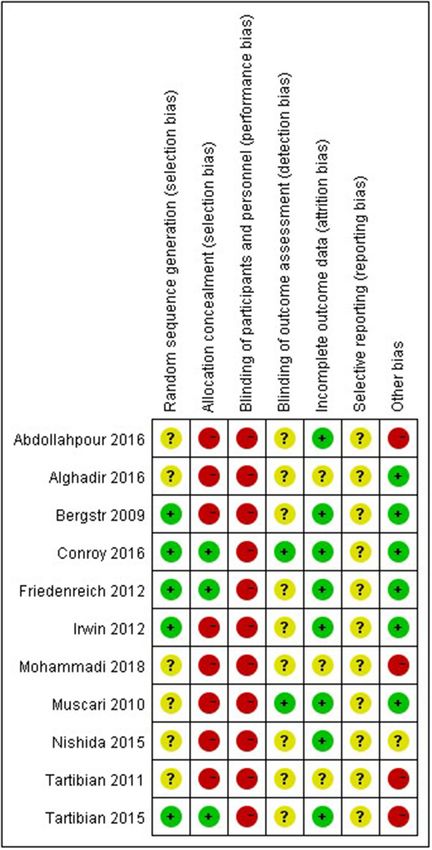
2012; Irwin and Olmstead, 2012; Tartibian et al., 2015; Conroy
et al., 2016) described the specific method of randomization,
and three of those studies (Friedenreich et al., 2012; Tartibian
et al., 2015; Conroy et al., 2016) reported allocation concealment.
All of the included studies demonstrated high performance bias,
as participants and personnel were not blind to the exercise
intervention. Two studies (Muscari et al., 2010; Conroy et al.,
2016) clearly described blind assessment of outcome measures.
Intention-to-treat analysis was used in five studies (Bergström
et al., 2009; Muscari et al., 2010; Friedenreich et al., 2012;
Abdollahpour et al., 2016; Conroy et al., 2016), and three
studies (Irwin and Olmstead, 2012; Nishida et al., 2015; Tartibian
et al., 2015) described reasons why participants dropped out or
failed to follow up. The risk of other bias in four studies was
judged as “high” due to limited sample size (Tartibian et al.,
2011, 2015), disproportionate dropout rates between the groups
(Abdollahpour et al., 2016), and lack of baseline measurements
(Mohammadi et al., 2018).
Effect of Interventions
Pre-intervention and post-intervention data were reported
using mean with standard deviation (SD), or mean with 95%
confidence interval, in 10 studies (Muscari et al., 2010; Tartibian
et al., 2011, 2015; Friedenreich et al., 2012; Irwin and Olmstead,
2012; Nishida et al., 2015; Abdollahpour et al., 2016; Alghadir
et al., 2016; Conroy et al., 2016; Mohammadi et al., 2018), and
median (IQR) or median (range) in one study (Bergström et al.,
2009). Of the 15 inflammatory markers measured in the included
studies, only CRP, TNF-α, IL-6, and IL-4 were reported in more
than two trials, rendering the data suitable for meta-analysis.
The effect of aerobic exercise on levels of CRP was measured
in seven studies. Seven studies (Bergström et al., 2009; Muscari
et al., 2010; Friedenreich et al., 2012; Irwin and Olmstead, 2012;
Tartibian et al., 2015; Alghadir et al., 2016; Mohammadi et al.,
2018) with 774 participants reported appropriate data. Three
studies (Muscari et al., 2010; Friedenreich et al., 2012; Tartibian
et al., 2015) demonstrated a significantly lower post-intervention
level of CRP in the exercise group compared to the control group.
The pooled SMD showed a statistically significant decrease in
CRP (SMD = 0.53, 95% CI 0.26–0.81, P = 0.0002; Figure 3).
Five of the included studies (Tartibian et al., 2011, 2015;
FIGURE 2 | Risk of bias in included studies: the authors’ judgments on each
risk of bias item for all included studies.
Friedenreich et al., 2012; Nishida et al., 2015; Abdollahpour et al.,
2016) looked at TNF-α levels, and two of these five(Tartibian
et al., 2011, 2015) found a significant post-intervention reduction
of the level of TNF-α in the exercise group compared with the
2016; Mohammadi et al., 2018). The remaining studies used control group; however, when the data from these five studies
the following strategies: (1) “at least 95% at training intensity were pooled, SMD between the studies demonstrated a significant
level 3–4 (1–3 walks and 1–2 aerobic exercise/week)” (Bergström reduction (SMD = 0.75, 95% CI 0.31–1.19, P = 0.0007; Figure 4).
et al., 2009); (2) “moderate intensity” (Irwin and Olmstead, 2012); Six of the included studies investigated IL-6 (Tartibian et al.,
and (3) “an intensity of lactate threshold” (Nishida et al., 2015). 2011, 2015; Friedenreich et al., 2012; Irwin and Olmstead,
All control groups were described as maintaining their usual 2012; Nishida et al., 2015; Abdollahpour et al., 2016), and
physical activity. four (Tartibian et al., 2011, 2015; Irwin and Olmstead, 2012;
Abdollahpour et al., 2016) of these studies identified a significant
Risk of Bias of the Included Studies reduction in IL-6 levels for the aerobic exercise group compared
The risk of bias of the included studies is displayed in Figure 2. to the control group. The forest plots also showed aerobic exercise
All of the included articles reported randomized group allocation, significantly reduced IL-6 levels in healthy middle-aged and older
but only five trials (Bergström et al., 2009; Friedenreich et al., adults (SMD = 0.71, 95% CI 0.24–1.17, P = 0.003; Figure 5).
Frontiers in Aging Neuroscience | www.frontiersin.org 5 April 2019 | Volume 11 | Article 98Zheng et al. Aerobic Exercise Reduces Inflammation Levels FIGURE 3 | Forest plots of the effect of aerobic exercise on CRP compared with no exercise. FIGURE 4 | Forest plots of the effect of aerobic exercise on TNF-α compared with no exercise. FIGURE 5 | Forest plots of the effect of aerobic exercise on IL-6 compared with no exercise. FIGURE 6 | Forest plots of the effect of aerobic exercise on IL-4 compared with no exercise. Frontiers in Aging Neuroscience | www.frontiersin.org 6 April 2019 | Volume 11 | Article 98
Zheng et al.                                                                                           Aerobic Exercise Reduces Inflammation Levels

   Only two of the eligible studies (Nishida et al., 2015; Conroy          2016; Meneses-Echavez et al., 2016). A recent systematic review
et al., 2016) reported IL-4 levels, and neither reported a                 reported regular exercise training may decrease levels of CRP and
statistically significant decrease in IL-4 levels for the aerobic          IL-6, but no statistical significance was found for TNF-α in an
exercise group compared with the control group. Likewise, the              elderly population (Monteiro Junior et al., 2017). Another meta-
pooled SMD did not show significant changes between the                    analysis, not limited to a specific clinical population, indicated
aerobic exercise and control groups (SMD = 0.00, 95% CI −0.03              that exercise training could lower CRP levels in individuals
to 0.02, P = 0.76; Figure 6).                                              (Fedewa et al., 2017). However, considering the methodological
   Three studies (Tartibian et al., 2011, 2015; Nishida et al.,            diversity among the included studies, particularly the differences
2015) that measured the concentration of interferon-gamma                  between exercise types (i.e., aerobic, resistance) and different
(INF-γ), prostaglandin E2 (PGE2 ), and interleukin-1beta (IL-1β),          basal levels of cytokines, the results of those meta-analysis or
respectively, demonstrated a statistically significant reduction           review should be interpreted cautiously. The present systematic
in the levels of these markers for the aerobic exercise group              review focused on the effect of aerobic exercise on inflammatory
compared to controls; other studies (Irwin and Olmstead, 2012;             markers in healthy middle-aged and older adults. Following the
Nishida et al., 2015; Conroy et al., 2016; Mohammadi et al.,               initial screening of over 13,000 article references, 11 randomized
2018), involved individually in assessing interleukin-5 (IL-5),            controlled trials were ultimately included in the review. The
interleukin-8 (IL-8), interleukin-10 (IL-10, interleukin-15 (IL-           pooled results revealed aerobic exercise led to a significant
15), interleukin-18 (IL-18), intercellular adhesion molecule-              reduction of inflammatory markers, including CRP, TNF-α, and
1 (ICAM-1), vascular cell adhesion molecule-1 (VCAM-1),                    IL-6. Furthermore, all included studies adhered to a pretest-
and tumor necrosis factor-beta (TNF-β) levels, failed to find              posttest-control design, in which participants are randomly
statistically significant differences between the aerobic exercise         assigned to the treatment or control group, and each participant
groups and controls.                                                       is measured both before and after the treatment. Considering that
                                                                           preexisting differences between groups can artificially inflate or
Adverse Events                                                             obscure posttest differences, we used the Morris method to adjust
No adverse events were reported in the studies included in                 the heterogeneity of inflammatory markers at baseline (before
this review.                                                               treatment) among the included studies (Morris, 2008). Therefore,
                                                                           the results in this review were more robust than findings of
DISCUSSION                                                                 previous studies.
                                                                              This study has several limitations. First, significant
This systematic review and meta-analysis sought to evaluate the            heterogeneity was found in the CRP, TNF-α, and IL-6 data
relationship between aerobic exercise and inflammatory markers             among the included studies; a possible cause may be that
in healthy middle-aged and older adults. Eleven randomized                 inflammatory marker levels are affected by different methods
controlled trials, with a total of 1,138 participants, that compared       of collection and sample preparation, as well as by time
aerobic exercise groups with no-exercise control groups were               elapsed between previous exercise session and plasma or
included in this review. The results demonstrate that regular              serums measurement (Wu et al., 2007). Additionally, there
aerobic exercise has a positive effect on decreasing most of the           were discrepancies between the included studies regarding
reported inflammatory makers, including CRP, TNF-α, and IL-6,              different types, duration, and frequencies of the aerobic exercise
in healthy middle-aged and older adults.                                   interventions. These are all potential sources of differences in
    There are strong correlations between inflammation and                 results between studies. However, due to an insufficient number
aging. The prospective epidemiological studies have found an               of studies of each inflammatory marker, sub-analysis could not
increased risk of age-related chronic diseases is associated with          be performed. Second, the pooled effect for other inflammatory
increased basal-level inflammation (Ridker et al., 2000). As a             markers, such as IL-8, IL-10, and VCAM-1, could not be analyzed
result, aging is associated with low-grade inflammation (Nagano            due to an insufficient number of included studies that assessed
et al., 2005), and increases in circulating levels of inflammatory         these markers. Thus, additional randomized controlled trials
markers have been observed in the aged populations (Ogawa                  should be conducted to determine the effects of aerobic exercises
et al., 2008). It is established that with age, physiological              on other inflammatory markers. Third, studies not reported in
processes generate adaptations within the immune system,                   English were excluded, which could have led to publication bias;
resulting in a continuous response of factors that trigger a               however, funnel plot analysis to detect publication bias was not
chronic inflammatory response (Ostan et al., 2008), including              possible due to the limited number of included studies (less ten
increased fat tissue, decreased sex steroid production, and                studies for each outcomes). Finally, relating to the specificity
chronic disorders (Woods et al., 2012). Exercise has direct effects        of intervention, it is not feasible to blind participants and
on the cellular immune system, as cytotoxic immune cells can be            exercise trainers during aerobic exercise intervention; therefore,
mobilized into circulation through adrenergic signaling during             performance bias may be inevitable.
exercise performance (Idorn and Hojman, 2016). Therefore,
exercise is recommended as an appropriate non-pharmacological              CONCLUSIONS
strategy to modulate the systemic inflammatory status; however,
many previous reviews have been limited to studying exercise               This review reveals that aerobic exercise has significant benefits
effects on inflammation in individuals with disease (Hayashino             on levels of CRP, TNF-α, and IL-6. Considering the limited
et al., 2014; Neefkes-Zonneveld et al., 2015; Hammonds et al.,             number of included studies, considerably larger-sample size

Frontiers in Aging Neuroscience | www.frontiersin.org                  7                                          April 2019 | Volume 11 | Article 98
Zheng et al. Aerobic Exercise Reduces Inflammation Levels
RCTs are necessary to determine the effect of aerobic exercise grant no.81574045), and the Collaboration Innovation
on additional inflammatory markers in middle-aged and Center for Rehabilitation Technology (X2015001-
older adults. Collaboration), Fujian provincial rehabilitation
industrial institution, and Fujian Key Laboratory of
AUTHOR CONTRIBUTIONS Rehabilitation Technology.
LC, GZ, and JT conceived and designed the study. PQ, RX, ACKNOWLEDGMENTS
HL, and BY performed the search, extraction of data, and
methodological assessment. PQ and GZ analyzed the data All authors are acknowledged for making a contribution to
and wrote the paper. All authors read and approved the this study.
final manuscript.
SUPPLEMENTARY MATERIAL
FUNDING
The Supplementary Material for this article can be found
This study is supported by the National Natural online at: https://www.frontiersin.org/articles/10.3389/fnagi.
Science Foundation of China (http://www.nsfc.gov.cn, 2019.00098/full#supplementary-material
REFERENCES diseases. J. Gerontol. Ser. A 69(Suppl 1), S4–S9. doi: 10.1093/gerona/
glu057
Abdollahpour, A., Khosravi, N., Eskandari, Z., and Haghighat, S. (2016). Friedenreich, C. M., Neilson, H. K., Woolcott, C. G., Wang, Q., Stanczyk, F.
Effect of six months of aerobic exercise on plasma interleukin-6 and Z., McTiernan, A., et al. (2012). Inflammatory marker changes in a yearlong
tumor necrosis factor-alpha as breast cancer risk factors in postmenopausal randomized exercise intervention trial among postmenopausal women. Cancer
women: a randomized controlled trial. Iran Red Crescent Med. J. 19:e27842. Prevent. Res. 5, 98–108. doi: 10.1158/1940-6207.CAPR-11-0369
doi: 10.5812/ircmj.27842 Hammonds, T. L., Gathright, E. C., Goldstein, C. M., Penn, M. S., and Hughes,
Alghadir, A. H., Gabr, S. A., and Al-Eisa, E. S. (2016). Effects of moderate aerobic J. W. (2016). Effects of exercise on c-reactive protein in healthy patients
exercise on cognitive abilities and redox state biomarkers in older adults. Oxid. and in patients with heart disease: a meta-analysis. Heart Lung 45, 273–282.
Med. Cell. Longev. 2016:2545168. doi: 10.1155/2016/2545168 doi: 10.1016/j.hrtlng.2016.01.009
Argilés, J. M., Busquets, S., Stemmler, B., and Lópezsoriano, F. J. (2015). Cachexia Hayashino, Y., Jackson, J. L., Hirata, T., Fukumori, N., Nakamura, F.,
and sarcopenia: mechanisms and potential targets for intervention. Curr. Opin. Fukuhara, S., et al. (2014). Effects of exercise on C-reactive protein,
Pharmacol. 22, 100–106. doi: 10.1016/j.coph.2015.04.003 inflammatory cytokine and adipokine in patients with type 2 diabetes: a meta-
Beavers, K. M., Brinkley, T. E., and Nicklas, B. J. (2010). Effect of analysis of randomized controlled trials. Metabol. Clin. Exp. 63, 431–440.
exercise training on chronic inflammation. Clin. Chim. Acta 411, 785–793. doi: 10.1016/j.metabol.2013.08.018
doi: 10.1016/j.cca.2010.02.069 Higgins, J. P. T., and Green, S. (2011). Cochrane Handbook for Systematic Reviews
Bergström, I., Lombardo, C., and Brinck, J. (2009). Physical training decreases of Interventions Version 5.1.0. The Cochrane Collaboration, 2011. Available
waist circumference in postmenopausal borderline overweight women. Acta online at: www.handbook.cochrane.org
Obstet. Gyn. Scan. 88, 308–313. doi: 10.1080/00016340802695942 Idorn, M., and Hojman, P. (2016). Exercise-dependent regulation of
Bonaccio, M., Di Castelnuovo, A., Pounis, G., De Curtis, A., Costanzo, S., NK cells in cancer protection. Trends Mol. Med. 22, 565–577.
Persichillo, M., et al. (2016). A score of low-grade inflammation and risk of doi: 10.1016/j.molmed.2016.05.007
mortality: prospective findings from the Moli-sani study. Haematologica 101, Irwin, M. R., and Olmstead, R. (2012). Mitigating cellular inflammation in older
1434–1441. doi: 10.3324/haematol.2016.144055 adults: a randomized controlled trial of Tai Chi Chih. Am. J. Geriatr. Psychiatry
Colbert, L. H., Visser, M., Simonsick, E. M., Tracy, R. P., Newman, A. B., 20, 764–772. doi: 10.1097/JGP.0b013e3182330fd3
Kritchevsky, S. B., et al. (2004). Physical activity, exercise, and inflammatory Kalogeropoulos, A., Georgiopoulou, V., Psaty, B. M., Rodondi, N., Smith,
markers in older adults: findings from the health, aging and body composition A. L., Harrison, D. G., et al. (2010). Inflammatory markers and incident
study. J. Am. Geriatr. Soc. 52, 1098–1104 doi: 10.1111/j.1532-5415.2004.52 heart failure risk in older adults. J. Am. Coll. Cardiol. 55, 2129–2137.
307.x doi: 10.1016/j.jacc.2009.12.045
Conroy, S. M., Courneya, K. S., Brenner, D. R., Shaw, E., O’Reilly, R., Yasui, Korniluk, A., Koper, O., Kemona, H., and Dymicka-Piekarska, V.
Y., et al. (2016). Impact of aerobic exercise on levels of IL-4 and IL-10, (2017). From inflammation to cancer. Ir. J. Med. Sci..186, 57–62.
results from two randomized intervention trials. Cancer Med. 5, 2385–2397. doi: 10.1007/s11845-016-1464-0
doi: 10.1002/cam4.836 Landman, G. W., Kleefstra, N., Groenier, K. H., Bakker, S. J., Groeneveld, G. H.,
Cronin, O., Keohane, D. M., Molloy, M. G., and Shanahan, F. (2017). The Bilo, H. J. G., et al. (2016). Inflammation biomarkers and mortality prediction
effect of exercise interventions on inflammatory biomarkers in healthy, in patients with type 2 diabetes (ZODIAC-27). Atherosclerosis 250, 46–51.
physically inactive subjects: a systematic review. QJM 2016, 629–637. doi: 10.1016/j.atherosclerosis.2016.04.015
doi: 10.1093/qjmed/hcx091 Lang, Y., Chu, F., Shen, D., Zhang, W., Zheng, C., Zhu, J., et al. (2018). Role of
Fedewa, M. V., Hathaway, E. D., and Wardritacco, C. L. (2017). Effect of inflammasomes in neuroimmune and neurodegenerative diseases: a systematic
exercise training on C reactive protein: a systematic review and meta-analysis review. Mediators Inflamm. 2018, 1–11. doi: 10.1155/2018/1549549
of randomised and non-randomised controlled trials. Br. J. Sport Med. 51, Lee, I. M., Sesso, H. D., Ridker, P. M., Mouton, C. P., Stefanick, M.
670–676. doi: 10.1136/bjsports-2016-095999 L., and Manson, J. E. (2012). Physical activity and inflammation in a
Fougère, B., Boulanger, E., Nourhashémi, F., Guyonnet, S., and Cesari, M. (2016). multiethnic cohort of women. Med. Sci. Sports Exercise 44, 1088–1096.
Chronic inflammation: accelerator of biological aging. J. Gerontol. Ser. A 9, doi: 10.1249/MSS.0b013e318242b11a
1218–1225. doi: 10.1093/gerona/glw240 Luo, D., Wan, X., Liu, J., and Tong, T. (2015). Optimally estimating the sample
Franceschi, C., and Campisi, J. (2014). Chronic inflammation mean from the sample size, median, mid-range, and/or mid-quartile range.
(inflammaging) and its potential contribution to age-associated Stat. Methods Med. Res. 27, 1785–1805. doi: 10.1177/0962280216669183
Frontiers in Aging Neuroscience | www.frontiersin.org 8 April 2019 | Volume 11 | Article 98Zheng et al. Aerobic Exercise Reduces Inflammation Levels Meneses-Echavez, J. F., Correa-Bautista, J. E., González-Jiménez, E., Schmidt, Sbardelotto, M. L., Pedroso, G. S., Pereira, F. T., Soratto, H. R., Brescianini, S. M., R. J., Elkins, M., Lobelo, F., et al. (2016). The effect of exercise Effting, P. S., et al. (2017). The effects of physical training are varied and occur training on mediators of inflammation in breast cancer survivors: a in an exercise type-dependent manner in elderly men. Aging Dis. 8, 887–898. systematic review with meta-analysis. Cancer Epidemiol. Biomarkers Prev. 25, doi: 10.14336/AD.2017.0209 1009–1017.doi: 10.1158/1055-9965.EPI-15-1061 Singh, T., and Newman, A. B. (2011). Inflammatory markers in population studies Mohammadi, H. R., Khoshnam, M. S., and Khoshnam, E. (2018). Effects of of aging. Ageing Res. Rev. 10, 319–329. doi: 10.1016/j.arr.2010.11.002 different modes of exercise training on body composition and risk factors Sparling, P. B., Howard, B. J., Dunstan, D. W., and Owen, N. (2015). for cardiovascular disease in middle-aged men. Int. J. Prevent. Med. 9. Recommendations for physical activity in older adults. BMJ 350:h100. doi: 10.4103/ijpvm.IJPVM_209_16 doi: 10.1136/bmj.h100 Monteiro Junior, R. S., de Tarso Maciel-Pinheiro, P., da Matta Mello Portugal, E., da Streese, L., Deiseroth, A., Schäfer, J., Schmidt-Trucksäss, A., and Hanssen, Silva Figueiredo, L. F., Terra, R., Carneiro, L. S. F., et al. (2017). Effect of exercise H. (2018). Exercise, arterial crosstalk-modulation, and inflammation in on inflammatory profile of older persons: systematic review and meta-analyses. an aging population: the ExAMIN age study. Front. Physiol. 9:116. J. Phys. Activity Health 15, 64–71. doi: 10.1123/jpah.2016-0735 doi: 10.3389/fphys.2018.00116 Morris, S. B. (2008). Estimating effect sizes from pretest-posttest-control group Tartibian, B., FitzGerald, L. Z., Azadpour, N., and Maleki, B. H. (2015). A designs. Organ. Res. Methods 11, 364–386. doi: 10.1177/1094428106291059 randomized controlled study examining the effect of exercise on inflammatory Muscari, A., Giannoni, C., Pierpaoli, L., Berzigotti, A., Maietta, P., Foschi, E., et al. cytokine levels in post-menopausal women. Post Reprod. Health 21, 9–15. (2010). Chronic endurance exercise training prevents aging-related cognitive doi: 10.1177/2053369114565708 decline in healthy older adults: a randomized controlled trial. Int. J. Geriatr. Tartibian, B., Hajizadeh Maleki, B., Kanaley, J., and Sadeghi, K. (2011). Long- Psychiatry 25, 1055–1064. doi: 10.1002/gps.2462 term aerobic exercise and omega-3 supplementation modulate osteoporosis Nagano, M., Nakamura, M., Sato, K., Tanaka, F., Segawa, T., and Hiramori, K. through inflammatory mechanisms in post-menopausal women: a randomized, (2005). Association between serum C-reactive protein levels and pulse wave repeated measures study. Nutr. Metab. 8:71. doi: 10.1186/1743-7075-8-71 velocity: a population-based cross-sectional study in a general population. Uchoa, M. F., Alexandra, M. V., and Pike, C. J. (2016). Interactions Atherosclerosis 180, 189–195. doi: 10.1016/j.atherosclerosis.2004.11.019 between inflammation, sex steroids, and Alzheimer’s disease risk Neefkes-Zonneveld, C. R., Bakkum, A. J., Bishop, N. C., Tulder, M. W., factors. Front. Neuroendocrin. 43, 60–82. doi: 10.1016/j.yfrne.2016. and Janssen, T. W. (2015). Effect of long-term physical activity and acute 09.001 exercise on markers of systemic inflammation in persons with chronic Walker, D. A. E. (2010). Modulation of vascular endothelial function by spinal cord injury: a systematic review. Arch. Phys. Med. Rehabil. 96, 30–42. chronic low-grade inflammation in healthy middle-aged and older adults: doi: 10.1016/j.apmr.2014.07.006 influence of habitual aerobic exercise. Integrative Physiology Graduate These Nicklas, B. J., Ambrosius, W., Messier, S. P., Miller, G. D., Penninx, B. W., Loeser, R. & Dissertations.3. Available online at: https://scholar.colorado.edu/iphy_ F., et al. (2004). Diet-induced weight loss, exercise, and chronic inflammation gradetds/3 in older, obese adults: a randomized controlled clinical trial. Am. J. Clin. Nutr. Wan, X., Wang, W., Liu, J., and Tong, T. (2014). Estimating the sample 79, 544–551. doi: 10.1093/ajcn/79.4.544 mean and standard deviation from the sample size, median, range and/or Nishida, Y., Tanaka, K., Hara, M., Hirao, N., Tanaka, H., Tobina, T., et al. (2015). interquartile range. BMC Med. Res. Methodol. 14:135. doi: 10.1186/1471-2288- Effects of home-based bench step exercise on inflammatory cytokines and 14-135 lipid profiles in elderly Japanese females: a randomized controlled trial. Arch. Woods, J. A., Wilund, K. R., Martin, S. A., and Kistler, B. M. (2012). Exercise, Gerontol. Geriatr. 61, 443–451. doi: 10.1016/j.archger.2015.06.017 inflammation and aging. Aging Dis. 3, 130–140. Ogawa, K., Suzuki, K., Okutsu, M., Yamazaki, K., and Shinkai, S. (2008). Wu, D., Ren, Z., Pae, M., Guo, W., Cui, X., Merrill, A. H., et al. (2007). Aging The association of elevated reactive oxygen species levels from neutrophils up-regulates expression of inflammatory mediators in mouse adipose tissue. J. with low-grade inflammation in the elderly. Immun. Ageing I A 5:13. Immunol. 179, 4829–4839. doi: 10.4049/jimmunol.179.7.4829 doi: 10.1186/1742-4933-5-13 Ostan, R., Bucci, L., Capri, M., Salvioli, S., Scurti, M., Pini, E., et al. Conflict of Interest Statement: The authors declare that the research was (2008). Immunosenescence and immunogenetics of human longevity. conducted in the absence of any commercial or financial relationships that could Neuroimmunomodulation15, 224–240. doi: 10.1159/000156466 be construed as a potential conflict of interest. Ridker, P. M., Rifai, N., Stampfer, M. J., and Hennekens, C. H. (2000). Plasma concentration of interleukin-6 and the risk of future myocardial Copyright © 2019 Zheng, Qiu, Xia, Lin, Ye, Tao and Chen. This is an open-access infarction among apparently healthy men. Circulation 101, 1767–1772. article distributed under the terms of the Creative Commons Attribution License (CC doi: 10.1161/01.CIR.101.15.1767 BY). The use, distribution or reproduction in other forums is permitted, provided Sahl, R. E., Andersen, P. R., Gronbaek, K., Morville, T. H., Rosenkilde, M., the original author(s) and the copyright owner(s) are credited and that the original Rasmusen, H. K., et al. (2017). Repeated excessive exercise attenuates the publication in this journal is cited, in accordance with accepted academic practice. anti-inflammatory effects of exercise in older men. Front. Physiol. 8:407. No use, distribution or reproduction is permitted which does not comply with these doi: 10.3389/fphys.2017.00407 terms. Frontiers in Aging Neuroscience | www.frontiersin.org 9 April 2019 | Volume 11 | Article 98
You can also read


