The Role of Primary Cilia in Thyroid Cancer: From Basic Research to Clinical Applications - Frontiers
←
→
Page content transcription
If your browser does not render page correctly, please read the page content below
REVIEW
                                                                                                                                                published: 08 June 2021
                                                                                                                                       doi: 10.3389/fendo.2021.685228

                                           The Role of Primary Cilia in Thyroid
                                           Cancer: From Basic Research to
                                           Clinical Applications
                                           Cheng-Xu Ma 1,2, Xiao-Ni Ma 1,2, Ying-Dong Li 3 and Song-Bo Fu 1,2*
                                           1 Department of Endocrinology, The First Hospital of Lanzhou University, Lanzhou, China, 2 The First Clinical Medical College

                                           of Lanzhou University, Lanzhou, China, 3 College of Integrated Traditional Chinese and Western Medicine, Gansu University
                                           of Chinese Medicine, Lanzhou, China

                                           Primary cilia (PC) are microtubule-based organelles that are present on nearly all thyroid
                                           follicle cells and play an important role in physiological development and in maintaining the
                                           dynamic homeostasis of thyroid follicles. PC are generally lost in many thyroid cancers
                                           (TCs), and this loss has been linked to the malignant transformation of thyrocytes, which is
                                           regulated by PC-mediated signaling reciprocity between the stroma and cancer cells.
                                           Restoring PC on TC cells is a possible promising therapeutic strategy, and the therapeutic
                           Edited by:
                                           response and prognosis of TC are associated with the presence or absence of PC. This
                        Carlos Suarez,     review mainly discusses the role of PC in the normal thyroid and TC as well as their
           University of Oviedo, Spain
                                           potential clinical utility.
                        Reviewed by:
                            Hua Chen,      Keywords: primary cilium, thyroid cancer, cell cycle, ciliogenesis, therapeutic strategy
                   University of Miami,
                         United States
                    Gianluca Baldanzi,
   Università degli Studi del Piemonte     INTRODUCTION
                        Orientale, Italy

                  *Correspondence:
                                           Primary cilia (PC) are solitary, nonmotile microtubule-based organelles that project from the cell
                         Song-Bo Fu        surface and function similar to an antenna on the cell to sense and convey multiple extracellular
                     fusb@lzu.edu.cn       signals (1). In thyroid follicular epithelial cells, PC protrude from the apical surface into the
                                           follicular luminal space, where they may sense the follicular luminal environment and transmit
                   Specialty section:      signals to follicular epithelial cells to maintain follicular homeostasis (2). Existing data have revealed
         This article was submitted to     that many signaling pathways important for development and disease, including the Hedgehog
               Cancer Endocrinology,       (Hh), Wnt, and platelet-derived growth factor (PDGF) pathways, are localized to PC (3). Therefore,
               a section of the journal    a loss of PC is associated with the onset of malignancy in some human tumors.
            Frontiers in Endocrinology
                                               Thyroid cancer (TC) is the most common endocrine cancer and has a rapidly increasing
           Received: 24 March 2021         incidence but relatively stable mortality. The main histological subtypes of TC are papillary thyroid
            Accepted: 24 May 2021          cancer (PTC), follicular thyroid cancer (FTC), poorly differentiated thyroid cancer (PDTC),
           Published: 08 June 2021
                                           anaplastic thyroid cancer (ATC), and medullary thyroid cancer (MTC). The first four types
                             Citation:     originate from thyroid follicular epithelial cells, and MTC arises from thyroid parafollicular cells.
 Ma C-X, Ma X-N, Li Y-D and Fu S-B
                                           PC is well preserved in PTC and FTC, and their frequency and length appear similar to those of
   (2021) The Role of Primary Cilia in
          Thyroid Cancer: From Basic
                                           normal thyroid follicles. Interestingly, defects in PC genesis have been observed in ATC (4).
    Research to Clinical Applications.     Additionally, oncogenic alterations, coupled to specific intracellular downstream signaling
        Front. Endocrinol. 12:685228.      pathways, lead to the development of different subtypes of TC. PC as a mediator of these
    doi: 10.3389/fendo.2021.685228         signaling pathways regulates TC development. Alteration in PC influences the communication

Frontiers in Endocrinology | www.frontiersin.org                                   1                                           June 2021 | Volume 12 | Article 685228
Ma et al. The Role of Primary Cilia in Thyroid Cancer
between TC cells and the tumor microenvironment, which in hormonogenesis at ages of less than 7 weeks. After that, thyroid
turn affected the therapeutic response and prognosis of TC. follicles became irregularly dilated and destroyed and displayed
In this review, we briefly describe the formation and structure malignant properties (papillary or solid proliferative nodules),
of PC on thyroid follicular cells and explore the potential roles of papillary or solid hyperplastic nodules were considered PDTC
PC in maintaining cellular homeostasis and promoting the (2), and other types of TC were not observed.
progression of thyroid disease. In cell level, the frequency of PC is not different between
human normal thyroid follicular cells and PTC cell lines, but the
frequency of PC is significantly reduced in ATC cell lines (2). The
loss of PC on ATC cells was associated with TC tumorigenesis and
STRUCTURE OF PC IN THE NORMAL progression (10). However, a study from Junguee Lee et al.
HUMAN THYROID GLAND demonstrated that loss of PC in PTCs results in increased
apoptosis, and it is associated with reduced tumor aggressiveness
PC consist of the basal body, transition zone and axoneme. The
(4). In this context, the loss of PC appears to select TC cells with
basal body derived from the mother centriole of the centrosome
more malignant features. These discrepant conclusions require
that is composed of nine microtubule triplets (5). The axoneme is
further confirmation due to the use of different research models.
constructed from nine parallel microtubule doublets protruding
In conclusion, some possible mechanisms for the association
from the mother centriole, which anchors the PC within the
with PC abnormal changes and TC tumorigenesis have been
plasma membrane. The transition zone is a specialized ciliary
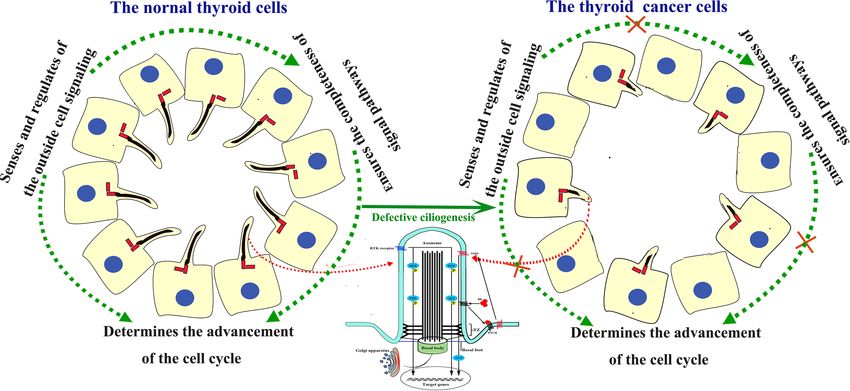
proposed (Figure 1). So the loss of PC is at least partially
domain that connects the basal body and axoneme backbone,
associated with the tumorigenesis and progression of TC.
which is localized toward the membrane in a Y-shaped
arrangement known as the “ciliary gate.” This gate separates
proteins inside the PC from proteins in the cytoplasm and limits
extracellular signal transduction.
In human thyroid follicular cells, PC are present in a ring-
PC MEDIATE HH, MAPK, AND PI3K
shaped 9 + 0 axonemal configuration, and the microtubules and SIGNALING IN TC
diameters of PC steadily decrease toward the distal end of the
Some signaling pathways related to the occurrence, development,
cilia while becoming broader closer to the base of the cilium.
invasion, and metastasis of TC are mediated by PC, and the
Dynein arms and central pair microtubules are absent (6).
receptors for these signaling pathways are often localized to PC.
Therefore, PC are non-motile structures. The length of PC
In the presence of Hh, Ptch1 is transported out of the cilium, and
ranges between 5.0 and 10.7 mm, and the mean length is 7.3 ±
Smo is transported into the cilium, where it promotes the
1.2 mm (7). Almost all human thyroid follicular cells displays at
formation of the activator form of Gli. Gli protein levels
least one PC that protrudes from the apical surface into the
increase in the cilium, and Gli proteins are then transported
follicular lumen, and occasionally, the presence of two PC in a V-
out of the cilium and into the nucleus, where they activate Hh
shaped distribution has been observed on adjacent cells. The PC
target genes. In the absence of Hh, Ptch1 is localized to the ciliary
of thyroid follicular cells taking advantage of their ideal
membrane, Smo is excluded from the cilium, and Gli is
localization coupled to specific intracellular downstream
converted to its repressor form (11). At an early phase of TC
signaling pathways regulates thyroid development.
development, TC stroma secreted Hh ligand mediates tumor-
stroma interaction and Hh pathway are aberrantly activated,
which supports TC cell invasion, migration, and growth in non-
ABNORMAL LENGTH AND FREQUENCY adherent conditions (12). Additionally, PC provide a spatially
OF PC IN TC diverse platform for mediating interaction between the stroma
and cancer cells, so PC genesis defects may disturb this
The frequency and length of PC often change when they respond interaction mediating Hh pathway aberrant activation. These
to diverse stimuli from both inside and outside of thyrocytes. In data show that the PC-mediated Hh pathway participates in
TC, the distribution and frequency of PC are aberrantly changed, TC tumorigenesis.
the number of thyrocytes exhibiting one or more cilia steadily On the other hand, PC-mediated growth factor binding to
decreases from ordinary PTC to FTC, and FTC, PDTC, and ATC RTKs triggers the MAPK and PI3K-AKT cascades to regulate TC
usually lack cilia (8). However, conventional PTC and follicular cell proliferation, and elevated RTK activity also promotes RET/
variants of PTC display well-expressed PC, the length of PC is RAS/BRAF mutations (13, 14). Moreover, oncogenic RAS/BRAF/
strikingly increased, and the frequency of PC seems to be MEK pathway influences Hh pathway activation in TC cell,
unchanged compared with normal thyroid glands, only generating a ligand independent non-canonical mechanism
oncocytic variants of PTC have a decreased frequency and of activation.
length of PC (9). More importantly, these variations of PC Since PC are the carrier of these signaling proteins, and they
appear to be associated with the progression and prognosis of integrate Hh and RTK signaling crosstalk to coordinate thyroid
TC. Moreover, the pathogenicity of PC variations in the hormone synthesis and development. Changes of PC directly
experimental animals of thyroid gland was also observed. A affect these related pathways, which is associated with
mouse model lacking PC showed normal folliculogenesis and tumorigenesis and TC development.
Frontiers in Endocrinology | www.frontiersin.org 2 June 2021 | Volume 12 | Article 685228Ma et al. The Role of Primary Cilia in Thyroid Cancer
FIGURE 1 | Structure of the PC and signaling pathways involving cilia in the human thyroid gland and TC. In normal thyroid gland cells, the PC acts as the sensor
and regulator of the outside cell signaling. In TC cells, the PC was absent. Absence of the PC block the signal from outside and neighbors, and disturb the signal
pathways inside cells, thus lead to uncontrolled cell cycle process and tumorigenesis.
PC PROTRUSION AND RESORPTION prognosis and is a new molecular target in TC therapy (20). Nek,
AFFECT TC CELL FATE which is localized to PC and centrosomes, inhibits ciliogenesis
and promotes spindle assembly, and it may contribute to the
PC protrusion and resorption are tightly coordinated with the coordination between ciliogenesis and cell cycle progression (21).
cell cycle; in addition, the coupling of both ciliogenesis and the Overexpression of Nek 1 in classical and follicular variants of
cell cycle depends on the centrosome, and the role of PTC has a high specificity and sensitivity and is often related to
the centrosome shifts from cell division to ciliogenesis (15). aggressiveness. Therefore, Nek 1 may contribute to the
Cells become quiescent, or proliferating cells enter G1 phase identification of malignant features during TC diagnosis (22).
(16), the centrioles from the centrosome begin to migrate to the Plk1, which is localized to the transition zone of PC, rapidly
cell surface and subsequently form the basal body, and assembly evokes PC resorption and regulates cell cycle progression at the
of PC is initiated; the PC then extend from the basal body into G2-M phase transition (23, 24). Plk1 expression is only
the follicular lumen. In dividing cells, PC are resorbed before S occasionally observed in normal thyrocytes, but overexpression
phase or during G2 phase (17). Subsequently, the centrosome of Plk1 is more frequently detected in smaller PTCs,
forms the mitotic spindle, and the cell enters mitosis. microcarcinomas, and incidental carcinomas. Overexpression
After mitosis, centrosomes are again available to assemble PC, of Plk1 may be an early event in PTC progression (25). Spata4
either in G0 or in early G1 phase (18). Utrilla confirmed this is a spermatogenesis-associated protein associated with thyroid
process in thyroid cells (7). These findings suggest that hormone in fish (26), and spata4 knockdown leads to an arrest of
ciliogenesis and the cell cycle appear to regulate each other via cells in S phase and causes a decrease in the number of cilia in
mutual crosstalk. human retinal epithelial cells (27). The orderly regulation of
these PC proteins between ciliogenesis and the cell cycle
determines the survival of TC cells.
We focused on how PC proteins are linked to cell cycle
progression and ciliogenesis in TC. Although the mechanisms by
PC PROTEINS AFFECT TC PROGRESSION which TC cells lose their cilia are unknown, Aurora kinase A,
PC proteins related to Aurora kinase A, NIMA-related kinases Nek, Plk1, and Spata4 are associated with cilium disassembly and
(Nek), Polo-like kinase (Plk1), and spermatogenesis-associated cell cycle regulation.
protein 4 (Spata4) have been identified as critical for the
regulation of both cilia and the cell cycle. Aurora kinase A,
which is localized to the centrosome and radial microtubules in
PC (19), is highly or weakly expressed in TC tissues and cell lines, DRUGS WITH EFFECTS ON PC
and this abnormal expression induces thyrocyte malignant
transformation. Moreover, activation of Aurora kinase A in The effects of drugs on PC in human cell lines and experimental
late G2 phase triggers spindle assembly and PC disassembly, animal models of TC have not been identified, but U0126
and it becomes inactivated at the completion of mitosis. inhibits the elongation of cilia, ganetespib causes the loss of PC
Overexpression of Aurora kinase A generally implies a poor in experimental animal models of other diseases (28, 29).
Frontiers in Endocrinology | www.frontiersin.org 3 June 2021 | Volume 12 | Article 685228Ma et al. The Role of Primary Cilia in Thyroid Cancer
Additionally, the administration of U0126 and ganetespib effects on PC have been tested in different human cell lines of TC,
effectively inhibits the proliferation of different histological which indicate a possible application of these drugs in clinical
types of TC cells (30, 31). Evidence for the association of studies. Future studies are required to evaluate the effects of these
U0126 and ganetespib with PC should be investigated in TC. drugs on PC of TC.
Drugs targeting PC have been assessed in patients with TC,
and the findings from clinical trials show that doxorubicin,
paclitaxel and docetaxel have modest antitumor activity in
patients with advanced, nonmedullary TC (32). Carboplatin is
recommended as a treatment for ATC in clinical practice CONCLUSIONS AND FUTURE
guidelines in oncology (33). The administration of these drugs PROSPECTS
for TC may provide a clinical benefit in adjuvant settings.
Doxorubicin induces cilium formation in breast fibroblasts Based on the findings described above, PC play a role in
(34), paclitaxel causes cilium elongation in the quail oviduct sustaining thyroid follicular cell polarity, differentiation, and
(35), and docetaxel decreases cilia numbers in olfactory cells (36). proliferation and feature signaling pathways associated with
In addition, carboplatin induces PC disassembly in sensory cells TC. PC undergo cycles of assembly and disassembly that
(37) and has been used to treat TC. Some RTK inhibitors have control TC cell survival, and PC loss in TC cells is usually
been recently approved for use in clinical practice, namely linked to tumor aggressiveness in the clinic. PC in thyroid cells
sorafenib and lenvatinib, have been approved for differentiated appear to function as tumor suppressors, and treatments that
thyroid cancer (DTC) and PDTC, and vandetanib and restore PC may be a potentially promising therapeutic strategy
cabozantinib have been approved for MTC (38), but their for TC. Preclinical and clinical studies will be required to test the
effect on PC has not been reported. roles of PC in the occurrence and progression of TC.
Anticancer drugs with documented effects on PC have been In the future, the relationship between ciliogenesis and
proposed. These drugs induce PC disassembly, restore pathological differentiation of TC tissue should receive
ciliogenesis, lengthen PC, and prevent the accumulation of increasing attention. Studies of the effects of potential
Smo in PC. They have been assessed in TC in preclinical and oncogenic genetic mutations on PC formation may further
clinical studies, considering these factors will formulate rational reveal the mechanisms underlying TC pathogenesis, and
therapeutic strategies for TC. powerful omics analyses have the potential to provide key
insights into the role of PC in TC. Therefore, larger studies are
required to assess whether the absence of PC drives TC
transformation or is a secondary effect of tumorigenesis,
IS RESTORING CILIA A PROMISING which will be critical when considering ciliotherapy as a
potential strategy.
THERAPEUTIC STRATEGY IN TC CELLS?
Although controversy exists regarding whether the length of PC
is modified in PTC, the frequency of PC in TC cells is usually
decreased. In addition, ATC and MTC exhibit loss of PC, and
dysfunction of PC in TC cells is associated with tumorigenesis AUTHOR CONTRIBUTIONS
and malignancy. More importantly, in Hh pathway-dependent C-XM, X-NM, Y-dL, and S-BF conceived the study and wrote the
cancers, there is loss of PC as a mechanism of resistance to Smo paper. All authors contributed to the article and approved the
inhibitors (39). Accordingly, restoring cilia may be a promising submitted version.
therapeutic strategy in TC (40).
There have been some pre-clinical examples of restoration of
PC as a therapeutic target, such as restoration of PC by HDAC
inhibitors in cholangiocarcinoma reduce cholangiocarcinoma
cell growth (41–43). In addition, the use of HDAC inhibitors FUNDING
to treat TC has been well described, although they failed to trigger a
major response against PTC, ATC, and MTC in clinical trials, The author(s) disclose receipt of the following forms of financial
HDAC inhibitors produced encouraging results in PTC, ATC, support for the research, authorship, and publication of this
and MTC cell lines (44–46). Compounds (gefitinib and article: this work was supported by grants from the Construction
dexamethasone) that are able to restore cilia have been verified Program of Gansu Provincial Clinical Medical Research Center
in cell lines of multiple human cancers (such as pancreatic, kidney, for Endocrine Diseases (20JR10FA667), The Gansu Provincial
breast, and lung cancers) (47). Gefitinib shows limited effectiveness Natural Science Foundation (20JR10RA681), The Lanzhou
in patients with advanced TC (48), and dexamethasone exerts Chengguan District Science and Technology Plan Project
antiproliferative effects on a human MTC cell line (49). (2019SHFZ0038), and The Special Funds of Science and
It is hard to say that the restoring of cilia by those drugs was a Technology Development of the Chinese Central Government
primary effect or a secondary effect. However, several drugs with to guide Local in 2020 (1004TCYA032).
Frontiers in Endocrinology | www.frontiersin.org 4 June 2021 | Volume 12 | Article 685228Ma et al. The Role of Primary Cilia in Thyroid Cancer
REFERENCES 22. Melo-Hanchuk TD, Martins MB, Cunha LL, Soares FA, Ward LS, Vassallo J,
et al. Expression of the NEK Family in Normal and Cancer Tissue: An
1. Singla V, Reiter JF. The Primary Cilium as the Cell’s Antenna: Signaling at a Immunohistochemical Study. BMC Cancer (2020) 20(1):23. doi: 10.1186/
Sensory Organelle. Science (2006) 313(5787):629–33. doi: 10.1126/science.1124534 s12885-019-6408-4
2. Lee J, Yi S, Chang JY, Kim JT, Sul HJ, Park KC, et al. Loss of Primary Cilia 23. Seeger-Nukpezah T, Liebau MC, Höpker K, Lamkemeyer T, Benzing T,
Results in the Development of Cancer in the Murine Thyroid Gland. Mol Cells Golemis EA, et al. The Centrosomal Kinase Plk1 Localizes to the Transition
(2019) 42(2):113–22. doi: 10.14348/molcells.2018.0430 Zone of Primary Cilia and Induces Phosphorylation of Nephrocystin-1. PloS
3. Jenks AD, Vyse S, Wong JP, Kostaras E, Keller D, Burgoyne T, et al. Primary One (2012) 7(6):e38838. doi: 10.1371/journal.pone.0038838
Cilia Mediate Diverse Kinase Inhibitor Resistance Mechanisms in Cancer. 24. Ito Y, Yoshida H, Matsuzuka F, Matsuura N, Nakamura Y, Nakamine H, et al.
Cell Rep (2018) 23(10):3042–55. doi: 10.1016/j.celrep.2018.05.016 Polo-Like Kinase 1 (PLK1) Expression Is Associated With Cell Proliferative
4. Lee J, Park KC, Sul HJ, Hong HJ, Kim KH, Kero J, et al. Loss of Primary Cilia Activity and Cdc2 Expression in Malignant Lymphoma of the Thyroid.
Promotes Mitochondria-Dependent Apoptosis in Thyroid Cancer. Sci Rep Anticancer Res (2004) 24(1):259–63.
(2021) 11(1):4181. doi: 10.1038/s41598-021-83418-3 25. Ito Y, Miyoshi E, Sasaki N, Kakudo K, Yoshida H, Tomoda C, et al. Polo-Like
5. Hua K, Ferland RJ. Primary Cilia Proteins: Ciliary and Extraciliary Sites and Kinase 1 Overexpression Is an Early Event in the Progression of
Functions. Cell Mol Life Sci (2018) 75(9):1521–40. doi: 10.1007/s00018-017- Papillary Carcinoma. Br J Cancer (2004) 90(2) 414–8. doi: 10.1038/sj.bjc.6601540
2740-5 26. Li W, Zhu L, Zha J, Wang Z. Effects of Decabromodiphenyl Ether (Bde-209)
6. Martin A, Hedinger C, Häberlin-Jakob M, Walt H. Structure and Motility of on Mrna Transcription of Thyroid Hormone Pathway and Spermatogenesis
Primary Cilia in the Follicular Epithelium of the Human Thyroid. Virchows Associated Genes in Chinese Rare Minnow (Gobiocypris Rarus). Environ
Archiv B Cell Pathol including Mol Pathol (1988) 55(3):159–66. doi: 10.1007/ Toxicol (2014) 29(1):1–9. doi: 10.1002/tox.20767
bf02896572 27. Albee AJ, Kwan AL, Lin H, Granas D, Stormo GD, Dutcher SK. Identification
7. Utrilla JC, Gordillo-Martı́nez F, Gó mez-Pascual A, Ferná ndez-Santos JM, of Cilia Genes That Affect Cell-Cycle Progression Using Whole-Genome
Garnacho C, Vá zquez-Romá n V, et al. Comparative Study of the Primary Transcriptome Analysis in Chlamydomonas Reinhardtti. G3 (Bethesda Md)
Cilia in Thyrocytes of Adult Mammals. J Anat (2015) 227(4):550–60. (2013) 3(6):979–91. doi: 10.1534/g3.113.006338
doi: 10.1111/joa.12360 28. Kim JI, Kim J, Jang HS, Noh MR, Lipschutz JH, Park KM. Reduction of
8. Nesland JM, Sobrinho-Simoes M, Johannessen JV. Scanning Electron Oxidative Stress During Recovery Accelerates Normalization of Primary Cilia
Microscopy of the Human Thyroid Gland and Its Disorders. Scanning Length That Is Altered After Ischemic Injury in Murine Kidneys. Am J Physiol
microscopy (1987) 1(4):1797–810. Renal Physiol (2013) 304(10):F1283–94. doi: 10.1152/ajprenal.00427.2012
9. Lee J, Yi S, Kang YE, Chang JY, Kim JT, Sul HJ, et al. Defective Ciliogenesis in 29. Nikonova AS, Deneka AY, Kiseleva AA, Korobeynikov V, Gaponova A,
Thyroid Hürthle Cell Tumors Is Associated With Increased Autophagy. Serebriiskii IG, et al. Ganetespib Limits Ciliation and Cystogenesis in
Oncotarget (2016) 7(48):79117–30. doi: 10.18632/oncotarget.12997 Autosomal-Dominant Polycystic Kidney Disease (ADPKD). FASEB J (2018)
10. Lee J, Yi S, Won M, Song YS, Yi HS, Park YJ, et al. Loss-of-Function of IFT88 32(5):2735–46. doi: 10.1096/fj.201700909R
Determines Metabolic Phenotypes in Thyroid Cancer. Oncogene (2018) 37 30. Kim JB, Yang EY, Woo J, Kwon H, Lim W, Moon BI. Sodium Selenite
(32):4455–74. doi: 10.1038/s41388-018-0211-6 Enhanced the Anti-Proliferative Effect of MEK-ERK Inhibitor in Thyroid
11. Hassounah NB, Bunch TA, McDermott KM. Molecular Pathways: The Role of Cancer Cells. In Vivo (2020) 34(1):185–90. doi: 10.21873/invivo.11760
Primary Cilia in Cancer Progression and Therapeutics With a Focus on 31. Lin SF, Lin JD, Hsueh C, Chou TC, Yeh CN, Chen MH, et al. Efficacy of an
Hedgehog Signaling. Clin Cancer Res (2012) 18(9):2429–35. doi: 10.1158/ HSP90 Inhibitor, Ganetespib, in Preclinical Thyroid Cancer Models.
1078-0432.ccr-11-0755 Oncotarget (2017) 8(25):41294–304. doi: 10.18632/oncotarget.17180
12. Xu X, Ding H, Rao G, Arora S, Saclarides CP, Esparaz J, et al. Activation of the 32. Bible KC, Kebebew E, Brierley J, Brito JP, Cabanillas ME, Clark TJ Jr, et al.
Sonic Hedgehog Pathway in Thyroid Neoplasms and Its Potential Role in 2021 American Thyroid Association Guidelines for Management of Patients
Tumor Cell Proliferation. Endocrine-related Cancer (2012) 19(2):167–79. With Anaplastic Thyroid Cancer. Thyroid (2021) 31(3):337–86. doi: 10.1089/
doi: 10.1530/erc-11-0305 thy.2020.0944
13. Abdullah MI, Junit SM, Ng KL, Jayapalan JJ, Karikalan B, Hashim OH. 33. Haddad RI, Lydiatt WM, Ball DW, Busaidy NL, Byrd D, Callender G, et al.
Papillary Thyroid Cancer: Genetic Alterations and Molecular Biomarker Anaplastic Thyroid Carcinoma, Version 2.2015. J Natl Compr Canc Netw
Investigations. Int J Med Sci (2019) 16(3):450–60. doi: 10.7150/ijms.29935 (2015) 13(9):1140–50. doi: 10.6004/jnccn.2015.0139
14. Christensen ST, Morthorst SK, Mogensen JB, Pedersen LB. Primary Cilia and 34. Filipová A, Diaz Garcia D, Bezrouk A, Č ı́žková D, Dvořá k J, Filip S. The Toxic
Coordination of Receptor Tyrosine Kinase (RTK) and Transforming Growth Effect of Cytostatics on Primary Cilia Frequency and Multiciliation. J Cell Mol
Factor b (Tgf-b) Signaling. Cold Spring Harb Perspect Biol (2017) 9(6): Med (2019) 23(8):5728–36. doi: 10.1111/jcmm.14487
a028167. doi: 10.1101/cshperspect.a028167 35. Boisvieux-Ulrich E, Laine MC, Sandoz D. In Vitro Effects of Taxol on
15. Pan J, Snell W. The Primary Cilium: Keeper of the Key to Cell Division. Cell Ciliogenesis in Quail Oviduct. J Cell Sci (1989) 92( Pt 1):(9–20. doi:
(2007) 129(7):1255–7. doi: 10.1016/j.cell.2007.06.018 10.1242/jcs.92.1.9
16. Dawe HR, Farr H, Gull K. Centriole/Basal Body Morphogenesis and 36. Kavoi BM, Plendl J, Makanya AN, Ochieng S, Kiama SG. Effects of
Migration During Ciliogenesis in Animal Cells. J Cell Sci (2007) 120(Pt Anticancer Drug Docetaxel on the Structure and Function of the Rabbit
1):7–15. doi: 10.1242/jcs.03305 Olfactory Mucosa. Tissue Cell (2014) 46(3):213–24. doi: 10.1016/j.tice.
17. Avasthi P, Marshall WF. Stages of Ciliogenesis and Regulation of Ciliary 2014.04.005
Length. Differentiation; Res Biol Diversity (2012) 83(2):S30–42. doi: 10.1016/ 37. Mount RJ, Takeno S, Wake M, Harrison RV. Carboplatin Ototoxicity in the
j.diff.2011.11.015 Chinchilla: Lesions of the Vestibular Sensory Epithelium. Acta Otolaryngol
18. Sá nchez I, Dynlacht BD. Cilium Assembly and Disassembly. Nat Cell Biol Suppl (1995) 519:60–5. doi: 10.3109/00016489509121871
(2016) 18(7):711–7. doi: 10.1038/ncb3370 38. Viola D, Valerio L, Molinaro E, Agate L, Bottici V, Biagini A, et al. Treatment
19. Bischoff JR, Anderson L, Zhu Y, Mossie K, Ng L, Souza B, et al. A Homologue of of Advanced Thyroid Cancer With Targeted Therapies: Ten Years of
Drosophila Aurora Kinase Is Oncogenic and Amplified in Human Colorectal Experience. Endocrine-related Cancer (2016) 23(4):R185–205. doi: 10.1530/
Cancers. EMBO J (1998) 17(11):3052–65. doi: 10.1093/emboj/17.11.3052 erc-15-0555
20. Baldini E, Sorrenti S, D’Armiento E, Prinzi N, Guaitoli E, Favoriti P, et al. 39. Zhao X, Pak E, Ornell KJ, Pazyra-Murphy MF, MacKenzie EL, Chadwick EJ,
Aurora Kinases: New Molecular Targets in Thyroid Cancer Therapy. La et al. A Transposon Screen Identifies Loss of Primary Cilia as a Mechanism of
Clinica Terapeutica (2012) 163(6):e457–62. Resistance to SMO Inhibitors. Cancer Discov (2017) 7(12):1436–49.
21. Mahjoub MR, Trapp ML, Quarmby LM. Nima-Related Kinases Defective in doi: 10.1158/2159-8290.cd-17-0281
Murine Models of Polycystic Kidney Diseases Localize to Primary Cilia and 40. Peixoto E, Richard S, Pant K, Biswas A, Gradilone SA. The Primary Cilium: Its
Centrosomes. J Am Soc Nephrol JASN (2005) 16(12):3485–9. doi: 10.1681/ Role as a Tumor Suppressor Organelle. Biochem Pharmacol (2020)
asn.2005080824 175:113906. doi: 10.1016/j.bcp.2020.113906
Frontiers in Endocrinology | www.frontiersin.org 5 June 2021 | Volume 12 | Article 685228Ma et al. The Role of Primary Cilia in Thyroid Cancer
41. Gradilone SA, Radtke BN, Bogert PS, Huang BQ, Gajdos GB, LaRusso 47. Khan NA, Willemarck N, Talebi A, Marchand A, Binda MM, Dehairs J, et al.
NF. Hdac6 Inhibition Restores Ciliary Expression and Decreases Tumor Identification of Drugs That Restore Primary Cilium Expression in Cancer
Growth. Cancer Res (2013) 73(7):2259–70. doi: 10.1158/0008-5472. Cells. Oncotarget (2016) 7(9):9975–92. doi: 10.18632/oncotarget.7198
CAN-12-2938 48. Pennell NA, Daniels GH, Haddad RI, Ross DS, Evans T, Wirth LJ, et al. A
42. Gradilone SA, Pisarello MJL, LaRusso NF. Primary Cilia in Tumor Biology: The Phase II Study of Gefitinib in Patients With Advanced Thyroid Cancer.
Primary Cilium as a Therapeutic Target in Cholangiocarcinoma. Curr Drug Thyroid (2008) 18(3):317–23. doi: 10.1089/thy.2007.0120
Targets (2017) 18(8):958–63. doi: 10.2174/1389450116666150223162737 49. Chung YJ, Lee JI, Chong S, Seok JW, Park SJ, Jang HW, et al. Anti-
43. Mansini AP, Lorenzo Pisarello MJ, Thelen KM, Cruz-Reyes M, Peixoto E, Jin Proliferative Effect and Action Mechanism of Dexamethasone in Human
S, et al. MicroRNA (miR)-433 and Mir-22 Dysregulations Induce Histone- Medullary Thyroid Cancer Cell Line. Endocr Res (2011) 36(4):149–57.
Deacetylase-6 Overexpression and Ciliary Loss in Cholangiocarcinoma. doi: 10.3109/07435800.2011.593012
Hepatology (2018) 68(2):561–73. doi: 10.1002/hep.29832
44. Spartalis E, Athanasiadis DI, Chrysikos D, Spartalis M, Boutzios G, Schizas D, Conflict of Interest: The authors declare that the research was conducted in the
et al. Histone Deacetylase Inhibitors and Anaplastic Thyroid Carcinoma. absence of any commercial or financial relationships that could be construed as a
Anticancer Res (2019) 39(3):1119–27. doi: 10.21873/anticanres.13220 potential conflict of interest.
45. Damaskos C, Garmpis N, Valsami S, Spartalis E, Antoniou EA, Tomos P, et al.
Histone Deacetylase Inhibitors: A Novel Therapeutic Weapon Against Copyright © 2021 Ma, Ma, Li and Fu. This is an open-access article distributed under
Medullary Thyroid Cancer? Anticancer Res (2016) 36(10) 5019–24. the terms of the Creative Commons Attribution License (CC BY). The use, distribution
doi: 10.21873/anticanres.11070 or reproduction in other forums is permitted, provided the original author(s) and the
46. Spartalis E, Kotrotsios K, Chrysikos D, Spartalis M, Paschou SA, Schizas D, copyright owner(s) are credited and that the original publication in this journal is
et al. Histone Deacetylase Inhibitors and Papillary Thyroid Cancer. Curr cited, in accordance with accepted academic practice. No use, distribution or
Pharm Des (2020) 27:2199–208. doi: 10.2174/1381612826666201211112234 reproduction is permitted which does not comply with these terms.
Frontiers in Endocrinology | www.frontiersin.org 6 June 2021 | Volume 12 | Article 685228You can also read


