Blockchain Technology Projects to Provide Telemedical Services: Systematic Review
←
→
Page content transcription
If your browser does not render page correctly, please read the page content below
JOURNAL OF MEDICAL INTERNET RESEARCH                                                                                               Koshechkin et al

     Review

     Blockchain Technology Projects to Provide Telemedical Services:
     Systematic Review

     Konstantin Koshechkin1, PhD; Georgy Lebedev1,2, PhD; George Radzievsky1, PhD; Ralf Seepold1,3, PhD; Natividad
     Madrid Martinez1,4, PhD
     1
      Federal State Autonomous Educational Institution of Higher Education, I.M. Sechenov First Moscow State Medical University of the Ministry of
     Health of the Russian Federation (Sechenov University), Moscow, Russian Federation
     2
      Federal Research Institute for Health Organization and Informatics, Moscow, Russian Federation
     3
      Ubiquitous Computing Lab, HTWG Konstanz, Konstanz, Germany
     4
      IoTLab, Reutlingen University, Reutlingen, Germany

     Corresponding Author:
     Konstantin Koshechkin, PhD
     Federal State Autonomous Educational Institution of Higher Education
     I.M. Sechenov First Moscow State Medical University of the Ministry of Health of the Russian Federation (Sechenov University)
     2-4 Bolshaya Pirogovskaya st.
     Moscow, 119991
     Russian Federation
     Phone: 7 9031516159
     Fax: 7 9031516159
     Email: koshechkin@gmail.com

     Abstract
     Background: One of the most promising health care development areas is introducing telemedicine services and creating
     solutions based on blockchain technology. The study of systems combining both these domains indicates the ongoing expansion
     of digital technologies in this market segment.
     Objective: This paper aims to review the feasibility of blockchain technology for telemedicine.
     Methods: The authors identified relevant studies via systematic searches of databases including PubMed, Scopus, Web of
     Science, IEEE Xplore, and Google Scholar. The suitability of each for inclusion in this review was assessed independently. Owing
     to the lack of publications, available blockchain-based tokens were discovered via conventional web search engines (Google,
     Yahoo, and Yandex).
     Results: Of the 40 discovered projects, only 18 met the selection criteria. The 5 most prevalent features of the available solutions
     (N=18) were medical data access (14/18, 78%), medical service processing (14/18, 78%), diagnostic support (10/18, 56%),
     payment transactions (10/18, 56%), and fundraising for telemedical instrument development (5/18, 28%).
     Conclusions: These different features (eg, medical data access, medical service processing, epidemiology reporting, diagnostic
     support, and treatment support) allow us to discuss the possibilities for integration of blockchain technology into telemedicine
     and health care on different levels. In this area, a wide range of tasks can be identified that could be accomplished based on digital
     technologies using blockchains.

     (J Med Internet Res 2021;23(8):e17475) doi: 10.2196/17475

     KEYWORDS
     telemedicine; distributed ledger; health information exchange; blockchain

                                                                               the past decades. Blockchain technology has already existed
     Introduction                                                              for more than 10 years; however, it did not affect health care in
     In terms of work organization, the health care system has not             general. Simultaneously, it was clearly shown that telemedicine
     changed much over the past century. Simultaneously, the                   could significantly affect clinical outcomes in several areas [1].
     technological infrastructure used by people has undergone
     complete digitalization, with significant changes occurring over
     https://www.jmir.org/2021/8/e17475                                                                 J Med Internet Res 2021 | vol. 23 | iss. 8 | e17475 | p. 1
                                                                                                                      (page number not for citation purposes)
XSL• FO
RenderX
JOURNAL OF MEDICAL INTERNET RESEARCH Koshechkin et al
Interest in using blockchain technology for health care systems The medical services market is very conservative, and
has become prominent since 2017. For example, a study introducing new technologies requires a long time. However,
conducted in the United States showed high levels of interest the significant advantages of the data transfer medium and
in these solutions among medical service consumers. long-term projects can lead to a radical transformation of the
Approximately 19% of the responding hospital executives and health care system as a whole. The provision of telemedicine
80% of the payers were either considering or were in the process services can be the main focus of blockchain technology
of implementing blockchain solutions [2]. implementation. Solutions for the decentralized distribution of
health information constitute one of the most significant benefits
The purpose of this work is to summarize and systematize the
of telemedicine [7-9].
methodology for applying blockchain technology in providing
telemedicine services. For implementing blockchain technology Public blockchain is simultaneously a peer-to-peer network and
in telemedicine, surveys were conducted to obtain answers the a public database without a central server [10].
following questions. How can blockchain-based projects
Figure 1 shows the differences between the types of blockchains.
improve telemedicine services? What are the most common
In a public blockchain, anyone is free to join and participate in
features of these solutions?
the blockchain network's core activities. A private blockchain
Telemedical services at the present level of operation allow allows only the selected entry of verified participants; the
remote consultations with doctors and consultations of medical operator has the right to override, edit, or delete the necessary
workers with patients using communication media such as the entries on the blockchain. A permitted blockchain has the
Internet. Doctors can monitor patients' health statuses remotely properties of private and public blockchains. Permissioned
using medical sensors based on the principles of the Internet of blockchains have seen an increase in popularity thanks to their
Things (IoT). Moreover, doctors can write electronic ability to allocate specific permissions to various network users.
prescriptions [3,4]. A blockchain database contains information about each
transaction of exchange between users. The transactions are
In the future, blockchain technology could potentially help
verified by the miners, who check the authenticity of the
obtain personalized, authentic, and secure health care by
committed actions and then form blocks from these transaction
merging the entire real-time clinical data of a patient and
records. Information is distributed on each network member
presenting it in an up-to-date secure health care setup [5,6].
host or the so-called node.
Figure 1. Blockchain types. EHR: electronic health record.
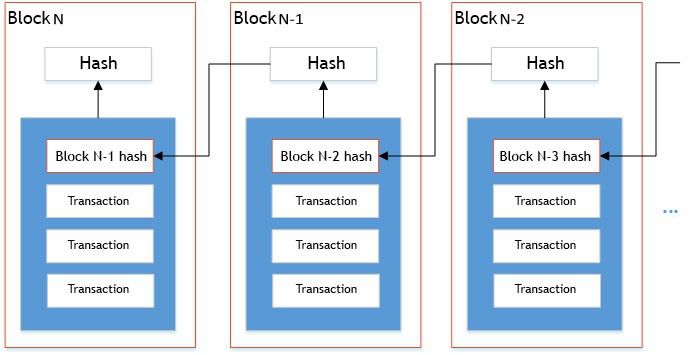
As Figure 2 shows, a blockchain is a distributed database with network performing information exchange processes have the
a sequence of attached and attaching blocks where every same sequence of blocks. A long chain called a transaction log
following block includes the value of the previous block's hash is the result of block interconnections [11].
function as hash information. All peers of the peer-to-peer
https://www.jmir.org/2021/8/e17475 J Med Internet Res 2021 | vol. 23 | iss. 8 | e17475 | p. 2
(page number not for citation purposes)
XSL• FO
RenderXJOURNAL OF MEDICAL INTERNET RESEARCH Koshechkin et al
Figure 2. Blockchain hash function.
Transactions are connected into blocks, where each block At present, it is possible to represent any information, including
contains nearly multiple transactions that form a hash tree. numerical data, texts, audios, and images, in a digital format
Further, the block is transmitted to a distributed ledger network suitable for storage and processing on a personal computer;
where it is checked by specified system participants to avoid moreover, the necessary infrastructure for rapid distribution of
mistakes and guarantee correctness. information is available. For example, we use high-speed mobile
Internet technology based on long-term evolution, a wireless
Providing increased attention to distributed registry technology
broadband communication standard. These technologies make
will lead to an understanding of this technology's potential
it possible to provide instant access to a vast range of
application in health care systems. Such conditions facilitate
information systems using hand-held personal computers, the
the integration of blockchain technology into existing projects,
functionality of which is contained in most modern mobile
the development of new high-tech ones, and working with a
phones [18].
large amount of data [12,13].
There is also a widespread introduction of technologies that
Cryptographic tokens are programmable digital units of the
will make using digital information ubiquitous. However, in
value recorded on a distributed ledger protocol such as a
health care, it is significantly inferior compared to other areas,
blockchain. Tokens do not have their own blockchain but depend
such as banking solutions or retail selling of consumer products.
or exist on an existing blockchain. Tokens may represent
Thus, many promising opportunities for the application of
fungible or in-fungible units of value in the form of money,
information and communication technologies allowing for
coins, points, digital items, or representations of real-world
increased availability and quality of medical services are
physical items and rights. Tokens can exist on public/open and
currently not implemented to the appropriate extent.
permissionless blockchains that anyone on the Internet can view,
or they can remain private, such as within an enterprise business Several reviews on digital technologies to change the health
network. care system landscape have been published lately. These reviews
state that blockchain technology offers a platform that could be
The last decade has had a revolutionary impact on the way
used for many potential applications in health care. Although
information is handled. More recently, meaningful information
this technology is in the early stages of design and development,
was considerably expensive, and the means for its analysis and
many organizations have proposed solutions that have the
dissemination were not available to ordinary citizens. Today,
potential to increase health care data transparency and operating
information resource availability has significantly increased,
efficiency. However, the scalability, security, and
which could be a valuable resource for teamwork and
cost-effectiveness of blockchain technology will require further
decision-making. Blockchain could significantly benefit
research prior to large-scale production and deployment [19-21].
telemedicine by managing medical data access and teamwork
The deployment of blockchain technology in telehealth and
in organizations. Despite their power, tools based on blockchain
telemedicine technology is still in its infancy. Several challenges
are easy to use and do not require high financial costs. The only
and research problems must be resolved to enable the
remaining problems are data interoperability and access
widespread adoption of blockchain technology in telehealth and
restrictions due to imperfect regulatory policies, lack of technical
telemedicine systems. The latest survey on telehealth and
regulation in the field of medical data exchange, and deeply
telemedicine systems shows that they are centralized and fall
rooted paper-based work traditions in many countries [14-17].
short of providing the necessary information security and
https://www.jmir.org/2021/8/e17475 J Med Internet Res 2021 | vol. 23 | iss. 8 | e17475 | p. 3
(page number not for citation purposes)
XSL• FO
RenderXJOURNAL OF MEDICAL INTERNET RESEARCH Koshechkin et al
privacy and there is a lack of blockchain-based health care the websites of the relevant projects. We performed a search
studies considering its use in telemedicine [22]. This topic has for whitepapers, system manuals, relevant user information,
attracted considerable interest in the context of the COVID-19 and other information describing project features on these
lockdowns. The vulnerable situation created owing to the websites. We searched the web-based journal databases and
COVID-19 pandemic has shown the necessity of developing a websites independently of each other. We searched the journal
single-source blockchain-based pandemic health record databases first and then searched the related sites.
management system to address several existing and future
challenges. Storing, sharing, and accessing COVID-19 pandemic
Selection Criteria
data in a single source of information (database) through The main inclusion criterion was that the project must play a
blockchain is the most crucial step to address the previously role in telemedical service and use blockchain technology as a
stated challenges; nevertheless, many issues need to be resolved significant domain. We settled on this criterion to filter out
by international health organizations, country projects based on the opinions of their developers. From a
leaders/governments, and international policy makers to broader perspective, authors can suggest many blockchain-based
introduce government-to-government digital health applications in theory that are suitable for telemedicine services.
service–related policies, data sharing acts, and health policies. Our approach was to use only the data about those projects
Further, issues regarding digital connectivity, digital inequality, being used in telemedicine. We excluded projects without
and the digital divide that exists primarily in the least- and English-language websites. We also excluded projects without
under-developed countries around the world must be addressed. a definite whitepaper or similar information guide. Projects
This pandemic situation is the perfect opportunity for humanity without precise contact data consisting of addresses and phone
to bring all countries together regardless of their differences numbers were also excluded. Publications for the last 10 years
under a single umbrella for ensuring world health safety and only were considered. At least 2 authors checked all the selected
fighting against COVID-19 and future pandemics [23-25]. In projects. Data on similar projects found from different sources
many cases, remote consultations have become the only option were combined.
for patients. Our study concerns the practical aspects of
implementing available blockchain technology in telemedicine. Results
Methods Evaluation and Assessment of Project Features
We analyzed the following features: medical data access
Knowledge Review (electronic health record [HER] distribution), medical service
Our goal was to review the narrow segment of scientific and processing, video conferencing, epidemiology reporting,
public domain knowledge regarding the interconnection between diagnostic support (with artificial intelligence [AI] technology),
telemedicine and blockchain technology. Many successful treatment support (with AI technology), patient data aggregation
projects do not have any grounding in research (for example, (for clinical trials, etc), visit arrangements for medical
HapiChain, DocCoin, and others); hence, we decided to include procedures, ordering medicines from pharmacies, payment
conventional web search engines, where people generally processing, and fundraising. These features resulted from the
showcase their innovations, often based on personal needs. Most analysis performed by the coauthors on assessing the
companies in the blockchain space are start-ups based on cross-represented systems. Their significant features were
emerging technologies, whereas the literature is stale owing to identified, and similar features in different systems were found.
the publication lag time (eg, 6-12 months to conduct the research We assessed the suitable projects and recorded their
followed by another 3-18 months to publish the findings). In functionalities in a spreadsheet (see Multimedia Appendix 1).
this study, we discovered different types of solutions with We analyzed the function descriptions in the published articles
similar standard features. and project website materials.
Search Strategy Data Analysis Results
The search was based on 2 main source types. The first source We found 37 matches in PubMed, 8 publications in Scopus, 5
was web-based journal databases, indexes, and reference lists. in Web of Science, 22 publications in IEEE Xplore, and 547
We searched for prototypes and worked in progress using the results in Google Scholar. As for the web search engines, we
following search terms: telemedical, telemedicine, blockchain, obtained 118,000 results from Google, 242,000 from Yahoo,
and distributed ledger. We constructed a search string using and 118,000 results from Yandex. From the first 100 web pages
AND, the conjunction logical operator, and OR, the disjunction of each search engine and the most relevant results from
logical operator ([telemedical OR telemedicine] AND journals, a total of 36 suitable projects were identified (only 3
[blockchain OR distributed ledger]). The search was based on of them in journal databases). As the results show, all the
the metadata, including, title, abstract, and keywords. We identified projects can be divided into the following areas:
targeted original research papers and review articles indexed tracking the origin of data (2/36, 5.6%), storing and managing
by PubMed, Scopus, Web of Science, IEEE Xplore, and Google data (21/36, 58%), telemedicine services (5/36,14%), diagnosing
Scholar. (3/36, 8%), and using blockchain to raise funds (5/36, 14%).
The second source comprised conventional web search engines We can describe these areas as follows: The origin of data is an
(Google, Yahoo, and Yandex). The first 100 results from each implementation of the authentication procedures based on
search engine were analyzed as the most relevant results to find
https://www.jmir.org/2021/8/e17475 J Med Internet Res 2021 | vol. 23 | iss. 8 | e17475 | p. 4
(page number not for citation purposes)
XSL• FO
RenderXJOURNAL OF MEDICAL INTERNET RESEARCH Koshechkin et al
blockchain. Storing and managing data could be possible using Medical data are stored in the blockchain system. For doctors,
blockchain solutions in different ways. Generally, the most the system offers reports on epidemiology, tips on diagnosis,
sensitive data could be stored in blocks on the blockchain itself. and treatment suggestions. In addition, experts have the
However, this is almost impossible for significant amounts of opportunity to interact with large groups of patients with similar
data owing to computational difficulties. The best solution is disease profiles and other characteristics. Furthermore, it can
to store data on the cloud, in an encoded manner, with the data be used by patients to pay for services using cryptocurrency
key stored in the blockchain. Software solutions could be limited [29].
to only the authentication and data transfer provision or could
Robomed (Russia) is controlled and administered by smart
perform as telemedicine service providers themselves with
contracts based on the Ethereum blockchain. The system aims
voice- and video-streaming capacities. Another way in which
to provide telemedicine services to patients. The Robomed
blockchain could help to improve the health care system is
electronic health record (her) medical information system allows
through smart contracts. They could be used for automation and
medical organizations to register, connect, and operate on the
control of the diagnostics. If we have a list of procedures to be
Robomed network. Robomed's core functions include real-time
performed before we are sure of the examination results, we
monitoring of all patient interactions, health care staff decision-
could load this list into a smart contract and perform them.
making, access privileges, health care professional scheduling,
Moreover, we cannot ignore the financial aspect of this patient health analysis, and consulting services. The Robomed
technology. As the popularity of blockchain stems from Bitcoin mobile app allows patients to receive telemedicine consultations
and other cryptocurrencies, it is used in many cases to sell tokens and exchange EHRs. Using smart contracts, Robomed
as a representative of some value. These tokens are proposed organizations can track and verify patient health statuses and
to be used to pay for medical services, and they could be earned adhere to clinical guidelines for health care services [30-32].
for clinical trial participation or adherence to the prescribed
The DocCoin project (Estonia) has a similar working principle.
treatment.
The user receives access to the service through the “Doc in
Selected Projects pocket” mobile app. In the system, doctors receive payment for
Only 18 projects met the selection criteria. The 5 most prevalent their services in electronic currency. The system's development
features of the available solutions (N=18) were the following: began in 2015, with an initial coin offering in 2018 to exchange
medical data access (14/18, 78%), medical service processing its tokens for cryptocurrency. Payment is charged for services
(14/18, 78%), diagnostic support (10/18, 56%), payment such as storing medical data, visiting specialists, ordering
transactions (10/18, 56%), and fundraising for telemedical medicines, and visiting medical institutions [33]. DocCoin is a
instrument development (5/18, 28%). global service that integrates the entire online medicine industry
and offers advantages to businesses and clients. DocCoin
The primary role of digital systems based on blockchain provides access to doctors around the world through its smart
technology for telemedicine is to distribute the medical contracts. Every user can receive specialist advice 24/7
information of patients and provide access to this data for anywhere in the world in any language.
specialists. Usually, the systems working in this direction allow
the patient to control which medical data are to be placed in the The Memorial Hermann Health Network network helps connect
system and who can access these data. As the implementation patients and health care organizations, providing them with the
of access control does not require any unique technical means ability to independently manage and control their data. This
or bureaucratic delays, the possibilities that open up to users system enables individual organizations to provide data
are extensive [26]. anonymously for scientific research. The system is implemented
on the basis of blockchain technology and allows one to create
In this study, we examined several examples of currently an account for storing personal data; smart contracts provide
existing telemedicine systems based on blockchain technology. encryption, and this system is aimed at big data analytics. A
The Medicalchain project (United Kingdom) mediates patients' blockchain-based solution helps distribute control among
consultations with doctors. Medicalchain is based on a double stakeholders, which provides strong protection against fraudulent
blockchain structure: The first blockchain controls access to activities. Blockchain also provides transparency, traceability,
medical data and is built using Hyperledger Fabric, whereas all auditing, and security, and allows data to be identified through
applications and services on the platform run on Ethereum. Any decentralized storage of information [34].
interactions with medical records are recorded as transactions
in the blockchain registry [27]. The Trusted Health system (United States) has a similar
operating principle, currently preparing for the release of its
The Symptomatic Platform (United States) was created to tokens. The accumulated medical information can be used for
support patients with multiple sclerosis, but it is suitable for scientific research. The most significant interest in patient data
managing data on any chronic disease. Telemedicine in this is expressed by organizations conducting clinical studies,
system is carried out by video conferencing. Users can store, insurance companies, pharmaceutical companies, and
analyze, and compare their data with others; they can also submit organizations providing analytical and consulting services. The
reports, perform statistical evaluation of the epidemiological presented information about the health of patients helps
situation, and undergo genetic screening [28]. specialists improve treatment methods, attract clients, increase
The Docademic system (Mexico) facilitates patients’ profits, and reduce expenses while simultaneously reducing the
communication with doctors through videoconferencing. cost of collecting information, thus improving its quality [35].
https://www.jmir.org/2021/8/e17475 J Med Internet Res 2021 | vol. 23 | iss. 8 | e17475 | p. 5
(page number not for citation purposes)
XSL• FO
RenderXJOURNAL OF MEDICAL INTERNET RESEARCH Koshechkin et al
Another application of blockchain technology is the creation intermediaries to guarantee payment and provision of services.
of diagnostic systems. For example, the Skychain project They are using their tokens for payment [40]. In this group of
(Russia) is an infrastructure for the placement, training, and use systems, blockchain technology serves as a supporting service
of AI, designed to perform diagnostics. As planned, AI should for telemedical interactions.
not replace the doctor but must monitor medical decisions to
HealPoint (United States) is based on the Ethereum platform
prevent mistakes. It is supposed to use its cryptocurrency to
for the implementation of telemedicine services. The system
function, which is necessary to run smart contracts. The proceeds
helps patients use medical consultation services, transfer
will be received by the owners of the neural networks
symptoms, medical records, and vital signs of the patient.
performing diagnostics. Doctors and patients will be able to
Ethereum-based smart contracts allow patients to obtain a
evaluate the results of research by several neural networks
second opinion from several medical experts around the world.
simultaneously and verify the diagnosis based on the obtained
Before providing medical services, network specialists verify
data [36]. This can be done without personal visits to different
the doctor's identity and license. All interactions with patients
specialists. Once created, medical images or other diagnostic
are digitally signed before being recorded on the blockchain for
materials can be evaluated by distant doctors using telemedical
audit purposes [41].
services.
HapiChain (France) exploits blockchain technology to improve
The DeepRadiology (United States) project aims to train
the security, scalability, and reliability of medical workflows.
machine intelligence but in a narrower direction. Medical images
Although HapiChain is patient-centric, it also helps clinicians
obtained by radiological methods are taken into account. This
save time and prevent unnecessary trips without improvising
decision is relevant owing to the high degree of subjectivity in
treatment. In HapiChain, two primary telemedicine services are
evaluating the medical images. The result of the study depends
embedded, namely telemonitoring and teleconsultation.
entirely on the qualifications and experience of the specialist
HapiCare, an existing health care monitoring system with
evaluating the image. In November 2017, DeepRadiology
self-adaptive coaching using probabilistic reasoning, is used
reported on the first artificial intelligence (AI) system that could
for telemonitoring. HapiChain then completes this service by
interpret computed tomography (CT) with a performance level
adding teleconsultation services exploiting blockchain
higher than that of doctors. The system was trained using more
technology [12].
than 9 million brain tomography images. The blockchain
technology in this system acts to implement a secure storage High interest in solutions based on cryptocurrency implemented
medium [37]. Blockchain would most effectively integrate as in blockchain technology causes widespread projects to attract
a mode of managing access to sensitive health data. By storing investment. This approach allows researchers to fully maintain
an index of health records and the related metadata linked to control without transferring the right to make decisions to a
the sensitive data (stored elsewhere on a secure cloud), the critical investor, board of directors, or any other collegial body
system would introduce a layer of interoperability to the formed by financing participants. For example, Elcoin (Russia)
currently disjointed set of systems. aims to obtain funding to develop medical equipment through
the release of its tokens. The company has created several
The eHealth First platform is an international project with the
medical devices. Funds are needed for further development,
goal of implementing natural language processing as most
which the company collects by electronic emission of tokens.
nonstructured medical records filled out manually. For these
The primary target audience is foreign investors [42]. Therefore,
purposes, solutions based on AI are also applied. The rest of
blockchain technology can be used as a medium for fundraising
the system is similar to the previously described ones. It is based
to develop telemedical services.
on the medical data of patients stored using blockchain
technology. It allows associating patients with specialists for Technical solutions are also used for the noninvasive diagnosis
diagnosis and consultation. The system also offers researchers of diabetes, stomach ulcers, and lung cancer. The Health
solutions, allowing them to conduct research based on Monitor project (Czech Republic) is based on the principle of
accumulated data [38]. analyzing markers of biochemical processes in the body; in a
solution created by system developers, the marker is a mixture
In another international system, CareX (United States, Canada,
of gases exhaled by humans [43]. Furthermore, this research
and India), the main emphasis is placed on using the solutions
project primarily uses cryptocurrency-based infrastructure as a
of this platform as a means of international payments. In some
tool to search for investments.
cases, the financial transfers through bank payments, even for
the payment of medical services from one country to another, More unusual is the PointNurse system (United States), which
raises questions from the financial supervisory authorities in is primarily aimed at telemedicine services, establishing a visual
the sending and receiving countries. The remaining functions link between specialists and patients. However, it focuses mainly
of the transmission of medical information in this system are on nursing staff, which is its singular goal. It allows practicing
also presented. An innovative aspect of this project is the ability nurses and members of the support team to conduct direct
to communicate with the chatbot, which implements AI elements consultations on primary health care to make a health
for making a preliminary diagnosis [39]. assessment. The system also has its cryptocurrency used to pay
for services and encourage patients to follow the
Similar issues affect the operation of the Solve.Care system
recommendations. The system works with specialists in several
(Estonia and Ukraine). It allows medical organizations,
languages. There is a rating for specialists, and patients can
insurance companies, and patients to work without
choose whom to contact [33,44,45].
https://www.jmir.org/2021/8/e17475 J Med Internet Res 2021 | vol. 23 | iss. 8 | e17475 | p. 6
(page number not for citation purposes)
XSL• FO
RenderXJOURNAL OF MEDICAL INTERNET RESEARCH Koshechkin et al
MedCredits (United States) uses Ethereum to help doctors automatically deducted from a patient's digital wallet, and funds
diagnose dermatological patients using telemedicine. It is a are moved into the supplier's digital wallet; therefore, payment
secure system that protects users from intruders through the happens seamlessly. Inside a smart contract, exact rules could
implementation of reputation-based systems. Moreover, it allows be included, describing the conditions such as when payments
one to check doctors' licenses. Two Ethereum-based smart will be transferred. It could be an acknowledgment of some
contracts implemented in MedCredits help automate medical data or procedure completion.
escrow-protocol-based payments and validate medical services.
The doctor can access the patient's symptoms to diagnose and
Smart Contracts and Tokens
prescribe treatment using the blockchain [33,46]. Blockchain technology can facilitate such an infrastructure in
the form of a decentralized marketplace where access to health
The common feature of blockchain-based services is that they data is under the individual's control. Information seekers can
deal with sensitive private data that can affect patients’ health. post their queries and individuals can remain anonymous and
Therefore, security and privacy issues should be solved first. decide whether they want to share their data. With the tokens
Blockchain technology–based systems can quickly provide in a blockchain-based marketplace, a reward can be
suitable solutions, as observed in clinical trials [47]. automatically transferred based on a digital contract once the
data has been delivered. Such a system has a clear advantage
Discussion over a fiat currency–based system where an agent must always
be involved, and the large population of unbanked individuals
Telemedicine Services
cannot participate.
Telemedicine services, including radiology, dermatology, and
cardiology services, could be provided in different ways to help Diagnostic centers can be included in the same unified system;
chronic patients and monitor acute patients. Real-time following the recommendation of a physician made via a
telemedicine (also called live telemedicine) makes it easy to telemedical service system, an appointment can be scheduled
facilitate doctor-patient interactions anytime and anywhere. for a specialized examination using inpatient diagnostic
Live telemedicine includes videoconferencing and telephonic equipment that requires an on-site visit. The same principle
consultations that let providers and patients communicate in applies to working with pharmacies. Pharmacy institutions
real time. Assessments of medical histories, essential visual connected to the system will receive a guarantee that this drug
examinations, psychiatric evaluations, and even ophthalmic was prescribed by the physician who referred to the patient
tests can all be conducted via real-time telemedicine. Remote indicated in the system. The high degree of transaction security
patient monitoring allows health care providers to monitor in blockchain systems ensures a suitable level of data
patients’ health data remotely, usually when they are in their authenticity.
own homes. Remote patient monitoring is especially effective Smart contracts are extremely useful for telemedicine. They are
for chronic conditions, ranging from heart disease to diabetes specific computer codes built into the blockchain network and
to asthma. Telemedicine can improve communication among are executed on computers or nodes. Terms between the parties
the members of a medical team. A primary physician can get in the smart contract are written in the form of code in the
greater access to a wide range of specialists without requiring blockchain. The involved parties are anonymous, but the
any travel. Telemedicine technology has considerably contract itself has available public properties. When a starting
accelerated the rate at which X-rays, computed tomography event has happened, for example, the occurrence of a specific
scans, and other important images are distributed from one date, the contract launches itself based on the conditions of the
medical professional to another. Thanks to telemedicine, health provision recorded in its code. Following the terms of the
care professionals have multiple ways to interact with patients contract, the network nodes update the register. After all the
in their own homes. Web-based services, such as patient portals, requirements are met, the contract is automatically closed, and
allow providers to share essential information and answer simple information about the actions performed is recorded in the
questions. Telemedicine could be the only option in harsh blockchain.
conditions; for example, space stations and polar expeditions
could receive only remote professional medical help. The In this work, 18 blockchain systems for telemedicine were
outbreak of COVID-19 proved that telemedicine was an analyzed. The results are presented in Multimedia Appendix 1.
effective option to fight a pandemic [24]. Their capacities were summarized and systematized under a
For example, a patient can obtain advice from a specialist common methodology to identify suitable opportunities for
without visiting another clinic or making a trip to a remote city applying blockchain technology to provide possible telemedicine
or country. There is no need to remain on the waiting list; services. To determine the required properties, the role of
systems with a large pool of doctors instantly allow patients to telemedicine services in the health care system has been
find the required specialist. The expansion of such systems to evaluated. Furthermore, the role of digital systems based on
the financial sector can also be implemented through blockchain blockchain technology for telemedicine has been determined.
transfers using cryptocurrencies. At the same time, within the The most promising projects available on digital support of
framework of the smart contracts, participants are guaranteed telemedicine services using blockchain technology are presented
the provision of services on the one hand and payment on the in this paper.
other. Smart contracts are pieces of code that sit on the Analysis of existing solutions has shown advantages for patients,
blockchain. Once a smart contract is executed, payments are medical organizations, and related institutions. Telemedicine
https://www.jmir.org/2021/8/e17475 J Med Internet Res 2021 | vol. 23 | iss. 8 | e17475 | p. 7
(page number not for citation purposes)
XSL• FO
RenderXJOURNAL OF MEDICAL INTERNET RESEARCH Koshechkin et al
solutions can increase the availability of medical services for They will act as miners and use their hardware and computing
patients, reduce the burden on medical institutions, reduce the infrastructure to maintain the integrity of the blockchain. In
cost of providing services, and increase their delivery efficiency. return, the system will provide them with access to anonymous
Telemedicine does not require expansive facilities and can patient data (with the latter's consent) for epidemiological and
optimize the utilization of on-site medical staff resources. other research activities.
Blockchain technology addresses the issue of access to medical
For example, such a project has already been implemented in
data and the preservation of their confidentiality. Another reason
Estonia [48]. Since 2008, all hospitals and doctors in the country
for blockchain system implementation is its financial capacity.
have been mandatorily digitizing health information. Recently,
It will ease the transfer of payments for medical services from
blockchain has become responsible for its own security.
one country to another without bureaucratic delays. It could be
used as a payment method from one medical institution to The distributed ledger acts as a database for medical records.
another, from a hospital to a foreign bank, or from a patient to When changes are made to a patient's medical record, this event
a foreign hospital. Nevertheless, all participants need to have is immediately recorded on the network, along with information
blockchain system tools to achieve this objective or employ about what exactly was changed, deleted, or added. This
brokers to convert blockchain tokens to fiat money. In addition, transparency level allows therapists, surgeons, pharmacists, and
governmental control and audit of foreign exchange inflows other professionals to receive up-to-date and correct patient
and outflows will be needed. information acceptable to the community.
Blockchain and Telemedicine Drawbacks The system makes it possible to make more accurate diagnoses,
Despite general concerns against blockchain as with any new taking into account a fully documented medical history, guide
technology, these solutions are successful at the pilot level. If doctors in crises (for example, provide information about allergic
we try to address only the most common issues, namely reactions to drugs), and even adjust treatment for chronic
decentralization risks, expenses, and computational complexity, diseases over time (depending on changes in the patient's
blockchain can become a unified (but decentralized) medical condition).
information database. In future, it will be possible for doctors Conclusions
to fill this database not only from EHRs but also with Internet
Our study identified several blockchain technology projects to
of Things gadgets. The blockchain can also record the results
provide telemedical services. They differ considerably from
of group examinations from diagnostic centers and information
each other and should be examined separately. There is no
about clinical trials of drugs. Any hospital in the country will
“silver bullet” in this market, but we suggest some points of
have authorized access to patient data. This will enable doctors
interest to start with in our review. These various features
to share clinical trial results faster, which will accelerate the
(medical data access, medical service processing, epidemiology
development of drugs for severe diseases. Centralization in this
reporting, diagnostic support, and treatment support) allow us
perspective will create eminent dependency on a central node.
to talk about the possibilities of integrating blockchain
This will result in a bottleneck for the entire system.
technology into telemedicine and health care on different levels.
In telemedicine, the main issue is medical data protection. In this area, a wide range of tasks can be identified that could
Additional effort is required to prevent unauthorized access to be accomplished based on digital technologies using
patients’ medical data, especially if they access telemedicine blockchains. Almost all existing projects are prototypes that are
on a public network or via an unencrypted channel. One of the under development. Considering that many of them are aimed
main challenges faced by blockchain solution developers is at attracting investments, it can be said that the role of scientific,
securing the blockchain. For example, in Bitcoin, miners use technical, legal, and economic experts in assessing the feasibility
their computing systems that consume electricity to perform of investing in various start-ups based on blockchain
the computations required to verify data on the blockchain. In technologies is increasing.
return, they receive a reward in the form of digital money.
Solutions based on blockchain technology are of most interest
Projects not related to cryptocurrencies cannot provide network for countries where there are currently no working centralized
participants with a similar form of reward. Therefore, it is information processing systems used for telemedicine.
difficult for them to generate public interest. In telemedicine Launching a distributed system based on open-source solutions
systems, the information in the blockchain can be protected by provides a potential opportunity to avoid significant investments
medical organizations and research agencies. in building a centralized system.
Conflicts of Interest
None declared.
Multimedia Appendix 1
Functionalities of the suitable blockchain-based projects analyzed in this study.
[XLSX File (Microsoft Excel File), 12 KB-Multimedia Appendix 1]
References
https://www.jmir.org/2021/8/e17475 J Med Internet Res 2021 | vol. 23 | iss. 8 | e17475 | p. 8
(page number not for citation purposes)
XSL• FO
RenderXJOURNAL OF MEDICAL INTERNET RESEARCH Koshechkin et al
1. Hersh WR, Helfand M, Wallace J, Kraemer D, Patterson P, Shapiro S, et al. Clinical outcomes resulting from telemedicine
interventions: a systematic review. BMC Med Inform Decis Mak 2001 Nov;1(1):5 [FREE Full text] [doi:
10.1186/1472-6947-1-5] [Medline: 11737882]
2. Healthcare industry interest in blockchain is heating up. Q3 Black Book Blockchain Vendors. 2017. URL: http:/
/blackbookmarketresearch.com/uploads/pdf/2017 [accessed 2021-04-01]
3. Martinez AW, Phillips ST, Carrilho E, Thomas SW, Sindi H, Whitesides GM. Simple telemedicine for developing regions:
camera phones and paper-based microfluidic devices for real-time, off-site diagnosis. Anal Chem 2008 Apr;80(10):3699-3707.
[doi: 10.1021/ac800112r]
4. Katuwal G, Pandey S, Hennessey M, Lamichhane B. Applications of blockchain in healthcare: current landscape &
challenges. arXiv. Preprint posted online on December 6, 2018. [FREE Full text]
5. Siyal AA, Junejo AZ, Zawish M, Ahmed K, Khalil A, Soursou G. Applications of blockchain technology in medicine and
healthcare: challenges and future perspectives. Cryptography 2019 Jan;3(1):3. [doi: 10.3390/cryptography3010003]
6. Liu H, Crespo RG, Martínez OS. Enhancing privacy and data security across healthcare applications using blockchain and
distributed ledger concepts. Healthcare 2020 Jul;8(3):243 [FREE Full text] [doi: 10.3390/healthcare8030243] [Medline:
32751325]
7. Bouras MA, Lu Q, Zhang F, Wan Y, Zhang T, Ning H. Distributed ledger technology for eHealth identity privacy: state
of the art and future perspective. Sensors 2020 Jan;20(2):483. [doi: 10.3390/s20020483]
8. Zheng X, Sun S, Mukkamala RR, Vatrapu R, Ordieres-Meré J. Accelerating health data sharing: a solution based on the
internet of things and distributed ledger technologies. J Med Internet Res 2019 Jun;21(6):e13583 [FREE Full text] [doi:
10.2196/13583] [Medline: 31172963]
9. Brogan J, Baskaran I, Ramachandran N. Authenticating health activity data using distributed ledger technologies. Comput
Struct Biotechnol J 2018;16:257-266 [FREE Full text] [doi: 10.1016/j.csbj.2018.06.004] [Medline: 30101004]
10. Tasatanattakool P, Techapanupreeda C. Blockchain: Challenges and applications. : IEEE Computer Society; 2018 Oct 18
Presented at: International Conference on Information Networking; October 18, 2018; Bangkok p. 473-475. [doi:
10.1109/ICOIN.2018.8343163]
11. Erokhin A, Koshechkin K, Ryabkov I. The distributed ledger technology as a measure to minimize risks of poor-quality
pharmaceuticals circulation. PeerJ Comput Sci 2020;6:e292 [FREE Full text] [doi: 10.7717/peerj-cs.292] [Medline:
33816943]
12. Kordestani H, Barkaoui K, Zahran W. HapiChain: a blockchain-based Framework for patient-centric telemedicine. : Institute
of Electrical and Electronics Engineers; 2020 Presented at: IEEE 8th International Conference on Serious Games and
Applications for Health (SeGAH); August 12-14, 2020; Vancouver p. 1-6. [doi: 10.1109/SeGAH49190.2020.9201726]
13. Griggs KN, Ossipova O, Kohlios CP, Baccarini AN, Howson EA, Hayajneh T. Healthcare blockchain system using smart
contracts for secure automated remote patient monitoring. J Med Syst 2018 Jun;42:130. [doi: 10.1007/s10916-018-0982-x]
14. Toshtemirov A, Mihuba G, Shundi MJ. Using blockchain technology for design of telemedicine system based on mobile
terminal. Int J Emerg Technol Eng Res 2018;6(12):12-19.
15. Colón KA. Creating a patient-centered, global, decentralized health system: combining new payment and care delivery
models with telemedicine, AI, and blockchain technology. BHTY 2018 Sep;1:1-18. [doi: 10.30953/bhty.v1.30]
16. Mackey T, Bekki H, Matsuzaki T, Mizushima H. Examining the potential of blockchain technology to meet the needs of
21st-nentury Japanese health care: viewpoint on use cases and policy. J Med Internet Res 2020 Jan;22(1):e13649 [FREE
Full text] [doi: 10.2196/13649] [Medline: 31917371]
17. Nusrat SA, Ferdous J, Ajmat SA, Ali A, Sorwar G. Telemedicine system design using blockchain in Bangladesh. 2020
Presented at: IEEE Asia-Pacific Conference on Computer Science and Data Engineering (CSDE); December 9-11, 2019;
Melbourne p. 1-5. [doi: 10.1109/CSDE48274.2019.9162401]
18. Aileni RM, Suciu G. IoMT: a blockchain perspective. In: Khan M, Quasim M, Algarni F, Alharthi A, editors. Decentralised
Internet of Things. Switzerland: Springer, Cham; 2020:199-215.
19. Angraal S, Krumholz HM, Schulz WL. Blockchain technology. Circ Cardiovasc Qual Outcomes 2017 Sep;10(9):1. [doi:
10.1161/circoutcomes.117.003800]
20. Kuo T, Kim HE, Ohno-Machado L. Blockchain distributed ledger technologies for biomedical and health care applications.
J Am Med Inform Assoc 2017 Nov;24(6):1211-1220 [FREE Full text] [doi: 10.1093/jamia/ocx068] [Medline: 29016974]
21. Mettler M. Blockchain technology in healthcare: the revolution starts here. 2016 Presented at: IEEE 18th International
Conference on e-Health Networking, Applications and Services (Healthcom); September 14-16, 2016; Munich p. 1-3. [doi:
10.1109/healthcom.2016.7749510]
22. Ahmad RW, Salah K, Jayaraman R, Yaqoob I, Ellahham S, Omar M. The role of blockchain technology in telehealth and
telemedicine. Int J Med Inform 2021 Apr;148:104399 [FREE Full text] [doi: 10.1016/j.ijmedinf.2021.104399] [Medline:
33540131]
23. Azim A, Islam MN, Spranger PE. Blockchainnovel coronavirus: towards preventing COVID-19 future pandemics. Iberoam
J Med 2020;2(3):215-218. [doi: 10.5281/zenodo.3779244]
https://www.jmir.org/2021/8/e17475 J Med Internet Res 2021 | vol. 23 | iss. 8 | e17475 | p. 9
(page number not for citation purposes)
XSL• FO
RenderXJOURNAL OF MEDICAL INTERNET RESEARCH Koshechkin et al
24. Monaghesh E, Hajizadeh A. The role of telehealth during COVID-19 outbreak: a systematic review based on current
evidence. BMC Public Health 2020 Aug;20(1):1193 [FREE Full text] [doi: 10.1186/s12889-020-09301-4] [Medline:
32738884]
25. Telehealth Continues To Change The Face Of Healthcare Delivery - For The Better Electronic Resource. URL: https:/
/www.forbes.com/sites/jeffgorke/2019/09/24/telehealth-continues-to-change-the-face-of-healthcare-delivery-for-the-better/
?sh=74889a89565f [accessed 2021-04-01]
26. Azaria A, Ekblaw A, Vieria T, Lippman A. MedRec: using blockchain for medical data access and permission management.
2016 Presented at: 2016 2nd International Conference on Open and Big Data (OBD); August 22-24, 2016; Vienna p. 25-30.
[doi: 10.1109/OBD.2016.11]
27. Armstrong S. Bitcoin technology could take a bite out of NHS data problem. BMJ 2018 May:k1996. [doi: 10.1136/bmj.k1996]
28. Symptomatic - Timelines. URL: https://www.symptomatic.io/marketing-page [accessed 2021-04-01]
29. What we believe: the safety of the people shall be the highest law. Marcus Tullius Cicero Quotes. URL: https://quotepark.
com/authors/marcus-tullius-cicero/ [accessed 2021-04-01]
30. Robomed Network Launches Blockchain-Based Health Services Platform. URL: https://www.itweek.ru/blockchain/
news-company/detail.php?ID=204320 [accessed 2021-04-01]
31. Healing Technologies: How Does the Big Data Help Physicians to Treat Patients. URL: https://medium.com/robomed
[accessed 2021-04-01]
32. Business Process Management. URL: https://robo-med.com/about/ [accessed 2021-04-01]
33. Mannaro K, Baralla G, Pinna A, Ibba S. A blockchain approach applied to a teledermatology platform in the Sardinian
region (Italy). Information 2018 Feb;9(2):44. [doi: 10.3390/info9020044]
34. A New Paradigm in Healthcare Data Privacy AND Security. URL: http://www.myhealthmydata.eu/ [accessed 2021-04-01]
35. Jarzabek G, Schucht P, Rzeczkowski L. Patient and doctor-centric health ecosystem in specialised medicine engineered on
blockchain. TrustedHealth 2017:33-34 [FREE Full text] [doi: 10.30748/soi.2021.164.04]
36. Skychain Global - Blockchain Infrastructure for Medical AI. URL: https://skychain.global/wp-content/uploads/2018/03/
wp_english-Newest.pdf [accessed 2021-04-01]
37. Merkow J, Lufkin R, Nguyen K, Soatto S, Tu Z, Vedaldi A. DeepRadiologyNet: radiologist level pathology detection in
CT head images. ArXiv. Preprint posted online on November 26, 2017. [FREE Full text]
38. eHealth First. URL: https://ehfirst.io/ [accessed 2021-04-01]
39. A new healthcare payment method using tokens on a blockchain. URL: https://neironix.io/documents/whitepaper/3185/
whitepaper.pdf [accessed 2021-04-01]
40. Yusuf H, Bergström MM. Creating legitimacy within blockchain startups in a virtual context - A study on how decentralized
organisations raise funds before executing an Initial Coin Offering [Dissertation].: The Institution for Informatics and
Media, Uppsala University; 2018. URL: https://www.diva-portal.org/smash/get/diva2:1286073/FULLTEXT01.pdf [accessed
2021-04-01]
41. HealPoint | AngelList Talent. URL: https://angel.co/company/healpoint [accessed 2021-04-01]
42. Elcoin. URL: https://elcoin.io/White_Paper%200.9_v3-final.pdf [accessed 2021-04-01]
43. Atutov SN, Calabrese R, Plekhanov AI, Tomassetti L. Diffusion and photodesorption of molecular gases in a polymer
organic film. Eur Phys J D 2014 Jan;68(1):1. [doi: 10.1140/epjd/e2013-40468-7]
44. PointNurse Reaches Milestone on Path to Digital Health Provider Leadership. URL: https://www.prnewswire.com/
news-releases/pointnurse-reaches-milestone-on-path-to-digital-health-provider-leadership-300974449.html [accessed
2021-04-01]
45. Engelhardt MA. Hitching healthcare to the chain: an introduction to blockchain technology in the healthcare sector. TIM
Review 2017 Oct;7(10):22-34. [doi: 10.22215/timreview/1111]
46. Todaro J. The community asked us to build. And that’s what we did. Preparing for the Launch of MedX. URL: https:/
/medium.com/medxprotocol/preparing-for-the-launch-of-medx-97d39e1d9e9c [accessed 2021-04-01]
47. Wong DR, Bhattacharya S, Butte AJ. Prototype of running clinical trials in an untrustworthy environment using blockchain.
Nat Commun 2019 Feb;10(1):917 [FREE Full text] [doi: 10.1038/s41467-019-08874-y] [Medline: 30796226]
48. Distributed Ledger in Healthcare: Why Medicine Needs Blockchain Electronic Resource. URL: https://tallinn.mhealth.events/
en/article/raspredelenniy-reestr-v-oblasti-zdravoohraneniya-pochemu-meditsine-nugen-blokcheyn-96363 [accessed
2021-04-01]
Abbreviations
AI: artificial intelligence
EHR: electronic health record
https://www.jmir.org/2021/8/e17475 J Med Internet Res 2021 | vol. 23 | iss. 8 | e17475 | p. 10
(page number not for citation purposes)
XSL• FO
RenderXJOURNAL OF MEDICAL INTERNET RESEARCH Koshechkin et al
Edited by G Eysenbach; submitted 15.12.19; peer-reviewed by F Lehocki, JT te Gussinklo, S Pit, E Chukwu, A Kamisalic, L Luo, C
Reis, J Liu, R Hylock, TT Kuo; comments to author 26.10.20; revised version received 12.02.21; accepted 09.05.21; published 18.08.21
Please cite as:
Koshechkin K, Lebedev G, Radzievsky G, Seepold R, Martinez NM
Blockchain Technology Projects to Provide Telemedical Services: Systematic Review
J Med Internet Res 2021;23(8):e17475
URL: https://www.jmir.org/2021/8/e17475
doi: 10.2196/17475
PMID:
©Konstantin Koshechkin, Georgy Lebedev, George Radzievsky, Ralf Seepold, Natividad Madrid Martinez. Originally published
in the Journal of Medical Internet Research (https://www.jmir.org), 18.08.2021. This is an open-access article distributed under
the terms of the Creative Commons Attribution License (https://creativecommons.org/licenses/by/4.0/), which permits unrestricted
use, distribution, and reproduction in any medium, provided the original work, first published in the Journal of Medical Internet
Research, is properly cited. The complete bibliographic information, a link to the original publication on https://www.jmir.org/,
as well as this copyright and license information must be included.
https://www.jmir.org/2021/8/e17475 J Med Internet Res 2021 | vol. 23 | iss. 8 | e17475 | p. 11
(page number not for citation purposes)
XSL• FO
RenderXYou can also read


