BlueScope Steel Limited - APPLICATION FOR ANTI-DUMPING DUTIES PLATE STEEL - Department of Industry
←
→
Page content transcription
If your browser does not render page correctly, please read the page content below
BlueScope Steel Limited
APPLICATION FOR ANTI-DUMPING DUTIES

            PLATE STEEL

             exported from

      the People’s Republic of China,
      Indonesia, Japan, the Republic of
      Korea and Taiwan
                 and
APPLICATION FOR COUNTERVAILING DUTIES

            PLATE STEEL

             exported from

      the People’s Republic of China

         PUBLIC FILE VERSION
              December 2012

                 PUBLIC FILE              1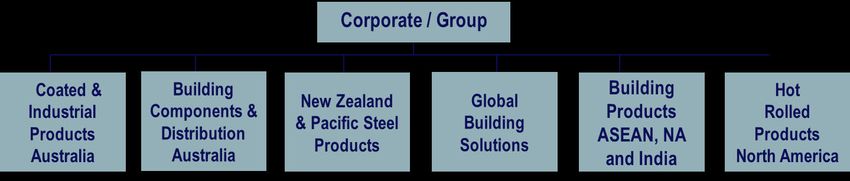
Plate Steel from China, Indonesia, Japan, Korea and Taiwan
AUSTRALIAN CUSTOMS SERVICE
Application for Dumping and
Countervailing Duties
DECLARATION
I request in accordance with Section 269TB of the Customs Act 1901 that the
Minister publish in respect of goods the subject of this application:
a dumping duty notice for plate steel exported from Indonesia, Japan,
Korea and Taiwan;
a countervailing duty notice, or
a dumping and a countervailing duty notice for plate steel exported from
the People’s Republic of China
This application is made on behalf of the Australian industry producing like goods
to the imported goods the subject of this application. The application is supported
by Australian producers whose collective output comprises:
25% or more of the total Australian production of the like goods; and
more than 50% of the total production of like goods by those Australian
producers that have expressed either support for, or opposition to, this
application.
I believe that the information contained in this application:
provides reasonable grounds for the publication of the notice(s)
requested; and
is complete and correct.
Signature:......................................................................................
Name: Alan Gibbs
Position: Development Manager – International Trade
Company: BlueScope Steel Limited
ABN: 19 000 019 625
Date: / /
PUBLIC FILE 2
Plate Steel from China, Indonesia, Japan, Korea and Taiwan
PART A
INJURY
TO AN AUSTRALIAN INDUSTRY
IMPORTANT
All questions in Part A should be answered even if the answer is ‘Not applicable’
or ‘None’. If an Australian industry comprises more than one company/entity,
each should separately complete Part A.
For advice about completing this part please contact the Customs Dumping
Liaison Unit on:
(02) 6275-6066 Fax (02) 6275-6990
PUBLIC FILE 3
Plate Steel from China, Indonesia, Japan, Korea and Taiwan

A-1     Identity and communication.
        Please nominate a person in your company for contact about the application:

        This application is made on behalf of BlueScope Steel Limited (“BlueScope”) the sole Australian
        manufacturer of plate steel products.

        Relevant contact details for personnel within BlueScope that will assist with enquiries concerning
        this application are as follows:

        Contact Name:                    Alan Gibbs
        Company and position:            Development Manager – International Trade
        Address:                         Five Islands Road, Port Kembla, NSW 2500
        Telephone:                       (02) 4275 3859
        Facsimile:                       (02) 4275 7810
        E-mail address:                  Alan.Gibbs@bluescopesteel.com
        ABN:                             16 000 011 058

        Alternative contact:

        Contact Name:                    Stuart Bell
        Company and position:            Finance Manager – BANZ Sales and Marketing
        Address:                         Five Islands Road, Port Kembla, NSW 2500
        Telephone:                       (02) 4275 4189
        Facsimile:                       (02) 4275 7810
        E-mail address:                  Stuart Bell@bluescopesteel.com

        If you have appointed a representative to assist with your application, provide the
        following details and complete Appendix A8 (Representation).

        The applicants have engaged the following consultant to assist with this application:

        Name:                                    Mr John O’Connor
        Representative's business name:          John O’Connor & Associates Pty Ltd
        Address:                                 P.O. Box 329, Coorparoo Qld 4151
        Telephone:                               (07) 3342 1921
        Facsimile:                               (07) 3342 1931
        E-mail address:                          jmoconnor@optusnet.com.au
        ABN:                                     39 098 650 241

                                         PUBLIC FILE                                             4
Plate Steel from China, Indonesia, Japan, Korea and Taiwan
A-2 Company information.
1. State the legal name of your business and its type (eg. company, partnership, sole trader,
joint venture). Please provide details of any other business names you use to
manufacture/produce/sell the goods that are the subject of your application.
The company seeking the imposition of anti-dumping measures is BlueScope Steel Limited
(ABN 19 000 019 625).
BlueScope Steel Limited (hereafter referred to as “BlueScope” or “BSL”) is an Australian
manufacturer of flat steel products. BlueScope produces the goods that are the subject of this
application which is plate steel that is marketed under the following trade names “XLERPLATE”
and “XLERPLATE LITE” steel. These products are sold into the Australian market direct to
manufacturing customers and via distributors.
2. Provide your company’s internal organisation chart. Describe the functions performed by
each group within the organisation.
An internal group organisation chart for BlueScope is set out below (as at 01 July 2012):
Functions performed by each group within the organization
1. Coated & Industrial Products Australia
• Supplier of flat steel products (including the goods under consideration
“GUC”);
• Supplier of metal coated and painted steel, with operations at the following
sites:
- Port Kembla Steel Works, NSW;
- Springhill, NSW;
- Western Port, Victoria;
- Western Sydney (NSW) and Acacia Ridge (QLD) COLORBOND® steel
painting facilities; and
- North America, Europe and Asia export trading offices
2. Building components and Distribution Australia
Supplier of flat steel solutions in Australia made up of the following businesses:
• BlueScope Distribution;
• BlueScope Lysaght
PUBLIC FILE 5Plate Steel from China, Indonesia, Japan, Korea and Taiwan
3. New Zealand & Pacific Steel Products
A fully integrated, flat steel products manufacturer in New Zealand.
Supplier of flat products;
Growing iron sands export business
operating in:
• Glenbrook, NZ;
• Taharoa NZ; and
• Lysaght Pacific Island .(Fiji, New Caledonia, Vanuatu)
4. Global Building Solutions
Global designer / supplier of pre-engineered buildings, with the following business
operations:
• Buildings North America;
• China –Building Solutions, Lysaght and Building Products;
• Buildings Asia;
• Buildings and Ranbuild Australia; and
• Saudi Building Systems.
5. Building Products ASEAN, North America and India
Seller of branded steel in Asia.
Metallic coating, painting and Rollforming operations include:
JV (completion pending)
• Asean coating lines (Indonesia, Malaysia, Thailand and Vietnam);
• ASEAN Lysaght and Ranbuild (Indonesia, Malaysia, Thailand, Vietnam,
Singapore and Brunei);
• Steelscape (U.S.A);
• ASC Profile (U.S.A); and
• India – Tata BlueScope JV
6. Hot Rolled Products North America
A 50:50 Joint Venture with Cargill Incorporated.
In Delta, Ohio
3. List the major shareholders of your company. Provide the shareholding percentages for
joint owners and/or major shareholders.
BlueScope Steel Limited is a publicly listed company. The Major (Top 20) shareholders within
BlueScope as at 13 August 2012 include:
PUBLIC FILE 6Plate Steel from China, Indonesia, Japan, Korea and Taiwan
SHAREHOLDER INFORMATION
As at 13 August 2012
Twenty Largest Registered Shareholders
%
Rank Name of shareholder Total Units Issued
Capital
1 J P MORGAN NOMINEES AUSTRALIA LIMITED 538,492,229 16.08%
2 NATIONAL NOMINEES LIMITED 520,935,825 15.55%
3 HSBC CUSTODY NOMINEES (AUSTRALIA) LIMITED 503,916,874 15.05%
4 CITICORP NOMINEES PTY LIMITED 357,546,050 10.68%
5 BNP PARIBAS NOMS PTY LTD 139,702,332 4.17%
6 CITICORP NOMINEES PTY LIMITED 94,262,038 2.81%
7 HSBC CUSTODY NOMINEES (AUSTRALIA) LIMITED 43,593,681 1.30%
8 JP MORGAN NOMINEES AUSTRALIA LIMITED 42,669,965 1.27%
9 QUEENSLAND INVESTMENT CORPORATION 16,308,020 0.49%
10 AMP LIFE LIMITED 14,180,882 0.42%
11 PACIFIC CUSTODIANS PTY LIMITED 10,122,041 0.30%
12 SHARE DIRECT NOMINEES PTY LTD 10,000,000 0.30%
13 IQ RENTAL & FINANCE PTY LTD 9,000,004 0.27%
14 BOND STREET CUSTODIANS LIMITED 8,101,661 0.24%
15 Y S CHAINS PTY LTD 7,900,000 0.24%
16 RBC INVESTOR SERVICES AUSTRALIA NOMINEES PTY LIMITED 7,707,888 0.23%
17 MERRILL LYNCH (AUSTRALIA) NOMINEES PTY LIMITED 7,163,039 0.21%
18 BLUESCOPE STEEL EMPLOYEE SHARE PLAN PTY LTD 6,935,600 0.21%
19 HSBC CUSTODY NOMINEES (AUSTRALIA) LIMITED - A/C 2 6,893,351 0.21%
20 BNP PARIBAS NOMS PTY LTD 4,181,500 0.12%
TOTAL 2,349,612,980 70.15%
Balance of Register 999,572,267 29.85%
Grand TOTAL 3,349,185,247 100.00%
4. If your company is a subsidiary of another company list the major shareholders of
that company.
BlueScope is not a subsidiary of another company.
5. If your parent company is a subsidiary of another company, list the major shareholders of
that company.
This question is not applicable to BlueScope.
6. Provide an outline diagram showing major associated or affiliated companies and your
company’s place within that structure (include the ABNs of each company).
Major Associated or affiliated companies
BlueScope is a publicly listed company, limited by shares. It has a number of subsidiaries and
joint ventures both in Australia and overseas, which are included in Confidential Attachment A-
2.6. A detailed listing of BlueScope’s subsidiaries is also located in its Annual Full Financial
Report, including the level of equity holding in each subsidiary company.
The following is a summary of the activities of the major affiliates:
Affiliated Company Activities of affiliate
Australian Affiliates
Lysaght Building Solutions Pty Ltd Manufacturer of roll formed steel profiles for the
building and construction markets, including
roofing, walling, rainwater goods, and structural
components such as purlins, girts and decking.
PUBLIC FILE 7Plate Steel from China, Indonesia, Japan, Korea and Taiwan
BlueScope Water Pty Ltd Manufacturer of rainwater tanks (Melbourne,
Sydney, Brisbane) ranging from 1,000 ltrs to
5,000 ltrs for use in small residential and
medium commercial applications.
Pioneer Water Tanks (Australia) Pty Ltd Manufacturer of large rural water storage tanks
up to 35,000 ltrs.
Highline Limited Manufacturer of steel buildings and associated
products for both the domestic and commercial
markets.
BlueScope Steel (AIS) Pty Ltd BlueScope Steel manufacturing - is the
Australian (Port Kembla) integrated Steelworks
where all major phases of production, including
iron making and slab making (5.3 million tpa), is
undertaken.
BlueScope Distribution Pty Ltd BlueScope Steel's reselling (distribution)
business which purchases coated steel in
volume and resells to smaller manufacturers
across Australia. Some facilities process steel
into slit coil or sheet for resale.
BlueScope Building Solutions Pty Ltd Designs, supplies and constructs commercial
and industrial buildings for the Australian
market.
International Affiliates
BlueScope Steel (Suzhou) Ltd Coating lines - coating of cold rolled steel
products with zinc and / or zinc and aluminium
to provide corrosion protection.
BlueScope Lysaght (Brunei) Sdn Bhd Manufacturer of roll formed steel profiles for the
building and construction markets, including
roofing, walling, rainwater goods, and structural
components such as purlins, girts and decking.
BlueScope Acier Nouvelle - Caledonie SA Manufacturer of roll formed steel profiles for the
building and construction markets, including
roofing, walling, rainwater goods, and structural
components such as purlins, girts and decking.
BlueScope Lysaght (Singapore) Pte Ltd Manufacturer of roll formed steel profiles for the
building and construction markets, including
roofing, walling, rainwater goods, and structural
components such as purlins, girts and decking.
BlueScope Lysaght Fiji Ltd Manufacturer of roll formed steel profiles for the
building and construction markets, including
roofing, walling, rainwater goods, and structural
components such as purlins, girts and decking.
BlueScope Lysaght (Thailand) Ltd Manufacturer of roll formed steel profiles for the
building and construction markets, including
roofing, walling, rainwater goods, and structural
components such as purlins, girts and decking.
BlueScope Steel Vietnam LLC Coating lines - coating of cold rolled steel
products with zinc and / or zinc and aluminium
to provide corrosion protection.
BlueScope Steel Asia Pte Ltd Service centre for the processing of coiled steel
into shapes and sizes per customer
requirements
BlueScope Steel International Limited Sales office
BlueScope Steel Southern Africa Pty Ltd Sales office
BlueScope Steel (Thailand) Ltd Cold rolling mill and pickle line, which converts
hot rolled coil into cold rolled coil. Coating lines
- coating of cold rolled steel products with zinc
and / or zinc and aluminium to provide
corrosion protection.
PUBLIC FILE 8Plate Steel from China, Indonesia, Japan, Korea and Taiwan
BlueScope Steel North America Sales office
BlueScope Steel (Malaysia) Sdn Bhd Coating lines - coating of cold rolled steel
products with zinc and / or zinc and aluminium
to provide corrosion protection.
Tasman Steel Holdings Ltd The New Zealand integrated Steelworks where
all major phases of production, including iron
making and slab making is undertaken.
Coating of cold rolled steel products with zinc
and / or zinc aluminium to provide corrosion
protection.
BlueScope Buildings Vietnam Ltd Manufacturer of roll formed steel profiles for the
building and construction markets, including
roofing, walling, rainwater goods, and structural
components such as purlins, girts and decking.
BlueScope Lysaght (Guangzhou) Ltd Manufacturer of roll formed steel profiles for the
building and construction markets, including
roofing, walling, rainwater goods, and structural
components such as purlins, girts and decking.
BlueScope Lysaght (Shanghai) Ltd Manufacturer of roll formed steel profiles for the
building and construction markets, including
roofing, walling, rainwater goods, and structural
components such as purlins, girts and decking.
BlueScope Lysaght (Langfang) Ltd Manufacturer of roll formed steel profiles for the
building and construction markets, including
roofing, walling, rainwater goods, and structural
components such as purlins, girts and decking.
BlueScope Lysaght (Chengdu) Ltd Manufacturer of roll formed steel profiles for the
building and construction markets, including
roofing, walling, rainwater goods, and structural
components such as purlins, girts and decking.
PT BlueScope Steel Indonesia Coating lines - coating of cold rolled steel
products with zinc and / or zinc and aluminium
to provide corrosion protection.
PT BlueScope Steel (Lysaght) Indonesia Manufacturer of roll formed steel profiles for the
building and construction markets, including
roofing, walling, rainwater goods, and structural
components such as purlins, girts and decking.
7. Are any management fees/corporate allocations charged to your company by your parent
or related company?
As BlueScope does not have a parent company, this question is not applicable to BlueScope.
8. Identify and provide details of any relationship you have with an exporter to Australia or
Australian importer of the goods.
BlueScope Steel’s International Affiliate, Tasman Steel Holdings ltd (known as New Zealand
steel) exports a range of flat steel products from New Zealand into Australia via their local sales
arm – New Zealand Steel Australia (NZSA).
BlueScope does have an arm’s length relationship via its Distribution business with importers of
the Goods Under Consideration (“GUC”) – namely [companies].
9. Provide a copy of all annual reports applicable to the data supplied in Appendix A3 (Sales
Turnover). Any relevant brochures or pamphlets on your business activities should also
be supplied.
PUBLIC FILE 9Plate Steel from China, Indonesia, Japan, Korea and Taiwan
BlueScope’s 2012 Annual Report and Full Financials are included with this application (Non-
Confidential Attachment A-2.9). BlueScope’s Annual Reports from 2003 to 2012 are available
from its website at www.bluescopesteel.com.
10. Provide details of any relevant industry association.
BlueScope is a member of the Australian Steel Institute – refer www.steel.org.au.
A-3 The imported and locally produced goods.
1. Fully describe the imported product(s) the subject of your application:
Include physical, technical or other properties.
Where the application covers a range of products, list this information for each make
and model in the range.
Supply technical documentation where appropriate.
The imported goods the subject to this application are:
‘Flat rolled products of:
iron;
non-alloy steel; or
non-heat treated alloy steel of a kind commonly referred to as Quench
and Tempered (Q&T) Green Feed;
of a width greater than 600mm, with a thickness equal to or greater than 4.75mm,
not further worked than hot rolled, not in coils, with or without patterns in relief.
Goods excluded from this application are:
250 grades of plate steel with a thickness greater than 150mm
350 grades of plate steel with a thickness greater than 100mm
Q & T Green Feed grades of plate steel with a thickness greater than
105mm
Heat treated Q & T grades of plate steel.’
It is understood that the standard dimensions of imported plate product ranges within
1500mm – 3200mm in width, 5mm – 150mm in thickness and 6 – 12 metres in length.
Imported non-alloy steel plate product is most commonly offered in nominal yield
strengths of 250 MPa and 350 Mpa, depending on application and end use.
Imported alloy steel plate product grades that are made by BlueScope steel and also
imported into Australia are generically called Q & T Green Feed. Q & T Green Feed is
supplied only in ‘non heat-treated‘ condition. Q & T Green Feed steel grades possess a
higher hardenability, which (on heat treating) results in higher strength and hardness
properties over 250 Mpa and 350 Mpa non alloy steel grades. To achieve this higher
hardenability, additional specific alloys are added during the steelmaking process (i.e.
thereby incurring a higher cost of production).
Q & T Green Feed grades of steel have chemical compositions that typically fall within the
following range:-
Carbon Max – 0.40%
Manganese Max – 1.6%
Silicon Max – 0.65%
Sulphur Max – 0.035%
Phosphorous Max – 0.035%
PUBLIC FILE 10Plate Steel from China, Indonesia, Japan, Korea and Taiwan
Nickel Max – 2.5%
Chrome Max – 2.0%
Molybdenum Max – 1.0%
Vanadium Max – 0.15%
Boron Max – 0.006%
It is noted that the % of individual alloying elements will vary in accordance with each
manufacturer’s grade specifications and that not all elements may be utilised in all Q & T
Green Feed steel grades.
Q&T Green Feed products are normally ‘negotiated mill to customer’ chemistry grades of
plate steel.
Q & T Green Feed is only supplied in the non heat-treated condition. (ie the heat
treatment process to achieve the higher hardenability is undertaken by BlueScope steel’s
customer(s)).
The GUC are generically called hot rolled plate steel, plate steel, coil plate steel or Q&T
Green Feed (used interchangeably with GUC in this application).
Trade or further generic names often used to describe these Goods include:
- “XLERPLATE” steel
- “XLERPLATE LITE” steel
- Plate
- Pattern Plate
- Coil Plate
- Checker Plate
- Floor Plate
- Q&T Green Feed
There are a number of relevant International Standards for plate steel products that cover
their own range of products via specific grade designations, including the recommended
or guaranteed properties of each of these product grades.
Q&T Green Feed products are ‘negotiated mill to customer’ chemistry grades of plate
steel.
These relevant standards are noted below in Table A-3.1a and A-3.1b
“Relevant International Standards for Plate Steel”. Refer to Non-Confidential Attachment
A-3.1 for Australia/New Zealand standards for plate steel.
Table A-3.1a - Relevant International Standards for Plate steel – Structural Grades
PUBLIC FILE 11Plate Steel from China, Indonesia, Japan, Korea and Taiwan
Australian and International Standards:- Structural Grades
AS/NZS 3678 ASTM JIS China
Grade Grade Grade Grade
250 A36 G3101-SS400 GB/T 700 - Q275
250L15
250L20
250Y20
250L40
250Y40
300
300L15
300L20
300Y20
300L40
300Y40
350 A572 -345 (50) G3101-SS490 GB/T 1591 - Q345
350L15
350L20
350Y20
350L40
350Y40
400 A572 -415 (60) GB/T 1591 - Q390
400L15
400L20
400Y20
400L40
400Y40
450 A572 -450 (65) GB/T 1591 - Q420
450L15 GB/T 1591 - Q460
450L20
450Y20
450L40
450Y40
Table A-3.1b - Relevant International Standards for Plate steel – PV Grades
Australian and International Standards:-
Pressure Vessel and Boiler Grades
AS 1548 ASTM
Grade Grade
PT 430 A516 - 415 (60)
PT 460 A516 - 450 (65)
PT 490 A516 - 485 (70)
PT 490 A516 - 485 (70)
PT 490 N A516 - 485 (70) N
2. What is the tariff classification and statistical code of the imported goods.
The GUC are classified within tariff sub-headings:
• 7208.40.00 statistical code 39;
• 7208.51.00 statistical code 40;
• 7208.52.00 statistical code 41; and
• 7225.40.00 statistical codes 22 and 24.
The GUC imported from China, Korea, Indonesia and Taiwan classified to 7208.40.00,
PUBLIC FILE 12Plate Steel from China, Indonesia, Japan, Korea and Taiwan
7208.51.00, 7208.52.00 attract a rate of duty applicable to “DCS” countries (i.e. a Free rate of
duty). Imports of the GUC from Japan and Taiwan classified to the same headings attract a 5
per cent rate of duty.
The GUC imported from China and Indonesia classified to 7225.40.00 attracts a 4 per cent rate
of duty (i.e. the DCS rate) and imports from Japan, Korea and Taiwan under this classification
attract a 5 per cent rate of duty.
Please refer to Non-Confidential Attachment A-3.2 for a copy of the Customs Tariff Schedule 3
extract.
BlueScope highlights with the Australian Customs and Border Protection Service (“Customs and
Border Protection”) that published Australian Bureau of Statistics (“ABS”) import clearance data
for the GUC do not disclose “country of import” details due to current suppression orders.
BlueScope has therefore relied upon export data from the nominated countries to determine
volumes of the GUC. Please refer to Section B-1.2 below for further information concerning
source data for exports of the GUC to Australia.
3. Fully describe your product(s) that are ‘like’ to the imported product:
Include physical, technical or other properties.
Where the application covers a range of products, list this information for each make
and model in the range.
Supply technical documentation where appropriate.
Indicate which of your product types or models are comparable to each of the
imported product types or models. If appropriate, the comparison can be done in a
table.
Locally produced goods
BlueScope manufactures flat rolled products of ‘non-alloy’ steel and ‘other alloy’ steel of widths
greater than 600mm, not further worked than hot rolled, not in coils, whether or not with ‘patterns
in relief’.
The locally produced goods are considered like goods to the imported flat rolled products of ‘non-
alloy’ steel and ‘other alloy’ steel the subject of this application.
Physical properties
Plate products have been produced by BlueScope since 1962. Hot rolled plate products made by
BlueScope steel are required to meet AS/NZS 3678 for structural and analysis plate steel grades,
and AS/NZS 1548 for pressure vessel plate steel grades. Q&T green feed plate steel grades are
most commonly a result of direct mill and customer negotiation around the chemistry specification
to be supplied.
The steel chemistry, percent hot reduction and cooling process, are used to produce the required
mechanical properties, as designated by Australian and International Standards.
BlueScope produces a wide variety of 250 and 350 type structural and pressure vessel plate steel
grades with differing chemical and physical properties. The 250 and 350 grades of plate steel
represent the majority of production and sales of plate steels manufactured by BlueScope. The
250 and 350 grade steel is the ‘like’ of the 250 and 350 imported grades.
BlueScope produces 250 and 350 in the following dimensions:
PUBLIC FILE 13Plate Steel from China, Indonesia, Japan, Korea and Taiwan
Width Range (mm) Thickness Range (mm) Length Range
Yield Strength (m)
(MPa)
250 1250 – 3300 5 – 150 2.4 – 22
350 1250 – 3300 5 – 100 2.4 – 22
Copies of BlueScope’s Product Brochures for the common grades of plate steel products are
included at Non-Confidential Attachments A-3.3.1 to A 3.3.5
More information can be found at:
http://steelproducts.bluescopesteel.com.au/home/steel-products/plate
4. Describe the ways in which the essential characteristics of the imported goods are alike
to the goods produced by the Australian industry.
BlueScope submits that the GUC manufactured in Australia by BlueScope are like goods to the
imported goods on the following grounds:
(i) Physical likeness
• Products made locally by BlueScope have a physical likeness to the goods exported
from China, Japan, Indonesia, Korea and Taiwan (the countries under reference);
• BlueScope’s locally produced plate steel and the imported goods are manufactured
to the requirements of Australian and International Standards, or in the case of Q&T
green feed plate steel grades, are customer negotiated chemistry specifications.
(ii) Commercial likeness
• Australian industry plate steel competes directly with imported plate steel in the
Australian market; and
• The locally produced goods and the imported goods are produced via similar
manufacturing processes.
(iii) Functional likeness
• Both the locally produced and imported plate steel have comparable or identical
end-uses.
(iv) Production likeness
• Locally produced and imported plate steel are manufactured in a similar manner and
via similar production processes.
On this basis, BlueScope considers its locally-produced plate steel is “alike” to the imported
goods, and possesses the same essential characteristics as the imported plate steel.
5. What is the Australian and New Zealand Standard Industrial Classification Code (ANZSIC)
applicable to your product.
The ANZSIC code applicable to plate steel product is category 2711.
6. Provide a summary and a diagram of your production process.
PUBLIC FILE 14Plate Steel from China, Indonesia, Japan, Korea and Taiwan
describe the use of the imported inputs; and
identify that at least one substantial process of manufacture occurs in Australia (for
example by reference to the value added, complexity of process, or investment in
capital).
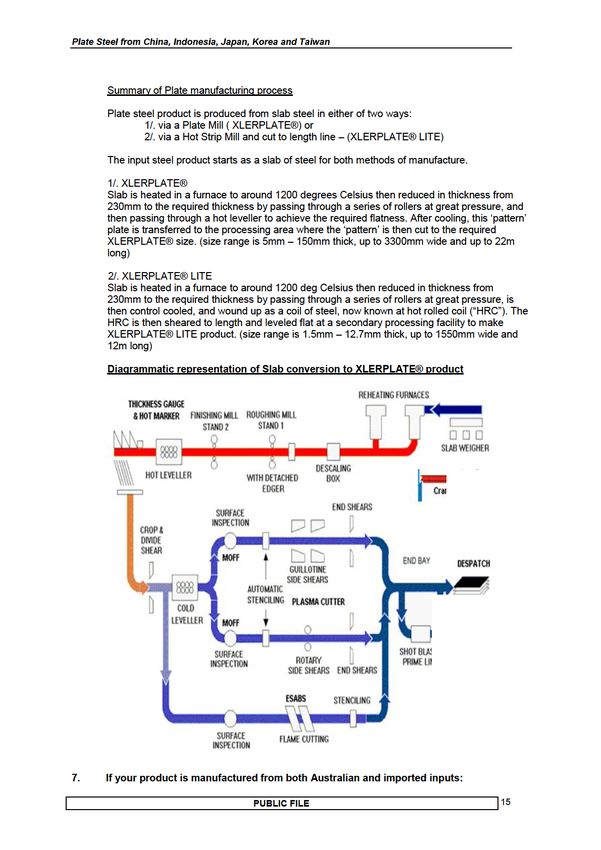
BlueScope manufactures steel plate in Australia from liquid steel, via flat steel production. The
steel production process is a capital intensive one that converts raw material iron ore and coal
into liquid steel, followed by casting into slab steel that is then converted into steel plate.
BlueScope is a fully-integrated flat steel product manufacturer with large capital intensive
manufacturing operations at Port Kembla in NSW.
BlueScope submits that it undertakes more than one substantial process of manufacture in the
production of the GUC.
BlueScope does not use imported steel in the manufacture of the GUC.
8. If your product is a processed agricultural good, you may need to complete Part C.3
(close processed agricultural goods).
The GUC are not close processed agricultural goods.
9. Supply a list of the names and contact details of all other Australian producers of the
product.
BlueScope is the sole Australian manufacturer of the goods the subject of this application.
PUBLIC FILE 16Plate Steel from China, Indonesia, Japan, Korea and Taiwan
2. Generally describe the Australian market for the Australian and imported
product and the conditions of competition within the overall market. Your description
could include information about:
sources of product demand;
marketing and distribution arrangements;
typical customers/users/consumers of the product;
the presence of market segmentation, such as geographic or product segmentation;
causes of demand variability, such as seasonal fluctuations, factors contributing to
overall market growth or decline, government regulation, and developments in
technology affecting either demand or production;
the way in which the imported and Australian product compete; and
any other factors influencing the market.
(i) Market Segmentation
The Australian market for plate steel products is dominated by three large segments. These
are:
Mining, Oil & Gas (that is the construction of new plant and the maintenance of that
plant) including bulk commodities materials handling;
Infrastructure including ports, wharves, bridges, wind towers, water storage; and
Transport & equipment manufacture including marine, road transport, earth moving,
general manufacture.
(ii) Sources of demand
Key sources of demand in the Australian market for the GUC include:
• Mining Oil & Gas plant construction and operation plus the movement and storage of
bulk commodities. Driven by Fixed Asset Investment & operations in the mining
commodities markets;
• Infrastructure - Fixed asset investment or maintenance of existing infrastructure. Can
be driven by need for assets to support Fixed Asset Investment in Mining, Oil and
Gas, population growth, expansion of trade (port facilities); and
• Transport & Equipment & general Manufacturing - Fixed asset investment and or
repairs in road & rail haulage, agricultural equipment, earth moving equipment
including wear surfaces. Demand for earth moving equipment can come from general
construction, mining and infrastructure FIA.
(iii) Distribution arrangements
BlueScope sells over 70% of its steel plate via a network of distribution companies via
distributor/resellers such as [companies]. These distribution companies offer plate
processing which includes the cutting, drilling, shaping of steel for customers who will
incorporate these “components” into a finished article. Distributors hold stock, provide credit
terms and can combine deliveries with other steel products e.g. pipe & tube and structural “I”
beams and “H” columns.
BlueScope sells the balance of approximately 30% directly to larger end-users or
“converters”. These larger end-users will mostly direct procure for large projects or they are
manufacturers with regular off-take such as manufacturers that make proprietary products
e.g. underground mining equipment.
The “converters” are generally large fabricators that will fabricate structures or items to a
design e.g. a specific pressure vessel or a particular stacker reclaimer. As well as this, there
are fabricators/maintenance companies that are drawing down steel from distributors for
regular repairs & maintenance.
PUBLIC FILE 18Plate Steel from China, Indonesia, Japan, Korea and Taiwan
Both BlueScope and importers of the GUC compete in all States and Territories in Australia
and across each segment via the same distribution channels in order to sell product directly
to the larger “converters” or manufacturing companies in Australia, and to
distributors/resellers that on-sell the product into the market.
(iv) Typical Customers
BlueScope’s major customers can be described as the four main distributors in Australia as
mentioned above.
Large fabricators/converters include [companies].
Manufacturers include [companies].
(v) Causes of demand variability
There are a variety of factors that influence demand variability for plate steel products within
the Australian market, including:
- Seasonal fluctuations
• Some variation in part due to Distribution customers reducing off-take toward
the end of the year due to reduced fabrication/manufacturing activity and end of
fiscal year stock management.
- Factors contributing to overall market growth or decline
• Availability of capital for infrastructure spending – government and
private;
• Global and domestic business and consumer confidence economic
conditions (GDP, unemployment, inflation, interest rates);
• Demand for Australian minerals, gas; and
• Trend to off-shore fabrication of large mining/oil & gas project
modules to off-shore – low cost labour countries.
- Government regulation
• Standards – international manufacturers do not always
manufacture to the same standards as Australian manufacturers;
this is commonly not understood until installation;
• Policy – major government spending on infrastructure such as
roads ports; and
• Incentives to develop renewable energy sources (wind power
generation – 150t of steel in each tower).
- Developments in technology affecting either demand or production;
• Not significant.
- Short Term Pricing Volatility
• Pressure on Australian manufacturing to compete with imported finished
products;
• Can influence purchasing decision on inventory levels;
• More evident in the indirect distribution channel; and
• Influenced via global steel capacity utilisation.
(vi) The way in which the imported and Australian products compete
All customers have the opportunity to purchase imported material either
Direct from the overseas mill;
PUBLIC FILE 19Plate Steel from China, Indonesia, Japan, Korea and Taiwan
via an international trader; and/or
via an aligned / non-aligned Australian based distributor / reseller.
2. Identify if there are any commercially significant market substitutes for the Australian and
imported product.
No, generally plate steels are not substitutable to any significant degree. Aluminium in some
instances is substitutable but due to a quite different weight/cost proposition, generally these
two products do not compete.
3. Complete appendix A1 (Australian production). This data is used to support your
declaration at the beginning of this application.
BlueScope has completed Confidential Appendix A1 for the twelve months to 30 September
2012. Please refer to Confidential Appendix A1.
4. Complete appendix A2 (Australian market).
BlueScope has completed Confidential Appendix A2 for the period October 2007 to September
2012 inclusive. Please refer to Confidential Appendix A2.
5. Use the data from appendix A2 (Australian market) to complete this table:
Indexed table of sales quantities*
(a) (b) (c) (d) (e) (f) (g)
Financial Your Other Total Dumped Other Total Total
n n
Year Sales Aust Aust Imports Imports Imports Market
Sales Sales
(a+b) (d+e) (c+f)
2007/08 100 100 100 100 100 100 100
2008/09 49.4 100 49.4 53.92 71.87 56.57 51.71
2009/10 67.29 100 67.29 66.04 88.38 67.34 67.95
2010/11 76.83 100 76.83 57.45 106.67 64.72 72.93
2011/12 75.18 100 75.18 86.06 120.61 91.16 80.31
Notes:
1. BlueScope is the sole Australian manufacturer of the GUC.
2. 2011 / 2012 data is incomplete due to a lag in Country of Origin data supply, there are no import volumes
recorded for September 2012.
The Table of indexed sales quantities confirms that the exports of the GUC from China, Korea,
Indonesia, Japan and Taiwan have increased substantially in 2011/12 – by approximately 50 per
cent on the volumes of 2010/11.
PUBLIC FILE 20Plate Steel from China, Indonesia, Japan, Korea and Taiwan
A-5 Applicant’s sales.
1. Complete appendix A3 (sales turnover).
BlueScope has completed Confidential Appendix A3.
Indexed data from Confidential Appendix A3 for the Like Goods (quantity and value) has been
included below.
2. Use the data from appendix A3 (sales turnover) to complete these tables.
BlueScope has completed the tables below from data included in its Confidential Appendix A3.
Indexed table of Applicant’s sales quantities (metric tonnes) for like goods
Quantity 2007/08 2008/09 2009/10 2010/11 2011/12
Like goods
Australian market 100 49.4 67.29 76.83 75.18
Export market 100 100.76 177.64 202.15 94.54
Total 100 53.78 76.69 87.51 76.83
Notes:
1. Refer to Confidential Appendix A3 for BlueScope sales data.
Indexed table of Applicant’s sales values for like goods
Values 2007/08 2008/09 2009/10 2010/11 2011/12
Like goods
Australian market 100 55.21 52.35 61.59 55.97
Export market 100 84.39 126.54 146.93 73.80
Total 100 57.24 57.53 67.56 57.22
Notes:
1. Refer to Confidential Appendix A3 for BlueScope sales data
BlueScope’s domestic sales quantities of steel plate have declined in 2011/12 as imports from the
countries the subject of this application increased by 40 per cent in 2011/12.
BlueScope’s domestic sales of steel plate had improved in successive years following the global
financial crisis (”GFC”) evident in the 2008/09 year. The 40 per cent growth in imports of the GUC in
2011/12 from China, Japan, Indonesia, Korea and Taiwan stalled BlueScope’s recovery from the
GFC.
BlueScope’s sales revenues in 2011/12 for the GUC reflect a larger decline than is evident for sales
quantities. Domestic sales revenue for the GUC has deteriorated by approximately X per cent in
2011/12, indicating increased price competition from dumped imports during the year.
PUBLIC FILE 21Plate Steel from China, Indonesia, Japan, Korea and Taiwan
Indexed table of Applicant’s sales quantities (metric tonnes) for All Products
Quantity 2007/08 2008/09 2009/10 2010/11 2011/12
All Products
Australian market 100 61.21 84.71 77.17 60.91
Export market 100 66.71 121.45 126.70 39.26
Total 100 63.02 96.84 93.52 53.77
Notes:
2. Refer to Confidential Appendix A3 for BlueScope sales data.
Indexed table of Applicant’s sales values for All Products
Values 2007/08 2008/09 2009/10 2010/11 2011/12
All Products
Australian market 100 63.43 71.19 67.74 55.09
Export market 100 53.95 93.33 101.84 31.30
Total 100 60.45 78.16 78.47 47.61
Notes:
2. Refer to Confidential Appendix A3 for BlueScope sales data;
BlueScope’s sales of all steel products are reflected in the above index tables. BlueScope’s
announced withdrawal from global export markets is evident in the 2011/12 data for “All Products”.
3. Complete appendix A5 (sales of other production) if you have made any:
internal transfers; or
domestic sales of like goods that you have not produced, for example if you have
imported the product or on-sold purchases from another Australian manufacturer.
Confidential Appendix A5 has been completed by BlueScope for the GUC. Please refer
Confidential Appendix A5.
4. Complete appendix A4 (domestic sales).
BlueScope has completed Confidential Appendix A4 for the twelve months to 30 September
2012. Please refer to confidential sales data provided by BlueScope.
5. If any of the customers listed at appendix A4 (domestic sales) are associated with your
business, provide details of the association. Describe the price effect of the association.
BlueScope sells the GUC through owned, related and unrelated parties in the Australian domestic
market. Owned or related domestic customers for plate steel include BlueScope Distribution Pty Ltd.
The approach to price setting for these owned or related companies [pricing strategy].
6. Attach a copy of distributor or agency agreements/contracts.
BlueScope has supply agreements in place with many of its domestic customers which detail the
terms of trade including supply arrangements, rebate structure, supply terms and conditions, etc.
An example of BlueScope’s Standard Terms and Conditions for domestic customers is included at
Confidential Attachment A-5.6.1, and a copy of a customer supply agreement is at Confidential
Attachment A-5.6.2.
PUBLIC FILE 22Plate Steel from China, Indonesia, Japan, Korea and Taiwan
7. Provide copies of any price lists.
BlueScope has both customer and product specific price lists. This is due to the differing product
purchase mix and differing service offers which exist across the customer base. Please find attached
an example of a BlueScope customer price list at Confidential Attachment A-5.7.1 and A5-7.2.
8. If any price reductions (for example commissions, discounts, rebates, allowances and credit
notes) have been made on your Australian sales of like goods provide a description and
explain the terms and conditions that must be met by the customer to qualify.
Where the reduction is not identified on the sales invoice, explain how you calculated
the amounts shown in appendix A4 (domestic sales).
If you have issued credit notes (directly or indirectly) provide details if the credited
amount has not been reported appendix A4 (domestic sales) as a discount or rebate.
BlueScope provides discounts and rebates for some sales identified in Confidential Appendix A4.
Discounts and rebates are separately identified. There [commercially sensitive pricing information].
9. Select two domestic sales in each quarter of the data supplied in appendix A4 (domestic
sales). Provide a complete set of commercial documentation for these sales. Include, for
example, purchase order, order acceptance, commercial invoice, discounts or rebates
applicable, credit/debit notes, long or short term contract of sale, inland freight contract, and
bank documentation showing proof of payment.
BlueScope has included two complete sets of commercial documentation in each of the four quarters
to 30 September 2012. Please refer to Confidential Attachment A-5.9.1 – A-5.9.8 for BlueScope
commercial documentation.
PUBLIC FILE 23Plate Steel from China, Indonesia, Japan, Korea and Taiwan
A-6 General accounting/administration information.
1. Specify your accounting period.
BlueScope’s financial year is 1 July to 30 June.
2. Provide details of the address(es) where your financial records are held.
BlueScope’s financial records for the goods the subject of this application, are located at its Five
Islands Road, Port Kembla premises.
3. To the extent relevant to the application, please provide the following financial
documents for the two most recently completed financial years plus any subsequent
statements:
chart of accounts;
BlueScope’s Chart of Accounts has been provided electronically with this application.
audited consolidated and unconsolidated financial statements (including all
footnotes and the auditor’s opinion);
BlueScope’s audited consolidated accounts are included in the company’s annual
report. These are available from BlueScope’s website at www.bluescopesteel.com
internal financial statements, income statements (profit and loss reports), or
management accounts, that are prepared and maintained in the normal
course of business for the goods.
These documents should relate to:
1. the division or section/s of your business responsible for the production
and sale of the goods covered by the application, and
2. the company overall.
BlueScope has also included monthly management report extracts at Confidential Attachment A-
6.3.1 to A-6.3.2
4. If your accounts are not audited, provide the unaudited financial statements for the two
most recently completed financial years, together with your taxation returns. Any
subsequent monthly, quarterly or half yearly statements should also be provided.
BlueScope’s accounts are audited annually. This question is therefore not applicable.
5. If your accounting practices, or aspects of your practices, differ from Australian generally
accepted accounting principles, provide details.
The accounting practices of BlueScope are maintained in accordance with Australia’s generally
accepted accounting principles.
6. Describe your accounting methodology, where applicable, for:
BlueScope’s accounting methodology complies with the Australian Accounting Standards issued
by the Australian Accounting Standards Board (AASB) and the International Financial Reporting
Standards (IFRS) issued by the International Accounting Standards Board (IASB).
Further detailed information can be sourced from BlueScope’s full financial report that can be
accessed on the internet at www.bluescopesteel.com
The recognition/timing of income, and the impact of discounts, rebates, sales returns
warranty claims and intercompany transfers;
Revenue is recognised by BlueScope when the significant risks and reward of the
PUBLIC FILE 24Plate Steel from China, Indonesia, Japan, Korea and Taiwan
ownership of the goods have passed to the buyer. This is considered to have occurred
when the legal title of the product is transferred to the customer and BlueScope is no longer
responsible for the product. The point at which title is transferred is dependent upon the
specific terms and conditions of the contract under the sale.
Sales discounts are recognised at invoice date. Rebates and warranty claims are provided
for on a monthly basis. Sales returns are recognised once the goods have been receipted
into BlueScope inventory.
provisions for bad or doubtful debts;
Collectability of trade receivables are reviewed regularly. Debts which are known to be
uncollectable are written off by reducing the carrying amount directly.
the accounting treatment of general expenses and/or interest and the extent to which
these are allocated to the cost of goods;
General expenses are allocated on an absorption cost basis.
costing methods (eg by tonnes, units, revenue, activity, direct costs etc) and
allocation of costs shared with other goods or processes;
BlueScope’s mainstream costing system is designed to enable:
- Actual process costs to be reported monthly;
- Cost detail as low as the cost element level;
- Actual fully absorbed product cost per unit of output (e.g. per tonne) at a
minimum of product group level. Where a standard costing system is
adopted, standard product costs updated for significant changes in process
cost are utilised;
- Product costs to be broken down into components such as feed, conversion
costs, yield, depreciation, support costs, etc; as well as
- The distinguishing of the underlying behavior of costs (e.g. fixed, variable,
cash, non-cash).
the method of valuation for inventories of raw material, work-in-process, and finished
goods (eg FIFO, weighted average cost);
Raw materials and stores, work in progress and finished goods, are stated at the lower of
cost and net realisable value.
valuation methods for scrap, by-products, or joint products;
The lower of cost and net realisable value.
valuation methods for damaged or sub-standard goods generated at the various
stages of production;
The lower of cost and net realisable value.
valuation and revaluation of fixed assets;
Regular purchases and sales of financial assets are recognised on trade-date - the date on
which BlueScope commits to purchase or sell the asset. Investments are initially recognised
at fair value plus transaction costs for all financial assets not carried at fair value through
profit or loss. Financial assets carried at fair value through profit or loss are initially
recognised at fair value and transaction costs are expensed in profit or loss. Financial
assets are derecognised when the rights to receive cash flows from the financial assets
have expired or have been transferred and BlueScope has transferred substantially all the
PUBLIC FILE 25Plate Steel from China, Indonesia, Japan, Korea and Taiwan
risks and rewards of ownership.
average useful life for each class of production equipment, the depreciation method
and depreciation rate used for each;
Depreciation on assets other than land is calculated on a straight-line basis to allocate their
cost over their estimated useful lives. The estimated useful lives of property, plant and
equipment are as follows:
Buildings - up to 40 years.
Plant, machinery and equipment – up to 40 years.
treatment of foreign exchange gains and losses arising from transactions and from
the translation of balance sheet items; and
Foreign currency transactions are translated into the functional currency using the
exchange rates prevailing at the dates of the transactions. Foreign exchange gains
and losses resulting from the settlement of such transactions and from the
translation at year-end exchange rates of monetary assets and liabilities
denominated in foreign currencies are recognised in the profit or loss, except when
they are deferred in equity as qualifying cash flow hedges and qualifying net
investment hedges or are attributable to part of the net investment in a foreign
operation.
Translation differences on available-for-sale financial assets are included in equity
until such time as the available-for-sale asset is sold and the translated amount is
reported in the profit and loss.
restructuring costs, costs of plant closure, expenses for idle equipment and/or plant
shut-downs.
Liabilities arising directly from undertaking a restructuring program, defined as the closure
of an operation, are recognised when a detailed plan of the restructuring activity has been
developed and implementation of the restructuring program as planned has commenced.
7. If the accounting methods used by your company have changed over the period covered
by your application please provide an explanation of the changes, the date of change,
and the reasons.
The accounting and financial practices/principles of BlueScope complies with the Australian
Accounting Standards issued by the Australian Accounting Standards Board (AASB) and the
International Financial Reporting Standards (IFRS) issued by the International Accounting
Standards Board (IASB).
BlueScope’s 2010 Annual Report included a note in relation to a change in accounting policy
following the introduction of revised AASB 127 Consolidated and Separate Financial
Statements, became operative on 1 July 2009.
Please refer to Note 1 (v) of Summary of Significant Accounting Policies in the BlueScope
2010 Annual Report.
PUBLIC FILE 26Plate Steel from China, Indonesia, Japan, Korea and Taiwan
A-7 Cost information
1. Complete appendices A6.1 and A6.2 (cost to make and sell) for domestic and export
sales.
BlueScope has completed Confidential Appendices A6.1 (for domestic sales) and A6.2 (for
export sales) for the period 2007/08 to 2011/12 (years ending September). Please refer to
Confidential Appendices A6.1 and A6.2.
A-8 Injury
1. Estimate the date when the material injury from dumped imports commenced.
BlueScope estimates that material injury from exports of plate from China, Indonesia, Japan,
Korea and Taiwan commenced to impact profit and profitability in 2009/10 as the market
recovered from the effects of the global economic downturn.
For the purposes of this application, BlueScope can demonstrate that its sales volumes
declined in the twelve month period to September 2012 and that dumped exports from China,
Indonesia, Japan, Korea and Taiwan (and subsidized exports from China) increased by more
than 40 per cent, resulting in material injury to the Australian industry producing like goods.
2. Using the data from appendix A6 (cost to make and sell), complete the following tables
for each model and grade of your production.
Index of production variations (metric tonnes)
Year 2007/08 2008/09 2009/10 2010/11 2011/12
Index 100 53.8 76.7 87.5 76.8
Notes:
1. Production rates based upon Appendix A6.1 and Appendix A6.2 data sourced from “Plate
steel”.
BlueScope’s production of the GUC for the combined domestic and export markets has
declined in BlueScope’s 2011/12 year as dumped exports from the nominated countries
increased by more than 40 per cent.
Index of cost variations (based on A$ per metric tonne)
Year 2007/08 2008/09 2009/10 2010/11 2011/12
Index 100 124.14 101.95 111.18 116.06
Notes:
1. Unit cost variations based upon Appendix A6.1 data sourced for ““Plate steel”.
BlueScope experienced cost increases in the manufacture of the GUC in both the 2010/11
and 2011/12 years.
PUBLIC FILE 27Plate Steel from China, Indonesia, Japan, Korea and Taiwan
Index of price variations (based on A$ per metric tonne)
Year 2007/08 2008/09 2009/10 2010/11 2011/12
Index 100 111.75 77.80 80.17 74.45
Notes:
1. Unit price variations based upon Appendix A6.1 data sourced for “Plate steel”.
BlueScope was unable to recover all cost increases experienced in 2010/11, and encountered
price depression in 2011/12 in its Australian sales of plate steel. BlueScope’s indices data
confirms that it experienced prices suppression in 2011/12.
Index of profit variations (based on A$ per metric tonne)
Year 2007/08 2008/09 2009/10 2010/11 2011/12
Index 100 91.22 37.76 28.76 5.48
Notes:
1. Unit profit variations based upon Appendix A6.1 data (Line M) sourced for “Plate steel”.
BlueScope’s profit variations for domestic sales of plate steel confirm that its selling prices
declined at a far greater rate than costs in 2009/10, and that further margin erosion was
evident in 2010/11 and 2011/12. The reduction in profit in 2011/12 reflects the increase in
costs and coinciding price reductions for domestic sales of plate steel.
Index of Profitability variations (based on unit profit as a % of unit selling price)
Year 2007/08 2008/09 2009/10 2010/11 2011/12
Index 100 81.63 48.54 35.88 7.36
Notes:
1. Unit profitability variations based upon Appendix A6.1 (Line 0) data sourced for “Plate steel”.
The diminution in BlueScope’s profitability in 2011/12 reflects the company’s reduction in profit
caused by increases in costs of production and coinciding declining prices for plate steel.
3. Complete appendix A7 (other economic factors).
Index of Revenue variations ($)
Year 2007/08 2008/09 2009/10 2010/11 2011/12
Index 100 55.21 52.35 61.59 55.97
Notes:
1. Revenues sourced from Appendix A3 for domestic sales of like goods only.
BlueScope’s revenues have declined in 2011/12 by approximately 5.5 percentage points on
2010/11 as sales volumes and unit prices have deteriorated. It is evident from the above data
that BlueScope has experienced injury in the form of declining domestic sales revenue in
2011/12 for the GUC.
PUBLIC FILE 28Plate Steel from China, Indonesia, Japan, Korea and Taiwan
Index of Employment numbers (number)
Year 2009 2010 2011 2012
Index 100 96.7 95.3 85.5
Notes:
1. Employment numbers sourced from Appendix A7 and are for BlueScope financial year ending June
only. As at date of lodgement of this application only the first quarter of the 2013 is complete and
hence data has not been included.
BlueScope’s employment indices reflect a reduction in the number of employees directly
involved in the manufacture of the GUC in the twelve months to June 2012.
Index of Capacity Utilisation (metric tonnes per annum)
Year 2009 2010 2011 2012
Index 100 110.3 127.0 122.8
Notes:
1. Production data for both domestic and export, sourced from Appendix A7. Data presented on an
annual year basis only.
BlueScope has reflected actual production (domestic and export) for like goods in above table.
It is evident that there has been a reduction in BlueScope’s production utilisation capacity for
plate steel in the twelve months to June 2012.
Index of Return On Investment (return on assets employed)
Year 2009 2010 2011 2012
Index 100 48.8 21.1 -99.4
Notes:
1. ROI data for domestic, sourced from Appendix A7. Data presented on an annual year basis only.
BlueScope’s return on investment for plate steel has been impacted in the 12 months to
June 2012 as its profit and profitability on domestic sales has fallen.
PUBLIC FILE 29Plate Steel from China, Indonesia, Japan, Korea and Taiwan
A-9 Link between injury and dumped imports.
To establish grounds to initiate an investigation there must be evidence of a relationship between
the injury and the alleged dumping. This section provides for an applicant to analyse the data
provided in the application to establish this link. It is not necessary that injury be shown for each
economic indicator.
1. Identify from the data at appendix A2 (Australian market) the influence of the volume of
dumped imports on your quarterly sales volume and market share.
In the twelve months to September 2012 (shown as 2011/12 in Section A-5 above) the Australian
steel plate market experienced an approximate 10.1 per cent growth on the previous twelve-month
period. This followed previous expansions of the plate steel market of approximately 31 per cent
and 7.3 per cent in the previous two years (2009/10 and 2010/11).
However, the Australian plate steel market in 2011/12 remained almost 20 per cent below the level
of the market in 2007/08.
The plate steel market contracted by almost 50 per cent during the global economic downturn of
late 2008 and early 2009 (the 2008/09 year). In the following years, the market commenced to
recover – although not to the same level of 2007/08 that occurred immediately prior to the
downturn.
Exports of dumped plate steel from China, Indonesia, Japan, Korea and Taiwan have increased by
more than 50 per cent in 2011/12 accounting for the 10.1 per cent market expansion in that year.
BlueScope’s sales in this year declined by X per cent – a sharp contrast to the 50 per cent
increase in dumped exports.
It is apparent that BlueScope has not benefited from increased demand in the Australian market
during 2011/12 – the growth has been primarily supplied with dumped exports. BlueScope
contends that the dumped exports from the nominated countries have displaced its domestic sales
and accounted for the majority of market growth sales in 2011/12 for plate steel.
2. Use the data at appendix A2 (Australian market) to show the influence of the price of
dumped imports on your quarterly prices, profits and profitability provided at appendix
A6.1 (costs to make and sell). If appropriate, refer to any price undercutting and price
depression evident in the market.
BlueScope has demonstrated that the dumped exports have increased by 50 per cent 2011/12 in
an expanding market. BlueScope’s domestic sales, however, have contracted. BlueScope
attributes its inability to capture the growth in the market (and its lost sales volumes) to price
undercutting from the dumped (and subsidized) exports.
This application includes evidence of market offers for imported plate steel from exporters in each
of the nominated countries (please refer to Summary of offers at Confidential Attachment A-9.2.1).
Some of the offers have been provided in written form, with the remainder being verbal offers that
have been documented by BlueScope. The hardcopy offers are included at Confidential
Attachment (A-9.2.2). Where available, BlueScope has identified the supplying mill in the country
of export, along with the FIS price offer into the Australian market.
The price undercutting information at Confidential Attachments A-9.2.1 (summary) and A-9.2.2
(supporting documentation) support BlueScope’s viewpoint that it has lost sales volume and
market share to imported plate steel sourced from China, Indonesia, Japan, Korea and Taiwan, at
prices that have been below BlueScope’s prevailing price at the time of the offer. BlueScope’s
response to the dumped (and subsidized) imported products is evident in its approximate X per
cent selling price decline evident from 2010/11 to 2011/12 (i.e. from an average selling price in
2010/11 of $XXXX per metric tonne to $XXXX per metric tonne in 2011/12).
BlueScope has previously provided information to Customs and Border Protection highlighting that
PUBLIC FILE 30You can also read


