Briefing for the Incoming Minister of Commerce and Consumer Affairs - 4 November 2020
←
→
Page content transcription
If your browser does not render page correctly, please read the page content below
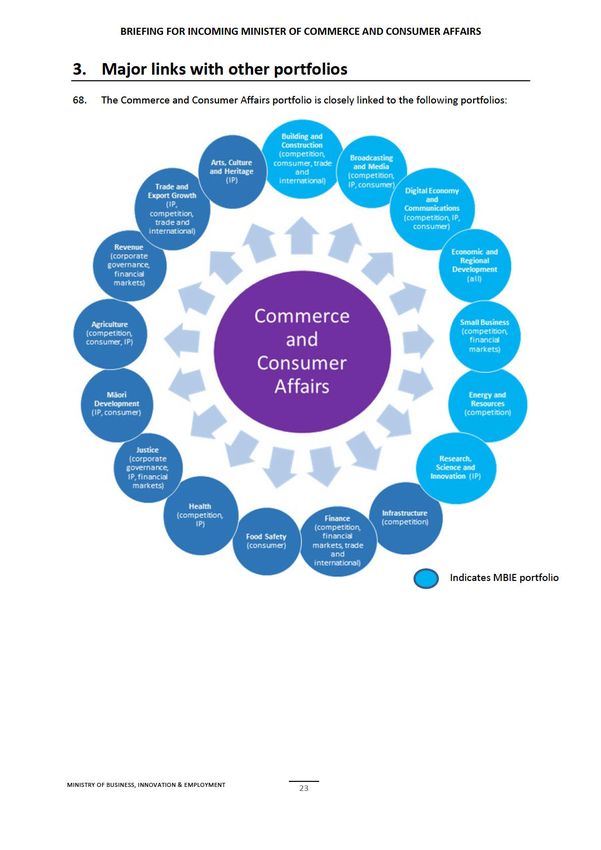
Briefing for the Incoming
Minister of Commerce and
Consumer Affairs
4 November 2020
BRIEFING FOR INCOMING MINISTER OF COMMERCE AND CONSUMER AFFAIRS

MINISTRY OF BUSINESS, INNOVATION & EMPLOYMENT
                                                2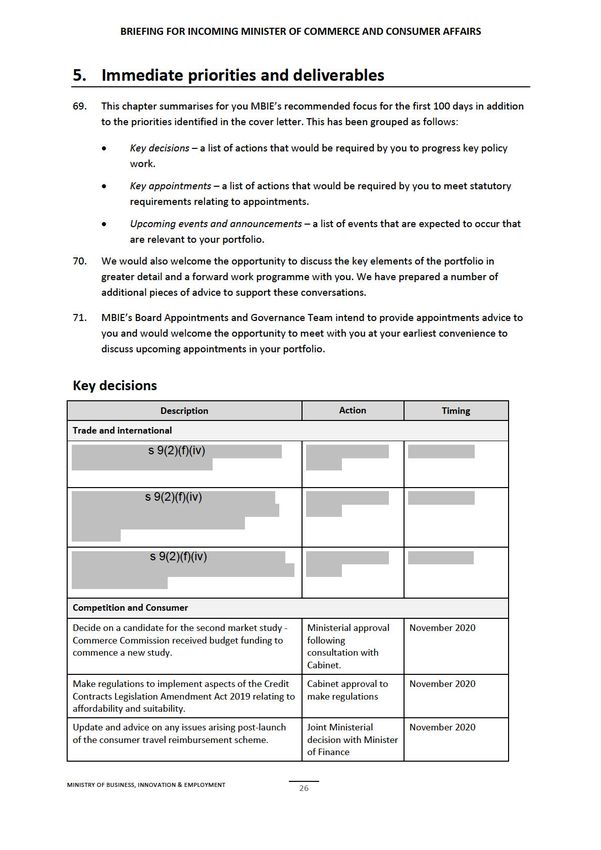
BRIEFING FOR INCOMING MINISTER OF COMMERCE AND CONSUMER AFFAIRS

 Contents
 1.    Portfolio overview .......................................................................................................................... 4
       Purpose ...................................................................................................................................................... 4
       The Commerce and Consumer Affairs portfolio ........................................................................................ 4
       Policy and operational functions................................................................................................................ 4
       Key issues affecting the portfolio ............................................................................................................... 5
       Summary of each system within the portfolio ........................................................................................... 8

 2.    Portfolio responsibilities ............................................................................................................... 18
       Policy and operational functions.............................................................................................................. 18
       MBIE’s financial viability........................................................................................................................... 18
       Legislation ................................................................................................................................................ 21

 3.    Major links with other portfolios ................................................................................................... 23

 4.    Key MBIE contacts ........................................................................................................................ 24

 5.    Immediate priorities and deliverables ........................................................................................... 26
       Key decisions ............................................................................................................................................ 26
       Key appointments .................................................................................................................................... 27
       Upcoming events and announcements ................................................................................................... 28

 Annex 1: Crown entities and other bodies ............................................................................................ 29
       Crown entities .......................................................................................................................................... 29
       Other bodies you have responsibilities for .............................................................................................. 33

 Annex 2: Legislation under the portfolio ............................................................................................... 39
       Corporate law and governance ................................................................................................................ 39
       Financial markets ..................................................................................................................................... 41
       Competition.............................................................................................................................................. 43
       Consumer ................................................................................................................................................. 43
       Intellectual property ................................................................................................................................ 45
       Trade and international............................................................................................................................ 46

MINISTRY OF BUSINESS, INNOVATION & EMPLOYMENT
                                                                              3
BRIEFING FOR INCOMING MINISTER OF COMMERCE AND CONSUMER AFFAIRS

 1. Portfolio overview

 Purpose
 1.      This briefing provides you with information about the Commerce and Consumer Affairs
         portfolio. It provides an overview of key issues affecting the portfolio and the key pieces of
         work currently underway. Further briefings will be provided to you, focussing on specific
         topics in depth. We look forward to discussing these and supporting you to implement your
         priorities for the portfolio.

 The Commerce and Consumer Affairs portfolio
 2.      The Commerce and Consumer Affairs portfolio is a key contributor to New Zealand’s economy
         and raising living standards for all New Zealanders. The portfolio has an important role in the
         economic and social recovery of New Zealand in countering the impacts from COVID-19.

 3.      As Minister of Commerce and Consumer Affairs, you can influence the environment in which
         businesses and consumers operate. This includes setting expectations and influencing the
         regulatory framework and policies that allow businesses to innovate, invest and trade, and
         consumers to purchase with confidence.

 4.      The portfolio comprises the following six broad regulatory systems:

         •       Corporate law and governance

         •       Financial markets
         •       Competition
         •       Consumer
         •       Intellectual property

         •       Trade and international.

 Policy and operational functions
 5.      Your policy role includes developing, setting and reviewing the rules that govern the way in
         which consumers and businesses interact in markets. This includes driving legislative and
         regulatory change, and ensuring that a commerce and consumer perspective is brought to
         initiatives led by other portfolios. A comprehensive list of policy linkages is provided in
         Chapter 3.

 6.      The Ministry of Business, Innovation and Employment (MBIE) has a number of operational
         functions that come under your portfolio. These functions put into effect legislation and policy
         that you have responsibility for:

         •       Companies Office: maintains registers including the companies register and personal
                 property securities register, along with enforcing the Companies Act 1993 and other
                 legislation.

MINISTRY OF BUSINESS, INNOVATION & EMPLOYMENT
                                                      4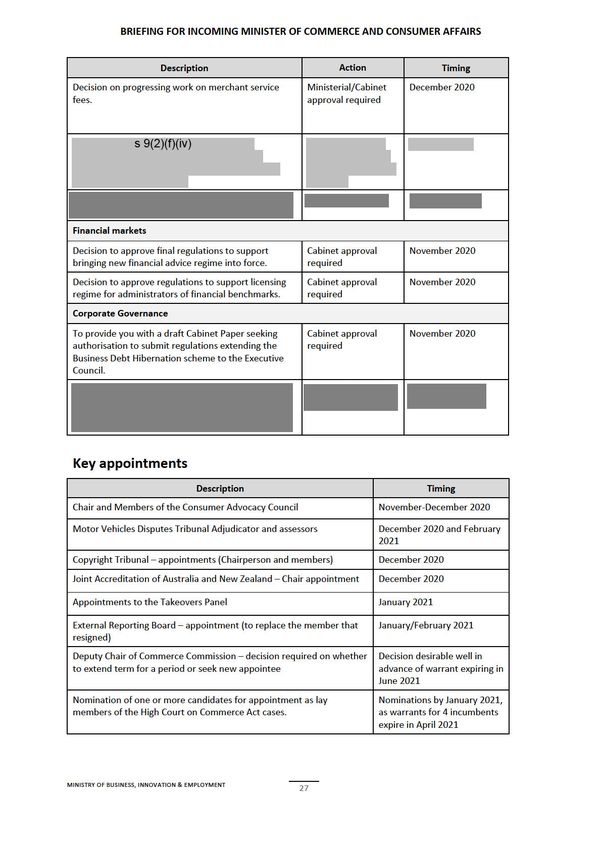
BRIEFING FOR INCOMING MINISTER OF COMMERCE AND CONSUMER AFFAIRS

         •       Consumer Protection: consumer information and programmes, including product
                 safety.

         •       Insolvency and Trustee Service: administers all bankruptcies and other personal
                 insolvency processes, and some company liquidations.

         •       Intellectual Property Office of New Zealand (or IPONZ): grants and maintains registers
                 of patents, trademarks, designs, plant variety rights and geographical indications.
         •       Standards New Zealand: manages the development of New Zealand standards, the
                 adoption of international standards and enables New Zealanders to access standards.
         •       Trade remedies: investigating claims by New Zealand industry that goods being
                 imported into New Zealand are dumped or subsidised, and imposing duties when
                 warranted.
         •       Trading Standards: fuel quality, accuracy of measurements used for business,
                 auctioneers, and the motor vehicle traders register.
 7.      You also have Ministerial responsibilities over the functioning and governance of six Crown
         entities and a number of statutory bodies, the largest being the Commerce Commission and
         the Financial Markets Authority (FMA). These responsibilities can include setting expectations,
         monitoring performance and making appointments. The objectives, functions and board
         membership of these bodies are discussed in Annex 1.

 Key issues affecting the portfolio
 8.      The primary focus of the portfolio is on businesses and consumers and how they interact in
         markets. It seeks to ensure that outcomes for consumers are fair, while supporting an
         innovative and competitive environment for businesses to operate in.

 9.      The portfolio supports businesses and consumers through settings that:

         •       encourage fair competition (competition policy) and provide intellectual property
                 protection for innovation (intellectual property policy);
         •       support effective governance of corporate entities throughout the corporate lifecycle,
                 including fair and equitable insolvency processes (corporate governance policy);

         •       aim to ensure consumers and investors can buy financial products and services,
                 including insurance and KiwiSaver, with confidence (financial markets policy);
         •       provide consumers with protection from unfair practices when purchasing products or
                 services and regulate the sale of unsafe goods (consumer policy);

         •       promote effective international regulatory cooperation to make doing business across
                 border easier (trade and international policy).
 10.     Increasingly, the portfolio is focussing on the interaction between businesses and consumers,
         particularly in relation to how businesses treat consumers. In line with developments
         overseas, this means a greater focus on good consumer outcomes (e.g. fair treatment) rather
         than just on transactional obligations (e.g. disclosure obligations setting out the information
         businesses are required to disclose to consumers). This involves an increasing focus on
MINISTRY OF BUSINESS, INNOVATION & EMPLOYMENT
                                                       5
BRIEFING FOR INCOMING MINISTER OF COMMERCE AND CONSUMER AFFAIRS

         sectoral and corporate accountability for ensuring that products and services are designed
         and delivered to optimise good outcomes (rather than assuming all customers are highly
         skilled, well informed, rational and proactive). Examples include statutory and contractual
         requirements that:

         •       companies will ensure that products are suited to an individual customer’s situation
                 (e.g. customers are not sold insurance they can’t use)
         •       businesses use nudges and default settings to support optimal customer decision-
                 making (e.g. the member engagement requirements for KiwiSaver default providers).
 11.     An increased focus on lifting the financial capability of New Zealanders via education, online
         tools and services is likely to also be necessary if the portfolio is to make the greatest
         contribution it can to their financial wellbeing.

 12.     Regulatory regimes have been adapting to a changing world and changing priorities. For
         example, there has been significant reform of the financial markets system following the
         global financial crisis in 2007/08.

 13.     We consider there are two key issues presenting both opportunities and challenges to the CCA
         portfolio in the coming years: COVID-19 and digitalisation.

 COVID-19
 14.     COVID-19 has put significant extra financial pressure on both businesses and individuals. And
         there remains a high level of uncertainty about the course of the pandemic and its impact on
         New Zealand. However, there is also a view that looks at this shock as an opportunity to (as
         the OECD puts it) ‘build back better’. How can New Zealand transition to a more productive,
         sustainable, inclusive and resilient economy and society? And what is the role of the CCA
         portfolio in this transition?

 15.     CCA played a significant role in the immediate response to COVID-19 (e.g. the business debt
         hibernation scheme, other changes to corporate governance settings to support otherwise
         viable businesses to stay afloat when impacted by COVID-19, and changes to competition
         settings to permit more flexibility in how businesses work together to respond to COVID-19).

 16.     As we move beyond the immediate response, it is important to consider the longer term goals
         for New Zealand’s economic and social recovery. These can be quite different. For example,
         the immediate response of seeking to support businesses impacted by COVID-19 would also
         have had the undesirable effect of keeping some otherwise insolvent businesses afloat. It will
         be important that future regulatory settings (e.g. in insolvency policy) are designed to support
         those business and consumer outcomes that contribute to New Zealand’s longer term goals.

 17.     COVID-19 also has the effect of acting as an accelerator of other trends (and so of the
         opportunities and challenges those trends present). Relevant to the CCA portfolio, it is
         accelerating the pace of change in relation to digital technologies (discussed below).

 18.     There appears to be an increase in protectionism and mistrust in multi-lateral institutions.
         While this trend was already underway (with the imposition of tariff and non-tariff trade
         barriers in many jurisdictions, on both goods and digital trade), COVID-19 risks exacerbating it.
         New Zealand may have to respond with more nimble and informal engagement with our
MINISTRY OF BUSINESS, INNOVATION & EMPLOYMENT
                                                       6
BRIEFING FOR INCOMING MINISTER OF COMMERCE AND CONSUMER AFFAIRS

         trading partners to build resilience, alongside the usual formal mechanisms of rule-setting
         institutions and free trade agreements.

 Digitalisation
 19.     Digitalisation refers broadly to the significant and ongoing development of digital technologies
         (e.g. digital platforms, blockchain, artificial intelligence, 3-D printing) and the products and
         services that this gives rise to. Digital products and services also flow easily across borders.
         This provides opportunities for New Zealand businesses to change the way they operate;
         interact with consumers; reach new markets; and provide new products and services to
         consumers.

 20.     We are seeing business models changing, with a strong growth in businesses that provide
         platforms for businesses to connect with customers (such as Trade Me and Amazon) and a
         greater focus on data (such as Google and Facebook). Combined with the general reduction of
         trade barriers over recent years (though, as we note below, we are seeing something of an
         uptick in protectionist policies again), we are also seeing New Zealand businesses more able to
         connect and participate in overseas markets.

 21.     Businesses that can adapt to, and take advantage of, these new technologies will have higher
         productivity and be better placed for the future. The CCA portfolio can play a role supporting
         these businesses to thrive by providing a regulatory environment that supports innovation
         and competition, and easier access to overseas markets. This will drive better outcomes for
         consumers while also supporting the wider goals of a more productive, resilient economy.

 22.     These same trends also present opportunities and challenges for consumers. These
         developments provide consumers with an increasing choice of new products and services that
         can be sourced from almost anywhere in the world. However, this can make it harder for
         consumers to protect their interests, for example when seeking redress in relation to cross-
         border transactions. And while the increasingly sophisticated use of consumer data can
         benefit consumers (for example, in terms of the products and services that are offered), it can
         also present challenges with respect to consumers’ control over that data.

 What do these mean for the CCA portfolio?
 Financial wellbeing
 23.     A crucial consideration for the portfolio in the coming years is going to be the impact of
         financial pressures and digitalisation on consumers and their financial wellbeing. These issues
         are not new, but are being exacerbated by COVID-19. Recent work in the portfolio includes
         regulating credit contracts, regulating financial service providers, reviewing insurance contract
         law, reviewing the conduct of financial institutions and reviewing the settings for KiwiSaver
         default providers.

 24.     These interventions, however, have focussed more on influencing the conduct of third parties
         rather than New Zealanders themselves. With an increase in debt problems, financial worries
         and personal insolvency as a result of COVID-19, there is a need to take advantage of the full
         suite of levers available in the portfolio (and across portfolios where necessary) to more
         directly influence individuals’ financial capability and wellbeing. KiwiSaver, consumer

MINISTRY OF BUSINESS, INNOVATION & EMPLOYMENT
                                                      7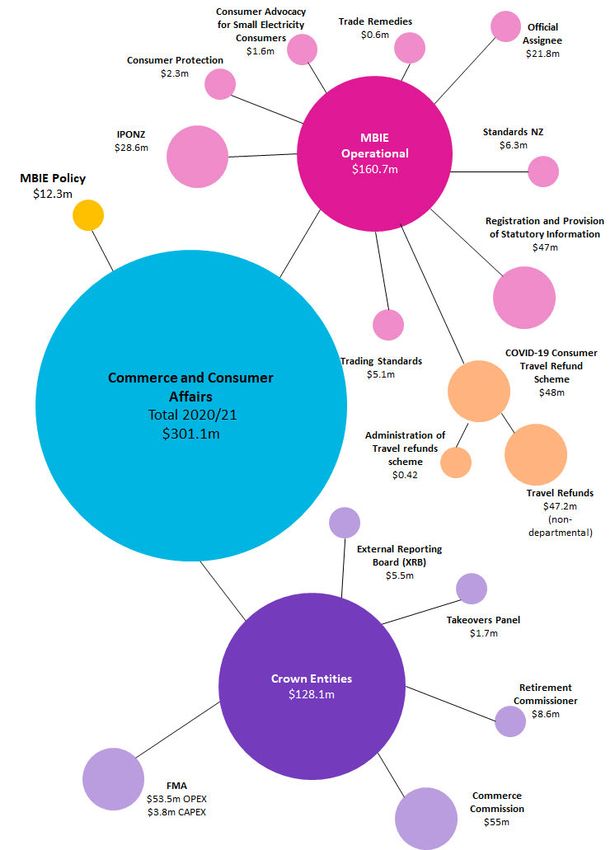
BRIEFING FOR INCOMING MINISTER OF COMMERCE AND CONSUMER AFFAIRS

          protections, influencing financial service providers, improving digital connectivity and
          affordability 1 and the insolvency regime all play an integral role in:

          •      improving financial wellbeing and resilience (e.g. through changes to KiwiSaver, better
                 provision of information, introducing a Consumer Data Right to facilitate access to
                 consumer data leading to better targeted products and services)

          •      avoiding debt becoming problem debt (e.g. implementing the newly strengthened
                 credit contract protections, and provision of new tools and services via the Commission
                 for Financial Capability to support at-risk consumers)

          •      dealing with problem debt once it arises (e.g. reforming the personal insolvency regime
                 – this is comparatively punitive in New Zealand and has not been reviewed since 2006).
 Regulatory Stewardship
 25.      While not a trend or issue in the same way as the others, considering the portfolio from a
          regulatory stewardship point of view provides important context. There has been significant
          regulatory reform in recent years, particularly in the financial markets and consumer policy
          areas. Future work will need to take this into account and strike an appropriate balance
          between letting these changes bed in (supported by effective monitoring and evaluation) and
          further changes, and also between regulatory and non-regulatory approaches to achieving
          desired outcomes.

 Summary of each system within the portfolio
 26.      The remainder of this chapter provides further detail about each of the six regulatory systems
          that make up the Commerce and Consumer Affairs Portfolio:

          •      What the system is about
          •      Key policy work underway
          •      How the system is being impacted by emerging themes (where relevant).

 Corporate law and governance
 27.      The corporate law and governance system sets the rules relating to the establishment,
          management and closure of companies and other types of entities. This system contains the
          key legal “infrastructure” for the creation, operation and dissolution of entities that many
          other regimes rely on or build from. While the specific activities carried out by entities are in
          many cases regulated by other regulatory systems those regulatory systems rely on the
          robustness of the corporate governance system, which establishes the overarching obligations
          of entities and their members. For this reason corporate law and governance system can often
          overlap with other policy areas.

 28.      MBIE is responsible for the policy and operational areas of the corporate governance system.
          Operational areas include:

 1
     This particular issue falls within the Digital Economy and Communications portfolio.

MINISTRY OF BUSINESS, INNOVATION & EMPLOYMENT
                                                       8
BRIEFING FOR INCOMING MINISTER OF COMMERCE AND CONSUMER AFFAIRS

         •       The Companies Office, which is responsible for the registration of many types of
                 entities, including companies, incorporated societies and limited partnerships, and for
                 the public enforcement of the legislation that those entities operate under. It operates
                 registers for some regulated occupations, such as auditors and financial service
                 providers, and some registers outside of your portfolio including charitable trusts,
                 retirement villages and the New Zealand Business Number.
         •       The Insolvency and Trustee Service (the Official Assignee’s Office), which administers all
                 personal insolvencies (i.e. bankruptcies, no asset procedures and summary instalment
                 orders) and some liquidations under the Companies Act 1993. The Official Assignee is
                 also responsible, through the Criminal Proceeds Management Unit, for the custody and
                 control of forfeited or retained criminal proceeds.
 29.     MBIE is focusing on:

         •       Reviewing access to “beneficial ownership” information. This review focusses on
                 whether there is a need for improved access to information about persons who directly
                 or indirectly exercise control over companies and limited partnerships. Identifying
                 beneficial owners can be crucial information for law enforcement to “follow the
                 money” under anti-money laundering, terrorism financing and other regimes that relate
                 to suspect assets held by corporate vehicles. Beneficial ownership information can also
                 be useful to regulators like the Overseas Investment Office and the wider intelligence
                 community.
         •       Climate-related financial disclosures. MBIE is working with the Ministry for the
                 Environment on legislation requiring listed issuers and large banks, insurers and
                 managed investment schemes to report on the impacts of climate change on their
                 businesses. The objective of this legislation is to move to a position where the effects of
                 climate change become routinely considered in business and investment decisions. It
                 requires businesses to measure and report clear, comparable, consistent, timely and
                 decision-useful information about their risks and opportunities arising from climate
                 change.

 Financial markets

 30.     The financial markets system focusses on promoting confident and informed participation of
         businesses, investors and consumers in financial markets, and the settings for well-functioning
         financial markets generally.

 31.     New Zealand’s financial markets regulatory settings have been overhauled since the Global
         Financial Crisis, with the introduction of the Financial Markets Conduct Act 2013, the
         establishment of the Financial Markets Authority as regulator, and ongoing reforms.

 32.     MBIE’s role in the system is to provide policy advice on a range of issues relating to the
         financial markets conduct regulatory system, including:

          a. the Financial Markets Conduct Act

          b. regulation of financial advice

MINISTRY OF BUSINESS, INNOVATION & EMPLOYMENT
                                                        9
BRIEFING FOR INCOMING MINISTER OF COMMERCE AND CONSUMER AFFAIRS
c. regulation of the conduct of banks and insurers
d. insurance contract law
e. the KiwiSaver Act 2006 – specifically the governance of KiwiSaver schemes and the
scheme rules that apply to all KiwiSaver schemes.
33. MBIE is also the monitoring agency for the Financial Markets Authority and the Commission
for Financial Capability, which both play key roles in the financial markets regulatory system,
outlined below.
34. MBIE is focussing on:
• Improving the conduct of financial institutions. Recent reviews have found that large
financial institutions like banks and insurers have not paid due regard to, or had systems
to support, good outcomes for consumers. This work involves introduction of a new
licensing regime for these institutions through the passage of the Financial Markets
(Conduct of Institutions) Amendment Bill and supporting regulations to ensure
consumers are treated fairly.
• Improving financial wellbeing of New Zealanders, to reduce hardship and problem debt,
increase savings, and increased investment and participation in financial markets. This
work includes reviewing the arrangements for KiwiSaver default providers.
• Reviewing KiwiSaver default providers. Providers of default KiwiSaver funds are
reviewed every seven years, and the terms for current providers are set to expire on 1
December 2021. Ahead of this, MBIE and the Treasury reviewed the settings for default
funds and have set new requirements for funds aimed at providing better outcomes for
default members. A Request for Proposals has been released to the market and we are
expecting responses before the end of the year. We will then enter an evaluation
process in 2021, with the aim to select and appoint new default providers by May 2021.
• A new regulatory regime for financial advice. Financial advice includes the
recommendations given by people who work in banks, and by mortgage, insurance and
investment brokers, and those who create investment plans. This work will involve
supporting the implementation of the Financial Services Legislation Amendment Act
2019, which will come into force in March 2021.
• Modernising insurance contract law. Insurance helps consumers and businesses cope
with unforeseen events. However, New Zealand’s insurance contract law is fragmented
and outdated, and a number of problem areas need to be addressed to facilitate more
efficient insurance markets that better meet parties’ expectations. Cabinet agreed in
late 2019 to reform New Zealand’s insurance contract law. We have begun work on an
exposure draft Bill to give effect to Cabinet’s decisions.
35. COVID-19 has raised questions about the financial resilience and capability of New Zealanders.
Are consumers financially prepared for further economic shocks or a prolonged downturn?
How well-informed are consumers about the range of products and services that are available
to them?
MINISTRY OF BUSINESS, INNOVATION & EMPLOYMENT
10BRIEFING FOR INCOMING MINISTER OF COMMERCE AND CONSUMER AFFAIRS
36. A further question arises as fewer New Zealanders are expected to own their own home in
retirement and so will be more reliant on saving for their retirement. Are KiwiSaver settings
delivering the best outcomes for New Zealanders to enable them to make good choices about
their plans for retirement?
Competition
37. This system is focussed on the protection and promotion of competition. Effective
competition from domestic and international firms gives New Zealand businesses an incentive
to increase their efficiency and innovate, and can lead to improvements in productivity and
consumer wellbeing (such as better quality products and services, and/or lower prices).
38. While competitive markets will often lead to desirable consumer outcomes, direct regulatory
intervention may be required in markets where there is little or no competition. In this
context, this system oversees the economic regulation of aeronautical services at the three
main airports (Auckland, Wellington and Christchurch), gas pipelines and electricity
transmission and distribution businesses with respect to their monopoly functions.
39. The Commerce Act 1986 underpins the competition system in New Zealand. The Act is
maintained by MBIE and enforced by the Commerce Commission. MBIE also actively promotes
competition by advising on government proposals that may affect competition (such as
amendments to the way occupations are regulated) and considering where there are parts of
the economy where competition may not be working particularly well.
40. In 2018, the Commerce Commission gained the ability to undertake market studies to
determine whether there are any factors that may be impeding competition in a market. The
first market study into the retail fuel sector was completed in December 2019 with the
publication of the Commerce Commission’s final report. The final report made a number of
recommendations aimed at improving competition and performance of retail fuel markets for
consumers. The previous Government accepted the report’s findings and addressed some of
the recommendations by passing, in mid-2020, the Fuel Industry Act to improve competition
in the retail fuel market. We are continuing to support work on regulations under that Act to
provide for its implementation.
41. MBIE is focussing on:
• Merchant service fees. We are ready to advance this Government priority and would
welcome a discussion on timing and the relationship with our work on a consumer data
right given that payment systems are complex two sided markets that are rapidly
evolving in the face of substantial technological disruption. Advancing work in this area
will require contributions from a range of agencies including MBIE, Treasury, the
Reserve Bank, and the Commerce Commission. The Ministers of Finance and Small
Business are also likely to have a strong interest in this work.
• Advancing market studies into the supermarkets and building supplies sectors. We are
preparing to advance your priority to refer market studies into the supermarkets and
building supplies sectors to the Commerce Commission. The Commerce Commission
has resourcing to undertake one study at a time. Our preliminary view is that a
supermarkets study will take approximately 16 months, concluding in May 2022, with
MINISTRY OF BUSINESS, INNOVATION & EMPLOYMENT
11BRIEFING FOR INCOMING MINISTER OF COMMERCE AND CONSUMER AFFAIRS
the building supplies study to commence in June 2022. More generally, we believe
there is also an opportunity to look at further integrating market studies into the
competition regulatory system. This could be done by assessing alternative mechanisms
to implement any pro-competitive measures recommended by the Commerce
Commission in market studies. One such mechanism would be industry codes that could
be made in regulations.
• Identifying barriers to competition and opportunities to promote competition in specific
sectors across the economy. Generic competition law is unlikely to be sufficient to
maximise competition but it is an important foundation. It is therefore important to
look beyond generic competition law and consider how competition can be lifted in
different industries to get better outcomes for New Zealanders. This will require
significant collaboration across portfolios and with specific industries. Focus areas so far
have been petrol markets and retail payments (EFTPOS, debit and credit cards).
• Maintaining the effectiveness of New Zealand’s competition laws. A bill is being drafted
to address issues relating to the misuse of market power. The bill will also remove
exemptions in the Commerce Act relating to intellectual property, and give the
Commerce Commission information sharing powers, among other matters.
• Three waters reform. Economic regulation is likely to have an important part to play in
securing better consumer outcomes as part of the reforms being made to the delivery
and regulation of drinking water, wastewater, and stormwater.
42. Digital technology is enabling new modes of doing business. In general, digital technology
promotes competition through such things as enabling businesses to better connect with
consumers, but it also raises new challenges for competition law and enforcement. The
growth of strategically important digital platforms, such as Google and Facebook, has focussed
attention on the intersection between competition law and other laws such as fair trading,
privacy, and consumer protection. Global responses led by major overseas economies are
likely to be forthcoming. The challenge for New Zealand authorities is to keep capability in
assessing competition impacts in fast moving digital markets and to be in a position to take
advantage of, or learn from, any international developments as appropriate. We, along with
the Commerce Commission, are continuing to monitor developments with digital technologies
and their implications for New Zealand’s competition law and enforcement.
Consumer
43. The consumer system focusses on the interactions that businesses and consumers have
before, during, and after the sale of a good or service, by providing important consumer
protections and business obligations. The system also provides protections and remedies
when buying through private sales, business-to-business transactions, and auctions.
44. Economy-wide consumer protection provisions in the Fair Trading Act 1986 and Consumer
Guarantees Act 1993 work alongside sector or issue specific provisions covering motor
vehicles and consumer credit contracts (which you are responsible for). The Fair Trading Act
protects against misleading and deceptive conduct and the sale of unsafe goods, and the
Consumer Guarantees Act provides minimum guarantees with all sales of consumer goods and
services.
MINISTRY OF BUSINESS, INNOVATION & EMPLOYMENT
12BRIEFING FOR INCOMING MINISTER OF COMMERCE AND CONSUMER AFFAIRS
45. As well as maintaining the overall consumer system, MBIE provides information, advice and
education to consumers and businesses, monitors and administers consumer product safety
(under the Fair Trading Act) and enforces the Weights and Measures Act 1987 which provides
for the measurement system used for trade. MBIE is also responsible for the occupational
licencing of auctioneers and motor vehicle traders.
46. Other portfolios also provide specific protections to consumers in areas such as building
products and food safety. At times, consumer issues may involve other portfolios working
closely with you.
47. The Commerce Commission enforces the Fair Trading Act and the Credit Contracts and
Consumer Finance Act 2003. The Credit Contracts and Consumer Finance Act aims to protect
consumers from irresponsible lending practices and ensure that they are able to make
informed borrowing decisions.
48. MBIE is focussing on:
• Implementing changes to consumer credit contracts. Last year amendments to the
Credit Contracts and Consumer Finance Act were passed to better protect consumers
from harmful lending practices. MBIE is finalising regulations and updating guidance
material for lenders. We, along with other government agencies, are also working with
the non-profit and financial services and banking sectors on a shared action plan to
enable safer credit and financial inclusion.
• Consumer data right. MBIE recently released a discussion paper that seeks feedback on
options for establishing a consumer data right in New Zealand. This would give
consumers greater choice and control over their data and enable them to securely
share data held about them (e.g. by a bank) with trusted third parties (e.g. a budgeting
app). This could significantly improve consumer welfare, enable higher levels of
innovation and competition, and have significant economic development benefits. A
consumer data right is also likely to have a positive impact on competition in retail
payment systems markets by enabling innovative new services that can act as a
competitive constraint on existing retail payment systems (e.g. Visa/MasterCard debit
and credit cards). New competition of this kind could lead to further reductions in
merchant service fees charged by providers.
• Informing and education consumers and businesses: MBIE recently launched a multi-
year work programme to investment into community-targeted information tools and
programmes to support consumers who face vulnerability and disadvantage where a
broad reach and digital programme may not be the most appropriate engagement
strategy. This programme of work launched in 2019/20 and will continue over the next
2-3 years. The Ministry’s broad reach, digital programme on increasing the ability of
consumers and businesses to transact with confidence will be maintained.
49. The acceleration of digital technology will present both challenges and opportunities to
consumers. On the opportunity side, the increased availability of data, and new ways of using
it, has the potential to significantly enhance the consumer experience. Challenges will include
ensuring that there are appropriate safeguards and that consumers can get redress when
issues arise from cross-border commerce, potentially through better trade agreements and
MINISTRY OF BUSINESS, INNOVATION & EMPLOYMENT
13BRIEFING FOR INCOMING MINISTER OF COMMERCE AND CONSUMER AFFAIRS
enhanced cooperation arrangements between regulators. The interface between consumer
protection laws and privacy is also a live issue as online services collect more and more
information from consumers.
Intellectual property
50. Intellectual property regulation encourages:
• the creation and dissemination of ideas and knowledge to promote innovation, increase
productivity and foster creative expression
• the development of high quality products and services by businesses.
51. MBIE is responsible for the policy and operational areas of the intellectual property system.
The Intellectual Property Office of New Zealand (IPONZ) sits within MBIE and is responsible for
administering the application, registration and related processes for a number of the
intellectual property regimes.
52. MBIE is focussing on:
• Reviewing the Copyright Act 1994. Fit for purpose copyright law is important to
encouraging the provision of, and access to, culture, knowledge, entertainment and
information. The copyright ecosystem has experienced significant technological and
market developments since the last review that affect how we create, distribute,
consume and use content. The government is reviewing the Copyright Act to ensure it
provides a supportive regulatory environment for these activities into the future, in the
best interests of New Zealand as a whole. MBIE concluded public consultation on
objectives for copyright and issues with the status quo in April 2019. We intend to
conduct further consultation on objectives before consulting on potential options for
reform in 2021. Obtaining Cabinet approval for this consultation process on objectives is
a priority for the review process.
• Reviewing the Plant Variety Rights Act 1987. The plant variety rights regime incentivises
plant breeding and the introduction of foreign cultivated varieties by overseas breeders.
It provides for the granting of intellectual property rights to people who breed and
develop new cultivated plant varieties. We began reviewing the Act in the first quarter
of 2017 and obtained policy approvals from Cabinet in November 2019. The timing of
the process is driven by a trade commitment to bring the Act into compliance with the
International Convention for the Protection of New Varieties of Plants by 30 December
2021. This deadline presents an immediate challenge following delays related to COVID-
19. Cabinet decisions on some outstanding policy issues are necessary in order to have
a Bill ready for introduction into the House.
• Assisting MFAT with the negotiation and implementation of free trade agreements
(FTAs). Free trade agreements commonly include an intellectual property Chapter
setting out minimum standards for the protection and enforcement of intellectual
property rights that trade partners must provide. Currently, New Zealand is negotiating
a number of FTAs including with the EU, United Kingdom, and the Pacific Alliance. You
have delegated authority (along with the Minister for Trade and Export Growth and the
MINISTRY OF BUSINESS, INNOVATION & EMPLOYMENT
14BRIEFING FOR INCOMING MINISTER OF COMMERCE AND CONSUMER AFFAIRS
Minister of Agriculture) in relation to the negotiating mandate for the geographical
indications provisions in the EU FTA.
53. Our western system of providing private rights in intellectual property fits poorly with Te Ao
Māori. There remain ways the intellectual property system inadequately protects the rights
and interests of Māori in keeping with the Treaty of Waitangi, notably as identified by the
Waitangi Tribunal in its 2011 report Ko Aoteroa Tēnei (on Wai 262). On 28 August 2019, the
Minister for Māori Development announced the Government’s intention (following
agreement by Cabinet) to develop a whole-of-government approach to the issues raised by
the Wai 262 inquiry. MBIE has a key role to play in this undertaking, which is being led by Te
Puni Kōkiri.
54. The review of the Plant Variety Rights Act is a recent example (recently examined and
endorsed by the Waitangi Tribunal) of MBIE ensuring an existing intellectual property statute
is effective and fit for purpose, including by reflecting our unique social, cultural and
constitutional circumstances. The Haka Ka Mate Attribution Act 2014 is an example of a
bespoke statute that provides some limited protection for Ngāti Toa Rangatahi as the kaitiaki
in respect of that haka. However, there are limits to what protection can be provided for
cultural rights and interests in taonga and mātauranga Māori within existing intellectual
property statutes. The whole-of-government approach is an opportunity for the government
to develop policies on substantive Wai 262 issues that cut across intellectual property statutes
in partnership with Māori. A notable example for this portfolio is the Waitangi Tribunal’s
recommendation that a new system of protection be developed for what it referred to as
‘taonga works’ and mātauranga Māori, given copyright is poorly suited to facilitating
kaitiakitanga in respect of these.
55. Although trade agreements can open up market opportunities, streamline processes and
reduce costs, they have the potential to limit our policy and regulatory choices. This is often
an issue for intellectual property laws. It is important that our international trade agreements
provide the policy space for New Zealand to develop laws which are appropriate for New
Zealand’s rapidly changing environment and our intellectual property regulatory framework is
not traded away merely for enhanced goods market access for our primary products and
foodstuffs. There will be consideration about how New Zealand regulations compare to and
link to the rest of the world, while ensuring they reflect local circumstances and what is best
for New Zealand overall.
Trade and International
56. This area comprises a grouping of regulatory instruments and policy initiatives all linked with
trade. MBIE’s activity is shaped by international instruments and institutions, as well as an
increasing focus on regulatory cooperation with New Zealand’s trading partners. This is critical
to growing markets and promoting competition, while ensuring our regulatory systems
continue to achieve their public policy objectives. The foundation for this work is strong
relationships with both domestic and international counterparts. We therefore work closely
with counterparts in organisations such as APEC and the OECD.
57. MBIE is focussing on:
MINISTRY OF BUSINESS, INNOVATION & EMPLOYMENT
15BRIEFING FOR INCOMING MINISTER OF COMMERCE AND CONSUMER AFFAIRS
• International regulatory cooperation. Differences in regulatory settings or
implementation across countries can impose costs and create barriers to trade and
investment. MBIE is championing the use of effective regulatory cooperation
mechanisms by those designing and implementing regulation to help address this
challenge. MBIE is focusing its regulatory cooperation efforts domestically and also on
emerging economies, particularly South East Asia, to help reduce regulatory barriers.
• Facilitating trade. New Zealand’s small size and distance from key markets make
international connections and digital transformation particularly important for all New
Zealand businesses and consumers. This has been heightened by the impacts of COVID-
19. MBIE facilitates trade and international connections through our work on
international regulatory cooperation, technical barriers to trade, and our engagement
with regional and international fora.
• APEC 2021. New Zealand is hosting APEC in 2021. MBIE has a strong interest across a
range of APEC policy fora. New Zealand has been asked to host the APEC Structural
Reform Ministerial Meeting next year. Structural reform touches on issues that are
relevant across both the Economic and Regional Development and Commerce
portfolios, such as competition and regulatory reform.
• Trade remedies. International trade takes place according to a set of rules designed to
ensure that competition is fair to New Zealand producers. The government can impose
remedial duties on imports when an investigation has established that they are dumped
(sold in New Zealand at a lower price than in their home market) or subsidised.
Legislation was changed in 2017 to implement a ‘public interest’ test to determine
whether to apply remedial duties in these circumstances. You have Ministerial
responsibility for making determinations on duties, which can occur at various stages of
investigations. MBIE has a current caseload that will require Ministerial decisions in the
coming months.
• Standards and conformance. An efficient standards and conformance (the process of
testing compliance with particular standards) infrastructure helps remove technical
barriers to improve trade. Businesses use these tools to support innovation and
development, and compete locally and internationally. Governments and consumers
rely on standards and conformance to protect public health, quality, safety and the
environment.
58. The trade and international area supports other parts of your portfolio, particularly the
competition, consumer and intellectual property systems:
• A focus on regulatory cooperation, together with high quality international agreements
and strong relationships with key overseas partners, helps to create an environment
that facilitates cross-border trade. This supports New Zealand’s businesses to innovate
and compete in the global market. It also encourages domestic businesses to up their
game to keep up with foreign firms vying for a share in the New Zealand market. New
Zealand businesses will also have more opportunities to participate in international
value chains.
• Digitalisation, including growth in the use of international e-commerce platforms, raises
questions about the future effectiveness of current competition and consumer settings
MINISTRY OF BUSINESS, INNOVATION & EMPLOYMENT
16BRIEFING FOR INCOMING MINISTER OF COMMERCE AND CONSUMER AFFAIRS
and how trade and other arrangements can ensure appropriate protections remain for
New Zealand businesses and consumers.
MINISTRY OF BUSINESS, INNOVATION & EMPLOYMENT
17BRIEFING FOR INCOMING MINISTER OF COMMERCE AND CONSUMER AFFAIRS
2. Portfolio responsibilities
Policy and operational functions
59. The Commerce and Consumer Affairs portfolio is funded under Vote Business, Science and
Innovation. The portfolio receives approximately $301.1m million in 2020/21 which is spread
across departmental funding (for policy and for MBIE to provide services directly) and non-
departmental funding (provided via MBIE to Crown entities to provide services). The
distribution of this funding is illustrated in the Figure 1 on page 20.
60. You are responsible for six Crown entities:
• Accreditation Council
• Commerce Commission
• Commission for Financial Capability (Retirement Commissioner)
• External Reporting Board
• Financial Markets Authority
• Takeovers Panel.
61. Of these, the Commerce Commission and the Financial Markets Authority are the largest, and
they have significant coverage across the economy. The Commerce Commission receives
funding of $54.9 million from the Commerce and Consumer Affairs portfolio 2 and the Financial
Markets Authority receives $57.3 million. The role of these Crown entities is discussed further
in Annex 1.
62. You also have responsibility for appointing members, or your input is sought on appointments,
for a range of industry bodies and dispute resolution schemes. More details about these other
bodies are provided in Annex 1.
MBIE’s financial viability
63. Many of the MBIE functions and Crown entities in this portfolio are at least partially funded by
third parties including through fees and levies. These are indicated by a red outline in Figure 1
on page 20. As the portfolio Minister, you are responsible for the regulations mandating these
levies and fees. The Accreditation Council does not appear on the diagram because it is a self-
funded entity operating a user and stakeholder funded not-for-profit business model. You also
have joint responsibility with the relevant Australian Federal Government Minister for the
Joint Accreditation System of Australia and New Zealand, which is a user funded trans-Tasman
government body.
2
The Commerce Commission receives a further $6.25 million from the Communications portfolio for
Enforcement of Telecommunications Sector Regulation, taking its total appropriated funding in 2020/21 to
$64.5 million.
MINISTRY OF BUSINESS, INNOVATION & EMPLOYMENT
18BRIEFING FOR INCOMING MINISTER OF COMMERCE AND CONSUMER AFFAIRS
64. Pre-COVID, 50% of MBIE’s departmental revenue was from third-party sources. The remainder
is Crown revenue. Third-party revenue has dropped to 37% this year, principally as a result of
a significant fall in revenue from immigration fees. While revenue has decreased, our
workload has remained at similar levels due to regulatory requirements and new activity
(border exemptions process for example). In the absence of new Crown funding, the current
shortfall will need to be funded through changes in service levels or investment across MBIE.
65. Departmental funding covers a number of portfolios, making a cross-portfolio approach to
prioritisation essential. However, there are limits to our ability to re-prioritise as third-party
funding can only be used for the purpose that it was collected – for example revenue from the
building levy can only be used to fund activities under the Building Act 2004. Uncertainty
around our third-party revenue is forecast to remain for the next few years. Looking ahead, a
more sustainable funding model, which facilitates greater cross-portfolio prioritisation, will be
required to maintain existing services and ensure that MBIE can continue to contribute
effectively to the COVID-19 response and recovery.
MINISTRY OF BUSINESS, INNOVATION & EMPLOYMENT
19BRIEFING FOR INCOMING MINISTER OF COMMERCE AND CONSUMER AFFAIRS
Figure 1: Distribution of 2020/21 Commerce and Consumer Affairs portfolio funding
MINISTRY OF BUSINESS, INNOVATION & EMPLOYMENT
20BRIEFING FOR INCOMING MINISTER OF COMMERCE AND CONSUMER AFFAIRS
Ross van Der General Manager – Business 04 901 1633
4
Schyff and Consumer s 9(2)(a)
Operational functions Ross.VanDerSchyff@mbie.govt.nz
Michael Bird General Manager – Entity 04 901 3929
Performance and Investment s 9(2)(a)
Board Appointments Michael.Bird@mbie.govt.nz
4
This position also holds the various statutory Commissioner roles in the intellectual property
system.
MINISTRY OF BUSINESS, INNOVATION & EMPLOYMENT
25s 9(2)(f)(iv) s 9(2)(f)(iv)
BRIEFING FOR INCOMING MINISTER OF COMMERCE AND CONSUMER AFFAIRS

 Annex 1: Crown entities and other bodies
 1.       You have Ministerial responsibilities over the functioning and governance of a number Crown
          entities and statutory bodies. These responsibilities can include setting expectations,
          monitoring performance and making or proposing appointments.

 Crown entities
 Commerce Commission
 2.       Established under the Commerce Act 1986, the Commerce Commission is responsible for
          promoting competition and protecting consumers by enforcing competition and consumer
          law and regulating specified markets in which competition does not exist, or is very limited.

 3.       The Commission aims to foster and develop healthy competition among businesses, informed
          choice by consumers, and sound economic regulation through its enforcement, quasi-judicial
          and regulatory responsibilities under the Commerce Act, Fair Trading Act 1986, Dairy Industry
          Restructuring Act 2001 5, Telecommunications Act 2001 6, Fuel Industry Act 2020 7, and Credit
          Contracts and Consumer Finance Act 2003.

 4.       The Commerce Act provides that the Commission must act independently in performing its
          statutory functions and duties and exercising its powers under the Act.

 5.       The Commission’s appropriations are funded from the Commerce and Consumer Affairs and
          Digital Economy and Communications portfolios, amounting to $64.5m in 2020/21. The
          Minister of Agriculture, Minister for the Digital Economy and Communications, and Minister of
          Energy and Resources also have a strong interest in the work of the Commission especially in
          relation to Part 4 of the Commerce Act (which regulates electricity lines, gas pipelines and
          specified activities of three airports), and the Telecommunications Act, which is wholly funded
          by levies on regulated parties; and its work relating to the Dairy Industry Restructuring Act,
          which is partially Crown-funded.

 6.       The Commission has six members, with one member appointed as the Telecommunications
          Commissioner 8. It also has four associate members, with one cross-appointed from the
          Australian Competition and Consumer Commission.

 5
  You are the Minister responsible for the appropriation which funds the Commission’s dairy activities, but
 portfolio responsibility for the Dairy Industry Restructuring Act 2001 sits with the Minister of Agriculture.
 6
  The appropriation and portfolio responsibility for the Telecommunications Act 2001 sit with the Minister for
 the Digital Economy and Communications.
 7
     Parts of the Act will come into force over the next two years.

 8
  The Minister for the Digital Economy and Communications recommends the appointment of the
 Telecommunications Commissioner.

MINISTRY OF BUSINESS, INNOVATION & EMPLOYMENT
                                                           29
BRIEFING FOR INCOMING MINISTER OF COMMERCE AND CONSUMER AFFAIRS
Chief Executive: Adrienne Meikle s 9(2)(a)
adrienne.meikle@comcom.govt.nz
Chair: Anna Rawlings s 9(2)(a)
anna.rawlings@comcom.govt.nz
Name Date of original appointment Expiry date of present term
Anna Rawlings (Chair) 9/06/2014 31/05/2022
Susan Begg (Deputy Chair) 17/06/2009 15/06/2021
Tristan Gilbertson (Telecommunications 8/06/2020 7/06/2025
Commissioner)
Dr Derek Johnston 1/11/2019 31/10/2023
Dr John Small 17/12/2018 7/06/2025
Elisabeth Welson 20/09/2012 31/03/2022
Joseph Liava’a (Associate Member) 8/04/2019 7/04/2022
John Crawford (Associate Member) 19/11/2018 18/11/2021
Vhari McWha (Associate Member) 14/09/2020 13/09/2025
Sarah Court (Associate Member, cross- 23/11/2015 30/04/2023
appointment from the Australian
Competition and Consumer Commission
Commission for Financial Capability (Retirement Commissioner)
7. The Commission was established in 1993 and continues to operate under the New Zealand
Superannuation and Retirement Income Act 2001. The Commission is headed by the
Retirement Commissioner. Its key activities are providing information, education and advice
on financial capability, and monitoring the effects of retirement income policies including
through carrying out regular reviews of retirement income policies. The Commissioner also
has a monitoring role under the Retirement Villages Act 2003. The Commission is funded by a
Crown appropriation of $8.6 million.
8. Jane Wrightson was appointed as Retirement Commissioner on 10 February 2020. Her present
term expires on 9 February 2023.
Retirement Commissioner: Jane Wrightson s 9(2)(a)
jane.wrightson@cffc.govt.nz
External Reporting Board
9. Constituted under the Financial Reporting Act 2013, the External Reporting Board (XRB) is
responsible for setting the strategy for financial reporting in New Zealand, and issuing
financial reporting, auditing, assurance and ethical standards. The XRB also seeks to influence
the development of international standards and has cross-membership with the Australian
Financial Reporting Council. The XRB is funded by a Crown appropriation of $4.4 million.
10. The XRB has been provided with one-off funding of $1.1 million in 2020/21 to commence work
on climate-related financial reporting standards. s 9(2)(f)(iv)
MINISTRY OF BUSINESS, INNOVATION & EMPLOYMENT
30BRIEFING FOR INCOMING MINISTER OF COMMERCE AND CONSUMER AFFAIRS
s 9(2)(f)(iv)
11. The Financial Reporting Act provides for the XRB Board to have up to nine members. It has
eight members at present, including one member cross-appointed from the Australian
Financial Reporting Council.
Chief Executive: April Mackenzie s 9(2)(a)
april.mackenzie@xrb.govt.nz
Chair: Michelle Embling s 9(2)(a)
michelle.j.embling@nz.pwc.com
Name Date of original appointment Expiry date of present term
Michele Embling (Chair) 1/07/2011 16/08/2019
Jane Taylor (Deputy Chair) 9/12/2013 8/12/2018
Professor Michael Bradbury 19/12/2016 18/12/2021
William (Bill) Edge (Australian Financial 19/12/2016 28/07/2019
Reporting Council)
John Kensington 19/12/2016 18/12/2021
Fergus Welsh 1/02/2015 31/01/2020
Jacqueline (Jackie) Robertson-Cheyne 1/05/2019 30/04/2024
Julia Fink 1/05/2019 30/04/2024
Financial Markets Authority
12. Established in 2011 by the Financial Markets Authority Act 2011, the Financial Markets
Authority (FMA) is New Zealand’s main statutory regulator for the securities and investment
industry and discharges statutory functions under a range of Acts including the Financial
Markets Conduct Act 2013 and Financial Advisers Act 2008 (to be repealed in March 2021). Its
main objective is to promote and facilitate the development of fair, efficient and transparent
financial markets in New Zealand, and a principal function is to promote the confident and
informed participation of business, investors and consumers in those financial markets.
13. In April 2020, Cabinet agreed to increase the FMA’s appropriation over three years from
2020/21, taking the FMA’s funding to approximately $61 million per annum in 2022/23 and
outyears. Approximately $50 million of this will be collected through levies.
14. The FMA Board currently consists of eight members.
Chief Executive: Rob Everett s 9(2)(a)
rob.everett@fma.govt.nz
Chair: Mark Todd s 9(2)(a)
mark.todd@canfield.co.nz
MINISTRY OF BUSINESS, INNOVATION & EMPLOYMENT
31You can also read


