Broadband Strategic Plan - REPORT - Town of Canmore
←
→
Page content transcription
If your browser does not render page correctly, please read the page content below

Attachment 1

                                                     REPORT

                                   Broadband Strategic Plan
Prepared for the Town of Canmore
by IBI Group
January 2018
IBI GROUP | TOWN OF CANMORE | REPORT: BROADBAND STRATEGIC PLAN

TABLE OF CONTENTS

1   Executive Summary.................................................................. 1

2   Current State Analysis – State of Broadband....................... 6

3   Broadband Standards............................................................ 10

4   Broadband Service Market Demand (Survey)......................17

5   Feasibility Analysis................................................................. 32

6   Best Practices Review........................................................... 42

7   Broadband Strategic Plan Recommendations................... 59

    APPENDIX A | Broadband Survey Comments ................. 63
IBI GROUP | TOWN OF CANMORE | REPORT: BROADBAND STRATEGIC PLAN

    TERM OR ABBREVIATION              MEANING

                            BW        Bandwidth Test

                         CADD         Computer Aided Drafting and Design

                           CBD        Central Business District

                          CIRA        Canadian Internet Registration Authority

                         CMTS         Cable Modem Termination Systems

                          CRTC        Canadian Radio-television and Telecommunications Commission

                    Dark Fibre        Unused Fibre Optic Cable

                            DSL       Digital Subscriber Line (Internet)

                          EPON        Ethernet over Passive Optical Network

                            FSB       Fibre Splice Box

                          FTTP        Fibre to the Premise

                              IP      Internet Protocol

                            ISP       Internet Service Provider

                            OLT       Optical Line Termination

                           ONT        Optical Network Terminal

                           PON        Passive Optical Network

                           POP        Point of Presence

                            PPP       Public Private Partnership

                            TSP       Telecommunications Service Providers

                           VPN        Virtual Private Network

JANUARY 2018
IBI GROUP | TOWN OF CANMORE | REPORT: BROADBAND STRATEGIC PLAN

  1 | Executive Summary
The Town of Canmore recognizes the importance of cost effective, high speed
connectivity to a community’s economy. With its proximity to Calgary and a rapidly
diversifying economy, high speed connectivity can link the Town’s many businesses and
facilities together, providing new and existing businesses and residents’ access to global
opportunities. IBI Group was engaged to provide a Broadband Strategic Plan for the
Town, including advisory services and recommendations to provide for the improvement
of broadband in Canmore.
The Town understands the importance of formulating a plan for how best to
improve the current state of their broadband services. This likely involves building a
telecommunications infrastructure on its own or in partnership with experienced service
providers.
The key drivers supporting the need for a municipal broadband strategy are to serve the
internal needs of the Town and support economic development and innovation within it.
This strategy can include providing broadband connectivity to the Town’s public sector
partners.
This report provides analysis and recommendations on Broadband Strategy. Additionally,
it provides an analysis of the existing market for broadband services, the results of a
broadband survey and bandwidth testing performed over the months of August and early
September 2017, a conceptual high level network design, case studies and analysis of
various business models. The Broadband Strategy will allow the Town to make decisions
on the long term deployment and support of a future broadband network.

Current State Analysis
Canmore is located along a major communications corridor that contains the
TransCanada Highway and the Canadian Pacific national railway, allowing for high speed
internet and dedicated network connectivity across North America as well as globally.
Last mile connectivity is generally limited to the incumbent providers (Telus and Shaw
Communications) and is based on legacy copper and coax networks. Fibre to the
premise is done on a case by case basis for commercial customers but can be expensive
and cost prohibitive for the end user.
Other service providers are available but they are mostly reliant on utilizing the
incumbent’s last mile connections, or they need to build their own fibre or wireless last
mile access.
Opportunities to build fibre in the community are available through Axia and Telus,
however, this does not provide an open and competitive environment and the Town
would not be able to utilize dedicated fibres for their requirements in these situations.

                                                                                                     JANUARY 2018   1
IBI GROUP | TOWN OF CANMORE | REPORT: BROADBAND STRATEGIC PLAN

Broadband Standards
Residents and businesses continue to have an increased reliance on reliable high speed
connectivity. Recently, the Canadian Radio and Telecommunications Commission (CRTC)
established that broadband internet was a basic service and set target service objectives
of 50 Mb/s download and 10 Mb/s upload, with unlimited usage capacity to be available
in 90% of Canadian premises by 2021.
Reliance on internet based services for both residential and commercial customers
continues to grow as internet based communications, entertainment and computing
applications and services expand.
The Town will need to work towards ensuring that broadband services in the Town keep
pace to continue to attract residents, visitors, and businesses which will allow for growth
and diversification of Town-based businesses.
Creating Dig Once policies for new construction, allowing for fibre deployment,
partnerships with incumbent or new service providers and/or deploying Town fibre
infrastructure will need to be evaluated and acted upon in order to ensure the Town’s
future broadband requirements are met.

Broadband Service Market Demand (Survey)
IBI Group conducted an online Survey and Speed Test from August 8, 2017 to September
10, 2017. The survey polled both residential and commercial broadband users.
Participants were queried on the importance of broadband, service provider satisfaction,
and typical applications utilized. Participants were also polled on the role of the Town
with respect to ensuring that reliable, and affordable, broadband needs were being met
in the future.
The outcome of the survey indicated that both residents and business were concerned
with the ability of current providers to keep pace with their needs. There was a bias
towards the Town taking an active role to improve broadband services; although
responses from the business community were small, the responses and speed test
results indicated a high level of dissatisfaction.
The speed test results showed that for the most part, broadband services across the
Town were below average with respect to Canadian averages and well below the CRTC’s
2016 established service standard.

2    JANUARY 2018

IBI GROUP | TOWN OF CANMORE | REPORT: BROADBAND STRATEGIC PLAN

Feasibility Analysis
IBI Group developed fibre and electronics conceptual network designs to provide fibre
to the premise for residential and commercial locations. The concept network provided
connectivity to the various Town facilities and public sector locations.
Operational requirements were identified and models were analyzed in order to assist the
Town in assessing not only the infrastructure costs, but also the ongoing requirements of
owning and operating a broadband service network.
The network costs identified are based on common industry best practices, but are
conceptual at this point. Detailed design and costing validation is required prior to
moving forward with construction and implementation.
Costs to implement a fibre optic backbone for the Town are estimated at $2.2M with
a recommended phase 1 backbone implementation of $334,000 to connect key Town
facilities and carrier locations.
Total project capital costs are summarized as follows:

Backbone:            $2.2M
Businesses:          $1M
Residential:         $11M
Total:               $14.2M

                                                                                                   JANUARY 2018   3
IBI GROUP | TOWN OF CANMORE | REPORT: BROADBAND STRATEGIC PLAN

Best Practices
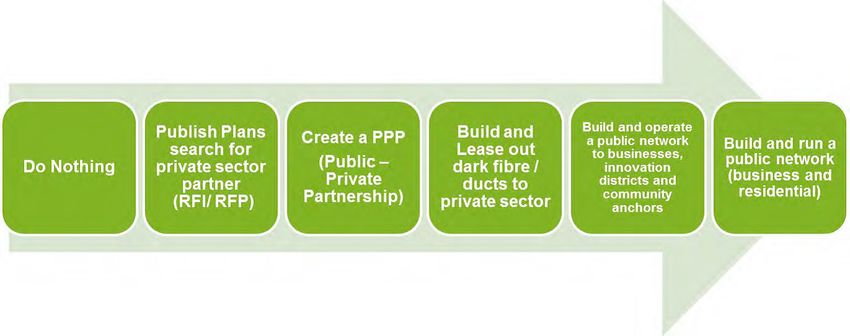
The Town of Canmore has various options for playing a role in the future of the Town’s
broadband services:

Each of the above options are explained with benefits, risks and case studies of current
deployments for each scenario.
Our recommendations for moving forward are focused on the sale of dark fibre services
as well as the offering of broadband services to businesses and residents on selective
basis with a view to providing services of a ubiquitous nature in the long term. This
business approach would be best executed using an Arm’s Length Utility structure.
Broadband Strategic Plan Recommendations
This report identifies a number of strategic plan recommendations that are based on
industry best practices and case studies. The state of broadband within the Town is
below Canadian averages, and well below the internet basic service standard identified
by the CRTC in 2016. There is also a strong indication from the community that they
want the Town to take an active role in improving broadband services to businesses and
residents.
1. That the Town adopt broadband standards identified in this report to move it from its
   current state of average 16.0/7.5 Mbps (download/upload) towards increased speeds
   of 100/20 Mbps and future symmetrical speeds of 1000/1000 Mbps. These standards
   would apply to existing Town facilities and provide guidance on any future investment
   or partnership with other providers that are focused on delivering services in the
   Town. These new standards would be phased in over several years, as the Town will
   required a fibre optic backbone network to support these speeds.
2. The construction of a fibre optic backbone network to connect Town facilities.
3. The creation of a pilot project to provide broadband services to businesses and
   residents within close proximity to the fibre optic backbone The creation of a
   detailed business plan to support this pilot is recommended.

4    JANUARY 2018
IBI GROUP | TOWN OF CANMORE | REPORT: BROADBAND STRATEGIC PLAN

4. It is recommended the Town adopt the following business approaches to achieve
   improved services, including the sale of dark fibre services as well as the offering of
   broadband services to businesses and residents on selective basis with a view to
   providing services of a ubiquitous nature in the long term. This business approach
   would be best executed using an Arm’s Length Utility structure.
5. Investments in municipal broadband networks have been identified as eligible under
   many federal government infrastructure programs such as the Building Canada
   Fund and the Connect to Innovate Programs. These programs do require provincial
   matching dollars, so planning and coordination with provincial representatives is
   required. Further investigation and follow up is recommended.
6. Internet as a Basic Service (Telecom regulatory policy CRTC 2016-496): in December
   2016 the CRTC announced this policy which provides for broadband internet as a
   basic service, defined as 50Mb/s download and 10Mb/s upload. The announcement
   created a fund of $750M over the next 5 years to support investment in broadband
   networks to achieve these service goals. Announcements are expected in late 2017
   to define the details of the funding mechanisms that will be available and eligibility
   of broadband projects to receive consideration for funding. Further investigation and
   follow up is recommended.
7.   On November 23, 2017 Infrastructure Canada announced the details of the Smart
     Cities Challenge program. Preliminary information on this program indicates that the
     intent of the Smart Cities Challenge program is to fund investments in technology
     that would require the use of broadband services, however, the Smart Cities
     Challenge program would expect that municipalities use existing programs, such as
     the Connect to Innovate and Internet as a Basic Service (referenced in items #5 and 6
     above) to fund investments in broadband networks.
8. It is recommended that a Dig Once Policy be reviewed by the Town’s engineering
   department to support the inclusion of underground conduit, handwells (splice/
   access boxes) in any Town road works, bridge or utility projects that involve
   the excavation of roadways, trenching on public rights of way, etc. Specific
   recommendations on conduit sizing and handwell placement are provided in section
   3 of this report.

                                                                                                    JANUARY 2018   5
IBI GROUP | TOWN OF CANMORE | REPORT: BROADBAND STRATEGIC PLAN

    2 | Current State Analysis – State of Broadband
Introduction
The Town of Canmore is currently serviced by Axia, Shaw and TELUS as the primary
carriers. Shaw and TELUS provide both residential and business services, while Axia
provides SuperNet, and business services.
Additional ISP’s such as Xplornet, TekSavvy and Lightspeed are also available. In the
case of TekSavvy and Lightspeed, their local connections are usually provided over
Shaw and TELUS facilities. These ISP’s are referred to as Third Party Internet Service
Providers, and are able to take advantage of fixed local loop rates from the incumbent
service providers (Shaw and TELUS) to offer their Internet services.
The railway right of way through Canmore is a major corridor for multiple Canadian
carriers which are able to offer business services. Similar to the third party ISP’s, they are
reliant on the three primary carriers to provide the last mile connectivity. That being said,
from an intercity perspective, the Town is in a position to access high speed backbone
connectivity to major Canadian centres.
Business services for the Town, as with other communities struggle to achieve the
reliable high speed connectivity required to support their growing data requirements.
Generally local fibre facilities are required to meet their bandwidth needs. Due to the
Carrier’s ROI (Return on Investment) requirements, initial and expensive installation
costs are not palatable to the end customer and businesses must then rely on existing
copper and coaxial based services to provide their basic internet requirements. In most
instances, these services are generally residential grade.

Axia
Axia is currently providing SuperNet connectivity for various Canmore institutions as well
as for Town Hall requirements.
Axia provides community wide fibre build programs that will provide fibre to the premise
for residential and business customers conditional on a guarantee of at least 30% of the
market subscribing to their services. Axia will plan, build, activate and operate an active
Ethernet network for the community and will provide layer 2 and layer 3 connectivity to
individuals, business as well as the municipal government at competitive rates. Axia does
not lease out their fibre and the Town would be required to lease active Ethernet services
for their needs.
The Axia model allows for the customers to select their voice and video products,
however the internet service is Axia’s. Axia is not required to provide Third Party Internet
Services as TELUS and Shaw are mandated to do by the CRTC.
The Town was approached by Axia in January 2017 to gauge interest from the
community. They require a 30% interest/commitment level prior to engaging in budgeting
and service design. Typically once approved, Axia will look to connect approximately
90% a community. This will be done on a concentrated effort in short order to reduce
construction and installation costs.

6    JANUARY 2018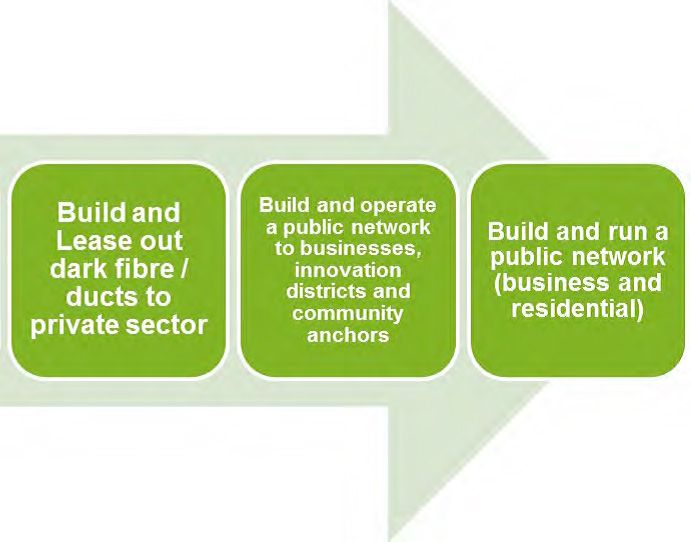
IBI GROUP | TOWN OF CANMORE | REPORT: BROADBAND STRATEGIC PLAN

Shaw
Shaw provides voice, video and internet services for the residential and business
community in the Town. The majority of Shaw’s services are provided utilizing their
Hybrid Fibre Coaxial (HFC) network with some business locations being fed by fibre
directly to the premise.
Shaw currently has a national program to upgrade their HFC network technologies to
accommodate the next generation of internet speeds which will eventually provide gigabit
user speeds. The planning and timing of these programs are not generally communicated
to the public.
With respect to business services that require higher speeds, and/or dedicated
bandwidth or fibre, Shaw either builds local fibre loops or leases last mile fibre in order to
accommodate these customers. As most commercial buildings in Canmore require fibre
to be built in these instances, upfront installation costs for the customer can be a hurdle
to ordering these services. This is due to construction costs associated with deploying
the fibre.
In discussions with Shaw, they have indicated that they are open to deploying fibre
networks if the community is willing to construct the duct/conduit infrastructure. The
preference is for a dedicated conduit for Shaw use. In this case, Shaw would more than
likely utilize this infrastructure to push fibre deeper into residential areas to increase their
cable plant capacity, and look at Fibre to the Premise deployments in commercial areas.
As mentioned, Shaw does lease last mile fibre, but this is done on a case by case basis
as they are approached by business customers with a request for service. The leasing of
this fibre still needs to meet their return on investment terms.
Freedom Mobile is a Shaw company and at this time relies on partner roaming in the
Town of Canmore. If Shaw was to expand Freedom’s footprint to Canmore, there is a
possibility it could lead to additional fibre deployment depending on required cell tower
deployment.

TELUS
TELUS provides voice, video, internet and cellular services for the residential and
business community for the Town of Canmore. TELUS utilizes a combination of DSL and
fibre optics to deliver these services to the Town. DSL is generally used as the internet
service delivery mechanism in town with the exception of fibre implemented on an
individual business customer basis.
DSL service speeds are limited by the distance of the customers copper pairs to the
Digital Subscriber Loop Access Multiplexor (DSLAM) that is either located in the TELUS
Central Office or in the field. DSL has the ability to deliver these higher speeds, but
it does require TELUS to deploy fibre deeper into the neighbourhood and deploy the
DSLAM electronics.
At present, TELUS has the PureFibre program which is a direct fibre to the premise
program which they have initiated/deployed to approximately 71 communities in
Alberta and British Columbia. The general goal of the PureFibre program is to deploy to
approximately 90% of a community in fairly short order. This minimizes construction and
deployment costs.

                                                                                                       JANUARY 2018   7
IBI GROUP | TOWN OF CANMORE | REPORT: BROADBAND STRATEGIC PLAN
TELUS has indicated that there is no cost for this program for a community. Terms of the
program were not discussed in detail. Timing on triggering a PureFibre program were
dependent on discussions directly with the community and business case scenarios on
TELUS’ part. Depending on discussions and existing work in the queue, this could take
up to a year.
Other Internet Service Providers
The Town of Canmore does have access to alternate Internet Service Providers such as
TekSavvy, Lightwave, and Xplornet to name a few.
With the exception of Xplornet, most of these providers are reliant on Axia, Shaw or
TELUS to provide any local facilities. As shown in the Table below, Third Party ISP’s
are able to utilize Shaw and TELUS business and residential services to resell to their
customers while paying the incumbents a wholesale rate that is set by the CRTC.
In the case of fixed Wireless, these providers generally require fibre fed tower locations to
support their services.
At this point, there is no mandate for Shaw nor TELUS to wholesale their local fibre
services in the Third Party ISP regulatory model. Any indication of a fibre to the premise
service would be based on a case by case model in this situation.
The Third Party ISP’s are responsible for their own Internet backbone networks, but
speeds and availability locally are the same as the incumbent providers. A complete list is
provided below in Table 1.
Table 1: Canmore Third Party Internet Service Provider List
ISP Cable DSL Fixed Wireless Fibre
TekSavvy ü ü ü
Vmedia ü ü
Yak ü ü
XinFlix ü ü ü
Slamhang ü ü
Nucleus ü ü
tnw ü ü
The Internet Centre ü
Uniserve ü ü
Unmetered ü ü
High end Internet connectivity for business services would still require either building or
leasing local fibre.
Internet Service Packages
Residential and business internet packages are provided in Table 2 and Table 3. For the
purposes of this exercise, not all the above listed ISP’s were examined. The pricing is
based on standard monthly pricing as shown on each ISP’s website. With the exception
of Axia, and Xplornet, all business internet plans are based on DSL or cable technologies.
Axia does not provide residential internet services in Canmore. The pricing shown is their
standard rates if they provide fibre services to a community.
8 JANUARY 2018IBI GROUP | TOWN OF CANMORE | REPORT: BROADBAND STRATEGIC PLAN
Table 2: Residential Internet Service Providers and Packages
Residential Speed Mbps
ISP 5 15 20 25 30 50 60 75 100 150 500 1000
Axia* $59.00 $79.00 $99.00
Lightspeed - DSL $29.95 $39.95 $44.95 $64.95 $74.95
Lightspeed - Cable $23.95 $32.95 $39.95 $49.95 $69.95
Shaw $60.00 $70.00 $80.00 $84.90
TekSavvy - DSL $29.99 $44.99 $53.95
TekSavvy - Cable $39.99
Telus $68.00 $73.00 $77.00 $82.00
Xplornet* $99.99
* Axia pricing is for reference only as Canmore is not an Axia fibre community ** Xplornet is a satellite based service
Table 3: Business Internet Service Providers and Packages
Commercial Speed Mbps
ISP 5 15 20 25 30 50 60 75 100 150 500 1000
Axia* $99.00 $199.00 $299.00 $599.00
Lightspeed - DSL $29.95 $39.95 $44.95 $64.95 $74.95
Lightspeed - Cable $23.95 $32.95 $39.95 $49.95 $69.95
Shaw $74.95 $96.95 $124.95 $145.95
TekSavvy - DSL $49.95 $44.99 $59.95
TekSavvy - Cable $54.95 $99.95
Telus $60.00 $85.00
Xplornet* $84.99
* Axia pricing is for reference only as Canmore is not an Axia fibre community ** Xplornet is a satellite based service
As shown above, there are a wide range of packages available in the Town. Availability for
various ISP’s services are based on location and the ability for the existing infrastructure
to support the various speeds. For the purpose of pricing existing ISP’s, a downtown
Canmore location was used as a common address. Axia’s prices are fixed for each
community they serve.
In addition to these packages, there are further differentiators with respect to upload
speeds, Data caps, email/web space, and open Wi-Fi hot spot availability. There is a
fairly broad range of speeds and price options available to the Town.
Dedicated Business Internet
Dedicated business internet packages are provided, but these costs are generally only
available when direct quotes are requested. These quotes usually require a facilities
check to be completed by the provider prior to a firm quotation being provided.
These dedicated lines can be obtained through service providers such as Bell, and Zayo,
however the local facilities are generally subleased through the current local providers,
being Axia, Shaw or TELUS.
JANUARY 2018 9IBI GROUP | TOWN OF CANMORE | REPORT: BROADBAND STRATEGIC PLAN 3 | Broadband Standards Introduction Responding to a global transition to knowledge based economies, governments at all levels have identified access to information communication technologies (ICT) as a cornerstone to support future sustainable economic development, enable wealth creation and serve as a cornerstone to maintain a high standard of living and quality of life. The very definition of broadband has evolved rapidly over the past 5 years as governments and regulatory bodies have closely examined the service characteristics of internet services that allow consumers and businesses to take advantage of the benefits these services. Canadian Regulatory Context In 2011, the Canadian Radio Telecommunications Commission (CRTC) established universal target speeds of 5 Mb/s download and 1 Mb/s upload, stating that these speeds should be available to all Canadians by the year 2015. In revisiting the 2011 universal target speeds, in 2016 the CRTC issued Telecom Regulatory Policy CRTC 2016-496 - Modern Telecommunications Services. This provided the path forward for Canada’s digital economy with the following statements to provide additional context for the policy: This decision sets out the actions the Commission is taking to help meet the needs of Canadians so that they can participate in the digital economy and society. Modern telecommunications services are fundamental to Canada’s future economic prosperity, global competitiveness, social development, and democratic discourse. In particular, fixed and mobile wireless broadband Internet access services are catalysts for innovation and underpin a vibrant, creative, interactive world that connects Canadians across vast distances and with the rest of the world. Canadians are using these services to find jobs, manage their investments, conduct business, further their education, keep informed on matters of public concern, consult with health care professionals, and interact with all levels of government. In general, fixed and mobile wireless broadband Internet access services improve the quality of life for Canadians and empower them as citizens, creators, and consumers. A country the size of Canada, with its varying geography and climate, faces unique challenges in providing similar broadband Internet access services for all Canadians. Private sector investments, as well as funding programs from various levels of government, support the expansion of these services outside densely populated urban centres. Despite these efforts, many Canadians, particularly in rural and remote areas, do not have access to broadband Internet access services that are comparable to those offered to the vast majority of Canadians in terms of speed, capacity, quality, and price. As part of this policy, the CRTC established that broadband internet was a basic service with target service objectives of 50 Mb/s download and 10 Mb/s upload, with unlimited usage capacity to be available in 90% of Canadian premises by the end of 2021 and in the remaining 10% of Canadian premises within 10 to 15 years. 10 JANUARY 2018
IBI GROUP | TOWN OF CANMORE | REPORT: BROADBAND STRATEGIC PLAN

Communities and regions within Canada have adopted strategies and targets for high
speed broadband within their community that go well beyond the CRTC’s recently
announced basic service objectives.
For example, in York Region (Ontario), the following vision statement has been adopted
by the Region: “To establish York Region as a Gigabit Region, recognized for its
leadership in fostering an eco-system of collaboration and business innovation within
a connected lifestyle community.” Supporting that vision, the Region established the
following 5 and 10 year broadband targets in 2014:

                                               5 Year Target                 10 Year Target
            Land Use Type
                                           Upload       Download          Upload          Download

    Regional Centres and Corridors        10 Gbps         10 Gbps         1 Tbps           1 Tbps
    Employment and Institutional
                                          10 Gbps         10 Gbps         1 Tbps           1 Tbps
    Lands
    Urban Residential                    500 Mbps        500 Mbps         1 Gbps           1 Gbps

    Urban Commercial                       1 Gbps         1 Gbps         10 Gbps          10 Gbps

    Towns and Villages                    50 Mbps        250 Mbps        100 Mbps         500 Mbps

    Rural Areas                           50 Mbps        100 Mbps        50 Mbps          250 Mbps

Source: York Region Broadband Strategy 20141

Global Context
In 2015 the American Federal Communications Commission established advanced
broadband speed thresholds of 25 Mb/s (download) and 3 Mb/s (upload)
Globally, many nations have identified high speed broadband as a key element of their
national development strategies to enable the next phase of economic growth, attract
global businesses to operate in their location and provide opportunities for their citizens
to participate in the knowledge economy. Countries such as Australia and Singapore
have invested in national broadband strategies and funded the development of extensive
fibre optic networks to ensure that affordable high speed broadband is available to
almost all citizens.
The Akamai State of the Internet Q1 2017 Report provides us a global context in terms of
not only download speed, but also the distribution of speeds in the range of 4Mb/s up to
25 Mb/s.

1
    http://www.york.ca/wps/wcm/connect/yorkpublic/3995a98f-d1f8-4fe1-b553-ce2651c89f2d/
may+1+broadband+ex.pdf?MOD=AJPERES

                                                                                                           JANUARY 2018   11
IBI GROUP | TOWN OF CANMORE | REPORT: BROADBAND STRATEGIC PLAN
Global Ranking (Q1 2017) Download Speed
Q1 2017
Country/Region QoQ Change YoY Change
Avg. Mbps
- Global 7.2 2.3% 15%
1 South Korea 28.6 9.3% -1.7%
2 Norway 23.5 -0.4% 10%
3 Sweden 22.5 -1.3% 9.2%
4 Hong Kong 21.9 -0.2% 10%
5 Switzerland 21.7 2.1% 16%
6 Finland 20.5 -0.7% 15%
7 Singapore 20.3 0.8% 23%
8 Japan 20.2 3.1% 11%
9 Denmark 20.1 -2.9% 17%
10 United States 18.7 8.8% 22%
Source: Akami State of the Internet Q1 20172
In terms of global ranking, we see top average download speeds of 28.6 Mb/s. Download
speeds globally are increasing on average at 15% per year. Canada’s Q1 2017 average
download speed ranks 20th globally at 16.2 Mb/s, while recent survey data from the town
of Canmore provides us with an average of 16.0 Mbps which would place it 21st in the
Global ranking, slightly below the Canadian average.
Another key metric to observe are the number of broadband connections above 15 Mb/s,
expressed as a percentage.
2
https://www.akamai.com/us/en/about/our-thinking/state-of-the-internet-report/global-state-of-the-internet-
connectivity-reports.jsp
12 JANUARY 2018IBI GROUP | TOWN OF CANMORE | REPORT: BROADBAND STRATEGIC PLAN
Americas Ranking % above 15Mb/s:
Global % Above 15 QoQ YoY
Country/Region
Rank Mbps Change Change
8 United States 48% 14% 36%
16 Canada 40% 16% 25%
50 Chile 15% 18% 243%
54 Uruguay 13% 55% 206%
65 Mexico 6.1% 15% 52%
66 Brazil 5.8% 16% 451%
68 Argentina 5.1% -5.6% 206%
72 Peru 4.4% 60% 211%
73 Ecuador 4.3% -9.4% 263%
75 Columbia 2.1% -6.0% 259%
- Panama 4.4% 15% 465%
- Costa Rica 1.0% 13% 66%
- Bolivia 0.4% 11% 117%
- Venezuela 0.1% 4.8% -42%
- Paraguay 0.1% 20% -55%
Source: Akami State of the Internet Q1 20172
From this data, we see the Canadian % above 15 Mbps at 40% with a global rank of 16.
Recent survey data from the Town of Canmore places the Town at at 32%, ranking it 27th
globally. Notably, the year over year change for these rankings are important to note in
that many of the lower ranked countries are making large progress towards improving
their ranking in this category.
Globally, broadband speeds continue to increase year over year. Fixed broadband
services have generally increased 25% year over year. According to a 2014 study
completed by Ookla ©, the Town's average download speed has increased 28% from
2010 to 2014. These increases are generally due to a combination of technology
advancements and competition.
Applications Drive Bandwidth
Historically, bandwidth consumption patterns have been driven by a download
consumption model. Consumers and business users would download content (e.g. email,
video, music) from major content creators on the internet and thus the disparity between
download and upload speeds available did not significantly impact the users experience
as long as download speeds could be maintained.
JANUARY 2018 13IBI GROUP | TOWN OF CANMORE | REPORT: BROADBAND STRATEGIC PLAN Video Emerging applications that support real time video communication (e.g. FaceTime, Skype, etc.) and the penetration of mobile devices has allowed a far greater number of consumers and businesses to upload video content created on their smart phones. Many online businesses rely on creating and publishing bandwidth intensive content to the internet or to corporate servers (e.g. graphic designers and videographers, professional photographers, engineers, etc.), creating pressure on limited upload speeds that currently exist. Overall the penetration and use of real time video in HD, 4K and emerging 8K formats continues to drive the need for high speed symmetrical bandwidth. The use of video and imaging applications within the healthcare and educational sectors continues to increase, driving the need for increasing bandwidth that is reliable and supports real time video applications. Cloud Over the past 5 years, most applications have moved to cloud based hosting and service models. Software as a Service (SaaS) has become the predominant business model for major application and software providers such as Microsoft, Google and many other firms. In order for clients to take advantage of the benefits of the cloud based services, they must have access to the internet in order for these applications to perform efficiently. While a single instance of a cloud application does not need a large volume of bandwidth, the widespread adoption of these applications mean that every device (computer, tablet, and smart phone) connected to the cloud is constantly consuming bandwidth, creating higher levels of bandwidth demand in the aggregate. Broadband Standards – Town of Canmore Standards for the Town need to be set within the context of the vision of the Town for its future development, the type of businesses and residents and future developments it wants to attract and its overall strategy to support growth and development. Canmore has transformed from a small mining town with a once uncertain future into an international tourist destination with a reputation for excellence and innovation. The Town’s youthful, energetic and well-educated population values a vigorous, outdoor adventure lifestyle that supports and encourages an entrepreneurial spirit. This compelling combination has made Canmore one of the fastest-growing and most desirable communities in Canada. Keenly aware of the fine balance between economic growth and environmental stewardship, Canmore seeks to support businesses that take advantage of its incredible location while producing minimal environmental impact. The Town’s future lies in the intellectual and creative wealth coming to the community from all over the world. There are strong growth opportunities in recreational tourism and the health and wellness sector. With the desire to support knowledge based growth as well as providing a world class tourism and hospitality experience, it is important that broadband standards reflect the need to provide a world class experience that encourages businesses to locate in the Town and residents, along with encouraging knowledge based residential businesses and professionals that work from home on a permanent or occasional basis. 14 JANUARY 2018
IBI GROUP | TOWN OF CANMORE | REPORT: BROADBAND STRATEGIC PLAN

Download / Upload Speeds
Focusing on the average download and upload speeds is an important standard however
careful attention must be paid to not only the average metric, but as well the distribution
of the results (median) values. It is important to note that while the CRTC has established
a basic service standard of 50 / 10 Mbps, this standard reflects the current state of the
incumbents’ technology and will promote continued investment in legacy technology.
Establishing standards beyond the minimum will allow the Town to take a leadership
position with respect to superior broadband services that will allow the Town to attract
businesses and residents that will take full advantage of broadband services and provide
knowledge economy based growth and investment in the Town.
Should the Town proceed with investments in broadband technology, either as a
wholesale or retail provider, or as a partner/ enabler of private sector investment, it is
recommended that a minimum broadband standard be maintained in order to ensure that
strategic objectives for the Town are met.
Looking forward 5 years and 10 years, it will be important that broadband investments
be able to support anticipated future growth and therefore aspirational targets for 5 years
and 10 years ahead are also recommended.

Town of Canmore Recommended Broadband Standards

                                                       Proposed
                                          Current                      5 Year      10 Year
                Metric                                 Standard
                                           State                       Target      Target
                                                         (2017)
                                         16.0 / 7.5                                 10 /10
Average Download / Upload Speed                       100 / 20 Mbps   1 /1 Gbps
                                          Mbps                                      Gbps

% Above 15 Mbps Download                   32%                          40%          80%

Latency (North America destinations)                             Less than 150ms

                                                      99.99% service uptime with a mean time
Reliability
                                                        to repair (MTTR) objective of 4 hours

Open Access to Carriers                                                Yes

% of Properties Connected                                               90%         100%

Other Recommended Broadband Standards and Policies:
Affordability and Usage Limits:
Flat rate pricing without incremental charges for usage
Access to 3rd parties:
The broadband network shall be managed as an open network, allowing connections to
other carriers on reasonable terms and prices and on a non-discriminatory basis.

                                                                                                     JANUARY 2018   15
IBI GROUP | TOWN OF CANMORE | REPORT: BROADBAND STRATEGIC PLAN
New Development Connections
All new property developments must include dedicated telecommunications conduit
systems for the Town’s use and operational control, providing a connection to the fibre
optic backbone system at the closest practical connection point (planned or existing)
and as well as a dedicated conduit connection from the backbone to the main telecom
room or distribution facility located within the new development, or provide a connection
directly to the dwelling unit.
Dig Once Standard
All new construction or rehabilitation of roadways, bridges or other transportation
infrastructure under the control and direction of the Town shall install new underground
telecommunications conduit and associated hand wells/ pull boxes as part of the project
scope.
All new construction of potable water or sanitary sewer trunk lines shall be reviewed for
the feasibility to install new underground telecommunications conduit and associated
handwells/ pull boxes as part of the project scope.
IBI Group recommends that following guidelines with respect to Fibre Optic Duct
Engineering. These guidelines are subject to review and approval by the Town of
Canmore's Engineering Department.
Fibre Optic Duct Engineering Guidelines:
1. Throughout the route, there shall be at least 2 x 50 mm HDPE conduits deployed
for backbone network. The exact quantity will be determined during detailed
design phase.
2. There shall be cable vaults located at approximately every 2 km along the route.
Size and type to be specified during detailed design phase.
3. There shall be hand wells located at approximately every 500 m along the route.
Additional hand wells may be required due to on-site conditions or wherever the
cumulative bends of conduits exceeds 180 degrees. Hand wells are also to be
located near each traffic controller and placed in order to aggregate drop conduit
for individual building connections. Size and type to be specified during detailed
design phase.
4. Additional 1 x 50 mm HDPE conduit, with sub-duct shall be installed for drop
connections to provide connectivity to commercial buildings or residences. The
installation of this conduit will be coordinated with specific construction details of
the individual property, to be determined during the detailed design phase.
16 JANUARY 2018IBI GROUP | TOWN OF CANMORE | REPORT: BROADBAND STRATEGIC PLAN
4 | Broadband Service Market Demand (Survey)
Introduction
The Town of Canmore, located in the Bow Valley, is one hour from Calgary and minutes
to Banff National Park. The Town is one of Alberta’s top tourist destinations but still
retains a diverse economic base with construction, health and wellness providing major
contributions to the local economy. There are approximately 14,000 residents with an
estimated 3,900 non-permanent residents that own property in the Town.
Canmore has 1,300 registered businesses in their Town registry. IBI Group reviewed this
data from the Town’s business registry, and of these businesses, 611 were registered as
Commercial and 717 as Home-Occupation.
The general breakdown of market segments using the Town provided business data is as
follows:
Market Segment Market % Broadband Dependence
Tourism/Hospitality 30% High/Medium
Construction 25% Low
Health/Education 21% High
Retail 15 High/Medium
Professional/Business 9 High
With respect to the market segments and their broadband dependence, reliance is
continually increasing as individuals have more devices that are required to be online, as
well as a growing reliance on cloud-based services, such as Ring Central, GoToMeeting,
Microsoft Office 365 and Amazon Web Services, to name just a few. Speed and reliability
are critical factors in operating a business, regardless of location.
In the hospitality sector, customers now expect high speed services for business use
as well as personal. Over the Top (OTT) services such as Netflix are expected to be
accessible and reliable for a location’s guests.
The same criteria carries into the residential market, where video streaming is a common
application. The Service Providers themselves are either already providing or moving
towards IP based video services such as Crave and Shaw Free Range. Customers
expect fast and reliable connectivity service.
Survey and Bandwidth Testing
Surveying and bandwidth testing was performed with the IBI Group Survey Tool. The
tool was used to gather information by directing residents and businesses to an online,
internet-based survey available through a link.
The survey was configured to identify residential and commercial use and pose specific
questions relevant to each service. In the case of business internet, it was important to
identify specific bandwidth applications that were key to each companies’ needs and
JANUARY 2018 17IBI GROUP | TOWN OF CANMORE | REPORT: BROADBAND STRATEGIC PLAN requirements for their success. As an example, a café requiring internet service for Point of Sale transactions is a low bandwidth user, whereas a corporate office with multiple employees utilizing cloud-based applications, and moving large files, requires high bandwidth. Bandwidth testing was performed as part of the survey process, with survey respondents asked to activate a test through their web browser, located at their residence as well as at their place of business, in order to measure and record the speed and capacity of their internet services. The Town has been provided with all raw data collected from the survey. This section of the report provides a summary of survey questions and responses as well as summary of bandwidth test results, classified by various categories of interest. The survey objective was to capture a valid, representative sample (within agreed upon confidence interval) from the Town residents and businesses. This information would provide feedback on various broadband questions, and create a baseline bandwidth measurement that would be used to measure the level of commercially available residential and business internet services and the changes to such services over time. Technical Configuration Access to the survey was provided through a link that was sent via email to businesses; various promotion initiatives were put in place by the Town to encourage survey participation. The following diagram depicts the survey network architecture that was implemented. Note that in this scope of work, offline data and Web data entry options were not used as the objective was to capture speed test results from desktop connected computers. The data collected from the survey was exported in a standard electronic format (e.g. Microsoft Excel). 18 JANUARY 2018
IBI GROUP | TOWN OF CANMORE | REPORT: BROADBAND STRATEGIC PLAN

Integration of Bandwidth Testing
The IBI Group Speed testing tool was utilized as part of this survey. Geocoded data was
captured from survey respondents using publically available mapping tools.
Survey respondents were asked to provide their address, so bandwidth coverage can
be mapped and coverage results reported by location and aggregated to community
level information. Bandwidth performance (upload, download speeds and latency) was
also measured and recorded. This information helped to illustrate specific broadband
performance characteristics by location and/or by service provider.

Survey Schedule
The Survey was designed based on survey questions previously reviewed by the Town
with suggested feedback and collaboration from IBI Group as to visual display, format,
etc.
The survey was launched on August 3, 2017 and ended September 10, 2017.
The Town advertised the survey through their website, Facebook and local media. IBI
Group participated in an interview with a local paper to provide additional information
with respect to the survey and its intended outcome.

Number of Responses
The format of the survey requested respondents to answer a number of questions.
Once all questions were completed, they were asked to click on a “Submit” button to
confirm their results and complete the survey. If the survey respondent did not answer all
questions, or did not click the submit button at the end of the survey, the questions that
were answered were still recorded and classified.
There was a total of 274 non-blank, non-test distinct survey results captured as of
September 10th, 2017. Based on approximately 13,000 residents in Canmore, this volume
of response to the survey questions provides a confidence interval of +/- 5.86% based
on a confidence level of 95%.
The confidence interval (also called margin of error) is the plus-or-minus figure usually
reported in newspaper or television opinion.
The confidence level tells you how sure you can be. It is expressed as a percentage and
represents how often the true percentage of the population who would pick an answer
lies within the confidence interval. The 95% confidence level means you can be 95%
certain; the 99% confidence level means you can be 99% certain. Most researchers use
the 95% confidence level.
The confidence was calculated based on all the survey results as opposed residential
and Business. The Business/Commercial survey participants were low, however when
reviewing the residential respondents, it was noted that 60% of these participants utilized
their service for Telecommuting and other business based applications.

                                                                                                   JANUARY 2018   19
IBI GROUP | TOWN OF CANMORE | REPORT: BROADBAND STRATEGIC PLAN Bandwidth Test Results by Location The results of the survey speed testing performed are mapped according to the address information gathered. IBI Group has provided three maps with broadband test results for the Town of Canmore. The broadband results are broken into residential, and commercial. The third map is results from test data made available from the Canadian Internet Registration Authority (CIRA) website; this map does not specifically indicate whether the test is residential or commercial. Exhibit 1 - Residential Broadband Test Results by Location Exhibit 2 - Commercial Broadband Test Results by Location Exhibit 3 - CIRA Broadband Test Results by Location 20 JANUARY 2018
Town of
Town  of Canmore
         CanmoreResidential
                 ResidentialBroadband Test Result
                               Broadband   Test Results

                                               Wapiti Camp Ground

                                                                                                                                                                                                             ¯
                                              Canmore Recreation Center

                                                                                             Fire Hall

                                                             Arts Place Civic Center Seniors Center
                                                   Scout Hall
                                                                                       N.W.M.P Barracks
                                                                                                                  Elevation Place
                                                                  Miner's Union Hall
                                                                                                                SHAW
                                                                TELUS

                                                         The Roundhouse Preschool and Daycare
                                                         Royal Canadian Air Cadets Building
                                                                                             AXIA

                                                                                                                                                                                 Bow Valley Food Bank

                                                                                                                                                                                     Public Works Facility

                                                                                                                                                  Public Transportation Office

                                                                                                                                                                     Elk Run Maintenance Bays (old)
                                                                                                          Waste Management Centre
                                                                                                                                                                      Salt and Sand Storage Facility

 Legend
      0 - 10 Mbs
      10 - 50 Mbs
      50 - 100 Mbs
      > 100 Mbs
      Town Facility
      Road Centreline

 Buildings
 BuildingClass
      Commercial & Industrial
      Institutional
      Recreational
      Residential
      Transportation/Utilities
      Land Titles

                      0          0.25   0.5                   1                               1.5                                   2
                                                                                                                                     Kilometers

                                                                           Broadband Strategic Plan
                                                                                                                                                                                                             EXHIBIT 1
                                                                           January 2018
Town of
Town of Canmore
CanmoreCommercial
CommercialBroadband TestTest
Broadband Result
Results
¯
Wapiti Camp Ground
Canmore Recreation Center
Fire Hall
Arts Place Civic Center Seniors Center
Tourism Building
Scout Hall
N.W.M.P Barracks
Elevation Place
Miner's Union Hall SHAW
TELUS
The Roundhouse Preschool and Daycare
Royal Canadian Air Cadets Building
AXIA
Bow Valley Food Bank
Maintenance Building
Public Works Facility
Legend
Public Transportation Office
0 - 10 Mbs
10 - 50 Mbs
50 - 100 Mbs
Elk Run Maintenance Bays (old)
Waste Management Centre
Town Facility
Salt and Sand Storage Facility
Road Centreline
Buildings
BuildingClass
Commercial & Industrial
Institutional
Recreational
Residential
Transportation/Utilities
Land Titles
0 0.15 0.3 0.6 0.9 1.2
Kilometers
Broadband Strategic Plan
EXHIBIT 2
January 2018Town of Canmore
Town CIRACira
of Canmore Broadband Stat Result
Broadband Test Results
Wapiti Camp Ground
Canmore Recreation Center
¯
Fire Hall
Arts Place Civic Center Seniors Center
Scout Hall
N.W.M.P Barracks
Elevation Place
Miner's Union Hall SHAW
TELUS
The Roundhouse Preschool and Daycare
Royal Canadian Air Cadets Building
AXIA
Bow Valley Food Bank
Maintenance Building
Public Works Facility
Public Transportation Office
Elk Run Maintenance Bays (old)
Waste Management Centre
Salt and Sand Storage Facility
Legend
0 - 10 Mbs
10 - 50 Mbs
50 - 100 Mbs
Town Facility
Road Centreline
Buildings
BuildingClass
Commercial & Industrial
Institutional
Recreational
Residential
Transportation/Utilities
Land Titles
0 0.225 0.45 0.9 1.35 1.8
Kilometers
Broadband Strategic Plan
EXHIBIT 3
January 2018IBI GROUP | TOWN OF CANMORE | REPORT: BROADBAND STRATEGIC PLAN
Survey Questions and Responses
As of September 11th, 2017, surveys initiated totalled 348. This data was reviewed and
surveys with a combination of missing data, out of town addresses and duplicate entries
removed.
The overall survey counts are as follows:
Totals Count
Surveys Initiated 348
Surveys in Canmore 220
Addresses with Lat/Long 173
Residential 193
Business 27
Speed Tests Completed 138
As the residential and business surveys had different questions, the results are provided
separately.
Residential Survey Questions and Responses
1. How important is access to you?
Rating Count Percentage
Not important 2 1%
Somewhat important 0 0%
Very important 36 19%
Can’t live without it 150 80%
Total Responses 188 100%
2. What is your satisfaction with your current home internet service?
Participants were asked to rate their service on a scale of 1 to 5 for the attributes of
reliability, speed, value and customer service.
(1 – Very Dissatisfied, 3 – Satisfied, 5 – Very Satisfied)
Satisfaction Customer
Reliability Speed Value
Level Service
1 to 5 3.66 3.21 2.58 3.21
JANUARY 2018 21IBI GROUP | TOWN OF CANMORE | REPORT: BROADBAND STRATEGIC PLAN
3. What is your overall satisfaction with your current internet service?
(1 – Very Dissatisfied, 2- Dissatisfied, 3 – It’s Okay, 4 – Satisfied, 5 – Very Satisfied)
Satisfaction Level Responses Percentage
Very Dissatisfied 8 5%
Dissatisfied 28 19%
It’s Okay 59 40%
Satisfied 38 26%
Very Satisfied 15 10%
Total 148 100%
4. What do you use your home internet for?
Usage Type Counts Percentage
Basic Internet 143 96%
Video Streaming
129 87%
(YouTube, Netflix, Crave, etc.)
Gaming 45 30%
Telecommuting
89 60%
(VPN. Web Conference, etc.)
Voice and Video
113 76%
(Skype, Facetime, WhatsApp, etc.)
Cloud Services and Storage
110 74%
(iCloud, One Drive, Google Drive, etc.)
*Based on 149 responses to the question
5. What is the maximum monthly amount you would be willing to pay for a high
speed internet connection at home?
Monthly Maximum Count Percentage
$30 9 6%
$50 36 22%
$75 67 41%
$100 44 27%
$150+ 7 4%
22 JANUARY 2018IBI GROUP | TOWN OF CANMORE | REPORT: BROADBAND STRATEGIC PLAN
6. If available, would you upgrade your service?
Upgrade Yes No
Counts 149 16
Percentage 90% 10%
7. What Internet package do you currently subscribe to?
Internet
Light No ISP
Package Rogers* Shaw TekSavvy Telus
Speed Provided
Mbps
5 1
15 1 17 1 8
25 11
30 1
50 20
75 26
150 48 7
Unknown 1 1 3
Total ISP 1 1 93 2 49 49
*Rogers is a wireless data stick service
These results are based on the participant providing their ISP information.
8. Has your Internet Service Provider kept up with your current needs?
Kept Up Count Percentage
Yes 105 59%
No 73 41%
Total 178 100%
9. What role, if any, should the Town of Canmore take in ensuring that Canmore’s
future internet speed requirements can be met?
Town’s Role Not Sure Passive Moderate Active
Responses
18 11 39 109
(Total 167)
Percentages 10% 6% 22% 62%
JANUARY 2018 23IBI GROUP | TOWN OF CANMORE | REPORT: BROADBAND STRATEGIC PLAN
Business Questions and Responses
1. What does your business currently use the internet for?
Business Usage Type Counts Percentage
Credit Card Processing 13 50%
Corporate VPN 14 54%
Large File Transfer 23 88%
Voice and Video communication (e.g. Skype, Ring
22 85%
Central, video conferencing, other VOIP services)
Download/viewing of videos (training/education for staff) 22 85%
Manage online business/website 26 100%
Security system / video camera monitoring of business
10 38%
and/or remote locations
Provide internet access (Wi-Fi) to customers/staff 18 69%
My business uses and/or provides Cloud Services 13 50%
2. What do you currently pay, on a monthly basis for your existing internet
connection?
$100 and Less $100-$200 $500 $1,000 and Up
8 5 1 5
3. How important is access to the internet for you?
Rating Count Percentage
Not important 0 0%
Somewhat important 0 0%
Very important 2 7%
Can’t live without it 25 93%
Total Responses 27 100%
4. What is your satisfaction with your current internet service?
Participants were asked to rate their service on a scale of 1 to 5 for the attributes of
reliability, speed, value and customer service.
(1 – Very Dissatisfied, 3 – Satisfied, 5 – Very Satisfied)
Satisfaction Customer
Reliability Speed Value Overall
Level Service
1 to 5 3.15 2.7 2.52 3.08 2.86
24 JANUARY 2018IBI GROUP | TOWN OF CANMORE | REPORT: BROADBAND STRATEGIC PLAN
5. What is your current download speed in Mbps (Megabits per second)?
Combined Table with results from Question 6.
6. What is your current upload speed in Mbps (Megabits per second)?
Count Download (Mbps) Upload (Mbps) Percentage
1 15 15 4%
1 25 5 4%
1 30 5 4%
1 60 10 4%
1 60 15 4%
1 100 20 4%
1 100 100 4%
1 150 15 4%
19 Unknown Unknown 68%
Unknown results can be due to employees not knowing their business internet contracts.
7. If you had access to a higher speed (e.g. 100 Mb/s or greater) reliable Internet
connection, would it allow you to: (select all that apply)
Yes No
a. Operate more efficiently (i.e. lower costs)?
89% 11%
b. Grow your business (i.e. increase revenue)?
72% 28%
c. Provide improved customer service?
81% 19%
8. If available, would you upgrade your internet service?
Yes No
88% 12%
JANUARY 2018 25IBI GROUP | TOWN OF CANMORE | REPORT: BROADBAND STRATEGIC PLAN
9. What service speed do you feel would meet all of your current requirements?
Speed (Mbps) Count Percentage
10 1 4%
50 2 7%
150 10 37%
1,000 8 30%
>1,000 5 19%
No Response 1 4%
10. What is the maximum monthly amount you would be willing to pay for a high
speed Internet connection for your business?
Rate/Month Count Percentage
$50 3 11%
$100 5 19%
$150 8 30%
$250 0 0%
$500 2 7%
>$1,000 8 30%
No Response 1 4%
11. Has your Internet Service Provider kept up with your current needs?
Yes No
36% 64%
12. What role, if any, should the Town of Canmore take in ensuring that Canmore’s
future internet speed requirements can be met?
Role Count Percentage
Not Sure 1 4%
Passive 2 7%
Moderate 4 15%
Active 20 74%
26 JANUARY 2018IBI GROUP | TOWN OF CANMORE | REPORT: BROADBAND STRATEGIC PLAN
• Passive – The Town has no involvement in Canmore’s internet needs
• Moderate – The Town encourages and/or supports the private sector in
Canmore’s internet needs
• Active – The Town partners with the private sector and/or invests as required
The survey also provided commercial respondents to provide comments with respect
to their current level of service. The majority of comments expressed frustration on the
quality of service and an inability to fully utilize hosted services, and reliability on file
transfers and the use of Voice over Internet type services.
Bandwidth Testing
The IBI Group Bandwidth testing tool measures the actual transfer speed of a file over
the Internet to a centralized server on the internet’s backbone, located at a data center in
Calgary, Alberta, Canada.
Many bandwidth tests, including some speed tests done by an Internet provider, measure
only the local connection between the residence or business and the nearest server that
is hosted by the Internet provider. This is a measurement of the maximum speed that can
be expected over the local connection, however it is not an accurate measurement of the
actual performance of the connection when accessing typical files on the Internet and
content that are not stored (cached) locally.
The location of the IBI Group server is a net neutral location via the Calgary Internet
Exchange.
The Town wishes to establish a baseline for the community of the Internet speeds that
are truly usable for high speed applications, such as voice and video streaming, to other
locations in the province and around the world. The Town anticipates that future Smart
City applications for residents and businesses will require much higher levels of Internet
bandwidth in the future, and not all applications may be hosted locally. Measuring from
one common location will provide a baseline to compare service levels in different
geographical areas of the town.
Survey respondents could return to the bandwidth testing portion of the survey multiple
times and record test results. Test results for each survey respondent were averaged to a
single result for each survey/unique location. IP address of the Internet Service Provider
(ISP) was also recorded to allow a correlation of results to service provider.
Test Parameters that were recorded include:
• Average Download Speed (Mb/s)
• Average Upload Speed (Mb/s)
• Latency (milliseconds)
JANUARY 2018 27You can also read


