BUSINESS CASE Sydney Dive Wreck
←
→
Page content transcription
If your browser does not render page correctly, please read the page content below
SYDNEY DIVE WRECK BUSINESS CASE FROM THE GBSDC INC.

Sydney Dive Wreck
BUSINESS CASE
Gordons Bay Scuba Diving Club Inc. (GBSDC)

Version 9 1st February 2019

1|Page
SYDNEY DIVE WRECK BUSINESS CASE FROM THE GBSDC INC.

Key Proposal Details

 Proposal name                   A Dive Wreck for Sydney
 Lead proponent (e.g. Council) Gordons Bay Scuba Diving Club (GBSDC Inc.)
 Lead proponent ABN              Y210124
 Proposal partners               Australian Government, NSW Government
 Lead Contacts
 Name                            John Rowe, Sam Baxter
 Position                        Founder, President
 Phone                           +61 2 412099453, 48834257
                                 +61 2 412261459, 96644274
 Email                           jcprowe@bigpond.net.au. sam1.baxter1@gmail.com

 Fax                             +61 2 4883494
 Address                         4A Trafalgar St Bronte NSW 2024

Proposal Scope
This is a proposal to give Sydney a dive wreck by sinking an ex-navy ship in recreational
dive depths off the Sydney coast funded by the NSW Government. This proposal forecasts
revenue over five years of $12.4M (low) and $48.6M (high) at a one off cost of $6M-$10M-a
cost benefit ratio of between 2.1 and 4.8 (Appendix 1). This supports the strategic
imperatives of the NSW Government and the Department of Industry (2.3). The dive wreck
has the potential for over 100 years (Gabriel et al. 2000) of useful life with very low post
sinking costs and apart from the economic benefit the dive wreck will provide recreational,
research and environmental benefits for generations to come. The GBSDC Inc. has consulted
widely with the community (2.5) and a petition may be tabled in the Legislative Assembly
with over 10,500 signatures asking the Government to make the necessary funds available for
a Sydney Dive Wreck.

Proposal Location

 Proposal address         4 kilometres S.S.E from Coogee Beach NSW

 Local government area Randwick City Council

 NSW electorate           Coogee NSW

 Federal electorate       Kingsford Smith NSW

2|Page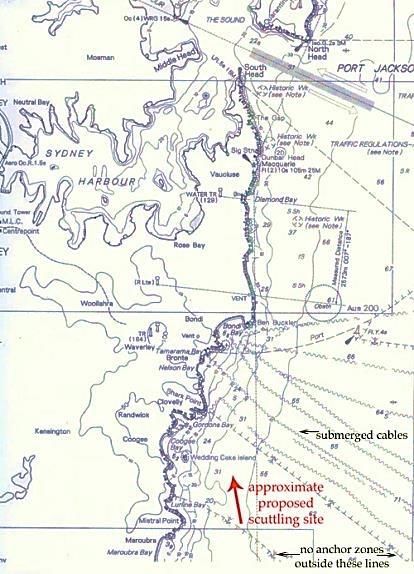
SYDNEY DIVE WRECK BUSINESS CASE FROM THE GBSDC INC.

Supporting Information

Appendix 1 Estimated annual revenue and project costs                              39-41

Appendix 2 (a) LGA’s Bayside, Randwick Woollahra Waverley tourist employment        42

Appendix 2 (b) LGA’s Bayside, Randwick Woollahra Waverley day & overnight visitors 43

Appendix 3 Community Engagement Letters of Support                                 44

Appendix 4 Recreational dive centres in NSW distance to dive wreck site           45-46

Appendix 5 Coogee dive wreck site characteristics                                  47

Appendix 6 Sport participation table Australia                                     48

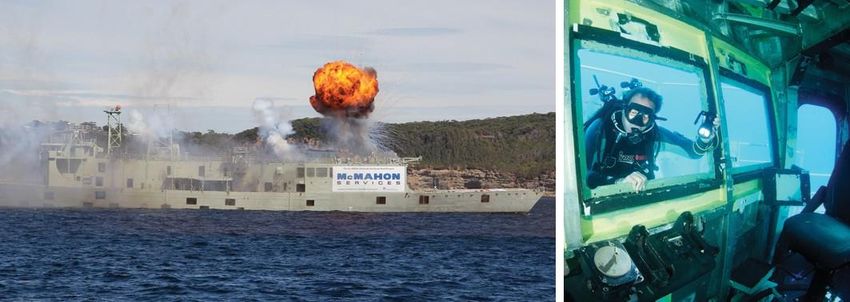
Appendix 7 ex-HMAS Adelaide scuttling McMahon Services                             49-50

Appendix 8 Dive wrecks worldwide                                                   51-56

Appendix 9 Sydney Dive Wreck and the Marine Estate Management Act No72, 2014       57

Appendix 10 Proposed Marine Parks for Hawkesbury Shelf bio-marine region           58

Appendix 11 Petition analysis by NSW Electoral Divisions                          59-60

Literature Cited                                                                   61-64

Acknowledgements
Member for Coogee: Bruce Notley-Smith, Coogee MP’s officers, Will Peters. Dive Industry
Representatives: PADI – Danny Dwyer, Dive Industry Association of Australia, Richard
Nicholls, Dive Centre Bondi, Duncan Paterson, Pro Dive Australia, Russell de Groot, and
Rod de Groot. Community Representatives Lynda Newman Randwick Tourism, Bernadette
Summers Coogee Chamber of Commerce, Environmental Engineering: Ed Rowe, Maritime
& Coastal. Arup, Independent Environmental and Marine Science advisors: Professor Iain
Suthers, UNSW Professor William Gladstone UTS. Sydney Marine Park: Sharnie Connell
GBSDC Representatives President Sam Baxter, Founder- John Rowe, Marine Scientist
A very special acknowledgement to Graham Willis Dive Instructor for his significant help
with this proposal and the very helpful advice received from Michael Hukic, Commonwealth
Bank and Stephen Hall, Senior Consultant from Forsythes.

3|Page

SYDNEY DIVE WRECK BUSINESS CASE FROM THE GBSDC INC.

CONTENTS

    1 EXECUTIVE SUMMARY                                        5

    2 CASE FOR CHANGE                                          6-21

    2.1 BACKGROUND                                             6-7
    2.2 RATIONALE FOR INVESTMENT                               8-12

    2.3 STRATEGIC ALIGNMENT                                    12-15

    2.4 EXPECTED OUTCOMES                                      15-18

    2.5 STAKEHOLDER & COMMUNITY SUPPORT                        19-21

  3 ANALYSIS OF THE PROPOSAL                                   22-26

    3.1 OBJECTIVES & INDICATORS                                22

    3.2 THE BASE CASE                                          22-23

    3.3 THE PREFERRED SOLUTION                                  23

    3.4 INFORMATION ABOUT THE PROPOSAL                          24

    3.5 PROJECTED COSTS                                         24

    3.6 COST-BENEFIT ANALYSIS                                   25

    3.7 FINANCIAL APPRAISAL                                     25

    3.8 PROPOSED FUNDING ARRANGEMENTS                           26

    3.9 FINANCIAL HEALTH & SUPPORT                             26

  4 IMPLEMENTATION CASE                                        26-37

    4.1 PROGRAM & MILESTONES                                    26

    4.2 GOVERNANCE                                                 27

    4.3 KEY RISKS                                                  28-34

    4.4 LEGISLATIVE, REGULATORY ISSUES & APPROVALS                 34-36

    4.5 PROPOSED MANAGEMENT ACTIVITIES                             37

  5 CONCLUSION APPENDICES                                          38-60

  6 LITERATURE CITED                                               61-64

4|Page
SYDNEY DIVE WRECK BUSINESS CASE FROM THE GBSDC INC. 1. Executive Summary 1.1 This is a proposal to give Sydney a dive wreck from a decommissioned navy ship off the Sydney coast as an artificial reef wreck. There are 22 Royal Australian Navy Ship scheduled for decommissioning in the coming years. 1.2 For the purposes of this proposal, the literature defines an artificial reef as a vessel that is sunk intentionally as a recreational resource including for diving, fishing, surfing, marine engineering, environmental restoration, or disposal. A shipwreck is a vessel that sunk as the result of an accident or misadventure (Edney & Spennemann 2014). However, as this proposal is mainly for diving we will use the term dive wreck. 1.3 Worldwide, since 1984 over 130 ships and planes (Appendix 8) have been sunk as dive wrecks. In Australia 7 ex-navy, ships have been sunk as dive wrecks with an estimated economic impact of $30M per annum (MauraBedlocCommunications 2016). Dive wrecks bring in millions of dollars to the economy and greatly assist biodiversity by acting as artificial reefs for fish and marine life. This proposal forecasts a low economic impact over five years of $12.4M and a high of $48.6M at a one off cost of between $6M-$10M-a cost benefit ratio of between 2.1 and 4.8 (Appendix 1). 1.4 The proposed dive wreck site at Coogee is 4km off the coastline, and there will be no visibility of the wreck from the beach, preserving the natural beauty and amenity of the area. A properly managed dive wreck has the potential for over 100 years of useful life (Gabriel et al. 2000), and will provide recreational activity and economic benefits for generations to come (Appendix 1a). 1.5 A Sydney dive wreck will be a great asset to Sydney's eastern beaches and to the one million Australians who take part in diving and snorkeling every year (Appendix 6). Not only will it appeal to the Australian market (Appendix 1a), its’ potential as an international diving attraction, for diving on ex-Navy ships is significant. We see a significant difference between attracting interstate and international divers to a location such as Avoca Beach for the ex- HMAS Adelaide, and a Sydney Dive Wreck. The Sydney tourist market is 24 times as large as the Central Coast market. Sydney is a major tourist hub, with a wide range of existing attractions (LGA Randwick) and over 31.5M overnight visitors in 2015 (Appendix 2a). Of these 2.9M were international. This compares to only 1.3M overnighters to the Central Coast for the same period with just 41000 of those being international. Growth figures from Destination NSW (DNSW) confirm the difference where Sydney is recording over 9% annual growth in visitor expenditure. DNSW has also identified a significant China market where one in ten went scuba diving during their trip to Australia. 536,000 visited NSW in 2015 (UTS: ACIR). 1.6 The community overwhelming supports the proposal (See 2.1 & 2.5 Appendix 11). The Hon Marjorie O’Neil MP for Coogee has a petition of over 10,500 signatures for the NSW Parliament. The dive wreck enjoys bipartisan support from both the leader of the opposition. The project aligns with the NSW Government’s strategy in, sports and recreation, business activity, tourism, and the goals of sustaining conditions for economic development, increase jobs and investment in NSW and an active recreation sector (Government 2018a). 5|Page
SYDNEY DIVE WRECK BUSINESS CASE FROM THE GBSDC INC.

    2.           Case for Change
    2.1 Background
    The creation of a dive wreck by scuttling an ex-Navy ship provides four key benefits
    to NSW:
    a) Economic – Provides a strong return on the investment with a payback period
       within 1-3 years.
    b) Recreational – Provides additional recreational opportunities for NSW residents
       and visitors by creating a new SCUBA diving site.
    c) Research- – Provides a new site at which marine research site can be conducted
    d) Environmental – Increases the overall biomass of marine life in the area where the
       dive wreck is located, and in surrounding areas.
    Additional details on these benefits are provided throughout this document.
    The Gordons Bay Scuba Diving Club Inc. (GBSDC) is an incorporated not for profit
    association founded in 1993 which maintains the underwater nature trail (public
    reserve #1986/75) in Gordons Bay between Clovelly and Coogee beaches NSW.
    Maintenance of the trail, which is ongoing, has involved over 5000 community
    service hours-1200 scuba divers, and 602 dives. The club is a community service
    award winner (PADI & Sydney Morning Herald) and supports marine science
    research projects. The club since 2005 has been advocating for a dive wreck for
    Sydney.
    To further explore community response and service delivery the Sydney Dive Wreck
    Organizing Committee (SDWOC) was set up by the MP for Coogee the Hon Mr.
    Bruce Notley-Smith (now Marjorie O’Neil) in mid-2015.

    SDWOC Members
         •    Chair – Bruce Notley-Smith, Member for Coogee
         •    Will Peters, Coogee MP’s officers.
         •    Dive Industry Representatives
                 – PADI – Danny Dwyer
                 – Dive Industry Association of Australia – Richard Nicholls
                 – Dive Centre Bondi – Duncan Paterson
                 – Pro Dive Australia – Russell de Groot
         •    Community Representatives
                 – Lynda Newman - Randwick Tourism
                 – Bernadette Summers Coogee Chamber of Commerce
                 – BJ Hatton Randwick Chamber of Commerce
                 – Sharnie Connell Sydney Marine Park
         •    Environmental Engineering
                 – Ed Rowe Arup, Maritime & Coastal.
         •    Independent Environmental and Marine Science advisors
                 – Professor Iain Suthers, UNSW
                 – Professor William Gladstone UTS
         •    GBSDC Representatives
                     President – Sam Baxter, Founder- John Rowe, Marine Scientist

6|Page
SYDNEY DIVE WRECK BUSINESS CASE FROM THE GBSDC INC.
2.1.1 The proposal is based on the Federal Government gifting an ex-Navy Ship
and the NSW government fully funding the sinking and ongoing maintenance and
management of the dive wreck in a manner similar to the ex-HMAS Adelaide.
The Federal Government has already made two ships available in the past
eighteen months, the ex HMAS Sydney, which was scrapped in Fremantle at a
cost of $2.75M and the ex HMAS Tobruk was sunk in 2018 as a dive wreck off
Bundaberg QLD by the QLD State government at a cost of $10M
(www.abc.net.au/news/2018-10-13).
2.1.2 The dive wreck is predicated on a complete ban of recreational and
commercial fishing in the immediate area of 350m x 250m similar to the ex
HMAS Adelaide (DPI 2010).
Figure 2.1 Proposed location of dive wreck (Australian 2001)
2.1.2 Current Use
Very little scuba diving activity occurs at the proposed location because of the sandy
bottom (Appendix 5). However, a sandy bottom is perfect site to sink a dive wreck.
Additionally, the site is adjacent to excellent diving at Wedding Cake Island, the
Magic Point Grey Nurse Sanctuary, and Shark Point Clovelly NSW. A dive wreck
would only enhance the diving in the immediate vicinity. Currently the Sydney
coastline does not have a dive wreck and this proposal is seen as a companion to the
dive wreck, the ex HMAS Adelaide (1V) sunk off Avoca Beach NSW in 2011.
7|PageSYDNEY DIVE WRECK BUSINESS CASE FROM THE GBSDC INC.
2.2 Rationale for Investment
2.2.1 Environmental Rationale
In summary:
• Functions as a new habitat for a multitude of fish and invertebrate species.
• Creates effective marine habitats on what is otherwise a soft-bottomed featureless
environment (Appendix 5).
• Alters the connectivity patterns between natural reefs in a positive way.
• Provide corridors so smaller fish can safely move from one reef to another.
• Conserves pre-existing habitats as well as form new habitats of complex ecological
systems.
In detail:
Many studies have demonstrated higher fish densities, biomass, and diversity on
artificial reefs than natural habitats (Diamant et al. 1986, Bohnsack 1991, Bohnsack et
al. 1994, Wilhelmsson et al. 1998, Clark & Edwards 1999, Rilov & Benayahu 2000,
Arena et al. 2007, Burt et al. 2009). In contrast to Rilov and Benayahu (2000) and
Arena et al. (2007) observed greater species richness on concrete pillars and
shipwrecks, respectively. Fishing on dive reefs can rapidly reduce target fish
populations and drastically decrease the value of a dive for tourism (Brock 1994).
Artificial reefs are good for fishing and divers but bad for fish (Arena 2013). In line
with this, Arena et al. (2007) suggested that the high vertical relief of four vessel reefs
studied might have accounted for increased settlement of juvenile fishes leading to
greater fish abundance and species richness recorded. Of interest, Granneman and
Steele (2014) found total fish tissue production tended to be greater on artificial reefs
than natural reefs, with a positive correlation occurring between tissue production and
the abundance of large boulders that were more numerous on artificial reefs. Some
authors note however, that given sufficient time and similar structural features,
differences in benthic community structure can become almost indistinguishable.
Three authors and colleagues studied seven shipwrecks of differing ages (20 to 100
years old) and observed increasing age of the artificial reef influenced its degree of
similarity to its adjacent natural reef (Aseltine-Neilson et al. 1999, Perkol-Finkel et al.
2006, Thanner et al. 2006). This was most evident with stony coral cover. Moreover,
Perkol-Finkel et al. (2006) noted a similar benthic community structure on a 119-year
8|PageSYDNEY DIVE WRECK BUSINESS CASE FROM THE GBSDC INC.
old shipwreck to that of a neighboring natural reef. In contrast, only a handful of
studies report less fish biomass and abundance on artificial reefs (Lindenberg 1973,
Carr & Hixon 1997, Thanner et al. 2006, Simon et al. 2013). Although this has
frequently been treated as a dichotomic problem, attraction and production (Pickering
& Whitmarsh 1997). These two hypothesis are only the extremes of a gradient that
can change within and among species depending on the availability of natural reefs,
mechanisms of natural population limitation, fishery exploitation pressure, and life
history dependence on reefs and species specific and age-specific behavioral
characteristics (Simon et al. 2013).
2.2.2 Economic rationale
Ocean-going ships have an average life cycle of approximately 28-35 years. At the
end of their lifespan, they are scrapped mainly for their recyclable steel (Glisson &
Sink 2006). However, it is this proposals recommendation that a dive wreck is much
more sensible, sustainable and economically viable option for the state of NSW than
any other option.
Consider the following:
The ex HMAS Sydney (IV) in 2017 cost the Australian federal government over
$2.75M to tow and scrap in Fremantle WA after the NSW Government rejected the
offer to create her as a dive wreck (Anon). A dive wreck has a useful life of up to 100
years or more (Gabriel 2004). The economic and community benefits of a dive wreck
for the NSW Community far outweigh the scrapping option. Our proposal estimates a
revenue over a 5-year period from $12.5M - $48M (Appendix 1). However, there is
no reason to conclude that this dive wreck proposal will not continue to earn income
for the NSW Community for the next 100 years or more which is a far more
sustainable option for a decommissioned ship than scrapping. Marine tourism and
recreation activity is a rapidly increasing phenomenon (Orams 2002). Large and
charismatic animals and dive wrecks sustain nature based tourism markets (Gallagher
& Hammerschlag 2011) . For example, the SS Yongala a ship wrecked off Townsville
QLD in 1911 and in 2017, SS Yongala is today one of the greatest attractions for dive
tourists from all over the world (Cafiero 1992). Wood, (Wood 2012) rates the Yongala
in the top ten best dive shipwrecks in the world. More than 10,000 divers visit the
wreck every year. At 110 meters long, she is one of the largest, most intact historic
9|PageSYDNEY DIVE WRECK BUSINESS CASE FROM THE GBSDC INC.
shipwrecks and has survived for 110 years (Wikipedia 2016).
• The ex HMAS Tobruk was sunk as a dive wreck off the waters of the
Bundaberg and Fraser Coasts on 28 June 2018 (ABC 2018). The HMAS Darwin was
decommissioned in December 2017. The Break O ’Day Council Skeleton Bay TAS
has submitted a proposal for the Darwin (MauraBedlocCommunications 2016) which
the Tasmanian government has declined to support (Mercury 2018).
The ex- HMAS Adelaide has set the gold standard of how to prepare and sink a dive
wreck in an environmentally sustainable way.
• The proposed site is offshore from Coogee and is some 4 kilometers from Coogee
beach.
• The site satisfies all of the criteria for a dive wreck site (Appendix 5).
• A dive wreck would provide a significant boost to tourism in eastern Sydney
and NSW. The project will generate from $1.9M to $3.9M per annum in diving
revenue. Tourism spend is estimated to be an additional $1.5-$6.9M for a total per
annum revenue estimate of between $3.4-$10.8M (Appendix 1) at an estimated
one off cost of some $6.5M (Appendix 7 McMahon Services 2011). Other
estimates put the cost as high as $10M (Johnston 2013). The sale of scrap of some
5200 tonnes from the ex HMAS Adelaide of aluminum brass, copper, lead and
steel was estimated to be $1.4M at current prices (Parker 2016). A dive wreck will
provide substantial more revenue than the sale of an ex-Navy ship for scrap plus
there are no scrapping costs with a dive wreck which were $2.1M on the ex
HMAS Sydney (1V) and the scrappers received the full value of the scrap sale not
the tax paying public.
In NSW the scuba dive market is valued at $300M (Nicholls 2014). Nationally it
is valued at $1B from international visitors and $547M from Australian divers
(Worley Parsons 2009). Beaver and Kelly (2015) value the market at $2.2B made
up of club divers $125M, domestic tourists, $406M, international tourists at
$1.7B. In NSW they value the dive related spend at $513M in 2015. Nationally
nearly 1M Australians participate in diving and snorkeling each year (Appendix
6). Therefore, a strong case can be made for the money resource to fund the
project (Appendix 7).
10 | P a g eSYDNEY DIVE WRECK BUSINESS CASE FROM THE GBSDC INC.
This proposal forecasts revenue over five years of $12.4M (low) and $48.6M
(high) at a one off cost of $6M-$10M-a cost benefit ratio of between 2.1 and 4.8
(Appendix 1).
A dive wreck site in Sydney would diversify dive offerings and create a more
attractive destination for this market. Other studies have shown that specialist dive
offerings do not flow solely to the industry but are also spread across the region
where it is hosted: Shark divers in Australia from March 2013-June 2014 in
Australia contributed $25.5M (Huveneers 2017). Dicken et al. (2014) calculated
that from July 2011- July 2012 in Sodwana Bay, South Africa, divers spent
$7.2M. Du Preez et al. (2012) in the Aliwal Shoal, South Africa, calculated that
the per capita spend on tiger shark diving was $198. In Fiji, shark diving
contributed $55.5M to the Fijian economy (Vianna et al. 2011). Catlin et al.
(2009) demonstrated that whale shark divers in 2006 spent $894 per trip.
2.2.3 Research rationale
• The Sydney Institute of Marine Science (SIMS) may undertake research projects
such as fish connectivity with natural rocky reefs and a dive wreck. Quantification
of the role of planktivorous fish to the $50B blue economy (Bennett et al. 2016)
based on tourism, fisheries, and sustaining rec. fishing around artificial reefs.
Assess fish movements with acoustic telemetry. Links with artificial reefs outside
the dive area. Teaching with web cams on the reef and underwater sculptures in
the lee of the dive wreck (Suthers 2019).
• The dive wreck may attract large crustaceans (Howard 1980) and is a potential
research project (Spanier et al. 2011) on the Sydney Rock Lobster (Sagmariasus
verreauxi). The installation of passive collectors and concrete housings (Jensen et
al. 2012) for spiny lobster, post larval puerulus in the dive wreck prior to sinking
may supplement natural habitats to increase survival rates of post larvae by
increasing the availability of settlement sites (Spanier et al. 2011).
2.2.4 Community rationale
• Great dive site for Scuba Divers. (Kirkbride-Smith 2014) summarizes the
research on diving on both dive wrecks (DR) and Natural Reefs (NR) which
reinforces our view that scuba divers needs and expectations are been met by our
proposed dive wreck i.e. large naval vessel in a preferred depth range (Milon 1989,
Ditton et al. 2002, Stolk et al. 2005, Shani et al. 2012). Dive wrecks are viewed as
11 | P a g eSYDNEY DIVE WRECK BUSINESS CASE FROM THE GBSDC INC.
effective conservation tools, (Stolk et al. 2005). Dive wrecks further provide for
divers an historical significance, marine life photographic opportunities and support
for management controls over dive wrecks (Edney 2012). Dive wrecks reduce the
impacts on historic shipwrecks (Edney & Spennemann 2015). Divers were asked to
state their most favored type of artificial reefs to dive on and 76.5% selected large ex-
navy ships (Kirkbride-Smith et al. 2013). ). A petition of over 10,500 signatures is to
be tabled in the NSW Legislative Assembly, reinforces the contention.
• Potential for underwater 24-hour camera surveillance for non-divers on shore.
• There is strong support in the community for this proposal with over
14000+supporters:
• 3000 plus signatures on a petition on Change.org (www.change.org Sydney
Dive Wreck).
• 1500 plus likes on Sydney Dive Wreck Facebook page’
• 10716 plus signatures on paper petition to be tabled in the NSW Parliament
• Positive response to an article in The Beast Eastern Suburbs Community
Magazine and Dive Log National Scuba Trade Magazine (Rowe 2013, Rowe & Log
2015). See section 2.5 for additional media.
• Numerous letters of support from marine scientists, members of the dive
community, government, and political representatives (See section 2.5).
• A land based memorial to the men and women who served in all RAN ships
would fit well into the Coogee coastline (John Byrne pers. com. 2017).
2.3 Strategic Alignment with the NSW Governments Objectives
The proposal to acquire, and then scuttle, an ex-Navy ship as a dive wreck in
recreational diving depths off Sydney’s coastline aligns with the strategic
imperatives of the NSW Government and the Department of Industry.
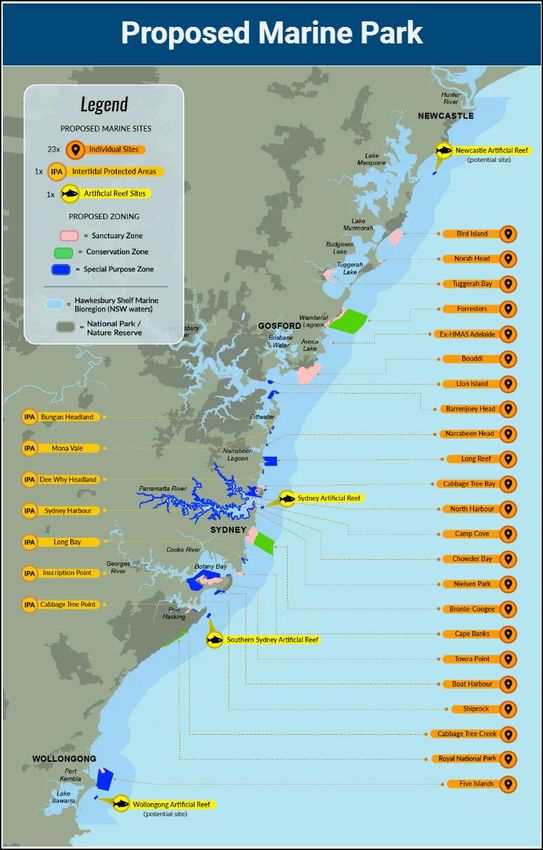
The suggested dive wreck site at Coogee borders the NSW Government’s Marine
Estate Management Strategy 2018 (Appendix 9) which proposes 25 distinct
sanctuary /conservation zones (Government 2018b). Further, it meets the objectives
set by MEMS as follows:
The primary objectives in the MEMS for proposed Bronte-Coogee site are fully met
by the dive wreck proposal:
(https://www.marine.nsw.gov.au/__data/assets/pdf_file/0019/821323/Hawkesbury-
site-Bronte-Coogee.pdf)
• enhance the conservation of marine biodiversity
• promote marine ecotourism in the bioregion
12 | P a g eSYDNEY DIVE WRECK BUSINESS CASE FROM THE GBSDC INC.
• continue to provide for marine economic opportunities that are consistent with
ecologically sustainable development, for example, low-risk commercial
fishing activities
• establish and maintain public infrastructure to support access and use of the
bioregion, for example moorings, boat ramps
• enhance the intrinsic benefits derived by the community from the marine
estate
• enhance bequest values for current and future generations
• reduce conflicts between users of the marine estate
• provide enhanced recreational experiences for particular user groups
• provide baseline monitoring areas (scientific reference sites)
• ensure appropriate mechanisms exist for community involvement in the
management of the marine estate
• promote stewardship of the marine estate.
Unfortunately, MEMA did not examine the Sydney Dive Wreck Proposal, listing it
only in the appendix as a submission received, in spite of the request by Minister Niall
Blair in a meeting on 16th November 2016 at the NSW Parliament for MEMA to
consider the proposal.
Tourism
1. Such a proposal supports the NSW Government’s focus on sports and recreational
facilities as well as directly supporting broader economic growth and an increased
focus on driving growth in tourist numbers and spend.
https://www.budget.nsw.gov.au/sites/default/files/budget-2018-
06/NSW%20Budget%202018-19%20-%20Budget%20Overview-1.pdf
2. The 2018-2019 State Budget made it clear that these three areas remain a focus.
3. Sports and Recreation
3.1. One of the key areas of the 2018-2019 State Budget is a focus on “Sports, arts
and culture for all.” The investment of $937.7M in sporting facilities in Sydney
and the $25M Regional Sports Infrastructure Fund demonstrate that the NSW
Government is building facilities that will be used by the broad community for
many years to come.
3.2. A dive wreck will have a useful life of at least 100 years, Unlike the major
investment the Government is choosing to make in establishing world class
sporting facilities in NSW, this facility would require minimal investment after
the initial purchase, preparation, EIS and sinking of a ship.
4. Business Activity
13 | P a g eSYDNEY DIVE WRECK BUSINESS CASE FROM THE GBSDC INC.
4.1. The 2018-2019 State Budget the Treasurer noted, “The Government is investing
in initiatives that will attract, support and encourage business activity across New
South Wales.”
4.2. Most of the positive impact in scuttling an ex-Navy ship in Sydney waters will be
for a wide range of small businesses. This is a section of the business community
that the NSW Government continues to support through the NSW Small Business
Strategy. The Government budget in 2017-2018 continues to support with
increased thresholds for small business.
http://www.industry.nsw.gov.au/__data/assets/pdf_file/0003/107643/nsw-small-
business-strategy.pdf
4.3. An ex-Navy dive wreck in Sydney waters will increase revenues for dive shops,
through increased boat traffic, dive courses, notably wreck and deep courses and
SCUBA associated equipment. In addition, several businesses in the locale of the
wreck such as cafes, restaurants, service stations, car hire, hotels and ships
chandleries will benefit.
5. Tourism
5.1. In addition to the significant investment that the NSW Government made in
sporting facilities in the 2018-2019 Budget, the Government also took the
opportunity to invest $173M for Destination NSW to support the delivery of the
Visitor Economy Industry Action Plan. https://www.industry.nsw.gov.au/invest-
in-nsw/industry-opportunities/tourism/industry-action-plan-tourism
5.2. As the Minister for Tourism, Major Events, Hospitality and Racing noted in his
2012 foreword in the NSW Government’s response to the final report of the
Visitor Economy Taskforce, “…the NSW visitor economy is worth more than
agriculture, forestry and fishing and just below mining.”
https://www.industry.nsw.gov.au/__data/assets/pdf_file/0007/53683/121218_VE-
IAP-Full-version_FINALv2.pdf
5.3. The sinking of an ex-Navy ship in Sydney Waters will attract both interstate and
international tourists and the ability to dive two ex-Navy Ships, the other being
ex-HMAS Adelaide off Avoca Beach NSW, will be more attractive than just
diving the ex-HMAS-Adelaide which is considerably less accessible.
Alignment with the NSW Department of Industry’s Goals
6. The sinking of an ex-Navy ship supports the following Department Goals:
6.1. Sustaining the conditions for economic development
6.2. Support to increase jobs and investment in NSW
6.3. Foster a vibrant and valued sport and active recreation sector
https://www.industry.nsw.gov.au/about/our-business/our-priorities
7. In turn this directly aligns to the “What we do” components of the 2015-2019
Corporate Plan in the following areas:
14 | P a g eSYDNEY DIVE WRECK BUSINESS CASE FROM THE GBSDC INC.
7.1. Promoting a vibrant and valued sport and active recreation sector that enhances
the lives of the people of NSW
7.2. Growing the visitor economy of NSW by promoting our attractiveness as a major
tourism centre and destination for events
7.3. Supporting small businesses in NSW to start and grow.
8. We would offer that apart from the economic, recreational and environmental benefits
that this project has it also provides the opportunity to meet one of the department’s
key attributes, namely an opportunity to “Think and act creatively to lead the way”.
https://www.industry.nsw.gov.au/__data/assets/pdf_file/0011/108884/NSW-
Department-of-Industry-Cluster-Corporate-Plan-2015-2019.pdf
2.4 Expected Outcomes
There are several discrete groups of beneficiaries from the outcomes of sinking of an
ex-Navy ship as a dive wreck in recreational diving depths in Sydney.
The key beneficiaries are -
- The NSW State Government
- The Department of Industry
- Destination NSW and Sydney.com
- The local councils of Bayside, Randwick, Woollahra and Waverley
- The Professional Dive Associations
- Small Businesses in Bayside, Randwick Woollahra and Waverley
- Sydney based Scuba Diving Operators
- The Community of Recreational Scuba Divers
- Dive Tourists: Local Interstate and International.
In what way will these stakeholders benefit from sinking an ex-Navy ship in Sydney
Waters?
2.4.1 The NSW Government
The NSW Government has summarised its approach as ‘Building for tomorrow and
delivering today’. The sinking of an ex-Navy ship in Sydney waters for the purposes
of recreational diving does just that. It delivers a facility in the short term that the
active diving community of NSW, that current estimates put at an estimate of between
8000-16,000 divers, will continue to benefit from for the next 100 years (Appendix 1).
Summary of Tangible benefits
Increased Revenues of from $2.5M-$9.7M over 5 years.
Support of the Government’s stated policies regarding:
15 | P a g eSYDNEY DIVE WRECK BUSINESS CASE FROM THE GBSDC INC.
Keeping our Environment Clean
(Divers are extremely environmentally aware and advocates for the marine
environment)
Tourism (Attracting interstate and international visitors to Sydney)
The provision of Recreational Facilities
(In alignment with current NSW Government commitments however with a
much longer period of positive return for minimal ongoing operational costs)
The promotion of a Healthy Lifestyle,
(Scuba Diving requires good levels of health and fitness to participate)
Support for Small Business.
(The dive operators of Sydney and the local businesses in the proximity of the
wreck are the main financial beneficiaries)
2.4.2 The Department of Industry
Sinking an ex-Navy ship in Sydney waters directly meets components of the
Department’s goals namely:
Sustaining the conditions for economic development
Support to increase jobs and investment in NSW
Foster a vibrant and valued sport and active recreation sector
2.4.3 Destination NSW
Destination NSW’s role is to market Sydney and NSW as one of the world’s premier
tourism-“destinations; to develop and deliver initiatives that will drive visitor growth
throughout the State; and to achieve the NSW Government’s goal of doubling
expenditure within the State’s visitor economy by 2020”.
The sinking of an ex-Navy ship provides a destination experience that would be a
feature on Sydney.com (under the auspices of Destination NSW) and directly supports
all of the projected outcomes.
2.4.4 The local councils of Bayside, Randwick Woollahra and Waverley
These four councils are likely to receive the largest financial benefit given their
proximity to the proposed dive site. Studies have shown (Appendix 1) that in addition
to the actual revenues directly associated with the act of diving on such a wreck that
there is an additional spend of between $5.4M-$31.3M over 5 years.
2.4.5 The Professional Dive Associations
There are several Professional Dive Associations however, those who will benefit
most, based on their presence in NSW, are:
- PADI (Professional Association of Dive Instructors),
16 | P a g eSYDNEY DIVE WRECK BUSINESS CASE FROM THE GBSDC INC.
- SSI (Scuba Schools International),
- RAID (Rebreather Association of International Divers)
- TDI (Technical Diving International) and
- SDI (Scuba Diving International).
PADI trains approximately 75% of all Open Water Scuba certifications in NSW and
will be the main beneficiary.
It is possible that the sinking of an ex-Navy ship in close proximity to Sydney will, of
itself, create interest in diving such that the number of Open Water certifications
increase. However what is more certain is that the specialities for both PADI Deep
Diver or equivalent (certification to a depth of 40 metres) and Wreck Diver will
increase markedly.
2.4.6 Small Businesses in Bayside, Randwick Waverley and Woollahra
Studies have shown that direct dive spend is from 13- 26% and, perhaps more
importantly, the non-dive spend is from 74-87% of a divers total expenditure
(Pendleton 2004, Escobedo 2007). The local businesses will benefit directly from this,
especially as other studies have shown that visitors always bring more to the economy
than locals (Bell et al. 1998, Johns et al. 2001, County 2004, Adams et al. 2006, Oh et
al. 2008, Tapsuwan & Asafu-Adjaye 2008, Wheaton et al. 2008, Leeworthy 2011a,
Huth et al. 2015). Marsden Jacobs Associates reports that in nature based travels day-
trip expenditures largely comprise shopping (28%), petrol (25%), food and beverages
(12%) and takeaway or restaurant meals (20%). For overnight visits, the major
expenditure items are accommodation (25%), domestic airfares (15%),
takeaway/restaurant meals (15%), petrol (10%), food and beverages (12%) and
shopping (8%) (Jacob 2017).
2.4.7 Sydney Based Scuba Dive Operators
The 21 Dive Operators (Appendix 3) within easy access of the proposed location
certify in the region of 4,000-5,000 new divers per year. This means that in the last
five years between 20,000 and 25,000 new divers have been certified. The business
case embedded in this document only user a number of divers from 8000-16000
active scuba divers (Appendix 1).
In addition to the original certification between 20% and 30% of those divers progress
to a higher level of certification or speciality, that provides them the education to dive
deeper safely. There is a measurable drop off in diving activity post initial
certification and this is reflected in the business plan.
By sinking an ex-Navy ship in Sydney, we estimate, based on activity associated with
the sinking of other dive wrecks that dive certifications will increase by 10-15%. The
increased additional certification levels that provide divers the education to dive
safely at increasing depths of 30-35% and through the attraction of ‘lapsed divers’ to
restart diving an increase in active divers of 5%.
17 | P a g eSYDNEY DIVE WRECK BUSINESS CASE FROM THE GBSDC INC.
2.4.8 The Community of Recreational Scuba Divers
Providing world-class facilities for recreational divers provides a compelling
proposition to remain in the sport, increase fitness, health and wellbeing and creates a
powerful group of environmental advocates. The sinking of an ex-Navy ship in
Sydney waters will put Sydney on the diving map in a new and compelling way.
2.4.9 Dive Tourists (Interstate and International)
Scuba Diving was ‘one of the world’s fastest growing recreational sports (Musa &
Dimmock 2013). PADI, one of the world’s leading certification agencies, certifies
more than 1 million divers per year and has certified in excess of 25 million divers
during its lifetime. Both of those numbers continue to grow and an attraction, such as
an easily accessible ex-Navy dive wreck in Sydney creates the opportunity to attract
some of that growing pool of scuba divers
Diving by its very nature is an equipment intensive sport that benefits from a
continuing investment in ongoing education, equipment and the servicing of that
equipment. Divers are willing to save and spend significant sums on their diving
experience (Binney 2009).
Summary
The sinking of an ex-Navy ship in Sydney waters has a wide range of beneficiaries,
not just the scuba divers that will dive the wreck.
We believe that by the NSW Government taking a leading role in the project to sink
an ex-Navy vessel in Sydney Waters will create a lasting legacy. This role will
contribute to the State’s bottom line, fulfil a number of the Governments policy
positions and, just as importantly, not cede ground to the Queensland Dive Industry,
which, with the support of the Queensland Government, has recently sunk its second
ex-Navy ship the ex-HMAS Tobruk.
18 | P a g eSYDNEY DIVE WRECK BUSINESS CASE FROM THE GBSDC INC.
2.5 Stakeholder and Community Support
The Sydney Dive Wreck team has consulted widely with stakeholders and with the
broader Sydney community regarding this proposal over the last 7 years. Over 40
letters are on file and are available by requesting a copy from John Rowe at
jcprowe@bigpond.net.au.
A summary is listed at appendix 3 with letter reference. Table2.5.1 outlines the key
stakeholder groups, the engagements with the Sydney Dive Wreck team, any issues,
and concerns raised by these groups and how this proposal has addressed these
concerns.
Table 2.5.1
Stakeholder SDW Concerns raised How addressed
Group Engagement
Commonwealth Meetings with None – very
Government Defence Minister supportive
(Defence) (2013/2017)
NSW Meeting with Niall 4 areas of concern All concerns
Government Blair and raised: addressed in response
- Primary department. Financial to department on
Industry November 2016 Environmental December
Health & Safety 2016.Submission
Community made to MEMA
Engagement .Excluded from the
strategy
NSW Meeting requested Previous ministers
Government 2017. supportive
- Tourism
NSW Meeting with Minister supportive
Government Minister scheduled
- Environment August 2018
Randwick Various meetings No concerns
Council with Individual raised
Councilors
Randwick Continuous Very supportive –
Tourism Involvement Member of
Sydney Dive
Wreck Committee
Local Precinct Presentations or No concerns No response from
Committees invitations to raised Malabar, Clovelly
Coogee Malabar, and Maroubra
Maroubra Clovelly
and Bronte Beach
Sydney Coastal Various meetings No concerns
Councils through 2016 & raised
2017
19 | P a g eSYDNEY DIVE WRECK BUSINESS CASE FROM THE GBSDC INC.
NPA Marine Various meetings No concerns
through 2016 & raised
2017
Recreational Various meetings No concerns Check shipping
Fishers Alliance through 2016 & raised channels
2017
Professional Various meetings No concerns
Fisherman’s through 2016 & raised
Associations 2017
Coogee Chamber Various meetings No concerns very supportive
of Commerce through 2016 & raised – member of Sydney
2017 Dive Wreck
organizing
Committee
Marine Research Various meetings No concerns
Organizations through 2016 & raised. Scientific
2017 advisors
appointed to
review plans.
Numerous letters
of support from
Marine Scientists.
Nature Correspondence No concerns
Conservation and discussions raised
Council 2016
Surf Live Saving Presentations to No concerns
South Maroubra, raised
No response from
Clovelly and
Coogee clubs
Dive Industry of Continuous Very supportive –
Australia Involvement Member of
Sydney Dive
Wreck Committee
Royal Australian Informal Very supportive –
Navy engagement with letters of support
numerous ex-Navy provided
staff
Sydney local Significant Overall very
community Engagement ( see supportive
details below)
2.5.2 The Sydney Dive Wreck team has been very actively engaged in making the
local community in Sydney’s East, and in particular within Coogee, aware of the
plans outlined in this proposal. The support has been very overwhelmingly positive.
The following is evidence for this:
Over 10,700 signatures on a paper petition to the NSW Legislative Assembly
20 | P a g eSYDNEY DIVE WRECK BUSINESS CASE FROM THE GBSDC INC.
Over 3,500 signatures on an online petition to the NSW Government
Over 1,500 ‘likes’ on Sydney Dive Wreck Facebook page
2.5.3 The Sydney Dive Wreck team has informed the community about Sydney Dive
Wreck plans at a wide range of community events and activities over the last 3 years
as follows:
Stalls at major local community fairs and festivals:
Randwick Eco Fair (2016, 2017)
Randwick Spot Festival (2016, 2017)
Coogee Family Fun Day (2016, 2017)
Bondi Winter Magic Festival (2017, 2018)
Stands at popular local community areas
Bondi Junction Station (2017)
Bondi to Coogee Walk (10 events through 2016, 2017, 2018)
Media Activities. (Audience figures in brackets see
www.gordonsbayscubadivingclub.com for full video)
Channel 9 Sydney News Saturday (260,000)
Channel 9 Sydney News Sunday (400,000)
2 x Daily Telegraph articles (1,998,000)
2 x Radio 2UW interviews Greater Sydney (300,000)
3 x ABC Radio 2BL interview (audience tbc)
2 x Weekly Southern Courier (130,000)
2 x Wentworth Courier (audience tbc)
2 x The Beast Magazine (122,000)
1 x Bruce Notley-Smith’s Community Newsletter (40,000)
Numerous letters of support from marine scientists, members of the dive
community, government, and political representatives (Appendix 8).
One member of the Darwin ships company has offered to take our petition to
the ship’s decommissioning ceremony.
Further, a land based memorial to the men and women who served in all RAN
ships would fit well into the Coogee coastline (John Byrne pers. com. 2017).
21 | P a g eSYDNEY DIVE WRECK BUSINESS CASE FROM THE GBSDC INC.
Analysis of the Proposal
3.1 Objectives & Indicators
S
Please outline what the proposal is seeking to achieve and how each desired outcome
will be measured
Table 3.1.1: Proposal objectives
Key Key proposal Key success
problem/opportunity objective indicator
Get a
No dive wreck for NSW Government
decommissioned
Sydney agrees to fund
Navy ship
Gazette a site under
No wreck site Crown Lands Act Site gazetted EIS
approved 1989 Complete an completed
EIS
Preparation in
Ship ready for
Prepare the ship accordance with the
sinking
London Protocol
At site in
Ship successfully
Sink the ship accordance with sec
sunk
4.2
3.2 The Base Case
3.2 Please summarise what is the ‘base case’ to be used to assess the merits of the
preferred solution? The base case is the ‘state of the world’ without the proposal, the
case with no change and business as usual.
• No Sydney Dive wreck that is world class challenging exciting and sustainable
dive experience for divers with varying interests and levels of experience.
• A safe dive wreck for Sydney
• Access for non-divers and divers to the Sydney dive wreck for commercial
operators, non-commercial interests, educational establishments, researchers,
public both on and off site.
• To create an artificial reef that is linked to a natural reef that provides habitat
and protection for a range of species naturally occurring within the dive site.
• To respect the history and heritage of the Royal Australian navy ships and all
who sail in them and by erecting a land based monument to all who served.
• To enhance tourism and increase the revenue and employment opportunities
for the citizens of NSW
• To be nationally and internationally recognised as a demonstration and
education site for the productive and sustainable use of an ex-Navy ship as a
22 | P a g eSYDNEY DIVE WRECK BUSINESS CASE FROM THE GBSDC INC.
dive site and artificial reef with a fishing closure which will contribute to
marine environmental awareness
• There would be no dive wreck without the proposal hence there is no case for
“no change “ or “business as usual”
3.3 The Preferred Solution
3.3.1 Please summarise how the preferred solution was selected.
• See section 2.2 rationale for investment
3.3.2 What alternative options were considered that would also solve the
abovementioned problems?
• Allocation an ex-Navy ship to another state meaning a complete loss of the
amenity
3.3.3 Alternative options that proponents may need to consider include:
A do-nothing option
• With considerable public support (10,700+ signatures on a formal NSW
Parliamentary Petition ), “do nothing” remains an option however is less
attractive due to the level of public support for the dive wreck
A do-minimum option
• Allocate funds for an EIS
A do-later option
• This is a possible scenario given the status of ex HMAS Darwin.
23 | P a g eSYDNEY DIVE WRECK BUSINESS CASE FROM THE GBSDC INC.
3.4 Information about the proposal
The NSW government has previously delivered a project very similar to this project,
that being the preparation, scuttling and ongoing management of the ex-HMAS
Adelaide near Avoca Beach on the Central Coast NSW.
We would recommend that the scope of works that was used on the management of
that project during delivery and operations be replicated on the Sydney Dive Wreck
project, with the following modifications:
• Adjustments to the works model that may have been recommended from any
project reviews conducted on the ex-HMAS Adelaide project.
• Adjustments to the scope of works model to include an interface to the Sydney
Dive Wreck Organizing Committee who will be available to act as
advisors/consultants to specifics relating to the Sydney region.
• Inclusion of the NSW MP for Coogee on the Steering Committee
• Consideration given to the installation of web cameras on the Sydney Dive
Wreck , and the creation of a marine display in the Coogee locality.
• Consideration given to the creation of a land based memorial in Coogee for
those who have served on RAN ships.
(Refer to Appendix 6 – which outlines some of the scope of works detailed for the ex-
HMAS Adelaide)
Proposal Exclusions
There are no specific exclusions in this proposal.
Related Projects
As outlined above , the project to scuttle the ex HMAS Adelaide as a dive wreck by
the NSW Government off Avoca Beach in 2011 is a very similar project.
3.5 Projected Costs
The NSW government has previously delivered a project very similar to this project,
that being the preparation, scuttling and ongoing management of the ex-HMAS
Adelaide off Avoca Beach NSW.
We would recommend that the capital costs incurred on the management of that
project during delivery and operations be replicated on the Sydney Dive Wreck
project, with the following modifications:
• Adjustments to the capital costs that may have been recommended from any
project reviews conducted on the ex-HMAS Adelaide project.
• Adjustments to the capital costs to include an interface to the Sydney Dive
Wreck Organizing Committee who will be available to act as
advisors/consultants to specifics relating to the Sydney region.
• Inclusion of the NSW MP for Coogee on the Steering Committee
• Quotations have been requested from potential firms.
24 | P a g eSYDNEY DIVE WRECK BUSINESS CASE FROM THE GBSDC INC.
The NSW government has previously delivered a project very similar to this project, that
being the preparation, scuttling and ongoing management of the ex-HMAS Adelaide off
Avoca Beach NSW.
We would recommend that the ongoing costs incurred on the management of that project
post sinking be replicated on the Sydney Dive Wreck project, with the following
modifications:
• Adjustments to the ongoing costs that may have been recommended from any
project reviews conducted on the ex-HMAS Adelaide project.
• Adjustments to the ongoing costs to include an interface to the Sydney Dive
Wreck Organizing Committee who will be available to act as advisors/consultants
to specifics relating to the Sydney region.
• Annual maintenance costs for buoys and signage at the dive site are not expected
to be significant perhaps in the vicinity of $1500.00 per annum
(MauraBedlocCommunications 2016).
• It is expected that revenue collected from dive permits will easily cover on going
maintenance costs.
3.6 Cost Benefit Analysis
This proposal forecasts revenue over five years of $12.4M (low) and $48.6M (high) at
a one off cost of $6M-$10M-a cost benefit ratio of between 2.1 and 4.8 (Appendix 1).
3.7 Financial Appraisal
The NSW government has previously delivered a project very similar to this project,
that being the preparation, scuttling and ongoing management of the ex-HMAS
Adelaide off Avoca Beach NSW.
We would recommend that the financial appraisal, which is used on that project
during delivery and operations, be replicated on the Sydney Dive Wreck project, with
the following three modifications:
• Adjustments to the financial appraisal that may have been recommended from
any project reviews conducted on the ex-HMAS Adelaide project.
• Adjustments to the financial appraisal to include an interface to the Sydney
Dive Wreck Organizing Committee who will be available to act as
advisors/consultants to specifics relating to the Sydney region.
• Inclusion of the NSW MP for Coogee on the Steering Committee
. This proposal overcomes the costly exercise of disposing of an obsolete navy
ship. Other options for the disposal of decommissioned navy ships could include
target practice for the Defence Forces, scrapping for metal, maritime museum pieces
and back packer accommodation (Defence 2013). The value achieved by these one
off options does not compare with the lifelong revenue for a ship sunk as a dive
wreck.
25 | P a g eSYDNEY DIVE WRECK BUSINESS CASE FROM THE GBSDC INC.
3.8 Proposed Funding Arrangements
Please outline how the proposal’s capital costs are to be funded.
Applicants will be expected to be able to provision for the funding of
ongoing costs, unless the funding program has specific provisions to fund
these costs.
Provide a breakdown by financial year if these costs will span multiple
financial years.
Ensure that total funding covers total capital costs outlined in Section 0.
m
R
T
2
0
1
7
1
8
2
0
21
08
091
90
02
2-0
e12
-1
oa2
ti2
an
n
-
21-
22-
li
Table 3.8: Proposed capital funding contributions ($000s)
Stage
Proposal capital costs $10M
Funding sources
NSW Government
$10M
(subject of this request)
Council contributions $0
Industry contributions $0
Community 1000
contributions hours
Other government
$0
contributions
Other funding sources
$0
(please detail)
Sub-total $10M
3.9 Financial Health & Support
There is no financial support from non-government parties. The project is based
entirely on funding from the NSW Government.
4. IMPLEMENTATION CASE
4.1 Program & Milestones
The NSW government has previously delivered a project very similar to this project,
that being the preparation, scuttling and ongoing management of the ex-HMAS
Adelaide at Avoca Brach NSW.
We would recommend that the program & milestones that were used on the
management of that project during delivery and operations be replicated on the
Sydney Dive Wreck project, with the following three modifications:
• Adjustments to the program & milestones that may have been recommended
from any project reviews conducted on the ex-HMAS Adelaide project.
26 | P a g eSYDNEY DIVE WRECK BUSINESS CASE FROM THE GBSDC INC.
4.2 Governance
The NSW government has previously delivered a project very similar to this project,
that being the preparation, scuttling and ongoing management of the ex-HMAS
Adelaide off Avoca Beach NSW.
We would recommend that the governance plan incurred on the management of that
project during delivery and operations be replicated on the Sydney Dive Wreck
project, with the following three modifications:
•
Adjustments to the governance that may have been recommended from any
project reviews conducted on the ex-HMAS Adelaide project.
• Adjustments to the governance to include an interface to the Sydney Dive
Wreck Organizing Committee who will be available to act as
advisors/consultants to specifics relating to the Sydney region. Inclusion of the
NSW MP for Coogee on the Steering Committee.
Some specifics points relating to the key personnel and organizational responsibilities,
which we expect would be included in the governance model, would be:
Key sponsor decision maker: Minister for Crown Lands
Steering Committee Chair: Minister for Crown Lands
Steering Committee Members:
Departmental Head of NSW Crown Lands
Representative from the NSW Department of the Environment
Representative from the NSW Department of Tourism
Project Manager (appointed by Department of Crown Lands)
Project Management Office representative
MP for Coogee
Representative(s) from Sydney Dive Wreck Organizing Committee
Representative from National Parks NSW
Representative from key subcontractor responsible for scuttling preparation (by
invitation)
We would be happy to provide additional details on any of these areas if required,
however as has been previously stated the NSW government has already delivered a
very similar project so we would expect the governance model to be well established
and understood.
27 | P a g eSYDNEY DIVE WRECK BUSINESS CASE FROM THE GBSDC INC.
4.3 Key risks
The NSW government has previously delivered a project very similar to this proposal,
that being the preparation, scuttling and ongoing management of the ex-HMAS
Adelaide off Avoca Beach NSW.
We would recommend that any key risks that were identified on the management of
that project during delivery and operations be replicated on the Sydney Dive Wreck
project, with the following three modifications:
• Adjustments to any key risks that may have been recommended from any
project reviews conducted on the ex-HMAS Adelaide project.
• Adjustments to any key risks to include an interface to the Sydney Dive
Wreck Organizing Committee who will be available to act as
advisors/consultants to specifics relating to the Sydney region.
• Inclusion of the NSW MP for Coogee on the Steering Committee
• Further the NSW Government commissioned Nation Partners (Wedgwood &
Speechley 2016) to carry out a risk assessment of the ex HMAS Sydney and
Tobruk as dive wrecks. It is not clear if this document can be made public but
it has been provided to the GBSDC by Crown Lands with the legal risks
blacked out. The key risks were responded to in a meeting at Parliament
House on 16th November 2016 with the Minister for Primary Industry Niall
Blair arranged by the Member for Coogee Mr Bruce Notley-Smith. Those
issues raised, by the DPI (italics) and the GBSDC answers provided follow:
4.3.1: Service delivery – no detailed planning has been undertaken and significant
uncertainty exists across the project lifecycle. Based on the experience with the Ex-
HMAS Adelaide and other dive wrecks, the market for this technically demanding
sport is small and largely confined to Sydney.
The minimum qualification for diving on the Adelaide is Advanced Open
Water. In PADI diver education terms for technical diving to occur one of
the following must occur.
Diving beyond 40 meters deep.
Required stage decompression.
Diving in an overhead environment beyond 40 linear meters
Accelerated decompression and or the use of variable gas mixtures during the
dive.
None of the above conditions applies to our proposal and accordingly it is not
correct to say that diving the Sydney as proposed is “technically demanding”.
In fact the dive wreck is targeted at the recreational dive and snorkel market
of which there were over 982000 participants in 2015 (Appendix 6)
International and interstate dive tourism has been negligible on the Central Coast.
28 | P a g eSYDNEY DIVE WRECK BUSINESS CASE FROM THE GBSDC INC.
The market for diving on ex-Navy ships is significant. Worldwide there have been
130 ships sunk as dive wrecks. We see a significant difference between attracting
interstate and international divers to a location such as Avoca Beach for the ex-
HMAS Adelaide, and a Sydney Dive Wreck. The Sydney tourist market is 24 times as
large as the Central Coast market. Sydney is a major tourist hub, with a wide range of
existing attractions (p7) and over 31.5m overnight visitors in 2015 (p15) . Of these
2.9m were international. This compares to only 1.3 m overnighters to the Central
Coast for the same period with just 41000 of those being international. Growth
figures from Destination NSW (DNSW) confirm the difference where Sydney is
recording over 9% annual growth in visitor expenditure. DNSW has also identified a
significant China market where one in ten went scuba diving during their trip to
Australia. 536,000 visited NSW in 2015 (UTS: ACIR).
4.3.2: Health and safety – the depth of the water at Coogee may pose
increased risk to the safety of divers at the proposed wreck site.
The site selection and business case prepared by the proponent of the Coogee
proposal is not adequate to substantiate the proposal for a project with an
order of cost of some $10M to Treasury.
Please advise what other information is required to meet the requirements of
the business case, and where there are any inadequacies. We have prepared
this business case based on a range of information - both from a top down
level from data extrapolating from data from research studies based on
typical revenue generated from creating dive wrecks worldwide, and from a
bottom up basis from local Sydney dive industry statistics.
If you have a preferred business case format please supply this so we can
prepare the business case as required.
We would also appreciate detailed information on how you arrived at the
estimate of $10M. In our proposal, we quote a cost range of $6M to $10M,
the latter figure being provided by the Minister for Defence in 2013. In our
research for the former figure, we have been quoted $4.5M for ship
preparation, $1M for reef connectivity for fish using smaller reefs and
underwater sculpture with Wedding Cake Island and an estimate of $0.5M to
meet the legal and regulatory requirements.
The approximate cost of converting the ship to scrap is around $2M (Trent
Raines Birdon) with no possibility of earning any revenue. For an additional
expenditure of $4M, the state has a dive wreck that well may last over 100
years. The question ignores the environmental, research and recreational
values outlined in our proposal (p5) and ignores our suggestion that on site
cameras relay images of the wreck to non-diving community members,
schools and educational institutes. The proposed development (p10) of an
artificial reef between Wedding Cake and the dive wreck will further
enhance the diving opportunities. More importantly, as it will be outside the
fishing closure of the dive wreck, it will provide recreational fishing
29 | P a g eYou can also read


