Carnegie Rulebook - Quined Games
←
→
Page content transcription
If your browser does not render page correctly, please read the page content below
Carnegie Rulebook
PART 1: INTRODUCING CARNEGIE
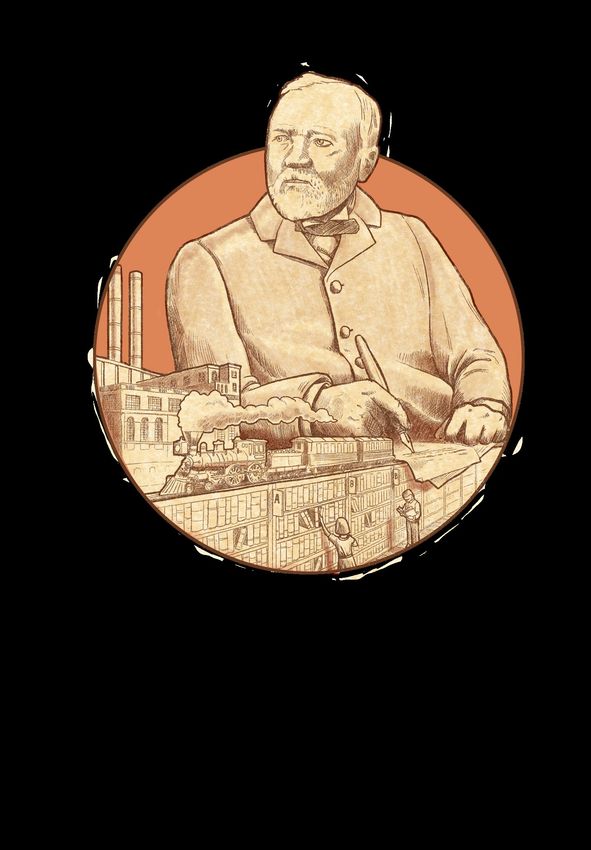
                                                                                This game is inspired by the life of Andrew Carnegie, who was born in
                                                                                Scotland in 1835 and emigrated to the United States with his parents
                                                                                in 1848. Although Carnegie started his career as a telegraph operator,
                                                                                his role as a major player in the rise of the United States’ steel industry
                                                                                made him one of the richest men in the world and an icon of the
                                                                                American dream.

                                                                                Carnegie was also a benefactor and philanthropist. Upon his death in
                                                                                1919, more than $350 million of his wealth was bequeathed to various
                                                                                foundations, with another $30 million going to various charities. His
                                                                                endowments created nearly 2,500 free public libraries that bear his
                                                                                name to this day: the Carnegie libraries.

                                                                                In Carnegie, players will recruit employees and expand their businesses
                                                                                by investing in real estate, producing goods, developing transport
                                                                                technology, and creating transport chains across the United States.
                                                                                Perhaps they will even become illustrious benefactors who contribute to
                                                                                the country’s greatness through their deeds and generosity!

                                                                                The game takes place over 20 rounds, with players each having one
                                                                                turn per round. In each round the active player will choose one of four
                                                                                actions, which the other players will follow.
         “Success is the power with which to acquire whatever one
                                                                                The success of a player’s Company is represented by their victory points
          demands of life without violating the rights of others.”
                                                                                (VP), and the player with the most VP at the end of the game will be
                                                  – Andrew Carnegie
                                                                                declared the winner, known forevermore for their philanthropic works.

1. How to Read these Rules
These rules are organized into four parts:                                         “As a game designer, I admire players who take the time to read
                                                                                   rules and explain them to others. It’s no secret that Carnegie is a
Part 1: Introducing Carnegie                                                       complex game. As encouragement, please remember that Carnegie
This section presents a list of game components, describes the game’s              himself was a great reader, and that he built his fortune by learning
setup, and provides a short overview of how Companies work.                        a lot from books.” – Xavier Georges

Part 2: Playing the Game
This section provides a full overview of the rules, detailing the steps of rounds, main actions, and final scoring.

Part 3: Transportation Tracks, Donations Chart, & Departments Board
This section provides in-depth explanations of these elements of the game.

Part 4:	Solo Game
This section presents rules for playing alone against a virtual opponent.

While reading these rules, remember:
Important and/or easily-forgotten points are highlighted like this.                Tips and game advice are written like this.

   Examples and captions are written like this.
                                                                                   Quotes and Thematic information are written like this.

                                                                            2
2. Game Components
This Rulebook, plus:

                                                                                                         16 Project tabs (4 per player)

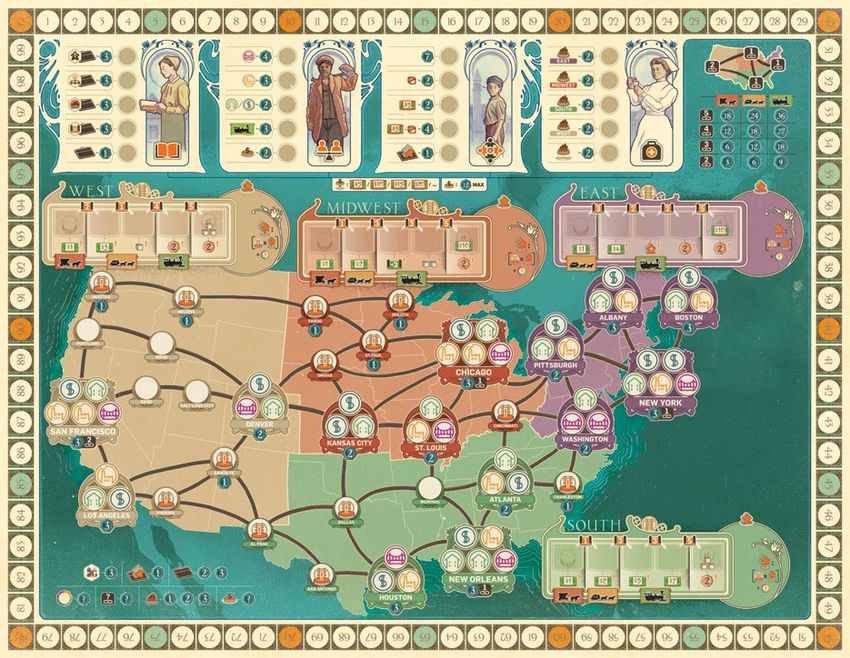
                                         1 Game board

                                                  4 Action markers (apply stickers before use)                4 Company boards

               8 Timeline tiles
                                                                                                     60 Employee figurines (15 per player)

                                                            4 Action Choice tiles

                                                                                                        120 Player disks (30 per player)

                                                                                                   40 Goods cubes

             1 Start and 1 End tile                              4 Player aids
         (to frame the Timeline tiles)                                                            1 Timeline marker           90 Banknotes
                                                                                                                             (40x$1, 30x$5,
                                                                                                                                20x$10)

                                                                                                 1 First-player marker

                                                                                                 Note: Although unlikely, certain
                                                                                                 components may run out during the game.
                                                                                                 If necessary, players may use appropriate
            32 Department tiles                                  25 Solo cards                   substitutes for money and goods cubes.
    (2 each of 16 different Departments)          (20 action cards and 5 victory point cards)    All other components are limited.

                                                                      3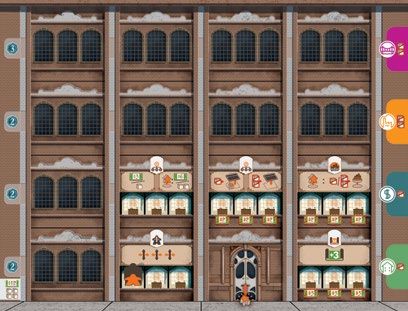
D1
3.		Game Setup
Two-player game setup shown.

 1   	Place the main game board in the center
      of the table.                                                                                                            9
 2   	Shuffle the 8 Timeline tiles. Draw 4 of                                      5
      these at random and arrange them as
      shown. Note that these tiles are double-                C
      sided; select sides at random. Frame these
      tiles with the Start and End tiles, and
      return the 4 unused Timeline tiles to
      the box.                                                                                                 D2

 3   	Place the four action markers on their
      corresponding starting positions on the
      far left of the Timeline.

 4   	For a 4/3/2-player game, select 4/8/16
      Department tiles at random and
      return them to the game box. Place the
      remaining Department tiles face-up on
      the table, as shown.

 5   	Create a supply of goods cubes and                                                   2
      money tokens near the main game board.

 6   	Provide each player with:

      A    4 goods cubes and $12.

      B 	1 Company board and a set of
           4 different project tabs. Players                                                3
           should slide each tab under the
           right side of their individual game
           boards so that the colors and
           icons match. Leave each tab’s first
           (rightmost) spot exposed.

      C 	10 Employee figurines. Each player
           places 1 of their employees standing         6                 D4
           up on each of their Company’s                                                                                                          B
           5 Departments, with another 5
           employees lying down in their
           Company’s Lobby (these may                        7
           be moved during step 11).
           Set the remaining 5 employees
           aside; they will not be available                                                                                                          D3
           at the beginning of the game.

      D 	30 player disks. Each player
           must place:
                                                                      A
                                                                                                                      C
				 D1 1 disk on the “0” position
         of the score track.                                                                                         11
				 D2 1 disk on the first space
         of each of the 4 regional
         transportation tracks.
                                                    7 The most daring player is designated as
                                                   	                                               9 a 2-player game, set aside 18 disks
                                                                                                   	In
				 D3 1 disk on each of the 3                      the first player. That player receives the     from an unused player color and shuffle
         available locations on their                 first-player marker and the Timeline           the solo-game action cards. Draw one
         project tabs (Housing,                       marker.                                        of these cards and place a disk on the
         Commerce, Industry).                                                                        donation chart in the location indicated
         Public Infrastructure                      8 (Not pictured) In a 4-player game,
                                                   	                                                at the top of the card. Then, place a disk
         (magenta) tabs do not                        give each player an Action Choice tile.        on the leftmost unoccupied construction
         start the game with a disk.                  In a 3-player game, only the third             space of each of the 2-4 cities named on
                                                      player receives an Action Choice tile;         that card’s 4th row. Repeat this process
				 D4 Th
         e remaining 22 disks form                   there are no Action Choice tiles in a          until all 18 disks have been placed.
        the player’s personal supply.                 2-player game.

                                                                          4
5

                                              D2
D2

                                                                                                                             4

                                           D2

               1

     10                                                                                                                    10

                                                                                 C

          	Do the same when setting up a 3-player      11 Starting with the first player and going
                                                        	                                            	In this setup diagram, the yellow player’s
            game, but with 9 disks instead. For a          in clockwise order, each player may          Company board shows one possible
            4-player game, skip this step.                 move their employees up to a total of        arrangement of employees after these
                                                           6 steps on their own Company boards;         6 moves have been made.
          10 Beginning with the player sitting to
          	                                               each movement must be made to an
             the right of the first player and going       orthogonally (not diagonally) adjacent     12 Finally, once these movements are

             counter-clockwise, each player will then      space. After an employee moves, it must       completed, each player may activate
             place the disk from their Housing tab         be laid down. Employees may be moved          employees (see page 13).
             onto the game board, on a Housing             onto empty building spaces on the
             space in a medium or major city.              player board.

                                                                             5
4. Company Basics
To succeed, players must understand how Companies work.                                      4.2. Recruiting Employees
                                                                                             Employees can be either active (standing) or inactive (lying down).
4.1. Company Organization
Player companies are organized into Departments. Each Department                             When an employee first enters a Company board, it always does so in
corresponds to one of the game’s four types of actions, as follows:                          an inactive state (lying down). Whenever an inactive employee moves,
                                                                                             it remains inactive. If an active (standing) employee is moved, it
                                                                                             must be laid down.
                   Human Resources
                   Allows players to move employees to different areas within their          Each Department may hold one active employee for each Employee
                   Companies; employees may move to Departments and/or empty                 Workstation depicted on that Department’s tile, and any number
                   spaces.                                                                   of inactive employees. For an employee to be considered active it
                                                                                             must occupy a Workstation, and each Workstation can only hold one
                   Management
                                                                                             employee. Lobbies may contain any number of inactive employees.
                   Allows players to acquire goods and money, as well as build new
                   Departments. Each Company begins the game with two different              Employees may only be activated at the end of a round, after all other
                   Management Departments.                                                   actions have been taken.
                   Construction
                   Allows players to build projects developed by their                       Many Departments’ Workstations are marked with dollar values,
                   R&D Departments.                                                          representing the costs of that employee’s salary and training. To activate
                                                                                             an employee in a Department, a player must pay the cost indicated on
                                                                                             the Workstation and then place the employee on that Workstation in
                   Research & Development (“R&D”)                                            an active (standing) position. If no cost is indicated, the employee may
                   Allows players to design new projects and develop                         be activated for free. Active employees remain active until they move or
                   transport networks.                                                       go on a Mission.

                                                                                                EXAMPLE
At the start of the game, each Company has 1 Lobby and 5
                                                                                                It’s the end of Mary’s turn; she wants to activate a total of 4 employees
Departments. During the game, players will be able to expand their
                                                                                                (highlighted below), which will cost $6.
Companies by building new Departments. Each Department may
hold 1-3 active (standing) employees, as indicated by the number of
Workstations illustrated on that Department.

 A Department cannot be used unless it contains at least one active
employee. Each Department may be used once per round for each
active employee that it contains.

                        1
                                                              1   	Department type

                                                             2    	Department ability
  2
                                                             3    	Employee
                                                                    Workstations
                                                                    (this Department
                        3                                           may hold two
                                                                    active employees)

                                                             4    	Cost to activate            Unfortunately, Mary only has $4, meaning that she cannot activate 1
                                                                   the employee at              of her 3 employees with a $2 activation cost. If she has enough income at
               4                                                   this Workstation             the end of the next round, she can then pay $2 to activate that employee.

4.3. Sending an Employee on a Mission                                                        4.4. Recovering Employees from Missions
          This symbol indicates a Department that generates effects                          When employees return from their Missions, they generate income and
          when its employees are sent on Missions. To send an                                become available for new work assignments. Returned employees are
          employee on a Mission, move an active employee from its                            placed in their Companies’ Lobbies in an inactive state (lying down).
          Workstation in that Department to one of the four Mission                          To activate a returned employee, it must first be moved out of its Lobby
          areas on the game board; you must move the employee                                with the Human Resources action; it will be eligible for activation
          you used to take this action.                                                      at the end of the round. Employees will return from Missions as the
          Employees on Missions are not                                                      action markers advance along the Timeline; this will be explained in
          considered to be active.                                                           detail in the next chapter.

Note: Players cannot send employees on
                                                                                               Tip: It is vital for Companies to send their employees on
Missions if they are unable to meet the
                                                                                               Missions, but players must be careful to not send out too many
requirements of that action (for example,
                                                                                               employees as Companies that lack employees will underperform.
an inability to build due to a lack of
                                                                                               So, it is so essential to recover employees sent on Missions as
goods cubes).
                                                                                               quickly as possible.

                                                                                         6
PART 2: PLAYING THE GAME
   “It marks a big step in your development when you come to                     EXAMPLE
   realize that other people can help you do a better job than you               It’s Thomas’ turn. He has chosen the Human Resources action,
   could do alone.” – Andrew Carnegie                                            which has already reached the end of its Timeline.

The game takes place over 20 rounds. Each round consists of four parts,
which take place in the following order:

1. Select Timeline Row

2. Events

3. Use Departments

4. Activate Employees & End of Round

1. Select Timeline Row
The first player selects the Timeline row that they wish to use: Human
Resources, Management, Construction, or R&D, and then places the                 He must place the Timeline marker to the right of the Human Resources
Timeline marker (gear) immediately to the right of that action’s marker          action marker and then turn over the action marker in the next row
on that Timeline row; doing so will trigger events and determine which           below (in this case, the Management Timeline), which will trigger
Departments players will be able to use.                                         an event (see page 8). At the end of his turn, Thomas will turn the
                                                                                 Management action marker face-up and advance it once space along
   EXAMPLE                                                                       its Timeline.

                                                                                 Tip: To choose the best possible action, players should consider
                                                                                 several things: what is best for them, what will help their
                                                                                 opponents, and which event(s) they want to trigger or avoid.
                                                                                 Sometimes a less-powerful action can be the best move, as it
                                                                                 may help you but be totally useless to others. Sometimes,
                                                                                 the business world can be ruthless…

   Mary chooses the R&D Timeline row; she places the Timeline marker
   on the R&D Timeline, to the right of the R&D action marker.

A player may choose any Timeline row, even if that action’s marker
has reached the last space of its Timeline. In this case, the first player
must still place the Timeline marker to the right of the action marker.
Then, the first player must then also turn over the action marker
on the Timeline row immediately below the chosen row (or Human
Resources, if R&D was chosen).

The turned-over action marker must be able to move forward along its
row. If it cannot do so, instead turn over the action marker on the next
row below, moving downwards row-by-row if necessary.

Whenever an action marker is turned face-down, it will trigger the
event marked to its right (next space). At the end of the round, turn the
marker face-up once again and advance it one space along its row.

                                                                             7
Tip: When selecting Timeline rows, players should consider
2. Events how many employees are in each Mission area, as returning
employees might cause opponents to gain income.
Placing the Timeline marker will trigger an event. There are two
possible events: Take Income and Make a Donation.
Tip: Players who send their employees on Missions should
pay attention to the Timeline. Sending employees on Missions
2.1. Take Income to regions several spaces away from the action markers can
be dangerous, because it may take a long time before they are
If the Timeline marker is placed on a Timeline space illustrated with a able to return home and generate income. By predicting what
Mission area, that Mission area becomes active. Starting with the first the other players might do, a player may be able to recover
player and going clockwise, each player with one or more employees in employees (and generate income) sooner.
the active Mission area may:
1. Return 1 or more of their employees from the active Mission area
to their Company’s Lobby. Each recovered employee will generate 2.2. Make a Donation
transport income according to how far the player has developed Donations can provide players with lots of end-game
their transportation in the active Mission area. At the beginning of VP. If the Timeline marker is placed on a “donation”
the game, each region generates $1 in transport income. symbol, the first player may choose to Make a
Donation. Then, going in clockwise order, the other
2. Then, each player that returned an employee from the active players may choose to make their own donations. To Make a Donation,
Mission area receives income from each project they have already a player must place a disk on an unoccupied space of the donation
built, anywhere on the game board. Income is shown on the chart (at the top of the game board).
project tab spaces freed up by placing construction disks, and
which are marked with a . This income is collected only once per A player’s first donation costs $5; each subsequent donation made
player, per round, even if more than 1 employee is returned to a by that player will increase in price by $5 (e.g.: a second donation
Company’s Lobby. will cost $10; a third will cost $15, and so on). For more on donations,
see page 14.
Note: If a player cannot (or does not want to) return an employee
to their Company’s Lobby, that player will not receive any income Note: If one of the four rightmost positions of the Timeline are
or transport income for that round. triggered, each player may choose to do one or both: Take Income
and/or Make a Donation.
Note: A player’s transport income corresponds to their level of
transport development in the active Mission area. A player must
take the income that corresponds exactly to the position of their
transportation marker in the active Mission area.
3. Use Departments
EXAMPLE The first player may use any of their own Departments that correspond
Mary (playing yellow) just designated the Midwest as the active Mission to the chosen action type, and in any order. Then, going in clockwise
area. With two employees on Missions in that region, she decides to order, the other players may do the same with their own corresponding
return them both to her Company’s Lobby. Departments.
Each Department may be used once for each active (standing)
employee in that Department. An active employee will remain active
until it moves or is sent on a Mission.
Players are never required to use all active employees in a given
Department, but they must finish using one Department before
using another, and may not return to a previously used Department
later in the same turn.
When a Department provides multiple effects, a player may decide
which effect to use for each of their active employees in that
Department.
Note that some Departments have passive or ongoing effects. Such a
Department will function as long as it contains 1 active employee (the
New Lobby does not require an active employee). For Department
descriptions, see pages 16 and 17.
This causes two things to happen: First, Mary receives $4 in transport ACTION CHOICE TILES
income ($2 for each returned employee). Then, she receives income from Action Choice tiles are only used in
each of her already-built projects ($2 and 1 goods cube, as shown in the games with 3 or 4 players. These tiles
circles with a symbol), because at least one of her employees has allow players to select an action type
returned from the Mission area. different from the one chosen by the first player. Each Action Choice
tile may be used only once per game; to use an Action Choice tile,
simply return it to the game box. At the end of the game, unused
Action Choice tiles are worth 3 VP each.
8Players begin the game with a Lobby and 5 Departments, which are described below:
3.1. Human Resources EXAMPLE
As Mary has two active employees in her Human Resources Department
The Human Resources Department allows players
(1 employee figurine + the permanent employee), her employees can
to train employees and assign them to different
make up to 6 moves. She first moves an employee from her Company’s
Departments. When taking this action, a player must
Lobby to her new Human Resources Department (2 moves), and then
carry out the following steps, in order:
she moves two more employees to her Construction Department (for a
1. Calculate the total number of possible moves that player’s total of 4 more moves). At the end of her turn, Mary can pay $6 to
employees can make. Each active employee in Human Resources activate those three employees.
provides 3 moves . As the starting Human Resources
Department features a permanent active employee (no other
employee may be activated in that Workstation), each player is
always entitled to a minimum of 3 moves.
2. Move active and/or inactive employees within the Company, up to
the total number of possible moves. Employees can move onto or
through any space or Department on their Company board, but
each move must be made orthogonally (never diagonally). Moving
an active (standing) employee will return it to an inactive (lying
down) state. Each space or Department may hold any number of
inactive employees.
Note: Inactive (laid down) employees are considered to be “in
training.” A player may only activate employees at the end of their
turn, after all other actions have been taken.
Note: The total number of possible moves is calculated at the
beginning of a player’s turn. Moving an active employee from
Human Resources will not reduce a player’s total number of
possible moves for that turn.
93.2. Management EXAMPLE
Thomas has two active employees in his “Commerce and Finance”
At the start of the game each Company has two
Management Department, and decides to take 2 goods cubes
Management Departments, which help to generate
(1 per employee).
resources and build new Departments to expand the
Company.
The first Management Department, “Commerce and Finance,”
provides one of the following benefits for each active employee in this
Department:
• Receive $3;
• Receive a goods cube;
• Send the employee on a Mission and receive $6;
• Send the employee on a Mission and receive 2 goods cubes.
He then uses the active employee in his “Strategic Planning”
Management Department, spending the 2 goods cubes to build a new
Construction Department which he then places on his Company board
in an empty space of his choice.
The second Management Department, “Strategic Planning,” makes
it possible to build new Departments. This Department provides the
following for each active employee on this space:
• Pay 1 goods cube and place a new Department on a free space
(one that does not already contain a Department) of the player’s
Company board that already contains at least one employee; OR
• Pay 2 goods cubes and place the new Department on any free
space of the player’s Company board.
A player may place a new Department on any space of their Company
board that does not already contain a Department. A Company may
never contain two identical Departments.
Tip: There are two benefits to building a new Department in a
space where an employee is already present: such a Department
costs one fewer goods cube to build, and the employee can be
activated at the end of the round, thus making the new
Department operational for the next round.
103.3. Construction EXAMPLE
The Construction action was chosen. Mary has 3 projects (2 Housing,
The Construction Department allows players to
1 Industry) that are ready to be built. Her Construction Department
build Housing, Commerce, Industry, and Public
contains 3 employees that are ready to go on a Mission, but she only
Infrastructure projects.
has two goods cubes available.
So, Mary can build up to 2 Housing projects OR the Industry project
(note the resource cost for construction shown next to each project tab).
Choosing to build her Industry project in Chicago, she moves
an employee to the Midwest Mission space, spends her two goods
cubes, and places the disk from her Industry tab onto one of Chicago’s
Industry locations.
If Mary had built her Industry in Cincinnati instead, she would
have immediately received her Transport income of 2 goods cubes,
as indicated below her Transport disk.
When this action is chosen, the player who uses this Department:
1. Sends the employee used to take this action to the Mission area of
the region where they wish to build, then
2. Pays 1 or 2 goods cubes (according to the type of project being
built), then moves a disk from their corresponding project tab
onto a construction site in the same region.
If a player builds a project in certain small cities (marked with ),
they will immediately receive the transport income indicated directly
below their marker’s position on that region’s transportation track.
Reminder: When sending an employee on a Mission, you must send
the same employee that you used to take this action.
Notes:
• If more than one disk is available on a project tab, the player must
build the one farthest to the right.
• The project must be built:
- in the region in which the employee was sent on a Mission,
AND
- on an unoccupied space of the game board, AND
- on a spot matching the chosen project type (with a symbol of
Housing, Commerce, Industry or Public Infrastructure), OR in
a small town (as these accept all types of projects).
113.4. Research & EXAMPLE
The R&D action was chosen. Mary has 2 active employees in her
Development (R&D) starting R&D Department, with 2 more in another R&D Department
The R&D Department allows players to improve that she had built previously (shown below; that Department provides 4
their transportation networks and develop new study points for each of its active employees), for a total of 3+3+4+4 =
Housing, Commerce, Industry, and Public 14 study points.
Infrastructure construction projects.
Each step on a Project tab indicates how many study points must be
spent to advance that tab to its next step. In this case, Mary spends 3
study points to advance her Industry tab She shifts that tab one space to
the right and places a new project marker on the space (circle) that was
just revealed.
Mary then decides to spend 4 more study points to advance this tab one
more step; this tab will now earn Mary 3 VP at the end of the game.
When this action is chosen, each player will receive study points for
each of their active employees in an R&D Department.
Study points can be spent in two different ways:
• A player may any move one of their project tabs one place to the
right and place a project disk on the tab’s newly revealed space
(circle); OR
• Move one of their transport disks on any regional transportation
track one space to the right.
To use either of these options, a player must pay the indicated
study point cost; these costs are indicated by these icons:
Note: Players may advance their project tabs or transport disks
more than one step in a turn. Any unused study points are lost at
the end of the turn.
Finally, Mary spends her 7 remaining study points to advance her
Note: If a player advances a project tab beyond its spaces marked
transport disk in the West region by three spaces.
for construction projects, they will receive the VP indicated on that
tab at the end of the game; study points cannot be used on a fully-
advanced tab.
Tip: Specializing in R&D can be a great way to earn VP.
Tip: The gears on the project tabs show the rewards provided by
each step of the tab, as well as the associated costs.
125.2. Scoring
4. Activate Employees The game ends after 20 rounds. Once all 4 action markers have reached
& End of Round the final spaces of their respective Timelines and all players have
finished their actions, scoring will occur.
At the end of the round, after all other actions have been taken, players During the game, players may earn immediate VP (shown as )
may activate inactive employees in any of their Departments. To do so, through income or certain Departments; all other VP are awarded
the player must pay the cost indicated under an empty Workstation at the end of the game (shown as ).
in the employee’s current Department and then stand the employee
upright on that Workstation. A player’s final score includes their immediate VP, plus:
Once each player has taken their turn, the first player must move the
action marker on the Timeline one space to the right, displacing the
Timeline marker. Then, the first player must pass the Timeline marker
and the locomotive to the next player in clockwise order; a new round
can now begin. 3 VP for an unused Action Choice tile;
5. End of the Game
1 VP for each active (standing) employee. Employees on Missions,
5.1. Connections between Major Cities and the permanent employee in the starting Human Resources
At the end of the game, players can each earn up to 36 VP for department, do not count toward the total number of active employees;
establishing connections between the 4 major cities of New York,
Chicago, New Orleans, and San Francisco.
To gain these points, a player must have connected at least two major
cities through a continuous line of their own construction disks.
2-3 VP for each Department they built during the game, depending
Players add the connection points on where it was built. Departments built in a Company’s topmost row
they have earned and cross-reference are worth 3 VP each, while all others are worth 2 VP each. These VP
the total with the lowest level of values are noted on the Company boards, to the left of each row;
transport they have achieved across
all connected regions. This scoring is
illustrated here and on the game
board. If a player has two separate,
unconnected networks of connections
between major cities (for instance,
San Francisco to Chicago and New earned from their project tabs, to a maximum of 6 VP for
VP
Orleans to New York), only the Housing, 9 VP for Commerce, 12 VP for Industry, and 15 VP
highest-scoring connection will count for Public Infrastructure;
for that player’s score.
EXAMPLE
Mary (yellow) has managed to establish connections between 3 major
cities: San Francisco, Chicago, and New York. Having reached the
P earned from their connections between major cities,
V
“railroad” level on each of these regions’ transportation tracks, she scores
to a maximum of 36 VP, as explained to the left;
27 VP.
0-3 VP for each of their Construction projects built in a small, medium
or major city, as indicated below each city on the game board;
VP earned from their donations (max. 12 VP per donation).
The player with the most points is the winner of the game!
For his part, Thomas (blue) has also managed to establish connections
between 3 major cities: San Francisco, New Orleans, and Chicago. There are no tiebreakers; tied players must shake hands and savor their
However, as Thomas did not reach the “railroad” level in the West, shared victory.
he will only score 18 VP.
13PART 3: TRANSPORTATION TRACKS,
DONATIONS, & DEPARTMENTS
1. Transportation Tracks 2. Donation
Each region of the country has a transportation track that players can develop over the course of
the game.
Chart
At the beginning of the game, players’ transportation tracks in the South, Midwest, and West “The man who dies rich, dies disgraced.”
start at the “Cart” level; in the East, they start at “Stagecoach.” By progressing along each region’s – Andrew Carnegie
transportation track, players can reach “Railroad” level or beyond.
As we saw in the “Playing the Game” section,
Whenever a player reaches the final box of a transportation track, they immediately receive a if a donation symbol is present on the space
special reward of either 3 goods cubes or $10, depending on the track. where the active player placed the Timeline
marker, players may each make one donation
- starting with the first player and going in
clockwise order.
Donations represent players’ financial,
material, and technical support of various
philanthropic projects; they will help to
increase players’ reputations, as well as
those of their Companies.
To Make a Donation:
At the end of the game, donations earn
VP according to certain factors. These may
include projects built, Company development,
accumulated wealth, and so on.
Note: Only one player may occupy the final box of each transportation track.
A player’s 1st donation costs $5, paid
to the supply. After making this payment,
Transport Income a player must place one of their disks on
A player receives transport income when they recover at least one employee from an unoccupied space of the donation chart
a Mission. This income corresponds exactly to the position of that player’s disk on (at the top of the game board).
the Mission region’s transportation track, multiplied by the number of employees
Each subsequent donation made by a player
recovered; that player may not choose a different reward.
will cost that player an additional $5 ($10
for their 2nd donation, $15 for their 3rd
Tip: Players should not neglect transport bonuses, especially if they decide to focus their donation, and so on).
development in a particular region.
A maximum of 12 VP may be earned for
each donation.
14Players may make the following donations:
Education Human Rights Welfare Health
The player receives 4 VP for each The player receives 7 VP.
Public Infrastructure project they
have built.
The player may pay 1 goods cube
to the supply in exchange for 2
The player receives 3 VP for each VP; this may be done up to 6
The player receives 3 VP for each Industry project they have built. times.
Department of the corresponding
type in their Company, including
starting Departments. The player receives 2 VP for each
of their construction disks built in
the corresponding region.
The player receives 2 VP for The player may pay $5 to the
each Housing and/or Commerce supply in exchange for 2 VP; this
project they have built. may be done up to 6 times.
The player receives 1 VP for each
Department on their Company
board, including starting The player receives 2 VP for each
Departments. of their construction disks built
in small cities, anywhere on the
The player receives 3 VP for each The player may pay $5 and
board.
region in which they have reached 1 goods cube to the supply in
(or passed) the “Railroad” level on exchange for 4 VP; this may
the transportation development be done up to 3 times.
track.
The player receives 2 VP for The player receives 1 VP for each
each donation they have made, active (standing) employee in
including this one. their Company.
NOTE: Payments made to
earn Welfare donation bonuses
can only be made during final
scoring.
153. Departments
There are 16 different Departments that players can add to their Companies. Note that Departments 4, 8, 12, & 16 are colored differently from
other Departments; this indicates that they provide passive or ongoing effects.
1. Training and Partnerships This Department is a powerful way to bring 2. Recruiting This Department offers a very efficient way
more flexibility in allocating employees. It to reach the maximum of 15 employees.
also allows its owner to supplement their
financial resources. Rules: To use this Department, the player
must send an active employee from this
Rules: To use this Department, the player Department on a Mission (move it to a
must send an active employee from this Mission area on the game board). Then,
Department on a Mission (move it to a that player must immediately place a
Mission area on the game board). The new employee from their supply into
player then receives any combination of $ their Company’s Lobby. This Department
and employee moves, to a maximum of 8. has no further effect once the player
(For example, a player could take $2 and has recruited all 5 employees from their
6 employee moves, $4 and 4 employee supply. Players may otherwise recruit
moves, $7 and 1 employee move, etc., as new employees as part of taking
long as the total is no greater than 8.) income from their Housing tabs and
from the East transportation track.
5. Purchasing This Department makes it possible to 6. Sales If a Company produces a lot of goods, this
produce a large quantity of goods quickly Department can sell them for the best
and free of charge. price.
Rules: To use this Department, the player Rules: Each time a player uses this
must send an active employee from this Department, they may pay 1 to 3 goods
Department on a Mission (move it to a cubes to the supply. For each cube paid in
Mission area on the game board); they may this way, they receive $5.
then take 3 goods cubes from the supply.
9. Construction This Department provides new 10. Construction Outsourcing This Department allows a player to build
construction capabilities and reduces without sending an employee on a Mission.
building costs.
Rules: Whenever this Department is used,
Rules: To use this Department, the player the player may pay $4 and 1-2 goods cubes
must send an active employee from this (according to the type of project being
Department on a Mission (move it to a built) to build a new project anywhere on
Mission area on the game board). That the board, without sending an employee
player then pays only 1 goods cube to build on a Mission.
a new project (even if it is an Industry
or Public Infrastructure project, which
normally cost 2 goods cubes).
13. Advanced Research This Department is an effective way to 14. Advanced Design A new design Department improves a
accelerate employees’ studies. Company’s study efficiency.
Rules: To use this Department, the player Rules: Whenever this Department is used,
must send an active employee from this its owner gains 4 study points for each
Department on a Mission (move it to a active employee in the Department.
Mission area on the game board); the
player then gains 8 study points.
163. Safety and Quality This Department helps to ensure the 4. New Lobby A new Lobby allows faster access to
quality of manufacturing processes and certain Departments, minimizing the need
products, as well as ensuring employees’ for employee movement.
safety and well-being.
Rules: Once this Department has been
Rules: To use this Department, the player built, it can hold new recruits and
must send an active employee from this returning employees, which can be
Department on a Mission (move it to a allocated between the two Lobbies as
Mission area on the game board). Then, desired. This Department has an ongoing
the player receives 1 VP for every two effect; it is the only Department that does
active employees in their Company, not require an active employee to function.
rounded up. Employees on Missions are
not considered to be active.
7. Logistics This Department improves a Company’s 8. Property Management This Department allows a player to
reliability and delivery time. immediately assign an employee to a newly
built Department.
Rules: Each time a player uses this
Department, they may pay 1 to 3 goods Rules: This Department has an ongoing
cubes to the supply. For each cube paid in effect as long as it contains an active
this way, they receive $3 and 1 VP. employee. Whenever a player adds a new
Department to their Company, they may
immediately move one of their employees
(active or inactive) from anywhere on their
Department board to the new Department,
in an inactive state. This employee can
be activated at the end of the round,
as normal.
11. Supply Chain This Department makes it possible to buy 12. Communications This Department increases the efficiency
goods at a reduced cost. of donations.
Rules: Whenever a player uses this Rules: As long as this Department
Department, they may purchase up to 3 contains an active employee, it has an
goods cubes at a cost of $1 each. ongoing effect: the costs of the player’s
new donations will be calculated on the
basis of $3 per donation, rather than $5.
15. Charitable Giving This Department allows a player to 16. Telegraph Operators This Department reduces transportation
duplicate a donation that another player development costs.
has already made.
Rules: As long as this Department
Rules: To use this Department, the contains an active employee, it has an
player must send an active employee ongoing effect: the player’s study point
from this Department on a Mission (move costs to progress along transportation
it to a Mission area on the game board). tracks are reduced by 1 (to a minimum of 1).
After paying the appropriate donation
cost, the player must then place one of
their donation disks on top of another
player’s donation disk, rather than on an
unoccupied space; a player may not make
the same donation twice.
17PART 4: SOLO RULES
In a solo game, Andrew Carnegie himself will be the virtual opponent; it goes without saying that it will be difficult to win against him.
1. Setup
Player setup is identical to that of the normal game; do not forget 1. Andrew starts the game with all of his disks available for
step 11, which involves moving employees up to 6 steps on the construction - use the disks of any unused player color. Note that
Company board. Andrew will not place a disk on the board during setup (as in step
10 of a multiplayer game).
As in a 2-player game, only 16 Departments will be available to
be built. 2. Andrew places one disk on each of the 4 regional transportation
tracks, as though he were a normal player.
Once player setup is done, set the game up for Andrew.
3. Align Andrew’s 5 victory-point cards in numerical order, with the
Andrew does not use employees, VP, money, goods cubes, or study 0 VP card on the left and the 10VP card on the right.
points during the game, and he does not use an individual Company
board. Andrew always has enough money, resources, and study points. 4. Shuffle the action cards to form a draw pile; place this to the left
of the 0 VP card.
5. Place the Timeline marker next to the Timeline, with the
locomotive at the top-left of the first victory-point card (0 VP).
2. Playing the Game against Andrew
During the game, the player and Andrew will alternate in selecting each Tip: Before choosing a Timeline row, the player should look at
round’s Timeline row. two things: First, look at the back of that round’s action card,
as it will indicate which Timeline row is currently Andrew’s
Use the locomotive to indicate who will choose the type of action to strongest; avoiding this action can help to prevent Andrew
be taken each round. When the locomotive is placed at the top-left from gaining too many points. Second, look at the top card of
of Andrew’s 0VP card, it is the player’s turn to decide. Placed to the the draw pile, which indicates the Timeline row that Andrew
top-right (above Andrew’s portrait), Andrew will decide. Remember to will choose in the next round; this may be valuable in making
move the locomotive at the end of each round. decisions from round to round.
The player will always choose the Timeline row for the first round
(locomotive to the left). 2.2.2. Locomotive to the Right: Andrew’s Choice
If the locomotive is to the right (above Andrew’s portrait), the symbol
A round in the solo game is divided into 5 steps:
on the back of the action card indicates the Timeline row that Andrew
has chosen for the round. As in the normal game, place the Timeline
2.1. New Action Card marker to the right of this action’s marker.
The player takes Andrew’s top action card and, without looking at it, Note: When an action marker reaches the last space of its Timeline,
places it face-down below the 0VP card. Andrew will place the Timeline marker to the right of that action
marker. In addition, Andrew will also turn over the action marker
2.2. Choice of Action on the Timeline row immediately below the chosen row (or Human
Resources, if R&D is the chosen Timeline row). However, the
2.2.1. Locomotive to the Left: Player’s Choice turned-over action marker must be one that can still move forward.
If the locomotive is placed to the left, the player chooses the action for If necessary, instead turn over the action marker on the next row
the round. They must place the Timeline marker on a Timeline row of below. This turned-over action marker will trigger an event as
their choice, immediately to the right of the action marker. though it were the chosen action. At the end of the round, turn
this marker face-up and advance it one space along its row.
182.3. Andrew’s Turn Turn Andrew’s current action card face-down, and place it under the
VP card that it has reached. If Andrew’s action card has not moved,
Flip the current round’s action card face-up.
place it under the “0 VP” card.
2.3.1. Event Finally, move the locomotive from one side of the “0 VP” card to the
If the Timeline marker is placed on a Mission area, nothing happens for other.
Andrew.
A new round can now begin.
If the Timeline marker is placed on a donation symbol, Andrew puts
a disk on the space of the donation board indicated at the top of the
current round’s action card. If the indicated space is already occupied,
or if Andrew has run out of disks, he will not place a disk; shift
3. End of Game
Andrew’s action card one space to the right. and Scoring
2.3.2. Resolve Andrew’s Action When the game ends, calculate Andrew’s score as follows:
Human Resources • Each of Andrew’s action cards are worth an amount of VP
Slide the current round’s action card to the right by the number of according to their positions along the row of VP cards;
spaces indicated;
• Any Department tiles that Andrew has acquired are worth
2 VP each;
Management • For each of Andrew’s transport disks that reached the last position
Andrew takes a tile from each Department whose number appears of a transportation track, Andrew earns 6 VP (Andrew does not
on the current round’s action card. For each Department noted on earn points for connected cities);
the card but not available, slide Andrew’s current action card one
space to the right; • Andrew’s construction disks are each worth the VP of the
cities where they were built (from 0-3 VP, as indicated on the
Construction game board);
Place one of Andrew’s disks on the leftmost construction site of
each city named on the current round’s action card. For each disk • Andrew’s donations are scored according to what the player did
that cannot be placed, slide Andrew’s current action card one during the game. For example, the player built 5 projects in the
space to the right; West; if Andrew had placed the donation disk that awards 2 VP
Research & Development (“R&D”) for each project built in that region, Andrew would score 10 VP
Move Andrew’s transport disk in the region indicated on the action (5 x 2).
card to the right by 1-3 spaces, as indicated. For each move that
cannot be made, slide the current round’s action card one space Tip: Players may find it unfair that Andrew receives points
to the right. for what they have done during the game, but businessmen of
Andrew’s caliber don’t care. Once Andrew has placed a donation
Note: Remember that only one player’s disk may occupy the last disk, the player knows that they can no longer make that
box of any transportation track. particular donation and may thus wish to avoid taking further
actions that would reward Andrew.
Note: Andrew cannot advance a card further than the rightmost
card (10 VP). If an affect would cause an action card to advance
further, it stays at the rightmost card (10 VP). Compare Andrew’s score with that of the player; the highest total score
wins!
2.4. Player’s Turn “No man becomes rich unless he enriches others.”
The player resolves events as in the normal game: Take Income and/or – Andrew Carnegie
Make a Donation.
Note: As in the normal game, if the Timeline marker is placed
on the last (rightmost) position of the Timeline, the player may
CREDITS
choose to do one or both of the following: Take Income and/or GAME DESIGN: Xavier Georges Pepe, Toni, Luis, Jean, Benoît, Dimitri,
Make a Donation. Anne-Cat, Pascal, Sébastien, Renaud,
ARTWORK: Ian O’Toole Miguel, Mathieu, Marc, Jean-Philippe, Eric,
Elizabeth, Stéphane, Frédéric, Thomas,
Then, as in the normal game, the player may use any of their PROJECT MANAGERS: Arno Quispel,
Bernard, Fanny, Laurent, and far too many
Departments that correspond to that round’s Timeline row. Rafaël Theunis
others to name.
EDITOR: Michael Schemaille
2.5. End of Round Artwork playtesters: Celine Gaudin
DIGITAL DEVELOPMENT: Dan Adams and Christophe Gaudin
The player may activate inactive employees in any of their
Departments. If you experience any issues with this
A word from the author: I would like
to extend special thanks to Sébastien product please contact the
Employees are activated as in the main game, by paying the cost
Dujardin, Paul Mulders, Stéphane Gobert, vendor where you purchased
indicated under an empty Workstation in the employee’s current
Etienne Goetynck, Marc Dave and Maryline this game, or contact our
Department and standing activated employees upright on their new
Dekens, whose help have been invaluable customer service at www.
Workstations.
to the development of this game. I would quined.nl/contact/
The player must then move the action marker on the Timeline by one also like to thank the many playtesters,
space to the right (displacing the Timeline marker). including: Etienne, Stéphane, Johan, Nell,
19Turn Reference Setup Reference
1
2 $
/ : x +
16 24 28
3 / / /
18 9 -
4
Icon Reference
DEPARTMENT MISSION EMPLOYEES DEPARTMENTS DONATIONS INCOME PROJECT TYPES TRANSPORT
TYPES SPACES TRACKS
$
ACTIVE EMPLOYEE DEPARTMENT DONATION
INCOME FROM PUBLIC
$
EMPLOYEE ON CURRENT SPACE ON INFRASTRUCTURE TRANSPORT TRACK
MISSION SPACE TRANSPORT TRACK
HUMAN RESOURCES
INACTIVE EMPLOYEE
DEPARTMENT WITH AN
ACTIVE EMPLOYEE MAKE A DONATION
INDUSTRY CART
MANAGEMENT
TAKE EMPLOYEE FROM
MISSION SPACE
GAIN ONE NEW $ INCOME FROM
REVEALED SPACES
EMPLOYEE FROM ON PROJECT TABS
(RETURN TO LOBBY)
SUPPLY TO LOBBY DEPARTMENT WITH AN STAGECOACH
COMMERCE
INACTIVE EMPLOYEE
PLACE A DONATION
DISK ON A SPACE
CONTAINING ANOTHER
CONSTRUCTION PLAYER’S DISK
EMPLOYEES ARRIVING RAILROAD
MOVE AN EMPLOYEE TO HOUSING
TAKE ONE OR MORE INTO LOBBY
THIS DEPARTMENT
EMPLOYEES FROM MAP VICTORY POINTS STUDY RESOURCES
MISSION SPACE
& MONEY
RESEARCH &
(RETURN TO LOBBY)
8
DEVELOPMENT MOVE AN EMPLOYEE STUDY POINTS $?
ONE SPACE (NO CONSTRUCTION DISK IMMEDIATE VP AVAILABLE TO SPEND GAIN MONEY
DIAGONALS) ON CONSTRUCT A NEW ON MAP
DEPARTMENT ON
PLACE EMPLOYEE ON
DEPARTMENT BOARD.
MAY END ON ANY A SPACE WITH NO
DEPARTMENT
1
MISSION SPACE SPACE. EMPLOYEE STUDY POINT COST
BECOMES INACTIVE. GAME-END VP SPEND MONEY
"This game only loosely evokes Andrew
CONSTRUCTION DISK
ON SMALL TOWN -1 GAIN A RESOURCE
SPACE DISCOUNT ON STUDY
Carnegie's achievements. While he was POINT COST
incredibly successful, Carnegie's business CONSTRUCT A NEW
methods have also been the subject of some DEPARTMENT ON ? SPEND A RESOURCE
controversy. Whatever your stance, there can be A SPACE WITH NO
DEPARTMENT AND AN MAJOR CITY
no question that Carnegie was an important INACTIVE EMPLOYEE CONNECTION POINTS
figure in American history." - Xavier Georges
20You can also read


