China vs. Brazil - Richard Bernstein Advisors
←
→
Page content transcription
If your browser does not render page correctly, please read the page content below

Research                            September 2021

   The Leaders In Pactive® Management

                                             China vs. Brazil
                                             Highlights:
                                             Latin America remains our favorite Emerging Market region. Sharply
                                             accelerating profits, supportive leading indicators, and bargain
                                             valuations make Brazil and Latin America overall seem very attractive.
                                             At the other extreme, Chinese equities (our favorite from 2019 to early
                                             2021) appear very unattractive because of peaking profits growth,
                                             expensive valuations, and a weak liquidity backdrop.
Matthew Poterba, CFA
                                               Brazil’s profits growth is now faster than China’s! Corporate
Senior Analyst
                                                  profits growth in Brazil recently surged past that in China. We
                                                  expect growth to peak for both countries in the second half of the
                                                  year, but strong leading indicators suggest more resilient growth
                                                  in Brazil than in China. Government policies in China might also
                                                  hamper future profits growth.
 Richard Bernstein Advisors LLC (RBA)
 is an investment manager focusing on          Brazil stocks remain a significant contrarian play. Brazil
 longer-term investment strategies that           stocks trade cheap to history whereas China stocks are expensive.
 combine top-down, macroeconomic                  We suspect Brazil stocks will reprice higher as investors gain
 analysis and quantitatively-driven               confidence in the recovery.
 portfolio construction. We strive to
 be the leading provider of innovative         Liquidity turning uncertain. Liquidity within Brazil and China
 investment solutions for investors, and          could be changing and needs close watch. China’s credit impulse
 our competitive edge is our research-            growth turned negative this spring, but recent policy looks more
 driven macro style of investing.                 neutral. Brazil, however, began to incrementally tighten policy this
                                                  year.
 Our top-down macro approach
 differentiates our firm from the
 more common, traditional bottom-up
 approach of most asset managers.            Continue to page 2 for full research report.
 Our extensive array of macro indicators
 allows us to construct portfolios
 for clients that are innovative,
 risk-controlled, and focused on
 overall portfolio construction instead
 of individual stock selection.

   CONTACT RBA
   Website: RBAdvisors.com
   Twitter: @rbadvisors
   Phone: (212) 692-4088                   © 2021 Richard Bernstein Advisors LLC   PAST PERFORMANCE IS NO GUARANTEE OF FUTURE RESULTS   1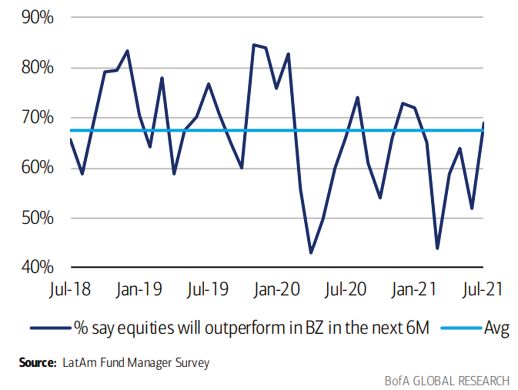
Research    September 2021

   As the global economy reopens and as growth matures, investors find themselves looking
   outside developed economies for opportunities. One of the challenges, however, is that although
   there have been periods of synchronized growth across many Emerging Market countries,
   “EM” consists of 27 different countries – each with its own economy, set of risks, and market
   exposures. As part of a global equity allocation, differentiating between Emerging Market
   countries is increasingly important when fundamentals diverge. Currently we see opportunities
   within Latin America – especially Brazil – as tailwinds for growth remain supportive and equities
   still appear cheap. China, on the other hand, is increasingly facing headwinds from slowing liquidity
   and drivers of growth.

   Profits Growth Looks Poised to Diverge in 2H21

   Brazilian versus Chinese profits growth is just one of several areas that highlight all Emerging
   Market countries are not created equal. For example, Brazilian trailing four-quarter profits
   have grown 94% year-on-year and have been accelerating at among the fastest rates
   globally, while those for Chinese companies – still increasing 9% in Q2 – have slowed
   relative to the rest of the world. Although it would be easy to dismiss the Brazilian growth
   dynamic as driven by 2020 base effects, we have found that markets consistently focus on
   the change in earnings growth – “better” or “worse” – and less on whether that growth is
   driven by easy comparisons.

   So, even though Chinese profits are growing, and we expect their growth rate to peak next
   quarter in the mid-20%s, the steep declines in 2020 earnings of Brazilian companies have
   supercharged 2021 growth rates, which we expect to further accelerate and remain well
   above 100% through year-end. Further, in 1Q22 – by which time the easy comparisons from
   2020 earnings will have rolled out – analysts expect relatively stronger profits growth of
   Brazilian companies (43% year-on-year) as compared to Chinese companies (17% year-on-
   year).

   Looking to the future, leading indicators of profits appear resilient in Brazil but weakening
   in China. Most recently, 6 of the 8 indicators (or 75%) in our Brazil profits cycle model were
   positive, whereas 7 of the 11 (or 64%) in our China profits cycle model were positive. As an
   example, our work shows that Purchasing Manager Indices (PMIs) of manufacturing firms
   have historically provided insight into the direction of future profits growth (Chart 1). Note
   inflections in China’s Manufacturing PMI have historically led to inflections in its profits
   cycle. Recently, manufacturing PMIs for China have clearly peaked, while those for Brazil
   have recently reaccelerated (Chart 2), suggesting profits growth for Chinese companies will
   be moderate while Brazilian companies may see strong growth continue.

                             © 2021 Richard Bernstein Advisors LLC   PAST PERFORMANCE IS NO GUARANTEE OF FUTURE RESULTS   2
Research September 2021
CHART 1:
China Manufacturing PMI vs. Trailing 12m EPS %YoY
60 (January 2011 - July 2021) 50%
China Trailing 12m EPS %YoY
China Manufacturing PMI, SA
55 25%
50 0%
45 -25%
MSCI China Trailing 12m EPS %YoY
China Manufacturing PMI
40 -50%
Jan-11 Jan-12 Jan-13 Jan-14 Jan-15 Jan-16 Jan-17 Jan-18 Jan-19 Jan-20 Jan-21
Source: Richard Bernstein Advisors LLC, Bloomberg Finance L.P. MSCI indices used.
For descriptors, see “Index Descriptions” at end of document.
CHART 2:
Manufacturing PMI for China and Brazil
(December 2018 - July 2021)
70
65 China Manufacturing PMI
Brazil Manufacturing PMI
60
55
50
45
40
35
Dec-18 Mar-19 Jun-19 Sep-19 Dec-19 Mar-20 Jun-20 Sep-20 Dec-20 Mar-21 Jun-21
Source: Bloomberg Finance L.P. and Markit. For descriptors, see “Index Descriptions” at end of document.
Brazil Stocks Remain Out-of-Favor
In addition to identifying profit outlooks, our research has shown that sentiment can be a key
driver of equity returns as well. With Brazilian stocks lagging the returns of global equities over the
last fifteen months, investors still appear skeptical of Brazil’s COVID recovery, as shown in Chart 3.
© 2021 Richard Bernstein Advisors LLC PAST PERFORMANCE IS NO GUARANTEE OF FUTURE RESULTS 3Research September 2021
This pessimistic outlook may explain why Brazilian stocks continue to trade at depressed forward
price-to-earnings multiples relative to broader Emerging Markets, and especially China (Chart
4). Chinese stocks, conversely, are still rich relative to their historical average, even despite the
recent sell-off in Chinese markets. We suspect this is partly due to investors extrapolating China’s
recovery and their markets behaving as a safe haven during the onset of COVID-19.
CHART 3:
Forward 12m Price-to-Earnings Ratios for Chinese and Brazilian Equities
(December 2018 - July 2021)
20
Brazil
China
15
Forward P/E Ratio
10
5
Jun-11 Jun-12 Jun-13 Jun-14 Jun-15 Jun-16 Jun-17 Jun-18 Jun-19 Jun-20 Jun-21
Source: Bloomberg Finance L.P. MSCI indices used. For descriptors, see “Index Descriptions” at end of document.
CHART 4:
Forward 12m Price-to-Earnings: Current versus 15-Year Average
(Monthly, As of July 31, 2021)
14 Current
13 Average
12
11
10
9
8
7
6
Emerging Markets China EM Latin America Brazil
Source: Richard Bernstein Advisors LLC, Bloomberg Finance L.P. MSCI indices
used. For descriptors, see “Index Descriptions” at end of document.
© 2021 Richard Bernstein Advisors LLC PAST PERFORMANCE IS NO GUARANTEE OF FUTURE RESULTS 4Research September 2021
Looking at investor sentiment from another angle, we note that BofA Research’s monthly Fund
Managers’ Survey shows investors have largely been less optimistic on Brazilian stocks since the
onset of the pandemic. The July survey noted that investors have become incrementally more
constructive on Brazilian stocks, but even with that improvement sentiment is still only just at
average levels (Chart 5).
CHART 5:
Sentiment towards equities in Brazil
We anticipate that as Brazilian companies deliver on strong earnings growth, investors will
become increasingly constructive on their equity prospects. China’s rebound, on the other
hand, appears largely priced in, and any earnings disappointment may cause investors to
reprice those stocks.
Changing Currents in Liquidity
Over the last 18 months Brazil met the pandemic head on with sizeable fiscal stimulus and a
dramatic easing of its policy rate (the Selic), as shown in Chart 6. These policy moves helped
stabilize, and more recently, have provided a tailwind to growth. China, on the other hand,
enacted fewer pro-growth policies during 2020 and 2021, in part because their domestic
economy was damaged less by the pandemic. History suggests that policy tends to work
with long lags, and as such we expect Brazil’s easing a year ago to continue to positively
reverberate throughout the country, particularly in contrast to China.
© 2021 Richard Bernstein Advisors LLC PAST PERFORMANCE IS NO GUARANTEE OF FUTURE RESULTS 5Research September 2021
CHART 6:
Year-over-Year Change in the Selic Rate
(September 2016 – August 2021)
6
Tightening
4
2
0
-2
-4
-6
Easing
-8
Sep-16 Mar-17 Sep-17 Mar-18 Sep-18 Mar-19 Sep-19 Mar-20 Sep-20 Mar-21
Source: Bloomberg Finance L.P.
More recently, the pace of Brazil’s easing has slowed, with the Banco Central do Brasil
(BCB) beginning to raise the Selic in March to combat sharply accelerating inflation and
following through with three subsequent rate hikes. When the BCB adjusts the Selic rate
up or down, it is effectively changing the cost of credit. Although the BCB has been raising
rates, the current Selic level remains quite accommodative relative to history. However,
the BCB’s shift from easing in 2020 to tightening in 2021 may pose a headwind to growth
toward year-end and next year.
Turning now to China, the most recent policy move has been one of slight easing rather than
tightening. Until recently, the PBOC had left the Required Reserve Ratio (RRR) unchanged,
but on July 9th it reduced the rate by 50 basis points for all banks (Chart 7)1. Although this
change should increase the quantity of credit available, history would suggest reducing
the RRR by this magnitude is unlikely to have a substantial impact on credit availability and
lending.
1
The RRR is the minimum amount of reserves that banks must hold rather than lend out.
© 2021 Richard Bernstein Advisors LLC PAST PERFORMANCE IS NO GUARANTEE OF FUTURE RESULTS 6Research September 2021
CHART 7:
Year-over-Year Change in the Required Reserve Ratio (RRR)
(September 2016 – August 2021)
2
Tightening
1
0
-1
-2
-3
Easing
-4
Sep-16 Mar-17 Sep-17 Mar-18 Sep-18 Mar-19 Sep-19 Mar-20 Sep-20 Mar-21
Source: Bloomberg Finance L.P.
This policy move also comes on the heels of several quarters of slowing credit growth, as
evident from China’s slowing and negative 12m change in its credit impulse, which peaked
in October 2020 (Chart 8)2. We see the RRR reduction as a sign that tighter credit over
the last few quarters may have stymied the growth outlook more than desired. We do not
expect sustained easing by the PBOC in the immediate future as they remain focused
on de-risking the financial sector, and therefore, tight credit likely remains a headwind to
accelerating growth in the coming quarters.
CHART 8:
China Credit Impulse, 12 Month Net Change
(July 2015 – July 2021)
10%
8%
6%
4%
2%
0%
-2%
-4%
-6%
-8%
-10%
Jan-16
Apr-17
Jan-18
Apr-18
Jan-19
Apr-21
Oct-15
Jan-17
Apr-16
Oct-16
Oct-19
Jan-20
Oct-17
Apr-20
Jan-21
Oct-18
Apr-19
Oct-20
Jul-15
Jul-16
Jul-17
Jul-18
Jul-19
Jul-20
Jul-21
Source: Bloomberg Finance L.P.
2
Credit impulse is the YoY change in new credit as a percentage of trailing four quarter GDP.
© 2021 Richard Bernstein Advisors LLC PAST PERFORMANCE IS NO GUARANTEE OF FUTURE RESULTS 7Research September 2021
Of course, we would be remiss if we did not also mention the recent market volatility and
policy news out of China. Within the last month, several companies in China’s property
market are increasingly showing signs of stress, government reforms were announced on
companies in China’s tutoring sector, and Chinese regulators took action against several
high-profile companies. The direction of China’s policy is an important determinant of the
outlook for its market, especially to the extent it positively or negatively impacts the profits,
liquidity, or sentiment backdrop.
Fundamentals Driving Performance
The brighter outlook for corporate profits growth, cheaper valuations, and a more
constructive credit backdrop in Brazil over China highlight that it may be advantageous to be
tactical within Emerging Market equities – especially now and during last year. As we stated
previously, not all Emerging Market countries are created equal - indeed, in 2021 thus far,
there has been over a twelve-percentage-point spread in the performance of Brazil (+3.12%)
and China (-9.58%) equities.3 This is all that more important in times of diverging country
fundamentals.
Don’t miss out on future RBA Insights, subscribe today.
To learn more about RBA’s disciplined approach to macro investing, please contact your
local RBA representative.
3
Performance of MSCI China index and MSCI Brazil index for the period 12/31/2020 – 8/10/2021.
© 2021 Richard Bernstein Advisors LLC PAST PERFORMANCE IS NO GUARANTEE OF FUTURE RESULTS 8Research September 2021
INDEX DESCRIPTIONS:
The following descriptions, while believed to be accurate, are in some cases abbreviated versions of more
detailed or comprehensive definitions available from the sponsors or originators of the respective indices.
Anyone interested in such further details is free to consult each such sponsor’s or originator’s website.
The past performance of an index is not a guarantee of future results.
Each index reflects an unmanaged universe of securities without any deduction for advisory
fees or other expenses that would reduce actual returns, as well as the reinvestment of all
income and dividends. An actual investment in the securities included in the index would require
an investor to incur transaction costs, which would lower the performance results. Indices
are not actively managed and investors cannot invest directly in the indices.
Brazil: The MSCI Brazil Index. The MSCI Brazil Index is a free-float-adjusted, market-capitalization-weighted
index designed to measure the equity-market performance of Brazil.
China: The MSCI China Index. The MSCI China Index is a free-float-adjusted, market-capitalization-
weighted index designed to measure the equity-market performance of China.
Emerging Markets: The MSCI Emerging Markets Index. The MSCI Emerging Markets Index is a free-
float-adjusted, market-capitalization-weighted index designed to measure the equity-market performance of
Emerging Markets.
EM Latin America: The MSCI Emerging Markets Latin America Index. The MSCI Emerging Markets Latin
America Index is a free-float-adjusted, market-capitalization-weighted index designed to measure the equity-
market performance of EM Latin America.
About Richard Bernstein Advisors
Richard Bernstein Advisors LLC is an investment manager focusing on long-only, global equity and
asset allocation investment strategies. RBA runs ETF asset allocation SMA portfolios at leading
wirehouses, independent broker/dealers, TAMPS and on select RIA platforms. Additionally, RBA
partners with several firms including Eaton Vance Corporation and First Trust Portfolios LP, and
currently has $14.7 billion collectively under management and advisement as of July 31st, 2021. RBA
acts as sub‐advisor for the Eaton Vance Richard Bernstein Equity Strategy Fund, the Eaton Vance
Richard Bernstein All‐Asset Strategy Fund and also offers income and unique theme‐oriented unit
trusts through First Trust. RBA is also the index provider for the First Trust RBA American Industrial
Renaissance® ETF. RBA’s investment insights as well as further information about the firm and
products can be found at www.RBAdvisors.com.
Nothing contained herein constitutes tax, legal, insurance or investment advice, or the recommendation of or an offer to sell, or the
solicitation of an offer to buy or invest in any investment product, vehicle, service or instrument. Such an offer or solicitation may only
be made by delivery to a prospective investor of formal offering materials, including subscription or account documents or forms, which
include detailed discussions of the terms of the respective product, vehicle, service or instrument, including the principal risk factors that
might impact such a purchase or investment, and which should be reviewed carefully by any such investor before making the decision
to invest. RBA information may include statements concerning financial market trends and/or individual stocks, and are based on current
market conditions, which will fluctuate and may be superseded by subsequent market events or for other reasons. Historic market trends
are not reliable indicators of actual future market behavior or future performance of any particular investment which may differ materially,
and should not be relied upon as such. The investment strategy and broad themes discussed herein may be inappropriate for investors
depending on their specific investment objectives and financial situation. Information contained in the material has been obtained from
sources believed to be reliable, but not guaranteed. You should note that the materials are provided “as is” without any express or implied
warranties. Past performance is not a guarantee of future results. All investments involve a degree of risk, including the risk of loss.
No part of RBA’s materials may be reproduced in any form, or referred to in any other publication, without express written permission
from RBA. Links to appearances and articles by Richard Bernstein, whether in the press, on television or otherwise, are provided for
informational purposes only and in no way should be considered a recommendation of any particular investment product, vehicle, service
or instrument or the rendering of investment advice, which must always be evaluated by a prospective investor in consultation with his or
her own financial adviser and in light of his or her own circumstances, including the investor’s investment horizon, appetite for risk, and
ability to withstand a potential loss of some or all of an investment’s value. Investing is subject to market risks. Investors acknowledge and
accept the potential loss of some or all of an investment’s value. Views represented are subject to change at the sole discretion of Richard
Bernstein Advisors LLC. Richard Bernstein Advisors LLC does not undertake to advise you of any changes in the views expressed herein.
© Copyright 2021 Richard Bernstein Advisors LLC. All rights reserved.
PAST PERFORMANCE IS NO GUARANTEE OF FUTURE RESULTS
© 2021 Richard Bernstein Advisors LLC PAST PERFORMANCE IS NO GUARANTEE OF FUTURE RESULTS 9You can also read


