CITY OF MELVILLE DISABILITY ACCESS AND INCLUSION PLAN
←
→
Page content transcription
If your browser does not render page correctly, please read the page content below
CITY OF MELVILLE
DISABILITY ACCESS AND INCLUSION
                  PLAN
             2017-2022

          City of Melville
          10 Almondbury Road, Booragoon WA 6154

          General Telephone: 1300 635 845
          Media Enquiries: (08) 9364 0245
          TTY service: 133 677
          National Relay Service: 1300 555 727

          Email: melinfo@melville.wa.gov.au
          Website: www.melvillecity.com.au

          This publication is available in alternate formats on
          request such as: electronic format, by email, on the City
          of Melville’s website, hard copy in large and standard
          print, braille, easy to read ‘easy english’ and audio format.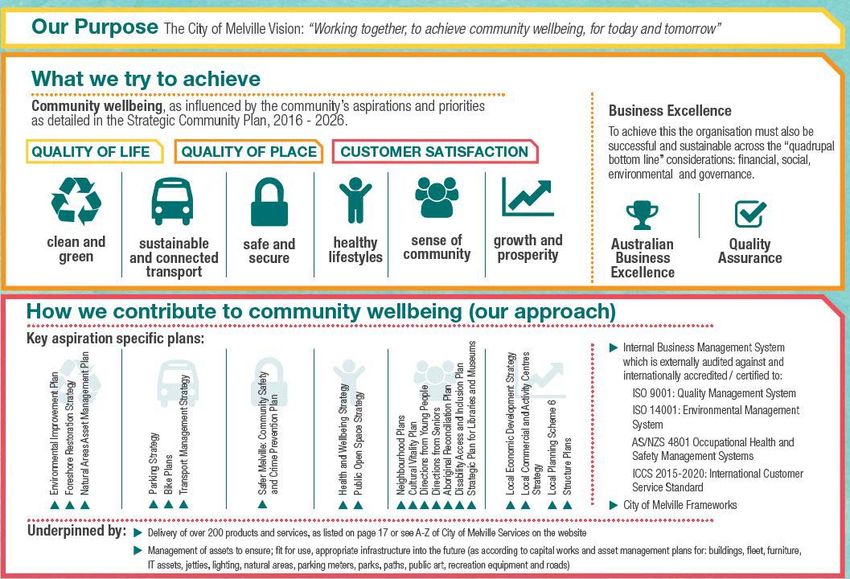
Message from the Mayor

The City of Melville is proud to present the 2017-2022 Disability Access and
Inclusion Plan (DAIP). This plan will continue to build on the successes of the
last five year period which included improving access to facilities and
information and promoting inclusion and equal opportunity for an accessible
inclusive Melville.

Some of the City’s accomplishments from the 2012-2017 DAIP included
improvements and installation of accessible toilets and ramps across the City,
training and education initiatives for staff, increased translation services such
as AUSLAN at our public events and innovative community projects involving
businesses to raise awareness and encourage local community supports for
people living with dementia. These initiatives continue to make the City of
Melville more age-friendly and accessible.

The City of Melville believes that a community that recognises and promotes
its diversity and supports the participation and inclusion of all of its members
makes for a richer community life and contributes to positive social justice
outcomes. This new plan will continue to promote accessible outcomes for
members of the community of all abilities and with disabilities.

I would like to thank the many people who have contributed to the
development of the revised DAIP. We will continue to develop positive
outcomes of this plan over the next five years.

Russell Aubrey
Mayor
City of Melville

Acknowledgements

The City of Melville acknowledges the Bibbulmun people as the traditional
owners of the land on which the City stands today and pays its respect to the
Whadjuk people, and elders both past and present. The City also gives thanks
to the individuals and groups in the community who have provided input and
feedback which has been invaluable in the preparation of this Disability
Access and Inclusion Plan.

                                                                           Page 2 of 40
Executive Summary

Disability access and inclusion is critical to a sense of community where all people
belong, are included and can enjoy equal opportunity in all areas of life. As a local
government, the City is committed to ensuring that it fulfills its obligations to the
community and also under law. It is a requirement of the WA Disability Services Act
(1993) that all local government authorities develop and implement a Disability
Access and Inclusion Plan (DAIP) that outlines the ways in which the authority will
ensure that people with disabilities have equal access to its facilities and services.
Other legislation of relevance and which underpin the outcomes and objectives of
this plan include the WA Equal Opportunity Act (1984) and the Commonwealth
Disability Discrimination Act (1992). The human rights of people with disabilities are
also enshrined internationally in the United Nations Convention of the Rights of
People with Disabilities which aims to enhance the opportunities of people with
disabilities in all areas of social and political life. This plan focuses on these
outcomes in the City.

People with disabilities, their families and their carers have the same rights as other
people to access services within our community. People with a disability have rights
under both State and Federal legislation against discrimination based on disability.

This plan will outline the key strategies that will be adopted by the City to address
each of the ‘outcome’ areas under the DAIP being:
   1. Equitable access to services and events
   2. Equitable access to buildings and facilities
   3. Equitable access to information
   4. Equitable access to quality customer service
   5. Equitable complaints procedures
   6. Equitable access to community engagement
   7. Equitable access to employment and traineeship, and
   8. Improved community awareness (of access and inclusion)

From an Australian Business Excellence Framework perspective, this Plan
addresses all categories to some extent, particularly in respect to leadership and
results and sustainable performance. The key principles that are addressed are:

1   Clear direction and mutually agreed plans enable organizational alignment and a
    focus on the achievement of goals
2   Understanding what customers and other stakeholders value, now and in the
    future, enables organisational direction, strategy and action.
3   Sustainable performance is determined by an organisations ability to create and
    deliver value for all stakeholders in an ethical, socially and environmentally
    responsible manner.

                                                                                 Page 3 of 40
Based on community consultation, examination of corporate and organisational risks,
corporate priorities and consultation with other local governments the following goals
for a more Accessible Inclusive Melville have been determined as priorities for the
City:

           Goal                                    Objectives
Equitable access to        People with disability have the same opportunities as
Services and Events        other people to access the services of, and any events
                           organised by, the City of Melville.
Equitable access to        People with disability have the same opportunities as
buildings and facilities   other people to access the buildings and other facilities
                           of the City of Melville.
Equitable access to        People with disability receive information from the City of
information                Melville in a format that will enable them to access the
                           information as readily as other people are able to access
                           it.
Equitable access to        People with disability receive the same level and quality
quality customer service   of service from the staff of the City of Melville as other
                           people receive from the staff of the City of Melville.
Equitable complaints       People with disability have the same opportunities as
procedures                 other people to make complaints to the City of Melville.
Equitable access to        People with disability have the same opportunities as
community engagement       other people to participate in any public consultation by
                           the City of Melville.
Equitable access to        People with disability have the same opportunities as
employment and             other people to obtain and maintain employment with the
traineeship                City of Melville.
Improved Community         The community are informed and educated by the City of
Awareness                  Melville about access and inclusion, social justice and
                           equal opportunity especially for people with disability.

                                                                               Page 4 of 40
Table of Contents
1 Linkages to the City of Melville Corporate Business Plan 2016-2020 .............. 6
1.1 Strategic Community Plan and Corporate Business Plan Integration . 6
2 Introduction ....................................................................................................... 7
2.1 Functions, Facilities and Services ........................................................... 8
2.2 Purpose: Objectives and Desired Outcomes.......................................... 8
2.3 Background ............................................................................................... 8
2.4 City of Melville Disability Access and Inclusion Policy ....................... 10
2.5 Scope ........................................................................................................ 10
2.6 Risk ........................................................................................................... 10
3 Strategic Context ............................................................................................ 12
3.1 Legislative Context ................................................................................. 12
3.2 City of Melville ......................................................................................... 12
3.3 Goals and Objectives .............................................................................. 14
4 Stakeholder Consultation and Data Analysis ............................................... 15
5 Strategies and Actions to Improve Access and Inclusion: 2017-2022 ...... 19
6 Review and Monitoring ................................................................................... 40
Page 5 of 401 Linkages to the City of Melville Corporate Business
Plan 2016-2020
Strategic Community Plan and Corporate Business Plan
Integration
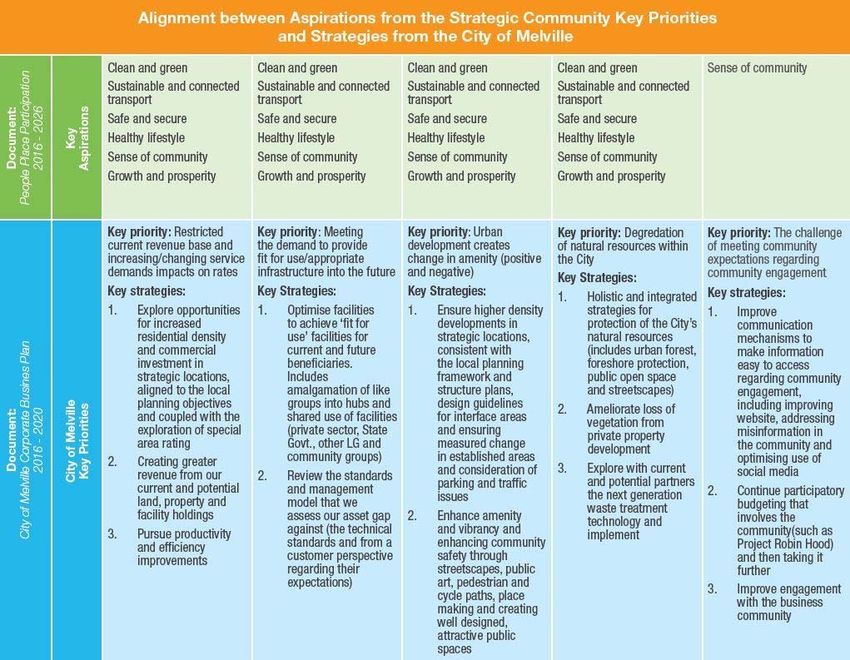
Our latest Strategic Community Plan ‘People, Places, Participation: A Strategic
Community Plan for the City of Melville 2016-2026 outlines the community’s
aspirations for the future of the City. The six community aspirations include:
• Safe and secure
• Healthy lifestyle
• Sense of community
• Clean and green
• Growth and prosperity
• Sustainable and connected transport.
This plan supports an improved ‘sense of community’ for the City – where the
community is Accessible and Inclusive to all.
Page 6 of 40The strategies and initiatives of this DAIP align with the overall strategies from the
Strategic Community Key Priorities and the City’s Corporate Business Plan 2016-
2020 by:
Recognising the importance of social outcomes for a ‘sense of community’ by
pursuing productivity, efficiency and improving communication across the
organisation on disability related upgrades, improvements and initiatives.
Optimising the City’s facilities, services, events and buildings for best possible
infrastructure use and possible upgrades.
Enhancing the vibrancy and accessible use of outdoor streetscapes, paths
and public open spaces.
Ensuring ongoing improvements to communication mechanisms such as the
website and social media by producing information in alternate formats.
Introduction
The City of Melville is located in the South West Metropolitan region, approximately
eight kilometres from Perth and has an estimated population of 102 363 (June 30th
2016 - City of Melville statistics) people living in the following suburbs:
Page 7 of 40Applecross, Alfred Cove, Ardross, Attadale, Bateman, Bicton, Booragoon,
Brentwood, Bull Creek, Kardinya, Leeming, Melville, Mt Pleasant, Murdoch, Myaree,
Palmyra, Willagee and Winthrop.
The aim of this DAIP is to ensure that all members of our community including those
with disabilities are able to also enjoy these aspirations in an accessible and
inclusive way.
Functions, Facilities and Services
The City of Melville is responsible for a wide range of functions, facilities and
services. This includes services to properties and the environment, the community,
regulatory services, general administration and processes of local government such
as Council meetings.
Purpose: Objectives and Desired Outcomes
The key purpose of this plan will continue to achieve one of the City’s key identified
priorities under the Strategic Community Plan of a ‘sense of community’ by working
together to achieve access and inclusion for all in Melville. The purpose of this plan is
to ensure that there are strategies and initiatives in place to continually improve
outcomes for people with disabilities, their families and their carers. Having a DAIP in
place also ensures that people with disability have the same rights as other people to
access services by the City.
This plan will outline the key strategies that will be adopted by the City to address
each of the ‘outcome’ areas under the DAIP being:
1. Equitable access to services and events
2. Equitable access to buildings and facilities
3. Equitable access to information
4. Equitable access to quality customer service
5. Equitable complaints procedures
6. Equitable access to community engagement
7. Equitable access to employment and traineeship, and
8. Improved community awareness (of access and inclusion)
Background
The City of Melville has been committed to facilitating the inclusion of people with
disabilities through the improvement of access to its facilities and services for many
years.
The City adopted its first Disability Service Plan (DSP) in 1995. In 2003 - 2004 the
City undertook a comprehensive review of its DSP and subsequently developed an
updated Disability Access and Inclusion Plan. The City’s latest plan was the DAIP 2012-
2017.
Page 8 of 40By way of review, the following is a summary of key achievements and initiatives by the
City over the years including under its most recent DAIP 2012-2017:
The City continued to facilitate and run the highly successful Access Advisory
Panel (membership by community members and advocates who provide
recommendations and feedback on a range of projects before they are finalised).
Meetings are held every 3 months and the panel continues to provide important
consultation and feedback on the City’s projects and programs.
Training and education programs are run internally annually to ensure staff have
adequate skills and knowledge on disability access and inclusion. Increasingly
projects, programs and activities within the City focus on understanding
accessibility broadly which encompasses invisible disabilities such as mental
health. The City is committed to programs and initiatives such as Act Belong
Commit.
The Activelink program has provided subsidised opportunities for people
experiencing barriers and disadvantage in the local community to participate in
sport and recreational activities. Support has now extended to a range of
community activities including art classes and library school activity programs.
City events such as the Point Walter Concert at Point Walter and Sculpture Walk,
Deep Water Point provided disability friendly access features such as areas for
people with mobility devices to access the concert stage and sculptures. These
events also provided specific AUSLAN interpreting both during the concert and
specialist tours of sculptures at Point Walter.
The City has been committed to improve relationships and engagement with the
local community about access and inclusion. DAIP related outcomes are
marketed as AIM (Accessible Inclusive Melville) with a new banner which
promotes a commitment to inclusion for all. Further the City has:
o A dedicated e-newsletter called ‘Accessible Inclusive Melville’ with over
4000 subscribers providing news and information on activities and
programs in the City and through local community groups.
o A topic page and forum on the City’s community engagement website
Melville Talks promoting access and inclusion issues.
A number of the City’s public toilets have been upgraded to be accessible
including a project for a ‘changing place’ at Deep Water Point.
The City’s Disability Access and Inclusion Directory is available in a range of
formats such as large font. Other formats are available on request.
The City’s website has now incorporated a functionality which allows users of
the site to alter text size. A new website is being designed based on feedback
from people with disabilities and older users. The website is being re-
developed and went through a thorough consultation process with people
with disability and older to ensure the new features will be inclusive.
Accessible formats of information such as large font and Braille has been created
and made available to members of the community as required.
A new brochure Accessible Careers @Melville invites people with disability to
apply for positions within the City. Internal training resources have been
updated and new relationships and networks made with Disability
Employment Service providers.
Community Partnership Funding is provided to a number of organisations in
the area that support people with a disability such as Interchange and Edge
Employment for example.
Page 9 of 40 The City has led innovative community projects with a number of
stakeholders such as through the Melville Age-Friendly Accessible
Businesses (MAFAB) network to support those in the community living with
dementia and promote awareness and education among businesses and the
community on access and inclusion. Other projects have included running a
disability expo in collaboration with community groups, a disability friendly
flash mob in Garden City shopping Centre and an all-inclusive kite-making
festival.
Every two years the City conducts a Community Wellbeing Survey. The latest
survey results in 2015 showed that in achieving the aspiration of ‘access and
inclusion’, 89.5% of those surveyed found that everyone could access the
City’s services and resources. 79.5% also reported feeling that they
“belonged” in the community.
City of Melville Disability Access and Inclusion Policy
The ‘Disability Access and Inclusion Policy CP-084’, reviewed in 2015, relates to all
staff and Elected Members and contractors providing services on behalf of the City
and all City buildings and facilities. This policy promotes and specifies the Council’s
commitment to ensure people with disabilities have equal opportunities of access
and community inclusion to Council services, products, facilities and information. It
ensures that consultation is appropriate and meaningful way for full participation. The
policy is available on the City’s website.
Scope
This DAIP applies to the City of Melville as a public authority, its officers, employees,
agents and contractors and sets out the objectives, strategies and initiatives to make
continual improvements across the 8 outcome areas set out under this plan. The
plan will be in place from 2017-2022.
Responsibility for developing, monitoring, implementing, reviewing and amending the
DAIP is a whole of organisational responsibility that is coordinated by the City’s
Social Justice Advocate. This includes the responsibility of ensuring that the plan is
rolled out throughout the organisation. The Implementation Plan is integrated within
the City’s reporting processes with the relevant officers and business unit responsible
for ensuring each action is completed. Reports are prepared twice a year to monitor
progress and report on outcomes.
Risk
The risks identified are that:
the key initiatives set out in the plan are not achieved
there is insufficient resources or budget to meet the requirements or feedback
of the community
Page 10 of 40 the aims or objectives of the DAIP are not understood by staff or agents and
contractors
The level of satisfaction reported by the community as identified by surveys
such as the City’s well-being survey (conducted every two years) will
decrease if accessible inclusive objectives are not met satisfactorily.
These risks are mitigated by planning and through strategies such as:
ensuring that the DAIP implementation is monitored and reported on
internally throughout the year and a report produced for the Disability
Services Commission each financial year to track progress
communication and planning with all areas and officers responsible for
implementation under the plan
providing staff awareness and training of the DAIP and access and inclusion.
Page 11 of 40Strategic Context
Legislative Context
Disability access and inclusion is critical to a sense of community where all people
belong, are included and can enjoy equal opportunity in all areas of life. As a local
government, the City is committed to ensuring that it fulfills its obligations to the
community and also under law. It is a requirement of the WA Disability Services Act
(1993) that all local government authorities develop and implement a Disability
Access and Inclusion Plan (DAIP) that outlines the ways in which the authority will
ensure that people with disabilities have equal access to its facilities and services.
Other legislation of relevance and which underpin the outcomes and objectives of
this plan include the WA Equal Opportunity Act (1984) and the Commonwealth
Disability Discrimination Act (1992). The human rights of people with disabilities are
also enshrined internationally in the United Nations Convention of the Rights of
People with Disabilities which aims to enhance the opportunities of people with
disabilities in all areas of social and political life. This plan focuses on outcomes in
this City.
City of Melville
The residential population of the City of Melville is approximately 103 767. According
to the 2015 Survey of Disability, Ageing and Carers (SDAC), 18.5% of Australians
identify themselves as having some form of disability. Based on the population
estimates, it is estimated that there are around 19,197 people with disabilities living
in the City.
In addition, the City’s residential population has an above average number of
persons 60 years and over (23%). This is consistent with the overall ageing trend of
the WA population, where by 2041, 25% of the population will be over the age of 60.
Currently it is estimated that 51% of people aged over 60 years have identified
themselves as having a disability due to needing assistance to manage health
conditions or cope with everyday activities. Importantly the City of Melville has the 2nd
highest number of people living with dementia in WA. (Based on Australian Bureau of
Statistics 2011 and Access Economics Report “Projections of dementia prevalence
and incidence in WA 2010-2050”). It is important therefore that this DAIP is
responsive to and reflects the needs of our local community.
Our latest Strategic Community Plan ‘People, Places, Participation: A Strategic
Community Plan for the City of Melville 2016-2026 outlines the community’s
aspirations for the future of the City. This plan supports an improved ‘sense of
community’ for the City – where the community is Accessible and Inclusive to all.
The strategies and initiatives of this DAIP align with the overall strategies from the
Strategic Community Key Priorities and the City’s Corporate Business Plan 2016-
2020 by:
Page 12 of 40 Recognising the importance of social outcomes for a ‘sense of community’ by
pursuing productivity, efficiency and improving communication across the
organisation on disability related upgrades, improvements and initiatives.
Optimising the City’s facilities, services, events and buildings for best possible
infrastructure use and possible upgrades.
Enhancing the vibrancy and accessible use of outdoor streetscapes, paths
and public open spaces.
Ensuring ongoing improvements to communication mechanisms such as for
example the website and social media channels by focusing on accessibility
and inclusion through producing information in alternate formats.
The following plans and strategies are also relevant to the ongoing implementation of
this DAIP:
• Age-Friendly Melville – Directions from Seniors 2013 – 2017
• Health and Wellbeing Strategy 2014 – 2017
• Neighbourhood Plans 2017-2021
• Directions from Young People 2017-2020
• Directions from Aboriginal Communities 2016 - 2019
• Safer Melville Plan 2017-2021
Being Age-Friendly and Accessible
One of the key achievements of the last few years has been a growing collaborative
approach to the City’s Age-Friendly and the DAIP. The City of Melville has been a
member of the World Health Organisation (WHO) Global Age-Friendly Communities
Network since 2010 and has continued to be a leader in creating a world that is
accessible and age-friendly. There are now almost 50 local governments in WA
endorsed as Age-Friendly communities. This fulfills the City’s overall objective of
leading and working collaboratively with many stakeholders to achieve accessible
inclusive outcomes.
Page 13 of 40Goals and Objectives
Based on community consultation, examination of corporate and organisational risks,
corporate priorities and consultation with other local governments the following goals
for a more Accessible Inclusive Melville have been determined as priorities for the
City:
Goal Objectives
Equitable access to People with disability have the same opportunities as
Services and Events other people to access the services of, and any events
organised by, the City of Melville.
Equitable access to People with disability have the same opportunities as
buildings and facilities other people to access the buildings and other facilities
of the City of Melville.
Equitable access to People with disability receive information from the City of
information Melville in a format that will enable them to access the
information as readily as other people are able to access
it.
Equitable access to People with disability receive the same level and quality
quality customer service of service from the staff of the City of Melville as other
people receive from the staff of the City of Melville.
Equitable complaints People with disability have the same opportunities as
procedures other people to make complaints to the City of Melville.
Equitable access to People with disability have the same opportunities as
community engagement other people to participate in any public consultation by
the City of Melville.
Equitable access to People with disability have the same opportunities as
employment and other people to obtain and maintain employment with the
traineeship City of Melville.
Improved Community The community are informed and educated by the City of
Awareness Melville about access and inclusion, social justice and
equal opportunity especially for people with disability.
Page 14 of 40Stakeholder Consultation and Data Analysis
A detailed stakeholder engagement plan was completed in preparation for the
development of this DAIP.
A wide engagement process was carried out to identify potential strategies to be
incorporated into the new Plan. Community members including people with
disabilities, their families and carers, local businesses and service providers
contributed feedback as well as City of Melville staff members.
The Disability Services Regulations 2004 set out the minimum consultation
requirements for public authorities in relation to DAIPs. Local government authorities
must call for submissions (either general or specific) by notice in a newspaper
circulating in the local district of the local government under the Local Government
Act 1995 or on any website maintained by or on behalf of the local government
authority. Other mechanisms may also be used.
This DAIP and review process was advertised and promoted widely:
• Through the local newspaper.
• Through the City’s publication, Mosaic.
• On the City’s website and online digital engagement platform, Melville Talks.
• To individuals and groups through e-mail and phone conversations.
• The City’s ‘Accessible Inclusive Melville’ e-newsletter (with over 4000
subscribers)
• Promoted at Council facilities and community events.
The various engagement methods used included:
• Community survey (hard copy and electronic) – 33 surveys received.
• Consultation with the Access Advisory Panel containing a range of
representation of people with disability, advocate and community service
organisations and local area coordinators from the Disability Services
Commission
• Telephone interviews with ‘Activelink’ program users (community members
with disability and their carers that use City of Melville services)
• Three public workshops – the workshop topics were:
• Visual Access and Inclusion
• Mental Health and Invisible Disabilities
• Culture, Disability and Aboriginal Communities
• Consultation and Review with: Access Advisory Panel
• Internal staff consultation and feedback was also received through email
feedback, workshops and meetings.
• Other surveys and feedback such as the Strategic Community Plan survey
results in 2015 and the CALD Neighbourhood Development Survey 2017.
• Face to face meetings with key members of the community such as with a
member of the GLBTIQ community experiencing access/signage issues at
recreation centre change rooms.
Page 15 of 40Feedback and Results – Workshop Consultation
Consultation and Review with the City’s Access Advisory Panel – 8 March 2017
10 panel members present representing both people living with disability and
advocate groups.
Summary of feedback:
The ageing population needs to be considered as this is likely to become an
issue. There are higher expectations and these should be met for the
community.
Strategies that work for communication include simple language and
appropriate formats that are accessible. A variety of tools is required.
Consider in more detail the role of the Access Advisory Panel and ways the
panel can help achieve DAIP outcomes.
A range of alternate print options should be included including more Easy
English and/or simplified language resources. It is important to consider the
needs of culturally and linguistically diverse communities with disabilities that
require information that they can more easily understand.
It important to consult with people with disabilities to ensure that they are
being asked what they require.
Visual Access and Inclusion Workshop – 17 March 2017
11 Participants attended this workshop. The workshop was facilitated by an external
consultant with lived experience of visual access needs. Participants included local
residents, educators from a local school and members of disability and community
organisations.
Summary of feedback:
It is important for a DAIP to acknowledge and support better inclusion for
people of all visual access needs.
Local governments tend to speak about physical disabilities but there are
also hidden/invisible disabilities (acquired brain injuries for example) and
there should be an investment in training for staff to better understand these
issues.
In terms of employment outcomes, flexibility in jobs is important including
work from home options, traineeships and access to alternative adaptive
technologies and formats.
Gaining access to adaptive technologies and alternate formats can also be
challenging when undertaking voluntary work as it is not always available.
The City should consider other broader partnerships and opportunities for
collaborating and improving access and inclusion with stakeholders such as
local universities.
Page 16 of 40Mental Health and Invisible Disabilities – 21 March 2017
7 participants attended this workshop facilitated by an external consultant.
Participants were of varied backgrounds and provided perspectives from both
professional and lived experience. Members of the local community who identified as
living with mental health were present.
Summary of feedback:
Bring in people with expertise in mental health to review building and facility
design to ensure equitable access.
Invite groups and organisations with knowledge and experience on mental
health to advise appropriately when the City is planning events.
Libraries may wish to consider hosting guest speakers, forums, and making
mental health a more prominent issue in the local community.
The City should consider holding more events on specific areas i.e. mental
health, ageing, disabilities to promote awareness.
Culture, Disability and Aboriginal Communities - 24 March 2017
4 participants attended this workshop which was facilitated by the City’s Community
Development Officer – Aboriginal Engagement. Participants were of varied
backgrounds offering both lived experience and professional expertise in the issues
affecting the local aboriginal community.
Summary of feedback:
Literacy issues among local aboriginal communities coupled with cultural
barriers and language means any information on disability access and
programs needs to be clear and easy to understand.
Building relationships face-to-face is the preferred method to communicate
most effectively with the local community.
There are currently challenges being faced by the local aboriginal community
to fully accessing online resources. Alternative promotional methods should
be considered when promoting disability access and inclusion information
such as for example Nyoongar radio, information at community centres or
directly by letterbox drop.
Online Survey Results
The overall feedback was a positive community satisfaction in disability access and
inclusion in the City over the last 5 years. However, there were suggestions for
further improvement. These included:
More responsive customer service with information in alternative formats to
be more readily available such as information in large print and braille for
example.
Increased accessible outdoor structures and wheelchairs particularly
improved paths and access to more parts of the City’s outdoor reserves and
parks.
A more responsive complaints process particularly with follow up on how
feedback and suggestions have been taken into account.
Page 17 of 40 Greater direct involvement and communication between people with
disability and the City on strategic issues, activities and public meetings.
The importance of our ageing population in Melville and the need to include
and focus on this as well as disability (particularly the issues of dementia and
physical access needs such as greater access to parking and transport).
A continued focus on providing people with disability employment and
traineeship opportunities at the City.
Informing and educating the community about access and inclusion and
social justice particularly working with local businesses.
Ensuring all components of ‘disability’ are taken into account when planning
strategies for better services including a focus on visual, hearing/interpreting
access, mental health and other ‘invisible disabilities’. Social issues such as
barriers that may be faced by particular groups including people of different
language/cultural backgrounds, local aboriginal communities, people on low
incomes and homelessness were also raised as important matters to
continue advocacy and awareness.
Page 18 of 40Strategies and Actions to Improve Access and Inclusion: 2017-2022
The City of Melville has developed a detailed Implementation Plan that will be used to track the date of implementation and
responsible officer against the following strategies and actions. This table will be used for the purposes of reporting progress
each financial year as required under the Disability Services Act (1993) to the Disability Services Commission.
7.1 DAIP Outcome 1: People with disability have the same opportunities as other people to access the services of, and any events
organised by, the City of Melville.
Strategies Actions / Measures of Success Responsibility Timeframe Status
1.1 Access and Inclusion are a A) Review the Accessible Events Checklist, Social Justice Advocate May New
part of the way City of Melville including the provision of temporary Annually
plans and evaluates events, accessible parking at all events, the provision
including festivals, meetings of Auslan and other interpreters as required
and consultations. and the promotion of Act, Belong, Commit
each year for any relevant updates.
B) Four public events will be ‘spot checked’ Social Justice Advocate Four reviews New
for review and check regarding access and Annually
inclusion requirements each year. Any
outcomes of these reviews will be used for
continuous improvement by the City.
Page 19 of 40C) Provision of interpreting services such as Community Events Annually New
AUSLAN will be made available wherever Officer / Coordinator
possible at major public events such at the Cultural Development
Point Walter Concert.
D) A separate ‘social inclusion’ budget will be Coordinator/Cultural Annually New
maintained and inclusion projects planned Development
accordingly each year in Cultural
Development.
D) All new staff are made aware of the tools Social Justice Advocate Jan New
and supports available to anyone requesting Annually
alternate formats or arrangements for
meetings and consultations through yearly
internal checklist updates and promotion via
tool box, team brief and through staff
presentations (for example – AUSLAN
interpreting, hearing loop or information in
alternate formats)
1.2 Accessibility information to A) Internal staff will be trained and guidelines Community events 2017-2018 Ongoing
be clearly communicated with produced to ensure all City of Melville events Officer / Relevant City
all marketing of City of Melville will be actively marketed in print and through of Melville Staff
events including festivals, social media as ‘Accessible’ and any relevant organising events /
meetings and consultations accessible features will be advertised Coordinator Marketing
where applicable. including City of Melville community and Communications
languages.
1.4 External A) Ensure the Accessible Events checklist Social Justice Advocate Annually New
agencies/communities to information sent out as part of the Events / Booking and Events
consider Access and Inclusion Package is reviewed each year for any Officer
Page 20 of 40in the planning of events and relevant updates.
services in the City of Melville.
B) Provide all recipients of the Community Coordinator Customer November Ongoing
Partnership Funding with a list of ways to Relations Annually
improve access and inclusion including how
to hold an accessible event as an ongoing
action. Ensure that this process is
continuously reviewed.
C) Ensure all recipients of Community Coordinator Customer November Ongoing
Partnership Funding complete a Relations Annually
questionnaire regarding how they are
consistent with the City of Melville’s Disability
Access and Inclusion Plan (DAIP). Ensure
that this process is continuously reviewed.
D) A comprehensive list of special needs Social Justice Advocate May Ongoing
groups within the community is included with / Coordinator Annually
the City’s emergency contact information and Neighbourhood Amenity
Local Emergency Management (Ranger Services)
Arrangements. This will be reviewed for any
relevant updates each year.
1.5 Ensure up to date A) Update the City’s Access and Inclusion Social Justice Advocate November Ongoing
information and clear Directory yearly and advertise and promote Annually
communication of services and that it is available in alternate formats.
Page 21 of 40events B) Maintain accurate information on the Social Justice Advocate November Ongoing
City’s website and on the City’s Melville Talks Annually
community website that helps residents
connect online that includes information on
Access and Inclusion such as the State
Government Access Guidelines.
C) Continue to promote and maintain Social Justice Advocate 2017-2018 New
database of subscribers to the Accessible November
Inclusive Melville e-news. Complete an Annually
evaluation of effectiveness each year. (complete
evaluation)
1.6 Community members are A) Staff in a Customer Service role are Social Justice Advocate January Ongoing
aware of interpreting supports trained and supported in promoting and using / Customer Service Annually
and national relay service interpreters and the National Relay Service Team Leader
options when communicating (NRS) when providing services to the
with Customer Service or staff community both face-to-face and over the
telephone.
Page 22 of 407.2 DAIP Outcome 2 - People with disability have the same opportunities as other people to access the buildings and other facilities of
the City of Melville.
Strategies Actions/ Measures of Success Responsibility Timeframe Status
2.1 Infrastructure Planning B) The Emergency Evacuation Plan Workplace Health & June New
and refurbishment of developed by the City includes safeguards Safety Coordinator Annually
Buildings and Facilities to and management of people with disabilities
incorporate access and on all levels of the Civic Centre building. This
inclusion requirements forms the basis of internal training and will be
reviewed yearly for any updates.
C) Accessible upgrades to toilets at public Social Justice Advocate/ 2018-2019 Ongoing
parks, reserves and buildings to be Building Services (new grant
undertaken each year in accordance with Coordinator applications)
business planning schedules and any 2020-2022
identified community feedback. This includes (implementation)
actively looking for grants or other project
supports to facilitate additional accessible
infrastructure such as ‘changing places’ or
other upgrades.
D) A Disability Access Consultant is engaged Manager Strategic As required Ongoing
for significant infrastructure planning and Planning /
refurbishment of buildings. The Access Manager Asset
Advisory Panel is utilised and promoted to Management
staff to obtain feedback.
Page 23 of 40G) Annual Budget allocation of $30 000 will Facilities/Asset Annually Ongoing
be applied each year for access upgrades Coordinator (in accordance
through the DAIP. with internal
budget cycles)
2.2 Continuous Improvement A) As part of the Capital Works programme Manager Parks and As required New
of external infrastructure accessibility will be considered during Environment
including, pathways, access development and upgrade of public open
ways, parking, transport, space including the infrastructure within those
playgrounds, streetscapes spaces.
and public open spaces
B) Update the evaluation process to raise the Asset Management Dec 2018 New
priority of accessibility issues, both direct and Coordinator Annually
indirect, in the new footpath development reviewed
process and access ways.
C) The ‘Capital Works Forward’ plan will be Asset Management 2017-2019 Ongoing
used to plan upgrades and address any Coordinator
accessibility issues identified in customer
requests.
D) Staff in specific service areas to Manager Statutory Training to be Ongoing
participate, where identified, in specific Planning / Manager completed as
disability related training that covers current Strategic Urban Planning required. Social
legislation and best practice. Social Justice / Manager Asset Justice Advocate
Advocate to recommend available training Management / Manager to recommend
courses/resources each year. Natural Areas & Parks courses/resource
annually
Page 24 of 402.3 Updated information is A) Ensure that City of Melville Website and Social Justice Advocate Bi-Annually New
available to residents about Your Welcome Website are updated with
the accessibility of buildings, access upgrades and developments on an
facilities, parks and annual basis.
playgrounds.
B) Access upgrades to be promoted through Social Justice Advocate Nov Ongoing
the Mosaic, media releases and Melville Annually
Talks.
2.4 Recreation Centres to A) Sports programs at the Recreation Leisure Facilities Annually New
provide activities, programs Centres have an element of disability access Coordinator
and equipment that is and cater for a variety of abilities.
accessible and inclusive.
B) Maintain and provide accessible features Leisure Facilities Annually Ongoing
and equipment e.g. wheelchairs, accessible Coordinator
parking and change facilities.
C) The Activelink program is to be Social Justice Advocate May Ongoing
coordinated and promoted to eligible Annually
residents to encourage greater participation
in sport, recreational and other activities. The
program is reviewed each year.
2.5 Libraries and museums A) Library services to continue to grow its Coordinator Library 2017-2019 Ongoing
equipment and stock include alternative format resources such as Large Services
accessible technology and Print and Talking Book collections and build
materials e.g. larger font/ working relationships with organisations such
captions/ subtitles. as Visability and the State Library.
Page 25 of 40B) Libraries to investigate ways of providing Learning & Outreach 2017-2019 Ongoing
current technology and/or programs or Librarian / Coordinator
services to assist people with disabilities, Library Services
particularly vision impairments, and train staff
to support and promote use.
C) New library and museum infrastructure Coordinator Library 2017-2019 Ongoing
and layout will take community access and Services
inclusion requirements and feedback into
account in planning and design.
D) Staff to participate in specific disability Coordinator Library August - Ongoing
related training that covers current legislation Services / Coordinator September
and best practice. Cultural Development Annually
E) Libraries to investigate ways to further Coordinator Cultural June 2019 New
engage and involve ‘isolated and Development /
housebound’ library users. Community Development
Officer – Seniors
F) Healthcote Cultural Precinct to develop Coordinator Cultural 2017-2019 Ongoing
precinct programs and tours each year for Development
people living with dementia in collaboration
with Centre for Attitudinal Healing.
G) Cultural Services to investigate Coordinator Cultural 2018-2020 New
opportunities for events and family activities Development
that are ‘autism’ friendly for children and
Page 26 of 40families. Programs will be planned and
reviewed annually.
2.6 City of Melville A) City of Melville sites/buildings/outdoor Social Justice Advocate Every 2 months New
sites/buildings/outdoor spaces will be inspected in accordance with a
spaces will be pro-actively planned schedule (or if identified in feedback
and regularly inspected for or complaint) at least every 2 months to
access and inclusion issues proactively check and report on any access
and for opportunities to issues.
improve.
Page 27 of 407.3 DAIP Outcome 3 - People with disability receive information from the City of Melville in a format that will enable them to access the
information as readily as other people are able to access it.
Strategies Actions / Measures of Success Responsibility Timeframe Status
3.1 Information is available in A) “Available in alternative formats” is included Marketing & 2017-2018 Ongoing
alternative formats. on marketing and other external Communications
communications. Social Justice Advocate to Coordinator
develop guidelines for staff use.
B) Melville Talks is the City’s new community Social Justice November New
engagement website. This website contains a Advocate / and March
specific section on Accessibility and Inclusion Stakeholder Bi-Annually
and people can elect to receive information Engagement
specifically on this topic (with capacity for mail Coordinator
out to people who have indicated an interest in
this topic). Content and information to be
reviewed and updated bi-annually.
B) Produce large font and accessible Social Justice November New
information for seniors as part of Melville’s Advocate / CDO – Annually
Age-Friendly initiatives and review materials Seniors
each year for improvement and conversion.
C) Investigate alternate technologies and Social Justice August New
formats and complete one project/publication Advocate Annually
conversion each year to raise community
awareness and increase staff education on
accessible formats (eg. Braille, easy English)
Page 28 of 403.2 Continuous improvement A) The City uses appropriate certified and Manager, Information Annually Ongoing
to the accessibility of the City tested versions of corporate software and Communication
of Melville website and applications including Windows and Microsoft Technology
documents. Office. Reviews of the website experience
occur on a regular basis and updates are
included in the annual business planning
processes specifically to ensure improvements
to accessibility and usability for both staff and
customers of the City.
B) A new website is being created and Manager, Information Sept 2017 New
upgrades are in line with appropriate W3C and Communication Review 2018
WCAG 2.0 International Standards. A review Technology Annually
of the current site’s accessibility has been
carried out and any further feedback from the
community on accessibility will be reviewed
each year.
C) City of Melville staff will be trained on Digital Annually New
accessibility and creating accessible online Communications
content. Advisor
3.3 Marketing is consistent A) That the City of Melville Style Guide is to be Social Justice Dec New
with accessibility standards consistent with best practice in accessible Advocate / Annually
for information. information and this guide will be reviewed Marketing and
each year for any relevant updates. Communications
Coordinator
Page 29 of 403.4 Staff are trained in A) The Customer Service Guide refers Social Justice Dec New
alternative communication specifically to accessibility and inclusion for all Advocate / Annually
strategies. customers and the Customer Service Level 2 Customer Relations
training for staff covers accessible Coordinator
communication strategies including information
on using interpreters and the National Relay
Service. This content will be reviewed and
updated as relevant annually.
B) An internal guide is produced to assist staff Social Justice June 2018 New
where a request for alternative formats or Advocate Annually
communication is made by a customer. The
guide will be reviewed each year for relevant
updates and made available on the staff
intranet.
Page 30 of 407.4 DAIP OUTCOME 4 - People with disability receive the same level and quality of service from the staff of the City of Melville as other
people receive from the staff of the City of Melville.
Strategies Actions / Measures of Success Responsibility Timeframe Status
4.1 Disability Awareness A) All Staff Disability Awareness Training Social Justice Advocate 2017-2018 New
Training is continuously package to be developed and deployed as part Review
improved. of the Corporate Training Calendar with an Annually
emphasis on the DAIP as a whole of the
organisation responsibility.
B) Social Justice Advocate contributes and is a Social Justice Advocate 2017-2018 New
member of Trainers Network Team (TNT) to Review
ensure training outcomes for disability Annually
awareness is delivered across the organisation
in a coordinated approach.
4.2 Information and resources A) Update Access & Inclusion resources on Social Justice Advocate November Ongoing
are readily available to staff the Intranet for staff annually. Annually
on Access and Inclusion.
B) Social Inclusion Officer is available as a Social Justice Advocate June Ongoing
resource to staff on access and inclusion Annually
issues. One lunch-time information session to
be organised and delivered each year to staff
to highlight a topic/issue on access and
inclusion.
Page 31 of 40C) Information on DAIP outcomes and Social Justice Advocate May and New
achievements will be provided in the November
organisation’s team brief bi-annually. Bi-Annually
4.3 Staff Induction and A) The DAIP and the Access and Inclusion is Social Justice Advocate Dec 2017 New
Orientation includes Access incorporated into the Orientation and Induction Annually
and Inclusion. process and the content reviewed each year
for any updates.
4.4 Feedback received A) Review any feedback received through Social Justice Advocate May and New
through complaints and complaints and compliments regarding access November
compliments forms and inclusion bi-annually as a mechanism for Annually
continuous Improvement. reporting on DAIP outcomes and also to
improve on any internal processes/services.
Page 32 of 407.5 DAIP OUTCOME 5 - People with disability have the same opportunities as other people to make complaints to the City of Melville.
Strategies Actions / Measures of Success Responsibility Timeframe Status
5.1 Complaint mechanisms A) A complaint to the City of Melville may be Manager Community Dec Ongoing
and feedback systems are lodged in writing, in person, online using e- Development Annually
regularly reviewed and pathway or by email, by telephone (national
maintained to ensure people TTY/Speech Relay/translation services are
with disabilities have equal available). The City also has social media as a
rights to make complaints communications tool where feedback /
information may be provided including on the
process to make complaints. The City also
engages with the community through the new
Melville Talks website. These processes will
be reviewed each year.
5.2 Staff are provided training A) All staff to be trained in Customer Service Social Justice Annually Ongoing
and support when responding Level Three training which incorporates how to Advocate / All staff
to complaints and feedback receive and respond to a complaint. The Social
on access and inclusion. Justice Advocate role provides internal ad-hoc
support and guidance to staff if there are any
specific or more complex matters raised. A
register will be maintained of issues raised for
annual disability awareness training (as case
studies and training/learning opportunities)
Page 33 of 407.6 DAIP Outcome 6 - People with disability have the same opportunities as other people to participate in any public consultation by the
City of Melville.
Strategies Actions Responsibility Timeframe Status
6.1 Consultation is sought on A) Seek feedback from community members Project team members / 2017-2019 New
strategic issues regarding regarding access upgrades to buildings, new Stakeholder Review Annually
disability access and inclusion or redeveloped facilities, equipment or Engagement
as required. programs through online engagement tools Coordinator
such as social media and the new Melville
Talks website. The City has social media as a
communications tool where feedback /
information may be provided including on the
process to make complaints. The Melville
Talks website meets WCAG 2.0 W3C
accessibility guidelines. Online content is
aimed to be accessible and age-friendly
through responsive design, the ability to tab
through content on the site and colour
contrast for good visibility and captioned
online videos.
B) Continue to facilitate and run the City’s Strategic Urban Planner Quarterly New
Access Advisory Panel (membership by / Social Justice
community members and advocates who Advocate
provide recommendations and feedback on a
range of projects before they are finalised).
Meetings are held every 3 months.
Page 34 of 406.2 A range of Consultation A) Consultation documents are available on All Project Teams 2017-2018 for Ongoing
techniques are employed the website in accessible formats and in website
where appropriate. alternative formats on request. Review and information as
consultation with Social Justice Advocate per upgrades
each year. Review Annually
B) Where undertaking a Stakeholder All Project Teams 2017-2018 Ongoing
Engagement Strategy, a variety of methods Review Annually
of consultation such as online, by telephone, for relevant
in person is required to be planned – in updates
templates and other supporting planning
documentation. Social Justice Advocate to
develop guidelines for staff.
Page 35 of 407.7 DAIP Outcome 7 - People with disability have the same opportunities as other people to obtain and maintain employment with the
City of Melville.
Strategies Actions / Measures of Success Responsibility Timeframe Status
7.1 Recruitment Practices A) The City of Melville values diversity and Employee Services Annually Ongoing
ensure equal opportunity of promotes equal opportunity. In line with this Coordinator
employment. and the commitment to the Disability Inclusion
and Access Plan, the City recognises that
people with disability bring a unique
perspective and range of skills to the
workplace. Employee Services will review
employment practices to ensure they are
transparent and support diversity each year.
B) Employment practices and relevant training Employee Services 2017-2019 New
for managers are reviewed yearly and Coordinator / Social Review Annually
information on recruitment is marketed and Justice Advocate
promoted to all including people with disability
such as through the development of a new
brochure “Inclusive Careers @ Melville”.
Brochure to continue to be marketed and
promoted to the disability community.
Page 36 of 407.2 Opportunity for work A) All job vacancies are promoted via Employee Services 2017 Ongoing
experience and employment supported employment network. Any additional Coordinator Review annually
of people with disability is contacts by the Social Justice Advocate will be
actively promoted and communicated to Employee Services regularly.
supported.
B) Provide opportunities and traineeships for Employee Services 2017-2019 New
local students with disabilities where possible. Coordinator
C) Explore the work opportunities that may be Employee Services 2017-2018 New
possible for people with disability within Coordinator develop
different departments in the City. opportunities
2018-2020
Implementation
D) Continue to establish, maintain and create a Social Justice June 2018 New
database of contacts and links with disability Advocate/ Employee Review Annually
employment services and utilise knowledge, Services Coordinator
expertise and feedback regarding employment
of people with disabilities. Any additional
contacts by the Social Justice Advocate will be
communicated to Employee Services regularly.
Page 37 of 40You can also read


