CNL(13)50 NASCO Implementation Plan for the period 2013-18 EU - UK (Scotland) - NASCO The North Atlantic Salmon Conservation ...
←
→
Page content transcription
If your browser does not render page correctly, please read the page content below
CNL(13)50

NASCO Implementation Plan for the period 2013-18

              EU – UK (Scotland)
CNL(13)50

               NASCO Implementation Plan for the period 2013-18
 The main purpose of this Implementation Plan is to demonstrate what actions are being
 taken by the jurisdiction to implement NASCO Resolutions, Agreements and Guidelines.

 Questions in the Implementation Plan refer to the following documents:
 • NASCO Guidelines for Management of Salmon Fisheries, CNL(09)43 (referred to as the
    ‘Fisheries Guidelines’);
 • Minimum Standard for Catch Statistics, CNL(93)51 (referred to as the ‘Minimum Standard’);
 • NASCO Guidelines for Protection, Restoration and Enhancement of Atlantic Salmon Habitat,
    CNL(10)51(referred to as the ‘Habitat Guidelines’);
 • Williamsburg Resolution, CNL(06)48; and
 • Guidance on Best Management Practices to address impacts of sea lice and escaped farmed
    salmon on wild salmon stocks (SLG(09)5) (referred to as the ‘BMP Guidance’).

Party:                      EU
Jurisdiction/Region:        UK (Scotland)

                                             1
1. Introduction
1.1 What are the objectives for the management of wild salmon? (Max 200 words)
The objectives for the management of wild salmon should be viewed in the context of the
Scottish Government’s overall purpose to promote sustainable economic growth.
The Scottish Government has overall policy responsibility for salmon and freshwater fish
stocks and fisheries in Scotland. Management of salmon fisheries is undertaken on a regional,
catchment basis by District Salmon Fishery Boards (DSFBs): bodies created under statute via
the Salmon and Freshwater Fisheries (Scotland) (Consolidation) Act 2003. Salmon fishing
rights are private heritable property rights and DSFBs are formed by the owners of these rights.
The Scottish Government has high level objectives to:
• Enhance the overall aims and objectives for salmon and freshwater fisheries
management.
• Promote the conservation and maintain the diversity of migratory and freshwater fish,
and to conserve their aquatic environment.
• Promote the social benefits of fishing as a widely available and healthy form of
recreation; and
• Enhance the contribution migratory and freshwater fisheries make to all parts of the
economy, but particularly in vulnerable communities and in areas with low levels of
employment.
For wild salmon, the conservation objectives will be achieved by:
• Undertaking an independent review of the management of salmon and freshwater
fisheries in Scotland to develop a management system fit for purpose in the 21st century.
• Continuing to progress and build upon the priorities for action identified in the Strategic
Framework for Scottish Freshwater Fisheries (2008)
• Working with DSFBs and Rivers and Fisheries Trusts to manage/regulate rod/net
fisheries to ensure sustainable exploitation.
• Implementing the EU Water Framework, Marine Strategy Framework, the Scottish
Biodiversity Strategy and Habitats Directives; and
These objectives are set alongside the objective for river environments as a whole to progress
towards achievement of good status as required under the EU Water Framework Directive and
not suffer deterioration in status.
1.2 What reference points (e.g. conservation limits, management targets or other
measures of abundance) are used to assess the status of stocks?(Max 200 words)
(Reference: Sections 2.4and 2.5 of the Fisheries Guidelines)
There are 398 salmon rivers in Scotland (see NASCO Rivers Database). Most of these rivers
regularly support salmon, although many are small (particularly on the west coast and the
islands) and consequently the salmon stocks of these rivers are very small and support minimal
catches. Expert opinion has been used to categorise all rivers into the stock categories required
for the NASCO Rivers Database.
Assessments (status of juvenile salmon populations at a number of sites and consideration of
the trends in rod catch in three notional seasonal run timing components) are conducted on the
17 SAC rivers for the purposes of Site Condition Monitoring under the EU Habitats Directive.
The status of juvenile salmonid populations also contributes to the assessments of fish
populations as indicators of Good Environmental Status under the Water Framework Directive.
2Scotland is working towards development of meaningful conservation limits and spawning
escapement estimates so that salmon stocks can be more accurately assessed according to
NASCO guidelines and appropriate management decisions taken. Our current work on the
determination of CLs and associated spawning stock levels has involved a critical appraisal of
possible ways of transporting CLs from a donor catchment to other Scottish catchments. The
limitations of the information currently available mean that it is not currently possible to
transfer CLs reliably among catchments. Our priority is to focus effort on obtaining the
necessary information to enable the development of meaningful CLs upon which reliable
management decisions can be taken. Funding has been secured to begin a programme of work
to develop a Scottish salmon counter network. It is anticipated that data gathered from this
network, together with other biological information, would allow both local stock recruitment
information to be derived (from which CLs can be estimated) and direct measures of spawning
escapement.
1.3 To provide a baseline for future comparison, what is the current status of stocks
relative to the reference points described in 1.2, and how are threatened and
endangered stocks identified?
Category Description of category and link to reference points No. rivers in
2012
1 Not threatened with loss 341
2 Threatened with loss 15
3 Restored 12
4 Maintained 1
5 Lost 9
6 Unknown 20
TOTAL: 398
Additional comments:
Until CLs and spawning escapement estimates are successfully derived the current status of
stocks presented above is as detailed in the NASCO Rivers Database.
1.4 How is stock diversity (e.g. genetics, age composition, run-timing, etc.) taken into
account in the management of salmon stocks?(Max 200 words)
District Salmon Fishery Boards have responsibility for management of salmon stocks at a local
level. Boards adopt their own policies and activities in relation to local management needs.
When determining what actions should be taken in relation to fishery management, stock
conservation and habitat protection and restoration, detailed consideration is given to:
• distribution within the catchment (i.e. potential population structuring);
• run timing and changes in the run-timing; and
• age composition and changes in age composition of spawning escapement.
Management measures are adjusted to prevent or rectify selective pressures on any one stock
component.
For the majority of rivers, monitoring is based mainly on catch data and juvenile surveys,
although data from adult fish counters, fish traps and smolt counts on a number of index
monitored rivers are also considered to assess broad-scale trends in stocks.
The suitability of genetic stock identification (GSI) is being assessed as a tool to identify
population structuring within and between rivers as well as to assess stock/population
composition of catches in the remaining mixed stock fisheries.
Central to fishery management is the need to seek and implement sound advice from
3appropriate sources. There is a wide range of organisations and resources that can support this
– local scientific fishery trusts, who often work in tandem with DSFBs, Marine Scotland
Science, the Institute of Fishery Management and academic institutions.
1.5 To provide a baseline for future comparison, what is the current and potential
quantity of salmon habitat?(Max 200 words)
(Reference: Section 3.1 of the Habitat Guidelines)
The information presented here has been summarised from the EU-UK (Scotland) Protection,
Restoration and Enhancement of Salmon Habitat Focus Area Report of 2009
(http://www.nasco.int/pdf/far_habitat/HabitatFAR_Scotland.pdf).
The current habitat available to salmon based on the best information currently available is
estimated at 863,795,829m2, consisting of 177,295,265m2 of river habitat and 686,500,564m2
of loch habitat.
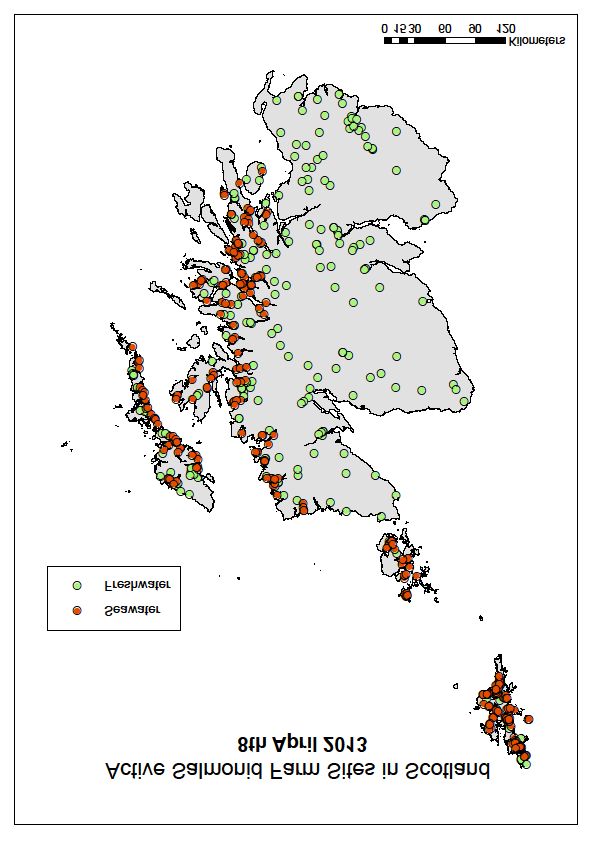
1.6 What is the current extent of freshwater and marine salmonid aquaculture?
Number of marine farms
258 sites currently (2013 figure)
Marine production (tonnes)
Production (2011 figures)
Atlantic salmon 158,018t
Sea trout 17.5t
Rainbow trout 1,156t
Number of freshwater facilities
228 registered active freshwater fish farms (this includes any
research establishments).
Freshwater production (tonnes)
Production from hatcheries in 2011 (thousands):
Atlantic salmon - eggs 7820 - juveniles 43626
Brown trout - eggs 421 - juveniles 175.3
Rainbow trout - eggs 215 - juveniles 16612
Arctic char - eggs 60
Production for table and stocking in 2011 (excluding from
hatcheries and nurseries):
Brown trout 43 t
Rainbow trout 3463 t
Brook trout 0.2t
Arctic char 1.5t
Append one or more maps showing the location of aquaculture facilities and aquaculture free
zones in rivers and the sea.
See Annex 3 for location of aquaculture facilities; there are no specified aquaculture free zones
although a planning presumption exists that there will be no further marine finfish sites on the
North and East coasts. Consultation on Scotland’s first National Marine Plan is currently
underway (ends November 2013) and it is anticipated that the Plan will be published by the end
of 2014.
41.7 To aid in the interpretation of this Implementation Plan, have complete data on
rivers within the jurisdiction been provided for the NASCO rivers database?
Yes/no/comments
No. All Scottish rivers (using the NASCO definition), and their associated Region/Province,
Latitude, Longitude and Stock Status category have been entered into the NASCO Rivers
Database. Catchment Area, Length, Flow and Conservation Requirements have not yet been
entered.
2. Fisheries Management:
2.1 What are the objectives for the management of the fisheries for wild salmon? (Max.
200 words)
The Scottish Government’s purpose is to focus government and public services on creating a
more successful country, with opportunities for all of Scotland to flourish, through increasing
sustainable economic growth. Wild salmon fisheries management contributes to three of the
Government’s strategic objectives (Wealthier and Fairer; Healthier; and Greener) and the
national outcome ‘We value and enjoy our built and natural environment and protect it and
enhance it for future generations’.
The Scottish Government does not directly manage fisheries for wild salmon. Local
management objectives for fisheries are set by the responsible authority: District Salmon
Fishery Boards informed by initially Government funded fishery management planning.
However, at a national level, the Government has objectives to:
• Maximise the socio-economic value from Scotland’s salmon and freshwater fisheries
while protecting and enhancing stocks;
• Implement the provisions in the Aquaculture and Fisheries (Scotland) Act 2013.
• Review the management of salmon and freshwater fisheries in Scotland to ensure it is
robust, sustainable and fit for purpose in the 21st century
• Open up access to additional habitat to salmon and freshwater fish as opportunities
arise; and
• Manage any interactions between wild fisheries and the aquaculture and renewables
sectors effectively.
2.2 What is the decision-making process for fisheries management, including
predetermined decisions taken under different stock conditions (e.g. the stock level
at which fisheries are closed)? (Max.200 words)
(This can be answered by providing a flow diagram if this is available.)
(Reference: Sections 2.1 and 2.7 of the Fisheries Guidelines)
The Scottish Government supports the science-based management of fisheries on a catchment
basis. The assessment of abundance decision flow chart (annex 2) provides a clear structure for
determining whether new management practices might be required. The chart does not suggest
what this management action might be, except for the initial precautionary recommendation to
reduce exploitation within the catchment.
DSFBs are the statutory managers of salmon fisheries and responsible for determining,
agreeing and implementing appropriate management measures based on the best-available
scientific evidence. Where there is evidence that management measures are required, Boards
are encouraged to agree voluntary measures in the first instance, for example catch and release
in the rod fishery and postponement of the net fishing season.
52.3 Are fisheries permitted to operate on salmon stocks that are below their reference
point and, if so, how many such fisheries are there and what approach is taken to
managing them that still promotes stock rebuilding?(Max 200 words.)
(Reference: Section 2.7 of the Fisheries Guidelines)
As noted at 1.2 a programme of work is underway to develop meaningful Conservation Limits
and spawning escapement for Scotland. In the meantime, Boards (as the statutory managers)
make decisions on the need for exploitation reduction based on use of the abundance flow chart
and other locally available data (e.g. juvenile densities). If a need for measures is evidenced
DSFBs are encouraged to agree voluntary measures with all relevant parties. Examples include
catch and release (73% of annual rod catch in 2011, 91% for spring salmon component) and
compensation for cessation of netting.
Boards may make applications for statutory conservation measures to Scottish Ministers.
Where a sound case is presented Ministers seek advice from statutory advisors and determine
whether a measure is put to the Scottish Parliament for approval.
While Boards are the recognised statutory managers of salmon fisheries, Scottish Ministers
have a set of fisheries management backstop powers which they can exercise in the event of
local management failure or to tackle national issues. In addition to the ability to make
conservation measures at their own hand, Ministers (having sought advice from scientific
advisors) can alter the weekly close time and carry out investigations into particular fisheries.
The Aquaculture and Fisheries (Scotland) Act 2013 provides additional powers for Ministers to
carry out genetic sampling, make annual close time orders and require information from
salmon fishery proprietors. Ministers are currently carrying out a 3 year investigation into
perceived problems with the spring salmon in the River South Esk; this investigation includes
genetic sampling of the net fishery and radio tagging of fish to identify spawning locations.
The project was commenced following an application for conservation measures by the local
Board and aims to gather additional information on the nature of the problem in order to inform
suitable management action. For the duration of the project, voluntary agreement to postpone
the start of the netting season and implement catch and release in the rod fishery has been
agreed between the Board and the proprietors.
2.4 Are there any mixed-stock salmon fisheries and, if so, (a) how are these defined,
(b) what was the mean catch in these fisheries in the last five years and (c) how are
they managed to ensure that all the contributing stocks are meeting their
conservation objectives? (Max. 300 words in total)
(Reference: Section 2.8 of the Fisheries Guidelines)
(a) Mixed Stock Fisheries have been defined by NASCO as fisheries exploiting a significant
number of salmon from two or more river stocks. On this definition all fixed engine fisheries
(coastal nets) are mixed stock and a number of rod and line fisheries in Scotland can be
expected to meet this definition. Further investigation would require to be undertaken in the
rod and line fisheries to determine which of these were definitely mixed stock.
(b) Mean catch taken in coastal net mixed-stock fisheries in the last 5 years (2007 – 2011) =
39.6 tonnes.
(c) Management approaches for MSFs are achieved through both voluntary and statutory
measures. Voluntary measures include postponement of season start, release of certain species
etc at certain times. Statutory measures include :
Annual Close Times – these regulate the season length
Weekly Close Times – these fine tune the exploitation rates to ensure spawning escapement.
6Conservation Regulations – These can be applied to regulate effort and exploitation
Action is being taken to aid management of MSFs, namely tools to identify stock composition
and status of the contributing stocks. The Aquaculture and Fisheries (Scotland) Act 2013 gives
Scottish Ministers power to take genetic samples and samples have already been collected
(along with baseline material) from one of the largest MSFs in Scotland (as part of the South
Esk Investigation project). The development of the new EC Data Collection Multi-Annual
Programme may provide opportunities for collection of additional data on salmon MSFs.
Activity and to develop meaningful CLs for stocks is outlined at section 1.2.
2.5 How are socio-economic factors taken into account in making decisions on
fisheries management? (Max. 200 words)
(Reference: Section 2.9 of the Fisheries Guidelines)
The primary management objective is to ensure the conservation or restoration of the stock(s).
When new management measures are considered, socio-economic factors may be taken into
account to influence the nature and balance of controls affecting different stakeholder groups
and the rate of stock recovery that is planned (See Decision Structure (Annex 2)).
Consideration is also given, inter alia, to:
• whether a proposed measure will have an unreasonable effect on someone’s livelihood
(e.g. net fishing) or the value of their property (e.g. fishing rights); this may mean that
it is necessary to reduce the impact of a conservation measure, for example by planning
the recovery of the stock over a longer period;
• whether one group of stakeholders will be unreasonably affected relative to another;
where reductions in exploitation are required, the effects on netsmen and anglers should
be equitable;
• the effect of controls on the viability of commercial and recreational fisheries; and
• the heritage value of the fishery; where fishing methods are unique to a very small
number of locations, consideration is given to retaining a residual fishery and/or
permitting a low level of catch.
2.6 What is the current level of unreported catch and what measures are being taken
to reduce this? (Max. 200 words)
(Reference: Section 2.2 of the Fisheries Guidelines and the Minimum Standard)
The total unreported catch (including the unreported landings by authorised fishers and illegal
catches by unauthorised fishers) for Scotland in 2011 was estimated to be 21 tonnes
representing approximately 12% of the total number of salmon caught and killed.
The following measures are in place or proposed to reduce unreported catches:
• ban on sale of rod caught salmon;
• targeted enforcement activity to suppress illegal fishing activity;
• proposed introduction of a statutory carcass tagging scheme for net caught salmon and
sea trout. Consultation will take place on the detail of the scheme in Autumn 2013.
72.7 What are the main threats to wild salmon and challenges for management in
relation to fisheries, taking into account the Fisheries Guidelines and the specific
issues on which action was recommended for this jurisdiction in the Final Report
of the Fisheries Management FAR Review Group,(CNL(09)11)?
Threat/
challenge F1
Current aged statutory management and governance framework for salmon
fisheries requires review to ensure that it is fit for the 21st century.
Threat/
challenge F2
Regulated fishing exceeds levels that are sustainable and threatens
conservation of stocks.
Threat/
challenge F3
Insufficient data on stocks and populations impacts management at required
granularity
Threat/
challenge F4
Illegal fishing damages stocks.
Threat/
challenge F5
Management of any identified interactions with aquaculture and renewable
energy sectors.
2.8 What actions are planned to address each of the above threats and challenges in
the five year period to 2018?
Action F1: Description of
action:
Instigate an independent review of the management of salmon
and freshwater fisheries in Scotland with the aim of creating a
management system which is robust, sustainable and fit for
purpose in the 21st century.
Planned Review anticipated to commence in 2013 with report in 2014
timescale: followed by public consultation on proposals for change.
Expected
outcome:
Modernised management system which has greater alignment of
responsibility with accountability and facilitates management of
fisheries in context of modern requirements and challenges.
Approach for To be considered as part of review process and implementation.
monitoring
effectiveness &
enforcement:
Action F2: Description of
action:
(a) Implementation of local fishery management plans with
agreed actions to monitor, mitigate and improve conditions for
salmon.
(b) Develop Scottish salmon counter network to improve
assessment of salmon stocks.
Planned
timescale:
2013 - 2018
Expected
outcome:
Determination of the need for changes to regulatory controls or
other measures on salmon fishing by nets and rods and
implementation of changes.
Approach for
monitoring
The Aquaculture and Fisheries (Scotland) Act 2013 enables
effectiveness & Ministers to require monitoring and evaluation of statutory
enforcement: measures for salmon management; requires DSFBs to report
8annually on how they have fulfilled their statutory obligations;
and enables dissolution of a DSFB where it persistently fails to
meet its obligations. The Act also provides greater powers for
Ministers to collect information, conduct investigations and take
samples from fisheries.
Action F3: Description of
action:
(a) Develop Scottish salmon counter network to improve
assessment of salmon stocks and aid development of meaningful
CLs and assessment of spawning escapement.
(b) Develop methods to aid assessment of the precise nature of
MSFs.
(c) Scoping work on better understanding marine migration
routes.
Planned
timescale:
(a) 2013 – 18. Funding secured for initial 12 month research
project to support planning of optimal network.
(b) 2013 – 18.
Expected
outcome:
Improved data on salmon stocks and populations facilitates
fisheries management planning, including management of
MSFs.
Approach for
monitoring
Review of improvement in salmon assessment.
effectiveness &
enforcement:
Action F4: Description of
action:
(a) On going DSFB fulfilment of obligations to enhance and
protect salmon fisheries (including enforcement of legislation).
Activities will vary depending on nature of problems but focus
on disruption and intervention of illegal fishing, including
intelligence-led enforcement. Work with DSFBs and IFM in
developing tools and training for enforcement, including
improving national coordination of enforcement.
(b) Scottish Government consultation on proposals to introduce
a statutory carcass tagging scheme for net caught fish, making it
illegal to sell untagged salmon and sea trout (it is already illegal
to sell rod caught fish).
Planned
timescale:
(a) 2013-18
(b) Consultation on carcass tagging scheme to commence
Autumn 2013.
Expected
outcome:
Reduced illegal fishing and corresponding response in salmon
stocks. Improve professionalism and national coordination in
salmon fisheries enforcement.
Approach for (a) Requirements on DSFBs under the Aquaculture & Fisheries
monitoring (Scotland) Act 2013 to report on fulfilment of their statutory
effectiveness & obligations.
enforcement:
9(b) Monitoring and evaluation of carcass tagging scheme will be
considered as part of the forthcoming consultation.
Action F5: Description of (a) Development and implementation of monitoring/research
action: strategy for potential marine renewable and salmonid
interactions.
(b) the Ministerial Group on Sustainable Aquaculture(MGSA)
and its sub groups;
(c) Scottish Government and salmon farming industry match-
funded research through the Scottish Aquaculture Research
forum (SARF) into any measurable impact from sea lice in a
Scottish context ;
(d) enhanced industry-led voluntary sea lice reporting over 30
river catchment areas;
(e) Marine Scotland is undertaking a 3-year project to identify
areas of opportunity and restriction for aquaculture which will
include consideration of the risk to wild salmonids;
(f) Scottish Government and SEPA funded work to improve
auto DEPOMOD modelling tool to further enhance the
sensitivity of the tool for SEPA discharge consents;
(g) Scottish Government funded research to develop shelf
modelling and sea lice modelling; and
(h) Scotland’s Aquaculture Database and Website is being
developed in partnership by Marine Scotland, The Crown
Estate, Scottish Environment Protection Agency, and The Food
Standards Agency in Scotland. This brings together data
collected by regulators about Aquaculture in Scotland and
makes it accessible through a data search tool and an interactive
map. The website is expected to go live by the Autumn 2013.
Planned (a) 2013/14
timescale:
(b) 2013 on-going
(c) 2013/14
(d) 2013
(e) 2013-16
(f) 2014/15
(g) 2013 on-going
(h) 2013
Expected (a) Investigation of potential impacts of marine renewable
outcome: energy generation on Atlantic salmon.
10(b - h) framework to enable delivery of sustainable aquaculture
growth targets by 2020 with due regard to the marine
environment
Approach for (a) Development of appropriate renewable energy industry
monitoring mitigating for identified effects on salmon where feasible.
effectiveness &
enforcement: (b-h) Progress will be monitored by the Ministerial Group for
Sustainable Aquaculture (MGSA).
3. Protection and Restoration of Salmon Habitat:
3.1 How are risks to productive capacity identified and options for restoring degraded
or lost salmon habitat prioritised, taking into account the principle of ‘no net loss’
and the need for inventories to provide baseline data? (Max. 200 words)
(Reference: Section 3 of the Habitat Guidelines)
The processes for identifying productive capacity and for prioritising the restoration of salmon
habitat were detailed comprehensively in Protection, Restoration and Enhancement of Salmon
Habitat Focus Area Report for EU-UK (Scotland) (IP(09)8)
[http://www.nasco.int/pdf/far_habitat/HabitatFAR_Scotland.pdf]. A brief summary is provided
below.
Marine Scotland Science provides an overall assessment of the health of salmon stocks and
productivity through collation, analysis and interpretation of rod catch data which is used as a
proxy for returning adult numbers (see section 1.2).
At finer spatial scales within rivers, the risks to salmon habitat are identified through a
combination of national and local plans. The EU Water Framework Directive identifies water
bodies that are at risk of failing to meet good ecological status or good ecological potential and
prioritises them for improvement. Assessment of local fish assemblages including Atlantic
salmon contributes to the overall ecological status of waterbodies. Consequently, where local
salmon populations are impacted by anthropogenic activity, this should trigger a downgrade of
the waterbody status and subsequent management action through the River Basin Management
Planning (RBMP) process which has associated funding in the form of the SEPA (Scottish
Environmental Protection Agency) managed Water Environment Fund, to address specific
pressures(see below for further information). In other cases delivery of improvement action is
underpinned by the polluter pays concept .
The European Habitats Directive also operates at a national level for selected Special Area of
Conservation (SAC) rivers. The health of SAC rivers is assessed every six years (through site
condition monitoring) and involves a combination of rod catch analysis and electrofishing. The
former providing an overall assessment of population health and the latter an assessment of
problems at finer spatial scales. Site condition monitoring highlights key issues for attention,
identifies status relative to year of designation and is used to prioritise funding within SNH and
other organisations including SEPA.
Although a number of national initiatives and legislation exists to assess the health of salmon
populations, risks to freshwater habitat and opportunities for restoration, much of Scotland’s
salmon management is currently carried out at a local level. District Salmon Fisheries Boards
and supporting Fisheries Trusts have produced Fisheries Management plans that identify where
they consider that there are local constraints on fish populations. Although these plans have no
legal status or guaranteed resources associated with them, they provide a basis for identifying
11risks to productivity and prioritising habitat restoration. The plans can then be used to explore
funding opportunities for restoration work from the SG, SEPA, SNH or the EU through for
example LIFE funding.
3.2 How are socio-economic factors taken into account in making decisions on salmon
habitat management?(Max. 200 words)
(Reference: Section 3.9 of the Habitats Guidelines)
See also: Protection, Restoration and Enhancement of Salmon Habitat Focus Area Report for
EU-UK (Scotland) (IP(09)8) [http://www.nasco.int/pdf/far_habitat/HabitatFAR_Scotland.pdf],
The default objectives for surface waters under the WFD are Good Ecological Status or Good
Ecological Potential. However, it may not be possible or affordable to achieve these objectives
in the short term for a variety of reasons, and so ‘alternative objectives’ can be set which may
result in an extended deadline or less stringent objectives. ‘Alternative objectives’ describe the
mechanism which the WFD provides for considering other environmental, social and economic
priorities alongside water management issues, and for prioritising action over successive river
basin planning cycles. The alternative objectives and their conditions are the only relevant
considerations when justifying the prioritisation of actions under the WFD.
The second round of RBMPs will include packages of measures and water body objectives that
are cost beneficial and affordable. Local stakeholders are to be involved in the identification of
local benefits to be gained by improving the water environment.
3.3 What are the main threats to wild salmon and challenges for management in
relation to estuarine and freshwater habitat taking into account the Habitat
Guidelines, and the specific issues on which action was recommended for this
jurisdiction in the Final Report of the Habitat Protection, Restoration and
Enhancement FAR Review Group,(CNL(10)11)?
Threat/
challenge H1
Impacts of climate change including changes to thermal and hydrological
regime.
Threat/
challenge H2
Lack of connectivity in rivers, including barriers and impacts of hydropower
developments.
Threat/
challenge H3
Lack of appropriate river discharges affecting specific life stages of salmon and
wider ecology.
Threat/
challenge H4
Land Management Practices causing diffuse pollution (e.g. soil erosion,
excessive nutrient and agri-chemical inputs), and morphological impacts.
123.4 What actions are planned to address each of the above threats and challenges in
the five year period to 2018?
Action H1: Description of
action:
[This action will contribute to addressing threats H1 and H3]
Implement Climate Change Adaptation Plans (produced by both
government and private sector).
a) MSS to implement a national river temperature monitoring
strategy for salmon rivers in collaboration with CAMERAS
(co-ordinated agenda for marine, environment and rural
affairs science) partners and local fishery trusts
b) National temperature monitoring network to be used to
identify areas of the river network that will be (1) sensitive
to climate induced temperature change and (2) appropriate
for management action
c) Riparian shade to be increased in sensitive and appropriate
water bodies, through collaborative projects undertaken by
DSFBs and/or fisheries trusts;
d) Influence decisions in the next round of Scottish Water
investment plans to ensure climate resilience for both water
abstractions and wastewater management, and ensure that
due regard is given to their impact on the environment;
e) Ensure climate change is considered within strategic
environment planning frameworks (eg RBMPs, Common
Agriculture Policy (CAP ) reform);
f) Support the development and regulation of scientifically
justifiable and robust thermal standards for freshwater,
transitional and coastal (TraC) waters to manage the impact
of industries including power generation.
Planned
timescale:
a) 2013-2015 (NERC CASE funded PhD studentship based at
Marine Scotland Science, MSS)
b) 2014-2016 (NERC CASE funded PhD studentship based at
MSS)
c) 2013–2016 dependent on funding
d) By 2014
e) 2013-18
f) 2013-18
Expected
outcome:
The overall aim is to moderate the effects of climate change in
waterbodies through landscape, landuse and discharge
management.
Approach for
monitoring • A national river temperature monitoring plan is being
effectiveness & developed that will collect data on stream water temperature,
enforcement: assess physical, hydrological and climatological controls and
allow for assessment of temporal trends.
13• Local experimental monitoring plans are being put in place
on selected rivers (e.g. Dee) where riparian planting is
planned in collaboration between MSS and local Fisheries
Boards / Trusts. This monitoring will assess changes in
stream energy budget (the processes controlling stream
temperature), stream temperature, shading and salmon
abundance in relation to riparian planting using a robust
Before and After Control Intervention (BACI) experimental
design. This will allow for assessment of the efficacy of
management actions and inform future decisions using
improved physical and biological models.
Action H2: Description of
action:
[This action will contribute to addressing threat H2]
Improve river connectivity through the identification and easing
/ removal of barriers.
a) A joint dataset has been developed by SEPA, MSS and local
fisheries trusts that builds on previous barrier mapping
exercises by MSS. This dataset is used to identify where
there are currently barriers to migration. In combination with
the MSS salmon distribution map and local fisheries
management plans, barriers can be prioritised for easement
or removal. Fish passage is also a requirement of Good
Ecological Potential (GEP) under WFD, so there is a general
expectation that those activities causing a barrier to
migration will be required to fund appropriate solutions
(subject to cost and benefits see above). Funding for barrier
removal can come from a variety of local, national and EU
sources. The SEPA restoration fund has some guaranteed
resources for habitat improvement over the period 2013-
2018 and barrier removal is associated with high priority
subject to assessment of costs and benefits.
Planned
timescale:
a) Existing RBMPs are currently being reviewed for the next
WFD planning cycle (2015 -21). Implementation of local
Fisheries Management Plans 2013-2018 as resources allow.
Expected
outcome:
a) Improvements to fish movement allowing greater access
throughout rivers, and more water bodies meeting Good
Ecological Status/Potential.
Approach for
monitoring
Where complete barrier removal is carried out, the expected
effectiveness & improvements are self evident and no monitoring is proposed.
enforcement: Where barrier easement or improvements to fish pass passage
are carried out these are expected to be associated with
appropriate site specific monitoring to indicate achievement of
Good Ecological Status/Potential under WFD or local fisheries
management objectives.
Action H3: Description of
action:
[This action will contribute to addressing threats H1 to H3]
Ensure appropriate provision of river flows
14a) Providing an evidence base from which to assess the flow
requirements of salmon. MSS has a project investigating the
hydraulic requirements of salmon and the transferability of
hydraulic suitability data among catchments. This type of
information is important for objectively identifying the
likely effects of changing flow regime. In addition projects
are under way within SEPA to assess the discharge
conditions associated with poor and bad ecological status /
potential in order prioritise future management action.
b) Implementing RBMP process and issue of CAR licenses for
abstraction and impoundment where the objective is to
maintain / achieve Good Ecological Status / Potential, which
will consider salmon as part of the overall process. In
addition there will be consideration of salmon flow
requirements in the revision of discharge standards under
WFD and improvements to WFD fish tools to try and
improve detection of ecological problems associated with
discharge regime.
Planned
timescale:
a) 2012-2014 under current funding, but follow on work
anticipated to be necessary
b) Existing RBMPs are currently being reviewed for the next
WFD planning cycle (2015 -21) and potentially for the
subsequent cycle (2021-27).
Expected
outcome: • Improved scientific understanding of habitat requirements
for salmon to underpin decision making
• Water bodies do not deteriorate from their current status;
and
• Revision of discharge regimes to support GES / GEP or any
other alternative WFD objective set within the overall
context of affordability and benefits to society.
Approach for
monitoring
The effectiveness of changing flow regimes will be assessed
effectiveness & through regular WFD monitoring. Where fish are the target of
enforcement: the altered flow regime, they will form part of the assessment
process.
Regular inspections by SEPA staff will be used to assess
compliance with licenses and license reviews will be carried out
as necessary.
Action H4: Description of
action:
[This action will contribute to addressing threats H1 to H4]
Taking an integrated catchment management approach to reduce
the impact of land use.
Reductions in diffuse pollution and morphological impacts will
be achieved through the controlled activity regulations (CAR)
and associated “General Binding Rules” and adherence to other
15guidelines such as the forest and water guidelines. GBRs include
requirements for buffer strips to reduce fine sediment and
nutrient delivery and encourage the growth of riparian
vegetation.
a) Working with partners to extend range of activities for
which SRDP (Scottish Rural Development Programme)
funding can be obtained to further reduce morphological and
diffuse pollution pressures beyond that prescribed by CAR.
Planned
timescale:
2013-2027
Expected
outcome:
Improvements to land management practices and more water
bodies meeting Good Ecological Status/Potential, as well as
Natura 2000 Protected Area objectives with associated benefits
to salmon. Benefits would be obtained within the overall context
of affordability and benefits to society.
Approach for
monitoring
Assessments of Good Ecological Status/Potential under WFD
effectiveness & monitoring (including fish where identified as most sensitive
enforcement: biological quality element), as well as Natura 2000 site
condition. A range of new indicators are also being developed to
improve assessment of fine sediment and morphological
impacts.
4. Management of Aquaculture, Introductions and Transfers, and
Transgenics:
4.1 What is the approach for determining the location of aquaculture facilities in (a)
freshwater and (b) marine environments to minimise the risks to wild salmon
stocks? (Max. 200 words for each)
Scotland has a regulatory framework in place to facilitate the sustainable economic growth of
the aquaculture sector whilst taking due regard to minimise its impact on the marine
environment and protect biodiversity. This includes:
• Fish farm businesses authorised and subject to inspection for containment measures,
disease control and sea lice management by MS Fish Health Inspectorate
• Farms licensed and controlled by the Scottish Environment Protection Agency to ensure
environmental impact from industry are assessed and managed
• Planning permission required for sites from local authorities
• Finfish farming industry signed up to voluntary Code of Good Practice which covers 99%
of farmed salmon production by volume
• In parallel, new voluntary sea lice public reporting covering 30 areas by industry in place
An Aquaculture and Fisheries (Scotland) Act will commence in September 2013 and builds on
existing regulatory framework.
Scotland is also developing a National Marine Plan for Scotland to: manage increasing
demands on marine environment; encourage economic development of industries; and
incorporate environmental protection into decision-making.
16A Ministerial Group for Sustainable Aquaculture (MGSA) has been established to work
alongside the Aquaculture & Fisheries (Scotland) Act to secure sustainability of aquaculture
growth and its interactions. The Group and its seven focused Working Groups will support
Scotland’s industry to achieve sustainable growth targets as set out in National Marine Plan
Consultation - to grow marine finfish production sustainably to 210,000 tonnes (from 159,000
tonnes in 2011) by 2020.
Research and initiatives also underway include:
• Development and implementation of monitoring/research strategy for potential marine
renewable and salmonid interactions;
• Scottish Government and salmon farming industry match-funded research through the
Scottish Aquaculture Research forum (SARF) into any measurable impact from sea lice in a
Scottish context;
• Marine Scotland is undertaking a 3-year project to identify areas of opportunity and
restriction for aquaculture which will include consideration of the risk to wild salmonids;
• Scottish Government and SEPA funded work to improve auto DEPOMOD modelling tool
to further enhance the sensitivity of the tool for SEPA discharge consents;
• Scottish Government funded research to develop shelf modelling and sea lice modelling;
and
• Scotland’s Aquaculture Database and Website is being developed in partnership by Marine
Scotland, The Crown Estate, Scottish Environment Protection Agency, and The Food
Standards Agency in Scotland. This brings together data collected by regulators about
Aquaculture in Scotland and makes it accessible through a data search tool and an
interactive map.
4.2 What progress can be demonstrated towards the achievement of the international
goals for effective sea lice management such that there is no increase in sea lice
loads or lice-induced mortality of wild stocks attributable to sea lice? (Max. 200
words)
(Reference: BMP Guidance)
One of the key health challenges for the Atlantic salmon farming industry is the continued
management and control of sea lice on farmed salmon. Through appropriate and proportionate
regulation, proactive compliance activity, and the adoption of best practice, by industry, the
potential impacts of sea lice on the wider marine environment can be managed effectively.
Marine Scotland’s Fish Health Inspectorate inspect fish farms on a regular basis to ensure
compliance with the regulations and where necessary to outline instances where there is a clear
need for improvement.
The Aquaculture and Fisheries (Scotland) Act 2013 builds on the existing regulatory
framework and includes a specific duty on fish farmers to have a Farm Management
Agreement or Statement in place. The agreements and/or statements must address key areas of
fish health management, management of parasites, movement of live fish, harvesting fish and
fallowing.
Scotland is also developing a National Marine Plan for Scotland to: manage increasing
demands on marine environment; encourage economic development of industries; and
incorporate environmental protection into decision-making.
A Ministerial Group for Sustainable Aquaculture (MGSA) has been established to work
alongside the Aquaculture & Fisheries (Scotland) Act to secure sustainability of aquaculture
17growth and its interactions. The Group and its seven focused Working Groups will support
Scotland’s industry to achieve sustainable growth targets as set out in National Marine Plan
Consultation - to grow marine finfish production sustainably to 210,000 tonnes (from 159,000
tonnes in 2011) by 2020. This includes an interactions group, a fish health and welfare group
which will look at disease and parasite control; and a Science and research Group which will
take a strategic oversight on aquaculture related research.
Research and initiatives underway include:
• Development and implementation of monitoring/research strategy for potential marine
renewable and salmonid interactions.
• Scottish Government and salmon farming industry match-funded research through the
Scottish Aquaculture Research forum (SARF) into any measurable impact from sea lice
in a Scottish context;
• Marine Scotland is undertaking a 3-year project to identify areas of opportunity and
restriction for aquaculture which will include consideration of the risk to wild
salmonids;
• Scottish Government and SEPA funded work to improve auto DEPOMOD modelling
tool to further enhance the sensitivity of the tool for SEPA discharge consents;
• Scottish Government funded research to develop shelf modelling and sea lice modelling
Scotland’s Atlantic salmon farming industry manage and control sea lice through adherence to
the statutory framework, and by the adoption of best practice as set out in the Code of Good
Practice for Scottish Fin Fish Aquaculture (covering 99% production by volume of farmed
salmon) which includes requirements in relation to sea lice control.
The recent use of cleanerfish (wrasse and lumpsuckers) has demonstrated positive results so far
with the cohabited species feeding on the sea lice that are on the salmon’s skin. Industry adopt
a multi-pronged approach in managing sea lice levels on farm that help mitigate against any
potential impacts.
4.3 What progress can be demonstrated towards the achievement of the international
goals for ensuring 100% containment in (a) freshwater and (b) marine
aquaculture facilities? (Max. 200 words each)
(Reference: BMP Guidance)
Scotland has a regulatory framework in place to facilitate the sustainable economic growth of
the aquaculture sector whilst taking due regard to minimise its impact on the marine
environment and protect biodiversity. This includes:
• Fish farm businesses authorised and subject to inspection for containment measures,
disease control and sea lice management by MS Fish Health Inspectorate
• Farms licensed and controlled by the Scottish Environment Protection Agency to ensure
environmental impact from industry are assessed and managed
• Planning permission required for sites from local authorities
• Finfish farming industry signed up to voluntary Code of Good Practice
• In parallel, new voluntary sea lice public reporting covering 30 areas by industry in
place
The Aquaculture and Fisheries (Scotland) Act includes specific powers to prescribe technical
requirements for equipment and training to: ensure installation and deployment of equipment
that is well maintained and appropriate for the site conditions; and impose a duty for adequate
18training to use prescribed equipment, and requirements on operators to keep records in relation
to training and equipment.
Scotland is also developing a National Marine Plan for Scotland to: manage increasing
demands on marine environment; encourage economic development of industries; and
incorporate environmental protection into decision-making.
A Ministerial Group for Sustainable Aquaculture (MGSA) has been established to work
alongside the Aquaculture & Fisheries (Scotland) Act to secure sustainability of aquaculture
growth and its interactions. The Group and its seven focused Working Groups will support
Scotland’s industry to achieve sustainable growth targets as set out in National Marine Plan
Consultation - to grow marine finfish production sustainably to 210,000 tonnes (from 159,000
tonnes in 2011) by 2020. This includes a Containment Working group with a remit to develop
Scottish Technical requirements for fish farm equipment and associated guidance; make
recommendations on training requirements to ensure a skilled workforce; and review escapes
reporting procedures.
2012 was the second lowest year for reported escapes [with the loss of 40,957 fish] since
statutory reporting was introduced in 2002. Reported escapes are published on the Marine
Scotland website at: www.scotland.gov.uk/Topics/marine/Fish-
Shellfish/18364/18692/escapeStatistics
This is due to a combination of increased awareness and significant industry investment in new
equipment, Fish Health Inspectorate inspections for measures in place to contain fish under
powers of the 2007 Aquaculture and Fisheries (Scotland) Act and work on accredited training
for fish-farm workers.
4.4 What progress has been made to implement NASCO guidance on introductions,
transfers and stocking? (Max. 200 words)
(Reference: Articles 5 and 6 and Annex 4 of the Williamsburg Resolution)
The Salmon and Freshwater Fisheries (Consolidation) (Scotland) Act 2003 (as amended)
regulates the introduction of live fish and spawn into inland waters. Introductions require
permission from either Scottish Ministers or District Salmon Fishery Boards. Scottish
Ministers’ consenting functions are operated by Marine Scotland Science based on a risk
assessment system. The Aquaculture and Fisheries (Scotland) Act 2013 contains powers for
Scottish Ministers to revoke or restrict the powers of DSFBs to consent to introduction of
salmon or salmon spawn, and provides that conditions can be placed on any consents granted.
In addition, the control of invasive non-native species is governed by the Wildlife and
Countryside (Scotland) Act 1981, as amended by the Wildlife and Natural Environment
(Scotland) Act 2011 (WANE). The keeping of certain species and release out with their native
range without permission is an offence.
4.5 What is the policy/strategy on use of transgenic salmon? (Max. 200 words)
(Reference: Article 7 and Annex 5 of the Williamsburg Resolution)
The Scottish Government is opposed to the cultivation of GM crops. Before any GMO
(including salmon) can be released in Scotland, Scottish Ministers would require, under the
Environmental Protection Act 1990, - to give consent – this would include an assessment of the
potential for detrimental effects.
4.6 What measures are in place to prevent the introduction or further spread of
Gyrodactylus salaris?(Max. 200 words)
Gyrodactylus salaris has not been detected in UK to date. Live fish movements from areas
known to be infected and in freshwater represent the most significant risk of introduction. We
19are not aware of any live fish imports of freshwater fish from Norway other than eggs. The
following measures have been taken to prevent its introduction and spread in Scotland:
• UK supports the maintenance of the EU guarantee that prevents higher risk imports of live
farmed (or other) salmonids from G. salaris risk areas;
• A surveillance programme for G. salaris is in place. This is managed by the FHI and
collects fish from a monitoring programme.
• Defra is funding research to assess the colonisation risk of G. salaris in UK (Cefas 2009-
13) and the susceptibility of UK fish stocks to this parasite (Stirling University PhD, 2008-
2012).
• A Contingency plan (see link below) is in place and exercises take place to ensure
preparedness for any potential outbreak. See:
http://scotland.gov.uk/resource/Doc/1062/0115961.pdf
4.7 What are the main threats to wild salmon and challenges for management in
relation to aquaculture, introductions and transfers, and transgenics, taking into
account the Williamsburg Resolution, the BMP Guidance and specific issues on
which action was recommended for this jurisdiction in the Final Report of the
Aquaculture FAR Review Group, (CNL(11)11)?
Threat/ Challenge A1
Management of fish introductions and stocking within appropriate
regulatory framework.
Threat/ challenge A2
Introduction and spread of non-native fish, invertebrate species,
parasite and diseases, including G. salaris.
Threat/ challenge A3
Management of any identified interactions between aquaculture and
wild fisheries.
4.8 What actions are planned to address each of the above threats and challenges in
the five year period to 2018?
Action A1: Description of
action:
[This action will contribute to addressing threats A1 and A2]
Continue to regulate salmonid and freshwater fish stocking in
Scottish rivers by implementing and enforcing existing
introductions legislation under the Salmon and Freshwater
Fisheries (Consolidation)( Scotland) Act 2003, Wildlife and
Countryside Act (Scotland) 1981 and Wildlife and Natural
Environment (Scotland) Act 2011.
Planned 2013-18
timescale:
Expected
outcome:
Greater transparency in stocking operations and hatchery
management
Approach for
monitoring
Periodic review and quality assurance of stocking programmes
effectiveness: and hatchery management.
Action A2: Description of
action:
[This action will contribute to addressing threats A1 and A2]
a) Implementing European Council Regulation No. 708/2007
20concerning Use of Alien and Locally Absent Species in
Aquaculture.
b) Encouraging anglers and other water users to remain vigilant
to the risk of non-native species and pathogens, to report
sightings and to take biosecurity measures (the 'Check,
Clean, Dry’ campaign.
Planned
timescale:
On-going
Expected
outcome: • Containment and/or eradication of undesirable non-native
fish species.
• Regulation of other fish species.
• Prevention of G. salaris and other parasites and diseases
occurring in Scotland.
Approach for
monitoring
Periodic review of approaches and periodic exercises to assess
effectiveness & the preparedness of participating agencies for a disease
enforcement: outbreak.
Action A3: Description of The Aquaculture and Fisheries (Scotland) Act 2013 aims to
action: ensure that farmed and wild fisheries – and their interactions
with each other – continue to be managed effectively,
maximising their combined contribution to supporting
sustainable economic growth with due regard to the wider
marine environment.
The Act includes an enabling power for the Scottish Ministers to
make regulations prescribing technical requirements for
equipment used for and in connection with fish farming; and
which make provision to ensure the requirements are complied
with.
The Ministerial Group on Aquaculture (MGA) was refocused in
2013 to work alongside the Aquaculture and Fisheries
(Scotland) Bill to secure the sustainability of aquaculture
growth, principally with regards to salmon farming, and
managing its interactions with the wildfish sector, to enable both
sectors to flourish in Scotland. Membership includes
aquaculture industry, wild fish interests, Environment NGO and
regulators. The main body will be supported by the more
focussed and project-based working groups including on
Interactions; on Science and Research; an Interactions Working
Group and an Improved Containment Working Group. Chairs
will provide an update on progress of their groups at the next
meeting of MGSA in November 2013.
Planned
timescale:
Work on developing a Scottish Technical Standard and
associated regulations made under the Aquaculture & Fisheries
(Scotland) Act 2013 is well underway.
21Regulations are expected to come into force by 2015. There will
then need to be an appropriate lead-in period to allow for
existing equipment to be replaced.
Expected
outcome:
The technical requirements will further improve containment,
minimise the risk of escapes occurring, and ensure installation
and deployment of fish farming equipment that is well
maintained and appropriate for the site conditions at which the
farm operates and minimise the potential for adverse impact on
wild salmonids.
MGSA will provide a framework to secure the sustainability of
salmon aquaculture growth whilst managing its interactions with
the wildfish sector, to enable both sectors to flourish in
Scotland. The interactions group will facilitate improvements in
the current relationship between the wild and farmed fishing
sectors, with a view to establishing closer, productive,
cooperative working relationships for the overall benefit of the
people of Scotland and the environment.
Approach for
monitoring
Regulatory regimes including enforcement in relation to
effectiveness & technical requirements are under development. Progress of
enforcement: Working groups will be reported at MGSA.
22You can also read


