COMMERCIAL RETAIL AND RETAIL PLAZA - edmonton.ca/assessment A summary of the methods used by the City of Edmonton in determining the value of ...
←
→
Page content transcription
If your browser does not render page correctly, please read the page content below

2021
ASSESSMENT
METHODOLOGY
COMMERCIAL RETAIL AND
RETAIL PLAZA

A summary of the methods used by the City of Edmonton in
determining the value of commercial retail and retail plaza
properties in Edmonton for assessment purposes.

edmonton.ca/assessment
2021 Retail and Retail Plaza
Assessment Methodology Page | 1
Table of Contents
Scope 2
Introduction 2
Mass Appraisal 4
Valuation Model 6
Commercial Property Types 7
Approaches to Value 9
Income Approach 9
Income Approach Definitions 10
Sample Assessment Detail Report 15
Sample Manual Assessment Detail Report 17
Variables 18
Condition 18
Effective Year Built 18
Location 19
Lot Location 19
Size 19
Traffic Influence 20
Space Types 20
Other Value Adjustments 22
Other Definitions 23
References 23
Time Adjustment Factors 39
Copyright of this material and content is owned by the City of Edmonton and none of the content and material may be
copied, reproduced, posted or transmitted in any form without the prior written consent of the City of Edmonton, unless
otherwise being used in accordance with Section 299 and 300 of the Municipal Government Act, R
SA 2000, c M-26.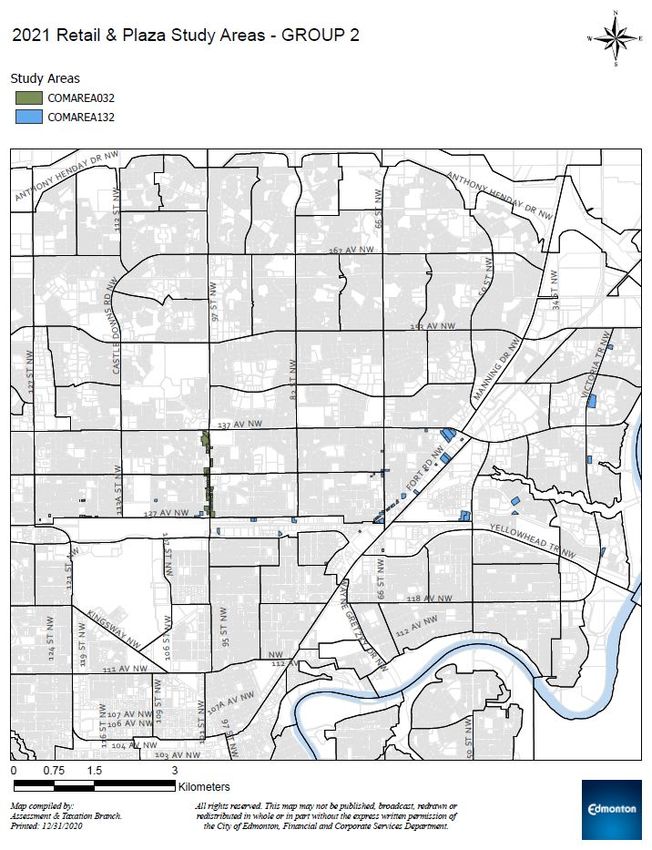
2021 Retail and Retail Plaza
Assessment Methodology Page | 2
Scope
This guide explains how Retail and Retail Plaza properties are valued for assessment purposes. The
guide is intended as a tool and complements the assessor’s judgment in the valuation process.
Introduction
Property assessments in the City of Edmonton are prepared in accordance with the requirements of
the Municipal Government Act, R.S.A. 2000, c. M-26, (hereinafter “MGA”) and the Matters Relating to
Assessment and Taxation Regulation, 2018, Alta Reg 203/17, (hereinafter “MRAT”). The MRAT regulation
establishes the valuation standard to be used, defines the procedures to be applied, and proposes
objectives for the quality to be achieved in the preparation of assessments. The legislation requires
the municipality to prepare assessments that represent market value by application of the mass
appraisal process. All assessments are expected to meet quality standards prescribed by the
province in the MRAT regulation.
Property assessments represent:
● an estimate of the value;
● of the fee simple estate in the property;
● as the property existed on December 31, 2020;
● reflecting typical market conditions;
● as if the property had been sold on July 1, 2020;
● on the open market;
● from a willing seller to a willing buyer.
The assessment is an estimate of the value that would result when those specific, defined conditions
are met.
The legislation requires the City of Edmonton to assess the fee simple estate.
“Fee simple interest [is] absolute ownership unencumbered by any other interest or estate…
leased fee interest [is] the ownership interest held by the lessor, which includes the right to
the contract rent specified in the lease plus the reversionary right when the lease expires…
leasehold interest [is] the interest held by the lessee (the tenant or renter) through a lease
conveying the rights of use and occupancy for a stated term under certain conditions.”
Appraisal Institute of Canada, T
he Appraisal of Real Estate Third Canadian Edition,
Vancouver, Canada, 2010, page 6.4
Copyright of this material and content is owned by the City of Edmonton and none of the content and material may be
copied, reproduced, posted or transmitted in any form without the prior written consent of the City of Edmonton, unless
otherwise being used in accordance with Section 299 and 300 of the Municipal Government Act, R
SA 2000, c M-26.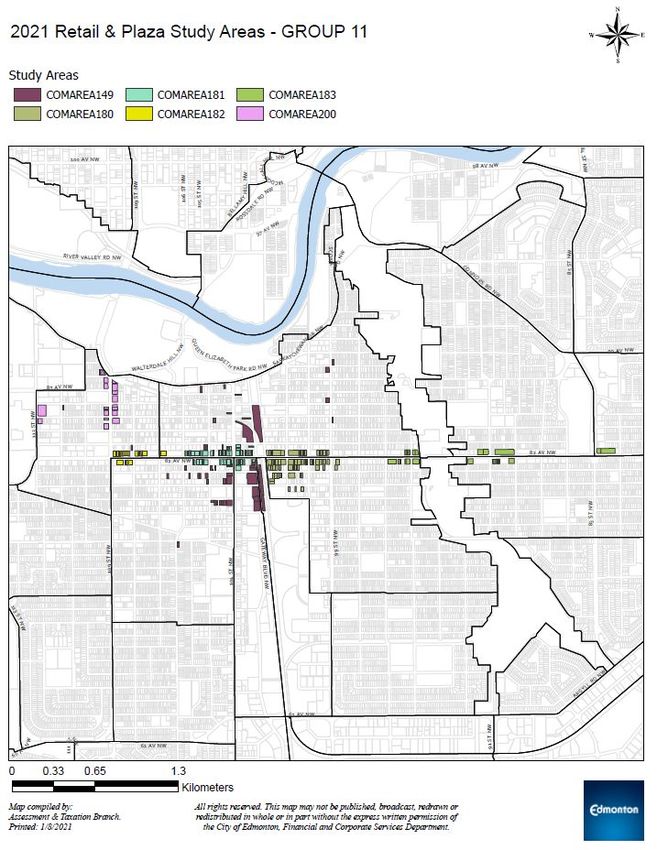
2021 Retail and Retail Plaza
Assessment Methodology Page | 3
Both market value and property, along with additional terms are defined in the M
GA and MRAT :
s.284(1)(r) “property” means
(i) a parcel of land
(ii) an improvement, or
(iii) a parcel of land and the improvements to it
MGA .s.284(1)(r)
s.1(k) “regulated property” means
(i) land in respect of which the valuation standard is agricultural use value,
(ii) designated industrial property, or
(iii) machinery and equipment
MRAT s.1(k)
s.9(1) the valuation standard for the land and improvements is market value unless
subsection (2)… applies
MRAT s.9(1)
s.1(1)(n) “market value” means the amount that a property, as defined in section 284(1)(r),
might be expected to realize if it is sold on the open market by a willing seller to a willing
buyer
MGA s.1(1)(n)
s.5 An assessment of property based on m arket value
(a) must be prepared using mass appraisal,
(b) must be an estimate of the value of the fee simple estate in the property, and
(c) must reflect typical market conditions for properties similar to that property
MRAT s.5
s.289(2) Each assessment must reflect
(a) the characteristics and physical condition of the property on December 31 of the
year prior to the year in which a tax is imposed
MGA s.289(2)(a)
s.6 Any assessment prepared in accordance with the Act must be an estimate of the value of
a property on J uly 1 of the assessment year
MRAT s.6
s.1(g) “mass appraisal” means the process of preparing assessments for a group of
properties using standard methods and common data and allowing for statistical testing
MRAT s.1(g)
Copyright of this material and content is owned by the City of Edmonton and none of the content and material may be
copied, reproduced, posted or transmitted in any form without the prior written consent of the City of Edmonton, unless
otherwise being used in accordance with Section 299 and 300 of the Municipal Government Act, R
SA 2000, c M-26.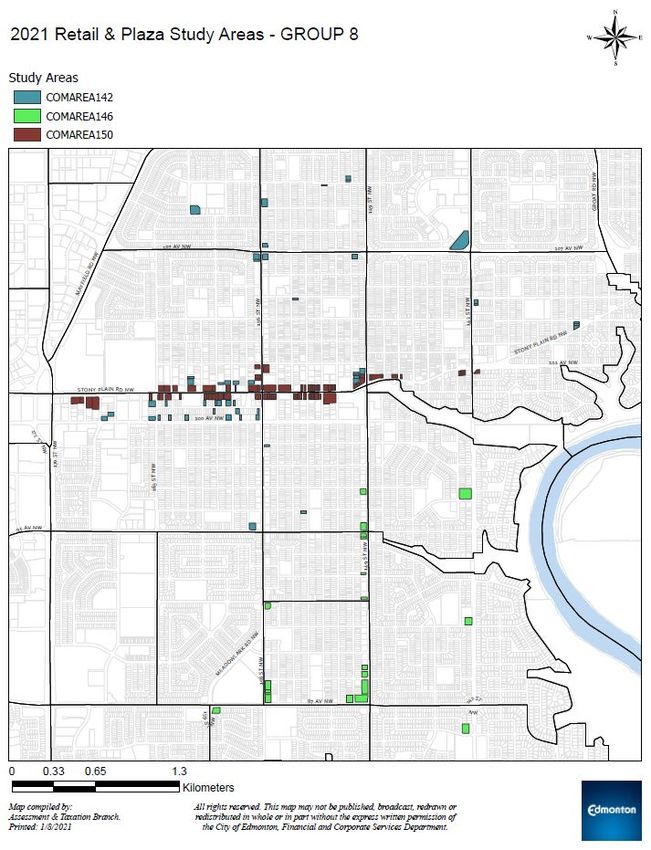
2021 Retail and Retail Plaza
Assessment Methodology Page | 4
Mass Appraisal
Mass appraisal is the legislated methodology used by the City of Edmonton for valuing individual
properties, and involves the following process:
● properties are stratified into groups of comparable properties
● common property characteristics are identified for the properties in each group
● a uniform valuation model is created for each property group
31(c) “valuation model” means the representation of the relationship between property
characteristics and their value in the real estate marketplace using a mass appraisal
process
MRAT s.31(c)
The following two quotations indicate how the International Association of Assessing Officers
distinguishes between mass appraisal and single-property appraisal:
“... single-property appraisal is the valuation of a particular property as of a given date: mass
appraisal is the valuation of many properties as of a given date, using standard procedures
and statistical testing.”
“Also, mass appraisal requires standardized procedures across many properties. Thus,
valuation models developed for mass appraisal purposes must represent supply and
demand patterns for groups of properties rather than a single property.”
Property Appraisal and Assessment Administration, pg. 88-89
Copyright of this material and content is owned by the City of Edmonton and none of the content and material may be
copied, reproduced, posted or transmitted in any form without the prior written consent of the City of Edmonton, unless
otherwise being used in accordance with Section 299 and 300 of the Municipal Government Act, R
SA 2000, c M-26.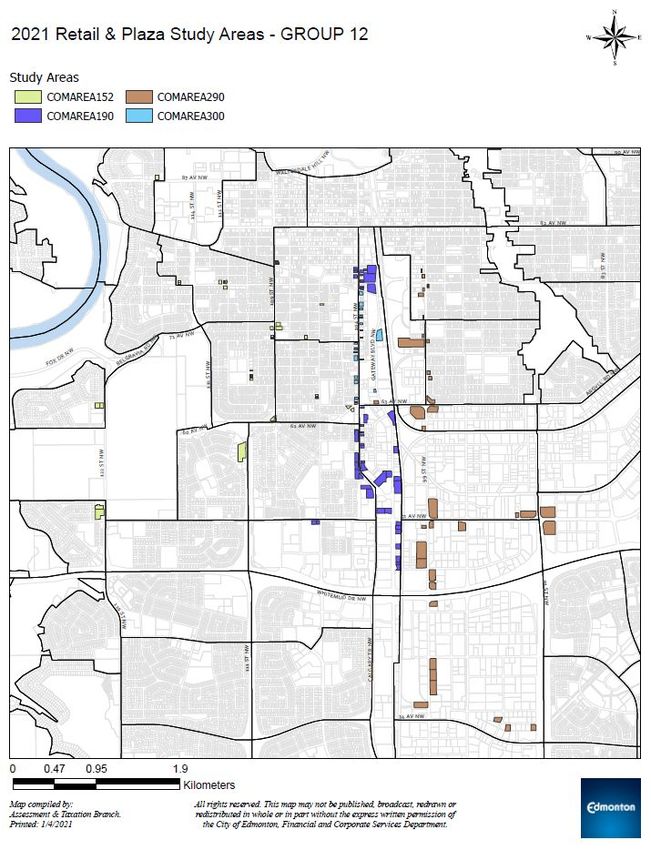
2021 Retail and Retail Plaza
Assessment Methodology Page | 5
For both mass appraisal and single-property appraisal, the process consists of the following stages:
Mass Appraisal Single Appraisal
Mass appraisal is used to The client specifies the nature
determine the assessment of the value to be estimated,
Definition and base for property taxation in this includes: rights to be
Purpose accordance with legislative valued, effective date of
requirements valuation, and any limiting
conditions.
Mass appraisal requires a The extent of data collection is
database of property specific to each assignment
Data Collection characteristics and market and depends on the nature of
information. the client’s requirements.
Mass appraisal is predicated Market analysis includes the
Market Analysis on highest and best use. analysis of highest and best
use
Valuation procedures are Subject property is the focus
predicated on groups of of the valuation. The analysis
Valuation Model comparable properties. of comparable properties is
generally six or less
The testing of acceptable The reliability of the value
analysis and objective criteria estimate is more subjective.
Validation
Acceptability can be judged by
the depth of research and
analysis of comparable sales
Copyright of this material and content is owned by the City of Edmonton and none of the content and material may be
copied, reproduced, posted or transmitted in any form without the prior written consent of the City of Edmonton, unless
otherwise being used in accordance with Section 299 and 300 of the Municipal Government Act, R
SA 2000, c M-26.
2021 Retail and Retail Plaza
Assessment Methodology Page | 6
Valuation Model
A valuation model creates an equation of variables, factors and coefficients that explains the
relationship between estimated market value and property characteristics. An assessed value is then
calculated by applying the appropriate valuation model to individual properties within a property
type.
s31 (a) “coefficient” means a number that represents the quantified relationship of each
variable to the assessed value of a property when derived through a mass appraisal
process
(b) “ factor” means a property characteristic that contributes to a value of a property;
(d) “variable” means a quantitative or qualitative representation of a property
characteristic used in a valuation model
MRAT, s.31 (a), (b) and (d)
s.33 Information prescribed … does not include coefficients
MRAT, s.33(3)
● variables are identified from property characteristics
● statistical analysis of how variables affect market value
Valuation ● factors and coefficients are determined
Model ● the resulting valuation models are applied to property
characteristics
Copyright of this material and content is owned by the City of Edmonton and none of the content and material may be
copied, reproduced, posted or transmitted in any form without the prior written consent of the City of Edmonton, unless
otherwise being used in accordance with Section 299 and 300 of the Municipal Government Act, R
SA 2000, c M-26.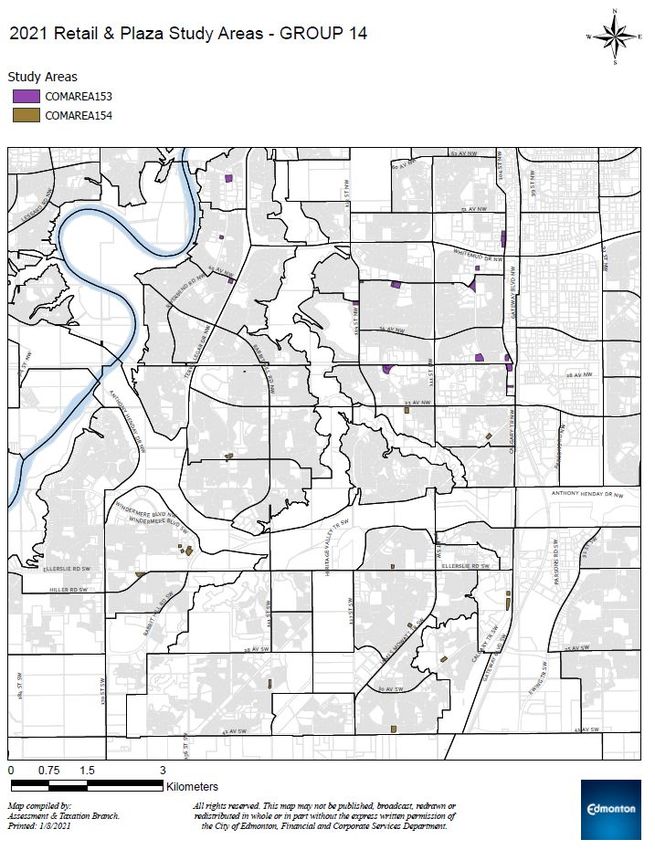
2021 Retail and Retail Plaza
Assessment Methodology Page | 7
Commercial Property Types
Retail properties are typically unanchored freestanding buildings. Multiple freestanding
buildings can be found on the same property. This includes street-front retail that may be
abutting other retail properties. They are typically pedestrian-oriented. In conjunction with
retail space, various uses on other floors can be found, such as residential and/or office
space. Some will have on-street parking with pedestrian traffic.
Retail Plazas are properties that consist of 3 or more retail spaces or units often laid out
in a continuous straight line (strip), a ‘U’ or ‘L’ shape configuration and are typically
unanchored. Each individual unit may have outside signage which can be seen from the
street. They are typically vehicle-oriented while some will have on-street parking with
pedestrian traffic. Generally, each unit has a separate customer entrance, some may be
accessed through a common corridor area. One or more retail orientated buildings may be
on the parcel.
There are other commercial property types in the marketplace, however only the pertinent
ones have been summarized below:
Residential Conversion properties were originally constructed for residential use. These properties
were converted to commercial retail use. Conversion changes to these buildings typically include the
removal of the residential kitchen and full bathrooms as they are not required for commercial retail
uses.
Retail and Office Condominiums are single units that are typically part of a larger building or
complex. Each unit as described on the condominium plan registered with the Land Titles Office has
its own certificate of title and can be bought and sold separately. Some properties are of mixed use
consisting of retail, commercial, and residential units.
Office buildings are designed for general commercial occupancy where the majority of the space
type is office use. Some of these typical uses include the offices of lawyers, accountants, engineers,
architects, real estate and insurance firms, health and government services and similar office
support services.
Shopping Centres are commercial establishments related in location, size, and type. Shopping
centre properties are grouped into two formats: open air and enclosed format properties. Enclosed
format properties are malls, which include super-regional, regional, and community shopping
centres. Open air format properties are described below:
Power Centres are typically large shopping developments, with one or more anchor(s)
and/or shadow anchor(s). Typically, these properties have direct exterior exposure and
access. They are commonly situated along major arterial roads. Power centres typically occur
over large commercial areas that include more than one parcel and it is not a requirement
that an anchor be on each parcel. Refer to definition of shadow anchor below.
Copyright of this material and content is owned by the City of Edmonton and none of the content and material may be
copied, reproduced, posted or transmitted in any form without the prior written consent of the City of Edmonton, unless
otherwise being used in accordance with Section 299 and 300 of the Municipal Government Act, R
SA 2000, c M-26.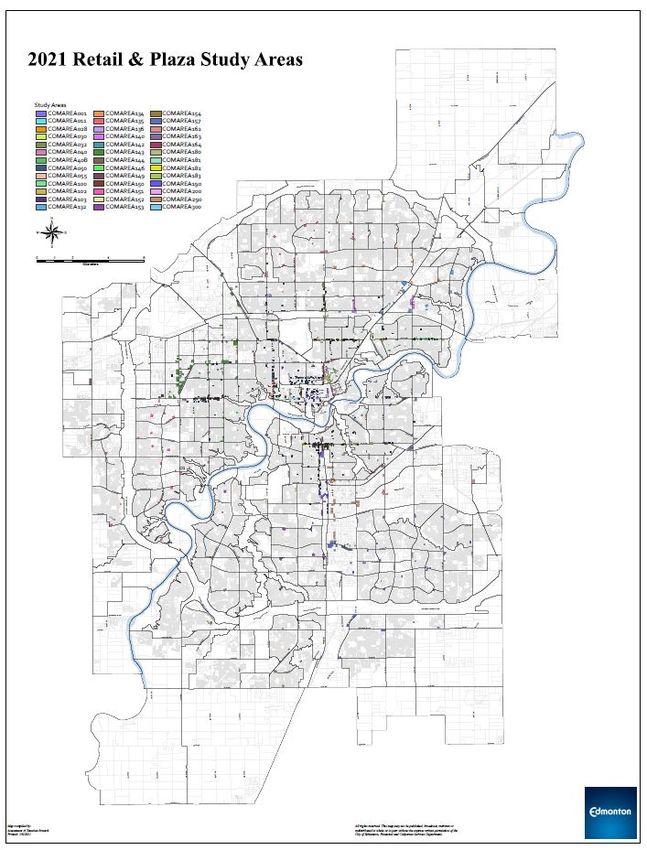
2021 Retail and Retail Plaza
Assessment Methodology Page | 8
Neighbourhood Shopping Centres are anchored and/or shadow anchored by a grocery
store or a drug store greater than 8,000 square feet. They typically provide for the sale of
convenience goods and personal services for the day-to-day living needs of the immediate
neighbourhood. Neighbourhood shopping centres typically occur over large commercial
areas that include more than one parcel and it is not a requirement that the anchor(s) be on
each parcel. Refer to definition of shadow anchor below.
Box Retail is typically a single site or stand-alone property and might not be directly abutted
by other retailers. They are commonly junior anchor sized spaces (see 2021 Neighbourhood,
Power & Box Retail Assessment Methodology guide for more information).
Anchor space typically has a gross leasable area of at least 60,001 square feet on the main floor, has
exterior access, and is often occupied by national retailers. They increase the attraction of
neighbouring commercial retail unit spaces. Anchor units have been further stratified based on
effective age. Older anchor spaces (1997 and older) have a lower rental rate than newer (1998 and
newer) anchor spaces. If upper level retail space is present for anchor space, it may be reflected on a
separate line on the Assessment Detail Report and receive a lower rental rate than the main floor,
based on 70% of the main floor rental rate.
Shadow Anchors are anchors that are a draw to the area, but they exist on a different legal parcel.
They can be seamlessly part of an adjacent shopping centre or in close proximity to a nearby centre.
The overall concept is that nearby properties are not required to be on the same legal parcel as the
anchor to benefit (e.g. through performance) from the traffic draw that the anchor generates to the
area.
Additional details are available in the 2021 Downtown Office, 2021 Suburban Office and 2021
Neighbourhood, Power & Box Retail Assessment Methodology guides, which are provided online at
Edmonton.ca.
Copyright of this material and content is owned by the City of Edmonton and none of the content and material may be
copied, reproduced, posted or transmitted in any form without the prior written consent of the City of Edmonton, unless
otherwise being used in accordance with Section 299 and 300 of the Municipal Government Act, R
SA 2000, c M-26.
2021 Retail and Retail Plaza
Assessment Methodology Page | 9
Approaches to Value
The approaches to determine market value are the direct comparison, income, and cost
approaches.
Direct Typical market value (or some other characteristic) is determined by
referencing comparable sales and other market data. It is often used
Comparison when sufficient sales or market data is available. It may also be referred
Approach to as the Sales Comparison Approach.
This approach considers the typical actions of renters, buyers and sellers
when purchasing income-producing properties. This approach estimates
Income
the typical market value of a property by determining the present value
Approach of the projected income stream. Often used to value rental or leased
property.
Typical market value is calculated by adding the depreciated replacement
Cost cost of the improvements to the estimated value of land. It is often used
Approach for properties under construction or when there is limited market data
available.
Income Approach
For this property type, the assessment is determined using the income approach. The income
approach best reflects the typical actions of buyers and sellers when purchasing income-producing
properties. The City of Edmonton requests financial information from owners during the annual
Request for Information (RFI) process.
Annually, property owners are required to provide the following via the RFI process:
● A completed Commercial Tenant Roll Form including information about space types (office,
retail, warehouse, storage); tenant location; lease term; lease rate; operating expenses;
tenant inducements and type; landlord and tenant improvements; escalations; other rent
(signage, percent rent) and vacant space.
● Year-end financial statements including the Income Statement, a Schedule of Income and
Expenses, and Notes.
● A complete Parking Details form including parking location, the number and type of stalls
and rate per stall.
● Yearly Expenses for owner occupied properties including power, water & sewer, gas, waste
removal, insurance and structural repairs.
For 2021, a second RFI was sent to property owners. The City sent a second RFI to request current
information reflecting the impact of COVID-19 from property owners. The City analyzed information
provided by property owners in response to both RFIs, including information reflecting the impact of
COVID-19.
The Income model analyzes the relationship between the variables of income producing properties
and their income. The City of Edmonton uses triple net rent in its Income model. For 2021
Copyright of this material and content is owned by the City of Edmonton and none of the content and material may be
copied, reproduced, posted or transmitted in any form without the prior written consent of the City of Edmonton, unless
otherwise being used in accordance with Section 299 and 300 of the Municipal Government Act, R
SA 2000, c M-26.2021 Retail and Retail Plaza
Assessment Methodology Page | 10
valuation, income information from July 1, 2015 to July 1st 2020 was analyzed. The resulting model
was then applied to the physical characteristics and attributes of every commercial property to
calculate each property’s market value assessment.
Sales information is received from Land Titles. Sales are validated. Validation may include;
conducting site inspections and interviews, reviewing land title, title transfers (change of ownership),
corporate searches, other land titles documents, sales validation questionnaires, and secondary
data collection. The resulting validated sales are used to develop capitalization rates to use in the
income approach. Sales reflect the condition of a property as of the sale date and thus may not
always be equivalent to their assessed value.
For 2021 valuation of Retail properties, sales occurring from July 1st, 2015 to June 30th, 2020 were
used. Time adjustments are applied to sale prices to account for any market fluctuations occurring
between the sale date and the legislated valuation date.
Income Approach Definitions
To provide a clear understanding of the terms used in the income approach, the following
definitions are supplied.
Typical Market Rent is the rent currently prevailing in the market for properties comparable to the
subject property (otherwise known as current economic rent). Current economic or market rents are
used to form the basis of the valuation as opposed to actual rents, because in many cases actual
rents reflect historical revenues derived from leases negotiated before the valuation date. In
determining potential gross income, the assessor is not bound by the contractual rent between the
landlord and tenant, but must determine rental income on the basis of what is typically paid in the
market at the time of valuation.
In order to estimate market typical rents for buildings in the Retail and Retail Plaza inventory for
2021 valuation, only new leases and lease renewals commencing within a 5 year period prior to the
valuation date have been considered. Lease step ups have not been used to derive the market
typical rents for the 2021 valuation as a large enough dataset is provided by the new and renewal
leases.
Base Rent / Net Rent is the stipulated or contract rent exclusive of additional charges to the
property (taxes, insurance, utilities and maintenance). Base and net rent do not include GST.
Triple Net Rent is the rental structure where the tenant (lessee) pays all charges to the property
(e.g.: taxes, insurance, utilities, maintenance) in addition to the stipulated or contract rent. Structural
repairs are excluded from the tenant responsibility.
Effective Rent generally defined, is the rental rate net of financial concessions such as periods of
free rent during the lease term. For 2021 valuation, there were no types of financial concessions that
were found to be typical in the marketplace for Retail and Retail Plaza properties. Therefore, no
adjustments were applied when determining typical market rents. Please see Tenant Improvement
Allowances and Tenant Inducements below.
Copyright of this material and content is owned by the City of Edmonton and none of the content and material may be
copied, reproduced, posted or transmitted in any form without the prior written consent of the City of Edmonton, unless
otherwise being used in accordance with Section 299 and 300 of the Municipal Government Act, R
SA 2000, c M-26.2021 Retail and Retail Plaza
Assessment Methodology Page | 11
Lease Types include gross leases, modified gross leases, single net leases, double net leases, and
triple net leases. These may not always mean the same thing in different markets. The expenses that
are included in each type of rent vary from market to market. In general, the following distinctions
can be made:
● Gross lease - tenant pays rent and property owner pays expenses
● Modified gross lease or Semi-gross lease - tenant and property owner share expenses
● Single net lease - tenant pays utilities and taxes or insurance, and property owner pays
structural repairs, property maintenance, and property taxes or insurance
● Double net lease - tenant pays utilities, taxes, and insurance, and property owner pays
structural repairs and property maintenance
● Triple net lease - tenant pays utilities, taxes, insurance, and maintenance, and property owner
pays for structural repairs only
● New is a new lease agreement of a tenant occupying a space that was vacant or
occupied by a previous tenant, may include tenant expansion.
● Renewal i s when a lease expires and the existing tenant signs a new lease term.
● Step-Up is a scheduled change to the rental rate within the term of the existing
lease.
Tenant Improvement Allowances is a dollar amount or allowance provided to the tenant by the
landlord for the renovation or completion of the interior finish, which may or may not equal the full
cost of construction or remodelling.
The City of Edmonton does not adjust for tenant improvement allowances. As the City is mandated
through legislation to assess the Fee Simple interest of each property, it is inherent that the estimated
market rent reflect fully finished space. When a tenant and landlord negotiate a base rental rate with
a tenant improvement allowance as part of the rental agreement, they have agreed upon the rent
that they believe the space can achieve as fully finished, not the rent it would achieve in its current
state.
Tenant Inducements are incentives provided by landlords either to attract new tenants or retain
existing tenants. Described below are the most common forms of tenant inducements:
● Common area expense or operating expense reimbursement is a form of tenant inducement
where operating expenses in excess of a predetermined base amount are reimbursed.
● Relocation Allowance is a credit offered by a landlord to cover relocation expenses incurred
by tenants.
● A buyout is a termination of an existing lease whereby the landlord agrees to pay the
remainder or terminate the original lease on behalf of the tenant.
● Cash payments are a signing bonus paid to tenants that enter into a new lease agreement.
● Free rent or discounted rent is an abatement of rent during some period of the lease term.
Free rent is a reduction in the face rental rate, the amount appearing on the face of the
lease, for a stated period of time. This adjustment is generally applied at the beginning of the
lease term. For example, a lease is signed with free rent for the first three months of a five
year lease.
Copyright of this material and content is owned by the City of Edmonton and none of the content and material may be
copied, reproduced, posted or transmitted in any form without the prior written consent of the City of Edmonton, unless
otherwise being used in accordance with Section 299 and 300 of the Municipal Government Act, R
SA 2000, c M-26.2021 Retail and Retail Plaza
Assessment Methodology Page | 12
Based on the information provided by the City of Edmonton through the RFI process, for 2021
valuation, tenant inducements and signage income were not typical in the marketplace for retail and
retail plaza properties. Therefore, no adjustments were applied when determining typical market
rent.
Operating Expenses (OE) are the periodic expenditures necessary to maintain the real property
and continue the production of the effective gross income; these are accounted for by the vacancy
shortfall and structural allowances in the Assessment Detail Report.
Common Area Maintenance (CAM) are the charges that reflect the costs of operating the interior
and exterior common areas of a commercial property, and therefore include expenses for cleaning,
utilities, heating, insurance, garbage & snow removal, and management fees.
Potential Gross Income (PGI) is the total current market rent for all space types that would be
collected if the property were fully occupied at the date of valuation. In estimating PGI, the assessor
distinguishes between market rent and contract rent. Market rent is the rate prevailing in the market
for comparable properties and is used in calculating market value by the income approach. Contract
rent is the actual amount agreed to by landlord and tenant.
Potential gross income is derived by multiplying all Gross Leasable Areas (GLA) in the building by
the current market rent for each particular space type.
X =
Vacancy Allowance is a deduction from the potential gross income for typical vacancy and
collection losses, assuming current market conditions and typical management. Vacancy losses are
best described as an allowance for vacant space. Collection losses are considered unpaid rents that
the landlord is unlikely to recover. These allowances are usually expressed as a percentage of
potential gross income.
Should a property demonstrate a history of higher than typical vacancy, the City may apply an
adjusted stabilized vacancy allowance (chronic vacancy). In order to qualify for chronic vacancy, a
property owner must provide the property’s rent rolls from the last 3 consecutive years
immediately preceding the valuation date to show that the property has had a vacancy rate that
falls within a range greater than the current typical. The rent rolls must show that the property has
experienced a vacancy greater than typical in each of the 3 preceding years. If this is demonstrated,
the average of the 3 years will determine which stabilized vacancy allowance is applied. The ranges
and the corresponding stabilized chronic vacancy allowances are demonstrated in the chart below.
The stabilized vacancy is applied on a per building basis. Storage space is not included in the vacancy
allowance calculation.
Copyright of this material and content is owned by the City of Edmonton and none of the content and material may be
copied, reproduced, posted or transmitted in any form without the prior written consent of the City of Edmonton, unless
otherwise being used in accordance with Section 299 and 300 of the Municipal Government Act, R
SA 2000, c M-26.2021 Retail and Retail Plaza
Assessment Methodology Page | 13
Actual Vacancy Stabilized Vacancy
(over three years)
≥ 10% to < 20% 10%
≥ 20% to < 30% 15%
≥ 30% to < 40% 20%
≥ 40% to < 50% 25%
≥ 50% to < 60% 30%
≥ 60% to < 80% 35%
≥ 80% to < 100% 40%
Effective Gross Income (EGI) is the anticipated income from all operations of real property
adjusted for vacancy and collection loss.
- =
Vacancy Shortfall is an expense related to the cost of carrying vacant space. Though the space is
vacant there are still costs associated with the space that the owner must pay, such as operating
expenses, heating, security, property taxes, etc. Storage space is not included in the vacancy
shortfall calculation.
X X =
Net Operating Income (NOI) is the actual or anticipated (before income tax) net income from the
operation of the property after deducting all expenses from the effective gross income but before
debt servicing costs. The term is often abbreviated to net income and sometimes stated as net
income before recapture.
- =
Structural Allowance (Structural Repair Percentage) is an allowance provided to cover items
which require periodic replacement because they wear out more rapidly than the building itself.
Typically, under the terms of conventional triple net leases, all operating expenses and property
taxes are fully recouped by the landlord from the tenant. The only exception relates to items of a
structural and or capital nature, which are normally excluded from such recoveries. Rather than
lump sum deductions, a structural allowance is applied annually over the economic life of the
property regardless of whether any expenses were incurred in any given year.
Overall Capitalization Rate (Cap Rate) reflects the relationship between the anticipated net
operating income from a single year (or an average of several years) and the total price or value of
the property. The cap rate converts net operating income into an indication of property value. The
cap rate, in its basic formula, is found by dividing net operating income by the sale price. The City of
Edmonton derives the typical cap rate by time-adjusting the sale prices of similar Retail and Retail
Copyright of this material and content is owned by the City of Edmonton and none of the content and material may be
copied, reproduced, posted or transmitted in any form without the prior written consent of the City of Edmonton, unless
otherwise being used in accordance with Section 299 and 300 of the Municipal Government Act, R
SA 2000, c M-26.2021 Retail and Retail Plaza
Assessment Methodology Page | 14
Plaza properties from the past 5 years to the valuation date; deriving a net operating income for
each of these sales using market typical rents, vacancy allowances and operating costs; and then
dividing the estimated net operating incomes by the time-adjusted sale prices.
÷
=
“Type” as indicated below specifies whether the variable applies to the account, unit, site or a
specific improvement:
● Account - An adjustment that is applied to a property account. A property account includes
the parcel of land and any improvements. .
● Unit - An adjustment that is applied to a condominium unit.
● Site - An adjustment that is applied to the parcel of land only.
● Building - An adjustment that is applied to the improvement only.
Copyright of this material and content is owned by the City of Edmonton and none of the content and material may be
copied, reproduced, posted or transmitted in any form without the prior written consent of the City of Edmonton, unless
otherwise being used in accordance with Section 299 and 300 of the Municipal Government Act, R
SA 2000, c M-26.2021 Retail and Retail Plaza
Assessment Methodology Page | 15
Sample Assessment Detail Report
Copyright of this material and content is owned by the City of Edmonton and none of the content and material may be
copied, reproduced, posted or transmitted in any form without the prior written consent of the City of Edmonton, unless
otherwise being used in accordance with Section 299 and 300 of the Municipal Government Act, R
SA 2000, c M-26.2021 Retail and Retail Plaza
Assessment Methodology Page | 16
Copyright of this material and content is owned by the City of Edmonton and none of the content and material may be
copied, reproduced, posted or transmitted in any form without the prior written consent of the City of Edmonton, unless
otherwise being used in accordance with Section 299 and 300 of the Municipal Government Act, R
SA 2000, c M-26.2021 Retail and Retail Plaza
Assessment Methodology Page | 17
Sample Manual Assessment Detail Report
Copyright of this material and content is owned by the City of Edmonton and none of the content and material may be
copied, reproduced, posted or transmitted in any form without the prior written consent of the City of Edmonton, unless
otherwise being used in accordance with Section 299 and 300 of the Municipal Government Act, R
SA 2000, c M-26.2021 Retail and Retail Plaza
Assessment Methodology Page | 18
Variables
Not all variables affect market value. Below is the list of variables that affect the assessment of Retail
and Retail Plaza properties for 2021.
Condition Size
Effective Year Built Space Type
Location Traffic Influence
Lot Location
The rates displayed on the Detail Report are determined based on one or more of the above
variables. For example; the valuation rates will vary based on space type, lot location, condition,
space type size, effective year built, traffic influence and location of the property. The capitalization
rate is based on a property’s physical condition and location.
Condition
The overall property condition has been rated using the following categories, generally described as:
Good:
● well maintained with high desirability;
● may have slight evidence of deterioration in minor components;
● often components are new or as good as new;
● high utility and superior condition.
Average:
● moderate maintenance;
● minor repairs or rehabilitation of some components required;
● within established norm for the era;
● normal deterioration for age.
Fair:
● below average maintenance;
● deferred maintenance requiring rehabilitation and/or replacement;
● discernible deterioration;
● reduced utility with signs of structural decay.
Poor:
● borderline derelict;
● far below average maintenance;
● major repairs and/or replacements are required.
Effective Year Built
The chronological age of a property adjusted to reflect an addition or significant renovation that
extends the improvement’s remaining economic life. The components that when replaced or
extensively renovated affect the remaining economic life of a property include the roof, the building
Copyright of this material and content is owned by the City of Edmonton and none of the content and material may be
copied, reproduced, posted or transmitted in any form without the prior written consent of the City of Edmonton, unless
otherwise being used in accordance with Section 299 and 300 of the Municipal Government Act, R
SA 2000, c M-26.2021 Retail and Retail Plaza
Assessment Methodology Page | 19
envelope (windows and doors, exterior siding, walls including insulation and vapor barrier, and
other structural components), the foundation, and mechanical components (electrical, plumbing and
HVAC). Completed additions to existing improvements will alter the effective age of a property.
Location
Retail and Retail Plaza properties are stratified based on geographic areas and are described below.
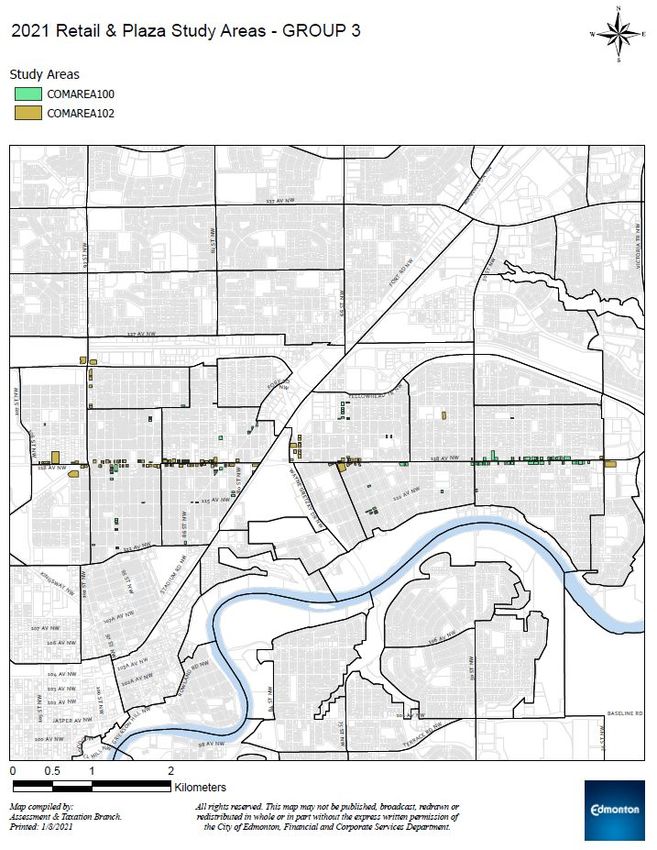
● Study Areas: Retail and retail plaza properties are stratified into study areas. Each study
area constitutes a geographic area. There are 39 distinct study areas. Detailed study area
maps can be found at the end of the methodology guide.
● Neighbourhoods: are geographic areas delineated in the City’s Neighbourhood Maps
found at http://maps.edmonton.ca. Neighbourhoods do not directly impact the
assessment values but typically neighbourhoods make up parts of the study areas as
defined above.
Lot Location
Lot location specifies whether a parcel of land is located on an interior lot or a corner lot. Refer to
Part I, Section 6.1(18) of the Edmonton Zoning Bylaw 12800 for further details regarding lot location.
● Corner Lot: Generally, a parcel of land located at the intersection of two public roadways
or abutting a public roadway, other than lanes.
● Interior Lot: Interior lot is any parcel of land other than a corner lot.
Size
Size refers to the total gross building area, gross leasable area, size of floorplate, and number of
stories.
Gross Building Area (GBA) is the total floor area of a building, including below-grade space but
excluding unenclosed areas, measured from the exterior of the walls. All enclosed floors of the
building including basements, mechanical equipment floors, penthouses, and the like are included
in the measurement. Parking spaces and parking garages are excluded.
Gross Leasable Area (GLA) is the total area designed for the occupancy and exclusive use of
tenants, including basements and mezzanines; measured from the center of joint partitioning to the
outside wall surface. Typically, the GLA reported by owners on their returned RFI documents is the
size used.
For the purposes of preparing retail property assessment, gross leasable area is calculated as
follows:
Main floor 95% of gross building area
Upper floors 90% of gross building area
Basement 90% of gross building area
Copyright of this material and content is owned by the City of Edmonton and none of the content and material may be
copied, reproduced, posted or transmitted in any form without the prior written consent of the City of Edmonton, unless
otherwise being used in accordance with Section 299 and 300 of the Municipal Government Act, R
SA 2000, c M-26.2021 Retail and Retail Plaza
Assessment Methodology Page | 20
For the purposes of preparing retail plaza assessment, the gross leasable area as reported on the
tenant roll form provided through the annual request for information (RFI) process is used.
Traffic Influence
Traffic influence is based on average annual weekday traffic volume counts as reported on the 2018
AAWDT Report: Average Annual Weekday Traffic Volumes Report. This report is accessible on the
City website: edmonton.ca.
None < 1,500 vehicles
Minor 1,500 – 5,000
Moderate 5,001 – 15,000
Major 15,001 – 50,000
Extreme > 50,000
Space Types
Auto Service i s an unfinished space designed for vehicles to enter the structure and generally there
are large bay doors. They may contain service pits or lifts. Typically, it consists of automobile service
bays, auto body repair and detailing, muffler, glass, oil, tire or mechanical repair services.
Apartment is a self-contained housing unit that occupies only part of a building.
Convenience Store or corner store, is a small store that stocks a range of everyday items such as
toiletries, soft drinks and tobacco products. Convenience Store space is defined by having either
built-in refrigeration units or improved electrical to allow for non-built-in refrigeration units.
Commercial Retail Units (CRUs) a re finished spaces designed to offer utility to an array of
commercial users. These units are typically located on the main floor with direct exterior or common
area access. They have been stratified based on gross leasable area as follows:
CRU < than or = to 1,000 ft2
CRU 1,001 to 3,000 ft2
CRU 3,001 to 5,000 ft2
CRU 5,001 to 10,000 ft2
CRU > than or = to 10,001 ft2
Bank is a space that has advanced security measures such as; reinforcement of walls, safes and
electronic deterrents and other features to keep the space secure.
Drug Store is specialized space for medical service and their construction will include secured areas
for controlled pharmaceuticals, clinic and retail area. Drug stores are larger than 3,500 square feet.
Office is space that is utilized, designed or intended for office use, and typically located on the
second floor or higher levels of a structure. Main floor office that experiences similar access and
exposure as retail units are valued as a CRU space for the purpose of valuation.
Copyright of this material and content is owned by the City of Edmonton and none of the content and material may be
copied, reproduced, posted or transmitted in any form without the prior written consent of the City of Edmonton, unless
otherwise being used in accordance with Section 299 and 300 of the Municipal Government Act, R
SA 2000, c M-26.2021 Retail and Retail Plaza
Assessment Methodology Page | 21
Restaurant is a food or beverage service establishment that contains a dedicated food or beverage
preparation area. May also contain a commercial kitchen area with improved ventilation, electrical
and plumbing. This space type is stratified based on gross leasable area as follows:
● Restaurant < than or = 3,000 ft2
● Restaurant > than or = to 3,001 ft2
Restaurant Fast Food is a food or beverage service establishment that has one or more drive-thru
windows. May also contain a commercial kitchen area with improved ventilation, electrical and
plumbing.
Theatre space is dedicated for film viewing, projection and supporting retail. Theatres built in 1989
and older are valued within the Retail & Retail Plaza inventory.
Storage Space is unfinished space that can only be used as storage as it does not offer utility for
other uses due to its small size, low ceiling height, lack of windows, lack of loading access, or its
location within the structure. Storage space offers less utility than warehouse space.
● Main Floor Storage is storage space located on the main floor. This space is differentiated
from warehouse space because it offers limited utility, often due to a lack of ramps, ceiling
height, or overhead doors.
● Upper Storage is storage space located on an upper floor, includes mezzanine space.
● Mezzanine is an intermediate floor between main floors of a building and usually smaller
than the main floor. A mezzanine typically has a low ceiling and may project in the form of
a balcony. Generally, mezzanine level cannot be leased or sold separately from the unit.
● Basement Storage i s storage space located below grade.
Upper Non-Storage is finished space located on an upper floor (excluding Apartment space). This
space typically commands a lower rent than main floor retail space.
Basement Non-Storage is finished space located below grade. This space typically commands a
lower rent than main floor retail space.
Warehouse is unfinished space located on the main floor that contains one or more bay doors, and
is typically utilized for storage, light manufacturing or product distribution.
Land Lease is a lease for a specific portion of land subject to specified terms. On the Retail and
Retail Plaza Assessment Detail Report, land leases are used exclusively for gas stations. The
improvements are valued based on their depreciated cost to construct under service station
equipment (SSE).
Copyright of this material and content is owned by the City of Edmonton and none of the content and material may be
copied, reproduced, posted or transmitted in any form without the prior written consent of the City of Edmonton, unless
otherwise being used in accordance with Section 299 and 300 of the Municipal Government Act, R
SA 2000, c M-26.2021 Retail and Retail Plaza
Assessment Methodology Page | 22
Other Value Adjustments
Adjustments may also be made for the following.
Additional Building is the assessed value added for other buildings situated on the subject parcel.
Associated Lots is a reduction to a primary improved property based upon a separate but related
associated parcel(s). This adjustment is applied when all, or part, of the land from the associated
parcel(s) is required to satisfy the operation of the primary property. The associated parcel(s) must
be owned by the same individual/corporation as the primary improved property or have a lease in
place with the primary improved property. As of the valuation date, The Edmonton Zoning Bylaw No.
12800 o
utlined the requirements to satisfy the operations of the primary property.
Buildings Under Construction are improvements that are not complete as of the condition date.
The adjustment is based on the cost rates from the Marshall & Swift manual, for the portion
completed (also called percent complete).
Construction Allowance (Shell Space Allowance) is an allowance provided for leasable space that
is without dividing walls, floor coverings, ceiling or other finishes. The adjustment is based on a $60
per square foot cost rate derived from the Marshall & Swift Manual. The construction allowance will
be applied to the difference when the amount of unfinished leasable space is greater than the
vacancy shortfall area applied (typical or chronic). If the amount of unfinished leasable space is less
than the vacancy shortfall area, an adjustment for shell space will not be made.
Contamination Site contamination refers to a property that has been affected by environmental
contamination which includes adverse conditions resulting from the release of hazardous
substances into surface water, groundwater, or soil.
Excess Land on an improved parcel is the land not needed to serve or support the existing
improvement. It is also the portion of the parcel not needed to accommodate the parcel’s primary
highest and best use. Excess land may be separated from the larger parcel (subdivided) and have its
own highest and best use, or it may allow for future expansion of the existing or anticipated
improvement. Excess land value is derived from assessed commercial land values. Please refer to
the 2021 Commercial Land Assessment Methodology.
Surplus Land is the land not necessary to support the highest and best use of the existing
improvement but, because of physical limitations, building placement, or neighborhood norms,
cannot be sold off separately. Surplus land may or may not contribute positively to value, and may
or may not accommodate future expansion of an existing or anticipated improvement. For the 2021
assessment, a 50% discount to the excess land rate was applied.
Service Station Equipment (SSE) service station equipment, including pumps, underground tanks,
canopy structures, car wash structures and equipment. The SSE is valued using the cost approach
based on the Marshall & Swift Manual. In addition, small free standing buildings may be on site, such
as a service garage.
Copyright of this material and content is owned by the City of Edmonton and none of the content and material may be
copied, reproduced, posted or transmitted in any form without the prior written consent of the City of Edmonton, unless
otherwise being used in accordance with Section 299 and 300 of the Municipal Government Act, R
SA 2000, c M-26.2021 Retail and Retail Plaza
Assessment Methodology Page | 23
Other Definitions
Actual Zoning is set by the Edmonton Zoning Bylaw No. 12800 and regulates the use and
development of a parcel. Edmonton Zoning Bylaw No. 12800 is available online at Edmonton.ca.
Derelict Property: An improvement may constitute a derelict property where the improvement is
unfit for occupancy and demonstrates severe deterioration to its physical condition. Derelict
properties will generally have exterior doors and windows boarded up, and will often be
uninhabitable on the basis of an order from Alberta Health Services, a Safety Codes Officer, or the
City of Edmonton Sustainable Development Department, Community Standards Branch, or Fire
Rescue Service. They often require extensive rehabilitation to the improvements or site to return
them to a useful state, or simply need to be redeveloped.
Effective Zoning is applied to reflect the current use and development of a parcel. The effective
zoning may differ from the actual zoning when current use differs from that which is permitted by
the actual zoning as subsequently amended by Edmonton Zoning Bylaw 12800 (ie. legal
nonconforming use).
Land Use Code defines the use of a property. The amount of a property subject to any specific Land
Use will be expressed as a percentage (%). Land Uses may be used for administrative reasons and
are not used in the valuation of Retail and Retail Plaza Inventory.
Site Coverage is the relationship, expressed as a ratio, between the total footprint area of the
improvement(s) and the amount of land associated with it. Site coverage is used to determine if
excess or surplus land exists.
Type specifies whether the variable applies to the account, unit, site, or building.
1. Account - An adjustment that is applied to the property on the account. The property on the
account includes the parcel of land and the improvements.
2. Unit - An adjustment that is applied to a condominium unit.
3. Site - An adjustment that is applied to the land.
4. Building - An adjustment that is applied to the building.
References
Appraisal Institute of Canada (2010). The Appraisal of Real Estate Third Canadian Edition. Vancouver,
Canada.
Eckert, J., Gloudemans, R., & Almy, R. (1990). Property Appraisal and Assessment Administration.
Chicago, Illinois: International Association of Assessing Officers.
Marshall and Swift Valuation Service, 2018, Corelogic Inc.
Province of Alberta. (2018). Matters Relating to Assessment and Taxation Regulation. Retrieved from
Service Alberta, Queen's Printer: http://www.qp.alberta.ca
Province of Alberta. (2018). Municipal Government Act. Edmonton, AB: Queen's Printer. Retrieved
from Service Alberta, Queen's Printer: h ttp://www.qp.alberta.ca
Copyright of this material and content is owned by the City of Edmonton and none of the content and material may be
copied, reproduced, posted or transmitted in any form without the prior written consent of the City of Edmonton, unless
otherwise being used in accordance with Section 299 and 300 of the Municipal Government Act, R
SA 2000, c M-26.2021 Retail and Retail Plaza
Assessment Methodology Page | 24
Study Area Maps
Copyright of this material and content is owned by the City of Edmonton and none of the content and material may be
copied, reproduced, posted or transmitted in any form without the prior written consent of the City of Edmonton, unless
otherwise being used in accordance with Section 299 and 300 of the Municipal Government Act, R
SA 2000, c M-26.2021 Retail and Retail Plaza
Assessment Methodology Page | 25
Copyright of this material and content is owned by the City of Edmonton and none of the content and material may be
copied, reproduced, posted or transmitted in any form without the prior written consent of the City of Edmonton, unless
otherwise being used in accordance with Section 299 and 300 of the Municipal Government Act, R
SA 2000, c M-26.2021 Retail and Retail Plaza
Assessment Methodology Page | 26
Copyright of this material and content is owned by the City of Edmonton and none of the content and material may be
copied, reproduced, posted or transmitted in any form without the prior written consent of the City of Edmonton, unless
otherwise being used in accordance with Section 299 and 300 of the Municipal Government Act, R
SA 2000, c M-26.2021 Retail and Retail Plaza
Assessment Methodology Page | 27
Copyright of this material and content is owned by the City of Edmonton and none of the content and material may be
copied, reproduced, posted or transmitted in any form without the prior written consent of the City of Edmonton, unless
otherwise being used in accordance with Section 299 and 300 of the Municipal Government Act, R
SA 2000, c M-26.2021 Retail and Retail Plaza
Assessment Methodology Page | 28
Copyright of this material and content is owned by the City of Edmonton and none of the content and material may be
copied, reproduced, posted or transmitted in any form without the prior written consent of the City of Edmonton, unless
otherwise being used in accordance with Section 299 and 300 of the Municipal Government Act, R
SA 2000, c M-26.2021 Retail and Retail Plaza
Assessment Methodology Page | 29
Copyright of this material and content is owned by the City of Edmonton and none of the content and material may be
copied, reproduced, posted or transmitted in any form without the prior written consent of the City of Edmonton, unless
otherwise being used in accordance with Section 299 and 300 of the Municipal Government Act, R
SA 2000, c M-26.2021 Retail and Retail Plaza
Assessment Methodology Page | 30
Copyright of this material and content is owned by the City of Edmonton and none of the content and material may be
copied, reproduced, posted or transmitted in any form without the prior written consent of the City of Edmonton, unless
otherwise being used in accordance with Section 299 and 300 of the Municipal Government Act, R
SA 2000, c M-26.2021 Retail and Retail Plaza
Assessment Methodology Page | 31
Copyright of this material and content is owned by the City of Edmonton and none of the content and material may be
copied, reproduced, posted or transmitted in any form without the prior written consent of the City of Edmonton, unless
otherwise being used in accordance with Section 299 and 300 of the Municipal Government Act, R
SA 2000, c M-26.2021 Retail and Retail Plaza
Assessment Methodology Page | 32
Copyright of this material and content is owned by the City of Edmonton and none of the content and material may be
copied, reproduced, posted or transmitted in any form without the prior written consent of the City of Edmonton, unless
otherwise being used in accordance with Section 299 and 300 of the Municipal Government Act, R
SA 2000, c M-26.2021 Retail and Retail Plaza
Assessment Methodology Page | 33
Copyright of this material and content is owned by the City of Edmonton and none of the content and material may be
copied, reproduced, posted or transmitted in any form without the prior written consent of the City of Edmonton, unless
otherwise being used in accordance with Section 299 and 300 of the Municipal Government Act, R
SA 2000, c M-26.2021 Retail and Retail Plaza
Assessment Methodology Page | 34
Copyright of this material and content is owned by the City of Edmonton and none of the content and material may be
copied, reproduced, posted or transmitted in any form without the prior written consent of the City of Edmonton, unless
otherwise being used in accordance with Section 299 and 300 of the Municipal Government Act, R
SA 2000, c M-26.2021 Retail and Retail Plaza
Assessment Methodology Page | 35
Copyright of this material and content is owned by the City of Edmonton and none of the content and material may be
copied, reproduced, posted or transmitted in any form without the prior written consent of the City of Edmonton, unless
otherwise being used in accordance with Section 299 and 300 of the Municipal Government Act, R
SA 2000, c M-26.2021 Retail and Retail Plaza
Assessment Methodology Page | 36
Copyright of this material and content is owned by the City of Edmonton and none of the content and material may be
copied, reproduced, posted or transmitted in any form without the prior written consent of the City of Edmonton, unless
otherwise being used in accordance with Section 299 and 300 of the Municipal Government Act, R
SA 2000, c M-26.2021 Retail and Retail Plaza
Assessment Methodology Page | 37
Copyright of this material and content is owned by the City of Edmonton and none of the content and material may be
copied, reproduced, posted or transmitted in any form without the prior written consent of the City of Edmonton, unless
otherwise being used in accordance with Section 299 and 300 of the Municipal Government Act, R
SA 2000, c M-26.2021 Retail and Retail Plaza
Assessment Methodology Page | 38
Copyright of this material and content is owned by the City of Edmonton and none of the content and material may be
copied, reproduced, posted or transmitted in any form without the prior written consent of the City of Edmonton, unless
otherwise being used in accordance with Section 299 and 300 of the Municipal Government Act, R
SA 2000, c M-26.You can also read


