Communication, Selection, and Negotiation - Module 5D Shipping, Packaging, and Customs Considerations
←
→
Page content transcription
If your browser does not render page correctly, please read the page content below

Communication, Selection, and
Negotiation
Module 5D Shipping, Packaging, and Customs Considerations
Motivation
Why is this module important?
Some research data to consider (Shockwatch Report, 2013):
43 percent of insurance claims made by shippers are due to
mechanical damage of the products during shipping
Another 15 percent are environment-related (water and
humidity)
Poorly conceived packaging can turn customers away from your
product
Inferior package design can cost you a lot in terms of shipping
damage
According to one study, the cost of goods damaged in-transit is
more than USD $4 billion annually—you can minimize many of
these costs by designing reliable and efficient packaging
2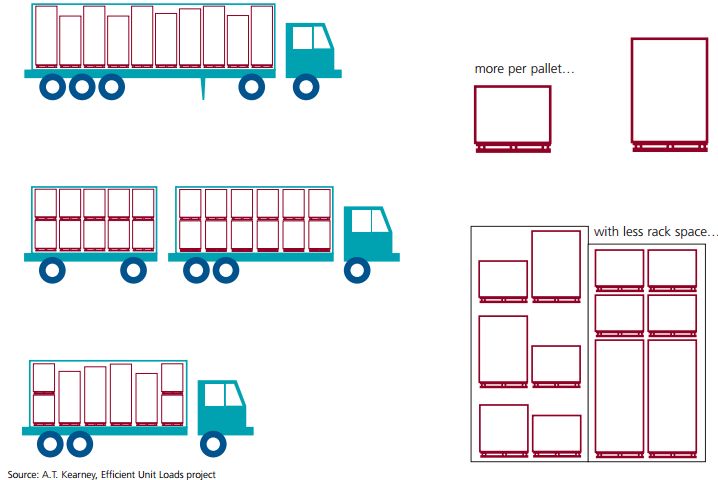
Motivation
Why is this module important? (cont.)
Shipping and packaging is one of the largest cost factors in the
total landed-costs equation
Knowing the industry rules and best practices can provide the
competitive edge you need to enter a new market!
3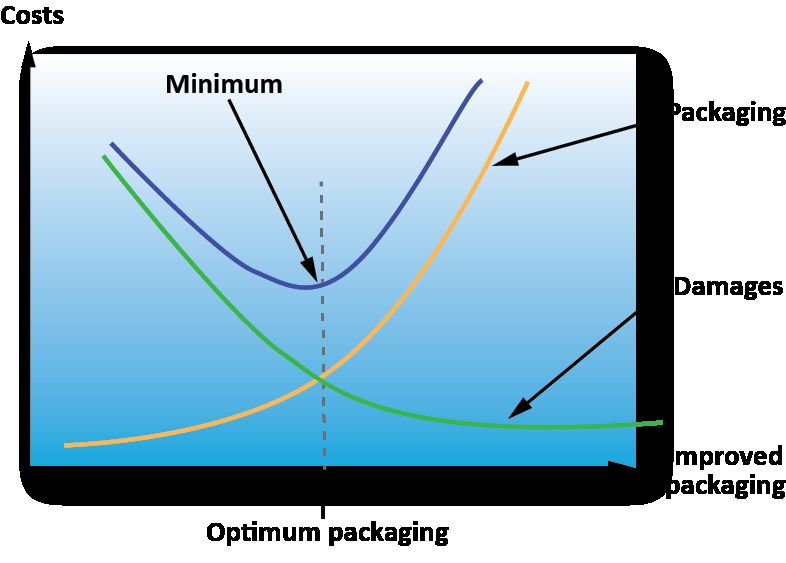
Shipping, Packaging, Customs
         Where does this fit into the development cycle?

            Concept                                                                                                         Launch
                                                                           Implement                   Production
PHASES

                                                 Product and
              and            Definition                                                                                       and
           Feasibility
                                                Process Design            and Validate                  and Stock           Closure

           Pre-alpha                            Alpha              Beta             Pilot               Ramp              Scale
BUILDS

            Concept                           Engineering         Design           Process
           Validation                          Validation        Validation       Validation
 PRODUCT DESIGN OBJECTIVES
          Market Research
                            Design Research
                                              Feasibility
                                                         Development
                                                                               Qualification
                                                                                                   Field Readiness
                                                                                                                           Launch
 MANUFACTURING READINESS LEVELS
          Levels:   1         2           3        4                 5     6          7        8       9             10
                         Mfg Research
                                              Mfg Development
                                                                   Mfg Capability
                                                                                    Mfg Capacity
                                                                                                            Production
                                                                                                                                      4
Module Outline
Learning objectives
Preparing your products for shipping
Introduction to packaging
Packaging costs and design requirements
Shipping documents
—Common shipping documents and regulatory requirements
—International shipment documentation
Total landed cost (TLC)
5Learning Objectives
LO1. Identify necessary packaging-related and shipping-related
regulatory requirements
LO2. Understand packaging cost factors
6What This Module Addresses
How do you prepare your goods for shipping?
What are important packaging considerations?
How packaging can influence your product design and materials
selection
Cost of packaging and how a good packaging decision can reduce
the shipping cost
What documents do you need to prepare for overseas shipping
and receiving
Understanding the best practices in shipping
Understanding the impact of packaging and shipping on total
landed cost
7Packaging/Shipping
Preparing products for shipment
Pack in strong containers, adequately sealed, and filled
whenever possible
Regardless of size, make sure the weight is evenly distributed to
provide proper bracing in the container
Goods should be palletized and containerized whenever possible
Consider packaging and unitizing alternatives
Packages and packing filler should be made of moisture-resistant
materials
To avoid pilferage, avoid writing contents
or brand names on
packages; other safeguards include using straps, seals, and
shrink wrapping
Observe any product-specific hazardous materials packing
requirements 8Packaging/Shipping
Checklist
Product safety
Product specifications
Quantity
Compliance with customer and regulatory shipping
requirements (regulatory documents and internal quality-
inspection report)
Packing customer compliant and secured?
100 percent inspection or sampling
Sign-off by quality inspector
9Packaging
Basics
Packaging considerations include preparing goods
for transport, distribution, storage, and retailing, as well as the
ultimate function/end use of the goods
Packaging includes both engineering (safety) and marketing
(communication) functions
Tip: A great starting method to evaluate packaging needs is to
evaluate the leading competitor and other like products. It is
critical to only consider those produced by credible, ethical,
reputable, well run, long standing companies. Leverage their
investment in internal and external resources as well as practical
experience that led to their current packaging and labeling format.
Use this as a data source while remembering that ultimately you
and only you are responsible for your products well being,
customer compliance, legal status etc.
10Packaging
Technical versus marketing
Technical packaging professionals need to apply science and
engineering skills, while marketing professionals provide insight
on artistic and aesthetics for understanding of consumer
motivation
Technical Functions Marketing Functions
Contain Communicate
Protect Promote
Dispense Display
Store Sell
Measure Motivate
Preserve Inform
11Packaging
Key functions
Contain:
How the packaging containment function is selected depends on
the form of the product (the product can range from all liquid,
solid/liquid mixture, free-flowing, non-free-flowing powder, solid
unit, discrete items, or multicomponent mix)
The nature of the product is also important (it may be corrosive,
corrodible, flammable, fragile, easily marked, under pressure,
hygroscopic, irregular in shape, sticky, odorous, toxic, perishable,
or aseptic)
12Packaging
Key functions (cont.)
Protect/Preserve:
“Protect” means preventing from any physical damage due to
accident and other travel incidents
“Preserve” usually refers to preventing biological and chemical
change in food (or similar biological/chemical) products so the
shelf-life of the products can be extended
13Packaging
Key functions (cont.)
Transport:
It underscores the safety of goods during transportation from
the point of production to the point of final consumption
One should consider various transport modes (truck, rail,
aircraft, cargo ship, etc.), handling techniques, and storage
conditions when selecting a package
Tip: Many transportation companies will assist you determining
your packaging needs and even test for you. i.e., UPS:
https://www.ups.com/us/en/services/customized-solutions/optimization-
logistics/package-engineering.page
https://compass.ups.com/ups-packaging-solutions-facility/
http://images.fedex.com/us/services/pdf/PKG_Testing_Under150Lbs.pdf
14Packaging
Key functions (cont.)
Inform/Sell:
It can be a good branding tool or medium to improve perceived
product quality
It deals with how a package communicates by its package
material, shape and size, color, predominant typography,
illustrations, recognizable symbols or icons, etc.
Government regulations can dictate how a message can be
presented on a package
Examples: how a product is named, quantity contained, and the
address of the responsible organization
15Packaging
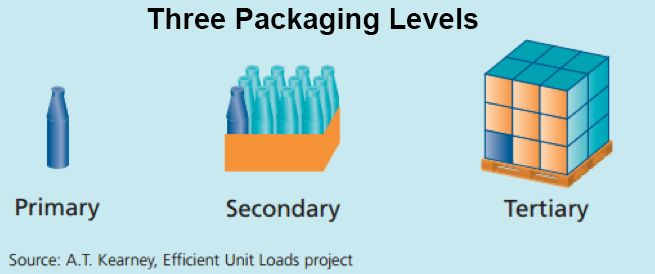
Examples - Levels of packaging
Plastic Bottles Cardboard Boxes Pallets
Individual Containers Plastic Trays Roll cages
16Packaging
Primary
Primary Package: The package, which has enclosed
the actual commodity, is called primary package. It refers to the
product’s immediate container. In some cases, the primary
package is kept until the consumer is ready to use the product
(i.e., plastic packet for socks); whereas in other cases, it is part of
the product (i.e., a toothpaste tube, ketchup bottle, etc.) and is
used throughout the life of the product.
For Primary Packaging that is for organizing or protecting the
product, such as a clear bag or film, it is also often called the
“Inner Pack.”
—A product with an inner pack then has Primary
Secondary Packaging.
Secondary
Source: http://www.qsstudy.com/business-studies/levels-of-packaging 17Packaging
Secondary
Secondary Packaging: The layer of cover added to the primary
package for its protection is called secondary package. It refers
to additional layers of protection that are kept until the product
is ready for use, i.e., a tube of toothpaste usually comes in a card
board box.
When consumers start using the toothpaste , they will dispose
off the box but retain the primary tube. Often called the “Outer
Pack.”
For retail products this is the packaging the
product is seen in when sitting on the shelf. Primary
Secondary
Source: http://www.qsstudy.com/business-studies/levels-of-packaging 18Packaging
Transit/transportation
Transportation Packaging: Transportation package is used to
facilitate identification, transportation, handling, and storing of
the products. It refers to further packaging components
necessary for storage, identification, or transportation. For
example a toothpaste manufacturer may send the goods to
retailers in corrugated boxes containing 10, 20, or 100 units.
Often called the “Master Carton or Pack.” It also includes things
like “Gaylord”, wooden crates etc. that are needed for transport.
Primary
Secondary
Transit
Source: http://www.qsstudy.com/business-studies/levels-of-packaging 19Packaging
Efficiency through unitization and palletization
Unit loads:
A unit load is a combination of products that are put together to
improve transportation and materials handling function.
Includes secondary items like cardboard boxes and plastic trays
that are used to contain primary products, and tertiary items like
pallets and roll cages, which are then used to unitize secondary
items.
According to a European consumer response report, “Unit loads
represent a key cost driver since they impact on transport,
storage, handling and packaging, estimated to account for 12–15
percent of retail sales price.”
20Packaging
Efficiency through unitization and palletization
Palletization of loads:
Loads are most commonly unitized on pallets, which allows use
of forklift truck or similar equipment for handling.
Most pallets are made of hard wood—denser and stiffer woods
are preferred for durability although they can be costlier than
other woods. Plastic is becoming more popular as the food
industry and other sterile or “particle” sensitive manufacturers
are required to use plastic. Use of GPS & RFID devices and
concern with recycling will also increased future use of plastic.
There are many possible pallet sizes and designs; however, for
the sake of standardized distribution, certain sizes and designs
predominate
21Packaging
Efficiency through space utilization
The advantage of unit load is that it packs tightly
into warehouse racks, intermodal containers, trucks, and
boxcars; yet it can be easily broken apart at a distribution point,
usually a distribution center.
Note: Figures show
More per pallet… how products can be
unitized to improve
the utilization of
With less space in a container.
rack space…
There are no one-to-
one correspondence
between trucks (on
the left) and racks
(on the right).
Source: A.T. Kearney, Efficient Unit Loads project
22Packaging
Design requirements
Functional requirements:
Consumer packaging (directed at a household) should provide
safe containment for the product and sufficient information to
user about how to use.
Commercial packaging (directed at a commercial enterprise)
should be attractive to the customers, provide a competitive
advantage, and be easy to store and stock.
23Packaging
Design requirements (cont.)
Distribution and safety:
Product labeling
The goal of the product labelling is to provide products details,
directions of use, and other relevant information to the
consumer
Sales requirements
Aesthetics, perceived quality of the product, and brief but
adequate product information for customers
24Packaging
Design requirements (cont.)
Unitization considerations:
Rigid containers
Flexible containers
Communication considerations:
Universal Product Code (UPC)
Electronic Product Code (EPC)
Radio-frequency identification (RFID) technology
Materials-handling considerations:
Pallets, fork-lift trucks, rider trucks, conveyers, etc.
25Packaging Costs
Contributing factors
Customer requirements (product type and materials, functional
requirements, sales requirements)
Packaging materials cost
Recyclability and reusability of packages
Shipment quantity (i.e., enough for palletization?)
Government regulations (i.e., safety and environmental
considerations)
26Packaging Costs
Tradeoffs
Packaging cost can increase exponentially as we
move from low to very low damage rate
The point where the total cost (packaging cost + cost of damage)
is minimum provides a desirable packaging design
Costs
of Package Packaging
Damages
Cost to
Improve
Optimum Packaging
Source: Adapted from Yam (2009) Packaging 27Documentation/Requirements
Common shipping documents
Bill of lading (BOL):
A required document to move a freight shipment
Serves as a receipt of freight services, conveys the freight terms,
and serves as a contract for carriage and a delivery receipt
An official document that may be admissible in court of law and
is issued by the shipping company
Freight bill:
Similar to BOL except that it does not serve as a key piece of
“evidence” in a dispute
Can include additional charges, information, or stipulations that
further clarify the information on the BOL
28Documentation/Requirements
Common shipping documents (cont.)
Freight claims:
A demand by a shipper or consignee upon a carrier (as for
reimbursement of an overcharge, or for loss or damage to goods
accepted for transportation).
Freight claims occur for various reasons; some are real, some are
contrived, some can be prevented, but they all can be controlled,
understood, and kept to acceptable, understandable, and
reconcilable levels.
29Documentation/Requirements
Regulatory requirements
Occupational Safety and Health Administration (OSHA)
requirements:
Under the Occupational Safety and Health Act of 1970 (OSH
Act), employers are responsible for providing a safe and
healthful workplace.
OSHA's mission is to ensure safe and healthful workplaces by
setting and enforcing standards, and by providing training,
outreach, education, and assistance.
Employers must comply with all applicable OSHA standards
Employers must also comply with the “General Duty Clause” of
the OSH Act, which requires employers to keep their workplace
free of serious recognized hazards.
30Documentation/Requirements
Regulatory requirements (cont.)
E-Fulfillment/Third-Party Logistics/Pick-and-Pack:
In broad terms, e-Fulfillment is an amalgamation of all the
people, processes, and technology employed to deliver an online
order to a customer.
The key is to make all of these come togetherto create a
positive customer experience before, during, and after a sale.
It includes everything from the online checkout process,
payment provider, and order management system; to the steps
taken to pick, pack, and ship the order.
At the end of 2014, U.S. e-trail sales surpassed $300 billion for
the first time—This number is expected to keep growing as
online shopping continues to increase.
31Documentation/Requirements
Regulatory requirements (cont.)
Environmental concerns:
The normal shipping hazards in the freight environment can vary
by mode.
Truckload, LTL, railcar, oceanic, and airfreight shipping
environments typically include hazards that are unique to those
modes, as well as their common hazards.
Many of the more severe hazards are due to the number of
separate handlings required and the mechanized material-
handling equipment used.
32Overseas Shipping
Considerations
Handling and determining method of shipping:
Consult with a freight forwarder to determine the method of
international shipping.
Usually consists of large and bulky shipments, so it requires a
long lead time and advance booking for a space on board a
transport.
The common practice is to have a multi-modal transit (more
than one means of transportation such as truck, rail, barge,
airplane, ship, etc.) operators take the full responsibility for the
entire movement of goods from factory to your final (i.e.,
customer) destination.
33Overseas Shipping
Considerations (cont.)
Factors to consider when determining international shipping
methods:
Cost of shipment
Delivery schedule
Accessibility to the shipped product by your foreign buyer
Check Mandatory Screening of Cargo on Passenger Flights if
shipped by a passenger aircraft
34Overseas Shipping
Considerations (cont.)
Other important considerations for international shipping:
Packaging and labeling
Cargo insurance
When shipping agricultural products, check the U.S. government
regulation at Ship Your Agricultural Products
35Preparing Products For Export Considerations Need to comply with both U.S. and foreign government regulations Product classification: Finding the Harmonized System (HS) code is the starting point to classifying a product and preparing it for export. The international HS is administrated by the World Customs Organization, and serves as the foundation for the import and export classification systems used in the United States. The U.S. import classification system, the Harmonized Tariff Schedule (HTS) administered by the U.S. International Trade Administration Commission (USITC), and the U.S. export classification system, the Schedule B administered by the U.S. Census Bureau, Foreign Trade Division, both rely on the international HS codes for their 4-digit and 6-digit headings and subheadings. 36
Preparing Products For Export
Considerations (cont.)
Rules of origin (ROO):
To take advantage of the reduced-duty benefits under a free
trade agreement (FTA), an exported product must originate from
an FTA party, or must contain a specified percentage of U.S.
inputs and components.
Each FTA has its own ROOs that describe how exported goods
shipped to a country or a region may qualify for duty-free or
reduced-duty benefits.
Because the ROOs are FTA-specific and product-specific, they
need to be followed carefully.
Foreign Standards and Certificates:
Research US Trade Partner Countries to understand the trade
benefits due to free trade and other agreements (export.gov)
37Importing Into The United States
Best practices
Review import rejection laws and trade barriers
Build relationships and network on the ground in the export
country
Hire a customs broker
Check license or permit requirements for importing certain
goods
Get assistance and training
More information on this subject can be found at
https://www.sba.gov/blogs/importing-goods-us-introductory-guide-small-
business-owners
Note: Customs brokers are private individuals, partnerships, associations or
corporations licensed, regulated and empowered by U.S. Customs and Border
Protection (CBP) to assist importers and exporters in meeting Federal requirements
governing imports and exports. 38U.S. Customs
Import Industry Guide
A comprehensive report that provides information on the
following:
Packaging requirements
Customs documents
Internet purchases
Intellectual property rights
Toxic Substance Control Act (TSCA)
International trade agreements
A detailed report can be found at:
http://www.dhl-
usa.com/content/dam/downloads/us/express/local_other/dhl_us_customs_im
port_guide.pdf
39Documentation/Requirements
International transport documentation
Exporting documents:
BOL, dock receipt, delivery instructions, export declaration,
letter of credit, consular invoice, commercial invoice, insurance
certificate, and transmittal letter
Importing documents:
Arrival notice, customs entries, carrier’s certificate and release
order, delivery order, freight release, and special customs invoice
(if applicable)
Note: For definitions and explanations of these documents, visit
www.export.gov
40Total Landed Cost
What it is and how to use it
Total
Total
Landed
Landed
Cost
Cost
Overhead and Risk and Logistics and
Purchase Inventory
Administrative Compliance Transportation Customs
Price Cost
Cost Cost Cost
TLC is the sum of all costs associated with making and delivering
products to the point where they produce revenue
Allows business models to optimize the supply chain
Identifies hidden costs in the supply chain
Reduces working capital, thereby improving cash flow
Packaging and shipping costs are huge drivers of your
logistics and transportation cost
41TLC Drivers
Purchase price
The base price of sourcing the associated goods and/or materials
—it includes the following:
The price of goods paid to the seller
Banking fees if and where applicable
Currency exchange rates
—Choosing which currency to use for purchasing is very
important
—Currencies with low volatility lead to reduction of risk and
handling
42TLC Drivers
Overhead/administrative costs
Includes cost terms that cannot be attributed directly to a
product:
It depends upon the hierarchy/levels present in an organization
particularly when it comes to purchasing decision approval
process (usually, the greater the hierarchy, the higher the cost
and inefficiency)
Banking fees if and where applicable
Cost of material handling, manufacturing overhead costs, and
oversight costs
43TLC Drivers
Transportation/logistics costs
Includes the line-haul cost, domestic/international
shipping alongside packaging and insurance costs—it depends on
the following factors:
The geographical distance traversed to deliver the product to the
customer
The total travel time (base trip time + refuelling time + loading
time + border crossing time [for land shipping])
Incoterm to be used, detailing the rules and regulations
regarding goods transportation
—Type of packaging being used; taking care to ensure that risk
of product damage is minimum
—Labor and fuel cost, and expedited shipping cost (if applicable)
—International trade agreements
Examples: http://www.dovelogistics.com/inco-terms-2016/
44TLC Drivers
Customs
Includes the customs inspection, taxes, broker fees, and the
merchandise processing fee (MPF)—the important factors to
consider are:
Applicable duties and taxes, with the objective of minimizing the
tax burden
Location of offshore production facility (if applicable)
The country to which the product is shipped, since the customs
and taxes vary vastly amongst different countries
45TLC Drivers
Inventory cost
It consists of the value of the safety/cycle stock, the value of the
inventory-in-transit, etc:
Safety stock: the minimum inventory level to prevent stock-outs
(associated with lead-time variability and demand)
Cycle stock: the minimum inventory required to meet customer
demands between inventory replenishment runs
Cost of inventory: it depends on the company’s business policy
and production locations
46TLC Drivers
Risk/compliance cost
It is the cost of complying with regulations and trade policies and
the cost of potential risks—including:
Updating with respect to changes in government rules and
guidelines
—Non-adherence could result in the disruption of the entire
product supply chain
Possibility of damaging the brand name
—This can occur by not meeting safety and/or health standards
or causing damage to the environment
Possibility of product recall due to defects
—This can lead to the occurrence of a reverse supply chain
47TLC Calculation
Example
Company Overhead and
Customer
US Selling Risk and Logistics and
in Administrative Compliance Inventory
Transportation Customs in
Price Cost Cost Cost London
USA Cost
$299 $15 $30 $10 $75* $45
This is a breakdown of the cost incurred for delivering an
electronic product shipment from the manufacturer in the US to
the customer in London
TLC = $299 + $15 + $30 + $10 + $75 + $45 = $475
Contribution (%) of shipping and packaging cost on:
TLC = $75/$475 = 15.8%
Note: *Includes Packaging Cost + Inland Freight + Air/Sea Freight
48References/Resources
Johnson, M. D., Sawaya, W. J., and Natarajarathinam,
M. (2013), A methodology for modelling comprehensive
international procurement costs. International Journal of
Production Research, 51(18), 5549-5564.2
World Industrial Reporter (2012) - Managing Your Supply Chain:
Accurately Calculating Total Landed Costs
https://www.worldindustrialreporter.com/wp-
content/uploads/2012/09/Calculating-Landed-Costs1.pdf
Supply Chain Digest (2008) - Global Supply Chain News: Getting
to Accurate Total Landed Costs
http://www.scdigest.com/assets/On_Target/08-06-09-1.php
Landsberg (2015), Reduce Shipping Costs with Package Redesign
Whitepaper http://resources.landsberg.com/wp-
content/uploads/2014/07/reduce-costs-packaging-redesign-whitepaper.pdf
49References/Resources
(Cont.)
Online articles:
http://news.ewmfg.com/blog/7-ways-to-reduce-packaging-costs
http://www.nosco.com/blog/5-ways-to-reduce-packaging-costs/
http://www.mckinsey.com/business-functions/operations/how-we-help-
clients/reduce-packaging-costs
The Efficient Unit Loads Report, Efficient Consumer Response
(ECR), Europe, PP.10, 46
http://ecr-all.org/wp-content/uploads/pub_1997_efficient_unit_loads.pdf
The Efficient Unit Loads Report, Efficient Consumer Response
(ECR), Europe, PP.13
http://ecr-all.org/wp-content/uploads/pub_1997_efficient_unit_loads.pdf
50References/Resources
(Cont.)
Adam Robinson (2014), Freight Bill vs. Bill Of Landing:
Knowing the Difference is Key to Effective Logistics, PP. 1
http://cerasis.com/2014/01/23/freight-bill-vs-bill-of-lading/
“Freight Claim” (entry), Merriam Webster Dictionary,
Online Edition http://www.merriamwebster.com/dictionary/freight%20claim
TransportGistics, Over, Short and Damage Claims or Loss and
Damage Claims http://www.insourceaudit.com/Whitepapers/ldclaims.asp
Occupational Safety
and Health Administration, United States
Department of Labor https://www.osha.gov/law-regs.html
Knox, Jillian (2016), 5 Things Everyone Should Know About
eFulfillment Services, PP.1 https://www.nchannel.com/blog/efulfillment-
services/
51References/Resources
(Cont.)
Anonymous (2014), Guide to Packaging Freight Shipments,
Institute of Packaging Professionals. PP.3
https://www.iopp.org/files/IoPPFreightShippingGuidelines8414.pdf
Anonymous (2014), Product Classification, export.gov
https://www.export.gov/article?id=Find-HS-Code
Anonymous (2016), Rules of Origin, export.gov
https://www.export.gov/article?id=Rules-of-Origin
Beesely, Caron (2016), Importing Goods into the U.S. – An
Introductory Guide for Small Business Owners, Managing a
Business, PP.1
https://www.sba.gov/blogs/importing-goods-us-introductory-guide-small-
business-owners
52References/Resources
(Cont.)
Anonymous (2010), Mandatory Screening of Cargo
on Passenger Flights, export.gov
http://2016.export.gov/articles/eg_main_021809.asp
Introduction and history of packaging development – module 1,
history of packaging development – lesson 1
http://ecoursesonline.iasri.res.in/mod/page/view.php?id=6193
Introduction and history of packaging development – module 1,
importance of Packaging– lesson 2, PP.1
http://ecoursesonline.iasri.res.in/mod/page/view.php?id=6195
TransportGistics, Over, Short and Damage Claims or Loss and
Damage Claims http://www.insourceaudit.com/Whitepapers/ldclaims.asp
Occupational Safety
and Health Administration, United States
Department of Labor https://www.osha.gov/law-regs.html
53References/Resources
(Cont.)
Benton, Jr. W. C., 1948-Purchasing and supply chain
management, New York, NY, McGraw-Hill
Anonymous (2016), ‘Agricultural Products’, export.gov
https://www.export.gov/article?id=Sector-Specific-Considerations-Agricultural-
Products
Anonymous (2016), United States Customs Import Industry
Guide, DHL
http://www.dhlusa.com/content/dam/downloads/us/express/local_other/dhl
_us_customs_import_guide.pdf
Anonymous (2016), Rules for International trade as defined by
Incoterms @ 2016 http://www.dovelogistics.com/inco-terms-2016/
Kit, L. Yam (2009), The Wiley Encyclopedia of Packaging
Technology, 3rd edition, PP.1242.
54List of Acronyms
3PL – Third Party Logistics
LTL – Less Than Load
HS – Harmonized System
HTS – Harmonized Tariff Schedule
USITC – U.S. International Trade Administration Commission
FTA – Free Trade Agreement
ROO – Rules Of Origin
55List of Acronyms
(cont.)
MRL – Manufacturing Readiness Level
TLC – Total Landed Cost
UPC – Universal Product Code
EPC – Electronic Product Code
RFID – Radio Frequency Identification
BOL – Bill of Lading
OSHA – Occupational Safety and Health Act
56List Of Terms
In glossary
Unit Load combines individual items or items in shipping containers into single "units" that can be moved easily with
a pallet jack or forklift truck.
Process Validation is the analysis of data gathered throughout the design and manufacturing of a product in order to
confirm that the process can reliably output products of a determined standard.
Manufacturing Capacity is the volume of products or services that can be produced by an enterprise using current
resources. Three commonly used definitions of capacity are as follows: design capacity, effective capacity & actual
output. (Repeat from 2B)
Production is the processes and methods used to transform tangible inputs (raw materials, semi-finished goods,
subassemblies) and intangible inputs (ideas, information, knowledge) into goods or services.
Primary Package is the first-level product packaging such as the bottle, can, jar, tube, etc., that contains the item sold.
It is the last packaging thrown by the consumer.
Secondary Package encloses the primary packaging, such as toothpaste tube in its box.
Transportation Packaging is designed to protect goods that are in transit, especially products that are shipped by truck
or train. However, the supply chain often includes other modes of transportation as well. Therefore, transport
packaging needs to be designed for both the local conditions and the export conditions if the goods are sent from one
country to another.
Unit Load combines individual items or items in shipping containers into single "units" that can be moved easily with a
pallet jack or forklift truck.
Palletization of Loads is a method of storing and transporting goods stacked on a pallet, and shipped as a unit load. It
permits standardized ways of handling loads with common mechanical equipment such as fork-lift trucks.
Universal Product Code UPC) is a barcode symbology that is widely used in the United States, Canada, United
Kingdom, Australia, New Zealand, in Europe and other countries for tracking trade items in stores. UPC (technically
refers to UPC-A) consists of 12 numeric digits, that are uniquely assigned to each trade item.
57List Of Terms
In glossary (cont.)
Electronic Product Code (EPC) is designed as a universal identifier that provides a unique identity for every physical
object anywhere in the world, for all time.
Radio-Frequency Identification (RFID) Technology uses electromagnetic fields to automatically identify and track tags
attached to objects. The tags contain electronically stored information.
Bill of Lading is a document issued by a carrier (or his agent) to acknowledge receipt of cargo for shipment.
Freight Bill is a carrier's invoice for freight charges applicable to a shipment. Also called freight invoice.
Freight Claims is a legal demand by a shipper or consignee to a carrier for financial reimbursement for a loss or
damage of a shipment.
Occupational Safety and Health Administration (OSHA) is an agency of the United States Department of Labor.
OSHA's mission is to "assure safe and healthful working conditions for working men and women by setting and
enforcing standards and by providing training, outreach, education and assistance"
E-Fulfillment is an amalgamation of all the people, processes, and technology employed to deliver an online order to a
customer.
Third Party Logistics is a company's use of third-party businesses to outsource elements of the company's distribution
and fulfillment services.
Pick-and-Pack is a part of a complete supply chain management process that is commonly used in the retail
distribution of goods. It entails processing small to large quantities of product, often truck or train loads and
disassembling them, picking the relevant product for each destination and re-packaging with shipping label affixed and
invoice included.
Rules of Origin (ROO) are used to determine the country of origin of a product for purposes of international trade.
58List Of Terms
In glossary (cont.)
Foreign Standards and Certificates are required fro many products that are sold in multiple countries. This may
include performance tests and quality assurance tests, to meet qualification criteria stipulated
in contracts, regulations, or specifications (typically called "certification schemes" in the product certification industry).
Most product certification bodies (or product certifiers) are accredited to ISO/IEC Guide 65:1996, an international
standard for ensuring competence in those organizations performing product certifications. The organizations that
perform this accreditation are called Accreditation Bodies, and they themselves are assessed by international peers
against the ISO 17011 standard. Accreditation bodies that participate in the International Accreditation Forum (IAF)
Multilateral Agreement (MLA) also ensure that these accredited Product Certifiers meet additional requirements set
forth in "IAF GD5:2006 - IAF Guidance on the Application of ISO/IEC Guide 65:1996".
Less Than Load (LTL) is the transportation of relatively small freight in a truck with products from other companies.
Harmonized System (HS) is an internationally standardized system of names and numbers to classify traded products.
Harmonized Tariff Schedule (HTS) is the primary resource for determining tariff (customs duties) classifications for
goods imported into the United States.
U.S. International Trade Administration Commission (USITC) is an independent, bipartisan, quasi-judicial, federal
agency of the United States that provides trade expertise to both the legislative and executive branches.
Free Trade Agreement free-trade area is the region encompassing a tradebloc whose member countries have signed
a free-trade agreement (FTA). Such agreements involve cooperation between at least two countries to reduce
trade barriers – import quotas and tariffs – and to increase trade of goods and services with each other.
59You can also read


