Convergent innovation for sustainable economic growth and affordable universal health care: innovating the way we innovate
←
→
Page content transcription
If your browser does not render page correctly, please read the page content below
Ann. N.Y. Acad. Sci. ISSN 0077-8923

A N N A L S O F T H E N E W Y O R K A C A D E M Y O F SC I E N C E S
Issue: Paths of Convergence for Agriculture, Health, and Wealth

Convergent innovation for sustainable economic growth
and affordable universal health care: innovating the way
we innovate
Laurette Dubé,1,2 Srivardhini Jha,2,3 Aida Faber,1,2 Jeroen Struben,1 Ted London,4
Archisman Mohapatra,5 Nick Drager,2,6,7 Chris Lannon,2 P. K. Joshi,8 and John McDermott8,9
1
  Desautels Faculty of Management, McGill University, Montréal, Québec, Canada. 2 McGill Centre for the Convergence of
Health and Economics (MCCHE), McGill University, Montréal, Québec, Canada. 3 International Food Policy Research Institute
(IFPRI), Washington, DC. 4 William Davidson Institute and Ross School of Business, University of Michigan, Ann Arbor,
Michigan. 5 The INCLEN Trust International, New Delhi, India. 6 Public Policy and Global Health Diplomacy, McGill University,
Montréal, Québec, Canada. 7 London School of Hygiene and Tropical Medicine, London, United Kingdom. 8 International Food
Policy and Research Institute (IFPRI), New Delhi, India. 9 Consultative Group on International Agricultural Research (CGIAR),
Research Program on Agriculture for Nutrition and Health, Washington, D.C.

Address for correspondence: Laurette Dubé, Desautels Faculty of Management, McGill University, 1001 Sherbrooke Street
West, Montréal, QC, Canada H3A 1G5. laurette.dube@mcgill.ca

This paper introduces convergent innovation (CI) as a form of meta-innovation—an innovation in the way we
innovate. CI integrates human and economic development outcomes, through behavioral and ecosystem transfor-
mation at scale, for sustainable prosperity and affordable universal health care within a whole-of-society paradigm.
To this end, CI combines technological and social innovation (including organizational, social process, financial, and
institutional), with a special focus on the most underserved populations. CI takes a modular approach that convenes
around roadmaps for real world change—a portfolio of loosely coupled complementary partners from the business
community, civil society, and the public sector. Roadmaps serve as collaborative platforms for focused, achievable,
and time-bound projects to provide scalable, sustainable, and resilient solutions to complex challenges, with benefits
both to participating partners and to society. In this paper, we first briefly review the literature on technological
innovation that sets the foundations of CI and motivates its feasibility. We then describe CI, its building blocks, and
enabling conditions for deployment and scaling up, illustrating its operational forms through examples of existing
CI-sensitive innovation.

Keywords: innovation; convergent innovation; health; agriculture; business; vulnerability; industrialization; collabo-
rative interdependence

                                                                    economic growth, technological innovation has also
Introduction
                                                                    contributed to reducing hunger6 and poverty7 while
From the onset of the Industrial Revolution, tech-                  increasing lifespan8–10 and improving health.1,11,12
nologies emerging from a rich diversity of research                 For example, technological innovation in crop pro-
and development (R&D) pipelines have brought                        duction during the Green Revolution belied dire
tremendous prosperity to the world. After millen-                   predictions of a Malthusian famine with increased
nia of little economic growth since the appearance of               population.7 Biotechnologies, pharmaceuticals, and
agriculture,1,2 yearly per-capita income in the West                medical and other healthcare technologies have alle-
grew by 20% in the 1700s, and then accelerated to                   viated suffering, saved lives, and cured many diseases
200% in the 1800s, and to 740% within the past                      in poor1,13,14 and rich countries alike.15,16 Trans-
century.3 The contribution of technological inno-                   portation, communication, and other technologies
vation to this overall economic growth has been es-                 have shaped modern societies and accelerated hu-
timated at between 50% and 80%.4,5 In addition to                   man and economic development globally.17
doi: 10.1111/nyas.12548
Ann. N.Y. Acad. Sci. 1331 (2014) 119–141
                                         C 2014 The New York Academy of Sciences                                         119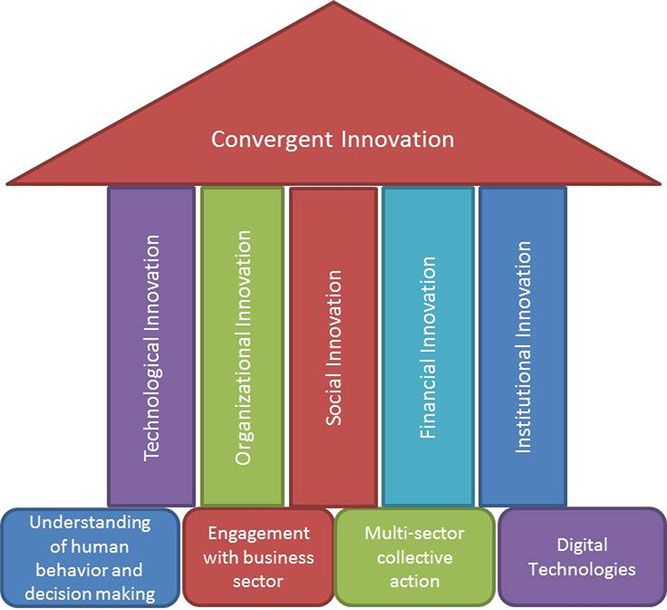
Convergent innovation                                                                                             Dubé et al.

   However, reliance on technological innovation             velopment. For instance, Pingali has proposed that
does not always lead to better outcomes.8,11,12,15,18        the outcomes of the Green Revolution agricultural
In the specific context of health, in many countries,        investment could have provided much greater eco-
the growth of healthcare costs outpaces the growth           nomic and human welfare benefits by linking to in-
of national income.19–21 While many medical and              vestment in nutrition and health R&D pipelines and
health technologies create value relative to costs,15,16     systems.7 The global economic burden of diet- and
evidence based on cross-sectional comparisons—               lifestyle-related chronic diseases such as diabetes
both across countries and within the United States—          and cardiovascular diseases is estimated at $47 tril-
suggests that one-third or more of medical technolo-         lion from 2010 to 2030 (75% of global GDP in
gies do not provide improved health.22–25 Health-            2010, U.S. $63 trillion) while causing 60% of deaths
care costs are now an important constraint on the            globally;42 80% of these deaths currently occur in
financial viability of individuals, businesses, and          low- and middle-income countries, and this per-
governments.8,21 In most rich countries, from 10%            centage is expected to increase rapidly.43 It has been
to over 12% of the national GDP is spent on health           suggested that this incredible economic and health
care, and universal health care is provided.26 How-          burden of obesity and NCDs is the unexpected but
ever, in the United States, the health system has the        natural outcome of ignoring nutrition and health in
most advanced technology but an important pro-               the many sectors of industrial innovation that shape
portion of uncovered people,27 at a cost of over 15%         lifestyle and environment, ranging from agriculture
of the GDP and rising so rapidly as to be the most           and food to transportation, housing, and communi-
significant threat to future public finance.20,28            cation technologies.44–47 The impact of rising obe-
   This rich-country model of healthcare innova-             sity, for instance, on health care has been clearly
tion is unaffordable and cannot be replicated in             demonstrated, and it is still increasing.48–50
low- and middle-income countries.29–31 In India,                Alternatives in health care are also required. At
for instance, less than 5% of the GDP is devoted             present, most emerging and low-income economies
to health care.32 Currently, about 30% of the pop-           follow a two-pronged strategy typically deployed
ulation only benefits from health financing cover-           in medical innovation and health system design,
age, with out-of-pocket health-related expenditures          capacity building, and delivery. The first prong fo-
amounting to over 40% of a household’s nonsub-               cuses on community and primary care for providing
sistence expenditure.33 As in many countries with            basic healthcare necessities, reducing infectious dis-
large numbers of poor households,34 ill health is a          eases and early mortality, with an emphasis on the
major determinant driving Indian households into             most vulnerable segments of the population.51 The
poverty or keeping them poor.35 Other nutrition              second prong, deployed in tertiary and higher-level
and health indicators in India are equally worrying.         care, caters to cutting-edge diagnostic and treatment
The absolute number of undernourished people is              technologies.52 Between these two extremes in the
greater than the population of sub-Saharan Africa,36         formal healthcare system is an unoccupied innova-
and undernutrition rates are higher than the pop-            tion space, which could overcome the nutrition and
ulation of Bangladesh, despite India’s superior eco-         health disconnects and take a more preventive ap-
nomic growth.37,38 Obesity and noncommunicable               proach to the burden of obesity and NCDs through
diseases (NCDs) are ever increasing, and India is            better multisectoral engagement and innovations in
described as the diabetes capital of the world.39–41         wellness, self-care, and the linking of nutrition and
   Clearly, alternative paths are urgently needed as         health innovations to basic primary care for vulner-
governments and agencies consider how to manage              able populations.44,45
economic growth and public finances while extend-               Establishing a virtuous circle linking economic
ing universal access to health care. Developed coun-         growth with health53,54 and other human develop-
tries need to transform away from existing paths,            ment outcomes55 is clearly easier said than done.
and developing countries need to avoid them. What            Technological developments in agriculture, food,
might the elements of these alternative paths be?            sanitation, housing, and other industrial sectors at
One key element will be leveraging R&D pipelines             the core of poverty alleviation have not achieved
in a portfolio across key economic and development           impact and scale sufficient to reach the most vul-
sectors such as health, agriculture, and industrial de-      nerable populations,7 even though the economic

120                                           Ann. N.Y. Acad. Sci. 1331 (2014) 119–141
                                                                                       C 2014 The New York Academy of Sciences
Dubé et al. Convergent innovation
development they enabled has reduced poverty constrained and shrinking. However, there seems to
globally by 50% since 1990.56 The joint optimiza- be growing recognition and appreciation by the pri-
tion of wealth and health requires both conver- vate sector, civil society, and governments that they
gence across industrial sectors and a more so- need to work together to solve recurrent and persis-
phisticated combination of technical and social tent challenges. Have we reached a tipping point in
innovation. which key actors are willing to consider both eco-
A rich portfolio of such social innovation has nomic growth and nutrition/health/human needs
developed over the last century to address prob- and to seriously explore convergence possibilities
lems of poverty, education, health, and other as- for breaking the silos of technological R&D pipelines
pects of human development that cannot be solved and social innovation?
by technologies alone. Social innovation provides Calls to this effect have been made by business66,67
new approaches, through both traditional and and civil society3 leaders, as well as by acade-
new social arrangements that address the under- mics.44,65,68–70 In addition, as for environmental
lying strategies, tactics, and theories of change sustainability,71 nutrition, health, and other aspects
to produce lasting impact through system-level of human development are slowly moving toward
transformation.57–60 Social innovation to address becoming core drivers of business innovation and
human development problems may entail changes strategies, with active engagement by civil society
in basic routines and programs; in operational and and governments. Also, business has started to en-
business models; in the flows of physical and fi- gage more meaningfully in social innovation and
nancial resources, communication, and authority in in multistakeholder partnerships for human devel-
communities, value chains, and markets; and in be- opment efforts to improve the impact, scalability,
liefs and institutions.60 For instance, recent work and resilience of universal healthcare coverage by
by Reardon61,62 has documented the development bringing to bear their resources and capabilities for
of more robust rural–urban food systems, through innovation, logistics, and investment.3,72 Yet, so far
social innovations in rural communities linked by no cohesive understanding exists of what innova-
commercial small and medium enterprises to ur- tion models sustain/underlie these critical transfor-
ban areas. Beyond these basic changes, new social mations.
innovations such as social enterprises,63 base-of- From this context, this paper introduces conver-
pyramid (BoP) ventures,64 and corporate shared gent innovation (CI) as a form of meta-innovation—
value creation65 and BoP programs64 support vil- an innovation in the way we innovate—that aligns
lages, communities, and emerging small and mid- and bridges individual and collective innovation
sized towns to drive local and regional activities and throughout society to surpass what had been possi-
provide access to health care. ble through siloed technological and social innova-
Given the importance of technological innova- tion to create human and economic development.
tions and the private sector as an engine for eco- CI proposes a comprehensive rethinking of com-
nomic growth, the convergence of these two main plex societal problems and examination of needed
types of innovation is critical. Like R&D pipelines innovations from a portfolio perspective to reach
for technological innovation, social innovation can, maximal societal outcomes given individual, local,
however, also be specialized and disconnected.63 and system-level contexts. Technologies are syner-
Moreover, because technological and social inno- gistically bundled with social (organizational, so-
vation originate in different societal sectors, there is cial process, financial, and institutional) innova-
a disconnect between them at present. This discon- tions, creating convergent outcomes for precisely
nect may be tied to their distinct leadership: private targeted, achievable, and time-bound challenges.44
sector for the former and civil society for the latter. In this paper, we first briefly review the literature
It may also be related to their different organiza- on technological innovation that sets the founda-
tional cultures and structures, with civil society, un- tions of CI and motivates its feasibility. We then
til recently, lagging behind the private sector in its describe CI, its building blocks, and enabling con-
organization,3 and with governments in many coun- ditions for deployment and scaling up, illustrating
tries struggling to connect effectively to either or its operational forms through examples of existing
both groups, particularly when public resources are CI-sensitive innovation. A fuller demonstration of
Ann. N.Y. Acad. Sci. 1331 (2014) 119–141
C 2014 The New York Academy of Sciences 121Convergent innovation Dubé et al.
early-stage design, development, and implementa- globalization that translated into the exportation
tion of a collaborative roadmap is presented in a of Western technologies and business methods to
companion paper.73 other places around the world.17 Centuries after
the onset of the Industrial Revolution, the envi-
Review of academic literature on ronmental, human, and financial limits to the suc-
technological innovation cessful deployment of this linear and siloed model
In this section, we examine the early patterns of tech- of innovation are being recognized.21,80,81 Although
nological innovation and how these evolved into the numerous adjustments are being made, they have
present disconnect between value creation for hu- yet to reach sufficient scale and scope for societal
man and economic outcomes. We then review a rich solutions.
portfolio of “convergence-sensitive” innovation ap-
proaches that have emerged over the last century. It
is these, combined with social innovation, that are Convergence-sensitive innovation models
brought together in CI. The above early model of technological innovation,
although still thriving, has progressively left room
Early linear innovation model for other models, whereby different actors collec-
Ever since Schumpeter237 promulgated his theory tively and iteratively—through trial and error—
of economic development, technologies emerging bring about successful commercial exploitation of
from R&D pipelines have been viewed as key drivers a new idea.82–84 Also, as we review below, later
of growth in the Western world, being the means approaches to innovation capitalized on capabil-
by which resources are transformed into commodi- ities and contexts of developing countries and
ties that have tradable value.74 Through this early emerging economies to bring about products and
“linear” model of innovation, scientific develop- processes better attuned to a context of resource
ment and disciplinary specialization arising with scarcity—or more appropriately to a context where
the Industrial Revolution have enabled technologi- resources of any type are not limitless as originally
cal breakthroughs that, with access to financial capi- assumed during the Industrial Revolution.17 These
tal, creative entrepreneurship, and mass-production newer approaches have integrated resource-limits
capacities, have helped address basic and less ba- considerations into technological innovation (fru-
sic human needs and fueled economic growth in gal innovation); fostered reciprocity between “the
an unprecedented manner.17 In other words, tech- West-and-the-Rest”85 in business innovation that
nological inventions from research institutions and addresses complex problems facing 21st-century so-
corporate labs have been commercialized to address ciety (reverse innovation); transformed technolog-
a number of human problems and needs. This in- ical or social processes (disruptive innovation); and
novative process, when providing value for clients enabled innovation to emerge throughout society
who are able and willing to pay, in turn supports (open innovation and collaborative innovation net-
positioning strategies for businesses, with well-fed works). More recently, a systems approach to in-
and fast-moving R&D pipelines competitively po- novation has arisen to help address and manage
sitioned within and across industrial sectors and the complexity involved. At the policy level, the
markets.17,75–77 “innovation system” concept, while not denying
This early linear model lent itself to cutthroat the importance of research and technology com-
hypercompetition in which lone innovators and en- mercialization, recognizes innovation as an inter-
trepreneurs fought each other for the fastest and active process involving individuals and organiza-
highest-margin road to market.17,78 Schumpeter’s tions possessing different types of knowledge within
key concept of creative destruction portrays the pro- a particular social, political, policy, economic, and
cess of introducing new goods and services and en- institutional context.83,86 In the field, the systems
tering new markets as a never-ending spiral that approach to innovation translates into a modular
destroys old ways of commerce while increasing eco- approach that bridges “loosely coupled”87,88 inno-
nomic efficiency and creating more wealth.79 This vators around collaborative platforms contribut-
rising spiral of supply and demand has been fur- ing to whole-system solutions to specific chal-
ther accelerated and intensified with the advent of lenges, needs, and opportunities. Together these
122 Ann. N.Y. Acad. Sci. 1331 (2014) 119–141
C 2014 The New York Academy of SciencesDubé et al. Convergent innovation
approaches, briefly reviewed below, provide robust provide “good-enough” products, processes, or
conceptual foundations for CI. broader solutions that meet basic needs at a low
cost and thus provide high value, often made of
Disruptive innovation. Christensen89 describes
simpler, cheaper materials and offering limited
the process of how distinct products or ideas form
functionalities.95 Providing extreme cost advantages
in a niche market and eventually scale up and com-
relative to existing solutions in contexts with se-
pletely redefine an industry. In particular, the au-
vere resource constraints, these innovations have fo-
thors highlight that these innovations may seem
cused primarily on small-holder agriculture, food,
unattractive or inconsequential to industry incum-
health care, education, financial access, and com-
bents. Disruptive innovation consists of new prod-
munity development. These include BOP innova-
ucts, processes, or services that transform an ex-
tion,64,70,96,97 catalytic innovation,89,91 frugal inno-
isting market or sector by introducing simplicity,
vation,95,98 “resource-constrained innovations,”99
convenience, accessibility, and affordability where
“cost innovations,”100,101 and jugaad innova-
complexity and high cost are the status quo. Al-
tion.102,103 For instance, India has established it-
though a classic example is the performance of hard
self as a leading producer of low-cost drugs, vac-
disk drives in the technological sector,90 disruptive
cines, and diagnostics and has played a crucial role
innovation has also occurred in many other indus-
in bringing a range of affordable medicines to devel-
trial sectors.91 In health care, for instance, disrup-
oping countries.104,105 These types of innovation are
tive innovation drove major restructuring at large
increasingly seen as the source of wealth creation for
manufacturing corporations like GE,67 while fos-
emerging economies and solutions to high health-
tering the emergence of medical clinics in the retail
care costs in the West.106 For instance, Narayana
sector (e.g., Walgreen’s TakeCare and CVS’s Min-
Health, which delivers state-of-the-art cardiac care
uteClinic). Although the lens of disruption allows
in India at a fraction of the cost of equal quality in
important insights into the process of successful in-
the United States, is now opening a 2000-bed clinic
novation, many potentially disruptive innovations
in the Cayman Islands, not far from U.S. borders.107
are likely to fail either because they are too complex
or because they are too high end. These problems
Open innovation and innovation networks.
are particularly vexing in contexts—such as large-
Open innovation108 describes an emergent model
scale healthy diet transformations—where most of
of innovation in which firms draw on research
the needs are in underserved populations or popu-
and development that may lie outside their own
lation segments.
boundaries. The paradigm of open innovation rec-
Reverse innovation. In contrast to disruptive in- ognizes that a firm, by itself, may no longer be able
novation, which tends to occur in high-end niches, to deal with the complexity and pace of technol-
reverse innovation92–94 is about creating fundamen- ogy and needs to harness external sources to gen-
tally different products to meet the needs of people erate new ideas, develop them, and bring them
in emerging markets that combine right function- to market.108,109 While open innovation is most
ality and a price they can afford, and bringing these applicable in “high technology” industries, there
back to core markets in industrialized countries. are instances of other industries embracing it as
This creates solutions that are affordable and of well.109
good quality for the increasingly cash-strapped and Building on open innovation is the notion of dis-
price-sensitive Western clients, be they individuals, aggregated “clusters,” “networks,” or “ecosystems”
organizations, or governments. Reverse innovation of innovation in a number of industries, including
can be disruptive, but disruptive technologies are computers, telecommunications, pharmaceuticals,
not necessary to enable reverse innovation.92 Exam- and consumer goods.82,110–121 In these networks,
ples of reverse innovations include the Tata Nano the innovation activities (R&D, product design,
car, the Grameen Bank (microfinance), and GE’s production, distribution, system integration) are
ultrasound.93 dispersed across the network constituents. Some
Both disruptive- and reverse-innovation ap- networks are orchestrated by a lead firm122 while
proaches further underlie a rich portfolio of in- others are self-organizing.123 Complementing the
novation approaches in emerging markets that organizational innovation networks are grassroots
Ann. N.Y. Acad. Sci. 1331 (2014) 119–141
C 2014 The New York Academy of Sciences 123Convergent innovation Dubé et al.
innovation by users,82,124–132 in consumer and whole, with strong single components potentially
nonconsumer domains like farming.132–134 In- forming a weak system.87,88,141 To date, the concept
novation by users is a participatory approach has been used predominantly to explain past pat-
to technology development that entails actively terns of economic performance at national levels86
leveraging user experience and knowledge to drive and within sectors,142 with interesting extension to
the innovation process.132 Such an approach to regional systems of innovation.143 The innovation
innovation development is likely to result in higher systems approach has thus far not been leveraged
acceptability and better diffusion of innovations. to inform the practice of innovation per se, as it
The formation and reformation of such innovation translates into products, processes, or services being
networks across a diverse set of actors has been brought to market or to the village.
found to be stimulated by an environment that
provides social and geographical propinquity.135 Platform architecture and modularity. While
However, innovation networks have now crossed the above streams suggest an unmistakeable trend
geographical boundaries, thanks to a revolution toward a collaborative, open innovation model,
in communication and collaboration technologies. the problems addressed by these models remain
This is evident from the emergence of “Collabo- grounded in the traditional paradigm (i.e., they
rative Innovation Networks” (COINs), which are address a narrow and specific business or social
a cyber-team of self-motivated people with a col- problem). However, CI, with a goal to simulta-
lective vision and enabled by the web to achieve neously drive economic growth and human de-
a common goal by sharing ideas, information and velopment, requires adopting a systems approach.
work.136 These networks work in a predominantly In other words, individual initiatives and organic
virtual manner (e.g., Wikipedia) leveraging a di- collaborations,144 each addressing a subset of the
verse, dispersed knowledge base to address global overall problem domain, need to be woven to-
problems.137 gether for behavioral change at scale and transfor-
In sum, the emergence of innovation networks mation of the entire ecosystem. Insights into how to
epitomizes a shift from a centralized, closed model make a systems approach to innovation operational
of innovation to a decentralized, open model of in- come from the engineering system design and com-
novation. puter science innovation literature,110,145–147 cen-
tral to which is the concept of modularity (e.g.,
Innovation systems. Evidence that has accumu- Refs. 110, 112, 148, and 149). The notion of in-
lated since the 1970s from direct observations of terdependence within modules and independence
countries and sectors with strong records of inno- between modules lies at the core of modula-
vation has shown that strengthened research capac- rity.110,145 The costs and benefits of modularity
ity for science and industrial technologies does not have been examined in the context of manage-
correlate highly with the capacity to innovate and ment of complexity,150 product-line architecture,151
adopt innovations throughout society in order to manufacturing,145 process design,152,153 process im-
support human development and economic growth provement,154 and industry evolution.110 Recently,
within and across sectors.138 Instead, the top ranks the concept of a platform has been used to spec-
were occupied by countries that had taken a sys- ify a system architecture that encompasses its over-
tems approach to innovation. An innovation system all structure and function, as well as the interfaces
can be defined as a network of institutions, organi- that govern the relationships among components
zations, and individuals from university, industry, and allow them to interoperate. Interfaces estab-
and government—what has been called the “triple lish the boundaries of modules—components of a
helix”139,140 —that focuses on bringing new prod- system whose “elements are powerfully connected
ucts, new processes, and new forms of organiza- among themselves and relatively weakly connected
tion into social and economic use, together with the to elements in other components.”110 Because they
institutions, policies, and other factors that affect define points of weak linkage in a network of rela-
their behavior and performance. From a systems tionships, modular interfaces reduce both coordi-
perspective, it is not so much the component parts, nation costs and transaction costs across the mod-
or nodes, but rather how it performs as a dynamic ule boundary,111 making innovation in one part of
124 Ann. N.Y. Acad. Sci. 1331 (2014) 119–141
C 2014 The New York Academy of SciencesDubé et al. Convergent innovation
Figure 1. Convergent innovation.
the system possible without requiring changes in through behavioral and ecosystem transformation.
all other parts. Thus, the loosely coupled nature The long-term goal is to create new paths of conver-
of modular designs is such that changes made to gence for agriculture, health, and wealth production
one module have little impact on the others, mak- and distribution. Convergence will allow the man-
ing transactions feasible where they were previously aging of trade-offs and the catalyzing of synergies
impossible or very costly in terms of time and in- within and between health and economic activi-
vestment. The concepts and methods of modular ties. This translates into rebalancing the emphasis
platform architecture are core to the CI approach. on curative technologies with more prevention and
This lens allows actors to work semi-independently better integrating economic and other social do-
toward a convergent goal while pursuing their re- mains in healthcare innovation, systems design, and
spective undertakings, mediated by a common in- policy. CI also brings together diverse actors and
novation platform. approaches, incorporating modern and traditional,
natural and industrial, and technical and social ap-
Convergent innovation proaches as appropriate. In this section, we briefly
describe CI, its building blocks, and enabling con-
The review above suggests that the path to sustain- ditions for deployment and scaling up, illustrating
able prosperity and affordable universal health cov- its operational forms through examples of existing
erage will depend more on the capacity to innovate CI-sensitive innovation. A fuller demonstration of
in the way we innovate than on accelerating technol- early-stage design, development, and implementa-
ogy development. The above streams together form tion of a CI roadmap is presented in a companion
the key lenses highlighting, respectively, processes of paper.73
scaling up; coordination and collective knowledge
building across distinct actors; the presence of coor- What is convergent innovation?
dinating institutions; and coordination through an CI is anchored in the whole-of-society (WoS)
innovation platform. paradigm for the convergence of human and eco-
Building on this, CI (Fig. 1) is a solution-oriented nomic development,44,144 which views the individ-
approach that combines technological and social in- ual and society as part of the same complex, dy-
novation in a form of “meta-innovation” that inte- namic, and adaptive system, shaping and being
grates human and economic development outcomes shaped by each other. CI pragmatically capitalizes
Ann. N.Y. Acad. Sci. 1331 (2014) 119–141
C 2014 The New York Academy of Sciences 125Convergent innovation Dubé et al.
on individual and collective actions deployed at dif- design160–162 may help alleviate the poor perfor-
ferent scales, each targeting behavioral change and mance of many nutrition- or health-sensitive tech-
progressive ecosystem transformation, one project nological innovations163 and contribute to a higher
at a time, making convergence the default modus acceptance rate of many organizational and insti-
operandi within and across sectors and scales. CI tutional transformations.164 This knowledge is also
links siloed technological and social innovation (in- increasingly used to complement the present port-
cluding organizational, social processes, financial, folio of policy tools with a rich diversity of nudge
and institutional innovation) to maximize availabil- policies and choice architecture designs,164–167 with
ity, access, and use of their single and combined the aim of making the normative (equitable, ethi-
convergent outcomes in both developing and de- cal, and leading to convergent outcomes) choice the
veloped countries, with a special focus on the most simplest and most appealing, guiding individuals to
underserved populations. act in their own and in society’s best interest while
Moving away from universally applicable preserving freedom of choice.
blueprints for change, CI takes a modular ap- The second key enabler of CI is strategic en-
proach that convenes a complementary set of par- gagement by private enterprises. Private enterprises,
ticipants from the public sector, the business com- the primary drivers of technological innovation,
munity, and civil society, loosely coupled around play a crucial role in the systemic transformation
roadmaps that serve as virtual collaborative plat- that CI aspires to achieve. Moving beyond view-
forms on concrete, precisely targeted, and time- ing human development as a peripheral, corporate
bound projects targeting scalable, sustainable, and social-responsibility (CSR) activity, private enter-
resilient solutions where convergence adds value to prises need to make it a core principle guiding their
the participants and to society. Modularity is key innovation and business strategy. We have seen this
to innovation in complex systems.155 Much like the happen in pockets, as documented by the scholars
modular platforms above, interfaces are defined for studying innovation for the BoP markets.65,168,169
each of the participants in terms of the facets of For instance, ITC, through its e-Choupal initia-
their core strategic activities that feed and are fed tive, has effectively sourced directly from the rural
by the roadmap projects. Challenges where CI bears community. This not only has strengthened ITC’s
the most promise relate to (1) addressing diet- and supply chain but has also uplifted the rural com-
lifestyle-related health problems linked to agri-food munities by integrating them into mainstream in-
and healthcare systems innovation and growth un- dustrial activity.170 While a handful of such cases
der both scarcity and affluence; (2) preventing and have been documented, they are still the exception,
controlling communicable and noncommunicable and the majority of private enterprises view human
diseases through sectoral and cross-sectoral innova- development as an obligation rather than a strat-
tion and partnerships; (3) scaling up home, school, egy. CI proposes that the new-age enterprises, be
and workplace wellness and self-care through the life they large multinational corporations or small and
course; and (4) expanding digital technologies and medium enterprises, need to shift the dominant
traditions for affordable universal health coverage. logic within their organizations171 toward proac-
tive and organic sensitivity for human development
Key enablers as a driver of their core innovation and business
Four key enablers of CI determine its relevance and strategy.
feasibility. First is the depth of knowledge now avail- The third key enabler of CI relates to community
able on human behavior both in terms of the di- mobilization and cross-sector collective action,
versity of rational and less rational motives driving facilitated by the rapid global increase in connec-
individual choice,156–158 whether personal, profes- tivity through Internet and mobile technologies,
sional, or political, and in terms of the sets of social allowing communities, both rural and urban, to
norms, rules, reciprocity, and other social capital organize themselves better and faster than ever.
processes that guide collective action.81,159 For in- Now community members can interact with each
stance, the integration of such knowledge into both other and also with communities around the world
technological and social innovation through be- in real time to achieve common goals.172–175 There
havioral change intervention or product/program is also a growing appreciation of how collective
126 Ann. N.Y. Acad. Sci. 1331 (2014) 119–141
C 2014 The New York Academy of SciencesDubé et al. Convergent innovation
action occurs and can be enhanced. Decades of enable convergence of health and economics in new
work in environmental sustainability of socioe- and exciting ways.
cological systems by Ostrom81,176,177 and other
Building blocks
leaders in the field178,179 demonstrated that com-
To understand which actors need to be involved
munities have an accurate understanding of how
and which elements need to be brought together
complex, multilevel socioecological systems operate
in the process toward self-sustaining innovation or
and how community actions can lead to more
universal healthcare coverage, we introduce four
sustainable and equitable outcomes. The BoP
key CI building blocks (technological, organiza-
literature has advanced our understanding of mar-
tional, social process, financial and institutional).
kets, moving from viewing the BoP community as
Table 1 briefly describes each building block and
mere customers to cocreators168,180 —incorporating
displays the form that an operational deployment
concepts of social embeddedness, mutual value
may take. These building blocks are concretely illus-
addition, and co-ownership as critical drivers of
trated in the companion roadmap papers on a CI
equity and sustainability.65,168,180 Cross-sectoral
targeting affordable dietary diversity and balance
collaboration around common goals that target
through the promotion of pulse production and
convergent outcomes between private sector actors
consumption around the world.73 This roadmap
and communities are at the core of many efforts in
brings to bear agricultural, food, and nutrition tech-
business engagement, including second-generation
nologies, first, to enable pulses to compete with
BoP protocols.181
other, more immediately lucrative, crops in the
Beyond connectivity, the fourth CI enabler is the
farming schedule, and second, to increase pulses’
rich functionality of information and communica-
share of the diet as affordable and environment-
tion technologies (ICTs) now available. At the core
friendly sources of protein, while also eventually
of ICTs’ enablers of CI is the ever-increasing digitiza-
competing with metformin, statins, and other such
tion of operational and administrative data and dig-
drugs for the prevention and management of dia-
ital literacy within and across organizations, value
betes and cardiovascular diseases. The health bene-
chains, and systems in industrialized societies.182–185
fits of pulses tied to the prevention and management
Operations, administration, and monitoring func-
of obesity,187 hypertension,188 diabetes,189 and car-
tions in government, NGOs, or commercial busi-
diovascular diseases190 are well documented.
nesses are now often supported by comprehensive
enterprise information systems (ES), fostering the Technological innovation. Technological inno-
standardization and real-time integration of flows vation has been extensively discussed above. In
of material, information, and finances. These ICT terms of CI, a critical challenge is managing the
systems can either be highly integrated or be linking diverse trade-offs associated with the costs and
organizations that are plural and loosely coupled, benefits of technologies at different levels from
separate from each other and yet responsive to each individual to society. For instance, as innovation
other in some fashion.87,88 This enabling is essential strategies are being developed by states and coun-
to supporting the modular architecture approach tries worldwide, an appropriate strategic choice to
of CI roadmap projects. As suggested by Zammuto ensure healthcare financial sustainability might be
et al.,186 the use of information (e.g., collection, stor- to reduce investments in medical technologies that
age, and distribution) can drive convergence with- do not contribute to population health in favor of
out imposing “command and control” hierarchies. investment in other technologies or social innova-
The authors proposed that innovation in ICT and tions that prevent diseases. However, this trade-off
the novel organizational arrangements and practices may be unacceptable to health professionals who
they support give rise to five key functional “affor- are committed to individual patient health191
dances:” (1) the visualizing of entire processes; (2) or to ethicists who view the provision of health
real-time and flexible product delivery; (3) service interventions as a human right,192 although one
and program innovation; (4) virtual and mass col- perhaps beyond the original vision enshrined in
laboration; and (5) simulation to capture complex the WHO essential medicines. A second point with
nonlinear dynamics and anticipate outcomes. ICT respect to technologies is the creation of demand
provides a disruptive innovation that can and does for better nutrition and health products, especially
Ann. N.Y. Acad. Sci. 1331 (2014) 119–141
C 2014 The New York Academy of Sciences 127Convergent innovation Dubé et al.
Table 1. Convergent innovation building blocks
Innovation Definition Example
Technological Technological innovation is an iterative New seed varieties
innovation process initiated by the perception of a Food process technologies
new market opportunity for a Pharmaceutical drugs
technology-based invention that leads Medical devices
to development, production, and Electronic devices such as DVD players,
marketing tasks striving for the mobile and other ICTs
commercial success of the invention
Social process Changes in the way individuals interact Micro-entrepreneurship
innovation with each other that opens up new Virtual and real-world communities
opportunities to individuals as well as formed on the basis of shared practice,
the entities they interact with shared problems (e.g., communities of
patients)
Electronic word of mouth and social
media
Organizational Intra- and/or interorganizational Traditional–modern value chain
innovation structures and processes that facilitate integration
new types of activities Accountable healthcare model
InnoCentive
Pulse Innovation Partnership73
Financial Advances over time in financial Distributed system risk financing
innovation instruments and payment systems used Crowd funding
in the lending and borrowing of funds Microcredit
Impact investment
Angel venture capital
Health/nutrition/human index for signals
to investment markets (e.g., ATNI)
Innovation prizes
Institutional Institutional innovation is a generative Reforms toward a market economy in
innovation process of collective action though countries like India and China
which institutions are created or Establishment of new credibility-
modified enhancing bodies, adjudicators
when benefits are not immediate. Without social and the valuing of externalities to favor synergies
demand creation, businesses providing innovative for more sustainable and equitable outcomes,
nutrition- or health-sensitive products face huge particularly for the most vulnerable populations.
innovation costs relative to weak demand com-
pared to providers of regular products. An enabling Organizational innovation. Organizational in-
ecosystem is required to spur more nutrition- and novation refers to intra- and/or interorganizational
health-sensitive technological innovation. Refram- structures and processes that facilitate new types
ing education efforts that focus on knowledge to of activities.51 Business process innovations, among
make them more effective for actual behavioral others, have reshaped entire industries, changing
change and demand building could make a signif- the distribution of value creation and value appro-
icant difference in this regard. Third, the enabling priation. Low-cost airlines, delivery, and retailers,
innovation-investment and policy-making envi- capitalizing on this organizational innovation, have
ronment needs to change innovation incentives been successful, driving 11 companies from this
128 Ann. N.Y. Acad. Sci. 1331 (2014) 119–141
C 2014 The New York Academy of SciencesDubé et al. Convergent innovation
sector to be part of the 27 companies born in the and communities as they interact with professional
last three decades to be on the Fortune 500 list.193 organizations and institutions, allowing them to ob-
Two key facets of this type of innovation are relevant tain better service and value. For instances, eKutir,201
here. First is innovation to foster more effective link- using the most modern platform technologies, is
ages between informal and formal value chains and transforming social processes within rural com-
markets, covering the full chain of value-creation ac- munities and between these and slum and other
tivities, professional practices, production, and de- poor urban communities in the state of Odisha, In-
livery systems. This type of innovation is relevant dia. The platform is becoming an engine for the
in agriculture, food, health, and many other sectors creation of micro-entrepreneurs in a diversity of
of activities and also equally relevant across indus- sectors, planting the seed for CI as villages are
trialized, emerging, and resource-poor economies. still struggling for subsistence. In the United States,
The second facet, motivated by the fact that both Wholesome Wave,202 also ICT-enabled, cleverly taps
health and economic sectors have evolved with a into agriculture funds for food stamps to improve
strong focus on building supply, bears on business access to and affordability of fresh fruits and vegeta-
and operational models that foster a better balance bles in order to address obesity and NCDs in under-
between drivers of supply and demand as well as af- served communities. They do so by building capac-
fordability, access, and equity. For instance, in spite ity and fostering linkages between vulnerable pop-
of many political barriers,27 accountable care194 is ulations and local food systems, while weaving in
emerging as an integrated model for health care in behavioral economics principles in order to design
the United States that takes a whole-person per- incentives for both buyers and producers. These so-
spective in order to bridge traditional healthcare cial entrepreneurs and their partner networks work
silos to boost quality and reduce costs by reallo- persistently to institutionalize such support in state
cating resources and changing processes on the ba- and national legislation, including the Farm Bill.
sis of measurable improvements in care. In India, Beyond governmental food-stamp money, comple-
iKure,195 employing a unique combination of medi- mentary funding comes from individuals as well as
cal and communication technologies, skills training, from local, state, national, and global private sectors
and capacity building, has developed a sustainable and philanthropy. The most recent innovation by
hub-and-spoke model that provides affordable and social entrepreneur Wholesome Wave tries to trans-
accessible health care up to the last-mile rural pop- form the social processes between agriculture, food,
ulation, alleviating some of the chronic problems and healthcare communities by introducing into the
of doctor nonattendance, inexistent or decrepit in- formal healthcare system prescriptions for fruits and
frastructure, and shortage of supplies faced by these vegetables for obese adolescents and diabetic moth-
villages.196–198 This also helps reduce the reliance of ers from underserved communities, while building
many poor people in India, like in many emerging further capacity for local food systems in rural, peri-
and less-developed countries, on informal providers urban and urban contexts.
for a large proportion of their health care and drugs,
these working outside of regulatory frameworks, Financial innovation. While the finance literature
with significant adverse consequences in terms of and practice emphasizes innovation in derivatives
safety, efficacy, and cost of treatment.199,200 and other stock market investment tools, we ex-
plore financial innovation more broadly in CI. Fi-
Social process innovation. This type of innova- nancial tools are key to any successful innovation.203
tion entails changes in the way individuals interact Financial innovations such as novel funding mecha-
with each other that open up new opportunities to nisms like crowdfunding,204,205 or micro-insurance
individuals as well as to the entities they interact schemes206 to ensure affordability, sustainability,
with. For instance, micro-entrepreneurship creates and resiliency, can provide both humanitarian and
local agency and self-reliance, enabling communi- economic returns on investments. A number of
ties in underserved populations to more sustainably access-to-finance models are being tried, moving
provide good or services locally, through financial beyond the well-known case of microfinance207
or nonfinancial exchange. The use of social media to influence investment,208,209 supporting compa-
and other ICT functions can empower individuals nies with strong social benefits through investments
Ann. N.Y. Acad. Sci. 1331 (2014) 119–141
C 2014 The New York Academy of Sciences 129Convergent innovation Dubé et al.
from “catalytic” philanthropy,210 which increasingly voids relate in this context to underdeveloped capital
targets investments and efforts to address gaps left markets, infrastructure, intermediary markets, reg-
by market and government failures.211 For exam- ulatory systems, contract-enforcing mechanisms, or
ple, Liechtenstein Global Trust (LG), a venture phi- other institutions.215 We posit that the limited con-
lanthropy, provides loans, grants, and investment vergence we see in practice today is due to a similar
capital to businesses that meet a broad range of nu- lack of institutions (or institutional voids) to bridge
trition needs. Other financial innovations provide private and public sector organizations for collective
environmental or health indices for social investors. action. With that as the point of departure, institu-
For instance, the ATNI,212 much like the Dow Jones tional innovation aims to fill these gaps and pro-
sustainability index, provides information on the mote new types of institutions that are necessary
nutrition policies, practices, and performance of for enabling CI. A core domain in which institu-
the largest food and beverage manufacturers. Pull tional innovation is urgently needed for CI is in
mechanisms such as innovation prizes are also be- rules for intellectual assets that better balance the
ing used to foster results-based financial incentives, trade-offs between rewarding innovators, preserv-
rewarding successful commercial and social inno- ing public investments in technology, and providing
vations that address health and other humanitarian affordable products.
problems in a way that is financially sustainable and
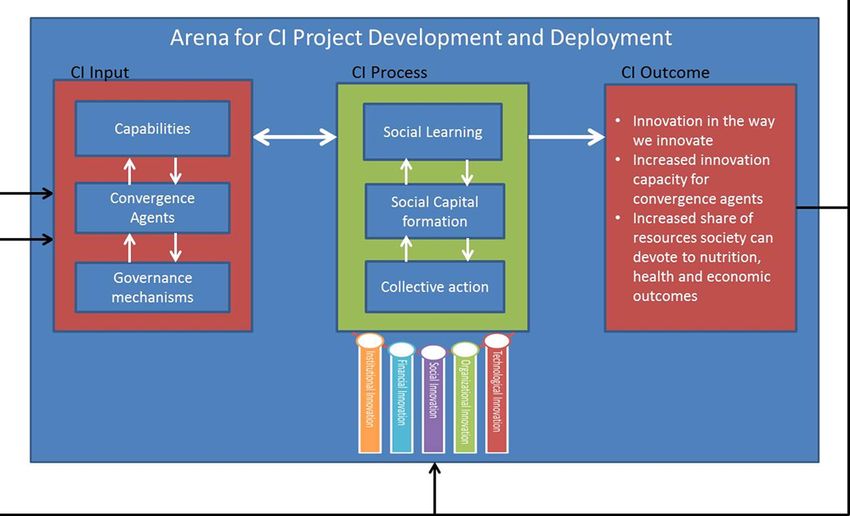
that supports economic development. Roadmap development and deployment
More investment and financial innovation is process
needed in social businesses213,214 and other forms In terms of the development and deployment pro-
of social entrepreneurships3,72 that are often formed cess (Fig. 2), CI roadmaps convene participants to
as for-profit enterprises, while targeting human de- generate convergent outcomes both through their
velopment outcomes. This status limits their access respective contribution to the collective convergence
to investment to the limited-impact investment pool target and through the pragmatic integration of con-
and excludes them from charities, while their target- vergence in their own mindsets and core strategies
ing of human development outcomes renders them and activities. Participants include individuals in
unable to compete in commercial capital markets. their diverse and sometimes conflicting roles as con-
Currently, there are a number of insurance inno- sumers, parents, producers, investors, and citizens;
vations. One very cost-effective approach is index- single organizations and institutions targeting con-
based drought insurance, in which the payout de- vergent outcomes; and clusters of organizations and
pends on a verifiable and objective index of drought institutions forming a loosely coupled partnership
(usually satellite imagery) rather than costly verifi- around concrete, time-bound, and achievable goals
cation of all individuals. Insurance can be bought within a roadmap domain. We focus here on the
by individuals or even by governments or philan- latter. Clusters of partners engage in roadmap inno-
thropies providing disaster support to vulnerable vations that are sufficiently close to their strategic
communities. In health care, the Discovery Group activities to motivate significant and lasting com-
in South Africa has developed a highly innovative mitment and return on investment (in terms of
private sector lead model of finance pooling that tar- both human and economic development, for indi-
gets wellness promotion and prevention and control vidual partners and for society). Their contribution
of NCDs. to the collective goals can take many shapes,179 from
simple interdependent aggregation of individual
Institutional innovation. Institutions embody partner actions into more coordinated or integrated
the deeper norms, rules, and regularized patterns collective actions to collaborations with diverse,
underpinning societies.44 The lens applied in ad- sometimes conflicting, mindsets, methods, and mo-
dressing institutional innovation in CI roadmaps tives.
is that of institutional voids,215 a concept origi- While it is impossible to outline a process that can
nally developed to understand challenges faced by be standardized across various problem domains, it
Western multinational corporations as they were is critical to develop a process that facilitates col-
entering into or attempting to build value chains lective understanding and trust building among
and markets in developing countries. Institutional distinct players. Beyond social capital, achieving
130 Ann. N.Y. Acad. Sci. 1331 (2014) 119–141
C 2014 The New York Academy of SciencesDubé et al. Convergent innovation
Figure 2. Development and deployment process of convergent innovation roadmaps.
transformative change in complex systems requires is likely to have a worldview strongly colored by
a collective capacity for learning and change.216 That their respective disciplines, sectors, or jurisdictions,
is, CI projects aimed at developing creative and ro- an adequate participative social-learning phase is
bust cross-sectoral solutions not only facilitate co- critical to strengthen early patterns of interaction
ordination of focused and sustained commitment and to build solution-focused scaffolds or bridges
but also build collective understanding of the dy- when boundaries are difficult to cross. Recent work
namically complex problems among actors. on practices used by cross-functional teams to inte-
Although there is no universal blueprint for the grate their knowledge in order to cocreate a solution
process of developing and deploying CI projects may be relevant here to avoid inertia caused by the
because of the diversity, complexity, and dy- overwhelming nature of the task.225 Others suggest
namic nature of conditions and contexts, guid- that when confronted with seemingly irreconcilable
ance can be derived from models of collective differences, strategies that jump over examining and
action in socioecological176,177,217–219 and market- discussing differences to develop a collective team
chain220 systems, as well as from a growing litera- problem-solving orientation are effective.226,227
ture on multi-stakeholder partnerships.221–224 The Through a social-learning process, CI groups of
roadmap process entails three iterative phases that individuals or stakeholder organizations learn to op-
will progressively transform multiple stakeholders erate: together they define problems and set priority
into CI partners. areas where CI could add value; and they search for
In a first, social-learning phase, all CI projects possible solutions and assess the value and feasi-
involve the use and combination of new ideas, tech- bility of alternative solutions for a specific practice.
nologies, or ways of doing things differently. Hence, In the social-learning phase, problems and solu-
CI project development starts by bringing together tions are defined and explored from multiple per-
individuals and organizations that are strongly and spectives, and participants get to know each other,
meaningfully engaged in reaching the targeted so- their activities, interests, ideas, and problems. Pro-
lution and that can articulate a common vision and gressively, participants experience a shift away from
goals with pragmatism, determination, ethics, and what authors have called “multiple cognitions” to-
a good dose of hope and enthusiasm. Since every- ward convergence on a “collective cognition”—a
one involved has traditionally worked in silos and shared vision of what solutions are brought to what
Ann. N.Y. Acad. Sci. 1331 (2014) 119–141
C 2014 The New York Academy of Sciences 131You can also read


