Data and Society Data and Dating - Lecture 9 - 3/22/19 Fran Berman, Data and Society, CSCI 4370/6370 - Computer Science
←
→
Page content transcription
If your browser does not render page correctly, please read the page content below
Data and Society
Data and Dating – Lecture 9

                         3/22/19

           Fran Berman, Data and Society, CSCI 4370/6370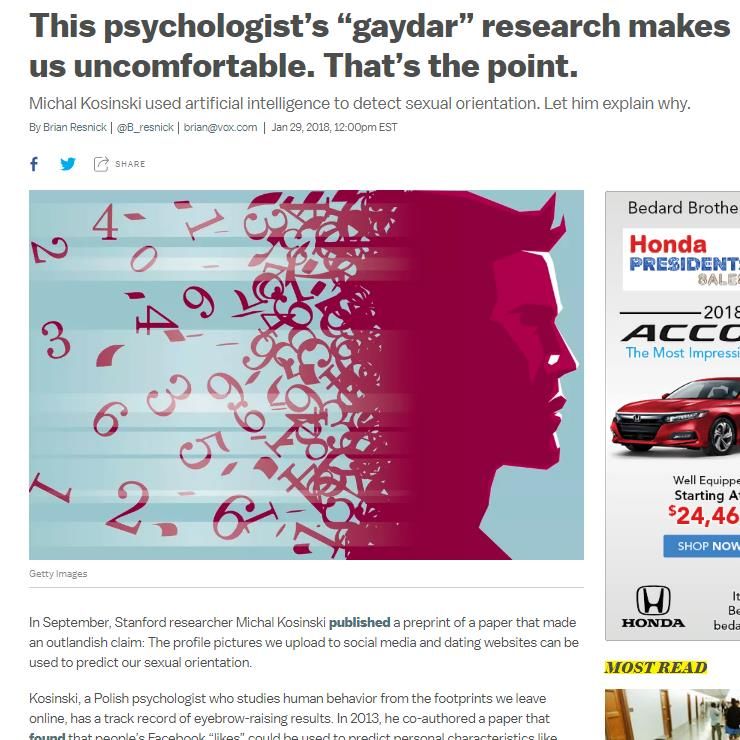
Announcements 3/22
• Op-Ed finals due Friday, 3/29.
   – For those who will turn in a Final Op-Ed on March 29
       • Revision will not be graded unless you also turn in Fran’s marked-up copy
         of the Draft Op-Ed
       • Final Op-Ed should be a revision based on Draft Op-Ed comments, not a new
         Op-Ed on a different topic
       • Final Op-Ed should be better than the Draft Op-Ed. Final Op-Ed grade will be
         recorded, even if it is lower than the Draft Op-Ed

• Briefings due Friday, 4/5. (Hardcopy to Fran at the
  beginning of class).
• Topic Reports for groups reporting 4/17 and 4/26 due April
  12. (Hardcopy to Fran at the beginning of class and .pdf to
  Fran with last names deleted).
• No class Wednesday 3/27

                      Fran Berman, Data and Society, CSCI 4370/6370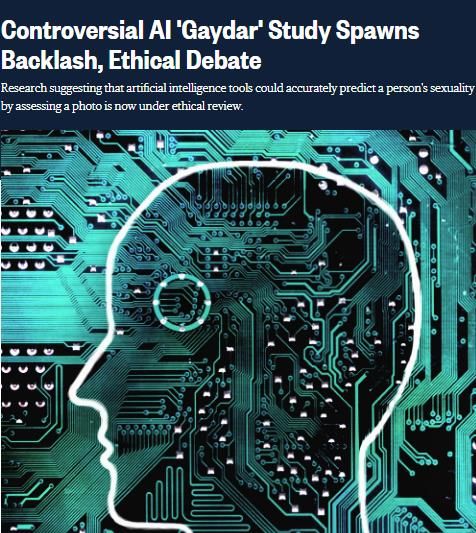
Wednesday Section      Friday Lecture (first half)                     Second half of class   Assts.
January 9: NO CLASS    January 11: INTRO – DATA AND SOCIETY            Fran presentation demo

January 16: NO CLASS   January 18: BIG DATA 1; Topic groups / Topic    Student presentations
                       materials information
January 23: Student    January 25: BIG DATA 2                          Student presentations   Op-Ed instructions
presentations
January 30: NO CLASS   February 1: DATA AND SCIENCE                    Student presentations

February 6: NO CLASS  February 8: DATA STEWARDSHIP AND                 Student presentations   Group Topics due
                      PRESERVATION
February 13: NO CLASS February 15: INTERNET OF THINGS                  Student presentations
February 20: Student  February 22: DATA AND PRIVACY /                  Student presentations   Op-Ed Drafts due
presentations         FOUNDATIONS
February 27: NO CLASS March 1: DATA AND PRIVACY / POLICY AND           Student presentations   Briefing instructions
                      REGULATION                                                               Op-Ed Drafts Returned
March 6: Spring Break March 8: Spring Break
March 13: Student     March 15: DATA AND ENTERTAINMENT [ANDY           Student presentations   Topic Reports 1 due
presentations         MALTZ]
March 20: TOPICS      March 22: DATA AND DATING                        Student presentations
PRESENTATIONS 1
March 27: NO CLASS    March 29: DIGITAL RIGHTS 1                       Student presentations   Op-Ed Finals due
April 3: NO CLASS      April 5: DIGITAL RIGHTS 2                       Student presentations   Briefings due
April 10: Student      April 12: DATA AND ETHICS                       Student presentations   Op-Ed Finals returned,
presentations                                                                                  Topic Reports 2, 3 due
April 17: TOPICS       April 19: CAREERS IN TECH [KATHY PHAM]          Student presentations
PRESENTATIONS 2
April 24: Student      April 26: TOPICS PRESENTATIONS 3
                                    Fran Berman, Data and Society, CSCI 4370/6370
presentations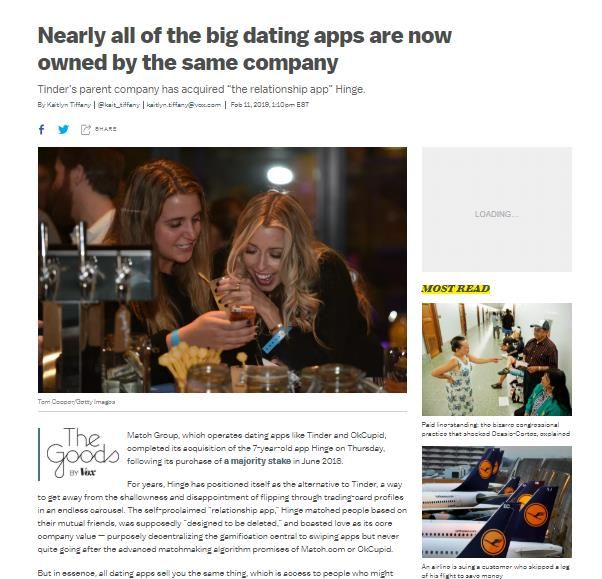
Finding a “Mate” has changed …
• Relationship
– Social contract romantic “soulmates”
• Potential Partner pool
– Typically within your community but your community is
increasingly on-line
– Someone you meet through family / church /
neighborhood Someone you meet through work,
travels, your social network, etc.
Fran Berman, Data and Society, CSCI 4370/6370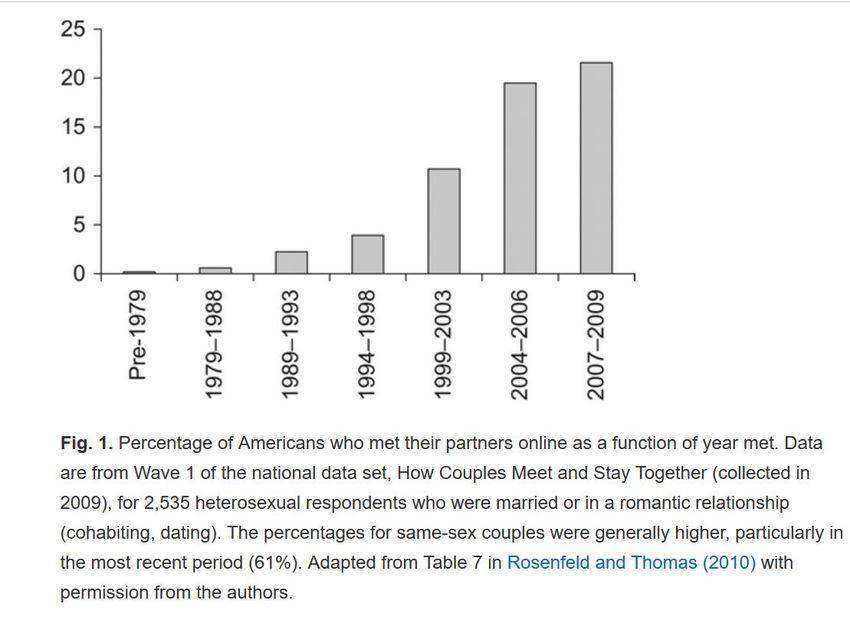
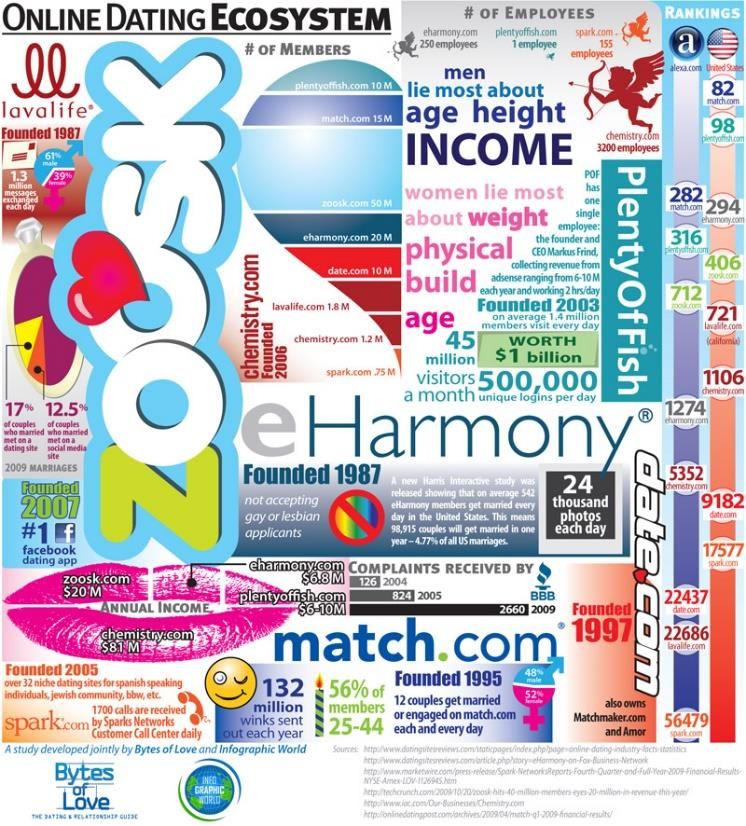
Data and Dating
• Paths to relationships
   –   Personal contacts in “real world” settings
   –   Family arrangement
   –   Matchmakers
   –   Personal ads
   –   On-line sites and apps

• Online dating vs. conventional ways of
  meeting
   – Access – exposure to large pool of
     romantic partners
   – Communication – opportunity to                               From
     utilize computer-mediated                                    https://visual.ly/community/infograph
                                                                  ic/love-and-sex/online-dating-
     communication before meeting                                 ecosystem

   – Matching – use of an algorithm to
     select potential partners
                          Fran Berman, Data and Society, CSCI 4370/6370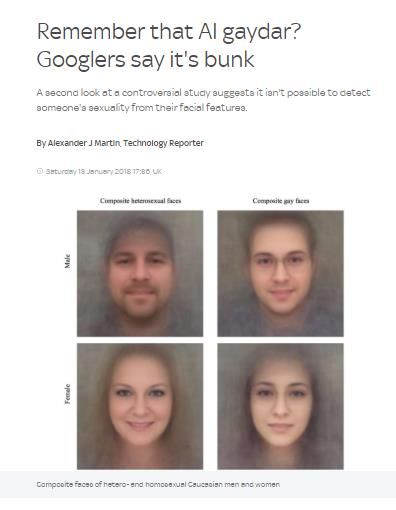
On-line dating
• On-line dating increasingly prevalent
  – 15% of Americans have used on-line dating or mobile
    apps
  – 41% of Americans know someone who uses online
    dating; 29% know someone who has met a spouse or
    long-term partner via online dating
• 5% of Americans who are in a marriage or
  committed relationship say they met their
  significant other online.
              From http://www.pewinternet.org/2016/02/11/15-percent-of-
               Fran Berman, Data and Society, CSCI 4370/6370
              american-adults-have-used-online-dating-sites-or-mobile-dating-
              apps/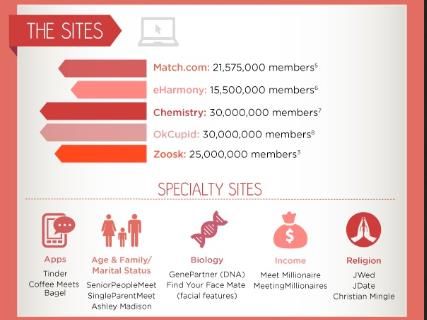
Increasing prevalence of couples who met
online

     From http://journals.sagepub.com/stoken/rbtfl/cK9EB6/4zQ0AM/full
                  Fran Berman, Data and Society, CSCI 4370/6370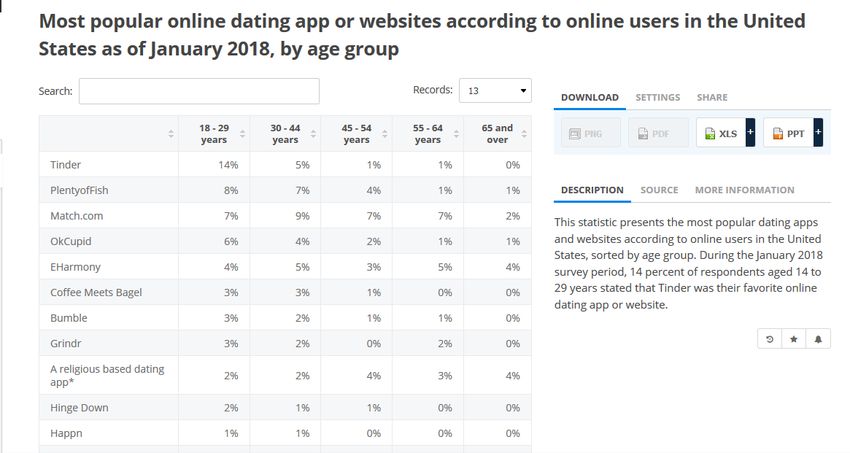
Demographics: Use

          From http://www.pewinternet.org/2016/02/11/15-percent-of-
          Fran  Berman, Data and Society, CSCI 4370/6370
          american-adults-have-used-online-dating-sites-or-mobile-dating-apps/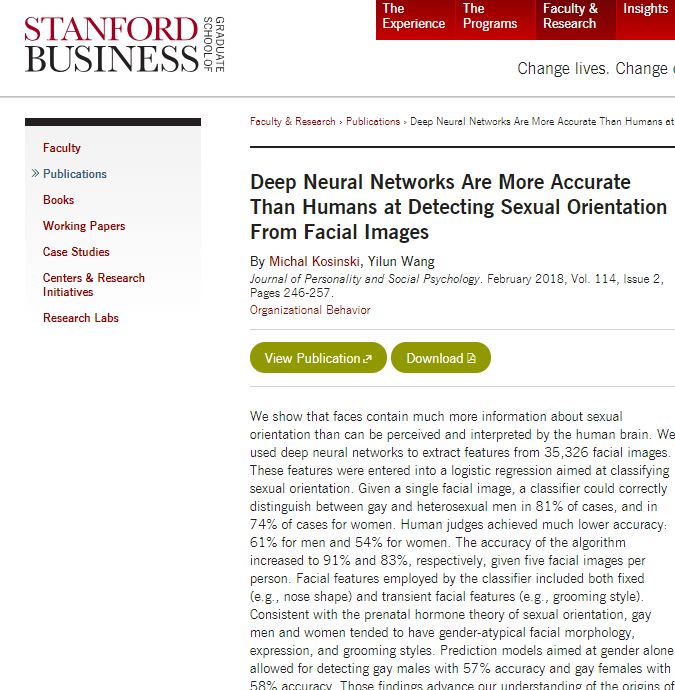
Many choices and target audiences for dating sites
(from https://datascience.berkeley.edu/wp-content/uploads/2014/02/BigData-Dating-
                                       IG.jpg)

                        Fran Berman, Data and Society, CSCI 4370/6370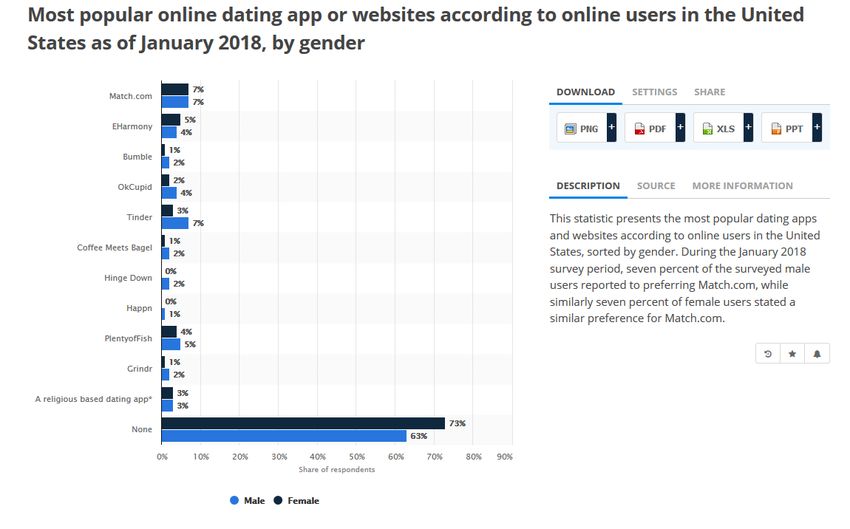
Fran Berman, Data and Society, CSCI 4370/6370
From http://journals.sagepub.com/stoken/rbtfl/cK9EB6/4zQ0AM/full
Demographics: Gender
(from https://www.statista.com/statistics/809443/us-users-favorite-dating-websites-apps-
gender/)

                           Fran Berman, Data and Society, CSCI 4370/6370
Demographics: Age group
(from https://www.statista.com/statistics/809450/us-users-favorite-dating-websites-apps-age-
group/)
Fran Berman, Data and Society, CSCI 4370/6370“Desirability” by Age
• Desirability measured by the number
of messages a user receives, when
and by whom, providing an indication
of who finds whom attractive.
• Measure of reflected desirability
similar to PageRank – PageRank
scores of desirability calculated to
create a ranking metric for the study
• Metric of desirability based on
(messaging) behavior, rather than
personal qualities (e.g. attractiveness)
• Desirability rises if many people contact you and they themselves are desirable.
• [Data from study of heterosexual U.S. participants in 4 cities from an on-line
dating site.
http://advances.sciencemag.org/content/advances/4/8/eaap9815.full.pdf]
Fran Berman, Data and Society, CSCI 4370/6370Other interesting data about desirability from
http://advances.sciencemag.org/content/advance
s/4/8/eaap9815.full.pdf
• Men and women tend to write substantially longer
messages to more desirable partners
• Women show an increase in their use of “positive”
words (from a DB) when communicating with more
desirable partners, while men show a decrease.
• On average, people pursue partners who are roughly
25% more desirable than they themselves are. (Hybrid
strategy of “matching” at their own rank and
competing for modestly more desirable mates).
Fran Berman, Data and Society, CSCI 4370/6370On-line matching algorithms
• Matching algorithms generally proprietary and considered a
competitive advantage
• Compatibility matching offered by on-line sites can be in-depth
• Matching algorithms differ in
– Use of data self-collected from users
– Other data about users
– What variables considered and how they are weighted
– Method to determine how desirable is the individual as a relationship
partner
– Site goal (e.g. long-term compatibility, hookup)
Fran Berman, Data and Society, CSCI 4370/6370Compatibility and complementarity
approaches
• Common approaches to matching leverage:
– Compatibility / Similarity: areas in which you and your potential
partner are aligned / similar
– Complementarity: areas in which you and your potential partner
are different/complementary
• Dating algorithms often leverage these different
approaches, typically against a model of what a successful
relationship will be like (e.g. having particular attributes,
having particular chemistry, etc.)
• Various algorithms may leverage behavioral,
anthropological, chemistry, or other models of successful
relationships
Fran Berman, Data and Society, CSCI 4370/63703 approaches to matching
Variables measured and matching principles used. Domain = focus of
variables, Constructs = how variables represent themselves.
Fran Berman, Data and Society, CSCI 4370/6370
From http://journals.sagepub.com/stoken/rbtfl/cK9EB6/4zQ0AM/fulleHarmony algorithmic approach
• E-Harmony General approach
– Algorithms developed based on
• interviews conducted with married couples to see what variables might be relevant
to predicting success in long-term relationships.
• Psychometric tests performed on large sample of couples
– Algorithm based on survey with 13 sections and 300 items.
• Survey captures 29 dimensions that allegedly predict long-term relationship
success.
• Traits are distinguished as core traits (unlikely to change in adulthood) and vital
attributes (which may change based on learning and experience
– Behavioral data on site (how long spent on site, how long to respond to an
email, how people contacted respond, etc.) used by the company to
predict how users will respond to proposed matches
– E-Harmony’s matchmaking software gathers 600 data points for each user
Fran Berman, Data and Society, CSCI 4370/6370PerfectMatch algorithmic approach
• PerfectMatch approach
– Developed in part by sociologist Pepper Schwartz
– Clients traits analyzed as whether they are similar or
complementary
– PerfectMatch seeks to leverage both similarity and
complementary traits, claiming that couples are more
compatible when they are similar on romantic
impulsivity, personal energy, outlook, and
predictability and when they are different on
flexibility, decision-making style, emotionality, and
self-nurturing.
Fran Berman, Data and Society, CSCI 4370/6370Chemistry.com algorithmic approach
• Chemistry approach
– Developed by Anthropologist Helen Fisher
– Clients typed according to 4 personality types (Explorer,
Builder, Negotiator, Director), 3 of which are linked to 2 sex
hormones (testosterone and estrogen) and 2
neurotransmitters (dopamine and serotonin).
– Survey contains around 60 items (including a question
about the length of one’s index finger compared to the
ring finger, allegedly indicating testosterone level)
– Users are shown visual representations and asked for
interpretation as well as answering questions
Fran Berman, Data and Society, CSCI 4370/6370OKCupid Matching Algorithm (“public”, patented)
• OKCupid Matching algorithm:
– Members answer questions (>1000 available)
– Percentage score of the “match” assigned based on
• Member’s answer
• What member would like others to answer
• How important the question is
– Score represents likelihood that they would be a
good match
– Not all members answer the same questions and
most members do not answer all questions
Fran Berman, Data and Society, CSCI 4370/6370Does on-line dating “work”?
(from https://www.statista.com/statistics/809524/us-users-meeting-someone-in-person-dating-app-
service-gender/)
Fran Berman, Data and Society, CSCI 4370/6370On-line dating is big
business
• Consolidation in on-line dating
companies
– Match Group
• Match Group (parent company of
Match.com) has acquired OKCupid,
PlentyOfFish, Tinder, Hinge,
OurTime, BlackPeopleMeet,
Match.com, etc.
• Controlling shareholder is
IAC/InterActiveCorp, it’s former
parent
• Revenue: 1.7B
– E-Harmony bought out by EU
Dating/Media company
Images: https://www.reuters.com/article/us-eharmony-m-a-prosieben-media/germanys-prosieben-buys-us-online-dating-site-eharmony-
Fran Berman, Data and Society, CSCI 4370/6370
idUSKCN1N30Y6 , https://www.vox.com/the-goods/2019/2/11/18220425/hinge-explained-match-group-tinder-dating-appsHow private is your data on-line?
Excerpted Privacy Policy for OKCupid
(https://www.okcupid.com/legal/privacy#how-we-use-information )
• Information they collect includes data from partners
• Information they use:
– “We may use your information where we have legitimate interests to do so.”
• Information shared with
– Other users
– Service providers and partners
• “We may also share information with partners who distribute and assist us in advertising
our services. For instance, we may share limited information on you in hashed, non-human
readable form to advertising partners.”
– With other Match Group businesses
– For corporate transactions
• “We may transfer your information if we are involved, whether in whole or in part, in a
merger, sale, acquisition, divestiture, restructuring, reorganization, dissolution, bankruptcy
or other change of ownership or control.”
Fran Berman, Data and Society, CSCI 4370/6370Not very private: The
”Gaydar” Study
[Wang and Kosinski]
• Science Problem: Can a machine be used
to detect sexual orientation and how does it
compare with human detection of sexual
orientation?
• Approach: Deep neural network algorithm
used to extract features from 35K facial
images of gay and heterosexual men and https://www.gsb.stanford.edu/faculty-
women. Features processed and entered research/publications/deep-neural-networks-are-more-
accurate-humans-detecting-sexual
into a logistic regression to classify sexual
orientation.
• Results: Algorithm could correctly distinguish between gay and heterosexual men
in 81% of the cases and between gay and heterosexual women in 74% of the cases.
Human judges achieved lower accuracy: 61% for men and 54% for women. (one
facial image per person, algorithm accuracy increases with 5 facial images)
Fran Berman, Data and Society, CSCI 4370/6370Assumptions and Methodology (Wang and
Kosinski)
• Approach based on Prenatal Hormone Theory (PHT) of sexual orientation:
“same-gender orientation stems from the underexposure of male fetuses or
the over-exposure of female fetuses to androgens that are responsible for
sexual differentiation”.
– PHT predicts that gay men and women develop more gender atypical facial features
than their heterosexual counterparts.
• Facial images from dating sites normalized
• Amazon Mechanical Turk workers asked to verify that the faces were adult,
Caucasian, fully visible, and of a gender that matched the reported gender.
• Derived set given to neural network algorithm and to humans from Amazon
Mechanical Turk workers for processing
– Neural network algorithm used logistic regression model trained to classify sexual
orientation using 500 values extracted from images in derived dataset
Fran Berman, Data and Society, CSCI 4370/6370Study Data Set
• Data used from public images on on-line dating sites
– 36+K men / 130+K images and 38+K women / 170+K images used in study
– Individuals classified heterosexual/homosexual dependent on “men seeking
women/men”, “women seeking men/women”
– Respondents were not asked for consent other than through T&A on sites
– Data from largely white, U.S. constituency
• Data needed to be normalized: Images vary in quality, facial expression,
head orientation, background, etc.
– Facial recognition algorithm extracts key features
– Derived dataset contained 50%/50% gay/straight men and 53%/47%
gay/straight women
• Subsequent data was also obtained from Facebook websites popular
among gay men according to “Facebook Audience Insights” platform and
“interested in” field of user’s FB profiles
Fran Berman, Data and Society, CSCI 4370/6370Reaction from the Scientific Community and
General Public
https://www.nbcnews.com/feature/nbc-out/controversial-ai-gaydar-study-spawns-backlash-ethical-debate-n801026;
https://theoutline.com/post/2228/that-study-on-artificially-intelligent-gaydar-is-now-under-ethical-review-michal-
Fran Berman, Data and Society, CSCI 4370/6370
kosinski?zd=1&zi=w35isyhh; https://news.sky.com/story/remember-that-ai-gaydar-googlers-say-its-bunk-11206505;
https://www.vox.com/science-and-health/2018/1/29/16571684/michal-kosinski-artificial-intelligence-facesAuthors’ perspective
• Authors on the study:
– “Our findings suggest that publicly available data and
conventional machine learning tools could be employed to
build accurate sexual orientation classifiers.”
– “Additionally, given that companies and governments are
increasingly using computer vision algorithms to detect
people’s intimate traits, our findings expose a threat to the
privacy and safety of gay men and women.”
• Full study:
https://www.gsb.stanford.edu/sites/gsb/files/publicati
on-pdf/wang_kosinski.pdf
Fran Berman, Data and Society, CSCI 4370/6370Data-mining into a relationship
“How I hacked on-line dating”, Amy Webb
(17:23 min)
https://www.ted.com/talks/amy_webb_how_i_
hacked_online_dating/up-next
Fran Berman, Data and Society, CSCI 4370/6370Lecture 9 Sources (not already on slides)
• Online Dating, Pew Research Center,
http://www.pewinternet.org/2016/02/11/15-percent-of-american-
adults-have-used-online-dating-sites-or-mobile-dating-apps/
• Online Dating: A critical analysis from the perspective of
psychological science, Sage Journals,
http://journals.sagepub.com/stoken/rbtfl/cK9EB6/4zQ0AM/full
• “Aspirational pursuit of mates online in dating markets”, Science,
http://advances.sciencemag.org/content/advances/4/8/eaap9815.full
.pdf
Fran Berman, Data and Society, CSCI 4370/6370Break
Fran Berman, Data and Society, CSCI 4370/6370Presentations
Fran Berman, Data and Society, CSCI 4370/6370March 29
• “How dirty data from civil rights violations leads to bad predictive policing,” Fast
Company, https://www.fastcompany.com/90312369/how-dirty-data-from-civil-
rights-violations-leads-to-bad-predictive-policing [Kevin B.]
• “What is blockchain and how can the entertainment industry use it?”, Forbes,
https://www.forbes.com/sites/legalentertainment/2019/03/01/what-is-blockchain-
technology-and-how-can-the-entertainment-industry-use-it/#490b6aae4a47 [Priya
S.]
• “Silicon Valley Congressman unveils an Internet bill of rights”, Washington Post,
https://www.washingtonpost.com/technology/2018/10/05/silicon-valley-
congressman-unveils-an-internet-bill-rights/?utm_term=.3cc343350ae9 [Aayushi
B.]
• “A landmark Vermont law nudges over 120 data brokers out of the shadows”, Fast
Company, https://www.fastcompany.com/90302036/over-120-data-brokers-inch-
out-of-the-shadows-under-landmark-vermont-law [Jessie O.]
Fran Berman, Data and Society, CSCI 4370/6370April 5
• “Nicki Minaj denies copyright infringement in response to Tracy Chapman
lawsuit”, Rolling Stone, https://www.rollingstone.com/music/music-
news/nicki-minaj-denies-copyright-infringement-tracy-chapman-lawsuit-
800762/ [Lexie Z.]
• “European governments approve controversial new copyright law”, Ars
Technica, https://arstechnica.com/tech-policy/2019/02/european-
governments-approve-controversial-new-copyright-law/ [Woody W.]
• “The Technology 202: advocate urges Congress to protect digital rights of
people of color as it crafts privacy bill”, the Washington Post,
https://www.washingtonpost.com/news/powerpost/paloma/the-technology-
202/2019/02/26/the-technology-202-advocate-urges-congress-to-protect-
digital-rights-of-people-of-color-as-it-crafts-privacy-
bill/5c744bc31b326b71858c6c3a/?utm_term=.75732855f17e [Chang X.]
• “India proposes Chinese-style Internet censorship”, New York Times,
https://www.nytimes.com/2019/02/14/technology/india-internet-
censorship.html [Yuming Z.]
Fran Berman, Data and Society, CSCI 4370/6370April 10
• “TikTok has illegally been collecting Children’s Data”, Vox,
https://www.vox.com/the-goods/2019/2/28/18244996/tiktok-children-privacy-
data-ftc-settlement
• “The perils of big data: How crunching numbers can lead to moral blunders”,
Washington Post, https://www.washingtonpost.com/outlook/2019/02/18/perils-
big-data-how-crunching-numbers-can-lead-moral-
blunders/?utm_term=.211cd7ee6de4
• “How we can design AI for the long-term interests of humanity,” Fast Company,
https://www.fastcompany.com/90312306/how-can-we-design-ai-for-the-best-
long-term-interests-of-humanity
• “Should NASA collect astronauts’ genetics information for occupational
surveillance and research?”, AMA Journal of Ethics, https://journalofethics.ama-
assn.org/article/should-nasa-collect-astronauts-genetic-information-occupational-
surveillance-and-research/2018-09
Fran Berman, Data and Society, CSCI 4370/6370April 24
• “What will online dating be like in 2030?” Mashable,
https://mashable.com/article/future-online-dating/#gBYFaVsRCZqf
[Charlie Y.]
• “Happy Valentine’s Day! Online dating scams cost Americans $143
million”, New York Times,
https://www.nytimes.com/2019/02/13/business/ftc-online-romance-
scams.html [Jimmy L.]
• “How much does your government spy on you? UN may rank the
snoopers”, Reuters, https://www.reuters.com/article/us-un-cyber-
rights/how-much-does-your-government-spy-on-you-u-n-may-rank-the-
snoopers-idUSKCN1QH1Y6 [Samad F.]
• “NATO catfished soldiers to prove a point about privacy”, Wired,
https://www.wired.com/story/nato-stratcom-catfished-soldiers-social-
media/ [Rachel R.]
Fran Berman, Data and Society, CSCI 4370/6370Presentations for Today
• “Can Alexa and Facebook predict the end of your relationship?”, Vox,
https://www.vox.com/the-goods/2019/1/2/18159111/amazon-facebook-big-data-
breakup-prediction [Rahul D.]
• “On-line dating study quantifies what’s ‘”out of your league’”, Washington Post,
https://www.washingtonpost.com/news/speaking-of-
science/wp/2018/08/08/online-dating-study-quantifies-whats-out-of-your-
league/?utm_term=.ad072433dd08 [Josephine L.]
• “Shady data brokers are selling online dating profiles by the millions,”
Motherboard, https://motherboard.vice.com/en_us/article/59vbp5/shady-data-
brokers-are-selling-online-dating-profiles-by-the-millions [Rufeng M.]
• “OKCupid study reveals the perils of big data science.”, Wired,
https://www.wired.com/2016/05/okcupid-study-reveals-perils-big-data-science/
[Yawen S.]
Fran Berman, Data and Society, CSCI 4370/6370You can also read


