DigitalCommons@University of Nebraska - Lincoln - UNL Digital Commons
←
→
Page content transcription
If your browser does not render page correctly, please read the page content below
University of Nebraska - Lincoln
DigitalCommons@University of Nebraska - Lincoln

Honors Theses, University of Nebraska-Lincoln                                                 Honors Program

Spring 4-8-2019

A Strategic Audit of Garmin LTD
Jared Frenzel

Follow this and additional works at: https://digitalcommons.unl.edu/honorstheses

   Part of the Technology and Innovation Commons

Frenzel, Jared, "A Strategic Audit of Garmin LTD" (2019). Honors Theses, University of Nebraska-Lincoln.
167.
https://digitalcommons.unl.edu/honorstheses/167

This Thesis is brought to you for free and open access by the Honors Program at DigitalCommons@University of
Nebraska - Lincoln. It has been accepted for inclusion in Honors Theses, University of Nebraska-Lincoln by an
authorized administrator of DigitalCommons@University of Nebraska - Lincoln.
A Strategic Audit of
             Garmin LTD

       An Undergraduate Honors Thesis
       Submitted in Partial fulfillment of
   University Honors Program Requirements
        University of Nebraska—Lincoln

                     By
              Jared Frenzel, BS
Computer Engineering and Electrical Engineering
           College of Engineering

                 April 8, 2019

              Faculty Mentors:
       Samuel A. Nelson, PhD, Business
Abstract:
Garmin is a consumer electronics company that has been designing, manufacturing, and selling
GPS products since 1989. Recently, however, Garmin has experienced growth well below the market
average. This report examines Garmin past and present business situation using analysis techniques such
as SWOT, PEST, and Porter’s Five Forces. The information obtained from these analyses will then be
used to propose a business strategy that would bring Garmin’s growth back into line with the market
average.
Keywords: Strategic Audit, Garmin, Engineering, Electronics, BusinessTable of Contents
Background ........................................................................................................................................1
Company History .......................................................................................................................................... 1
Products and Industries ................................................................................................................................ 1
Core competencies ............................................................................................................................................................ 1
Automotive ........................................................................................................................................................................ 1
Aviation .............................................................................................................................................................................. 2
Marine ............................................................................................................................................................................... 2
Fitness ................................................................................................................................................................................ 2
Outdoor ............................................................................................................................................................................. 2
Situation Analysis ...............................................................................................................................2
Business Model ............................................................................................................................................ 2
Internal ........................................................................................................................................................ 3
Financials ........................................................................................................................................................................... 3
Leadership ......................................................................................................................................................................... 4
SWOT: Strengths and Weaknesses .................................................................................................................................... 4
External ........................................................................................................................................................ 5
Competition ....................................................................................................................................................................... 5
PEST Analysis ..................................................................................................................................................................... 5
Porter’s Five Forces ........................................................................................................................................................... 6
SWOT: Opportunities and Threats ..................................................................................................................................... 7
Strategy Alternatives ..........................................................................................................................7
Goals and Evaluation criteria ........................................................................................................................ 7
Proposals ..................................................................................................................................................... 7
Expand Avionics Segment to New Markets ....................................................................................................................... 7
Increase Vehicle Integration of Auto Products .................................................................................................................. 7
Use Growing Health Concerns to Expand Fitness .............................................................................................................. 8
Strategy Recommendation and Justification .......................................................................................8
Implementation Timeline....................................................................................................................8
Contingency Plan ................................................................................................................................9
Bibliography ..................................................................................................................................... 10Frenzel 1
navigations-based innovations in existing
Background products.
Company History
Garmin was founded in Kansas in 1989 by its The second core competency Garmin possesses
namesakes, Gary Burrell and Min Kao. While is its vertical integration. On nearly every
Garmin is probably best known today for its product line it offers, Garmin was responsible
consumer automobile navigation systems, it for the manufacturing, mechanical design,
originally designed them for the US Army. This circuitry design, and software development. This
was largely due to the Global Positioning System amount of in-house development allows for
(GPS) being designated a military asset at the faster prototyping and greater collaboration
time, and not available for civilian use (Johnson- between designers and manufacturers. As a
Freese). Once the US Government allowed the result, Garmin’s products are typically
commercial use of the network, Garmin rapidly developed faster and are of a higher quality than
expanded into the company it is today, with its competition. Doing everything in house also
products in the aviation, marine, automotive, has the added advantage of making Garmin’s
and fitness industries. operating profit margins quite high (CSI Market).
Products and Industries Automotive
Core competencies The automotive business segment contains
many of Garmin’s first and best-known
Garmin has two core competencies that have
products. Garmin produces a myriad of
contributed to its success in every industry it has
consumer dash-mounted navigation devices as
entered.
well as a number of OEM console-integrated
navigation devices. With the recent ubiquity of
The first of these is its GPS technology. Because
mobile devices and their
Garmin has been
built-in navigation
working with the
capabilities, Garmin has
technology since the
scrambled to diversify this
early days of
segment with other
commercial availability,
automobile devices, such
Garmin has refined its
as dash cams, rear-view
GPS products to a level
cameras, and tire pressure
difficult for new
sensors (“Garmin Product
entrants to replicate.
Page”). This diversification
This is due to a
has done little to stagger
combination of
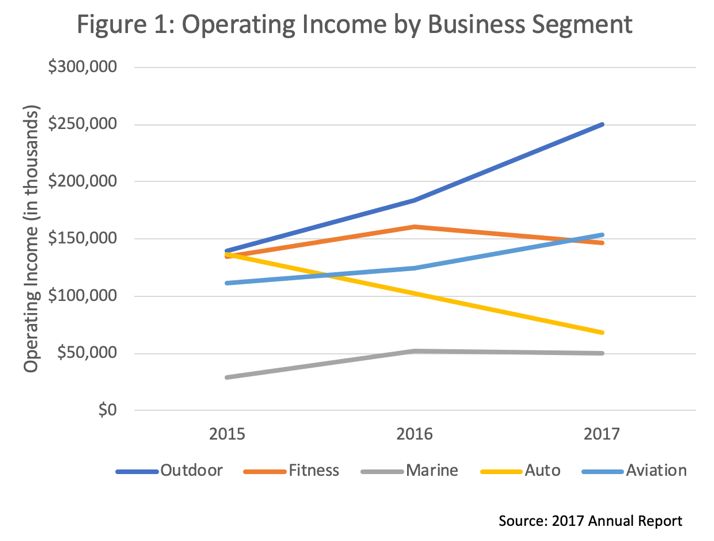
this segment’s atrophy in
Garmin’s hardware, dead reckoning algorithms,
recent years (see Figure 1).
and cartographic data collection. Garmin uses
this advantage to disrupt new industries withFrenzel 2
Aviation to the inclusion of GPS in the devices, which gave
Aviation was the second major market Garmin them a tremendous advantage over traditional
entered after its initial success in the automotive devices that tracked activities primarily through
segment. It initially offered panel-mounted step count. Since then, the segment has
navigational devices for small consumer aircraft. expanded to include a wider range of fitness
After it made a name for itself in the industry, it watches in addition to devices made for bicycles.
created product lines for auto-pilot systems, Many of these devices contain additional
HUDs and panel-mount displays, Traffic Alert sensors such as optical heart rate, ECG monitor,
and Collision Avoidance Systems (TCAS), and and accelerometers that can be used to provide
various communication systems (“Garmin a variety of health metrics to the user. Aside
from GPS, Garmin’s core competency in this
Product Page”). This segment has seen steady
growth of operating income recent years industry is its battery life. The battery life of
despite the massive development costs incurred Garmin devices can be measured in weeks
due to the highly regulated nature of the whereas the battery life of competitors such as
industry (“2017 Annual Report”). the Gear S3 or the Apple Watch are measured in
days. This is done through a combination of
Marine hardware and a proprietary operating system
Garmin’s marine division featured a beginning Garmin has been developing since the original
quite similar to its aviation division. Garmin Forerunner was released (“Garmin Product
entered the market by releasing a panel- Page”).
mounted navigation unit for small consumer Outdoor
boats and yachts. Once name recognition had
been built within the industry, Garmin released The outdoor division is perhaps the most
a plethora of other products such as chart promising in terms of operational profit. It
plotters, fish finders, entertainment systems, makes hand-held navigation devices, dog
and communication systems (“Garmin Product trackers, bow sights, golfing rangers, and
Page”). Marine has more than doubled its recent durable smartwatches (“Garmin Product Page”).
operating profit due to gains in market share. The last of these, Garmin’s Fenix smartwatch
Some of these gains can be attributed to line, also represents Garmin’s premium
technologies such as Panoptix – an industry-first smartwatch offering. The Fenix is developed in
imaging technology Garmin recently introduced conjunction with the fitness division and
into its product lineup (“2017 Annual Report”). produces a majority of this segment’s revenue
(“2017 Annual Report”).
Fitness
Garmin’s fitness division started from a single Situation Analysis
product line of running watches that were Business Model
developed in the early 2000’s (Garmin Garmin is a consumer electronics company, and
Forerunner). These were largely successful due consequently makes its money from the design,Frenzel 3
manufacture, and sale of consumer electronics. had a third party been contracted to perform
These sales come it three primary forms: direct these actions. As a result, Garmin is able to
sales via the Garmin website, indirect sales via maintain relatively high operating profit margins
third party vendors such as Walmart, Bass Pro, - as high as 35.8 percent in some segments
or Best Buy, and product integration sales from (“2017 Annual Report”).
manufacturers such as Honda, Fiat, or Toyota. Internal
The value in Garmin products lies in the unique Financials
innovations it is able to create by drawing upon Garmin sells its consumer electronics with a high
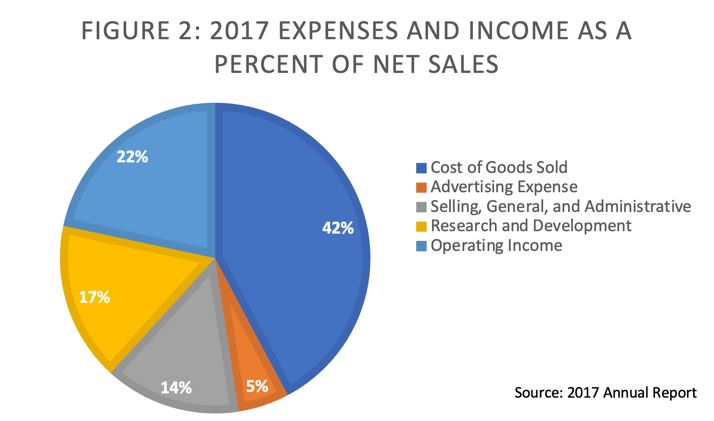
the technology and experience of its mature gross profit margin. This can be seen in Figure 2,
product lines. This can where the annual gross
be seen in Garmin’s profit is 1.78 billion dollars
smart watch lines, and the gross profit margin
which are able to utilize is 58 percent. While all of
GPS tracking without Garmin’s products have
compromising battery relatively high gross profit
life – a feat Garmin’s margins, the breakdown of
competitors struggle costs after costs of goods
with. Additionally, sold can vary quite
Garmin is able to bring new technologies to erratically depending on the business segment
market faster and in in question.
better products due to
its vertically integrated This can be clearly seen in
nature. This can be Figure 3, which breaks down
exemplified in the costs by business
Garmin’s industry-first segment. Possibly the
use of Panoptix in its largest outlier is the amount
fish tracker lineup. the aviation division spends
These two advantages on research and
often give Garmin products feature sets that are development. This is largely explained by the
impossible for competitors to replicate. stringent regulations placed on the avionics
industry. Any product developed by Garmin in
The majority of the costs Garmin incurs come this business segment must undergo rigorous
from manufacturing, development, advertising, testing, and as a result, will require far more
and sales/product support. Because Garmin engineering and development hours to
does most of its development and complete. Another interesting irregularity is the
manufacturing in-house, it is able to avoid some amount the fitness and outdoor divisions spend
of the additional expense that would be incurred on advertising. This is due to the products ofFrenzel 4
these segments being marketed towards the shrinking business segment, or to bring about
general consumer rather than a niche market. significant product line changes.
SWOT: Strengths and Weaknesses
Garmin’s capital structure is equity based. Total
shareholder equity account for 3.8 billion of Strengths:
Garmin’s 5 billion dollars of liabilities, with the • Engineering Talent – Garmin is first and
remaining 1.2 billion being comprised mainly of foremost an engineering company. This
operational debt (“2017 Annual Report”). As a reputation coupled with its well-known
result, Garmin does not incur any interest good treatment of its employees make it
expense when calculating its net income. a destination for embedded systems
developers and engineers throughout
Garmin pays a dividend of approximately 2 the Midwest.
dollars per share, and its net income per share • Vertical Integration – Garmin’s vertical
for 2017 was $3.70 (“2017 Annual Report”). integration allows for it to create better
Consequently, only 45 percent of Garmin’s net products faster. It also results in higher
income was invested back into the company in operating profit margins.
2017. • GPS Technology – Garmin’s experience
in GPS technology has been a driving
Leadership
force in its entry and subsequent growth
Garmin’s current CEO is Clifton Pemble. Pemble in all its business segments.
has been with the company since its founding in • Capital Structure – Garmin incurs no
1989 as a software developer. He served as interest expense as it is entirely financed
President and COO of Garmin in 2007 until being with stockholder equity.
promoted to CEO in 2013 (“Garmin Leadership • Diverse Product Offerings – Garmin has
Page”). Pemble’s background makes him well product lines in numerous industries.
known and respected by most of the company’s Even when certain markets decline,
engineers. Garmin can still experience steady
growth.
Pemble’s leadership style could be classified as Weaknesses:
“nurturer” as he has overseen steady growth of • Location – Much of the best engineering
the company during the last 5 years. However, it talent is employed on the west coast.
may be time for a leadership change, as drastic Despite Garmin’s success in the
changes need to be made in the auto business Midwest, it is still missing out on quite a
segment (see Figure 1), and Pemble might lack bit of talent by being located in Kansas.
the emotional separation needed to make • Dividend Payments – Garmin pays
drastic changes to Garmin’s oldest business around 55 percent of its net profit out as
segment. Garmin may need a “surgeon” type dividends. As a result, it is not able to
leader to either divest itself of this rapidlyFrenzel 5
invest as much back into research and competitor with the most similar offering to
development as it would otherwise. Garmin is Fitbit, which has better brand
External recognition. While Garmin’s revenues have still
grown due to overall industry growth, it faces
Competition issues with receding market share (“2017
Garmin faces unique challenges and Annual Report”).
competitors in each of its different business Outdoor
segments. Garmin’s main competitors in its outdoor
Automotive segment are Vista Outdoor and MiTAC for its
Garmin’s main competitors in its automotive handheld navigation offerings and Apple, Fitbit,
segment are TomTom and MiTac for dash-top and Samsung for its wearables offerings. Garmin
solutions and Harman and Panasonic for in-dash dominates the handheld market, quite similarly
solutions. Garmin led the dash-top market with to how it does for dash-top navigation devices.
an 80 percent market share in America, but lags Unfortunately, Garmin also faces the same
behind its competitors in in-dash solutions. This issues with market share that the fitness
could be problematic going forward as in-dash segment suffers from (“2017 Annual Report”).
solutions are becoming a much larger slice of the
PEST Analysis
market (“2015 Annual Report”).
Aviation Political
Garmin’s main competitors in its aviation The largest political factor Garmin faces by far is
segment are Honeywell and Rockwell Collins. federal regulation on the avionics industry by
Garmin dominates the market in retrofit and the FAA. Regulations increase development time
small aircraft solutions, but has failed to enter and costs. High profile accidents like the recent
the market for large passenger aircraft and Boeing 737 MAX crashes could potentially
military aircraft (“2017 Annual Report”). prompt further regulation of the industry. This
may eat into Garmin’s operating profit in this
Marine
business segment.
Garmin’s main competitors in its marine
segment are Furuno and Johnson Outdoors.
Garmin manufacturers most of its products in
Garmin’s cartography and first-to-market
facilities in Taiwan and China. Therefore,
Panoptix technology make its products highly
changes to labor regulations in these countries
competitive in this industry despite its relative
or changes in import laws could impact Garmin
newness (“2017 Annual Report”).
(“2017 Annual Report”).
Fitness
Economic
Garmin’s main competitors in its fitness
Garmin products are mostly luxury products.
segment are Apple, Fitbit, and Samsung. Apple
Therefore, any large downturns in the economy
and Samsung produce more generic
would have an exaggerated effect on Garmin’s
smartwatches and have the power of their
sales numbers.
brands and platforms supporting them. TheFrenzel 6
Social in this situation is great. The majority of Garmin
With the ever-growing obesity rates word-wide, products, however, are strictly marketed to the
fitness and health has become one of the fastest mass consumer. The result of this is far less
growing markets. Garmin should try to capitalize customer leverage. Garmin has taken advantage
on this growth in their fitness and outdoor of this by driving up their prices.
segments. Threat of Substitutes
Technological Many of Garmin’s products’ value is centered
The most pressing technology issue Garmin upon navigation. The greatest substitute for
faces is the ever-growing prevalence of smart these products is a mobile device. To prevent
phones. Smart phones have drastically reduced mobile devices from overtaking Garmin’s
the revenues from Garmin’s dash-mounted offerings, Garmin must pair new features with
navigation devices as well as its handheld its navigational devices to give them additional
navigation devices. This trend is likely to value over simply using a phone.
continue, and Garmin will need to further Threat of New Entrants
differentiate itself in order to compete with the New entrants to the navigation industry face an
built-in navigation of smartphones (“2017 enormous barrier of entry. New entrants must
Annual Report”). build their own cartography databases in order
to be competitive with existing players. This,
Porter’s Five Forces
coupled with the prevalence of smart phones,
Supplier Power makes expanding into the navigation industry
While Garmin faces far less supplier pressure unappealing for most companies.
than its competition due to its in-house
manufacturing capability, it still has suppliers. Garmin products that don’t require the use of
These suppliers are the companies that navigational technology, such as fish finders or
manufacture the raw components of Garmin’s bow sights are far more susceptible to
electronics. Some of these components, such as competition from new entrants. Fortunately,
NAND flash memory, have relatively few these products form a minority of Garmin’s
suppliers. Consequently, prices of these offerings, and the impact of any loss in market
components can, and have been, artificially share would be minimal.
inflated (Hruska). Fortunately, while these
Competitive Rivalry
increases in component prices may affect gross
Garmin’s products face a large amount of
margin, they do not hurt Garmin’s
competition. Nearly every product Garmin
competitiveness, as all of Garmin’s competitors
offers has a direct analogue produced by
are exposed to these same pressures.
another company. Garmin must continue to
Buyer Power offer superior value or lower prices on all of its
Buyer power is greatest in segments that utilize products in order to remain competitive.
OEM partnerships. Because Garmin is dealing
with only a handful of customers, their leverageFrenzel 7
SWOT: Opportunities and Threats Finally, all strategic options will be judged on
Opportunities: their feasibility given Garmin’s resources and
current market conditions.
• Growth in the fitness and health
industries Proposals
• Expansion into avionics for large/military Expand Avionics Segment to New Markets
aircraft
Garmin currently dominates the market in
Threats:
retrofit and small aircraft avionics. While
• Decrease in competitiveness as the
admirable, this segment of the market
ubiquity of smartphones makes
represents a small piece of the avionics industry
navigation a less useful product feature
as a whole. The real money is in large
• Complete replacement of automotive
commercial and military avionics. The most
navigational products by smartphones
reasonable of these for Garmin to disrupt is
• Increase in development cost for
commercial. This market is projected to bring in
avionics as the industry becomes more
209 billion dollars in annual revenue
regulated
(Sonawane), far more than the 3.1 billion
projected for the small aircraft market (“Global
Strategy Alternatives
Light Aircraft…”).
Goals and Evaluation criteria
All publicly traded companies have a duty to Increase Vehicle Integration of Auto Products
serve the best interest of their shareholders – Garmin’s auto segment has been rapidly
usually by making the most money. In Garmin’s deteriorating as smart phones commonly
case, this must be done carefully, as while replace dash-top navigation units. To combat
engineering talent is one of its strengths, it is still this, Garmin could switch focus to its in-dash
a very much limited resource. Therefore, any OEM units. Garmin could increase its
strategy chosen will be judged on its ability to competitiveness in this market by designing
maximize operating profit margin. This will more fully integrated solutions. The easiest way
assure that Garmin’s engineering hours are to do this would be through a combination of
spent in the most profitable way. adding sensor-based features and merging
existing console functionality such as media and
Another strategic goal Garmin should have is to climate controls into the navigational unit. The
trigger new growth in one of its stagnant or seamless user experience a solution like this
dying business segments. Industry could provide would be far more appealing to
diversification is one of Garmin’s greatest auto manufacturers than Garmin’s current
strengths, not only for its added financial offerings.
stability, but also for the innovations cross-
industry experimentation can inspire.Frenzel 8
Use Growing Health Concerns to Expand Fitness the message in their ads could damage Garmin’s
With obesity on the rise globally, weight loss has brand as a performance sport company.
become a massive industry, particularly in Additionally, the fitness segment has been
America. Garmin should capitalize on this trend experiencing solid growth over the last few
by adding weight loss centric products to its years, and consequently should not be the focus
fitness device lineup. This could be done simply of a strategy change.
by shifting the focus of its training optimized
programs to weight loss and creating a new
Designing a more integrated in-dash navigation
marketing campaign.
system would require relatively few engineering
Strategy Recommendation and hours. Much of the functionality that would be
implemented in such a system has already been
Justification built in existing Garmin products. This makes this
In this section, each of the proposed strategies strategy attractive in terms of both feasibility
will be evaluated according to the goals laid out and operational profit. Additionally, although
in the Goals and Evaluation Criteria section. sales of dash-top navigation units will likely
continue to drop, revenues from in-dash units
As stated in the strategy outline, expanding into are projected to grow at 8 percent annually. This
the commercial aircraft market has the potential steady growth would be key in turning around
to net Garmin billions of dollars in new revenue. the decline of Garmin’s auto business segment
However, breaking into this market would (Kulkarni). Because this strategy meets all three
require millions of engineering hours to develop criteria, it is the best solution of the three.
and test the complex systems required for large
commercial aircraft. Garmin has little Implementation Timeline
experience building avionics for aircraft with Because this product would mainly involve
large fuselages or jet engines, so it would also changing the form factor of existing Garmin
need to poach engineers from rival firms. technologies, the projected timeline for its
Consequently, while this strategy fulfills the implementation is relatively short. Work on
operating profit criteria, it would require an requirements and specifications would begin in
enormous upfront investment that Garmin Q2 of 2019. After an agreement has been made
cannot currently support, making it infeasible. with the auto manufacturer, work could begin
on mechanical and circuitry prototyping in Q3,
Tailoring a fitness wearable towards weight loss with early development models being made
would be a simple engineering feat as Garmin available to software developers in Q2 of 2020.
would simply have to adjust existing algorithms. Software development and testing should be
The necessary changes to their adverting could concluded by Q4 of 2020. This would put Garmin
have negative side effects. Increasing in position to start manufacturing by Q1 of 2021.
advertisement expenditures could potentially
lower the operational profit margin and splittingFrenzel 9 Contingency Plan This strategy may fail to resuscitate the auto division through either lack of sales or unforeseen engineering issues. If this occurs, Garmin should seek to sell the auto division or simply stop developing new auto products. Auto is currently the division with smallest operational profit margin, and if this strategy cannot improve that, then Garmin’s developers are better off working within one of its other divisions.
Frenzel 10

Bibliography
CSI Market. Garmin Ltd. (GRMN) Business Description - CSI Market. 2019. 31 March 2019.
Garmin LTD. "2015 Annual Report." 2016.
—. 2017 Annual Report. Annual Report. Olathe, 2018.
—. "Garmin Leadership Page." 2019.
—. Garmin Product Page. 2019. 31 March 2019.
Global Light Aircraft Market 2018 to 2022 -- A $3.1 Billion Market Opportunity by 2022 . 1 August 2018.
       7 April 2019.
Hruska, Joel. Extreme Tech. 3 January 2019. 6 April 2019.
Johnson-Freese, Joan. Space as a Strategic Asset. Columbia University Press, 2007.
Kulkarni, Amrut. Car GPS Navigation System Market by Component (Hardware & Software), Car type
       (Passenger car and Commercial Car), and End User (OEM & Aftermarket) - Global Opportunity
       Analysis and Industry Forecast, 2017 - 2023 . September 2017. 8 April 2019.
Sonawane, Kalyani. Commercial Aircraft Market by Size (Wide-Body, Narrow-Body, Regional), End User
       (Government, Private Sector) - Global Opportunity Analysis and Industry Forecast, 2014 - 2022 .
       September 2016. 7 April 2019.
You can also read


