DISCOUNT RATES The D in the DCF. - NYU Stern
←
→
Page content transcription
If your browser does not render page correctly, please read the page content below
Aswath Damodaran   20

DISCOUNT RATES
The D in the DCF..
Estimating Inputs: Discount Rates
21

     ¨   While discount rates obviously matter in DCF valuation, they
         don’t matter as much as most analysts think they do.
     ¨   At an intuitive level, the discount rate used should be
         consistent with both the riskiness and the type of cashflow
         being discounted.
         ¤   Equity versus Firm: If the cash flows being discounted are cash flows to
             equity, the appropriate discount rate is a cost of equity. If the cash
             flows are cash flows to the firm, the appropriate discount rate is the
             cost of capital.
         ¤   Currency: The currency in which the cash flows are estimated should
             also be the currency in which the discount rate is estimated.
         ¤   Nominal versus Real: If the cash flows being discounted are nominal
             cash flows (i.e., reflect expected inflation), the discount rate should be
             nominal

     Aswath Damodaran
                                                                                          21
Risk in the DCF Model
22

                                                        Relative risk of         Equity Risk Premium
     Risk Adjusted        Risk free rate in the       company/equity in    X
     Cost of equity
                      =
                          currency of analysis    +       questiion
                                                                               required for average risk
                                                                                         equity

     Aswath Damodaran
                                                                                                           22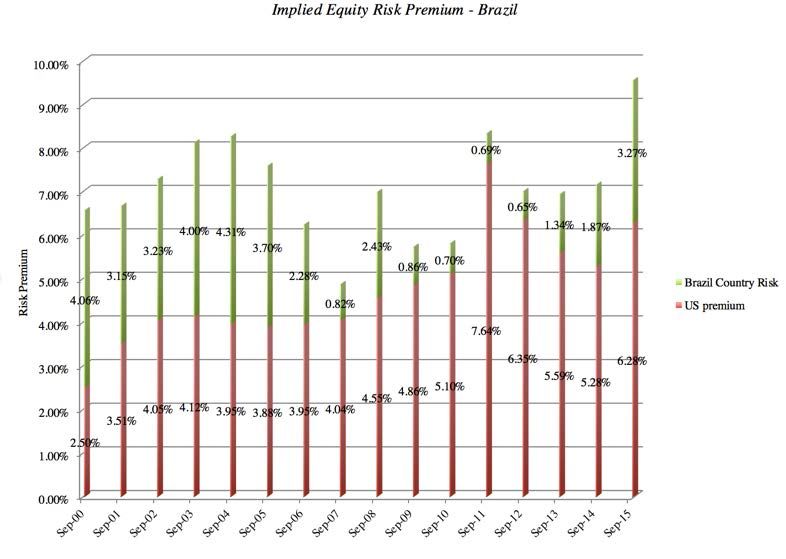
Not all risk is created equal…
23

     ¨   Estimation versus Economic uncertainty
         ¤   Estimation uncertainty reflects the possibility that you could have the “wrong
             model” or estimated inputs incorrectly within this model.
         ¤   Economic uncertainty comes the fact that markets and economies can change over
             time and that even the best models will fail to capture these unexpected changes.
     ¨   Micro uncertainty versus Macro uncertainty
         ¤   Micro uncertainty refers to uncertainty about the potential market for a firm’s
             products, the competition it will face and the quality of its management team.
         ¤   Macro uncertainty reflects the reality that your firm’s fortunes can be affected by
             changes in the macro economic environment.
     ¨   Discrete versus continuous uncertainty
         ¤   Discrete risk: Risks that lie dormant for periods but show up at points in time.
             (Examples: A drug working its way through the FDA pipeline may fail at some stage
             of the approval process or a company in Venezuela may be nationalized)
         ¤   Continuous risk: Risks changes in interest rates or economic growth occur
             continuously and affect value as they happen.

     Aswath Damodaran
                                                                                                   23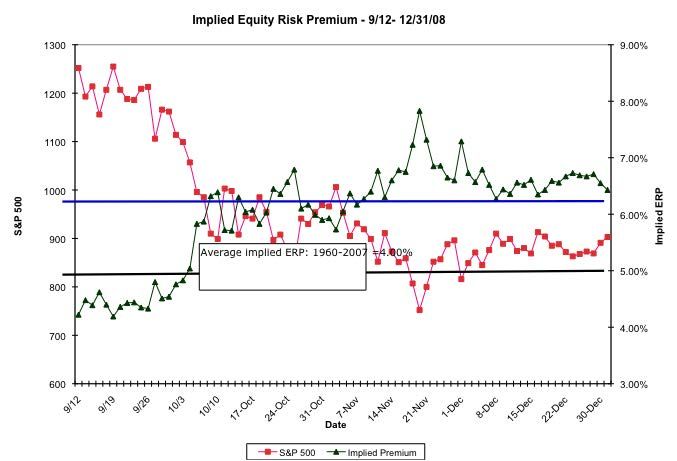
Risk and Cost of Equity: The role of the marginal
     investor
24

     ¨   Not all risk counts: While the notion that the cost of equity should
         be higher for riskier investments and lower for safer investments is
         intuitive, what risk should be built into the cost of equity is the
         question.
     ¨   Risk through whose eyes? While risk is usually defined in terms of
         the variance of actual returns around an expected return, risk and
         return models in finance assume that the risk that should be
         rewarded (and thus built into the discount rate) in valuation should
         be the risk perceived by the marginal investor in the investment
     ¨   The diversification effect: Most risk and return models in finance
         also assume that the marginal investor is well diversified, and that
         the only risk that he or she perceives in an investment is risk that
         cannot be diversified away (i.e, market or non-diversifiable risk). In
         effect, it is primarily economic, macro, continuous risk that should
         be incorporated into the cost of equity.

     Aswath Damodaran
                                                                                  24
The Cost of Equity: Competing “ Market Risk” Models
25

     Model Expected Return                 Inputs Needed
     CAPM E(R) = Rf + b (Rm- Rf)           Riskfree Rate
                                           Beta relative to market portfolio
                                           Market Risk Premium
     APM       E(R) = Rf + Sbj (Rj- Rf)    Riskfree Rate; # of Factors;
                                           Betas relative to each factor
                                           Factor risk premiums
     Multi      E(R) = Rf + Sbj (Rj- Rf)   Riskfree Rate; Macro factors
     factor                                Betas relative to macro factors
                                           Macro economic risk premiums
     Proxy     E(R) = a + S bj Yj          Proxies
                                           Regression coefficients

     Aswath Damodaran
                                                                               25
Classic Risk & Return: Cost of Equity
26
¨ In the CAPM, the cost of equity:
Cost of Equity = Riskfree Rate + Equity Beta * (Equity Risk
Premium)
¨ In APM or Multi-factor models, you still need a risk
free rate, as well as betas and risk premiums to go
with each factor.
¨ To use any risk and return model, you need
¨ A risk free rate as a base
¨ A single equity risk premium (in the CAPM) or factor risk
premiums, in the the multi-factor models
¨ A beta (in the CAPM) or betas (in multi-factor models)
Aswath Damodaran
2627 Discount Rates: I
The Risk Free Rate
Aswath DamodaranThe Risk Free Rate: Laying the Foundations
28
¨ On a riskfree investment, the actual return is equal to the expected
return. Therefore, there is no variance around the expected return.
¨ For an investment to be riskfree, then, it has to have
¤ No default risk
¤ No reinvestment risk
¤ It follows then that if asked to estimate a risk free rate:
1. Time horizon matters: Thus, the riskfree rates in valuation will
depend upon when the cash flow is expected to occur and will
vary across time.
2. Currencies matter: A risk free rate is currency-specific and can be
very different for different currencies.
3. Not all government securities are riskfree: Some governments
face default risk and the rates on bonds issued by them will not
be riskfree.
Aswath Damodaran
28Test 1: A riskfree rate in US dollars!
29
¨ In valuation, we estimate cash flows forever (or at least
for very long time periods). The right risk free rate to use
in valuing a company in US dollars would be
a. A three-month Treasury bill rate (0.2%)
b. A ten-year Treasury bond rate (2%)
c. A thirty-year Treasury bond rate (3%)
d. A TIPs (inflation-indexed treasury) rate (1%)
e. None of the above
¨ What are we implicitly assuming about the US treasury
when we use any of the treasury numbers?
Aswath Damodaran
29Test 2: A Riskfree Rate in Euros
30
Euro Government Bond Rates - January 1, 2016
10.00%
9.00%
8.00%
7.00%
6.00%
5.00%
4.00%
3.00%
2.00%
1.00%
0.00%
Aswath Damodaran
30Test 3: A Riskfree Rate in Indian Rupees
31
¨ The Indian government had 10-year Rupee bonds
outstanding, with a yield to maturity of about 7.73% on
January 1, 2016.
¨ In January 2016, the Indian government had a local currency
sovereign rating of Baa3. The typical default spread (over a
default free rate) for Baa3 rated country bonds in early 2016
was 2.44%. The riskfree rate in Indian Rupees is
a. The yield to maturity on the 10-year bond (7.73%)
b. The yield to maturity on the 10-year bond + Default spread (10.17%)
c. The yield to maturity on the 10-year bond – Default spread (5.29%)
d. None of the above
Aswath Damodaran
31Sovereign Default Spread: Three paths to
the same destination…
32
¨ Sovereign dollar or euro denominated bonds: Find
sovereign bonds denominated in US dollars, issued by an
emerging sovereign.
¤ Default spread = Emerging Govt Bond Rate (in US $) – US
Treasury Bond rate with same maturity.
¨ CDS spreads: Obtain the traded value for a sovereign
Credit Default Swap (CDS) for the emerging government.
¤ Default spread = Sovereign CDS spread (with perhaps an
adjustment for CDS market frictions).
¨ Sovereign-rating based spread: For countries which don’t
issue dollar denominated bonds or have a CDS spread,
you have to use the average spread for other countries
with the same sovereign rating.
Aswath Damodaran
32Local Currency Government Bond Rates –
January 2016
33
Aswath Damodaran
33Approach 1: Default spread from
Government Bonds
The Brazil Default Spread
Brazil 2021 Bond: 6.83%
US 2021 T.Bond: 2.00%
Spread: 4.83%
34Approach 2: CDS Spreads – January 2016
35
Aswath Damodaran
35Approach 3: Typical Default Spreads:
January 2016
36
Aswath Damodaran
36Getting to a risk free rate in a currency: Example
37
¨ The Brazilian government bond rate in nominal reais on
January 1, 2016 was 16.51%. To get to a riskfree rate in
nominal reais, we can use one of three approaches.
¨ Approach 1: Government Bond spread
¤ The 2021 Brazil bond, denominated in US dollars, has a spread of
4.83% over the US treasury bond rate.
¤ Riskfree rate in $R = 16.51% - 4.83% = 11.68%
¨ Approach 2: The CDS Spread
¤ The CDS spread for Brazil, adjusted for the US CDS spread was
5.19%.
¤ Riskfree rate in $R = 16.51% - 5.19% = 11.32%
¨ Approach 3: The Rating based spread
¤ Brazil has a Baa3 local currency rating from Moody’s. The default
spread for that rating is 2.44%
¤ Riskfree rate in $R = 16.51% - 2.44% = 14.07%
Aswath Damodaran
37Test 4: A Real Riskfree Rate
38
¨ In some cases, you may want a riskfree rate in real terms
(in real terms) rather than nominal terms.
¨ To get a real riskfree rate, you would like a security with
no default risk and a guaranteed real return. Treasury
indexed securities offer this combination.
¨ In January 2016, the yield on a 10-year indexed treasury
bond was 0.75%. Which of the following statements
would you subscribe to?
a. This (0.75%) is the real riskfree rate to use, if you are valuing
US companies in real terms.
b. This (0.75%) is the real riskfree rate to use, anywhere in the
world
Explain.
Aswath Damodaran
3839
-5.00%
10.00%
15.00%
20.00%
0.00%
5.00%
Japanese Yen
Aswath Damodaran
Czech Koruna
Swiss Franc
Taiwanese $
Bulgarian Lev
Euro
Hungarian Forint
Thai Baht
Danish Krone
Swedish Krona
HK $
Croatian Kuna
Israeli Shekel
Romanian Leu
Canadian $
Norwegian Krone
British Pound
Risk free Rate
Korean Won
Pakistani Rupee
Phillipine Peso
Polish Zloty
Vietnamese Dong
Chinese Yuan
US $
January 2016 Risk free rates
Singapore $
Risk free Rates - January 2016
Malyasian Ringgit
Default Spread based on rating
Australian $
NZ $
Iceland Krona
Chilean Peso
Mexican Peso
Indian Rupee
Peruvian Sol
Colombian Peso
Indonesian Rupiah
Venezuelan Bolivar
Russian Ruble
Nigerian Naira
Turkish Lira
South African Rand
Kenyan Shilling
Brazilian Reai
Why do risk free rates vary across currencies?
39Risk free Rate: Don’t have or trust the
government bond rate?
1. Build up approach: The risk free rate in any currency can be
written as the sum of two variables:
Risk free rate = Expected Inflation in currency + Expected real interest rate
The expected real interest rate can be computed in one of two ways: from
the US TIPs rate or set equal to real growth in the economy. Thus, if the
expected inflation rate in a country is expected to be 15% and the TIPs rate
is 1%, the risk free rate is 16%.
2. US $ Rate & Differential Inflation: Alternatively, you can scale up
the US $ risk free rate by the differential inflation between the US
$ and the currency in question:
Risk free rateCurrency=
Thus, if the US $ risk free rate is 2.00%, the inflation rate in the foreign
currency is 15% and the inflation rate in US $ is 1.5%, the foreign currency risk
free rate is as follows:
Risk free rate = 1.02
!.!"
− 1 = 15.57%
!.!"#
40One more test on riskfree rates…
41
¨ On January 1, 2016, the 10-year treasury bond rate in
the United States was 2.27%, a historic low. Assume that
you were valuing a company in US dollars then, but were
wary about the risk free rate being too low. Which of the
following should you do?
a. Replace the current 10-year bond rate with a more reasonable
normalized riskfree rate (the average 10-year bond rate over
the last 30 years has been about 5-6%)
b. Use the current 10-year bond rate as your riskfree rate but
make sure that your other assumptions (about growth and
inflation) are consistent with the riskfree rate
c. Something else…
Aswath Damodaran
4142
-5.00%
10.00%
15.00%
20.00%
0.00%
5.00%
1954
Aswath Damodaran
1955
1956
1957
1958
1959
1960
1961
1962
1963
1964
1965
1966
1967
1968
1969
1970
1971
1972
1973
1974
Inflation rate
1975
1976
1977
1978
1979
1980
1981
1982
1983
1984
1985
Real GDP growth
1986
1987
1988
1989
1990
1991
1992
1993
1994
1995
1996
Ten-year T.Bond rate 1997
1998
1999
2000
2001
2002
2003
2004
2005
2006
Interest rate fundamentals: T. Bond rates, Real growth and inflation
2007
2008
2009
Some perspective on risk free rates
2010
2011
2012
2013
2014
2015
42Negative Interest Rates?
43
¨ In 2016, there were at least three currencies (Swiss
Franc, Japanese Yen, Euro) with negative interest
rates. Using the fundamentals (inflation and real
growth) approach, how would you explain negative
interest rates?
¨ How negative can rates get? (Is there a bound?)
¨ Would you use these negative interest rates as risk
free rates?
¤ If no, why not and what would you do instead?
¤ If yes, what else would you have to do in your valuation to
be internally consistent?
Aswath Damodaran
4344 Discount Rates: II
The Equity Risk Premium
Aswath DamodaranThe ubiquitous historical risk premium
45
¨ The historical premium is the premium that stocks have historically
earned over riskless securities.
¨ While the users of historical risk premiums act as if it is a fact (rather than
an estimate), it is sensitive to
¤ How far back you go in history…
¤ Whether you use T.bill rates or T.Bond rates
¤ Whether you use geometric or arithmetic averages.
¨ For instance, looking at the US:
Aswath Damodaran
45The perils of trusting the past…….
46
¨ Noisy estimates: Even with long time periods of history,
the risk premium that you derive will have substantial
standard error. For instance, if you go back to 1928
(about 80 years of history) and you assume a standard
deviation of 20% in annual stock returns, you arrive at a
standard error of greater than 2%:
Standard Error in Premium = 20%/√80 = 2.26%
¨ Survivorship Bias: Using historical data from the U.S.
equity markets over the twentieth century does create a
sampling bias. After all, the US economy and equity
markets were among the most successful of the global
economies that you could have invested in early in the
century.
Aswath Damodaran
46Risk Premium for a Mature Market? Broadening
the sample to 1900-2015
47
Country Geometric ERP Arithmetic ERP Standard Error
Australia 5.00% 6.60% 1.70%
Austria 2.60% 21.50% 14.30%
Belgium 2.40% 4.50% 2.00%
Canada 3.30% 4.90% 1.70%
Denmark 2.30% 3.80% 1.70%
Finland 5.20% 8.80% 2.80%
France 3.00% 5.40% 2.10%
Germany 5.10% 9.10% 2.70%
Ireland 2.80% 4.80% 1.80%
Italy 3.10% 6.50% 2.70%
Japan 5.10% 9.10% 3.00%
Netherlands 3.30% 5.60% 2.10%
New Zealand 4.00% 5.50% 1.70%
Norway 2.30% 5.20% 2.60%
South Africa 5.40% 7.20% 1.80%
Spain 1.80% 3.80% 1.90%
Sweden 3.10% 5.40% 2.00%
Switzerland 2.10% 3.60% 1.60%
U.K. 3.60% 5.00% 1.60%
U.S. 4.30% 6.40% 1.90%
Europe 3.20% 4.50% 1.50%
World-ex U.S. 2.80% 3.90% 1.40%
World 3.20% 4.40% 1.40%
Aswath Damodaran
47The simplest way of estimating an additional
country risk premium: The country default spread
48
¨ Default spread for country: In this approach, the country equity risk
premium is set equal to the default spread for the country,
estimated in one of three ways:
¤ The default spread on a dollar denominated bond issued by the country.
(In January 2016, that spread was 4.83% for the Brazilian $ bond)
¤ The sovereign CDS spread for the country. In January 2016, the ten year
CDS spread for Brazil, adjusted for the US CDS, was 5.19%.
¤ The default spread based on the local currency rating for the country.
Brazil’s sovereign local currency rating is Baa3 and the default spread for a
Baa3 rated sovereign was about 2.44% in January 2016.
¨ Add the default spread to a “mature” market premium: This default
spread is added on to the mature market premium to arrive at the
total equity risk premium for Brazil, assuming a mature market
premium of 6.00%.
¤ Country Risk Premium for Brazil = 2.44%
¤ Total ERP for Brazil = 6.00% + 2.44% = 8.44%
Aswath
Aswath Damodaran
Damodaran
48An equity volatility based approach to
estimating the country total ERP
49
¨ This approach draws on the standard deviation of two equity
markets, the emerging market in question and a base market
(usually the US). The total equity risk premium for the
emerging market is then written as:
¤ Total equity risk premium = Risk PremiumUS* sCountry Equity / sUS Equity
¨ The country equity risk premium is based upon the volatility
of the market in question relative to U.S market.
¤ Assume that the equity risk premium for the US is 6.00%.
¤ Assume that the standard deviation in the Bovespa (Brazilian equity) is
30% and that the standard deviation for the S&P 500 (US equity) is
18%.
¤ Total Equity Risk Premium for Brazil = 6.00% (30%/18%) = 10.0%
¤ Country equity risk premium for Brazil = 10.00% - 6.00% = 4.00%
Aswath Damodaran
49A melded approach to estimating the additional
country risk premium
50
¨ Country ratings measure default risk. While default risk premiums
and equity risk premiums are highly correlated, one would expect
equity spreads to be higher than debt spreads.
¨ Another is to multiply the bond default spread by the relative
volatility of stock and bond prices in that market. Using this
approach for Brazil in January 2016, you would get:
¤ Country Equity risk premium = Default spread on country bond* sCountry
Equity / sCountry Bond
n Standard Deviation in Bovespa (Equity) = 30%
n Standard Deviation in Brazil government bond = 20%
n Default spread for Brazil= 2.44%
¤ Brazil Country Risk Premium = 2.44% (30%/20%) = 3.66%
¤ Brazil Total ERP = Mature Market Premium + CRP = 6.00% + 3.66% = 9.66%
Aswath Damodaran
50A Template for Country Risk
51
Aswath Damodaran
51ERP : Jan 2016
Black #: Total ERP
Red #: Country risk premium
AVG: GDP weighted averageFrom Country Equity Risk Premiums to
Corporate Equity Risk premiums
53
¨ Approach 1: Assume that every company in the country is equally
exposed to country risk. In this case,
¤ E(Return) = Riskfree Rate + CRP + Beta (Mature ERP)
¤ Implicitly, this is what you are assuming when you use the local Government’s
dollar borrowing rate as your riskfree rate.
¨ Approach 2: Assume that a company’s exposure to country risk is similar
to its exposure to other market risk.
¤ E(Return) = Riskfree Rate + Beta (Mature ERP+ CRP)
¨ Approach 3: Treat country risk as a separate risk factor and allow firms to
have different exposures to country risk (perhaps based upon the
proportion of their revenues come from non-domestic sales)
¤ E(Return)=Riskfree Rate+ b (Mature ERP) + l (CRP)
Mature ERP = Mature market Equity Risk Premium
CRP = Additional country risk premium
Aswath Damodaran
53Approaches 1 & 2: Estimating country risk
premium exposure
54
¨ Location based CRP: The standard approach in valuation is to
attach a country risk premium to a company based upon its
country of incorporation. Thus, if you are an Indian company,
you are assumed to be exposed to the Indian country risk
premium. A developed market company is assumed to be
unexposed to emerging market risk.
¨ Operation-based CRP: There is a more reasonable modified
version. The country risk premium for a company can be
computed as a weighted average of the country risk
premiums of the countries that it does business in, with the
weights based upon revenues or operating income. If a
company is exposed to risk in dozens of countries, you can
take a weighted average of the risk premiums by region.
Aswath Damodaran
54Operation based CRP: Single versus Multiple
Emerging Markets
55
¨ Single emerging market: Embraer, in 2004, reported that it derived 3% of
its revenues in Brazil and the balance from mature markets. The mature
market ERP in 2004 was 5% and Brazil’s CRP was 7.89%.
¨ Multiple emerging markets: Ambev, the Brazilian-based beverage
company, reported revenues from the following countries during 2011.
Aswath Damodaran
55Extending to a multinational: Regional breakdown
Coca Cola’s revenue breakdown and ERP in 2012
56
Things to watch out for
1. Aggregation across regions. For instance, the Pacific region often includes Australia & NZ with Asia
2. Obscure aggregations including Eurasia and Oceania
56Two problems with these approaches..
57
¨ Focus just on revenues: To the extent that revenues are
the only variable that you consider, when weighting risk
exposure across markets, you may be missing other
exposures to country risk. For instance, an emerging
market company that gets the bulk of its revenues
outside the country (in a developed market) may still
have all of its production facilities in the emerging
market.
¨ Exposure not adjusted or based upon beta: To the extent
that the country risk premium is multiplied by a beta, we
are assuming that beta in addition to measuring
exposure to all other macro economic risk also measures
exposure to country risk.
Aswath Damodaran
57A Production-based ERP: Royal Dutch Shell
in 2015
58
Country Oil & Gas Production % of Total ERP
Denmark 17396 3.83% 6.20%
Italy 11179 2.46% 9.14%
Norway 14337 3.16% 6.20%
UK 20762 4.57% 6.81%
Rest of Europe 874 0.19% 7.40%
Brunei 823 0.18% 9.04%
Iraq 20009 4.40% 11.37%
Malaysia 22980 5.06% 8.05%
Oman 78404 17.26% 7.29%
Russia 22016 4.85% 10.06%
Rest of Asia & ME 24480 5.39% 7.74%
Oceania 7858 1.73% 6.20%
Gabon 12472 2.75% 11.76%
Nigeria 67832 14.93% 11.76%
Rest of Africa 6159 1.36% 12.17%
USA 104263 22.95% 6.20%
Canada 8599 1.89% 6.20%
Brazil 13307 2.93% 9.60%
Rest of Latin America 576 0.13% 10.78%
Royal Dutch Shell 454326 100.00% 8.26%
Aswath Damodaran
58Approach 3: Estimate a lambda for country risk
59
¨ Country risk exposure is affected by where you get your
revenues and where your production happens, but there are
a host of other variables that also affect this exposure,
including:
¤ Use of risk management products: Companies can use both options/futures
markets and insurance to hedge some or a significant portion of country risk.
¤ Government “national” interests: There are sectors that are viewed as vital to
the national interests, and governments often play a key role in these
companies, either officially or unofficially. These sectors are more exposed to
country risk.
¨ It is conceivable that there is a richer measure of country risk
that incorporates all of the variables that drive country risk in
one measure. That way my rationale when I devised
“lambda” as my measure of country risk exposure.
Aswath Damodaran
59A Revenue-based Lambda
¨ The factor “l” measures the relative exposure of a firm to country
risk. One simplistic solution would be to do the following:
l = % of revenues domesticallyfirm/ % of revenues domesticallyaverage firm
¨ Consider two firms – Tata Motors and Tata Consulting Services,
both Indian companies. In 2008-09, Tata Motors got about 91.37%
of its revenues in India and TCS got 7.62%. The average Indian firm
gets about 80% of its revenues in India:
l Tata Motors= 91%/80% = 1.14
l TCS= 7.62%/80% = 0.09
¨ There are two implications
¤ A company’s risk exposure is determined by where it does business and
not by where it is incorporated.
¤ Firms might be able to actively manage their country risk exposures
60A Price/Return based Lambda
61
ReturnEmbraer = 0.0195 + 0.2681 ReturnC Bond
ReturnEmbratel = -0.0308 + 2.0030 ReturnC Bond
Embraer versus C Bond: 2000-2003 Embratel versus C Bond: 2000-2003
40 100
80
20
60
40
Return on Embrat el
Return on Embraer
0
20
0
-20
-20
-40 -40
-60
-60 -80
-30 -20 -10 0 10 20 -30 -20 -10 0 10 20
Return on C-Bond Return on C-Bond
Aswath Damodaran
61Estimating a US Dollar Cost of Equity for
Embraer - September 2004
62
¨ Assume that the beta for Embraer is 1.07, and that the US $ riskfree rate
used is 4%. Also assume that the risk premium for the US is 5% and the
country risk premium for Brazil is 7.89%. Finally, assume that Embraer
gets 3% of its revenues in Brazil & the rest in the US.
¨ There are five estimates of $ cost of equity for Embraer:
¤ Approach 1: Constant exposure to CRP, Location CRP
n E(Return) = 4% + 1.07 (5%) + 7.89% = 17.24%
¤ Approach 2: Constant exposure to CRP, Operation CRP
n E(Return) = 4% + 1.07 (5%) + (0.03*7.89% +0.97*0%)= 9.59%
¤ Approach 3: Beta exposure to CRP, Location CRP
n E(Return) = 4% + 1.07 (5% + 7.89%)= 17.79%
¤ Approach 4: Beta exposure to CRP, Operation CRP
n E(Return) = 4% + 1.07 (5% +( 0.03*7.89%+0.97*0%)) = 9.60%
¤ Approach 5: Lambda exposure to CRP
n E(Return) = 4% + 1.07 (5%) + 0.27(7.89%) = 11.48%
Aswath Damodaran
62Valuing Emerging Market Companies with
significant exposure in developed markets
63
¨ The conventional practice in investment banking is to add the country
equity risk premium on to the cost of equity for every emerging market
company, notwithstanding its exposure to emerging market risk. Thus, in
2004, Embraer would have been valued with a cost of equity of 17-18%
even though it gets only 3% of its revenues in Brazil. As an investor, which
of the following consequences do you see from this approach?
a. Emerging market companies with substantial exposure in developed
markets will be significantly over valued by equity research analysts.
b. Emerging market companies with substantial exposure in developed
markets will be significantly under valued by equity research analysts.
Can you construct an investment strategy to take advantage of the misvaluation?
What would need to happen for you to make money of this strategy?
Aswath Damodaran
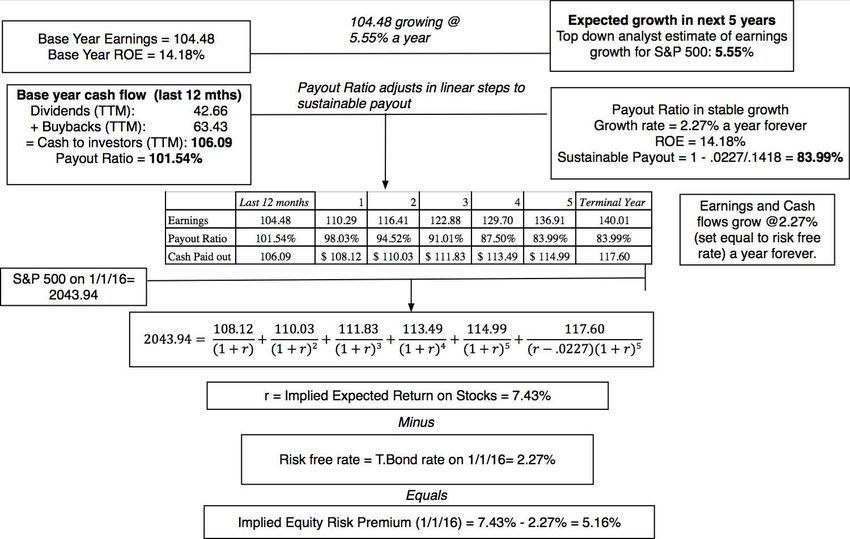
63Implied Equity Premiums
64
¨ Let’s start with a general proposition. If you know the price
paid for an asset and have estimates of the expected cash
flows on the asset, you can estimate the IRR of these cash
flows. If you paid the price, this is what you have priced the
asset to earn (as an expected return).
¨ If you assume that stocks are correctly priced in the aggregate
and you can estimate the expected cashflows from buying
stocks, you can estimate the expected rate of return on stocks
by finding that discount rate that makes the present value
equal to the price paid. Subtracting out the riskfree rate
should yield an implied equity risk premium.
¨ This implied equity premium is a forward looking number and
can be updated as often as you want (every minute of every
day, if you are so inclined).
Aswath Damodaran
64Implied Equity Premiums: January 2008
65
¨ We can use the information in stock prices to back out how risk averse the market is and how much of a risk
premium it is demanding.
After year 5, we will assume that
earnings on the index will grow at
Between 2001 and 2007 Analysts expect earnings to grow 5% a year for the next 5 years. We 4.02%, the same rate as the entire
dividends and stock will assume that dividends & buybacks will keep pace.. economy (= riskfree rate).
buybacks averaged 4.02% Last year’s cashflow (59.03) growing at 5% a year
of the index each year.
61.98 65.08 68.33 71.75 75.34
January 1, 2008
S&P 500 is at 1468.36
4.02% of 1468.36 = 59.03
¨ If you pay the current level of the index, you can expect to make a return of 8.39% on stocks (which is obtained by
solving for r in the following equation)
61.98 65.08 68.33 71.75 75.34 75.35(1.0402)
1468.36 = + + + + +
(1+ r) (1+ r) 2 (1+ r) 3 (1+ r) 4 (1+ r) 5 (r − .0402)(1+ r) 5
¨ Implied Equity risk premium = Expected return on stocks - Treasury bond rate = 8.39% - 4.02% = 4.37%
€
Aswath Damodaran
65A year that made a difference.. The implied
premium in January 2009
66
Year Market value of index Dividends Buybacks Cash to equity Dividend yield Buyback yield Total yield
2001 1148.09 15.74 14.34 30.08 1.37% 1.25% 2.62%
2002 879.82 15.96 13.87 29.83 1.81% 1.58% 3.39%
2003 1111.91 17.88 13.70 31.58 1.61% 1.23% 2.84%
2004 1211.92 19.01 21.59 40.60 1.57% 1.78% 3.35%
2005 1248.29 22.34 38.82 61.17 1.79% 3.11% 4.90%
2006 1418.30 25.04 48.12 73.16 1.77% 3.39% 5.16%
2007 1468.36 28.14 67.22 95.36 1.92% 4.58% 6.49%
2008 903.25 28.47 40.25 68.72 3.15% 4.61% 7.77%
Normalized 903.25 28.47 24.11 52.584 3.15% 2.67% 5.82%
In 2008, the actual cash
returned to stockholders was After year 5, we will assume that
68.72. However, there was a earnings on the index will grow at
41% dropoff in buybacks in Analysts expect earnings to grow 4% a year for the next 5 years. We
will assume that dividends & buybacks will keep pace.. 2.21%, the same rate as the entire
Q4. We reduced the total economy (= riskfree rate).
buybacks for the year by that Last year’s cashflow (52.58) growing at 4% a year
amount. 54.69 56.87 59.15 61.52 63.98
54.69 56.87 59.15 61.52 63.98 63.98(1.0221)
January 1, 2009 903.25 = + + + + +
(1+ r) (1+ r) (1+ r) (1+ r) (1+ r) (r −.0221)(1+ r)5
2 3 4 5
S&P 500 is at 903.25
Adjusted Dividends & Expected Return on Stocks (1/1/09) = 8.64%
Buybacks for 2008 = 52.58 Riskfree rate = 2.21%
Equity Risk Premium = 6.43%
Aswath Damodaran
66The Anatomy of a Crisis: Implied ERP from
September 12, 2008 to January 1, 2009
67
Aswath Damodaran
67An Updated Equity Risk Premium: January
2016
68
Payout ratio assumed to stay stable. 106.09
growing @ 5.55% a year Expected growth in next 5 years
Base year cash flow (last 12 mths) Top down analyst estimate of earnings
Dividends (TTM): 42.66 growth for S&P 500: 5.55%
+ Buybacks (TTM): 63.43
= Cash to investors (TTM): 106.09
Last 12 mths 1 2 3 4 5 Terminal Year Earnings and Cash
flows grow @2.27%
Dividends + Buybacks 106.09 $ 111.99 $ 118.21 $ 124.77 $ 131.70 $ 139.02 142.17 (set equal to risk free
rate) a year forever.
S&P 500 on 1/1/16=
2043.94
You have to solve for
111.99 118.21 124.77 131.70 139.02 142.17 the discount rate (r). I
2043.94 = + + + + +
(1 + ,) (1 + ,)/ (1 + ,)1 (1 + ,)2 (1 + ,)3 (, − .0227)(1 + ,)3 used the solver or Goal
seek function in Excel
r = Implied Expected Return on Stocks = 8.39%
Minus
Risk free rate = T.Bond rate on 1/1/16= 2.27%
Equals
Implied Equity Risk Premium (1/1/16) = 8.39% - 2.27% = 6.12%
Aswath Damodaran
6869
Implied Premiums in the US: 1960-2015
2015
2014
2013
2012
2011
2010
2009
2008
2007
2006
2005
2004
2003
2002
2001
2000
1999
1998
1997
1996
Implied Premium for US Equity Market: 1960-2015
1995
1994
1993
1992
1991
1990
1989
1988
Year
1987
1986
1985
1984
1983
1982
1981
1980
1979
1978
1977
1976
1975
1974
1973
1972
1971
1970
1969
1968
1967
1966
1965
1964
1963
1962
1961
1960
Aswath Damodaran
7.00%
6.00%
5.00%
4.00%
3.00%
2.00%
1.00%
0.00%
Implied PremiumA Buyback Adjusted Version of the US ERP
70
Aswath Damodaran
70Implied Premium versus Risk Free Rate
71
Implied ERP and Risk free Rates
25.00%
Expected Return on Stocks = T.Bond Rate + Equity Risk Premium
20.00%
15.00% Since 2008, the expected return on
Implied Premium (FCFE)
stocks has stagnated at about 8%,
but the risk free rate has dropped
dramatically.
10.00%
5.00%
T. Bond Rate
0.00%
1961
1962
1963
1964
1965
1966
1967
1968
1969
1970
1971
1972
1973
1974
1975
1976
1977
1978
1979
1980
1981
1982
1983
1984
1985
1986
1987
1988
1989
1990
1991
1992
1993
1994
1995
1996
1997
1998
1999
2000
2001
2002
2003
2004
2005
2006
2007
2008
2009
2010
2011
2012
2013
2014
2015
Aswath Damodaran
71Equity Risk Premiums and Bond Default Spreads
72
Equity Risk Premiums and Bond Default Spreads
7.00% 9.00
8.00
6.00%
7.00
5.00%
6.00
Premium (Spread)
ERP / Baa Spread
4.00%
5.00
4.00
3.00%
3.00
2.00%
2.00
1.00%
1.00
0.00% 0.00
ERP/Baa Spread Baa - T.Bond Rate ERP
Aswath Damodaran
72Equity Risk Premiums and Cap Rates (Real
Estate)
73
Figure 18: Equity Risk Premiums, Cap Rates and Bond Spreads
8.00%
6.00%
4.00%
2.00%
ERP
0.00% Baa Spread
1980
1981
1982
1983
1984
1985
1986
1987
1988
1989
1990
1991
1992
1993
1994
1995
1996
1997
1998
1999
2000
2001
2002
2003
2004
2005
2006
2007
2008
2009
2010
2011
2012
2013
2014
2015
Cap Rate premium
-2.00%
-4.00%
-6.00%
-8.00%
Aswath Damodaran
73Why implied premiums matter?
74
¨ In many investment banks, it is common practice (especially
in corporate finance departments) to use historical risk
premiums (and arithmetic averages at that) as risk premiums
to compute cost of equity. If all analysts in the department
used the arithmetic average premium (for stocks over T.Bills)
for 1928-2015 of 7.92% to value stocks in January 2014, given
the implied premium of 6.12%, what are they likely to find?
a. The values they obtain will be too low (most stocks will look
overvalued)
b. The values they obtain will be too high (most stocks will look
under valued)
c. There should be no systematic bias as long as they use the
same premium to value all stocks.
Aswath Damodaran
74Which equity risk premium should you use?
75
If you assume this Premium to use
Premiums revert back to historical norms Historical risk premium
and your time period yields these norms
Market is correct in the aggregate or that Current implied equity risk premium
your valuation should be market neutral
Marker makes mistakes even in the Average implied equity risk premium over
aggregate but is correct over time time.
Predictor Correlation with implied Correlation with actual Correlation with actual return
premium next year return- next 5 years – next 10 years
Current implied premium 0.750 0.475 0.541
Average implied premium: Last 5 0.703 0.541 0.747
years
Historical Premium -0.476 -0.442 -0.469
Default Spread based premium 0.035 0.234 0.225
Aswath Damodaran
75An ERP for the Sensex
76
¨ Inputs for the computation
¤ Sensex on 9/5/07 = 15446
¤ Dividend yield on index = 3.05%
¤ Expected growth rate - next 5 years = 14%
¤ Growth rate beyond year 5 = 6.76% (set equal to riskfree rate)
¨ Solving for the expected return:
537.06 612.25 697.86 795.67 907.07 907.07(1.0676)
15446 = + + + + +
(1+ r) (1+ r) 2 (1+ r) 3 (1+ r) 4 (1+ r) 5 (r − .0676)(1+ r) 5
¨ Expected return on stocks = 11.18%
€ ¨ Implied equity risk premium for India = 11.18% - 6.76% =
4.42%
Aswath Damodaran
76Changing Country Risk: Brazil CRP & Total
ERP from 2000 to 2015
77
Aswath Damodaran
77The evolution of Emerging Market Risk
78
Growth Growth Cost of Cost of
PBV PBV ROE ROE US T.Bond Rate Rate Equity Equity Differential
Start of year Developed Emerging Developed Emerging rate Developed Emerging (Developed) (Emerging) ERP
2004 2.00 1.19 10.81% 11.65% 4.25% 3.75% 5.25% 7.28% 10.63% 3.35%
2005 2.09 1.27 11.12% 11.93% 4.22% 3.72% 5.22% 7.26% 10.50% 3.24%
2006 2.03 1.44 11.32% 12.18% 4.39% 3.89% 5.39% 7.55% 10.11% 2.56%
2007 1.67 1.67 10.87% 12.88% 4.70% 4.20% 5.70% 8.19% 10.00% 1.81%
2008 0.87 0.83 9.42% 11.12% 4.02% 3.52% 5.02% 10.30% 12.37% 2.07%
2009 1.20 1.34 8.48% 11.02% 2.21% 1.71% 3.21% 7.35% 9.04% 1.69%
2010 1.39 1.43 9.14% 11.22% 3.84% 3.34% 4.84% 7.51% 9.30% 1.79%
2011 1.12 1.08 9.21% 10.04% 3.29% 2.79% 4.29% 8.52% 9.61% 1.09%
2012 1.17 1.18 9.10% 9.33% 1.88% 1.38% 2.88% 7.98% 8.35% 0.37%
2013 1.56 1.63 8.67% 10.48% 1.76% 1.26% 2.76% 6.02% 7.50% 1.48%
2014 1.95 1.50 9.27% 9.64% 3.04% 2.54% 4.04% 6.00% 7.77% 1.77%
2015 1.88 1.56 9.69% 9.75% 2.17% 1.67% 3.17% 5.94% 7.39% 1.45%
2016 1.89 1.59 9.24% 10.16% 2.27% 1.77% 3.27% 5.72% 7.60% 1.88%
Aswath Damodaran
7879 Discount Rates: III
Relative Risk Measures
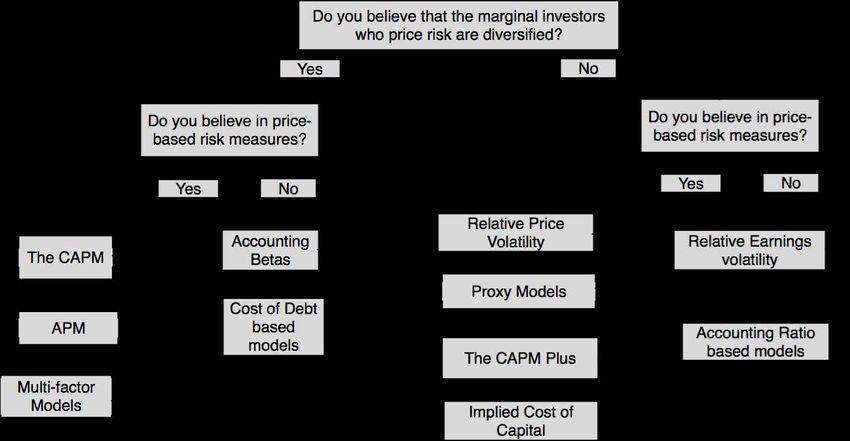
Aswath DamodaranThe CAPM Beta: The Most Used (and
Misused) Risk Measure
80
¨ The standard procedure for estimating betas is to regress
stock returns (Rj) against market returns (Rm) -
Rj = a + b Rm
where a is the intercept and b is the slope of the regression.
¨ The slope of the regression corresponds to the beta of
the stock, and measures the riskiness of the stock.
¨ This beta has three problems:
• It has high standard error
• It reflects the firm’s business mix over the period of the
regression, not the current mix
• It reflects the firm’s average financial leverage over the period
rather than the current leverage.
Aswath Damodaran
80Unreliable, when it looks bad..
81
Aswath Damodaran
81Or when it looks good..
82
Aswath Damodaran
82One slice of history..
83
During this time period, Valeant was a
stock under siege, without a CEO,
under legal pressure & lacking
financials.
Aswath DamodaranAnd subject to game playing
84
Aswath DamodaranMeasuring Relative Risk: You don’t like betas or
modern portfolio theory? No problem.
85
Aswath Damodaran
85Don’t like the diversified investor focus,
but okay with price-based measures
86
1. Relative Standard Deviation
• Relative Volatility = Std dev of Stock/ Average Std dev across all stocks
• Captures all risk, rather than just market risk
2. Proxy Models
• Look at historical returns on all stocks and look for variables that
explain differences in returns.
• You are, in effect, running multiple regressions with returns on
individual stocks as the dependent variable and fundamentals about
these stocks as independent variables.
• This approach started with market cap (the small cap effect) and over
the last two decades has added other variables (momentum, liquidity
etc.)
3. CAPM Plus Models
• Start with the traditional CAPM (Rf + Beta (ERP)) and then add other
premiums for proxies.
Aswath Damodaran
86Don’t like the price-based approach..
87
1. Accounting risk measures: To the extent that you don’t trust
market-priced based measures of risk, you could compute
relative risk measures based on
• Accounting earnings volatility: Compute an accounting beta or relative
volatility
• Balance sheet ratios: You could compute a risk score based upon accounting
ratios like debt ratios or cash holdings (akin to default risk scores like the Z
score)
2. Qualitative Risk Models: In these models, risk assessments
are based at least partially on qualitative factors (quality of
management).
3. Debt based measures: You can estimate a cost of equity,
based upon an observable costs of debt for the company.
• Cost of equity = Cost of debt * Scaling factor
• The scaling factor can be computed from implied volatilities.
Aswath Damodaran
87Determinants of Betas & Relative Risk
88
Beta of Equity (Levered Beta)
Beta of Firm (Unlevered Beta) Financial Leverage:
Other things remaining equal, the
greater the proportion of capital that
a firm raises from debt,the higher its
Nature of product or Operating Leverage (Fixed equity beta will be
service offered by Costs as percent of total
company: costs):
Other things remaining equal, Other things remaining equal
the more discretionary the the greater the proportion of
product or service, the higher the costs that are fixed, the Implciations
Highly levered firms should have highe betas
the beta. higher the beta of the than firms with less debt.
company. Equity Beta (Levered beta) =
Unlev Beta (1 + (1- t) (Debt/Equity Ratio))
Implications Implications
1. Cyclical companies should 1. Firms with high infrastructure
have higher betas than non- needs and rigid cost structures
cyclical companies. should have higher betas than
2. Luxury goods firms should firms with flexible cost structures.
have higher betas than basic 2. Smaller firms should have higher
goods. betas than larger firms.
3. High priced goods/service 3. Young firms should have higher
firms should have higher betas betas than more mature firms.
than low prices goods/services
firms.
4. Growth firms should have
higher betas.
Aswath Damodaran
88In a perfect world… we would estimate the beta of a
firm by doing the following
89
Start with the beta of the business that the firm is in
Adjust the business beta for the operating leverage of the firm to arrive at the
unlevered beta for the firm.
Use the financial leverage of the firm to estimate the equity beta for the firm
Levered Beta = Unlevered Beta ( 1 + (1- tax rate) (Debt/Equity))
Aswath Damodaran
89Adjusting for operating leverage…
90
¨ Within any business, firms with lower fixed costs (as a
percentage of total costs) should have lower unlevered
betas. If you can compute fixed and variable costs for
each firm in a sector, you can break down the unlevered
beta into business and operating leverage components.
¤ Unlevered beta = Pure business beta * (1 + (Fixed costs/ Variable
costs))
¨ The biggest problem with doing this is informational. It is
difficult to get information on fixed and variable costs for
individual firms.
¨ In practice, we tend to assume that the operating
leverage of firms within a business are similar and use
the same unlevered beta for every firm.
Aswath Damodaran
90Adjusting for financial leverage…
91
¨ Conventional approach: If we assume that debt carries
no market risk (has a beta of zero), the beta of equity
alone can be written as a function of the unlevered beta
and the debt-equity ratio
bL = bu (1+ ((1-t)D/E))
In some versions, the tax effect is ignored and there is no (1-t) in
the equation.
¨ Debt Adjusted Approach: If beta carries market risk and
you can estimate the beta of debt, you can estimate the
levered beta as follows:
bL = bu (1+ ((1-t)D/E)) - bdebt (1-t) (D/E)
While the latter is more realistic, estimating betas for debt can be
difficult to do.
Aswath Damodaran
91Bottom-up Betas
92
Step 1: Find the business or businesses that your firm operates in.
Possible Refinements
Step 2: Find publicly traded firms in each of these businesses and
obtain their regression betas. Compute the simple average across
these regression betas to arrive at an average beta for these publicly If you can, adjust this beta for differences
traded firms. Unlever this average beta using the average debt to between your firm and the comparable
equity ratio across the publicly traded firms in the sample. firms on operating leverage and product
Unlevered beta for business = Average beta across publicly traded characteristics.
firms/ (1 + (1- t) (Average D/E ratio across firms))
While revenues or operating income
Step 3: Estimate how much value your firm derives from each of are often used as weights, it is better
the different businesses it is in. to try to estimate the value of each
business.
Step 4: Compute a weighted average of the unlevered betas of the If you expect the business mix of your
different businesses (from step 2) using the weights from step 3. firm to change over time, you can
Bottom-up Unlevered beta for your firm = Weighted average of the change the weights on a year-to-year
unlevered betas of the individual business basis.
If you expect your debt to equity ratio to
Step 5: Compute a levered beta (equity beta) for your firm, using change over time, the levered beta will
the market debt to equity ratio for your firm. change over time.
Levered bottom-up beta = Unlevered beta (1+ (1-t) (Debt/Equity))
Aswath Damodaran
92Why bottom-up betas?
93
¨ The standard error in a bottom-up beta will be significantly
lower than the standard error in a single regression beta.
Roughly speaking, the standard error of a bottom-up beta
estimate can be written as follows:
Std error of bottom-up beta = Average Std Error across Betas
Number of firms in sample
¨ The bottom-up beta can be adjusted to reflect changes in the
firm’s business mix and financial leverage. Regression betas
reflect the past. €
¨ You can estimate bottom-up betas even when you do not
have historical stock prices. This is the case with initial public
offerings, private businesses or divisions of companies.
Aswath Damodaran
93Estimating Bottom Up Betas & Costs of
Equity: Vale
Sample' Unlevered'beta' Peer'Group' Value'of' Proportion'of'
Business' Sample' size' of'business' Revenues' EV/Sales' Business' Vale'
Global'firms'in'metals'&'
Metals'&' mining,'Market'cap>$1'
Mining' billion' 48' 0.86' $9,013' 1.97' $17,739' 16.65%'
Iron'Ore' Global'firms'in'iron'ore' 78' 0.83' $32,717' 2.48' $81,188' 76.20%'
Global'specialty'
Fertilizers' chemical'firms' 693' 0.99' $3,777' 1.52' $5,741' 5.39%'
Global'transportation'
Logistics' firms' 223' 0.75' $1,644' 1.14' $1,874' 1.76%'
Vale'
Operations' '' '' 0.8440' $47,151' '' $106,543' 100.00%'
Aswath Damodaran
94Embraer’s Bottom-up Beta
95
Business Unlevered Beta D/E Ratio Levered beta
Aerospace 0.95 18.95% 1.07
¨ Levered Beta = Unlevered Beta ( 1 + (1- tax rate) (D/E Ratio)
= 0.95 ( 1 + (1-.34) (.1895)) = 1.07
¨ Can an unlevered beta estimated using U.S. and European
aerospace companies be used to estimate the beta for a Brazilian
aerospace company?
a. Yes
b. No
What concerns would you have in making this assumption?
Aswath Damodaran
95Gross Debt versus Net Debt Approaches
96
¨ Analysts in Europe and Latin America often take the difference between
debt and cash (net debt) when computing debt ratios and arrive at very
different values.
¨ For Embraer, using the gross debt ratio
¤ Gross D/E Ratio for Embraer = 1953/11,042 = 18.95%
¤ Levered Beta using Gross Debt ratio = 1.07
¨ Using the net debt ratio, we get
¤ Net Debt Ratio for Embraer = (Debt - Cash)/ Market value of Equity
= (1953-2320)/ 11,042 = -3.32%
¤ Levered Beta using Net Debt Ratio = 0.95 (1 + (1-.34) (-.0332)) = 0.93
¨ The cost of Equity using net debt levered beta for Embraer will be much
lower than with the gross debt approach. The cost of capital for Embraer
will even out since the debt ratio used in the cost of capital equation will
now be a net debt ratio rather than a gross debt ratio.
Aswath Damodaran
96The Cost of Equity: A Recap
97
Preferably, a bottom-up beta,
based upon other firms in the
business, and firmʼs own financial
leverage
Cost of Equity = Riskfree Rate + Beta * (Risk Premium)
Has to be in the same Historical Premium Implied Premium
currency as cash flows, 1. Mature Equity Market Premium: Based on how equity
and defined in same terms Average premium earned by or market is priced today
(real or nominal) as the stocks over T.Bonds in U.S. and a simple valuation
cash flows 2. Country risk premium = model
Country Default Spread* ( σEquity/σCountry bond)
Aswath Damodaran
9798 Discount Rates: IV
Mopping up
Aswath DamodaranEstimating the Cost of Debt
99
¨ The cost of debt is the rate at which you can borrow at
currently, It will reflect not only your default risk but also the
level of interest rates in the market.
¨ The two most widely used approaches to estimating cost of
debt are:
¤ Looking up the yield to maturity on a straight bond outstanding from
the firm. The limitation of this approach is that very few firms have
long term straight bonds that are liquid and widely traded
¤ Looking up the rating for the firm and estimating a default spread
based upon the rating. While this approach is more robust, different
bonds from the same firm can have different ratings. You have to use a
median rating for the firm
¨ When in trouble (either because you have no ratings or
multiple ratings for a firm), estimate a synthetic rating for
your firm and the cost of debt based upon that rating.
Aswath Damodaran
99Estimating Synthetic Ratings
100
¨ The rating for a firm can be estimated using the financial
characteristics of the firm. In its simplest form, the rating
can be estimated from the interest coverage ratio
Interest Coverage Ratio = EBIT / Interest Expenses
¨ For Embraer’s interest coverage ratio, we used the
interest expenses from 2003 and the average EBIT from
2001 to 2003. (The aircraft business was badly affected
by 9/11 and its aftermath. In 2002 and 2003, Embraer
reported significant drops in operating income)
Interest Coverage Ratio = 462.1 /129.70 = 3.56
Aswath Damodaran
100Interest Coverage Ratios, Ratings and Default
Spreads: 2003 & 2004
101
If Interest Coverage Ratio is Estimated Bond Rating Default Spread(2003) Default Spread(2004)
> 8.50 (>12.50) AAA 0.75% 0.35%
6.50 - 8.50 (9.5-12.5) AA 1.00% 0.50%
5.50 - 6.50 (7.5-9.5) A+ 1.50% 0.70%
4.25 - 5.50 (6-7.5) A 1.80% 0.85%
3.00 - 4.25 (4.5-6) A– 2.00% 1.00%
2.50 - 3.00 (4-4.5) BBB 2.25% 1.50%
2.25- 2.50 (3.5-4) BB+ 2.75% 2.00%
2.00 - 2.25 ((3-3.5) BB 3.50% 2.50%
1.75 - 2.00 (2.5-3) B+ 4.75% 3.25%
1.50 - 1.75 (2-2.5) B 6.50% 4.00%
1.25 - 1.50 (1.5-2) B– 8.00% 6.00%
0.80 - 1.25 (1.25-1.5) CCC 10.00% 8.00%
0.65 - 0.80 (0.8-1.25) CC 11.50% 10.00%
0.20 - 0.65 (0.5-0.8) C 12.70% 12.00%
< 0.20 (Cost of Debt computations
102
¨ Companies in countries with low bond ratings and high default risk
might bear the burden of country default risk, especially if they are
smaller or have all of their revenues within the country.
¨ Larger companies that derive a significant portion of their revenues
in global markets may be less exposed to country default risk. In
other words, they may be able to borrow at a rate lower than the
government.
¨ The synthetic rating for Embraer is A-. Using the 2004 default
spread of 1.00%, we estimate a cost of debt of 9.29% (using a
riskfree rate of 4.29% and adding in two thirds of the country
default spread of 6.01%):
Cost of debt
= Riskfree rate + 2/3(Brazil country default spread) + Company default
spread =4.29% + 4.00%+ 1.00% = 9.29%
Aswath Damodaran
102Synthetic Ratings: Some Caveats
103
¨ The relationship between interest coverage ratios and
ratings, developed using US companies, tends to travel
well, as long as we are analyzing large manufacturing
firms in markets with interest rates close to the US
interest rate
¨ They are more problematic when looking at smaller
companies in markets with higher interest rates than the
US. One way to adjust for this difference is modify the
interest coverage ratio table to reflect interest rate
differences (For instances, if interest rates in an
emerging market are twice as high as rates in the US,
halve the interest coverage ratio.
Aswath Damodaran
103Default Spreads: The effect of the crisis of
2008.. And the aftermath
104
Default spread over treasury
Rating 1-Jan-08 12-Sep-08 12-Nov-08 1-Jan-09 1-Jan-10 1-Jan-11
Aaa/AAA 0.99% 1.40% 2.15% 2.00% 0.50% 0.55%
Aa1/AA+ 1.15% 1.45% 2.30% 2.25% 0.55% 0.60%
Aa2/AA 1.25% 1.50% 2.55% 2.50% 0.65% 0.65%
Aa3/AA- 1.30% 1.65% 2.80% 2.75% 0.70% 0.75%
A1/A+ 1.35% 1.85% 3.25% 3.25% 0.85% 0.85%
A2/A 1.42% 1.95% 3.50% 3.50% 0.90% 0.90%
A3/A- 1.48% 2.15% 3.75% 3.75% 1.05% 1.00%
Baa1/BBB+ 1.73% 2.65% 4.50% 5.25% 1.65% 1.40%
Baa2/BBB 2.02% 2.90% 5.00% 5.75% 1.80% 1.60%
Baa3/BBB- 2.60% 3.20% 5.75% 7.25% 2.25% 2.05%
Ba1/BB+ 3.20% 4.45% 7.00% 9.50% 3.50% 2.90%
Ba2/BB 3.65% 5.15% 8.00% 10.50% 3.85% 3.25%
Ba3/BB- 4.00% 5.30% 9.00% 11.00% 4.00% 3.50%
B1/B+ 4.55% 5.85% 9.50% 11.50% 4.25% 3.75%
B2/B 5.65% 6.10% 10.50% 12.50% 5.25% 5.00%
B3/B- 6.45% 9.40% 13.50% 15.50% 5.50% 6.00%
Caa/CCC+ 7.15% 9.80% 14.00% 16.50% 7.75% 7.75%
ERP 4.37% 4.52% 6.30% 6.43% 4.36% 5.20%104Updated Default Spreads - January 2016
105
Default Spreads for 10-year Corporate Bonds: January 2015 vs January 2016
25.00%
20.00%
20.00%
16.00%
15.00%
12.00%
10.00%
9.00%
7.50%
6.50%
5.50%
5.00% 4.25%
3.25%
2.25%
1.75%
1.00% 1.10% 1.25%
0.75%
0.00%
Aaa/AAA Aa2/AA A1/A+ A2/A A3/A- Baa2/BBB Ba1/BB+ Ba2/BB B1/B+ B2/B B3/B- Caa/CCC Ca2/CC C2/C D2/D
Spread: 2016 Spread: 2015
Aswath Damodaran
105Subsidized Debt: What should we do?
106
¨ Assume that the Brazilian government lends money to
Embraer at a subsidized interest rate (say 6% in dollar
terms). In computing the cost of capital to value
Embraer, should be we use the cost of debt based upon
default risk or the subsidized cost of debt?
a. The subsidized cost of debt (6%). That is what the
company is paying.
b. The fair cost of debt (9.25%). That is what the company
should require its projects to cover.
c. A number in the middle.
Aswath Damodaran
106Weights for the Cost of Capital Computation
107
¨ In computing the cost of capital for a publicly traded
firm, the general rule for computing weights for debt
and equity is that you use market value weights (and
not book value weights). Why?
a. Because the market is usually right
b. Because market values are easy to obtain
c. Because book values of debt and equity are meaningless
d. None of the above
Aswath Damodaran
107Estimating Cost of Capital: Embraer in 2004
108
¨ Equity
¤ Cost of Equity = 4.29% + 1.07 (4%) + 0.27 (7.89%) = 10.70%
¤ Market Value of Equity =11,042 million BR ($ 3,781 million)
¨ Debt
¤ Cost of debt = 4.29% + 4.00% +1.00%= 9.29%
¤ Market Value of Debt = 2,083 million BR ($713 million)
¨ Cost of Capital
Cost of Capital = 10.70 % (.84) + 9.29% (1- .34) (0.16)) = 9.97%
¤ The book value of equity at Embraer is 3,350 million BR.
¤ The book value of debt at Embraer is 1,953 million BR; Interest
expense is 222 mil BR; Average maturity of debt = 4 years
¤ Estimated market value of debt = 222 million (PV of annuity, 4 years,
9.29%) + $1,953 million/1.09294 = 2,083 million BR
Aswath Damodaran
108If you had to do it….Converting a Dollar Cost of
Capital to a Nominal Real Cost of Capital
109
¨ Approach 1: Use a BR riskfree rate in all of the calculations
above. For instance, if the BR riskfree rate was 12%, the cost
of capital would be computed as follows:
¤ Cost of Equity = 12% + 1.07(4%) + 0.27 (7. 89%) = 18.41%
¤ Cost of Debt = 12% + 1% = 13%
¤ (This assumes the riskfree rate has no country risk premium
embedded in it.)
¨ Approach 2: Use the differential inflation rate to estimate the
cost of capital. For instance, if the inflation rate in BR is 8%
and the inflation rate in the U.S. is 2%
" 1 + Inflation %
BR
Cost of capital= (1 + Cost of Capital$ )$ '
# 1 + Inflation$ &
= 1.0997 (1.08/1.02)-1 = 0.1644 or 16.44%
Aswath Damodaran
€ 109Dealing with Hybrids and Preferred Stock
110
¨ When dealing with hybrids (convertible bonds, for
instance), break the security down into debt and equity
and allocate the amounts accordingly. Thus, if a firm has
$ 125 million in convertible debt outstanding, break the
$125 million into straight debt and conversion option
components. The conversion option is equity.
¨ When dealing with preferred stock, it is better to keep it
as a separate component. The cost of preferred stock is
the preferred dividend yield. (As a rule of thumb, if the
preferred stock is less than 5% of the outstanding market
value of the firm, lumping it in with debt will make no
significant impact on your valuation).
Aswath Damodaran
110Decomposing a convertible bond…
111
¨ Assume that the firm that you are analyzing has $125 million
in face value of convertible debt with a stated interest rate of
4%, a 10 year maturity and a market value of $140 million. If
the firm has a bond rating of A and the interest rate on A-
rated straight bond is 8%, you can break down the value of
the convertible bond into straight debt and equity portions.
¤ Straight debt = (4% of $125 million) (PV of annuity, 10 years, 8%) + 125
million/1.0810 = $91.45 million
¤ Equity portion = $140 million - $91.45 million = $48.55 million
¨ The debt portion ($91.45 million) gets added to debt and the
option portion ($48.55 million) gets added to the market
capitalization to get to the debt and equity weights in the cost
of capital.
Aswath Damodaran
111Recapping the Cost of Capital
112
Cost of borrowing should be based upon
(1) synthetic or actual bond rating Marginal tax rate, reflecting
(2) default spread tax benefits of debt
Cost of Borrowing = Riskfree rate + Default spread
Cost of Capital = Cost of Equity (Equity/(Debt + Equity)) + Cost of Borrowing (1-t) (Debt/(Debt + Equity))
Cost of equity
based upon bottom-up Weights should be market value weights
beta
Aswath Damodaran
112You can also read


