Disease management interventions in a nationwide community pharmacy - Walgreens
←
→
Page content transcription
If your browser does not render page correctly, please read the page content below
Disease management
                         interventions in a
                       nationwide community
                             pharmacy
                     Presented at the 40th Annual Meeting and Scientific
                       Sessions of the Society of Behavioral Medicine,
                                       Washington DC
                                          Michael S. Taitel, PhD
                                             March, 9, 2019

Member of Walgreens Boots Alliance
©2019 Walgreen Co. All rights reserved.
Outline

       1.     Pharmacies as accessible healthcare destinations
       2.     Expanding the role of pharmacy and pharmacies
       3.     CMS and P4P adherence incentives
       4.     Medication adherence interventions
       5.     Examples of pharmacy outcomes studies
       6.     Behavioral medicine research opportunities
       7.     Questions?

©2019 Walgreen Co. All rights reserved.                          2
95% of Americans live within 5 miles of a pharmacy

                                            ~9,800
                                                                   76%
                                                                   of the U.S. lives within
                                            drugstores             5 miles of a Walgreens

                                            300                         1,000+
                                            community-based             disease-state
                                            specialty pharmacies        specialized pharmacies

  ©2019 Walgreen Co. All rights reserved.                                                        3
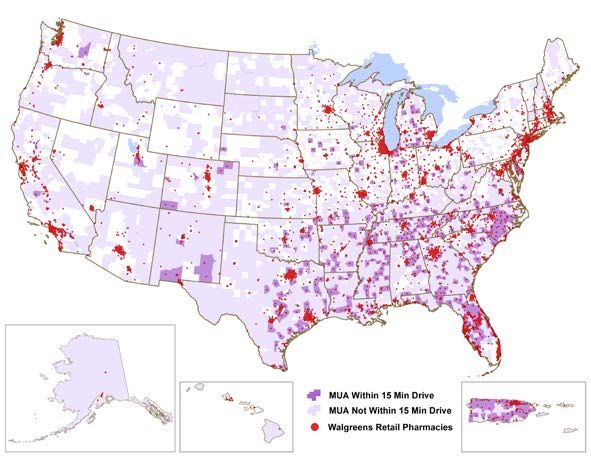
Pharmacies provide healthcare access in
     medically underserved areas (MUA)
                        40% of MUAs are within a 15-minute drive time of a Walgreens pharmacy.
                        59% of Walgreens pharmacies provided influenza vaccinations to MUA residents.

                Two-thirds (66%) of the
     123 million people living in MUAs are within
       a 15-minute drive time of a Walgreens.

1.    MUA data is from https://data.hrsa.gov/data/download as of January 2018.
2.    Walgreens locations represent open retail pharmacies as of January 2018.
3.    MUA’s were defined as being within a 15-minute drive of Walgreens if the MUA centroid
      overlapped with the 15-minute drive time area of a Walgreens
       ©2019 Walgreen Co. All rights reserved.                                                          4
Both the pharmacists’ role and pharmacy
services are being expanded
• Medication counseling • Innovations in retail healthcare
• Adherence support services
• Chronic disease education Retail health clinics
Primary care
• Self-management support
Senior care
• Biometric monitoring
Urgent care
• Vaccinations Lab
• Opioid education Optical
• Prescribing Hearing
• Digital interventions Dental
(Next presentation)
©2019 Walgreen Co. All rights reserved. 5
Increased incentives to manage adherence

CMS Star Health Plan Quality Ratings             Pay for Performance
Medication adherence is triple weighted         Pharmacy Contracting
• Diabetes
• High cholesterol
• Hypertension

                                            $

  ©2019 Walgreen Co. All rights reserved.                              6
What impacts medication adherence?
Adherence Metrics
PDC = Proportion of days covered
% Adherent = % of patients with
PDC ≥ 0.80
Persistence = Days on therapy until
discontinuation
Oluga A, McGuire MJ. Adherence and health care costs. Risk 7
©2019 Walgreen Co. All rights reserved. Management Healthcare Policy. 2014; 7: 35–44.Medication adherence interventions
• Pharmacist–initiated calls to discuss patients’ new medications for
New to Therapy Consultations targeted drug classes.
• Automated calls, emails, or text messages sent to patients before their
Refill Reminders prescriptions are due for refill
• A call or face-to-face consult for patients with a history of refilling late
Late to Refill and are late on their current fill
Pick Up Reminders & • Omni-channel set of reminders for patients to pick up their filled
Return to Stock prescriptions
• Condition-specific specialty pharmacy programs, clinical counseling &
Connected Care support to address challenges of complex and comorbid conditions
90-day • Filling retail scripts for 90 days supply vs 30 days supply
• Comprehensive medication profile review and targeted disease state or
Medication Therapy Management medication review
• Consultation and process for patients with multiple chronic conditions
Medication Synchronization to pick-up all of their medications at the same time.
©2019 Walgreen Co. All rights reserved. 8New-to-therapy consultation program
increases adherence by 3.7 percent
Diuretics* 2.1%
Hematological* 3.7%
Beta blockers* 3.7%
Antidepressants* 4.5%
7.2%
Antiparkinson* 7.2%
All* 3.7%
0.0% 1.0% 2.0% 3.0% 4.0% 5.0% 6.0% 7.0% 8.0%
Test group had one phone intervention with their pharmacist; the control group had none; PDC increase by test group at the confirmed intervention level
PDC=Proportion of days covered; Time=February 2013 through February 2014; N=306,854 patients
Taitel M, Jiang JZ, Rudkin K. Impact of pharmacist-call intervention program on new-to-therapy patients’ medication adherence. Poster presented at: 19th Annual
International Meeting of the International Society for Pharmacoeconomics and Outcomes Research; May 31-June 4, 2014; Montreal, Canada.
©2019 Walgreen Co. All rights reserved. 9Pharmacist Medicare Part D late-to-refill calls
increase the percent of adherent patients (PDC≥80%)
Differences in Adherent Patients Between Groups
55%
53% ∆ 2.38% ∆ 3.38% ∆ 2.93%
% Adherent Patients
51%
49%
47%
45%
43%
41%
39%
37%
35%
ANTIHYPERTENSIVES ANTIHYPERLIPIDEMICS ANTIDIABETICS
Intervention 50.3% 50.2% 44.1%
Control 48.0% 46.8% 41.1%
©2019 Walgreen Co. All rights reserved. 1090-day refills at retail pharmacy improves
adherence and reduce costs for Medicaid patients
Compared with 30-day refills,
patients with 90-day refills had
Adherence Persistency Cost from
• Greater medication adherence Improved Improved $7.70
• Greater persistency 20 percent 23 percent to
• Nominal wastage vs. vs. $26.86
30-day 30-day PPPY
• Greater savings
refills refills less for four
therapeutic
areas assessed*
Data=Pharmacy claims from January 2010
N=52,898 Medicaid patients
Adherence was measured by the medication possession ratio (MPR); persistency was the number of continuous days of therapy until a 30-day gap occurred, if one occurred.
PPPY = per patient per year. *Four medication classes were statin, antihypertensive, selective serotonin reuptake inhibitor (SSRI) and oral hypoglycemic medications.
1. Taitel M, Fensterheim L, Kirkham H, Sekula R, Duncan I. Medication days’ supply, adherence, wastage, and cost among chronic patients in Medicaid. Medicare & Medicaid
Research Review. 2012;2(3):E1-E13.
©2019 Walgreen Co. All rights reserved. 11Medication therapy management (MTM)
counseling delivers excellence in patient care
• A retail pharmacy MTM program has been shown to reduce high-risk-medication
(HRM) use in the elderly1
–The test group had a 5.6 percent reduction in overall HRM rate
–The control group had a 4 percentage point reduction in HRM rate
65-74 75-84 85+ Overall
0.00%
-1.00%
-2.00%
-3.60%
-3.00% -3.96%
-4.43% -4.20%
-5.19%
-4.00%
-6.20% -5.99% -5.63%
-5.00%
-6.00%
-7.00% Test
Age group Control
1. Taitel M, Lou Y, Huang Z, Nada J. Face-to-face medication therapy management program at community pharmacy reduces high risk
medication use in the elderly. Poster presented at: Annual Research Meeting of AcademyHealth; June 8-10, 2014; San Diego, CA.
12
©2019 Walgreen Co. All rights reserved.Influenza vaccination uptake among diabetes
patients in community pharmacies
• 84.6% of the diabetes patients receiving a pneumococcal vaccination also received an influenza
vaccination (Figure1).
• 86.2% of the influenza vaccinations administered to diabetes patients were between August and
December, offering maximum protection early in the influenza season (Figure 2).
©2019 Walgreen Co. All rights reserved. 13Research opportunities
• Problems
- Aging population
- Limited resources
- More and more expensive medications
- Growing incidence of diabetes
- Anti-vaccine movement
• Patients’ adoption of retail healthcare
• Self-management in the changing healthcare environment
• Understanding the pharmacy environment
• Behavior change theory and practice based on multiple brief encounters
©2019 Walgreen Co. All rights reserved. 14More research opportunities
• Develop brief motivational interviewing techniques
• Leveraging omni-channel communications to reinforce behavior change
• The role of small incentives to support medication adherence
• Medication management self-efficacy by among seniors and care givers
• Understanding the patients’ condition journey and behavior changes
needed at each stage
• Tailoring interventions by social determinants of health
• Overcoming vaccine hesitancy
• Program evaluation of new initiatives
©2019 Walgreen Co. All rights reserved. 15Questions?
The Walgreens Center for
Health & Wellbeing Research
www.Walgreens.com/research
Research@walgreens.com
©2019 Walgreen Co. All rights reserved. 16You can also read


