DISPLAY WEEK 2018 PREVIEW AND AR/VR DISPLAYS - March/April 2018 Vol. 34, No. 2
←
→
Page content transcription
If your browser does not render page correctly, please read the page content below
Mar-Apr Cover.qxp_SID Cover 3/13/18 11:31 AM Page 1

    DISPLAY WEEK 2018 PREVIEW AND AR/VR DISPLAYS

                                                                                               March/April 2018
    Official Publication of the Society for Information Display • www.informationdisplay.org      Vol. 34, No. 2
ENSURE QUALITY DEVICES
FROM THE INSIDE OUT

                                                                                                     From display measurement
                                                                                                     to assembly verification, find
                                                                                                     your solution provider for
                                                                                                     100% inspection. Radiant
                                                                                                     cameras offer imaging
                                                                                                     power to detect subtle
                                                                                                     flaws in light, color, and
                                                                                                     components that are easily
                                                                                                     missed by humans and
                                                                                                     other systems, ensuring
                                                                                                     quality from the inside out.

                                                                                                        A Konica Minolta Company

                        SEE THE DIFFERENCE
                                             See Us at Display Week, Booth 1029

Radiant Vision Systems, LLC Global Headquarters - Redmond, WA USA | +1 425 844-0152 | www.RadiantVisionSystems.com | Info@RadiantVS.com
ID TOC Issue2 p1_Layout 1 3/13/2018 12:18 PM Page 1
SID Information
SOCIETY FOR INFORMATION DISPLAY
DISPLAY
contents
MARCH/APRIL 2018
VOL. 34, NO. 2
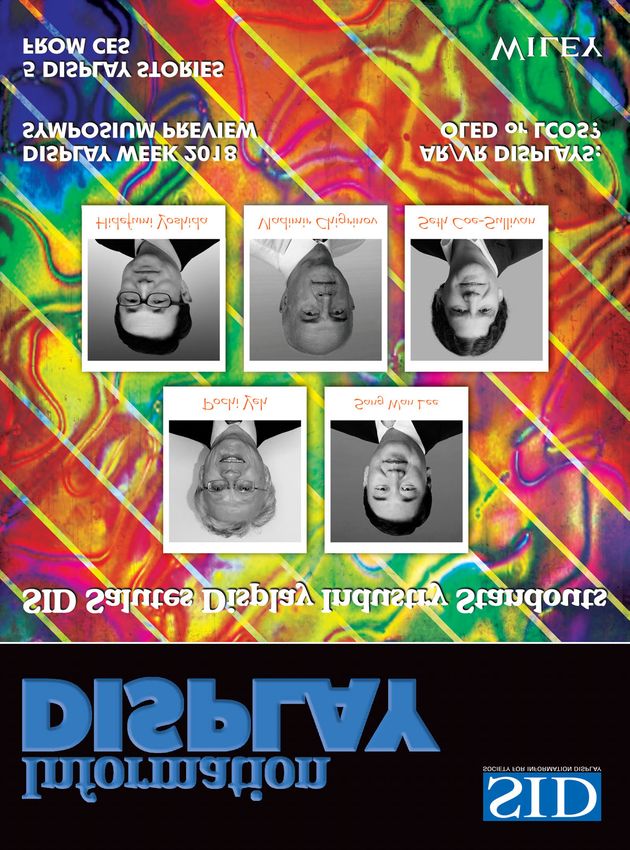
ON THE COVER: The winners of this year’s
major awards from SID are: (top row from left
DISPLAY WEEK 2018 PREVIEW AND AR/VR DISPLAYS
to right) Pochi Yeh, Sang Wan Lee; and
(bottom row from left to right) Hidefumi Yoshida,
Vladimir Chigrinov, and Seth Coe-Sullivan.
Official Publication of the Society for Information Display • www.informationdisplay.org
March/April 2018
Vol. 34, No. 2 2 Editorial: Generations of Innovation
n By Stephen P. Atwood
3 Industry News
n By Jenny Donelan
4 Guest Editorial: The Race for Dominance: OLED or LCOS Microdisplays in
Augmented and Virtual Reality
n By Seth Coe-Sullivan
6 2018 Honors and Awards: SID Salutes Display Industry Standouts
This year’s winners of the Society for Information Display’s Honors and Awards include
Hidefumi Yoshida, who will receive the Karl Ferdinand Braun Prize; Pochi Yeh, who has earned
Cover Design: Acapella Studios, Inc.
the Jan Rajchman Prize; Sang Wan Lee, who will receive the inaugural David Sarnoff Industrial
Achievement Prize; Vladimir Chigrinov, who has earned the Slottow-Owaki Prize; and
Seth Coe-Sullivan, who will receive the Peter Brody Prize.
n By Jenny Donelan
12 Display Marketplace: LCOS and AR/VR
Companies are delivering different renditions of augmented-reality and virtual-reality (AR and
VR) products to the market. All these products have different specifications and applications.
In the Next Issue of This article will discuss the differences between AR and VR, and how liquid-crystal-on-silicon
Information Display (LCOS) microdisplays can play an important role in making these applications more viable.
n By Po King Li
Show Issue
• 2018 Display Industry Awards 16 AR/VR Outlook: OLED Displays and the Immersive Experience
• Products on Display After generating much initial excitement over the past several years, AR/VR technology has
hit some recent roadblocks. New applications, facilitated by OLEDs, could jump-start this
• How Gen 10 Fabs Will Disrupt the
technology yet again.
n By Barry Young
Industry
• AR/VR Landscape
• Interviews with Harman and Radiant
Vision Systems
22 Symposium Preview: Looking Forward to the 2018 Display Week Technical
Program
This year’s technical program shines a spotlight on AR/VR, microLEDs, and wearables – the
hottest topics in the display industry right now. But there is so much more to discover –
amazingly efficient OLEDs, state-of-the-art automotive displays, ultra-high resolutions. Read
this handy preview to find out which papers belong to that absolutely can’t-miss category.
INFORMATION DISPLAY (ISSN 0362-0972) is published 6 times a n By Jenny Donelan
year for the Society for Information Display by Palisades Convention
Management, 411 Lafayette Street, 2nd Floor, New York, NY 10003;
William Klein, President and CEO. EDITORIAL AND BUSINESS
OFFICES: Jenny Donelan, Editor in Chief, Palisades Convention 28 Show Review: Five Short Display Stories from CES 2018
Management, 411 Lafayette Street, 2nd Floor, New York, NY 10003;
telephone 212/460-9700. Send manuscripts to the attention of the Editor,
OLEDs, car cockpits, quantum dots, and really big TVs were all part of the narrative at this
ID. SID HEADQUARTERS, for correspondence on sub-scriptions and year’s Consumer Electronics Show in Las Vegas.
n By Ken Werner
membership: Society for Information Display, 1475 S. Bascom Ave.,
Ste. 114, Campbell, CA 95008; telephone 408/879-3901, fax -3833.
SUBSCRIPTIONS: Information Display is distributed without charge
to those qualified and to SID members as a benefit of membership
(annual dues $100.00). Subscriptions to others: U.S. & Canada: $75.00 35 Business of Displays: Q&A with Jasper Display
one year, $7.50 single copy; elsewhere: $100.00 one year, $7.50 single
copy. PRINTED by Wiley & Sons. PERMISSIONS: Abstracting is
permitted with credit to the source. Libraries are permitted to photocopy
beyond the limits of the U.S. copyright law for private use of patrons,
37 SID News: 50th Anniversary of the LCD
providing a fee of $2.00 per article is paid to the Copyright Clearance
Center, 21 Congress Street, Salem, MA 01970 (reference serial code
0362-0972/17/$1.00 + $0.00). Instructors are permitted to photocopy 40 Corporate Members and Index to Advertisers
isolated articles for noncommercial classroom use without fee. This
permission does not apply to any special reports or lists published in this
magazine. For other copying, reprint or republication permission, write
to Society for Information Display, 1475 S. Bascom Ave., Ste. 114, For Industry News, New Products, Current and Forthcoming Articles,
Campbell, CA 95008. Copyright © 2018 Society for Information
Display. All rights reserved.
see www.informationdisplay.org
Information Display 2/18 1
ID Editorial Issue2 p2,30_Layout 1 3/14/2018 12:40 PM Page 2

          editorial
                                                                                                     DISPLAY
                                                                                                     Information

                                     Generations of Innovation                                       Executive Editor: Stephen P. Atwood
                                     by Stephen P. Atwood
                                                                                                     617/306-9729, satwood@azonix.com

                                   In spite of the rapidly growing pace of innovation, key
                                                                                                     Editor in Chief: Jenny Donelan
                                                                                                     603/924-9628, jdonelan@pcm411.com
                                   technologies remain generational. In many cases, the things
                                   we consider ubiquitous today were probably nascent 25 to
                                                                                                     Global Ad Director:

                                   50 years ago, or even longer. The original internet was
                                                                                                     Dan Nicholas, dnicholas@wiley.com

                                   developed in the 1960s and 1970s, and the ubiquitous web
                                                                                                     Senior Account Manager

                                   began around 1990. If you were born later than about 2000,
                                                                                                     Print & E-Advertising:

      you probably can’t imagine a world without liquid-crystal displays (LCDs), the web,
                                                                                                     Roland Espinosa

      and real-time instant access to practically every piece of information and news you
                                                                                                     201/748-6819, respinosa@wiley.com

      want. But there was a time, a generation or two ago, when people had to wait for the           Editorial Advisory Board
      daily newspaper to come out, consult printed books and catalogs for technical data,
      and do computational modeling with slide rules and adding machines.
                                                                                                     Stephen P. Atwood, Chair

         Such was the setting when George Heilmeier and associates at RCA unveiled that
                                                                                                       Azonix Corp.

      first LCD back in 1968. That’s 50 years ago – a time when we were on the verge of a
                                                                                                     Ionnis ( John) Kymissis
                                                                                                       Electrical Engineering Department, Columbia

      manned moon landing but were mostly watching black-and-white cathode-ray-tube
                                                                                                         University

      (CRT) TVs and programming early computers with punch cards. Incidentally, space
                                                                                                     Larry Weber

      travel itself took several generations to evolve from amateur rocketry to a manned
                                                                                                      Consultant

      spacecraft that could escape the gravity of the earth.                                         Guest Editors
         While the principle of an LCD was solidly understood in the 1970s, the pervasive
      displays we know today came about only after numerous additional innovations.
                                                                                                     Lighting

      These include active-matrix addressing, three major generations of thin-film transis-
                                                                                                      Marina Kondakova, OLEDWorks

      tors (TFTs), optical compensation films, and various LC modes such as twisted
                                                                                                     Emissive Technology

      nematic (TN), vertical alignment (VA), in-plane switching (IPS), optically compressed
                                                                                                      Seth Coe-Sullivan, Luminit

      bend (OCB), backlight technology, and many more. This is not to mention a collective
                                                                                                     Automotive Displays

      capital investment on the scale of the gross national product of several countries. It
                                                                                                      Karlheinz Blankenbach, Pforzheim University

      took at least 20 years for LCDs to first appear in computers and on desktops.
                                                                                                     Digital Signage

         LCD technology today is the culmination of at least two generations of work by
                                                                                                      Gary Feather, NanoLumens

      countless scientists, engineers, and visionary business leaders. LCDs enable virtually
                                                                                                     Wearables/Flexible

      every major consumer and industrial product today, either directly or indirectly. They
                                                                                                      Ruiqing (Ray) Ma, Nanosys

                                                                                                     Contributing Editors
      also support a gigantic global supply-chain ecosystem producing critical components
      and materials to make those displays. It’s hard to fully imagine all the economic value        Alfred Poor, Consultant
      fueled by the LCD industry today.                                                              Steve Sechrist, Consultant

         This technology platform continues to evolve, as the next generation of ambitious
                                                                                                     Paul Semenza, Consultant

      engineers and scientists build their careers with further innovations. Meanwhile, we
                                                                                                     Jason Heikenfeld, University of Cincinnati

      have a chance to look back at some of the most seminal contributions to the field with
                                                                                                     Raymond M. Soneira, DisplayMate Technologies

      a special event at Display Week. This May, SID is holding a 50th anniversary LCD
      Celebration at the show in Los Angeles. The celebration will feature a collection of
      LCD luminaries who have played pivotal roles in this technology. The details are
      described in our SID News feature, and the roster of speakers is not to be missed. This
      will be a wonderful chance to either reminisce if you were there for part of the history,
      or gain some perspective on how we got here and where this technology is going next.
         Some of the people who were there along the way and made crucial contributions to
      the LCD industry are recognized by this year’s SID Honors and Awards. As Jenny
      Donelan explains in our cover story for this issue, “by chance,” each of the major
      award winners “has enjoyed a career based on or related to LCDs.” Each year, the
                                                                                                     The opinions expressed in editorials, columns, and
                                                                                                     feature articles do not necessarily reflect the opinions of
      Society for Information Display honors those individuals who have made outstanding             the executive editor or publisher of Information Display
      contributions to the field of displays, and if anything symbolizes the generational            magazine, nor do they necessarily reflect the position of
                                                                                                     the Society for Information Display.
                                                                            (continued on page 38)

      2   Information Display 2/18
ID Industry News Issue2 p3,39_Layout 1 3/14/2018 12:29 PM Page 3
industry news
By Jenny Donelan
Of course, TVs are not the only OLED story. OLED is used for
OLEDs March Through Peaks and Valleys lighting, though its base has so far been high end and architectural.
Ever since OLED displays started appearing in products like mobile And it has continued to be employed in mobile devices, to the point
phones and cameras in the early 2000s, OLED technology has experi- where it is the dominant display material in Samsung’s flagship smart-
enced highs and lows worthy of a character in a novel by Charles Dickens. phones. Last year, it was also used for the first time in an Apple smart-
Even before Sony introduced the XEL 1, the first commercially avail- phone – the iPhone X. In some ways also like a Dickens character,
able OLED TV, in 2008, emissive OLED technology was viewed by despite the stumbles, OLED continues to survive and even thrive.
many in the industry as the successor to plasma and LCD. Sony sold its One reason is – quite literally – its flexibility. OLED offers many
first batch of 1,300 XEL 1 TVs in one day. But for various reasons – options to developers looking for a lightweight, flexible material for
manufacturing cost and yield challenges among them – OLED TVs did myriad new display products.
not really catch on. Below are just a few highlights from OLED’s most recent history.
It looked like OLEDs were going to find their moment in 2012, (For a complete and even exhaustive account, check out the very excel-
when both Samsung and LG Display announced 55-in. OLED units. lent “OLED history: A ‘guided tour’ of OLED highlights from inven-
These impressive, beautiful TVs were shown at Display Week 2012 in tion to application” from OLED-info at www.oled-info.com/history.)
Boston, where they both received Best in Show awards from SID. In • LG Display will now supply flexible OLEDs to Sony for future
2013, both companies followed up with curved versions of 55-in. Sony smartphones.1
OLED TVs. But again there were rumors of mass-production hurdles. • LG Display is already supplying Sony with OLED displays for
Shortly afterward, Samsung stopped making OLED TVs, concentrating Sony’s OLED TVs. In 2017, Sony reportedly requested LG to
instead on quantum-dot enhanced LCD TVs (more on those below in double its OLED panel shipments because demand for Sony’s
the article about Samsung’s “The Wall”). LG Display continued to OLED TVs had been better than expected.2
develop and sell OLED TVs – and slowly, but surely, sales increased, • Since the summer of 2017, various news sources have been report-
even growing, as reported in last issue’s Industry News, 133 percent ing that Sharp (acquired by Foxconn in 2016) would be creating
year over year 2016/2017. flexible OLED panels for smartphones. In January 2018, Sharp’s
Product Briefs . . . .
(continued on page 39)
Konica Minolta Introduces New Display Color Radiant Announces New AR/VR Lens for Lenovo, Google Intro Display for Google
Analyzer Near-to-Eye Assistant
Konica Minolta’s new display color analyzer, the Radiant Vision Systems has announced the release At CES 2018, Lenovo and Google introduced the
CA-410, improves on the accuracy, spectral sensi- of a new AR/VR lens for its ProMetric imaging Lenovo Smart Display with Google Assistant built
tivity, and chromaticity readings of its predeces- photometers and colorimeters (Fig. 2). e lens in, one of several such Google-based home-assis-
sors, including a luminance measurement range features a unique optical design specially tant systems created in response to Amazon’s Echo
25 times wider than that of previous models engineered for measuring the visual quality of Show (Fig. 3). According to several reviewers, the
(Fig. 1). According to Konica Minolta, the CA-410 near-to-eye displays inside virtual-reality (VR), Smart Display stands out from the rest of those for
is designed especially for the evaluation of more mixed-reality (MR), and augmented-reality (AR) its functionality and good looks. e HD touch-
advanced technology, such as HDR displays. headsets. screen display comes in both 8-in. and 10-in. IPS
LCD models, with the former at 1,200 x 800 reso-
lution and a suggested retail price of $199, and the
latter at 1,920 x 1,200 resolution and a suggested
price of $249. e device rotates from portrait to
landscape mode and comes with a handy physical
web cam shutter.
Fig. 1: Konica Minolta’s new color analyzer is
designed to address the requirements posted by Fig. 2: Radiant Vision Systems’ AR/VR lens can
newer display technology. Image courtesy easily be removed and replaced with standard
Konica Minolta. lenses for additional display measurement appli-
cations, such as testing displays outside of headset
equipment or on the production line. Image
courtesy Radiant Vision Systems.
Fig. 3: The Lenovo Smart Display is a Google-
based home assistant system. Image courtesy Lenovo.
Information Display 2/18 3
ID Guest Editorial Issue2 p4_Layout 1 3/14/2018 1:41 PM Page 4

          guest editorial                                                                                            SID OFFICERS
                                                                                                        President: Yong-Seog Kim
                                                                                                        President-Elect: Helge Seetzen
                                                                                                        Treasurer: Takatoshi Tsujimura
                                     The Race for Dominance: OLED or LCOS                               Secretary: Achin Bhowmik
                                     Microdisplays in Augmented and Virtual                             Past President: Amal Ghosh

                                     Reality
                                                                                                            REGIONAL VICE PRESIDENTS
                                     by Seth Coe-Sullivan                                               Bay Area: Sri Peruvemba
                                                                                                        Pacific & South Americas: Adi Abileah
                                    When I was invited to be the guest editor of this edition of        East Americas: John Kymissis
                                                                                                        Europe: Paul Lacey
                                    Information Display, display engines for augmented reality
                                                                                                        Japan: Katsumi Kondo
                                    (AR) and virtual reality (VR) came to mind, as this topic           Cross Strait: Xiaolin Yan
                                    continues to be the subject of hot debate in our industry.          Rest of Asia: Jun Souk
      I have colleagues residing in different camps with regard to which microdisplay will
      be the dominant player in this escalating market, so I reached out to Barry Young and                      COMMITTEE CHAIRS
      Po King Li, both highly respected technical experts in the field who have different opin-
                                                                                                        Academic: Hyun Jae Kim
      ions on the subject. Our own work at Luminit leverages both of these technologies, along
                                                                                                        Archives: Larry Tannas Jr.
      with LED- and laser-illuminated MEMs devices, and so we are more than a passive
                                                                                                        Audit: Robert Powell
      stakeholder in this race for dominance.
                                                                                                        Bylaws: Aris Silzars
         Barry Young’s article, “OLED Displays and the Immersive Experience,” offers a
                                                                                                        Chapter Formation Chair: Yong-Taek Hong
      realistic view of the challenges facing the industry in creating a truly enveloping AR or
                                                                                                        Conventions: Aris Silzars
      VR experience. He notes that while augmented- and virtual-reality consumer products
      may give famous CEOs a lot of buzz, end-user acceptance is lagging, due largely to price
                                                                                                        Conventions Vice-Chair, BC & MFC:
                                                                                                        John Jacobs
      and the awkward and bulky headsets currently available. In spite of the hardware and
      software challenges, however, he emphasizes the advantages of OLED microdisplays for
                                                                                                        Conventions Vice-Chair, Social Media:
                                                                                                        Erica Montbach
      creating a truly immersive VR experience. Advantages in latency, contrast ratio, response         Definitions and Standards: Tom Fiske
      time, and black levels, he notes, as well as advancements in luminance, make OLED                 Display of the Year Awards: Wei Chen
      microdisplays ideal for both VR and AR.                                                           Display Training School: Qun (Frank) Yan
         Po King’s article, “LCOS and AR/VR,” paints a different picture of the liquid-crystal          Honors and Awards: Shin-Tson Wu
      on silicon (LCOS) vs. OLED debate. He notes the advantages of front-lit LCOS and color-           Investment Committee: Helge Seetzen
      filter LCOS, particularly in AR, where picture quality, high luminance, small pixel size,         I-Zone Committee: Harit Doshi
      low power consumption, and small form factor are critical. In addition, LCOS micro-               Long-Range Planning: Helge Seetzen
      displays, according to Po King, can adapt to various optical architectures, and the design        Marketing, Head of Marketing: Sri Peruvemba
      flexibility solves the weight and size issues that have been barriers for consumer adoption.      Membership: Tomokazu Shiga
         Although the articles express different points of view, both authors agree that the
      engineering involved in designing and building consumer-friendly, affordable VR or AR
                                                                                                        Membership Vice-Chair, Social Media:
                                                                                                        Hari Atkuri
      devices with a large field of view (FOV) remains a challenge. In addition, the technological      Nominations: Amal Ghosh
      landscape is evolving, making the adoption of one platform even more difficult. For               Program Chair: Yi-Pai Huang
      example, lasers are playing an increasingly important role in AR and VR, and the spatial          Publications: John Kymissis
      and spectral precision of a laser light source could be a game changer for creating a highly      Publications Vice-Chair, Information Display
      realistic AR and VR experience. In addition, matching the light source, whether OLED,             Magazine Editor: Steve Atwood
      LED, or laser, to the combiner, such as waveguide, hologram, or conventional optic                Publications Vice-Chair, JSID Editor in Chief:
      remains a challenge, and system-level analysis is needed to understand the best display           Herbert DeSmet
      engine for a particular device.                                                                   Publications Vice-Chair, SID-Wiley Book Series
                                                                                                        Editor: Ian Sage
         Some spectators may see this race for dominance in AR and VR display technology as
      neck and neck between LCOS and OLED. It’s hard to call, because the course in this
      technological marathon keeps changing. Whatever microdisplay camp you’ve planted a                           SOCIETY FOR
      flag in, I think we can all agree that in spite of the challenges that lie ahead, the potential          INFORMATION DISPLAY
      of AR and VR devices is endless, and LCOS, OLED, and MEMs devices are all likely
      to play an important role in much the same way that OLED and LCD co-exist in macro
                                                                                                              1475 S. Bascom Ave., Ste. 114

      displays today.
                                                                                                                  Campbell, CA 95008
                                                                                                                     408/879-3901

      Seth Coe-Sullivan is vice president and chief technology officer at Luminit LLC. He is also a
                                                                                                                 e-mail: office@sid.org

      co-founder of quantum-dot company QD Vision. He can be reached at scoe-sullivan@
                                                                                                                      www.sid.org

      luminit.com. n

      4   Information Display 2/18
LIGHT & DISPLAY

                                                                      Join us at Display Week
                                                                         Booth #1329

  Whether you are analyzing a display
  with ultra-low or high brightness,
  the extremely versatile CA-410 delivers precise
  evaluations of light and color with reliable performance.

                                                                                                                                    CA-410
                                                                                                                                    Disaply Color Analyzer

                      #LightMeasurement #DisplayMeasurement #KonicaMinoltaSensing
           KONICA MINOLTA SENSING AMERICAS, INC • 888.473.2656 • SENSING.KONICAMINOLTA.US

                                                            AMAZING INSIGHTS
                                                             MISS IT & MISS OUT May 20-25
                                                              Register Today at www.DisplayWeek.org

                   The World’s Latest Electronic Display Science, Technology,
                      Manufacturing, and Business Growth Opportunities
Display Week is where the entire electronic                                 The Learning Opportunities
display industry value chain meets to connect,                               • Technical Symposium - the prestigious, world-renowned SID forum. Special focus
collaborate and commercialize next-gen display
                                                                               Quantum Dots and Micro-LEDs; and Wearable Displays, Sensors, and Devices.
                                                                             • Business Track – the exclusive SID-DSCC conferences on state-of-the-industry and
adoption by consumer and industrial OEMs                                       economic outlook. NEW for 2018: Immersive Experience Markets Conference; an
looking for competitive advantage and market                                   expanded full day Investor’s Conference; Special focus topics: smartphone and
                                                                               autonomous vehicles markets.
leadership.
                                                                            The Solutions Exhibition
                                                                            See more than 200 leading display technology product and service solution providers
 Exhibitors & Sponsors:
 Americas & Europe: Jim Buckley Asia:      Sue Chung                        systems. Source suppliers, collaborate and get one-on-one problem solving support for
 Email:     jbuckley@pcm411.com Email:     schung@sid.org                   your project related challenges.
 Telephone: (203) 502-8283      Telephone: (408) 389-9596
                                                                                         Register Today at www.DisplayWeek.org

                          Meet With Leading
                          Companies Like These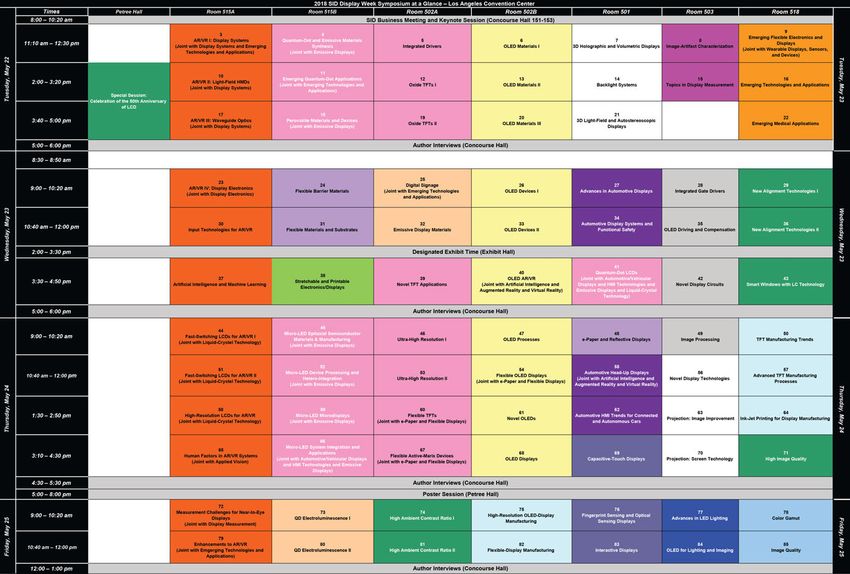
ID Donelan H&Ap6-10_Layout 1 3/13/2018 2:41 PM Page 6

                             2018 Honors and Awards

      SID Salutes Display Industry Standouts
      This year’s winners of the Society for Information Display’s Honors and Awards include
      Hidefumi Yoshida, who will receive the Karl Ferdinand Braun Prize for his contributions
      to LCD technology; Pochi Yeh, who has earned the Jan Rajchman Prize for his development
      of matrix methods for analyzing the viewing-angle properties of LCDs; Sang Wan Lee, who
      will receive the inaugural David Sarnoff Industrial Achievement Prize for his leadership and
      contributions to the growth of the display industry; Vladimir Chigrinov, who has earned the
      Slottow-Owaki Prize for his educational efforts in the field of liquid-crystal devices; and
      Seth Coe-Sullivan, who will receive the Peter Brody Prize for his pioneering contributions
      to quantum-dot technology.

      by Jenny Donelan

      I   N this, the 50th anniversary of the
      liquid-crystal display (see our SID News
                                                         Sang Wan Lee, who has won the first-
                                                      ever David Sarnoff Industrial Achievement
                                                                                                       life’s work. We owe our own work and
                                                                                                       careers to their inspiration and dedication.
      article in this issue about the celebration     Prize, was a different kind of LCD pioneer,      Please join us in congratulating them for
      scheduled for Display Week), it seems           a key executive behind the success of the        their contributions to the industry and the
      appropriate that by chance, every one of this   LCD flat-panel TV. Without his persistent        Society for Information Display as we
      year’s Honors and Awards recipients has         championship, the TV landscape might look        know it.
      enjoyed a career based on or related to         quite a bit different than it does today.
      LCDs. Hidefumi Yoshida, this year’s Karl        The Sarnoff Prize was created to honor
      Ferdinand Braun Prize winner, based his         individuals who may not have served the                The 2018 winners will be
      40-year career on LCDs. Pochi Yeh, winner       industry through hours in the laboratory,
      of the Jan Rajchman Prize, used his back-       but have contributed through their efforts as
                                                                                                            honored at the SID Honors
      ground in optics for thin films to improve      visionaries and evangelists. Lee is an ideal          & Awards Banquet, which
      the performance of LCDs. Vladimir Chigri-       example of such a visionary. For an excit-         takes place at 8:00 pm, Monday
      nov, Slottow-Owaki Prize winner, became         ing look at how his predictions for LCD-TV
      so inspired by the physics of liquid crystals   sales (viewed as somewhat audacious in
                                                                                                          evening, May 21, 2018, during
      that he abandoned a study of pure mathe-        2005, when he made them) came true, see                  Display Week at the
      matics for a research and teaching career       “Anniversary of a Prediction” by Past SID               Intercontinental Hotel
      dedicated to LCDs. Seth Coe-Sullivan, this      President Paul Drzaic in the March 2010
      year’s Peter Brody Prize winner, is known       issue of this magazine. (In the next issue of               in Los Angeles.
      for his work with quantum dots, but notably     ID, we will feature an article about the new        Tickets cost $100 and must be
      chose from among their many possibilities       award and its namesake, another television         purchased in advance – they will
      to focus on how they might enhance LCD          proponent from earlier days, David Sarnoff.)
      panels.                                            Something else this year’s winners have              not be available on site.
                                                      in common besides LCDs is that they saw               Visit www.displayweek.org
      Jenny Donelan is the editor in chief of         the potential in a particular display technol-
      Information Display magazine. She can be        ogy and were intrigued enough by it and                   for more information.
      reached at jdonelan@pcm411.com.                 passionate enough about it to make it their

      6   Information Display 2/18
                                                        0362-0972/2/2018-006$1.00 + .00 © SID 2018
ID Donelan H&Ap6-10_Layout 1 3/13/2018 2:41 PM Page 7

      2018 Karl Ferdinand Braun Prize                      especially through his pioneering work on
      This award is presented for an outstanding           multidomain vertical alignment technology
      technical achievement in, or contribution to,        when he was at Fujitsu,” says Jun Souk, a
      display technology.                                  professor at Hanyang University. “He is
         Hidefumi Yoshida, SID Fellow and research         regarded very highly as a pioneer in making
      director at Sharp Corp., will receive the Karl       VA a commercially successful technology.”
      Ferdinand Braun Prize “for his contributions to         In fact, one of the achievements Yoshida
      LCD technology, especially wide-view multi-          says he is most pleased with concerns verti-
      domain vertical-alignment LCD, the photo-            cally aligned (VA)-LCD photo-alignment.
      alignment process, half-tone technology, and         “When I started out,” says Yoshida, “there
      fast-response and flexible LCD architectures.”       was no equipment at our company for pro-
         Dr. Yoshida has focused on LCD technology         ducing a suitable beam of UV light for sub-
      for his entire career – a period spanning more       strate irradiation.” He had heard that polarized
      than 30 years. But when starting out in the          UV light could be effective for creating an
      mid-1980s, he nearly followed a completely           alignment layer, but few options existed for
      different career path. Yoshida was preparing         polarizing materials. “I concluded that for
      to start work at Fujitsu Ltd. (his first job after   mass-production, I would need to develop a
      graduating with an M.S. from Tokyo Univer-           solution using non-polarized light,” he says.

                                                                                                                                Pochi Yeh
      sity) as a dynamic random access (DRAM)              A UV light manufacturer agreed to let him
      engineer, when a director and supervisor at          borrow its equipment, and he ended up per-
      the company changed Yoshida’s department             forming experiments at its factory every week
      and area of concentration to LCD.                    for almost half a year (each round trip to the      contributions to the development of matrix
         DRAM’s loss was LCD’s gain, because               factory took three hours). “I was able to real-     methods for analyzing the viewing-angle
      Yoshida went on to make many significant             ize the uniform alignment by irradiating with       properties of LCDs, and to the development
      contributions to the field, including develop-       un-polarized UV, improving the alignment            of phase compensators.”
      ing new display modes for vertically aligned         layer. In this case, the anisotropic irradiation       Dr. Yeh, a prolific author and inventor, is
      LCDs; dividing domains by optical alignment;         was the key. If the surface of a substrate is       perhaps best known as one of the developers
      improving viewing angles by developing new           irradiated by UV light coming from an oblique       of the Extended Jones Matrix Method, used
      optical or pixel configurations; creating a fast     direction, the irradiation is anisotropic and the   in simulating the design and analysis of opti-
      response mode with oblique field applica-            slant alignment necessary for VA is realized.”      cal transmission in LCDs. In addition, notes
      tions; and much more. He also developed both         In this way he was able to prove that polarized     Andy Ying-Guey Fuh, professor emeritus at
      a transparent LCD and a flexible one.                UV light was not necessary in principle.            National Cheng Kung University, “Dr. Yeh
         “Dr. Yoshida has made significant con-            “Nowadays,” he says, “better alignment is           and his co-workers were among the first to
      tributions to the LCD technology process,            realized by using polarizers, but at the time it    propose and demonstrate thin-film compen-
                                                           was not a viable approach in mass production.”      sators to improve the viewing-angle charac-
                                                              Yoshida earned a Ph.D. from the Tokyo            teristics of liquid-crystal displays, including
                                                           Institute of Technology in 1997 and served as       contrast ratios and color stability.”
                                                           a visiting scientist at Kent State University          Yeh, who graduated from the California
                                                           from 1994 to 1996. He joined Sharp in 2008,         Institute of Technology with a Ph.D. in physics,
                                                           where he now works as a research director.          was originally trained as a physicist, and
                                                           The greatest challenge the LCD industry now         started his career working in optics for thin
                                                           faces, he says, is the onslaught of OLED and        films. In the early 1990s, he was the principal
                                                           quantum dot technology. “In the past,” says         technical advisor at Rockwell Science Center,
                                                           Yoshida, “there were some rivals to LCDs, but       which was sponsoring a project aimed at
                                                           they disappeared due to their own problems          improving the viewing quality of LCDs for
                                                           or issues.” Now, he notes, whatever display         avionics displays.
                                                           technologies eventually prevail, issues of             “In the early days of LCDs,” explains Yeh,
                                                           reliability, manufacturability, and cost per-       “the contrast and colors degraded signifi-
                                                           formance remain the key factors.                    cantly at large viewing angles. And at that
                                                                                                               time, Rockwell made all the cockpit displays
                                                           2018 Jan Rajchman Prize                             for Boeing aircrafts.” Consistent color and
                                                           This award is presented for an outstanding          contrast over wide viewing angles were
                                                           scientific or technical achievement in, or con-     necessary to ensure that the pilot and co-pilot
                                                           tribution to, research on flat-panel displays.      saw exactly the same information on the
                                                              Pochi Yeh, a technology consultant, will         cockpit display. So there was a need to
                 Hidefumi Yoshida                          receive the Jan Rajchman Prize “for his             improve the contrast and color of Rockwell’s

                                                                                                                                    Information Display 2/18   7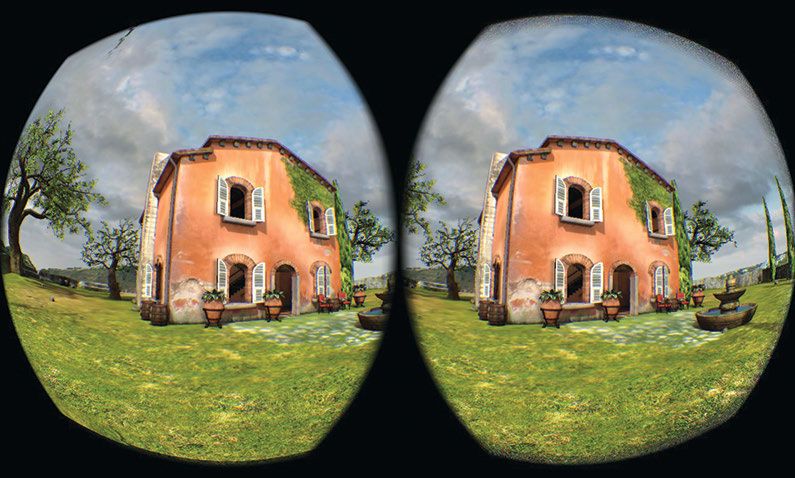
ID Donelan H&Ap6-10_Layout 1 3/13/2018 2:41 PM Page 8

      2018 Honors and Awards

      LCDs. “My background in thin films,” says                                                              effect on the display industry over a period
      Yeh, “was useful for the development of com-                                                           of many years, and are broadly recognized
      pensators that greatly improved the viewing                                                            across the industry.
      quality of LCDs for cockpits.” That work                                                                  Sang Wan Lee, professor at Hanyang
      gained momentum and distribution, as those                                                             University and former CEO of Samsung’s
      same high-quality LCDs eventually went into                                                            LCD Division, has earned the inaugural David
      households as flat-screen televisions. That                                                            Sarnoff Industrial Achievement Prize “for his
      work on compensators, says Yeh, led to work                                                            leadership and contributions to the growth of
      in further aspects of LCD optics that eventu-                                                          the display industry, and especially to large-
      ally became his career. In addition to working                                                         screen LCD TVs.”
      at Rockwell, Yeh was a professor at the                                                                   Dr. Lee is known for his pioneering efforts
      University of California at Santa Barbara for                                                          on behalf of the flat-panel display industry,
      nearly 30 years.                                                                                       and for his significant impact on the LCD
         Yeh notes that technical problems that still                                                        industry in particular. Lee assumed leadership
      need to be solved in LCDs include higher                                                               of the LCD division at Samsung Electronics
      frame rates and 3D imagery. “The most diffi-                                                           in 1993. During his 15 years as CEO at
      cult problem is the display of real 3D images                                                          Samsung, he led the company to grow the
      and videos using holographic technology in a                                                           notebook and LCD monitor market through

                                                                       Sang Wan Lee
      flat LCD panel,” says Yeh.                                                                             aggressive investment and panel-size stan-
                                                                                                             dardization. He was the first to invest in Gen
      2018 David Sarnoff Industrial                                                                          7 fabs that made volume production of LCD-
      Achievement Prize                                  ents who would not qualify for one of SID’s         TV panels economically feasible, and which
      The David Sarnoff Industrial Achievement           technical achievement awards but who                in turn made possible the era of very large-
      Prize is designed to honor outstanding recipi-     nonetheless have had a profound, positive           screen LCD TVs in the early 2000s.

                                                     2018 SID Fellow Awards
                            The grade of Fellow is conferred annually upon SID members of outstanding qualifications and experience
                    as scientists or engineers whose significant contributions to the field of information display have been widely recognized.

                            Steven Bathiche “for his contributions to one of                          Ioannis Kymissis “for his sustained contributions
                            the first computer-vision mixed-reality computers                         in the application of thin-film electronics to display
                            for multi-touch and object recognition, and to the                        technologies.”
                            seed technologies for Microsoft Surface computers.”                          Dr. Kymissis is an associate professor in the
                               Mr. Bathiche is a research director with the                           electrical engineering department at Columbia
                            Applied Sciences Group at Microsoft. He has a                             University. He has a Ph.D. in electrical engineering
                            master of science degree in bioengineering from                           and computer science from the Massachusetts
          the University of Washington.                                            Institute of Technology.

                            Mary Lou Jepsen “for her contributions to display                          Seok-Lyul Lee “for his invention, product develop-
                            technology and product development, especially                             ment, and commercialization of fringe-field switch-
                            low-cost laptop and netbook displays, low-power                            ing liquid-crystal display devices.”
                            sunlight-readable LCDs, virtual reality, and wear-                           Mr. Lee is senior manager/chief researcher at
                            able displays.”                                                            AU Optronics. He earned his M.S. in polymer/
                               Dr. Jepsen is the founder of Openwater. She has                         nanoscience technology at Chonbuk National
                            a Ph.D. in optical physics from Brown University.                          University.

                                                                Qiong-Hua Wang “for her contributions to the
                                                                science and technology of 3D display systems based
                                                                on integral imaging and lenticular lenses.”
                                                                   Dr. Wang is a professor at Beihang University.
                                                                She earned a Ph.D. in optical engineering at the
                                                                University of Electronic Science & Technology of
                                                                China.

      8    Information Display 2/18
ID Donelan H&Ap6-10_Layout 1 3/13/2018 2:41 PM Page 9
“Professor Lee stimulated and led the from 1998 to 2001, he notes, going from 1.5 Samsung LCD was indeed able to reap the
LCD industry by setting a high level of targets million units in 1998 to 15 million in 2001. benefits of “early-bird mode,” as Lee puts it.
to be achieved,” says Jin Jang, director of “But,” Lee explains, “the LCD-TV market It’s important to note here that while Lee
the Advanced Display Research Center and was a different and very difficult one for wanted his company to be first to the market,
Department of Information Display at Kyung many reasons.” First, there was no suitable he didn’t wish for it to be exclusive there.
Hee University. “For example,” says Jang, LCD technology for large-screen TVs at that “I always believed the LCD industry should
“he was invited to give a keynote speech at time, including wide viewing-angle technol- grow together,” he says, “and we could make
Display Week 2005 in Boston, at which time ogy, a high-speed liquid-crystal driving method the market big through the whole industry
he forecast sales of LCD TVs to increase to for moving imagery, and high gamut color. working together.”
100 million units per year by 2010. He called There wasn’t any process equipment to make When asked what advice he would give
on the entire display industry to work together such TVs, and creating that equipment would to other CEOs in this area, Lee observes that
to achieve this goal.” Although this seemed require a huge and risky fab investment. the current situation is challenging, with the
like a radical prediction at the time, it came Undeterred and inspired, Lee drove for- worldwide TV market near-saturated and
true two years early, in 2008. ward. “I decided to challenge the LCD-TV LCD penetration close to 100 percent. He
Lee explains that he grew interested in TVs panel business,” he says, “and to be ahead of adds that there are very many players now
in the early 2000s when he saw how quickly the other manufacturers (the early bird gets and that “China’s bold investment in Gen 10
LCDs (already the dominant display in lap- the worm strategy).” With the world’s first fabs can change the market.” Today’s CEOs
tops) were replacing CRTs in desktop moni- 40-in. LCD-TV prototype announced in 2001, are facing difficult challenges, with fast-
tors. LCD monitor sales doubled every year and the first Gen 7 fab operational in 2005, changing, more-diversified display dynamics,
including OLED TVs, QLEDs, microLEDs,
2018 SID Special Recognition Awards
and more. But success can still be had if
CEOs practice forward thinking by investing
in innovative materials, says Lee.
Presented to members of the technical, scientific,
and business community (not necessarily SID members)
2018 Slottow-Owaki Prize
The Slottow-Owaki Prize is awarded for out-
for distinguished and valued contributions to the information-display field.
standing contributions to the education and
training of students and professionals in the
Jae-Hoon Kim “for his switching and fringe-field
field of information displays.
contribution to the devel- switching LCDs.”
Vladimir Chigrinov, professor at Hong
opment of LCDs and Dr. Tomioka and
Kong University of Science and Technology,
other optical and organic Dr. Kunimatsu are engi-
will receive the Slottow-Owaki Prize “for his
devices.” neers at Japan Display,
educational efforts in the field of liquid-
Dr. Kim is a professor Inc. Dr. Tomioka received
crystal devices, as evidenced by his teaching,
at Hanyang University. a Ph.D. in chemistry from
supervision of graduate students, and prolific
He earned his Ph.D. in physics at Sogang Tohoku University.
publications and conference presentations.”
University. Dr. Kunimatsu received
Dr. Chigrinov got his start in the display
his Ph.D. in chemistry
industry after receiving his M.S. degree in
Hisahiro Sasabe “for his from the University of
applied mathematics from the Moscow Tech-
contributions to the Southampton.
nical University of Electronics and Mathemat-
science and technology of
ics in 1973. But as he headed toward doctoral
multifunctional materials
work, he became more and more interested
realizing low-power-
in the physics of liquid crystals than in pure
consumption OLEDs, Katsuhide Uchino “for mathematics. “I worked in projects aimed at
and for outstanding his leading contributions understanding the fundamental aspects of
contributions to the literature.” to the research and LCD technology,” says Chigrinov, “including
Dr. Sasabe is an associate professor at development of designs the special measurement techniques of LC
Yamagata University. He received his Ph.D. for high-resolution physical parameters such as viscosity, elastic-
in applied chemistry from Osaka Prefecture AMOLED displays and ity, optical and dielectric constants, etc.”
University. micro-OLED displays.” He subsequently earned a Ph.D. in solid-state
Mr. Uchino is a device engineer and physics from the Shubnikov Institute of
Yasushi Tomioka and Noboru Kunimatsu manager at Sony Corp. He earned an M.S. Crystallography at the USSR Academy of
“for their leading contributions to the in applied physics from Waseda University. Sciences, with a thesis titled “Investigation
research and development of photodecom-
of Instabilities in Nematic Liquid Crystals.”
position-type photoalignment into mass
Throughout his career, Chigrinov has
production of planar-aligned in-plane
participated in making prototypes of the first
Information Display 2/18 9ID Donelan H&Ap6-10_Layout 1 3/13/2018 2:41 PM Page 10
2018 Honors and Awards
professional relationships he has with former the development of QDs, making exception-
students who have embarked on their post- ally efficient use of his short 20-year-old
graduate careers at universities and companies. career. His doctoral thesis at the Massa-
“I still look forward to new research projects chusetts Institute at Technology, where he
with my former students and continue to work received his Ph.D. in 2005, led to the forma-
with them on interesting future LC applica- tion of QD Vision, a company that paved the
tions in displays and photonics,” he says. way for quantum-dot technology for displays.
According to Larry Weber, founder of
2018 Peter Brody Prize Plasmaco, “Seth’s major contribution to
The Peter Brody Prize is awarded to honor active-matrix displays has been to develop
outstanding contributions of young practical ways to introduce quantum dots into
researchers (under age 40) who have made manufacturable products. An example of this
major-impact technical contributions to the is his work with Sony to put the QD Vision
developments of active-matrix addressed dis- quantum dots into the Sony 65-in. Bravia
plays in one or more of the following areas: active-matrix LCD first shown at the January
• Thin-film transistor devices 2013 Consumer Electronics Show in Las
• Active-matrix addressing techniques Vegas. This product won the Best in Show
• Active-matrix device manufacturing and Best Home Theater Product at CES.
• Active-matrix display media Today the display industry widely accepts the
Vladimir Chigrinov • Active-matrix display enabling components concept that quantum dots are needed to make
Seth Coe-Sullivan, vice president of superior active-matrix LCD products.”
liquid-crystal displays based on dynamic technology and chief technology officer for Coe-Sullivan first learned about QDs when
scattering with electrically controlled birefrin- Luminit, will receive the Peter Brody Prize he was interviewing with professors at MIT,
gence. He also focused on computer modeling “for his pioneering contributions to quantum- deciding which group he would join. Profes-
of these LC properties. Under his supervision, dot based technologies in displays and to their sor Vladimir Bulovic at MIT showed him
a unique software module was created that impact on active-matrix display technologies.” some images he had received from Professor
enabled the simulation and optimization of Quantum dots (QDs) are new but now Moungi Bawendi, says Coe-Sullivan, and
real LC behavior without entailing any physi- well known in the display industry, both as a expressed his desire to make a good LED out
cal experiments. In addition to this research, material in current use as an LCD backlight of these materials. “Bulovic’s passion was
Chigrinov has written six books and more color gamut enhancer, and as a material contagious,” says Coe-Sullivan, “and I spent
than 280 journal papers, and taught in various with potential to disrupt the industry with the next 17 years of my life (and counting) in
capacities at the Hong Kong University of new types of self-emitting devices, including the field.”
Science and Technology since 1999. displays. Dr. Coe-Sullivan, an expert in QD When asked what achievement he is proud-
Says physicist and inventor Martin Schadt, materials and devices for solid-state lighting est of with regard to his quantum dot work,
“Professor Chigrinov is a dedicated applied and displays, has been a major force behind Coe-Sullivan replies, “I’m proud that we
scientist with a profound understanding of (not me alone) were able to reduce QDs to
liquid crystal science and technology. His something relatively simple that adds value
well-written textbooks and original publica- to the devices that you use every day. There
tions on LCDs are inspiring and of great value were and are lots of incarnations that were
for teachers and students.” more elegant, sexier, and flashier than using
Looking back at his career, Chigrinov says QDs as a down-conversion replacement for
he is particularly proud of pioneering LC phosphors in LCD TVs backlights, but we
photoaligning technology, including highly stayed focused on the simple and useful, and
sensitive optically rewritable (ORW) photo- created an industry around that innovation.
aligning materials and superfast ferroelectric Now the QD industry (there is one!) can work
LC (FLC) materials. on those harder but cooler solutions, and bring
Students’ comments over the years on a whole new generation of QD products to
Chigrinov’s lectures attest to his success as an market in displays, and elsewhere.” n
educator. Such comments include: “deep
understanding of the subject area and good Submit Your News Releases
attitude toward students,” “very up to date
with recent developments,” “enthusiastic
Please send all press releases and new
about the material, and very knowledgeable
product announcements to:
on the subject,” and “very kind-hearted per- Information Display Magazine
Jenny Donelan
son” who is “easy to approach.” Chigrinov’s
Seth Coe-Sullivan
411 Lafayette Street, Suite 201
greatest satisfaction as an educator are the
New York, NY 10003
Fax: 212.460.5460
e-mail: jdonelan@pcm411.com
10 Information Display 2/18Invitation to submit review papers
The Journal is soliciting review papers on
any display-related topic. If you have a
great idea for a review paper, please
contact the editor at editor@sid.org.
Page charges for invited review papers
will be waived. Herbert DeSmet
Editor-in-Chief
A number of other review papers are
presently being prepared. An advanced circuit with only one pin per
Announcements column is proposed to drive active-matrix
organic light-emitting diode with real-time
Awards feedback. Without using extra memory and
Silver jubilee
The winners of the Best Paper Award 2017 doubling the pin number in column, the
JSID was first published in its present form and of the Outstanding Student Paper proposed method can be implemented at
in 1993, 25 years ago. The first Editor-in- Award 2017 will be announced during lower cost than the other external
Chief was Alan Sobel, still an active and Display Week on May 22nd. compensation approaches.
respected member of the display research
Electrowetting optical switch with large
community. Please read my Editorial in
JSID social media presence aperture tuning range | Yannanqi Li, et
Vol. 26(1) where I reminisce briefly about
al.| DOI: 10.1002/jsid.620
some changes the Journal has gone through See the bottom of this page for our Twitter
in those 25 years. and Facebook coordinates.
Special issues Highlighted recent papers
We will again have several special sections
for expanded papers from SID sponsored High-resolution and compact virtual
conferences. mouse using lens arrays to capture In this paper, we propose an electrowetting
At the time of writing, ‘Best of finger images on light sensors | Zong Qin optical switch with large aperture tuning
EuroDisplay 2017’ papers are being et al.| DOI: 10.1002/jsid.613 range by deforming the shape of the liquid
reviewed and are expected to appear in droplet. The aperture can be largely tuned
issues 2 (February) and up, but also in a from ~0.5 to ~6.2 mm. We analyze the
virtual online issue. electro-optical characteristics such as
Like last year we have installed an transmission (~350:1), actuation time
expedited review procedure for the (~320 ms), and relaxation time (~3.6 s).
‘Expanded Distinguished Papers of Fig. 1 depicts the top-view and side-view
Display Week 2018’. 44 abstracts have of the fabricated device.
been nominated by the paper selection
committee as ‘candidate Distinguished
Papers’ and a large majority of the authors
have submitted an expanded version to Information about the Journal
A virtual mouse using lens arrays and light
JSID. At the time of writing, the papers are
sensors is proposed for finger positioning. JSID is published monthly by Wiley.
being reviewed with the highest priority.
Experiments verify a high resolution of 26 Subscription fees apply, but SID members
The expedited review is stricter than for
ppi over a working area of 10 cm × 10 cm. and student-members have free online
regular contributions, because there is not
The system volume is as compact as 3.1 access via sid.org/Publications.aspx
enough time to allow for major revisions to
mm (thickness) × 4.5 mm (length) × 2, Many universities also have an institutional
the papers. All accepted papers will be
while multiple imaging paths guarantee an subscription.
published online in a virtual issue before
acceptable accuracy of approximately two JSID is indexed in the Web of Science.
the start of Display Week and will be
distinguishable points. Submit your original manuscript online via
assigned to monthly issues 2-5. The
Distinguished Papers will be ‘open access’ An external compensation method for mc.manuscriptcentral.com/sid
until the end of the year. AMOLED using the concept of ramp- Author guidelines can be found on the
Finally, we are expecting a handful of stop | Ya-Hsiang Tai and Chi-Hao Lin | Journal’s homepage at Wiley Online:
expanded selected papers from IDW'17 DOI: 10.1002/jsid.616 tinyurl.com/jsidhome.
for publication in the July and August Editorial board: tinyurl.com/jsideb.
issues and also in a virtual online issue of Please direct any questions about the
JSID. journal to the Editor-in-Chief of JSID at
editor@sid.org
Invited review papers EarlyView: accepted papers about to be
published can be accessed online via
A first invited review paper was authored tinyurl.com/jsidev
by K. Vodrahalli and A.K. Bhowmik and
published in v25(11): 3D computer vision
based on machine learning with deep #JSOCINFDISP tinyurl.com/jsidfb
neural networks: A review (DOI:
10.1002/jsid.617).ID King Li p12-15_Layout 1 3/14/2018 12:43 PM Page 12
display marketplace
LCOS and AR/VR
Companies are delivering different renditions of augmented-reality and virtual-reality
products to the market, including Google Glass, Microsoft Hololens, ODG R-7, Magic
Leap One, Oculus Rift, HTC Vive, and the Dell Visor. All these products have different
specifications and applications. This article will discuss the differences between VR and
AR, and how LCOS microdisplays can play an important role in making these applications
more viable.
by Po King Li
V IRTUAL-REALITY (VR) headsets
have existed for more than 30 years, but major
AR glasses require a complex optical
module to deliver the digital content overlap.
• AR glasses are a stand-alone device.
They do not usually connect to any PC or
technical breakthroughs that provide a new We will briefly introduce these different game console. They have enough pro-
experience to users have only arrived in the optical architectures later in this article. The cessing power to render the 3D imagery.
past few years. These breakthroughs include following are characteristics of AR systems: • The user experiences digital content as
high-resolution thin-film transistor (TFT)- • AR provides a see-through optical device an overlap with the real environment.
LCD and OLED panels, power graphics for the user. When the AR glasses are off, • Currently, most AR applications are for
processing units (GPUs), cloud computing, the user is still able to see the environ- enterprises, such as 3D models for
and 3D rendering software. ment surrounding her. AR glasses are not architecture, warehouse management,
Augmented-reality (AR) devices are an immersive experience. and medical and educational applica-
cousins to VR devices, but with different
DNA. There are several differences, but the
main one is that VR provides an immersive
experience for users, who experience the
virtual world the system provides and are not
able to see the environment around them
(Fig. 1). AR involves a wearable device that
allows users to view the surrounding environ-
ment with an overlap of digital content. For
example, a user can see his friend’s face with
a digitally generated hat; an architect is able
to see her newly designed building at the con-
struction site before construction has begun;
a field technician can follow 3D instructions
from the other side of the world to fix a copy
machine; a doctor can perform heart surgery
with directions from an expert in another
country (Fig. 2).
Po King Li is VP of marketing & sales,
LCOS displays, at Himax Display. He can be Fig. 1: The Oculus Rift is a well-known VR headset that enables users to experience immersive
reached at poking_li@himaxdisplay.com. applications in which they see nothing of their physical surroundings. Source: Oculus
12 Information Display 2/18
0362-0972/2/2018-012$1.00 + .00 © SID 2018ID King Li p12-15_Layout 1 3/14/2018 12:43 PM Page 13
tions. But more gaming applications are
coming.
In summation, VR provides a virtual world
to the user, whereas AR adds digital content to
a real-world view. This is the key difference
between these two product categories.
Liquid Crystal on Silicon
Liquid crystal on silicon (LCOS) is a well-
known microdisplay technology that is widely
used by AR headset designers due to several
key advantages that we will discuss. The
liquid crystal is sandwiched between a layer
of glass and a silicon wafer (Fig. 3). The Fig. 2: A popular AR device (which its maker refers to as a mixed-reality device) is the Hololens
silicon wafer’s top metal layer has two key from Microsoft. The headset at left enables augmented-reality applications, including remote
functions: First, it is a mirror to reflect the plumbing repairs, as shown at right. Source: Microsoft
light, and second, the mirror’s voltage drives
the liquid crystal, twisting it in order to create
an image. When the polarized light reflects
from the mirror, the light can project through
the optical system so the user can see the image.
LCOS has various applications in projec-
tors, head-up displays (HUDs) for cars, and
AR glasses. Other useful LCOS applications
are in phase modulation for communication
applications and holographic displays. (It
would take another article to discuss phase
modulation and LCOS.) LCOS projection
systems offer one of the best image-quality
visual systems available. Sony and JVC’s
top-of-the-line home theater projectors both
use LCOS as the display source. Since LCOS
Fig. 3: A cross-section of LCOS includes, from top to bottom, a glass plate, the liquid-crystal
is based on a silicon design, there is no limit
materials, and a color-filter layer based on a silicon substrate.
on resolution. Both 4K and 8K projection
systems have been implemented with LCOS.
There are several different types of these
systems (two appear in Fig. 4):
• The three-panel LCOS system is used
mostly for home theater projectors. It
uses three LCOS panels, each projecting
in red, green, and blue light provided by
the optical system. The system uses a
lamp, LED, or laser as a light source.
• The color-sequential single-panel system
has been used in some AR glasses. The
system consists of one LCOS panel, and
the system projects red, green, and blue
color fields sequentially. The optical
system sequentially provides red, green,
and blue light to the LCOS panel.
• The color-filter single-panel system inte-
grates a color filter on the top metal layer
so that the optical system requires only
white light as the input. This design uses
the color filters on the LCOS panel to Fig. 4: At left is a color-sequential LCOS optical system, and at right is a color-filter LCOS
create the colored image. optical system.
Information Display 2/18 13You can also read


