DRAFT SCHOOL-WIDE TIER II INTERVENTIONS: CHECK-IN CHECK-OUT
←
→
Page content transcription
If your browser does not render page correctly, please read the page content below
Tier II Getting Started Workbook [Draft v. Feb 15 2011]   1

                         DRAFT

SCHOOL-WIDE TIER II INTERVENTIONS:
           CHECK-IN CHECK-OUT
   GETTING STARTED WORKBOOK

                         Susannah Everett

                           George Sugai

                           Lindsay Fallon

                          Brandi Simonsen

                          Breda O’Keeffe

                     Version: February 15, 2011

    OSEP Center on Positive Behavioral Interventions and Supports

            Center for Behavioral Education and Research

                      University of Connecticut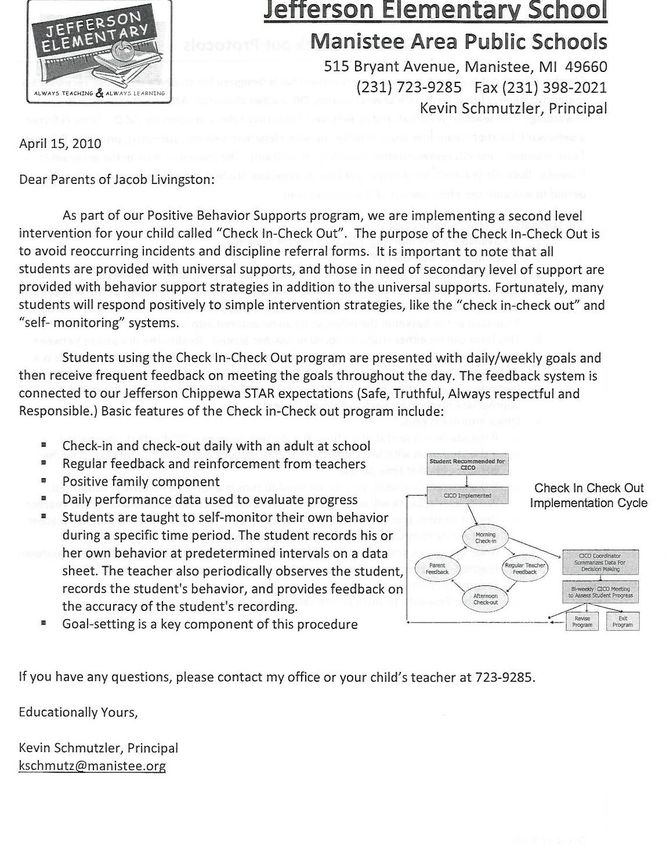
Tier II Getting Started Workbook [Draft v. Feb 15 2011]   2

                               ACKNOWLEDGEMENTS

The development of these training materials were shaped and influenced by the dedicated work of
many practitioners and researchers, including of Doug Cheney, Sandy Christenson, Deanne Crone, Glen
Dunlap, Celeste Dickey, Heather George, Pam Halvik, Leanne Hawken, Rob Horner, Don Kincaid,
Margaret Lathrop, and Rob March.

Preparation of these materials is supported in part by the OSEP Center on Positive Behavioral
Interventions and Supports (http://pbis.org). The Center is supported by a grant from the Office of
Special Education Programs, US Department of Education (H326S98003). Opinions expressed herein are
those of the authors and do not necessarily reflect the position of the US Department of Education, and
such endorsements should not be inferred. Sale and/or photocopying of these materials in whole or part
are prohibited without expressed permission of the authors and the OSEP Center on PBIS.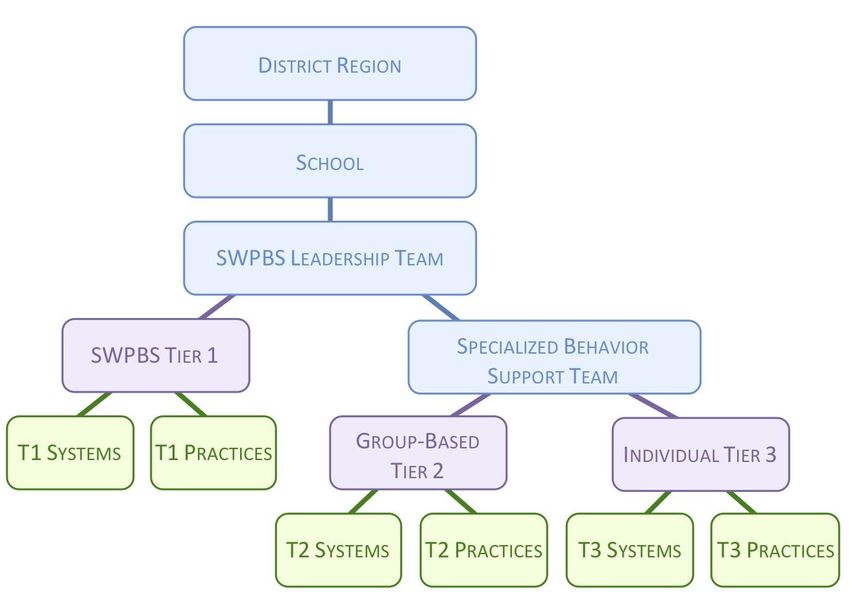
Tier II Getting Started Workbook [Draft v. Feb 15 2011]           3

               HOW SHOULD THIS WORKBOOK BE USED?

WHAT IS THE PURPOSE OF THIS WORKBOOK?

The purpose of this workbook is to support implementation of Tier II1 behavioral interventions and
systems in your school. The contents and format of the workbook were developed to accompany team
training that is guided by a trainer fluent in School-Wide Positive Behavior Supports2 (SWPBS), or to be
a booster for teams, coaches, and others who have completed a training experience.

In addition, this workbook is directly linked to the SWPBS framework, and emphasizes a specific
exemplar, Check-In Check-Out (CICO), an evidence-based, group-oriented intervention Tier II prevention
program.

Tier II interventions are one component of a continuum of behavioral supports, and their features and
systems reflect the structure of SWPBS. They are evidence based, utilize teams to make data-based
decisions, require systems-level support, and emphasize prevention. These targeted systems and
practices focus on both school-wide and individual student outcomes.

HOW IS THIS WORKBOOK ORGANIZED?

The organization of this workbook assumes that users have a basic working knowledge and experience
with SWPBS, especially at Tier I.

In addition, content is organized around key questions that together support implementation of Tier II
behavioral interventions and systems. The content is not necessarily sequenced to represent a particular
implementation order. More importantly, users should attend to the system requirements associated
with readiness, content and skill fluency, implementation fidelity, and data-based decision making.

1
  Tier I = Primary or Universal Prevention; Tier II = Secondary or Targeted Prevention; Tier III = Tertiary or Intensive
Prevention.
2
  SWPBS = Positive Behavioral Interventions and Supports (PBIS).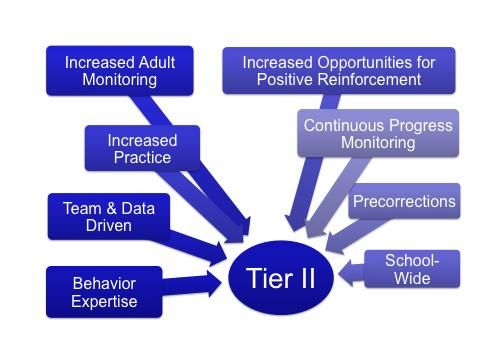
Tier II Getting Started Workbook [Draft v. Feb 15 2011]    4

The answer for each key question is structured around (a) an overview of relevant content knowledge,
(b) a self-assessment of existing and needed systems and practices to guide action planning, and (c)
action planning tools to direct contextualized implementation and specific product development.

The appendices contain sample school-wide planning tools as well as materials specific to CICO, such as,
sample daily point cards, information to share with parents, training materials for teachers, lesson plans
for students, and checklists to ensure the fidelity of your implementation. For a detailed explanation of
the program and the research demonstrating the efficacy of CICO, please refer to Crone, Hawken, and
Horner (2010) and references at the end of the workbook.
Tier II Getting Started Workbook [Draft v. Feb 15 2011]                        5

                                             TABLE OF CONTENTS

Is Foundation Knowledge in Place? ........................................................................................ 7
   What is School-Wide Positive Behavior Support? ............................................................................7
   What is the Purpose of Tier II Interventions?................................................................................. 10
   What are the Defining Features of Tier II Interventions? ................................................................ 11

When is a School Ready for Tier II Practices and Systems?.................................................... 12
   Does Implementation of Tier I Practices and Systems Need a Booster? .......................................... 12
   Is School Ready for Tier II Interventions and Systems?................................................................... 13

Have Commitments and Agreements for Implementation Been Secured? ............................ 15
   Have Commitment, Participation, and Support from Key Stakeholders Been Documented? ........... 15

What is a Specialized Behavior Support Team? .................................................................... 17
   What Are the Roles, Responsibilities and Functions of Specialized Behavior Support Teams? ......... 18
   Who are the Members of the Specialized Behavior Support Team? ............................................... 20

Check-In Check-Out Foundations ......................................................................................... 22
   What is Check-In Check-Out? ........................................................................................................ 22
   How Do I Monitor Student Progress and Know If CICO is Implemented Accurately and Fluently? .... 24

What Does a CICO Coordinator Do? ..................................................................................... 25
   What are the Specific Roles and Responsibilities of the Coordinator? ............................................ 26

How Are Data Used for Decision Making in CICO? ................................................................ 28
   What Is CICO-SWIS? ..................................................................................................................... 28
   How is CICO-SWIS Used to Make Decisions about Individual Students?.......................................... 30
   How is CICO-SWIS Used to Make Decisions about the Program? .................................................... 32

What Is Included in an Action Plan for Implementation of CICO Practices and Systems? ....... 34

References .......................................................................................................................... 43

Appendices ......................................................................................................................... 44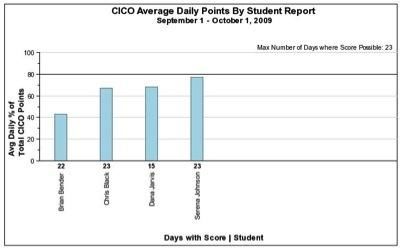
Tier II Getting Started Workbook [Draft v. Feb 15 2011]                         6

A Classroom Management Self-Assessment................................................................................ 45
B CICO Coordinator Training: Suggested Topics ........................................................................... 46
C Lesson Plans ........................................................................................................................... 47
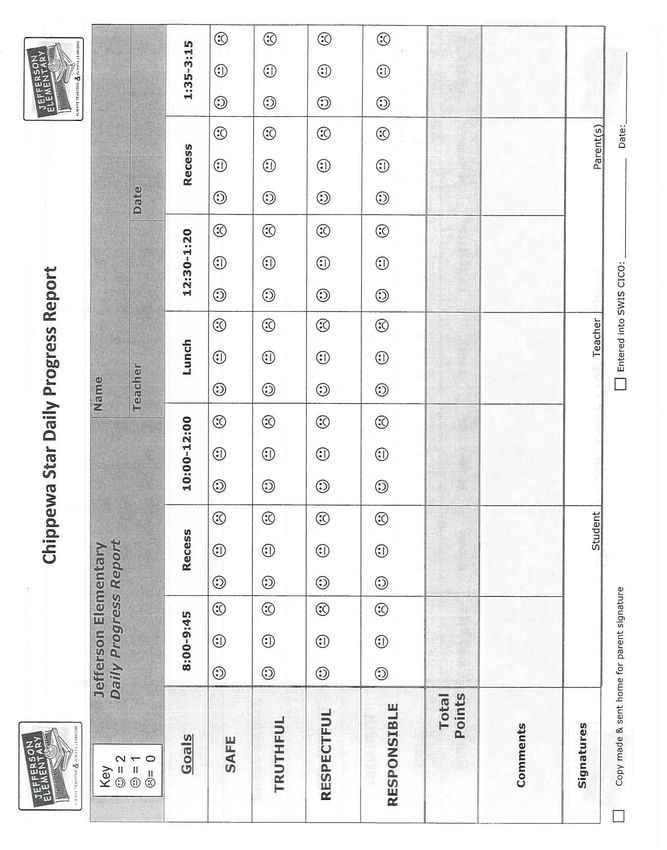
D Daily Progress Report Examples .............................................................................................. 52
E Check-In Check-Out Sample Checklists....................................................................................... 55
F Sample Referral Form ............................................................................................................... 56
G Sample Permission Forms ........................................................................................................ 57
H Implementation Self-Assessment And Action Plan .................................................................... 59
Tier II Getting Started Workbook [Draft v. Feb 15 2011]   7

                    IS FOUNDATION KNOWLEDGE IN PLACE?

                           WHAT IS SCHOOL-WIDE POSITIVE BEHAVIOR SUPPORT?

School-wide Positive Behavior Supports3 (SWPBS) is a framework for enhancing adoption and
implementation of a continuum of evidenced-based interventions to achieve academically and
behaviorally important outcomes for all students.
SWPBS is defined by four inter-related elements:

           Data refers to information about where we are now and have been (i.e., baseline data), and
                   what we know about something (evidence). This information is used to define where we
                   want to go (outcomes), what we might use to get there (practices), and what we need
                   to effective and efficient at what we do.
           Outcomes refer to what we want student to learn and do well, both academically and
                 behaviorally. They derived from data, and guide decisions about what practices to select
                 for achieving those outcomes.
           Practices refer to what instructional and behavioral interventions, strategies, programs,
                   curricula, etc. are used to achieve a stated outcome. In addition, the selection of
                   practice is guided by the evidence (data) that are available to demonstrate the
                   effectiveness of a practice and the resources and supports needed for accurate and
                   effective implementation (systems).
           Systems refer to the supports, resources, training, etc. that implementers would need to
                  maximize their implementation of a given practice to achieve a specific outcome.

3
    Also referenced as Positive Behavioral Interventions and Supports (PBIS)
Tier II Getting Started Workbook [Draft v. Feb 15 2011] 8
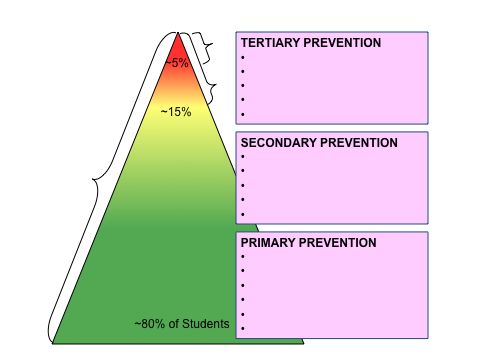
A defining feature of school-wide positive behavior supports (SWPBS) is a prevention logic that is
organized as a continuum of support, most often in three tiers.
Primary Tier (I) – School-wide practices and systems for preventing the development and
occurrences of problem behavior for all students across all settings.
Secondary Tier (II) – More specialized and intensive practices and systems for supporting
students whose behaviors have been documented as unresponsive to Tier I
practices and systems.
Tertiary Tier (III) – Highly specialized and individualized practices and systems for supporting
students whose behaviors have been documented as unresponsive to Tiers I & II
practices and systems.Tier II Getting Started Workbook [Draft v. Feb 15 2011] 9 Tier II interventions within the SWPBS continuum of supports are illustrated below:
Tier II Getting Started Workbook [Draft v. Feb 15 2011] 10

                         WHAT IS THE PURPOSE OF TIER II INTERVENTIONS?

The three-tiered prevention logic organizes behavior supports along a continuum, matching intervention
intensity to students’ needs. In this workbook, the focus is on Tier II practices and systems, which have
been designed to
        1. Prevent the development or decrease the frequency and/ or intensity of students’ problem
           behaviors
        2. Provide standardized interventions that effectively and efficiently support students yet do
           not require the time and resources needed to develop individualized plans
The implementation of three-tiered prevention logic in SWPBS is a direct application of the Response-
to-Intervention (RtI) framework that is applied to academic content teaching and learning (e.g.,
literacy). The defining features of RtI are embedded with the SWPBS approach:
Tier II Getting Started Workbook [Draft v. Feb 15 2011] 11
WHAT ARE THE DEFINING FEATURES OF TIER II INTERVENTIONS?
Tier II interventions are typically group-based, standardized practices and systems designed to
supplement primary prevention efforts, and are appropriate for students who exhibit problem behaviors
across multiple settings.
Crone, Hawken, and Horner (2010) indicate that Tier II interventions have the following critical features:
Consistent, standardized implementation across students
Easily accessible (e.g., within a few days of referral)
Continuous availability
Implemented by all school staff
Consistent with and extra doses of school-wide expectations and interventions
A variety of evidence based Tier II interventions meet these criteria, and most incorporate effective
practices, such as,
Targeted and explicit skill instruction
Acknowledgements of appropriate behavior
Increased adult support
Frequent performance feedback for targeted behaviors
Plans for generalization and maintenance
Check-In Check-Out, or CICO, is a commonly utilized and well-researched Tier II intervention, and is
highlighted in this workbook.Tier II Getting Started Workbook [Draft v. Feb 15 2011] 12
WHEN IS A SCHOOL READY FOR TIER II PRACTICES AND
SYSTEMS?
DOES IMPLEMENTATION OF TIER I PRACTICES AND SYSTEMS NEED
A BOOSTER?
Because of the importance of implementation of Tier I practices and systems, we recommend that your
team complete the following four steps before proceeding in this workbook:
Tier I Self-Assessment
Step 1: Complete the Team Implementation Checklist or Benchmarks
of Quality
Step 2: Review most recent School-wide Evaluation Tool score
Step 2: Review most current school-wide discipline data (e.g., SWIS)
Step 4: Modify Tier I implementation action plan based on data from
Steps 1 and 2Tier II Getting Started Workbook [Draft v. Feb 15 2011] 13
IS SCHOOL READY FOR TIER II INTERVENTIONS AND SYSTEMS?
Tier I systems and practices are critical foundations for effective implementation of Tier II systems and
practices.
SWPBS Systems established, including:
o School board/district/regional support
o SWPBS Leadership Team
o Administrator endorsement and active participation
o Continuous, data-based professional development (training and coaching)
o Recognition of staff behavior, contributions, and/or accomplishments
o School-wide data system
SWPBS Practices established, including:
o Three to five positively stated and defined school-wide expectations positively defined
o Expectations regularly taught in both classroom and non-classroom settings
o School-wide reinforcement plan to acknowledge expected behavior
o Plan and continuum of consequences for rule violations
o Evidence-based classroom management practices (see Appendix A for Classroom
Management Self-Assessment)
To enhance the support of successful implementation of Tier II practices and systems, schools must
document that Tier I practices and systems are in place by meeting at least one of the following criteria:
> 80%/80% on the School-wide Evaluation Tool (SET)
>80% on Team Implementation Checklist (TIC)
>70% on the Benchmarks of Quality (BoQ)
Copies of the SET, TIC, and BoQ are available in the appendices and at www.pbis.org.Tier II Getting Started Workbook [Draft v. Feb 15 2011] 14
The following self-assessment has been designed to enable teams to determine whether they should
proceed with Tier II implementation. An important consideration is the level of Tier I implementation.
Tier II Readiness Self-Assessment
1. Obtain your most recent SET, TIC, and/or BoQ score. TIC/SET/BoQ score
a. If less than a year old, use your most recent SET, TIC, and/or
BoQ score.
b. If more than a year old or if major changes have occurred
with regard to SWPBS implementation in your school,
administer the SET, TIC, and/or BoQ.
2. Enter your TIC, SET, or BoQ score. Date administered:
_________
3. Determine readiness to implement Tier II practices and systems.
Proceed if you meet one or more of the following criteria: Decision(s):
a. >80% on Team Implementation Checklist (TIC), ____ Proceed w/ Tier II
b. >70% on the Benchmarks of Quality (BoQ), or implementation
c. > 80%/80% on the School-wide Evaluation Tool (SET). ____ Develop action
plan to improve Tier I
implementation
____ Reconsider Tier II
implementation at this
time
If Tier I practices and systems are not
firmly in place, reconsider implementation
STOP of Tier II practices and systems at this
time.Tier II Getting Started Workbook [Draft v. Feb 15 2011] 15
HAVE COMMITMENTS AND AGREEMENTS FOR
IMPLEMENTATION BEEN SECURED?
HAVE COMMITMENT, PARTICIPATION, AND SUPPORT FROM KEY
STAKEHOLDERS BEEN DOCUMENTED?
Effective implementation of any practice also requires active support at both the district and building
levels, including resource allocation to develop, implement, and sustain interventions. Stakeholders at
every level must understand the practice and receive regular feedback regarding implementation.Tier II Getting Started Workbook [Draft v. Feb 15 2011] 16
To assess the level of commitment, participation, and support from key stakeholders, complete the
following self-assessment, and develop actions based on your answers:
Tier II Commitment Self-Assessment
Establish Commitment Rating Action Steps
School Principal has agreed to YES NO ?
establish Tier II practices and
supports?
School Principal has agreed to YES NO ?
attend training meetings?
School Principal has agreed to YES NO ?
direct financial and personnel
resources toward
implementation?
School has established a YES NO ?
specialized behavior support team
(see next section)?
School faculty members (>80%) YES NO ?
have agreed to implement Tier I
practices and systems to support
Tier II implementation?
School faculty members (>80%) YES NO ?
have agreed to participate in Tier II
implementation as needed?
If commitments haven’t been confirmed (5
STOP “YES”), reconsider implementation of Tier
II practices and systems.Tier II Getting Started Workbook [Draft v. Feb 15 2011] 17
WHAT IS A SPECIALIZED BEHAVIOR SUPPORT TEAM?
The following planning tool illustrates the capacities of and the relationships between teams
instrumental for the implementation of three tiers of behavioral support, including Tier II interventions
and systems.
SCHOOL-WIDE POSITIVE BEHAVIORAL SUPPORT CAPACITY SELF-ASSESSMENT & PLANNING TOOL
George Sugai
DRAFT April 5, 2010Tier II Getting Started Workbook [Draft v. Feb 15 2011] 18
WHAT ARE THE ROLES, RESPONSIBILITIES AND FUNCTIONS OF
SPECIALIZED BEHAVIOR SUPPORT TEAMS?
A Specialized Behavior Support Team includes individuals with behavioral expertise and crossover
membership with the larger, SWPBS leadership team. This team functions to establish systems and
practices for students who require more intensive behavioral support. This team ensures access to
interventions, evaluates the fidelity of systems and practices, and regularly utilizes data to monitor the
progress of students. Team membership is shaped by individuals who would be responsible for specific
functions or activities related to implementation and support of Tier II practices and systems. These
responsibilities include the following:Tier II Getting Started Workbook [Draft v. Feb 15 2011] 19
Specialized Behavior Support Team: Roles, Responsibilities, and Functions
Provide training and support to school staff regarding the program(s)
Provide specialized behavioral assessment strategies, interventions, and supports
Meet regularly (e.g., weekly or biweekly) to review the program, monitor individual student
progress, and review new referrals
Coordinate school-wide implementation of the overall Tier II practices and systems
Develop screening procedures and data-based decision rules for referring students to
intervention
o Screening using risk-related existing information, such as office discipline referrals
or attendance data and/or
o Teacher nomination and/or
o Universal screening procedures such as the SSBD or SSRS
Develop data-based decision rules (including time frames) for placing students, monitoring
progress, and fading the intervention
Summarize and review data to address the following questions:
o Are appropriate students being referred?
o Are students receiving support quickly?
o Has entire staff been trained?
o Are data reviewed on a regular basis?
o Have data-based decision rules been established for accessing, monitoring progress,
and fading the intervention?
o Are interventions implemented as planned?
o Is adequate training provided to individuals who will implement interventions?
o Are students actively participating in the intervention?
o Is effectiveness of intervention and support being monitored?Tier II Getting Started Workbook [Draft v. Feb 15 2011] 20
WHO ARE THE MEMBERS OF THE SPECIALIZED BEHAVIOR SUPPORT
TEAM?
To reiterate, the Specialized Behavior Support Team has specific functions and responsibilities as
described above. As such, the membership of the team should ensure that these functions and
responsibilities are included and covered. Individuals in the following positions are often included on the
team:
Specialized Behavior Support Team: Membership Examples
Representative from SWPBS Leadership Team
Tier II Intervention Coordinator
School Administrator
Behavior Specialists (e.g., school counselor, school
psychologist, social worker, special educator)
Teacher membership on the Specialized Behavior Support Team often varies based on which students
are participating in Tier II interventions.
TEAMS AND TEACHERS ARE CRITICAL FOR SUCCESS!
A common misperception is that these strategies will “fix” the student and the classroom teacher does
not need to be an active participant since “specialists” or outside staff are often involved in the
intervention – it is important to stress that these interventions will require high level of involvement
among ALL staff within the school building (Lewis, 2009).
The following assessment has been designed to enable teams to examine who is on and/or needs to be added to
their Specialized Behavior Support Team. Tier II functions or responsibilities are used as the basis for examining
membership.Tier II Getting Started Workbook [Draft v. Feb 15 2011] 21
Team Membership Self-Assessment
Function Name of Person(s) Position of If unfilled, Action Steps
Person(s)
Administration
Tier II
Coordination
Behavior Support
Specialization
Data Assessment
SWPBS
Leadership Team
SWPBS Coaching
Other
OtherTier II Getting Started Workbook [DRAFT February 15 2011] 22
CHECK-IN CHECK-OUT FOUNDATIONS
WHAT IS CHECK-IN CHECK-OUT?
Check-In Check-Out (CICO) is a Tier II, group-oriented intervention, designed especially for students
whose problem behaviors (a) are unresponsive to Tier I practices and systems, (b) do not require more
immediate individualized interventions, and (c) are observed across multiple settings or contexts.
Because CICO is a group-based, standardized intervention, it is efficient and cost-effective. For
example, the program can accommodate a number of students (e.g., up to thirty), and students can
enter the program within a few days following referral. CICO also provides a built-in system for (a)
monitoring students’ progress in the program, (b) evaluating the fidelity of implementation, and (c)
transitioning to a self-managed program.
The critical features that define CICO for students include the following practices:
Check-In Check-Out Practice Features
Increased positive adult contact
Embedded social skills training
Direct link to school-wide behavioral goals and expectations
Frequent feedback
Daily home-school communication
Positive reinforcement contingent on meeting behavioral goals
Research conducted on CICO and similar programs have consistently demonstrated associated
decreases in problem behaviors, office discipline referrals, and referrals for special education services.
Most importantly, research also has demonstrated that this intervention is most effective if Tier I,
SWPBS systems and practices are well-established within the school.
In typical implementation of CICO, and other Tier II interventions, students engage in the following daily
activities:Tier II Getting Started Workbook [Draft v. Feb 15 2011] 23
Check-In Check-Out Daily Activities
Check in with a CICO coordinator (or their homeroom teacher)
in the morning
Carry a point card that is based on school-wide expectations
Receive frequent and regular feedback on their behavior from
adults throughout the day
Review their goals with the coordinator (or their homeroom
teacher) at the end of the day
Take their point card home for parent signature and positive
feedback
The CICO implementation cycle is illustrated below:Tier II Getting Started Workbook [Draft v. Feb 15 2011] 24
HOW DO I MONITOR STUDENT PROGRESS AND KNOW IF CICO IS
IMPLEMENTED ACCURATELY AND FLUENTLY?
A critical component of the CICO intervention is data-based decision making to monitor and evaluate
student progress, make intervention adjustments, communicate with others, and enhance
implementation fidelity.
To be effective, data-based decision making systems must have the following:
Clearly specified questions that target what data need to be collected
Measurable definitions of what data need to be collected
Efficient tools procedures for collecting the data
Efficient means for entering the data into a data storage and analysis system
Efficient procedures for summarizing and reporting the data for each question
Efficient procedures for using the data to guide action planning decisionsTier II Getting Started Workbook [Draft v. Feb 15 2011] 25
WHAT DOES A CICO COORDINATOR DO?
The CICO coordinator role is central to the effective and efficient implementation of CICO, and is
responsible for direct coordination and implementation of the CICO intervention with students.
Coordinator-specific training topics are listed in Appendix C. Although “Coordinator” is often used to
refer to a person or position, attention should be focused on the roles, responsibilities, etc. that are
required to “coordinate” CICO practices and logistics. Thus, functions and activities of the coordinator
are often shared by more than one person.
The person(s) who assumes these responsibilities must have the following general characteristics:
General CICO Coordinator Characteristics
Fluent with CICO procedures
Respected as a positive adult by students
Effective communication skills with students, school staff, and
family members
Consistent with follow-through and activity completion
Effective in using data for decision making with regard to
student progress and implementation fidelity
COORDINATORS ARE KEY!
A coordinator must be in school daily, and have a flexible schedule at the beginning and end of the day.
“The coordinator must be someone who the students respect, enjoy, and trust. This person should be
enthusiastic, positive, and friendly” (Crone, Hawken, & Horner, 2010).Tier II Getting Started Workbook [Draft v. Feb 15 2011] 26
WHAT ARE THE SPECIFIC ROLES AND RESPONSIBILITIES OF THE
COORDINATOR?
CICO coordination is usually the responsibility of one trained staff member, but specific functions and
responsibilities can be shared and duplicated across staff members. The advantages of this shared
approach include (a) coverage in the case of absences, (b) support for multiple students across settings
and contexts, and (c) long term implementation sustainability. As such, coordination has been shared,
for example, by school psychologists, counselors, administrators, paraprofessionals, and educational
assistants.
Specific and important functions and responsibilities of the CICO coordinator include the following:
Sample of CICO Coordinator Functions and Responsibilities
Introduce and train students entering the CICO
intervention (see sample training steps and lesson plans in
Appendix D)
Check students in and out on a daily basis
o Positive “set up” (e.g., reminders, practice) for the
beginning of the day
o Positive reinforcement, reminders, and practice at
the end of the day
Reinforce students for meeting behavioral goals, turning in
progress reports, and obtaining parent/guardian
signatures
Communicate with teachers and families regarding
progress and needs of individual students
Collect daily progress reports
Enter data daily into system
Summarize data and prioritize students to review with the
Behavior Support Team, students and their parents, and
participating staff membersTier II Getting Started Workbook [Draft v. Feb 15 2011] 27
Selection of CICO Coordinator(s) Self-Assessment
Proposed Individual(s): Position:
Selection Question Rating Action Plan
Respected positively by students? YES NO ?
Respected positively by adults? YES NO ?
Effective communication skills with students, YES NO ?
school staff, and family members?
Consistent with task and activity follow- YES NO ?
through and completion?
Effective in using data for decision making YES NO ?
with regard to student progress monitoring
and implementation fidelity?
Fluent with CICO procedures? YES NO ?
Capacity to train others on CICO procedures? YES NO ?
If coordination functions are not in place,
STOP delay school-wide implementation of CICO
interventions and systems.Tier II Getting Started Workbook [Draft v. Feb 15 2011] 28
HOW ARE DATA USED FOR DECISION MAKING IN CICO?
WHAT IS CICO-SWIS?
CICO-SWIS is a computer application nested within the School-Wide Information System (SWIS; see
www.swis.org), specially-designed to support CICO data-based decision making.
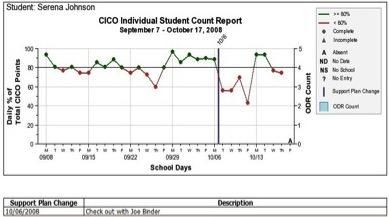
CICO-SWIS produces both individual student count reports (percentage of daily points earned) and
individual student period reports (average percentage of points per period) to monitor individual
student progress. The program also produces an average daily point per student report and a school-
wide report to facilitate monitoring the fidelity and implementation of the intervention.
Once the school contacts their facilitator and CICO-SWIS readiness tasks outlined below are complete, a
licensing agreement is completed and the facilitator can conduct CICO-SWIS training. The SWIS
Facilitator’s Guide (version 4.3) identifies the following requirements for CICO-SWIS. Several of the
requirements (e.g., Daily Progress Report) are addressed in detail below in the practices and materials
section.
CICO-SWIS Self-Assessment
CICO-SWIS Requirements Rating Action Plan
1. School has a SWIS Facilitator, SWIS account, YES NO ?
and a signed CICO-SWIS license agreement
2. School is implementing a universal system of YES NO ?
support (SWPBS) as indicated by SET (>80),
TIC (>80) or BoQ (>70) scores
3. School has access to a coach and/or trainer YES NO ?
for coordinating implementation of CICOTier II Getting Started Workbook [Draft v. Feb 15 2011] 29
4. School is implementing CICO with the following features in
place:
a. Description of the program YES NO ?
b. CICO Coordinator YES NO ?
c. Process for identifying students YES NO ?
d. Process/materials for training adults, YES NO ?
students, and families
5. School has a standard Daily Progress Report/CICO point
card with the following information:
a. Defined # of check-in periods (up to 10) YES NO ?
b. Defined # of expectations/goals (3 to 5) YES NO ?
c. A three-point rating scale YES NO ?
6. A 90-minute Swift at CICO-SWIS training YES NO ?
session is scheduled for the CICO-SWIS users
(2-3 people) and coach, conducted by the
SWIS facilitator
7. CICO-SWIS data entry person and data entry YES NO ?
time are defined
8. Schedule and assignments for CICO report YES NO ?
generation are defined
9. The Universal Team and Behavioral Support YES NO ?
Teams have scheduled meetings to use the
CICO-SWIS data for problem solving and
decision-making. CICO Coordinator,
Coach/SWIS facilitator, have scheduled at
least three follow up meetings with teamTier II Getting Started Workbook [Draft v. Feb 15 2011] 30
HOW IS CICO-SWIS USED TO MAKE DECISIONS ABOUT
INDIVIDUAL STUDENTS?
Data about individual students are used in a variety of ways to guide decisions4.
Screening and Identification: The Behavior Support Team utilizes office discipline referrals
and staff recommendations to screen for students who might benefit from CICO.
Baseline: To determine current levels of functioning, baseline data are collected for 3 to 5
days while parental permission is obtained.
Daily Data Entry: Individual student data are entered daily into the CICO Section of SWIS.
Weekly Review: The Behavior Support Team reviews data weekly or biweekly
Progress Monitoring: The Behavior Support Team uses student data to make the following
decisions about individual student’s response to the intervention:
o Continue CICO
o Modify and continue
o Fade to self-managed program
o Exit and evaluate for alternative supports or individualized, tier III interventions
Data Updates: At least monthly, school staff and parents receive information about the
overall program and individual students, as appropriate.
4
Adapted from SWIS Facilitator Guide, Version 4.3Tier II Getting Started Workbook [Draft v. Feb 15 2011] 31 The following graph is an example of an individual student CICO-SWIS data report:
Tier II Getting Started Workbook [Draft v. Feb 15 2011] 32
HOW IS CICO-SWIS USED TO MAKE DECISIONS ABOUT THE
PROGRAM?
Data about the overall CICO program are used to improve resource use and fidelity of implementation,
for example,
Number of students in the program
o When fully implemented, CICO and other secondary interventions should support
approximately 7- 15% of students school-wide.
Intervention success rate/effectiveness
o Percentage of students participating in CICO that are meeting their goals on a regular
basis. Approximately 70% of students in CICO should respond to the intervention.
Intervention implementation accuracy/fidelity
o Percentage of program steps implemented accurately daily, weekly, etc. is used to
provide supports for additional resource and professional development.Tier II Getting Started Workbook [Draft v. Feb 15 2011] 33 The following graph is an example of a CICO-SWIS program report for multiple students:
Tier II Getting Started Workbook [Draft v. Feb 15 2011] 34

      WHAT IS INCLUDED IN AN ACTION PLAN FOR
  IMPLEMENTATION OF CICO PRACTICES AND SYSTEMS?

Once systems are established, the team should customize the CICO intervention to fit the culture and
needs of your school. The following activities represent the major materials and tasks that comprise
CICO, and for the team and coordinator to complete. Specific examples are included in the appendices.
A CICO implementation manual should be developed to organize and represent the completion of these
materials, procedures, and examples.
Tier II Getting Started Workbook [Draft v. Feb 15 2011] 35
1. Assess school-wide readiness for implementation of CICO.
Tasks Completed Actions Needed
Assess fidelity of implementation of YES NO ?
Tier I SWPBS (SET, BoQ, TIC)
Secure full commitment and active YES NO ?
participation by school principal
(resources, priority, time)
Secure full commitment and active YES NO ?
participation by >80% of school faculty
Establish Specialized Behavior Support YES NO ?
Team to guide and coordinate
implementation
Identify individual to coordinate and YES NO ?
facilitate Specialized Behavior Support
Team
Ensure that school-wide discipline YES NO ?
data system can support Tier II
information
Document that>80% of classroom YES NO ?
behavior management systems are
consistent with SWPBS Tier I.
YES NO ?Tier II Getting Started Workbook [Draft v. Feb 15 2011] 36
2. Develop CICO program to align with individual school context/culture (e.g., age, grades,
demographics).
Tasks Completed Actions Needed
Select program name (e.g., Hello, YES NO ?
Update, Goodbye [HUG] program;
HAWK program)
Develop daily progress report name YES NO ?
(e.g., PAWS Card, SOARS Card)
Incorporate existing 3-5, positively YES NO ?
stated, school-wide expectations (e.g.,
Be respectful, Be responsible, Show
pride in yourself and your school)
Develop CICO implementation manual YES NO ?
that includes all procedures, materials,
and examples
YES NO ?Tier II Getting Started Workbook [Draft v. Feb 15 2011] 37
3. Develop screening, referral, and progress monitoring procedures and materials.
Tasks Completed Actions Needed
Develop screening materials and YES NO ?
procedures for identifying students
who might benefit
Develop procedures and criteria for YES NO ?
staff and/or family member referral to
CICO
Develop system for collection, storage, YES NO ?
summarization, and display of data
(e.g., SWIS.org)
Develop procedures and schedule for YES NO ?
weekly individual student summary
and progress monitoring
Develop weekly and monthly schedule
YES NO ?
to share individual student progress
with parents.
YES NO ?Tier II Getting Started Workbook [Draft v. Feb 15 2011] 38
4. Develop student appropriate daily progress report.
Tasks Completed Actions Needed
Include place to indicate daily/weekly YES NO ?
goal
Include place to indicate daily schedule YES NO ?
(no more than 10 check-ins)
Include place to indicate check-out YES NO ?
summary
Use 3-point rating scale YES NO ?
Include place to indicate teacher YES NO ?
initials and comments
Include place to indicate parent YES NO ?
signature
Include place to indicate weekly YES NO ?
summary
YES NO ?Tier II Getting Started Workbook [Draft v. Feb 15 2011] 39
5. Develop student appropriate reinforcement plan.
Tasks Completed Actions Needed
Develop menu of social to activity to YES NO ?
tangible reinforcers
Develop schedule for immediate, YES NO ?
period, daily, weekly, monthly
reinforcement
Develop planned opportunities for YES NO ?
individual, group, classroom, grade,
program reinforcement
Develop planned opportunities for YES NO ?
participation by student, staff, family
YES NO ?Tier II Getting Started Workbook [Draft v. Feb 15 2011] 40
6. Develop student appropriate daily CICO procedures.
Tasks Completed Actions Needed
Select and prepare location for first YES NO ?
and last check-in
Develop schedule for first and last YES NO ?
check-in
Gather and prepare materials and YES NO ?
supplies
Develop list of check-in procedures YES NO ?
(e.g., previous review, goal setting,
reminders)
Develop list for check-out procedures YES NO ?
(e.g., data summary, progress
monitoring, reinforcement, reminders)
Develop checklist for assessing YES NO ?
implementation fidelity
Develop guidelines and examples for YES NO ?
teacher response when student does
or does not meet criteria and/or goals
for (a) individual check-in, (b) daily
review, and (c) end of week/month
evaluation
YES NO ?Tier II Getting Started Workbook [Draft v. Feb 15 2011] 41
7. Develop implementation readiness and orientation for CICO.
Tasks Completed Actions Needed
Develop description of features and YES NO ?
benefits to students, teachers, and
families
Develop contract or agreement (e.g., YES NO ?
responsibilities, form and procedures
for students, families, and staff
Develop staff orientation and/or YES NO ?
review (booster) of implementation
manual
Develop family orientation materials YES NO ?
and meeting
Develop student lesson plan for YES NO ?
teaching CICO procedures
Develop student social skills lesson on YES NO ?
school-wide expectations
YES NO ?Tier II Getting Started Workbook [Draft v. Feb 15 2011] 42
8. Develop program review procedures.
Tasks Completed Actions Needed
Develop schedule for Behavior Support YES NO ?
Team meeting weekly/biweekly
Develop data decision rules and YES NO ?
procedures for determining when and
what program adjustments are needed.
Develop summary of individual student YES NO ?
progress, implementation fidelity, and
implementation adjustments.
Include monthly program review and YES NO ?
report at SWPBS team meeting and all-
faculty meetings
Develop procedures for staff members YES NO ?
who (a) should be acknowledged for
their efforts and (b) need additional
supports to implement with fidelity
YES NO ?Tier II Getting Started Workbook [Draft v. Feb 15 2011] 43
REFERENCES
Anderson, C. A. (2010, March). Getting to red and yellow: Systems to support students with behavioral
challenges. Presentation at the Association for Positive Behavior Support, St. Louis, MO.
Cheney, D. A., Flower, A., & Templeton, T. (2008). Applying response to intervention metrics in the social
domain for students at risk for developing emotional or behavioral disorders. Journal of Special
Education, 42, 108-126.
Cheney, D. A & Lynass, L. (2009). Check, Connect, and Expect: Program manual. Seattle, WA: University
of Washington.
Cheney,D. A., Stage, S. A., Hawken, L. S., Lynass, L., Mielenz, C. & Waugh, M. (2009). A two year outcome
study of the Check, Connect and Expect intervention for students at risk for severe behavior
problems. Journal of Emotional and Behavioral Disorders, 17, 226-243.
Crone, D. A., Hawken, L. S., & Horner, R. H. (2010). Responding to problem behavior in schools: The
Behavior Education Program. New York: Guilford Press.
Fairbanks, S., Sugai, G., Guardino, D., & Lathrop, M. (2007). Response to intervention: Examining
classroom behavior support in second grade. Exceptional Children, 73, 288–310.
Filter, K. J., McKenna, M. K., Benedict, E. A., Horner, R. H., Todd, A. W., & Watson, J. (2007). Check
in/check out: A post-hoc evaluation of an efficient, secondary-level targeted intervention for
reducing problem behaviors in schools. Education and Treatment of Children, 30(1), 69-84.
Hawken, L. (2006). School psychologists as leaders in the implementation of a targeted intervention:
TheBehavior Education Program (BEP). School Psychology Quarterly, 21, 91-111.
Hawken, L. S., & Horner, R. (2003). Evaluation of a targeted group intervention within a school-wide
system of behavior support, Journal of Behavioral Education, 12, 225-240.
Hawken, L. S., Vincent, C. G., & Schumann, J. (2008).Response to intervention for social behavior:
Challenges and opportunities. Journal of Emotional and Behavioral Disorders, 16, 213-225.
Illinois PBIS Network (2010, June). Focus on tier II/tier III coaching. Presented at Illinois External Coaches
Forum, Rosemont, IL.
Lewis, T. (2009, November). Moving up the continuum: Building systems to support tier II and III
interventions. Keynote session presented at New England PBIS 5th Annual Forum, Norwood, MA.
Meyers, D. M., Briere, D. E., & Simonsen, B. (in press). Lessons learned from implementing a check
in/check out behavioral program in an urban middle school. Beyond Behavior.
Michigan’s Integrated Behavior and Learning Support Initiative (2009). Targeted behavior support:
Participant workbook.
Todd, A. W., Horner, R. H., Rossetto-Dickey, C., & Cave, M. (2010). 2010 SWIS facilitator guide: Version
4.3. Eugene, OR: Educational and Community Supports.
Todd, A. W., Kaufman, A., Meyer, G., & Horner, R. H. (2008). The effects of a targeted intervention to
reduce problem behaviors: Elementary school implementation of check in—check out. Journal
of Positive Behavior Interventions, 10, 46-55.Tier II Getting Started Workbook [Draft v. Feb 15 2011] 44
APPENDICES
Appendix A Classroom Management Self-Assessment
Appendix B CICO Coordinator Training: Suggested Topics
Appendix C Sample CICO Lesson Plans
Teacher Training
Student Training
Parent Training
Appendix D Daily Progress Report Examples
Appendix E Sample CICO Daily Checklists
Appendix F Sample Referral Form
Appendix G Sample Permission Forms
Appendix H Implementation Self-AssessmentTier II Getting Started Workbook [Draft v. Feb 15 2011] 45
A CLASSROOM MANAGEMENT SELF-ASSESSMENT
Teacher__________________________ Rater_______________________ Date___________
Instructional Activity Time Start_______
Time End _______
Tally each Positive Student Contacts Total # Tally each Negative Student Contacts Total #
5
Ratio of Positives to Negatives: _____ to 1
Classroom Management Practice Rating
1. I have arranged my classroom to minimize crowding and distraction Yes No
2. I have maximized structure and predictability in my classroom (e.g., explicit classroom Yes No
routines, specific directions, etc.).
3. I have posted, taught, reviewed, and reinforced 3-5 positively stated expectations (or Yes No
rules).
4. I provided more frequent acknowledgement for appropriate behaviors than Yes No
inappropriate behaviors (See top of page).
5. I provided each student with multiple opportunities to respond and participate during
Yes No
instruction.
6. My instruction actively engaged students in observable ways (e.g., writing, verbalizing) Yes No
7. I actively supervised my classroom (e.g., moving, scanning) during instruction. Yes No
8. I ignored or provided quick, direct, explicit reprimands/redirections in response to
Yes No
inappropriate behavior.
9. I have multiplestrategies/systems in place to acknowledge appropriate behavior (e.g.,
Yes No
class point systems, praise, etc.).
10. In general, I have provided specific feedback in response to social and academic Yes No
behavior errors and correct responses.
Overall classroom management score:
# Yes____
10-8 “yes” = “Super”7-5 “yes” = “So-So”Tier II Getting Started Workbook [Draft v. Feb 15 2011] 46
B CICO COORDINATOR TRAINING: SUGGESTED TOPICS
Adapted from Crone, Hawken, & Horner
1. SWPBS school-specific systems and practices
2. Overview of CICO
a. Coordination as cornerstone for successful implementation
i. Positive relationship with students
ii. Link between students, teachers, behavior support team, and families
3. Confidentiality
a. Student files
b. Identifying students participating in the intervention (appropriate staff to inform)
c. Decision rules regarding referral of concerns to teacher, counselor, school psychologist,
etc.
4. Check-In Procedures
a. When, where check-in occurs
b. Greeting students
c. Managing multiple students
d. Procedures for when a student does not check in
5. Check-Out Procedures
a. When/where check-out occurs
b. Progress Reports
i. Summarizing Scores
ii. Required Components
c. Reinforcement System
d. Procedures for sending home the DPR for signatures (decision regarding copies)
e. Procedures for when a student does not check out
f. Procedures for lost DPRs
6. Data entry
a. SWIS CICO training
b. Logistics (when, where)
7. Team meetings
a. Organizing agenda
b. Sharing data
c. Prioritizing students
d. Reviewing referrals
8. Training students, families, and staff
a. Review lesson plans
b. Student social skills training for appropriately accepting feedbackTier II Getting Started Workbook [Draft v. Feb 15 2011] 47
C LESSON PLANS
Here are some example lesson plans for introducing teachers, students and parents to the CICO
program. Please adjust these so that they are appropriate for your school’s CICO program, students,
teachers, and families.
TEACHER TRAINING FOR CICO
Materials needed:
o CICO cards for your school
o Procedures, examples/non-examples sheet
Rationale for CICO: “‘Check In, Check Out’ (the name of your school’s program) is a school-wide
intervention for students who may need more positive adult attention and structured feedback
to be successful in school. Students who are displaying frequent minor rule violations across
numerous settings are often successful using this program. It is very important that this is a
POSITIVE experience for the student to give them an opportunity to improve their behavior.”
Procedure: “Every day, students using CICO will check in at the beginning of the day with _____
(CICO coordinator) at the _____ (location of CICO), where they will receive their CICO card
(name of your school’s card here). They will carry the card with them during the day. We ask you
to give them points after each period or activity and brief, descriptive, positive feedback every
time. If they do not earn full points, we ask that you include a brief descriptive corrective
statement describing why they did not earn the point(s), and positive feedback about what they
did well. At the end of the day, students will check out with _____ (CICO coordinator), who will
also give positive feedback, and calculate their points for the day. The students may receive
some type of reward based on the percentage of points they earn.
1. Ensure that the student has their CICO sheet with them. (If not, have extras on hand so
the student can continue the CICO program with minimal interruption).
2. After each period, circle the points the student has earned.
3. Give the student brief, specific, primarily positive feedback about their behavior related
to the school-wide expectations (see examples below).
4. If not all points were earned, give brief feedback about what needs to be done better
next time.Tier II Getting Started Workbook [Draft v. Feb 15 2011] 48 NONexamples (Please do NOT do these!): Student does not earn full points; teacher is negative: “I can’t believe how you were talking in class today. I told you five times to stop. You are not earning any points for that period. That was terrible.” Student does not earn full points; teacher uses sarcasm: “What were you thinking? So, you think it’s ok to poke other students with pencils.” Teacher penalizes student for behavior for a previous period or activity that has already passed and been rated: “I can’t give you full points for your good behavior in reading, because you were not following directions earlier in math.” Student earns full points; teacher does not give specific feedback on what the student did well: “Good work.” Teacher circles all points at the end of the day, instead of after each period or activity. Examples: Student earns full points; teacher enthusiastically gives brief, specific, positive feedback: “Wow! You did such a nice job of following directions, keeping your hands and materials to yourself, and using kind words. I am impressed!” Student earns full points for all but one area; teacher gives positive and brief corrective feedback: “You really kept your hands and materials to yourself, and worked hard today. You received 2s for those. I am giving you a 1 for following directions because I had to remind you three times to put your materials away. You can earn a 2 next time if you follow directions the first time.” Student does not earn full points in any area: teacher gives brief corrective feedback, and reminds the student of the rules: “You are earning 0s today because I had to remind you many times to keep working, to keep your hands to yourself when sitting next to Jorge, and to use kind words with Janet. I know you can earn 2s if you remember to work hard, keep your hands to yourself and use kind words.”
Tier II Getting Started Workbook [Draft v. Feb 15 2011] 49

STUDENT TRAINING FOR CICO
Plan about 15 minutes to orient students to the CICO program. You will show them how it is done, and
provide special instruction on accepting corrective feedback about their behavior.
Materials needed:
   o   CICO sheets for students to see and to practice with.
       Rationale for CICO: “Check In, Check Out’ (the name of your school’s program) is going to help
       you get praise and rewards for following school rules.
       Procedure: “Here is the CICO card (name of your school’s card here). You will pick one of these
       up from ______ (CICO coordinator) every morning at ____ (time) in ______ (location). Then you
       will take it with you to all of your classes/activities. At the end of each class/activity, your
       teacher will circle the points (point to numbers on card) you earned for following school rules
       (point to rules on card). At the end of the day, you will take your CICO card to ______ (CICO
       coordinator) at ____ (time) in ______ (location). The CICO coordinator will help you add up your
       points, and if you earn enough points, you will get to choose an activity or reward (describe
       system for your school or that student) for following school rules. If you do not earn enough
       points, you can try again the next day. Then you will take the card home to your
       parents/families to show them how you did. You need to bring that card back the next day to
       school. Here is an easy way to remember what to do:
           1. Pick up card at check in.
           2. Carry card with you to all classes.
           3. Take card to check out at the end of the day.
           4. Take card home at end of day.
           5. Bring card back to school the next day.
       Trainer Demonstrates Examples/Nonexamples of Following School Rules: “Now you will watch
       me follow the school rules and get a rating, then you will practice.”
       (Show the type of behavior that will get the student a high, medium and low score for each
       rule):
       “For following directions (point to rule on card), to get a 2, I have to follow the teacher’s
       directions every time in class. So when the teacher says, ‘Get your math book out,’ I have to do
       it right away every time (demonstrate).
       If I don’t do it right away or every time, and the teacher has to remind me, I will get a 1
       (demonstrate).
       If I don’t do it or need lots of reminders, I will get no points (demonstrate).”
       Students Practice Following School Rules:
       “OK. Your turn, show me how you follow directions really well! (Have students only practice the
       CORRECT way to follow directions- not the incorrect way. Score their card for that skill and give
       them positive feedback.)”
       Repeat the trainer demonstration and student practice for the other rules on the card.
       Trainer Demonstrates Examples/NONexamples of Accepting Feedback:
Tier II Getting Started Workbook [Draft v. Feb 15 2011] 50 “At the end of each class, your teacher is going to circle your score for each rule, and tell you what you did well, and what you can improve. I am going to show you what to do when you get all your points, and what to do when you do not get your points, then you will practice. “I am going to pretend I got all my points. If the teacher says, ‘Nice work following directions, keeping your hands and materials to yourself, and using kind words,’ I will say, ‘Thank you.’ That’s the right way to do it. “If I got all my points, and the teacher says, ‘Great! You followed all of the school rules perfectly,’ I am not going to say anything to my friends. Saying, ‘ha ha. I got all my points and you didn’t’ is the wrong way to do it. “If I did not get all my points, and the teacher says, ‘You earned a 1 for following directions because I reminded you to get started 3 times,’ I will say, ‘OK. I will try harder next class.’ That’s the right thing to say. “If I did not get all my points, and the teacher says, ‘You got 0 points for using kind words because you were not being friendly with Sanjay,’ I will NOT say, ‘That’s not fair! He started it!’ That’s the wrong way to do it. “If I did not meet my goal at the end of the day, and the coordinator says, ‘You did not earn enough points to meet your goal today. You can try again tomorrow,’ I will NOT say (in an upset way), ‘This is dumb. You didn’t add my points up right!” That’s the wrong way to do it. “If I did not meet my goal at the end of the day, and the coordinator says, ‘You did not earn enough points today,’ I will say (calmly), ‘I wish I could have made my goal, but I can make it tomorrow if I try harder.’ That’s the right way to do it.” Students Practice Accepting Feedback: “OK. Your turn to practice what to say when the teacher or coordinator tells you things you like or don’t like to hear. “I am going to circle the number on the sheet and pretend you did well or didn’t do well. Then you practice the right thing to say after that (students should only practice the correct way!). Practice by giving the student high scores and positive feedback (student should say “ok” or “thanks”). Practice by giving the student a low score and corrective feedback (student should say something like, “I will try harder tomorrow”).
Tier II Getting Started Workbook [Draft v. Feb 15 2011] 51

PARENT TRAINING FOR CICO
This can be done at a meeting with parents, if possible, or over the phone. This should not be the first
time the parent(s) have heard about the program. They should have given permission and been
consulted on the program for their child.
        Rationale for CICO: “As we discussed, we are going to start the CICO program (your school’s
        program) with ____ (student’s name). The point of this program is for _____ (student’s name) to
        have positive interactions with teachers, staff and you for following school expectations so your
        child is more likely to meet those expectations in the future.
        Procedure: “We will ask your child to:
            1. Pick up a card with the school rules and ratings on it at check in every morning.
            2. Carry card with him/her to all classes.
            3. Take card to check out at the end of the day.
            4. Receive a reward or points toward a reward.
            5. Take card home at end of day to be signed by you, the parent(s).
            6. Bring card back to school the next day.
        “We want this to be positive for your child. When they meet their goal, you might say things
        like, ‘Wow! Nice work today,’ or ‘You have done a great job following all the rules this week!’ If
        your child did not meet their goal, you can encourage them to do better the next day, ‘What can
        you do to meet your goal tomorrow?’ or ‘I know that if you work hard, you can meet your goal
        tomorrow.’ Please do not punish or be negative to him/her if s/he did not meet the goal. If so,
        s/he may not want to participate in the program.
        “Please contact _______ (CICO coordinator) if you have any questions or concerns about this
        program.”
You can also read


