Early experience of COVID-19 vaccination in adults with systemic rheumatic diseases: results from the COVID-19 Global Rheumatology Alliance ...
←
→
Page content transcription
If your browser does not render page correctly, please read the page content below
Infections
RMD Open: first published as 10.1136/rmdopen-2021-001814 on 7 September 2021. Downloaded from http://rmdopen.bmj.com/ on September 18, 2021 by guest. Protected by copyright.
ORIGINAL RESEARCH
Early experience of COVID-19
vaccination in adults with systemic
rheumatic diseases: results from the
COVID-19 Global Rheumatology
Alliance Vaccine Survey
Sebastian Eduardo Sattui ,1 Jean W Liew,2 Kevin Kennedy ,3
Emily Sirotich ,4 Michael Putman,5 Tarin T Moni,6 Akpabio Akpabio ,7
Deshiré Alpízar-Rodríguez ,8 Francis Berenbaum ,9 Inita Bulina,10
Richard Conway ,11 Aman Dev Singh,12 Eimear Duff,13 Karen L Durrant,14
Tamer A Gheita,15 Catherine L Hill,16,17 Richard A Howard,18 Bimba F Hoyer,19
To cite: Sattui SE, Liew JW, Evelyn Hsieh,20,21 Lina El Kibbi,22 Adam Kilian,23 Alfred Hyoungju Kim ,24
Kennedy K, et al. Early
experience of COVID-19 David F L Liew,25,26 Chieh Lo,27 Bruce Miller,28 Serena Mingolla,29 Michal Nudel,30
vaccination in adults with Candace A Palmerlee,31 Jasvinder A Singh ,32,33 Namrata Singh,34
systemic rheumatic diseases: Manuel Francisco Ugarte-Gil ,35,36 John Wallace,37 Kristen J Young,38
results from the COVID-19
Global Rheumatology Alliance Suleman Bhana,39 Wendy Costello,40 Rebecca Grainger,41
Vaccine Survey. RMD Open Pedro M Machado ,42,43 Philip C Robinson ,44,45 Paul Sufka,46
2021;7:e001814. doi:10.1136/ Zachary S Wallace,47,48 Jinoos Yazdany,49 Carly Harrison,50 Maggie Larché,51
rmdopen-2021-001814
Mitchell Levine,52 Gary Foster,53 Lehana Thabane,52 Lisa G Rider,54
►► Additional supplemental Jonathan S Hausmann ,48,55,56 Julia F Simard ,57,58 Jeffrey A Sparks 48,59
material is published online only.
To view, please visit the journal
online (http://dx.d oi.org/10.
ABSTRACT
1136/r mdopen-2021-001814).
Background We describe the early experiences of
Key messages
adults with systemic rheumatic disease who received the
COVID-19 vaccine.
What is already known about this subject?
JSH, JFS and JAS contributed
►► People with systemic rheumatic diseases, who
equally. Methods From 2 April to 30 April 2021, we conducted
were largely excluded from COVID-19 vaccine
SES and JWL contributed an online, international survey of adults with systemic
equally. clinical trials, may have additional concerns
rheumatic disease who received COVID-19 vaccination.
about the impact of their underlying disease or
We collected patient-reported data on clinician
SES and JWL are joint first antirheumatic medications on COVID-19 vaccine
communication, beliefs and intent about discontinuing
authors. response.
disease-modifying antirheumatic drugs (DMARDs) around
JSH, JFS and JAS are joint ►► Studies of rheumatic disease flares following
senior authors. the time of vaccination, and patient-reported adverse
vaccination for other infections were previously
events after vaccination.
reassuring, and studies from a physician-based
Received 9 July 2021 Results We analysed 2860 adults with systemic
registry and a prospective cohort have shown
Accepted 18 August 2021 rheumatic diseases who received COVID-19 vaccination
a low frequency of flares following COVID-19
(mean age 55.3 years, 86.7% female, 86.3% white). Types
vaccination.
of COVID-19 vaccines were Pfizer-BioNTech (53.2%),
Oxford/AstraZeneca (22.6%), Moderna (21.3%), Janssen/ What does this study add?
© Author(s) (or their
employer(s)) 2021. Re-use Johnson & Johnson (1.7%) and others (1.2%). The most ►► In this international online survey of adults
permitted under CC BY-NC. No common rheumatic disease was rheumatoid arthritis with systemic rheumatic disease who received
commercial re-use. See rights (42.3%), and 81.2% of respondents were on a DMARD. COVID-19 vaccination, patient-reported adverse
and permissions. Published The majority (81.9%) reported communicating with
by BMJ.
events were typical of those reported in the gen-
clinicians about vaccination. Most (66.9%) were willing eral population, with rheumatic disease flare re-
For numbered affiliations see to temporarily discontinue DMARDs to improve vaccine quiring medication changes occurring inRMD Open
RMD Open: first published as 10.1136/rmdopen-2021-001814 on 7 September 2021. Downloaded from http://rmdopen.bmj.com/ on September 18, 2021 by guest. Protected by copyright.
they completed the survey in English, Italian or Hebrew
Key messages (first translations made available) between 2 April and 30
April 2021 and reported having received at least one dose
How might this impact on clinical practice or further
of any COVID-19 vaccine. Respondents were excluded if
developments?
►► Clinicians should maintain awareness of changing guidelines as
they did not provide information on the following char-
further data become available in order to provide continued com- acteristics: age, sex, country of residence, race/ethnicity,
munication and patient counselling regarding risks and benefits of rheumatic disease diagnosis and use of antirheumatic
vaccination. medications. Respondents reporting only diagnoses of
osteoarthritis and/or only fibromyalgia without other
systemic rheumatic diseases were also excluded.
pains (22.8%) and fever/chills (19.9%). Rheumatic disease flares that The survey was administered online using the Qualtrics
required medication changes occurred in 4.6%.
platform, an online survey software that allows for the
Conclusion Among adults with systemic rheumatic disease who
received COVID-19 vaccination, patient-reported adverse events were
creation and distribution of surveys and other measure-
typical of those reported in the general population. Most patients were ment tools. After providing initial consent to partici-
willing to temporarily discontinue DMARDs to improve vaccine efficacy. pate, respondents were required to enter their year of
The relatively low frequency of rheumatic disease flare requiring birth and only received additional questions if they were
medications was reassuring. over the age of 18 years. Where possible, participants
were required to enter a response to questions before
proceeding in order to minimise missing responses. Also,
Internet Protocol address gating, restricting only one
INTRODUCTION
survey entry per individual (or source), was employed in
Multiple COVID-19 vaccines have become available, with
order to secure integrity of responses and data.
established safety and efficacy in the general population.1
However, people with systemic rheumatic diseases, who
may have a unique risk and benefit profile, were largely Measures and data collection
excluded from the initial vaccine clinical trials. People Demographics
with systemic rheumatic diseases may have specific Self-
reported demographics including year of birth
concerns on how their underlying disease or their immu- (from which age was calculated), sex assigned at birth,
nomodulatory therapies affect the benefit and safety of highest level of education, current employment and
receiving COVID-19 vaccination.2 3 These concerns have country of residence were collected. Country of resi-
been further complicated by heterogenous vaccine roll- dence was grouped by the WHO region.7 Race/Ethnicity
outs and access, and conflicting advice from clinicians was grouped into mutually exclusive categories: black,
in response to major organisation recommendations.4–6 Asian (including East Asian, South Asian and West
There is a paucity of data regarding vaccinated patients Asian), Hispanic, Latinx or Latin American, white, Amer-
with rheumatic diseases, and better information could ican Indian/Alaska Natives/Aboriginal/Indigenous/
inform decision making and guidance for clinicians First Nations, Arab, Pacific Islander and multiple iden-
and patients. This study describes a large, international tities (ie, participants reporting more than one race/
survey of adults with systemic rheumatic disease who ethnicity).
received a COVID-19 vaccine, focusing on their experi-
ences communicating with clinicians, their beliefs about Systemic rheumatic disease diagnosis and clinical information
and management of medications for their rheumatic Participants could report multiple systemic rheumatic
disease around the time of vaccination, and their experi- disease diagnoses. Comorbidities were also collected
ence with adverse events after vaccination. and included over 30 possible selections. Patient global
assessment of current rheumatic disease activity was self-
METHODS reported using a patient global assessment of disease
Survey design and inclusion activity visual analogue scale from 0 (remission/very low
The COVID-19 Global Rheumatology Alliance (C19-GRA) disease activity) to 10 (very high disease activity).8
Vaccine Survey was developed and refined based on feed-
back from relevant stakeholders (clinicians, researchers Disease-modifying antirheumatic drug, glucocorticoid and non-
and patient partners) and collaborators from December steroidal anti-inflammatory drug use
2020 through March 2021. The survey collected informa- Participants reported the disease- modifying antirheu-
tion from both COVID-19 vaccinated and unvaccinated matic drugs (DMARDs), glucocorticoids and non-
adults with systemic rheumatic diseases. steroidal anti- inflammatory drugs (NSAIDs) that they
To study a more homogenous group and to obtain a were taking at the time of the survey. Medications were
better understanding of characteristics and factors asso- grouped into different classes according to mechanism
ciated with vaccination, this analysis was restricted to of action, with a free text option to report additional
adults with systemic rheumatic diseases who received medications. Free text was categorised into appropriate
COVID-19 vaccination. Respondents were included if medication classes after translation.
2 Sattui SE, et al. RMD Open 2021;7:e001814. doi:10.1136/rmdopen-2021-001814Infections
RMD Open: first published as 10.1136/rmdopen-2021-001814 on 7 September 2021. Downloaded from http://rmdopen.bmj.com/ on September 18, 2021 by guest. Protected by copyright.
DMARDs were categorised using the most recent
American College of Rheumatology (ACR) COVID-19
Vaccine Clinical Guidance Summary.6 Medications,
where holding or altered dosage timing around time of
vaccination was recommended (methotrexate, abatacept,
rituximab, Janus kinase (JAK) inhibitors) were grouped
independently.
Communication with clinicians and medication changes
Participants were asked about vaccine-related commu-
nication and counselling by their clinicians. All survey
respondents were asked about their general willing-
ness to temporarily discontinue medications based on a
5-point Likert scale. In addition, for each specific medi-
cation that participants reported taking, they were asked
if they would be willing to discontinue those medica-
tions (yes/no/unsure), to improve the effectiveness of
a COVID-19 vaccine. They were also asked about their
greatest concern(s) about temporarily discontinuing
those medications. Finally, participants were asked if they
held any medications before or after vaccination (yes/
no/unsure).
Adverse events after vaccination Figure 1 Flow diagram illustrating the analysed sample.
In addition to self-reported anaphylaxis, participants were
asked about the occurrence of postvaccination adverse
events, lasting >2 days and within 2 months of vaccination, mean (SD) age of participants was 55.3 (14.3) years, 2480
(86.7%) were female and 2469 (86.3%) self-identified
such as headaches, fever or chills, widespread muscle/
joint pain and rash, among others. Respondents also as white. Most participants (1603, 56.1%) were from
the Americas (USA n=1366, Canada n=200 and Latin
reported whether they experienced postvaccine flares of
America n=37), followed by respondents from the Euro-
existing systemic rheumatic disease (lasting >2 days) and
pean region (UK n=935, and rest of Europe n=252).
if these flares required treatment modifications.
Demographics and clinical characteristics of respondents
Survey dissemination are shown in table 1.
The English language version of the survey was launched Rheumatoid arthritis (RA) (1209, 42.3%) was the most
globally on 2 April 2021. Translations in Italian and common systemic rheumatic disease reported among
Hebrew were added on 5 April 2021. We employed a participants, followed by inflammatory myositis (487,
convenience sampling strategy with patient partners 17.0%), Sjögren’s syndrome (438, 15.3%), systemic
leading survey dissemination. International patient lupus erythematosus (391, 13.7%) and spondyloarthritis
organisations received images, text and survey links (256, 9.0%). Use of systemic glucocorticoids and NSAIDs
designed to explain the survey’s purpose, and dissem- was reported by 762 (26.6%) and 740 (25.9%), respec-
inated the survey to their members. Additionally, the tively. The most used DMARDs were methotrexate (855,
survey was publicly accessible from the C19-GRA website ( 29.9%), antimalarials (733, 25.6%) and other conven-
www.rheum-covid.org) and disseminated via social media tional synthetic DMARDs (510, 17.8%). Tumour necrosis
by GRA members and patient organisations. The full factor (TNF) inhibitors were the most used biologic
survey is included in the online supplemental materials. DMARD (bDMARD) (493, 17.2%), and 520 (18.2%) of
patients reported not taking any DMARD.
Statistical analysis The most reported comorbidities were hypertension
Descriptive statistics, including means and SD, propor- (912, 31.9%), lung disease (736, 25.7%) and obesity
tions and 95% CIs, were reported. All analyses were (673, 23.5%). The most received COVID-19 vaccine was
performed using R V.4.1.0. the Pfizer-BioNTech vaccine (1522, 53.2%), followed
by Oxford- AstraZeneca (645, 22.6%), Moderna (610,
21.3%) and Janssen/Johnson & Johnson (50, 1.7%). Few
RESULTS respondents received other vaccines (33, 1.2%).
Demographics and clinical characteristics
Between 2 April and 30 April 2021, 2860 adults with Communication with healthcare providers regarding
systemic rheumatic disease who received at least one COVID-19 vaccination
dose of a COVID-19 vaccine participated in the survey Most participants (2341, 81.9%) had discussed COVID-19
(see figure 1 for flow diagram of analysed sample). The vaccination with their healthcare provider. Participants
Sattui SE, et al. RMD Open 2021;7:e001814. doi:10.1136/rmdopen-2021-001814 3RMD Open
RMD Open: first published as 10.1136/rmdopen-2021-001814 on 7 September 2021. Downloaded from http://rmdopen.bmj.com/ on September 18, 2021 by guest. Protected by copyright.
Table 1 Demographics and clinical characteristics of Table 1 Continued
the COVID-19 Global Rheumatology Vaccine Survey Number of
respondents who received COVID-19 vaccination (n=2860) respondents N (%)
Number of
Antimalarials 733 (25.6)
respondents N (%)
Methotrexate 855 (29.9)
Age (years), mean (SD) 55.3 (14.3)
Other csDMARDs§ 513 (17.8)
Age (years) categories
Mycophenolate mofetil 228 (8.0)
18–29 139 (4.9)
Other antimetabolites¶ 21 (0.7)
30–49 788 (27.6)
Abatacept 71 (2.5)
50–69 1336 (46.7)
Rituximab 162 (5.7)
70+ 469 (16.4)
TNF inhibitors 498 (17.2)
Sex at birth
Other bDMARDs** 206 (7.2)
Female 2480 (86.7)
JAK inhibitors 121 (4.2)
Male 373 (13.0)
IVIG 102 (3.6)
Other/Prefer not to say 7 (0.2)
Number of DMARDs
Race/Ethnicity
0 520 (18.2)
White 2469 (86.3)
1 1271 (44.4)
Hispanic, Latinx or Latin American 77 (2.7)
2 839 (29.3)
Asian (South, East Asian) 46 (1.6)
3 or more 230 (8.0)
Black 37 (1.3)
Patient global assessment of disease activity
Middle Eastern or North African 21 (0.7)
(0=very low; 10=very high)
American Indian/laska Natives/Aboriginal/ 7 (0.2)
Mean (SD) 4.2 (2.4)
Indigenous/First Nations
Comorbidities
Other* 203 (7.1)
Hypertension 912 (31.9)
WHO region
Lung disease†† 736 (25.7)
Region of the Americas 1603 (56.1)
Obesity 672 (23.5)
European region 1187 (41.5)
Diabetes 164 (5.7)
Western Pacific/South-East Asian/African/ 70 (2.4)
Eastern Mediterranean regions Cardiovascular disease 163 (5.7)
Educational level None 832 (29.1)
High school (secondary level)/General 314 (11.0) COVID-19 vaccine received
Educational Development (GED) or less Pfizer-BioNTech 1522 (53.2)
Some college 553 (19.3) Oxford-AstraZeneca 645 (22.6)
Bachelor’s degree (graduated college) 776 (27.1) Moderna 610 (21.3)
Graduate or professional degree 1217 (42.6) Janssen/Johnson & Johnson 50 (1.7)
Systemic rheumatic disease diagnosis† Other vaccines‡‡ 33 (1.2)
Rheumatoid arthritis 1209 (42.3)
*Other participants include Pacific Islander, other, prefer not to say and do
Inflammatory myositis 487 (17.0) not know/unsure.
†Participants may indicate more than one rheumatic disease and more
Sjögren’s syndrome 438 (15.3)
than one antirheumatic medication.
Systemic lupus erythematosus 391 (13.7) ‡Other connective tissue disease include mixed connective tissue disease
and undifferentiated connective tissue disease.
Spondyloarthritis, other than psoriatic arthritis 256 (9.0) §Includes apremilast, azathioprine, 6-mercaptopurine, leflunomide,
Psoriatic arthritis 206 (7.2) sulfasalazine.
¶Includes calcineurin inhibitors (ciclosporin, tacrolimus),
Other connective tissue disease‡ 196 (6.9) cyclophosphamide, thalidomide and lenalidomide.
Systemic vasculitis 167 (5.8) **Includes asthma, emphysema, chronic bronchitis, chronic obstructive
pulmonary disease, pulmonary hypertension, interstitial lung disease,
Systemic sclerosis 126 (4.4) idiopathic pulmonary fibrosis, other lung diseases.
††Includes belimumab, IL-1 inhibitors (anakinra, canakinumab, rilonacept),
Antiphospholipid syndrome 68 (2.4)
IL-6 inhibitors (tocilizumab, sarilumab, siltuximab), IL-12/IL-23 inhibitors
Autoinflammatory disease 31 (1.1) (ustekinumab, guselkumab), IL-17 inhibitors (secukinumab, ixekizumab),
eculizumab, mepolizumab and vedolizumab.
Sarcoidosis 21 (0.7) ‡‡Includes Novavax, Sinovac/Sinopharm, Sputnik V, Cansino, ‘not sure’
Medications† and ‘other’.
bDMARDs, biologic DMARDs; csDMARDs, conventional synthetic
Systemic glucocorticoids 762 (26.6) DMARDs; DMARDs, drug-modifying antirheumatic drugs; IL, interleukin;
NSAIDs 740 (25.9) IVIG, intravenous immunoglobulin; JAK, Janus kinase inhibitors; NSAIDs,
non-steroidal anti-inflammatory drugs; TNF, tumour necrosis factor.
DMARDs
Continued
4 Sattui SE, et al. RMD Open 2021;7:e001814. doi:10.1136/rmdopen-2021-001814Infections
RMD Open: first published as 10.1136/rmdopen-2021-001814 on 7 September 2021. Downloaded from http://rmdopen.bmj.com/ on September 18, 2021 by guest. Protected by copyright.
Table 2 Communication with healthcare providers
regarding COVID-19 vaccination
Number of
respondents
N (%)
Contacted healthcare provider to discuss N=2860
vaccine
Yes 1775 (62.1)
No 965 (33.7)
Not sure/Not applicable 120 (4.2)
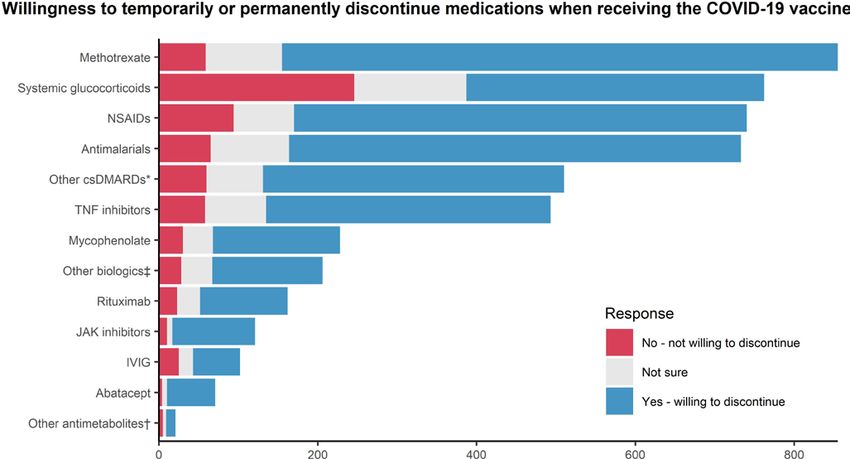
Contact from healthcare provider to N=2860 Figure 2 Willingness to temporarily or permanently
discuss vaccine discontinue medications when receiving the COVID-19
Yes 1349 (47.2) vaccine. IL, interleukin; NSAIDs, non-steroidal anti-
inflammatory drugs; csDMARDs, conventional synthetic
No 1383 (48.4)
drug modifying antirheumatic drugs; JAK, Janus kinase
Not sure/Not applicable 128 (4.5) inhibitors; TNF, tumour necrosis factor; IVIG, intravenous
Discussed vaccine with healthcare provider N=2860 immunoglobulin. *Includes apremilast, azathioprine,
during a visit 6-mercaptopurine, leflunomide and sulfasalazine.
†Includes calcineurin inhibitors (ciclosporin, tacrolimus),
Yes 1817 (63.5)
cyclophosphamide, thalidomide and lenalidomide.
No 932 (32.6) ‡Includes belimumab, IL-1 inhibitors (anakinra,
Not sure/Not applicable 111 (3.9) canakimumab, rilonacept), IL-6 inhibitors (tocilizumab,
sarilumab, siltuximab), IL-12/IL-23 inhibitors (ustekinumab,
Advice from healthcare provider about N=2341
guselkumab), IL-17 inhibitors (secukinumab, ixekizumab),
receiving COVID-19 vaccine
eculizumab, mepolizumab and vedolizumab.
Strongly endorsed 1938 (82.8)
Suggested it 300 (12.8)
Provider was unsure 42 (1.8) vaccine effectiveness, while 472 (16.5%) disagreed and
477 (16.7%) reported being unsure. Concern for flare
Advised against it 6 (0.3)
of systemic rheumatic disease after receiving the vaccine
Strongly discouraged 4 (0.2) was reported in 1267 (44.3%) respondents, while 1009
Respondent unsure/Missing 51 (2.2) (35.3%) were not concerned, and 584 (20.4%) were
Satisfaction about COVID-19 vaccine N=2341 unsure.
conversation with healthcare provider When asked about the specific medications that partic-
Very satisfied 1491 (63.7) ipants reported taking for the treatment of their systemic
rheumatic disease, the majority were willing to discon-
Satisfied 574 (24.5)
tinue these medications due to COVID-19 vaccination
Neither satisfied nor dissatisfied 210 (9.0) (figure 2; online supplemental table). For participants
Dissatisfied 52 (2.2) taking methotrexate, 700/855 (81.9%) were willing to
Very dissatisfied 14 (0.6) stop, with only 59 (6.9%) not willing to stop. For other
medications recommended by the ACR to be modified
reported contacting their healthcare provider to discuss around COVID-19 vaccination (eg, NSAIDs, mycopheno-
COVID-19 vaccination (1775, 62.1%), having the health- late, abatacept, rituximab, JAK inhibitors), the majority
care provider contact them (1349, 47.2%) and/or having of respondents were willing to discontinue temporarily.
a discussion regarding vaccines during a clinical visit Among participants taking systemic glucocorticoids,
(1817, 63.5%) (table 2). Of all respondents who discussed fewer (375/762, 49.2%) were willing to stop, 246 (32.3%)
vaccination with their healthcare provider, 2238/2341 were not willing to stop and 141 (18.5%) were unsure.
(95.6%) reported that vaccination was recommended, Finally, when asked about actual medication discontin-
while 42 (1.8%) answered that their provider was unsure, uation, most patients who reported taking any prescrip-
and 10 (0.4%) reported a provider recommendation tion medication (1875/2644, 70.9%) answered that they
against vaccination. Most patients (2065, 88.2%) were did not temporarily stop or discontinue any of their
satisfied with the conversation with their clinician, while rheumatic medications before or after receiving the
only a minority were dissatisfied (66, 2.8%) or neither COVID-19 vaccine, while a minority decided to change
satisfied nor dissatisfied (210, 9.0%). their medication use (764, 28.9%). Only five (0.2%)
patients were not sure if they had made any changes to
Medications and COVID-19 vaccination their medication use.
Most participants (1911, 66.8%) agreed with tempo- Systemic rheumatic disease flare was the most frequently
rarily discontinuing their medications to improve reported concern regarding holding or stopping
Sattui SE, et al. RMD Open 2021;7:e001814. doi:10.1136/rmdopen-2021-001814 5RMD Open
RMD Open: first published as 10.1136/rmdopen-2021-001814 on 7 September 2021. Downloaded from http://rmdopen.bmj.com/ on September 18, 2021 by guest. Protected by copyright.
Table 3 Concerns about medication discontinuation around COVID-19 vaccination
Side effects Unsuccessful Medication may
Disease Withdrawal when previously when previously no longer work No
N flare effects stopped stopped as well concerns
Systemic 762 443 (58.1) 188 (24.7) 26 (3.4) 28 (3.7) 15 (2.0) 62 (8.1)
glucocorticoids
NSAIDs 740 412 (55.7) 18 (2.4) 29 (3.9) 13 (1.8) 14 (1.9) 254 (34.3)
Antimalarials 733 518 (70.7) 24 (3.3) 8 (1.1) 8 (1.1) 18 (2.5) 157 (21.4)
Methotrexate 855 616 (72.0) 13 (1.5) 10 (1.2) 3 (0.4) 39 (4.6) 174 (20.4)
Other csDMARDs* 513 372 (72.5) 13 (2.5) 6 (1.2) 8 (1.6) 19 (3.7) 95 (18.5)
Mycophenolate 228 169 (74.8) 8 (3.5) 9 (4.0) 2 (0.9) 7 (3.1) 33 (14.6)
Other 21 11 (52.4) 1 (4.8) 1 (4.8) 0 (0) 1 (4.8) 7 (33.3)
antimetabolites†
Abatacept 71 53 (74.6) 3 (4.2) 1 (1.4) 0 (0) 5 (7.0) 9 (12.7)
Rituximab 162 131 (81.9) 1 (0.6) 3 (1.9) 2 (1.3) 7 (4.4) 18 (11.3)
TNF inhibitors 493 369 (75.5) 6 (1.2) 5 (1.0) 4 (0.8) 73 (14.8) 36 (7.4)
Other biologics‡ 206 157 (77.3) 4 (2.0) 2 (1.0) 3 (1.5) 21 (10.2) 19 (9.4)
JAK inhibitors 121 104 (86.0) 2 (1.7) 1 (0.8) 0 (0) 7 (5.8) 7 (5.8)
IVIG 102 80 (79.2) 2 (2.0) 1 (1.0) 1 (1.0) 1 (1.0) 17 (16.8)
*Includes apremilast, azathioprine, 6-mercaptopurine, leflunomide, sulfasalazine.
†Includes calcineurin inhibitors (ciclosporin, tacrolimus), cyclophosphamide, thalidomide and lenalidomide.
‡Includes belimumab, IL-1 inhibitors (anakinra, canakimumab, rilonacept), IL-6 inhibitors (tocilizumab, sarilumab, siltuximab), IL-12/IL-23
inhibitors (ustekinumab, guselkumab), IL-17 inhibitors (secukinumab, ixekizumab), eculizumab, mepolizumab and vedolizumab.
csDMARDs, conventional synthetic DMARDs; DMARDs, drug-modifying antirheumatic drugs; IL, interleukin; IVIG, intravenous
immunoglobulin; JAK, Janus kinase inhibitors; NSAIDs, non-steroidal anti-inflammatory drugs; TNF, tumour necrosis factor.
antirheumatic medications (table 3). In participants taking vaccinated people with systemic rheumatic diseases.
systemic glucocorticoids, disease flares were the most Almost all participants who discussed vaccination with
frequently reported concern (443/762, 58.1%) followed by a provider were recommended to receive a COVID-19
withdrawal effects (188, 24.7%). Disease flare was the most vaccination and respondents were overall satisfied with
common concern among patients on all other medications. COVID-19 vaccine-related conversations with their clini-
‘No concerns’ was the second most frequent response for cians. The majority were willing to discontinue their
people receiving all other medications, except for TNF medications to improve vaccine response, although
inhibitors and other bDMARDs where ‘concern for rheu- many remained concerned about systemic rheumatic
matic medication may not work as well’ (73/494, 14.8% and disease flares. Although 1 in 8 reported a flare of disease
21/206, 10.2%, respectively) was reported. after vaccination, fewer than 1 in 20 required a change
in treatment. While these findings have been reassuring
COVID-19 vaccination-associated adverse events
Among all participants, 1371/2860 (47.9%) participants regarding communication with physicians regarding
reported at least one adverse event lasting for at least 2 vaccination recommendations, individuals with systemic
days post-COVID-19 vaccine (table 4). Fatigue or sleepi- rheumatic disease remain concerned about the side
ness (955, 33.4%) was the most common reported adverse effects of vaccines, and the risk of flares associated with
event, followed by headache (792, 27.7%), and wide- vaccination, particularly around holding antirheumatic
spread muscle/joint pains (653, 22.8%). There were only medications.
six (0.2%) episodes of self-reported anaphylaxis. Flares of People with systemic rheumatic disease represent a
existing systemic rheumatic disease, lasting at least 2 days subgroup for whom general population data may not
post-COVID-19 vaccine, were reported by 382 (13.4%) of apply. Potential concerns include reduced immunoge-
participants, with 132 (4.6%) requiring a new or increased nicity of vaccines related to either the underlying condi-
dose of medication to treat the flare. The frequency of tion or the use of antirheumatic medications; and vaccines
adverse events and flares of disease were similar across causing worsened adverse events or flares of their under-
vaccine types. lying rheumatic diseases.2 In an international survey of
1531 individuals with rheumatic disease conducted in
DISCUSSION December 2020, for instance, 32% reported uncertainty
This is the largest international survey of patient percep- around vaccination,3 which may in part be driven by
tions and outcomes related to COVID-19 vaccines among these concerns.
6 Sattui SE, et al. RMD Open 2021;7:e001814. doi:10.1136/rmdopen-2021-001814Infections
RMD Open: first published as 10.1136/rmdopen-2021-001814 on 7 September 2021. Downloaded from http://rmdopen.bmj.com/ on September 18, 2021 by guest. Protected by copyright.
Table 4 Adverse events and disease flares after COVID-19 vaccination, reported by patients to be severe and lasting at least
2 days
All Pfizer-BioNTech Oxford/AstraZeneca Moderna Janssen/Johnson & Others*
n=2860 n=1522 n=645 n=610 Johnson n=50 n=33
Any adverse events 1350 (47.2) 648 (42.6) 335 (51.9) 327 (53.6) 30 (60.0) 10 (30.3)
Fatigue or sleepiness 955 (33.4) 455 (29.9) 229 (35.5) 245 (40.2) 22 (44.0) 4 (12.1)
Headache 792 (27.7) 350 (23.0) 218 (33.8) 196 (32.1) 23 (46.0) 5 (15.2)
Widespread muscle/Joint 653 (22.8) 294 (19.3) 166 (25.7) 176 (28.9) 17 (34.0) 0 (0)
pain
Fever or chills 568 (19.9) 214 (14.1) 167 (25.9) 170 (27.9) 16 (32.0) 1 (3.0)
Anaphylaxis† 6 (0.2) 2 (0.1) 1 (0.2) 1 (0.2) 1 (2.0) 1 (3.0)
Other‡ 204 (7.1) 86 (5.7) 49 (7.6) 64 (10.5) 4 (8.0) 1 (3.0)
Nausea or vomiting 364 (12.7) 167 (11.0) 90 (14.0) 101 (16.6) 6 (12.0) 0 (0)
Any flare of rheumatic 382 (13.4) 184 (12.1) 93 (14.4) 96 (15.7) 7 (14.0) 2 (6.1)
disease§
Flare requiring new 132 (4.6) 58 (3.8) 40 (6.2) 32 (5.2) 2 (4.0) 0 (0)
or increased dose of
medication§
*Includes Novavax, Sinovac/Sinopharm, Sputnik V, Cansino, not sure and others.
†Anaphylaxis was not required to last 2 days.
‡Including chest pain/palpitations, other allergic reactions and rash.
§Exacerbation of symptoms or new symptoms attributed to underlying systemic rheumatic disease.
Rheumatologists have a prominent role in commu- concerns about a flare of their systemic rheumatic
nicating risks and benefits of vaccination. Prior surveys disease. As expected, current glucocorticoid users had an
of people with systemic rheumatic diseases have high- especially high frequency of respondents who were less
lighted limited communication with rheumatologists or willing to hold these medications. This may be explained
other healthcare providers, especially about medication by prior experience of flares when stopping or lowering
changes.9–11 Other studies have cited lack of a recom- dose of glucocorticoids, concerns about adrenal insuffi-
mendation from a treating physician for vaccination ciency or a relationship between glucocorticoid use and
hesitancy.12–15 Among the vaccinated population in our active disease. However, despite reported willingness,
study, there was a high frequency of communication with only a minority of participants discontinued any medi-
clinicians about the COVID-19 vaccines, and respondents cation around COVID-19 vaccination. Future studies
were generally very satisfied. A key factor is the timing of are needed to firmly establish an evidence base for
our survey during global vaccination efforts versus other temporarily holding specific antirheumatic therapies to
surveys that were completed prior to the availability of enhance vaccine efficacy while balancing risk for disease
the COVID-19 vaccine. Another factor is that our study flare.
sample was limited to those who were vaccinated, so good The degree to which vaccination in general and the
communication with healthcare providers over vaccine COVID-19 vaccinations in particular cause flares of rheu-
recommendations is unsurprising. matic diseases has been a principal concern.21 Prior to the
Whether to hold antirheumatic medications for vacci- COVID-19 pandemic, a study in the UK Clinical Practice
nation, and for how long, remains unclear for many Research Database found no increased risk of flare after
medication classes. Hypothetical concerns about reduced influenza vaccination among people with autoimmune
immunogenicity have recently been corroborated by inflammatory rheumatic disease.22 In a small study, RA
antibody titre studies.16 17 Recommendations from the disease activity remained stable following hepatitis B vacci-
ACR, for instance, have reflected these concerns. Initial nation.23 Conversely, an internet- based case-crossover
guidance in February of 2021 recommended holding study of patients with confirmed gout found twofold
methotrexate, JAK inhibitors, abatacept and rituximab in higher odds for gout flares after any patient-reported
certain patients with controlled disease6; an April 2021 vaccination.24 Similar to the rates reported in trials in
update also included mycophenolate mofetil.18 These the general population, a minority of patients in our
guidelines were based on limited data, including one study reported systemic reactions to vaccination, which
randomised controlled trial of methotrexate holding included fatigue, fever and pain. Systemic rheumatic
for influenza vaccination in patients with RA,19 and disease flares requiring a change in medication, however,
two studies of holding tofacitinib in patients with RA.20 were uncommon. These data align with a large, physician-
Our survey found that most patients would be willing reported registry supported by EULAR COVID-19 data-
to temporarily discontinue their medications but had base.25 Between 5 February and 27 April 2021, clinicians
Sattui SE, et al. RMD Open 2021;7:e001814. doi:10.1136/rmdopen-2021-001814 7RMD Open
RMD Open: first published as 10.1136/rmdopen-2021-001814 on 7 September 2021. Downloaded from http://rmdopen.bmj.com/ on September 18, 2021 by guest. Protected by copyright.
reported 1519 patients with rheumatic disease who had significant flares requiring changes in medications were
received COVID-19 vaccination, the majority (83%) of relatively infrequent. Clinicians should maintain aware-
whom received an mRNA-based vaccine. Overall, 31% ness of changing guidelines as further data become avail-
had potential vaccine-related side effects; 5% had flares able to provide continued communication and patient
of their underlying systemic rheumatic disease, 1.2% of counselling regarding risks and benefits of vaccination.
which were reported as severe. In two prospective cohorts Future studies should assess the degree to which vaccine
of patients with systemic rheumatic disease followed immunogenicity and reactogenicity among individuals
after COVID-19 vaccination, disease activity remained with systemic rheumatic disease differ compared with the
stable.26 27 The complementary findings from these two general population. Further knowledge about barriers to
studies provide reassuring evidence regarding safety and vaccination in different racial and ethnic groups among
reactogenicity of COVID-19 vaccination among a systemic patients living with systemic rheumatic diseases is needed.
rheumatic disease population.
Strengths of our study include rapid dissemination, Author affiliations
1
Division of Rheumatology, Hospital for Special Surgery, New York, New York,
global reach and questions specifically addressing
USA
concerns and willingness to hold specific antirheumatic 2
Section of Rheumatology, Boston University School of Medicine, Boston,
medications. Several important limitations should be Massachusetts, USA
acknowledged. First, selection bias may have resulted 3
Health Research Methods, Evidence, and Impact, McMaster University, Hamilton,
from respondents with adverse events being more likely to Ontario, Canada
4
Medicine, McMaster University, Hamilton, Ontario, Canada
fill out the survey. Despite this, the frequency of systemic 5
Department of Medicine, Medical College of Wisconsin, Milwaukee, Wisconsin,
rheumatic disease flares requiring medication changes USA
remained low and was overall consistent with similar 6
Department of Biochemistry & Biomedical Sciences, McMaster University Faculty
registries. Second, although participants were asked “Has of Science, Hamilton, Ontario, Canada
7
a doctor ever told you had any of the following rheuma- Rheumatology, Sheffield Teaching Hospitals NHS Foundation Trust, Sheffield, UK
8
Research Unit, Mexican College of Rheumatology, Coyoacan, Ciudad de México,
tologic diseases?”, report of self-diagnosis or misdiagnosis
Mexico
is a possibility. However, the reports of treatment with 9
Rheumatology, Sorbonne Université, Paris, France
systemic immunomodulators prescribed by clinicians 10
Department of Internal Diseases, Rheumatology Centre, Paul Stradins Clinical
and the fact that the distribution of the survey through University Hospital, Riga, Latvia
11
patient organisations potentially minimises this making Rheumatology, Saint James's Hospital, Dublin, Ireland
12
it unlikely that this could substantially affect the results. Community Medicine, GMC Patiala, Punjab, India
13
Department of Rheumatology, Saint James's Hospital, Dublin, Ireland
Third, this study was limited to English, Hebrew and 14
Autoinflammatory Alliance, San Francisco, California, USA
Italian translations of the survey and may not be gener- 15
Rheumatology and Clinical Immunology, Faculty of Medicine, Cairo University,
alisable to those who speak other languages or reside Cairo, Egypt
16
in other regions. Translations into other languages are Rheumatology Department, The Queen Elizabeth Hospital, Adelaide, South
ongoing and will be reported in the future. Fourth, Australia, Australia
17
Department of Medicine, University of Adelaide, Adelaide, South Australia,
respondents were mostly white and reported high levels Australia
of education. These results may not be applicable to 18
Spondylitis Association of America, Van Nuys, California, USA
addressing barriers among other racial or ethnic groups 19
Medical Department I, Department for Rheumatology and Clinical Immunology,
or among other socioeconomic groups.28–30 Fifth, at University Hospital Schleswig-Holstein Campus Kiel, Kiel, Schleswig-Holstein,
the time of the survey, geographic variation in vaccine Germany
20
Section of Rheumatology, Allergy & Immunology, Yale School of Medicine, New
availability and access resulted in a preponderance of Haven, Connecticut, USA
UK and US respondents. Sixth, the timing of our survey 21
Section of Rheumatology, VA Connecticut Healthcare System—West Haven
coincided with the Centers for Disease Control and Food Campus, West Haven, Connecticut, USA
22
and Drug Administration pause on the Janssen/Johnson Rheumatology, Specialized Medical Center Hospital, Riyadh, Saudi Arabia
23
& Johnson vaccine,31–33 which limited the number of Department of Internal Medicine, Division of Rheumatology, Saint Louis University,
Saint Louis, Missouri, USA
responses from those who had received this vaccine. 24
Medicine/Rheumatology, Washington University in Saint Louis School of Medicine,
Seventh, some conditions such as inflammatory myositis Saint Louis, Missouri, USA
may be over-represented in our cohort, due to the regis- 25
Rheumatology, Austin Health, Heidelberg West, Victoria, Australia
26
tries and patient advocacy groups to which our survey was Clinical Pharmacology and Therapeutics, Austin Health, Heidelberg, Victoria,
disseminated most easily. Finally, this was a descriptive Australia
27
I-Shou University College of Medicine, Yanchau Sheng, Taiwan
analysis and inferential statistics were intentionally not 28
Medicine, University of California San Diego, La Jolla, California, USA
performed. 29
Italian National Patient Association for Rehumatoid and Rare Disease (APMARR),
Rome, Italy
30
The Israeli Association for RMD Patients "Mifrakim Tz'eirim", Haifa, Israel
31
CONCLUSION Relapsing Polychondritis Foundation, International Relapsing Polychondritis
Research Network, Walnut Creek, California, USA
This study presents encouraging data regarding commu- 32
Department of Medicine, University of Alabama at Birmingham, Birmingham,
nication between people with systemic rheumatic diseases Alabama, USA
and their physicians and to the overall safety of COVID-19 33
Medicine Service, Birmingham Veterans Affairs Medical Center, Birmingham,
vaccination in this patient population. Reassuringly, Alabama, USA
8 Sattui SE, et al. RMD Open 2021;7:e001814. doi:10.1136/rmdopen-2021-001814Infections
RMD Open: first published as 10.1136/rmdopen-2021-001814 on 7 September 2021. Downloaded from http://rmdopen.bmj.com/ on September 18, 2021 by guest. Protected by copyright.
34
Medicine, Division of Rheumatology, University of Washington, Seattle, Disclaimer The views expressed here are those of the authors and participating
Washington, USA members of the COVID-19 Global Rheumatology Alliance and do not necessarily
35
Department of Rheumatology, Universidad Cientifica del Sur, Lima, Peru represent the views of the American College of Rheumatology (ACR), EULAR, the
36
Universidad Científica del Sur, Lima, Peru (UK) National Health Service (NHS), the National Institute for Health Research
37 (NIHR) or the (UK) Department of Health, or any other organisation. The funders had
Autoinflammatory UK, Edinburgh, UK
38 no role in the decision to publish or preparation of this manuscript. The content
Division of Rheumatology, University of Texas Southwestern Medical School, is solely the responsibility of the authors and does not necessarily represent the
Dallas, Texas, USA official views of Harvard University, its affiliated academic health care centers, or
39
Crystal Run Healthcare, Middletown, New York, USA the National Institutes of Health.
40
Irish Children's Arthritis Network (iCAN), Tipperary, Ireland
41 Competing interests SES has received funding from the Vasculitis Foundation
Department of Medicine, Malaghan Institute of Medical Research, Wellington, and the Vasculitis Clinical Research Consortium unrelated to this work. JL has
New Zealand received research grant funding from Pfizer unrelated to this work. ES is a Board
42
MRC Centre for Neuromuscular Diseases, University College London, London, UK Member of the Canadian Arthritis Patient Alliance, a patient run, volunteer-
43
Rheumatology, University College London Centre for Rheumatology, London, UK based organisation whose activities are primarily supported by independent
44
Faculty of Medicine, The University of Queensland, Herston, Queensland, Australia grants from pharmaceutical companies. MP was supported by a Rheumatology
45
Metro North Hospital & Health Service, Royal Brisbane and Woman's Hospital Research Foundation Scientist Development grant. DA-R is a Scientific Advisor for
Health Service District, Herston, Queensland, Australia GlaxoSmithKilne unrelated to this work. FB reports personal fees from Boehringer,
46 Bone Therapeutics, Expanscience, Galapagos, Gilead, GSK, Merck Sereno, MSD,
Healthpartners, St Paul, Minnesota, USA
47 Nordic, Novartis, Pfizer, Regulaxis, Roche, Sandoz, Sanofi, Servier, UCB, Peptinov,
Clinical Epidemiology Program and Rheumatology Unit, Division of TRB Chemedica and 4P Pharma outside of the submitted work. No funding relevant
Rheumatology,Allergy, and Immunology, Massachusetts General Hospital, Boston, to this manuscript. RC: speakers bureau for Janssen, Roche, Sanofi, AbbVie.
Massachusetts, USA KD reports no COI-unpaid volunteer president of the Autoinflammatory Alliance.
48
Department of Medicine, Harvard Medical School, Boston, Massachusetts, USA Any grants or funding from pharma is received by the non-profit organisation
49
Medicine/Rheumatology, University of California, San Francisco, California, USA only. CLH received funding under a sponsored research agreement unrelated to
50
LupusChat, New York, New York, USA the data in the paper from Vifor Pharmaceuticals. LeK has received a research
51
Division of Clinical Immunology and Allergy, McMaster University Department of grant from Lilly unrelated to this work. AHJK participated in consulting, advisory
Medicine, Hamilton, Ontario, Canada board or speaker's bureau for Alexion Pharmaceuticals, Aurinia Pharmaceuticals,
52 Annexon Biosciences, Exagen Diagnostics and GlaxoSmithKilne and received
Department of Health Research Methods, Evidence and Impact (HEI), McMaster
funding under a sponsored research agreement unrelated to the data in the
University Faculty of Health Sciences, Hamilton, Ontario, Canada paper from GlaxoSmithKline. JSingh has received consultant fees from Crealta/
53
Department of Health Research Methods, Evidence, and Impact (HEI); Medicine, Horizon, Medisys, Fidia, PK Med, Two Labs, Adept Field Solutions, Clinical Care
McMaster University, Hamilton, Ontario, Canada Options, Clearview Healthcare Partners, Putnam Associates, Focus Forward,
54
Environmental Autoimmunity Group, NIEHS/NIH/DHHS, Bethesda, Maryland, USA Navigant Consulting, Spherix, MedIQ, Jupiter Life Science, UBM, Trio Health,
55
Rheumatology, Boston Children's Hospital, Boston, Massachusetts, USA Medscape, WebMD and Practice Point Communications; and the National
56
Division of Rheumatology and Clinical Immunology, Beth Israel Deaconess Institutes of Health and the American College of Rheumatology. JSingh owns
Medical Center, Boston, Massachusetts, USA stock options in TPT Global Tech, Vaxart Pharmaceuticals and Charlotte’s Web
57 Holdings. JSingh previously owned stock options in Amarin, Viking and Moderna
Epidemiology and Population Health and Department of Medicine, Division of
Pharmaceuticals. JSingh is on the speaker’s bureau of Simply Speaking. JSingh is
Immunology & Rheumatology, Stanford School of Medicine, Stanford, California, a member of the executive of Outcomes Measures in Rheumatology (OMERACT),
USA an organisation that develops outcome measures in rheumatology and receives
58
Department of Medicine, Clinical Epidemiology Unit, Sweden arms-length funding from eight companies. JSingh serves on the FDA Arthritis
59
Department of Medicine, Division of Rheumatology, Inflammation, and Immunity, Advisory Committee. JSingh is the chair of the Veterans Affairs Rheumatology
Brigham and Women's Hospital, Boston, Massachusetts, USA Field Advisory Committee. JSingh is the editor and the Director of the University of
Alabama at Birmingham (UAB) Cochrane Musculoskeletal Group Satellite Center
on Network Meta-analysis. NSingh is supported by funding from the Rheumatology
Twitter Sebastian Eduardo Sattui @SattuiSEMD, Manuel Francisco Ugarte-Gil @
Research Foundation Investigator Award and the American Heart Association.
mugartegil, Pedro M Machado @pedrommcmachado and Philip C Robinson @
MFU-G has received research support from Pfizer and Janssen, unrelated to this
philipcrobinson
work. SB reports personal fees from Novartis, AbbVie, Pfizer and Horizon Pharma,
Acknowledgements We would like to thank Saskya Angevare, Richard P Beesley, outside the submitted work. RG reports personal fees from AbbVie New Zealand,
Eugenia Chock, Berk Degirmenci, Christele Felix, Shangyi Jin, Elsa Mateus, Andrea Cornerstones, Janssen New Zealand and personal fees and non-financial support
Peirce, Esra Sari, Robert Tseng, Leslie Wang and Erick Adrian Zamora for their Pfizer New Zealand (allRMD Open
RMD Open: first published as 10.1136/rmdopen-2021-001814 on 7 September 2021. Downloaded from http://rmdopen.bmj.com/ on September 18, 2021 by guest. Protected by copyright.
Provenance and peer review Not commissioned; externally peer reviewed. 13 Nguyen M, Lindegaard H, Hendricks O, et al. Factors associated
with influenza and pneumococcal vaccine uptake among rheumatoid
Data availability statement Data are available on reasonable request. arthritis patients in Denmark invited to participate in a pneumococcal
Researchers interested in performing additional analyses from survey data are vaccine trial (Immunovax_RA). Scand J Rheumatol 2017;46:446–53.
invited to submit proposals through the COVID-19 Global Rheumatology Alliance at 14 Harrison N, Poeppl W, Miksch M, et al. Predictors for influenza
rheum-covid.org. For approved projects, we will be able to provide summary tables vaccine acceptance among patients with inflammatory rheumatic
and data analyses as requested. We do not currently have IRB approval to make diseases. Vaccine 2018;36:4875–9.
the raw data available to other researchers. 15 Lawson EF, Trupin L, Yelin EH, et al. Reasons for failure to
Open access This is an open access article distributed in accordance with the receive pneumococcal and influenza vaccinations among
immunosuppressed patients with systemic lupus erythematosus.
Creative Commons Attribution Non Commercial (CC BY-NC 4.0) license, which
Semin Arthritis Rheum 2015;44:666–71.
permits others to distribute, remix, adapt, build upon this work non-commercially,
16 Deepak P, Kim W, Paley MA. Glucocorticoids and B cell depleting
and license their derivative works on different terms, provided the original work is agents substantially impair immunogenicity of mRNA vaccines to
properly cited, appropriate credit is given, any changes made indicated, and the SARS-CoV-2. medRxiv2020.
use is non-commercial. See: http://c reativecommons.org/licenses/by-nc/4.0/. 17 Haberman RH, Herati R, Simon D, et al. Methotrexate hampers
immunogenicity to BNT162b2 mRNA COVID-19 vaccine in immune-
ORCID iDs mediated inflammatory disease. Ann Rheum Dis 2021. doi:10.1136/
Sebastian Eduardo Sattui http://orcid.org/0000-0002-3945-6828 annrheumdis-2021-220597. [Epub ahead of print: 25 May 2021].
Kevin Kennedy http://orcid.org/0 000-0001-8230-091X 18 Curtis JR, Johnson SR, Anthony DD. American College of
Emily Sirotich http://o rcid.org/0000-0002-7 087-8543 rheumatology guidance for COVID‐19 vaccination in patients
Akpabio Akpabio http://orcid.org/0000-0002-4920-6494 with rheumatic and musculoskeletal diseases: version 2. Arthritis
Deshiré Alpízar-Rodríguez http://orcid.org/0000-0002-6930-0517 Rheumatol 2021:1–16.
Francis Berenbaum http://o rcid.org/0 000-0001-8252-7815 19 Park JK, Lee YJ, Shin K, et al. Impact of temporary methotrexate
Richard Conway http://o rcid.org/0 000-0003-2538-3362 discontinuation for 2 weeks on immunogenicity of seasonal influenza
Alfred Hyoungju Kim http://o rcid.org/0000-0003-4074-0516 vaccination in patients with rheumatoid arthritis: a randomised
Jasvinder A Singh http://o rcid.org/0 000-0003-3485-0006 clinical trial. Ann Rheum Dis 2018;77:898–904.
Manuel Francisco Ugarte-Gil http://orcid.org/0000-0003-1728-1999 20 Winthrop KL, Silverfield J, Racewicz A, et al. The effect of tofacitinib
Pedro M Machado http://o rcid.org/0000-0002-8411-7972 on pneumococcal and influenza vaccine responses in rheumatoid
Philip C Robinson http://o rcid.org/0000-0002-3156-3418 arthritis. Ann Rheum Dis 2016;75:687–95.
21 Schulze-Koops H, Specker C, Skapenko A. Vaccination of patients
Jonathan S Hausmann http://o rcid.org/0000-0003-0786-8788
with inflammatory rheumatic diseases against SARS-CoV-2:
Julia F Simard http://orcid.org/0000-0001-5 735-9856 considerations before widespread availability of the vaccines. RMD
Jeffrey A Sparks http://orcid.org/0 000-0002-5556-4618 Open 2021;7:e001553–2.
22 Nakafero G, Grainge MJ, Myles PR, et al. Association between
inactivated influenza vaccine and primary care consultations for
autoimmune rheumatic disease flares: a self-controlled case series
study using data from the clinical practice research Datalink. Ann
REFERENCES Rheum Dis 2019;78:1122–6.
1 Regulatory Affairs Professionals Society. COVID-19 Vaccine Tracker., 23 Elkayam O, Yaron M, Caspi D. Safety and efficacy of vaccination
2021. Available: https://www.raps.org/news-and-articles/news- against hepatitis B in patients with rheumatoid arthritis. Ann Rheum
articles/2020/3/covid-19-vaccine-tracker [Accessed 13 June 2021]. Dis 2002;61:623–5.
2 Furer V, Rondaan C, Agmon-Levin N, et al. Point of view on 24 Yokose C, McCormick N, Chen C, et al. Risk of gout flares after
the vaccination against COVID-19 in patients with autoimmune vaccination: a prospective case cross-over study. Ann Rheum Dis
inflammatory rheumatic diseases. RMD Open 2021;7:e001594–10. 2019;78:1601–4.
3 Felten R, Dubois M, Ugarte-Gil MF, et al. Vaccination against 25 Machado PM, Lawson-Tovey S, Hyrich K, et al. LB0002 COVID-19
COVID-19: expectations and concerns of patients with autoimmune VACCINE SAFETY IN PATIENTS WITH RHEUMATIC AND
and rheumatic diseases. Lancet Rheumatol 2021;3:e243–5. MUSCULOSKELETAL DISEASE. Ann Rheum Dis 2021;80:199–200.
4 Ritchie H. COVID-19 vaccinations. our world in data, 2021. Available: 26 Furer V, Eviatar T, Zisman D, et al. Immunogenicity and safety of
https://ourworldindata.org/covid-vaccinations [Accessed 13 June the BNT162b2 mRNA COVID-19 vaccine in adult patients with
2021]. autoimmune inflammatory rheumatic diseases and in the general
5 Hazlewood GS, Pardo JP, Barnabe C, et al. Canadian rheumatology population: a multicentre study. Ann Rheum Dis 2021:1–9.
association recommendation for the use of COVID-19 vaccination 27 Geisen UM, Berner DK, Tran F, et al. Immunogenicity and safety
for patients with autoimmune rheumatic diseases. J Rheumatol of anti-SARS-CoV-2 mRNA vaccines in patients with chronic
2021;48:1–39. inflammatory conditions and immunosuppressive therapy in
6 Curtis JR, Johnson SR, Anthony DD, et al. American College of a monocentric cohort. Ann Rheum Dis 2021. doi:10.1136/
rheumatology guidance for COVID-19 vaccination in patients annrheumdis-2021-220272. [Epub ahead of print: 24 Mar 2021].
with rheumatic and musculoskeletal diseases: version 1. Arthritis 28 Ndugga N, Pham O, Hill L. Latest data on COVID-19 vaccinations
Rheumatol 2021;73:1093–107. race/ethnicity. Kaiser family Foundation, 2021. Available: https://
7 World Health Organization. Who countries, 2021. Available: https:// www.kff.org/coronavirus-covid-19/issue-brief/latest-data-on-covid-
www.who.int/countries [Accessed 13 June 2021]. 19-vaccinations-race-ethnicity/ [Accessed 13 June 2021].
8 Anderson JK, Zimmerman L, Caplan L, et al. Measures of 29 Thompson HS, Manning M, Mitchell J, et al. Factors associated with
rheumatoid arthritis disease activity: patient (PtGA) and provider racial/ethnic group-based medical Mistrust and perspectives on
(PrGA) global assessment of disease activity, disease activity score COVID-19 vaccine trial participation and vaccine uptake in the US.
(DAS) and disease activity score with 28-Joint counts (DAS28), JAMA Netw Open 2021;4:e2111629.
simplified disease activity index (SDAI), Cl. Arthritis Care Res 30 Nguyen LH, Joshi AD, Ph D. Racial and ethnic differences in
2011;63:S14–36. COVID-19. medRxiv2021.
9 Glintborg B, Jensen DV, Engel S, et al. Self-Protection strategies and 31 FDA. FDA and CDC lift recommended pause on Johnson &
health behaviour in patients with inflammatory rheumatic diseases Johnson (Janssen) COVID-19 vaccine use following thorough
during the COVID-19 pandemic: results and predictors in more than safety review, 2021. Available: https://www.fda.gov/news-events/
12 000 patients with inflammatory rheumatic diseases followed in press-announcements/fda-and-cdc-lift-recommended-pause-
the Danish DANBIO registry. RMD Open 2021;7:e001505–13. johnson-johnson-janssen-covid-19-vaccine-use-following-thorough
10 George MD, Venkatachalam S, Banerjee S, et al. Concerns, [Accessed 13 June 2021].
healthcare use, and treatment interruptions in patients with common 32 CDC. CDC recommends use of Johnson & Johnson’s Janssen
autoimmune rheumatic diseases during the COVID-19 pandemic. J COVID-19 vaccine, 2021. Available: https://www.cdc.gov/
Rheumatol 2021;48:603–7. coronavirus/2019-ncov/vaccines/safety/JJUpdate.html [Accessed
11 Rosenbaum JT, Hamilton H, Choi D, et al. Biologics, spondylitis and 13 June 2021].
COVID-19. Ann Rheum Dis 2020;79:1663–5. 33 FDA. Joint CDC and FDA statement on Johnson & Johnson
12 Hua C, Morel J, Ardouin E, et al. Reasons for non-vaccination COVID-19 vaccine, 2021. Available: https://www.fda.gov/news-
in French rheumatoid arthritis and spondyloarthritis patients. events/press-announcements/joint-cdc-and-fda-statement-johnson-
Rheumatology 2015;54:748–50. johnson-covid-19-vaccine [Accessed 13 June 2021].
10 Sattui SE, et al. RMD Open 2021;7:e001814. doi:10.1136/rmdopen-2021-001814You can also read


