ECONOMIC IMPACT OF GO OGLE'S APAC NETWORK INFRASTRUCTURE FOCUS ON SINGAPORE - David Abecassis, Dion Teo, Goh Wei Jian, Dr. Michael Kende, Prof ...
←
→
Page content transcription
If your browser does not render page correctly, please read the page content below

> THE IMPACT OF FACEBOOK’S CONNECTIVITY INITIATIVES IN THE ASEAN REGION          C O N S U LT I N G

    ECONOMIC IMPACT OF GOOGLE’S APAC
    NETWORK INFRASTRUCTURE
    FOCUS ON SINGAPORE
    David Abecassis, Dion Teo, Goh Wei Jian, Dr. Michael Kende, Prof. Neil Gandal
    SEPTEMBER 2020

                                                                                 analysysmason.com
1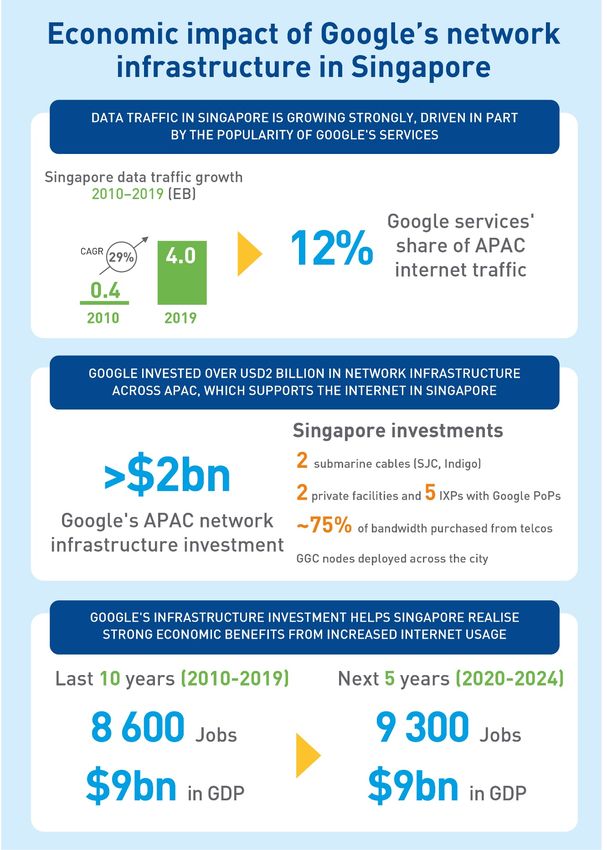
Economic impact of Google’s APAC network infrastructure – Singapore | 1

     1

    1    All currency in USD, in real 2019 terms

2020250-274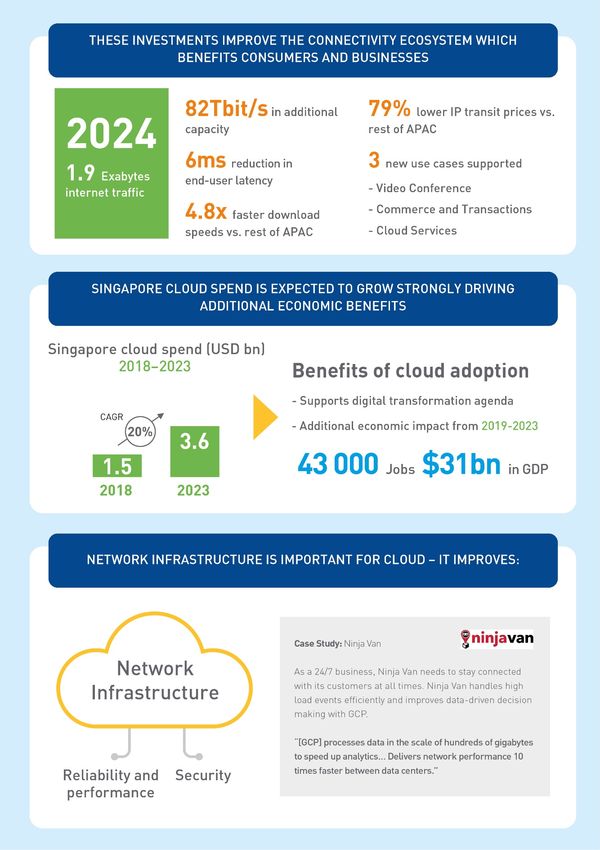
Economic impact of Google’s APAC network infrastructure – Singapore | 2

2020250-274
Economic impact of Google’s APAC network infrastructure – Singapore | 3

2020250-274
Economic impact of Google’s APAC network infrastructure – Singapore | 4

    Singapore has one of the world’s most developed telecom landscapes. As of 2019, 88% of its
    population was connected to the internet. Internet traffic generated across both fixed and mobile
    networks has been growing strongly at around 29% annually from 2010 to 2019, reaching 4EB in
    total in 2019.

    There are three main telecoms service providers in Singapore, in addition to a smaller new-entrant
    mobile operator (TPG) and many retail service providers and MVNOs:

    •   Singtel, the incumbent and largest telecoms operator in Singapore
    •   StarHub, the second-largest operator under ST Telemedia
    •   M1, owned by Keppel Corporation.

    Singapore’s fixed and mobile networks provide extensive coverage: close to 100% of households2
    have access to fibre broadband and 99% of the population is within range of 4G mobile coverage. 3

    Singapore is also one of the main submarine cable hubs in APAC, and is connected to 23
    international submarine cable systems that, as of 2019, offered a total of 857Tbit/s in potential
    capacity. 4

1   Google’s network infrastructure investments contributed to higher internet usage in
    Singapore, equivalent to 20% of internet traffic in 2019

    Google’s investments in network infrastructure not only improve service performance and reliability
    of its content and services, they also improve the overall performance and cost-effectiveness of
    internet infrastructure in Singapore. Investments in submarine cables bring new supply, improve the
    diversity of links and also support the expansion of Google’s edge infrastructure in Singapore. The
    connectivity improvements include lower latency, faster end-user speeds, lower cost of international
    connectivity and stimulation of new use cases. These effects translate into more internet traffic
    generated by both consumers and businesses in Singapore.

    Google is an investor in two submarine cable systems that land in Singapore, namely:

    •   SJC, a Pan-Asia cable which launched in 2013 and connects Singapore, Japan, China, Hong
        Kong, the Philippines, Brunei and Thailand
    •   Indigo, which went live in 2019 and connects Australia, Singapore and Indonesia.

    These cables bring a total of 82Tbit/s in potential capacity to Singapore. Google also purchases
    additional capacity on other international links provided by telecoms carriers, and this purchased
    bandwidth accounts for close to 75% of Google’s network capacity in Singapore. 5

    2    FTTx coverage and capex worldwide: forecast and analysis 2019-2025, Analysys Mason Research
    3    Analysys Mason Research
    4    Refers to the estimated theoretical maximum capacity that a cable could handle with current technology
    5    Google data received in Feb 2020

2020250-274
Economic impact of Google’s APAC network infrastructure – Singapore | 5
Besides bringing additional bandwidth into Singapore, Google’s investments in submarine cables
also improve route diversity. Our modelling also suggests that Google’s network investments are
correlated to lower end-user latency: in Singapore, this could be linked to a 6ms reduction in end-
user latency in Singapore by 2019.
Google’s investments have also contributed to the decline in the cost of international bandwidth: IP
transit prices in Singapore are amongst the lowest in the region, at around 79% lower than less well-
connected economies as shown in Figure 1 below.
Figure 1: IP transit prices6 across APAC [Source: TeleGeography, Analysys Mason, 2019]
Strong Average / Weak
35
USD per Mbit/s
10
4.7
5
1.0 -79%
0
Australia (Sydney)
South Korea
Indonesia
Taiwan
Myanmar
Singapore
Japan (Tokyo)
Vietnam
Thailand
Pakistan
Malaysia
Hong Kong
New Zealand
Philippines
IP transit price per market
Average IP transit price (excluding Vietnam)
Apart from investments in international capacity, Google has also invested in edge infrastructure
and deployed PoPs in two private peering facilities and cross-connected to IXPs at five locations as
shown in Figure 2 below. GGC nodes are also deployed in operator networks across Singapore.
Name of facility / Type Location Figure 2: List of Google
fabric
peering facilities in
BBIX Singapore Public Singapore Singapore [Source:
Equinix Singapore Public Singapore Google, PeeringDB,
MegaIX Public Singapore 2020]
SGIXPeering LAN Public Singapore
6 Refers to USD per Mbit/s of IP transit prices in 2019 based on the committed data rate of 10Gbit/s from
TeleGeography; calculation is based on averaging the weighted median prices by cities and quarters (up to
Q3 2019) to derive 2019 prices; IP transit price data for 10Gbit/s is referenced, as it provides the highest
number of available data points (14 APAC economies with submarine cables)
2020250-274Economic impact of Google’s APAC network infrastructure – Singapore | 6
SOX Public Singapore
Equinix (SG3) Private Singapore
Global Switch Private Singapore
These investments in edge infrastructure and PoPs bring popular Google content closer to end users
in Singapore, which contributes to faster download speeds; 7 in 2019, the average download speeds
in the country were up to 4.8× that of less well-connected economies, as shown below in Figure 3.
Figure 3: Download speed comparison [Source: M-lab, 2019]
Strong Average Weak
30
17
20
20
Mbit/s
8
10 +4.8x
4
0
Hong Kong
Myanmar
Taiwan
Malaysia
Pakistan
Brunei
Sri Lanka
Cambodia
Thailand
Singapore
Indonesia
Australia
Bangladesh
Japan
South Korea
Philippines
New Zealand
Vietnam
Download speed per market
Average download speed
Improvements in latency and internet speed increase ISPs’ ability to deliver innovative services such
as cloud services, video conferencing and gaming. Low latency is also critical for transactional
services, including e-commerce.
The end result of these improvements is greater demand for the internet in Singapore: based on
Analysys Mason’s modelling, we estimate that internet traffic in Singapore would have been 20%
lower in 2019 had Google not made investments in network infrastructure, and the impact is
expected to increase to 29% of internet traffic by 2024, as seen below in Figure 4. 8
7 Google traffic is a significant contributor to network traffic in APAC – approximately 12% of total uplink and
downlink network traffic
8 This takes into account the effect of the entire submarine cable system(s) that Google participates in. As
explained in Annex A of the full report, the fact that Google was an investor in these systems appears to
have a statistically significant effect on their impact on the geographies they serve, including Singapore.
2020250-274Economic impact of Google’s APAC network infrastructure – Singapore | 7
Figure 4: Impact of Google’s investments in edge network infrastructure on internet traffic served by
Google’s services in Singapore [Source: Analysys Mason, 2020]
Impact from historical Impact from historical and
investments upcoming investments
4% 4% 5% 15% 17% 18% 19% 20% 20% 20% 24% 26% 27% 28% 29%
8.0
6.8
6.0
6.0 5.5
5.0
4.6
4.0
4.9
4.0
EB
3.0 4.4
2.6 4.0
2.3 3.5 3.7
2.2 3.2
1.8
2.0 1.4 2.4
0.9 1.8 1.9 2.1
0.4 0.6 1.2
1.5
0.0
2010
2011
2012
2013
2014
2015
2016
2017
2018
2019
2020
2021
2022
2023
2024
With Google’s investment in submarine cable and edge network
Without Google’s investment in submarine cable and edge network
% impact on internet traffic
2 The positive impact of Google’s network infrastructure investment benefits the
internet ecosystem in Singapore, supporting 9 000 jobs and led to USD1 billion in
additional GDP in 2019 alone
The increase in internet use has a positive impact on economic activity across various sectors,
leading to benefits for consumers and businesses. We estimate that the increase in internet usage
contributed USD9 billion in GDP impact (in real terms9) in Singapore from 2010 to 2019; in 2019,
we estimate that GDP would have been 0.37% lower in the scenario where Google had not made
investments in network infrastructure.
Google’s continued network investments from 2020 onwards are expected to spur higher internet
traffic usage. The historical and continued investments are expected to contribute an additional
USD9 billion in GDP impact from 2020 to 2024, of which USD1.9 billion would be in 2024 alone
(see Figure 5 below). This GDP impact represents the base case of Analysys Mason’s modelling
estimates and could range between USD2 billion and USD16 billion from 2020 to 2024 (see
Figure 6 below).
9 GDP figures are in constant USD using 2019 as the base year and using a fixed exchange rate to USD in
2019; GDP statistics in USD are sourced from the World Bank and Euromonitor
2020250-274Economic impact of Google’s APAC network infrastructure – Singapore | 8
Figure 5: Increase in real GDP attributable to Google’s network infrastructure investments in Singapore
[Source: Analysys Mason, 2020]
Impact from historical Impact from historical and
investments upcoming investments
0.37% 0.50%
Total GDP impact: Total GDP impact:
USD9 billion USD9 billion
3.0
1.8 1.9
1.6 1.7
2.0
USD billion
1.5
0.2 0.2
1.1 1.2 1.3 1.3 0.2 0.2
1.1 0.1 0.6 0.7 0.7
0.9
1.0 0.8 0.4 0.5
0.3 0.4
0.2 0.9 0.9 1.0 1.0 1.0
0.0
2010
2011
2012
2013
2014
2015
2016
2017
2018
2019
2020
2021
2022
2023
2024
Impact from improvement in end-user latency
GDP impact as % of total GDP Impact from lower IP transit price
Impact from higher bandwidth and edge capacity
2020250-274Economic impact of Google’s APAC network infrastructure – Singapore | 9
Figure 6: Increase in real GDP from 2020 to 2024 attributable to Google’s network infrastructure
investments in Singapore by modelling scenarios and connectivity components [Source: Analysys
Mason, 2020]
Drivers of data traffic
Conservative10 Base case11 Aggressive12
impacting GDP
Bandwidth and edge 5 9 16
impact + IP transit price +
Latency impact
Bandwidth and edge 5 8 14
impact + IP transit price
impact
Bandwidth and edge 2 5 10
impact only
The economic benefits arising from Google’s network infrastructure investments translate into jobs:
direct jobs in the construction and telecoms sector and indirect jobs driven by the improvement of
broadband connectivity across the broader economy, particularly in industries such as IT, financial
services and manufacturing. Based on an assessment of gross value added (GVA) across industries
in Singapore, we estimate that, in 2019, the average GVA per job was USD147 000 in industries
most affected by the quality of the internet (see Figure 7 below).
10 The conservative modelling scenario refers to the use of coefficients (within the 95% confidence interval) in
the supply and demand side equations to provide the lowest GDP impact. Specifically, the highest coefficient
values are used in the supply side equation for latency and both latency and IP transit price variables in the
demand side equation for mobile data usage; the lowest coefficient values are used in the supply side
equation for internet bandwidth and internet bandwidth variable in the demand side equation for mobile
data usage
11 The base case modelling scenario refers to the use of mid-point coefficients (within the 95% confidence
interval) in the supply side equations (coefficients for submarine cable count and Google submarine cable
percentage variables) and demand side equation (coefficients for internet bandwidth); Latency and IP transit
price variables in the demand side equation are kept at the highest coefficient values which provides the
lowest GDP impact
12 The aggressive modelling scenario refers to the use of coefficients (within the 95% confidence interval) in
the supply and demand side equations to provide the highest GDP impact while keeping latency and IP
transit variables unadjusted (see above base case modelling scenario). Specifically, the lowest coefficient
values are used in the supply side equation for latency; the highest coefficients are used for the supply side
equation for internet bandwidth and the internet bandwidth variable in the demand side equation for mobile
data usage
2020250-274Economic impact of Google’s APAC network infrastructure – Singapore | 10
Figure 7: 2019 GVA per job by industry in Singapore [Source: Analysys Mason, national statistics
authority via Euromonitor, 2020]
300
USD thousand/job
200
147
290 271
103
100 220
140
113 95 104
80 84
0 36
2
extraterritorial organisations
and undefined sectors
and business activities
and water supply
communications
Wholesale and retail trade1
and defence2
Financial intermediation
Hotels and restaurants
Activities of households,
Manufacturing
forestry and fishing
Construction
Public administration
Transport, storage and
Electricity, gas
Agriculture, hunting,
Real estate, renting
Selected industries most affected by quality of internet
Average across selected industries
Average across all industries
1 Includes repair of motor vehicles, motorcycles, personal and household goods
2 Includes compulsory social security
Based on this assessment, we estimate that Google’s network investments and their impact on GDP
translated to around 8600 jobs created by 2019, growing to around 9300 jobs by 2024 (see Figure 8
below).
2020250-274Economic impact of Google’s APAC network infrastructure – Singapore | 11
Figure 8: Impact of Google’s network investments on job creation in Singapore [Source: Analysys
Mason, 2020]
Impact from historical Impact from historical and
investments upcoming investments
10.0 9.2 9.3 9.3 9.3
8.5 8.5 8.6 8.6
8.2 8.2
7.8
7.5 7.1
Thousand
5.0
3.7
2.8
2.2
2.5
0.0
2010
2011
2012
2013
2014
2015
2016
2017
2018
2019
2020
2021
2022
2023
2024
3 Investments in network infrastructure contribute to the reliability and security of the
cloud, driving further positive economic impacts in a segment that is expanding at
20% annually
According to BCG’s “Ascent to the Cloud” report, Singapore has one of the most advanced public
cloud markets in APAC. The country’s public cloud spend is growing at 20% annually, from
USD1.5 billion in 2018 to an expected USD3.6 billion in 2023. The increase in cloud spend is
expected to have a cumulative GDP impact of USD31 billion between 2019 and 2023 and support
43 000 jobs in 2023. 13
Google is an important player among cloud service providers in the world. At the end of 2019, GCP
had been deployed in seven cloud regions in APAC, one of which is in Singapore. The GCP region
in Singapore was launched in 2017 with two zones and was the first Google cloud region in South-
East Asia. A third zone has been launched in 2018 which further improves the availability and
reliability of cloud services to customers.14
Google’s network infrastructure investments provide route diversity, connecting cloud regions in
Singapore to other regions through different paths and enable low service latency, high levels of
availability and increased resilience to cable cuts. The improved reliability, resilience and security of the
Cloud service is important to Google Cloud customers in Singapore as shown in the case study below.
13 The studies underlying the cloud market forecasts were conducted before the onset of the COVID-19
pandemic and thus did not include the effects on the economy arising from COVID-19. We have left these
forecasts unchanged, although the forecasts used for the main economic impact assessment in this report
reflect updated forecasts as of June 2020. The size of the cloud services market may actually increase
faster than anticipated as a result of COVID-19
14 Google Cloud Blog; see: https://cloud.google.com/blog/products/gcp/gcp-opens-a-third-zone-in-the-
singapore-region
2020250-274Economic impact of Google’s APAC network infrastructure – Singapore | 12
Case study: Ninja Van deployed GCP solutions to scale up its delivery service operations
Ninja Van was founded in 2014 and began its operations in Singapore and now has a last-mile
logistics network covering six countries in Southeast Asia (Singapore, Malaysia, Philippines,
Indonesia, Thailand and Vietnam).
As a 24/7 business, Ninja Van needs to stay connected with its customers at all times.
Furthermore, with a majority of their customers being online shoppers, the company experiences
unplanned surges in demand during online sales events making it hard to predict resource needs.
Being a customer of GCP, Ninja Van is able to handle high load events efficiently with Google
Kubernetes Engine and improves data-driven decision making with Cloud Dataproc.
“ [GCP] processes data in the scale of hundreds of gigabytes to speed up analytics
[and] delivers network performance 10 times faster between data centres.
”
Ninja Van
Besides improving the performance of cloud services, Google’s network investments also serve as
the underlying infrastructure layer delivering cloud traffic. Carrying cloud traffic on Google’s own
network reduces the security footprint, making it less likely that GCP customers’ traffic will be
attacked, intercepted, or manipulated by malicious actors.
4 Singapore’s regulatory regime is conducive to the deployment and landing of
submarine cables
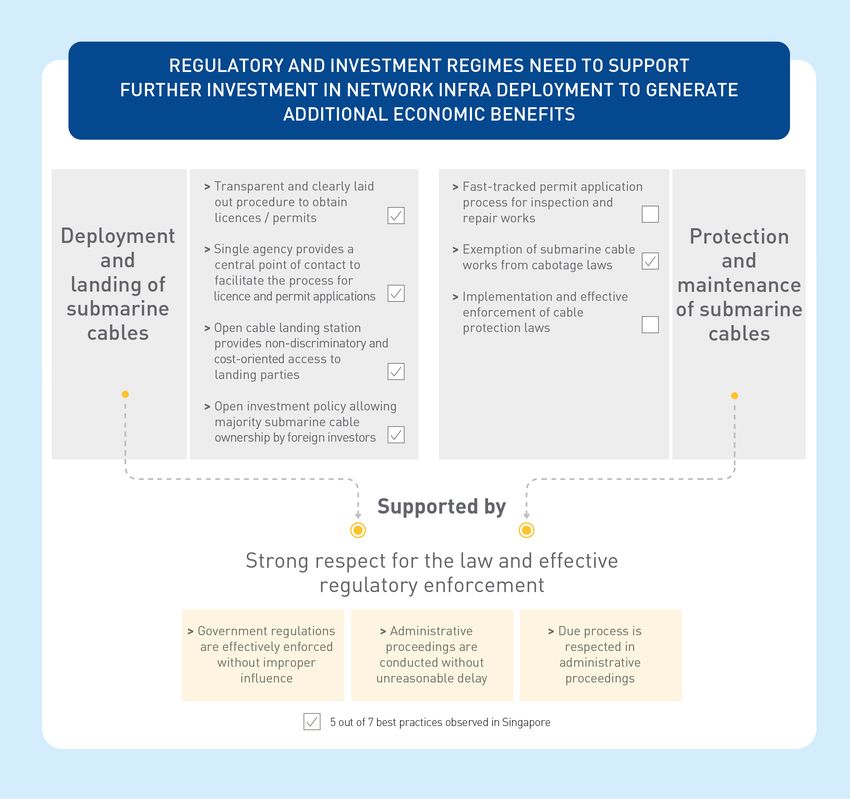
Singapore has a transparent and efficient process for landing submarine cables. IMDA provides the
required information to cable owners and helps to facilitate permit applications with other
government agencies. Access to cable landing stations are based on cost-oriented pricing and on
non-discriminatory terms, and there are also no equity limits on foreign investments in network
infrastructure. These factors have enabled Singapore to become a leading submarine cable hub in
the region.
Singapore is also a jurisdiction with strong regulatory enforcement principles. It scores well on the
Rule of Law index, with a regulatory enforcement factor score of 0.87, which is the highest score
amongst APAC countries. 15 This boosts investors’ confidence, particularly in the context of capital-
intensive investments such as the deployment of submarine cables.
15 World Justice Project – “Rule of Law Index 2020”, see https://worldjusticeproject.org/our-work/research-
and-data/wjp-rule-law-index-2020
2020250-274Economic impact of Google’s APAC network infrastructure – Singapore | 13
There are best practice processes in other economies that could be applicable to Singapore,
particularly regarding the protection and maintenance of submarine cables. Cable cuts on key routes
can have a significant impact on the quality of the internet in the region and it is in the interest of
governments to allow for speedy repair works to be conducted. An ‘approval in principle’ approach,
such as that implemented in Taiwan, could speed up the permitting process, reducing the mean time
to commence repair on cable faults. We also note that the seas around Singapore are busy and full
of maritime activity. Singapore could consider introducing cable protection zones where possible,
which would reduce the likelihood of cable damage due to human activity.
2020250-274You can also read


