Ecosystem Sciences Management Working Group Science Advisory Board Overview and ESMWG History - Cynthia J. Decker, Ph.D, Executive Director, NOAA ...
←
→
Page content transcription
If your browser does not render page correctly, please read the page content below
Ecosystem Sciences Management
         Working Group

Science Advisory Board Overview and
          ESMWG History
                             Cynthia J. Decker, Ph.D,
                             Executive Director, NOAA SAB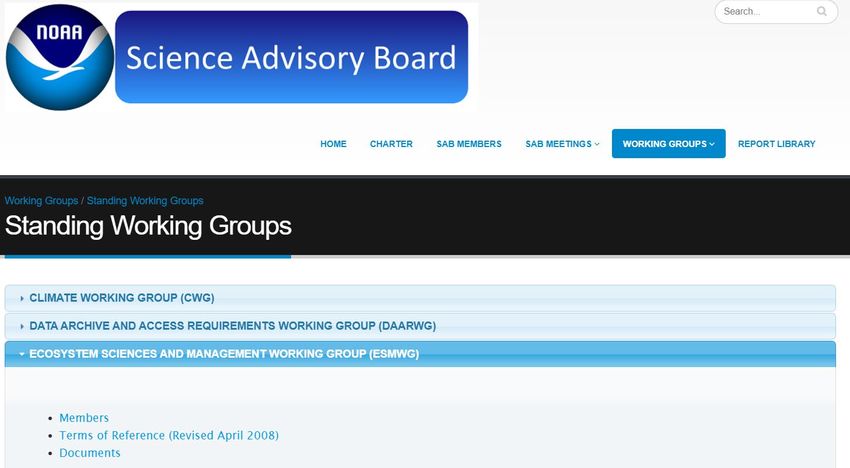
Welcome!

           2
Purpose and Background of the SAB
The only NOAA federal advisory committee to advise across
all lines, strategic councils, & offices.
History: created in 1997 by the Under Secretary (J. Baker);
first convened in 1998
Review Membership: ~15 members; 3-yr term renewable once;
nominated by Under Secretary; 3 in-person meetings per
year; remote meetings as needed
SAB Office: Executive Director and 3 part-time staff
Report Advise Website: sab.noaa.gov; includes all meeting documents,
reports, and information on working groups
SAB
3
Importance of the SAB
Reports directly to the Under Secretary
Executive Director works directly with the Chief Scientist & Deputy Under Secretary
to identify issues
Assistant Administrators & Strategic Council Chairs look to the SAB for high-level
advice
All of the above attend the meetings and provide feedback on reports and
recommendations
4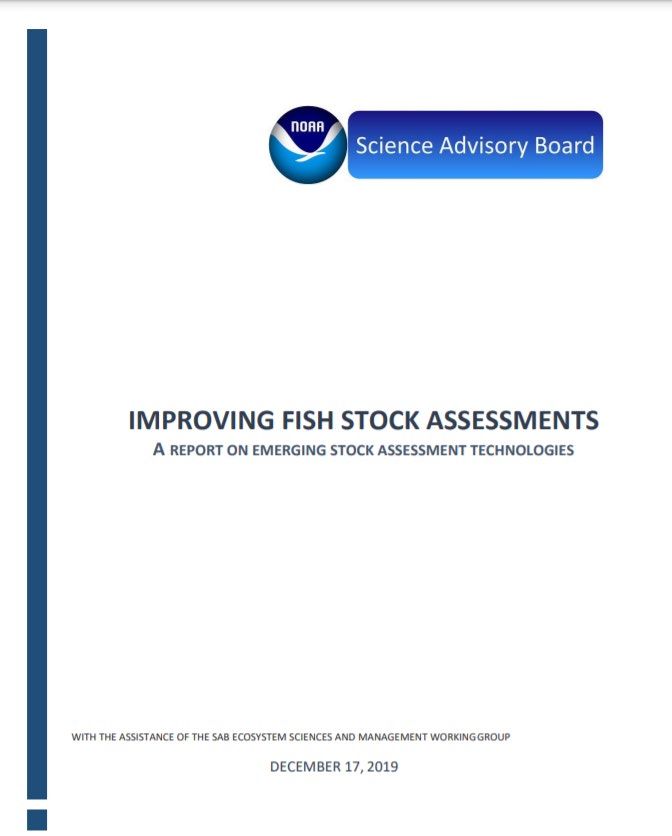
Value Added
Works to provide strategic guidance on trends, issues and new areas of cutting-edge
research that may impact NOAA mission in the future
Provides advice from external experts, i.e. not the usual suspects
Validates requirements and needs
Identifies gaps in programs, expertise, funding
Report Review Network of Experts Advise Sounding Board
5
The SAB in NOAA
                                          FACA
  US Undersecretary of                                                      SAB
  Commerce for Oceans
 and Atmosphere (NOAA                                                   13 Current
     Administrator)                                                     Members
                                       SAB Staff
     NOAA Chief
      Scientist

                                    Data Archive   Environmental    Ecosystem          Tsunami
                         Climate     and Access     Information    Sciences and      Science and
                                   Requirements       Services     Management        Technology

                                                                                             6
SAB Website: sab.noaa.gov
SAB
Members
Meeting Details
Meeting Documents
Working Groups
Members
Reports
Terms of Reference
Report Library
7NOAA SAB Working Groups
The NOAA Science Advisory Board is called upon to provide advice to NOAA on a wide
variety of topics important to the agency. Because of the breadth of subject matter that
the group addresses, they frequently consult with additional experts on specific topics.
To that end, there are four standing SAB working groups:
Data Archiving and Access Requirements Working Group (DAARWG)
Ecosystem Sciences and Management Working Group (ESMWG)
Environmental Information Services Working Group (EISWG)
Tsunami Science and Technology Advisory Panel (TSTAP)
Climate Working Group (CWG)
8How working groups interact with the SAB
The SAB develops an annual Work Plan.
Working groups are involved in the Work Plan topic development.
Working groups typically get assignments for drafting reports on portions of the work
plan topics.
Working groups report back to the SAB periodically, present a final report.
The SAB accepts a working group report and forwards it to NOAA for a response.
Final reports are published on the SAB website.
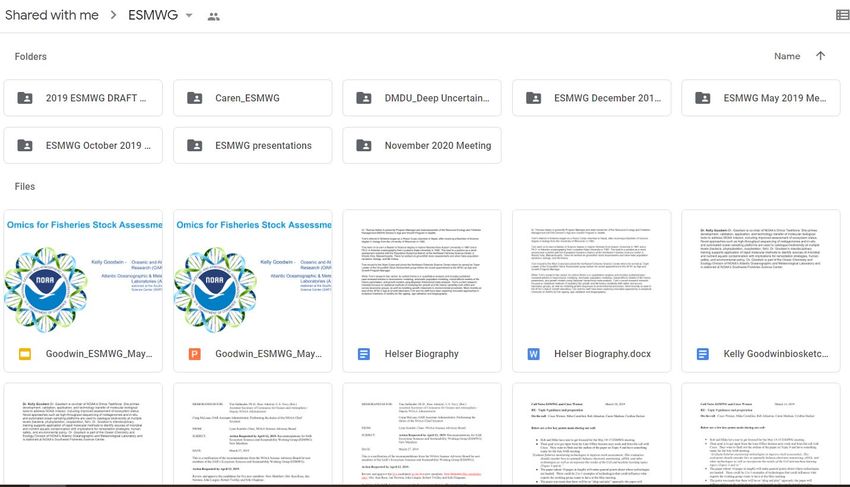
9ESMWG Google Drive
Access granted after
become a member
All ESMWG related
documents:
membership, reports,
meeting documents
and minutes
Allows for joint
collaboration on
projects
10ESMWG Members
CO-CHAIRS
Dr. Michael Castellini - University of Alaska, Fairbanks
Dr. Robert Johnston- Clark University
MEMBERS
Dr. Erik Chapman - New Hampshire Sea Grant,University of New Hampshire
Dr. Jim Cowan - Louisiana State University
Dr. Selina Heppell - Oregon State University
Ms. Molly McCammon-Alaska Ocean Observing System
Dr. Jan Newton - University of Washington
Dr. Ed Parnell - University of California at San Diego
Dr. Kenneth Rose - University of Maryland
Dr. Robert Twilley - Louisiana State University
Dr. Lisa Wainger-University of Maryland, Chesapeake Biological Laboratory
SAB LIAISON
TBD
11Others involved with the ESMWG
SAB Office
Dr. Cynthia Decker – NOAA SAB Executive Director
Vacant– SAB Staff
NOAA Liaisons
Dr. Jonathan Pennock (OAR)– Director, National Sea Grant Office
Dr. Cisco Werner (NMFS) – Director of Scientific Programs and Chief Science Advisor
John Armor (NOS) – Director, Office of National Marine Sanctuaries
12Definition of the ESMWG
From the Term of Reference:
The Ecosystem Sciences and Management Working Group (ESMWG) will provide scientific advice and
broad direction to the NOAA Science Advisory Board (SAB) regarding NOAA’s ecosystem related programs,
in the context of national and international activities. The ESMWG will focus on the broad research,
monitoring, and management components of NOAA’s ecosystem portfolio, as well as on the underlying
observations and data management issues. The ESMWG will assist in establishing plans, assessing
progress, and reviewing priorities on a continuing basis.
13The role of the ESMWG
As a sanctioned working group of the NOAA SAB, the ESMWG:
Advises the SAB on the condition and capabilities of NOAA’s ecosystem portfolio and,
Submits formal reports to the SAB that identify current issues, deficiencies,
recommendations for remedial action, and proposed initiatives.
14The ESMWG will:
1. Foster ongoing dialogue
2. Enhance communication with external partners and stakeholders, and
3. Provide a sounding board for proposals to enhance the delivery of science
supporting ecosystem approaches to management
15ESMWG members will
Be appointed for three-year terms on a rolling and randomized basis with the
opportunity for one additional term.
Provide suggestions of new candidates annually to the NOAA SAB for consideration.
Convene 2-3 times per year.
16Past ESMWG Work
Potential for Citizen Science in Support of Data Improving Fish Stock Assessments (2019)
Needs for Ecosystem-Based Science (2018)
17Upcoming ESMWG Work
Decision Making under Deep Uncertainty Report
Coastal Resilience - SAB priority topic
18Questions?
19You can also read


