ELInes 06 2017 - Extreme Light Infrastructure
←
→
Page content transcription
If your browser does not render page correctly, please read the page content below
2017       Extreme Light Infrastructure
           NEWSLETTER ISSUE 06
           April 2017

ISSUE 06

06 E LInes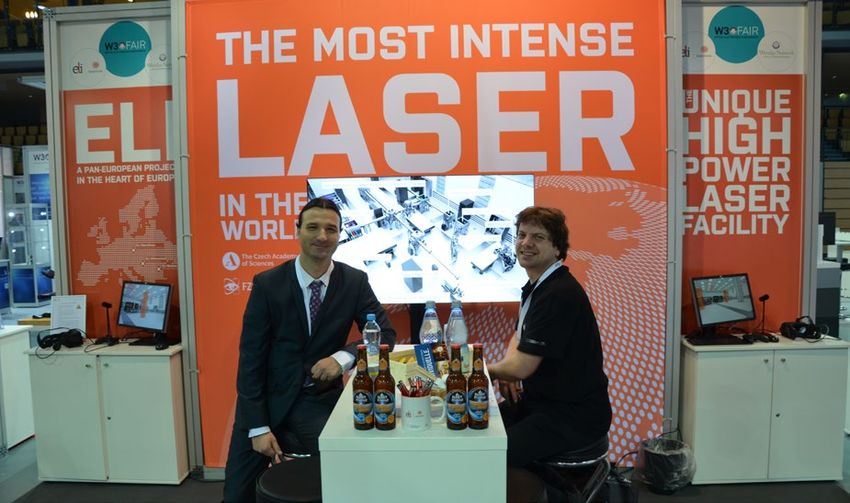
E LInes
ISSUE 06

1

                                                                                 I. Editorial

                                          The setting-up of the ELI-ERIC is proceeding through its
                                          various facets: the buildings of the three ELI-pillars are now
                                          being filled with equipment, and the providers’ teams are
                                          currently busy assembling the first laser sources. Furthermore,
                                          we proceed with gathering the list of experimental facilities,
                                          instruments and options to be offered to users in the first call
                                          for external users that will be published in the second half of
                                          the year, with the definition of the financial commitment of
                                          the host countries during the start-up period, and with the
                                          definition of the framework to acquire commitments of the
                                          other European Countries. And this is only a shortlist of the
                                          various issues now on the different tables.
                                         A first meeting of the Administration and Finance Committee
                                         (AFC) has already helped us to focus on the priority issues to
                Carlo Rizzuto
                                         be addressed to further build the basic understanding and the
      trust between all contributors to the joint enterprise, and this integrates the advisory functions
      to the future ELI-ERIC, adding to the effective action of the ISTAC, which has been in place since
      2016.
      Several working groups are now defining data and details for the start-up period, and are thinking
      about how the organization and staff of the three pillars will work together in a single entity.
      One important aspect is the training of existing and of new personnel in view of the transition
      from construction and installation to the users’ support, while operating as a full-fledged user
      facility. A strong effort will be needed also in terms of training users and staff together, while
      developing the first experimental stations. In this activity there will be a specific focus to involve
      junior researchers, the main users of tomorrow, whose fresh ideas might turn out to be the best
      opportunities for new revolutionary scientific results.

                                                                                            Carlo Rizzuto
                                              Director-General, ELI-DC International Association AISBL
E LInes
                                                                                                              ISSUE 06

                                                                                                              2

                                                                                         Contents

I. Editorial ���������������������������������������������������������������������������������������������������� 1
II. Highlights������������������������������������������������������������������������������������������������ 3
    2.1 ELI-NP – Brilliant gamma beams for industrial applications	                                              3
    2.2. ELI Beamlines – Completion of HAPLS	                                                                    3
    2.3 ELI-ALPS – Ultrafast photoemission as a probe for nanoplasmonic
    field enhancement	                                                                                           3

III. Scientific experiments and new research possibilities���������������������� 4
    3.1 X-ray sources at ELI Beamlines	                                                                          4
    3.2 ELI-NP, Integration status High Power Laser System	                                                      5
    3.3 ELI-ALPS, Update on laser installation	                                                                  7

IV. Portraits�������������������������������������������������������������������������������������������������� 9
    4.1 Alexander Andreev, Head of the laser plasma theory group at ELI-ALPS	                                   9
    4.2 Calin Alexandru Ur, Head of High Brilliance Gamma Beams at ELI-NP	                                     10
    4.3 Lucia Koubíková, Laser System Engineer at ELI Beamlines	                                               11

V. Apply Now��������������������������������������������������������������������������������������������� 13
    5.1 ELI-ALPS 	                                                                                             13
    5.2 ELI Beamlines 	                                                                                        13
    5.3 ELI-NP 	                                                                                               14

VI. Events���������������������������������������������������������������������������������������������������� 16
    6.1 ELI-NP – Université Paris-Saclay Workshop	                                                             16
    6.2 W3+ FAIR Wetzlar 	                                                                                     16
    6.3 Laser Photonics event	                                                                                 17

Colophon���������������������������������������������������������������������������������������������������� 18
Contact������������������������������������������������������������������������������������������������������� 19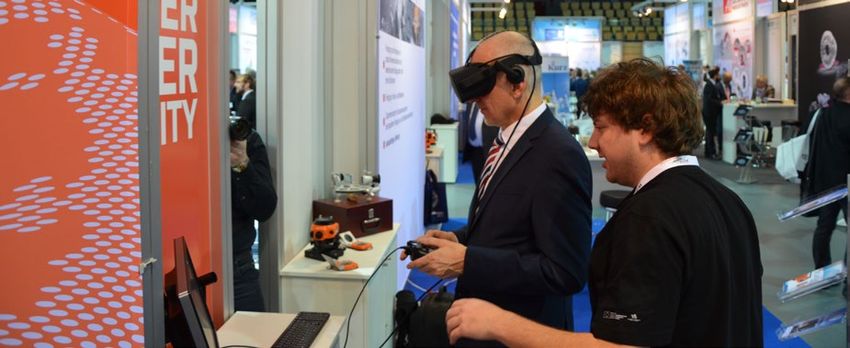
E LInes
ISSUE 06

3

                                                                          II. Highlights

      2.1 ELI-NP – Brilliant
      gamma beams for
      industrial applications
      In the journal Applications of Novel Scintillators
      for Research and Industry, researchers of ELI-
      NP published a report on the foreseen indus-
      trial applications that will benefit from the high
      quality and unique characteristics of ELI-NP
      gamma beam and the challenges they present.
      The paper presents the experimental setups,
      discusses their performance based on analyt-         2.3 ELI-ALPS – Ultrafast
      ical calculations and numerical Monte-Carlo
      simulations, and comments about constrains           photoemission as a probe
      imposed by the limitation of current scintilla-
      tor detectors.
                                                           for nanoplasmonic field
      Read the article here:                               enhancement
      http://www.eli-np.ro/scientific-papers/Ian-
      cu_2016_J._Phys.__Conf._Ser._763_012003.pdf          The 17th January 2017 edition of Nanoletters
                                                           featured an article by ELI-ALPS researchers
                                                           about probing nano-optical near-fields. In the
                                                           article, an experimental method is demon-
                                                           strated utilizing ultrafast photoemission from
                                                           plasmonic nanostructures that is capable of
                                                           probing the maximum nanoplasmonic field
                                                           enhancement in any metallic surface envi-
      2.2. ELI Beamlines –                                 ronment. It is argued that ultrafast plasmonic
                                                           photoelectrons can act as versatile probes for
      Completion of HAPLS                                  nanoplasmonic near-fields.
                                                           Read the article here:
      The High-Repetition-Rate Advanced Pet-               http://pubs.acs.org/doi/abs/10.1021/acs.nan-
      awatt Laser System (HAPLS), being developed          olett.6b04893
      at Lawrence Livermore National Laboratory
      (LLNL), recently completed a significant mile-
      stone: demonstration of continuous operation
      of an all diode-pumped, high-energy femto-
      second petawatt laser system. With comple-
      tion of this milestone, the system is ready for
      delivery and integration at ELI Beamlines.
      Read the article here:
      https://www.eli-beams.eu/en/media/news/liv-
      ermore-meets-key-milestone-delivery-worlds-
      high/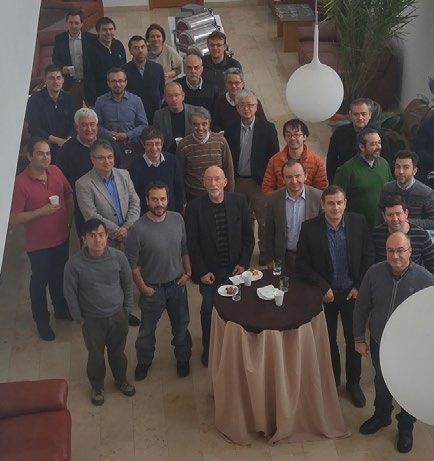
E LInes
                                                                                                ISSUE 06

                                                                                                 4

                        III. Scientific experiments and
                              new research possibilities

3.1 X-ray sources at ELI                           ‘We have chosen to focus on reliable and
                                                   suitable sources for application benefits,
Beamlines                                          which can provide sure photons for our users,’
                                                   says Nejdl. For most of these, the scientific
                                                   concepts are already well-known, he explains.
There are many ways to generate X-ray              ‘They are low risk, sure sources, which we will
radiation from laser matter interaction. ‘We       boost to a maximum with our unique set of
are currently developing four different types      lasers. Only the laser-driven undulator X-ray
of X-ray sources for ELI Beamlines,’ says          source (LUX) that is currently being developed
Jaroslav Nejdl, leader of research activity        in collaboration with DESY, Hamburg, is a
2 at the facility. The research program is         technology for the longer term, since we want
aiming particularly for sources that are able      to push the generation down to soft X-rays,
to generate bright femtosecond pulses when         and more importantly to demonstrate lasing,
driven by the Beamlines lasers. There will be      in order to increase the source brightness.’
a beamline based on high-order harmonic
generation (HHG) and an incoherent plasma          ‘One of the explicit goals of our research activity
X-ray source (PXS) both driven by the “L1” laser   is to push the frontiers of compact laser driven
(1 kHz, 100 mJ, 20 fs). Another class is formed    X-ray sources and make them competitive to
the sources based on radiation of relativistic     the large scale facilities like synchrotrons and
electron beams driven by the “L3” laser (10 Hz,    free electron lasers,’ he adds. ‘By using a new
30 J, 30 fs), which rely on betatron radiation     generation of lasers developed here we are
emitted during acceleration of electrons in        expecting higher numbers of X-ray photons
nonlinear plasma wave and on undulator             and better optical qualities in repetition rates
radiation.                                         that are attractive for users.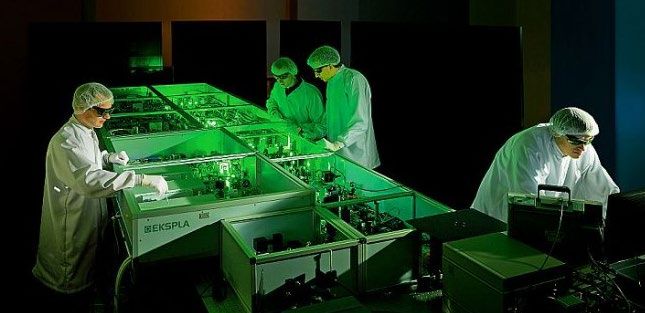
E LInes
ISSUE 06

5
      Once we are able to make table-top systems, it      of the sources are tested elsewhere, but it will
      will be possible for users around the world to      probably take until 2018 before we will start
      get an X-ray source in their homelab, instead       generating radiation, because ramping up the
      of having to go to a synchrotron or other large     L3 laser and finalization of its beam transport
      facility to do their experiments.’                  might need a bit more time.’
      Combined, synchronised sources                      Nejdl is very confident the work within his re-
      Unique about ELI Beamlines from the X-ray           search activity will be fruitful. ‘We have a very
      point of view is that different radiation sources   good team which is more than capable to run
      can be combined and precisely synchronised          this big facility well. And we’re very motivated
      in one experiment. ‘This way, users should          to make this into a success.’
      be able to study ultrafast dynamics in pump-        Read more about the X-ray sources at ELI
      probe experiments in a wide range of wave-          Beamlines: www.eli-beams.eu/en/research/x-
      lengths. For example, users will be able to use     ray-sources
      synchronised XUV-pumps and X-ray probes,
      or combine infrared with X-rays. This way we
      open up different windows on the same object        3.2 ELI-NP, Integration
      of study. Since we will drive different sourc-
      es with the same laser, we get a very good          status High Power Laser
      temporal synchronisation.’ The type of exper-
      iments ELI Beamlines will facilitate, is hard to    System
      be done elsewhere, he says. ‘Users can study        By Daniel Ursescu and Ioan Dancus
      fast processes in matter, and can make “mov-
      ies” at the scale of femtoseconds in a wide
      range of energies.’                                 The High Power Laser System (HPLS), under
                                                          installation at ELI-NP in Romania [1, 2], is a
      Practically ready                                   Ti:Sapphire, hybrid CPA [3] system and it con-
      Two of the sources dedicated to 1 kHz ope-          sists of six optical outputs: two 0.1 PW out-
      ration are nearing completion, says Nejdl. ‘At      puts running at 10 Hz repetition rate, two 1
      the moment we are using a commercial laser          PW outputs running at 1 Hz and two 10 PW
      which is 20 times weaker than the eventual L1       outputs running at 1 shot per minute. This
      laser to demonstrate the systems are actually       laser system is produced by a consortium
      working. The HHG beamline is practically            formed by Thales Optronique SAS and Thales
      ready, we are now moving forward towards            Systems Romania.
      the acceptance tests. As soon as the eventual       During the first stage of implementation,
      laser is in place and ramped up, we will of         Thales consortium demonstrated high perfor-
      course be able to get more of the radiation         mances for the 100 TW and 1 PW outputs of
      out, but the source is designed to operate          arm 1 of the ELI-NP HPLS in the Thales Op-
      at lower driving laser energies as well. The        tronique SAS laboratories in Elancourt, France
      same goes for the plasma X-ray source that          [4]. During this work, Thales demonstrated
      will be tested in the coming weeks. After that      more than 4 Joules for the 100 TW level am-
      both sources will be commissioned in the E1         plifier and 39 Joules of energy for the 1 PW
      experimental hall which is yet to be finalized,     amplifier with a spectral bandwidth of about
      and then we will be able to offer beam time         75nm FWHM.
      to users.’
                                                          Deformable mirror
      For the sources based on relativistic electron
      beams which will be operated with the L3 laser,     Using the 100 TW compressor, Thales
      i. e. the betatron source and the LUX Beamline,     obtained at the output of the system: 2.8
      there still is more work to be done before us-      Joules energy, 21 fs pulse duration, 0.9 Strehl
      ers can get the first light in Dolní Břežany, he    ratio and 13 orders of magnitude contrast at
      says. ‘The concepts and some major elements         20 ps. The excellent Strehl ratio was obtained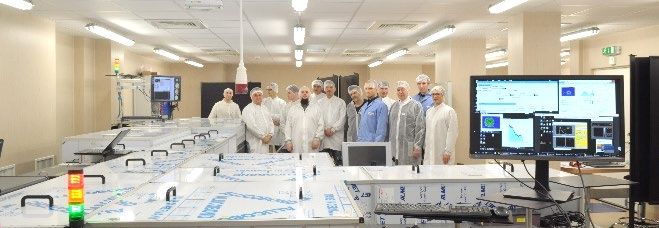
E LInes
                                                                                              ISSUE 06

                                                                                               6
by the use of a Deformable Mirror (DM),
manufactured by Imagine Optic, in closed loop
with a wavefront sensor. The very good pulse
contrast is a consequence of implementing
an Optical Parametric Chirp Pulse Amplifier
(OPCPA) and XPW filter in the Front End of
the HPLS.
For the 1 PW level, tests were performed us-
ing an attenuated beam and the same 100TW
compressor. The use of the 100TW compres-
sor for these measurements is a consequence          Picture 1. 10 PW compressor chambers imple-
of the space limitation and difficulties in the      mented in ELI-NP Laser Room
implementation of the 1 PW compressor in
the Thales laboratories. Same performances
were obtained for the pulse duration, 21 fs
and Strehl ratio, 0.9 for the 1 PW output of
the HPLS.
The 10 PW amplifiers of the HPLS are pumped
by 16 ATLAS 100 lasers (8 units per arm). This
100 Joules at 527nm lasers were a great chal-
lenge, successfully overcome by Thales. 14 of
these lasers were already delivered at ELI-NP
premises and 2 more are under production
within the Thales facilities (in France).            Picture 2. 100 TW and 1 PW compressor cham-
                                                     bers and parts of the beam distribution system
From December 2016 the Thales team, with             implemented in ELI-NP Laser Room
its partners (BOVIS, Newport, SEMA, SDMS,
ELMET), started the implementation of the
HPLS in the ELI-NP facility. At this moment, all
of the heavy equipment is positioned in the
HPLS Room: optical tables, compressor cham-
bers, beam transport line for 100 TW and 1
PW, all pump lasers (except 2 ATLAS 100).
On-going work: the implementation of the
electrical, cooling water and vacuum distribu-
tion systems that will supply utilities to all the
sub-systems involved in the HPLS.
1. N.V. Zamfir, Rom. Rep. Phys., 2016 68             Picture 3. View of the HPLS arm 1 in the Laser
   (Supplement), S3–S4                               Room from the Control Room

2. Extreme Light Infrastructure – Nuclear
   Physics (ELI-NP) White Book - http://www.
   eli-np.ro/documents/ELI-NP-WhiteBook.
   pdf - as in May 2016
3. Donna Strickland, Gerrard Mourou, Opti.
   Comm., 1985, 56(3), 219-221
4. Francois Lureau et. al. Proc. SPIE 9726, Sol-
   id State Lasers XXV: Technology and De-
   vices, 972613 (2016)
                                                     Picture 4. HPLS arm 1 in the ELI-NP Laser Room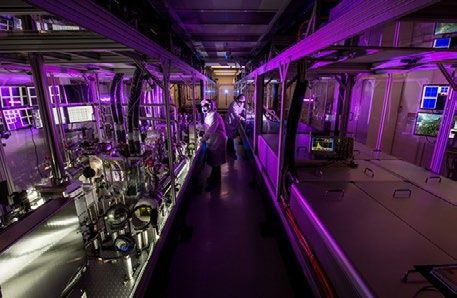
E LInes
ISSUE 06

7
                                                          currently working at 53 W average power and 5
                                                          TW peak power, and has already demonstrated
                                                          its extremely good stability: it can function for
                                                          days on end without any problems.’
                                                          The other laser system establishing a new laser
                                                          class Osvay refers to is the High Repetition (HR)
                                                          system being developed in Jena, Germany. The
                                                          unique combination of chirped fiber lasers with
                                                          nonlinear optical compression allows for laser
                                                          pulses at a central wavelength of 1030 nm with
                                                          a 100 kHz repetition rate, a peak power of 1
                                                          TW, and 6 fs pulse duration. ‘The first stage at
      Picture 5. 10 PW Compressors installed in the       0.2 TW peak power and 100 W average power
      ELI-NP Laser Room and the installation team         is already running in an extremely stable way
                                                          proven upon 24 hours tests.’
                                                          Unique contracts
                                                          ‘At ELI-ALPS, we have negotiated quite unique
                                                          types of contracts with the manufacturers,’
                                                          Osvay starts explaining when asked about the
                                                          current status of the systems. ‘All of the lasers
                                                          are planned to go through a trial period of
                                                          several months at our facility, where they will
                                                          have to run at their full specifications for a
                                                          certain period of time without any problems. So
                                                          the systems are being developed to a certain
                                                          point at the the site of the manufacturers. Then
      Picture 6. 10 PW Compressors chambers in-           they will be transferred to us, assembled here
      stalled in the ELI-NP Laser Room                    at ELI-ALPS, installed, demonstrated, and only
                                                          when they turn out to work properly, they will
                                                          be commissioned officially.’
      3.3 ELI-ALPS, Update on
                                                          ‘The above mentioned first stage of the SYLOS
      laser installation                                  system has been fully operational at the
                                                          Lithuanian manufacturers’ site since May 2016.
      Five different lasers are planned to be installed   Due to the current state of the building, we have
      at ELI-ALPS. ‘All of these are unique. And two of   not been able to ship it here yet. That is why
      them will be establishing a new kind of standard    we decided to start the trial period in Vilnius,
      worldwide,’ emphasizes Karoly Osvay, Research       instead of at our location here. The second stage
      Technology Director at ELI-ALPS. ‘The SYLOS         of development, in which the power output will
      laser developed by the Lithuanian manufacturers     be ramped up and the pulses will be shortened
      Ekspla and Sviesos Konversija (Light Conversion)    somewhat will also start there, in the middle of
      is based on optical parametric amplification,       June this year.’
      not on the conventional laser amplification         The same goes for the most powerful laser ELI-
      method. It will set a new standard for all those    ALPS will house: the High Field (HF) beamline,
      kinds of laser systems, since a system like this    which will operate at an average power of 340 W,
      has never existed anywhere in the world before.’    with a peak power of 2 TW, at a 10 Hz repetition
      The SYLOS system will eventually operate at a       rate and with pulse durations of about 17 fs.
      1kHz repetition rate with a peak power of 20        ‘That laser will be installed in fall 2018, and will
      TW, carrier-envelope-phase stabilized pulses of     be fully operational in April 2019 hopefully.’ The
      duration less than 6 fs, and a central wavelength   only system with similar parameters existing
      around 900 nm. ‘The first stage of the system is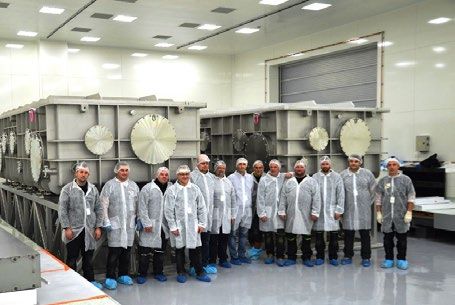
E LInes
                                                                                                   ISSUE 05
                                                                                                         06

                                                                                                   8

today is currently being developed at the              and will be installed this summer. ‘Like the HR
Lawrence Livermore Laboratory in the US for ELI        system, it consumes less energy, and there is no
Beamlines, but it uses a different technology.         vacuum needed. So we can work with temporary
                                                       cooling systems, until the construction on the
As far as the High Repetition rate laser is            building is finished.’
concerned, that system is nearing completion,
says Osvay. ‘That will be shipped by the end of        Finally, a terahertz system is foreseen, which is
May this year, and installed in June/July. Then        a combined fiber laser - multiple-pass amplifi-
the trial period will start, and after that, we will   er system built by Amplitude Technologies and
start the second stage in which we will boost the      Amplitude Systèmes in France, and will go up
parameters five times, from the current average        to 20-25 Watt peak power, at a 50 Hz repetition
energy of 100 W to 500 W, and a slightly shorter       rate, with pulses with a duration of about half
pulse duration. That should be fully operational       a picosecond. ‘Last December we signed the
at its final specifications by spring 2019 as well.’   contract to get that built. By now the concep-
                                                       tual design has just been completed. The final
Besides these three large-scale laser systems,         acceptance test is foreseen in April 2018, and it
ELI-ALPS also is awaiting two smaller systems.         should be installed by July/August 2018.’
One is a mid-infrared system with 15 watts of
average power, a 100 KHz repetition rate and a
central wavelength of 3,1 micron. That system
is currently being built in France by FASTLITE ,
E LInes
ISSUE 06

9

                                                                                IV. Portraits

      4.1 Alexander Andreev,                                the last possibility to do something new in my
                                                            career. And it is very exciting work. In ELI-ALPS,
      Head of the laser plasma                              we are building a facility which has no compe-
                                                            tition, because the only way to generate atto-
      theory group at ELI-ALPS                              second pulses interesting for applications, is with
                                                            a high power laser.’
      Alexander Andreev (1949) was born in Mos-             How do you combine this position with your
      cow, Russia. He received his B.E., M.E. and PhD       other positions in Germany and Russia?
      in physics from Leningrad State University. In
      1991, he received a Doctor of Science degree          ‘I mainly work in Germany, and I travel to Sze-
      from Vavilov State Optical Institute in Russia.       ged and St. Petersburg every once in a while
      In 1993 he got appointed professor from State         to meet with people I work with face to face.
      Technical University of St. Petersburg. Since         For example, in Russia, I still have some stu-
      joining Vavilov State Optical Institute in 1972,      dents. It is good to visit them regularly.
      professor Andreev has been engaged in research        I am a theorist and mainly work with analytical
      and development of high power lasers and their        models and simulations. There is no need for me
      applications. At the moment, he is a guest pro-       to physically be present at the experimental sites
      fessor in MBI, Berlin, Germany, group leader in       on a daily basis. For example, currently some of
      ELI-ALPS, Szeged, Hungary and professor of St.        my code is running at the supercomputer in Ju-
      Petersburg State University, Russia.                  lich, at the other side of Germany. And today it is
                                                            very well possible to cooperate with colleagues in
                                                            other countries with the aid of email and Skype.’
                                                            What are your main tasks at ELI-ALPS?
                                                            ‘My group is now a theory group. We describe
                                                            the parameters that characterise the plasma that
                                                            forms when an intense laser hits a solid or gas
                                                            target. It is this plasma that ultimately generates
                                                            the attosecond pulses, and we are searching
                                                            for the best way to do this. As a theory group,
                                                            our job is to come up with an interesting idea,
                                                            do simulations and modelling, discuss it with
      Alexander Andreev                                     experimentalists, and compare our predictions
                                                            with experimental results. Based on these, we
      How and why did you get involved in                   perfect our models, and the process begins
      ELI-ALPS?                                             again for better understanding of a real process.
                                                            Because we can use very intense laser beams
      ‘Wolfgang Sandner was one of the directors of the     and dense targets, we can create an extremely
      Max Born Institute, where I have been working for     high number of harmonics, a factor of 10 to
      the last seven years. When he was establishing ELI,   100 better than elsewhere. That way, the pulse
      he asked some of his colleagues at the institute      duration can be shorter, and the efficiency can be
      for help. I was one of them. At the MBI, I was in-    higher. We want to be able to create attosecond
      volved in the development of a new class of high      pulses with a significant energy interesting for
      power lasers and their applications. This activity    applications, so we are also looking for ways to
      is now terminated at the institute, but fortunate-    amplify the week atto pulse generated by high
      ly I could keep working on this topic within ELI.     power laser system, by using for example Raman
      For me, getting involved in ELI-ALPS was perhaps      amplification techniques.’
E LInes
ISSUE 06
10
What ambitions do you have for the facility? I could return to my home institution in Ro-
‘When all the lasers are installed, the most chal- mania. It is a great challenge and responsibil-
lenging part will finally begin. We can do exper- ity to contribute to the building of something
iments to validate our theories, and move for- unique like this.’
ward. Eventually, I hope ELI-ALPS will propose What are your main tasks at the facility?
new methods which help us to gain a deeper un-
derstanding of nature and in particularly investi- ‘I am leading the local research activity to imple-
gate exotic states of matter. We aim to break new ment the gamma beam system. We maintain the
ground in photonics, plasmonics and in plasma connections and communication with the sup-
physics. And with this new knowledge, hopefully pliers and have discussions with them about the
we can manipulate processes at extremely short technical aspects of the implementation and in-
timescales and by doing so create new materials stallation on site. Furthermore we are preparing
and technologies.’ the local team which in the future will be respon-
sible for operating the system. At the moment
4.2 Calin Alexandru Ur, we are participating in training programs to
learn how to operate and maintain the systems.
Head of High Brilliance The good thing is that we have the opportunity
to be involved in all phases of the installation
Gamma Beams at ELI-NP and commissioning of the gamma beam sys-
tem. That way we get a thorough understand-
ing of all the different parts of the system and
Calin Alexandru Ur (1966) gained his PhD in Nu- of how everything works. During the commis-
clear Physics in 1999 at the Institute of Atomic sioning phase, you typically run into all possible
Physics in Bucharest, Romania. From 2000 until sorts of problems, and that is when you learn
2013, he worked as a researcher at the Istituto most about troubleshooting.’
Nazionale di Fisica Nucleare in Padova, Italy.
Since 2013, he has returned to Romania to work And what will your duty be when all systems
at ELI-NP as a senior researcher. are up and running?
‘In the future, besides operating and upgrad-
ing the system, we will also do experiments,
which I am also looking forward to very much.
In fact, I am heading two different research
groups. One is involved in basic research on
the intimate structure of nuclei. The unique
features of the gamma beams at ELI-NP will al-
low for the study of nuclear structure and re-
actions as well as nuclear astrophysics topics
with unprecedented resolution and accuracy.
The other group is more oriented towards appli-
cations. For example we can use gamma beams
to image large objects. Unlike X-rays, which do
not penetrate matter very far, high energy gam-
Calin Alexandru Ur ma beams can image the inner structures of ob-
jects up to several tens of centimeters in size.
How did you get involved in ELI? That way you can investigate non-destructively,
for example, the inside of an old artifact, and
‘I have been working for thirteen years at the see how and when it was made. Or we can look
Italian institute for nuclear physics but I never for defects in welding, without damaging the
lost contact with my home institution IFIN-HH. welded object. That way we can help industry to
ELI-NP offered me a great opportunity to work prolong the service life of devices.’
on a facility that is not to be found anywhere
else in the world, with the extra advantage thatE LInes
ISSUE 06
11
What are you looking forward to the most?
‘I like both aspects of my job – both the tech-
nical and the experimental part. I hope I will be
able to keep combining them. Maintaining the
machine is a big challenge as well, since it has
parameters not achieved before in the world. I
am a nuclear physicist and I am looking forward
to contribute to the study of an unexplored field
at the frontiers between nuclear, plasma and la-
sers physics.’
What is your hope ELI will turn out to be?
Lucia Koubíková
‘I hope ELI-NP will become a pole of attraction
I was certainly interested in the possibility to
for many young researchers and engineers
work with the most powerful laser systems in
from Romania and from abroad. The fact that
the world! The fact that the ELI facility was being
ELI-NP is located here is important for Roma-
built so close to my home was just the so-called
nia, not only for science but also for industry.
“cherry on the top”. After my graduation, it was
Industry was involved from the beginning in
a very straightforward decision for me to send
this project to develop new technologies at the
an email to ELI and ask about the opportunity
limits of the present knowledge. In the future,
of full-time employment, or further research. I
we will need to maintain the machines, and
was invited for an interview and then hired as
that pushes also the limits of industry to de-
a laser system diagnostics engineer for the L2
velop parts for repair or replacement. Since the
program. ’
facility will not be steady, but will be evolving
continuously, we will keep pushing industry to What are your main tasks at the ELI facility?
come up with new highly technological prod-
ucts and methods that in turn will raise their ‘I am currently part of the HAPLS (High-Repetition-
level of competitiveness. And as far as science Rate Advanced Petawatt Laser System) team,
is concerned: ELI-NP will be a research center which is finalising the development of the L3
that will raise the bar of Romanian research, laser system at the Lawrence Livermore National
and keep it competitive on an international Laboratory (LLNL) in the US. Within this team,
scale.’ I am the lead operator and technician for the
pump system of the laser.
4.3 Lucia Koubíková, I have been staying in the US for 14 months
now. Initially, we came here to be trained to op-
Laser System Engineer at erate and maintain the laser, but we have also
ELI Beamlines helped in the final stages of the development. It
has been a great experience and a privilege to
be able to work with some of the most experi-
Lucia Koubíková was born in the Czech Republic enced people in laser design & development in
in 1986. She studied Physical Engineering at the the world.
Czech Technical University in Prague, where she
graduated in 2013. Since 2013, she has been a Recently, we completed a significant
laser system engineer at ELI Beamlines. milestone and set the world record for diode-
pumped petawatt lasers. We also fulfilled
How and why did you get involved in ELI the requirements here at LLNL and we are
Beamlines? ready to ship the system to Prague within two
months. Following our transfer back to the
‘I heard about the ELI project for the very first Czech Republic, our team at ELI will continue to
time during my studies in a laser physics pro- collaborate with our colleagues at LLNL in order
gram at the Czech Technical University – and to fully implement HAPLS within the ELI facility.E LInes
ISSUE 06
12
I will be a part of the commissioning team for
the full laser system performance, and as a shot-
director, I will also be responsible for all high
power operations.’
What makes this job challenging for you?
‘HAPLS is the first laser of this class ever be-
ing built anywhere around the world – it truly
is a state-of-the-art system. Every single part of
the system is unique and very complex; there
is always something new to learn. Also, when
we need to troubleshoot a problem, we must
take extra care because we might be doing it for
the very first time ever. Perhaps this is the most
challenging part of my job: working on complex
and unique problems no one else has had to
deal with before.
I have definitely learnt a lot on my trip in the
US and I am looking forward to working more
on this amazing laser, as well as further im-
provements during the commissioning phase
at the ELI facility in Prague. ’
What ambitions do you have?
‘Right now I am really focused on my work on
the HAPLS laser. For the next two years, my
plans are to help with the integration at the ELI
facility and to take care that everything goes
as smooth as possible so that we can reach the
full performance, as intended. At ELI, excellent
people and laser science come together, and
I will do my best to continue this project’s
success.’E LInes
ISSUE 06
13
V. Apply Now
5.1 ELI-ALPS
Research positions in Terahertz Sources and Applications Group
ELI-ALPS has multiple job openings in Early Stage Researcher and Research Fellow positions in
the Terahertz Sources and Applications Group within the Particle and Terahertz Sources Divi-
sion. Applicants will take part in the development and application of advanced terahertz (THz)
spectroscopic techniques and intense pulsed THz sources. The work will include THz nonlinear
spectroscopic studies, spectrally resolved THz imaging, and applications using extremely intense
THz pulses.
http://www.eli-hu.hu/sites/default/files/allashirdetesek/eli-alps_PaTHz_Terahertz_20161213.pdf
Research Fellow in the Electron Acceleration Group
The Group’s duties mainly consist of developing and implementing the laser driven electron
acceleration programme at ELI-ALPS, whereby acceleration will be via the Laser Wakefield Accel-
eration mechanism (LWFA). The applicant is expected to assist in the development of the LWFA
electron beamlines and their applications through precursor experiments in partner laboratories;
the design/development of instrumentation/diagnostics with their respective control software,
relevant to the electron beamline; experimental data analysis; and electron beamline applica-
tions’ related tasks.
http://www.eli-hu.hu/sites/default/files/allashirdetesek/PaTHz_ElectronGroup_PostDoc_20160909.pdf
Research positions in the High Harmonic Generation (HHG) Group
The HHG Group has multiple job openings for Early Stage Researchers and Research Fellows. The
high harmonic generation (HHG) development beamlines within the HHG group would provide
the unique opportunity to explore intense laser interaction with solid surfaces under extreme
conditions of light intensity and pressure. The primary goal of the HHG group is to implement
HHG development beamlines and undertake the necessary scientific R&D activity that leads to its
further development as an attosource. As part of their training, candidates would get the chance
to gain insight in project management, handle state of the art diagnostics and gain knowledge
on advanced metrology schemes.
http://www.eli-hu.hu/sites/default/files/allashirdetesek/SHHG_positions_20160704.pdf
More information can be found on the ELI-ALPS website here:
http://www.eli-hu.hu/?q=en/jobs
5.2 ELI Beamlines
Bio-laboratory technician – experimental programmes
The suitable candidate will be responsible for cooperation in the design, construction and com-
missioning of a new biolaboratory for advanced research in life sciences with other technical and
administrative teams at ELI Beamlines; overseeing the installation and performing routine main-
tenance of main laboratory infrastructure equipment; installation of main research instrumentsE LInes
ISSUE 06
14
and their routine maintenance; management of laboratory consumables and small laboratory
equipment; and communication with vendors and suppliers about technical matters related to
the laboratory instrumentation and equipment.
https://www.eli-beams.eu/en/about/careers/technical/bio-laboratory-technician-experimen-
tal-programmes/
Leader of Research Programme 2: X-ray sources driven by ultrashort laser pulses
The suitable candidate will be responsible for the delivery of X-ray sources driven by ultra-
short laser pulses and their integration into the ELI Beamlines facility. This will include re-
sponsibility for key activities such as the coordination of laser driven X-ray beamlines re-
search and development team, implementation of the laser driven X-ray beamlines project
parts with respect to deadlines, staff, and technologies used, and the coordination of in-
terfacing between the laser driven X-ray beamlines research and development team.
https://www.eli-beams.eu/en/about/careers/scientific/leader-research-programme-2/
More information can be found on the ELI Beamlines website here:
http://www.eli-beams.eu/jobs/
5.3 ELI-NP
Senior/Junior Researcher (Experimental Plasma Physics with High-Power Lasers)
The Senior Researcher will perform scientific experiments and technological developments in
topics relevant to Research Activity 3, will create and lead scientific working groups and guide
junior researchers, postdocs and PhD students. He or she will participate in the definition and
implementation of the scientific aims of Research Activity 3.
http://www.eli-np.ro/jobs/160725/Senior_Researcher_ELI-NP_RA3_Plasma_Physics_Profile.pdf
The Junior Researcher will perform scientific experiments and technological developments, par-
ticipate in scientific working groups, assist the research of postdoctoral researchers and PhD
students.
http://www.eli-np.ro/jobs/160725/Junior_Researcher_ELI-NP_RA3_Plasma_Physics_Profile.pdf
Senior/Junior Researcher (Experimental Strong-Field Physics with Lasers)
The Senior Researcher will perform scientific experiments and technological developments in
Strong-Field QED with High-Power Lasers at experimental area E6 and E1, will create and lead
scientific working groups and guide junior researchers, postdocs and PhD students. He or she
will advise the Head of Research Activity in his or her area of expertise and will participate in the
definition and implementation of the scientific aims of Research Activity 3.
http://www.eli-np.ro/jobs/160725/Senior_Researcher_ELI-NP_RA3_Strong_Field_Physics_Profile.pdf
The Junior Researcher will perform scientific experiments and technological developments in
Strong-Field QED with High-Power Lasers at experimental areas E6 and E1, participate in scien-
tific working groups and assist the research of postdoctoral researchers and PhD students.
http://www.eli-np.ro/jobs/160725/Junior_Researcher_ELI-NP_RA3_Strong_Field_Physics_Profile.pdfE LInes
ISSUE 06
15
Senior/Junior Researcher (Theoretical and Computational Physics with High Intensity La-
sers)
The Senior Researcher will perform scientific computations and theoretical developments in top-
ics relevant to Research Activity 3, will create and lead scientific working groups, and will guide
junior researchers, postdocs and PhD students. The Senior Researcher will advise the Head of
Research Activity in his or her area of expertise and will participate in the definition and imple-
mentation of the scientific aims of Research Activity 3.
http://www.eli-np.ro/jobs/160725/Senior_Researcher_ELINP_RA3_Theoretical_Computational_
Physics_Profile.pdf
The Junior Researcher will perform scientific computations and theoretical developments in all
the main scientific directions of Research Activity 3, participate in scientific working groups, assist
the research of postdoctoral researchers and PhD students.
http://www.eli-np.ro/jobs/160725/Junior_Researcher_ELI-NP_RA3_Theoretical_Computational_
Physics_Profile.pdf
More information can be found on the ELI-NP website here:
http://www.eli-np.ro/jobsE LInes
ISSUE 06
16
VI. Events
6.1 ELI-NP – Université Paris-Saclay Workshop
26-27 January 2017
by Florin Negoita
The ELI-NP – Université Paris-Saclay Workshop
organized at ELI-NP’s premises on 26-27 January
2017 was a very successful event where partic-
ipants could exchange views and the most up-
to-date information on high-power ultrashort
lasers, optics and experiments in high energy
density physics and nuclear physics. Representa-
tives from five laboratories within the Universi-
té Paris-Saclay, namely Laboratoire Interactions,
Dynamiques et Lasers (LIDYL), Laboratoire pour
l’Utilisation des Lasers Intenses (LULI), Laboratoire
d’Optique Appliquée (LOA), Institut de Physique
Nucléaire d’Orsay (IPNO) and Centre de Sciences
Nucléaires et de Science de la Matière (CSNSM)
and the Centre d’Etudes Nucléaires de Bordeaux
Gradignan (CENBG) from Bordeaux University
have met ELI-NP researchers and engineers aim-
ing at enhancing the collaboration between the
Romanian and French scientific communities in
these fields. Several topics of common interest
were identified, and specific collaborative arrangements have been proposed. Based on the out-
standing achievements and experience of the French community in laser, plasma physics, and
nuclear physics, many useful suggestions and comments have been given to the ELI-NP teams
regarding the implementation and the operation of the ELI-NP facility at its maximum capacity.
A full range of diagnostics, detectors and other experimental equipment currently under devel-
opment have been discussed. Based on the grounds prepared at this workshop, new specific
bilateral collaborations will start.
6.2 W3+ FAIR Wetzlar
21-22 February 2017
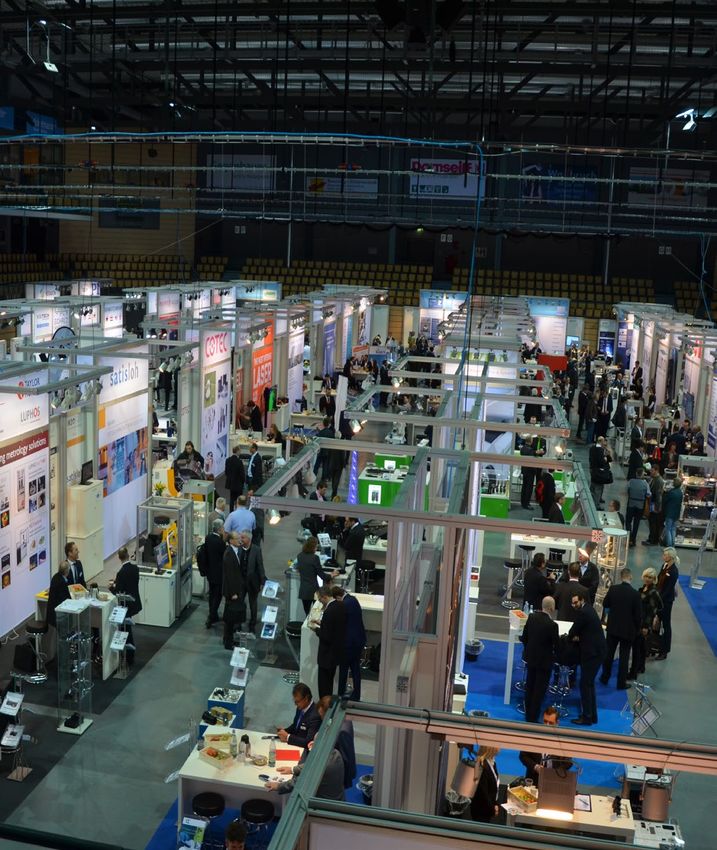
On 21 and 22 February 2017, ELI participated in the W3+ FAIR in Wetzlar, Germany. ELI was rep-
resented by the ELI Beamlines colleagues. In addition to a booth, ELI was also part of the official
program with a mini-workshop coordinated by Georg Korn, the leader of the experimental pro-
grammes at ELI Beamlines, where ELI was introduced, and its capabilities presented to the par-
ticipants. A German news site made a video about the fair, in which the ELI booth is also visible,
see www.1730live.de/wetzlar-das-optik-mekka/.E LInes
ISSUE 06
17
The W3+ FAIR is an interdisciplinary networking trade fair for the fields of optics, elec-
tronics and mechanics. It provides these high-tech sectors with multidisciplinary forum
for information, innovation and contact in the traditional location of Wetzlar in Germany.
More information about this action you can find at: http://w3-messe.de/en/Home.html.
6.3 Laser Photonics event
26-29 June 2017
IIn June, ELI will be present at the biannual, Laser World of Photonics Fair in Munich, the largest
event worldwide in the photonics sector. ELI will have a dedicated booth, presenting the most
up-to-date scientific and technical information, pictures and videos about the facilities. If you
want to contribute, feel free to get in touch with the contacts at the ELI-pillars (see colophon).
More information about the event can be found at www.world-of-photonics.com/E LInes
ISSUE 06
18
Colophon
Publication coordination: Mariann Réda, Sonja Knols, Catalin Miron
Text contributors: Ioan Dancus, Florin Negoita, Carlo Rizzuto, Daniel Ursescu
Your contacts at ELI-pillars: Mariann Réda (ELI-ALPS), Michael Vích (ELI Beamlines),
Georgeta Pana (ELI-NP)
Layout: Mara Tanase
Editing: Sonja KnolsE LInes
ISSUE 06
19
Contact
We offer the possibility to register to the ELInes electronic
newsletter distribution via our website.
We would be happy to collect your comments and receive
suggestions for new subjects to be treated by ELInes. You can
contact us via our website and at elines@eli-laser.eu
© ELI Delivery Consortium 2017
www.eli-laser.eu
info@eli-laser.eu
ExtremeLightInfrastructure
delivery consortium ELI_laser
eli_laser_euYou can also read


