ELPAC Post-Test Guide - 2019-2020 Test Administration Summative ELPAC Student Score Report Technical Information for ELPAC Coordinators and ...
←
→
Page content transcription
If your browser does not render page correctly, please read the page content below
2019–2020 Test Administration

                      ELPAC Post-Test Guide

    Summative ELPAC
  Student Score Report
  Technical Information
 for ELPAC Coordinators
and Research Specialists

© California Department of Education
Prepared by Educational Testing Service ®
Posted May 2020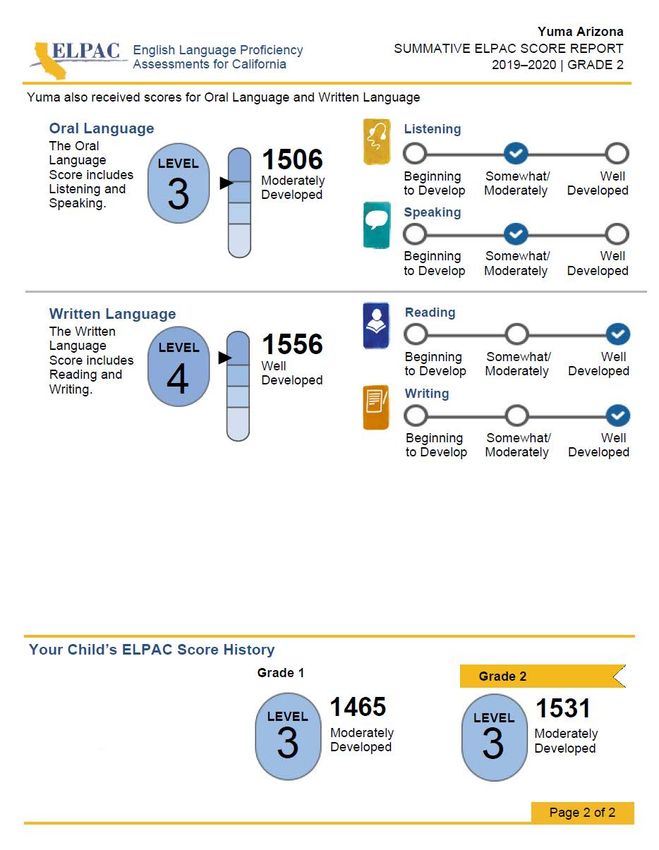
California Assessment System

2019–2020 ELPAC Post-Test Guide
Table of Contents
I. General Information ........................................................................................................... 1
   New in 2019–2020 ............................................................................................................... 2
     Report Delivery .................................................................................................................. 2
     Student Score Reports ...................................................................................................... 2
   Introduction to ELPAC Reporting ......................................................................................... 3
     Purposes of the Reports and Using the Results ................................................................ 3
     Overview of the Summative ELPAC .................................................................................. 3
     Reports Available for the Summative ELPAC .................................................................... 4
     Summative ELPAC Domains and Task Types Reported ................................................... 6
     A Note about Universal Tools, Designated Supports, and Accommodations .................. 10
   Interpreting Results ............................................................................................................ 11
     ELPAC Scale Scores ....................................................................................................... 11
II. Student Score Report Description ................................................................................. 15
   The ELPAC Student Score Report ..................................................................................... 16
     ELPAC Reporting Levels ................................................................................................. 16
     Additional Messaging....................................................................................................... 16
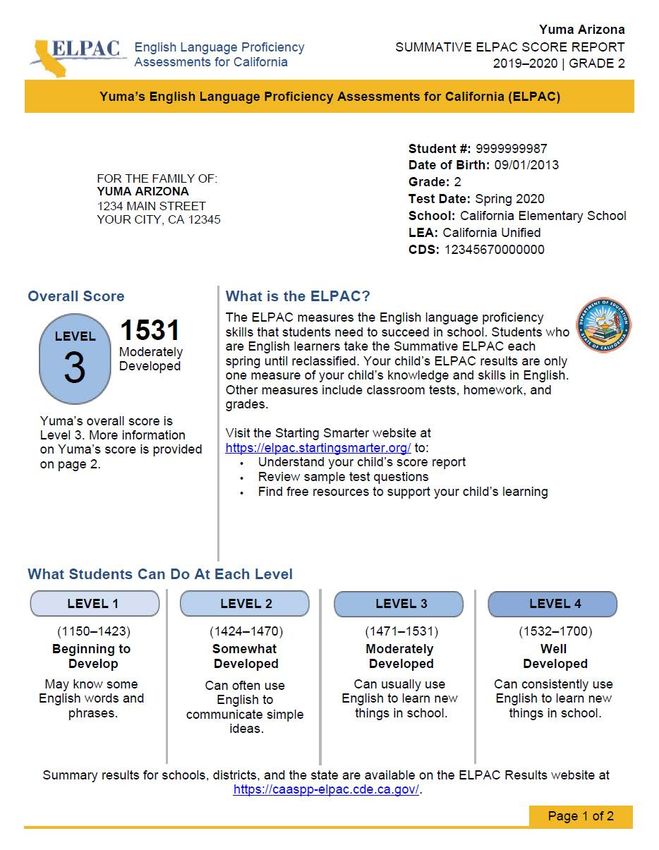
     Page 1 of 2, Top: Student Information ............................................................................. 17
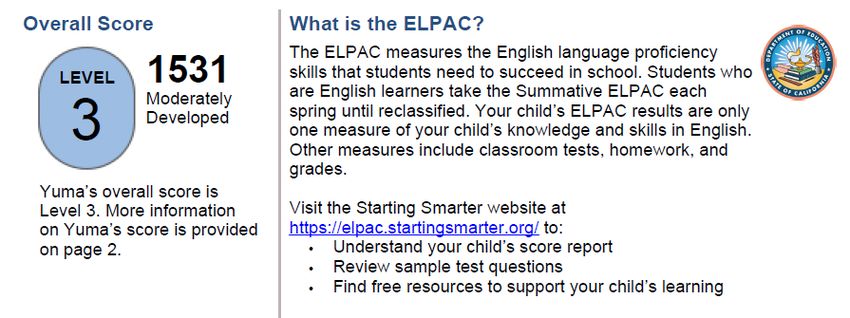
     Page 1 of 2, Middle: Score Overview............................................................................... 18
     Page 1 of 2, Bottom: Reporting Level Descriptions ......................................................... 19
     Page 2 of 2, Top: Composite Scores ............................................................................... 20
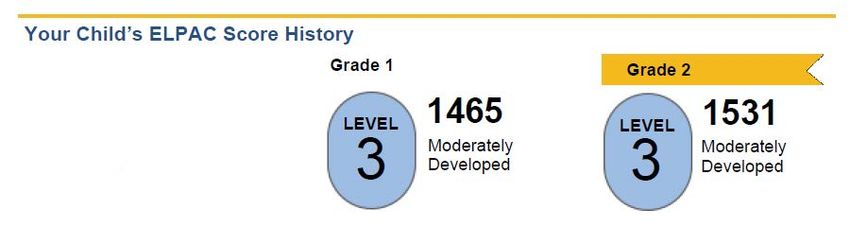
     Page 2 of 2, Bottom: Score History.................................................................................. 21
     Sample of the Student Score Report for the Summative ELPAC .................................... 22
Appendices .......................................................................................................................... 25
   Appendix A. Scale Score Ranges ...................................................................................... 26
   Appendix B. Additional Resources ..................................................................................... 28

 List of Tables
Acronyms and Initialisms in the ELPAC Post-Test Guide........................................................iii
Table I.1 Listening Task Types ............................................................................................... 6
Table I.2 Speaking Task Types .............................................................................................. 7
Table I.3 Reading Task Types ................................................................................................ 8
Table I.4 Writing Task Types .................................................................................................. 9
Table I.5 Overall Reporting Levels ....................................................................................... 12
Table II.1 Student Information Descriptions .......................................................................... 17
Table II.2 Score Overview Descriptions ................................................................................ 18
Table II.3 Reporting Level Descriptions ................................................................................ 19
Table II.4 Composite Scores ................................................................................................ 20
Table II.5 Information About the ELPAC............................................................................... 21

                                                                 – ii –
California Assessment System

         Acronyms and Initialisms in the ELPAC Post-Test Guide
Term                 Description
2012 ELD Standards   2012 California English Language Development Standards
CDE                  California Department of Education
CERS                 California Educator Reporting System
EL                   English learner
ELP                  English language proficiency
ELPAC                English Language Proficiency Assessments for California
LEA                  local educational agency
LOSS                 lowest obtainable scale score
IEP                  individualized education program
PLDs                 performance level descriptors
RFEP                 reclassified fluent English proficient
SSR                  Student Score Report
TOMS                 Test Operations Management System

                                   – iii –
This page is left blank intentionally.
I. General Information
General Information |
New in 2019–2020
New in 2019–2020
Report Delivery
California Educator Data System
• Student performance information can be reviewed through the California Educator
Reporting System (CERS), which is an application available to local educational agency
(LEA) users with the appropriate permissions to view data at the LEA, school, and
grade levels.
LEA Student Data File
• Student data files now include the following data:
− Transitional kindergarten indicator
− Scores from the previous year
− Country of origin
Student Score Reports
General
• Student Score Reports (SSRs) will contain the previous year’s score information.
• SSRs will contain a new footnote for students who used an unlisted resource that
changed the construct of the test.
Report Download
• SSRs can be downloaded in merged PDF files and by language.
• Reports are generated weekly instead of biweekly.
2 2019–2020 ELPAC Post-Test Guide May 2020
Copyright © 2020 by the California Department of Education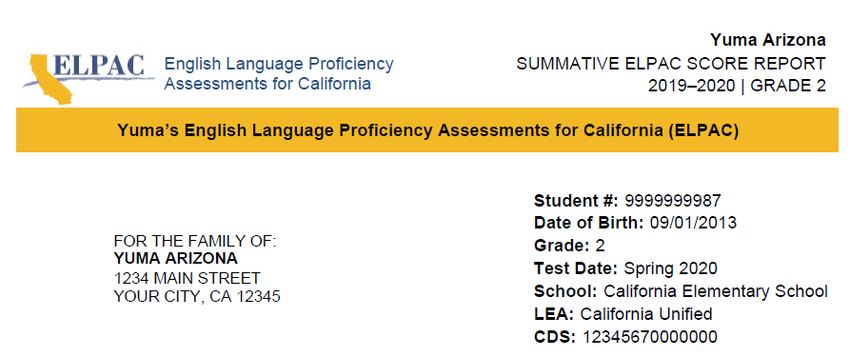
General Information |
Introduction to ELPAC Reporting
Introduction to ELPAC Reporting
Additional Resources Linked in This Section:
• California Department of Education (CDE) Data Privacy web page—
https://www.cde.ca.gov/ds/dp/
• CDE English Language Proficiency Assessments for California (ELPAC) web
page—https://www.cde.ca.gov/ta/tg/ep/
• CDE Matrix Four: Universal Tools, Designated Supports, and Accommodations
for the ELPAC—https://www.cde.ca.gov/ta/tg/ep/documents/elpacmatrix4.docx
• CDE Summative ELPAC General Performance Level Descriptors (PLDs) web
page—https://www.cde.ca.gov/ta/tg/ep/elpacgpld.asp
• CDE Test Results for California’s Assessments website—https://caaspp-
elpac.cde.ca.gov/elpac/
Purposes of the Reports and Using the Results
Summative ELPAC results are used to measure how well English learners (ELs) are
progressing annually toward English language proficiency (ELP). This information is used to
assist LEAs and schools in the ongoing process of program monitoring and evaluation. The
Summative ELPAC results also are one of four criteria used to determine whether ELs are
ready to be designated as reclassified fluent English proficient (RFEP) on the basis of the
reclassification guidance in accordance with state law.
California Code of Regulations, Title 5, Article 2, Section 11518.15(b), requires LEAs to
provide individual Summative ELPAC results to parents or guardians within 30 calendar days
after they are received by the LEA. Only authorized LEA personnel, the student, and parents
or guardians may access the ELPAC results of an individual student.
Overview of the Summative ELPAC
The Summative ELPAC is an annual assessment to measure student progress toward
meeting the 2012 California English Language Development Standards (2012 ELD
Standards), which describe the English language skills that students need to succeed in
school. 1 Information about how the ELPAC reporting levels map to the 2012 ELD Standards
information is included on the CDE Summative ELPAC General PLDs web page.
1California Department of Education. (2014). California 2012 English Language Development
Standards: Kindergarten Through Grade 12. Adopted by the State Board of Education
November 2012. Sacramento, CA: California Department of Education. Retrieved from
https://www.cde.ca.gov/sp/el/er/documents/eldstndspublication14.pdf
May 2020 2019–2020 ELPAC Post-Test Guide 3
Copyright © 2020 by the California Department of Education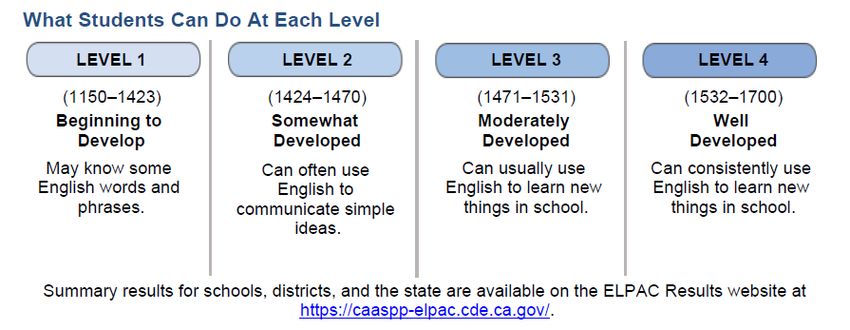
General Information |
Introduction to ELPAC Reporting
As of February 2020, the Summative ELPAC is a computer-based assessment. Students in
grades three through twelve are now administered all ELPAC domains online. Students in
kindergarten through grade two receive the Writing domain as a paper-pencil test, but receive
all other ELPAC domains online. A large-print, paper-pencil version of the Writing domain
assessment is available for students in kindergarten through grade two if this resource is
indicated in the student’s individualized education program (IEP).
ELPAC results can indicate the progress of ELs in acquiring the skills of listening, speaking,
reading, and writing in English. Performance levels are reported in the individual domains of
Listening, Speaking, Reading, and Writing in English. Students will also receive an overall
score that is a combination of two composite scores: an oral language composite score
comprised of the Listening and Speaking domains, and a written language composite score
comprised of the Reading and Writing domains.
Paper-pencil tests are available to students who test using a braille or large-print form or for
students unable to take the assessment online as indicated in the IEP. “Emergency” paper-
pencil versions are available as well. The emergency paper-pencil tests require the CDE’s
approval to order and administer. However, the braille forms for kindergarten through grade
two students do not require CDE approval, since only the paper braille form is available for
these grades during the Summative 2019–2020 administration year. Students assigned to
use a paper-pencil test will use the paper-pencil version for all domains.
Reports Available for the Summative ELPAC
Reporting Criteria
Any student meeting test-taking criteria is reported. Students not meeting at least one
criterion are not reported. What follows are the criteria for receiving test scores:
• Online and paper-pencil testing, grades three through twelve—The student logged on to
at least one domain in each composite or student responses were entered for at least
one domain in each composite.
• Online and paper-pencil testing, all grades—The student logged on to at least one
domain in each composite.
• Online and paper-pencil testing, all grades—An alternate assessment or domain
exemption was assigned to at least one domain in each composite.
• Online testing, all grades—The student logged on to at least one domain in one
composite and has an alternate assessment or domain exemption assigned in the other
composite.
• Paper-pencil testing, kindergarten through grade two: The student is considered a test-
taker if a blank Answer Book is returned to ETS for processing with student
demographic information on the Answer Book.
4 2019–2020 ELPAC Post-Test Guide May 2020
Copyright © 2020 by the California Department of EducationGeneral Information |
Introduction to ELPAC Reporting
Summative ELPAC Student Score Reports
The 2019–2020 Summative ELPAC SSR includes the following information:
• An overall level and scale score
• A level and scale score for each composite reported (oral and written language)
• A performance level for each domain tested (Listening, Speaking, Reading, and Writing)
The SSR provides information about the student’s annual progress toward ELP.
Scale score ranges for each of the four reporting levels are identified for overall, oral
language, and written language for all grades tested. These ranges incorporate the level
threshold scores approved by the California State Board of Education.
The four reporting levels for overall and each composite reported are: well developed (4),
moderately developed (3), somewhat developed (2), and beginning to develop (1).
The student’s ELPAC results
• are one measure of ELP that should be viewed with other available information, such as
classroom tests, assignments, and grades;
• can be used to help talk to the student’s parent or guardian about the student’s progress
made toward English language proficiency; and
• can be used to determine if a student is ready to be designated as RFEP.
Student Results File
Student data files are found in the Test Operations Management System (TOMS). Data files
include student information, overall and individual domain results, and historical scores for
the student if the student has taken the Summative ELPAC in a previous administration.
Aggregated Results Website
ELPAC results are available for the state, LEAs, and schools on the CDE Test Results for
California’s Assessments website.
May 2020 2019–2020 ELPAC Post-Test Guide 5
Copyright © 2020 by the California Department of EducationGeneral Information |
Introduction to ELPAC Reporting
Summative ELPAC Domains and Task Types Reported
The task types assessed in each of the Summative ELPAC domains are identified by grade
level and grade span in the tables in this subsection.
Listening
Table I.1 lists the task types assessed in the Listening domain and indicates whether the task
was assessed in a particular grade level or grade span.
Table I.1 Listening Task Types
Grade Grade Grade Grade
Listening Grade Grade Span Span Span Span
Tasks Kindergarten 1 2 3–5 6–8 9–10 11–12
Listen to a Yes Yes Yes Yes Yes Yes Yes
Short
Exchange
Listen to a No Yes Yes Yes Yes Yes Yes
Classroom
Conversation
Listen to a Yes Yes Yes Yes No No No
Story
Listen to an Yes Yes Yes Yes Yes Yes Yes
Oral
Presentation
Listen to a No No No No Yes Yes Yes
Speaker
Support an
Opinion
6 2019–2020 ELPAC Post-Test Guide May 2020
Copyright © 2020 by the California Department of EducationGeneral Information |
Introduction to ELPAC Reporting
Speaking
Table I.2 lists the task types assessed in the Speaking domain and indicates whether the task
was assessed in a particular grade level or grade span.
Table I.2 Speaking Task Types
Grade Grade Grade Grade
Speaking Grade Grade Span Span Span Span
Tasks Kindergarten 1 2 3–5 6–8 9–10 11–12
Talk About a Yes Yes Yes Yes Yes Yes Yes
Scene
Speech No No Yes Yes Yes Yes Yes
Functions
Support an Yes Yes Yes Yes Yes Yes Yes
Opinion
Retell a Yes Yes Yes Yes No No No
Narrative
Present and No No No No Yes Yes Yes
Discuss
Information
Summarize Yes Yes Yes Yes Yes Yes Yes
an Academic
Presentation
May 2020 2019–2020 ELPAC Post-Test Guide 7
Copyright © 2020 by the California Department of EducationGeneral Information |
Introduction to ELPAC Reporting
Reading
Table I.3 lists the task types assessed in the Reading domain and indicates whether the task
was assessed in a particular grade level or grade span.
Table I.3 Reading Task Types
Grade Grade Grade Grade
Reading Grade Grade Span Span Span Span
Tasks Kindergarten 1 2 3–5 6–8 9–10 11–12
Read-Along Yes No No No No No No
Word with
Scaffolding
Read-Along Yes No No No No No No
Story with
Scaffolding
Read-Along Yes No No No No No No
Information
Read and No Yes Yes No No No No
Choose a
Word
Read and No Yes Yes Yes No No No
Choose a
Sentence
Read a No Yes Yes Yes Yes Yes Yes
Short
Informational
Passage
Read a No No No Yes Yes Yes Yes
Student
Essay
Read a No Yes Yes Yes Yes Yes Yes
Literary
Passage
Read an No Yes Yes Yes Yes Yes Yes
Informational
Passage
8 2019–2020 ELPAC Post-Test Guide May 2020
Copyright © 2020 by the California Department of EducationGeneral Information |
Introduction to ELPAC Reporting
Writing
Table I.4 lists the task types assessed in the Writing domain and indicates whether the task
was assessed in a particular grade level or grade span.
Table I.4 Writing Task Types
Grade Grade Grade Grade
Reading Grade Grade Span Span Span Span
Tasks Kindergarten 1 2 3–5 6–8 9–10 11–12
Label a Yes No No No No No No
Picture—
Word, with
Scaffolding
Write a Story Yes Yes Yes No No No No
Together
with
Scaffolding
Write an No Yes Yes No No No No
Informational
Text
Together
Describe a No Yes Yes Yes Yes Yes Yes
Picture
Write About No Yes Yes Yes Yes Yes Yes
an
Experience
Write About No No No Yes Yes Yes Yes
Academic
Information
Justify an No No No Yes Yes Yes Yes
Opinion
May 2020 2019–2020 ELPAC Post-Test Guide 9
Copyright © 2020 by the California Department of EducationGeneral Information |
Introduction to ELPAC Reporting
A Note about Universal Tools, Designated Supports, and
Accommodations
Matrix Four: Universal Tools, Designated Supports, and Accommodations for the ELPAC
(Matrix Four) provides LEAs the accessibility resources that are available for an ELPAC
administration.
Matrix Four follows a three-tiered accessibility approach that includes universal tools,
designated supports, and accommodations.
1. Universal tools are available to all students through the test delivery system on the
basis of student preference and selection.
2. Designated supports are available to all students through TOMS when determined for
use by an educator or team of educators—with parent/guardian and student input, as
appropriate—or specified in the student’s IEP or Section 504 plan.
3. Accommodations must be permitted on the ELPAC to all eligible students if specified
in the student’s IEP or Section 504 plan. In the computer-based ELPAC, a number of
accommodations are embedded in the assessment, although many non-embedded
accommodations are also available.
Accessibility resources allow all students to show what they know and what they can do.
These resources are not intended to give an advantage, but, rather, to provide students with
the opportunity for a fair and valid testing experience. These include braille and large-print
Answer Books and paper-pencil versions of the test for each ELPAC grade level and grade
span.
Please refer to Matrix Four: Universal Tools, Designated Supports, and Accommodations for
the ELPAC for additional information and a list of the universal tools, designated supports,
and accommodations (embedded and non-embedded) allowed as part of the ELPAC.
Unlisted resources are not universal tools, designated supports, or accommodations. Unlisted
resources are made available if specified in the eligible student’s IEP or Section 504 plan.
With CDE approval, unlisted resources may have been used by LEAs during the 2019–2020
Summative ELPAC administration. If the unlisted resource changed the construct of the test,
the student was given the lowest obtainable scale score and a footnote was placed on the
Student Score Report.
10 2019–2020 ELPAC Post-Test Guide May 2020
Copyright © 2020 by the California Department of EducationGeneral Information |
Interpreting Results
Interpreting Results
The Student Score Report shows the student’s results on the Summative ELPAC, the state
test of ELP. The ELPAC provides information about the student’s annual progress toward
English language proficiency. The student’s 2019–2020 ELPAC results should be compared
only to ELPAC results from the 2018–2019 administration because the threshold scores and
reporting levels are the same for these two administration years.
ELPAC Scale Scores
Scale scores are important measures for the ELPAC. Reporting levels are assigned on the
basis of scale scores for all tests. Scale scores were identified during a process called
“standard setting.” Once set, the scale scores for each grade level do not change between
administrations, which means they can be used to determine year-to-year gains in student
English proficiency.
The advantage of the scale score metric is that it allows a particular score—for example, an
overall score of 1585 on the grade five Summative ELPAC—to mean the same thing
regardless of what items students took for a grade-level, English language proficiency test.
Scale scores provide a common reference over the years.
Each ELPAC grade level or grade span has its own scale score range.
Equating and Scaling
When tests are constructed for each grade or grade span, every effort is made to make the
tests parallel and of the same level of difficulty from one year to another. However, even with
those efforts, small differences in test difficulty still exist between test forms. A psychometric
procedure called equating makes adjustments for test difficulty so that students in one year
are held to the same standards as students in another year.
In the case of the 2019–2020 Summative ELPAC, grade level or grade span test forms were
administered. Then, student item responses were used to put student scores onto the
previous year’s scale through the equating process. Details about equating and scaling for
operational assessments and information about test development will be described in an
upcoming report, the “ELPAC Mode Comparability Study.”
Scale Score Ranges
Assessments were scaled vertically after the 2016–2017 field test, which means that scores
for certain questions that were common between adjacent grades were linked. This will make
it possible to monitor students’ year-to-year progress in learning English and to describe
student progress over time across grade levels.
Scale scores offer a more precise way to determine students’ performance on the
assessments than reporting levels, which are described in the next subsection, because each
reporting level is based on a range of numbers, rather than an individual number like a scale
May 2020 2019–2020 ELPAC Post-Test Guide 11
Copyright © 2020 by the California Department of EducationGeneral Information |
Interpreting Results
score. Scale score ranges for the Summative ELPAC range from 1150–1950 and are listed in
appendix A.
ELPAC Reporting Levels
ELPAC overall reporting levels are designations given to particular scale score ranges. The
minimum and maximum scale scores for each level vary by grade and grade span.
Performance levels for domains are also reported for Listening, Speaking, Reading, and
Writing.
Threshold scores—the maximum scores at Level 1, Level 2, Level 3, and Level 4 by grade or
grade span—determine the scale score ranges for Summative ELPAC reporting levels.
These were set based on a standard setting and validation study that used the 2017–2018
operational ELPAC data. The results allow meaningful comparisons between individual
students and group comparisons between schools and local educational agencies across
grades.
Overall Reporting Levels
Table I.5 lists the four ELPAC reporting levels and describes what students at each level can
typically do at each level.
Table I.5 Overall Reporting Levels
Reporting Level What Students Can Typically Do at Each Level
Level 4 Students at this level have well developed English skills
• They can usually use English to learn new things in school and to
interact in social situations.
• They may occasionally need help using English.
Level 3 Students at this level have moderately developed English skills.
• They can sometimes use English to learn new things in school and
to interact in social situations.
• They may need help using English to communicate on less-familiar
school topics and in less-familiar social situations.
Level 2 Students at this level have somewhat developed English skills.
• They usually need help using English to learn new things at school
and to interact in social situations.
• They can often use English for simple communication.
Level 1 Students at this level are beginning to develop English skills.
• They usually need substantial help using English to learn new things
at school and to interact in social situations.
• They may know some English words and phrases.
12 2019–2020 ELPAC Post-Test Guide May 2020
Copyright © 2020 by the California Department of EducationGeneral Information |
Interpreting Results
Domain Reporting Levels
The student’s overall score is a combination of two other scores: an oral language composite
score comprised of the Listening and Speaking domains, and a written language composite
score comprised of the Reading and Writing domains.
Domain-level performance is reported as Beginning to Develop, Somewhat/Moderately, and
Well Developed on the ELPAC SSR.
May 2020 2019–2020 ELPAC Post-Test Guide 13
Copyright © 2020 by the California Department of EducationGeneral Information |
Interpreting Results
This page is left blank intentionally.
14 2019–2020 ELPAC Post-Test Guide May 2020
Copyright © 2020 by the California Department of EducationII. Student Score Report
DescriptionStudent Score Report Description |
The ELPAC Student Score Report
The ELPAC Student Score Report
This section explains the student’s Summative English Language Proficiency Assessments
for California (ELPAC) Student Score Report (SSR). Data displayed on the samples in this
guide are for demonstration purposes only and do not reflect valid data.
ELPAC Reporting Levels
For the overall score and the composite scores—oral language score for the Listening and
Speaking domains, and written language score for the Reading and Writing domains—there
are four possible reporting levels:
1. Well Developed (Level 4)
2. Moderately Developed (Level 3)
3. Somewhat Developed (Level 2)
4. Beginning to Develop (Level 1)
For the domain scores, there are three possible reporting levels:
1. Well Developed (Level 3)
2. Somewhat/Moderately (Level 2)
3. Beginning to Develop (Level 1)
Additional Messaging
In cases where a domain exemption was requested for a student with a disability that
precludes student testing in one or more domains, the student was assessed in the remaining
domains in which it was possible to assess the student. A tilde (~) is present in the table next
to the domain name, and the following message will appear on the second page of the SSR:
῀ Student was exempted from one or more domains of the ELPAC. Scores for
the composite were calculated based on the completed domain(s).
Some students whose individualized education program team determined that a student with
the most significant cognitive disabilities was unable to participate in one or more domains of
the ELPAC, even with accommodations, took a locally determined alternate assessment
instead of the ELPAC. In these cases, where the LEA assigned the student in the Test
Operations Management System (TOMS) to take an alternate assessment, an asterisk (*) is
present in the table next to the domain name, and the following message appears on the
second page of the SSR:
* A locally determined alternate assessment was used for one or more
domains. The student received the lowest score in that domain.
16 2019–2020 ELPAC Post-Test Guide May 2020
Copyright © 2020 by the California Department of EducationStudent Score Report Description |
The ELPAC Student Score Report
When a testing irregularity occurred during an ELPAC administration and a case for the
irregularity was opened in the Security and Test Administration Incident Reporting System, it
is noted with a caret (^) in the table next to the domain name and the following message
appears at the bottom of the first page of the SSR:
^ A testing irregularity occurred during the administration of this domain, but it
did not affect the student’s score. More information can be obtained at the
school.
Finally, a student might have tested using an unlisted resource that was assigned by the LEA
in TOMS. When the assigned unlisted resource changed the construct being tested, the
following message, noted with a pound sign (#), appears on the second page of the SSR:
# An unlisted resource that changed the construct was used for one or more
domains. The student received the lowest score in that domain.
Page 1 of 2, Top: Student Information
1 2
Table II.1 Student Information Descriptions
Callout Feature Description
1. Student’s mailing This area shows the student’s residential address as
address listed in the California Longitudinal Pupil Achievement
Data System.
2. Student and school This area shows information about the student and the
information school and local educational agency name, as well as
the county/district code.
Note: The grade noted indicates the grade in which
the student was enrolled at the start of testing.
May 2020 2019–2020 ELPAC Post-Test Guide 17
Copyright © 2020 by the California Department of EducationStudent Score Report Description |
The ELPAC Student Score Report
Page 1 of 2, Middle: Score Overview
2
1
3
Table II.2 Score Overview Descriptions
Callout Feature Description
1. Overall score and This box provides the student’s overall score and level
level for the ELPAC with a brief summary of the student’s
performance.
2. Testing program This area provides a description of the ELPAC.
overview
3. Starting Smarter This section describes the new Smarter Balanced
website information Starting Smarter website, which describes student
score reports and other information that supports
student learning.
18 2019–2020 ELPAC Post-Test Guide May 2020
Copyright © 2020 by the California Department of EducationStudent Score Report Description |
The ELPAC Student Score Report
Page 1 of 2, Bottom: Reporting Level Descriptions
1
2
3
Table II.3 Reporting Level Descriptions
Callout Feature Description
1. Reporting levels This row lists the Summative ELPAC reporting levels.
2. Level description This row provides the following information for each
level:
• Score range
• Level name
• Level description
3. ELPAC results This section describes the ELPAC public reporting
website information website on which results for schools, districts, and the
state are found.
May 2020 2019–2020 ELPAC Post-Test Guide 19
Copyright © 2020 by the California Department of EducationStudent Score Report Description |
The ELPAC Student Score Report
Page 2 of 2, Top: Composite Scores
1 2
3
4
Table II.4 Composite Scores
Callout Feature Description
1. Composite skill The title in each section displays the name of the
composite skill, either oral language or written
language.
2. Score and level The graph represents the student’s score and reporting
level for the composite.
3. Domains within the The reporting levels for the domains that comprise a
composite composite are presented—Listening and Speaking for
the oral language composite, and Reading and Writing
for the written language composite.
4. Domain levels This section of the chart shows reporting levels for the
assessment’s domains; a check mark indicates a
student’s domain reporting level—either Beginning to
Develop, Somewhat/Moderately, or Well Developed.
20 2019–2020 ELPAC Post-Test Guide May 2020
Copyright © 2020 by the California Department of EducationStudent Score Report Description |
The ELPAC Student Score Report
Page 2 of 2, Bottom: Score History
1 2
Table II.5 Information About the ELPAC
Callout Feature Description
1. Score history The leftmost graph shows the student’s overall score
(grades one through and reporting level from the 2018–2019 ELPAC
twelve only) administration.
2. Current-year’s score The rightmost graph shows the student’s overall score
and reporting level from the current ELPAC
administration.
May 2020 2019–2020 ELPAC Post-Test Guide 21
Copyright © 2020 by the California Department of EducationStudent Score Report Description |
The ELPAC Student Score Report
Sample of the Student Score Report for the Summative
ELPAC
Page 1
22 2019–2020 ELPAC Post-Test Guide May 2020
Copyright © 2020 by the California Department of EducationStudent Score Report Description |
The ELPAC Student Score Report
Page 2
May 2020 2019–2020 ELPAC Post-Test Guide 23
Copyright © 2020 by the California Department of EducationStudent Score Report Description |
The ELPAC Student Score Report
This page is left blank intentionally.
24 2019–2020 ELPAC Post-Test Guide May 2020
Copyright © 2020 by the California Department of EducationAppendices
Appendices |
Appendix A. Scale Score Ranges
Appendix A. Scale Score Ranges
Level 1 Level 1 Level 2 Level 2 Level 3 Level 3 Level 4 Level 4
Grade Level Score Type Minimum Maximum Minimum Maximum Minimum Maximum Minimum Maximum
Kindergarten Overall 1150 1373 1374 1421 1422 1473 1474 1700
Kindergarten Oral Language 1150 1385 1386 1426 1427 1477 1478 1700
Kindergarten Written Language 1150 1345 1346 1409 1410 1462 1463 1700
1 Overall 1150 1410 1411 1454 1455 1506 1507 1700
1 Oral Language 1150 1407 1408 1450 1451 1492 1493 1700
1 Written Language 1150 1413 1414 1458 1459 1519 1520 1700
2 Overall 1150 1423 1424 1470 1471 1531 1532 1700
2 Oral Language 1150 1413 1414 1459 1460 1509 1510 1700
2 Written Language 1150 1432 1433 1480 1481 1553 1554 1700
3 Overall 1150 1447 1448 1487 1488 1534 1535 1800
3 Oral Language 1150 1434 1435 1465 1466 1511 1512 1800
3 Written Language 1150 1460 1461 1508 1509 1556 1557 1800
4 Overall 1150 1458 1459 1498 1499 1548 1549 1800
4 Oral Language 1150 1438 1439 1471 1472 1521 1522 1800
4 Written Language 1150 1477 1478 1524 1525 1574 1575 1800
5 Overall 1150 1466 1467 1513 1514 1559 1560 1800
5 Oral Language 1150 1446 1447 1476 1477 1532 1533 1800
5 Written Language 1150 1486 1487 1549 1550 1586 1587 1800
6 Overall 1150 1474 1475 1516 1517 1566 1567 1900
6 Oral Language 1150 1449 1450 1483 1484 1541 1542 1900
6 Written Language 1150 1498 1499 1549 1550 1591 1592 1900
26 2019–2020 ELPAC Post-Test Guide May 2020
Copyright © 2020 by the California Department of EducationAppendices |
Appendix A. Scale Score Ranges
Scale Score Ranges (continuation)
Level 1 Level 1 Level 2 Level 2 Level 3 Level 3 Level 4 Level 4
Grade Level Score Type Minimum Maximum Minimum Maximum Minimum Maximum Minimum Maximum
7 Overall 1150 1480 1481 1526 1527 1575 1576 1900
7 Oral Language 1150 1455 1456 1497 1498 1553 1554 1900
7 Written Language 1150 1504 1505 1555 1556 1597 1598 1900
8 Overall 1150 1485 1486 1533 1534 1589 1590 1900
8 Oral Language 1150 1460 1461 1504 1505 1568 1569 1900
8 Written Language 1150 1509 1510 1561 1562 1609 1610 1900
9 Overall 1150 1492 1493 1544 1545 1605 1606 1950
9 Oral Language 1150 1464 1465 1511 1512 1578 1579 1950
9 Written Language 1150 1519 1520 1577 1578 1631 1632 1950
10 Overall 1150 1492 1493 1544 1545 1605 1606 1950
10 Oral Language 1150 1464 1465 1511 1512 1578 1579 1950
10 Written Language 1150 1519 1520 1577 1578 1631 1632 1950
11 Overall 1150 1499 1500 1554 1555 1614 1615 1950
11 Oral Language 1150 1469 1470 1513 1514 1582 1583 1950
11 Written Language 1150 1528 1529 1594 1595 1645 1646 1950
12 Overall 1150 1499 1500 1554 1555 1614 1615 1950
12 Oral Language 1150 1469 1470 1513 1514 1582 1583 1950
12 Written Language 1150 1528 1529 1594 1595 1645 1646 1950
May 2020 2019–2020 ELPAC Post-Test Guide 27
Copyright © 2020 by the California Department of EducationAppendices |
Appendix B. Additional Resources
Appendix B. Additional Resources
California Department of Education English Language Development Standards—
https://www.cde.ca.gov/sp/el/er/documents/eldstndspublication14.pdf
California Department of Education English Language Proficiency Assessments for California
(ELPAC) web page—
https://www.cde.ca.gov/ta/tg/ep/
California Department of Education Test Blueprints for the Summative ELPAC web
document—
https://www.cde.ca.gov/ta/tg/ep/documents/elpacsummativebluprt.pdf
California Technical Assistance Center’s ELPAC website—
https://www.elpac.org/
ELPAC Starting Smarter website—
https://elpac.startingsmarter.org/
28 2019–2020 ELPAC Post-Test Guide May 2020
Copyright © 2020 by the California Department of EducationYou can also read


