Embrace Surgical Transfer Guidelines for Newborns - Sheffield ...
←
→
Page content transcription
If your browser does not render page correctly, please read the page content below

CAEC Reg. ID no. EMB1800

Embrace Surgical
Transfer Guidelines for
Newborns

Reference:        EMB1800
Written by:       Cath Harrison
Peer reviewer     Steve Hancock
Approved:         July 2020
Review Due:       July 2021

Purpose
Guidance for the referral and stabilization of newborns transferred with surgical
conditions for potential surgical procedures.

Intended Audience
Embrace clinical staff and referral hospital clinical staff.

SC(NHS)FT;                                                           Page 1 of 13
Updated: Review date: July 2021
Authors: Cath Harrison
CAEC Reg. ID no. EMB1800

 Contents
                                                          Page

Introduction                                              3
Referral                                                  3

Section 1. General Stabilization Procedures for all babies 3

1.1. Pain assessment                                      3

1.2. Gastro-intestinal problems                           3

1.3. X-ray and diagnostics                                4

1.4. Drugs                                                4

1.5. Parents                                              4

1.6 Embrace team                                          4

1.7 During transfer                                       4

Section 2. Specific Conditions                            4

2.1. Oesophageal atresia / Tracheo-oesophageal fistula    4

2.2. Abdominal wall defects                               5

2.3. Abdominal distension / suspected bowel obstruction   6

2.4. Necrotising enterocolitis                            6

2.5. Congenital diaphragmatic hernia                      7

2.6. Pneumothorax / pneumomediastinum                     7

2.7. Choanal atresia                                      8

2.8. Pierre Robin / Micrognathia                          8

2.9 Neural tube defects                                   9

Appendices                                                10

 SC(NHS)FT;                                                      Page 2 of 13
 Updated: Review date: July 2021
 Authors: Cath Harrison
CAEC Reg. ID no. EMB1800
INTRODUCTION
REFERRAL
Referrals for surgical patients come through Embrace Yorkshire & Humber Infant &
Children Transport Service (Embrace) if transfer is anticipated.
For surgical referrals from Sheffield Teaching Hospital Jessop Wing requiring
emergency surgery at Sheffield Childrens Hospital NHS Foundation Trust (SCH), the
referral should be made by telephone and the call conference should include a
surgeon, anaesthetist, neonatologist and the Embrace consultant.
If intensive care is required the NICU Consultant will also be asked to join the call to
provide advice. General Surgical patients will not be refused without discussion with
the General Surgical Consultant on call and the Consultant will always be contacted
for decisions about patient transfer after 2200 hours.
Time critical surgical neonatal patients will routinely be transferred by Embrace. In
exceptional circumstances, when a transport team is not immediately available, the
referring hospital team may be required to transfer the patient. Guidance is available
(appendix 2).
1. GENERAL STABILIZATION PROCEDURES FOR ALL SURGICAL BABIES
1.1 Airway and Breathing
Some conditions require specific considerations to stabilise A and B without
compromising stability. See below for details.
Pain assessment
o Consider IV paracetamol and/or morphine infusion
1.2 Circulation
o 2 points of secure i.v. access or a double lumen UVC
o Keep nil by mouth
o Indwelling 8 or 10 g gastric tube (Replogle tube if available for suspected
oesophageal atresia/ trachea-oesophageal fistula (OA/TOF))
Position confirmed by X-ray or acid positive pH paper
On free drainage
Frequent aspiration
If baby premature and small, consider smaller size gastric tube
o IV fluid management
Remember maintenance fluids and replacement fluids for
losses
Maintenance - 10% glucose with additives or 10% glucose and
0.45% sodium chloride
We do not infuse TPN during transfer
Losses from gastric tubes – If loss is greater than 20 ml/kg
over 24 hours replace with 0.45% sodium chloride or 0.9%
sodium chloride (with 20mmol/litre potassium chloride) Please
discuss with accepting surgical consultant
SC(NHS)FT; Page 3 of 13
Updated: Review date: July 2021
Authors: Cath Harrison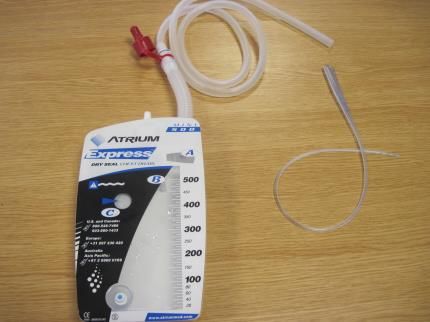
CAEC Reg. ID no. EMB1800
Fluid boluses for hypovolaemia - use 0.9% sodium chloride or
4.5% human albumin solution (babies will be losing protein-rich
fluid from gut)
Beware of excessive fluid losses, e.g. in gastroschisis,
exomphalos and necrotising enterocolitis (NEC)
1.3 X-ray and radiology
o X rays and radiology images to be sent to receiving unit by PACS
o Alternatively hard copies or a CD must be transferred with the baby
1.4 Drugs
o Antibiotics – should be discussed with accepting surgical team
o Morphine infusion preferred for sedation and/or analgesia
o Ensure Vitamin K has been prescribed and administered IM or IV prior to
transfer in all surgical babies. Document this clearly
1.5 Parents
o Ensure maternal blood is taken for cross-matching – appropriate bottle,
fully labelled by hand (appendix 1)
o Written consent will be obtained by Consultant Surgeon upon arrival at
receiving hospital. Consent will be taken by telephone in case parents not
able to travel to receiving hospital
o Please ensure contact details are documented clearly
1.6 Stability
o It may not be possible to achieve total stability before transfer in critically
ill infants. Resuscitation must take place, but if the baby cannot be
stabilised without surgical intervention, there may be occasions where it
is better to transfer the baby urgently without achieving total stability. This
is a difficult judgment and must be discussed with the Consultant
Surgeon / Neonatologist and Embrace Consultant at the receiving
hospital
1.7 During transfer
o Avoid hypothermia in all circumstances - minimum interference reduces
temperature stress on infant
o Continually assess circulatory status
o Consider further fluid boluses
o Consider inotropes
2. SPECIFIC CONDITIONS
2.1 Oesophageal atresia / tracheo-oesophageal fistula (OA/TOF)
Airway and breathing:
o Avoid ventilation if possible - inspiratory gases take path of least
resistance (= through fistula) and may cause significant abdominal
distension (or perforation). This can lead to a life threatening splinting of
the diaphragm and failure to ventilate/oxygenate
SC(NHS)FT; Page 4 of 13
Updated: Review date: July 2021
Authors: Cath HarrisonCAEC Reg. ID no. EMB1800
o If ventilation needed - urgent consultation with Consultant Neonatologist /
Surgeon on-call
o This is now a time critical transfer and the baby must be moved as soon
as possible to avoid prolonged ventilation prior to surgery
Circulation:
o As above
o Insert Replogle tube (or 10G gastric tube)
In pouch
On continuous drainage + aspirate and flush at least every 10
minutes:
- To keep upper pouch empty and prevent overflow or
tracheal compression
- Must be done, even if infant does not appear to have
excess secretions
Suction mouth with standard suction catheter if secretions
present every 20-30 minutes
Drugs:
o If ventilated, commence morphine infusion for sedation and consider
muscle relaxation for transfer
During transfer:
o Baby to be nursed prone if possible
o Try to keep infant comfortable (crying promotes gastric distension and
subsequent regurgitation / aspiration)
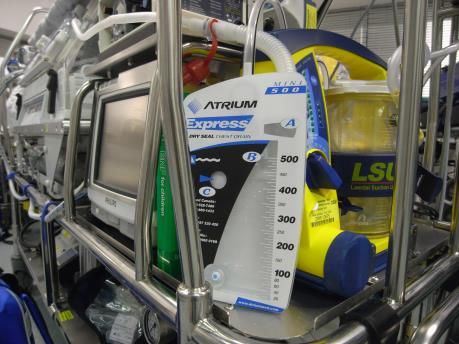
o Attach Replogle tube to Atrium drain on continuous suction (Appendix 3)
o If excess secretion, may need to stop to flush tube with sodium chloride
and use “bulb” mechanism for further suction
o Do not leave syringe attached to the replogle tube as this will alter
suctioning ability
2.2 Abdominal wall defects: gastroschisis / exomphalos / ectopic bladder
Airway and breathing:
o These infants rarely need intubation and ventilation for transfer unless co-
morbidities lead to respiratory compromise
Circulation:
o as above
Drugs:
o Start first line antibiotics plus metronidazole
Exposed viscera:
o Cover with plastic/cling-film (does not need to be sterile)
o Contra-indicated: cotton wool and sodium chloride soaks
o Exomphalos with intact sac must be handled with extreme care to
prevent rupture, avoid pressure and kinking, and prevent stool
contamination of the defect
o Ectopic bladder - gelaperm is more gentle
During transfer:
o Nurse baby on side as this relieves tension on the mesentery
SC(NHS)FT; Page 5 of 13
Updated: Review date: July 2021
Authors: Cath HarrisonCAEC Reg. ID no. EMB1800
o Close observation of viscera - if circulation appears to be compromised,
then reposition viscera in relation to infant (inspect base of viscera mass)
o Consider administration of fluid boluses
o Consider supplementary oxygen
o Regular temperature, pulse, respiration rate and BP monitoring
2.3 Abdominal distension / suspected bowel obstruction
Airway and breathing:
o Consider intubation and ventilation if abdominal distension compromising
respiratory status
o If ventilation problematic and chest movement difficult to achieve despite
high pressure, discuss with consultant surgeon re abdominal drain
o Check blood gas including lactate
Circulation:
o as above
o These babies can lose a lot of fluid and need close monitoring
o Assess and correct shock with fluid boluses
o May need inotropes
During transfer:
o Nurse in supine position
o If abdominal distension significant - close observation for hypoxia (due to
splinting effect) and raise head of mattress to try and improve respiratory
status.
2.4 Necrotising enterocolitis (NEC)
Airway and breathing:
o Ventilate if hypotensive or acidotic
Circulation:
o As above
o Fluid loss can be an issue – consider fluid boluses after assessment of
circulatory status
o Check FBC, clotting and consider administration of FFP/extra Vitamin
K/platelets/blood
o If UAC/UVC in situ, do not remove
Drugs:
o Start first line antibiotics plus metronidazole (e.g. IV Amoxicillin +
Gentamicin plus Metronidazole)
o Remember pain relief - may need morphine bolus and then continuous
infusion and/or IV paracetamol
2.5 Congenital diaphragmatic hernia
Usually antenatally diagnosed with planned delivery in a tertiary centre.
Airway and breathing:
o Insert a 8-10 g gastric tube immediately, aspirate and leave on free
drainage
o Intubate as soon as diagnosis is made, without using bag and mask
ventilation, using adequate sedation and muscle relaxation
SC(NHS)FT; Page 6 of 13
Updated: Review date: July 2021
Authors: Cath HarrisonCAEC Reg. ID no. EMB1800
o "Gentle ventilation" to avoid barotrauma or pneumothorax (no
hyperventilation). This technique will necessitate relatively higher COs
levels to be tolerated.
o Surfactant not indicated, unless less than 33 weeks gestation
o Monitor pre- and post-ductal saturations
o Ventilate in 100% O2 regardless of saturations
o May require nitric oxide for pulmonary hypertension
Circulation:
o As above
o UVC and UAC desirable
NGT on continuous drainage
Aspirate at least every 10 minutes to decompress stomach
o Achieve good blood pressure with use of inotropes- dopamine and
dobutamine to support blood pressure
Drugs:
o Commence on morphine infusion
o Commence on atracurium infusion or regular pancuronium
During transfer:
o Nitric oxide
o Keep baby sedated and muscle relaxed
o Maintain good BP - preferably with arterial monitoring
Adjust inotropes to achieve this
o Carefully observe for the possible occurrence of pneumothorax
(unaffected side)
See Embrace CDH guideline
2.6 Pneumothorax / pneumomediastinum
Airway and breathing:
o If under tension the air leak must be drained by needle thoracocentesis.
o Maintain airway patency and support respiratory drive prior to considering
formal drainage, unless under tension and patient in extremis
o Pneumothorax which is not under tension and causing minimal
symptoms:
Formal drainage must be done if ventilated or on CPAP
because risk of tension is significant
Seldinger drain catheter placement is preferred
Secure catheter with large Opsite dressing
Use Atrium pneumostat in transit
o Tension pneumothorax during transfer:
= Catastrophic event causing sudden and severe
deterioration
Perform needle thoracocentsis aspiration immediately
o Pneumomediastinum:
Chest drain has very limited value
Place infant in ambient oxygen concentration of 100% to
enhance absorption of gas collection
Circulation:
o As above
SC(NHS)FT; Page 7 of 13
Updated: Review date: July 2021
Authors: Cath HarrisonCAEC Reg. ID no. EMB1800
Drugs:
o Remember analgesia for insertion and post-insertion of drains.
During transfer:
o Chest drain catheter must be securely fixed in position prior to transfer -
large Opsite dressing
o Chest drain catheter must be attached to an Atrium pneumostat
2.7 Choanal atresia
Airway and breathing:
o If bilateral, infant is unable to breathe through nose
o Oro-pharyngeal airway (appropriately sized Guedel) must be provided -
secure in place with tape
Circulation:
o As above
During transfer:
o Close observation of breathing pattern during transfer is essential
2.8 Pierre Robin / micrognathia
Airway and breathing:
o If significant respiratory distress, then place oro-pharyngeal airway
(appropriately sized Guedel) or consider naso-pharyngeal airway; secure
for transfer.
o If endotracheal intubation is considered, this must be discussed with
Transport Consultant before any attempt is made. This can be extremely
difficult - ask for help from referring unit Consultants in
neonatology/paediatrics, anaesthetics, ENT
During transfer:
o Nurse and transfer infant in prone position, as this usually improves
airway patency
2.9 Neural tube defects: meningocele / encephalocele
Airway and breathing:
o Maintain open airway
o Ventilation not usually required
o If associated hydrocephalus and large head size, airway positioning is
important
Drugs:
o Start first line antibiotics e.g IV Amoxicillin + Gentamicin
Position:
o Nurse infant in prone position to prevent pressure on lesion
o Sterile dressing if sac is ruptured
o Cover back in cling film to prevent stool contamination - can use
Gelaperm/gauze and light bandage
During transfer:
o Nurse infant in prone position to prevent pressure on lesion
SC(NHS)FT; Page 8 of 13
Updated: Review date: July 2021
Authors: Cath HarrisonCAEC Reg. ID no. EMB1800
Appendix 1
Preparing a neonatal patient for emergency transfer
The transport medicine environment is challenging. For transfer to occur safely your patient
may need interventions that would not be performed if the patient remained in your
hospital. To minimise the time the Embrace team needs to prepare the patient for
transport, please consider the following check list before the team arrives. Additional
resources are available at www.embrace.sch.nhs.uk
Documentation and communication (*as appropriate)
Be prepared to verbally handover to the Embrace team
Update the parents on the baby’s condition and the plans for transfer
Photocopies of recent relevant notes, recent investigation results, drug chart, TPN
prescription*
Badger summary or transfer letter with relevant history
Highlight/document any safeguarding concerns*
Transfer relevant radiology to receiving hospital by PACS (CD or hard copy are
alternatives)
Maternal blood sample (6ml EDTA)- fully labelled with request form
- First name
- Last name
- Date of birth
- NHS number
- Date & time of sample
- Name and signature of person taking sample
Patient preparation
Neo-Fit device to secure ETT, use a “Push Test” to ensure the tube does not move.
Confirm and document position on CXR (T2 ideal for transfer)
Stabilised on a suitable mode of ventilation
Recent blood gas and blood glucose *
Gastric tube in situ and secured*
Minimum 2 points of IV access, well secured
If umbilical lines are indicated:
Double lumen UVC
UVC position checked and documented – not in heart or liver
UAC position checked and documented – ‘high’ (T6-T9) or ‘low’ (below L3)
Prepare suitable maintenance fluids, and all other infusions in 50ml fully labelled
syringes
TPN cannot be infused during transfer
Complete urgent transfusion of blood products and order any anticipated products
necessary for transfer.
o
Maintain temperature above 36.5 C (unless therapeutically cooled)
Follow TOBY guidance for passive therapeutic cooling including rectal temperature
monitoring
On arrival, the Embrace team will:
Introduce themselves, take handover and assess the patient
Review copies of patient documentation, charts and drug card
Contact the Embrace Consultant as required
Ensure patient is prepared for transfer
o Transport monitoring
o Check ETT and IV access are correctly positioned and well secured
o Check all prescriptions, infusions and swap to transport pumps
o Stabilise on transport ventilator and perform a blood gas
o Transfer to the transport incubator/baby pod and secure baby and equipment
Communicate with parents and discuss travel arrangements
SC(NHS)FT; Page 9 of 13
Updated: Review date: July 2021
Authors: Cath HarrisonCAEC Reg. ID no. EMB1800
One parent may be able to travel with their baby but mothers must be:
- Discharged fully from in-patient maternal care
- At least 24 hours post vaginal delivery
- At least 72 hours post LSCS
- Physically able to walk and climb steps into ambulance independently
_______________________________________________________________
For further information or assistance please call Embrace to speak directly to a Transport Consultant
0114 268 8180
SC(NHS)FT; Page 10 of 13
Updated: Review date: July 2021
Authors: Cath HarrisonCAEC Reg. ID no. EMB1800
Appendix 2
Preparing a patient for a time critical one-way transfer by the referring hospital
team
The transport medicine environment is challenging particularly for time critical transfers. For transfer to occur
safely your patient may need interventions that would not be performed if the patient remained in your hospital. To
minimise the time needed to prepare the patient for transport, please consider the following check list.
Remember to always involve Embrace from the time of seeking specialist advice in order to facilitate the
most efficient and appropriate transfer for your patient.
Further resources to support this process, including the Safe Transfer Of Paediatric Patients (STOPP) tool are
available at www.embrace.sch.nhs.uk
Documentation and communication (*as appropriate)
Update the parents on the child’s condition and the plans for transfer
Photocopies of recent relevant notes, recent investigation results, drug chart*
Highlight/document any safeguarding concerns*
Transfer relevant radiology to receiving hospital by PACS (CD or hard copy are alternatives)
Maternal blood sample (6ml EDTA) - fully labelled with request form (babies under 3months) *
- First name
- Last name
- Date of birth
- NHS number
- Date & time of sample
- Name and signature of person taking sample
Patient preparation
ETT secured using tape (Elastoplast/zinc oxide), confirm tube does not move with a “push test”
Confirm and document position on CXR (T2 is ideal for transfer)
On transport ventilator with continuous ETCO2 monitoring
Recent blood gas demonstrating adequate gas exchange and normal blood glucose
Adequate analgesia, sedation and muscle relaxation*
Gastric tube*
Minimum 2 points of IV access, well secured
Maintenance fluids and all other infusions fully labelled
Pupillary responses monitored and recorded regularly
Seizures controlled and metabolic causes excluded
o
Maintain temperature above 36.5 C (unless therapeutically cooled)
Adequate patient monitoring for transport – ECG, BP, SaO2, ETCO2, Temp
Patient and equipment adequately secured for transport
Emergency airway and breathing equipment
Adequate gas supply available for journey
Emergency fluids and drugs
Assess risk of staff involved in transfer and consider change of personnel if inexperienced or fatigued
___________________________________________________________________________
For further information or assistance please call Embrace to speak directly to a Transport Consultant
0114 268 8180
SC(NHS)FT; Page 11 of 13
Updated: Review date: July 2021
Authors: Cath HarrisonCAEC Reg. ID no. EMB1800
Appendix 3
TOFS = REPLOGLE = ATRIUM (mini 500)
NNU continuous Replogle suctioning pressure equates to 3-4 cmh20
Transport options until now
Intermittent @ either 80mmhg-Lowest Laerdal suction OR manual aspiration
Atrium mini 500 = attenuated suction pressure 20cmH2O
Instructions for assembly overleaf JH Dec 2010
Attach rubber tubing (this is in the box & latex free) to Atrium chest drain and the end of the
replogle tube.
SC(NHS)FT; Page 12 of 13
Updated: Review date: July 2021
Authors: Cath HarrisonCAEC Reg. ID no. EMB1800
Then either
Attach to portable suction unit with suction tubing to the suction entry port on the top of the
Atrium drain and set to 80mmhg and apply continuous suction. (suction unit may eventually cut out if
it gets hot, leave for a few minutes then restart)
Or
Attach a suction bulb to the suction entry port on the top of the Atrium drain and manually
squeeze intermittently as required.
hand squeezed from your seated position if required
Secure to Trolley with Velcro straps supplied
Remember Position & secure your equipment where you can reach it without
unbuckling & leaving your seat… You still need to flush with saline.
SC(NHS)FT; Page 13 of 13
Updated: Review date: July 2021
Authors: Cath HarrisonYou can also read


