EVALUATION OF SENSITIVITY AND SPECIFICITY OF FOUR COMMERCIALLY AVAILABLE SARS-COV-2 ANTIBODY IMMUNOASSAYS - PUBLIC HEALTH ENGLAND, PORTON DOWN ...
←
→
Page content transcription
If your browser does not render page correctly, please read the page content below
Evaluation of sensitivity and
specificity of four commercially
available SARS-CoV-2 antibody
immunoassays

Public Health England, Porton Down
Nuffield Department of Medicine, University of Oxford
Oxford University Hospitals NHS Foundation Trust

July 2020
OFFICIAL: Evaluation of sensitivity and specificity of four commercially available SARS-CoV-2 antibody immunoassays

About Public Health England
Public Health England exists to protect and improve the nation’s health and wellbeing,
and reduce health inequalities. We do this through world-leading science, research,
knowledge and intelligence, advocacy, partnerships and the delivery of specialist public
health services. We are an executive agency of the Department of Health and Social
Care, and a distinct delivery organisation with operational autonomy. We provide
government, local government, the NHS, Parliament, industry and the public with
evidence-based professional, scientific and delivery expertise and support.

Public Health England
Wellington House
133-155 Waterloo Road
London SE1 8UG
Tel: 020 7654 8000
www.gov.uk/phe
Twitter: @PHE_uk
Facebook: www.facebook.com/PublicHealthEngland

© Crown copyright 2020
You may re-use this information (excluding logos) free of charge in any format or
medium, under the terms of the Open Government Licence v3.0. To view this licence,
visit OGL. Where we have identified any third party copyright information you will need
to obtain permission from the copyright holders concerned.

Published July 2020
PHE publications                                             PHE supports the UN
gateway number: GW-1386                                      Sustainable Development Goals

                                                            1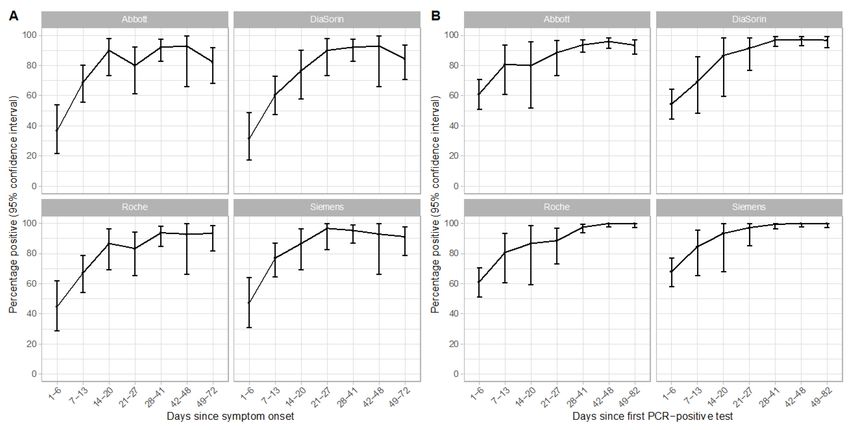
Evaluation of sensitivity and specificity of four commercially available SARS-CoV-2 antibody immunoassays

 Contents
 Executive summary                                                                                          3
 1. Introduction                                                                                            5
 2. Methods                                                                                                 7
 3. Results: Primary analysis                                                                               11
 4. Results: Secondary analysis                                                                             13
 5. Conclusions                                                                                             17
 6. Appendix                                                                                                18
 7. References                                                                                              30
 8. Supporting corporate information                                                                        31

                                                              2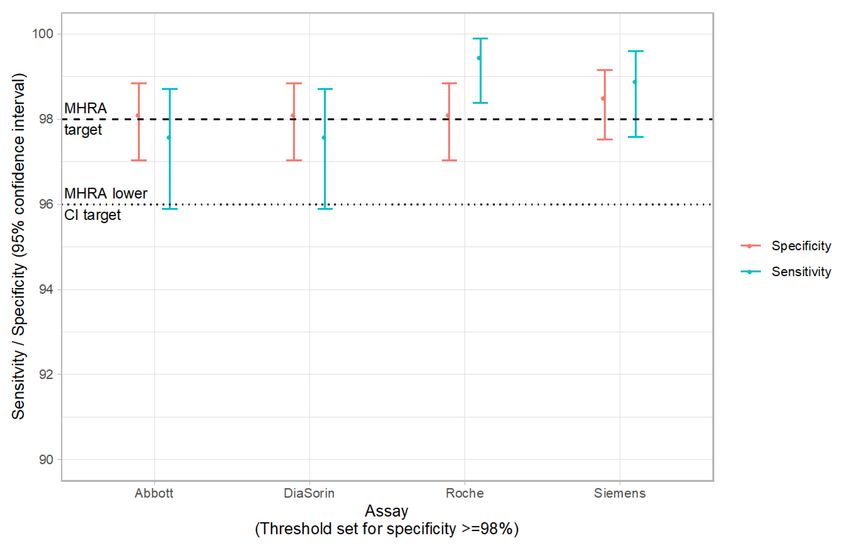
Evaluation of sensitivity and specificity of four commercially available SARS-CoV-2 antibody immunoassays

 Executive summary
 Public Health England (Porton Down) and a clinical/research team at the University of
 Oxford and Oxford University Hospitals NHS Foundation Trust were commissioned by
 the Department of Health and Social Care (DHSC) to evaluate several commercial
 immunoassays for SARS-CoV-2 antibody detection available on the UK market.
 An external appraisal of assay performance is highly desirable in order to determine
 performance metrics with precision, using a large, well-characterised sample set.

 Over a three-week period in May-June 2020, we evaluated four SARS-CoV-2 antibody
 assays, namely Abbott’s SARS-CoV-2 Immunoassay, DiaSorin’s LIAISON® SARS-
 CoV-2 S1/S2 IgG, Roche’s Elecsys® Anti-SARS-CoV-2, and Siemens’ SARS-CoV-2
 Total (COV2T) (referred to as Abbott, DiaSorin, Roche, and Siemens assays hereafter).

 Assays were performed in line with the manufacturers’ instructions and at the pre-
 specified thresholds for determining positive vs negative test results. For each test, we
 calculated sensitivity and specificity, to compare against the UK Medicines and
 Healthcare products Regulatory Agency (MHRA) Target Product Profile (TPP) for
 ‘enzyme immunoassays’ for SARS-CoV-2.

 Sensitivity was evaluated on 536 positive samples from unique adult individuals with
 laboratory-confirmed SARS-CoV-2 infection at ≥20 days post-symptom onset;
 specificity was evaluated on 994 pre-pandemic (2015-2018) specimens from unique,
 healthy adult individuals.

 Primary results were as follows:

   Assay                     Sensitivity               Specificity             Appraisal against MHRA Target
                             [95% CI]                  [95% CI]                Product Profile (TPP)

   Abbott                    92.7 (90.2, 94.8)         99.9 (99.4, 100)        Meets specificity criterion

   DiaSorin                  95.0 (92.8, 96.7)         98.6 (97.6, 99.2)       Meets specificity criterion

   Roche                     97.2 (95.4, 98.4)         99.8 (99.3, 100)        Meets specificity criterion

   Siemens                   98.1 (96.6, 99.1)         99.9 (99.4, 100)        Meets sensitivity and specificity
                                                                               criteria

                                                              3
Evaluation of sensitivity and specificity of four commercially available SARS-CoV-2 antibody immunoassays

 We also undertook secondary analyses, highlighting that the Roche assay could meet
 the current MHRA TPP sensitivity criteria with an assay threshold adjustment (eg at a
 revised assay threshold of ≥0.128 the sensitivity would be 99.4 [95% CI: 98.4, 99.9]
 with a specificity of 98.1 [95% CI: 97.0, 98.8]).

 Further, by optimising assay thresholds to achieve a specificity of ≥98% and extending
 the sample timeframe specification to ≥30 days post-symptom onset (in lieu of the
 current MHRA TPP specification of ≥20 days), all four assays would meet the sensitivity
 criteria.

                                                              4
Evaluation of sensitivity and specificity of four commercially available SARS-CoV-2 antibody immunoassays

 1. Introduction
 1.1. SARS-CoV-2 has emerged as a novel cause of human infection, causing a global
 pandemic in the first 6 months of 2020, with >8.2 million confirmed cases of infection
 and 443K deaths (1). Case ascertainment and testing have been critical to controlling
 the spread of infection, and in developing effective strategies to mitigate the public
 health and economic impact of this pathogen.

 1.2. Laboratory testing for SARS-CoV-2 broadly takes two forms: firstly, direct detection
 of the presence of virus, by testing respiratory samples with real-time PCR (RT-PCR),
 and secondly, an assessment of the immunological response to infection, by using
 serology to determine the presence of antibody (2), and/or neutralisation assays to
 evaluate the capacity of antibodies to effectively target the virus. Neutralisation assays
 are time- and resource-intensive tests, and are currently limited in their capacity for
 rollout. Serological diagnosis has therefore been pursued, with the aim of detecting
 either specific types of SARS-CoV-2 antibody (IgM, IgG, IgA), or total antibody,
 supporting several aims:
 • at a population level, determining exposure provides insight into spread in
     communities and healthcare settings, identification of risk groups, and
     supports tracking and modelling of infection over time
 • at an individual level, antibodies are deemed likely to be a correlate of
     protection against future infection, and may therefore contribute to managing
     personal risk-assessments
 • to support research and development, antibody measurement is a critical
     tool, particularly in providing quantification of antibody responses in vaccine
     trials
 Antibodies to SARS-CoV-2 typically start to appear >5-7 days after infection (3, 4), and
 are therefore an unreliable marker for early acute infection. Importantly, it remains
 unclear what degree of immunity the presence of antibody confers, and how durable
 this might be.

 1.3. To cope with the demand for serological diagnosis, several manufacturers have
 developed immunoassays that are compatible with current global laboratory
 infrastructures, including high-throughput analyzers. However, assembling appropriate
 and large sets of samples to thoroughly test the performance of these assays has been
 difficult within the very short time frames of assay development and release, and direct
 comparisons of platforms have been limited.

                                                         5
Evaluation of sensitivity and specificity of four commercially available SARS-CoV-2 antibody immunoassays
1.4. The UK Medicines and Healthcare products Regulatory Agency (MHRA) has
recently released a ‘Target Product Profile for enzyme immunoassays’ (5) to support
Pillar 3 of the UK testing strategy (“Mass-antibody testing to help determine if people
have immunity to coronavirus” (6)), specifying:
• a clinical sensitivity of ≥98% (95% CI: 96-100%) in confirmed SARS-CoV-2
positive cases (defined by RT-PCR) ≥20 days after the appearance of first
symptoms;
• a clinical specificity of ≥98% (95% CI: 96-100%) on samples collected >6
months before the first identified cases of SARS-CoV-2 infection
The sensitivity of a test characterises its capacity to identify known positives (ie infected
individuals), and the specificity its capacity to identify known negatives (ie uninfected
individuals). Of note, there is no clear gold standard against which to evaluate these
antibody tests; PCR-positivity is a proxy for the expected presence of antibody, but
negative antibody tests in PCR-positive individuals could either represent an issue with
antibody test performance, or alternatively be explained by a failure to mount a
measurable antibody response (eg in immunocompromise), or through a false-positive
PCR test in individuals who have not genuinely had SARS-CoV-2 infection.
1.5. To directly evaluate and compare the sensitivity and specificity of four commercial
immunoassays for SARS-CoV-2 antibody (Abbott, DiaSorin, Roche, Siemens; Table
S1), we formed a collaboration between Public Health England -Porton Down, Oxford
University Hospitals NHS Foundation Trust, and the University of Oxford. Using a large
collection of serum/plasma samples from individuals with SARS-CoV-2 infection
confirmed by RT-PCR, and a bank of known negative samples collected pre-pandemic,
we ran the same samples across all four platforms in a ‘head-to-head’ evaluation.
6Evaluation of sensitivity and specificity of four commercially available SARS-CoV-2 antibody immunoassays
2. Methods
2.1. We developed a written protocol for the head-to-head evaluation, which was shared
with the four commercial companies and with DHSC at the outset. We provided
manufacturers with the opportunity to raise questions and feedback on the protocol. The
full data and analysis, including the protocol, will be submitted for publication on a pre-
print server (publicly accessible) and in a peer-reviewed journal as soon as possible.
2.2. Samples for testing were collected from adults in the UK, in line with MHRA TPP
specifications, namely a ‘known negative’ group of samples collected >6 months prior to
the known appearance of SARS-CoV-2 (ie sample collection earlier than July 2019),
and a ‘known positive’ group of samples collected from individuals with a previous
positive SARS-CoV-2 RT-PCR nose/throat swab, with blood samples taken ≥20 days
post-symptom onset. In total, 994 samples from 994 individuals were included in the
sensitivity/specificity analyses as the ‘known negative’ cohort, and 536 samples from
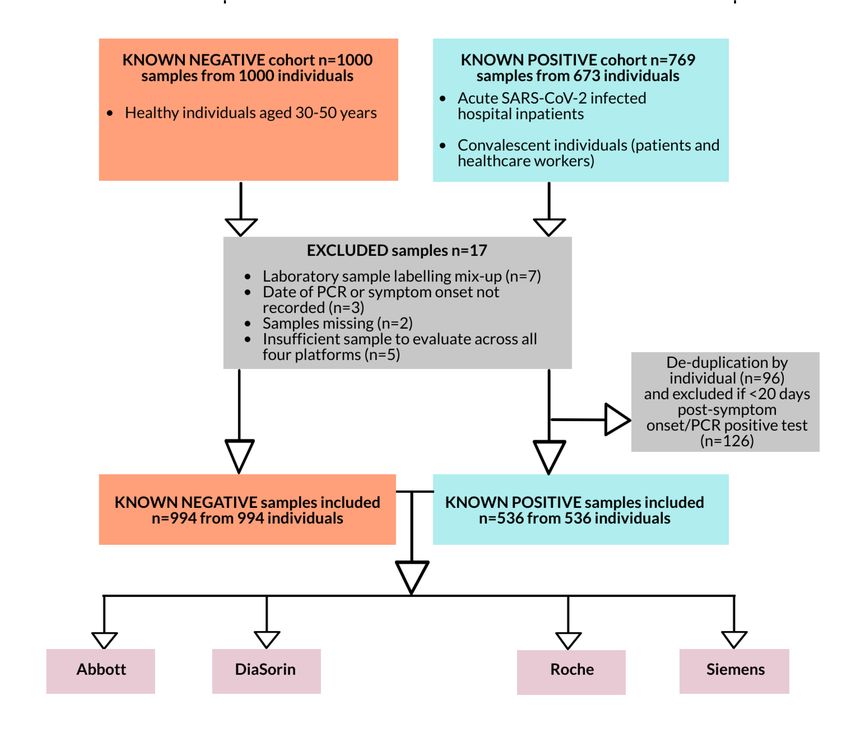
536 individuals as the ‘known positive’ cohort. Sample selection and exclusions are
shown in Figure 1; characteristics of included samples are presented in Table 1.
7Evaluation of sensitivity and specificity of four commercially available SARS-CoV-2 antibody immunoassays
Figure 1. Sample collections and inclusions/exclusions. For de-duplication of
samples by individual, the latest sample meeting the MHRA criteria (ie latest sample
taken ≥20 days after symptom onset) was included. Table S2 summarises the partial
results for the five samples that were of insufficient volume to run across all platforms.
8Evaluation of sensitivity and specificity of four commercially available SARS-CoV-2 antibody immunoassays
Table 1. Summary of serum samples used for head-to-head analysis of four commercial
immunoassay platforms for the detection of SARS-CoV-2 antibodies
Group Source Number of Days from Days from PCR-
samples symptom onset, positive test,
median (IQR; median (IQR;
min, max; min, max;
number of number of
samples) samples)
Known Healthy individuals 30-50 years of 994 n/a n/a
negative age, collected between 2015-2018 in
Oxfordshire (Oxford BioBank,
www.oxfordbiobank.org.uk)
Known Healthcare workers and patients ≥18 158 37 27
positive years of age at Oxford University (28-53; 20, 73; (22-36; 3, 59;
Hospital NHS Foundation Trust, n=158) n=105)
Oxfordshire, UK
Known Volunteer plasma donors ≥18 years 378 All samples ≥28 44
positive of age via NHS Blood and Transplant days post- (40-49; 32, 82;
(NHSBT), across the UK symptom onset* n=378)
* Although specific data on time from symptoms is not available for this group, all donors had to be have been at least 28 days post-
symptom onset to be eligible for sampling: see https://www.nhsbt.nhs.uk/plasma-trial/
2.3. Tests were performed in accordance with the manufacturer’s instructions by trained
laboratory staff in UK Accreditation Service (UKAS) accredited laboratories on
appropriate analysers, and with the specified controls and calibrants, at the thresholds
set by the manufacturer for testing in the UK (Table S1). The Abbott and DiaSorin tests
were performed at the John Radcliffe Hospital Clinical Biochemistry and Microbiology
laboratories in Oxford, and the Roche and Siemens tests at PHE Porton Down. For the
DiaSorin assay, where the manufacturer specifies additional repeat testing in duplicate in
the event that results fall within an equivocal zone (12.0 ≤ xEvaluation of sensitivity and specificity of four commercially available SARS-CoV-2 antibody immunoassays
2.4. Data for each assay were collated and checked by an analysis group; the cleaned
data were locked prior to analysis. Statistical analyses and data visualisations were
performed in R (version 3.6.3). The analysis, results and draft report were reviewed by
an external review group (Prof Janet Darbyshire, Emeritus Professor of Epidemiology at
University College London, and Prof Sir David Spiegelhalter, Winton Professor of the
Public Understanding of Risk, University of Cambridge).
10Evaluation of sensitivity and specificity of four commercially available SARS-CoV-2 antibody immunoassays
3. Results: Primary analysis
3.1. We calculated sensitivity and specificity and 95% confidence intervals (exact
binomial method) for each assay, using the manufacturers’ thresholds and in line with the
current MHRA TPP criteria. The results are presented in Table 2 and Figure 2. The
Siemens assay met the current MHRA TPP criteria for both sensitivity and specificity; the
Abbott, DiaSorin and Roche assays met the current MHRA TPP criteria for specificity
only.
Table 2. Sensitivity and specificity (95% confidence interval, CI) for each assay using the
current MHRA TPP criteria: ≥20 days post-symptom onset in confirmed laboratory cases
of SARS-CoV-2 for positive cases, and >6 months prior to the first known COVID-19
cases for negatives. Equivocal results were excluded from the calculation of sensitivity
and specificity for the DiaSorin assay (n=9).
Assay Number Number Number not *Number Sensitivity Number Number Number *Number Specificity
PCR- detected detected equivocal (95% CI) pre- detected not equivocal (95% CI)
positive pandemic detected
controls
Abbott 536 497 39 n/a 92.7 994 1 993 n/a 99.9
(90.2, 94.8) (99.4, 100)
DiaSorin 536 509 20 7 95.0 994 12 980 2 98.6
(92.8, 96.7) (97.6, 99.2)
Roche 536 521 15 n/a 97.2 994 2 992 n/a 99.8
(95.4, 98.4) (99.3, 100)
Siemens 536 526 10 n/a 98.1 994 1 993 n/a 99.9
(96.6, 99.1) (99.4, 100)
11Evaluation of sensitivity and specificity of four commercially available SARS-CoV-2 antibody immunoassays
Figure 2. Sensitivity and specificity (95% confidence intervals) plotted for each
assay using the current MHRA TPP criteria: ≥20 days post-symptom onset in
confirmed laboratory cases of SARS-CoV-2 for positive cases, and >6 months
prior to the first known COVID-19 cases for negatives. The MHRA TPP target
performance is shown (dashed line) including the required lower bound of the 95%
confidence interval (dotted line) for both sensitivity and specificity. Data are presented for
994 known negative samples and 536 known positive samples run on each assay;
equivocal results were excluded from the calculation of sensitivity and specificity for the
DiaSorin assay (n=9).
12Evaluation of sensitivity and specificity of four commercially available SARS-CoV-2 antibody immunoassays
4. Results: Secondary analysis
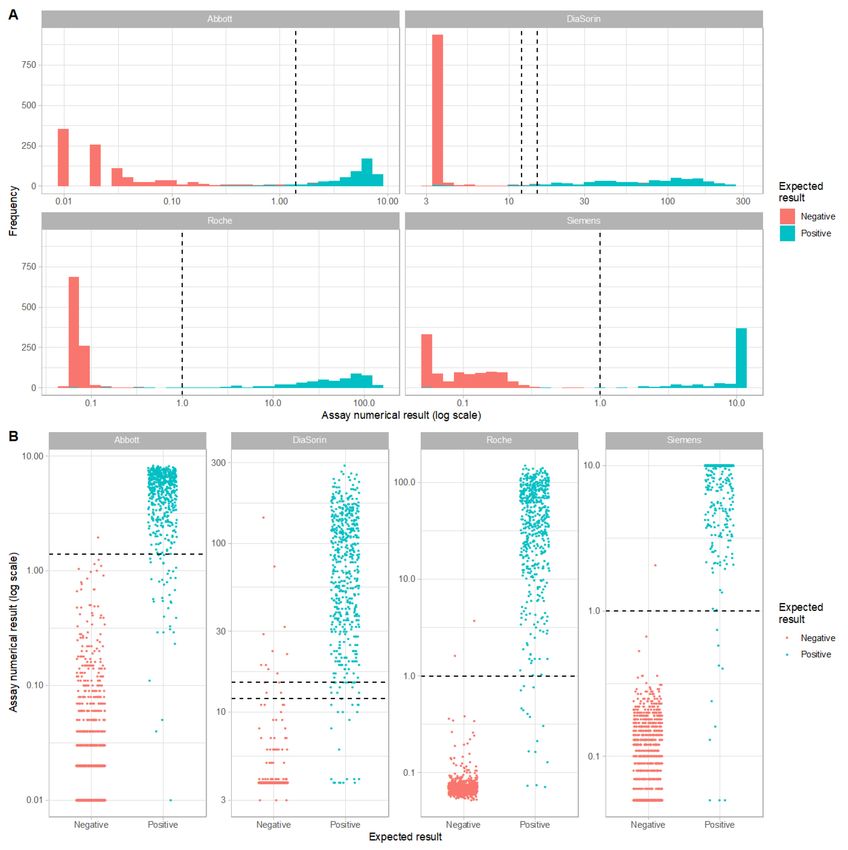
4.1. The distribution of numerical values obtained for each sample from each assay is
shown in Figure 3, illustrating the separation of sample values around the thresholds set
by the manufacturers.
4.2. We used ROC curves to investigate the performance of each assay (Figure 4). ROC
curves evaluate the trade-off between true positive rates (ie assay sensitivity) versus
false positive rates (ie 1-specificity) at a given assay threshold. They can therefore be
used to illustrate how assay threshold adjustment can impact on whether an assay
achieves the MHRA criteria for both sensitivity and specificity. An assay threshold
adjustment to ≥0.128 would have resulted in the Roche assay meeting both the current
MHRA TPP sensitivity and specificity criteria (revised sensitivity: 99.4 [95% CI: 98.4,
99.9] revised specificity of 98.1 [95% CI: 97.0, 98.8]; Figure 4, Appendix Figure S1, Table
S3). Sensitivity and specificity for each assay with revised thresholds chosen to ensure
all assays met the target specificity ≥98.0% are shown in Appendix Figure S1.
13Evaluation of sensitivity and specificity of four commercially available SARS-CoV-2 antibody immunoassays
Figure 3. Distribution of numerical results obtained for each assay, using samples
defined according to the current MHRA TPP criteria. Assay thresholds (set by the
manufacturers) are shown as dashed lines. For the purposes of plotting values on a log
scale, values of zero were set to the lowest non-zero value and results of greater or less
than the largest or smallest values were truncated to the largest and smallest values.
Data are presented for 994 known negative samples and 536 known positive samples
run on each assay.
14Evaluation of sensitivity and specificity of four commercially available SARS-CoV-2 antibody immunoassays
Figure 4. ROC curves for each assay at the current MHRA TPP specification of ≥20
days after the appearance of first symptoms. The green shaded area represents the
MHRA TPP sensitivity and specificity of ≥98% and ≥98% respectively. Assay values
associated with 10 exemplar points on the ROC curve are shown in each panel. Data are
shown based on analysis of 536 samples in the positive category, and 994 pre-pandemic
negative samples run on each assay.
4.3. We also assessed the performance of each assay according to the time-point of
sample collection. Based on samples collected ≥30 days after the appearance of first
symptoms, the Siemens and Roche assays would meet the current MHRA TPP
sensitivity and specificity criteria (Appendix Figure S2). ROC curves are shown for this
revised time cutoff (Appendix Figure S3).
4.4. The sensitivity and specificity of each assay in samples obtained ≥30 days after
symptom onset, using revised assay thresholds chosen to ensure all assays had
specificity ≥98.0% are shown (Appendix Figure S4), demonstrating that with these
revisions, all platforms would meet the TPP sensitivity and specificity criteria. Data are
shown based on analysis of 490 samples assigned as positive, and 994 pre-pandemic
negative samples run on each assay.
15Evaluation of sensitivity and specificity of four commercially available SARS-CoV-2 antibody immunoassays 4.5. Antibody responses rose over the first 3-4 weeks from symptom onset (Figure 5). Antibody responses were sustained up to 73 days post symptom onset and up to 82 days post a positive PCR result. Figure 5. Percentage of tests from SARS-CoV-2 RT-PCR-positive individuals positive over time by serology platform. Samples from
Evaluation of sensitivity and specificity of four commercially available SARS-CoV-2 antibody immunoassays

 5. Conclusions
 5.1. Based on the exact current MHRA TPP criteria for evaluating sensitivity and
 specificity, all assays tested met the specificity requirement, but only the Siemens met
 both the sensitivity and specificity requirements (Table 1).

 5.2. Secondary analyses demonstrate that assay thresholds could be re-evaluated to
 refine sensitivity/specificity trade-offs, and assay performance is optimised for samples
 taken ≥30 days after symptom onset.

                                                        17
Evaluation of sensitivity and specificity of four commercially available SARS-CoV-2 antibody immunoassays
6. Appendix
6.1. The appendix contains supplementary material to support the results of secondary
analyses not included in the main text.
Figure S1. Sensitivity and specificity (95% confidence intervals) plotted for each
assay using the current MHRA TPP criteria with alternative assay thresholds to
keep specificity ≥98%. For each assay the lowest threshold that kept specificity ≥98%
was chosen (Abbott = 0.49, DiaSorin = 10, Roche = 0.128, Siemens = 0.29). The MHRA
TPP target performance is shown (dashed line) including the required lower bound of
the 95% confidence interval (dotted line) for both sensitivity and specificity.
18Evaluation of sensitivity and specificity of four commercially available SARS-CoV-2 antibody immunoassays
Figure S2. Sensitivity and specificity (95% confidence intervals) plotted for each
assay using revised criteria. Sensitivity and specificity were defined using a revised
criterion of ≥30 days post-symptom onset in confirmed laboratory cases of SARS-CoV-2
for positive cases. Equivocal results were excluded from the calculation of sensitivity
and specificity for the DiaSorin platform (n=9). The MHRA TPP target performance is
shown (dashed line) including the required lower bound of the 95% confidence interval
(dotted line) for both sensitivity and specificity.
19Evaluation of sensitivity and specificity of four commercially available SARS-CoV-2 antibody immunoassays
Figure S3. ROC curves for each assay at the current MHRA TPP specification
revised ≥30 days after the appearance of first symptoms. The green shaded area
represents the MHRA TPP sensitivity and specificity of ≥98% and ≥98% respectively.
Assay values associated with 10 exemplar points on the ROC curve are shown in each
panel. Data are shown based on analysis of 490 samples in the positive category, and
994 pre-pandemic negative samples run on each assay.
20Evaluation of sensitivity and specificity of four commercially available SARS-CoV-2 antibody immunoassays
Figure S4. Sensitivity and specificity (95% confidence intervals) plotted for each
assay using the current MHRA TPP criteria with alternative assay thresholds to
keep specificity ≥98% and revised criteria to show samples ≥30 days after the
appearance of first symptoms. For each assay the lowest threshold that kept
specificity ≥98% was chosen (Abbott = 0.49, DiaSorin = 10, Roche = 0.128, Siemens =
0.29). The MHRA TPP target performance is shown (dashed line) including the required
lower bound of the 95% confidence interval (dotted line) for both sensitivity and
specificity.
21Evaluation of sensitivity and specificity of four commercially available SARS-CoV-2 antibody immunoassays
Figure S5. Sensitivity for each assay by disease severity (asymptomatic, mild,
severe, critical/death; n=158). Disease severity was defined in line with WHO
guidance (7) as follows: asymptomatic = no symptoms; mild = no oxygen requirement;
severe = SaO2 ≤93%; critical = respiratory failure requiring intubation; symptom
category was assigned on the day of sampling.
22Evaluation of sensitivity and specificity of four commercially available SARS-CoV-2 antibody immunoassays Table S1. Summary of the commercial immunoassays evaluated. Information presented is based on the product literature released by each manufacturer. Assay and analyser Viral target and antibody type Manufacturers’ thresholds used Abbott SARS-CoV-2 Nucleocapsid protein, Negative:
Evaluation of sensitivity and specificity of four commercially available SARS-CoV-2 antibody immunoassays

 Table S2. Partial results for five samples for which there was insufficient sample
 to run across all four platforms.

  Sample            Expected          Days since      Platform          Actual result
  barcode           result            symptom
                                      onset
  900753            Negative          n/a             Abbott            Negative
                                                      DiaSorin          Negative
                                                      Roche             Negative
  500379            Positive          40              Abbott            Positive
                                                      DiaSorin          Positive
  500380            Positive          41              Abbott            Positive
                                                      DiaSorin          Positive
  500381            Positive          41              Abbott            Negative
                                                      DiaSorin          Negative
  500384            Positive          42              Abbott            Positive
                                                      DiaSorin          Positive

                                                        25
Evaluation of sensitivity and specificity of four commercially available SARS-CoV-2 antibody immunoassays
Table S3. Extended evaluations of sensitivity and specificity (95% CI) for each
assay . This includes (i) manufacturer’s data for samples taken at least ≥14 days post-
symptom onset/PCR test, (ii) adapted MHRA TPP criteria extended to ≥30 days, (iii) per
protocol criteria (iv) changing assay thresholds to achieve ≥98% specificity and optimise
sensitivity (v) changing assay thresholds to achieve ≥98% specificity and optimise
sensitivity, and extending timeframe from symptom onset to sample from ≥20 days to
≥30 days.
(i)
Manufacturers’ sensitivity and specificity evaluations
Assay Number of PCR-positive Sensitivity (95% CI) Number pre- Specificity (95% CI)
cases pandemic
controls
Abbott 88 96.77% (90.86, 99.33) 1070 99.63% (99.05, 99.90)
(≥14 days post-symptom
onset)
DiaSorin 14 97.56% (87.40, 99.57) 1090 98.5% (97.6, 99.2)
(≥15 days from RT-PCR-
positive test)
Roche 29 100% (88.1, 100) 5272 99.81% (99.65, 99.91)
(≥14 days from RT-PCR-
positive test)
Siemens 42 100.00% (91.59, 100.00) 1091 99.82 (99.34, 99.98)
(≥14 days from RT-PCR-
positive test)
26Evaluation of sensitivity and specificity of four commercially available SARS-CoV-2 antibody immunoassays
(ii)
Extending timeframe from symptom onset to sample from ≥20 days to ≥30 days
Assay Number Number Number Number Sensitivity Number Number Number Number Specificity
PCR- detected not equivocal (95% CI) pre- detected not equivocal (95% CI)
positive detected pandemic detected
controls
Abbott 490 458 32 n/a 93.5 994 1 993 n/a 99.9
(90.9, (99.4,
95.5) 100)
DiaSorin 490 468 16 6 95.5 994 12 980 2 98.6
(93.3, (97.6,
97.2) 99.2)
Roche 490 481 9 n/a 98.2 994 2 992 n/a 99.8
(96.5, (99.3,
99.2) 100)
Siemens 490 482 8 n/a 98.4 994 1 993 n/a 99.9
(96.8, (99.4,
99.3) 100)
(iii)
Per protocol evaluation with timeframe from symptom onset set at ≥14 days (NB protocol draft
predated the publishing of the MHRA’s TPP)
Assay Number Number Number Number Sensitivity Number Number Number Number Specificity
PCR- detected not equivocal (95% CI) pre- detected not equivocal (95% CI)
positive detected pandemic detected
controls
Abbott 561 520 41 n/a 92.7 994 1 993 n/a 99.9
(90.2, (99.4,
94.7) 100)
DiaSorin 561 529 24 8 94.3 994 12 980 2 98.6
(92.0, (97.6,
96.1) 99.2)
Roche 561 543 18 n/a 96.8 994 2 992 n/a 99.8
(95.0, (99.3,
98.1) 100)
Siemens 561 548 13 n/a 97.7 994 1 993 n/a 99.9
(96.1, (99.4,
98.8) 100)
27Evaluation of sensitivity and specificity of four commercially available SARS-CoV-2 antibody immunoassays
(iv)
Adopting changed assay thresholds to achieve ≥98% specificity and optimise sensitivity
Assay Number Number Number Number Sensitivity Number Number Number Number Specificity
PCR- detected not equivocal (95% CI) pre- detected not equivocal (95% CI)
positive detected pandemic detected
controls
Abbott 536 523 13 n/a 97.6 994 19 975 n/a 98.1
(95.9, (97.0,
98.7) 98.8)
DiaSorin 536 523 13 n/a 97.6 994 19 975 n/a 98.1
(95.9, (97.0,
98.7) 98.8)
Roche 536 533 3 n/a 99.4 994 19 975 n/a 98.1
(98.4, (97.0,
99.9) 98.8)
Siemens 536 530 6 n/a 98.9 994 15 979 n/a 98.5
(97.6, (97.5,
99.6) 99.2)
(v)
Adopting changed assay thresholds to achieve ≥98% specificity and optimise sensitivity and
extending timeframe from symptom onset to sample from ≥20 days to ≥30 days
Assay Number Number Number Number Sensitivity Number Number Number Number Specificity
PCR- detected not equivocal (95% CI) pre- detected not equivocal (95% CI)
positive detected pandemic detected
controls
Abbott 490 482 8 n/a 98.4 994 19 975 n/a 98.1
(96.8, (97.0,
99.3) 98.8)
DiaSorin 490 481 9 n/a 98.2 994 19 975 n/a 98.1
(96.5, (97.0,
99.2) 98.8)
Roche 490 488 2 n/a 99.6 994 19 975 n/a 98.1
(98.5, (97.0,
100) 98.8)
Siemens 490 485 5 n/a 99.0 994 15 979 n/a 98.5
(97.6, (97.5,
99.7) 99.2)
28Evaluation of sensitivity and specificity of four commercially available SARS-CoV-2 antibody immunoassays
Table S4. Summary of concordance/discordance of results between assays. “+”
denotes a positive result, “-” a negative result and “+/-“ an equivocal result (the latter
relevant for the DiaSorin assay only).
Abbott DiaSorin Roche Siemens Known Known Total
result result result result negative positive
- - - - 976 7 983
- - - + 1 2 3
- - + - 2 2 4
- - + + 0 2 2
- + - - 12 0 12
- + - + 0 6 6
- + + + 0 16 16
- +/- - - 2 0 2
- +/- + + 0 4 4
+ - - - 1 0 1
+ - + - 0 1 1
+ - + + 0 6 6
+ + + + 0 487 487
+ +/- + + 0 3 3
TOTAL 994 536 1530
29OFFICIAL: Evaluation of sensitivity and specificity of four commercially available SARS-CoV-2 antibody immunoassays
7. References
1. Center for Systems Science and Engineering (CSSE) at Johns Hopkins University.
COVID-19 Dashboard. https://coronavirus.jhu.edu/map.html. Accessed: 17/Jun/2020.\
2. Amanat F, Stadlbauer D, Strohmeier S et al. 2020. A serological assay to detect SARS-
CoV-2 seroconversion in humans. Nat Med doi:10.1038/s41591-020-0913-5.
3. Zhao J, Yuan Q, Wang H et al. Antibody responses to SARS-CoV-2 in patients of novel
coronavirus disease 2019. Clin Infect Dis doi:10.1093/cid/ciaa344.
4. Adams ER, Ainsworth M, Anand R et al. Antibody testing for COVID-19: A report from
the National COVID Scientific Advisory Panel [version 1; peer review: awaiting peer
review]. Wellcome Open Res 2020, 5:139
(https://doi.org/10.12688/wellcomeopenres.15927.1)
5. UK Medicines and Healthcare products Regulatory Agency (MHRA). Target Product
Profile: enzyme Immunoassay (EIA) Antibody tests to help determine if people have
antibodies to SARS-CoV-2. https://www.gov.uk/government/publications/how-tests-and-
testing-kits-for-coronavirus-covid-19-work/target-product-profile-enzyme-immunoassay-
eia-antibody-tests-to-help-determine-if-people-have-antibodies-to-sars-cov-2. Last
updated 12/Jun/2020. Last accessed: 17/Jun/2020.
6. Department of Health and Social Care (DHSC). Coronavirus (Covid-19): Scaling up our
testing programmes.
https://assets.publishing.service.gov.uk/government/uploads/system/uploads/attachment
_data/file/878121/coronavirus-covid-19-testing-strategy.pdf. Last accessed:
17/Jun/2020.
7. World Health Organisation (WHO). Report of the WHO-China Joint Mission on
Coronavirus Disease 2019 (COVID-19). https://www.who.int/docs/default-
source/coronaviruse/who-china-joint-mission-on-covid-19-final-report.pdf. Last
accessed: 17/Jun/2020.
30OFFICIAL: Evaluation of sensitivity and specificity of four commercially available SARS-CoV-2 antibody immunoassays
8. Supporting corporate information
8.1 PHE has a comprehensive system for managing conflicts of interest. The manufacturers
provided to PHE free of charge the test kits required for the head-to-head evaluation. They also
provided to PHE on a short-term, cost-free loan basis any required proprietary equipment and
software.
8.2 In line with its Conflict of Interest Policy, PHE works in co-operation with the
pharmaceutical, biotechnology, vaccine, diagnostic, and other healthcare-related industries in
order to facilitate the development of products and technologies beneficial to health. In this
context, PHE maintains active relationships with a broad range of companies in the UK and
internationally.
8.3 The manufacturers were made aware of the results of this evaluation prior to
publication but had no editorial rights over the content of the report except to ensure factual
accuracy. No such comments were received.
8.4 PHE is not a regulatory body and does not issue accreditation of any testing laboratories
or provide approvals, validations or endorsements of any particular products including any
SARS-CoV-2 diagnostic assay.
8.5 PHE’s name and logo are proprietary to PHE and cannot be used for the purpose of
commercial promotion of any particular product.
31You can also read


