Exporting Plants and Plant Product to the EU - Post Transition Period - 7th May 2019. Tom Youngman, Defra.
←
→
Page content transcription
If your browser does not render page correctly, please read the page content below
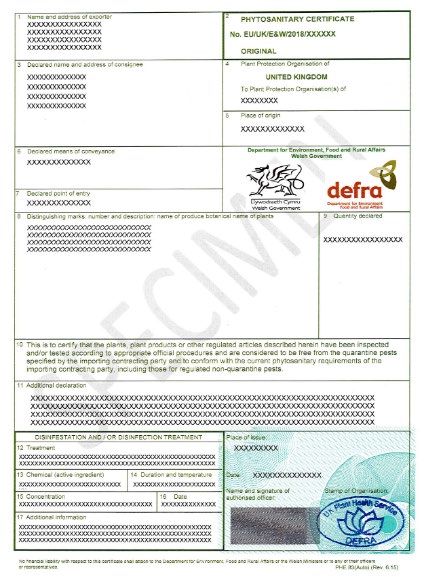
Exporting Plants and Plant Product to the EU –
         Post Transition Period

7th May 2019. Tom Youngman, Defra.                        1
Contents

1. Introduction
2. Exports: 1 January 2021
3. Prohibited goods
4. Special Requirements
5. Goods not of GB origin
6. Export applications
7. Fees and charges
8. WPM
9. Steps to take now to prepare for end of transition
10. Further information

                                                        2
Introduction
Plants and plant products moving from GB to EU will be subject to phytosanitary controls from
1 January 2021.
NI will be in the same phytosanitary and sanitary zone as the EU. However, requirements for
NI will be discussed at a webinar on the 9th December and is still subject to ongoing
negotiations with the EU.
Exports controls will not be phased in (as they are on imports), a Phytosanitary Certificate
(PC) will be required from 01 January to export regulated goods.
EU plant passports will no longer be used to export plants for planting to the EU.
3Exports approach: 1 January 2021
From 1 January 2021, new exports controls will apply to regulated plants and plant products
to the EU.
Which goods are regulated can be found on the EU’s website:
https://ec.europa.eu/food/plant/plant_health_biosecurity/legislation/new_eu_rules_en
Goods which will require a PC are generally:
All plants for planting
Root and tubercle vegetables
Most fruits
Cut flowers
Seeds
Vegetables
Wood packaging material
Used agricultural machinery planting;
All goods will require a PC
4Exports approach: 1 January 2021
What doesn’t require a PC
There are only 5 goods that do not require a PC, fruits of:
Coconuts
Pineapples
Durians
Bananas & Plantain
Dates
What goods are prohibited?
The EU has stated that after the transition period, GB exports to the EU will be subject to EU
third country import requirements, including existing plant health prohibitions on seed potatoes
and ware potatoes from third countries. GB will be classed as a third country.
This includes the prohibitions in Annex VI of EU Implementing Reg 2019/2072 and
Implementing Reg 2018/2019 and includes things such as prohibitions on growing medium as
a commodity and plants for planting of Malus (apples) and Prunus (plums, peaches and
cherries).
These goods can not be exported.
5Special Requirements
Some goods also have special requirements, also known as additional declarations, that have
to be met when exporting goods.
A list of goods subject to special requirements can be found in Annex VII and X of 2019/2072.
They will often contain options that in which the exporting country has to declare how they met
the import requirements.
Your local inspector will be aware of the requirements but you should be too.
Generally there tend to be 4 options:
Country freedom
Area freedom
Place of production or site freedom
Treatments
There may be other options available,, such as
testing, so always check the special requirements for
each commodity.
There may be more than one special requirement for
a commodity.
6Special Requirements
When goods are of GB origin the GB inspector will be able to select the appropriate option.
What about goods not of GB origin?
Where goods are not of GB origin but the special requirements are materially the same to
enter GB (import) as they are for the import to EU then the GB Competent Authority (CA) will
infer that it has met the EU’s requirements. e.g. This is a requirement for apples.
GB Import Special Requirement:
This consignment complies with point 97 (a) of The Plant Health (Phytosanitary Conditions) (Amendment) (EU Exit) Regulations 2020 in
that it originates in a country which, in accordance with the measures specified in ISPM4, is known to be free from Botryosphaeria
kuwatsukai (Hara) G.Y. Sun and E. Tanaka
EU Import Special requirement
This consignment complies with point 64 (a) of The Phytosanitary Conditions Regulation 2019/2072 in that it originates in a country which,
in accordance with the measures specified in ISPM4, is known to be free from Botryosphaeria kuwatsukai (Hara) G.Y. Sun and E.
Tanaka
7Special Requirements
What about goods not of GB origin that don’t require a PC to be imported into GB but
have special requirements
This will apply to commodities such as:
Citrus
Curry leaves
If there is no PC with the special requirements GB CA will be unable to issue a GB PC for
export, as they will be unable to know how the goods have met the import requirements.
This means, that although there is no requirement for a PC to enter GB, you will have to ask
the original exporting country to provide a PC with the special requirements, that meets the EU
import requirements, if you plant to export those goods on to the EU.
If the goods do not have any special requirements then the GB CA will be able to certify.
8Exports Pre-notification
Exporters should apply to their CA. APHA is the CA for England and Wales and Scottish Govt
is the CA for Scotland. In England and Wales this will be through eDomero from January and
in Scotland it is via the Scottish Govt.
APHA will aim to ensure a phytosanitary certificate will be issued by the date requested, as
long as an application is lodged 7 working days in advance of the export. This will allow time
for the inspector to visit, inspect and have the phytosanitary certificate issued.
You may not know exactly which goods you are exporting, seven days in advance, but you
may know that you require an export inspection. Booking the diary slot enables APHA to
allocate resources.
Ensure that you update and amend your application as soon as possible when you know
exactly what is being exported. This will need to be provided before the inspector arrives as
this will enable them to make sure that any special requirements can be met.
Exports for APHA will operate between 0700 – 1900, 7 days a week.
Most PCs will be issued on site by the inspector.
Fees will apply for exports and can be found on GOV.UK (https://www.gov.uk/guidance/plant-
health-controls)
9Wood packaging material (WPM)
Position after 1 Jan 2021:
• After the end of the Transition Period, all wood packaging material (WPM) moving
between GB and the EU must be treated and appropriately marked in compliance with
international standards (ISPM 15).
• This is in line with international requirements for trade and is in place to protect both the EU
and GB from harmful plant pests and diseases.
• Defra, and the Forestry Commission are continuing to work closely with the wood packaging
material sector to understand what further actions they need to take to manage this new
requirement by the end of the Transition Period.
• As there will be no immediate change to the biosecurity threat of WPM originating from the EU
at the end of the Transition Period, GB will maintain its current risk-based checking regime for
EU wood packaging material.
• Contact your supplier or TIMCON if you need more advice about moving WPM from 1 January
2021. (https://www.timcon.org/default.asp)
10Steps to take now to prepare for end of transition
To prepare for 1 January 2021 you need to:
Familiarise yourself with the EU’s phytosanitary import certificate requirements for different
plants and plant products
Check if your plants require laboratory testing of samples to ensure they are free from pests
and diseases or inspections during the growing season - contact your local plant health
inspector to find out if your plants need these tests before applying for a PC.
Register with the relevant competent authority as a professional operator:
• Animal and Plant Health Agency (APHA) for plants and plant products (England and Wales)
• Scottish Government for plants and plant products (Scotland)
• Forestry Commission for wood or wood products (GB wide)
Check if there other requirements that may affect your goods:
Marketing requirements (fruit & veg)
Marketing requirements (propagation material)
CITES
Organics
11Where to find more information
• Plant Health Transition page on GOV.UK - https://www.gov.uk/guidance/importing-and-
exporting-plants-and-plant-products-from-1-january-2021
• Plant Health Portal - https://planthealthportal.defra.gov.uk/eu-exit-guidance/ (includes Q&A)
• WPM - https://www.timcon.org/default.asp
• Border Operating Model -
https://assets.publishing.service.gov.uk/government/uploads/system/uploads/attachment_data
/file/925140/BordersOpModel.pdf
• EU webpage -
https://ec.europa.eu/food/plant/plant_health_biosecurity/legislation/new_eu_rules_en
• E2E feasibility testing for exports - https://www.eventbrite.com/e/exports-feasibility-testing-
session-plants-for-planting-and-fresh-produce-tickets-129989444929
12Thank you for listening
Are there any questions?
13You can also read


