Fact Sheet - The Australian Wine ...
←
→
Page content transcription
If your browser does not render page correctly, please read the page content below
Fact Sheet
                                                                                        VITICULTURE

                        Grapevine yellow speckle disease

 Introduction
 Grapevine yellow speckle disease was first described in Australia by Taylor and Woodham (1972)
 in Sunraysia, north-western Victoria. They demonstrated that the disease was graft-transmissible
 and concluded that the causal agent might be a virus. Sixteen years later, Koltunow and Rezaian
 (1998) from CSIRO, Adelaide, proved that the causal agent was the viroid GYSVd-1. A similar viroid
 was later diagnosed and named GYSVd-2.

 Viroids are smallest known infectious RNA molecules comprising a single strand of non-coding
 circular RNA. While viruses contain genes and can code for their essential proteins, viroids have
 no genes and are totally dependent on their host plant. A total of six viroids have been detected in
 grapevines globally, of which only Grapevine yellow speckle viroid 1 (GYSVd-1) and GYSVd-2 are
 symptomatic (Habili 2017). The other viroids are Australian grapevine viroid, Hop stunt viroid,
 Citrus exocortis viroid and Grapevine latent viroid (GLVd, Zhang et al. 2018). All these viroids,
 except GLVd, have been detected in Australia. GLVd is latent in the grapevine and is rare. The full-
 length sequences of three grapevine viroids (AGVd, GYSV-1 and Hop stunt viroid) have been

Updated February 2021
Fact Sheet
                                                                                        VITICULTURE

 detected in a 10-year-old bottled wine (Habili et al. 2012). This means that wines imported into
 Australia may contain full-length viroid sequences, a possible cause for biosecurity concern.

 Symptoms
 Most grapevine varieties are infected with GYSVd-1 and test positive by PCR (Habili 2017), but not
 all vines show symptoms. Severe yellow speckle symptoms occur in Australia sporadically and
 then only on some leaves of the vines (Salman et al. 2014). A study of 32 Chardonnay vines over
 five years (2009-2013) in the Alverstoke vineyard, Urrbrae, South Australia found all vines were
 positive for GYSVd-1 by PCR every year, but only a maximum of eight vines showed symptoms in a
 single year. This occurred in November 2009, when the vineyard encountered 11 consecutive days
 when maximum daytime temperatures were at or above 35°C (Salman et al. 2014). In the years
 after 2009, the number of symptomatic vines was consistently less than eight.

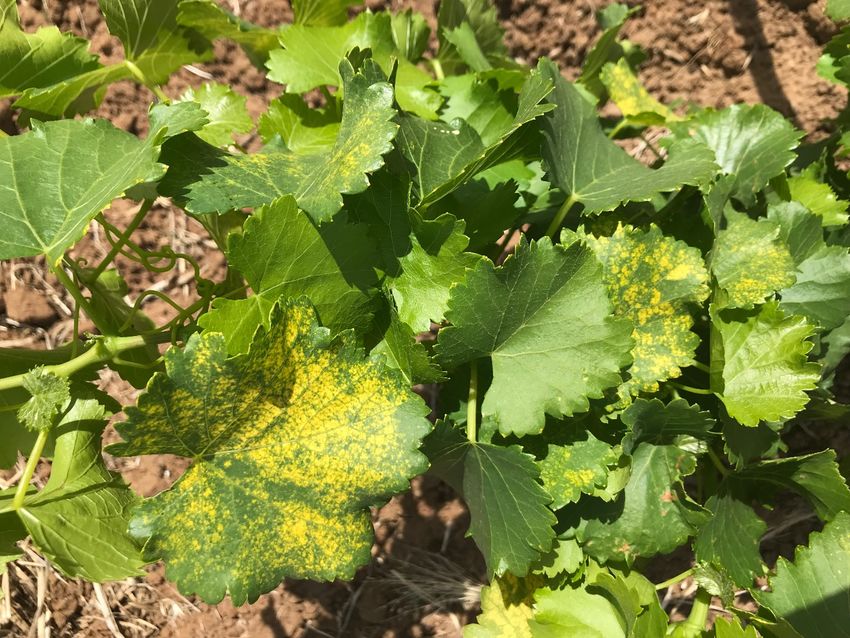
 Yellow speckle symptoms first appear as pinpoint dots initially close to the mid-rib and then
 gradually progress towards the distal ends of the leaves (Figures 1 and 2). In severely affected
 plants, the whole leaf blade may turn bright yellow. In other countries where grapevine fanleaf
 virus (GFLV) is endemic, a severe symptom called vein banding appears which is the result of a
 synergistic reaction between viroids and viruses.

 In the Adelaide Hills, young Gruner Veltliner vines growing in sleeved guard tubes showed
 symptoms only on the leaves growing out of the sleeves that were exposed to direct sunshine, but
 not on the leaves within the sleeves. When Sultana H5 leaves were subjected to dark treatment
 for half of the leaf blades by wrapping in aluminum foil, only the exposed halves of the leaves
 facing the sun showed yellow speckles. It appears that the bright sunshine in Australia combined
 with hot temperatures can play an important role in the expression of yellow speckle symptoms
 (Martelli, personal communication).

 Transmission
 No transmission of yellow speckle disease has been observed even after 40 years of growing
 healthy and infected vines next to each other and it seems that the viroid is not transmitted by
 seeds (Taylor and Woodham 1972). Subsequent reports from the same researchers suggest that
 natural spread of grapevine yellow speckle disease occurs randomly (Woodham and Krake 1982).
 To date, the possibility of natural spread of GYSVd is inconclusive.

 Elimination of viroids from grapevines
 Unlike viruses that thrive in cooler temperatures, viroids flourish in warmer temperatures, and
 that was why Taylor and Woodham (1972) refrained from classifying these agents as a virus. While
 shoot tip culture and thermotherapy can eliminate viruses from plants, viroids are resistant to hot
 temperature treatments. So far, there have not been any convincing reports of the elimination of
 viroids from grapevines.

Updated February 2021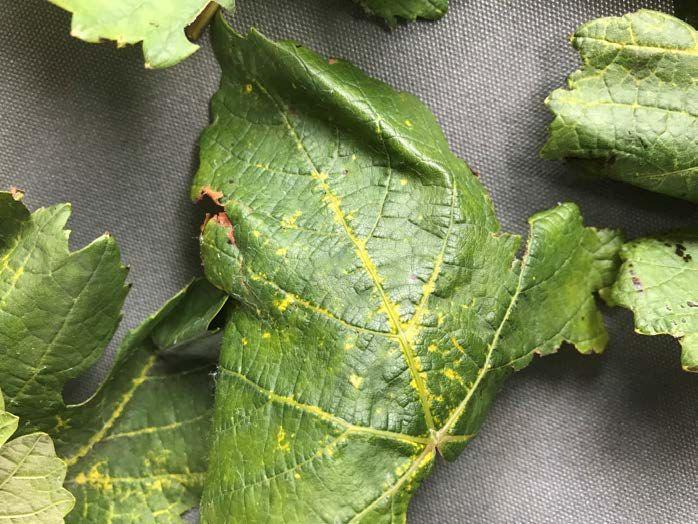
Fact Sheet
                                                                                                                     VITICULTURE

 How harmful is yellow speckle disease?
 No data are available on the effect of yellow speckle disease on vine vigour, yield and wine quality.
 One possible reason could be that so far, no viroid-free control vines have ever been found.
 Overall, grapevine viroids seem to have little economic impact on fruit yield and wine quality.

 Figure 1. Yellow speckle disease on Sultana clone H5 growing at the Alverstoke Orchard, Urrbrae, South Australia (photo courtesy of
 Tony Hoare)

 Figure 2. Yellow speckle disease on Pinot Noir clone Able (photo courtesy of Tony Hoare)

Updated February 2021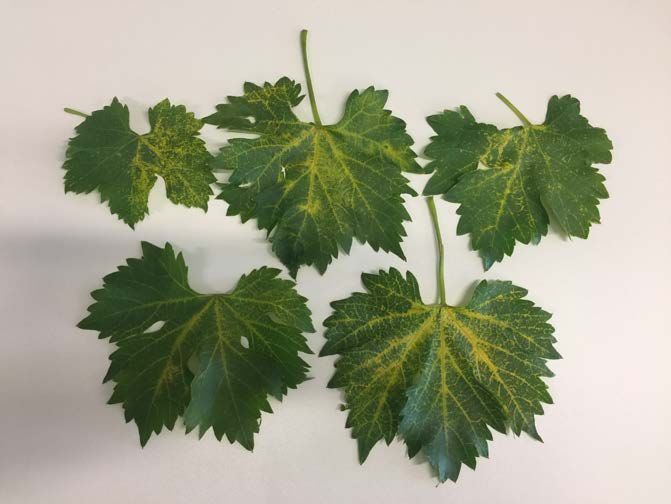
Fact Sheet
                                                                                              VITICULTURE

 References and further reading
 Habili, N. 2017. Apscaviroids infecting grapevines. Hadidi, A., Flores, R., Randles, J., Palukaitis, P.
 (eds.) Viroids and Satellites Cambridge, MA, USA: Academic Press: 251-262.

 Habili, N., Yazarlou, A., Randles, J. W. 2012. First report on the detection of grapevine virus and
 viroid RNA in bottled wines. Proceedings of the 17th Congress of the International Council for the Study
 of Virus and Virus-like Diseases of the Grapevine (ICVG), Davis, California, USA, October 7-14, 2012,
 120–121.

 Salman, T. M. Habili, N., Shi, B. J. 2014. Effect of temperature on symptom expression and
 sequence polymorphism of Grapevine yellow speckle viroid 1 in grapevine. Virus Res. 189: 243-
 247.

 Taylor, R.H., Woodham, R.C. 1972. Grapevine yellow speckle – a newly recognized graft
 transmissible disease of Vitis. Aust. J. Agric. Res. 23: 447-452.

 Woodham, R. C., Krake, L. R. 1982. Grapevine yellow speckle disease – studies on natural spread
 observed in the field. Vitis 21: 337-345.

 Zhang Z, Cui X, Jiang J, Xiao H, Wang H, Wu Q, Habili N, Li S. 2018. Improved detection of grapevine
 latent viroid by RT-qPCR, its bioassay analysis, and its rare occurrence worldwide. J. Virol. Meth.
 254: 13-17.

 Acknowledgement
 This work was supported by Australia's grapegrowers and winemakers through their investment
 body Wine Australia, with matching funds from the Australian Government. The AWRI is a
 member of the Wine Innovation Cluster.

 Contact
 For further information, please contact: AWRI helpdesk

 Phone 08 8313 6600 Fax 08 8313 6601 Email helpdesk@awri.com.au

 Website www.awri.com.au

 Address Wine Innovation Central Building, Corner of Hartley Grove & Paratoo Rd, Urrbrae
 (Adelaide), SA 5064

Updated February 2021
You can also read


